Chapter 9
Impulse and Momentum
• How do I define momentum?


• How do I determine the impulse given to an object?


• How do I define the angular momentum of an object?
Newton’s Second Law
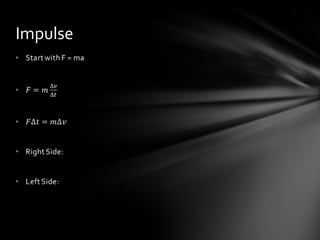
• F = ma


• Dropping a book


• Does the F = ma help us?


• Hitting a ball?
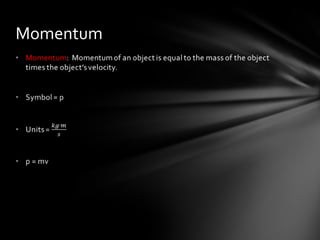
Momentum
Momentum
http://www.youtube.com/watch?v=y2Gb4NIv0Xg
Impulse
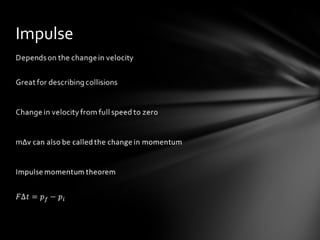
Impulse
Impulse and Momentum
• If the force on an object is constant, the impulse is the product of the
  force multiplied by the time interval over which it acts


• Because velocity is a vector, momentum is also a vector


• Similarly, impulse is a vector because force is a vector


• This means signs will be important for motion in one dimension
Baseball Being Hit
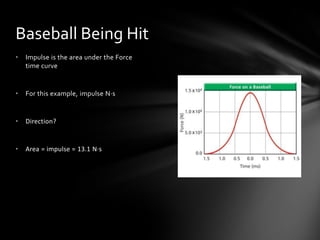
•   Impulse is the area under the Force
    time curve


•   For this example, impulse N·s


•   Direction?


•   Area = impulse = 13.1 N·s
After the ball has been hit?
m = 0.145 kg
v = -38 m/s
Impulse = 13.1 N·s
Final momentum?
Final speed?
Example
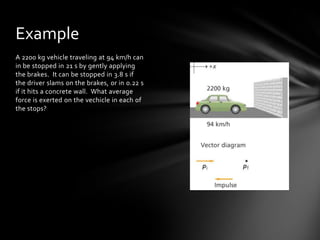
A 2200 kg vehicle traveling at 94 km/h can
in be stopped in 21 s by gently applying
the brakes. It can be stopped in 3.8 s if
the driver slams on the brakes, or in 0.22 s
if it hits a concrete wall. What average
force is exerted on the vechicle in each of
the stops?
Applications
• What happens to the driver when a crash suddenly stops a car?


• An impulse is needed to bring the drivers momentum to zero


• A large change in momentum occurs only when there is a large impulse


• A large impulse can result either from a large force acting over a short
  period of time or from a smaller force acting over a long period of time


• Air bag


• Bending legs when you jump
Angular Momentum
• We can also talk about momentum for angular motion


• Angular velocity only changes if a torque is applied


• Spinning?
Homework
Read Section 9.1
Do Problems # 1 – 9, starting page 233
Car Crashes
Egg Drop
Homework
Page 251, # 56 - 66

Notes 9.1

  • 1.
  • 2.
    Impulse and Momentum •How do I define momentum? • How do I determine the impulse given to an object? • How do I define the angular momentum of an object?
  • 3.
    Newton’s Second Law •F = ma • Dropping a book • Does the F = ma help us? • Hitting a ball?
  • 4.
  • 5.
  • 6.
  • 7.
  • 8.
    Impulse and Momentum •If the force on an object is constant, the impulse is the product of the force multiplied by the time interval over which it acts • Because velocity is a vector, momentum is also a vector • Similarly, impulse is a vector because force is a vector • This means signs will be important for motion in one dimension
  • 9.
    Baseball Being Hit • Impulse is the area under the Force time curve • For this example, impulse N·s • Direction? • Area = impulse = 13.1 N·s
  • 10.
    After the ballhas been hit? m = 0.145 kg v = -38 m/s Impulse = 13.1 N·s Final momentum? Final speed?
  • 11.
    Example A 2200 kgvehicle traveling at 94 km/h can in be stopped in 21 s by gently applying the brakes. It can be stopped in 3.8 s if the driver slams on the brakes, or in 0.22 s if it hits a concrete wall. What average force is exerted on the vechicle in each of the stops?
  • 12.
    Applications • What happensto the driver when a crash suddenly stops a car? • An impulse is needed to bring the drivers momentum to zero • A large change in momentum occurs only when there is a large impulse • A large impulse can result either from a large force acting over a short period of time or from a smaller force acting over a long period of time • Air bag • Bending legs when you jump
  • 13.
    Angular Momentum • Wecan also talk about momentum for angular motion • Angular velocity only changes if a torque is applied • Spinning?
  • 14.
    Homework Read Section 9.1 DoProblems # 1 – 9, starting page 233
  • 15.
  • 16.
  • 17.