Impulse and Momentum

Work & Energy                                 Impulse & Momentum
• Scalar equation.                            • Vector equation.
• The concept of work relates force to        • The concept of impulse relates force to time.
displacement.
• Greater force or greater displacement is    • Greater force or greater time of action is
associated with more work done.               associated with more impulse applied.
• More work done changes the motion of a      • More impulse changes the motion of a system
system to a greater degree.                   to a greater degree.
• That which is changed is called kinetic     • That which is changed is called momentum.
energy.                                       Impulse & Momentum
Work & Energy


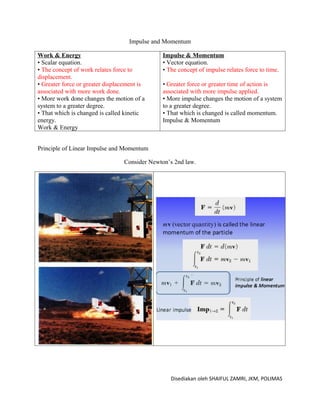
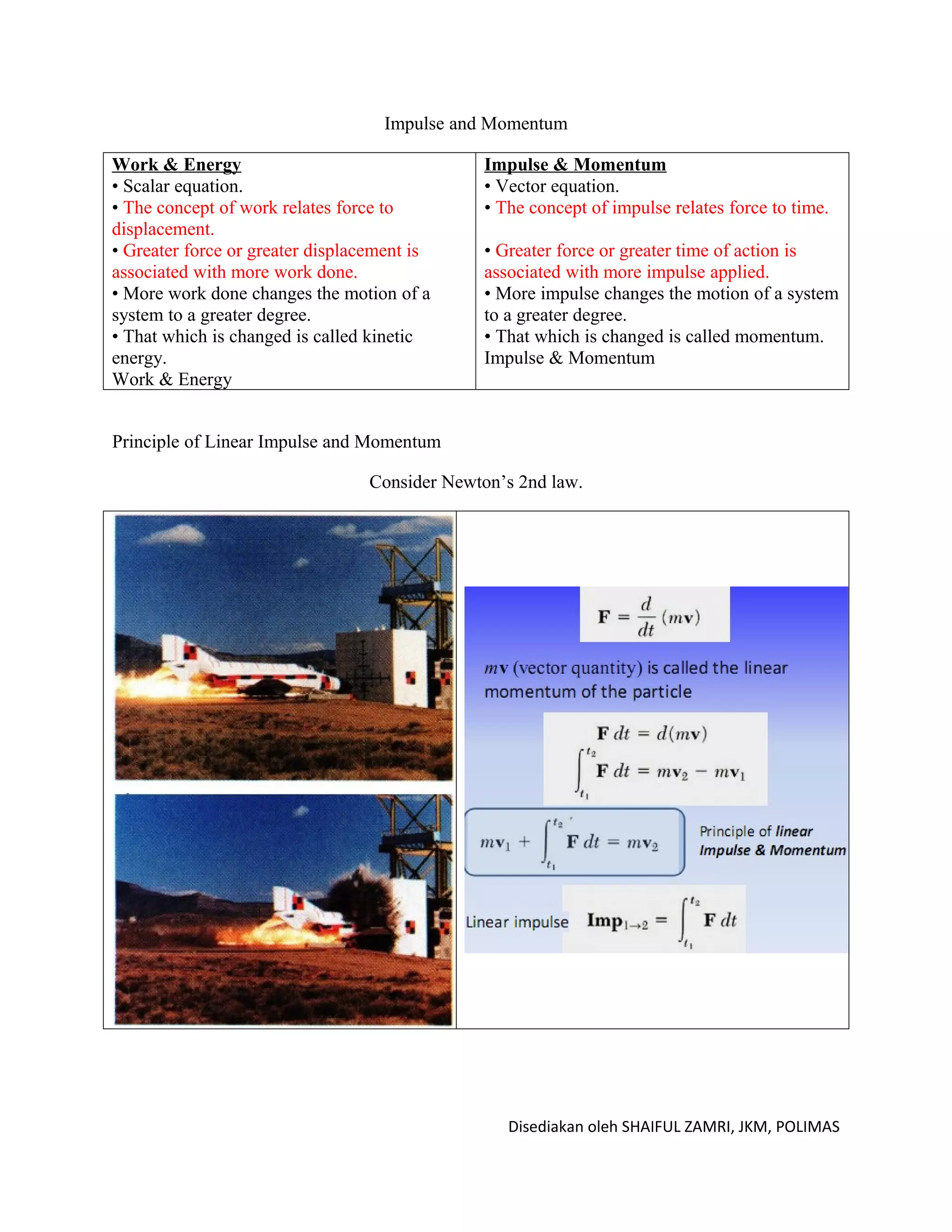
Principle of Linear Impulse and Momentum

                                 Consider Newton’s 2nd law.


                                                 Disediakan oleh SHAIFUL ZAMRI, JKM, POLIMAS
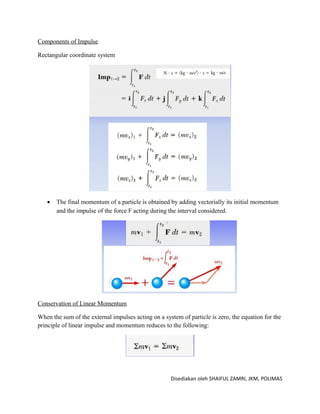
Components of Impulse

Rectangular coordinate system


   •   The final momentum of a particle is obtained by adding vectorially its initial momentum
       and the impulse of the force F acting during the interval considered.


Conservation of Linear Momentum

When the sum of the external impulses acting on a system of particle is zero, the equation for the
principle of linear impulse and momentum reduces to the following:


                                                     Disediakan oleh SHAIFUL ZAMRI, JKM, POLIMAS
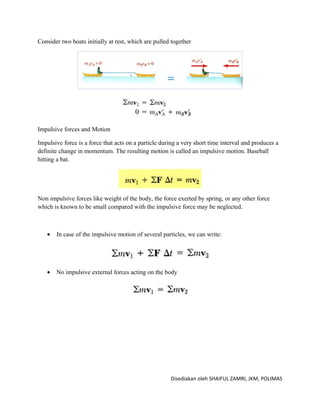
Consider two boats initially at rest, which are pulled together


Impulsive forces and Motion

Impulsive force is a force that acts on a particle during a very short time interval and produces a
definite change in momentum. The resulting motion is called an impulsive motion. Baseball
hitting a bat.


Non impulsive forces like weight of the body, the force exerted by spring, or any other force
which is known to be small compared with the impulsive force may be neglected.


   •   In case of the impulsive motion of several particles, we can write:


   •   No impulsive external forces acting on the body


                                                      Disediakan oleh SHAIFUL ZAMRI, JKM, POLIMAS
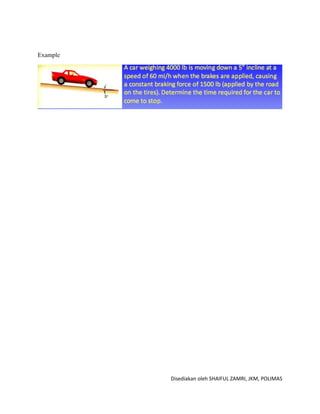
Example


          Disediakan oleh SHAIFUL ZAMRI, JKM, POLIMAS
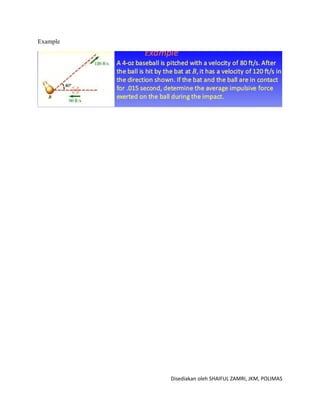
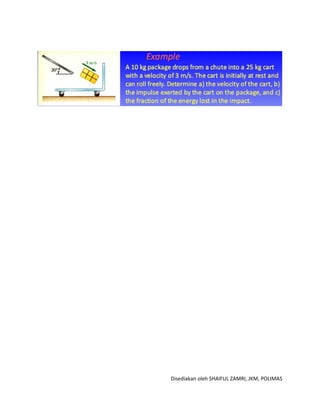
Example


          Disediakan oleh SHAIFUL ZAMRI, JKM, POLIMAS
Disediakan oleh SHAIFUL ZAMRI, JKM, POLIMAS
Impact

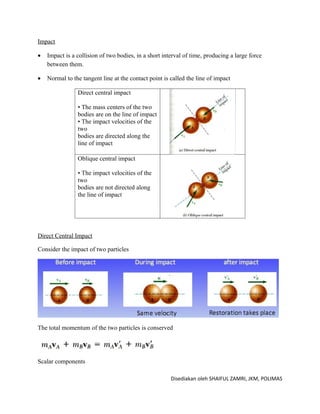
•   Impact is a collision of two bodies, in a short interval of time, producing a large force
    between them.

•   Normal to the tangent line at the contact point is called the line of impact

                Direct central impact

                • The mass centers of the two
                bodies are on the line of impact
                • The impact velocities of the
                two
                bodies are directed along the
                line of impact

                Oblique central impact

                • The impact velocities of the
                two
                bodies are not directed along
                the line of impact


Direct Central Impact

Consider the impact of two particles


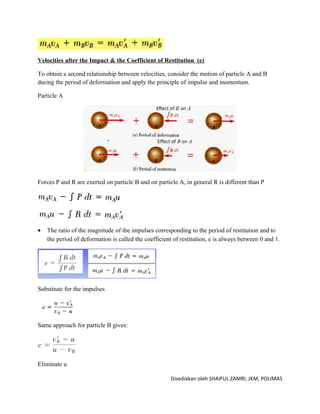
The total momentum of the two particles is conserved


Scalar components

                                                       Disediakan oleh SHAIFUL ZAMRI, JKM, POLIMAS
Velocities after the Impact & the Coefficient of Restitution (e)

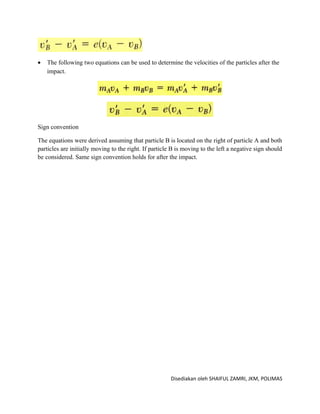
To obtain a second relationship between velocities, consider the motion of particle A and B
during the period of deformation and apply the principle of impulse and momentum.

Particle A


Forces P and R are exerted on particle B and on particle A, in general R is different than P


•   The ratio of the magnitude of the impulses corresponding to the period of restitution and to
    the period of deformation is called the coefficient of restitution, e is always between 0 and 1.


Substitute for the impulses


Same approach for particle B gives:


Eliminate u

                                                       Disediakan oleh SHAIFUL ZAMRI, JKM, POLIMAS
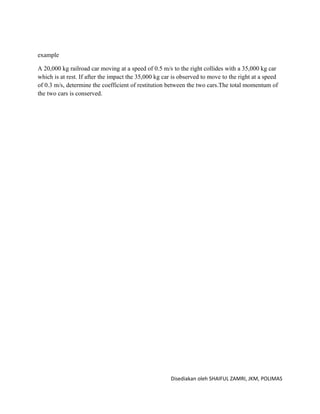
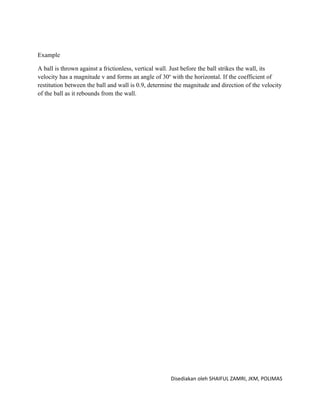
•   The following two equations can be used to determine the velocities of the particles after the
    impact.


Sign convention

The equations were derived assuming that particle B is located on the right of particle A and both
particles are initially moving to the right. If particle B is moving to the left a negative sign should
be considered. Same sign convention holds for after the impact.


                                                        Disediakan oleh SHAIFUL ZAMRI, JKM, POLIMAS
example

A 20,000 kg railroad car moving at a speed of 0.5 m/s to the right collides with a 35,000 kg car
which is at rest. If after the impact the 35,000 kg car is observed to move to the right at a speed
of 0.3 m/s, determine the coefficient of restitution between the two cars.The total momentum of
the two cars is conserved.


                                                      Disediakan oleh SHAIFUL ZAMRI, JKM, POLIMAS
Example

A ball is thrown against a frictionless, vertical wall. Just before the ball strikes the wall, its
velocity has a magnitude v and forms an angle of 30o with the horizontal. If the coefficient of
restitution between the ball and wall is 0.9, determine the magnitude and direction of the velocity
of the ball as it rebounds from the wall.


                                                      Disediakan oleh SHAIFUL ZAMRI, JKM, POLIMAS

Impulse and momentum student

  • 1.
    Impulse and Momentum Work& Energy Impulse & Momentum • Scalar equation. • Vector equation. • The concept of work relates force to • The concept of impulse relates force to time. displacement. • Greater force or greater displacement is • Greater force or greater time of action is associated with more work done. associated with more impulse applied. • More work done changes the motion of a • More impulse changes the motion of a system system to a greater degree. to a greater degree. • That which is changed is called kinetic • That which is changed is called momentum. energy. Impulse & Momentum Work & Energy Principle of Linear Impulse and Momentum Consider Newton’s 2nd law. Disediakan oleh SHAIFUL ZAMRI, JKM, POLIMAS
  • 2.
    Components of Impulse Rectangularcoordinate system • The final momentum of a particle is obtained by adding vectorially its initial momentum and the impulse of the force F acting during the interval considered. Conservation of Linear Momentum When the sum of the external impulses acting on a system of particle is zero, the equation for the principle of linear impulse and momentum reduces to the following: Disediakan oleh SHAIFUL ZAMRI, JKM, POLIMAS
  • 3.
    Consider two boatsinitially at rest, which are pulled together Impulsive forces and Motion Impulsive force is a force that acts on a particle during a very short time interval and produces a definite change in momentum. The resulting motion is called an impulsive motion. Baseball hitting a bat. Non impulsive forces like weight of the body, the force exerted by spring, or any other force which is known to be small compared with the impulsive force may be neglected. • In case of the impulsive motion of several particles, we can write: • No impulsive external forces acting on the body Disediakan oleh SHAIFUL ZAMRI, JKM, POLIMAS
  • 4.
    Example Disediakan oleh SHAIFUL ZAMRI, JKM, POLIMAS
  • 5.
    Example Disediakan oleh SHAIFUL ZAMRI, JKM, POLIMAS
  • 6.
    Disediakan oleh SHAIFULZAMRI, JKM, POLIMAS
  • 7.
    Impact • Impact is a collision of two bodies, in a short interval of time, producing a large force between them. • Normal to the tangent line at the contact point is called the line of impact Direct central impact • The mass centers of the two bodies are on the line of impact • The impact velocities of the two bodies are directed along the line of impact Oblique central impact • The impact velocities of the two bodies are not directed along the line of impact Direct Central Impact Consider the impact of two particles The total momentum of the two particles is conserved Scalar components Disediakan oleh SHAIFUL ZAMRI, JKM, POLIMAS
  • 8.
    Velocities after theImpact & the Coefficient of Restitution (e) To obtain a second relationship between velocities, consider the motion of particle A and B during the period of deformation and apply the principle of impulse and momentum. Particle A Forces P and R are exerted on particle B and on particle A, in general R is different than P • The ratio of the magnitude of the impulses corresponding to the period of restitution and to the period of deformation is called the coefficient of restitution, e is always between 0 and 1. Substitute for the impulses Same approach for particle B gives: Eliminate u Disediakan oleh SHAIFUL ZAMRI, JKM, POLIMAS
  • 9.
    The following two equations can be used to determine the velocities of the particles after the impact. Sign convention The equations were derived assuming that particle B is located on the right of particle A and both particles are initially moving to the right. If particle B is moving to the left a negative sign should be considered. Same sign convention holds for after the impact. Disediakan oleh SHAIFUL ZAMRI, JKM, POLIMAS
  • 10.
    example A 20,000 kgrailroad car moving at a speed of 0.5 m/s to the right collides with a 35,000 kg car which is at rest. If after the impact the 35,000 kg car is observed to move to the right at a speed of 0.3 m/s, determine the coefficient of restitution between the two cars.The total momentum of the two cars is conserved. Disediakan oleh SHAIFUL ZAMRI, JKM, POLIMAS
  • 11.
    Example A ball isthrown against a frictionless, vertical wall. Just before the ball strikes the wall, its velocity has a magnitude v and forms an angle of 30o with the horizontal. If the coefficient of restitution between the ball and wall is 0.9, determine the magnitude and direction of the velocity of the ball as it rebounds from the wall. Disediakan oleh SHAIFUL ZAMRI, JKM, POLIMAS