Impulse, collision and
Momentum
REGIE L. MAGALLANES, LPT, M.ED
Physics 121 - Instructor
Impulse
It is the multiplication of applied
force and time interval it applied.
Impulse is also a vector quantity
having both magnitude and
direction.
Impulse
It has the same direction with
applied net force.
Impulse = Force X Time Interval
Impulse
Impulse and momentum are directly
related to each other.
Impulse
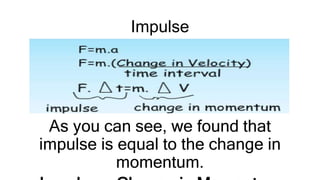
As you can see, we found that
impulse is equal to the change in
momentum.
Example
A 20 Kg mass is sitting on a frictionless
surface. An unknown constant force pushes
the mass for 5 seconds until the mass
reaches a velocity of 10 m/s.
A.What is the initial momentum of the mass?
B.What is the final momentum of the mass?
C.What was the force acting on the mass?
D.What was the impulse acting on the mass?
A. What is the initial momentum of the
mass?
Momentum is the mass times velocity. Since
the mass is at rest, the initial velocity is 0 m/s.
Momentum = m.v
= (50 Kg).(0m/s)
= 0kg.m/s
B. What is the final momentum of the
mass?
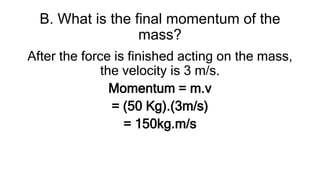
After the force is finished acting on the mass,
the velocity is 3 m/s.
Momentum = m.v
= (50 Kg).(3m/s)
= 150kg.m/s
c. What was the force acting on the
mass?
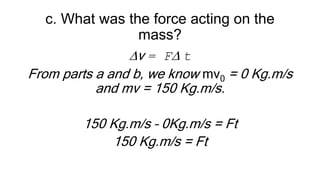
Dv = FD t
From parts a and b, we know mv0 = 0 Kg.m/s
and mv = 150 Kg.m/s.
150 Kg.m/s – 0Kg.m/s = Ft
150 Kg.m/s = Ft
c. What was the force acting on the
mass?
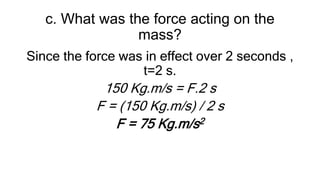
Since the force was in effect over 2 seconds ,
t=2 s.
150 Kg.m/s = F.2 s
F = (150 Kg.m/s) / 2 s
F = 75 Kg.m/s2
c. What was the force acting on the
mass?
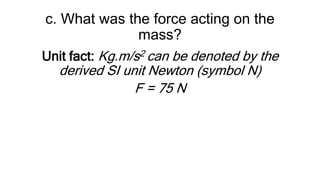
Unit fact: Kg.m/s2 can be denoted by the
derived SI unit Newton (symbol N)
F = 75 N
D. What was the impulse acting on the
mass?
The impulse is the force multiplied by the time
passed. It is also equal to the change in
momentum over the same time period.
Ft = 75 N . 2 s
Ft = 150 Ns or 150 kg.m/s
The impulse was 150 Ns.
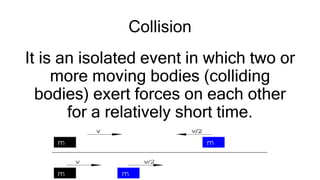
Collision
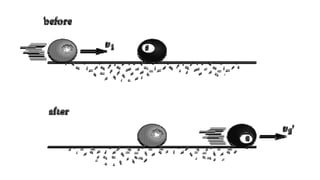
It is an isolated event in which two or
more moving bodies (colliding
bodies) exert forces on each other
for a relatively short time.
Collision
Although the most common
colloquial use of the word "collision"
refers to accidents in which two or
more objects collide, the scientific
use of the word "collision" implies
nothing about the magnitude of the
forces.
Collision
Collision is short duration interaction
between two bodies or more than
two bodies simultaneously causing
change in motion of bodies involved
due to internal forces acted between
them during this.
Collision
Collisions involve forces (there is a
change in velocity). The magnitude
of the velocity difference at impact is
called the closing speed. All
collisions conserve momentum.
Collision
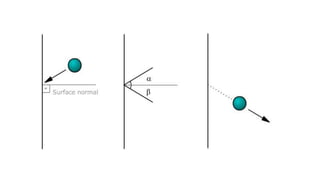
What distinguishes different types of
collisions is whether they also
conserve kinetic energy. Line of
impact is the line which is common
normal for surfaces are closest or in
contact during impact.
Collision
This is the line along which internal
force of collision acts during impact
and Newton's coefficient of
restitution is defined only along this
line.
Collision
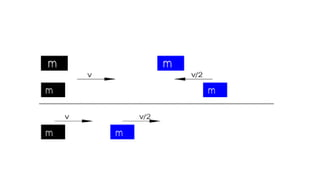
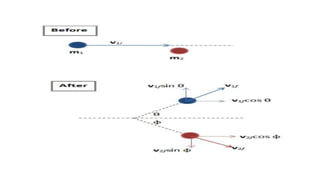
Specifically, collisions can either
be elastic, meaning, they conserve
both momentum and kinetic energy.
Elastic Collision
A perfectly elastic collision is defined
as one in which there is no loss
of kinetic energy in the collision.
Elastic Collision
In reality, any macroscopic collision
between objects will convert some
kinetic energy to internal energy and
other forms of energy, so no large
scale impacts are perfectly elastic.
Elastic Collision
However, some problems are
sufficiently close to perfectly elastic
that they can be approximated as
such. In this case, the coefficient of
restitution equals to one.
Elastic Collision
The molecules of
a gas or liquid rarely experience
perfectly elastic collisions because
kinetic energy is exchanged
between the molecules' translational
motion and their internal degrees of
freedom.
Inelastic Collision
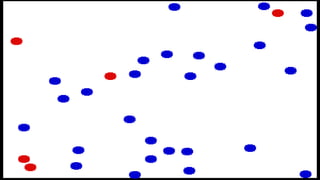
At any one instant, half the collisions are –
to a varying extent – inelastic (the pair
possesses less kinetic energy after the
collision than before), and half could be
described as “super-elastic”
(possessing more kinetic energy after the
collision than before). Averaged across an
entire sample, molecular collisions are
elastic.
Inelastic Collision
Inelastic collisions may not conserve
kinetic energy, but they do
obey conservation of momentum.
Inelastic Collision
Inelastic, meaning, they conserve
momentum but not kinetic energy.
An inelastic collision is sometimes
also called a plastic collision.
Inelastic Collision
An inelastic collision is one in which
part of the kinetic energy is changed
to some other form of energy in the
collision.
Inelastic Collision
Momentum is conserved in inelastic
collisions (as it is for elastic collisions),
but one cannot track the kinetic energy
through the collision since some of it is
converted to other forms of energy. In
this case, coefficient of restitution is not
equal to one.
COR
The coefficient of restitution (COR)
of two colliding objects is
a fractional value representing the
ratio of speeds after and before an
impact, taken along the line of the
impact.
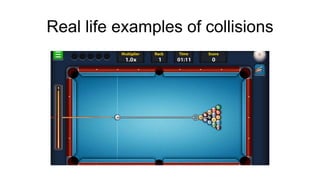
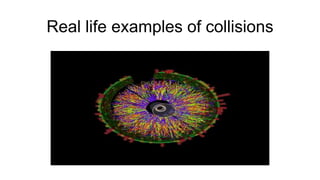
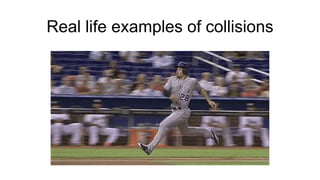
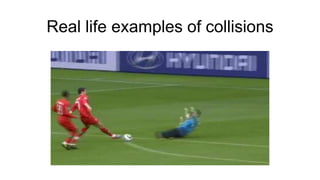
Real life examples of collisions
Momentum
Momentum is a fundamental
concept in physics that quantifies
the motion possessed by an object.
It is defined as the product of an
object's mass and velocity.
Components of Momentum
Momentum = mass × velocity
p = m x v
Units: kg m/s
Therefore, massive objects moving
at a high speed have a large
momentum
Two cases of Momentum
•A slow moving elephant has a large
momentum.
-Even though it has a small velocity, it has
a lot of mass.
•A bullet has a large momentum
-Even though it has a small mass, it has a
very large velocity.
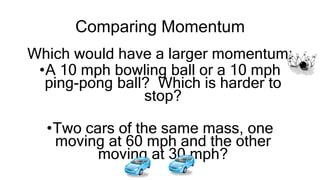
Comparing Momentum
Which would have a larger momentum:
•A 10 mph bowling ball or a 10 mph
ping-pong ball? Which is harder to
stop?
•Two cars of the same mass, one
moving at 60 mph and the other
moving at 30 mph?
Conservation of Momentum
• “The total momentum of any given
system will remain constant unless
acted upon by an external force.”
or
•The momentum before a collision is
equal to the momentum after a
collision.
Example
When a bullet is fired from a gun,
what happens?
Example
The bullet moves in the forward
direction and the gun kicks
backward. Before firing, the total
momentum of the system was zero.
Example
When the bullet is fired it gains some
momentum (due to velocity acquired by
it). In response, the gun moves in the
opposite direction such that its
momentum is equal in magnitude but
opposite in direction to the momentum
of the bullet.

Physics: Impulse, collision and Momentum

  • 1.
    Impulse, collision and Momentum REGIEL. MAGALLANES, LPT, M.ED Physics 121 - Instructor
  • 2.
    Impulse It is themultiplication of applied force and time interval it applied. Impulse is also a vector quantity having both magnitude and direction.
  • 3.
    Impulse It has thesame direction with applied net force. Impulse = Force X Time Interval
  • 4.
    Impulse Impulse and momentumare directly related to each other.
  • 5.
    Impulse As you cansee, we found that impulse is equal to the change in momentum.
  • 6.
    Example A 20 Kgmass is sitting on a frictionless surface. An unknown constant force pushes the mass for 5 seconds until the mass reaches a velocity of 10 m/s. A.What is the initial momentum of the mass? B.What is the final momentum of the mass? C.What was the force acting on the mass? D.What was the impulse acting on the mass?
  • 7.
    A. What isthe initial momentum of the mass? Momentum is the mass times velocity. Since the mass is at rest, the initial velocity is 0 m/s. Momentum = m.v = (50 Kg).(0m/s) = 0kg.m/s
  • 8.
    B. What isthe final momentum of the mass? After the force is finished acting on the mass, the velocity is 3 m/s. Momentum = m.v = (50 Kg).(3m/s) = 150kg.m/s
  • 9.
    c. What wasthe force acting on the mass? Dv = FD t From parts a and b, we know mv0 = 0 Kg.m/s and mv = 150 Kg.m/s. 150 Kg.m/s – 0Kg.m/s = Ft 150 Kg.m/s = Ft
  • 10.
    c. What wasthe force acting on the mass? Since the force was in effect over 2 seconds , t=2 s. 150 Kg.m/s = F.2 s F = (150 Kg.m/s) / 2 s F = 75 Kg.m/s2
  • 11.
    c. What wasthe force acting on the mass? Unit fact: Kg.m/s2 can be denoted by the derived SI unit Newton (symbol N) F = 75 N
  • 12.
    D. What wasthe impulse acting on the mass? The impulse is the force multiplied by the time passed. It is also equal to the change in momentum over the same time period. Ft = 75 N . 2 s Ft = 150 Ns or 150 kg.m/s The impulse was 150 Ns.
  • 13.
    Collision It is anisolated event in which two or more moving bodies (colliding bodies) exert forces on each other for a relatively short time.
  • 14.
    Collision Although the mostcommon colloquial use of the word "collision" refers to accidents in which two or more objects collide, the scientific use of the word "collision" implies nothing about the magnitude of the forces.
  • 16.
    Collision Collision is shortduration interaction between two bodies or more than two bodies simultaneously causing change in motion of bodies involved due to internal forces acted between them during this.
  • 17.
    Collision Collisions involve forces(there is a change in velocity). The magnitude of the velocity difference at impact is called the closing speed. All collisions conserve momentum.
  • 18.
    Collision What distinguishes differenttypes of collisions is whether they also conserve kinetic energy. Line of impact is the line which is common normal for surfaces are closest or in contact during impact.
  • 19.
    Collision This is theline along which internal force of collision acts during impact and Newton's coefficient of restitution is defined only along this line.
  • 22.
    Collision Specifically, collisions caneither be elastic, meaning, they conserve both momentum and kinetic energy.
  • 25.
    Elastic Collision A perfectlyelastic collision is defined as one in which there is no loss of kinetic energy in the collision.
  • 26.
    Elastic Collision In reality,any macroscopic collision between objects will convert some kinetic energy to internal energy and other forms of energy, so no large scale impacts are perfectly elastic.
  • 27.
    Elastic Collision However, someproblems are sufficiently close to perfectly elastic that they can be approximated as such. In this case, the coefficient of restitution equals to one.
  • 28.
    Elastic Collision The moleculesof a gas or liquid rarely experience perfectly elastic collisions because kinetic energy is exchanged between the molecules' translational motion and their internal degrees of freedom.
  • 29.
    Inelastic Collision At anyone instant, half the collisions are – to a varying extent – inelastic (the pair possesses less kinetic energy after the collision than before), and half could be described as “super-elastic” (possessing more kinetic energy after the collision than before). Averaged across an entire sample, molecular collisions are elastic.
  • 30.
    Inelastic Collision Inelastic collisionsmay not conserve kinetic energy, but they do obey conservation of momentum.
  • 32.
    Inelastic Collision Inelastic, meaning,they conserve momentum but not kinetic energy. An inelastic collision is sometimes also called a plastic collision.
  • 33.
    Inelastic Collision An inelasticcollision is one in which part of the kinetic energy is changed to some other form of energy in the collision.
  • 34.
    Inelastic Collision Momentum isconserved in inelastic collisions (as it is for elastic collisions), but one cannot track the kinetic energy through the collision since some of it is converted to other forms of energy. In this case, coefficient of restitution is not equal to one.
  • 35.
    COR The coefficient ofrestitution (COR) of two colliding objects is a fractional value representing the ratio of speeds after and before an impact, taken along the line of the impact.
  • 36.
    Real life examplesof collisions
  • 37.
    Real life examplesof collisions
  • 38.
    Real life examplesof collisions
  • 39.
    Real life examplesof collisions
  • 40.
    Real life examplesof collisions
  • 41.
    Momentum Momentum is afundamental concept in physics that quantifies the motion possessed by an object. It is defined as the product of an object's mass and velocity.
  • 42.
    Components of Momentum Momentum= mass × velocity p = m x v Units: kg m/s Therefore, massive objects moving at a high speed have a large momentum
  • 43.
    Two cases ofMomentum •A slow moving elephant has a large momentum. -Even though it has a small velocity, it has a lot of mass. •A bullet has a large momentum -Even though it has a small mass, it has a very large velocity.
  • 44.
    Comparing Momentum Which wouldhave a larger momentum: •A 10 mph bowling ball or a 10 mph ping-pong ball? Which is harder to stop? •Two cars of the same mass, one moving at 60 mph and the other moving at 30 mph?
  • 45.
    Conservation of Momentum •“The total momentum of any given system will remain constant unless acted upon by an external force.” or •The momentum before a collision is equal to the momentum after a collision.
  • 46.
    Example When a bulletis fired from a gun, what happens?
  • 47.
    Example The bullet movesin the forward direction and the gun kicks backward. Before firing, the total momentum of the system was zero.
  • 48.
    Example When the bulletis fired it gains some momentum (due to velocity acquired by it). In response, the gun moves in the opposite direction such that its momentum is equal in magnitude but opposite in direction to the momentum of the bullet.

Editor's Notes

  • #2 Explaining the Causes of Motion in a Different Way.
  • #39 Here a few example showing the involvement of collisions in Soccer. The forces exerted by the players have been resolved into component vectors for convenience.
  • #41 CLLISIONS AT THE SUBATOMIC SCALE This is how collisions helped us make breakthroughs in atomic research……