• For this lesson,
we will know the
definition of
Impulse and
Momentum.
• In this lesson,
you can learn how
to solve regards
with impulse and
momentum.
• We will discuss
about the
conservation of
linear
momentum.
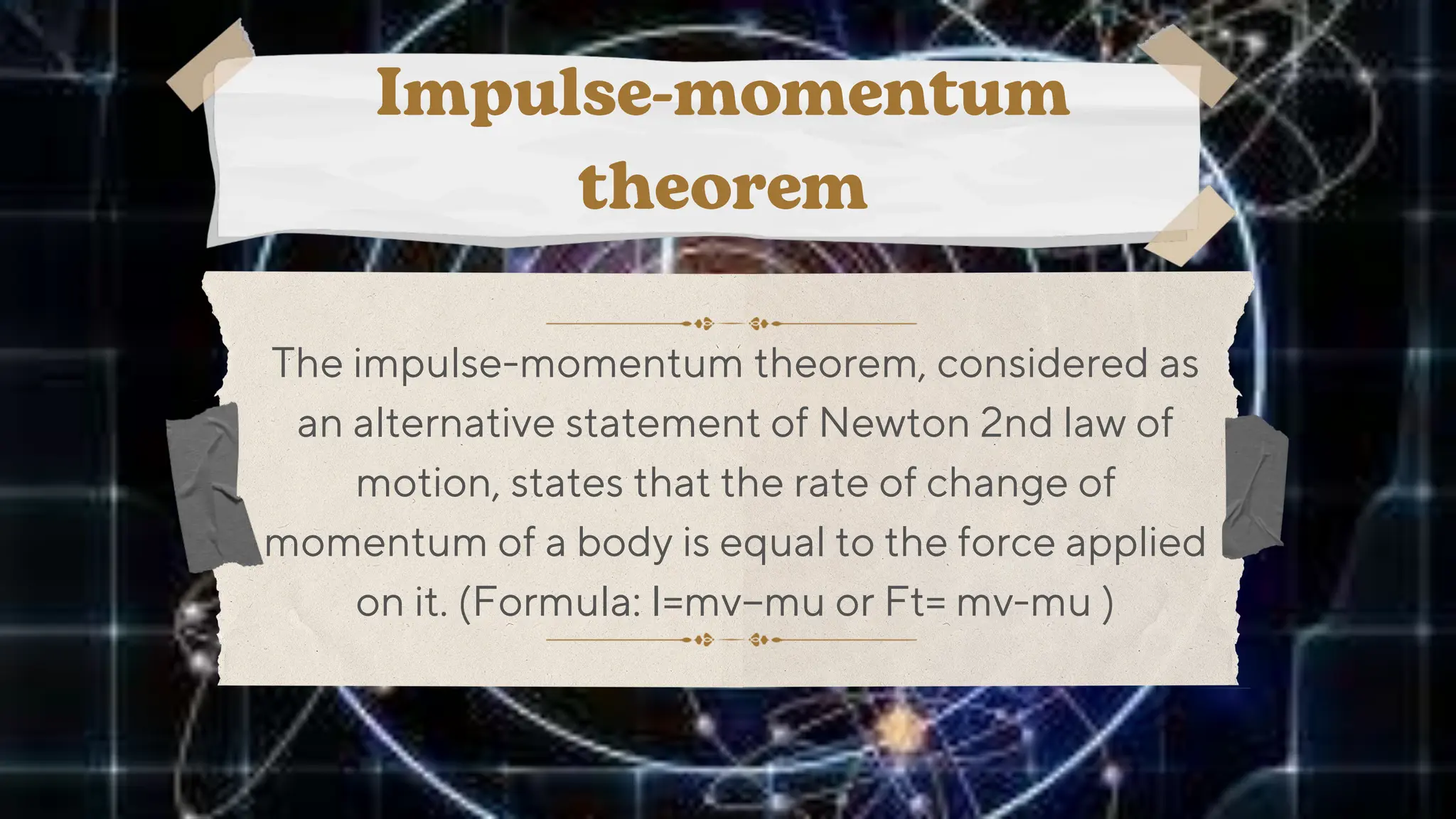
The impulse-momentum theorem, considered as
an alternative statement of Newton 2nd law of
motion, states that the rate of change of
momentum of a body is equal to the force applied
on it. (Formula: I=mv−mu or Ft= mv-mu )
• Is a vector quantity, with the same direction as the
direction of velocity.
• Momentum can be defined as "mass in motion" All
objects have mass; so if an object is moving, then it has
its mass in motion.
• Is the product of mass (m) of the object and its velocity
(v).
Momentum
Impulse
is defined as the product force acting on an
object and the time during which the force
acts, which means impulse is the change in
momentum. Impulse is a vector quantity
and has the same direction as the average
force.
• Impulse is N•s
• Momentum is kg•m/s
• Impulse= F∆t
• Momentum: a) p=mv-mu
b) F∆t=mv-mu
Hypervelocity bullets used in 0.22
long rifle usually weigh around 2.1 g
and can have a speed of 550 m/s.
What must the speed of a 75 kg man
to match the momentum of its
bullet?
A neophyte player catches a 125 g ball
moving at 25.0 m/s in 0.02 s. A
proffesional player catches the same ball
in 1.0 s by slightly retracting his hand
during the catch. Find the forces exerted
by the ball on the hands of the two players.
Conversion of Impulse Momentum: The
principle of conservation of momentum states
that if two objects collide, then the total
momentum before and after the collision will
be the same if there is no external force acting
on the colliding objects.
o Internal forces – the forces that the
particles of a system exert on one another.
o External forces – forces exerted on any
part of the system by other objects outside
the system.
Internal and External Forces
A person standing on a skateboard.
When the person pushes off the
ground in one direction, the
skateboard moves in the opposite
direction, demonstrating the
conservation of momentum.
A person stepping from a small boat onto a
dock. As the person moves toward the dock,
the boat moves away. Again, the total
momentum of the system (person + boat)
remains constant, but the distribution of
momentum changes, leading to the observed
motion.
This is also applicable in rocket propulsion.
When a rocket is fired, the expelled exhaust
gases move downward at high speed. The
downward momentum of the gases is equal
and opposite to the upward momentum of
the rocket, resulting in balanced forces.
This upward force exerted by the
gases is known as thrust. The
relationship between force, time, and
momentum change is described by
the impulse-momentum theorem.
A 50.0 kg student uses an improvised 75 kg raft in order to cross a
heavily flooded street. He noticed that as he jumps to the sidewalk
opposite the street with a speed of 1.5 m/s relative to the flood, the
raft moves away. With what the speed will the raft move relative to
flood? Assume that the raft is stationary before the student jumps to
the sidewalk. Neglect the fluid friction.
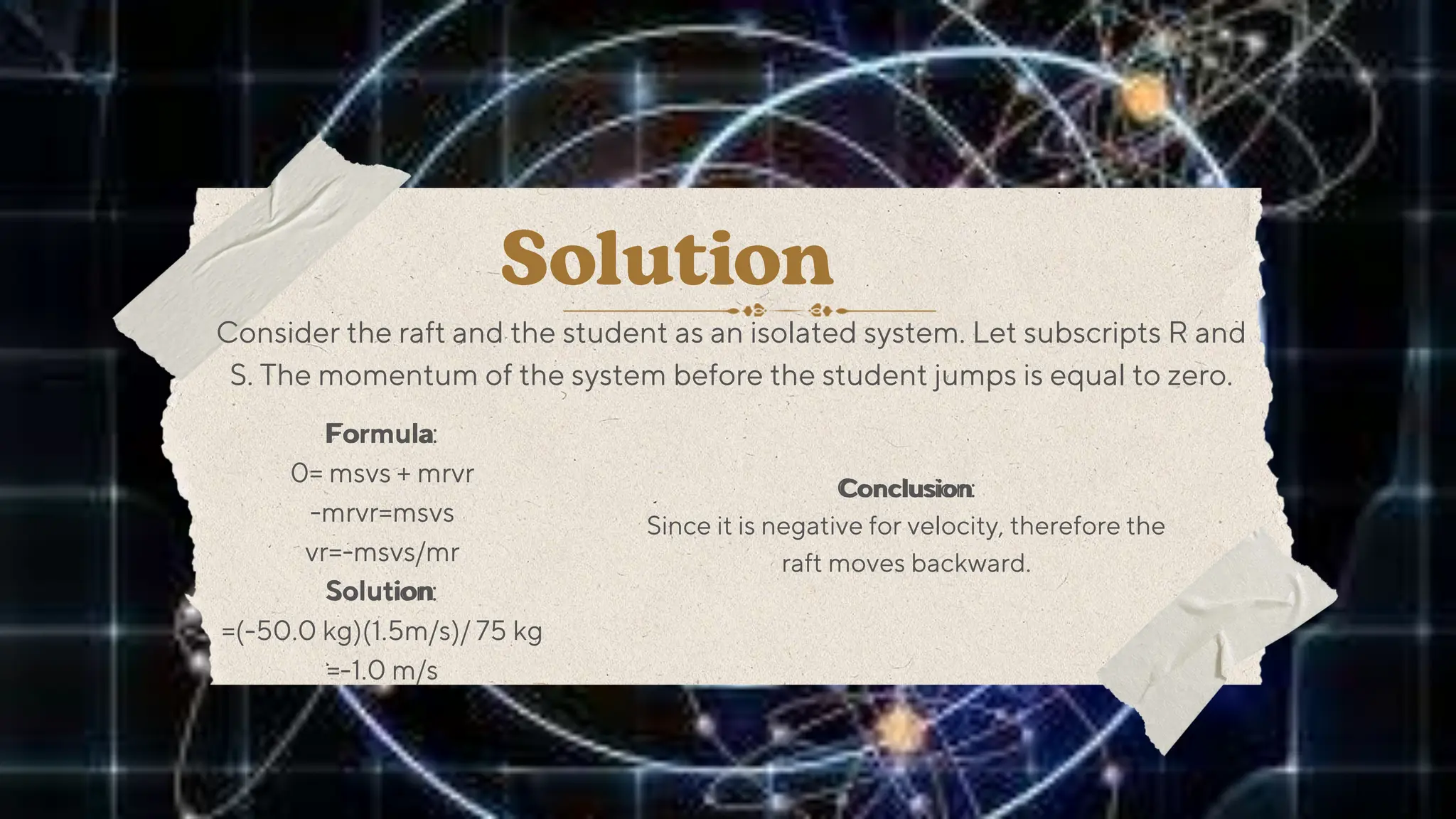
Consider the raft and the student as an isolated system. Let subscripts R and
S. The momentum of the system before the student jumps is equal to zero.
Formula:
0= msvs + mrvr
-mrvr=msvs
vr=-msvs/mr
Solution:
=(-50.0 kg)(1.5m/s)/ 75 kg
=-1.0 m/s
Formula
Solution
Conclusion:
Since it is negative for velocity, therefore the
raft moves backward.
Conclusion
A child accidentally dropped a 0.250 kg plate to the floor.
The plate broke into 3 pieces: a 0.125 kg piece moves in the
+y direction with a speed of 1.2 m/s and a 0.053 kg piece in
the +x direction at a speed of 1.6 m/s. Find (a) the mass of
the third piece and (b) the horizontal and vertical
components of its velocity.
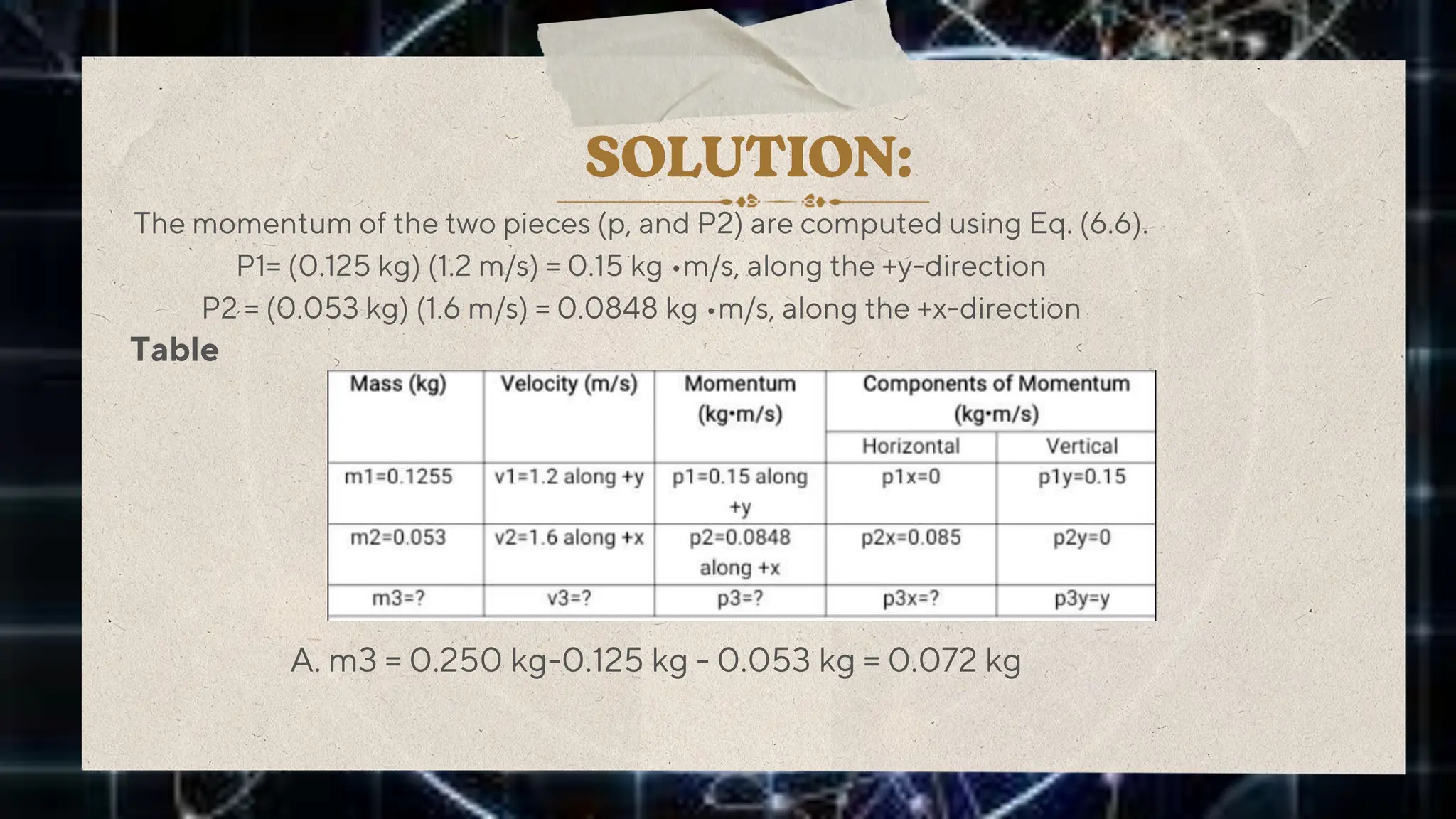
The momentum of the two pieces (p, and P2) are computed using Eq. (6.6).
P1= (0.125 kg) (1.2 m/s) = 0.15 kg •m/s, along the +y-direction
P2 = (0.053 kg) (1.6 m/s) = 0.0848 kg •m/s, along the +x-direction
Table
A. m3 = 0.250 kg-0.125 kg - 0.053 kg = 0.072 kg
B. To determine the horizontal (v,*) and vertical (Vy) components of the velocity of the third
piece, apply the conservation of momentum for the horizontal and vertical momenta. Since
the plate has no horizontal motion as it falls on the floor, there is no horizontal momentum
before the interaction. The conservation of horizontal momentum gives
0 = 0.085 kg •m/s + P3x
P3x = - 0.085 kg • m/s.
Therefore, V3x = -0.085 kg • m/s / 0.072kg
= -1.181 m/s ~ -1.2 m/s.
The conservation of vertical momentum gives
0=0.15 kg •m/s + p3y
P3y = -0.15 kg• m/s
V3y = -0.15 kg • m/s / 0.072 kg
= -2.083 m/s ~ -2.1 m/s.A. m3 = 0.250 kg-0.125 kg - 0.053 kg = 0.072 kg
IMPULSE-AND-MOMENTUM-PHYSICS-PRESENTATION.pptx

IMPULSE-AND-MOMENTUM-PHYSICS-PRESENTATION.pptx

  • 2.
    • For thislesson, we will know the definition of Impulse and Momentum. • In this lesson, you can learn how to solve regards with impulse and momentum. • We will discuss about the conservation of linear momentum.
  • 3.
    The impulse-momentum theorem,considered as an alternative statement of Newton 2nd law of motion, states that the rate of change of momentum of a body is equal to the force applied on it. (Formula: I=mv−mu or Ft= mv-mu )
  • 4.
    • Is avector quantity, with the same direction as the direction of velocity. • Momentum can be defined as "mass in motion" All objects have mass; so if an object is moving, then it has its mass in motion. • Is the product of mass (m) of the object and its velocity (v). Momentum
  • 5.
    Impulse is defined asthe product force acting on an object and the time during which the force acts, which means impulse is the change in momentum. Impulse is a vector quantity and has the same direction as the average force.
  • 6.
    • Impulse isN•s • Momentum is kg•m/s
  • 7.
    • Impulse= F∆t •Momentum: a) p=mv-mu b) F∆t=mv-mu
  • 9.
    Hypervelocity bullets usedin 0.22 long rifle usually weigh around 2.1 g and can have a speed of 550 m/s. What must the speed of a 75 kg man to match the momentum of its bullet?
  • 10.
    A neophyte playercatches a 125 g ball moving at 25.0 m/s in 0.02 s. A proffesional player catches the same ball in 1.0 s by slightly retracting his hand during the catch. Find the forces exerted by the ball on the hands of the two players.
  • 11.
    Conversion of ImpulseMomentum: The principle of conservation of momentum states that if two objects collide, then the total momentum before and after the collision will be the same if there is no external force acting on the colliding objects.
  • 12.
    o Internal forces– the forces that the particles of a system exert on one another. o External forces – forces exerted on any part of the system by other objects outside the system. Internal and External Forces
  • 13.
    A person standingon a skateboard. When the person pushes off the ground in one direction, the skateboard moves in the opposite direction, demonstrating the conservation of momentum.
  • 14.
    A person steppingfrom a small boat onto a dock. As the person moves toward the dock, the boat moves away. Again, the total momentum of the system (person + boat) remains constant, but the distribution of momentum changes, leading to the observed motion.
  • 15.
    This is alsoapplicable in rocket propulsion. When a rocket is fired, the expelled exhaust gases move downward at high speed. The downward momentum of the gases is equal and opposite to the upward momentum of the rocket, resulting in balanced forces.
  • 16.
    This upward forceexerted by the gases is known as thrust. The relationship between force, time, and momentum change is described by the impulse-momentum theorem.
  • 18.
    A 50.0 kgstudent uses an improvised 75 kg raft in order to cross a heavily flooded street. He noticed that as he jumps to the sidewalk opposite the street with a speed of 1.5 m/s relative to the flood, the raft moves away. With what the speed will the raft move relative to flood? Assume that the raft is stationary before the student jumps to the sidewalk. Neglect the fluid friction.
  • 19.
    Consider the raftand the student as an isolated system. Let subscripts R and S. The momentum of the system before the student jumps is equal to zero. Formula: 0= msvs + mrvr -mrvr=msvs vr=-msvs/mr Solution: =(-50.0 kg)(1.5m/s)/ 75 kg =-1.0 m/s Formula Solution Conclusion: Since it is negative for velocity, therefore the raft moves backward. Conclusion
  • 20.
    A child accidentallydropped a 0.250 kg plate to the floor. The plate broke into 3 pieces: a 0.125 kg piece moves in the +y direction with a speed of 1.2 m/s and a 0.053 kg piece in the +x direction at a speed of 1.6 m/s. Find (a) the mass of the third piece and (b) the horizontal and vertical components of its velocity.
  • 22.
    The momentum ofthe two pieces (p, and P2) are computed using Eq. (6.6). P1= (0.125 kg) (1.2 m/s) = 0.15 kg •m/s, along the +y-direction P2 = (0.053 kg) (1.6 m/s) = 0.0848 kg •m/s, along the +x-direction Table A. m3 = 0.250 kg-0.125 kg - 0.053 kg = 0.072 kg
  • 23.
    B. To determinethe horizontal (v,*) and vertical (Vy) components of the velocity of the third piece, apply the conservation of momentum for the horizontal and vertical momenta. Since the plate has no horizontal motion as it falls on the floor, there is no horizontal momentum before the interaction. The conservation of horizontal momentum gives 0 = 0.085 kg •m/s + P3x P3x = - 0.085 kg • m/s. Therefore, V3x = -0.085 kg • m/s / 0.072kg = -1.181 m/s ~ -1.2 m/s. The conservation of vertical momentum gives 0=0.15 kg •m/s + p3y P3y = -0.15 kg• m/s V3y = -0.15 kg • m/s / 0.072 kg = -2.083 m/s ~ -2.1 m/s.A. m3 = 0.250 kg-0.125 kg - 0.053 kg = 0.072 kg