Learning
Objective
At the endof the lesson, the learners are
expected to:
a.Define and identify the factors that affects
momentum and impulse;
b.Relate impulse and momentum to collision of
objects (e.g., vehicular collision) [S9FE - IVb -36]
and;
c.Appreciate the importance of understanding
the causes and effects of collision-related
4.
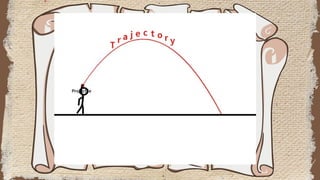
What will happento the ball if it
hits the board instead of inside
the ring?
- as +lo +
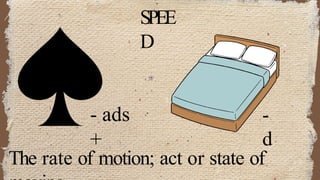
The rate of change of position along
a straight line with respect of time.
VELOCIT
Y
7.
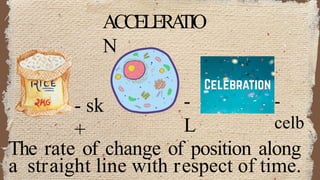
The rate ofchange of position along
a straight line with respect of time.
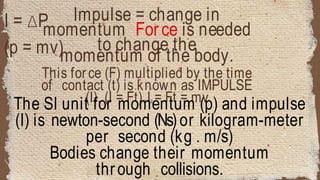
- sk
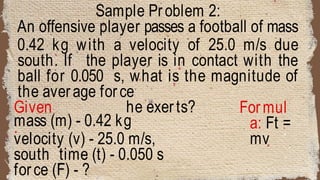
+
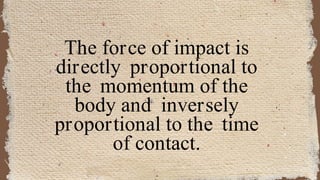
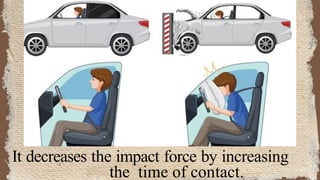
-
L
-
celb
ACCELERA
TIO
N
8.
MA
SS
- p +- gra
The property of a body that is a measure
of the amount of material it contains and
causes it to have weight in a gravitational
9.
-
ry
- my +-
g
MOMENTU
M
is a quantity that describes an
object's
resistance to stopping (a kind of
10.
- S
+
- L+ -
A
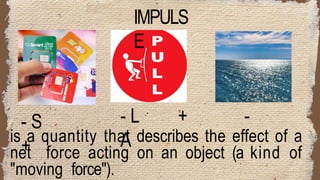
IMPULS
E
is a quantity that describes the effect of a
net force acting on an object (a kind of
"moving force").
11.
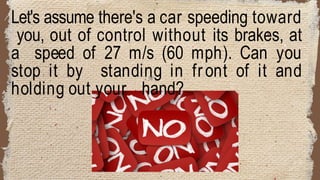
Let's assume there'sa car speeding toward
you, out of control without its brakes, at
a speed of 27 m/s (60 mph). Can you
stop it by standing in front of it and
holding out your hand?
12.
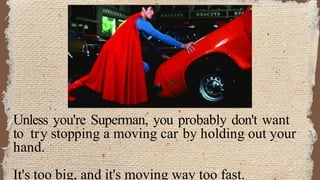
Unless you're Superman,you probably don't want
to try stopping a moving car by holding out your
hand.
It's too big, and it's moving way too fast.
13.
How about ifyou bumped to another
player bigger than you?
14.
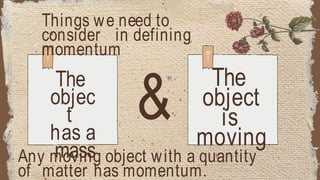
Things we needto
consider in defining
momentum
&
The
objec
t
has a
mass
The
object
is
moving
Any moving object with a quantity
of matter has momentum.
15.
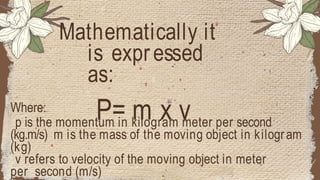
Where:
p is themomentum in kilogram meter per second
(kg.m/s) m is the mass of the moving object in kilogram
(kg)
v refers to velocity of the moving object in meter
per second (m/s)
Mathematically it
is expressed
as:
P= m x v
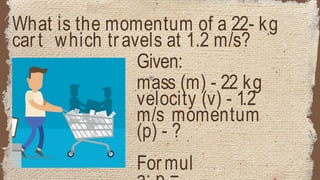
16.
What is themomentum of a 22- kg
cart which travels at 1.2 m/s?
Given:
mass (m) - 22 kg
velocity (v) - 1.2
m/s momentum
(p) - ?
Formul
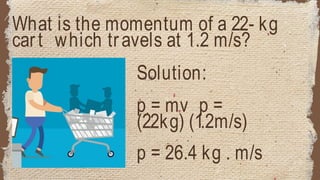
17.
What is themomentum of a 22- kg
cart which travels at 1.2 m/s?
Solution:
p = mv p =
(22kg) (1.2m/s)
p = 26.4 kg . m/s
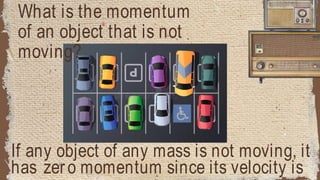
18.
What is themomentum
of an object that is not
moving?
If any object of any mass is not moving, it
has zero momentum since its velocity is
19.
What do youthink will happen to the
bus after if it passes along a curvy
road?
a.It will slow down
b.It will speed up
c.Its velocity will speed up
What can you
sayabout the
mass of the
bus?
a.It increases
b.It decreases
c.It does not
change at
22.
When the objectslows down or
moves faster, its velocity
decreases or increases. If there
is a change in the velocity or
the mass of an object, there is
also a change in momentum.
And that change in
momentum is called IMPULSE.
23.
Impulse = changein
momentum Force is needed
to change the
momentum of the body.
This force (F) multiplied by the time
of contact (t) is known as IMPULSE
(I). (I = Ft) I = Ft = mv
I = ΔP
(p = mv)
The SI unit for momentum (p) and impulse
(I) is newton-second (Ns)or kilogram-meter
per second (kg . m/s)
Bodies change their momentum
through collisions.
24.
Sample Problem 2:
Anoffensive player passes a football of mass
0.42 kg with a velocity of 25.0 m/s due
south. If the player is in contact with the
ball for 0.050 s, what is the magnitude of
the average force
he exerts?
Given
:
Formul
a: Ft =
mv
mass (m) - 0.42 kg
velocity (v) - 25.0 m/s,
south time (t) - 0.050 s
force (F) - ?
25.
The force ofimpact is
directly proportional to
the momentum of the
body and inversely
proportional to the time
of contact.
What do youthink is the impulse of
an object moving with constant
momentum? constant - no change
There is no impulse or zero impulse
for objects moving with constant
momentum.
29.
Any moving objecthas
momentum
p = mv
Impulse is the change
in
momentum of a
moving object.
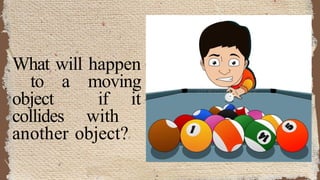
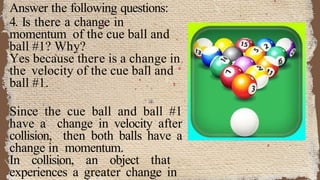
Scenario #1:
Suppose you
areplaying
billiard. The cue
ball and ball
#1 are initially
at rest. Then
you use the tako
to hit ball #1.
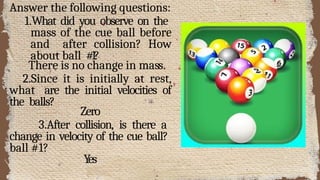
32.
Answer the followingquestions:
1.What did you observe on the
mass of the cue ball before
and after collision? How
about ball #1?
There is no change in mass.
2.Since it is initially at rest,
what are the initial velocities of
the balls?
Zero
3.After collision, is there a
change in velocity of the cue ball?
ball #1?
Yes
33.
Answer the followingquestions:
4. Is there a change in
momentum of the cue ball and
ball #1? Why?
Yes because there is a change in
the velocity of the cue ball and
ball #1.
Since the cue ball and ball #1
have a change in velocity after
collision, then both balls have a
change in momentum.
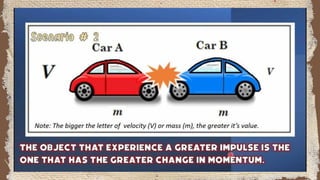
In collision, an object that
experiences a greater change in
34.
Therefore, this showsthe
relationship
between momentum and
impulse. A change in
momentum is equal to
impulse.
36.
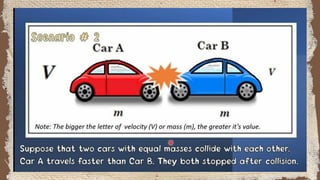
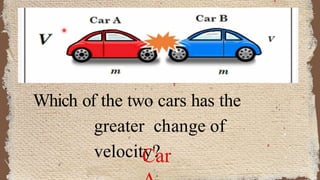
Which of thetwo cars has the
greater change of
velocity?
Car
37.
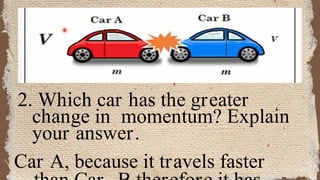
2. Which carhas the greater
change in momentum? Explain
your answer.
Car A, because it travels faster
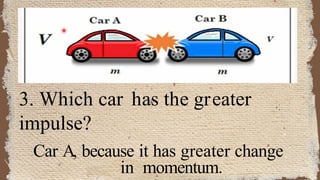
38.
3. Which carhas the greater
impulse?
Car A, because it has greater change
in momentum.
40.
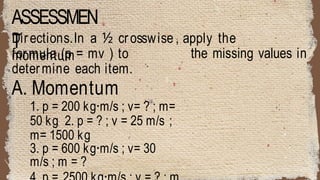
ASSESSMEN
T
Directions.In a ½crosswise , apply the
momentum the missing values in
formula (p = mv ) to
determine each item.
A. Momentum
1. p = 200 kg·m/s ; v= ? ; m=
50 kg 2. p = ? ; v = 25 m/s ;
m= 1500 kg
3. p = 600 kg·m/s ; v= 30
m/s ; m = ?
41.
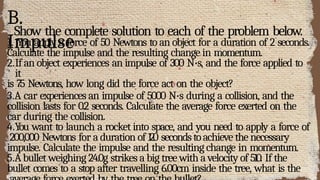
B.
Impulse
Show the completesolution to each of the problem below.
1. You apply a force of 50 Newtons to an object for a duration of 2 seconds.
Calculate the impulse and the resulting change in momentum.
2.If an object experiences an impulse of 300 N·s, and the force applied to
it
is 75 Newtons, how long did the force act on the object?
3.A car experiences an impulse of 5000 N·s during a collision, and the
collision lasts for 0.2 seconds. Calculate the average force exerted on the
car during the collision.
4.You want to launch a rocket into space, and you need to apply a force of
200,000 Newtons for a duration of 120 secondstoachieve the necessary
impulse. Calculate the impulse and the resulting change in momentum.
5.Abullet weighing 24.0g strikes a big tree with a velocity of 510. If the
bullet comes to a stop after travelling 6.00cm inside the tree, what is the
42.
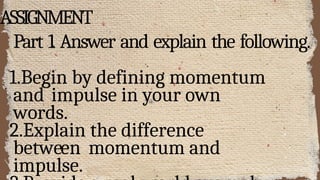
ASSIGNMENT
Part 1. Answerand explain the following.
1.Begin by defining momentum
and impulse in your own
words.
2.Explain the difference
between momentum and
impulse.
43.
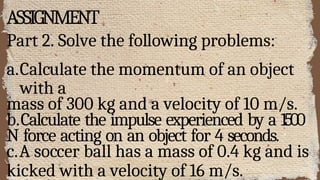
ASSIGNMENT
Part 2. Solvethe following problems:
a.Calculate the momentum of an object
with a
mass of 300 kg and a velocity of 10 m/s.
b.Calculate the impulse experienced by a 1500
N force acting on an object for 4 seconds.
c.A soccer ball has a mass of 0.4 kg and is
kicked with a velocity of 16 m/s.
44.
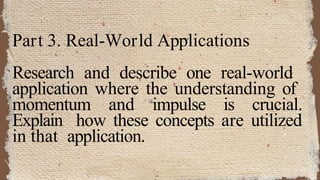
Part 3. Real-WorldApplications
Research and describe one real-world
application where the understanding of
momentum and impulse is crucial.
Explain how these concepts are utilized
in that application.
45.
Submission Guidelines
-Organize yourassignment neatly in
a document.
-Clearly label each part (Part 1, Part 2, Part
3).
-Show all calculations and provide explanations
where necessary.
- Include any additional resources or references
you used for research.
-Submit your assignment by [insert submission
method and deadline].


![Learning
Objective
At the end of the lesson, the learners are
expected to:
a.Define and identify the factors that affects
momentum and impulse;
b.Relate impulse and momentum to collision of
objects (e.g., vehicular collision) [S9FE - IVb -36]
and;
c.Appreciate the importance of understanding
the causes and effects of collision-related](https://image.slidesharecdn.com/momentumandimpulse-250817135218-d7f7f561/85/Momentum-and-Impulse-pptxxxxxxxxxxxxxxxxxxxxxxxxx-2-320.jpg)










![Submission Guidelines
-Organize your assignment neatly in
a document.
-Clearly label each part (Part 1, Part 2, Part
3).
-Show all calculations and provide explanations
where necessary.
- Include any additional resources or references
you used for research.
-Submit your assignment by [insert submission
method and deadline].](https://image.slidesharecdn.com/momentumandimpulse-250817135218-d7f7f561/85/Momentum-and-Impulse-pptxxxxxxxxxxxxxxxxxxxxxxxxx-45-320.jpg)


