Momentum (P)
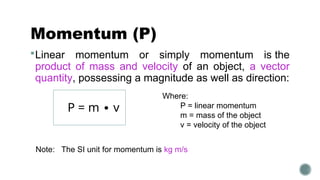
Linear momentumor simply momentum is the
product of mass and velocity of an object, a vector
quantity, possessing a magnitude as well as direction:
Where:
P = linear momentum
m = mass of the object
v = velocity of the object
Note: The SI unit for momentum is kg m/s
P = m ∙ v
3.
Momentum
All object hasmass; so if an object is moving, then it has
momentum – it has its mass in motion.
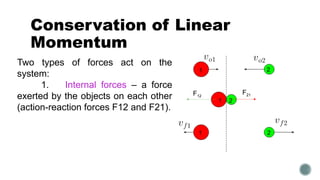
The amount of momentum which an object has is dependent
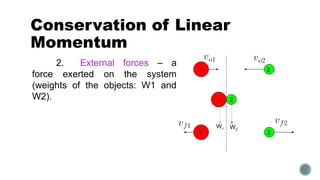
upon two variables:
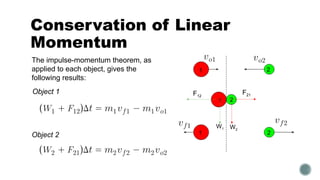
how much matter is moving?
how fast matter is moving?
In simple words, momentum is a mass in motion.
4.
Momentum
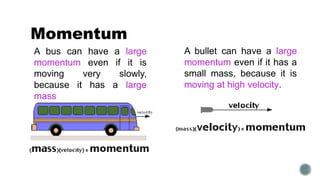
A bus canhave a large
momentum even if it is
moving very slowly,
because it has a large
mass
A bullet can have a large
momentum even if it has a
small mass, because it is
moving at high velocity.
5.
Momentum
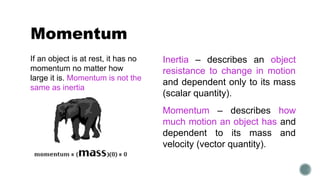
If an objectis at rest, it has no
momentum no matter how
large it is. Momentum is not the
same as inertia
Inertia – describes an object
resistance to change in motion
and dependent only to its mass
(scalar quantity).
Momentum – describes how
much motion an object has and
dependent to its mass and
velocity (vector quantity).
6.
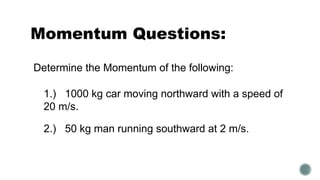
Momentum Questions:
2.) 50kg man running southward at 2 m/s.
1.) 1000 kg car moving northward with a speed of
20 m/s.
Determine the Momentum of the following:
7.
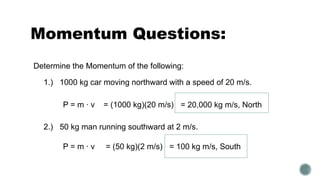
Momentum Questions:
2.) 50kg man running southward at 2 m/s.
1.) 1000 kg car moving northward with a speed of 20 m/s.
Determine the Momentum of the following:
P = m ∙ v = (1000 kg)(20 m/s) = 20,000 kg m/s, North
P = m ∙ v = (50 kg)(2 m/s) = 100 kg m/s, South
8.
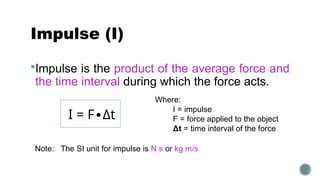
Impulse (I)
Impulse isthe product of the average force and
the time interval during which the force acts.
Where:
I = impulse
F = force applied to the object
Δt = time interval of the force
Note: The SI unit for impulse is N s or kg m/s
I = F Δ
∙ t
9.
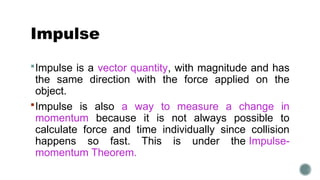
Impulse
Impulse is avector quantity, with magnitude and has
the same direction with the force applied on the
object.
Impulse is also a way to measure a change in
momentum because it is not always possible to
calculate force and time individually since collision
happens so fast. This is under the Impulse-
momentum Theorem.
10.
Impulse
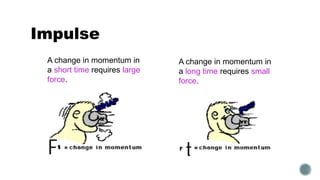
A change inmomentum in
a short time requires large
force.
A change in momentum in
a long time requires small
force.
11.
Impulse Question:
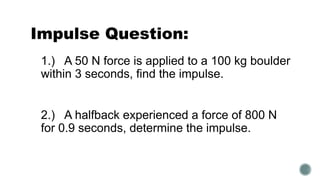
1.) A50 N force is applied to a 100 kg boulder
within 3 seconds, find the impulse.
2.) A halfback experienced a force of 800 N
for 0.9 seconds, determine the impulse.
12.
Impulse Question:
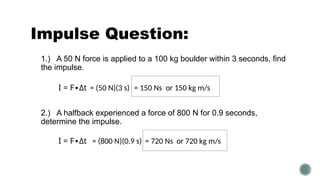
1.) A50 N force is applied to a 100 kg boulder within 3 seconds, find
the impulse.
2.) A halfback experienced a force of 800 N for 0.9 seconds,
determine the impulse.
I = F Δ
∙ t = (50 N)(3 s) = 150 Ns or 150 kg m/s
I = F Δ
∙ t = (800 N)(0.9 s) = 720 Ns or 720 kg m/s
13.
Impulse-Momentum Theorem
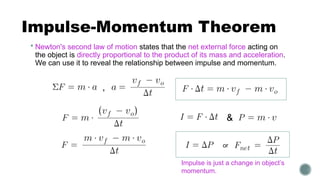
Newton'ssecond law of motion states that the net external force acting on
the object is directly proportional to the product of its mass and acceleration.
We can use it to reveal the relationship between impulse and momentum.
or
,
&
Impulse is just a change in object’s
momentum.
14.
Conservation of Linear
Momentum
12
1
1
2
2
F21
F12
Two types of forces act on the
system:
1. Internal forces – a force
exerted by the objects on each other
(action-reaction forces F12 and F21).
15.
Conservation of Linear
Momentum
12
1
1
W1
2
W2
2
2. External forces – a
force exerted on the system
(weights of the objects: W1 and
W2).
16.
Conservation of Linear
Momentum
12
1
1
W1
2
The impulse-momentum theorem, as
applied to each object, gives the
following results:
W2
2
F12
F21
Object 1
Object 2
17.
Conservation of Linear
Momentum
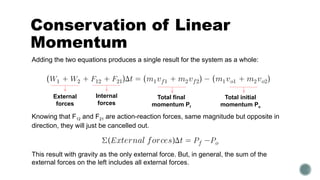
Addingthe two equations produces a single result for the system as a whole:
Knowing that F12 and F21 are action-reaction forces, same magnitude but opposite in
direction, they will just be cancelled out.
External
forces
Internal
forces
Total final
momentum Pf
Total initial
momentum Po
This result with gravity as the only external force. But, in general, the sum of the
external forces on the left includes all external forces.
18.
Conservation of Linear
Momentum
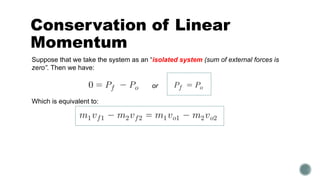
Supposethat we take the system as an “isolated system (sum of external forces is
zero”. Then we have:
Which is equivalent to:
or
19.
Example:
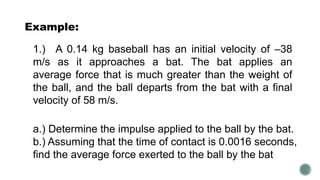
1.) A 0.14kg baseball has an initial velocity of –38
m/s as it approaches a bat. The bat applies an
average force that is much greater than the weight of
the ball, and the ball departs from the bat with a final
velocity of 58 m/s.
a.) Determine the impulse applied to the ball by the bat.
b.) Assuming that the time of contact is 0.0016 seconds,
find the average force exerted to the ball by the bat
20.
Example:
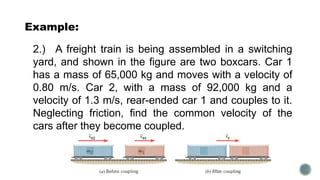
2.) A freighttrain is being assembled in a switching
yard, and shown in the figure are two boxcars. Car 1
has a mass of 65,000 kg and moves with a velocity of
0.80 m/s. Car 2, with a mass of 92,000 kg and a
velocity of 1.3 m/s, rear-ended car 1 and couples to it.
Neglecting friction, find the common velocity of the
cars after they become coupled.
Collisions in onedimension
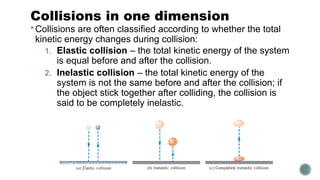
Collisions are often classified according to whether the total
kinetic energy changes during collision:
1. Elastic collision – the total kinetic energy of the system
is equal before and after the collision.
2. Inelastic collision – the total kinetic energy of the
system is not the same before and after the collision; if
the object stick together after colliding, the collision is
said to be completely inelastic.
23.
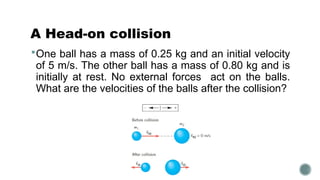
A Head-on collision
Oneball has a mass of 0.25 kg and an initial velocity
of 5 m/s. The other ball has a mass of 0.80 kg and is
initially at rest. No external forces act on the balls.
What are the velocities of the balls after the collision?
24.
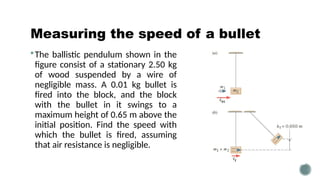
Measuring the speedof a bullet
The ballistic pendulum shown in the
figure consist of a stationary 2.50 kg
of wood suspended by a wire of
negligible mass. A 0.01 kg bullet is
fired into the block, and the block
with the bullet in it swings to a
maximum height of 0.65 m above the
initial position. Find the speed with
which the bullet is fired, assuming
that air resistance is negligible.
25.
Seatwork (1 wholeyellow
paper)
1. A golfer, driving a golf ball off the tee, gives the ball a velocity of +
38 m/s. The mass of the ball is 0.045 kg, and the duration of the
impact with the golf club is 3 x . (a) What is the change in
momentum of the ball? (b) Determine the average force applied
to the ball by the club.
2. Kevin has a mass of 87 kg and is skating with in-line skates. He
sees his 22-kg younger brother up ahead standing on the
sidewalk, with his back turned. Coming up from behind, he grabs
his brother and rolls off at a speed of 2.4 m/s. Ignoring friction,
find Kevin’s speed just before he grabbed his brother.
Editor's Notes
#14 By applying the impulse-momentum theorem to midair collision between two objects. The two object having masses are approaching each other with initial velocities as shown in the figure. The collection of these objects being studied is referred as the “system”. In this case, the system contains only the two objects. They interact during the collision and depart with final velocities. Due to collision, the initial and final velocities are not the same.
During the collision, F12 , is the force exerted on object 1 by object 2, while F21 is the force exerted on object 2 by object 1. These are action-reaction forces that are equal in magnitude but opposite in direction, so F12=-F21 These two are internal forces.
#15 The force of gravity also acts on the objects, their weights being W1 and W2. These are considered as external forces, because they are applied by earth, which is outside the system. Friction and air resistance are also considered as external forces although these forces are ignored for the sake of simplicity.
#18 Technically, initial and final momenta are very nearly equal to zero even when the sum of the external forces is not zero. This occurs when the time interval during which the forces act is so short that is effectively zero.
#33 The collision is completely inelastic because the bullet penetrated the block.
The total linear momentum of the combined body is conserved because the suspension wires supports the system weight, which means that the sum of all external force acting on the body is nearly equal to zero
As the body swings upward, conservation of mechanical energy applies.
Tension force in the wire does no work because it acts perpendicular to the axis of motion.