ABSOLUTE BASICS TO SUCH A SIMPLE PROCESS…
YEAH RIGHT
BUT… THIS IS SO SIMPLE… JUST ADD FLUX…
• By now you probably know better that many of the shortcut-eager quick-
fixers will just give you a temporary fix but not a solution…
• So if really want to control your process, drive scrap down and bring your
process under control maybe you want to start reading.
• In general a quick fix implies no thinking, and without analysis is like applying
yourself a band aid to stop your neighbor’s bleeding.
UNDERSTAND YOUR PROCESS FIRST!!!
• There are many variables involved so make sure you UNDERSTAND FIRST
• Second… Analyze from the standpoint of requirements so you can figure out
what you might be missing
REQUIREMENTS
• The surfaces to be soldered must be free of
oxides and other contaminants in order to achieve proper physical and electrical
bond
• The temperature difference between the unit to solder and the molten solder must not
be so dramatic to produce CTE mismatch (product thermal cracking)
• Must have one (1) solder joint per pad/pin, no more (bridges) and no less (skips)
• No foreign materials present or undesired residues resulting from the process
• Components must be present, be the right component, on
the correct position and properly connected
PARTS OF THE PROCESS/MACHINE
• Conveyor: as it takes the product across the different stages it is co-
responsible for the results as it interacts with all requirements.
• Flux Applicator: Applies the solder facilitator. (simple!? )
• Preheating: Prepares Product and Flux for the arrival of solder.
• Wave Solder: the hot mean molten metal that we need to apply to the
electro-mechanical bond points.
CONVEYOR SETUP PARAMETERS
• Inclination angle between 5°-7° (typically 6°) to control wave/pcb contact
surface
• Transport speed determines EVERYTHING (fluxing, preheat profile, wave
dwell)
• Leveling front-to-back determines homogeneous contact with flux & wave
• Parallelism affects board flatness and support.
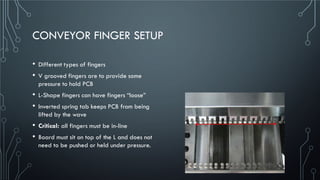
CONVEYOR FINGER SETUP
• Different types of fingers
• V grooved fingers are to provide some
pressure to hold PCB
• L-Shape fingers can have fingers “loose”
• Inverted spring tab keeps PCB from being
lifted by the wave
• Critical: all fingers must be in-line
• Board must sit on top of the L and does not
need to be pushed or held under pressure.
HOW TO SET UP CONVEYOR
• Leveling
• In-to-Out 6°
• Front-Back Level Flat
• Clearance from bottom of PCB to:
• Fluxer nozzle 2.5mm < Clearance < 8mm
• Wave nozzle 2.5mm < Clearance < 8mm
• Conveyor Width (L-Shaped) must be just sufficient to hold part from falling but no
compression.
FOAM FLUXER SETUP
• MUST be leveled also to produce homogeneous flux application
• Nozzle-to-board clearance
• Bubble Size homogeneous and as small as
possible
• Air Supply dry and clean
• Controls for pressure and air volume are used to maintain
bubble size and foam column height
• Air Knife setup critical
• Avoids excess flux
• Pushes flux up to top side pads
• PCB must not be dripping of flux when it leaves fluxer
Unleveled
Conveyor-fluxer
AIR KNIFE SETUP
• Angle too shallow or too much air
• Collapses Foam Column
• Board underfluxed
• Angle too steep or little air
• Excess flux on top (steep angle)
• Excess flux underneath dripping into
preheaters (risk of fire)
CONTROLLING FLUX
• VOC / Solvent based flux evaporates at
varying rates depending on temperature,
atmospheric pressure and air flow
• Must keep constant control over solids content
as solvent evaporates
• It will affect solder results, and residues
• Foam consistency changes and alters bubble size.
• The lower the air flow the lower the evaporation, but will also lower foam flux column
height.
• Maintain aerator wet in solvent at all times! Otherwise it will clog pores with solids
PREHEATERS
• Infrarred heaters (radiant)
• Heat bounces from metal shiny areas
• Dull areas (solder mask) raise higher
temperatures
• Heater temperature >6x over PCB
temperature
• Convection heaters
• Slower heat transfer rates
• Homogenous temperatures
• Heater temperature ~1:1 to PCB
PREHEAT SETUP
• Heat up ramp rates must meet Flux specifications (typically 2-3°C/Sec)
• Direct relationship with conveyor speed
• faster speeds = lower ramp rates & low exit temperature
• lower speeds = higher ramp rates & higher exit temperature)
• Exit temperature must also be met.
• Temperature too high or too soon before wave will consume flux before wave
• Temperature too low will leave too much flux on board (spatter, outgassing & solder
balls)
• Temperature is evaluated at Top Side!!!
WAVE SETUP FOR ASYMMETRIC WAVE
• Wave nozzle must be leveled
• Wave height (nozzle to top of wave)
• Minimize height to reduce dross
• Wave height must be at least 50%
of PCB depth (relation to conveyor)
• Back flow must be minimal.
• Wave MUST be perpendicular to
conveyor (consistency in height,
penetration and contact dwell time)
SOLDER WAVE CHARACTERISTICS
• Front cascade must be laminar across PCB
• Flow around the edges of nozzle (front and back) is turbulent and will not
ensure penetration and debridging
• Backflow speed must be equal to PCB speed to ensure debridging and excess
removal
• Liquid temperature too low will also cause bad solder results
• Wave height above nozzle >2.5mm but as low as possible prevent component
terminals from hitting the nozzle
USING GLASS TO VERIFY WAVE
• HIGH IMPORTANCE:
• Preheat glass or it will shatter into pieces
• Conveyor must not compress glass
• Perpendicular contact area is relevant
• Cannot determine laminar flow you must ensure
PCB is at least 6mm inside the nozzle edges
OTHER CONSIDERATIONS
• DFM
• Pin to hole ratio desirable .008 to .020”
(0.2 to 0.5mm) for proper filling
• Lead to pad ratio >2:1
• Lead protrusion: shorter is better for
component lifting reduction and solder bridging
• Topside pad reduction helps

Wave soldering 101

  • 1.
    ABSOLUTE BASICS TOSUCH A SIMPLE PROCESS… YEAH RIGHT
  • 2.
    BUT… THIS ISSO SIMPLE… JUST ADD FLUX… • By now you probably know better that many of the shortcut-eager quick- fixers will just give you a temporary fix but not a solution… • So if really want to control your process, drive scrap down and bring your process under control maybe you want to start reading. • In general a quick fix implies no thinking, and without analysis is like applying yourself a band aid to stop your neighbor’s bleeding.
  • 3.
    UNDERSTAND YOUR PROCESSFIRST!!! • There are many variables involved so make sure you UNDERSTAND FIRST • Second… Analyze from the standpoint of requirements so you can figure out what you might be missing
  • 4.
    REQUIREMENTS • The surfacesto be soldered must be free of oxides and other contaminants in order to achieve proper physical and electrical bond • The temperature difference between the unit to solder and the molten solder must not be so dramatic to produce CTE mismatch (product thermal cracking) • Must have one (1) solder joint per pad/pin, no more (bridges) and no less (skips) • No foreign materials present or undesired residues resulting from the process • Components must be present, be the right component, on the correct position and properly connected
  • 5.
    PARTS OF THEPROCESS/MACHINE • Conveyor: as it takes the product across the different stages it is co- responsible for the results as it interacts with all requirements. • Flux Applicator: Applies the solder facilitator. (simple!? ) • Preheating: Prepares Product and Flux for the arrival of solder. • Wave Solder: the hot mean molten metal that we need to apply to the electro-mechanical bond points.
  • 6.
    CONVEYOR SETUP PARAMETERS •Inclination angle between 5°-7° (typically 6°) to control wave/pcb contact surface • Transport speed determines EVERYTHING (fluxing, preheat profile, wave dwell) • Leveling front-to-back determines homogeneous contact with flux & wave • Parallelism affects board flatness and support.
  • 7.
    CONVEYOR FINGER SETUP •Different types of fingers • V grooved fingers are to provide some pressure to hold PCB • L-Shape fingers can have fingers “loose” • Inverted spring tab keeps PCB from being lifted by the wave • Critical: all fingers must be in-line • Board must sit on top of the L and does not need to be pushed or held under pressure.
  • 8.
    HOW TO SETUP CONVEYOR • Leveling • In-to-Out 6° • Front-Back Level Flat • Clearance from bottom of PCB to: • Fluxer nozzle 2.5mm < Clearance < 8mm • Wave nozzle 2.5mm < Clearance < 8mm • Conveyor Width (L-Shaped) must be just sufficient to hold part from falling but no compression.
  • 9.
    FOAM FLUXER SETUP •MUST be leveled also to produce homogeneous flux application • Nozzle-to-board clearance • Bubble Size homogeneous and as small as possible • Air Supply dry and clean • Controls for pressure and air volume are used to maintain bubble size and foam column height • Air Knife setup critical • Avoids excess flux • Pushes flux up to top side pads • PCB must not be dripping of flux when it leaves fluxer Unleveled Conveyor-fluxer
  • 10.
    AIR KNIFE SETUP •Angle too shallow or too much air • Collapses Foam Column • Board underfluxed • Angle too steep or little air • Excess flux on top (steep angle) • Excess flux underneath dripping into preheaters (risk of fire)
  • 11.
    CONTROLLING FLUX • VOC/ Solvent based flux evaporates at varying rates depending on temperature, atmospheric pressure and air flow • Must keep constant control over solids content as solvent evaporates • It will affect solder results, and residues • Foam consistency changes and alters bubble size. • The lower the air flow the lower the evaporation, but will also lower foam flux column height. • Maintain aerator wet in solvent at all times! Otherwise it will clog pores with solids
  • 12.
    PREHEATERS • Infrarred heaters(radiant) • Heat bounces from metal shiny areas • Dull areas (solder mask) raise higher temperatures • Heater temperature >6x over PCB temperature • Convection heaters • Slower heat transfer rates • Homogenous temperatures • Heater temperature ~1:1 to PCB
  • 13.
    PREHEAT SETUP • Heatup ramp rates must meet Flux specifications (typically 2-3°C/Sec) • Direct relationship with conveyor speed • faster speeds = lower ramp rates & low exit temperature • lower speeds = higher ramp rates & higher exit temperature) • Exit temperature must also be met. • Temperature too high or too soon before wave will consume flux before wave • Temperature too low will leave too much flux on board (spatter, outgassing & solder balls) • Temperature is evaluated at Top Side!!!
  • 14.
    WAVE SETUP FORASYMMETRIC WAVE • Wave nozzle must be leveled • Wave height (nozzle to top of wave) • Minimize height to reduce dross • Wave height must be at least 50% of PCB depth (relation to conveyor) • Back flow must be minimal. • Wave MUST be perpendicular to conveyor (consistency in height, penetration and contact dwell time)
  • 15.
    SOLDER WAVE CHARACTERISTICS •Front cascade must be laminar across PCB • Flow around the edges of nozzle (front and back) is turbulent and will not ensure penetration and debridging • Backflow speed must be equal to PCB speed to ensure debridging and excess removal • Liquid temperature too low will also cause bad solder results • Wave height above nozzle >2.5mm but as low as possible prevent component terminals from hitting the nozzle
  • 16.
    USING GLASS TOVERIFY WAVE • HIGH IMPORTANCE: • Preheat glass or it will shatter into pieces • Conveyor must not compress glass • Perpendicular contact area is relevant • Cannot determine laminar flow you must ensure PCB is at least 6mm inside the nozzle edges
  • 17.
    OTHER CONSIDERATIONS • DFM •Pin to hole ratio desirable .008 to .020” (0.2 to 0.5mm) for proper filling • Lead to pad ratio >2:1 • Lead protrusion: shorter is better for component lifting reduction and solder bridging • Topside pad reduction helps