1
GAS METAL ARC WELDING ( MIG )
2
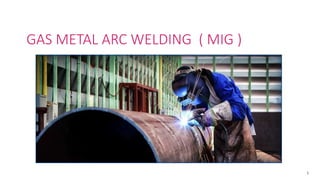
GAS METAL ARC WELDING
Gas Metal Arc Welding is frequently referred to as
MIG/MAG Welding.
Wire is continuously fed from a spool.
An arc is struck between the end of a wire electrode and
the work piece, melting both to form a weld pool and the
wire serves as the source of heat (via the arc at the wire
tip) and filler metal for the joint.
The weld pool is protected from the surrounding
atmosphere by a shielding gas fed through a nozzle
surrounding the wire.
3
GAS METAL ARC WELDING EQUIPMENT
4
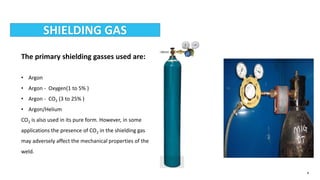
SHIELDING GAS
The primary shielding gasses used are:
• Argon
• Argon - Oxygen(1 to 5% )
• Argon - CO2 (3 to 25% )
• Argon/Helium
CO2 is also used in its pure form. However, in some
applications the presence of CO2 in the shielding gas
may adversely affect the mechanical properties of the
weld.
Types of Molten Metal Transfers in GMAW
• Short circuiting transfer (GMAW-S)
• Globular Transfer
• GMAW spray transfer
• Pulsed spray transfer (GMAW-P)
Short circuiting transfer (GMAW-S)
• (GMAW-S) is a metal transfer mode in which molten metal from
consumable welding wire is deposited during repeated short
circuits.
• Short circuits can occur up to 200 times a second depending on
welding power-source controls.
• GMAW-S occurs at current levels below 200 A, with smaller welding
wire diameters of 0.045" or less.
• The low heat input associated with GMAW-S makes it suitable for
welding thin-gauge base metals up to 1/4".
• GMAW-S can be used in all welding positions because it produces
a small, fast-freezing weld pool.
• Typical electrode extensions for GMAW-S are 3/8" to 1/2" with the
contact tip even with the gas nozzle.
Short circuiting transfer (GMAW-S)
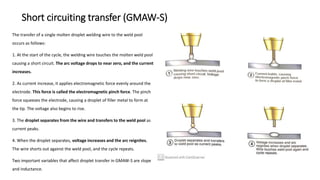
The transfer of a single molten droplet welding wire to the weld pool
occurs as follows:
1. At the start of the cycle, the welding wire touches the molten weld pool
causing a short circuit. The arc voltage drops to near zero, and the current
increases.
2. As current increase, it applies electromagnetic force evenly around the
electrode. This force is called the electromagnetic pinch force. The pinch
force squeezes the electrode, causing a droplet of filler metal to form at
the tip. The voltage also begins to rise.
3. The droplet separates from the wire and transfers to the weld pool as
current peaks.
4. When the droplet separates, voltage increases and the arc reignites.
The wire shorts out against the weld pool, and the cycle repeats.
Two important variables that affect droplet transfer in GMAW-S are slope
and inductance.
Short circuiting transfer (GMAW-S)
• It is commonly used to weld root passes on pipe and open root joints on plate.
• GMAW-S produces faster travel speeds, higher electrode efficiencies (in the range of 93%), and less distortion
because of its lower heat input.
• GMAW-S is easy to use, which give it high operator appeal.
• However, the low heat input associated with GMAW-S can result in incomplete fusion.
• A mixture of 75% Ar and 25% CO2 is commonly used for GMAW-S.
• A mixture of 75% Ar and 25% CO2 produces faster travel speeds, a smooth and focused arc with good penetration
characteristics, and less spatter than 100% C02.
• Straight C02 can be used where good penetration is essential but bead contour and appearance are not particularly
important.
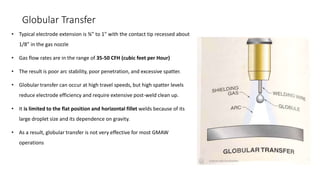
Globular Transfer
• When the wire feed speed and voltage are increased above the
upper range for GMAW-S, the transfer mode changes to globular
transfer.
• Globular transfer occurs at the rate of a few droplets per second.
• In globular transfer, the molten drop grows to 2 or 3 times the
diameter of the wire, before separating and transferring to the
workpiece.
• As the globule moves across the arc, it assumes an irregular shape
and a rotary motion because of the physical forces of the arc.
• Metal transfer also occurs as the result of occasional short circuits.
Globular Transfer
• Typical electrode extension is ¾” to 1” with the contact tip recessed about
1/8” in the gas nozzle
• Gas flow rates are in the range of 35-50 CFH (cubic feet per Hour)
• The result is poor arc stability, poor penetration, and excessive spatter.
• Globular transfer can occur at high travel speeds, but high spatter levels
reduce electrode efficiency and require extensive post-weld clean up.
• It is limited to the flat position and horizontal fillet welds because of its
large droplet size and its dependence on gravity.
• As a result, globular transfer is not very effective for most GMAW
operations
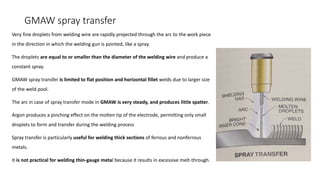
GMAW spray transfer
Very fine droplets from welding wire are rapidly projected through the arc to the work piece
in the direction in which the welding gun is pointed, like a spray.
The droplets are equal to or smaller than the diameter of the welding wire and produce a
constant spray.
GMAW spray transfer is limited to flat position and horizontal fillet welds due to larger size
of the weld pool.
The arc in case of spray transfer mode in GMAW is very steady, and produces little spatter.
Argon produces a pinching effect on the molten tip of the electrode, permitting only small
droplets to form and transfer during the welding process
Spray transfer is particularly useful for welding thick sections of ferrous and nonferrous
metals.
It is not practical for welding thin-gauge metal because it results in excessive melt-through.
GMAW spray transfer
For ferrous metals, argon with mixtures of 1% to 5% oxygen or 3% to 25% CO2 are commonly used.
A small amount of oxygen or CO2 improves the stability of the arc and reduces the tendency for
undercut by eliminating the Arc Wandering on the tip of the electrode.
Addition of Oxygen also reduces the Transition Current level to produce spray transfer.
However, oxygen content is limited to 5% or less to avoid porosity and oxidation of alloying
elements like Silicon and Manganese in the steel.
Argon and oxygen/CO2 mixtures produce a deep finger-like penetration profile.
A common gas mixture for carbon and low-alloy steels is 90% Ar and 10% C02.
for stainless steels is 98% Ar and 2% C02.
An argon-C02 mixture produces a more rounded penetration profile compared to the finger-like
penetration of argon/oxygen.
Metal-cored welding wires perform well in a 90% Ar and 10% C02 gas shield.
Spray transfer for nonferrous metals requires 100% argon shielding gas or a mixture of argon and
helium.
GMAW spray transfer
Even small amounts of oxygen are unsuitable for nonferrous metals because oxygen is a
reactive gas. It interacts with the molten metal to form porosity and other defects.
Using a longer electrode extension with spray transfer allows for higher deposition rates.
The welding wire has a longer preheat time before entering the arc, so there is less
amperage needed to melt the wire and faster travel speeds are possible.
If electrode extension is excessive, reduced penetration may occur.
Typical electrode extension for spray transfer is 3/4" to 1", with the contact tip recessed
about 1/8" in the gas nozzle.
Gas flow rates are in the range 35 to 50 CFH.
Spray transfer produces high deposition rates with high welding efficiencies in the range
of 98%.
Spray transfer produces an excellent, spatter-free bead appearance and good fusion and
penetration and it requires little or no post-weld cleaning
Pulsed spray transfer (GMAW-P)
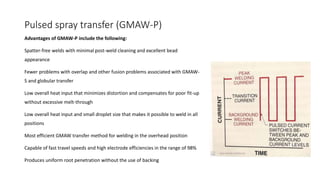
(GMAW-P) is a variation of spray transfer in which current is pulsed from a low background level to
a peak level above the spray transfer transition current.
During peak current, a single molten droplet is pinched from the end of the welding wire and
transfers across the arc.
At the end of the peak current portion of the cycle, current drops to the background level.
Background current is set high enough to maintain the arc and heat the welding wire but low
enough that no metal transfer occurs.
The pulsing cycle from peak current to background current occurs up to several hundred times per
second. Pulsing frequency increases with wire feed speed.
It is possible to weld a wide variety of metal thicknesses, including thin gauge sheet metal.
It is difficult to select the required pulsing parameters on a Non-Synergic Pulsed GMAW power
source. Hence synergic GMAW power sources have been developed with different software
programmes developed to produce the required pulsed parameters for a given type of material and
size of the filler wire.
Pulsed spray transfer (GMAW-P)
Advantages of GMAW-P include the following:
Spatter-free welds with minimal post-weld cleaning and excellent bead
appearance
Fewer problems with overlap and other fusion problems associated with GMAW-
S and globular transfer
Low overall heat input that minimizes distortion and compensates for poor fit-up
without excessive melt-through
Low overall heat input and small droplet size that makes it possible to weld in all
positions
Most efficient GMAW transfer method for welding in the overhead position
Capable of fast travel speeds and high electrode efficiencies in the range of 98%
Produces uniform root penetration without the use of backing

Gmaw transfer modes

  • 1.
    1 GAS METAL ARCWELDING ( MIG )
  • 2.
    2 GAS METAL ARCWELDING Gas Metal Arc Welding is frequently referred to as MIG/MAG Welding. Wire is continuously fed from a spool. An arc is struck between the end of a wire electrode and the work piece, melting both to form a weld pool and the wire serves as the source of heat (via the arc at the wire tip) and filler metal for the joint. The weld pool is protected from the surrounding atmosphere by a shielding gas fed through a nozzle surrounding the wire.
  • 3.
    3 GAS METAL ARCWELDING EQUIPMENT
  • 4.
    4 SHIELDING GAS The primaryshielding gasses used are: • Argon • Argon - Oxygen(1 to 5% ) • Argon - CO2 (3 to 25% ) • Argon/Helium CO2 is also used in its pure form. However, in some applications the presence of CO2 in the shielding gas may adversely affect the mechanical properties of the weld.
  • 5.
    Types of MoltenMetal Transfers in GMAW • Short circuiting transfer (GMAW-S) • Globular Transfer • GMAW spray transfer • Pulsed spray transfer (GMAW-P)
  • 6.
    Short circuiting transfer(GMAW-S) • (GMAW-S) is a metal transfer mode in which molten metal from consumable welding wire is deposited during repeated short circuits. • Short circuits can occur up to 200 times a second depending on welding power-source controls. • GMAW-S occurs at current levels below 200 A, with smaller welding wire diameters of 0.045" or less. • The low heat input associated with GMAW-S makes it suitable for welding thin-gauge base metals up to 1/4". • GMAW-S can be used in all welding positions because it produces a small, fast-freezing weld pool. • Typical electrode extensions for GMAW-S are 3/8" to 1/2" with the contact tip even with the gas nozzle.
  • 7.
    Short circuiting transfer(GMAW-S) The transfer of a single molten droplet welding wire to the weld pool occurs as follows: 1. At the start of the cycle, the welding wire touches the molten weld pool causing a short circuit. The arc voltage drops to near zero, and the current increases. 2. As current increase, it applies electromagnetic force evenly around the electrode. This force is called the electromagnetic pinch force. The pinch force squeezes the electrode, causing a droplet of filler metal to form at the tip. The voltage also begins to rise. 3. The droplet separates from the wire and transfers to the weld pool as current peaks. 4. When the droplet separates, voltage increases and the arc reignites. The wire shorts out against the weld pool, and the cycle repeats. Two important variables that affect droplet transfer in GMAW-S are slope and inductance.
  • 8.
    Short circuiting transfer(GMAW-S) • It is commonly used to weld root passes on pipe and open root joints on plate. • GMAW-S produces faster travel speeds, higher electrode efficiencies (in the range of 93%), and less distortion because of its lower heat input. • GMAW-S is easy to use, which give it high operator appeal. • However, the low heat input associated with GMAW-S can result in incomplete fusion. • A mixture of 75% Ar and 25% CO2 is commonly used for GMAW-S. • A mixture of 75% Ar and 25% CO2 produces faster travel speeds, a smooth and focused arc with good penetration characteristics, and less spatter than 100% C02. • Straight C02 can be used where good penetration is essential but bead contour and appearance are not particularly important.
  • 9.
    Globular Transfer • Whenthe wire feed speed and voltage are increased above the upper range for GMAW-S, the transfer mode changes to globular transfer. • Globular transfer occurs at the rate of a few droplets per second. • In globular transfer, the molten drop grows to 2 or 3 times the diameter of the wire, before separating and transferring to the workpiece. • As the globule moves across the arc, it assumes an irregular shape and a rotary motion because of the physical forces of the arc. • Metal transfer also occurs as the result of occasional short circuits.
  • 10.
    Globular Transfer • Typicalelectrode extension is ¾” to 1” with the contact tip recessed about 1/8” in the gas nozzle • Gas flow rates are in the range of 35-50 CFH (cubic feet per Hour) • The result is poor arc stability, poor penetration, and excessive spatter. • Globular transfer can occur at high travel speeds, but high spatter levels reduce electrode efficiency and require extensive post-weld clean up. • It is limited to the flat position and horizontal fillet welds because of its large droplet size and its dependence on gravity. • As a result, globular transfer is not very effective for most GMAW operations
  • 11.
    GMAW spray transfer Veryfine droplets from welding wire are rapidly projected through the arc to the work piece in the direction in which the welding gun is pointed, like a spray. The droplets are equal to or smaller than the diameter of the welding wire and produce a constant spray. GMAW spray transfer is limited to flat position and horizontal fillet welds due to larger size of the weld pool. The arc in case of spray transfer mode in GMAW is very steady, and produces little spatter. Argon produces a pinching effect on the molten tip of the electrode, permitting only small droplets to form and transfer during the welding process Spray transfer is particularly useful for welding thick sections of ferrous and nonferrous metals. It is not practical for welding thin-gauge metal because it results in excessive melt-through.
  • 12.
    GMAW spray transfer Forferrous metals, argon with mixtures of 1% to 5% oxygen or 3% to 25% CO2 are commonly used. A small amount of oxygen or CO2 improves the stability of the arc and reduces the tendency for undercut by eliminating the Arc Wandering on the tip of the electrode. Addition of Oxygen also reduces the Transition Current level to produce spray transfer. However, oxygen content is limited to 5% or less to avoid porosity and oxidation of alloying elements like Silicon and Manganese in the steel. Argon and oxygen/CO2 mixtures produce a deep finger-like penetration profile. A common gas mixture for carbon and low-alloy steels is 90% Ar and 10% C02. for stainless steels is 98% Ar and 2% C02. An argon-C02 mixture produces a more rounded penetration profile compared to the finger-like penetration of argon/oxygen. Metal-cored welding wires perform well in a 90% Ar and 10% C02 gas shield. Spray transfer for nonferrous metals requires 100% argon shielding gas or a mixture of argon and helium.
  • 13.
    GMAW spray transfer Evensmall amounts of oxygen are unsuitable for nonferrous metals because oxygen is a reactive gas. It interacts with the molten metal to form porosity and other defects. Using a longer electrode extension with spray transfer allows for higher deposition rates. The welding wire has a longer preheat time before entering the arc, so there is less amperage needed to melt the wire and faster travel speeds are possible. If electrode extension is excessive, reduced penetration may occur. Typical electrode extension for spray transfer is 3/4" to 1", with the contact tip recessed about 1/8" in the gas nozzle. Gas flow rates are in the range 35 to 50 CFH. Spray transfer produces high deposition rates with high welding efficiencies in the range of 98%. Spray transfer produces an excellent, spatter-free bead appearance and good fusion and penetration and it requires little or no post-weld cleaning
  • 14.
    Pulsed spray transfer(GMAW-P) (GMAW-P) is a variation of spray transfer in which current is pulsed from a low background level to a peak level above the spray transfer transition current. During peak current, a single molten droplet is pinched from the end of the welding wire and transfers across the arc. At the end of the peak current portion of the cycle, current drops to the background level. Background current is set high enough to maintain the arc and heat the welding wire but low enough that no metal transfer occurs. The pulsing cycle from peak current to background current occurs up to several hundred times per second. Pulsing frequency increases with wire feed speed. It is possible to weld a wide variety of metal thicknesses, including thin gauge sheet metal. It is difficult to select the required pulsing parameters on a Non-Synergic Pulsed GMAW power source. Hence synergic GMAW power sources have been developed with different software programmes developed to produce the required pulsed parameters for a given type of material and size of the filler wire.
  • 15.
    Pulsed spray transfer(GMAW-P) Advantages of GMAW-P include the following: Spatter-free welds with minimal post-weld cleaning and excellent bead appearance Fewer problems with overlap and other fusion problems associated with GMAW- S and globular transfer Low overall heat input that minimizes distortion and compensates for poor fit-up without excessive melt-through Low overall heat input and small droplet size that makes it possible to weld in all positions Most efficient GMAW transfer method for welding in the overhead position Capable of fast travel speeds and high electrode efficiencies in the range of 98% Produces uniform root penetration without the use of backing