IMPRESSIONISM.


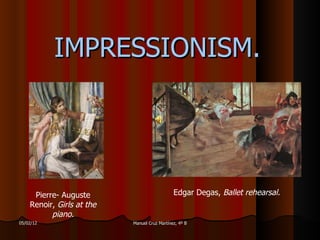
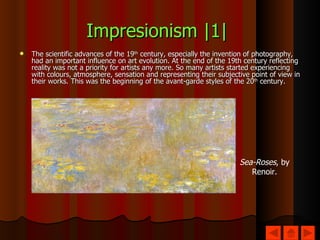
     Pierre- Auguste                          Edgar Degas, Ballet rehearsal.
    Renoir, Girls at the
          piano.
05/02/12                   Manuel Cruz Martínez, 4º B
INDEX:
   Impressionism |1|.
   Impressionism |2|.
   Main features of Impressionism.
   Painting.
   Édouard Manet.
   Claude Monet.
   Pierre- Auguste Renoir.
   Edgar Degas.
   Alfred Sisley.
   Camille Pissarro.
   Impressionism in Spain.
   Sorolla.
   Sculpture.
   Auguste Rodin.
   Explanation of a painting: Rouen Cathedral, by Claude Monet
   Explanation of a sculpture: The Thinker, by Auguste Rodin
   Sources.
Impresionism |1|
   The scientific advances of the 19th century, especially the invention of photography,
    had an important influence on art evolution. At the end of the 19th century reflecting
    reality was not a priority for artists any more. So many artists started experiencing
    with colours, atmosphere, sensation and representing their subjective point of view in
    their works. This was the beginning of the avant-garde styles of the 20th century.


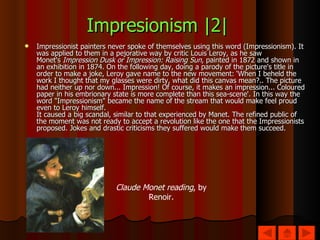
                                                                      Sea-Roses, by
                                                                         Renoir.
Impresionism |2|
   Impressionist painters never spoke of themselves using this word (Impressionism). It
    was applied to them in a pejorative way by critic Louis Leroy, as he saw
    Monet's Impression Dusk or Impression: Raising Sun, painted in 1872 and shown in
    an exhibition in 1874. On the following day, doing a parody of the picture's title in
    order to make a joke, Leroy gave name to the new movement: ‘When I beheld the
    work I thought that my glasses were dirty, what did this canvas mean?.. The picture
    had neither up nor down... Impression! Of course, it makes an impression... Coloured
    paper in his embrionary state is more complete than this sea-scene'. In this way the
    word "Impressionism" became the name of the stream that would make feel proud
    even to Leroy himself.
    It caused a big scandal, similar to that experienced by Manet. The refined public of
    the moment was not ready to accept a revolution like the one that the Impressionists
    proposed. Jokes and drastic criticisms they suffered would make them succeed.


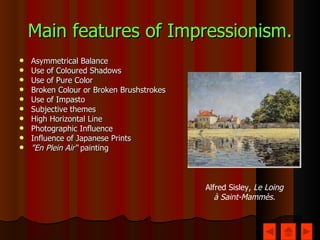
                             Claude Monet reading, by
                                     Renoir.
Main features of Impressionism.
   Asymmetrical Balance
   Use of Coloured Shadows
   Use of Pure Color
   Broken Colour or Broken Brushstrokes
   Use of Impasto
   Subjective themes
   High Horizontal Line
   Photographic Influence
   Influence of Japanese Prints
   "En Plein Air“ painting


                                           Alfred Sisley, Le Loing
                                              à Saint-Mammès.
Camille Pissarro, Paysanne
   poussant une brouette.


PAINTING.

   Alfred Sisley, Les berges de l'Oise.
Édouard Manet.
   He was the precursor of Impressionism. He admired Velázquez and Goya.
    Some of his paintings are: The balcony, The fifer, Olympia, The Luncheon
    on the grass.


                                                Édouard Monet, Olympia.


Édouard Manet,
 The Balcony.              Édouard
                          Manet, The
                            Fifer.
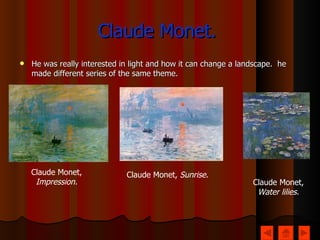
Claude Monet.
   He was really interested in light and how it can change a landscape. he
    made different series of the same theme.


    Claude Monet,             Claude Monet, Sunrise.
     Impression.                                                 Claude Monet,
                                                                  Water lilies.
Pierre- Auguste Renoir.
      He was mainly interested in two things: the scenes in open air and the
       feminine beauty and sensuality.


                                 Pierre- Auguste
                               Renoir, Luncheon at
                                the Boating Party.


                                 Pierre- Auguste
                                 Renoir, Dance at
                                 the Moulin de la
                                     Galette.

Pierre- Auguste Renoir, The
          Swing.
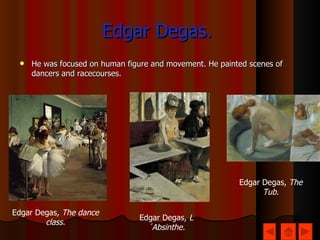
Edgar Degas.
    He was focused on human figure and movement. He painted scenes of
     dancers and racecourses.


                                                          Edgar Degas, The
                                                                Tub.

Edgar Degas, The dance
                                Edgar Degas, L
        class.
                                  ´Absinthe.
Alfred Sisley.
   He painted scenes in the open air, such as Flood at Port- Marly.


                                Alfred Sisley,
                                Passerelle
                                d'Argenteuil


                                                         Alfred Sisley, Flood at
                                                              Port- Marly.

                              Alfred Sisley,
                                 Le canal
                              Saint-Martin.
Camille Pissarro.
   As Alfred Sisley he painted scenes in the open air, such as Boulevard
    Montmartre.


Camile Pissarro,              Camille Pissarro, La Moisson.            Camille
  Boulevard                                                          Pissarro, Le
Montamartre at                                                         Jardin à
    night.                                                            Pontoise.
IMPRESSIONISM IN
     SPAIN

          Sorolla, Sad Inheritance.
Sorolla.
   His most important paintings were his beach paintings, which can be
    classified as belonging to this style.


                                                             Sorolla, Castilla.
Sorolla, Children on         Sorolla, Walk on the
  the Seashore.                     Beach.
SCULPTURE.


   Auguste Rodín, The age of
            Bronze.
Auguste Rodin
     He used multiple planes to get light effects. Some of his main works
      of art were: The kiss, The thinker and Balzac.


                                                      Auguste Rodin, The
Auguste Rodin, The Kiss.      Auguste Rodin,
                                                      Burghers of Calais.
                                 Balzac.
Explanation of a painting:
   Claude Monet: Rouen Cathedral. It corresponds to the series of
    paintings of the Rouen Cathedral.
                          "Rouen Cathedral", Claude Monet. It was made between 1892
                          and 1893 and reworked in Monet´s studio in 1894. The
                          material used was oil on canvas. There are 17 different
                          version of this painting. This one is located in the National
                          Gallery of Art in Washington, D.C., USA. The meaning of this
                          painting was the purpose of showing that light could change a
                          landscape. It can be considered as belonging to
                          Impressionism because of the use of light. It has a lot of
                          importance because he selected what he considered to be the
                          twenty best paintings from the series to exhibit at his Paris
                          dealer’s gallery and it influenced other artist too, like Pissarro
                          and Cézanne. Some important information is that apart from
                          its religious significance, Rouen Cathedral–built in the Gothic
                          style–represented all that was best in French history and
                          culture, being a style of architecture that was admired and
                          adopted by many European countries during the Middle Ages.
                          Monet made a lot of paintings about this theme, he used
                          different colours to represent his interest in light.
Explanation of a sculpture:
   Auguste Rodin: The Thinker


                            It was made in 1902, now it's in the Museé Rodin in
                            Paris. There are some twenty other original castings as
                            well as various other versions, studies, and posthumous
                            castings. It represents a man in sober meditation battling
                            with a powerful internal struggle. It's often used in
                            philosophy. It's considered the best sculpture and most
                            representative of Impressionism. He was in origin named
                            "The Poet" the piece was part of a commission by
                            the Musée des Arts Décoratifs, Paris to create a
                            monumental portal to act as the door of the museum.
                            It's made in bronze and marble. As you can see it´s an
                            impressionist sculpture because of the expression of
                            “The Thinker”.
Sources:
 Campo de Criptana Cristina Blanco and Paqui Perez Fons (2011). Social
  Sciences History 4th Year ESO.
 Anonimous writter. "The Thinker", web site "Wikipedia, the free
  encyclopedia", entered in the 28th of April of 2012, consulted in the 28th of
  April of 2012. URL: http://en.wikipedia.org/wiki/The_Thinker
 Beatriz Aragonés Escobar. "Impressionism", sitio web "Spanisharts",
  consulted in the 28th of April of 2012. URL: http://www.spanisharts.com/
  history/del_impres_s.XX/impresionismo/i_impresionismo.html

Impressionism

  • 1.
    IMPRESSIONISM. Pierre- Auguste Edgar Degas, Ballet rehearsal. Renoir, Girls at the piano. 05/02/12 Manuel Cruz Martínez, 4º B
  • 2.
    INDEX:  Impressionism |1|.  Impressionism |2|.  Main features of Impressionism.  Painting.  Édouard Manet.  Claude Monet.  Pierre- Auguste Renoir.  Edgar Degas.  Alfred Sisley.  Camille Pissarro.  Impressionism in Spain.  Sorolla.  Sculpture.  Auguste Rodin.  Explanation of a painting: Rouen Cathedral, by Claude Monet  Explanation of a sculpture: The Thinker, by Auguste Rodin  Sources.
  • 3.
    Impresionism |1|  The scientific advances of the 19th century, especially the invention of photography, had an important influence on art evolution. At the end of the 19th century reflecting reality was not a priority for artists any more. So many artists started experiencing with colours, atmosphere, sensation and representing their subjective point of view in their works. This was the beginning of the avant-garde styles of the 20th century. Sea-Roses, by Renoir.
  • 4.
    Impresionism |2|  Impressionist painters never spoke of themselves using this word (Impressionism). It was applied to them in a pejorative way by critic Louis Leroy, as he saw Monet's Impression Dusk or Impression: Raising Sun, painted in 1872 and shown in an exhibition in 1874. On the following day, doing a parody of the picture's title in order to make a joke, Leroy gave name to the new movement: ‘When I beheld the work I thought that my glasses were dirty, what did this canvas mean?.. The picture had neither up nor down... Impression! Of course, it makes an impression... Coloured paper in his embrionary state is more complete than this sea-scene'. In this way the word "Impressionism" became the name of the stream that would make feel proud even to Leroy himself. It caused a big scandal, similar to that experienced by Manet. The refined public of the moment was not ready to accept a revolution like the one that the Impressionists proposed. Jokes and drastic criticisms they suffered would make them succeed. Claude Monet reading, by Renoir.
  • 5.
    Main features ofImpressionism.  Asymmetrical Balance  Use of Coloured Shadows  Use of Pure Color  Broken Colour or Broken Brushstrokes  Use of Impasto  Subjective themes  High Horizontal Line  Photographic Influence  Influence of Japanese Prints  "En Plein Air“ painting Alfred Sisley, Le Loing à Saint-Mammès.
  • 6.
    Camille Pissarro, Paysanne poussant une brouette. PAINTING. Alfred Sisley, Les berges de l'Oise.
  • 7.
    Édouard Manet.  He was the precursor of Impressionism. He admired Velázquez and Goya. Some of his paintings are: The balcony, The fifer, Olympia, The Luncheon on the grass. Édouard Monet, Olympia. Édouard Manet, The Balcony. Édouard Manet, The Fifer.
  • 8.
    Claude Monet.  He was really interested in light and how it can change a landscape. he made different series of the same theme. Claude Monet, Claude Monet, Sunrise. Impression. Claude Monet, Water lilies.
  • 9.
    Pierre- Auguste Renoir.  He was mainly interested in two things: the scenes in open air and the feminine beauty and sensuality. Pierre- Auguste Renoir, Luncheon at the Boating Party. Pierre- Auguste Renoir, Dance at the Moulin de la Galette. Pierre- Auguste Renoir, The Swing.
  • 10.
    Edgar Degas.  He was focused on human figure and movement. He painted scenes of dancers and racecourses. Edgar Degas, The Tub. Edgar Degas, The dance Edgar Degas, L class. ´Absinthe.
  • 11.
    Alfred Sisley.  He painted scenes in the open air, such as Flood at Port- Marly. Alfred Sisley, Passerelle d'Argenteuil Alfred Sisley, Flood at Port- Marly. Alfred Sisley, Le canal Saint-Martin.
  • 12.
    Camille Pissarro.  As Alfred Sisley he painted scenes in the open air, such as Boulevard Montmartre. Camile Pissarro, Camille Pissarro, La Moisson. Camille Boulevard Pissarro, Le Montamartre at Jardin à night. Pontoise.
  • 13.
    IMPRESSIONISM IN SPAIN Sorolla, Sad Inheritance.
  • 14.
    Sorolla.  His most important paintings were his beach paintings, which can be classified as belonging to this style. Sorolla, Castilla. Sorolla, Children on Sorolla, Walk on the the Seashore. Beach.
  • 15.
    SCULPTURE. Auguste Rodín, The age of Bronze.
  • 16.
    Auguste Rodin  He used multiple planes to get light effects. Some of his main works of art were: The kiss, The thinker and Balzac. Auguste Rodin, The Auguste Rodin, The Kiss. Auguste Rodin, Burghers of Calais. Balzac.
  • 17.
    Explanation of apainting:  Claude Monet: Rouen Cathedral. It corresponds to the series of paintings of the Rouen Cathedral. "Rouen Cathedral", Claude Monet. It was made between 1892 and 1893 and reworked in Monet´s studio in 1894. The material used was oil on canvas. There are 17 different version of this painting. This one is located in the National Gallery of Art in Washington, D.C., USA. The meaning of this painting was the purpose of showing that light could change a landscape. It can be considered as belonging to Impressionism because of the use of light. It has a lot of importance because he selected what he considered to be the twenty best paintings from the series to exhibit at his Paris dealer’s gallery and it influenced other artist too, like Pissarro and Cézanne. Some important information is that apart from its religious significance, Rouen Cathedral–built in the Gothic style–represented all that was best in French history and culture, being a style of architecture that was admired and adopted by many European countries during the Middle Ages. Monet made a lot of paintings about this theme, he used different colours to represent his interest in light.
  • 18.
    Explanation of asculpture:  Auguste Rodin: The Thinker It was made in 1902, now it's in the Museé Rodin in Paris. There are some twenty other original castings as well as various other versions, studies, and posthumous castings. It represents a man in sober meditation battling with a powerful internal struggle. It's often used in philosophy. It's considered the best sculpture and most representative of Impressionism. He was in origin named "The Poet" the piece was part of a commission by the Musée des Arts Décoratifs, Paris to create a monumental portal to act as the door of the museum. It's made in bronze and marble. As you can see it´s an impressionist sculpture because of the expression of “The Thinker”.
  • 19.
    Sources:  Campo deCriptana Cristina Blanco and Paqui Perez Fons (2011). Social Sciences History 4th Year ESO.  Anonimous writter. "The Thinker", web site "Wikipedia, the free encyclopedia", entered in the 28th of April of 2012, consulted in the 28th of April of 2012. URL: http://en.wikipedia.org/wiki/The_Thinker  Beatriz Aragonés Escobar. "Impressionism", sitio web "Spanisharts", consulted in the 28th of April of 2012. URL: http://www.spanisharts.com/ history/del_impres_s.XX/impresionismo/i_impresionismo.html