SOFTWARE ENGINEERING
UNIT – 3
SOFTWARE ARCHITECTURE AND DESIGN
INTRODUCTION TO SOFTWARE DESIGN
 Software Design is more creative than analysis.
 It is helpful in problem solving activity.
 Software design is a process to transform user requirements into
some suitable form which helps the programmer in software
coding and implementation.
 Software design is the first step in SDLC life cycle which moves
the focus from problem domain to solution domain.
 It tries to specify how to fulfill the requirement in SRS.
 In software design, we consider the system to be a set of
components or modules with clearly defined behaviors &
boundaries.
Role of Software Architecture
 What is Architecture?
 Architecture is a design of a system which gives a very high level view
of the parts of the system and how they are related to form the whole
system.
 That is, architecture partitions the system in logical parts such that
each part can be comprehended independently, and then describes the
system in terms of these parts and the relationship between these
parts.
 Any complex system can be partitioned in many different ways, each
providing an useful view and each having different types of logical
parts.
 Definitions of software architecture is “ the software architecture of a
system is the structure or structures of the system, which comprise
software elements, the externally visible properties of those elements,
Role of Software Architecture
 Some of the important uses that software architecture descriptions
play are :-
1. Understanding and communication:
i) An architecture description is primarily to communicate the
architecture to its various stakeholders, which include the users who
will use the system, the clients who commissioned the system, the
builders who will build the system, and, of course, the architects.
ii) An architecture description is an important means of communication
between these various stakeholders.
iii) To facilitate communication, software architecture descriptions must
facilitate the understanding of systems.
Role of Software Architecture
 2. Reuse:
 Architecture descriptions can help software reuse.
 Reuse is considered one of the main techniques by which productivity
can be improved, thereby reducing the cost of software.
 The architecture has to be chosen in a manner such that the
components which have to be reused can fit properly and together with
other components that may be developed, they provide the features
that are needed.
 Architecture also facilitates reuse among products that are similar and
building product families such that the common parts of these
different but similar products can be reused
Role of Software Architecture
 3. Construction and Evolution :-
 As architecture partitions the system into parts, some architecture
provided partitioning can naturally be used for constructing the
system.
 Which also requires that the system be broken into parts such that
different teams (or individuals) can separately work on different parts.
 A suitable partitioning in the architecture can provide the project
with the parts that need to be built to build the system.
 The construction of a software system usually does not end in delivery
of the product—a software system also evolves with time.
 During evolution, often new features are added to the system. The
architecture of the system can help in deciding where to add the new
features with minimum complexity and effort.
Role of Software Architecture
 4.Analysis:-
 It is highly desirable if some important properties about the behavior
of the system can be determined before the system is actually built.
 This will allow the designers to consider alternatives and select the
one that will best suit the needs.
 Many engineering disciplines use models to analyze design of a product
for its cost, reliability, performance, etc.
 Architecture opens such possibilities for software also.
 It is possible (thought the methods are not fully developed or
standardized yet) to analyze or predict the properties of the system
being built from its architecture.
Architecture Views
 There is a general view emerging that there is no unique architecture
of a system.
 The situation is similar to that of civil construction a discipline that is
the original user of the concept of architecture and from where the
concept of software architecture has been borrowed
 For a building, if you want to see the floor plan, you are shown one set
of drawings. If you are an electrical engineer and want to see how the
electricity distribution has been planned, you will be shown another
set of drawings. And if you are interested in safety and firefighting,
another set of drawings is used. These drawings are not independent
of each other—they are all about the same building.
 Each drawing provides a different view of the building, a view that
focuses on explaining one aspect of the building and tries to a good
job.
Architecture Views
 Similar is the situation with software architecture.
 In software, the different drawings are called views.
 A view represents the system as composed of some types of elements and relationships between
them.
 Which elements are used by a view, depends on what the view wants to highlight.
 Different views expose different properties and attributes, thereby allowing the stakeholders and
analysts to properly evaluate those attributes for the system.
 By focusing only on some aspects of the system, a view reduces the complexity that a reader has
to deal with at a time.
 A view describes a structure of the system.
 Most of the proposed views generally belong to one of these three types
 Module •
 Component and connector
 Allocation
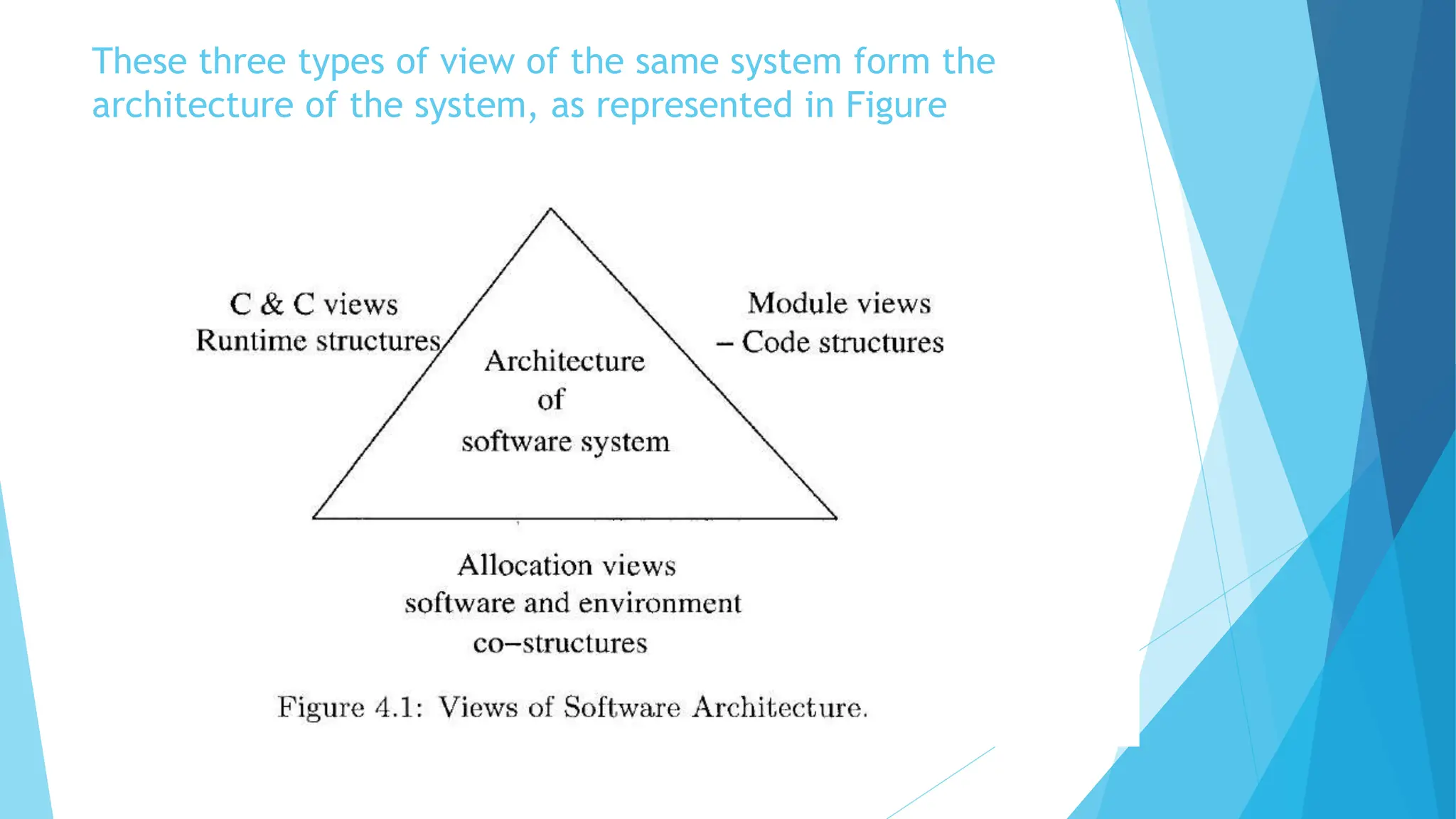
These three types of view of the same system form the
architecture of the system, as represented in Figure
Architecture Views
 Module:-
 In a module view, the system is viewed as a collection of code units, each
implementing some part of the system functionality.
 That is, the main elements in this view are modules. These views are code-based
and do not explicitly represent any runtime structure of the system.
 Examples of modules are packages, a class, a procedure, a method, a collection
of functions, and a collection of classes.
 The relationships between these modules are also code-based and depend on
how code of a module interacts with another module.
 Examples of relationships in this view are "is a part of" (i.e., module B is a part
of module A), "uses or depends on" (a module A uses services of module B to
perform its own functions and correctness of module A depends on correctness of
module B,) and "generalization or specialization" (a module B is a generalization
of a module A.)
Architecture Views
 Component and Connector (C&C) view:-
 The system is viewed as a collection of runtime entities called
components.
 That is, a component is a unit which has an identity in the executing
system.
 Objects (not classes), a collection of objects, and a process are
examples of components.
 While executing, components need to interact with others to support the
system services.
 Connectors provide means for this interaction.
 Shared data can also act as a connector.
 If the components use some middleware to communicate and
coordinate, then the middleware is a connector.
Architecture Views
 Allocation View :-
 An allocation view focuses on how the different software units are allocated
to resources like the hardware, file systems, and people.
 That is, an allocation view specifies the relationship between software
elements and elements of the environments in which the software system is
executed.
Component and Connector View
 Component and Connector (C&C) architecture view of a system has two
main elements—components and connectors.
 Components are usually computational elements or data stores that
have some presence during the system execution.
 Connectors define the means of interaction between these
components. A C&C view of the system defines the components, and
which component is connected to which and through what connector.
 A C&C view describes a runtime structure of the system—what
components exist when the system is executing and how they interact
during the execution.
 The C&C structure is essentially a graph, with components as nodes and
connectors as edges.
Components
 Components are generally units of computation or data stores in the
system.
 A component has a name, which is generally chosen to represent the role
of the component or the function it performs.
 The name also provides a unique identity to the component, which is
necessary for referencing details about the component in the supporting
documents.
 In a box-and-line diagram, often all components are represented as
rectangular boxes.
 Such an approach will require that types of the components are described
separately and the reader has to read the description to figure out the
types of the components.
Components
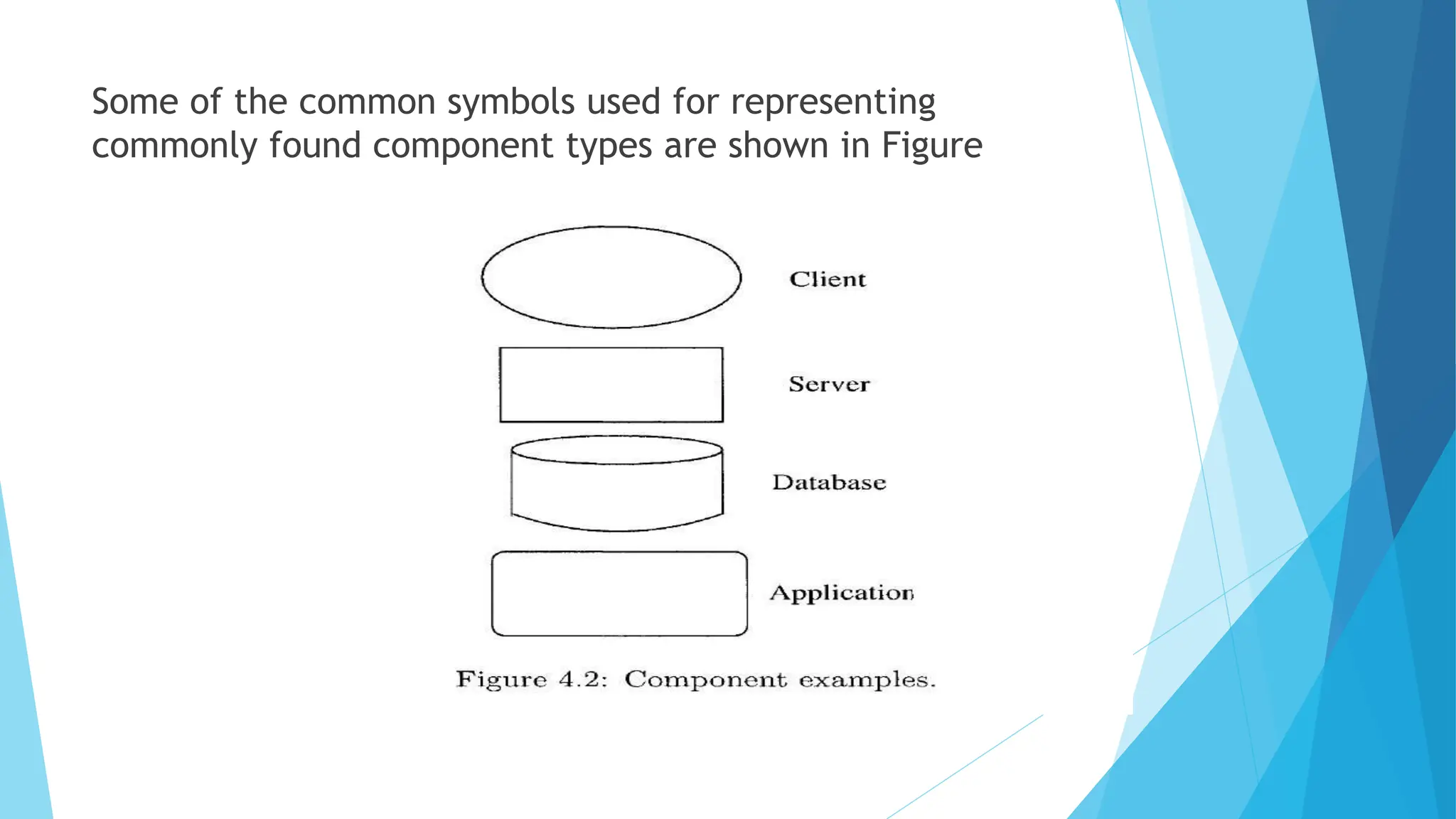
 It is much better to use a different symbol/notation for each different
component type.
 If there are multiple components of the same type, then each of these
components will be represented using the same symbol they will be
distinguished from each other by their names.
 Components use interfaces to communicate with other components.
The interfaces are sometimes called ports.
 A component must clearly specify its ports. In a diagram, this is
typically done by putting suitable marks on the edges of the symbol
being used for the component.
 There is no standard list of component types.
Some of the common symbols used for representing
commonly found component types are shown in Figure

software engineering Architecture and design Unit 3.pptx

  • 1.
    SOFTWARE ENGINEERING UNIT –3 SOFTWARE ARCHITECTURE AND DESIGN
  • 2.
    INTRODUCTION TO SOFTWAREDESIGN  Software Design is more creative than analysis.  It is helpful in problem solving activity.  Software design is a process to transform user requirements into some suitable form which helps the programmer in software coding and implementation.  Software design is the first step in SDLC life cycle which moves the focus from problem domain to solution domain.  It tries to specify how to fulfill the requirement in SRS.  In software design, we consider the system to be a set of components or modules with clearly defined behaviors & boundaries.
  • 3.
    Role of SoftwareArchitecture  What is Architecture?  Architecture is a design of a system which gives a very high level view of the parts of the system and how they are related to form the whole system.  That is, architecture partitions the system in logical parts such that each part can be comprehended independently, and then describes the system in terms of these parts and the relationship between these parts.  Any complex system can be partitioned in many different ways, each providing an useful view and each having different types of logical parts.  Definitions of software architecture is “ the software architecture of a system is the structure or structures of the system, which comprise software elements, the externally visible properties of those elements,
  • 4.
    Role of SoftwareArchitecture  Some of the important uses that software architecture descriptions play are :- 1. Understanding and communication: i) An architecture description is primarily to communicate the architecture to its various stakeholders, which include the users who will use the system, the clients who commissioned the system, the builders who will build the system, and, of course, the architects. ii) An architecture description is an important means of communication between these various stakeholders. iii) To facilitate communication, software architecture descriptions must facilitate the understanding of systems.
  • 5.
    Role of SoftwareArchitecture  2. Reuse:  Architecture descriptions can help software reuse.  Reuse is considered one of the main techniques by which productivity can be improved, thereby reducing the cost of software.  The architecture has to be chosen in a manner such that the components which have to be reused can fit properly and together with other components that may be developed, they provide the features that are needed.  Architecture also facilitates reuse among products that are similar and building product families such that the common parts of these different but similar products can be reused
  • 6.
    Role of SoftwareArchitecture  3. Construction and Evolution :-  As architecture partitions the system into parts, some architecture provided partitioning can naturally be used for constructing the system.  Which also requires that the system be broken into parts such that different teams (or individuals) can separately work on different parts.  A suitable partitioning in the architecture can provide the project with the parts that need to be built to build the system.  The construction of a software system usually does not end in delivery of the product—a software system also evolves with time.  During evolution, often new features are added to the system. The architecture of the system can help in deciding where to add the new features with minimum complexity and effort.
  • 7.
    Role of SoftwareArchitecture  4.Analysis:-  It is highly desirable if some important properties about the behavior of the system can be determined before the system is actually built.  This will allow the designers to consider alternatives and select the one that will best suit the needs.  Many engineering disciplines use models to analyze design of a product for its cost, reliability, performance, etc.  Architecture opens such possibilities for software also.  It is possible (thought the methods are not fully developed or standardized yet) to analyze or predict the properties of the system being built from its architecture.
  • 8.
    Architecture Views  Thereis a general view emerging that there is no unique architecture of a system.  The situation is similar to that of civil construction a discipline that is the original user of the concept of architecture and from where the concept of software architecture has been borrowed  For a building, if you want to see the floor plan, you are shown one set of drawings. If you are an electrical engineer and want to see how the electricity distribution has been planned, you will be shown another set of drawings. And if you are interested in safety and firefighting, another set of drawings is used. These drawings are not independent of each other—they are all about the same building.  Each drawing provides a different view of the building, a view that focuses on explaining one aspect of the building and tries to a good job.
  • 9.
    Architecture Views  Similaris the situation with software architecture.  In software, the different drawings are called views.  A view represents the system as composed of some types of elements and relationships between them.  Which elements are used by a view, depends on what the view wants to highlight.  Different views expose different properties and attributes, thereby allowing the stakeholders and analysts to properly evaluate those attributes for the system.  By focusing only on some aspects of the system, a view reduces the complexity that a reader has to deal with at a time.  A view describes a structure of the system.  Most of the proposed views generally belong to one of these three types  Module •  Component and connector  Allocation
  • 10.
    These three typesof view of the same system form the architecture of the system, as represented in Figure
  • 11.
    Architecture Views  Module:- In a module view, the system is viewed as a collection of code units, each implementing some part of the system functionality.  That is, the main elements in this view are modules. These views are code-based and do not explicitly represent any runtime structure of the system.  Examples of modules are packages, a class, a procedure, a method, a collection of functions, and a collection of classes.  The relationships between these modules are also code-based and depend on how code of a module interacts with another module.  Examples of relationships in this view are "is a part of" (i.e., module B is a part of module A), "uses or depends on" (a module A uses services of module B to perform its own functions and correctness of module A depends on correctness of module B,) and "generalization or specialization" (a module B is a generalization of a module A.)
  • 12.
    Architecture Views  Componentand Connector (C&C) view:-  The system is viewed as a collection of runtime entities called components.  That is, a component is a unit which has an identity in the executing system.  Objects (not classes), a collection of objects, and a process are examples of components.  While executing, components need to interact with others to support the system services.  Connectors provide means for this interaction.  Shared data can also act as a connector.  If the components use some middleware to communicate and coordinate, then the middleware is a connector.
  • 13.
    Architecture Views  AllocationView :-  An allocation view focuses on how the different software units are allocated to resources like the hardware, file systems, and people.  That is, an allocation view specifies the relationship between software elements and elements of the environments in which the software system is executed.
  • 14.
    Component and ConnectorView  Component and Connector (C&C) architecture view of a system has two main elements—components and connectors.  Components are usually computational elements or data stores that have some presence during the system execution.  Connectors define the means of interaction between these components. A C&C view of the system defines the components, and which component is connected to which and through what connector.  A C&C view describes a runtime structure of the system—what components exist when the system is executing and how they interact during the execution.  The C&C structure is essentially a graph, with components as nodes and connectors as edges.
  • 15.
    Components  Components aregenerally units of computation or data stores in the system.  A component has a name, which is generally chosen to represent the role of the component or the function it performs.  The name also provides a unique identity to the component, which is necessary for referencing details about the component in the supporting documents.  In a box-and-line diagram, often all components are represented as rectangular boxes.  Such an approach will require that types of the components are described separately and the reader has to read the description to figure out the types of the components.
  • 16.
    Components  It ismuch better to use a different symbol/notation for each different component type.  If there are multiple components of the same type, then each of these components will be represented using the same symbol they will be distinguished from each other by their names.  Components use interfaces to communicate with other components. The interfaces are sometimes called ports.  A component must clearly specify its ports. In a diagram, this is typically done by putting suitable marks on the edges of the symbol being used for the component.  There is no standard list of component types.
  • 17.
    Some of thecommon symbols used for representing commonly found component types are shown in Figure