Prepared by Dr.T.Thendral 06.07.2023
 SDLC – Software Development Life Cycle
 Process model is a framework that describes the
activities, actions, tasks, milestones and work products
performed at each stage of a software development
project that leads to a high quality software
Prepared by Dr.T.Thendral 06.07.2023
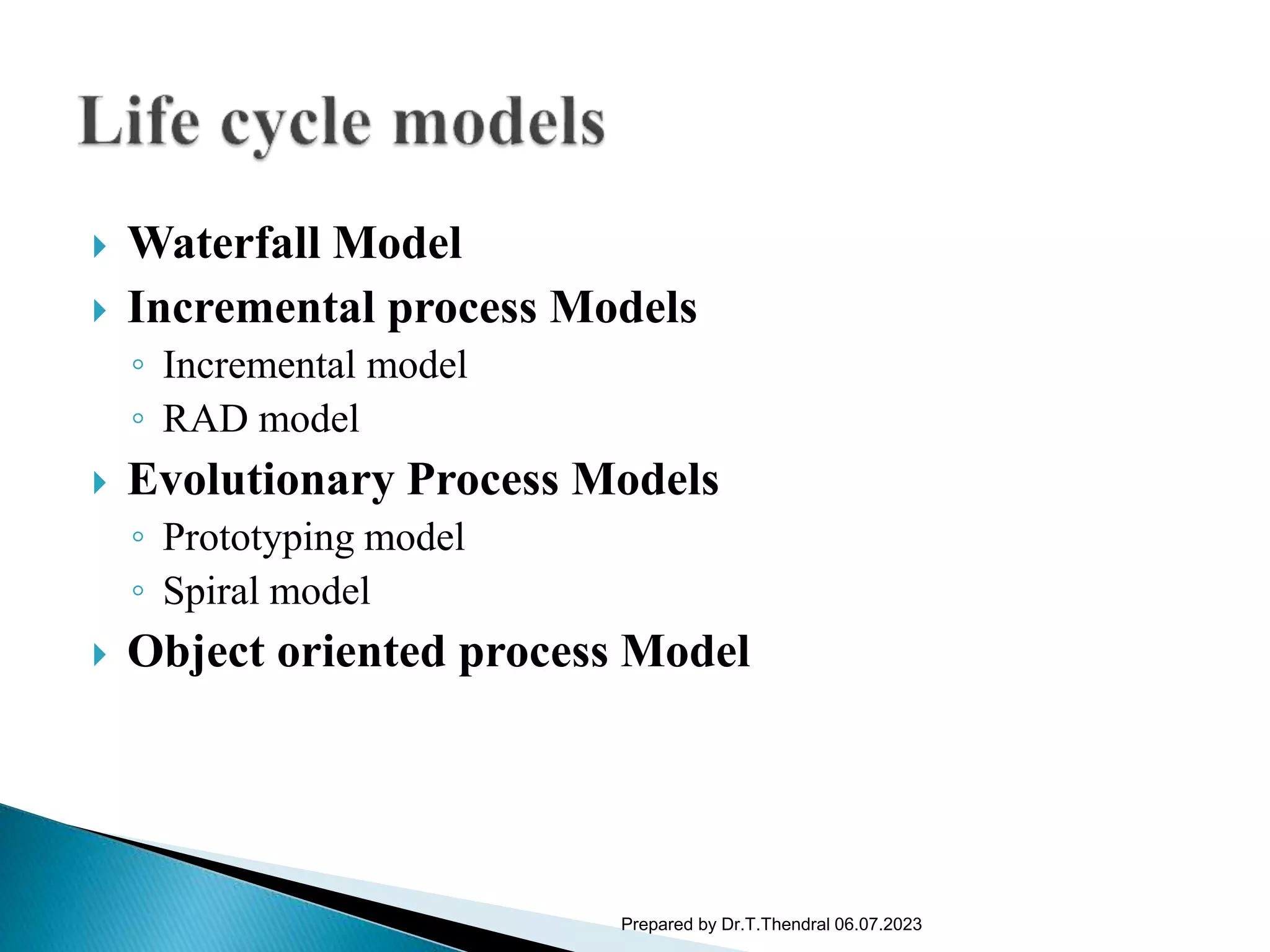
 Waterfall Model
 Incremental process Models
◦ Incremental model
◦ RAD model
 Evolutionary Process Models
◦ Prototyping model
◦ Spiral model
 Object oriented process Model
Prepared by Dr.T.Thendral 06.07.2023
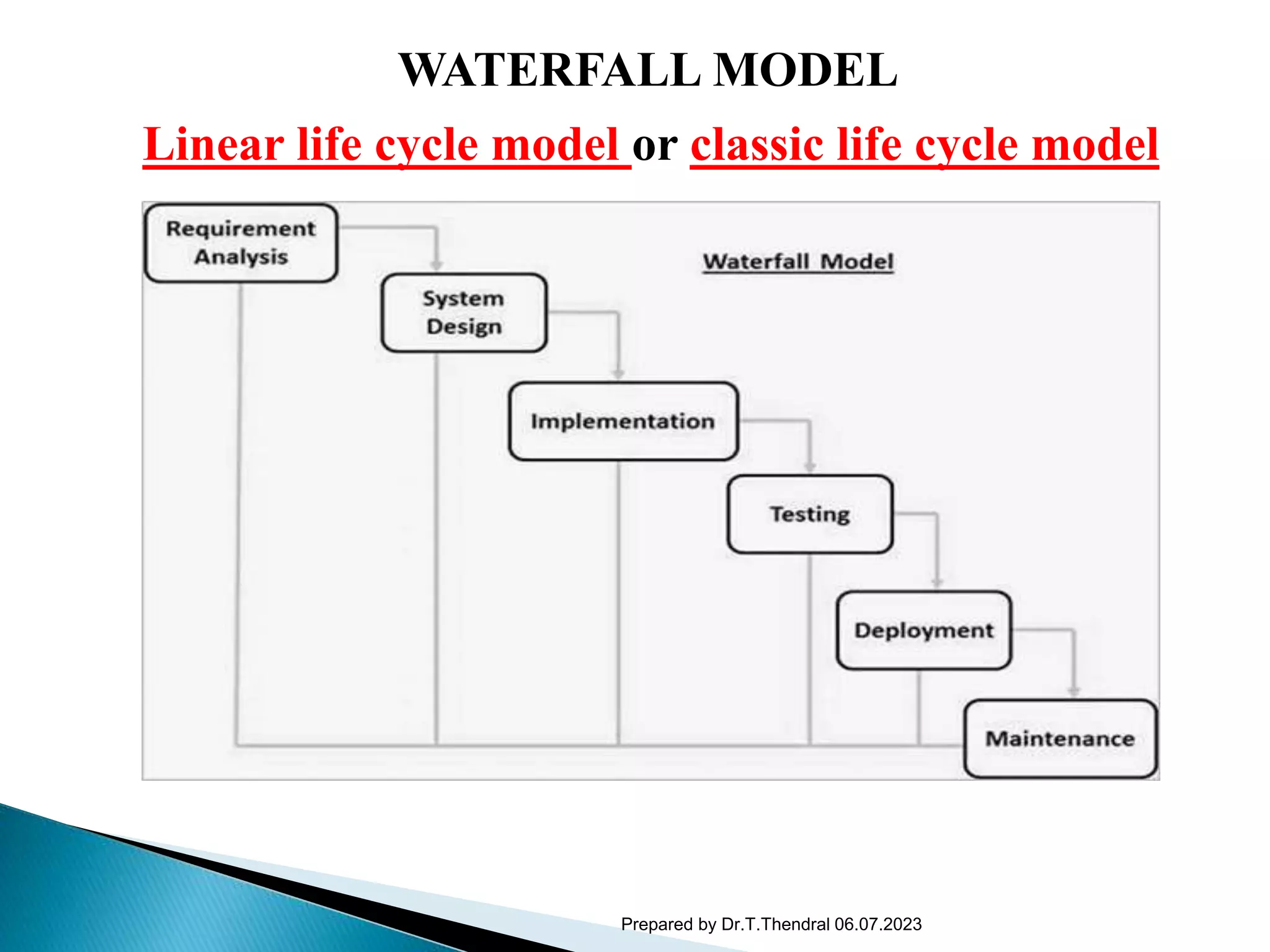
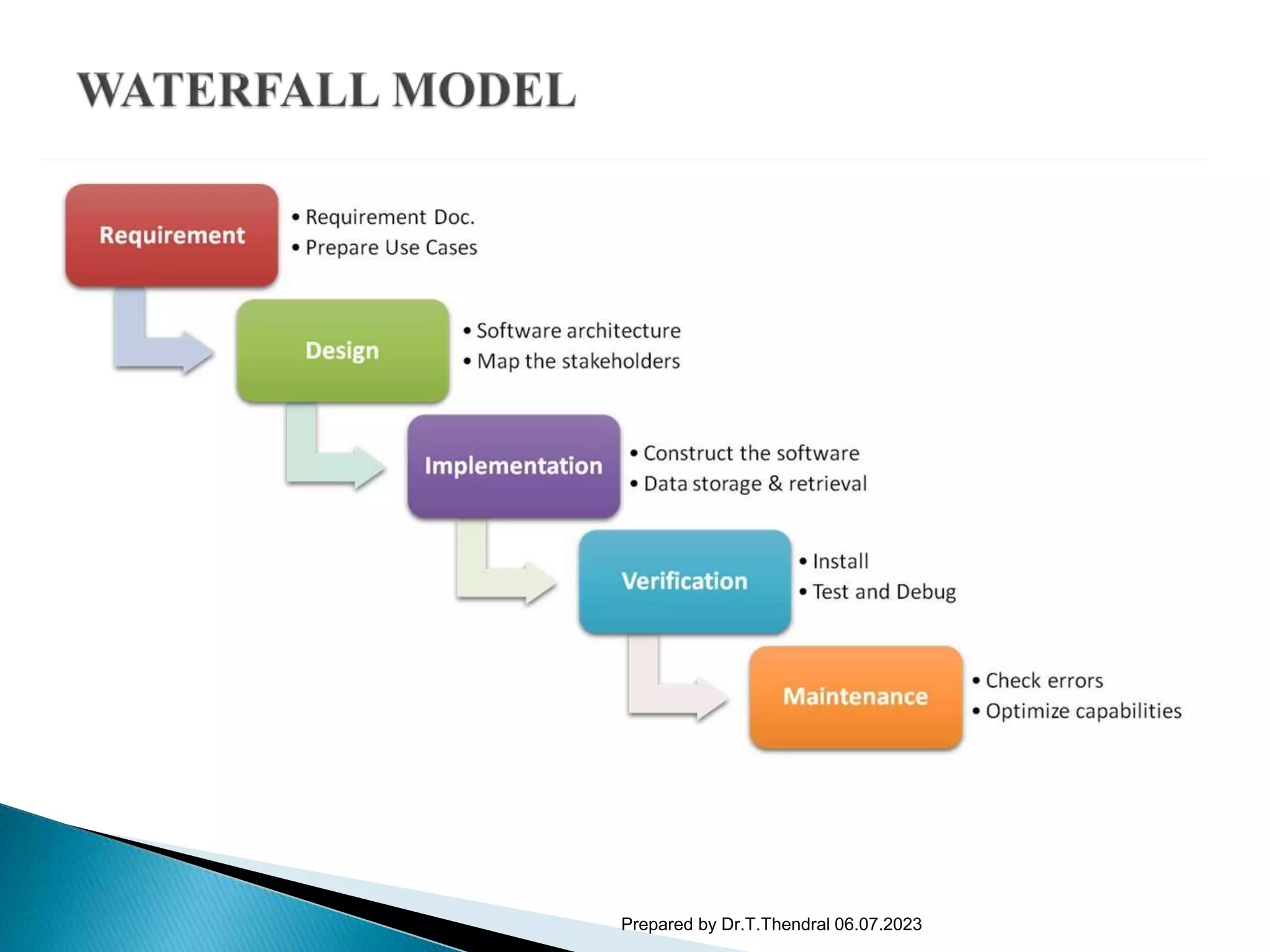
WATERFALL MODEL
Linear life cycle model or classic life cycle model
Prepared by Dr.T.Thendral 06.07.2023
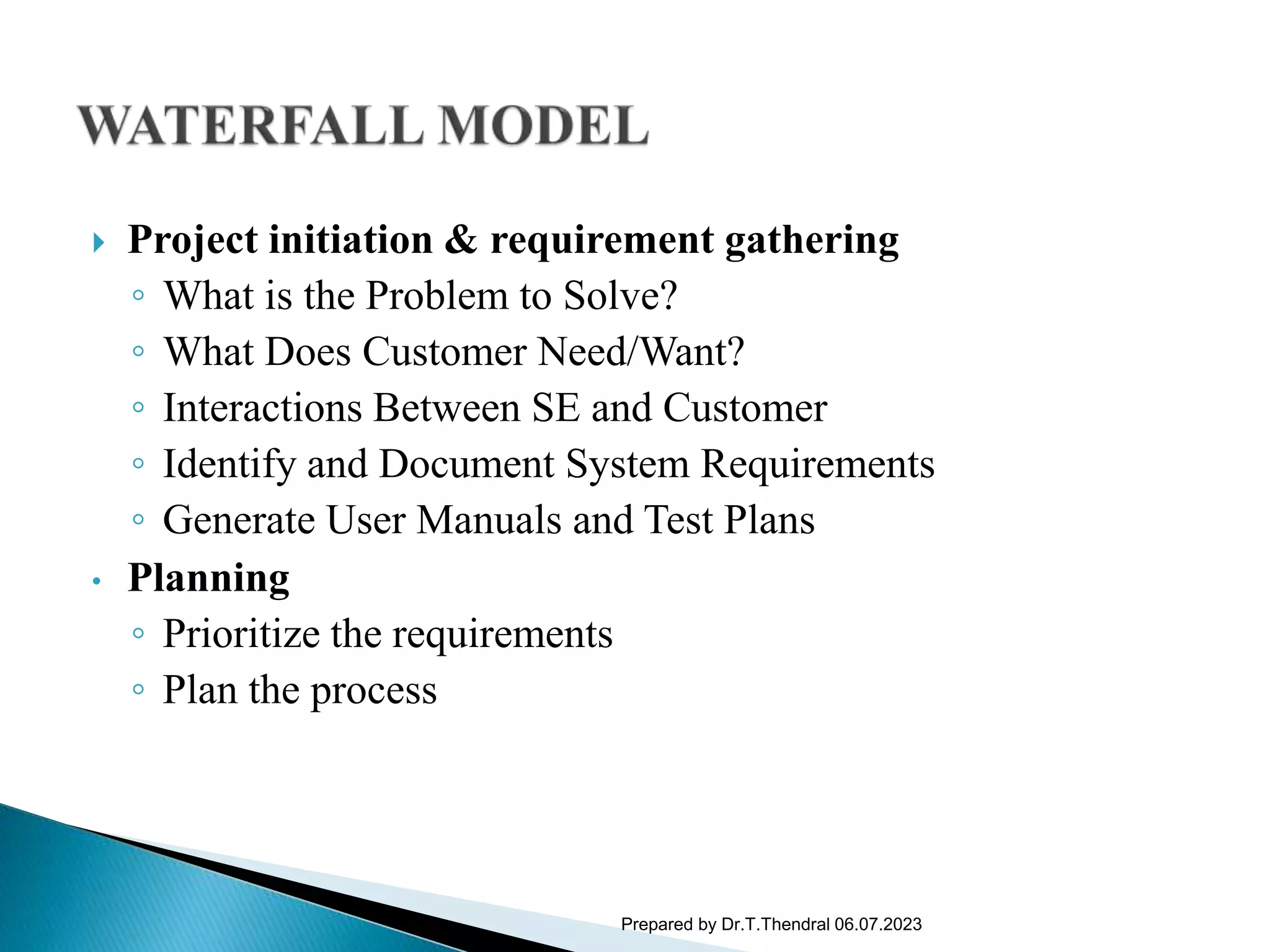
 Project initiation & requirement gathering
◦ What is the Problem to Solve?
◦ What Does Customer Need/Want?
◦ Interactions Between SE and Customer
◦ Identify and Document System Requirements
◦ Generate User Manuals and Test Plans
• Planning
◦ Prioritize the requirements
◦ Plan the process
Prepared by Dr.T.Thendral 06.07.2023
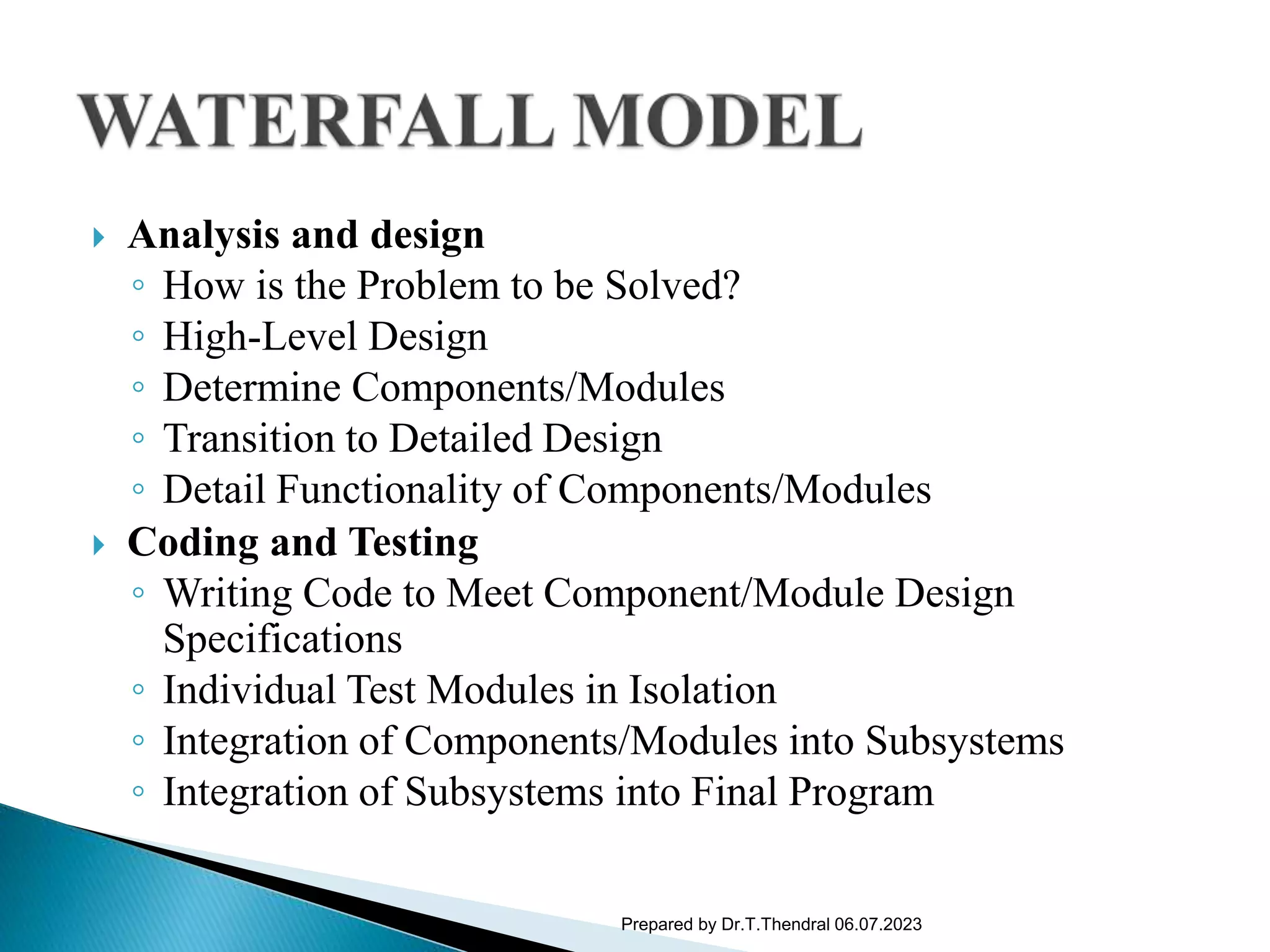
 Analysis and design
◦ How is the Problem to be Solved?
◦ High-Level Design
◦ Determine Components/Modules
◦ Transition to Detailed Design
◦ Detail Functionality of Components/Modules
 Coding and Testing
◦ Writing Code to Meet Component/Module Design
Specifications
◦ Individual Test Modules in Isolation
◦ Integration of Components/Modules into Subsystems
◦ Integration of Subsystems into Final Program
Prepared by Dr.T.Thendral 06.07.2023
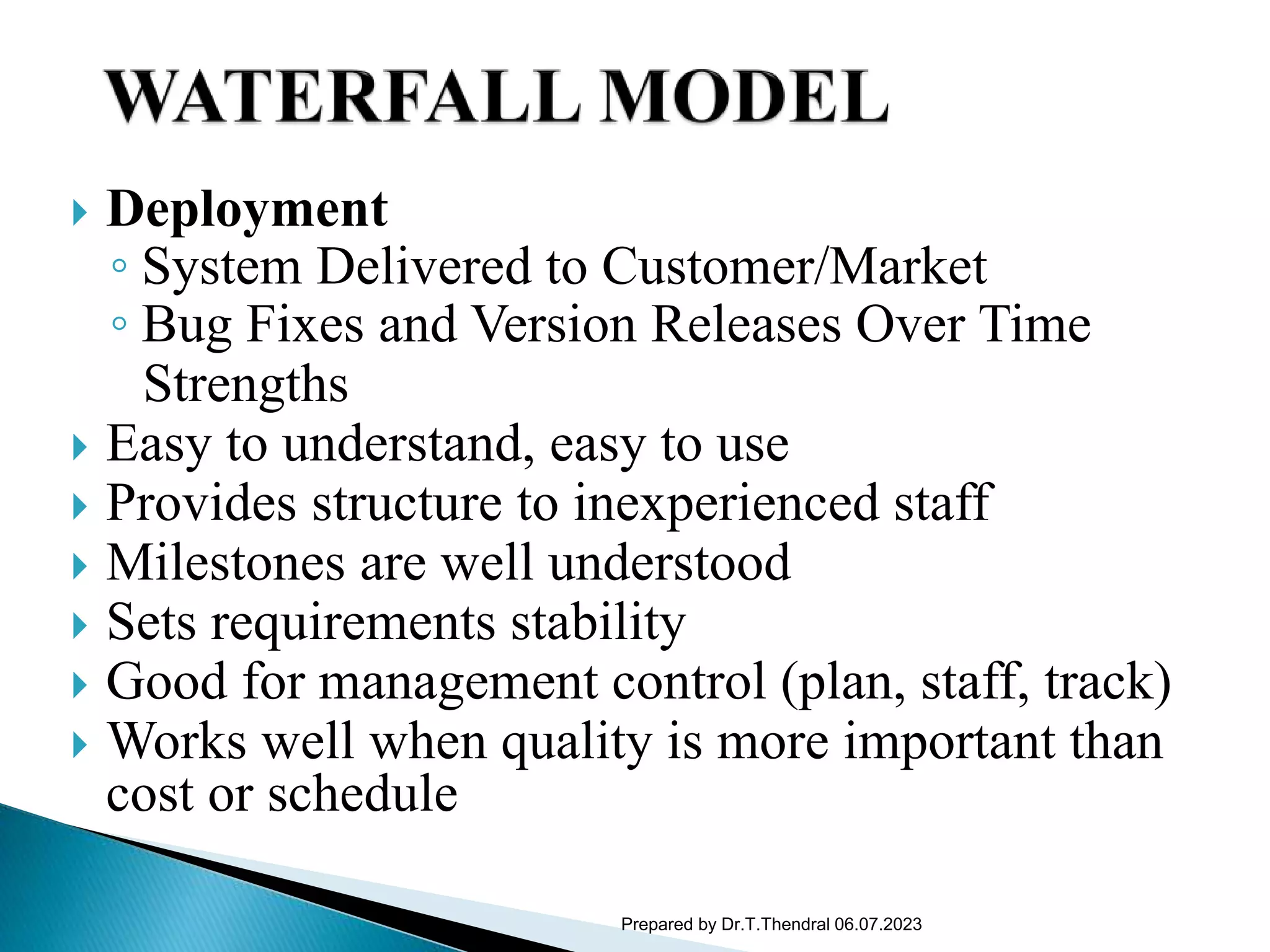
 Deployment
◦ System Delivered to Customer/Market
◦ Bug Fixes and Version Releases Over Time
Strengths
 Easy to understand, easy to use
 Provides structure to inexperienced staff
 Milestones are well understood
 Sets requirements stability
 Good for management control (plan, staff, track)
 Works well when quality is more important than
cost or schedule
Prepared by Dr.T.Thendral 06.07.2023
 All projects cannot follow linear process
 All requirements must be known upfront
 Few business systems have stable
requirements
 The customer must have patience
 A working version of the program will not be
available until late in the project time-span
 Leads to ‘blocking states’
 Inappropriate to changes
Prepared by Dr.T.Thendral 06.07.2023
 Requirements are very well known
 Product definition is stable
 Technology is understood
 New version of an existing product
 Porting an existing product to a new platform
Prepared by Dr.T.Thendral 06.07.2023
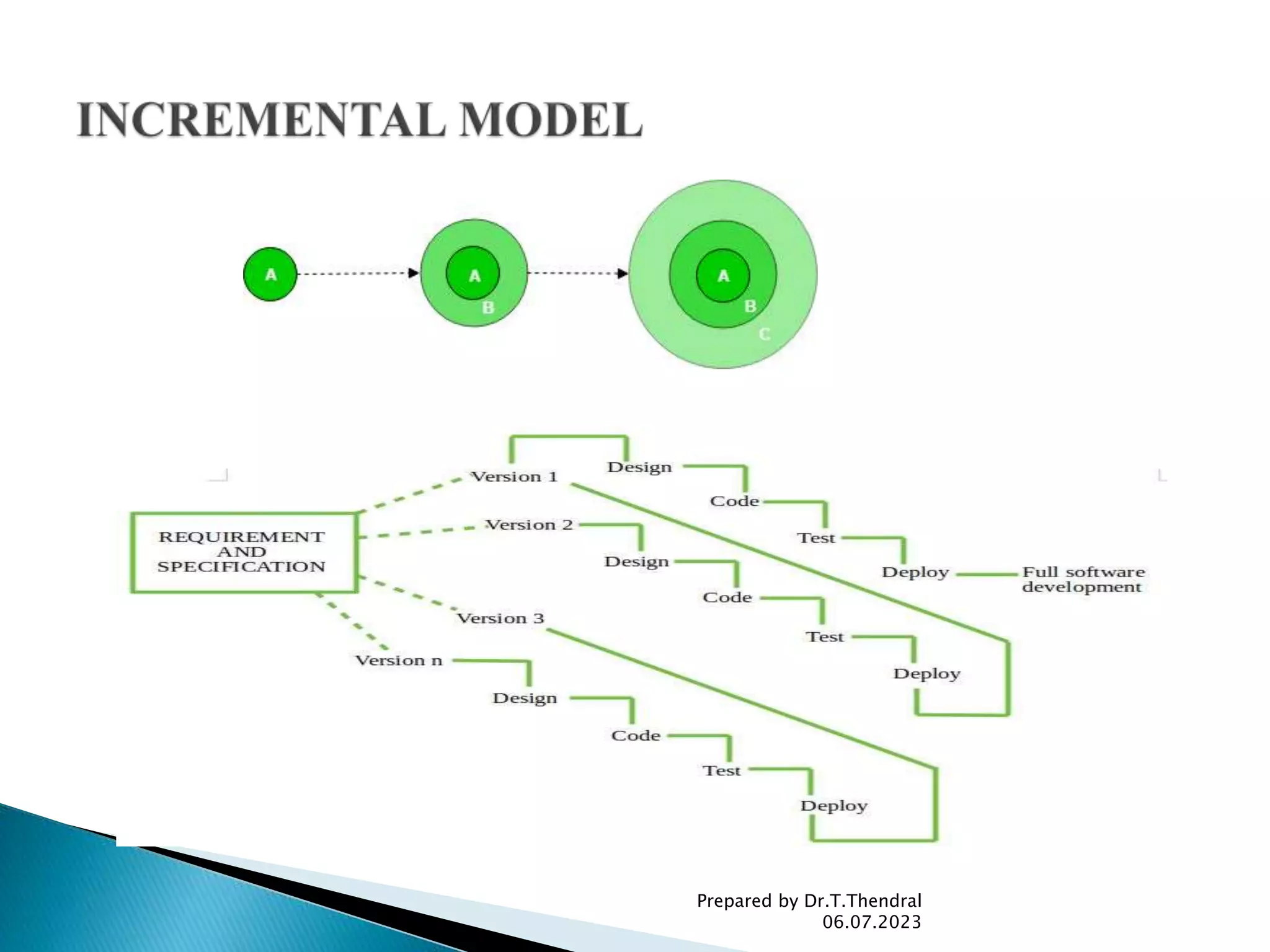
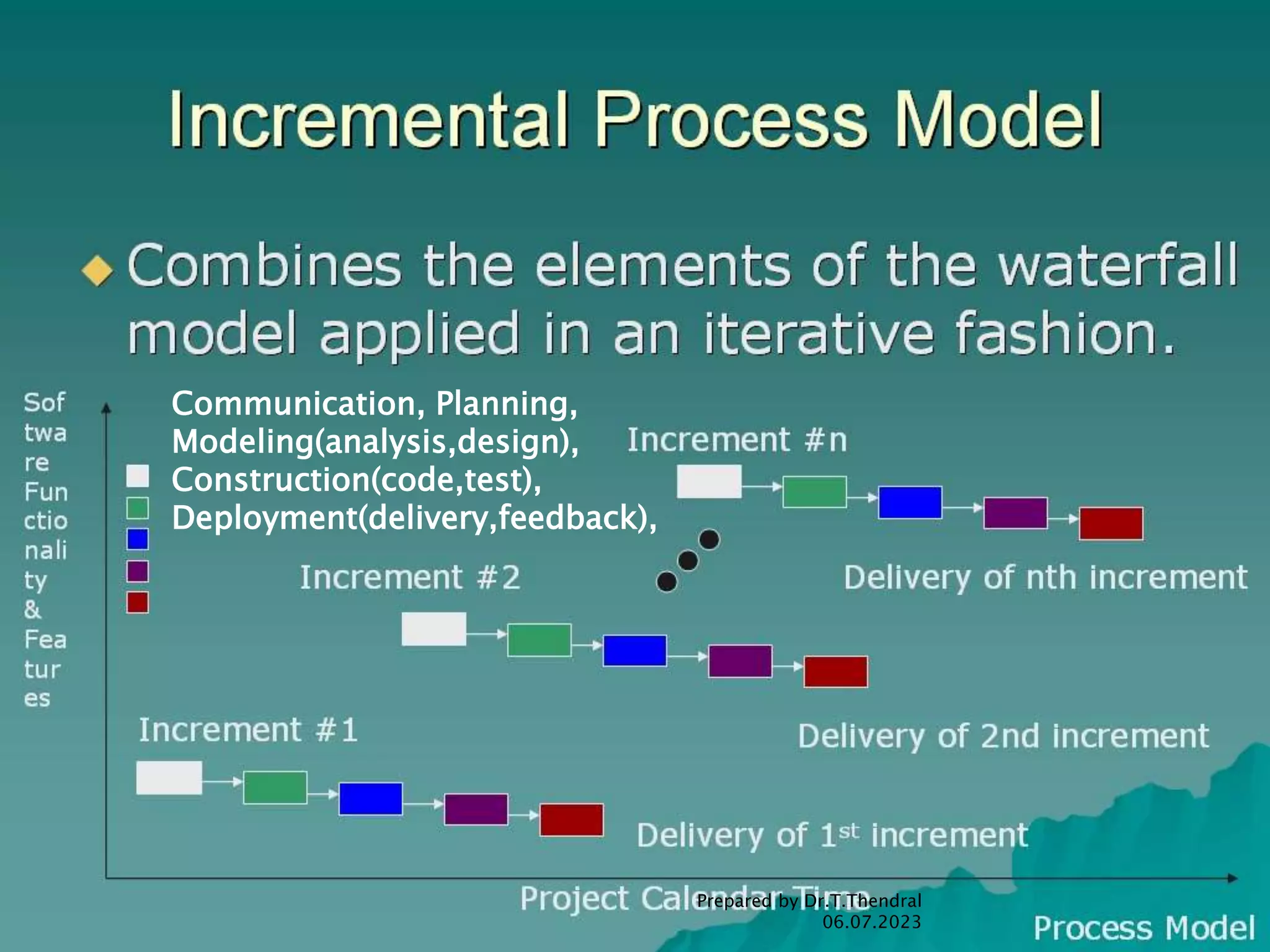
 Combines the elements of waterfall model in an iterative
fashion
 Construct a partial implementation of a total system
 Then slowly add increased functionality
 User requirements are prioritised and the highest priority
requirements are included in early increments
 Each subsequent release of the system adds function to the
previous release, until all designed functionality has been
implemented
Prepared by Dr.T.Thendral 06.07.2023
Prepared by Dr.T.Thendral
06.07.2023
Prepared by Dr.T.Thendral
06.07.2023
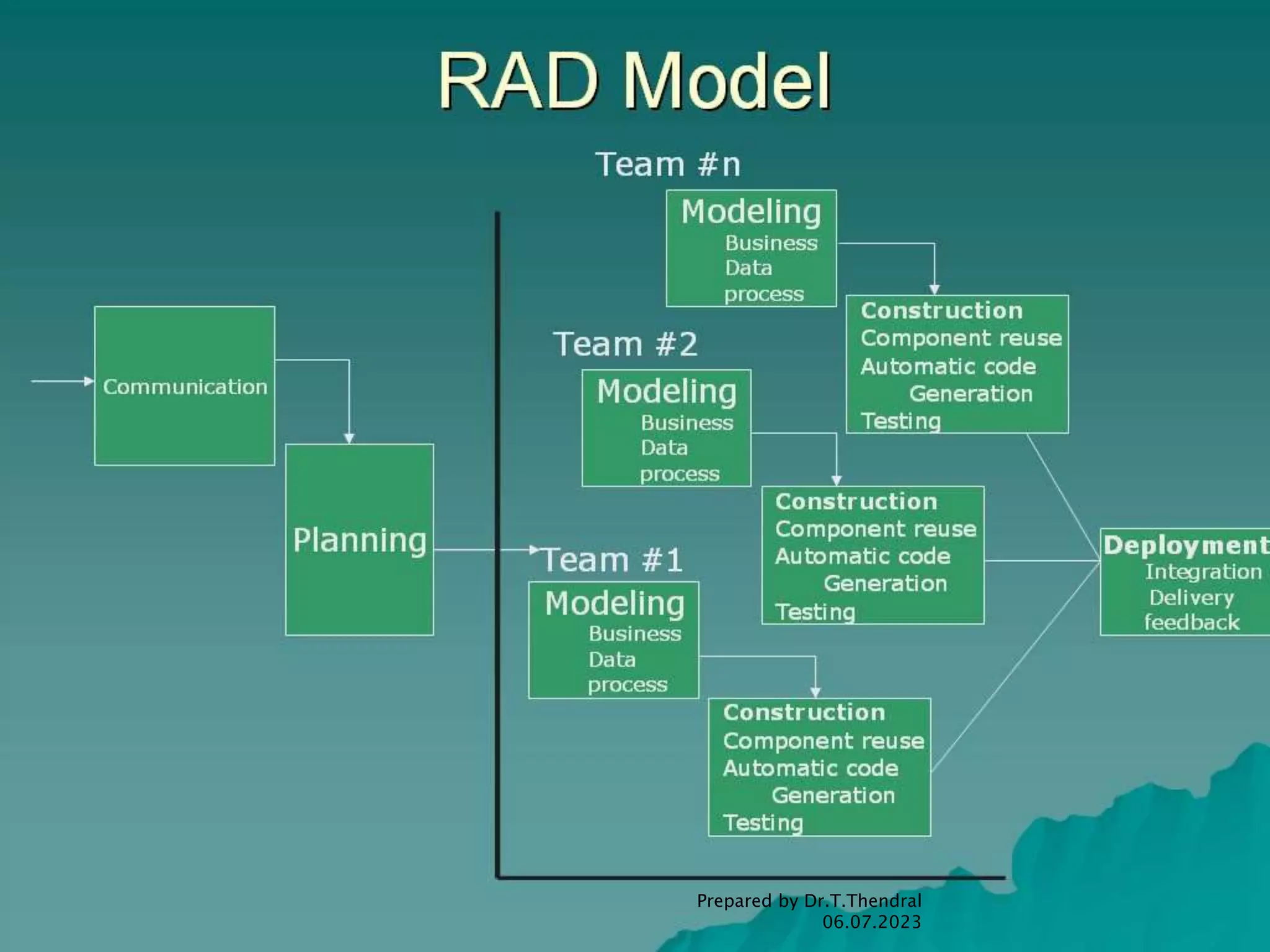
Communication, Planning,
Modeling(analysis,design),
Construction(code,test),
Deployment(delivery,feedback),
 The Incremental Approach uses a set number of steps and
development goes from start to finish in a linear path of
progression.
 The Iterative Approach has no set number of steps, rather
development is done in cycles.
 Incremental Model is a process of software development
where requirements are broken down into multiple standalone
modules of software development cycle.
 Incremental development is done in steps from analysis
design, implementation, testing/verification, maintenance.
Prepared by Dr.T.Thendral
06.07.2023
 Requires good planning and design
 Requires early definition of a complete and
fully functional system to allow for the
definition of increments
 Well-defined module interfaces are required
(some will be developed long before others)
 Total cost of the complete system is not lower
Prepared by Dr.T.Thendral
06.07.2023
 When staffing is not available by deadline
 Most of the requirements are known up-front but are
expected to evolve over time
 When the software can be broken into increments and
each increment represent a solution
 A need to get basic functionality to the market early
 On projects which have lengthy development
schedules
 On a project with new technology
Prepared by Dr.T.Thendral
06.07.2023
 An incremental process model that emphasizes short
development cycle
 “High-speed” adaptation of the waterfall model.
 RAD approach also maps into the generic framework
activities
Prepared by Dr.T.Thendral
06.07.2023
Prepared by Dr.T.Thendral
06.07.2023
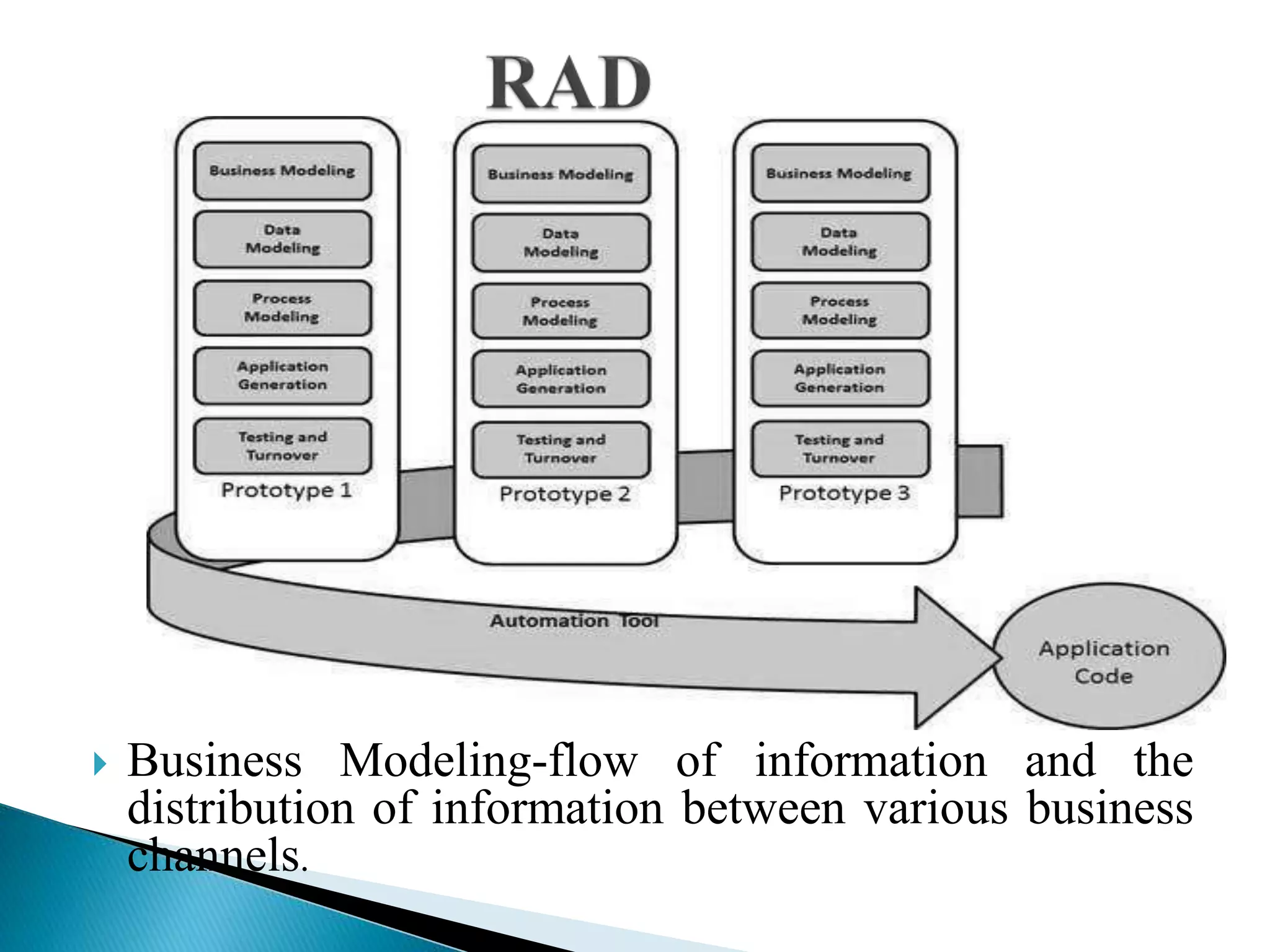
 Business Modeling-flow of information and the
distribution of information between various business
channels.
 The information gathered in the Business Modeling
phase is reviewed and analyzed to form sets of data
objects vital for the business.
 The attributes of all data sets is identified and
defined.
 The relation between these data objects are
established and defined in detail in relevance to the
business model.
 The data object sets defined in the Data Modeling
phase are converted to establish the business
information flow needed to achieve specific business
objectives as per the business model.
 The process model for any changes or enhancements
to the data object sets is defined in this phase.
 Process descriptions for adding, deleting, retrieving
or modifying a data object are given.
 The actual system is built and coding is done by
using automation tools to convert process and data
models into actual prototypes.
Testing and Turnover
 The overall testing time is reduced in the RAD model
as the prototypes are independently tested during
every iteration
 Changing requirements can be accommodated
 Progress can be measured
 Iteration time can be short with use of powerful RAD tools
 Productivity with fewer people in a short time
 Reduced development time
 Increases reusability of components
 Quick initial reviews occur
 Encourages customer feedback
 Integration from very beginning solves a lot of integration
issues
 Requires highly skilled developers/designers.
 High dependency on modeling skills.
 Inapplicable to cheaper projects as cost of modeling and
automated code generation is very high.
 Management complexity is more.
 Suitable for systems that are component based and
scalable.
 Requires user involvement throughout the life cycle.
 Suitable for project requiring shorter development times.
 For large projects, RAD requires sufficient human
resources to create the right number of RAD teams
 If developers & customers are not committed to
rapid-fire activities, RAD projects will fail.
 If the system cannot be properly modularized,
building the components will be problematic
 If high-performance is an issue, RAD may not work.
 RAD may be inappropriate when technical risks are
high
Prepared by Dr.T.Thendral 06.07.2023
 Reasonably well-known requirements
 User involved throughout the life cycle
 Project can be time-boxed
 Functionality delivered in increments
 High performance not required
 Low technical risks
 System can be modularized
Prepared by Dr.T.Thendral
06.07.2023
 These models produce an increasingly more
complete version of the software with each iteration
 When to use
◦ Tight market deadlines
◦ Well defined system requirements
◦ No details about system definition
Prepared by Dr.T.Thendral 06.07.2023
 A prototype is a partially developed product that
enables customers and developers to examine some
aspects of the proposed system and decide if it is
suitable or appropriate for the finished product
◦ Start with what is known about requirements
◦ Do a quick design
◦ Build the prototype by focusing on what will be
seen by the user
◦ Use the prototype to show the user and help
refining requirements
Prepared by Dr.T.Thendral 06.07.2023
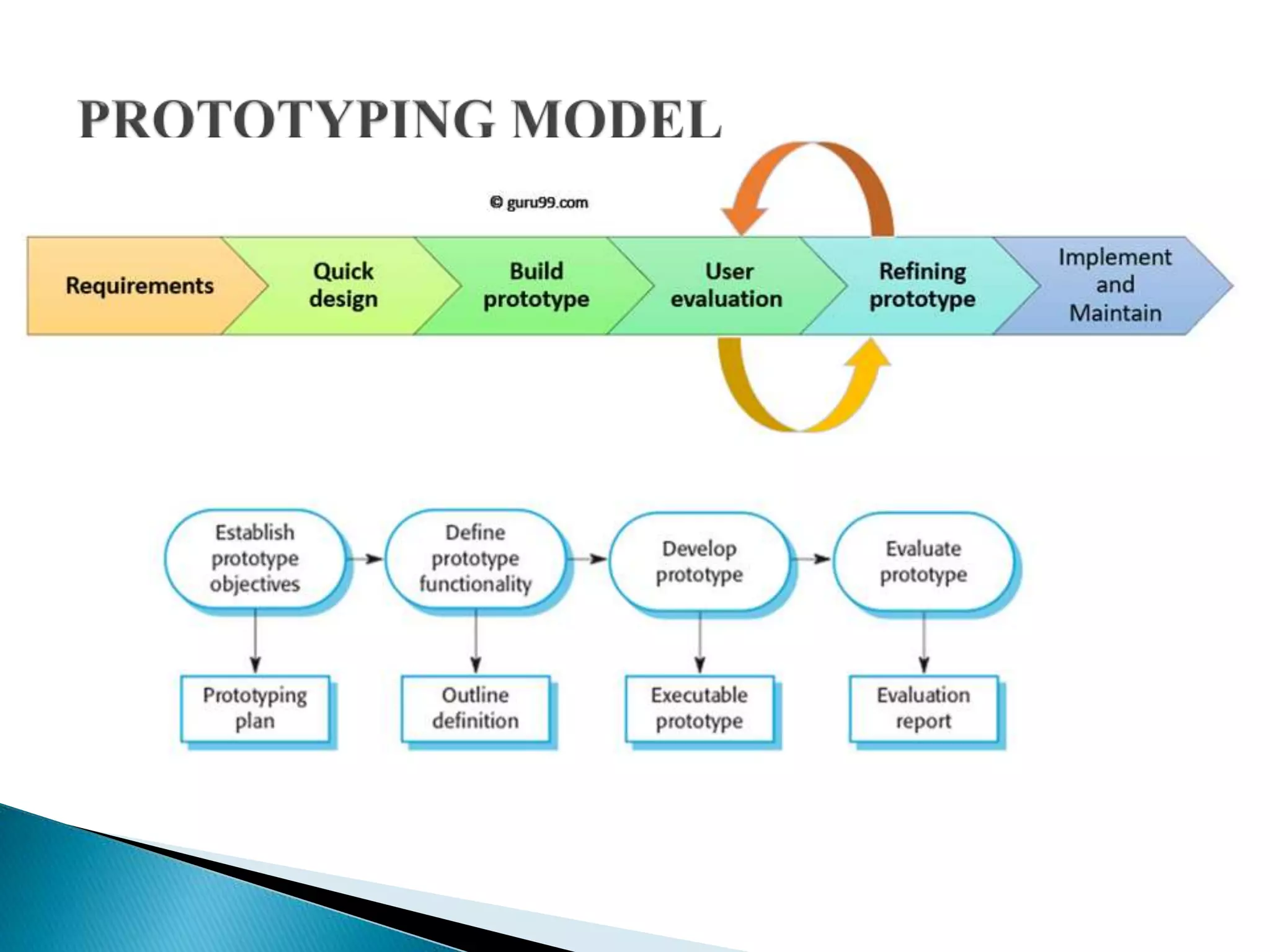
PROTOTYPING MODEL
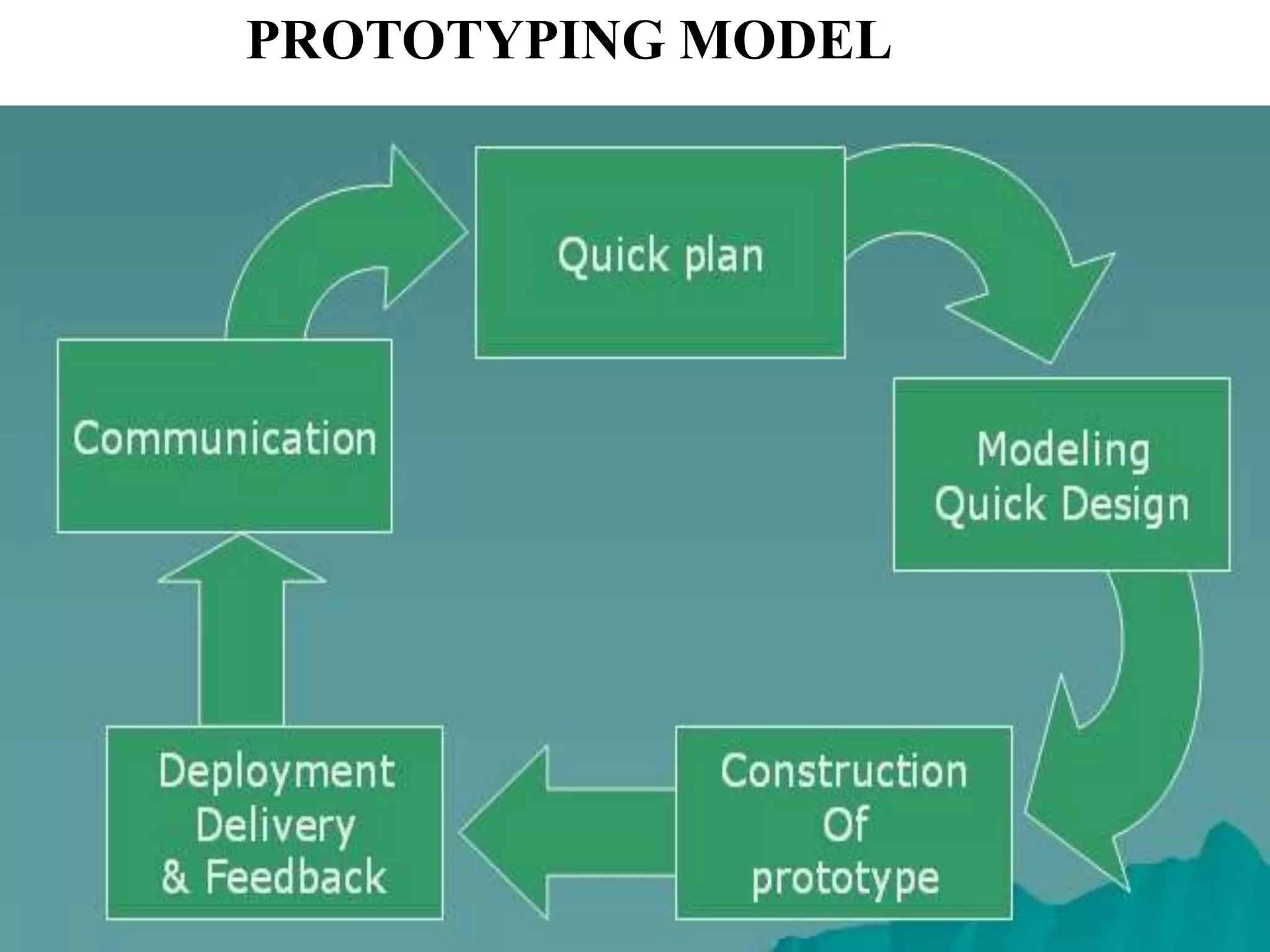
PROTOTYPING MODEL
Prepared by Dr.T.Thendral
06.07.2023
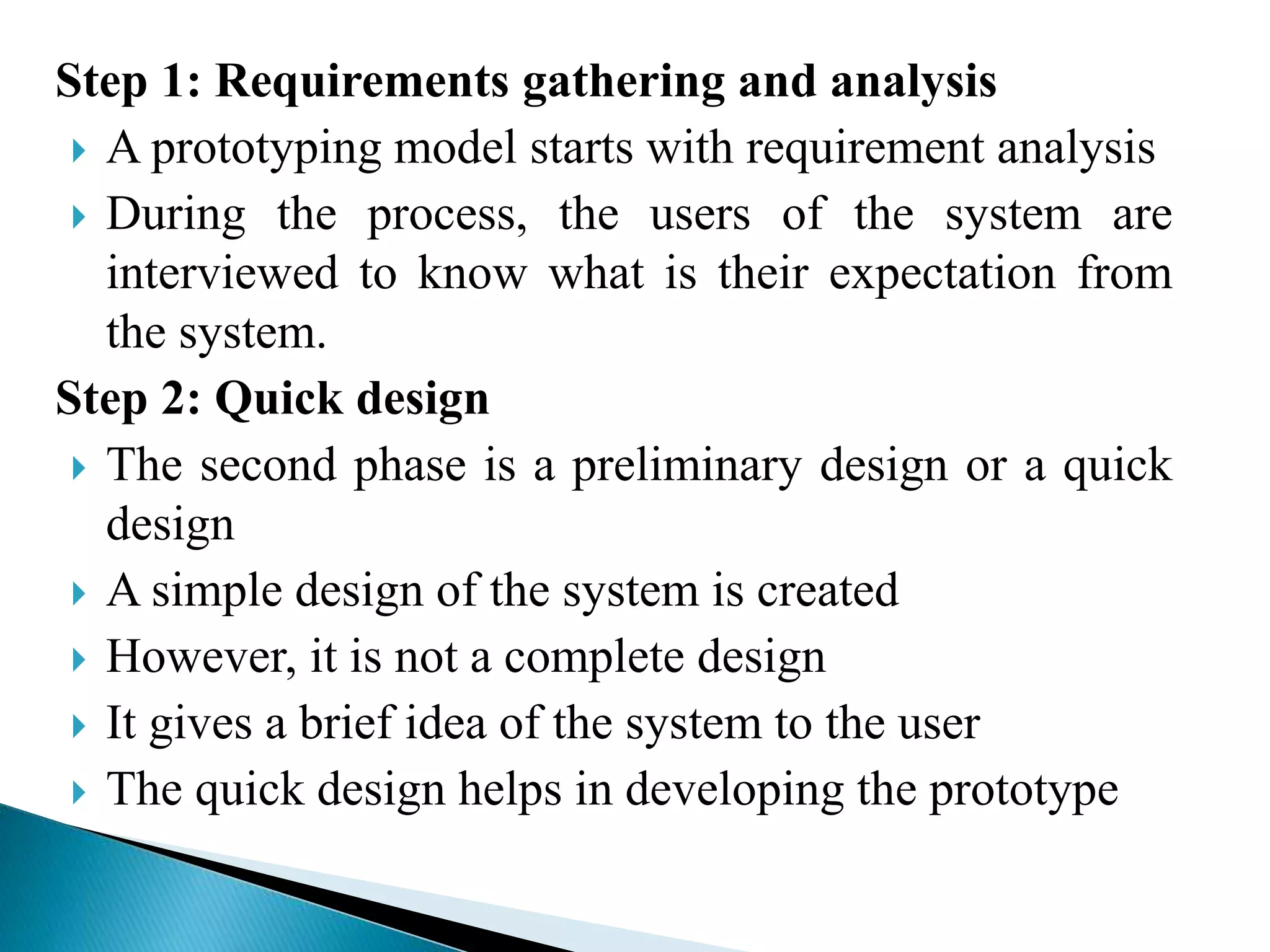
Step 1: Requirements gathering and analysis
 A prototyping model starts with requirement analysis
 During the process, the users of the system are
interviewed to know what is their expectation from
the system.
Step 2: Quick design
 The second phase is a preliminary design or a quick
design
 A simple design of the system is created
 However, it is not a complete design
 It gives a brief idea of the system to the user
 The quick design helps in developing the prototype
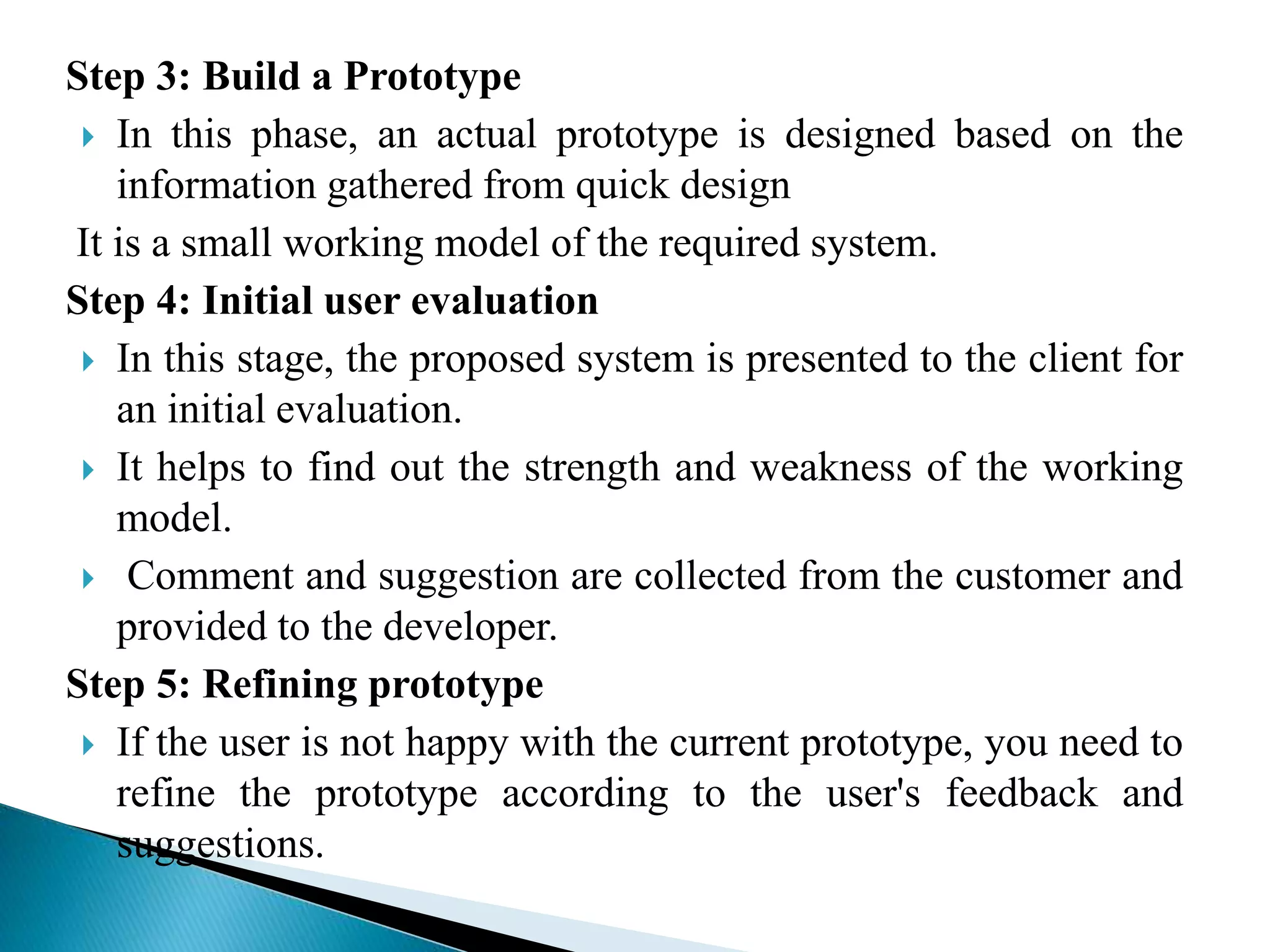
Step 3: Build a Prototype
 In this phase, an actual prototype is designed based on the
information gathered from quick design
It is a small working model of the required system.
Step 4: Initial user evaluation
 In this stage, the proposed system is presented to the client for
an initial evaluation.
 It helps to find out the strength and weakness of the working
model.
 Comment and suggestion are collected from the customer and
provided to the developer.
Step 5: Refining prototype
 If the user is not happy with the current prototype, you need to
refine the prototype according to the user's feedback and
suggestions.
 Customer sees what appears to be a working version of the
software and presumes that it is the final thing
 The developer often makes implementation compromises in
order to get a prototype working quickly
Only one advantage is actual software is engineered
with an eye toward quality
Prepared by Dr.T.Thendral
06.07.2023
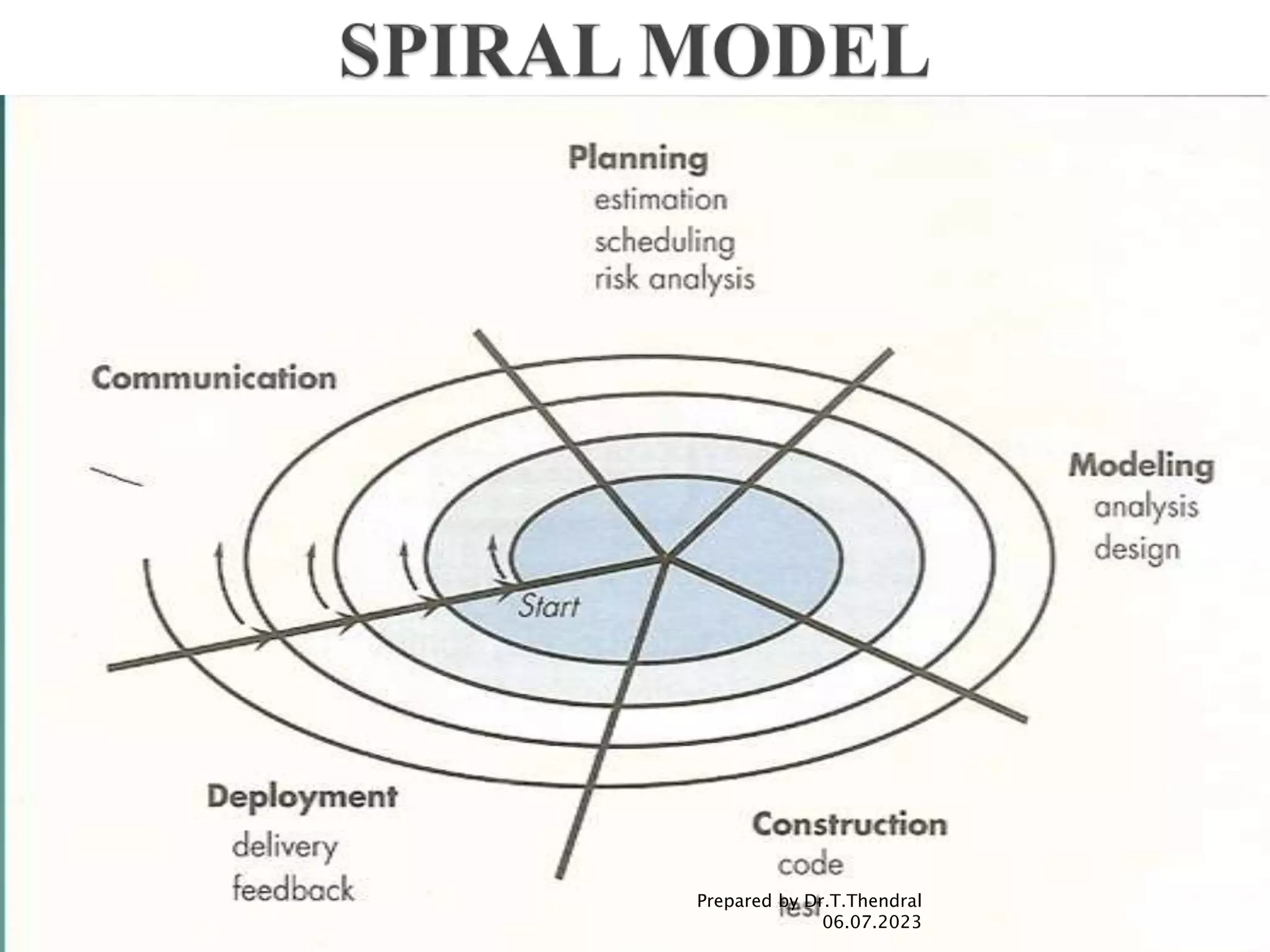
 It couples the iterative nature of prototyping with the
controlled and systematic aspects of the waterfall model
Process
 Adapted to complete life cycle
 Process is represented as a spiral rather than as a sequence of
activities with backtracking.
 Each loop in the spiral represents a phase in the process.
 No fixed phases such as specification or design - loops in the
spiral are chosen depending on what is required.
Prepared by Dr.T.Thendral
06.07.2023
Prepared by Dr.T.Thendral
06.07.2023
 Focuses attention on reuse options
 Focuses attention on early error elimination
 Puts quality objectives up front
 Integrates development and maintenance
 Provides a framework for hardware/software Development
Prepared by Dr.T.Thendral
06.07.2023
 It may be difficult to convince customers that the
evolutionary approach is controllable
 It demands risk assessment expertise and relies on this
expertise for success
 If a major risk is uncovered and managed, problems
will occur
Prepared by Dr.T.Thendral
06.07.2023
 When creation of a prototype is appropriate
 When costs and risk evaluation is important
 For medium to high-risk projects
 Long-term project commitment unwise because of
potential changes to economic priorities
 Users are unsure of their needs
 Requirements are complex
 New product line
 Significant changes are expected
Prepared by Dr.T.Thendral 06.07.2023

PROCESS MODELS.ppt

  • 1.
  • 2.
     SDLC –Software Development Life Cycle  Process model is a framework that describes the activities, actions, tasks, milestones and work products performed at each stage of a software development project that leads to a high quality software Prepared by Dr.T.Thendral 06.07.2023
  • 3.
     Waterfall Model Incremental process Models ◦ Incremental model ◦ RAD model  Evolutionary Process Models ◦ Prototyping model ◦ Spiral model  Object oriented process Model Prepared by Dr.T.Thendral 06.07.2023
  • 4.
    WATERFALL MODEL Linear lifecycle model or classic life cycle model Prepared by Dr.T.Thendral 06.07.2023
  • 5.
  • 6.
     Project initiation& requirement gathering ◦ What is the Problem to Solve? ◦ What Does Customer Need/Want? ◦ Interactions Between SE and Customer ◦ Identify and Document System Requirements ◦ Generate User Manuals and Test Plans • Planning ◦ Prioritize the requirements ◦ Plan the process Prepared by Dr.T.Thendral 06.07.2023
  • 7.
     Analysis anddesign ◦ How is the Problem to be Solved? ◦ High-Level Design ◦ Determine Components/Modules ◦ Transition to Detailed Design ◦ Detail Functionality of Components/Modules  Coding and Testing ◦ Writing Code to Meet Component/Module Design Specifications ◦ Individual Test Modules in Isolation ◦ Integration of Components/Modules into Subsystems ◦ Integration of Subsystems into Final Program Prepared by Dr.T.Thendral 06.07.2023
  • 8.
     Deployment ◦ SystemDelivered to Customer/Market ◦ Bug Fixes and Version Releases Over Time Strengths  Easy to understand, easy to use  Provides structure to inexperienced staff  Milestones are well understood  Sets requirements stability  Good for management control (plan, staff, track)  Works well when quality is more important than cost or schedule Prepared by Dr.T.Thendral 06.07.2023
  • 9.
     All projectscannot follow linear process  All requirements must be known upfront  Few business systems have stable requirements  The customer must have patience  A working version of the program will not be available until late in the project time-span  Leads to ‘blocking states’  Inappropriate to changes Prepared by Dr.T.Thendral 06.07.2023
  • 10.
     Requirements arevery well known  Product definition is stable  Technology is understood  New version of an existing product  Porting an existing product to a new platform Prepared by Dr.T.Thendral 06.07.2023
  • 11.
     Combines theelements of waterfall model in an iterative fashion  Construct a partial implementation of a total system  Then slowly add increased functionality  User requirements are prioritised and the highest priority requirements are included in early increments  Each subsequent release of the system adds function to the previous release, until all designed functionality has been implemented Prepared by Dr.T.Thendral 06.07.2023
  • 12.
  • 13.
    Prepared by Dr.T.Thendral 06.07.2023 Communication,Planning, Modeling(analysis,design), Construction(code,test), Deployment(delivery,feedback),
  • 14.
     The IncrementalApproach uses a set number of steps and development goes from start to finish in a linear path of progression.  The Iterative Approach has no set number of steps, rather development is done in cycles.  Incremental Model is a process of software development where requirements are broken down into multiple standalone modules of software development cycle.  Incremental development is done in steps from analysis design, implementation, testing/verification, maintenance. Prepared by Dr.T.Thendral 06.07.2023
  • 15.
     Requires goodplanning and design  Requires early definition of a complete and fully functional system to allow for the definition of increments  Well-defined module interfaces are required (some will be developed long before others)  Total cost of the complete system is not lower Prepared by Dr.T.Thendral 06.07.2023
  • 16.
     When staffingis not available by deadline  Most of the requirements are known up-front but are expected to evolve over time  When the software can be broken into increments and each increment represent a solution  A need to get basic functionality to the market early  On projects which have lengthy development schedules  On a project with new technology Prepared by Dr.T.Thendral 06.07.2023
  • 17.
     An incrementalprocess model that emphasizes short development cycle  “High-speed” adaptation of the waterfall model.  RAD approach also maps into the generic framework activities Prepared by Dr.T.Thendral 06.07.2023
  • 18.
  • 19.
     Business Modeling-flowof information and the distribution of information between various business channels.
  • 20.
     The informationgathered in the Business Modeling phase is reviewed and analyzed to form sets of data objects vital for the business.  The attributes of all data sets is identified and defined.  The relation between these data objects are established and defined in detail in relevance to the business model.
  • 21.
     The dataobject sets defined in the Data Modeling phase are converted to establish the business information flow needed to achieve specific business objectives as per the business model.  The process model for any changes or enhancements to the data object sets is defined in this phase.  Process descriptions for adding, deleting, retrieving or modifying a data object are given.
  • 22.
     The actualsystem is built and coding is done by using automation tools to convert process and data models into actual prototypes. Testing and Turnover  The overall testing time is reduced in the RAD model as the prototypes are independently tested during every iteration
  • 23.
     Changing requirementscan be accommodated  Progress can be measured  Iteration time can be short with use of powerful RAD tools  Productivity with fewer people in a short time  Reduced development time  Increases reusability of components  Quick initial reviews occur  Encourages customer feedback  Integration from very beginning solves a lot of integration issues
  • 24.
     Requires highlyskilled developers/designers.  High dependency on modeling skills.  Inapplicable to cheaper projects as cost of modeling and automated code generation is very high.  Management complexity is more.  Suitable for systems that are component based and scalable.  Requires user involvement throughout the life cycle.  Suitable for project requiring shorter development times.
  • 25.
     For largeprojects, RAD requires sufficient human resources to create the right number of RAD teams  If developers & customers are not committed to rapid-fire activities, RAD projects will fail.  If the system cannot be properly modularized, building the components will be problematic  If high-performance is an issue, RAD may not work.  RAD may be inappropriate when technical risks are high Prepared by Dr.T.Thendral 06.07.2023
  • 26.
     Reasonably well-knownrequirements  User involved throughout the life cycle  Project can be time-boxed  Functionality delivered in increments  High performance not required  Low technical risks  System can be modularized Prepared by Dr.T.Thendral 06.07.2023
  • 27.
     These modelsproduce an increasingly more complete version of the software with each iteration  When to use ◦ Tight market deadlines ◦ Well defined system requirements ◦ No details about system definition Prepared by Dr.T.Thendral 06.07.2023
  • 28.
     A prototypeis a partially developed product that enables customers and developers to examine some aspects of the proposed system and decide if it is suitable or appropriate for the finished product ◦ Start with what is known about requirements ◦ Do a quick design ◦ Build the prototype by focusing on what will be seen by the user ◦ Use the prototype to show the user and help refining requirements Prepared by Dr.T.Thendral 06.07.2023 PROTOTYPING MODEL
  • 30.
    PROTOTYPING MODEL Prepared byDr.T.Thendral 06.07.2023
  • 31.
    Step 1: Requirementsgathering and analysis  A prototyping model starts with requirement analysis  During the process, the users of the system are interviewed to know what is their expectation from the system. Step 2: Quick design  The second phase is a preliminary design or a quick design  A simple design of the system is created  However, it is not a complete design  It gives a brief idea of the system to the user  The quick design helps in developing the prototype
  • 32.
    Step 3: Builda Prototype  In this phase, an actual prototype is designed based on the information gathered from quick design It is a small working model of the required system. Step 4: Initial user evaluation  In this stage, the proposed system is presented to the client for an initial evaluation.  It helps to find out the strength and weakness of the working model.  Comment and suggestion are collected from the customer and provided to the developer. Step 5: Refining prototype  If the user is not happy with the current prototype, you need to refine the prototype according to the user's feedback and suggestions.
  • 33.
     Customer seeswhat appears to be a working version of the software and presumes that it is the final thing  The developer often makes implementation compromises in order to get a prototype working quickly Only one advantage is actual software is engineered with an eye toward quality Prepared by Dr.T.Thendral 06.07.2023
  • 34.
     It couplesthe iterative nature of prototyping with the controlled and systematic aspects of the waterfall model Process  Adapted to complete life cycle  Process is represented as a spiral rather than as a sequence of activities with backtracking.  Each loop in the spiral represents a phase in the process.  No fixed phases such as specification or design - loops in the spiral are chosen depending on what is required. Prepared by Dr.T.Thendral 06.07.2023
  • 35.
  • 36.
     Focuses attentionon reuse options  Focuses attention on early error elimination  Puts quality objectives up front  Integrates development and maintenance  Provides a framework for hardware/software Development Prepared by Dr.T.Thendral 06.07.2023
  • 37.
     It maybe difficult to convince customers that the evolutionary approach is controllable  It demands risk assessment expertise and relies on this expertise for success  If a major risk is uncovered and managed, problems will occur Prepared by Dr.T.Thendral 06.07.2023
  • 38.
     When creationof a prototype is appropriate  When costs and risk evaluation is important  For medium to high-risk projects  Long-term project commitment unwise because of potential changes to economic priorities  Users are unsure of their needs  Requirements are complex  New product line  Significant changes are expected Prepared by Dr.T.Thendral 06.07.2023