Birla Vishvakarma Mahavidyalaya (Engg. College)
[An Autonomous Institution]
Seminar On:
IMPORTANCE OF NON STRUCTURAL ELEMENTS DURING
EARTHQUAKE
Guided by : Dr. Snehal Mevada
Prepared by : Mehul Doshi (16SE818)
CONTENTS
• Introduction
• Literature Review
• Observations
• References
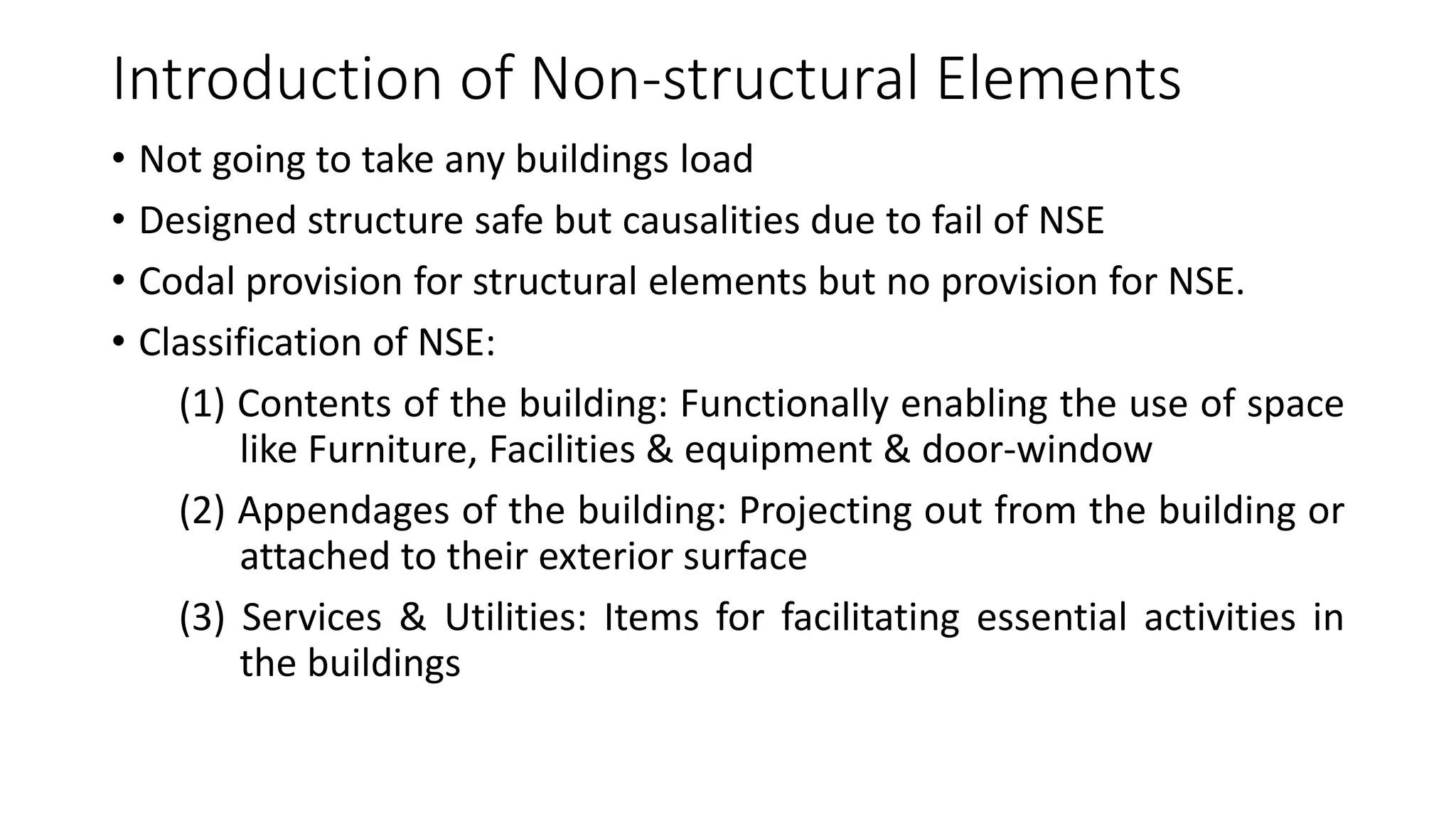
Introduction of Non-structural Elements
• Not going to take any buildings load
• Designed structure safe but causalities due to fail of NSE
• Codal provision for structural elements but no provision for NSE.
• Classification of NSE:
(1) Contents of the building: Functionally enabling the use of space
like Furniture, Facilities & equipment & door-window
(2) Appendages of the building: Projecting out from the building or
attached to their exterior surface
(3) Services & Utilities: Items for facilitating essential activities in
the buildings
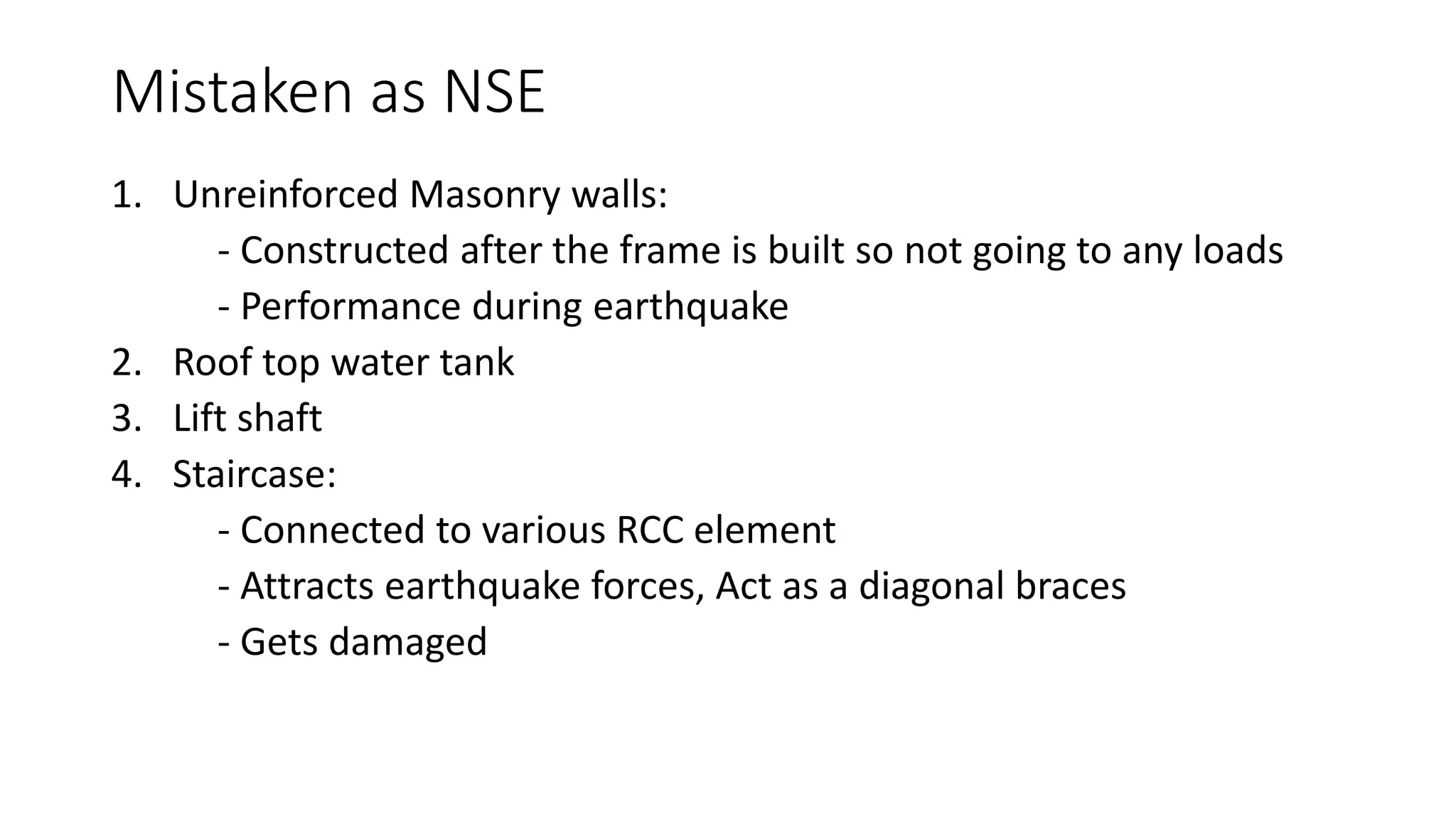
Mistaken as NSE
1. Unreinforced Masonry walls:
- Constructed after the frame is built so not going to any loads
- Performance during earthquake
2. Roof top water tank
3. Lift shaft
4. Staircase:
- Connected to various RCC element
- Attracts earthquake forces, Act as a diagonal braces
- Gets damaged
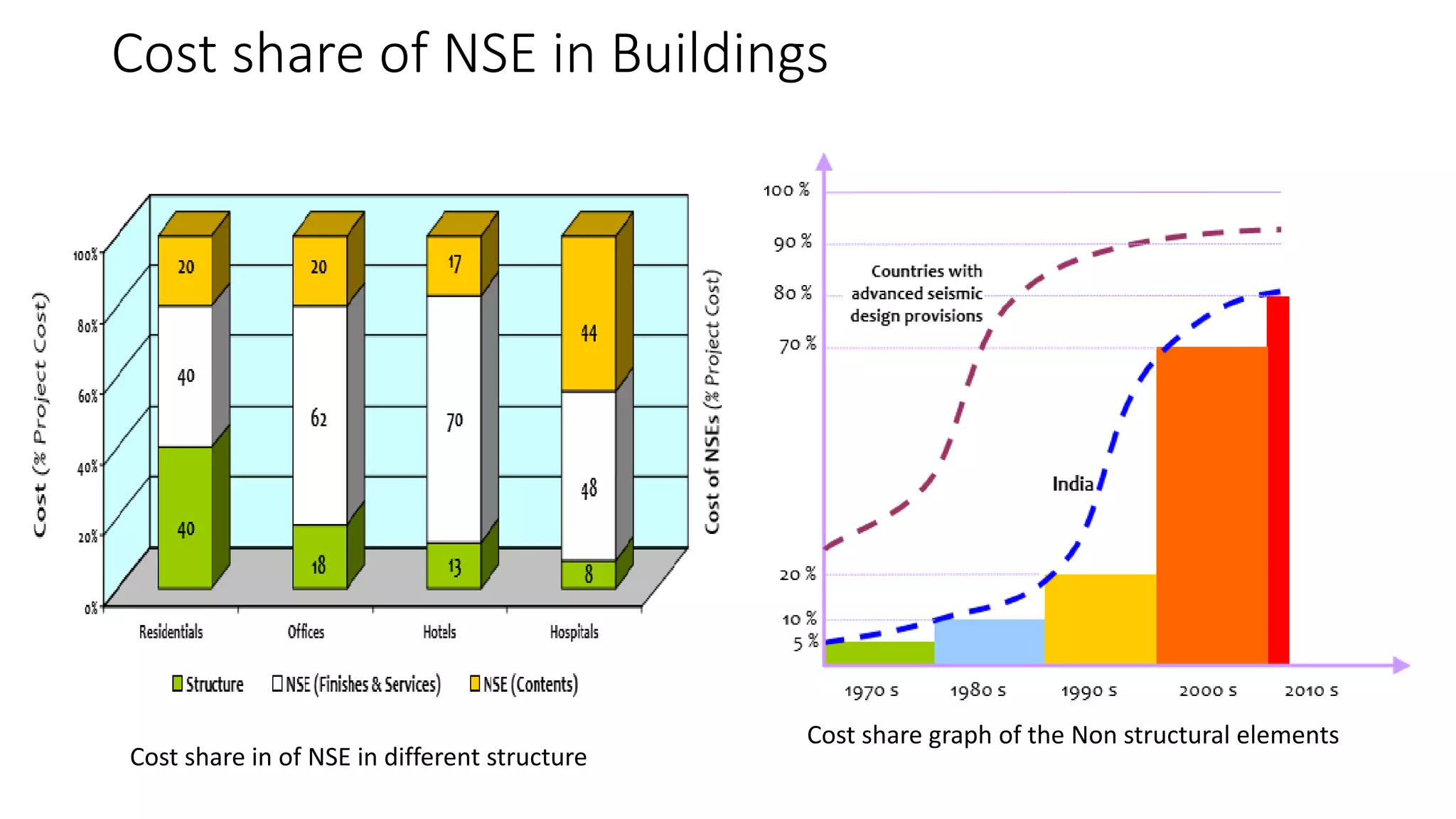
Cost share of NSE in Buildings
Cost share graph of the Non structural elements
Cost share in of NSE in different structure
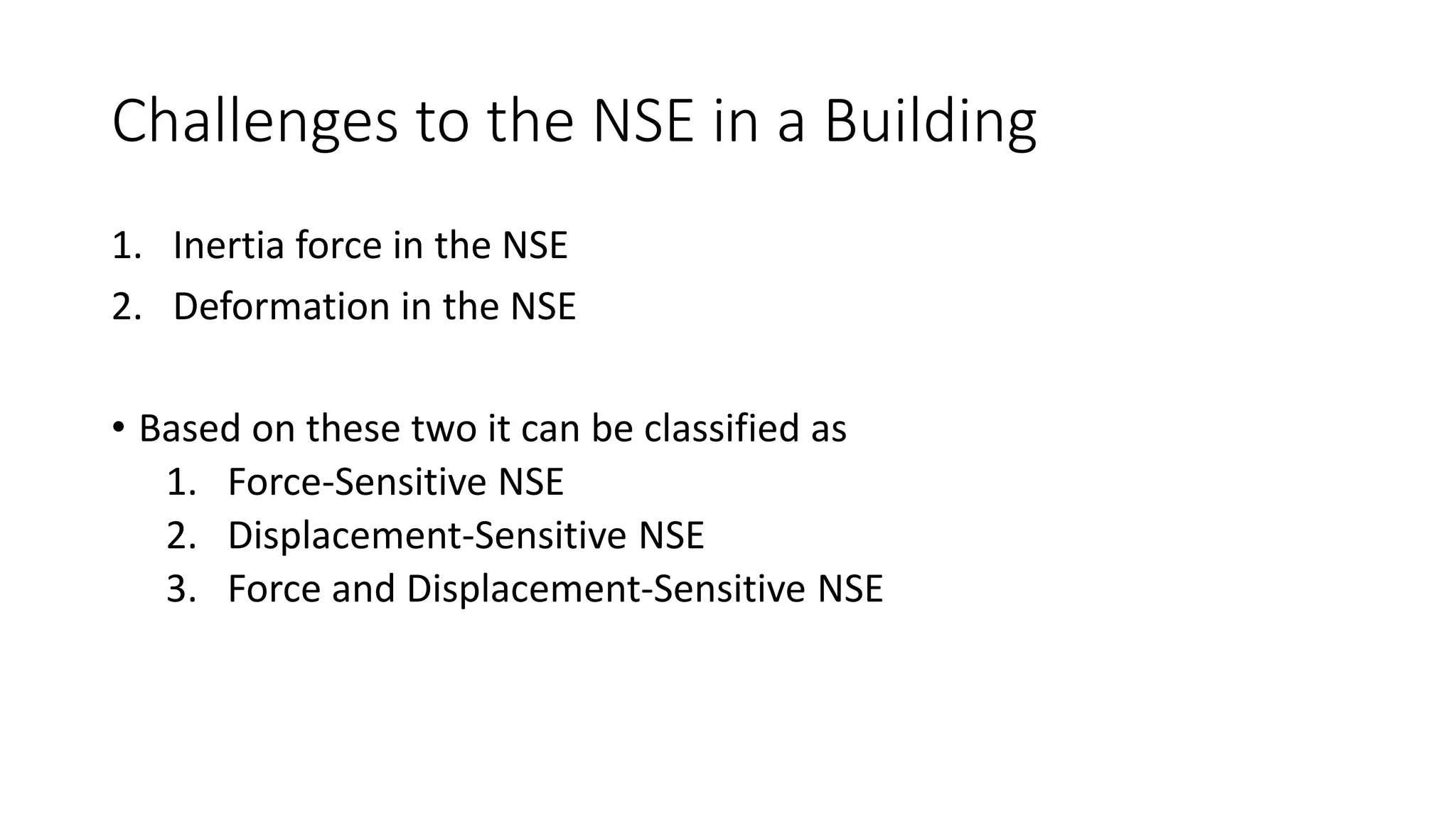
Challenges to the NSE in a Building
1. Inertia force in the NSE
2. Deformation in the NSE
• Based on these two it can be classified as
1. Force-Sensitive NSE
2. Displacement-Sensitive NSE
3. Force and Displacement-Sensitive NSE
Interaction between NSE & SE
• Building shakes  NSE shaken, but vise versa of this is possible?
• Structural secondary system
• Non structural secondary system
• Mass of the NSEs decides interaction
• Considerable interaction leads to Hybrid structure
• Buildings modelled with both NSE & SE of response for combined
system
Effects of earthquake on NSE
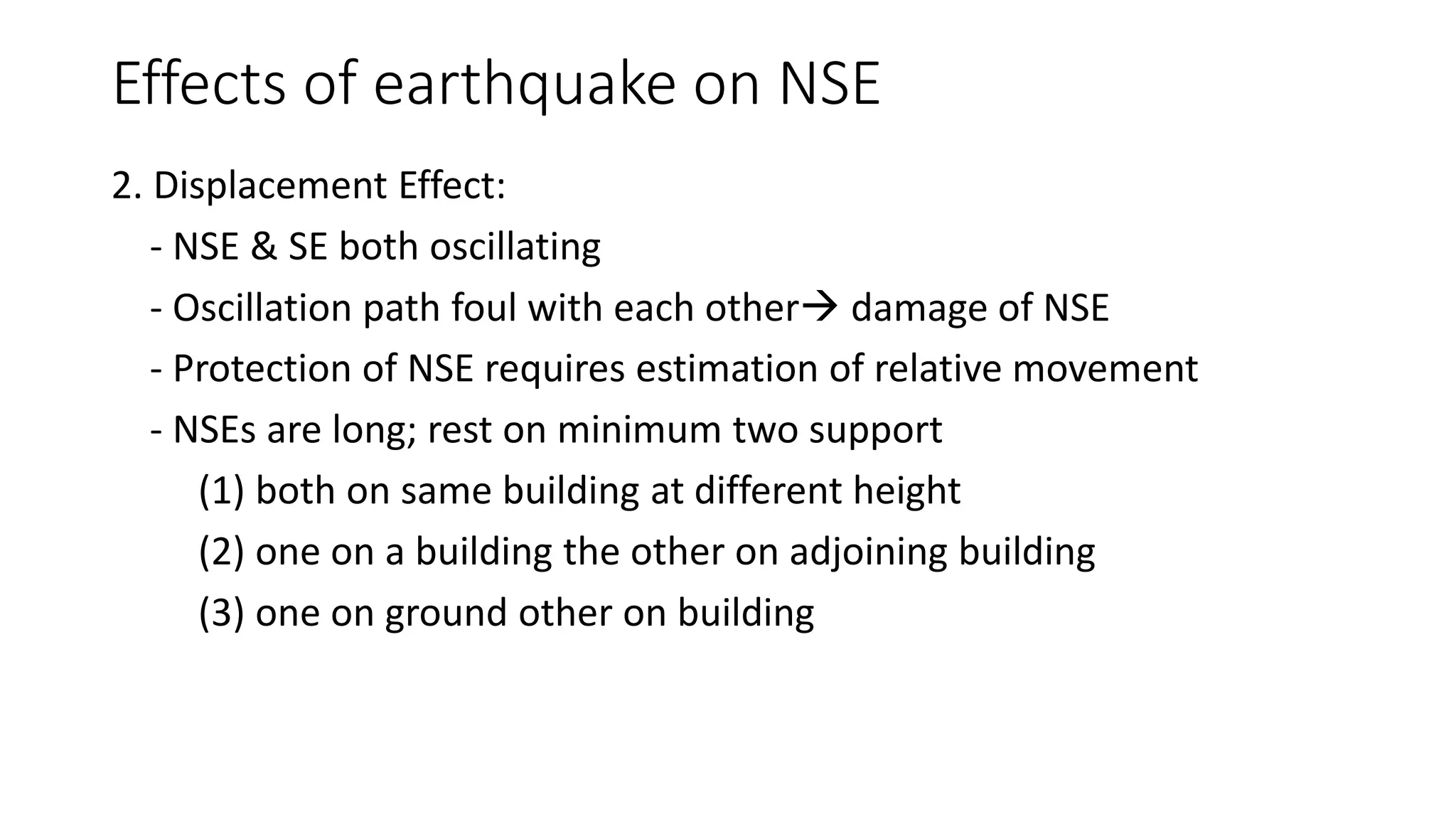
1. Acceleration Effect
- Seismic design of the
connection between NSE & SE is
performed using force in NSE.
- Force= Inertia (m*a) or Elastic
(k*δ)
- Difficult to analyze each NSE
for acceleration
- Floor Acceleration Response
Spectrum
Effects of earthquake on NSE
2. Displacement Effect:
- NSE & SE both oscillating
- Oscillation path foul with each other damage of NSE
- Protection of NSE requires estimation of relative movement
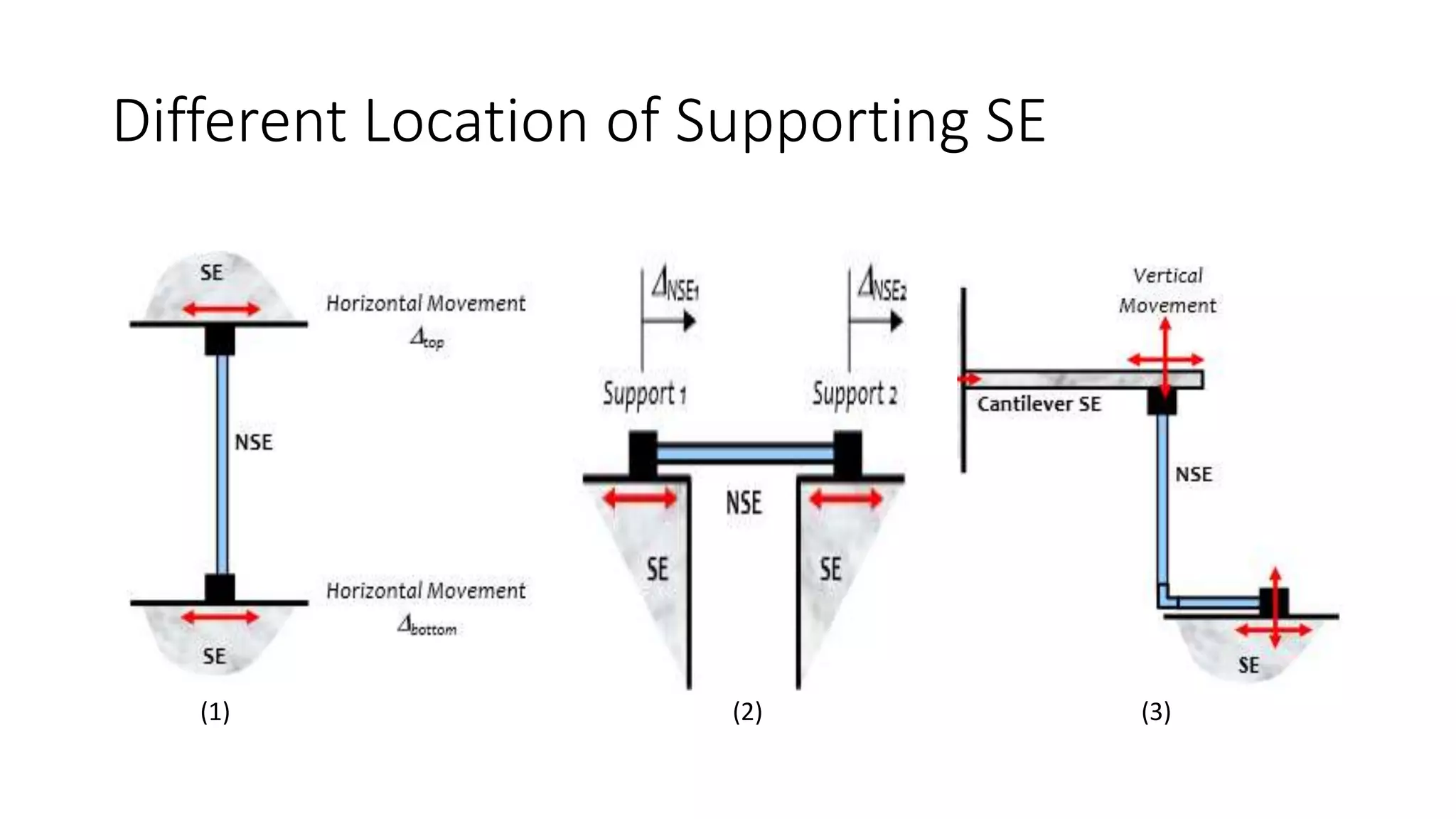
- NSEs are long; rest on minimum two support
(1) both on same building at different height
(2) one on a building the other on adjoining building
(3) one on ground other on building
Different Location of Supporting SE
(1) (2) (3)
Effects of earthquake on NSE
2. Displacement Effect:
- Support point shaking different amount
- Relative movement of the NSE
- Supports are moving out or coming closer then compression or
tension type relative displacement given by Iδ1I + Iδ2I
- One support come closer & other go away then relative
displacement [Iδ1I - Iδ2I ]
- Both these should be < δ(accommodate)
- Every displacement sensitive NSE should be checked at each level
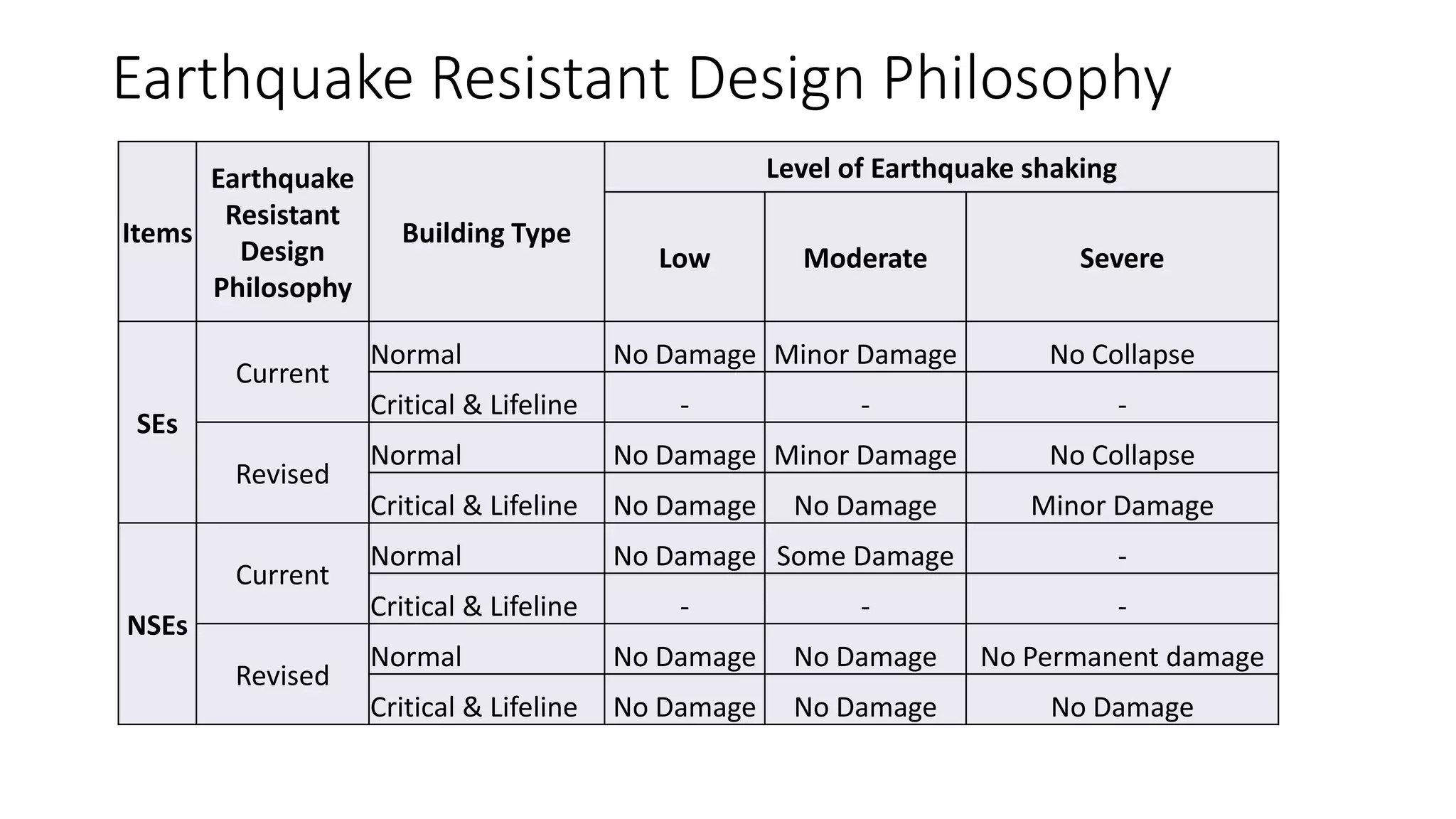
Earthquake Resistant Design Philosophy
Items
Earthquake
Resistant
Design
Philosophy
Building Type
Level of Earthquake shaking
Low Moderate Severe
SEs
Current
Normal No Damage Minor Damage No Collapse
Critical & Lifeline - - -
Revised
Normal No Damage Minor Damage No Collapse
Critical & Lifeline No Damage No Damage Minor Damage
NSEs
Current
Normal No Damage Some Damage -
Critical & Lifeline - - -
Revised
Normal No Damage No Damage No Permanent damage
Critical & Lifeline No Damage No Damage No Damage
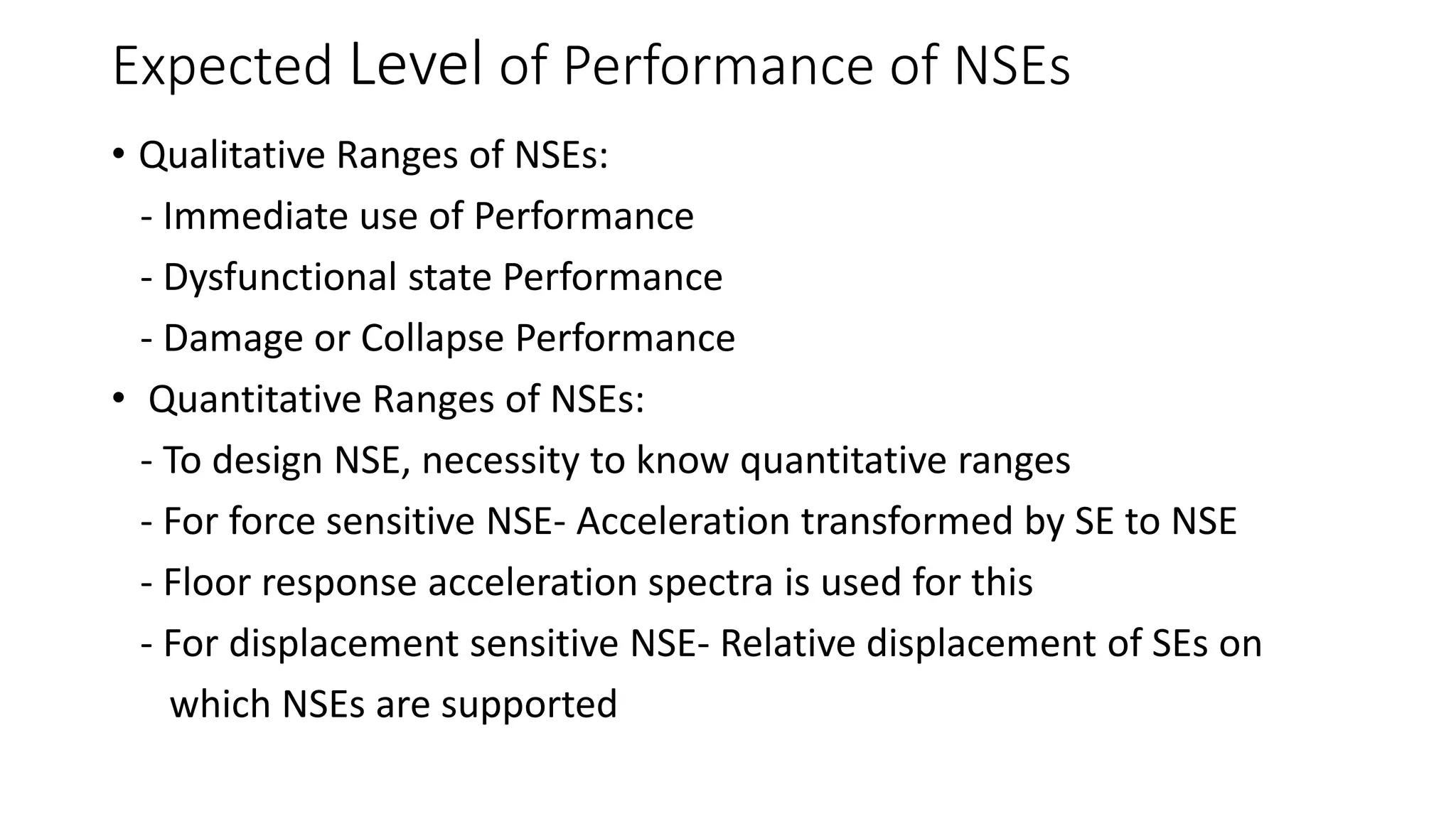
Expected Level of Performance of NSEs
• Qualitative Ranges of NSEs:
- Immediate use of Performance
- Dysfunctional state Performance
- Damage or Collapse Performance
• Quantitative Ranges of NSEs:
- To design NSE, necessity to know quantitative ranges
- For force sensitive NSE- Acceleration transformed by SE to NSE
- Floor response acceleration spectra is used for this
- For displacement sensitive NSE- Relative displacement of SEs on
which NSEs are supported
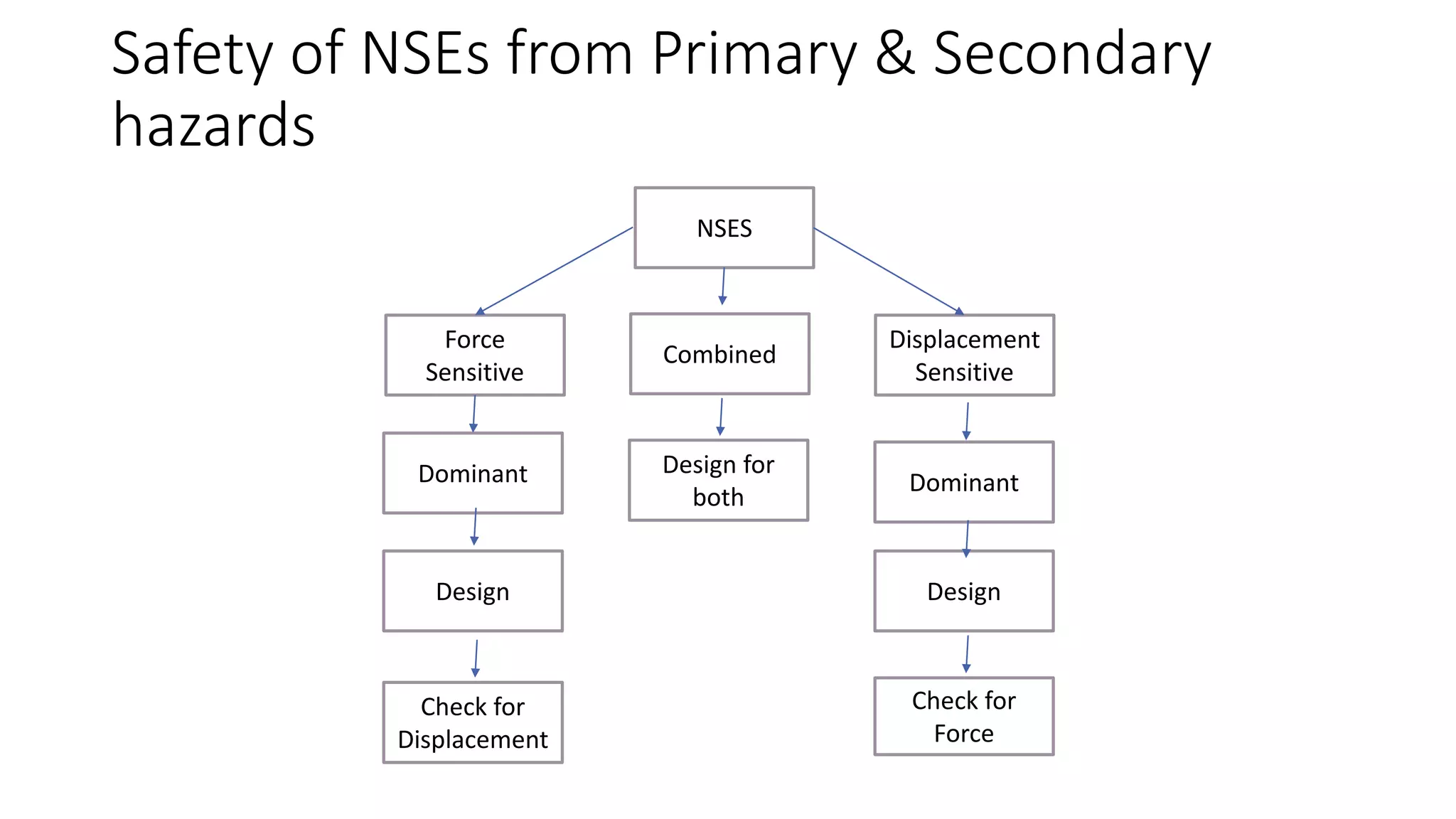
Safety of NSEs from Primary & Secondary
hazards
Check for
Force
NSES
Force
Sensitive
Displacement
Sensitive
Dominant Dominant
Design for
both
Combined
DesignDesign
Check for
Displacement
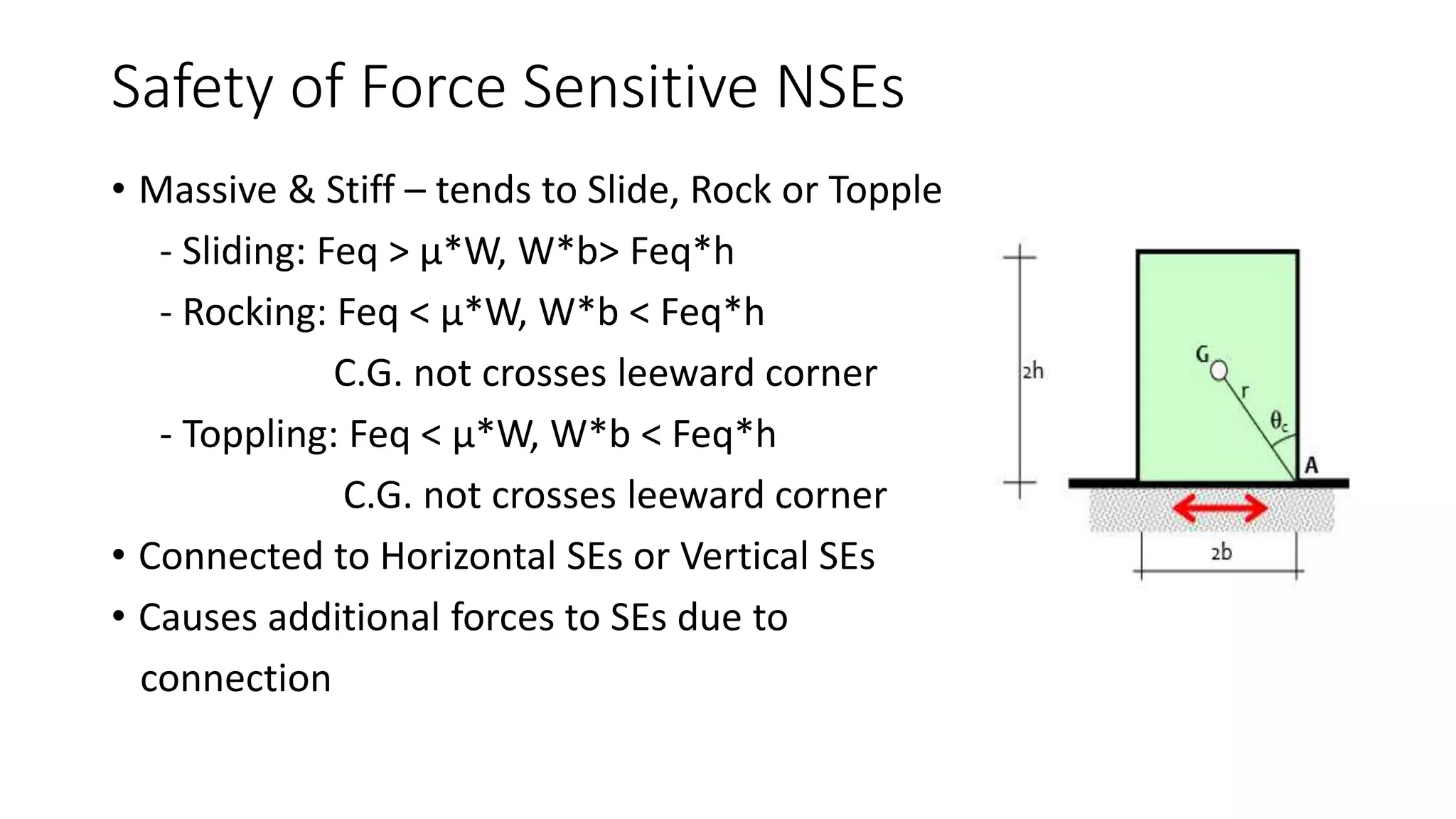
Safety of Force Sensitive NSEs
• Massive & Stiff – tends to Slide, Rock or Topple
- Sliding: Feq > μ*W, W*b> Feq*h
- Rocking: Feq < μ*W, W*b < Feq*h
C.G. not crosses leeward corner
- Toppling: Feq < μ*W, W*b < Feq*h
C.G. not crosses leeward corner
• Connected to Horizontal SEs or Vertical SEs
• Causes additional forces to SEs due to
connection
Safety of Force Sensitive NSEs
• Main strategy – Prevent it from sliding & increase its restoring
moment
• Some NSEs can not be directly connected to SE but it is encased &
shroud is connected with SE
• NSEs near wall – Hold back by connection with wall, NSEs in middle of
the room – connected with Slab
• NSEs one over other secured by tying top element to ground in
mutually perpendicular direction
• Small objects are not anchored individually, Strings, Front panel plates
& vertical spacer in chemical laboratory, Book shelves in library
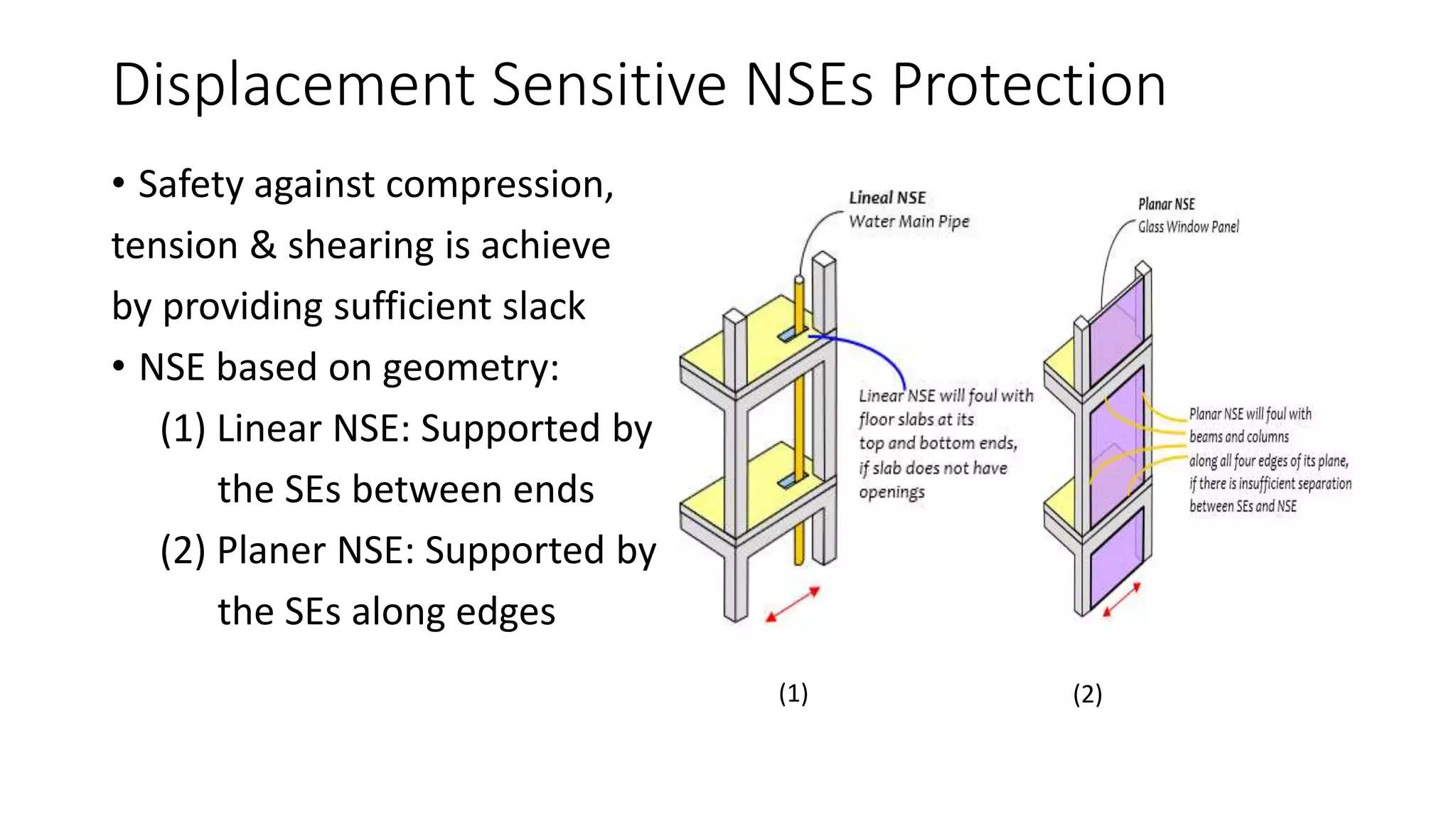
Displacement Sensitive NSEs Protection
• Safety against compression,
tension & shearing is achieve
by providing sufficient slack
• NSE based on geometry:
(1) Linear NSE: Supported by
the SEs between ends
(2) Planer NSE: Supported by
the SEs along edges
(1) (2)
Classification of Protection strategies
1. Non-Engineered (Based on concept)
- To secure small & light NSEs
- Not connected with SEs (Ex. Glasses, Crockery, Bottles on shelves
& books on library shelves
- String or front panel use to hold in position
- Tying gas cylinder to wall with chain
2. Pre-Engineered Practice:
- Factory made objects & moderate size like cup-board
- Connection details based on calculation , experiments on shake
table & past earthquake experiences.
Literature Review
• Mevada et. al. (2013) studied that Non-structural elements give poor
performance during past earthquake and observed that design
provision should be developed for the NSE.
• Investigated the seismic response of the NSE by time history analysis
performed to obtain the Acceleration & Displacement
• Found that Non structural element experiences minimum
displacement & acceleration at the center of the first floor
Seismic Response of Non-structural elements
(International Journal of Innovation in Engineering & Technology)
Literature Review
• Gupta et. al. (2016) studied that various NSEs affect the behavior of
the SEs, influence is small if the NSE attached to SE is flexible.
• Natural period of the structural system will be shorten. Generally
dynamic analysis of SDOF system is used
• Distribution of storey shear in column may change which may sustain
more forces then that it was assumed due to behavior of the NSE and
it is observed that the position of column should also be changed
Behavior of the NSE during an earthquake
(International Journal of Advanced Research in Science, Engineering and Technology)
Literature Review
• Mondal & Jain (2005) studied that very less information are provided
in IS 1893 so IS code should include following Clauses
1. Provision of seismic relative displacement
2. Define force & displacement sensitive element
3. Amplification of lateral force that increases with the verticle
location of the NSEs
4. Importance factor of the NSE
5. Parameter to take care the flexibility of NSEs
• They have compared different code and give following statement:
1. Horizontal force on NSEs are about 26% to 43%.
2. Designed lateral forces of elements attached on roof ranges from
80% to 150%
Design of NSEs : A review of codal provision (The Indian Concrete Journal)
Literature Review
• Chandwell et. al.(2014) studied minimum design loads equation
from ASCE/SEI 7 on NSEs which improved seismic performance of
NSE. But observed that it will not give that much confidence for NSE
at higher level of floor.
• For NSE in which torsion & diaphragm deformation is not take into
account in equation to find the force. Observed that torsional effect &
diaphragm flexibility affect the horizontal distribution of Peak
Horizontal Acceleration.
• The assumption made in distribution of vertical & horizontal seismic
demands on NSE do not articulate with recorded data & results and
studied that about 50 & 84 percentile PVFA values increase lineaely
from base to roof different from the constant distribution assumed in
ASCE/SEI 7
EVALUATION OF ASCE/SEI 7 PROVISIONS FOR DETERMINATION OF SEISMIC DEMANDS ON NONSTRUCTURAL COMPONENTS (U S National Conference)
Literature Review
• Ju & Young Jung (2013) studied that failure of piping system after
earthquake leads to subsequent shut down of hospital & observed
that although it is design by UBC-97 & NEHRP but fails
• Evaluated the static & dynamic characteristics of complex actual
piping system based on NFPA-13 & SMACNA guideline and observed
that current piping system subjected to design lateral force based on
UBC-97 was failed in both guideline and observed that mode shape of
pipe system is different from building.
Evaluation of Performance Requirements for Seismic Design of Piping System
International Journal of Civil, Environmental, Structural, Construction & Architectural Engineering
Observations
• As cost share of NSEs in the newly constructed building is rising,
designing of them is very necessary.
• Generally, more buildings are designed by thinking about structural
safety only although they have costly interiors.
• About all the structural elements are included in code. But the
causalities is very large during earthquake as no designing clauses
there for the NSEs & very less awareness among engineers,
contractor & designer.
• Although foreign-countries have also include these elements in their
codes but it is at very primary stage which will not give assurance
against safety of the NSE.
• The seismic behavior of the NSEs should be studied in detail.
References
1. Earthquake Protection of NSEs in Building by C V R Murti
2. http://www.eucentre.it/
3. https://www.irmi.com/articles/expert-
commentary/earthquake-performance-of-nonstructural-
components
4. http://www.bvt.co.nz/faq-seismic-restraint-of-non-
structural-building-elements/
5. https://www.nibs.org/resource/resmgr/BSSC/P-
749_Chapter4.pdf
THANK YOU

Importance of Non Structural Elements during Earthquake

  • 1.
    Birla Vishvakarma Mahavidyalaya(Engg. College) [An Autonomous Institution] Seminar On: IMPORTANCE OF NON STRUCTURAL ELEMENTS DURING EARTHQUAKE Guided by : Dr. Snehal Mevada Prepared by : Mehul Doshi (16SE818)
  • 2.
    CONTENTS • Introduction • LiteratureReview • Observations • References
  • 3.
    Introduction of Non-structuralElements • Not going to take any buildings load • Designed structure safe but causalities due to fail of NSE • Codal provision for structural elements but no provision for NSE. • Classification of NSE: (1) Contents of the building: Functionally enabling the use of space like Furniture, Facilities & equipment & door-window (2) Appendages of the building: Projecting out from the building or attached to their exterior surface (3) Services & Utilities: Items for facilitating essential activities in the buildings
  • 4.
    Mistaken as NSE 1.Unreinforced Masonry walls: - Constructed after the frame is built so not going to any loads - Performance during earthquake 2. Roof top water tank 3. Lift shaft 4. Staircase: - Connected to various RCC element - Attracts earthquake forces, Act as a diagonal braces - Gets damaged
  • 5.
    Cost share ofNSE in Buildings Cost share graph of the Non structural elements Cost share in of NSE in different structure
  • 6.
    Challenges to theNSE in a Building 1. Inertia force in the NSE 2. Deformation in the NSE • Based on these two it can be classified as 1. Force-Sensitive NSE 2. Displacement-Sensitive NSE 3. Force and Displacement-Sensitive NSE
  • 7.
    Interaction between NSE& SE • Building shakes  NSE shaken, but vise versa of this is possible? • Structural secondary system • Non structural secondary system • Mass of the NSEs decides interaction • Considerable interaction leads to Hybrid structure • Buildings modelled with both NSE & SE of response for combined system
  • 8.
    Effects of earthquakeon NSE 1. Acceleration Effect - Seismic design of the connection between NSE & SE is performed using force in NSE. - Force= Inertia (m*a) or Elastic (k*δ) - Difficult to analyze each NSE for acceleration - Floor Acceleration Response Spectrum
  • 9.
    Effects of earthquakeon NSE 2. Displacement Effect: - NSE & SE both oscillating - Oscillation path foul with each other damage of NSE - Protection of NSE requires estimation of relative movement - NSEs are long; rest on minimum two support (1) both on same building at different height (2) one on a building the other on adjoining building (3) one on ground other on building
  • 10.
    Different Location ofSupporting SE (1) (2) (3)
  • 11.
    Effects of earthquakeon NSE 2. Displacement Effect: - Support point shaking different amount - Relative movement of the NSE - Supports are moving out or coming closer then compression or tension type relative displacement given by Iδ1I + Iδ2I - One support come closer & other go away then relative displacement [Iδ1I - Iδ2I ] - Both these should be < δ(accommodate) - Every displacement sensitive NSE should be checked at each level
  • 12.
    Earthquake Resistant DesignPhilosophy Items Earthquake Resistant Design Philosophy Building Type Level of Earthquake shaking Low Moderate Severe SEs Current Normal No Damage Minor Damage No Collapse Critical & Lifeline - - - Revised Normal No Damage Minor Damage No Collapse Critical & Lifeline No Damage No Damage Minor Damage NSEs Current Normal No Damage Some Damage - Critical & Lifeline - - - Revised Normal No Damage No Damage No Permanent damage Critical & Lifeline No Damage No Damage No Damage
  • 13.
    Expected Level ofPerformance of NSEs • Qualitative Ranges of NSEs: - Immediate use of Performance - Dysfunctional state Performance - Damage or Collapse Performance • Quantitative Ranges of NSEs: - To design NSE, necessity to know quantitative ranges - For force sensitive NSE- Acceleration transformed by SE to NSE - Floor response acceleration spectra is used for this - For displacement sensitive NSE- Relative displacement of SEs on which NSEs are supported
  • 14.
    Safety of NSEsfrom Primary & Secondary hazards Check for Force NSES Force Sensitive Displacement Sensitive Dominant Dominant Design for both Combined DesignDesign Check for Displacement
  • 15.
    Safety of ForceSensitive NSEs • Massive & Stiff – tends to Slide, Rock or Topple - Sliding: Feq > μ*W, W*b> Feq*h - Rocking: Feq < μ*W, W*b < Feq*h C.G. not crosses leeward corner - Toppling: Feq < μ*W, W*b < Feq*h C.G. not crosses leeward corner • Connected to Horizontal SEs or Vertical SEs • Causes additional forces to SEs due to connection
  • 16.
    Safety of ForceSensitive NSEs • Main strategy – Prevent it from sliding & increase its restoring moment • Some NSEs can not be directly connected to SE but it is encased & shroud is connected with SE • NSEs near wall – Hold back by connection with wall, NSEs in middle of the room – connected with Slab • NSEs one over other secured by tying top element to ground in mutually perpendicular direction • Small objects are not anchored individually, Strings, Front panel plates & vertical spacer in chemical laboratory, Book shelves in library
  • 17.
    Displacement Sensitive NSEsProtection • Safety against compression, tension & shearing is achieve by providing sufficient slack • NSE based on geometry: (1) Linear NSE: Supported by the SEs between ends (2) Planer NSE: Supported by the SEs along edges (1) (2)
  • 18.
    Classification of Protectionstrategies 1. Non-Engineered (Based on concept) - To secure small & light NSEs - Not connected with SEs (Ex. Glasses, Crockery, Bottles on shelves & books on library shelves - String or front panel use to hold in position - Tying gas cylinder to wall with chain 2. Pre-Engineered Practice: - Factory made objects & moderate size like cup-board - Connection details based on calculation , experiments on shake table & past earthquake experiences.
  • 19.
    Literature Review • Mevadaet. al. (2013) studied that Non-structural elements give poor performance during past earthquake and observed that design provision should be developed for the NSE. • Investigated the seismic response of the NSE by time history analysis performed to obtain the Acceleration & Displacement • Found that Non structural element experiences minimum displacement & acceleration at the center of the first floor Seismic Response of Non-structural elements (International Journal of Innovation in Engineering & Technology)
  • 20.
    Literature Review • Guptaet. al. (2016) studied that various NSEs affect the behavior of the SEs, influence is small if the NSE attached to SE is flexible. • Natural period of the structural system will be shorten. Generally dynamic analysis of SDOF system is used • Distribution of storey shear in column may change which may sustain more forces then that it was assumed due to behavior of the NSE and it is observed that the position of column should also be changed Behavior of the NSE during an earthquake (International Journal of Advanced Research in Science, Engineering and Technology)
  • 21.
    Literature Review • Mondal& Jain (2005) studied that very less information are provided in IS 1893 so IS code should include following Clauses 1. Provision of seismic relative displacement 2. Define force & displacement sensitive element 3. Amplification of lateral force that increases with the verticle location of the NSEs 4. Importance factor of the NSE 5. Parameter to take care the flexibility of NSEs • They have compared different code and give following statement: 1. Horizontal force on NSEs are about 26% to 43%. 2. Designed lateral forces of elements attached on roof ranges from 80% to 150% Design of NSEs : A review of codal provision (The Indian Concrete Journal)
  • 22.
    Literature Review • Chandwellet. al.(2014) studied minimum design loads equation from ASCE/SEI 7 on NSEs which improved seismic performance of NSE. But observed that it will not give that much confidence for NSE at higher level of floor. • For NSE in which torsion & diaphragm deformation is not take into account in equation to find the force. Observed that torsional effect & diaphragm flexibility affect the horizontal distribution of Peak Horizontal Acceleration. • The assumption made in distribution of vertical & horizontal seismic demands on NSE do not articulate with recorded data & results and studied that about 50 & 84 percentile PVFA values increase lineaely from base to roof different from the constant distribution assumed in ASCE/SEI 7 EVALUATION OF ASCE/SEI 7 PROVISIONS FOR DETERMINATION OF SEISMIC DEMANDS ON NONSTRUCTURAL COMPONENTS (U S National Conference)
  • 23.
    Literature Review • Ju& Young Jung (2013) studied that failure of piping system after earthquake leads to subsequent shut down of hospital & observed that although it is design by UBC-97 & NEHRP but fails • Evaluated the static & dynamic characteristics of complex actual piping system based on NFPA-13 & SMACNA guideline and observed that current piping system subjected to design lateral force based on UBC-97 was failed in both guideline and observed that mode shape of pipe system is different from building. Evaluation of Performance Requirements for Seismic Design of Piping System International Journal of Civil, Environmental, Structural, Construction & Architectural Engineering
  • 24.
    Observations • As costshare of NSEs in the newly constructed building is rising, designing of them is very necessary. • Generally, more buildings are designed by thinking about structural safety only although they have costly interiors. • About all the structural elements are included in code. But the causalities is very large during earthquake as no designing clauses there for the NSEs & very less awareness among engineers, contractor & designer. • Although foreign-countries have also include these elements in their codes but it is at very primary stage which will not give assurance against safety of the NSE. • The seismic behavior of the NSEs should be studied in detail.
  • 25.
    References 1. Earthquake Protectionof NSEs in Building by C V R Murti 2. http://www.eucentre.it/ 3. https://www.irmi.com/articles/expert- commentary/earthquake-performance-of-nonstructural- components 4. http://www.bvt.co.nz/faq-seismic-restraint-of-non- structural-building-elements/ 5. https://www.nibs.org/resource/resmgr/BSSC/P- 749_Chapter4.pdf
  • 26.