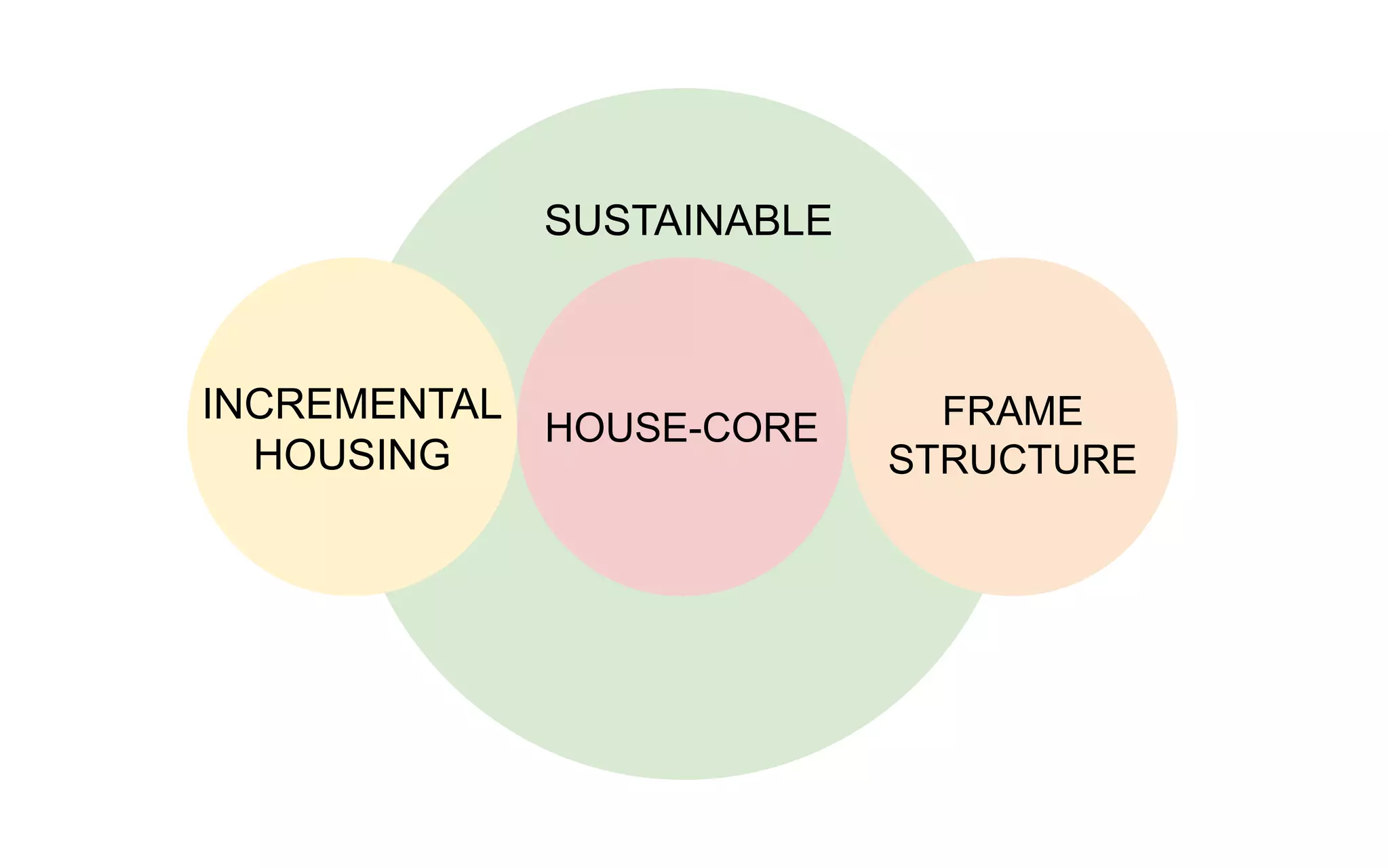
INCREMENTAL
HOUSING
HOUSE-CORE FRAME
STRUCTURE
SUSTAINABLE
WHAT?
Incrementalism is seen as an antidote to challenges of affordability, allowing low-income families to
pay for housing construction over time, and to operate outside of prohibitively expensive formal
building codes and regulations (Femke Van Noorloos et al. 2019. Environment & Urbanization Copyright. International
Institute for Environment and Development (IIED).Vol 32(1): 37–54. DOI: 10.1177/0956247819887679).
Incremental housing is a step-by-step process. It goes by different names (starter house,
phased-development house, owner-driven house), but fundamentally, incremental housing is an integral urban
development process, building housing communities and citizens. It is not quick, immediate or
complete, but choice remains with the owner (Reinhard Goethert, 2010).
Incremental building is not the same as building small, complete, houses that can be extended later. Incremental
building, rather, provides “half of a better house”: the houses are delivered incomplete, though typically liveable, for the
owner to improve and ‘complete’ gradually over time (Laura Wainer, 2016).
Incremental housing concept is a housing system that is designed for the occupants to be able to develop their own
house in the future (Wibowo & Larasati, 2018, Incremental Housing Development; An Approach the Needs of Low Cost
Housing in Indonesia).
Incremental housing is a gradual housing process that starts from meeting some of the residents' needs and
then being developed by the residents over time
https://sdgs.un.org/goals
WHY?
Most urban poor have come from rural
areas to seek a living in cities for various
reasons ranging from deprivation of
lands in rural areas to higher income in
urban areas. Fast
pseudo-urbanization in developing
countries is the root cause of the
formation of slums (Park et al, 2019).
Financial limitations and lack of regulation & provision trigger
independent housing development on limited land by adding
new spaces little by little but irregularly, thus forming slum
settlements (Zainal, 1981 in Yudhistira, 2021).
Slums are built without proper infrastructure, continuous
inflow of urban poor results in an aggravation of the living
environment, such as densely-packed narrow houses, limited
access to water and lack of sanitation facilities (UN Habitat).
The lack of occupancy level (backlog) in Indonesia is still very
high. The data from BPS demonstrates that the estimated number
of houses built per year is only about 400 to 500 thousand of
housing units. On the other hand, the demand for community
housing per year reached over 800 thousand housing units
(Wibowo & Larasati, 2018).
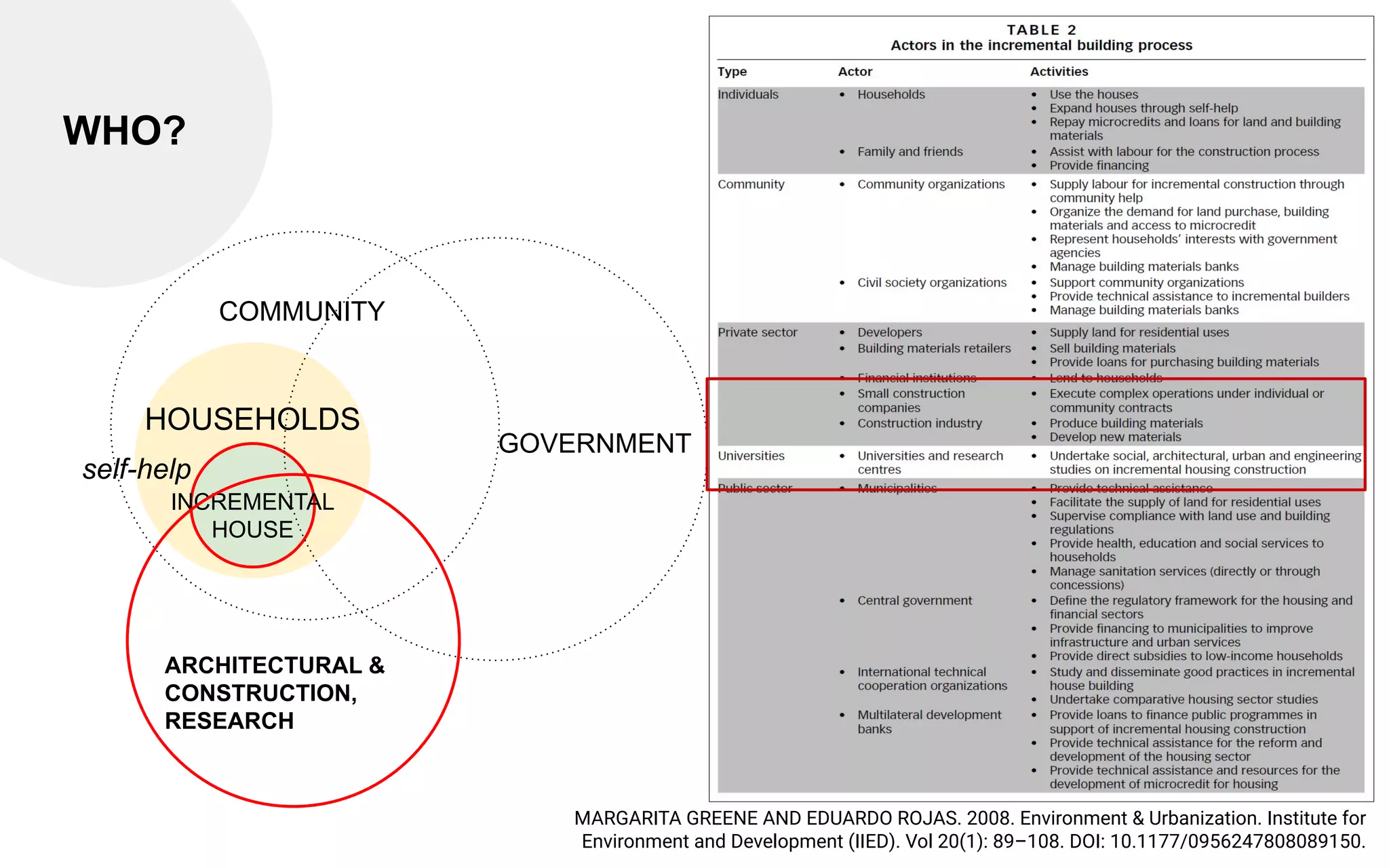
WHO?
MARGARITA GREENE AND EDUARDO ROJAS. 2008. Environment & Urbanization. Institute for
Environment and Development (IIED). Vol 20(1): 89–108. DOI: 10.1177/0956247808089150.
HOUSEHOLDS
COMMUNITY
INCREMENTAL
HOUSE
GOVERNMENT
ARCHITECTURAL &
CONSTRUCTION,
RESEARCH
self-help
HOW?
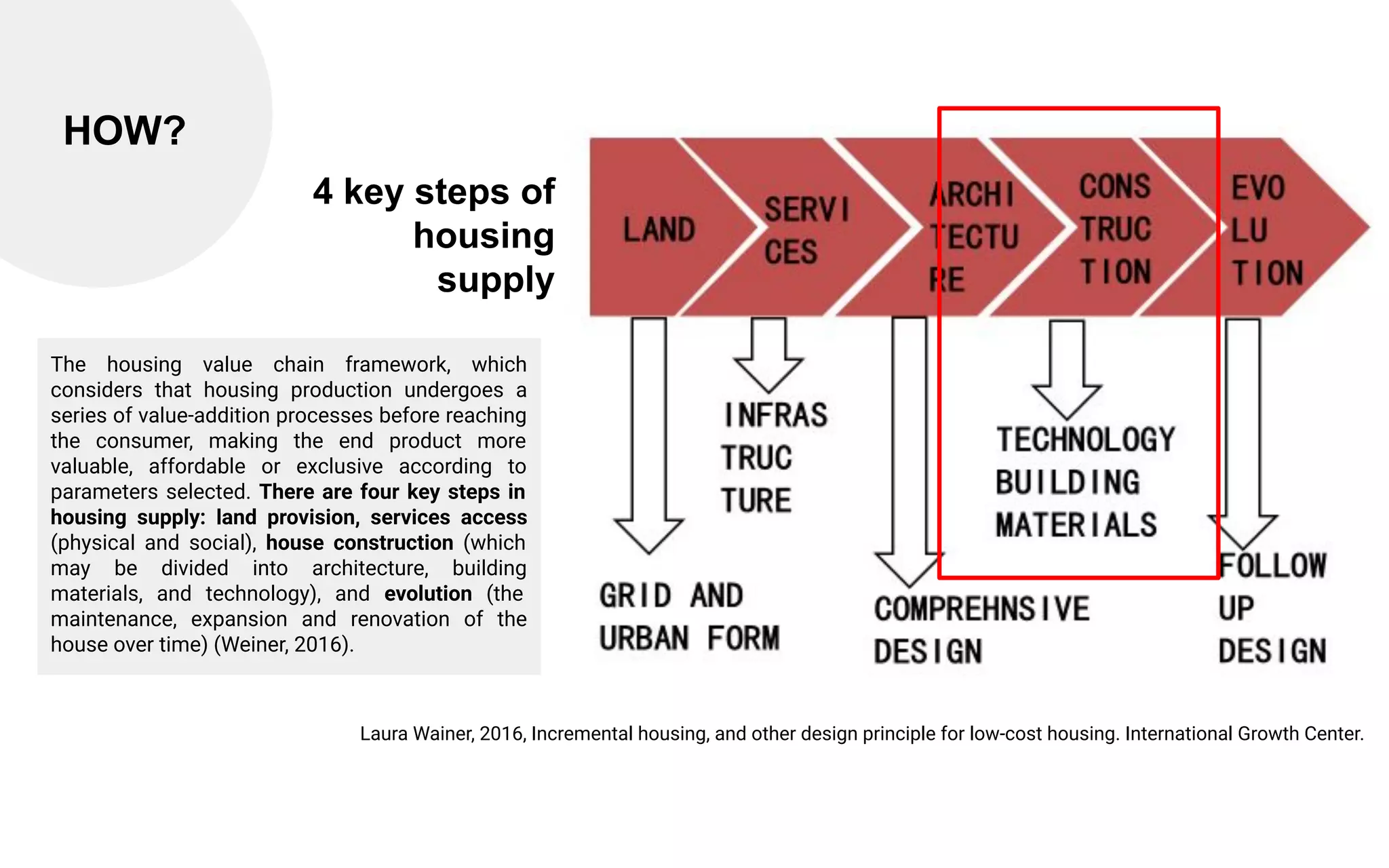
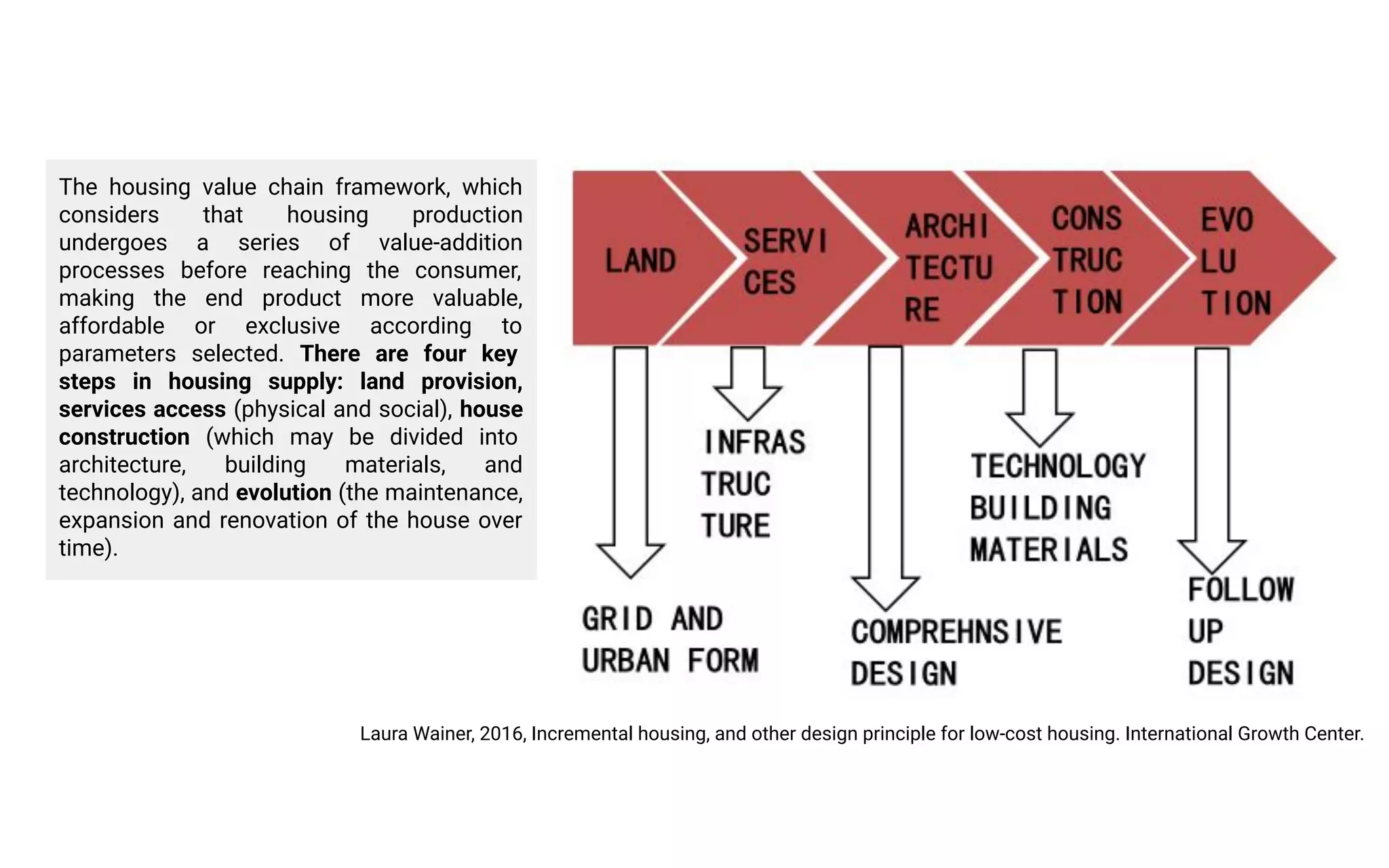
The housing value chain framework, which
considers that housing production undergoes a
series of value-addition processes before reaching
the consumer, making the end product more
valuable, affordable or exclusive according to
parameters selected. There are four key steps in
housing supply: land provision, services access
(physical and social), house construction (which
may be divided into architecture, building
materials, and technology), and evolution (the
maintenance, expansion and renovation of the
house over time) (Weiner, 2016).
Laura Wainer, 2016, Incremental housing, and other design principle for low-cost housing. International Growth Center.
4 key steps of
housing
supply
HOW?
Three phases of the
incremental process
MARGARITA GREENE AND EDUARDO ROJAS. 2008. Environment
& Urbanization. Institute for Environment and Development
(IIED). Vol 20(1): 89–108. DOI: 10.1177/0956247808089150.
Access to land
obtain access to land suitable
for residential use.
Housing
Nucleus
Construction of basic/primary
function of a home; protection
against external weather
Incremental
Improvement
beneficiaries expand it using
the precarious materials of
their previous dwelling or other
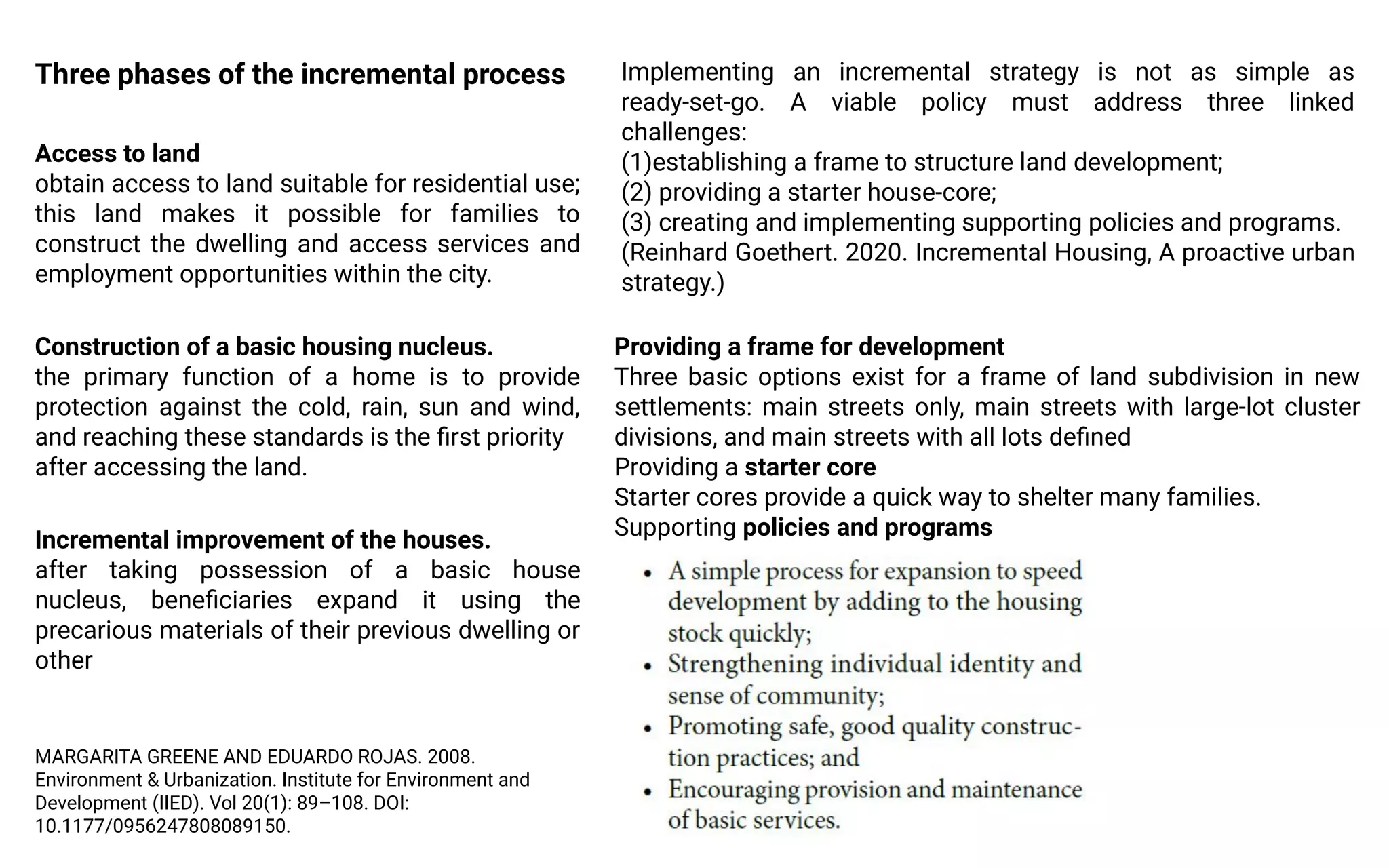
Implementing an incremental strategy is not as
simple as ready-set-go. A viable policy must
address three linked challenges:
Providing a frame to structure land development
Providing a starter house-core
creating and implementing supporting policies and
programs
(Reinhard Goethert. 2020. Incremental Housing, A
proactive urban strategy.)
HOW?
Construction
Improvement
Possibilities
Frame Structure
Pre-assembled
components
Materials
Distribution
MARGARITA GREENE AND EDUARDO ROJAS. 2008. Environment & Urbanization. Institute for
Environment and Development (IIED). Vol 20(1): 89–108. DOI: 10.1177/0956247808089150.
House-core
HOW?
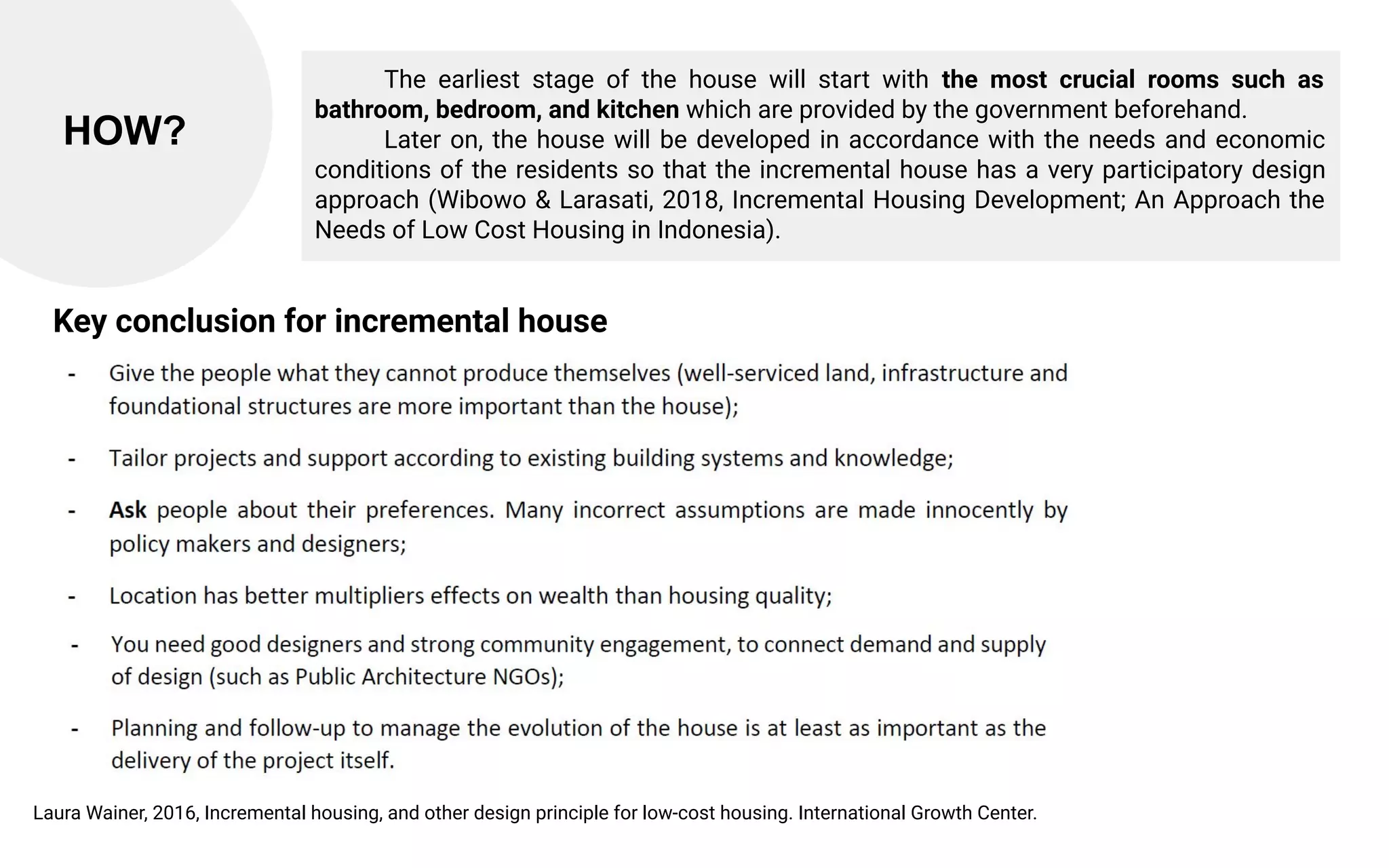
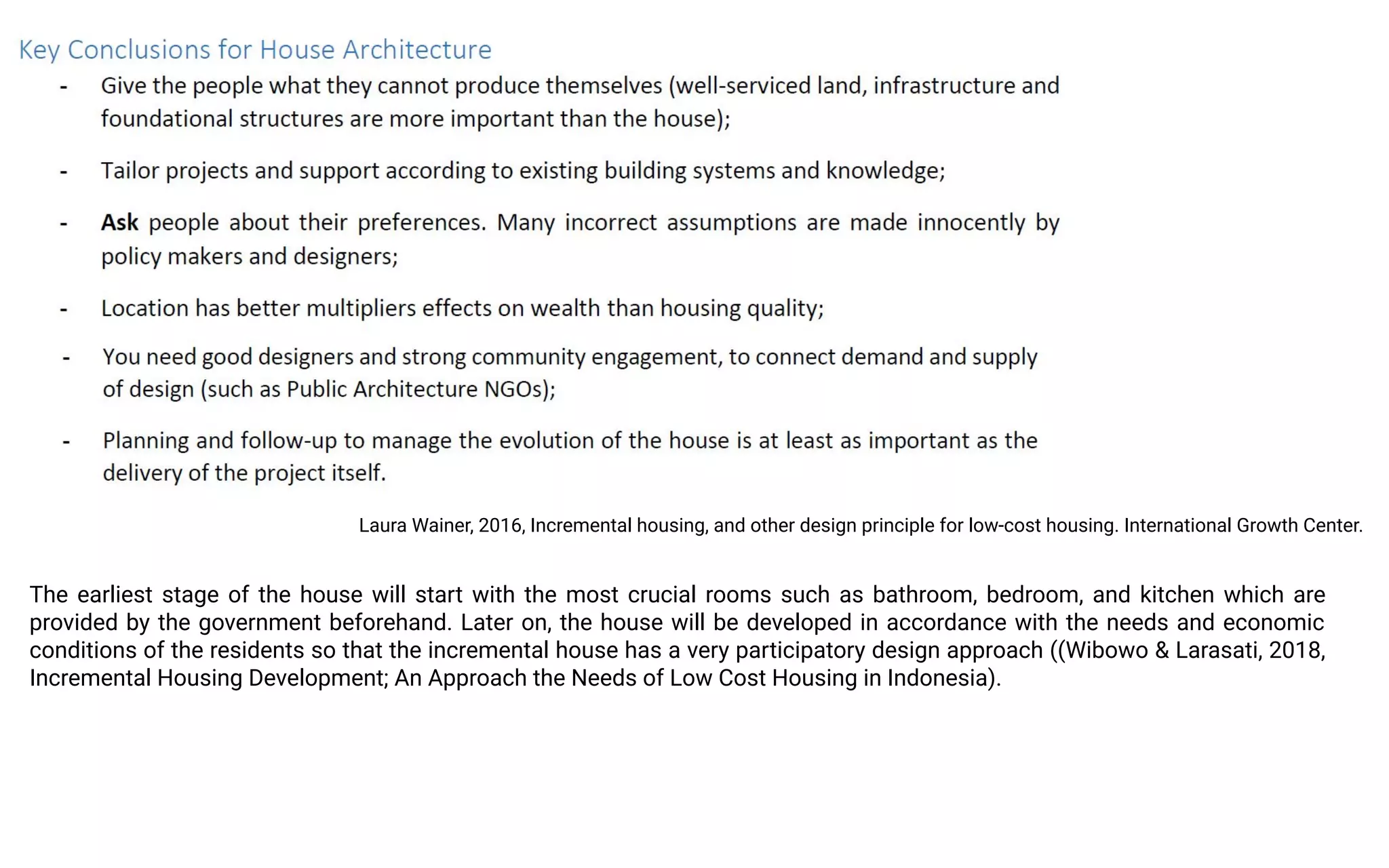
Key conclusion for incremental house
Laura Wainer, 2016, Incremental housing, and other design principle for low-cost housing. International Growth Center.
The earliest stage of the house will start with the most crucial rooms such as
bathroom, bedroom, and kitchen which are provided by the government beforehand.
Later on, the house will be developed in accordance with the needs and economic
conditions of the residents so that the incremental house has a very participatory design
approach (Wibowo & Larasati, 2018, Incremental Housing Development; An Approach the
Needs of Low Cost Housing in Indonesia).
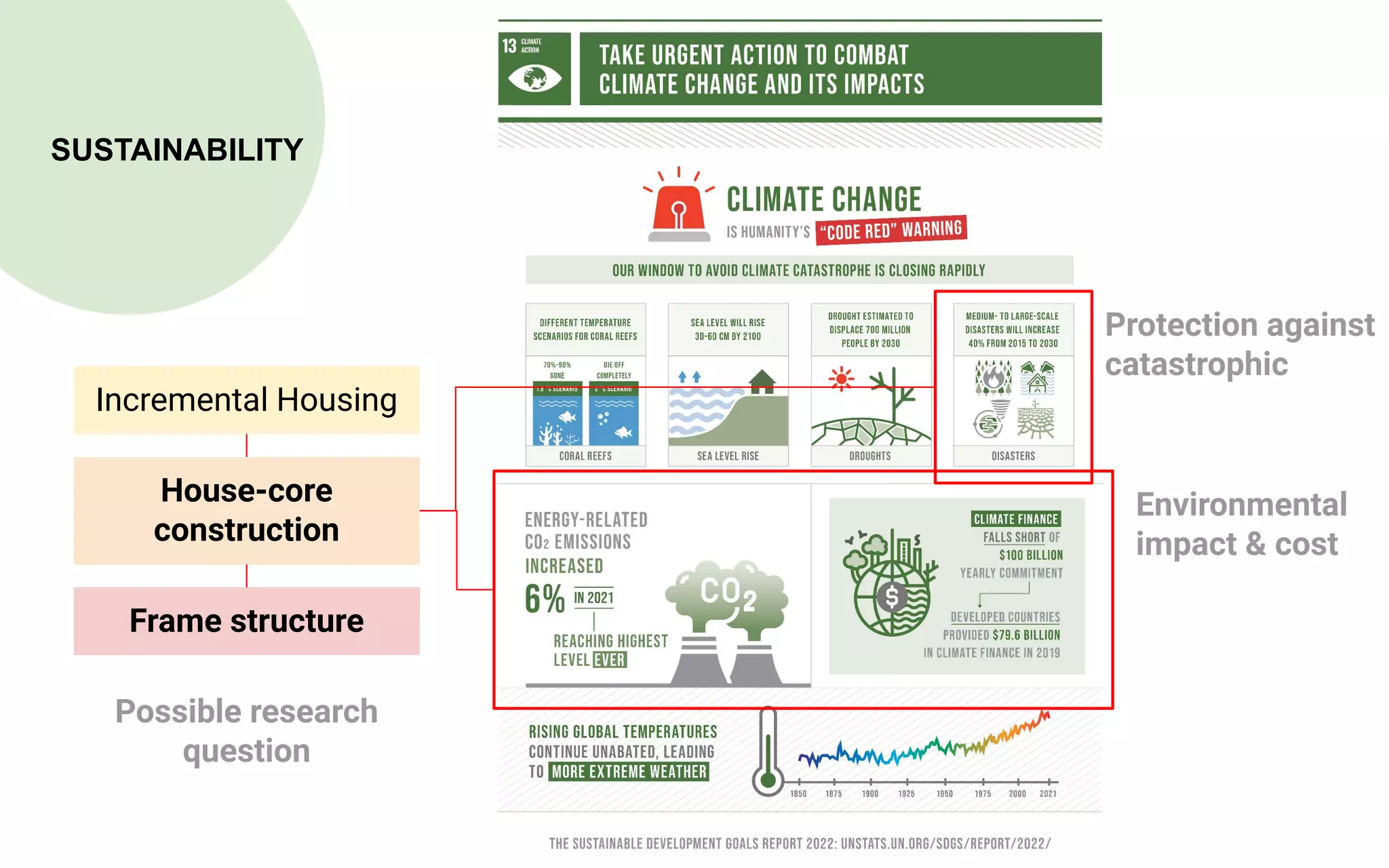
SUSTAINABILITY
Protection against
catastrophic
Environmental
impact & cost
Incremental Housing
House-core
construction
Frame structure
Possible research
question
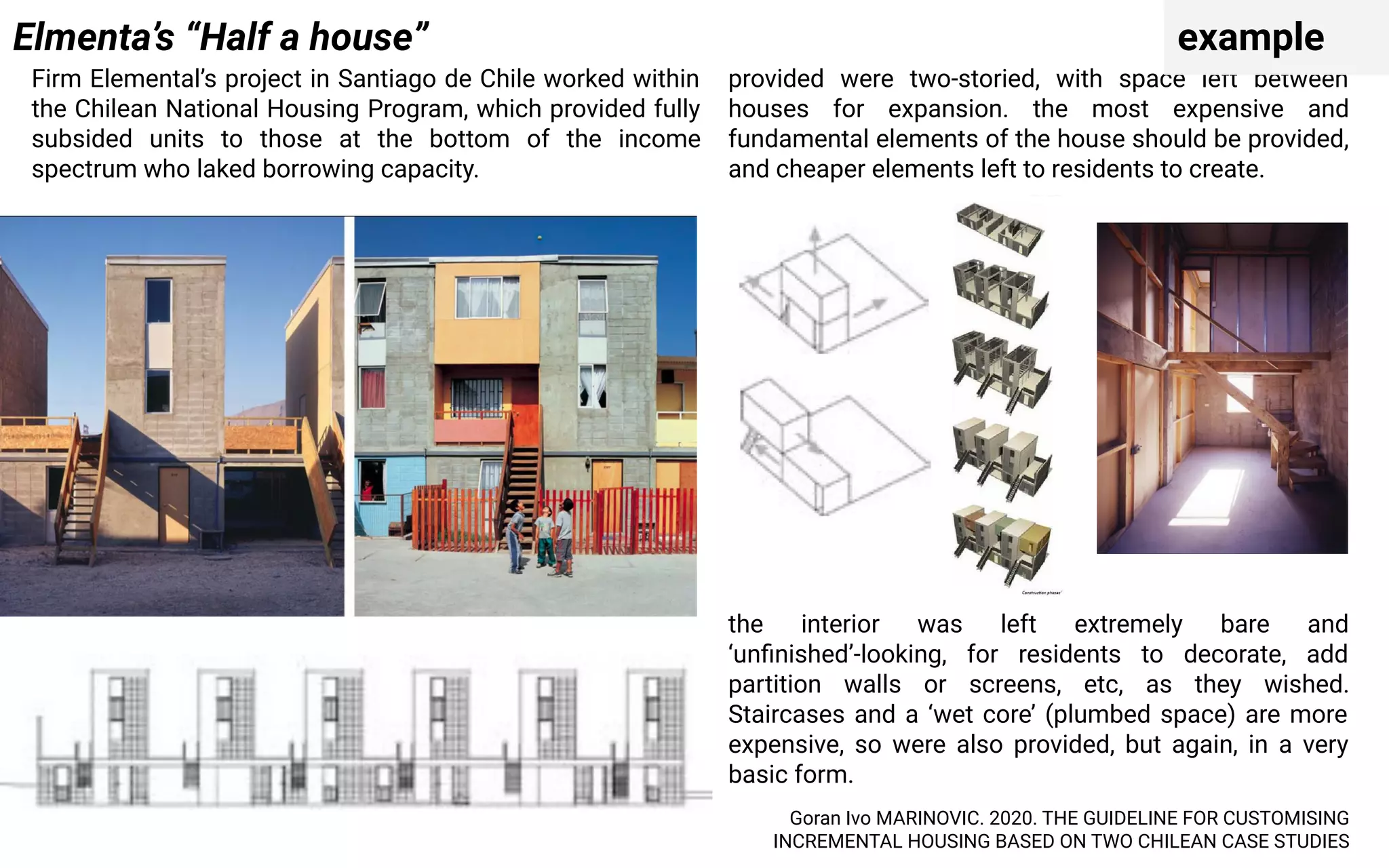
Firm Elemental’s project in Santiago de Chile worked within
the Chilean National Housing Program, which provided fully
subsided units to those at the bottom of the income
spectrum who laked borrowing capacity.
Elmenta’s “Half a house”
provided were two-storied, with space left between
houses for expansion. the most expensive and
fundamental elements of the house should be provided,
and cheaper elements left to residents to create.
the interior was left extremely bare and
‘unfinished’-looking, for residents to decorate, add
partition walls or screens, etc, as they wished.
Staircases and a ‘wet core’ (plumbed space) are more
expensive, so were also provided, but again, in a very
basic form.
Goran Ivo MARINOVIC. 2020. THE GUIDELINE FOR CUSTOMISING
INCREMENTAL HOUSING BASED ON TWO CHILEAN CASE STUDIES
example
Pada tahun 2009, perusahaan kehutanan Arauco menugaskan Elemental
untuk mengembangkan rencana untuk mendukung pekerja dan
kontraktornya agar memiliki akses ke rumah permanen. Secara khusus, ini
tentang mengembangkan beberapa jenis perumahan dalam kerangka
kebijakan perumahan saat ini untuk Dana Perumahan Solidaritas fsv i
(hingga uf600 tanpa utang, sekitar us$25.000) dan fsv ii (hingga uf1000
dengan kredit hipotek, tentang kami $25.000). $40.000). Desain ini akan
disediakan oleh perusahaan sebagai semacam subsidi bagi komite
perumahan untuk mengajukan dana publik (Alejandro Aravena, 2013).
Slums are built without proper infrastructure, continuous inflow of urban poor results in an aggravation of
the living environment, such as densely-packed narrow houses, limited access to water and lack of
sanitation facilities (UN Habitat).
Most urban poor have come from rural areas to seek a living in cities for various reasons ranging from
deprivation of lands in rural areas to higher income in urban areas. Fast pseudo-urbanization in
developing countries is the root cause of the formation of slums (Park et al, 2019).
Respon terhadap masalah penyediaan tempat bermukim yang layak berkompetisi dengan permasalahan
serta kepentingan lain yang juga dipandang memiliki urgensi penanganan tinggi. Ini termasuk: intensifnya
arus urbanisasi, tingginya kepadatan penduduk, keberadaan pemukiman kumuh (slums dan squaters),
kemacetan, peningkatan tindak kejahatan, polusi, dan keterbatasan infrastruktur pendukung operasional
perkotaan sehari-hari (Suartika, 2013).
keterbatasan finansial dan kurangnya pengaturan & penyediaan memicu pembangunan rumah secara
mandiri pada lahan terbatas dengan menambah ruang baru sedikit demi sedikit namun tidak teratur,
sehingga membentuk pemukiman yang kumuh (Zainal, 1981 in Yudhistira, 2021).
the incremental house is the right concept for people who want to build their houses gradually and
at a low cost as it can be continued according to the ability of its users (Zainal, 1981 in Yudhistira, 2021).
Incrementalism is seen as an antidote to challenges of affordability, allowing low-income families to pay
for housing construction over time, and to operate outside of prohibitively expensive formal building
codes and regulations (Femke Van Noorloos et al. 2019. Environment & Urbanization Copyright.
International Institute for Environment and Development (IIED).Vol 32(1): 37–54. DOI:
10.1177/0956247819887679).
Incremental housing is a step-by-step process. It goes by different names (starter house,
phased-development house, owner-driven house), but fundamentally, incremental housing is an integral
urban development process, building housing communities and citizens. It is not quick, immediate or
complete, but choice remains with the owner (Reinhard Goethert, 2010).
Incremental building is not the same as building small, complete, houses that can be extended later.
Incremental building, rather, provides “half of a better house”: the houses are delivered incomplete, though
typically liveable, for the owner to improve and ‘complete’ gradually over time (Laura Wainer, 2016).
Incremental housing concept is a housing system that is designed for the occupants to be able to develop
their own house in the future (Wibowo & Larasati, 2018, Incremental Housing Development; An Approach
the Needs of Low Cost Housing in Indonesia).
The lack of occupancy level (backlog) in Indonesia is still very high. The data from BPS demonstrates
that the estimated number of houses built per year is only about 400 to 500 thousand of housing units.
On the other hand, the demand for community housing per year reached over 800 thousand housing
units (Wibowo & Larasati, 2018).
MARGARITA GREENE AND EDUARDO ROJAS. 2008. Environment &
Urbanization. Institute for Environment and Development (IIED). Vol
20(1): 89–108. DOI: 10.1177/0956247808089150.
The housing value chain framework, which
considers that housing production
undergoes a series of value-addition
processes before reaching the consumer,
making the end product more valuable,
affordable or exclusive according to
parameters selected. There are four key
steps in housing supply: land provision,
services access (physical and social), house
construction (which may be divided into
architecture, building materials, and
technology), and evolution (the maintenance,
expansion and renovation of the house over
time).
Laura Wainer, 2016, Incremental housing, and other design principle for low-cost housing. International Growth Center.
Three phases of the incremental process
Access to land
obtain access to land suitable for residential use;
this land makes it possible for families to
construct the dwelling and access services and
employment opportunities within the city.
Construction of a basic housing nucleus.
the primary function of a home is to provide
protection against the cold, rain, sun and wind,
and reaching these standards is the first priority
after accessing the land.
Incremental improvement of the houses.
after taking possession of a basic house
nucleus, beneficiaries expand it using the
precarious materials of their previous dwelling or
other
MARGARITA GREENE AND EDUARDO ROJAS. 2008.
Environment & Urbanization. Institute for Environment and
Development (IIED). Vol 20(1): 89–108. DOI:
10.1177/0956247808089150.
Implementing an incremental strategy is not as simple as
ready-set-go. A viable policy must address three linked
challenges:
(1)establishing a frame to structure land development;
(2) providing a starter house-core;
(3) creating and implementing supporting policies and programs.
(Reinhard Goethert. 2020. Incremental Housing, A proactive urban
strategy.)
Providing a frame for development
Three basic options exist for a frame of land subdivision in new
settlements: main streets only, main streets with large-lot cluster
divisions, and main streets with all lots defined
Providing a starter core
Starter cores provide a quick way to shelter many families.
Supporting policies and programs
MARGARITA GREENE AND EDUARDO ROJAS. 2008. Environment & Urbanization. Institute for Environment and Development
(IIED). Vol 20(1): 89–108. DOI: 10.1177/0956247808089150.
Laura Wainer, 2016, Incremental housing, and other design principle for low-cost housing. International Growth Center.
The earliest stage of the house will start with the most crucial rooms such as bathroom, bedroom, and kitchen which are
provided by the government beforehand. Later on, the house will be developed in accordance with the needs and economic
conditions of the residents so that the incremental house has a very participatory design approach ((Wibowo & Larasati, 2018,
Incremental Housing Development; An Approach the Needs of Low Cost Housing in Indonesia).

Incremental Housing.pdf

  • 1.
  • 2.
    WHAT? Incrementalism is seenas an antidote to challenges of affordability, allowing low-income families to pay for housing construction over time, and to operate outside of prohibitively expensive formal building codes and regulations (Femke Van Noorloos et al. 2019. Environment & Urbanization Copyright. International Institute for Environment and Development (IIED).Vol 32(1): 37–54. DOI: 10.1177/0956247819887679). Incremental housing is a step-by-step process. It goes by different names (starter house, phased-development house, owner-driven house), but fundamentally, incremental housing is an integral urban development process, building housing communities and citizens. It is not quick, immediate or complete, but choice remains with the owner (Reinhard Goethert, 2010). Incremental building is not the same as building small, complete, houses that can be extended later. Incremental building, rather, provides “half of a better house”: the houses are delivered incomplete, though typically liveable, for the owner to improve and ‘complete’ gradually over time (Laura Wainer, 2016). Incremental housing concept is a housing system that is designed for the occupants to be able to develop their own house in the future (Wibowo & Larasati, 2018, Incremental Housing Development; An Approach the Needs of Low Cost Housing in Indonesia). Incremental housing is a gradual housing process that starts from meeting some of the residents' needs and then being developed by the residents over time
  • 3.
    https://sdgs.un.org/goals WHY? Most urban poorhave come from rural areas to seek a living in cities for various reasons ranging from deprivation of lands in rural areas to higher income in urban areas. Fast pseudo-urbanization in developing countries is the root cause of the formation of slums (Park et al, 2019). Financial limitations and lack of regulation & provision trigger independent housing development on limited land by adding new spaces little by little but irregularly, thus forming slum settlements (Zainal, 1981 in Yudhistira, 2021). Slums are built without proper infrastructure, continuous inflow of urban poor results in an aggravation of the living environment, such as densely-packed narrow houses, limited access to water and lack of sanitation facilities (UN Habitat). The lack of occupancy level (backlog) in Indonesia is still very high. The data from BPS demonstrates that the estimated number of houses built per year is only about 400 to 500 thousand of housing units. On the other hand, the demand for community housing per year reached over 800 thousand housing units (Wibowo & Larasati, 2018).
  • 4.
    WHO? MARGARITA GREENE ANDEDUARDO ROJAS. 2008. Environment & Urbanization. Institute for Environment and Development (IIED). Vol 20(1): 89–108. DOI: 10.1177/0956247808089150. HOUSEHOLDS COMMUNITY INCREMENTAL HOUSE GOVERNMENT ARCHITECTURAL & CONSTRUCTION, RESEARCH self-help
  • 5.
    HOW? The housing valuechain framework, which considers that housing production undergoes a series of value-addition processes before reaching the consumer, making the end product more valuable, affordable or exclusive according to parameters selected. There are four key steps in housing supply: land provision, services access (physical and social), house construction (which may be divided into architecture, building materials, and technology), and evolution (the maintenance, expansion and renovation of the house over time) (Weiner, 2016). Laura Wainer, 2016, Incremental housing, and other design principle for low-cost housing. International Growth Center. 4 key steps of housing supply
  • 6.
    HOW? Three phases ofthe incremental process MARGARITA GREENE AND EDUARDO ROJAS. 2008. Environment & Urbanization. Institute for Environment and Development (IIED). Vol 20(1): 89–108. DOI: 10.1177/0956247808089150. Access to land obtain access to land suitable for residential use. Housing Nucleus Construction of basic/primary function of a home; protection against external weather Incremental Improvement beneficiaries expand it using the precarious materials of their previous dwelling or other Implementing an incremental strategy is not as simple as ready-set-go. A viable policy must address three linked challenges: Providing a frame to structure land development Providing a starter house-core creating and implementing supporting policies and programs (Reinhard Goethert. 2020. Incremental Housing, A proactive urban strategy.)
  • 7.
    HOW? Construction Improvement Possibilities Frame Structure Pre-assembled components Materials Distribution MARGARITA GREENEAND EDUARDO ROJAS. 2008. Environment & Urbanization. Institute for Environment and Development (IIED). Vol 20(1): 89–108. DOI: 10.1177/0956247808089150. House-core
  • 8.
    HOW? Key conclusion forincremental house Laura Wainer, 2016, Incremental housing, and other design principle for low-cost housing. International Growth Center. The earliest stage of the house will start with the most crucial rooms such as bathroom, bedroom, and kitchen which are provided by the government beforehand. Later on, the house will be developed in accordance with the needs and economic conditions of the residents so that the incremental house has a very participatory design approach (Wibowo & Larasati, 2018, Incremental Housing Development; An Approach the Needs of Low Cost Housing in Indonesia).
  • 9.
    SUSTAINABILITY Protection against catastrophic Environmental impact &cost Incremental Housing House-core construction Frame structure Possible research question
  • 10.
    Firm Elemental’s projectin Santiago de Chile worked within the Chilean National Housing Program, which provided fully subsided units to those at the bottom of the income spectrum who laked borrowing capacity. Elmenta’s “Half a house” provided were two-storied, with space left between houses for expansion. the most expensive and fundamental elements of the house should be provided, and cheaper elements left to residents to create. the interior was left extremely bare and ‘unfinished’-looking, for residents to decorate, add partition walls or screens, etc, as they wished. Staircases and a ‘wet core’ (plumbed space) are more expensive, so were also provided, but again, in a very basic form. Goran Ivo MARINOVIC. 2020. THE GUIDELINE FOR CUSTOMISING INCREMENTAL HOUSING BASED ON TWO CHILEAN CASE STUDIES example
  • 11.
    Pada tahun 2009,perusahaan kehutanan Arauco menugaskan Elemental untuk mengembangkan rencana untuk mendukung pekerja dan kontraktornya agar memiliki akses ke rumah permanen. Secara khusus, ini tentang mengembangkan beberapa jenis perumahan dalam kerangka kebijakan perumahan saat ini untuk Dana Perumahan Solidaritas fsv i (hingga uf600 tanpa utang, sekitar us$25.000) dan fsv ii (hingga uf1000 dengan kredit hipotek, tentang kami $25.000). $40.000). Desain ini akan disediakan oleh perusahaan sebagai semacam subsidi bagi komite perumahan untuk mengajukan dana publik (Alejandro Aravena, 2013).
  • 12.
    Slums are builtwithout proper infrastructure, continuous inflow of urban poor results in an aggravation of the living environment, such as densely-packed narrow houses, limited access to water and lack of sanitation facilities (UN Habitat). Most urban poor have come from rural areas to seek a living in cities for various reasons ranging from deprivation of lands in rural areas to higher income in urban areas. Fast pseudo-urbanization in developing countries is the root cause of the formation of slums (Park et al, 2019). Respon terhadap masalah penyediaan tempat bermukim yang layak berkompetisi dengan permasalahan serta kepentingan lain yang juga dipandang memiliki urgensi penanganan tinggi. Ini termasuk: intensifnya arus urbanisasi, tingginya kepadatan penduduk, keberadaan pemukiman kumuh (slums dan squaters), kemacetan, peningkatan tindak kejahatan, polusi, dan keterbatasan infrastruktur pendukung operasional perkotaan sehari-hari (Suartika, 2013). keterbatasan finansial dan kurangnya pengaturan & penyediaan memicu pembangunan rumah secara mandiri pada lahan terbatas dengan menambah ruang baru sedikit demi sedikit namun tidak teratur, sehingga membentuk pemukiman yang kumuh (Zainal, 1981 in Yudhistira, 2021). the incremental house is the right concept for people who want to build their houses gradually and at a low cost as it can be continued according to the ability of its users (Zainal, 1981 in Yudhistira, 2021).
  • 13.
    Incrementalism is seenas an antidote to challenges of affordability, allowing low-income families to pay for housing construction over time, and to operate outside of prohibitively expensive formal building codes and regulations (Femke Van Noorloos et al. 2019. Environment & Urbanization Copyright. International Institute for Environment and Development (IIED).Vol 32(1): 37–54. DOI: 10.1177/0956247819887679). Incremental housing is a step-by-step process. It goes by different names (starter house, phased-development house, owner-driven house), but fundamentally, incremental housing is an integral urban development process, building housing communities and citizens. It is not quick, immediate or complete, but choice remains with the owner (Reinhard Goethert, 2010). Incremental building is not the same as building small, complete, houses that can be extended later. Incremental building, rather, provides “half of a better house”: the houses are delivered incomplete, though typically liveable, for the owner to improve and ‘complete’ gradually over time (Laura Wainer, 2016). Incremental housing concept is a housing system that is designed for the occupants to be able to develop their own house in the future (Wibowo & Larasati, 2018, Incremental Housing Development; An Approach the Needs of Low Cost Housing in Indonesia). The lack of occupancy level (backlog) in Indonesia is still very high. The data from BPS demonstrates that the estimated number of houses built per year is only about 400 to 500 thousand of housing units. On the other hand, the demand for community housing per year reached over 800 thousand housing units (Wibowo & Larasati, 2018).
  • 14.
    MARGARITA GREENE ANDEDUARDO ROJAS. 2008. Environment & Urbanization. Institute for Environment and Development (IIED). Vol 20(1): 89–108. DOI: 10.1177/0956247808089150.
  • 15.
    The housing valuechain framework, which considers that housing production undergoes a series of value-addition processes before reaching the consumer, making the end product more valuable, affordable or exclusive according to parameters selected. There are four key steps in housing supply: land provision, services access (physical and social), house construction (which may be divided into architecture, building materials, and technology), and evolution (the maintenance, expansion and renovation of the house over time). Laura Wainer, 2016, Incremental housing, and other design principle for low-cost housing. International Growth Center.
  • 16.
    Three phases ofthe incremental process Access to land obtain access to land suitable for residential use; this land makes it possible for families to construct the dwelling and access services and employment opportunities within the city. Construction of a basic housing nucleus. the primary function of a home is to provide protection against the cold, rain, sun and wind, and reaching these standards is the first priority after accessing the land. Incremental improvement of the houses. after taking possession of a basic house nucleus, beneficiaries expand it using the precarious materials of their previous dwelling or other MARGARITA GREENE AND EDUARDO ROJAS. 2008. Environment & Urbanization. Institute for Environment and Development (IIED). Vol 20(1): 89–108. DOI: 10.1177/0956247808089150. Implementing an incremental strategy is not as simple as ready-set-go. A viable policy must address three linked challenges: (1)establishing a frame to structure land development; (2) providing a starter house-core; (3) creating and implementing supporting policies and programs. (Reinhard Goethert. 2020. Incremental Housing, A proactive urban strategy.) Providing a frame for development Three basic options exist for a frame of land subdivision in new settlements: main streets only, main streets with large-lot cluster divisions, and main streets with all lots defined Providing a starter core Starter cores provide a quick way to shelter many families. Supporting policies and programs
  • 17.
    MARGARITA GREENE ANDEDUARDO ROJAS. 2008. Environment & Urbanization. Institute for Environment and Development (IIED). Vol 20(1): 89–108. DOI: 10.1177/0956247808089150.
  • 18.
    Laura Wainer, 2016,Incremental housing, and other design principle for low-cost housing. International Growth Center. The earliest stage of the house will start with the most crucial rooms such as bathroom, bedroom, and kitchen which are provided by the government beforehand. Later on, the house will be developed in accordance with the needs and economic conditions of the residents so that the incremental house has a very participatory design approach ((Wibowo & Larasati, 2018, Incremental Housing Development; An Approach the Needs of Low Cost Housing in Indonesia).