CASBEE
PRESENTATION ON
RAHUL BAJRACHARYA 69029
ROJAN SHRESTHA 69031
ROJINA SHRESTHA 69032
SHRISTI SHAKYA 69044
Green Building???
Creating structures and using
processes that are:
environmentally responsible
resource-efficient
throughout a building’s life-
cycle from siting to design,
construction, operation,
maintenance, renovation and
deconstruction.
– Reduce carbon consumption,
– Energy independence,
– Preserve natural systems
– Improved building performance
– Increased revenue (higher rents/sales price,
improved productivity, fewer/shorter vacancies)
– Lower cost (utilities, costs of conversion)
Why Green???
Comprehensive Assessment System for Built
Environment Efficiency
Building Rating System
• There has been a growing movement towards sustainable
construction since the second half of the 1980s, leading to the
development of various methods for evaluating the
environmental performance of buildings.
6
40% of CO2 are related to buildings in Japan
New construction
Residential bldgs 3.4%
Commercial bldgs 3.2%
Renovation
1.1%
0.9%
Operation
13.5%
18.0%
Construction Operation Renovation DemolitionMaterial
Production
Design
by T. Ikaga
1300Mt-CO2
in 2005
Introduction
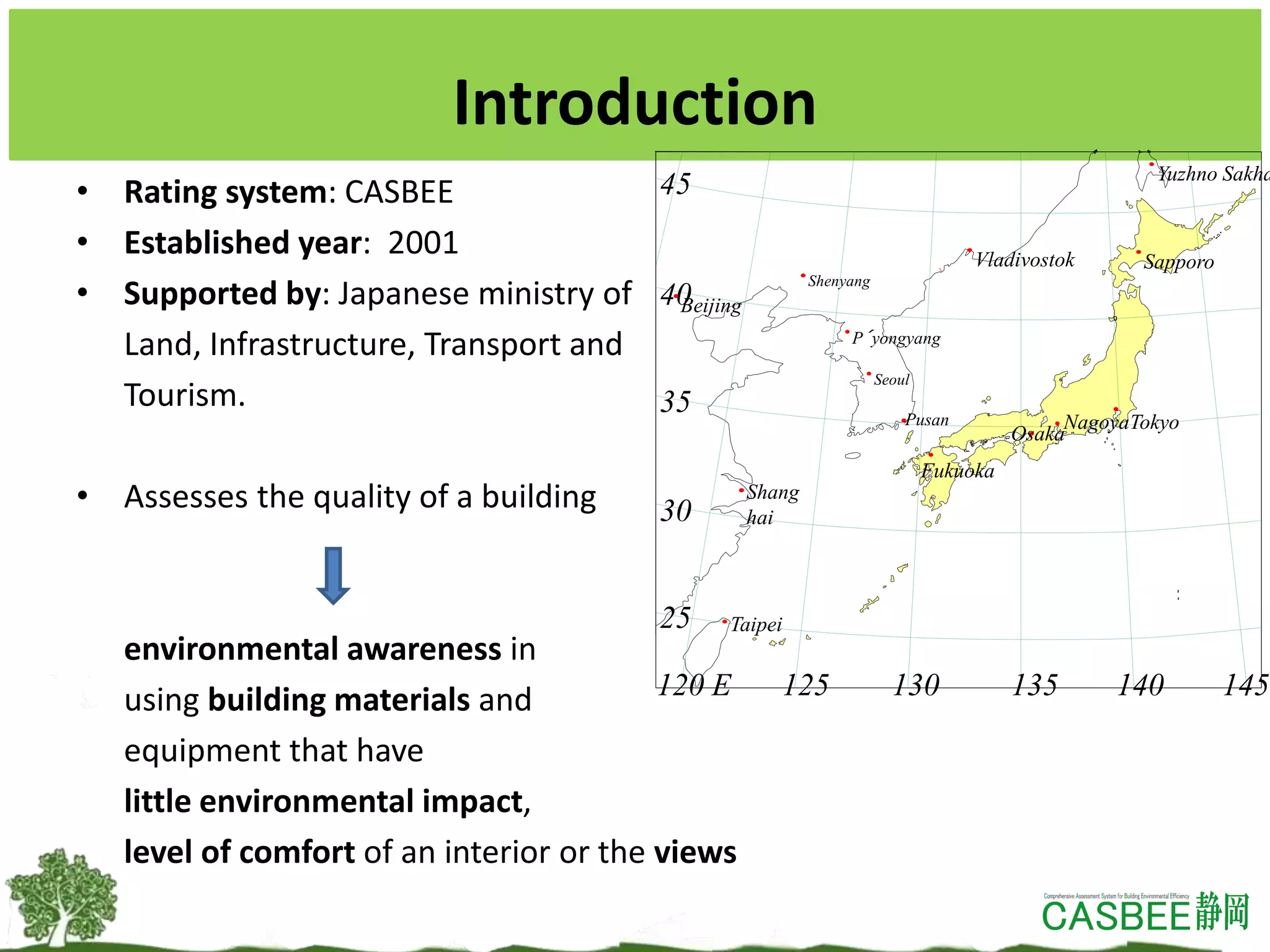
• Rating system: CASBEE
• Established year: 2001
• Supported by: Japanese ministry of
Land, Infrastructure, Transport and
Tourism.
• Assesses the quality of a building
environmental awareness in
using building materials and
equipment that have
little environmental impact,
level of comfort of an interior or the views
25
30
35
40
45
120 E 125 130 135 140 145
Tokyo
Shang
hai
Osaka
Seoul
Pusan
Beijing
Shenyang
Vladivostok
Taipei
P´yongyang
Nagoya
Sapporo
Yuzhno Sakha
Fukuoka
Policies
• The system should be structured to award high assessments
to superior buildings, thereby enhancing incentives to
designers and others.
• The assessment system should be as simple as possible.
• The system should be applicable to buildings in a wide range
of building types.
• The system should take into consideration issues and
problems peculiar to Japan and Asia.
CASBEE assessment tools principles
[1] Comprehensive assessment throughout the life cycle of the building
[2] Assessment of the Built Environment Quality and Built Environment
Load
[3] Assessment based on the newly developed Built Environment
Efficiency (BEE) indicator
APPLICATION:
• CASBEE-Housing and CASBEE-Building are applied for individual houses and
buildings to assess their environmental performance.
• CASBEE-Urban Development is used to evaluate environmental performance of
urban blocks and town development.
• CASBEE-City evaluates environmental performance on a local government
scale.
• These are assessed based on BEE indicators by CASBEE.
CASBEE Assessment Tools
• CASBEE-Housing and CASBEE-Building are
applied for individual houses and
buildings to assess their environmental
performance.
• CASBEE-Urban Development is used to
evaluate environmental performance of
urban blocks and town
development.
Four Basic Tools
Pre-design, CASBEE for New Construction, CASBEE for Existing
Buildings, CASBEE for Renovation
Application Name
For Detached Houses
CASBEE for Detached Houses
(for New Construction, for Existing Building)
For Temporary Construction CASBEE for Temporary Construction
Brief versions
CASBEE for New Construction (Brief Version), for
Existing
Buildings (Brief version), for Renovation (Brief version)
CASBEE for Urban Development (Brief version)
Local government versions
CASBEE-Nagoya, CASBEE-Osaka, CASBEE-Yokohama
etc.
For Heat Island effect CASBEE for Heat Island
For Urban Development CASBEE for Urban Development
For Cities CASBEE for Cities
For Market Promotion CASBEE for Market Promotion
CASBEE for Specific Purposes
(April 2014)
Building Environmental Quality and Performance:
CASBEE major categories of criteria
Indoor
Environment
Quality
Thermal comfort
Acoustics
and
noise
Lighting
and
illumination
Air quality
Quality of
service
Functionality and
usability
amenities
Durability
and
reliability
flexibility
and
adaptability
Outdoor
environment
on site
preservation and creation of biotope
outdoor amenities townscape and landscape
Building Environmental loading:
Resources
and
materials
recycled materials
Water
conservation
materials
with low
health risks
sustainably harvested
timber
Energy
thermal load
efficiency
of systems
use of
natural
energy
efficient
operations
Off-site
environment
air pollution, noise and vibration
sunlight obstruction,
light pollution
heat island effect,
and local on local infrastructure
CASBEE major categories of criteria
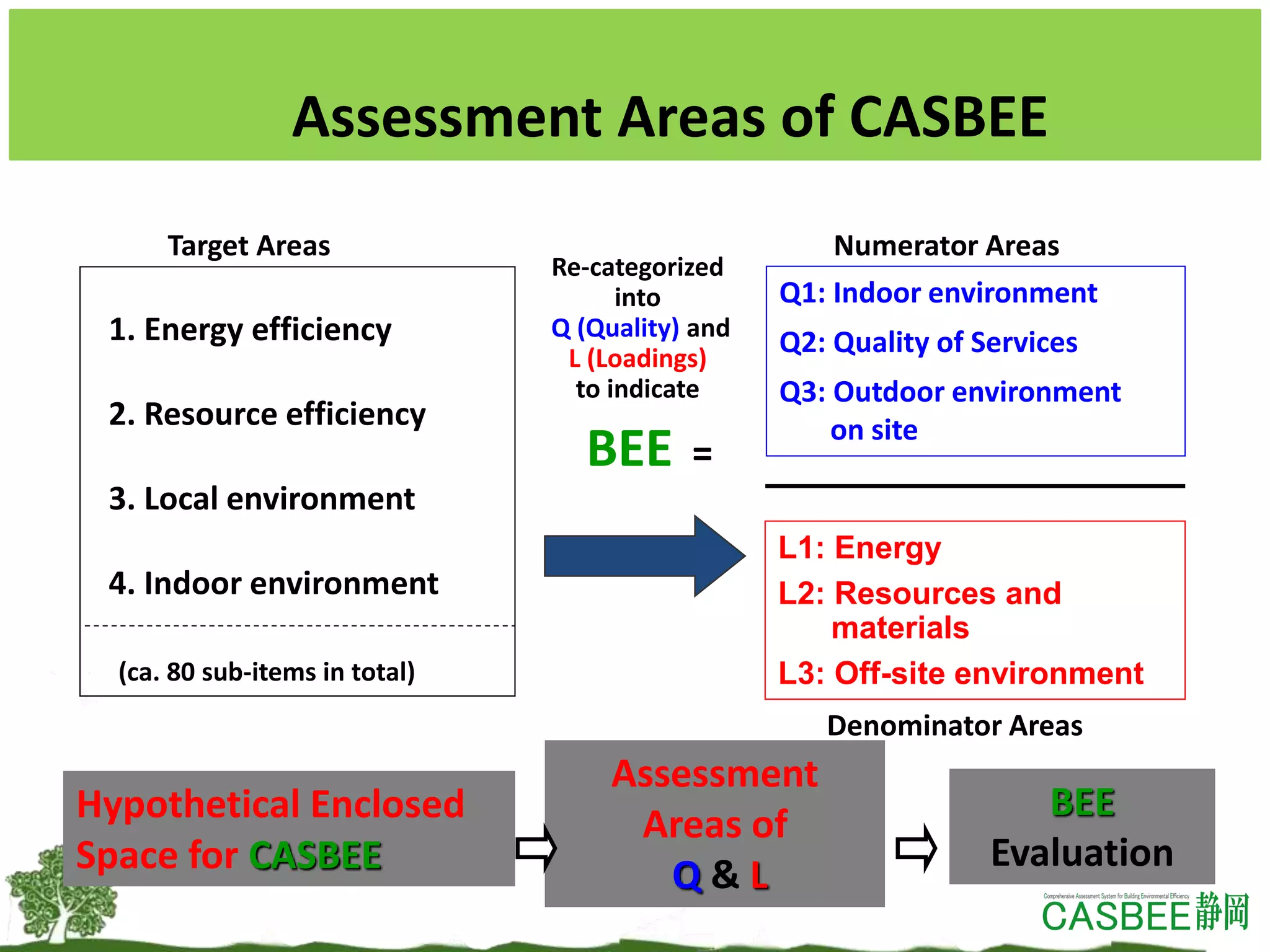
Re-categorized
into
Q (Quality) and
L (Loadings)
to indicate
BEE =
Assessment Areas of CASBEE
Q1: Indoor environment
Q2: Quality of Services
Q3: Outdoor environment
on site
Numerator Areas
L1: Energy
L2: Resources and
materials
L3: Off-site environment
Denominator Areas
BEE
Evaluation
Assessment
Areas of
Q & L
Hypothetical Enclosed
Space for CASBEE
1. Energy efficiency
2. Resource efficiency
3. Local environment
4. Indoor environment
(ca. 80 sub-items in total)
Target Areas
Assessment Field % of the
overall
weight
Items related to L
% of the
overall
weight
Water Efficiency 50 Water Leakage Detection (3.6%)
water use during construction (1.8%)
Waste water management (7.2%)
Sanitary Used Pip (2.4%)
15
Materials and
Resources
10 Regionally procured materials (1.5%)
Materials fabricated on site (0.5%)
Use of readily renewable materials
(1.5%)
Use of salvaged materials (1.5%)
Use of recycled materials (2%)
Use of lightweight materials (0.5%)
Use of higher durability materials
(0.5%)
Use of prefabricated elements (1.5%)
Life Cycle Cost (LCC) analysis of
materials in the project
(0.5%)
0
Indoor Environmental
Quality 10 10
CASBEE ASSESSMENT PROCESS
Assessment Field
% of the
overall
weight
Items related to L
% of the
overall
weight
Sustainable Site.
Accessibility
and
Ecology
I5
Desert area development (1.5%)
Informal area redevelopment (1.5%)
Brownfield site redevelopment (1.5%)
Compatibility with National
Development Plan (1.5%)
Transport infrastructure connection
(1.5%)
Catering for remote sites (1.5%)
Alternative methods of transport
(1.5%)
Protection of habitat (1.5%)
Respect for sites of historic or cultural
interest (1.5%)
Minimizing Pollution during
construction (1.5%)
0
Energy Efficiency 25
Passive External Heat Gain loss
Reduction (3.5%)
Energy Efficient Appliances (1.5%)
Vertical Transportation Systems
(1.5%)
Peak Load Reduction (3%)
Renewable Energy Sources (5%)
Environmental Impact (2%)
Energy and Carbon Inventories (1%)
7.5
Assessment Field
% of the
overall
weight
Items related to L
% of the
overall
weight
Management 10 Providing Containers for site materials
waste (1%)
Control of emissions and pollutants
(1%)
waste recycling workers on site
(0.5%)
Providing Identified and separated
storage areas (1%)
Project Waste Management Plan
(0.5%)
Engaging a company specialized in
recycling (1%)
Protecting water sources from
pollution (1%)
Waste from mixing equipment (1%)
3
Assessment Field % of the
overall
weight
Items related to Q % of the overall
weight
Sustainable Site.
Accessibility and
Ecology
15
0
Energy Efficiency 25 Energy Efficiency Improvement
(5%)
Optimized balance of Energy and
Performance (2%)
Operation and Maintenance (0.5%)
7.5
Water Efficiency 30 Indoor Water Efficiency
Improvement (4.8%)
Outdoor Water Efficiency
Improvement (5.4%)
Efficiency of Water-based Cooling
(2.4%)
Water Feature Efficiency (2.4%)
15
Materials and Resources 10 0
Indoor Environmental
Quality
10 Optimized Ventilation (3.33%)
Controlling emissions from building
materials
(3.33%)
Controlling emissions from building
materials
(3.33%)
Thermal Comfort (1.3%)
Visual Comfort (1.3%)
Acoustic Comfort (0.67%)
10
Assessment Field % of the
overall
weight
Items related to Q % of the overall
weight
Management 10 Providing access for lorries, plant
and equipment
(0.5%)
Providing a Building User Guide
(1.5%)
Providing a Periodic Maintenance
Schedule (1%)
3
(Neighboring building) (Neighboring building)
Hypothetical Enclosed
Space
Site Boundary
Assessment category “L”
as negative impact
outside the boundary
Assessment category “Q”
as positive impact
inside the boundary
Emission of
Air-pollutants,
Noise, Heat
etc.
Resource
Consumption,
Embodied CO2
Emission, etc.
Soil, Water-pollutants etc.
What is ‘Hypothetical Boundary’?
BEE Representation
• Plot L on the x axis and Q on the y
axis.
• The BEE value assessment result is
expressed as the gradient of the
straight line passing through the
origin (0,0).
• The higher the Q value and the lower
the L value, the steeper the gradient
and the more sustainable the building
is.
• possible to graphically present the
results of built environment
assessments using areas bounded by
these gradients.
From Eco-efficiency to Built Environment
Efficiency (BEE)
• Eco-Efficiency - "Value of products and services per unit environmental load.”
• Efficiency - in terms of input and output quantities
• so a new model - expanded definition of Eco-Efficiency - as "(beneficial output) /
(input + non-beneficial output)."
• This new model of
environment efficiency
can be extended to
define Built
Environment Efficiency
(BEE), which CASBEE
uses as its assessment
indicator.
“BEE Graphical Display”
50
100
0 50 100
C
B+AS
BEE=1.5BEE=3.0
BEE=0.5
L
Q
B-
BEE=1.0
(Very sustainable)
(Unsustainable)
30
60 BEE=2.0
B-
Rating system
Rating for
CASBEE
Ranks Assessment BEE value Expression
S Excellent BEE= 3.0 or more and Q=50 or more *****
A Very good BEE=1.5-3.0
BEE=3.0 or or more and Q is less than
50
****
B + Good BEE=1.0-1.5 ***
B Fairy Poor BEE=0.5-1.0 **
C Poor BEE=less than 0.5 *
CASBEE Different Than Other Rating System
- New concept for assessment (distinguishes environmental load from quality of
building performance)
- CASBEE results are presented as a measure of eco-efficiency or BEE.
- Accuracy of Data Inputting High ,Accuracy of Data Processing High ,Accuracy of
Data Outputting high
Comparison between various rating system
BREEAM LEED CASBEE GRIHA
Year of commence
1990 1998 2001 2007
Country of origin UK USA Japan India
Developed by Building Research
Establishment (BRE)
Ltd
U.S Green Building
Council (USGBC)
Japan Sustainable
Building Consortium
(JSBC)
MNRE
Geographical focus Global Global Global but specially
in japan
Local, India and
nearby area
Characteristics Two process of
assessment.
1.Design stage
2.Post construction
A voluntary tool
constitute of 5
sustainability
areas.
Industrial
standard
certification
process
Primarily on
environment
concern.
Having 3 stages of
development
Designed for
building’s
environmental
performance in
context to Indian
atmospheric
condition
Building
type
Offices, retails,
industry units,
courts, educations,
healthcare, prison
Healthcare
facilities, schools,
homes, entire
neighbourhoods.
Residential and
non-residential
type of building
Commercial,resid
ential and
Institutional
Assessment
criteria for
green
building tool
1.Management
2.Health and
Wellbeing
3.Energy
4.Water
5.Material
6.Trasport
7.Waste
8.Landuse and
Ecology
9.Pollution
1.Sustainable site
2.Water efficiency
3.Energy and
atmosphere
4.Materials and
resources
5.Indoor
environmental
quality credits
6.Innovation in
Design
7.Regional Priority
Built environment
quality
1.Indoor
environment
2.Quality of
service
3.Outdoor
environment on
site
Built load
1.Energy
2.Resources and
material
3.Off-site
environment
1.Sustainable Site
2.Water
Management
Energy
optimization
4.Sustainable
building materials
5.Waste
Management
6.Health and
wellbeing
7.Building
operation
and maintenance
8.Innovation
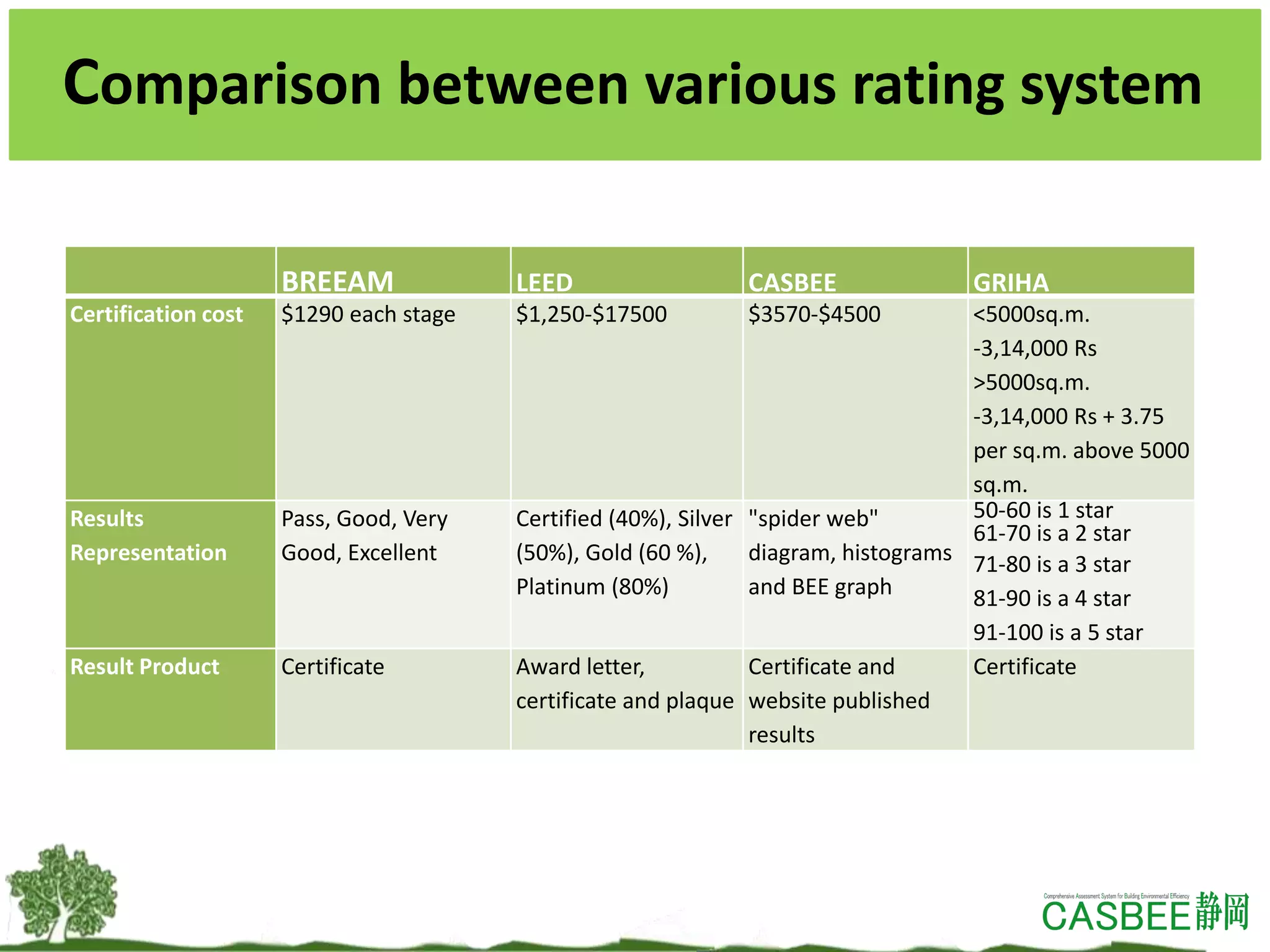
Comparison between various rating system
BREEAM LEED CASBEE GRIHA
Certification cost $1290 each stage $1,250-$17500 $3570-$4500 <5000sq.m.
-3,14,000 Rs
>5000sq.m.
-3,14,000 Rs + 3.75
per sq.m. above 5000
sq.m.
Results
Representation
Pass, Good, Very
Good, Excellent
Certified (40%), Silver
(50%), Gold (60 %),
Platinum (80%)
"spider web"
diagram, histograms
and BEE graph
50-60 is 1 star
61-70 is a 2 star
71-80 is a 3 star
81-90 is a 4 star
91-100 is a 5 star
Result Product Certificate Award letter,
certificate and plaque
Certificate and
website published
results
Certificate
Comparison between various rating system
Disadvantages
• Meticulous record keeping is required
• The main disadvantage of the certification process is that they
are expensive.
• Sometimes the availability of materials may cause problem.
• Takes time for the certification.
Certification & Accreditation
1. CASBEE Assessment Certification:
provided by IBEC
2. CASBEE Assessor Accreditation:
associated with the education system
also provided by IBEC
IBEC: Institute for Built Environment & Energy Conservation
Utilization of CASBEE in local governments
Number of buildings reported to local
governments (as of March 2015)
CASE STUDY-OBAYASHI TECHNICAL RESEARCH INSTITUTE MAIN BUILDING
[CASBEE rank] S (5 STAR)
[CASBEE tool used] CASBEE for New
Construction (2008 edition)
[Location] Kiyose City, Tokyo
[Completion date] September, 2010
[Site area] 69,401m
2
[Total floor area] 5,535m
2
[Structure] Steel construction
(seismically isolated
structure (Super-Active base
isolation system))
[Owner] Obayashi Corporation
[Designer] Obayashi Corporation
[Contractor] Obayashi Corporation
Project Outline
This building is a central workplace for Obayashi
Corporation.
With an aim to create an environmentally-
friendly workplace, the building adopted a
complex passive.
The systems allowed for 55 percent
reduction in CO2 emissions during
operation, the highest level in Japan.
Awards
Adopted as the 2nd Model Project for Promoting CO2 Reduction in Housing and Building in 2009
by the Ministry of Land, Infrastructure, Transport and Tourism
Source: Japanese Sustainable Building database
ABOUT THE PROJECT Source: Japanese Sustainable Building database
ECOLOGICAL ROOF SYSTEM
Solar panels installed on the entire of the slanted roof generate power.
A system that diffracts skylight with less fluctuation on a reflecting surface
eliminates the need of lighting during daytime.
Source: Japanese Sustainable Building database
PERI-BUFFER SYSTEM
This peri-buffer zone is intended to control impact of air-conditioning loads on
the inside working zone, and consists of aisles, meeting space and lounges that are located
around the working area and adjacent to an outdoor deck.
A thermal buffer
zone established
around windows
reduces air-
conditioning
loads.
Source: Japanese Sustainable Building database
Displacement Natural ventilation system
This helps control
adverse effects of
increase in outside
air temperature
caused by sunlight
reflected by exterior
pavement materials
When outside air meets the predetermined conditions, an air-conditioner is stopped
automatically.
The air is discharged from high side lights on the upper of the building.
Source: Japanese Sustainable Building database
SENSIBLE/LATENT HEAT SEPARATED PERSONAL RADIANT AIR-CONDITIONING SYSTEM (O-TASC)
Personal air-conditioning by using radiative-convective task panels.
A desiccant air-conditioner treats latent heat
of the outside air properly, and brings it into the
zones through blower outlets on the floor.
Task panels treat sensible heat
generated from human.
Source: Japanese Sustainable Building database
LIGHTING/AIR-CONDITIONING CONTROL SYSTEM USING IC TAGS
IC tags that are used for security control detects if individual staffs are at their seats and in the
office, and task lighting and air-conditioning systems are controlled to be turned on/off.
Detailed switch control
depending on the required
time and location allows for
eliminating unnecessary
energy use.
Source: Japanese Sustainable Building database
HYBRID HEAT PUMP SYSTEM OF GEOTHERMAL AND WELL-WATER HEAT
•well water is used as heat source for the heat pump to improve the efficiency in
heat source operation.
•A heat source system that utilizes stable geothermal power throughout the year.
Source: Japanese Sustainable Building database
VISUALIZATION SYSTEM
•The visualization system displays the effects of environmental measures on the monitor
for occupants by utilizing the energy data obtained from BEMS.
• It calculates and displays energy usage and its reduction in terms of CO2 emissions by
items on a real time basis.
Source: Japanese Sustainable Building database
SUMMARY Source: Japanese Sustainable Building database
Bibliography
http://www.sciencedirect.com/science/article/pii/S1877705811048636
http://www.survivalrenewableenergy.com/
http://www.ijern.com/journal/November-2013/41.pdf
(BREEAM,20 13), (Mao et al., 2009)
LEED, 2013), (Ding, 2008)
CASBEE, 2013), (Ding, 2008), (Sinou & Kyvelou, 2006)

CASBEE

  • 1.
    CASBEE PRESENTATION ON RAHUL BAJRACHARYA69029 ROJAN SHRESTHA 69031 ROJINA SHRESTHA 69032 SHRISTI SHAKYA 69044
  • 2.
    Green Building??? Creating structuresand using processes that are: environmentally responsible resource-efficient throughout a building’s life- cycle from siting to design, construction, operation, maintenance, renovation and deconstruction.
  • 3.
    – Reduce carbonconsumption, – Energy independence, – Preserve natural systems – Improved building performance – Increased revenue (higher rents/sales price, improved productivity, fewer/shorter vacancies) – Lower cost (utilities, costs of conversion) Why Green???
  • 4.
    Comprehensive Assessment Systemfor Built Environment Efficiency
  • 5.
    Building Rating System •There has been a growing movement towards sustainable construction since the second half of the 1980s, leading to the development of various methods for evaluating the environmental performance of buildings.
  • 6.
    6 40% of CO2are related to buildings in Japan New construction Residential bldgs 3.4% Commercial bldgs 3.2% Renovation 1.1% 0.9% Operation 13.5% 18.0% Construction Operation Renovation DemolitionMaterial Production Design by T. Ikaga 1300Mt-CO2 in 2005
  • 7.
    Introduction • Rating system:CASBEE • Established year: 2001 • Supported by: Japanese ministry of Land, Infrastructure, Transport and Tourism. • Assesses the quality of a building environmental awareness in using building materials and equipment that have little environmental impact, level of comfort of an interior or the views 25 30 35 40 45 120 E 125 130 135 140 145 Tokyo Shang hai Osaka Seoul Pusan Beijing Shenyang Vladivostok Taipei P´yongyang Nagoya Sapporo Yuzhno Sakha Fukuoka
  • 8.
    Policies • The systemshould be structured to award high assessments to superior buildings, thereby enhancing incentives to designers and others. • The assessment system should be as simple as possible. • The system should be applicable to buildings in a wide range of building types. • The system should take into consideration issues and problems peculiar to Japan and Asia.
  • 9.
    CASBEE assessment toolsprinciples [1] Comprehensive assessment throughout the life cycle of the building [2] Assessment of the Built Environment Quality and Built Environment Load [3] Assessment based on the newly developed Built Environment Efficiency (BEE) indicator APPLICATION: • CASBEE-Housing and CASBEE-Building are applied for individual houses and buildings to assess their environmental performance. • CASBEE-Urban Development is used to evaluate environmental performance of urban blocks and town development. • CASBEE-City evaluates environmental performance on a local government scale. • These are assessed based on BEE indicators by CASBEE. CASBEE Assessment Tools
  • 10.
    • CASBEE-Housing andCASBEE-Building are applied for individual houses and buildings to assess their environmental performance. • CASBEE-Urban Development is used to evaluate environmental performance of urban blocks and town development.
  • 11.
    Four Basic Tools Pre-design,CASBEE for New Construction, CASBEE for Existing Buildings, CASBEE for Renovation
  • 12.
    Application Name For DetachedHouses CASBEE for Detached Houses (for New Construction, for Existing Building) For Temporary Construction CASBEE for Temporary Construction Brief versions CASBEE for New Construction (Brief Version), for Existing Buildings (Brief version), for Renovation (Brief version) CASBEE for Urban Development (Brief version) Local government versions CASBEE-Nagoya, CASBEE-Osaka, CASBEE-Yokohama etc. For Heat Island effect CASBEE for Heat Island For Urban Development CASBEE for Urban Development For Cities CASBEE for Cities For Market Promotion CASBEE for Market Promotion CASBEE for Specific Purposes (April 2014)
  • 13.
    Building Environmental Qualityand Performance: CASBEE major categories of criteria Indoor Environment Quality Thermal comfort Acoustics and noise Lighting and illumination Air quality Quality of service Functionality and usability amenities Durability and reliability flexibility and adaptability Outdoor environment on site preservation and creation of biotope outdoor amenities townscape and landscape
  • 14.
    Building Environmental loading: Resources and materials recycledmaterials Water conservation materials with low health risks sustainably harvested timber Energy thermal load efficiency of systems use of natural energy efficient operations Off-site environment air pollution, noise and vibration sunlight obstruction, light pollution heat island effect, and local on local infrastructure CASBEE major categories of criteria
  • 15.
    Re-categorized into Q (Quality) and L(Loadings) to indicate BEE = Assessment Areas of CASBEE Q1: Indoor environment Q2: Quality of Services Q3: Outdoor environment on site Numerator Areas L1: Energy L2: Resources and materials L3: Off-site environment Denominator Areas BEE Evaluation Assessment Areas of Q & L Hypothetical Enclosed Space for CASBEE 1. Energy efficiency 2. Resource efficiency 3. Local environment 4. Indoor environment (ca. 80 sub-items in total) Target Areas
  • 16.
    Assessment Field %of the overall weight Items related to L % of the overall weight Water Efficiency 50 Water Leakage Detection (3.6%) water use during construction (1.8%) Waste water management (7.2%) Sanitary Used Pip (2.4%) 15 Materials and Resources 10 Regionally procured materials (1.5%) Materials fabricated on site (0.5%) Use of readily renewable materials (1.5%) Use of salvaged materials (1.5%) Use of recycled materials (2%) Use of lightweight materials (0.5%) Use of higher durability materials (0.5%) Use of prefabricated elements (1.5%) Life Cycle Cost (LCC) analysis of materials in the project (0.5%) 0 Indoor Environmental Quality 10 10 CASBEE ASSESSMENT PROCESS
  • 17.
    Assessment Field % ofthe overall weight Items related to L % of the overall weight Sustainable Site. Accessibility and Ecology I5 Desert area development (1.5%) Informal area redevelopment (1.5%) Brownfield site redevelopment (1.5%) Compatibility with National Development Plan (1.5%) Transport infrastructure connection (1.5%) Catering for remote sites (1.5%) Alternative methods of transport (1.5%) Protection of habitat (1.5%) Respect for sites of historic or cultural interest (1.5%) Minimizing Pollution during construction (1.5%) 0 Energy Efficiency 25 Passive External Heat Gain loss Reduction (3.5%) Energy Efficient Appliances (1.5%) Vertical Transportation Systems (1.5%) Peak Load Reduction (3%) Renewable Energy Sources (5%) Environmental Impact (2%) Energy and Carbon Inventories (1%) 7.5
  • 18.
    Assessment Field % ofthe overall weight Items related to L % of the overall weight Management 10 Providing Containers for site materials waste (1%) Control of emissions and pollutants (1%) waste recycling workers on site (0.5%) Providing Identified and separated storage areas (1%) Project Waste Management Plan (0.5%) Engaging a company specialized in recycling (1%) Protecting water sources from pollution (1%) Waste from mixing equipment (1%) 3
  • 19.
    Assessment Field %of the overall weight Items related to Q % of the overall weight Sustainable Site. Accessibility and Ecology 15 0 Energy Efficiency 25 Energy Efficiency Improvement (5%) Optimized balance of Energy and Performance (2%) Operation and Maintenance (0.5%) 7.5 Water Efficiency 30 Indoor Water Efficiency Improvement (4.8%) Outdoor Water Efficiency Improvement (5.4%) Efficiency of Water-based Cooling (2.4%) Water Feature Efficiency (2.4%) 15 Materials and Resources 10 0 Indoor Environmental Quality 10 Optimized Ventilation (3.33%) Controlling emissions from building materials (3.33%) Controlling emissions from building materials (3.33%) Thermal Comfort (1.3%) Visual Comfort (1.3%) Acoustic Comfort (0.67%) 10
  • 20.
    Assessment Field %of the overall weight Items related to Q % of the overall weight Management 10 Providing access for lorries, plant and equipment (0.5%) Providing a Building User Guide (1.5%) Providing a Periodic Maintenance Schedule (1%) 3
  • 21.
    (Neighboring building) (Neighboringbuilding) Hypothetical Enclosed Space Site Boundary Assessment category “L” as negative impact outside the boundary Assessment category “Q” as positive impact inside the boundary Emission of Air-pollutants, Noise, Heat etc. Resource Consumption, Embodied CO2 Emission, etc. Soil, Water-pollutants etc. What is ‘Hypothetical Boundary’?
  • 22.
    BEE Representation • PlotL on the x axis and Q on the y axis. • The BEE value assessment result is expressed as the gradient of the straight line passing through the origin (0,0). • The higher the Q value and the lower the L value, the steeper the gradient and the more sustainable the building is. • possible to graphically present the results of built environment assessments using areas bounded by these gradients.
  • 23.
    From Eco-efficiency toBuilt Environment Efficiency (BEE) • Eco-Efficiency - "Value of products and services per unit environmental load.” • Efficiency - in terms of input and output quantities • so a new model - expanded definition of Eco-Efficiency - as "(beneficial output) / (input + non-beneficial output)." • This new model of environment efficiency can be extended to define Built Environment Efficiency (BEE), which CASBEE uses as its assessment indicator.
  • 24.
    “BEE Graphical Display” 50 100 050 100 C B+AS BEE=1.5BEE=3.0 BEE=0.5 L Q B- BEE=1.0 (Very sustainable) (Unsustainable) 30 60 BEE=2.0 B-
  • 25.
    Rating system Rating for CASBEE RanksAssessment BEE value Expression S Excellent BEE= 3.0 or more and Q=50 or more ***** A Very good BEE=1.5-3.0 BEE=3.0 or or more and Q is less than 50 **** B + Good BEE=1.0-1.5 *** B Fairy Poor BEE=0.5-1.0 ** C Poor BEE=less than 0.5 *
  • 26.
    CASBEE Different ThanOther Rating System - New concept for assessment (distinguishes environmental load from quality of building performance) - CASBEE results are presented as a measure of eco-efficiency or BEE. - Accuracy of Data Inputting High ,Accuracy of Data Processing High ,Accuracy of Data Outputting high
  • 27.
    Comparison between variousrating system BREEAM LEED CASBEE GRIHA Year of commence 1990 1998 2001 2007 Country of origin UK USA Japan India Developed by Building Research Establishment (BRE) Ltd U.S Green Building Council (USGBC) Japan Sustainable Building Consortium (JSBC) MNRE Geographical focus Global Global Global but specially in japan Local, India and nearby area Characteristics Two process of assessment. 1.Design stage 2.Post construction A voluntary tool constitute of 5 sustainability areas. Industrial standard certification process Primarily on environment concern. Having 3 stages of development Designed for building’s environmental performance in context to Indian atmospheric condition
  • 28.
    Building type Offices, retails, industry units, courts,educations, healthcare, prison Healthcare facilities, schools, homes, entire neighbourhoods. Residential and non-residential type of building Commercial,resid ential and Institutional Assessment criteria for green building tool 1.Management 2.Health and Wellbeing 3.Energy 4.Water 5.Material 6.Trasport 7.Waste 8.Landuse and Ecology 9.Pollution 1.Sustainable site 2.Water efficiency 3.Energy and atmosphere 4.Materials and resources 5.Indoor environmental quality credits 6.Innovation in Design 7.Regional Priority Built environment quality 1.Indoor environment 2.Quality of service 3.Outdoor environment on site Built load 1.Energy 2.Resources and material 3.Off-site environment 1.Sustainable Site 2.Water Management Energy optimization 4.Sustainable building materials 5.Waste Management 6.Health and wellbeing 7.Building operation and maintenance 8.Innovation Comparison between various rating system
  • 29.
    BREEAM LEED CASBEEGRIHA Certification cost $1290 each stage $1,250-$17500 $3570-$4500 <5000sq.m. -3,14,000 Rs >5000sq.m. -3,14,000 Rs + 3.75 per sq.m. above 5000 sq.m. Results Representation Pass, Good, Very Good, Excellent Certified (40%), Silver (50%), Gold (60 %), Platinum (80%) "spider web" diagram, histograms and BEE graph 50-60 is 1 star 61-70 is a 2 star 71-80 is a 3 star 81-90 is a 4 star 91-100 is a 5 star Result Product Certificate Award letter, certificate and plaque Certificate and website published results Certificate Comparison between various rating system
  • 31.
    Disadvantages • Meticulous recordkeeping is required • The main disadvantage of the certification process is that they are expensive. • Sometimes the availability of materials may cause problem. • Takes time for the certification.
  • 32.
    Certification & Accreditation 1.CASBEE Assessment Certification: provided by IBEC 2. CASBEE Assessor Accreditation: associated with the education system also provided by IBEC IBEC: Institute for Built Environment & Energy Conservation
  • 33.
    Utilization of CASBEEin local governments
  • 34.
    Number of buildingsreported to local governments (as of March 2015)
  • 35.
    CASE STUDY-OBAYASHI TECHNICALRESEARCH INSTITUTE MAIN BUILDING [CASBEE rank] S (5 STAR) [CASBEE tool used] CASBEE for New Construction (2008 edition) [Location] Kiyose City, Tokyo [Completion date] September, 2010 [Site area] 69,401m 2 [Total floor area] 5,535m 2 [Structure] Steel construction (seismically isolated structure (Super-Active base isolation system)) [Owner] Obayashi Corporation [Designer] Obayashi Corporation [Contractor] Obayashi Corporation Project Outline This building is a central workplace for Obayashi Corporation. With an aim to create an environmentally- friendly workplace, the building adopted a complex passive. The systems allowed for 55 percent reduction in CO2 emissions during operation, the highest level in Japan. Awards Adopted as the 2nd Model Project for Promoting CO2 Reduction in Housing and Building in 2009 by the Ministry of Land, Infrastructure, Transport and Tourism Source: Japanese Sustainable Building database
  • 36.
    ABOUT THE PROJECTSource: Japanese Sustainable Building database
  • 37.
    ABOUT THE PROJECTSource: Japanese Sustainable Building database
  • 38.
    ECOLOGICAL ROOF SYSTEM Solarpanels installed on the entire of the slanted roof generate power. A system that diffracts skylight with less fluctuation on a reflecting surface eliminates the need of lighting during daytime. Source: Japanese Sustainable Building database
  • 39.
    PERI-BUFFER SYSTEM This peri-bufferzone is intended to control impact of air-conditioning loads on the inside working zone, and consists of aisles, meeting space and lounges that are located around the working area and adjacent to an outdoor deck. A thermal buffer zone established around windows reduces air- conditioning loads. Source: Japanese Sustainable Building database
  • 40.
    Displacement Natural ventilationsystem This helps control adverse effects of increase in outside air temperature caused by sunlight reflected by exterior pavement materials When outside air meets the predetermined conditions, an air-conditioner is stopped automatically. The air is discharged from high side lights on the upper of the building. Source: Japanese Sustainable Building database
  • 41.
    SENSIBLE/LATENT HEAT SEPARATEDPERSONAL RADIANT AIR-CONDITIONING SYSTEM (O-TASC) Personal air-conditioning by using radiative-convective task panels. A desiccant air-conditioner treats latent heat of the outside air properly, and brings it into the zones through blower outlets on the floor. Task panels treat sensible heat generated from human. Source: Japanese Sustainable Building database
  • 42.
    LIGHTING/AIR-CONDITIONING CONTROL SYSTEMUSING IC TAGS IC tags that are used for security control detects if individual staffs are at their seats and in the office, and task lighting and air-conditioning systems are controlled to be turned on/off. Detailed switch control depending on the required time and location allows for eliminating unnecessary energy use. Source: Japanese Sustainable Building database
  • 43.
    HYBRID HEAT PUMPSYSTEM OF GEOTHERMAL AND WELL-WATER HEAT •well water is used as heat source for the heat pump to improve the efficiency in heat source operation. •A heat source system that utilizes stable geothermal power throughout the year. Source: Japanese Sustainable Building database
  • 44.
    VISUALIZATION SYSTEM •The visualizationsystem displays the effects of environmental measures on the monitor for occupants by utilizing the energy data obtained from BEMS. • It calculates and displays energy usage and its reduction in terms of CO2 emissions by items on a real time basis. Source: Japanese Sustainable Building database
  • 45.
    SUMMARY Source: JapaneseSustainable Building database
  • 46.