Contents
Foreword          ................................................................................................................                                          v
Acknowledgement .............................................................................................................                                              vi
List of Contributors ............................................................................................................                                         vii
Accronyms         ................................................................................................................                                       viii

Chapter 1: Quality Improvement Initiatives in the Kenyan Health Sector .............                                                                                       1
1.1      Introduction ................................................................................................................................................     1
1.2      Situation Analysis of Quality ............................................................................................................                        2
         Management Activities ......................................................................................................................                      2
         1.2.1    The Kenya Quality Model ............................................................................................                                     2
         1.2.2     The Kenya Quality Model for Health .....................................................................                                                2
         1.2.3    NHIF Experience with KQM ..........................................................................................                                      3
1.3      5S-CQI Continuous Quality Improvement TQM Step-wise approach .................                                                                                    3
         1.3.1    Experience with 5S-CQI (Continuous Quality
                  Improvement)-TQM approach in Kenya ............................................................                                                          3
1.4      Linkage of KQMH and 5S-Continous Quality
         Improvement-TQM stepwise approach ....................................................................................                                            4

Chapter 2: Overview of the Kenya Quality Model for Health ....................................                                                                             5
2.1      What is KQMH? ........................................................................................................................................            5
         2.1.1    KQMH Principles and Dimensions ...........................................................................                                               5
         2.1.1.1 KQMH Principles Systems Approach to Management ..............................                                                                             5
         2.1.1.2 KQMH Dimensions .............................................................................................................                             7
         2.1.2    Who can use the KQMH? ..............................................................................................                                     8
         2.1.3    KQMH Implementation .................................................................................................                                    8
         2.1.5    Scoring Process ....................................................................................................................                     9

CHAPTER 3: Operationalizing Kqmh Using 5s-Continous
Quality Improvement (Kaizen)-tqm Step-wise Approach .........................................                                                                            10
3.1      Introduction ...............................................................................................................................................    10
         3.1.1 5S Principles (Work Environment Improvement (WEI) .....................................                                                                   11
         3.1.2     Implementation of 5S Activities ................................................................................                                      11
         3.1.2.1 5S Implementation Phases ..........................................................................................                                     11
         3.1.2.1.1 Preparatory Phase .............................................................................................................                       12
3.2      Introductory Phase ..............................................................................................................................               15
         3.2.1.1 Implementation Phase ..................................................................................................                                 22
         3.2.1.2 Maintenance Phase .........................................................................................................                             23
         3.2.3.3 Steps for implementing Continuous Quality ....................................................                                                          26
                   Improvement activities: ..................................................................................................                            26
         3.2.3.4 Continuous Quality Improvement Suggestion ...............................................                                                               27
         3.2.4     Quality Control Story ........................................................................................................                        28


Implementation Guidelines for the Kenya Quality Model for Health • 2011                                                                                                  iii
3.2.4.1 Organizational issues and the resource necessary ... for the activities                                                                               35
                    3.2.4.2 Valuable Hints for practicing Continuous Quality Improvement .......                                                                                 36
                   3.2.4.3 How to deal with resistance in implementing
                            Continuous Quality Improvement (CQI) activities .........................................                                                            37
3.2.5              Total Quality Management (TQM) ...............................................................................................                                38
3.2.5.1            What is TQM ...............................................................................................................................................   38
3.2.5.2            Implementation of TQM ....................................................................................................................                    39
3.2.5.3            Implementation Phases .....................................................................................................................                   40

Chapter 4: 5s-cqi (Kaizen) Tools for Kqmh Implementation .....................................                                                                                   43
         4.1.1    Introduction ...........................................................................................................................                       43
         4.1.2    5S Tools .....................................................................................................................................                 43
         4.2.1    Alignment ...............................................................................................................................                      43
         4.2.2    Numbering/Alphabetical Coding ............................................................................                                                     43
         4.2.3    5S Sorting Tag Label .......................................................................................................                                   44
         4.2.4    Safety signs .............................................................................................................................                     44
         4.2.5    Color coding ..........................................................................................................................                        45
         4.2.7    Labeling ....................................................................................................................................                  47
         4.2.8    Symbols ....................................................................................................................................                   47
         4.2.9    X-Y Axis ......................................................................................................................................                48
         4.2.10. Zoning .......................................................................................................................................                  48
         4.2.11. 5S Corner .................................................................................................................................                     49
         4.1.3    5S Tools for enhancement of Visual Control ......................................................                                                              50
         4.1. 3.1 What is visual control? .....................................................................................................                                  50
         4.3.2    What are potential benefits of visual control? .................................................                                                               50
         4.3.4    Practicing of visual control ...........................................................................................                                       51

Chapter 5: Monitoring and Evaluation of Kqmh .........................................................                                                                           53
5.1      Introduction .............................................................................................................................................              53
         5.1.1   What is Monitoring and Evaluation? ......................................................................                                                       53
         5.1.2   Importance of Monitoring and Evaluation .......................................................                                                                 53
         5.1.3   KQMH Monitoring Tools .................................................................................................                                         54
         5.1.5 Envisioned KQMH M & E Information – Flow System .....................................                                                                             54

Chapter 6: Operationalizing Kqmh Implementation: Issues to Consider ...............                                                                                              55
6.2      Roles & Responsibilities ......................................................................................................................                         55
6.3      Knowledge and Skills Required for the Implementation ...............................................                                                                    56
         of KQMH .......................................................................................................................................................         56
6.4      KQMH Software .......................................................................................................................................                   56
6.5      Improving this guide ..........................................................................................................................                         56

Glossary of Terms ...............................................................................................................                                                57
Quality Definitions ............................................................................................................                                                 59
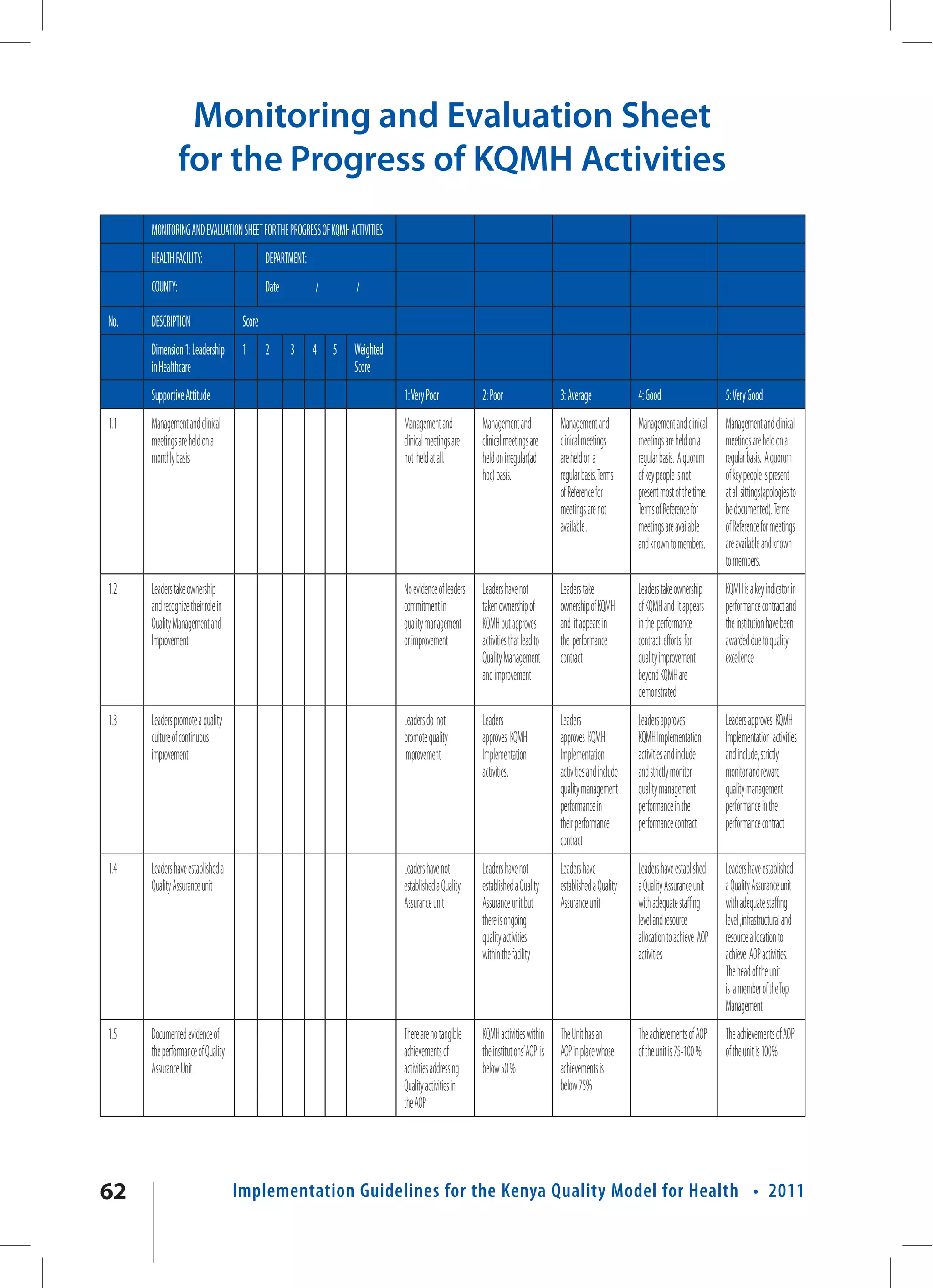
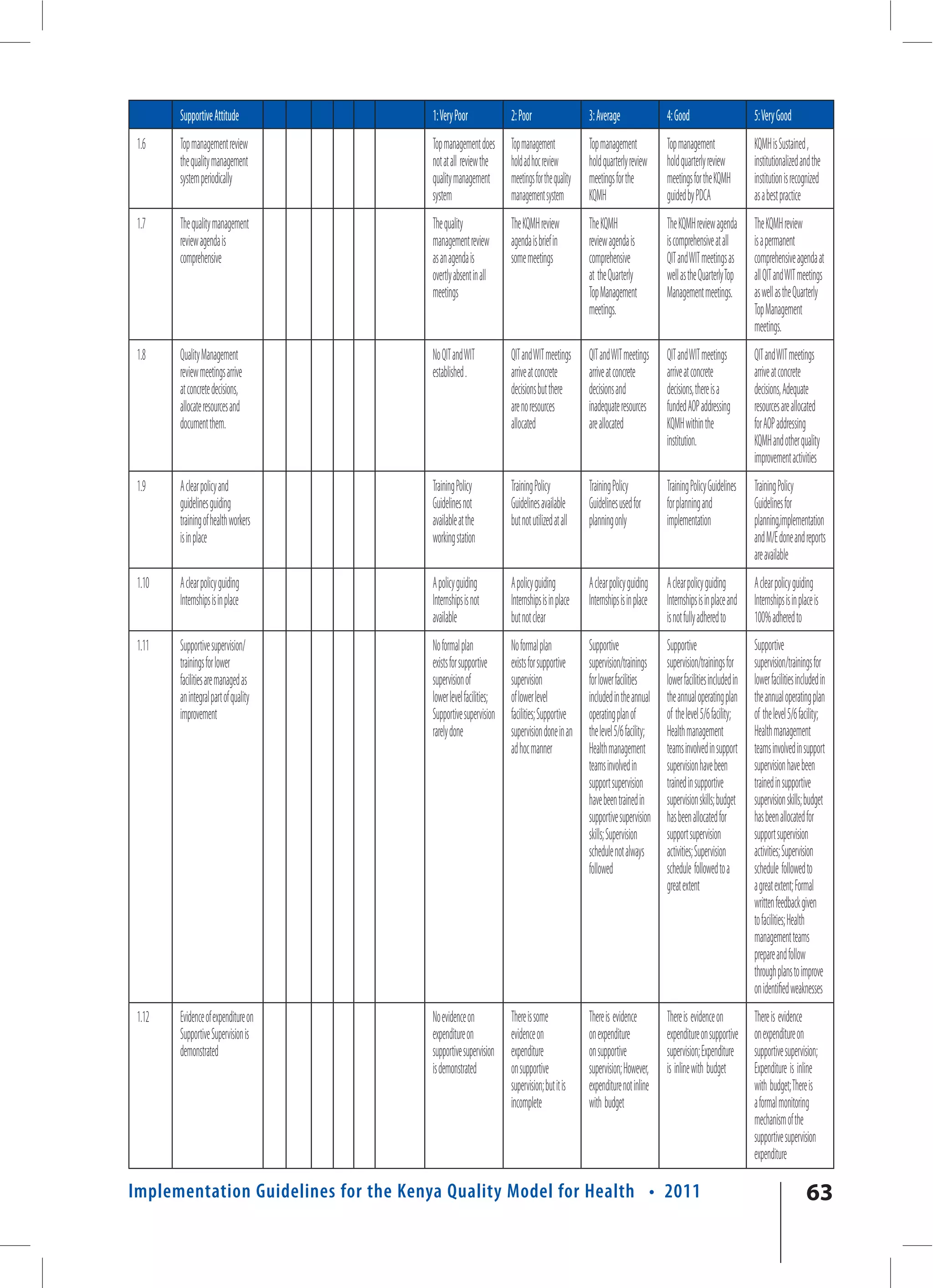
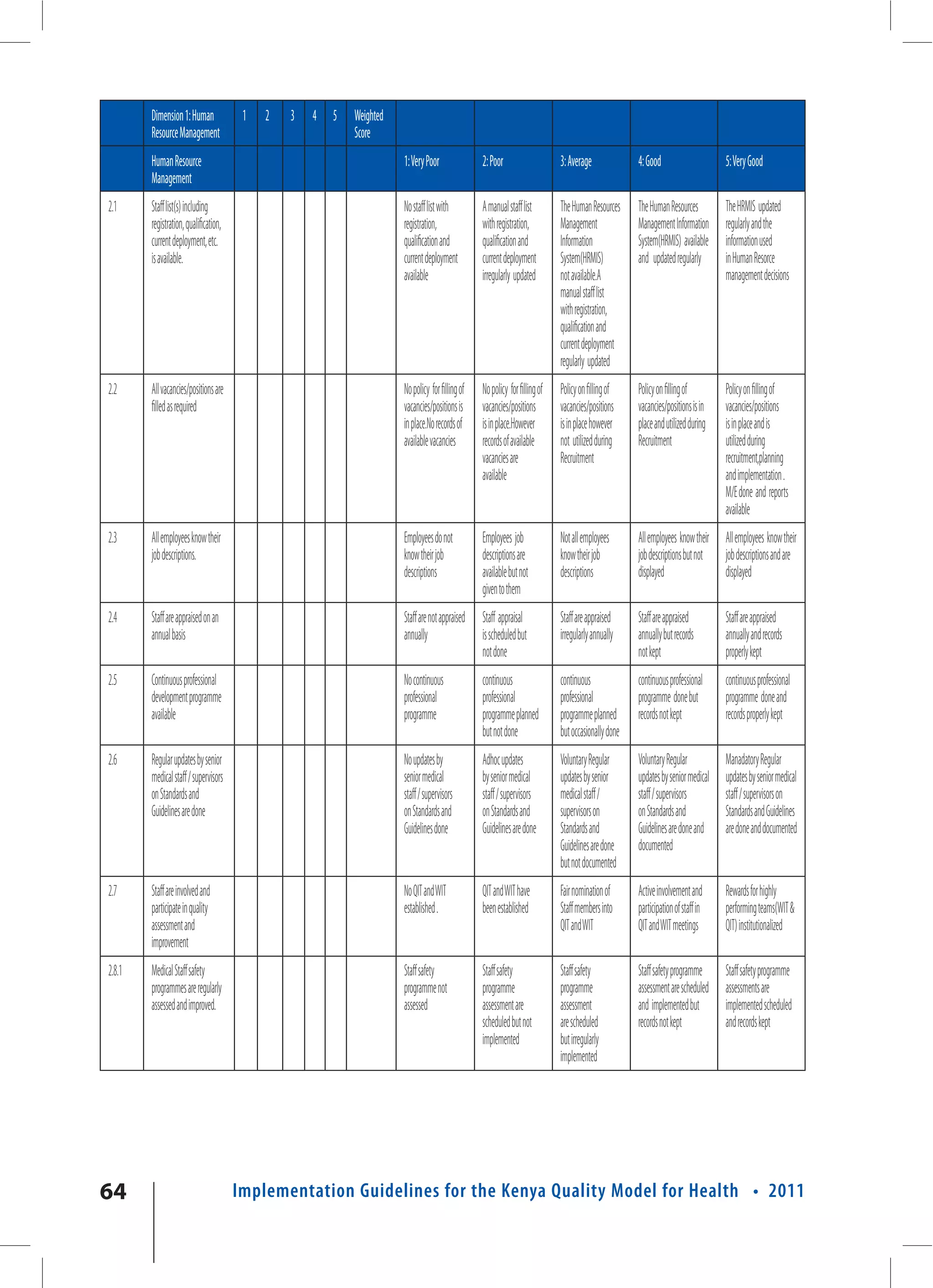
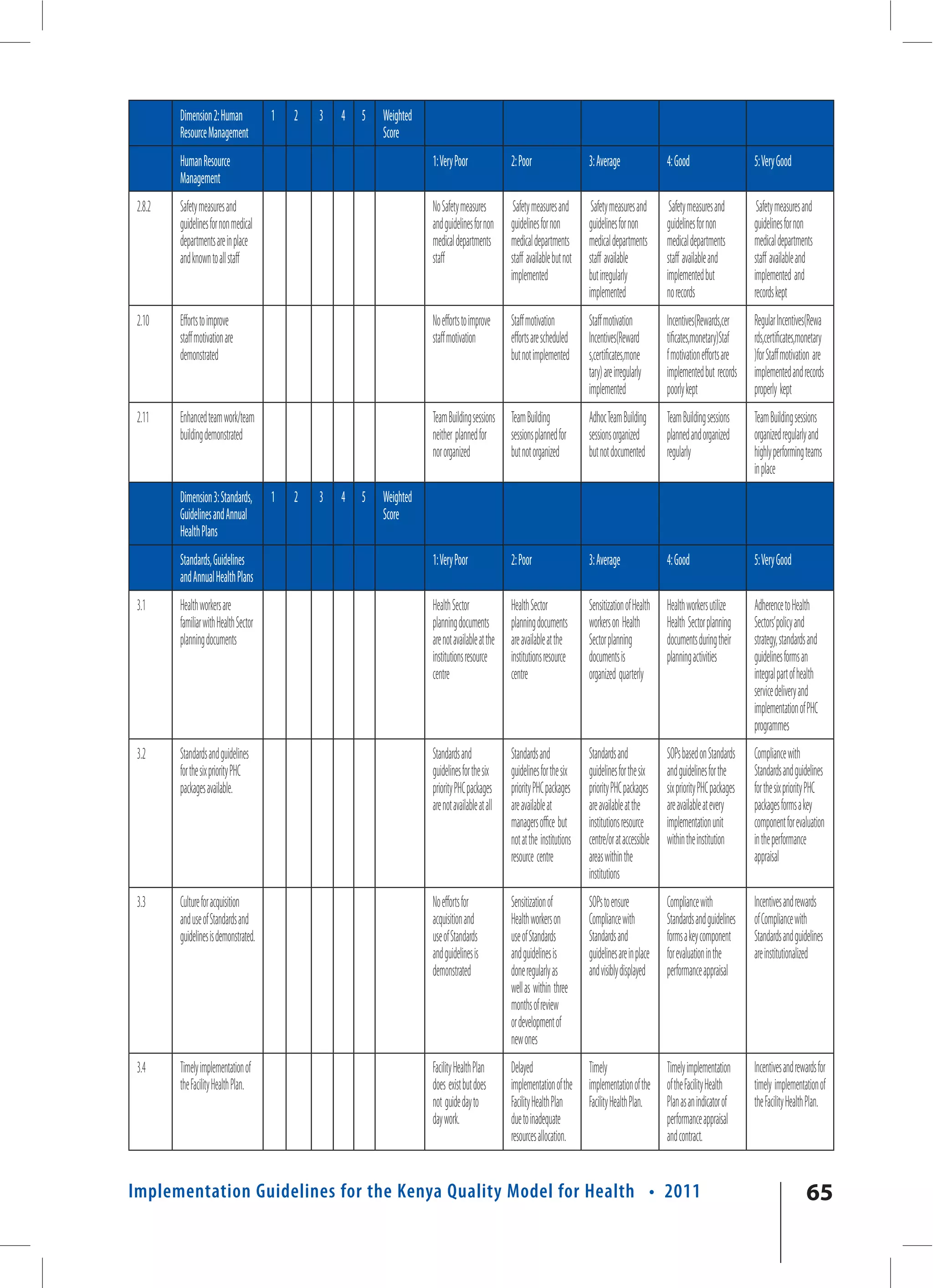
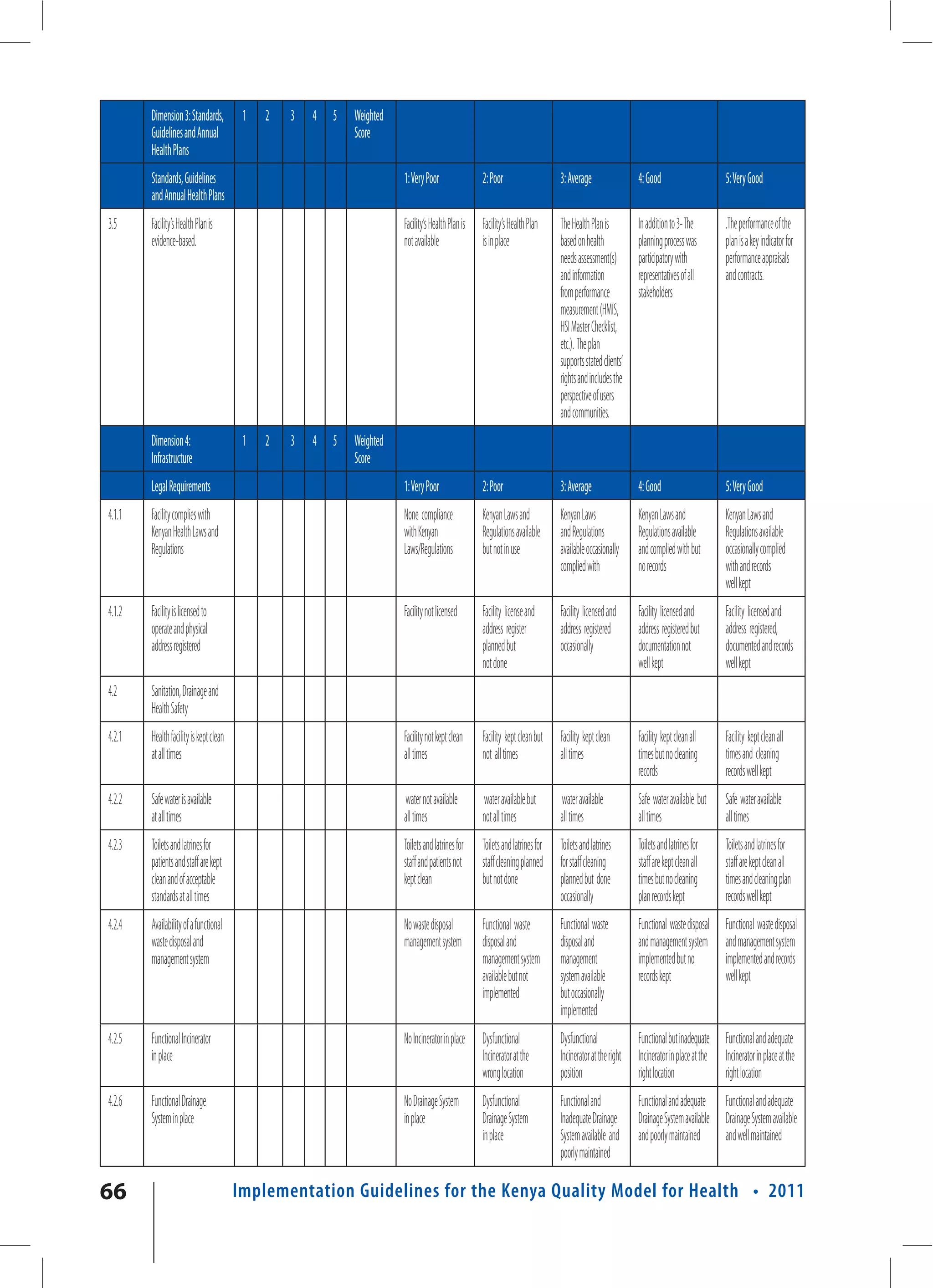
Monitoring and Evaluation Sheet for the Progress of KQMH Activities...................                                                                                           62


iv                                Implementation Guidelines for the Kenya Quality Model for Health • 2011
Foreword

T
        he promulgation of the Constitution of Kenya on 27th August 2010 was a major
        milestone towards improvement of health standards. The need to address the
        citizens’ expectations of the right to the highest attainable standards of health
including reproductive health and emergency treatment as enshrined in the constitu-
tion through prioritizing Quality management as an integral component of the health
care services is now urgent than ever before. Further, the social pillar for the Vision 2030
stipulates that to improve the overall livelihoods of Kenyans, the country has to aim
at providing an efficient and high quality health care system with the best standards.
This Concept of quality and the benefits it would confer to the health providers’ work
and the outcomes for their patients however have not completely been understood by
health managers and providers.
     Attempts to mainstream Quality assurance and Standards into the reform pro-
cess, as articulated in the second NHSSP (2005-2010) have led to implementation of
piecemeal quality improvement activities. The KQMH has integrated evidence based
medicine (EBM) with total quality management (TQM) and patient partnerships in an
attempt to provide a conceptual framework for quality management. Further, using
the experience gathered in Asian countries, particularly in Sri-Lanka, the Japan Interna-
tional Cooperation Agency (JICA) has supported capacity building of staffs who have
spearheaded the piloting of the implementation of 5S-Continous Quality Improvement
(Kaizen)-Total Quality Management (TQM) step-wise approach in Mathari and Coast
Provincial General Hospitals (CPGH) with good results.
     The KQMH guidelines incorporates the 5S- Continuous Quality Improvement-TQM
approach as an operational tool for KQMH as well as lays out the process of creating
the linkages to other existing quality improvement approaches including International
Standards Organization (ISO). The integrated approach will form the basis for ISO cer-
tification for health facilities at all KEPH levels. This document therefore will be a guide
to all health facilities and vertical programmes in implementing quality improvement
activities. The ministry thus recommends the day-to-day use of the guide by all health
managers and providers by making it an integral part of their performance assessment
in order to continuously improve quality of healthcare provided.


MS. MARY NGARI CBS,                                     MR. MARK BOR, CBS
Permanent Secretary,                                    Permanent Secretary
Ministry of Medical Services                            Ministry of Public Health
                                                        and Sanitation

Implementation Guidelines for the Kenya Quality Model for Health • 2011                   v
Acknowledgement

D
           evelopment of this guide marks an important milestone in the efforts of the
           health sector to ensure quality health services are provided to all Kenyans. Its
           use is expected to contribute to attainment of the highest standards of health
services delivery as envisaged in the constitution of Kenya.
      These guidelines have been designed and developed through a long process of
consultations, teamwork and information gathering. This process was guided by Dr.
Judith Bwonya-head, Department of standards, Research and Regulatory Services
(DSRS)-Ministry of Medical Services .The process was co-ordinated by Dr. Lucy Musyoka
and Mr. Isaac Mwangangi of Ministry of Medical Services as well as Dr Rael Mutai and
Mr. Joachim Mwanza of Ministry of Public Health and Sanitation .
      We wish to thank everyone who contributed, in one way or another, to the success-
ful development of this guide. Special thanks go to the staff drawn from Department
of Standards and Regulatory Services (DSRS), Department of Primary Health Services-
MOPHS,NHIF,management and staff of Mathari and Coast Provincial General Hospitals
who piloted the 5s-CQI (Kaizen)-TQM approach, Kenya Bureau of Standards(KEBS),Chris
tian Health Association of Kenya(CHAK),Kenya Episcopal Conference-Catholic Secretar-
iat, Technical staff of JICA-Kenya office and the Deutsche Gesellschaft fŸr Internationale
Zusammenarbeit (GIZ-formerly GTZ).
      Last but not least, the Government appreciates the financial support given by the
Japanese government through its Japan International Cooperation Agency and the
German government through the Deutsche Gesellschaft fŸr Internationale Zusammen-
arbeit (GIZ-formerly GTZ) towards capacity building and piloting the 5s-CQI (Kaizen)-
TQM approach in Kenya and development of KQMH respectively.


DR. FRANCIS M. KIMANI,                     DR. S. K. SHARIF, MBS, MBCHB,
Director of Medical Services               M.MED, DLSHTM
                                           Director of Public Health and Sanitation


vi               Implementation Guidelines for the Kenya Quality Model for Health • 2011
List of Contributors
Dr Judith Bwonya          -   Department of Standards & Regulatory Services-MOMS
Dr Lucy Musyoka           -   Division of Quality Assurance and Standards-MOMS
Mr. Dan Owiti             -   Division of Quality Assurance and Standards-MOMS
Mr. Isaac Mwangangi       -   Division of Quality Assurance and Standards-MOMS
Mr Francis K. Muma        -   Division of Quality Assurance and Standards-MOMS
Dr. Susan Magada          -   Department of Standards & Regulatory Services-MOMS
Dr Gideon Toromo          -   Division of Quality Assurance and Standards-MOMS
Dr Simon K. Kibias        -   Department of Primary Health Services-MOPHS
Dr Rael Mutai             -   Department of Primary Health Services-MOPHS
Mr. George O Ogoye        -   Department of Primary Health Services-MOPHS
Mr. Mwanza Joachim        -   Department of Primary Health Services-MOPHS
Mr Cyrus Wambari          -   Kenya Bureau of Standards (KEBS)
Mr. Joseph M. Oyongo      -   Christian Health Association of Kenya
Dr. David I. Mwangi       -   Coast Provincial General Hospital-MOMS
Mr.Eric Khaemba Were      -   Coast Provincial General Hospital-MOMS
Mr. Joseph K. Kenga       -   Coast Provincial General Hospital-MOMS
Mrs. Lydia L. N. Sowa     -   Coast Provincial General Hospital-MOMS
Maureen Nafula            -   GIZ Consultant
Dr. George J.Midiwo       -   National Hospital Insurance Fund-NHIF
Mrs. Julia Ouko           -   National Hospital Insurance Fund-NHIF
Mr. Mohamed Shafat        -   National Hospital Insurance Fund-NHIF
Erastus Masinde           -   National Hospital Insurance Fund-NHIF
Reuben Mutwiri            -   National Hospital Insurance Fund-NHIF
Kamau John-Pius           -   National Hospital Insurance Fund-NHIF
Lilian Mumbi              -   National Hospital Insurance Fund-NHIF
Vitalis Akora             -   HENNET
Mr. Elijah Kinyangi       -   Japan International Cooperation Agency
Dr. Naphtali Agata        -   Japan International Cooperation Agency
Dr Margaret Njenga        -   Kenya Episcopal Conference - Catholic Secretariat
Ms. Betty Malamba         -   Kenya Episcopal Conference - Catholic Secretariat
Dr John Gatere            -   Mathari Hospital-MOMS
Mrs. Esther M. Mate       -   Mathari Hospital-MOMS


Implementation Guidelines for the Kenya Quality Model for Health • 2011       vii
Accronyms
AAKCP   Asia-Africa Knowledge Co-creation Programme
AIDS    Acquired immune deficiency syndrome
CPGH    Coast Provincial General Hospital
CQI     Continuous Quality Improvement
DMS     Director of Medical Services
DSRS    Department of Standards and Regulatory Services
EBM     Evidence Based Medicine
EPI     Expanded Programme of Immunization
FBO     Faith-based organization
GIZ     Deutsche Gesellschaft fŸr Internationale Zusammenarbeit (Formerly GTZ)
HIV     Human immune-deficiency virus
ICC     Interagency Coordinating Committee
IMCI    Integrated management of childhood illness
IPC     Infection Prevention and Control
ISO     International Standards Organization
JICA    Japan International Cooperation Agency
JIT     Just In-Time
KEBS    Kenya Bureau of Standards
KEPH    Kenya Essential Package for Health
KQMH    Kenya Quality Model For Health
KQM     Kenya Quality Model
M&E     Monitoring and Evaluation
MOMS    Ministry of Medical Services
MOPHS   Ministry of Public Health & Sanitation
NHIF    National Hospital Insurance Fund
NHSSP   National Health Sector Strategic Plan
PDCA    Plan, Do, Check and Act
QIP     Quality Improvement Programme
QIT     Quality Improvement Team
RH      Reproductive health
TB      Tuberculosis
TQM     Total Quality Management
WIT     Work Improvement Team


viii           Implementation Guidelines for the Kenya Quality Model for Health • 2011
Chapter 1:
             Quality Improvement Initiatives
              in the Kenyan Health Sector
1.1     Introduction
Quality is a critical dimension of Social Justice and Human Rights principles and it forms
one of the pillars of a viable and sustainable health care system. As such, there has been
a growing interest among the Policy Makers and Stakeholders during the recent past
to improve quality of care through establishment of a customer oriented approach. The
National Health Sector Strategic Plan II prioritizes Quality Assurance and Standards as a
support system that facilitates the development and use by all health professionals of
clinical standards, protocols and guidelines and ensures strengthening of the clients’
rights.
     The Kenyan Health System has been facing many challenges that include declin-
ing trends of health indicators, Health Systems failure, dissatisfied customers/clients
and health providers resulting to high attrition rates. There also exist wide disparities
in the quality of services delivered not only between public and private institutions of
similar categorization but also across regions and towns and in between institutions of
disparate ownership and or sponsorship. Investments, particularly in infrastructure and
human resources, have not been appropriately coordinated, with the result that these
inputs are not rationalized or equitably distributed across the country.
     The constitution of Kenya in its chapter on Bills of right is clear on the need to
address the citizens’ expectations of the right to the highest attainable standards of
health including reproductive health and emergency treatment. The social pillar for the
Vision 2030 indicates the need to improve the overall livelihoods of Kenyans, through
provision of efficient and high quality health care systems with the best standards. To
address this, the Health Sector will implement various quality models including KQMH,
ISO and 5S-Continuous Quality Improvement (Kaizen)-TQM approach aiming at improv-
ing health service delivery. As a long term target, quality excellence in the health sector
is envisaged to be achieved through the implementation of KQMH using the 5S-CQI
(Continuous Quality Improvement)-TQM step-wise approach.


Implementation Guidelines for the Kenya Quality Model for Health • 2011                  1
1.2     Situation Analysis of Quality
        Management Activities

1.2.1 The Kenya Quality Model
The Government of Kenya through Ministries responsible of Health in collaboration
with the health stakeholders is mandated with providing leadership and stewardship
in development of health systems for improved Quality Health Services. In 2001, the
Ministry of health then through the Department of Standards & Regulatory Services
(DSRS) spearheaded the development of the Kenya Quality Model (KQM) to provide a
conceptual framework for quality improvement in health services and systems in the
country. The document integrated evidence-based medicine(EBM) through wide
dissemination of public health and clinical standards and guidelines with total quality
management(TQM) and patient partnership(PP).It also defined quality improvement in
healthcare as a process:
•     To improve adherence to standards and guidelines
•     To improve Structure-Process-Outcome of health services by applying Quality
      Management principles and tools
•     To satisfy Patients / Clients needs in a culturally appropriate way.

    Despite this initiative, the preparatory process of KQM was not participatory and its
principles were not known by many and hence leading to failure in its implementation.
The country faced a lot of implementation challenges that led to a variety of quality
imperfections such as substandard health facilities, professional misconduct, and non-
professionals offering SUB-standard services and poorly regulated pharmaceutical sub-
sector amongst others. It therefore became necessary to review and update the KQM.

1.2.2 The Kenya Quality Model for Health
The KQM was reviewed in the 2008-2009 financial year, renamed the Kenya Quality
Model for Health (KQMH) and expanded to cater for clinical care, management support
and leadership. The new model addressed the in-adequacies identified in the first KQM
and articulated quality standards and checklists for KEPH levels 2, level 3, level 4 and
level 5& 6. The review took into consideration active participation of the health stake-
holders.
     The KQMH has been piloted and implemented with encouraging results. The imple-
mentation of the reviewed Kenya Quality Model for Health has been noted to be the
first step towards ISO certification. However, this document is limited to articulating the
quality standards and accompanying checklists for the various levels of care and does
not cover on modalities of implementation. The deployment of tools mentioned in
KQMH such as different tools for continuous quality improvement, the Plan-Do –Check-
Act cycle etc and the process of implementation is not comprehensibly elaborated.
2                Implementation Guidelines for the Kenya Quality Model for Health • 2011
1.2.3 NHIF Experience with KQM
NHIF adapted the KQM in the year 2005 for the purposes of quality assurance and
improvement of the standards offered by its service providers as well as a tool for al-
locating rebates to health facilities. Since the adoption of KQM, NHIF has developed
a training curriculum which it has used to train Quality Improvement Teams (QIT) in
about 500 health facilities at levels 4, 5 and 6. There have been several challenges en-
countered in its implementation particularly following the definition of different levels
of health care with variance in norms and standards

1.3     5S-CQI Continuous Quality Improvement -
        TQM Step-wise approach
     A JICA’s cooperation scheme of “Asia African Knowledge Co-creation Program
(AAKCP) “ that aims to create new knowledge and future between Asian and African
People has applied the 5s-Kaizen-TQM stepwise approach in several African countries
including Kenya. As a result of Kenya’s participation, Kenya adopted the 5s-Kaizen-TQM
stepwise approach and introduced it in the health sector.
    The 5s principles will be applied to improve the work environment during imple-
mentation of KQMH. Whereas 5S is practiced on a day-to-day basis in the facilities,
KAIZEN activities for participatory problem solving will ensure that the processes are
re-defined to meet the set standards of KQMH.The adherence to set standards will be
assessed through administration of facility-self assessment and external quality assess-
ment by peers or Quality Assurance Officers (QAOs).
    The Goal of the step-wise approach is not just to install 5s or KAIZEN activities into
hospitals, but to change organizational culture and management style of hospitals. The
achievement of TQM is envisaged to ensure that the Health Service delivery becomes
outcome-oriented and patient-centered. ”safety and quality” are the essential features
of the outcome. Responsiveness and Equity are core components of patients-centered-
ness. To achieve these goals, participatory approach within teams is essential –between
health managers at diverse categories and ranks and health providers; health providers
to patients and vice versa. So this approach will change the hospitals from “only existing
organization” to “value creating organization”.

1.3.1 Experience with 5S-CQI (Continuous Quality
      Improvement)-TQM approach in Kenya
 The Ministry of Medical services has adopted the 5S-CQI (Continuous Quality Improve-
ment)-TQM approach and has been piloting the approach in Mathari Hospital and
Coast Provincial General Hospital (CPGH) since 2007. The pilot has produced visible
results and an improved patient and work environment as evidenced by orderliness
in the use of available work space, improved management of files and related medi-


Implementation Guidelines for the Kenya Quality Model for Health • 2011                     3
cal records with proper labeling, use of proper signage and color-coding of waste bins
in the two Hospitals/Health Facilities. CPGH has also seen a reduction in the average
length of stay in orthopedic ward from twenty seven (27) before the implementation of
the initiative to Nineteen (19) days after the implementation.
    To facilitate these achievements, the two pilot sites established 5S committees and
Work Improvement Teams (WIT) in several hospital units. Regular management and
health service quality audit and monitoring using checklists with feedback have been
institutionalized. An avenue for staff Participation has led to internalization of change
in mindset for quality improvement. The Continuing Medical Education (CME) sessions
have provided a suitable avenue for involvement of more staff in sensitization and train-
ing. This has contributed to building a motivated health workforce in the two Hospitals.

1.4     Linkage of KQMH and 5S-Continous Quality
        Improvement-TQM stepwise approach
 The principles underlying both the KQMH and the 5S-Continous Quality Improvement-
TQM approach focus on improving the quality of services. Implementation of 5S-Conti-
nous Quality Improvement -TQM approach will serve as a foundation for work environ-
ment improvement that enhances improved productivity. Then, the target is gradually
shifted to the improvement and redesigning the process to meet the quality standards
articulated in KQMH and, thereafter, to the realization of Total Quality Management.
TQM is one of the three components of KQMH.
     It is important for all health workers to understand that 5S-CQI (Continuous Quality
Improvement)-TQM step-wise approach should continue to be implemented as other
QIPs are introduced. This will facilitate quick realization of outcome and impact of other
QIPs introduced in health services delivery.


4               Implementation Guidelines for the Kenya Quality Model for Health • 2011
Chapter 2:
                     Overview of the Kenya
                    Quality Model for Health
2.1 What is KQMH?
The Kenya quality model for health (KQMH) is a conceptual framework for holistic qual-
ity management system that systematically addresses a range of organizational quality
issues with the main aim of delivering positive health impacts.
KQMH integrates evidence based medicine (EBM) with total quality management
(TQM) and patient partnerships. EBM involves the development and dissemination of
standards and guidelines; TQM involves the application of quality management prin-
ciples and use of master checklist and adherence to standards and guidelines; Patient
Partnership involves the promotion of community involvement and participation.
KQMH uses a checklist to ‘score’ performance of an organization against established
standards. The scores can be used as an internal benchmark of improvement over a
period of time. Scoring’ can also provide an organization with an internal benchmark for
its next self assessment, in order to capture trends. It can also be used among organiza-
tions for some external benchmarking and comparison.

2.1.1 KQMH Principles and Dimensions
KQMH is designed to measure and improve the overall quality health service delivery
and is based on 7 principles and 12 Dimensions.

2.1.1.1 KQMH Principles
The seven principles for KQMH are:

Systems Approach to Management
•    Identifying, understanding and managing interrelated steps and processes as a
     system Contributes to the organization’s effectiveness and efficiency in achieving
     its objectives

Process Orientation
Addressing all steps required to achieve a desired result and managing activities and
related resources as a process.


Implementation Guidelines for the Kenya Quality Model for Health • 2011                 5
Leadership
This is required to provide guidance and motivation to Quality Improvement. In this
respect, Leaders should:

•    Create unity in the objective and the directions of the organization.
•    Maintain a team environment in which staff can become fully involved in achiev-
     ing the organization’s objectives.
•    Demonstrates commitment to the organization
•    Help to overcome workers natural resistance to change and to convince staff that
     quality is important

Customer orientation (External and Internal)
Organizations depend on their customers and therefore should:

•    understand current and future needs
•    meet customer requirements
•    strive to exceed expectations
•    build up a relationship and show commitment
•    provide feedback, M&E
•    display and communicate patients’ rights

Involvement of people and stakeholders
People refer to staff, professionals and managers at all levels of an organization as well
other stakeholders. People are the essence of an organization; their full involvement
enables their abilities to be used for the organization’s benefit. Other stakeholders need
to be coordinated and their co-operation sought for the organization’s benefit.

Continuous Quality Improvement
Quality improvement is a never ending journey. Continuous improvement of the
organization and overall performance should be the permanent objective of the
organization.

Evidence based Decision Making
Effective decisions are based on the analysis of data and information. Health organiza-
tions therefore need to
•    Ensure that data and information are available, sufficiently accurate and reliable.
•    Make data accessible to those who need it.
•    Analyze data by using valid methods.
•    Make decisions and take action based on facts balanced with experience and
     intuition

6                Implementation Guidelines for the Kenya Quality Model for Health • 2011
2.1.1.2 KQMH Dimensions
 KQMH is based on Donabedian’s classic ‘structure’, ‘process’, ‘outcome’ model for as-
sessment of quality of care. The model identifies structures and processes that health
providers would need to establish, implement and maintain in order to operate and
produce results/outcomes.

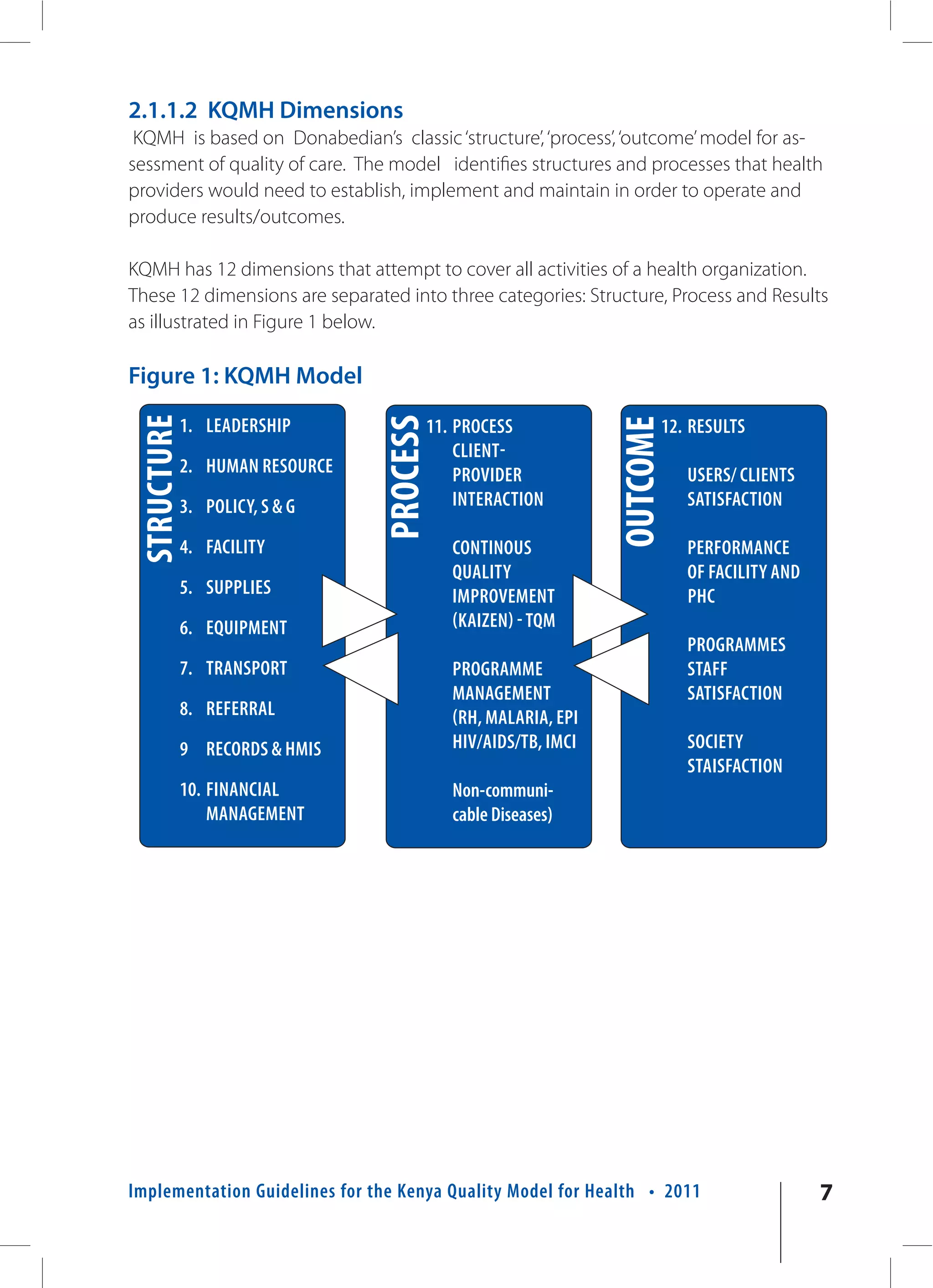
KQMH has 12 dimensions that attempt to cover all activities of a health organization.
These 12 dimensions are separated into three categories: Structure, Process and Results
as illustrated in Figure 1 below.

Figure 1: KQMH Model

      1. LEADERSHIP                  11. PROCESS                  12. RESULTS
                                         CLIENT-
      2. HUMAN RESOURCE                  PROVIDER                    USERS/ CLIENTS
      3. POLICY, S & G                   INTERACTION                 SATISFACTION

      4. FACILITY                       CONTINOUS                    PERFORMANCE
                                        QUALITY                      OF FACILITY AND
      5. SUPPLIES                       IMPROVEMENT                  PHC
      6. EQUIPMENT                      (KAIZEN) - TQM
                                                                     PROGRAMMES
      7. TRANSPORT                      PROGRAMME                    STAFF
                                        MANAGEMENT                   SATISFACTION
      8. REFERRAL                       (RH, MALARIA, EPI
      9 RECORDS & HMIS                  HIV/AIDS/TB, IMCI            SOCIETY
                                                                     STAISFACTION
      10. FINANCIAL                     Non-communi-
          MANAGEMENT                    cable Diseases)


Implementation Guidelines for the Kenya Quality Model for Health • 2011                7
Structure
The structure criteria are concerned with the inputs required to deliver results.
These are:
•    Leadership-supervision
•    Human Resources
•    Policy; Standards &Guidelines
•    Facility
•    Supplies
•    Equipment
•    Transport
•    Referral
•    Records & Health Management Information Systems
•    Financial Management

Process
Process involves the transformation of inputs into results. The process criteria manage
the client-provider interaction. A number of tools and mechanisms such as TQM and
continuous quality improvement can be used in managing an organization’s processes.

Results
Results are what an organization achieves and include Users/clients satisfaction, Per-
formance of facility and primary health care programmes, staff satisfaction and society
satisfaction.

Each of the 12 dimensions of KQMH has a high level definition and is supported by
a number of standards from which the assessment checklists have been developed.
Standards and checklists for each level of KEPH are contained in KQMH documents.

2.1.2 Who can use the KQMH?
KQMH was developed in a consultative process involving stakeholders in the Kenyan
health sector. The model has been developed for use by health facilities at all levels of
KEPH in both the public and non-public sector including Faith Based Institutions, pri-
vate for no profit and private for profit institutions. Checklists have been developed to
match each of the corresponding KEPH levels. These checklists are provided as separate
annexes to these implementation guidelines.

2.1.3 KQMH Implementation
 Introduction of KQMH in an institution begins with Obtaining management buy in
since Change must begin with the top leadership. In order to ensure commitment by
the top leadership, quality should be reflected in the Vision, Mission, goals and objec-

8                Implementation Guidelines for the Kenya Quality Model for Health • 2011
tives of the institution. This is expected to be in line with the health sector policy state-
ments. The top leadership should be adequately briefed on KQMH and its benefits. They
should be encouraged to grace, participate, and get involved in sensitization/training
sessions .The Sensitization/Training sessions will be guided by the KQMH training Cur-
riculum developed alongside the guidelines .
Cross- functional KQMH implementation teams will be formed. The KQMH implementa-
tion teams will be the Quality Improvement teams (QIT) and the Work Improvement
Teams (WIT). The TOR and the process of implementation are as outlined in the subse-
quent chapters.

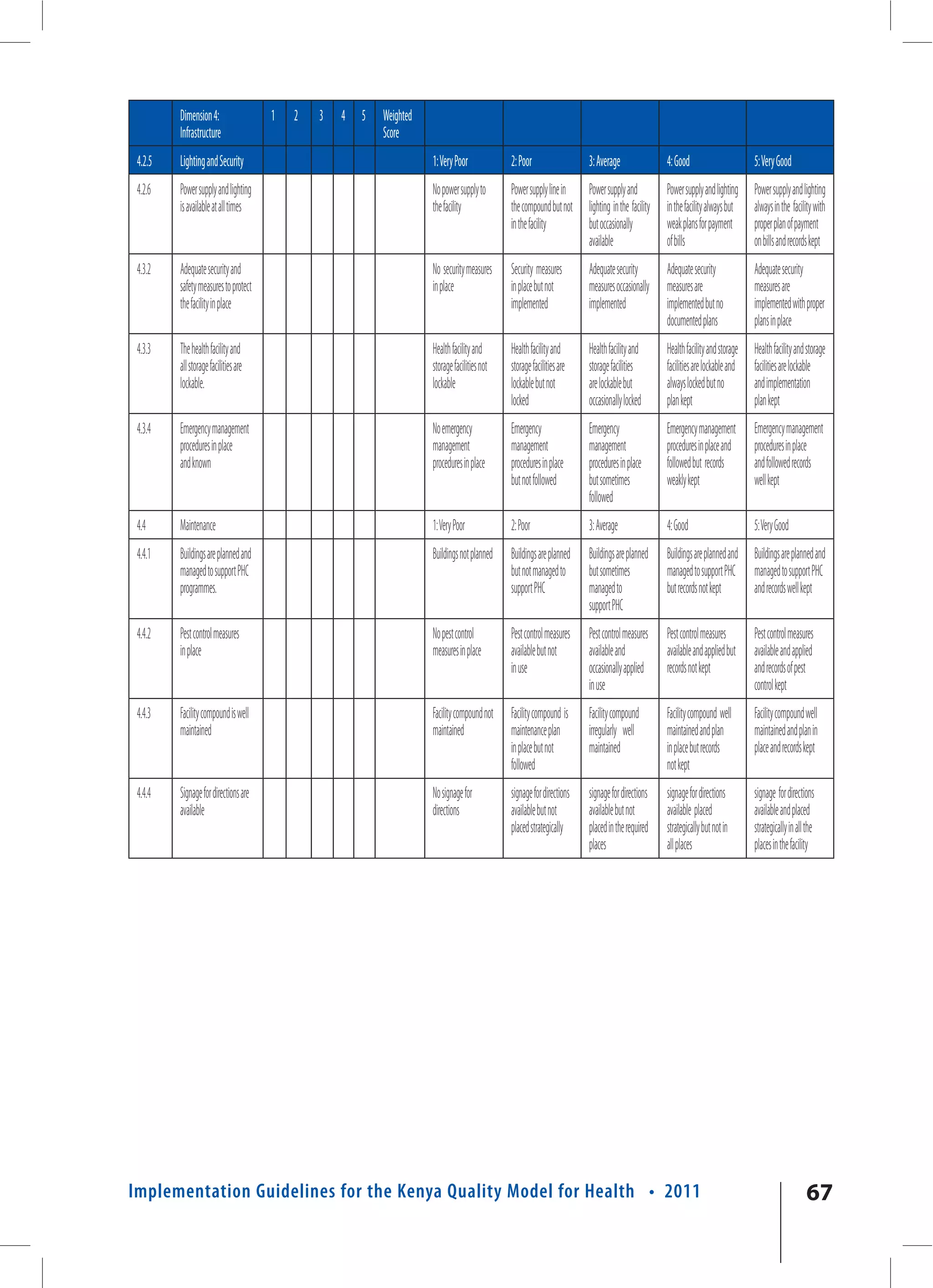
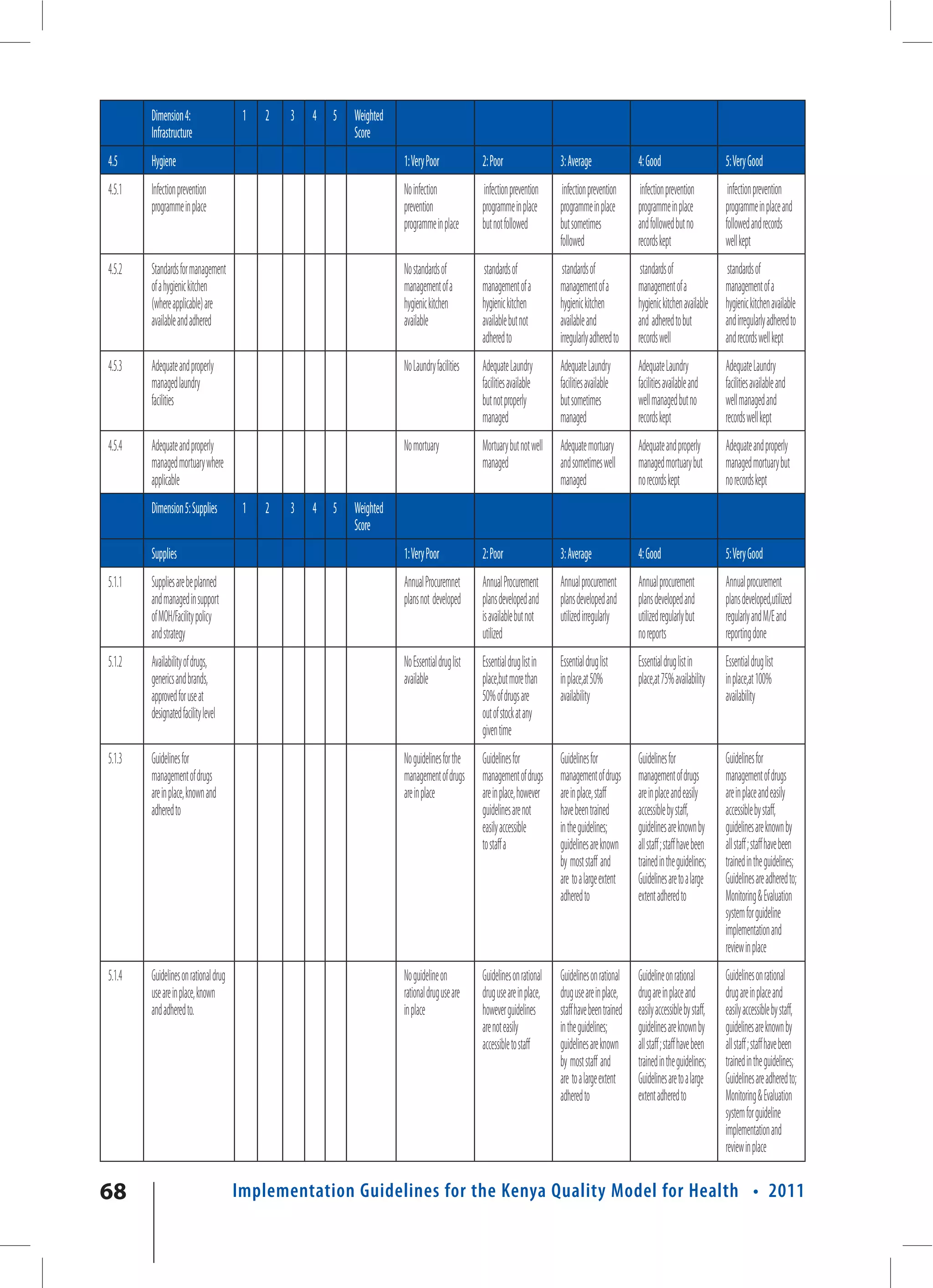
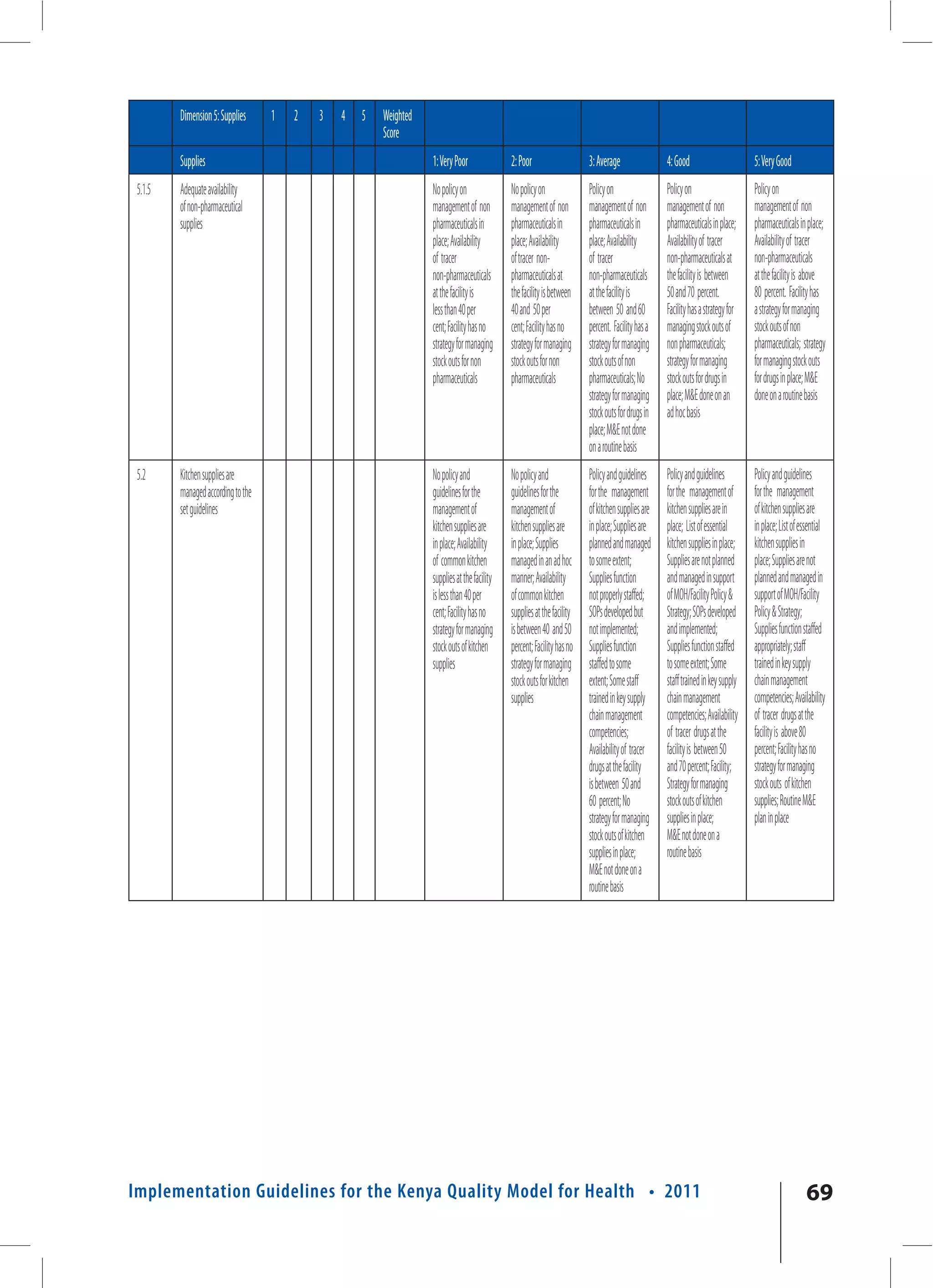
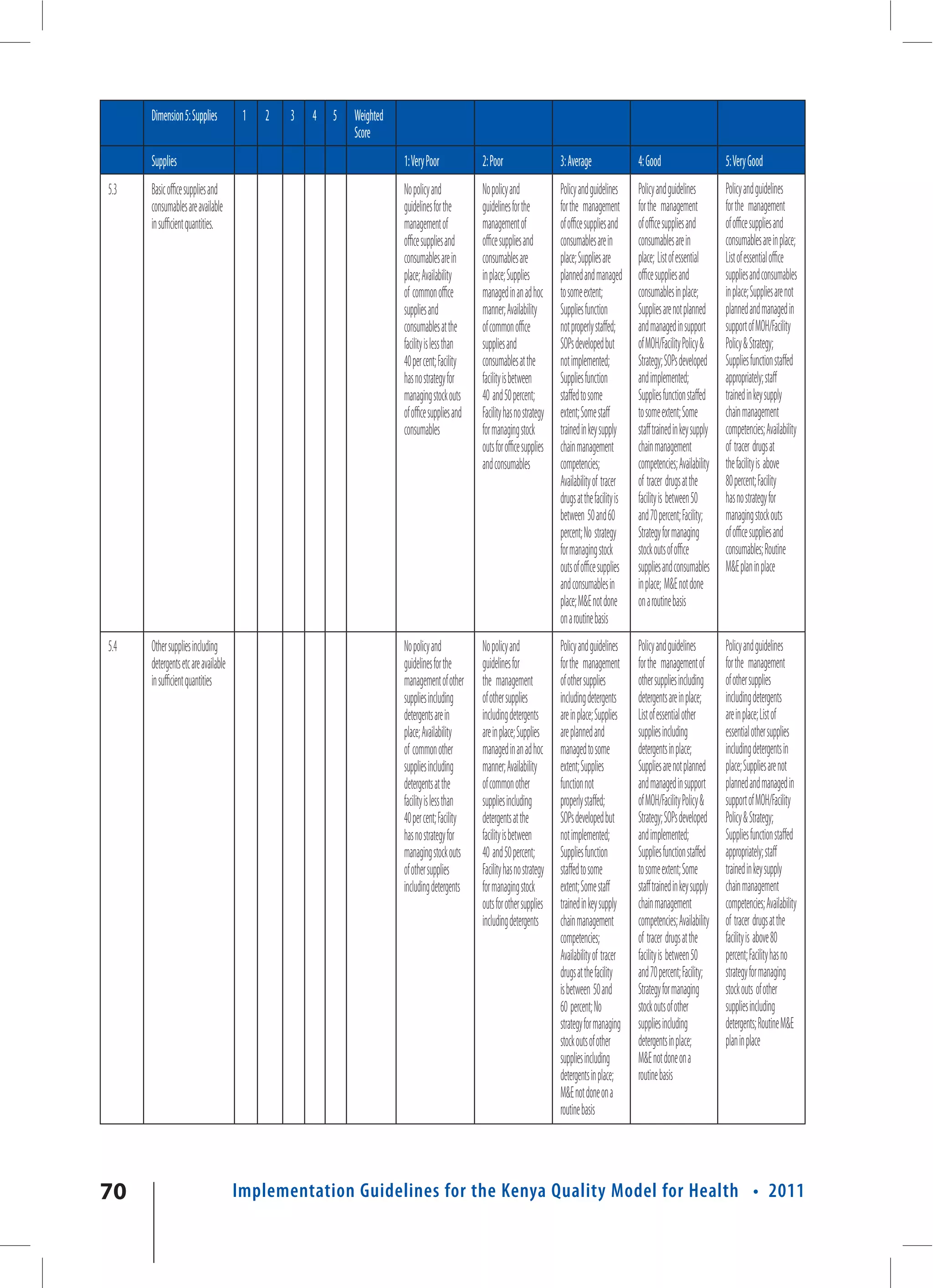
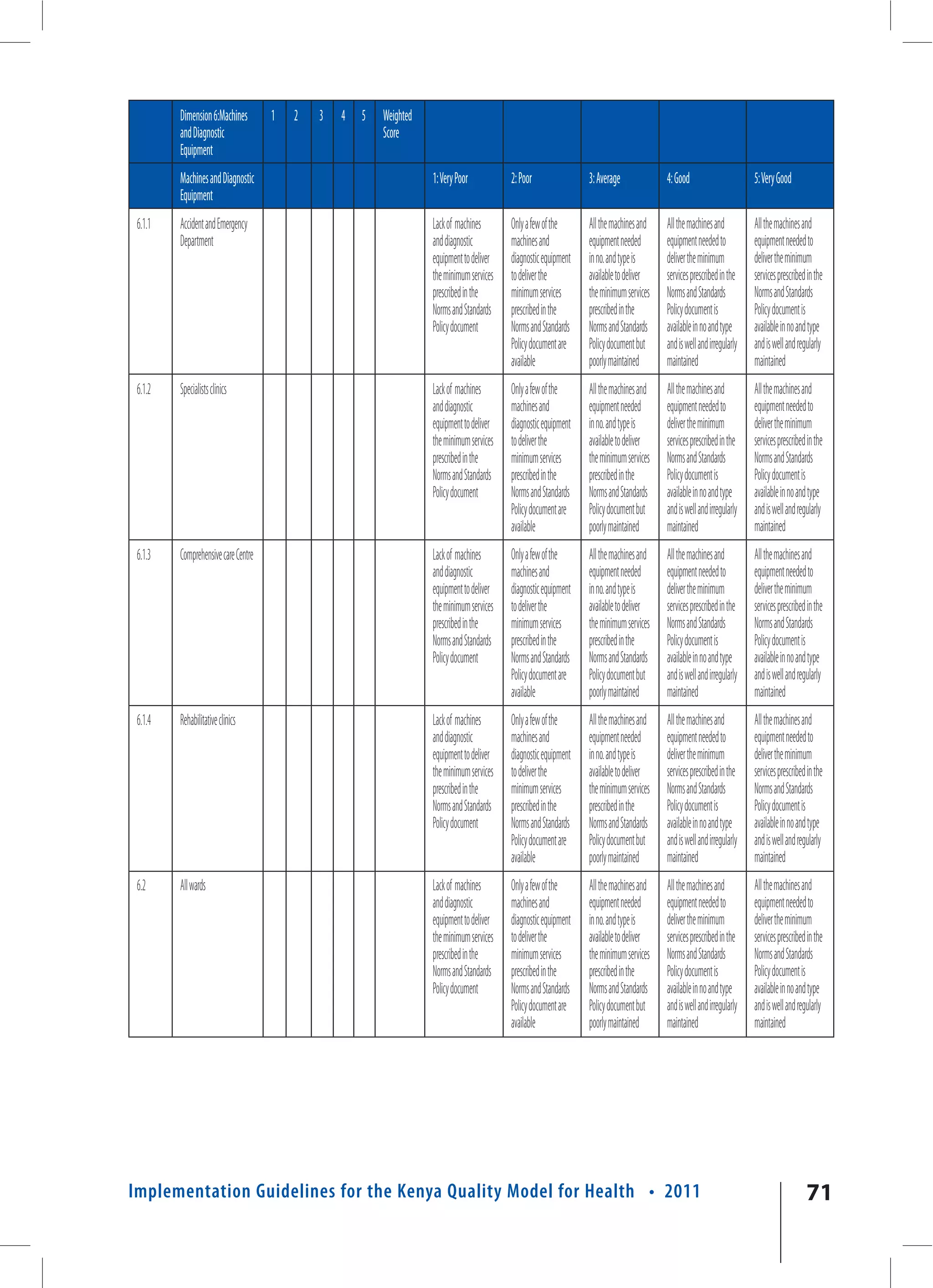
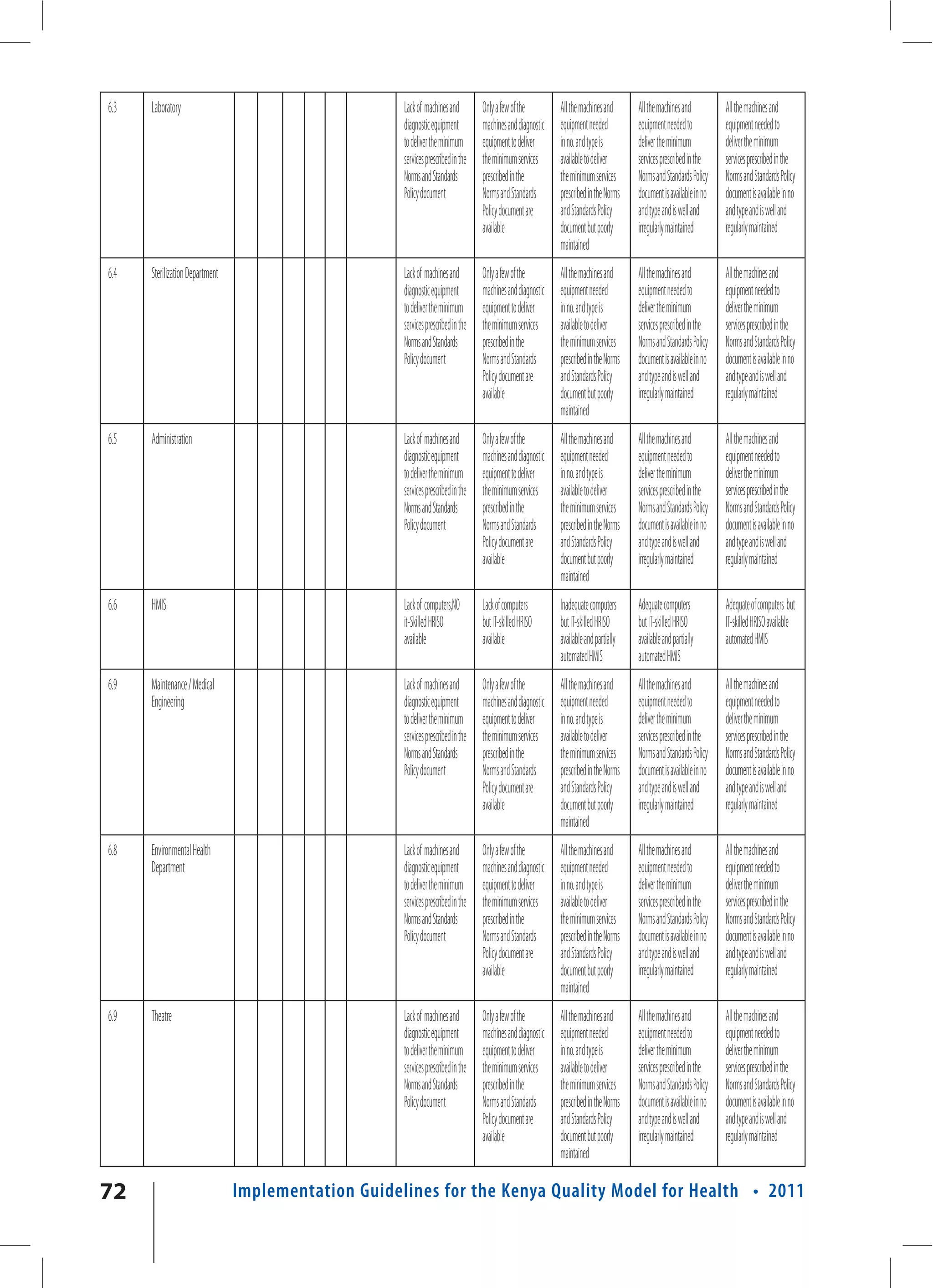
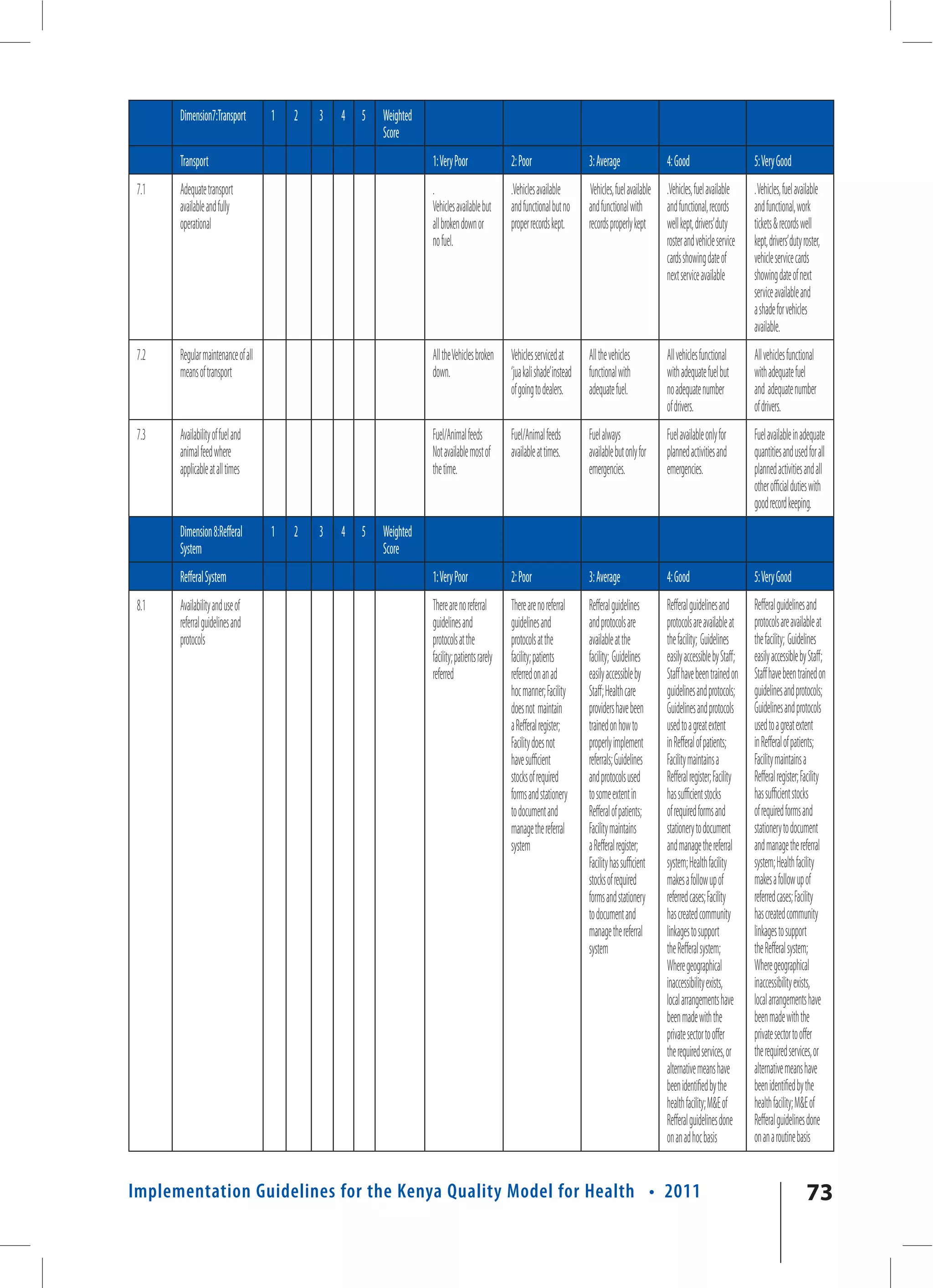
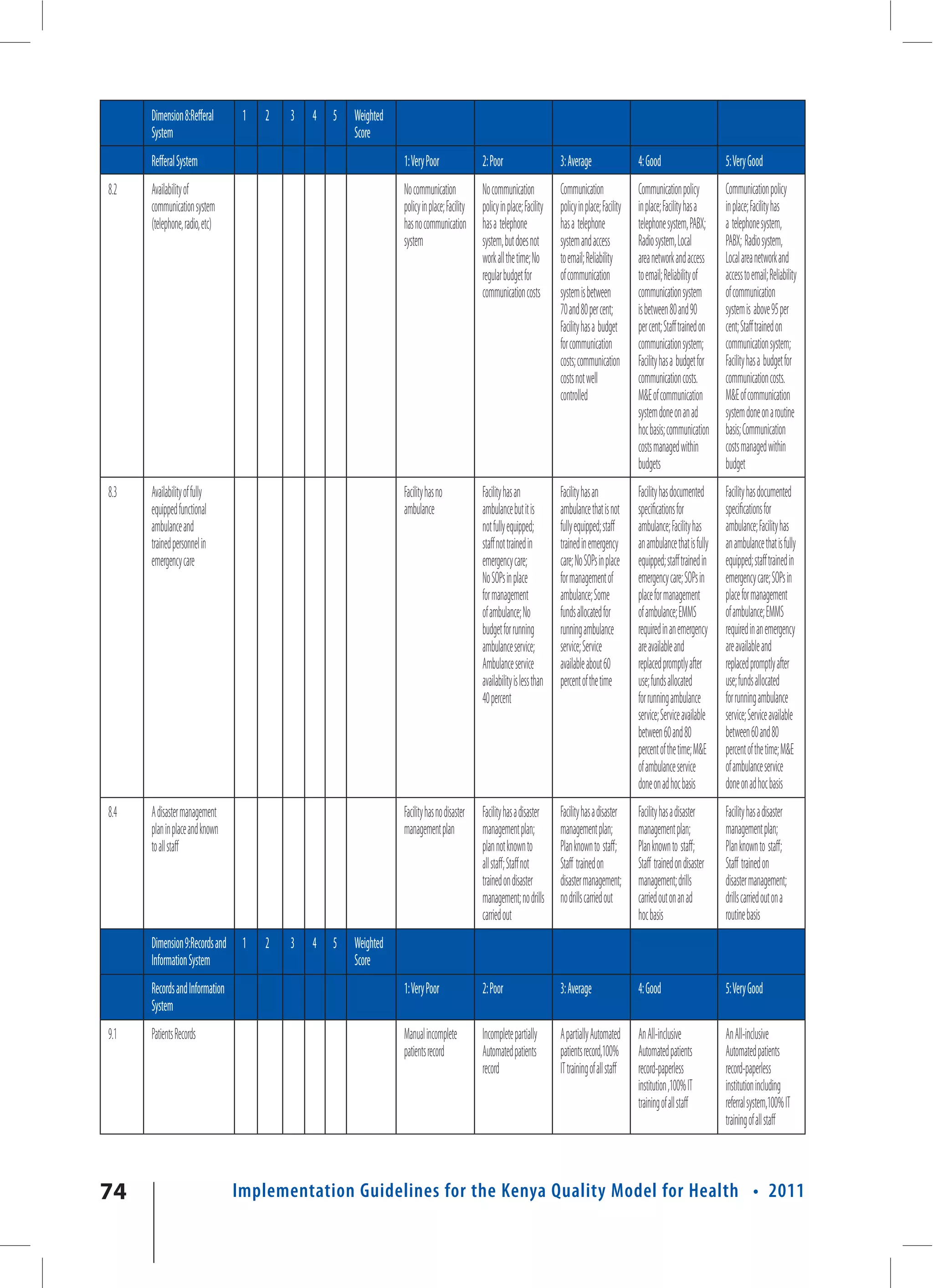
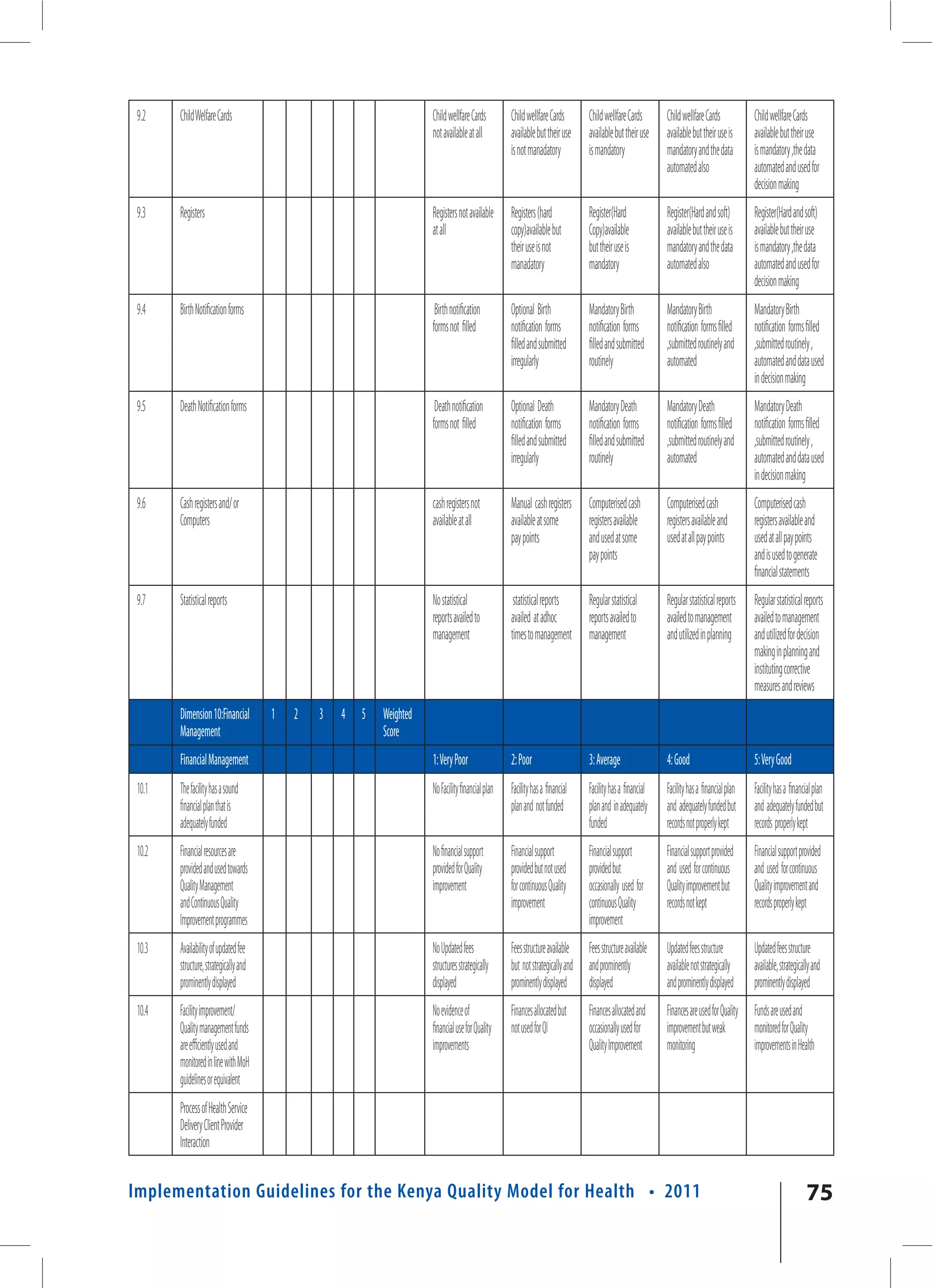
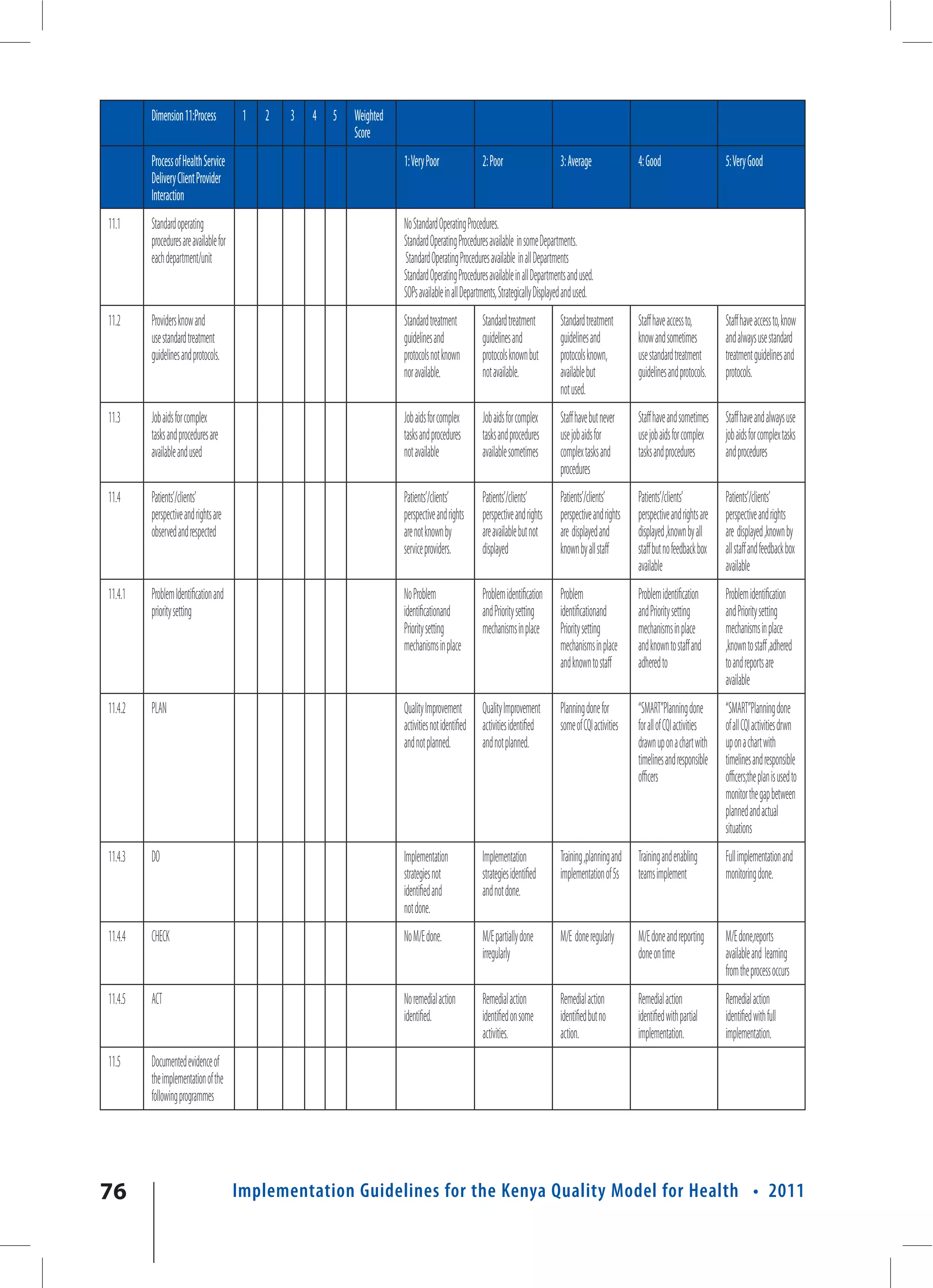
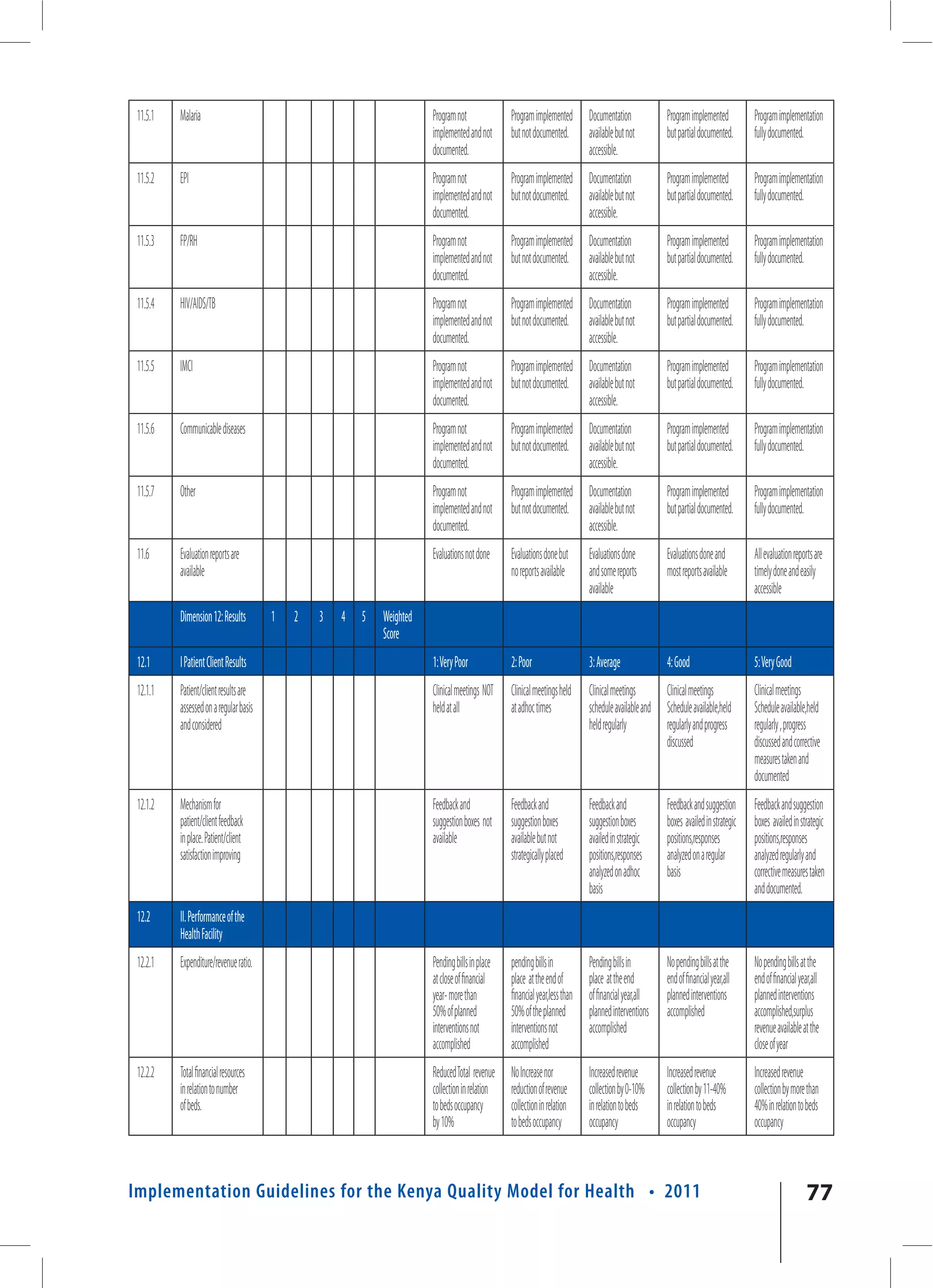
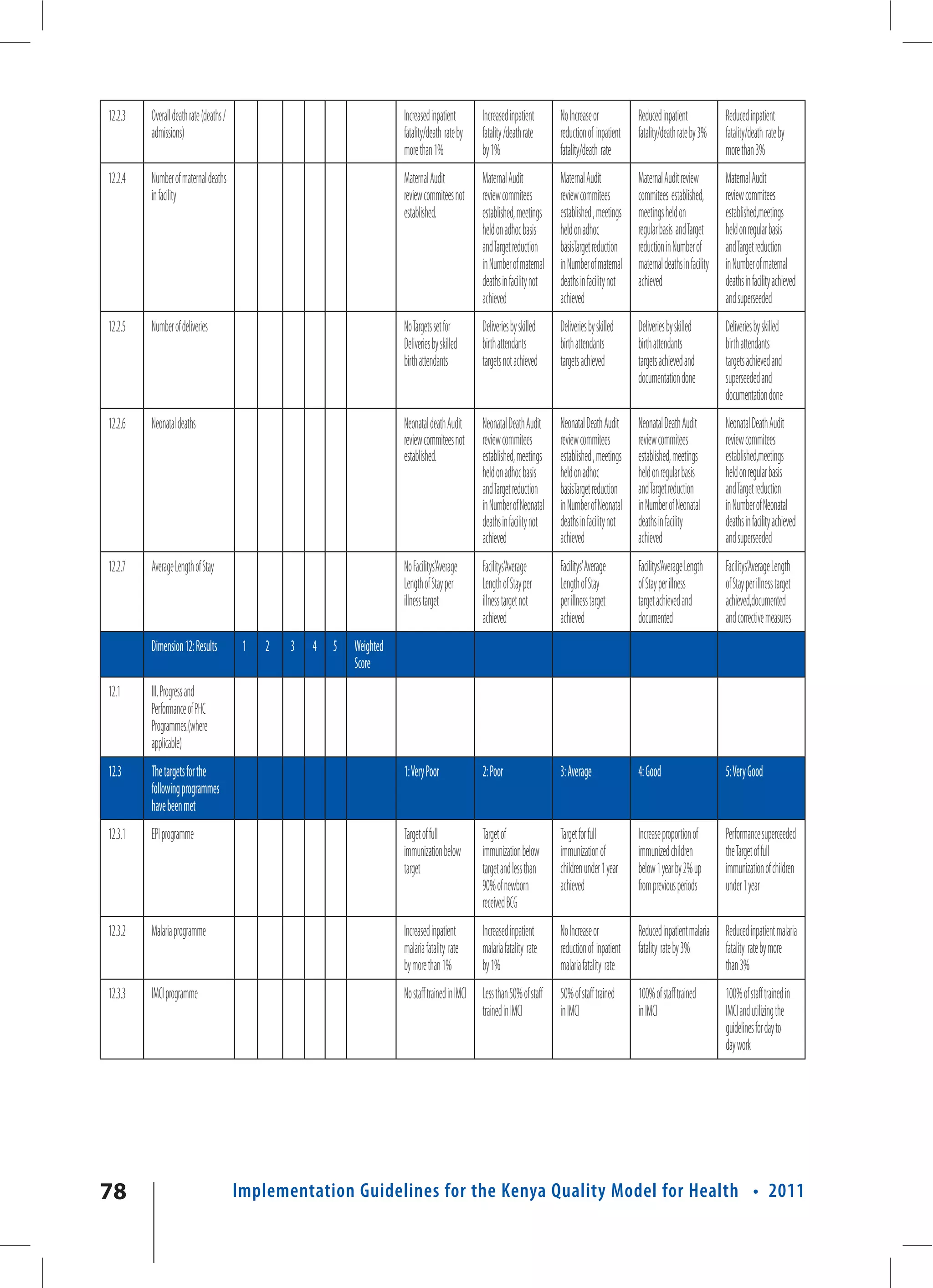
2.1.4 KQMH Scoring System
 The scoring system of the Checklist is based on a 5-point scoring system. A score of 1
or 0 % is the lowest score: a score of 5 or 100 % is the highest possible score.
1 or 0-24 %: A minimum standard has not been met. There are no visible signs of any ef-
forts to address compliance with the standards, only excuses. Self assessment has been
initiated

2 or 25-49%: A minimum standard has not been met. However, there is evidence for
commitment to change for the better, particularly by the top management. There
are some demonstrated efforts to improve the situation. Health managers are able to
produce some evidence that the issue of non-compliance has been assessed and an
improvement plan to reach a stage of compliance is currently being implemented.

3 or 50-74 %: A minimum standard has been met. This score refers to meeting the
standard as outlined.

4 or 75-99 %: A minimum standard has been met. Moreover, there is some demon-
strated additional effort to surpass the standards under score 3. There is visible commit-
ment to continuous improvement. Evidence can be produced to demonstrate quality
improvement.

5 or 100 and above%: Evidence to demonstrate positive results and trends over a pe-
riod of one year can be produced. An excellence distinction has been achieved and the
facility is recognized as a centre of excellence. Other International Standards are being
met for certification.

2.1.5 Scoring Process
Each point on the checklist shall be scored against its performance as compared to the
standard for the item. The score is weighted. The scoring guide used for monitoring is
attached in Annex 1.


Implementation Guidelines for the Kenya Quality Model for Health • 2011                    9
CHAPTER 3:
             Operationalizing KQMH
     Using 5s-Continous Quality Improvement
        (Kaizen)-TQM Step-wise Approach
3.1 Introduction
 Total Quality Management is one of the components of KQMH. TQM can only be
realized after achieving organization-wide work environment improvement and
organization-wide continuing implementation of Continuous Quality Improvement.
Thus, TQM is logically explained as a three-step-approach of;

1.   Work Environment Improvement (WEI) using 5 S Principles
2.   Continuous Quality Improvement (KAIZEN) practice for problem-solving in work
     processes and service contents at all work front-lines
3.   TQM for adjusting decision-making in full utilization of reliable evidences provided
     from CQI processes, which were continuingly carried out by the workforces.

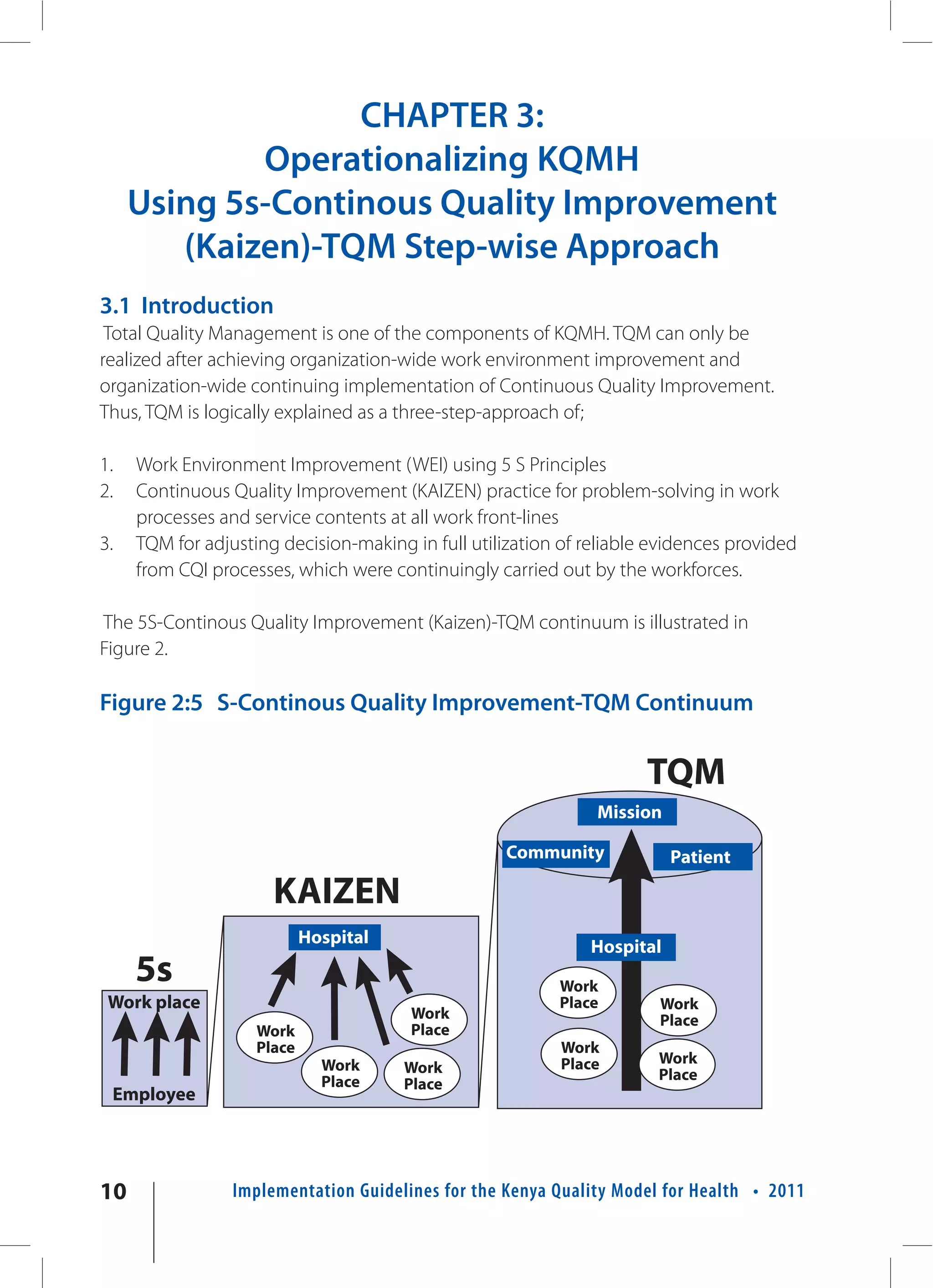
The 5S-Continous Quality Improvement (Kaizen)-TQM continuum is illustrated in
Figure 2.

Figure 2:5 S-Continous Quality Improvement-TQM Continuum


                                                                     TQM
                                                               Mission

                                                    Community            Patient

                      KAIZEN
                         Hospital                             Hospital
     5s
 Work place


 Employee


10               Implementation Guidelines for the Kenya Quality Model for Health • 2011
3.1.1 5S Principles (Work Environment Improvement (WEI)

3.1.1.1 What is 5S?
5S Process, or simply “5S”, is a structured program to systematically achieve total
organization, cleanliness, and standardization in the workplace. “5S” was invented in
Japan, and stands for five (5) Japanese words that start with the letter ‘S’: Seiri, Seiton,
Seiso, Seiketsu, and Shitsuke. An equivalent set of five ‘S’ words in English have been
adopted to preserve the “5S” acronym in English usage. These are: Sort, Set (in place),
Shine, Standardize, and Sustain

3.1.2 Implementation of 5S Activities

3.1.2.1 5S Implementation Phases
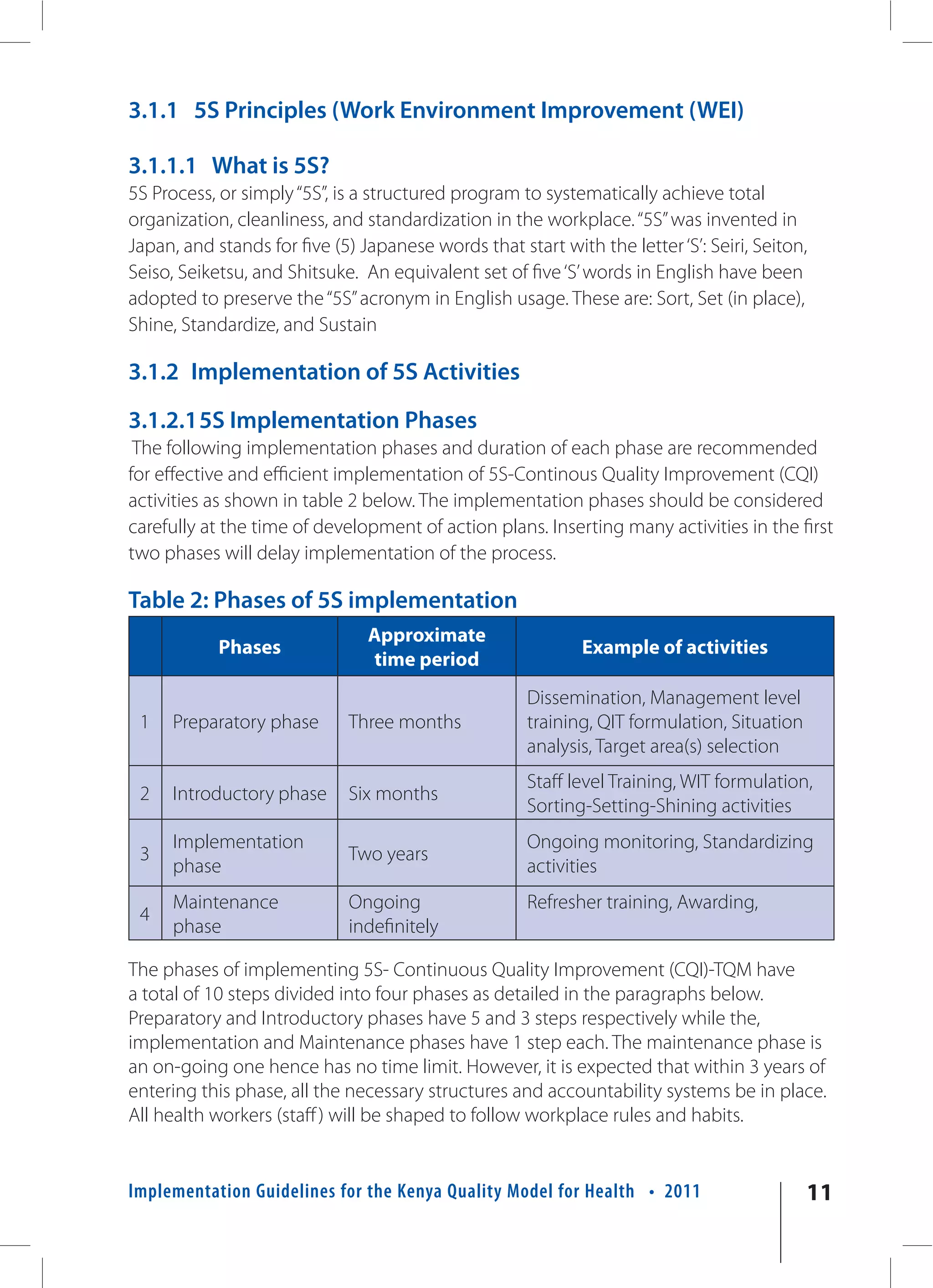
 The following implementation phases and duration of each phase are recommended
for effective and efficient implementation of 5S-Continous Quality Improvement (CQI)
activities as shown in table 2 below. The implementation phases should be considered
carefully at the time of development of action plans. Inserting many activities in the first
two phases will delay implementation of the process.

Table 2: Phases of 5S implementation
                                Approximate
            Phases                                           Example of activities
                                time period
                                                      Dissemination, Management level
 1    Preparatory phase      Three months             training, QIT formulation, Situation
                                                      analysis, Target area(s) selection
                                                      Staff level Training, WIT formulation,
 2    Introductory phase     Six months
                                                      Sorting-Setting-Shining activities
      Implementation                                  Ongoing monitoring, Standardizing
 3                           Two years
      phase                                           activities
      Maintenance            Ongoing                  Refresher training, Awarding,
 4
      phase                  indefinitely

The phases of implementing 5S- Continuous Quality Improvement (CQI)-TQM have
a total of 10 steps divided into four phases as detailed in the paragraphs below.
Preparatory and Introductory phases have 5 and 3 steps respectively while the,
implementation and Maintenance phases have 1 step each. The maintenance phase is
an on-going one hence has no time limit. However, it is expected that within 3 years of
entering this phase, all the necessary structures and accountability systems be in place.
All health workers (staff ) will be shaped to follow workplace rules and habits.


Implementation Guidelines for the Kenya Quality Model for Health • 2011                      11
3.1.2.1.1 Preparatory Phase
In this phase, the aim is to make managers and staffs understand and adopt the 5S-
Continous Quality Improvement (CQI)-TQM concepts. It is also important to know
“where and how you are” by conducting situational analysis. Time allocation for this
phase is approximately three (3) months.

Step-1: Sensitization of 5S-CQI (Continuous Quality Improvement)-TQM concepts:
All staff in your health facility can be targeted for sensitization of 5S-Continous Quality
Improvement (CQI)-TQM concepts. 5S is a philosophy and a way of organizing and
managing the workplace and work flow with the intent to improve efficiency by
eliminating waste , improving work- flow and reducing process unreasonableness .

The following points should be emphasized during the sensitization session:

(i)   5S is to improve working environment for smooth implementation of quality
      improvement activities (Foundation of all QIP).
(ii) 5S is not in conflict with any other quality improvement approaches that are
      already introduced in the Kenyan Health Sector.
(iii) 5S is not a one time event. It should be practiced day by day and should become
      part of the culture of the health facility. Periodical training is necessary for both
      management and department/section level for sustainability.

    Step-2: Training for Management Level
One of the key factors for successful 5S implementation is “strong leadership and
commitment”. Therefore, training for management level is essential in order to
implement 5S-Continous Quality Improvement (CQI)-TQM activities. In this training, the
concepts of 5S-Continous Quality Improvement (CQI)-TQM must be well understood
and adopted by managers and the steps of 5S-Continous Quality Improvement
(CQI)-TQM activities implementation should be logically presented and internalized.
The KQMH training curriculum should guide the contents in the management level
training. This should include but not limited to:

•      Overview of quality terminology and concepts such as: • Quality management
      systems: ISO 9000,KQAMH and 5S-Continous Quality Improvement (CQI) –TQM
      concepts
•     Situation analysis methodology for hospital/institution
•     How to establish Quality Improvement Team (QIT) and its roles and responsibilities
•     Preparation of Action Plan
•     How to establish Workplace Improvement Teams (WIT) and its relationship with
      QIT
•     Monitoring and evaluation of 5S activities

12               Implementation Guidelines for the Kenya Quality Model for Health • 2011
It is important to develop 5S-Continous Quality Improvement (CQI)-TQM Action Plan at
the end of this training.

Step-3: Establishment of Quality Improvement Team (QIT)
After the training of the management level, it is recommended to establish a team
taking leadership for implementing quality improvement activities. This is the Quality
Improvement Team (QIT).

Members of QIT will be nominated by the top leadership and should include members
of Health Facility Management Team and middle management. Their main role will
be to coordinate planning and implementation of quality improvement activities.
The membership of this team should aim at improving the speed of decision-making
and enhance commitment for quality improvement in the hospital. As such, this team
should include a:
•   Patron: someone with clout
•   Team Leader- Responsible for the management of the entire initiative, setting a
    base agenda, facilitating meetings, and monitoring progress with communicating
    with members as needed. Team leader also works to ensure that each member
    gives input on an issue. One strategy to do this is to ask everyone to voice their
    opinion one at a time. Another is to cast votes.
•    Initiator - Someone who suggests new ideas. One or more people can have this
    role at a time.
•   Rapporteur - This person records whatever ideas a team member may have. It
    is important that this person quote a team member accurately and not “edit” or
    evaluate them. Rapporteur also summarizes a list of options
•   Devil’s Advocate/Skeptic - This is someone whose responsibility is to look for
    potential flaws in an idea.
•    Optimist - This is someone who tries to maintain a positive frame of mind and
    facilitates the search for solutions.
•   Timekeeper - Someone who tracks time spent on each portion of the meeting.

The Terms of reference of QIT include:

•    To train Health facility staff on KQMH and use of 5S-Continous Quality
    Improvement (CQI)-TQM step-wise approach
•   To conduct situation analysis
•    To implement KQMH using 5S-Continous Quality Improvement (CQI) –TQM
    approach for common problems of the Health Facility


Implementation Guidelines for the Kenya Quality Model for Health • 2011              13
•    To conduct periodical monitoring and provide technical advice to WIT
•    To document all KQMH activities conducted in the Health Facility
•    To review progress and the action plan
•    To provide necessary input for KQMH activities
•    Provide quarterly progress reports to Hospital/Health Facility Management team
     for onward forwarding to the ministry headquarters

Step-4: Conduct of Situation Analysis
Situation analysis is done to identify problems, cause(s) of problems and come up with
possible solutions. This is done through a problem identification process that may
include but not limited to:

•    Organized brainstorming meetings by QIT to identify problems and opportunity
     for improvements.
•    Organized departmental meetings with an agenda of identifying quality gaps
     affecting their service delivery.
•    Observations and interview from staff

This is documented and appropriate photographing of the work place must be taken
to document the current situation prior to 5S implementation. These are useful for
comparison and to measure progress (before-after) and impact of 5S implementation.

The findings of the situation analysis should be documented and used to modify
the action plan (version 0) accordingly to guide implementation of 5S activities. The
findings will also help staff better appreciate the status of their “working environments”.

Step-5: Selection of Target area(s)
Selection of “Target area(s)” is highly recommended for successful implementation of 5S
activities. Proper implementation of 5S activities at targeted area(s) allows to “showcase”
(model of 5S), which assists staff to better understand “what 5S is all about” (Seeing is
believing!)

When selecting the target area(s), DO NOT start with sections or departments that are
facing lots of problems as it will take a long time to solve the problems and build a
“showcase”. The number of target area(s) can be decided according to the capacity of
QIT and other resources. Criteria of target area selection are described in the box below.


14               Implementation Guidelines for the Kenya Quality Model for Health • 2011
Box 1: Criteria of target area selection
 Examples of Criteria for target area selection include:
 • There is someone who has commitment to implement KQMH Program in the
    section and is ready to champion it;
 • The section/department needs to be improved for better customer care; and
 • Section/Department is facing fewer problems or the problems are easy to tackle.

Once 5S is successfully introduced to the targeted area(s), mechanisms to sustain the
activities in area should be put in place and expansion to other target area(s) can be
considered.


3.2 Introductory Phase
In this phase, the aim is to make staff understand and adopt 5S-Continous Quality
Improvement (CQI)-TQM concepts. It is also important to know “How to do” with 5S
activities. Time required for this phase is approximately 6 months.

Step-6: Training all Staff
One of the key factors for successful 5S implementation is “everyone’s participation”.
Therefore, training of all staff at targeted area(s) is essential. The KQMH training
curriculum should guide the contents in the staff training. The training is customized
depending on the KEPH levels of care:

1.     KEPH levels 2 and 3 (Dispensaries & Health Centers) - Health Care Workers from
       health facilities will cover topics that will help them::
       a) Define quality , quality management, 5S- CQI)-TQM concepts
       b) Describe the principles and elements of the Kenya Quality Model for
           Health(KQMH)
       c) Understand the operationalization of 5S-CQI tools
       d) Establish Work Improvement Team
       e) Carry out Situation analysis method for facility level self assessment using the
           KQAMH checklist
       f ) Manage quality circles and other quality improvement groups
       g) Development of action plan for Facility level


Implementation Guidelines for the Kenya Quality Model for Health • 2011                15
2.   KEPH Levels 4,5,6 (Hospitals)- Health Care Workers from health facilities will cover
     topics that will help them:

     a)  Define quality and its concepts (Quality Control, Quality Assurance, Quality
         Improvement, Quality Management) and 5S- CQI)-TQM concepts
     b) Describe the principles and elements of the Kenya Quality Model for
         Health(KQMH)
     c) Understand the operationalization of 5S-CQI tools
     d) Establish Work Improvement Team
     e) Carry out Situation analysis method for facility level self assessment using the
         KQAMH checklist
     f ) Manage quality circles and other quality improvement groups
     g) Development of action plan for supervision and implementation of KQMH by
         the hospital

Step-7: Establishment and Strengthening of Work
        Improvement Team

A work improvement team (WIT) is a small group consisting of first-line employees,
who continually control and improve the quality of their network, products and
services. The aim of these teams is to provide staff with opportunities for meaningful
involvement and contribution in solving problems and challenges. Main roles of WIT
are as follows:

•    To promote 5S activities in several workplaces
•    To identify, analyze, and solve problems and improve outputs of their work unit.
•    To collect the voice of frontline staff
•    To train in the principles of 5S
•    To monitor 5S progress

The outcomes of WITs include higher quality outputs and improved productivity.
Formation of WITs essentially necessitates pursuing several steps which are: forming,
storming, and norming, performing and closing. The group norms of the team
generally consist of:
•   Close relationships developed and the team demonstrating cohesiveness
•   Team group rules and boundaries agreed on
•   Cooperation
•   Team identifies and members enjoy camaraderie (fellowship/peer consciousness)
    with one another.
•   Commitment to work out differences and giving constructive feedback

16               Implementation Guidelines for the Kenya Quality Model for Health • 2011
High performing teams usually establish urgency and direction, pay particular attention
to meetings, set some clear rules for behavior, spend a lot of time together and exploit
the power of positive feedback, recognition and rewards. The team meetings should
be conducted regularly as per schedule and minutes of the meetings, including the
attendance record of the participants, should also be kept properly and appraised
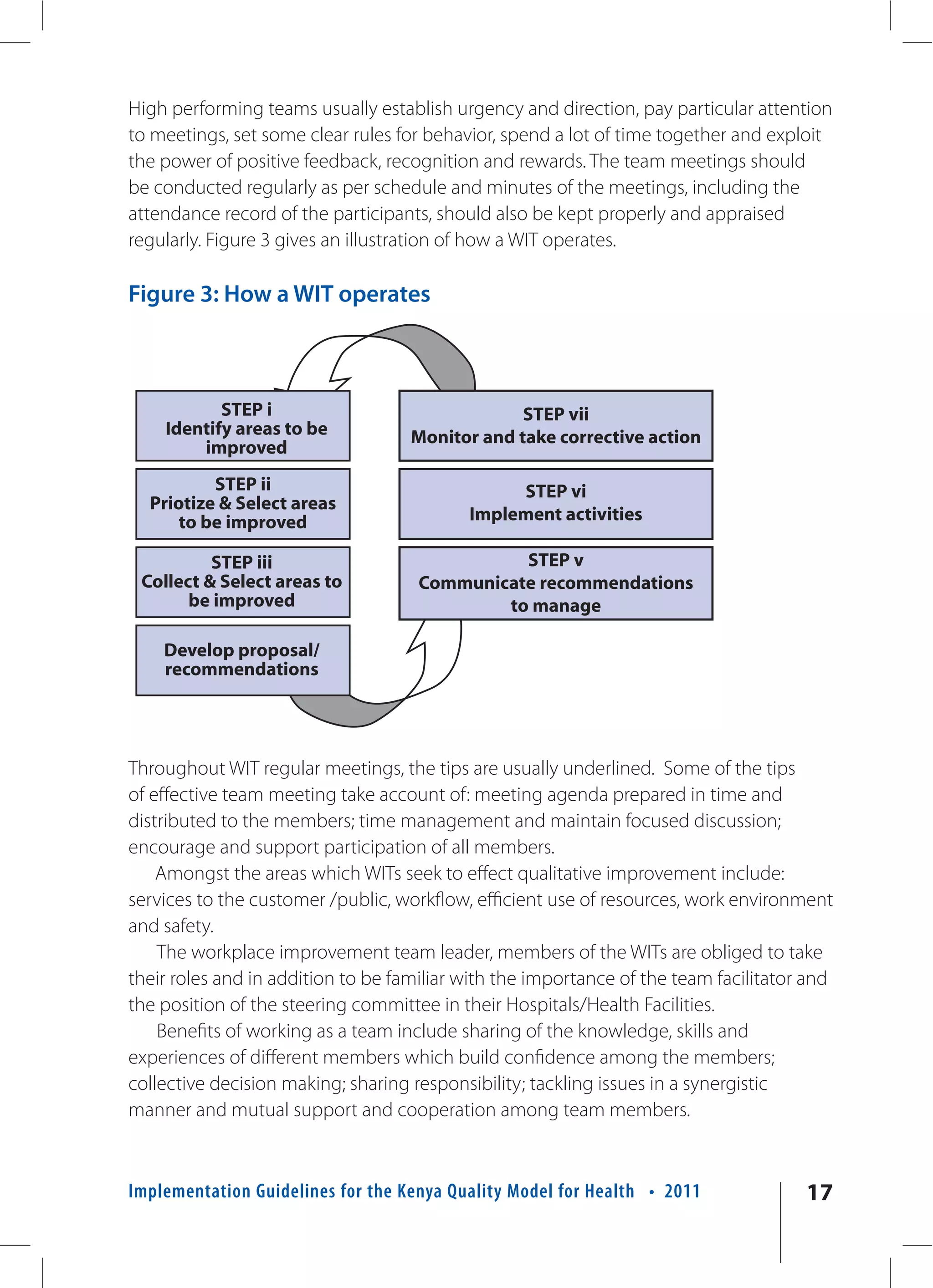
regularly. Figure 3 gives an illustration of how a WIT operates.

Figure 3: How a WIT operates


           STEP i                                STEP vii
    Identify areas to be            Monitor and take corrective action
        improved
          STEP ii                               STEP vi
  Priotize & Select areas
      to be improved                       Implement activities

          STEP iii                             STEP v
 Collect & Select areas to           Communicate recommendations
       be improved                           to manage

    Develop proposal/
    recommendations


Throughout WIT regular meetings, the tips are usually underlined. Some of the tips
of effective team meeting take account of: meeting agenda prepared in time and
distributed to the members; time management and maintain focused discussion;
encourage and support participation of all members.
    Amongst the areas which WITs seek to effect qualitative improvement include:
services to the customer /public, workflow, efficient use of resources, work environment
and safety.
    The workplace improvement team leader, members of the WITs are obliged to take
their roles and in addition to be familiar with the importance of the team facilitator and
the position of the steering committee in their Hospitals/Health Facilities.
    Benefits of working as a team include sharing of the knowledge, skills and
experiences of different members which build confidence among the members;
collective decision making; sharing responsibility; tackling issues in a synergistic
manner and mutual support and cooperation among team members.


Implementation Guidelines for the Kenya Quality Model for Health • 2011               17
Teamwork is vital in achieving continuous quality improvement and is at the heart
of quality improvement. Usually the teams take a problem as an opportunity and the
team members support each other’s efforts .One big tree does not make a forest BUT
many trees do!

Step-8: Practice of Sort, Set and Shine
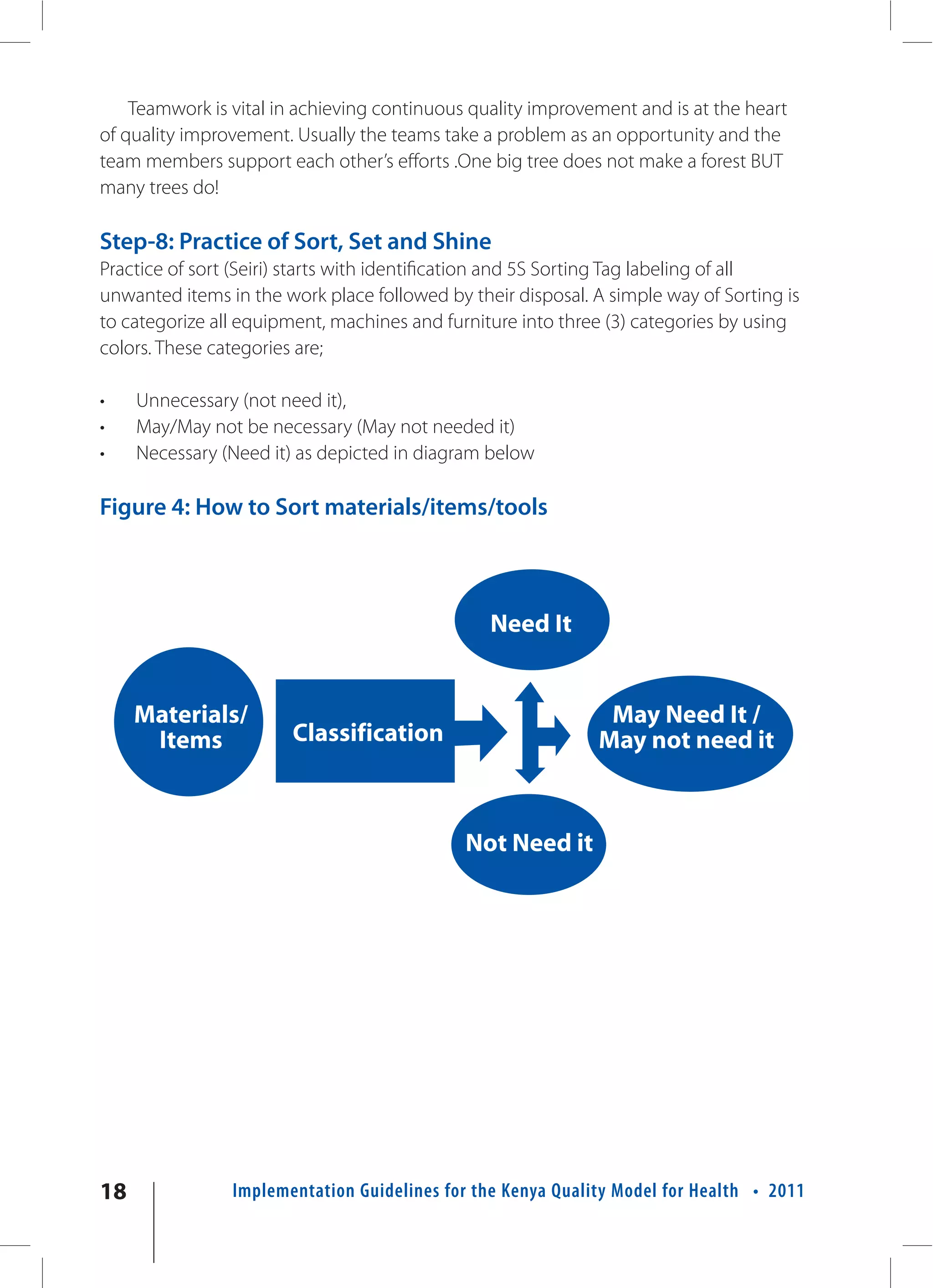
Practice of sort (Seiri) starts with identification and 5S Sorting Tag labeling of all
unwanted items in the work place followed by their disposal. A simple way of Sorting is
to categorize all equipment, machines and furniture into three (3) categories by using
colors. These categories are;

•    Unnecessary (not need it),
•    May/May not be necessary (May not needed it)
•    Necessary (Need it) as depicted in diagram below

Figure 4: How to Sort materials/items/tools


18              Implementation Guidelines for the Kenya Quality Model for Health • 2011
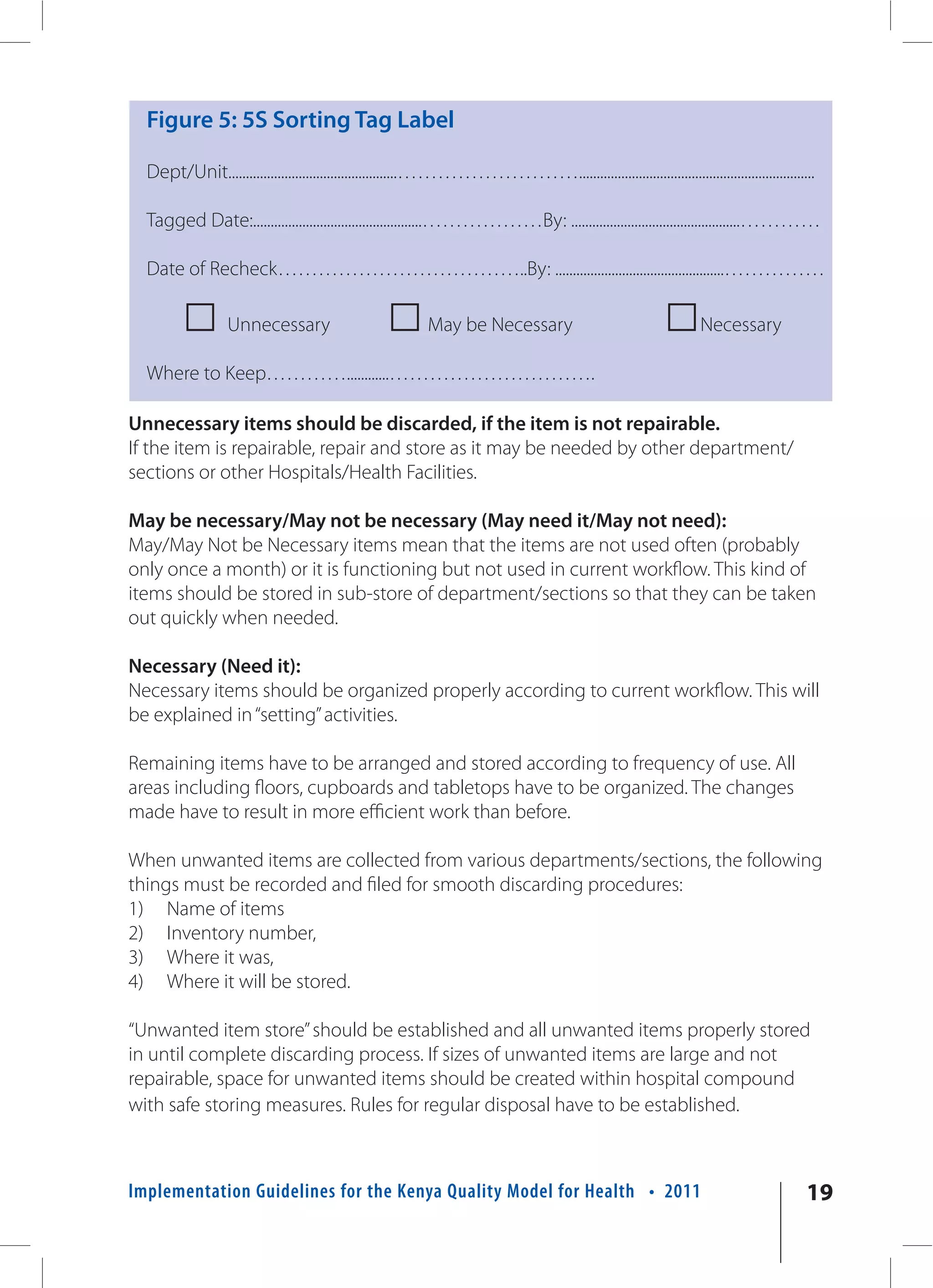
Figure 5: 5S Sorting Tag Label

  Dept/Unit................................................………………………...................................................................

  Tagged Date:................................................………………By: ................................................…………

  Date of Recheck………………………………..By: ................................................……………

                  Unnecessary                            May be Necessary                                       Necessary

  Where to Keep…………............………………………….

Unnecessary items should be discarded, if the item is not repairable.
If the item is repairable, repair and store as it may be needed by other department/
sections or other Hospitals/Health Facilities.

May be necessary/May not be necessary (May need it/May not need):
May/May Not be Necessary items mean that the items are not used often (probably
only once a month) or it is functioning but not used in current workflow. This kind of
items should be stored in sub-store of department/sections so that they can be taken
out quickly when needed.

Necessary (Need it):
Necessary items should be organized properly according to current workflow. This will
be explained in “setting” activities.

Remaining items have to be arranged and stored according to frequency of use. All
areas including floors, cupboards and tabletops have to be organized. The changes
made have to result in more efficient work than before.

When unwanted items are collected from various departments/sections, the following
things must be recorded and filed for smooth discarding procedures:
1) Name of items
2) Inventory number,
3) Where it was,
4) Where it will be stored.

“Unwanted item store” should be established and all unwanted items properly stored
in until complete discarding process. If sizes of unwanted items are large and not
repairable, space for unwanted items should be created within hospital compound
with safe storing measures. Rules for regular disposal have to be established.


Implementation Guidelines for the Kenya Quality Model for Health • 2011                                                              19
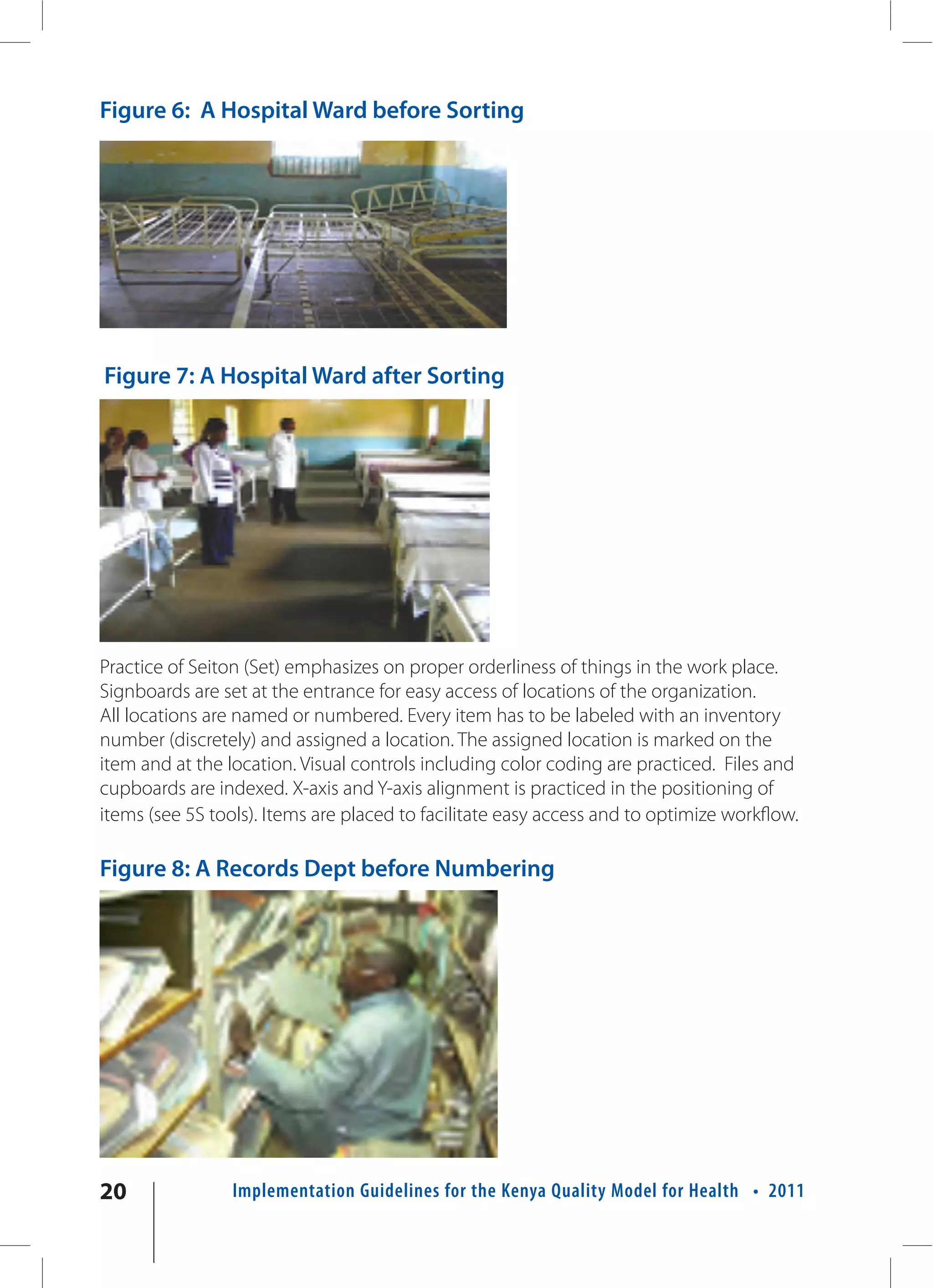
Figure 6: A Hospital Ward before Sorting


Figure 7: A Hospital Ward after Sorting


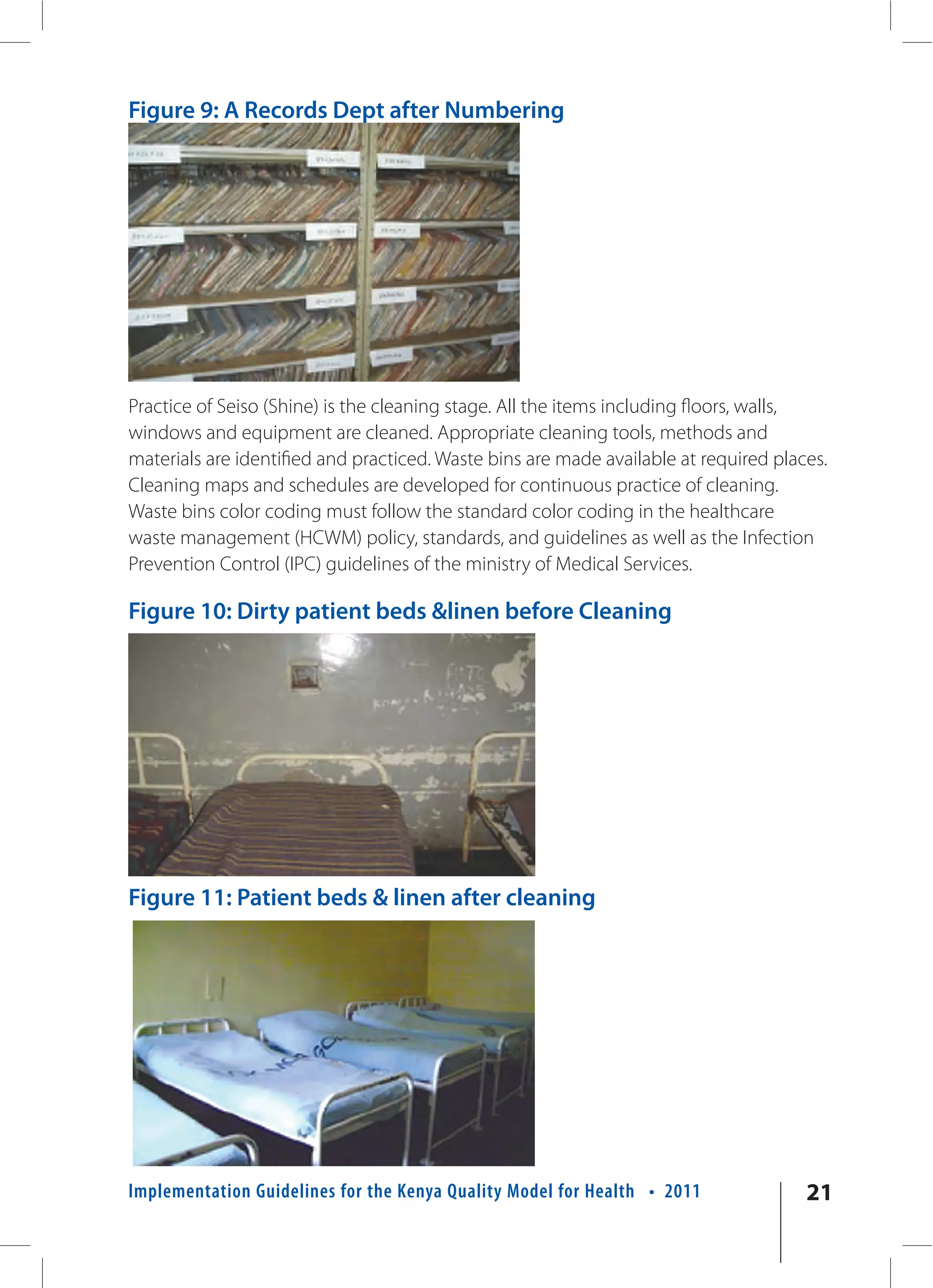
Practice of Seiton (Set) emphasizes on proper orderliness of things in the work place.
Signboards are set at the entrance for easy access of locations of the organization.
All locations are named or numbered. Every item has to be labeled with an inventory
number (discretely) and assigned a location. The assigned location is marked on the
item and at the location. Visual controls including color coding are practiced. Files and
cupboards are indexed. X-axis and Y-axis alignment is practiced in the positioning of
items (see 5S tools). Items are placed to facilitate easy access and to optimize workflow.

Figure 8: A Records Dept before Numbering


20               Implementation Guidelines for the Kenya Quality Model for Health • 2011
Figure 9: A Records Dept after Numbering


Practice of Seiso (Shine) is the cleaning stage. All the items including floors, walls,
windows and equipment are cleaned. Appropriate cleaning tools, methods and
materials are identified and practiced. Waste bins are made available at required places.
Cleaning maps and schedules are developed for continuous practice of cleaning.
Waste bins color coding must follow the standard color coding in the healthcare
waste management (HCWM) policy, standards, and guidelines as well as the Infection
Prevention Control (IPC) guidelines of the ministry of Medical Services.

Figure 10: Dirty patient beds &linen before Cleaning


Figure 11: Patient beds & linen after cleaning


Implementation Guidelines for the Kenya Quality Model for Health • 2011               21
Note that since 5S tasks appear minor, staff may not concentrate on 5S after the initial
implementation. Inspections through monitoring teams and continuous evaluations of
all work units are essential to keep track of the 5S program.

3.2.1.1 Implementation Phase
In this phase, the aim is to practice S1 to S3 properly and generate the maintenance
system for S1 to S3. Time allocation for this phase is approximately two (2) years.

Step 9: Proper practice of S1 to S3 (Sort, Set and Shine) to generate
maintenance system, develop standards and regulations.
(Standardization (Seiketsu) establishes regular and continuous practice of maintaining
tidiness, orderliness and cleanliness (first 3-Ss). All processes and procedures of the
organization are standardized to reduce the re-cycling time, to reduce waste, to
enhance safety and to improve outcome. Thus, the following kinds of activities are
implemented in this phase:
•    Development of Standard Operating Procedures (SOPs),
•    Development of Standard Operational Manual (SOM)
•    Display marking of safety signs
•    Garbage typing collection system (infectious/non-infectious, recyclable), following
     the maintenance phase IPC/HCWM guidelines
•    Color coding for linen system
•    Zoning for storing/parking equipment

“Checklists” should be developed for each activity/service area and utilize it for the
standardization.
Heijyunka (Equalization) is important for reducing variability. Variability is the cause of
creating needless work in the workflow. Therefore, consider equalizing the following
during this phase:
1.   Individual capacity,
2.   Quality, Productivity and Safety,
3.   Information,
4.   Staff’s mindset towards Continous Quality Improvement activities.
These aspects can be equalized using various tools as mentioned below:
•    Individual capacity: Information sharing and development of Standard Operational
     Procedures.
•    Quality, Productivity and Safety: Use of Standard Operational Manual and Standard
     Operational Procedures.
•    Information: Sharing among staff of policy and strategy for quality improvement and current
     situation of Continuous Quality Improvement activities.
•    Staff’s mindset towards to Continuous Quality Improvement Activities: Fair performance
     evaluation and awards to good practice, equal opportunity of training to all staff.

22                Implementation Guidelines for the Kenya Quality Model for Health • 2011
Note: 5S Standard Operational Manual (SOM) should be developed by the ministry or
other relevant established authority so as to maintain national standards. On the other
hand, Standard Operating Procedures (SOPs) are developed at institutional level and
can be modified according to circumstances at department/ward level.
3.2.1.2 Maintenance Phase
In this phase, the aim is to ensure people follow work habits and keep workplace rules
and regulations. To make 5S activities as part of your organization culture, it takes a long
time and needs to be continually repeated. There is no time allocation of this phase as it
is an ongoing process.

Step 10: Making 5S activities a culture of your facility
Sustain (Shituske) is about discipline in maintaining consistent practice of 5S.
Training programs are conducted for employees; competitions are organized and
good practices are rewarded; authoritarian rule is discouraged and employees are
motivated to internalize 5S. Training should include organization-wide meetings where
management and employees announce their results. This serves as an incentive to
motivate staff and to practice benchmarking.
    Care should be taken not to get into a routine with 5S activities. Once again, since
5S tasks appear minor, staff may not concentrate on 5S after the initial implementation.
Inspections through patrol teams and continuous evaluations of all work units are
essential to keep track of 5S program. The following activities are expected to be
conducted in this phase:
1.     Periodical training of staff
2.     Periodic monitoring by both patrol team from management and departmental
       monitoring team.
3.     Quality competitions and awards for good practice
4.     5S poster development and display
5.     Establishment of 5S corner within department/section
6.     Display of 5S progress chart/table/graphs
Box 2: Tips for successful 5S implementation
     “5-S of the mind”
     5S is usually used for “things”, however, it is important to implement “5S in your mind” for
     practicing 5S activities appropriately.
     Sort your mind to concentrate on your work
     Set your mind to organize your work
     Shine and standardize your mind to enjoy your work and maintain your way of working
     Sustain your mind to carry out your work actively and maintain the quality of your work
     “5-S of the brain”
     Sort your brain is to clarify your work on what / for whom / what purpose / by when
     / and how

Implementation Guidelines for the Kenya Quality Model for Health • 2011                        23
3.2.2: 5S for health institutions
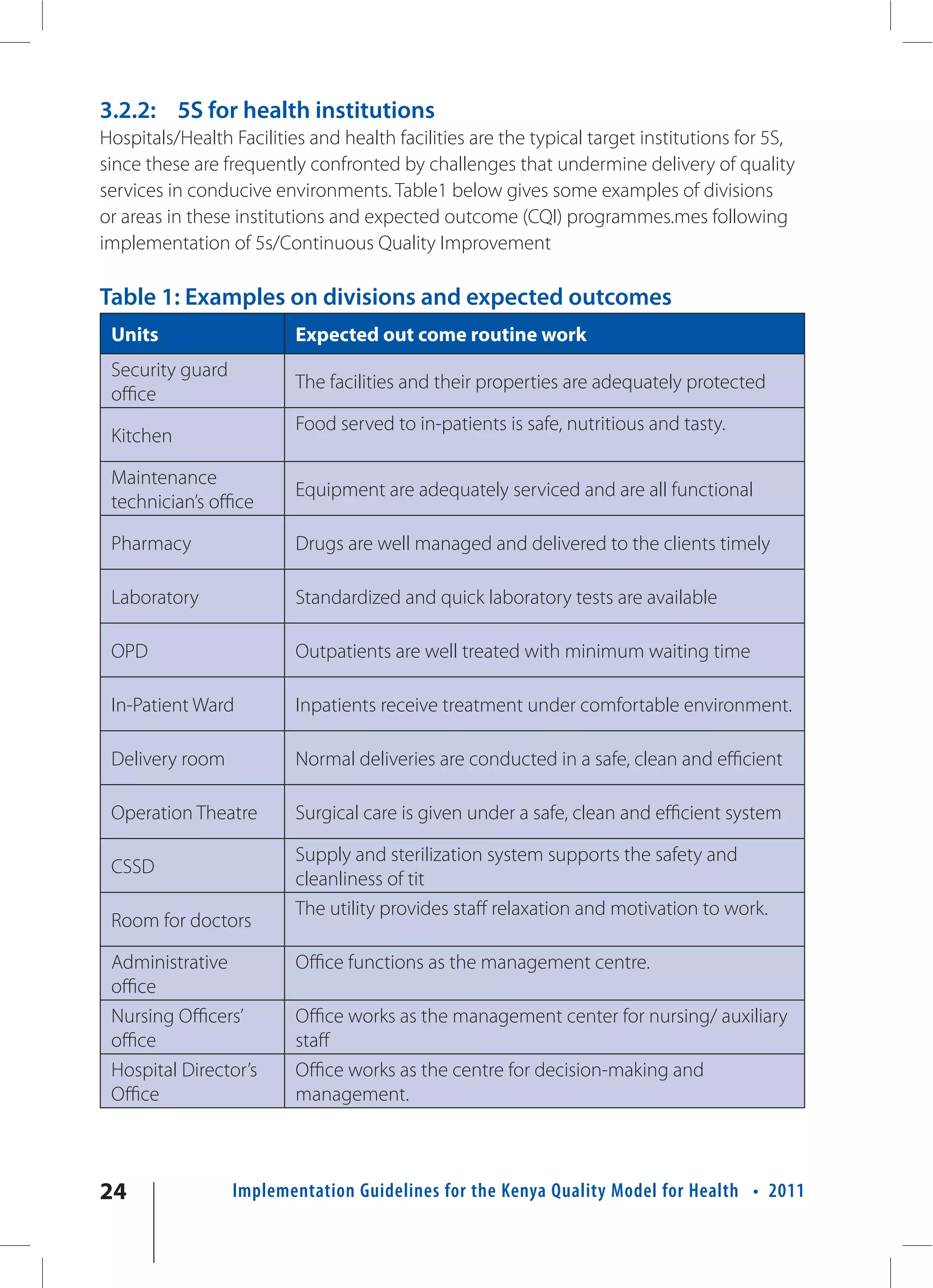
Hospitals/Health Facilities and health facilities are the typical target institutions for 5S,
since these are frequently confronted by challenges that undermine delivery of quality
services in conducive environments. Table1 below gives some examples of divisions
or areas in these institutions and expected outcome (CQI) programmes.mes following
implementation of 5s/Continuous Quality Improvement

Table 1: Examples on divisions and expected outcomes
 Units                    Expected out come routine work
 Security guard
                          The facilities and their properties are adequately protected
 office
                          Food served to in-patients is safe, nutritious and tasty.
 Kitchen

 Maintenance
                          Equipment are adequately serviced and are all functional
 technician’s office

 Pharmacy                 Drugs are well managed and delivered to the clients timely

 Laboratory               Standardized and quick laboratory tests are available

 OPD                      Outpatients are well treated with minimum waiting time

 In-Patient Ward          Inpatients receive treatment under comfortable environment.

 Delivery room            Normal deliveries are conducted in a safe, clean and efficient

 Operation Theatre        Surgical care is given under a safe, clean and efficient system

                          Supply and sterilization system supports the safety and
 CSSD
                          cleanliness of tit
                          The utility provides staff relaxation and motivation to work.
 Room for doctors

 Administrative           Office functions as the management centre.
 office
 Nursing Officers’        Office works as the management center for nursing/ auxiliary
 office                   staff
 Hospital Director’s      Office works as the centre for decision-making and
 Office                   management.


24                Implementation Guidelines for the Kenya Quality Model for Health • 2011
The table above illustrates possible targets that can be set for the various areas
(implementation units) in a health unit planning to implement 5S/Continuous Quality
Improvement (CQI). To have a tangible outcome, each division is expected to achieve
its set targets without excessive workload to the staff in the unit. The workload should
be moderate and implemented in a stimulating working environment that allows the
staff to be innovative in developing ideas or proposals for the enhancement of their
jobs and the outcomes. In practice, it is not easy to realize this due to too many clients
to attend to, too much paper work with multiple reporting systems often found in
many health facilities.
     The objective of Continuous Quality Improvement is -Work Improvement,
whereas the core objective of 5S is -Work Environment Improvement. The difference
between 5S and Continuous Quality Improvement is the difference of target and
process. The most important achievement of 5S is “employees’ satisfaction (ES)” as
the result of improvement of work environment. In other words, - Easy to Work is the
visible outcome of 5S. The main achievement of Continuous Quality Improvement is,
however, not only ES but also “organization‘s satisfaction” through improvement of work
processes leading to high quality services and safety.
     The Continuous Quality Improvement (CQI) process starts after implementing 5S
for the sole purpose of meeting clients’ satisfaction. Productivity and safety must be
considered in the process of executing Continuous Quality Improvement. Nevertheless,
5S activities must be continued to maintain the foundation of quality improvement.
Continuous Quality Improvement teaches individual skills for working effectively in
small groups, solving problems, documenting and improving processes, collecting
and analyzing data and self-managing within a peer group. Continuous Quality
Improvement activities deal not only with improving results, but also and more
significantly with improving capacity to produce better results in the future. Normally,
WIT is established in a department/section to discuss problems and find solutions
within the department/section. WIT is the main actor in the Continuous Quality
Improvement (CQI) process.

Continuous Quality Improvement focuses on:

i.     Moving rapidly from planning to implementation.
ii.    Making continued progress rather than waiting to find the perfect solution.
iii.   Health Worker involvement and teamwork.
iv.    Addressing the root causes of problems.
v.     Process improvement from a systems perspective.


Implementation Guidelines for the Kenya Quality Model for Health • 2011               25
3.2.3.3     Steps for implementing Continuous Quality
            Improvement activities:
The PDSA/PDCA (Deming) cycle is the backbone of Continuous Quality Improvement
activities. However, Continuous Quality Improvement does not stop with the fourth
step of PDCA. Continuous Quality Improvement aims to raise the standard of the
workplace, productivity, quality and safety in a continuous upward spiral through
rotating PDCA cycle, reflecting on achievement of Continuous Quality Improvement
and taking action to improve the way for next Continuous Quality Improvement.

The actions for each of the steps in PDCA cycle for Continuous Quality Improvement
are as follows:

Step 1: Plan, preparing how to implement Continuous Quality Improvement
•   Clarify the objectives and decide on the control characteristics (control items)
•   Set measurable target
•   Decide on the methods to be used to achieve the target

Step 2: Do, Implementing Continuous Quality Improvement activities
•   Study and train in the method to be used
•   Utilize the method
•   Collect the measurable data set up on the plan for decision-making

Step 3: Check, Reviewing the result of Continuous Quality Improvement
activities and achievements
•   Check whether the results of implementation has been performed according to
    the plan or standard
•   Check whether the various measured values and test results meet the plan or
    standard
•   Check whether the results of implementation match the target values

Step 4; Act, taking countermeasures based on the review in Step 3
•   If the results of implementation deviate from the plan or standard, take action to
    correct this
•   If an abnormal result has been obtained, investigate the reason for it and take
    action to prevent it recurring
•   Improve working system and methods


26              Implementation Guidelines for the Kenya Quality Model for Health • 2011
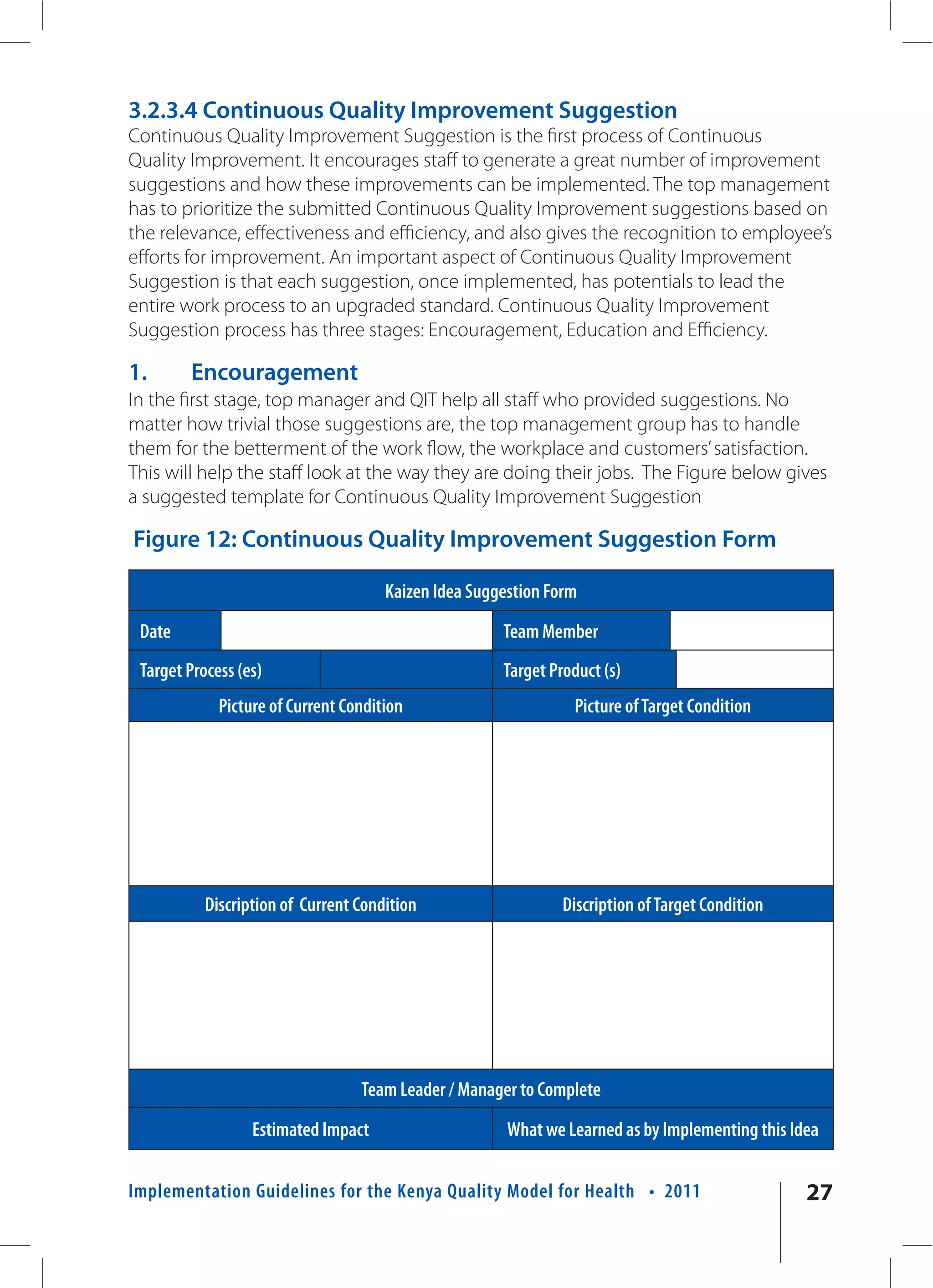
3.2.3.4 Continuous Quality Improvement Suggestion
Continuous Quality Improvement Suggestion is the first process of Continuous
Quality Improvement. It encourages staff to generate a great number of improvement
suggestions and how these improvements can be implemented. The top management
has to prioritize the submitted Continuous Quality Improvement suggestions based on
the relevance, effectiveness and efficiency, and also gives the recognition to employee’s
efforts for improvement. An important aspect of Continuous Quality Improvement
Suggestion is that each suggestion, once implemented, has potentials to lead the
entire work process to an upgraded standard. Continuous Quality Improvement
Suggestion process has three stages: Encouragement, Education and Efficiency.

1.      Encouragement
In the first stage, top manager and QIT help all staff who provided suggestions. No
matter how trivial those suggestions are, the top management group has to handle
them for the betterment of the work flow, the workplace and customers’ satisfaction.
This will help the staff look at the way they are doing their jobs. The Figure below gives
a suggested template for Continuous Quality Improvement Suggestion

Figure 12: Continuous Quality Improvement Suggestion Form

                                      Kaizen Idea Suggestion Form
 Date                                                 Team Member
 Target Process (es)                                  Target Product (s)
             Picture of Current Condition                       Picture of Target Condition


           Discription of Current Condition                    Discription of Target Condition


                                  Team Leader / Manager to Complete
                  Estimated Impact                     What we Learned as by Implementing this Idea


Implementation Guidelines for the Kenya Quality Model for Health • 2011                          27
2.      Education
In the second stage, manager and QIT provide employee training so that employees
can provide better suggestions. The main objective of the training is equipping the staff
with skills to provide better suggestions by describing the problem objectively and
establishing the background of the problem.

3.      Efficiency
This involves the implementation of suggestions made by staff. However, it is important
to note that implementation of staff suggestions is only made after staff demonstrates
an interest in improving work flows and has been trained both interested and
educated.
    Continuous Quality Improvement ideas, related to these topics, should be well
scrutinized in a participatory approach. The before and after Continuous Quality
Improvement should be quantitatively and/or qualitatively compared using workable
indicators. Also it is important both for the staff and managers to be able to confirm
what they learnt through the Continuous Quality Improvement process.
After receiving various Continuous Quality Improvement ideas, top management group
and /or responsible persons of QIT have to make decision promptly on the prioritization
among the ideas.

 Some example of major subjects for Continuous Quality
 Improvement Suggestion includes:

 •    Improvement in one’s own work
 •    Savings in energy, material, and other resources
 •    Improvements in medical equipment and facility
 •    Improvements in medical supply, medicine and other goods
 •    Improvements in work process
 •    Improvements in quality of service packages and / or products
 •    Improvement in non-medical customer services and customers relations


3.2.4 Quality Control Story
Quality Control (QC) story is a basic procedure for solving problems scientifically,
rationally, efficiently and effectively. It allows individual staff or teams to solve even
persistent problems in a rational and scientific way. QC story consist seven basic steps.
It is recommendable that one QC story should be finalized within around six months. If
the QC story is shorter than six month, the work unit members involved in the process
may not cope with each step and cannot utilize the QC tools properly. If QC story is
longer than six months, the members may get bored and discouraged in tackling

28               Implementation Guidelines for the Kenya Quality Model for Health • 2011
problem-solving. The most prioritized topic for problem-solving should be selected
for respective work unit conducting Continuous Quality Improvement. As already
mentioned above, the solution should be achievable within six months.

    The 7 basic steps are as follows:
    Step 1; Select Topic, Describe Problem           Step 4; Analyze causes

    Step 2; Understand situation and Set Target,     Step 5; Plan and Implement
    Analyze problems and Specific objectives         counter measures

    Step 3; Planning                                 Step 6; Check Result

                         Step 7; Standardize and Establish control


Step 1; Select Topic, Describe Problems Areas of priority concerns
Since members of WIT will work together on Continuous Quality Improvement for six
months, it is important to select a challenging and attractive topic. WIT has to notify the
problem, which is expected to be removed through Continuous Quality Improvement,
to the top management via QIT. For doing the above, the followings are useful in
identifying existing undesirable conditions.

•      Check the Continuous Quality Improvement suggestion which should be solved
       by the team
•      Check the roles and job descriptions of each staff and department
•      Check the policies and objectives assigned to the work unit and department
•      Conduct study visit to the work venues suffering from problems
•      Formulate reporting using Video/photos, if possible

Further the topic should be:

•      a common issue for all work unit members
•      highly necessary and relevant in the work unit and the venue
•      manageable in the work venue by the job group
•      challenging but achievable
•      appearing with no negative influence
•      linked to hospital policies and objectives
•      have the potential to develop new capacity of work unit members including WIT
       members.


Implementation Guidelines for the Kenya Quality Model for Health • 2011                29
Examples of Continuous Quality Improvement suggestion topics for Hospitals/Health
Facilities include:

•     Reduction of waiting or idle time within job sequences at reception, pharmacy,
      laboratory, administration office and so forth,
•     Reduction of the number of missing drug orders at dispensaries,
•     Prevention of failure in maintaining temperature of hospital meals prior to serving,
•     Reduction of expenditure for electricity and water usage
•     Reduction of preparation time of instruments and the consumables for emergency
      cases

Step 2; Understand situation and Set target, analyze problems and
specific objectives

This process involves three stages:

i.     Analyze problems and identify Important Key Areas for
       improvement
At the first step in analytical process, WIT member should collect data related to the
selected topic. Both quantitative and qualitative data should be in his or her hands. The
data collection methods, used here, are expected to be standardized in advance for
better reliability of the collected data. Reliable data can be obtainable, if the personnel,
handling the data, effectively calibrate the information on the existing situation among
the job group. The term “situation”, used here, implies the conditions related to the topic
in the past, and the existing present one. In addition to that, various influential factors
to the “situation” should also be well considered by the job group. Understanding
the unfavorable present situation should be accomplished by scrutinizing how
unsatisfactory it is and, at the same time, how it was bad in the past.

ii.      Useful check-up actions for understanding the situation
This step aims to aims to expose what is wrong, what to tackle and how to proceed. It
required the following actions to be taken:

•     To collect time line data and visualize them on charts or graphs
•     To check work process flow and visualize them on charts or graphs
•     To collect events, which gave influence to the positive and negative change of the
      situation
•     To analyze linkages between the problems in the work flow by demonstrating the
      work flow with data by stratification


30                Implementation Guidelines for the Kenya Quality Model for Health • 2011
iii.      Specific objectives, the expected results and the mile stones

The objectives for problem-solution shall be decided by balancing the ideal conditions
and constraints on the determinant factors, such as duration, cost, and human
resources. The expected results of problem-solving should, thereon, be indicated clearly
based on the following criteria.

•      What -Specific character of the topic
•      How much -Quantitative target value of the topic
•      How well -Qualitative target value of the topic
•      By When -Time limit of QC circle activities to solve the topic
•      To whom -Target beneficiaries related to the topic
•      Where -Target area related to the topic

If this second stage in QC story of understanding the situation, setting targets,
analyzing problems and Specific objectives is not taken properly, it will be hard for WIT
to achieve the expected work improvement goal.


Step 3: Planning
The WIT, handling Continous Quality Improvement topic, are required to draw up the
plan as a team and allocate the roles, tasks and responsibilities for each job group
member. All members are supposed to share fairly allocated responsibility of the
Continous Quality Improvement activities with respect to their skills and responsibilities
in the work area. All activities in Continous Quality Improvement should be drawn up
on a chart with time line and indications on in-charge members. The chart is essential
to monitor the gap between planned and actual situations.

Step 4; Analyze causes
This step is the most important step in Continuous Quality Improvement using QC
story. Accurately identifying the true causes show various hints for creating solution
measures. If the WIT and job group members cannot identify the causes of visible
problems, the countermeasures, planned by the group will not be practical. Analyzing
causes is actually an investigation process using the logic of “Cause-Effects relationship”.
Root causes, which maybe crucial ground causes of various visible problems, can be
identified in this analytical process. Ideas for necessary actions, which should be taken
as the countermeasures, are automatically created, in a later stage, through the brain-
storming. QC Tools, which can be applied to this analytical process, are followings. The


Implementation Guidelines for the Kenya Quality Model for Health • 2011                 31
details will be opened up in the latter chapter. Here in this portion of the explanation
on Continuous Quality Improvement process, the readers just touch upon the names
with good imagination on the contents.

•    Fish Bone (Cause – Effects) Diagram or Problem Tree
•    Pareto Diagram
•    Graphs
•    Check sheets
•    Histogram
•    Scatter diagrams
•    Control Charts

The sequence of this analytical process can be summarized as follows:

•    Brainstorming to identify problems
•    Sorting the problems in “Cause – Effects Relationship”
•    Rating the causes and finding root causes
•    Analyzing one of the root causes
•    Drawing the results of analysis
•    Analyzing another root cause and again
•    Selecting prioritized target causes for solution

Step 5; Plan and Implement countermeasures
This step is broken down into two tasks:

i.   Plan countermeasures
     The WIT and the job group members look into possible countermeasures as many
     as possible with paying attention to the following sequences related to the nature
     of the targeted problem. The process for participatory work are (1) considering
     the problems from all angles, (2) collecting ideas from the related parties and
     stakeholders in upstream and downstream segments of the work system, (3)
     discussing the topic in open-mind and avoiding critics for critics. For collecting
     wide-ranged ideas from multiple groups of the concerned people, the following
     several ways of thinking are available, if the job group led by WIT wish to be in a
     higher status both in efficiency and effectiveness of brain-storming and the group
     work.
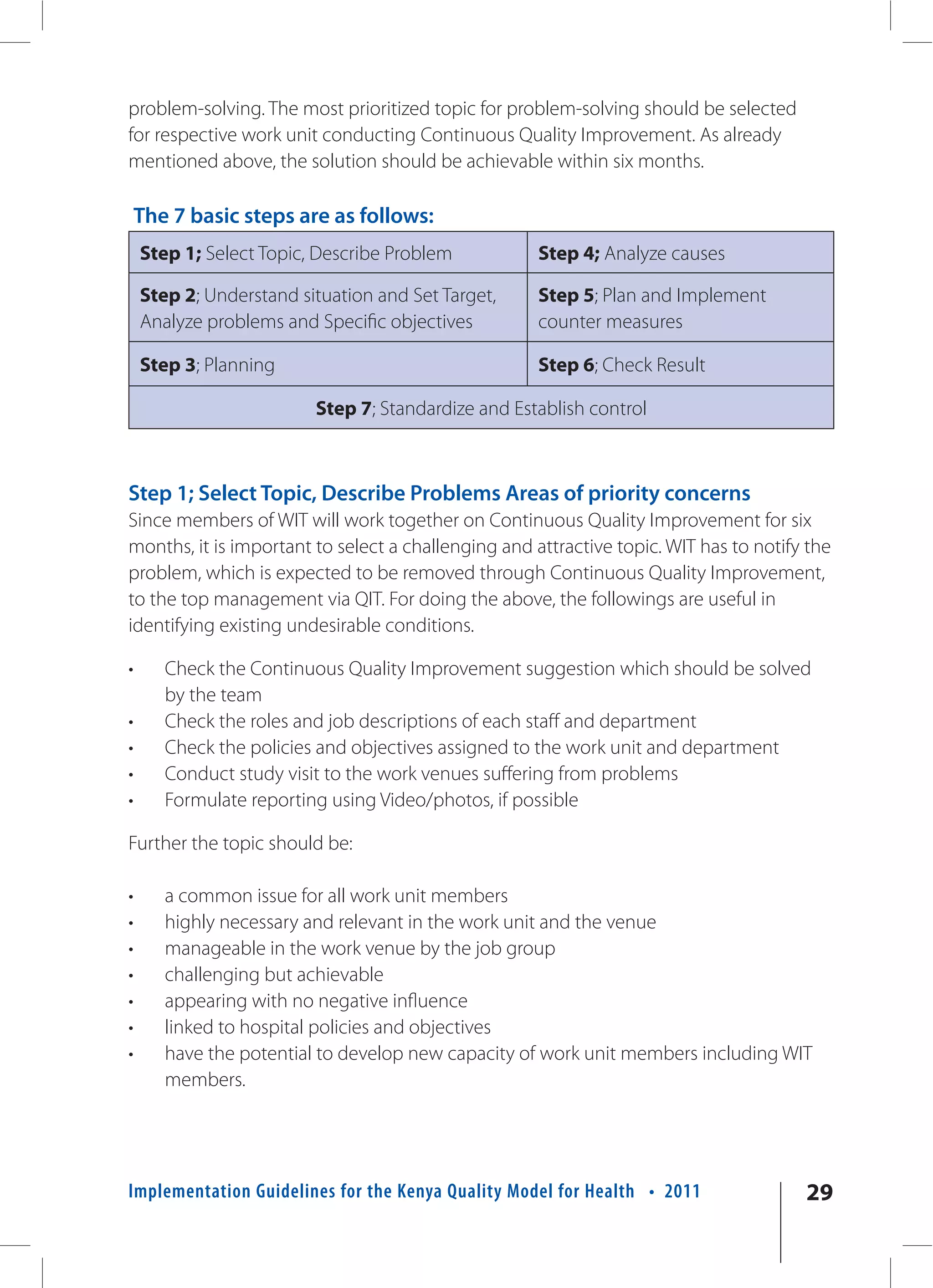


32               Implementation Guidelines for the Kenya Quality Model for Health • 2011
Strategic ways of thinking for idea generation in brain-storming

  •    Elimination
  •    Reversal
  •    Normal and Exceptional
  •    Constant and Variable
  •    Expansion and Contraction
  •    Combination and Separation
  •    Collection and Dispersion
  •    Addition and Subtraction
  •    Changing Order
  •    Same and Different
  •    Sufficiency and Substitution
  •    Parallel and Series

  Consideration to 4M components of sustaining productivity and quality

  1.   Manpower (Human resources)
  2.   Machines (Physical facilities, equipment and other hardware)
  3.   Materials
  4.   Methods

  The 5W1H closely related to operational plan
  What
  Who
  When
  Who
  Where

Prioritization of countermeasures should be conducted after the above-mentioned
identification process. The three keywords, effectiveness, feasibility and efficiency, are
useful in putting priority onto the various candidate countermeasures. This process is
a sort of alternative analysis based upon the practical way of thinking respecting the
said three keywords. The selected countermeasures for implementation should be
reconfirmed and agreed upon among the team members.


Implementation Guidelines for the Kenya Quality Model for Health • 2011                  33
ii. Implement the countermeasures
Prior to implementation of the countermeasures, recording the present situation
with constraints is essential activity for the convenience of the future monitoring and
evaluation processes. For visualization purpose and also for easiness in demonstration
of changes, photo and/or video-takings are highly recommendable. The each step
of the countermeasure implementation should be properly recorded, with summary,
in documents. It is expected that this procedure comes to be a part of routine
administrative practice in wider range in the entire hospital.

The changes after latter stage in problem-solving should be objectively and jointly
evaluated by QIT and WIT. The outcomes are shared by the entire job group with the
fact that they found workload reduction and improvement of work efficiency. In case,
they detect some positive feedback both from internal and external clients.

Step 6; Check Results
The WIT and the job group members check the results of the countermeasures
implemented in the previous step. The following processes are important.

•    Collect the data of improvement results by workable indicators
•    Compare ideal situation and actual result
•    Identify benefits by the countermeasures
•    Analyze reason of success / failure (if necessary)

The indicators, mentioned above, are measurement instruments, which should be
professionally formulated and set in appropriate places in the work sequence. The
following conditionality is normally given to the workable indicators.

•    Which target should be measured?
•    What extent of change is expected?
     • Where should it be measured?
     • When should it be measured?
     • Who does measure it?
     • How should it be measures?

Step 7; Standardize and Establish guidelines
The WIT and the job group members consider the means to prevent backsliding and to
expand the results to other part of the organization using new standards of procedures,
which are formulated based on the outcomes and evidences in Continuous Quality
Improvement process. For prevention of setback, consideration to the external
uncontrollable conditions, which might affect negatively to the improved condition by

34              Implementation Guidelines for the Kenya Quality Model for Health • 2011
Continuous Quality Improvement, should be carefully looked into and incorporated to
the plan for assuring sustainability. In case, setting rules, regulations and responsibility
sharing among the concerned groups are necessary. Standardization of the work
process is one key issue to sustain the effects of Continuous Quality Improvement
together with the dissemination of the new form of work improvement throughout the
organization.

The following actions are, generally, necessary for the standardization

•   Clearly spell out all the key points of new method
•   Obtain the agreement of relevant work areas
•   Obtain the approval of superiors
•   Follow the official guidelines of the organization when standards or guidelines
    have to be established and also revised

In case of the revision, the facts, related to the reasons, time/date and responsible posts,
should be clearly inserted to the designated portion of the documents. The revision
should be widely announced together with the advocacy programme of the updated
version of standards / guidelines.

3.2.4.1 Organizational issues and the resource necessary
        for the activities

To commence Continuous Quality Improvement activities, the commitment of
top management is important as emphasized at introduction of 5S activities. Top
management should commit to the following:

•   To describe the clear directions and objectives
•   To share the directions and objectives with all staff through continuous
    communication
•   To make decisions based on the evidences
•   To select measurable evidence for decisions making
•   To measure the evidence by the staff of the workplace
•   To trust the staff
•   Not to be afraid the change and challenge
•   Ensure that WIT activities contribute to improving the health of the enterprise
    by treating WIT activities as an important part of employee development and
    workplace vitalization,
•   Provide guidance and support for total participation while respecting the
    humanity of all employees.

Implementation Guidelines for the Kenya Quality Model for Health • 2011                 35
Based upon the above, the top management shall keep in mind that Continuous
Quality Improvement (improvement of productivity) will be attained based on
employees’ satisfaction. If productivity is attained by the sacrifice of employees’
satisfaction, then it is Not Continuous Quality Improvement (improvement) and it is
only Transaction (Exchange) between productivity and employees’ satisfaction.

Continuous Quality Improvement activities should be implemented by small teams
called WIT. The team is a small group consisting of first-line employees, who continually
control and improve the quality of their network, products and services. These small
groups operate autonomously, utilize quality control concepts and techniques and
other improvement tools, and promote self- and mutual-development. Activities of
WIT are periodical activities around a half year. When a WIT attains its purpose in the
period, new target of Continuous Quality Improvement would be selected based on
the directions and objectives of the organization. Continuous Quality Improvement will
be attained through continuous WIT activities.

WIT activities are core activities for the improvement of productivity and quality, and
also aim to develop members’ capabilities, to achieve self-actualization, to make the
workplace more pleasant, vital and satisfying, to improve customer satisfaction, and to
contribute to society.

At the first step, WIT should upgrade into QC Circle and a Quality Improvement Team
(QIT) should be upgraded also. Even though name of WIT is remaining, the function of
WIT should upgrade into QC circle.
WIT aims:

a)   at promoting 5S activities in several workplaces,
b)   at collecting the voice of frontline staff,
c)   at defining the problems,
d)   at training the principle of 5S,
e)   at monitoring 5S progress and so on.

3.2.4.2 Valuable Hints for practicing Continuous Quality
        Improvement
The starting point of Continuous Quality Improvement recognizes how to reduce the
unnecessary work called: the three Ms- MURI = Strenuous work, MURA = Irregularity,
MUDA = waste. The following are the hints for better Continuous Quality Improvement
from the experience in Japan:


36               Implementation Guidelines for the Kenya Quality Model for Health • 2011
Trustworthy ideas for better implementation and outcome of CQI

 1.    There is no usual work without implementation
 2.    Sharing usual work through standardizing
 3.    Implementation will make work usual
 4.    Challenge from pity success
 5.    The fail is the egg of the further success
 6.    But big fail make you discourage
 7.     The success make you encourage even if it is small
 8.    Looking the Reality
 9.    Continuous measuring will take a time
 10.   Calculation will induce the mistakes
 11.   To consider necessary function to attain the objective as minimum as possible

 Hints for Changing Process
 1. to reduce effort too much
 2. to avoid taking care too much
 3. not to check too much
 4. to implement naturally
 5. to consider cutting corners with employees’ satisfaction, productivity,
     quality and safety

 Plan with Implementation
 1. to consider feasibility of the plan
 2. to avoid negative effect by the implementation

3.2.4.3     How to deal with resistance in implementing
            Continuous Quality Improvement (CQI) activities
Change management is bound to be difficult and complex in any organization. It will
often seem to slow down or stop Continuous Quality Improvement (CQI) activities.
Even when management of the organization has strong leadership and 5S-CQI-TQM
concept is well adopted by managers, “resistance to change” among workers can
substantially slow down or stop continuous Quality Improvement (CQI) activities.
“Un-cooperative or resistant to change staff” in your organization will Influence
“Cooperative staff” to have negative thinking and attitude on Continuous Quality
Improvement (CQI) activities.


Implementation Guidelines for the Kenya Quality Model for Health • 2011            37
Symptoms of Organization that is likely to resist to Change:
    •  Prioritizing “profit” over customer satisfaction
    •  Weak leadership and hesitance to “change”
    •  Copying Continuous Quality Improvement (CQI) methodology and implement-
       ing without proper understanding and adoption of the concept.
    •  Lack of organization to appreciate the importance of user-friendliness
       • Lack of organization to appreciate the importance of user-friendliness

Often, it has been observed that those “un-cooperative or resistant to change staff” are
senior staffs of an institution that are also well experienced and skilled. Un-involvement
of experienced and skilled personnel into Continuous Quality Improvement activities
is Inexpedient as skills and knowledge of those personnel are very effective for quality
improvement. Therefore, it is necessary to change the mindset of “un-cooperative or
resistant staff” for successful implementation of Continuous Quality Improvement/
Continuous Quality Improvement (CQI) activities. Once resistance to “change” is
reduced, managers should aim to build mutual understanding and communication
mechanism between management and workers. As previously mentioned, QIT and WIT
is very important for development of this mechanism. Communication mechanism,
it is important to respect humanity and await consensus between management and
workers.

 Box 3: Hints on how to change the mindset of un-cooperative or resistant staff
•  Show examples and explain the effectiveness and necessity of 5-S using data,
   pictures etc.
• Remove “unnecessary work” from current workflow,
• Remove variability of work (Equalization/Leveling)
• Make work procedures clear and develop Standard Operating Procedures,
• Explain what we can do if 5S is introduced.

3.2.5     Total Quality Management (TQM)

3.2.5.1 What is TQM

In ISO 8402, definition of Total Quality Management (TQM) is described as follows.

“Management approach of an organization centered on Quality, based on
the participation of all its members and aiming at long-tem success through
customer satisfaction, and benefits to all members of the organization and to
society”


38               Implementation Guidelines for the Kenya Quality Model for Health • 2011
TQM is characterized by a visionary and strategic leadership working with a goal-
oriented Quality Improvement team that provides data produced out of routine CQI
(Continuous Quality Improvement) activities conducted by all WITS. Total Quality
Management (TQM) is the description of a culture, attitude and organization of a facility
that strives to provide clients with services that satisfy their need. The culture requires
quality in all aspects of the facility’s operations, with processes being done right the
first time and defects and waste eradicated from operations. Total Quality Management
(TQM) is a method by which management and employees become involved in the
continuous improvement of services. Within the health sector, TQM is a health service
management strategy aimed at embedding awareness of quality in all organizational
processes as shown in Figure 11 below:

Figure 13: From 5-S to TQM

     TQM                        Quality in all Hospital Processes


     Continous                            Work / Service
      Quality                             Improvement


        5S                   Work Environment Improvement

                                                       Service Provider Oriented


3.2.5.2          Implementation of TQM
The process of implementing TQM is referred to as the Mission Deployment
Management. It has the following steps:

i.    Top management has to identify and formulate the statements of
      - mission, credo and vision- of the hospital. Logical coherence should be main-
      tained between the above policy statements and the short- and mid- term objec-
      tives of the organization.


Implementation Guidelines for the Kenya Quality Model for Health • 2011                39
ii.   Top management encourages mid-level managers including all department heads
     to formulate departmental short term objectives maintaining consistency with the
     policy statements.
iii. The departmental objectives set by the mid-level managers have to be approved
     by the top management and notified to all staff members of each department.
     Five (5) S and Continuous Quality Improvement activities have to be accordingly
     carried out by each department to attain the departmental objective.
iv. The mid-level managers, responsible for departmental objectives, maintain
     periodical monitoring and reporting with reciprocating information with the top
     management. Top management gives proper instruction or guidance to the mid-
     level managers upon necessity.
v. Top management analyzes the monitoring results to find out determinant factors
     of successes and failures.
vi. Top management notifies the analysis results to the department to reflect them to
     the next process of short-term objective setting.
Top down initiative is important to maintain the organization-wide Continuous Quality
Improvement. There is need to achieve Standardization of CQI processes throughout
the organization for purposes of ensuring reliability of the collected evidences for
top level managerial decision-making. This is ensured through institutionalization of
periodical training for mid-level managers. The top management is responsible for
managing managers across the management ladder of the organization

3.2.5.3 Implementation Phases
TQM implementation has five phases as illustrated in figure below.

Figure 14: TQM Implementation Phases

         Quality


        Sustaining                                             Phase 5


        Expanding                                    Phase 4


      Implementation                       Phase 3


       Introduction              Phase 2


                       Phase 1
       Preparation


40                     Implementation Guidelines for the Kenya Quality Model for Health • 2011
TQM IMPLEMENTATION PHASES

 Phase 1      Preparation          • Learn about KQMH,5S, Continuous Quality
                                      Improvement, Productivity and Quality
                                   • Situation Analysis (Continuous Quality
                                      Improvement Diagnosis Team, photos/ Video)
                                    • Integrate and align - Quality Goals‘ into the
                                      hospital plan
                                    • Determine how transfer initiative will be
                                      integrated with other processes and initiatives
                                      already in the organization
                                    • Establish KQMH teams and Select resource
                                      persons
                                   • Identify 10 key areas for improvement and budget
                                      implication
 Phase 2      Introduction         • Establish infrastructure

                                   • Quality Management Department/Unit
                                     (Depends on the size of the institution)
                                   • KQMH Quality Improvement Teams

                                    • Develop KQMH activity Action plans
                                   • Sensitizitization/Training of middle
                                      level managers
                                    • Study visits
 Phase3       Implementation        • Train staff members and disseminate
                                      objectives
                                    • Conduct projects
                                   • Form WITs
                                   • Start with implementing 5S (No cost,
                                      Low cost activities)
                                    • Support and monitor projects
                                    • Measure and review programme
                                    • Customer and employee satisfaction surveys
                                    • Review lessons learned
                                   • Make decisions
                                    • Involve consultants


Implementation Guidelines for the Kenya Quality Model for Health • 2011            41
Phase4    Expanding            • Modify original plan based on lessons
                               • Expand to other units and additional training
                               • Communicate success of pilot and on-going
                                 projects
                               • Establish and communicate objectives to all
                                 staff members
                               • Measure, review and inspect
                               • Customer and employee satisfaction surveys
                                 and disseminate to middle level managers

Phase5;   Staining            • Conduct audit and take appropriate actions
                               • Continue to assess culture and act on gaps
                               • Customer and employee satisfaction surveys
                                 and disseminate to middle level managers
                               • Stay focus on the customers and bottom line
                               • Strategic goals for the organization must in-
                                 clude measurable, stretch goals related to such
                                 areas as customer loyalty, service performance,
                                 competitive performance, costs of poor quality,
                                 and internal quality culture
                               • Upper managers must personally review and
                                 audit progress towards quality goals
                               • All employees must be trained to know what
                                 is expected of them, know how they are doing
                                 with respect to those expectations, and have
                                 the skills, tools, and authority to regulate their
                                 work to meet expectation
                              • Training – on the job, competitions (Essay, Post-
                                 ers, quiz)
                               • Apply for awards


42          Implementation Guidelines for the Kenya Quality Model for Health • 2011
Chapter 4:
               5s-cqi (Kaizen) Tools for KQMH
                       Implementation
4.1.1 Introduction
There are several 5S tools that will help you to practice 5S activities. These tools are
usually used for practice of S1 (Sort), S2 (Set) and S4 (Standardize). Nevertheless, 5S
tools can be combined for sorting, setting and standardization practice. All tools require
an agreed set of rules. The rules have to be known by all staff in the health facility and
everyone must follow the rules. The 5S tools that will be described in this chapter are
Alignment, Numbering/Alphabetical coding, 5S Sorting Tag label, Safety signs, Color
coding, Sign board/Mapping, Labeling, Symbols, X-Y axis and 5S Corner.

4.1.2 5S Tools
4.2.1 Alignment
This is used for “SET” activities to organize files, equipment, materials etc, in order to
improve orderliness and beatification. The two pictures below give an example of
alignment in a hospital implementing 5S.

Figure 15: an example of alignment in a hospital implementing 5S


4.2.2 Numbering/Alphabetical Coding
This is used for S2 “SET” activity. This is to organize files and other items by numbers/
alphabets. It helps users to find necessary things or information quickly and easily. It is
very useful to practice the “Can See-Can Take Out – Can Return” principle. It requires an
agreed set of rules, or a central coordinator to maintain the system.
Figure 16: Example of a Numbering System


Implementation Guidelines for the Kenya Quality Model for Health • 2011                      43
Figure 16: Example of a Numbering System


4.2.3 5S Sorting Tag Label
This tool is used for S1”SORT” activities when some items are difficult to decide, whether
it is necessary or unwanted items during Sort practice. Put 5S Sorting Tag on undecided
items and observe for a month. If you didn’t move or use it for a month, it means these
items are “may be necessary” OR “unnecessary” for the current workflow. You need
to decide on its category by ticking on the options on the tag (Necessary; May be
necessary; or Unnecessary) as illustrated bellow.

Figure 17: 5S Sorting Tag Label

                                       5S Sorting Tag
   •    Dept. /Unit……………….. ………………..……………….........………………..
   •    Tagged date…………………..…………..By………………………..…………
   •    Date of Re-check………………………..…By…………………………..……..
   •    Necessary                    May be necessary                  Unnecessary
   •    Where to keep……………....................................................................………..…………..

4.2.4 Safety signs
This tool is use for S2 “SET” and S4 “STANDARDIZE” activities. This is used to warn visitors
and workers to pay attention on hazardous items. Majority of hazardous items, which
are commonly used in a health facility, have international/national standardized safety
signs. Therefore, it is recommended to use common safety signs. If you may not find or
access to common safety signs, you may develop your own design. The picture below
shows some examples of common safety signs.


44                 Implementation Guidelines for the Kenya Quality Model for Health • 2011
Figure 18: Example of Common Safety Signs


4.2.5 Color coding
This tool is used for S4, “STANDARDIZE” activities. This is used for making facility users
understand the meaning of something by colors. It is often used for collection of
garbage, medical waste and linen by type. It can also be used for categorization of
areas/zones, identification of gas cylinders (full or empty) and so on.

You should refer to the National IPC Guidelines and HCWM standards, policy and
guidelines for the accepted national Color Coding for different types of wastes.

Figure 19:Color-coded disinfectant buckets


            JIK (10 Min.)         SOAPY
                                                     CLEAN


Implementation Guidelines for the Kenya Quality Model for Health • 2011                      45
Figure 20: Segregation of Waste
All waste is potentially harmful. Separate waste at source of generation and put them in
their designated colour-coded and labelled bins.

         SHARPS                   HIGHLY-INFECTIOUS             INFECTIOUS            NON-INFECTIOUS
   e.g. Surgical blade          e.g. Sputum Container         e.g. Used Cotton,     e.g. Discarded Paper,
   Syringe ± Needle           Used Test Tubes, Anatomical       Used Gauze,           Packing Material,
      Broken glass           Waste eg. placenta, Used blood     Used Gloves,         Empty Bottles/Cans
          Luncet              giving sets, Oozing gauze or    Used IV fluid lines       Food peelings
                              dressing, Waste from highly
                                     infectious PTs


   YELLOW / WHITE                   RED BUCKET                YELLOW BUCKET          BLACK BUCKET
     SAFETY BOX


Resource: “Injection safety and appropriate health care waste management”,
Ministry of Health, MMIS(2005)
*Let’s discard rubbish by colour cording in order to protect hospital staffs, patients/
clients, communities from infection. *Let’s consider recycling before discarding
something. Recycling reduces the amount of the waste.
Produced by; Sr. Alayo Hellen, In charge of Infection control / Eri Kobayashi, JICA volunteer, 2010

4.2.6 Signboards / Mapping
This tool is used for S4, “STANDARDIZE” activities. This is used for identifying the location
of places and guiding facility users to the place where they want to visit. Use common
languages that are understood by all.

Figure 21: Example of Signboards


46                       Implementation Guidelines for the Kenya Quality Model for Health • 2011
4.2.7 Labeling
This tool is used for S2 (SET) activities. It is used for identification of each item and
organizing them properly. This is especially useful for filing and storing items in cabinet/
store shelves. It is important to note that where there are many electrical switches,
they must be labeled to identify which switch is for what (Lights/equipments). Where
a switch is hidden (even if one), then a label to direct to its location must be put on the
wall to guide staff working in that area or new entrants.

Figure 22: Example of Labeling


4.2.8 Symbols
This tool is used for S4, “STANDARDIZE” activities. This is used for making everyone to
understand the meaning of something by marks/symbols without or with minimum
explanation.


Figure 23: Example of Symbols


Implementation Guidelines for the Kenya Quality Model for Health • 2011                 47
4.2.9 X-Y Axis
This tool is used for S2 “SET” activities. This is used for improvement of orderliness and
beautification. It is especially used for display and poster presentation. It is important to
remove old/outdated posters from notice boards regularly to keep it tidy.
Figure 23: Poorly arranged notice board.

Figure 24: Well arranged board following X-Y axis


4.2.10. Zoning
This tool is used for S2, “SET” and S4, “STANDARDIZE” activities. This is used to identify
or recognize the proper location or storage of items. This helps people to understand
“Where it is supposed to be”


Figure 25: Example of Zoning


48               Implementation Guidelines for the Kenya Quality Model for Health • 2011
4.2.11. 5S Corner
This is effective for S5, “SUSTAIN” activities. Utilize existing notice board or establish new
notice board apart from existing notice board. There are three types of 5S corners.
• Type 1: 5S corner for all hospital staff at administration block
• Type 2: 5S corner for visitors (patients, care takers etc) at OPD waiting room, corridor
• Type 3: 5S corner for all departments/wards staff at each department/ward

On the 5S corner, the following information is displayed.
• 5S posters,
• Pictorial Progress Report,
• Implementation Progress Chart/Table
• Monitoring and Evaluation information (target areas, schedule, method etc.)
• Training information (target personnel, schedule, venue, topics etc.)
• QIT/WIT Meeting information (schedule, venue, agenda etc)
• Mission statement on quality improvement
• Information on waste bin color coding and type of waste

Table 2 clarifies what kind of information should be displayed on which type of 5S
corner

Table 2: information to be displayed on 5S corners

              Information on 5S corner                          Types of 5S corner
                                                           OPD Waiting/
                   Administration                                             Dept./Ward
                                                             Corridor
 5S posters                                                       Y             Y        Y
 Pictorial Progress Report                                        Y             Y        Y
 Implementation Progress Chart/Table                              Y            NA        Y
 Evaluation information                                           Y            NA        Y
 Training information                                             Y            NA        Y
 QIT/WIT Meeting information                                      Y            NA        Y
 Mission statement on quality improvement                         Y             Y        Y
 Information on waste bin color coding
                                                                  Y             Y        Y
 and type of waste

NB: Y: Necessary to display NA: Not applicable


Implementation Guidelines for the Kenya Quality Model for Health • 2011                   49
Figure 26:5S corner at Administration                     Figure 27:5S corner at
                                                              department/ward


4.1.3 5S Tools for enhancement of Visual Control

4.1. 3.1 What is visual control?
Visual control means devices or mechanisms that are designed to manage or control
our operations (process) so as to meet the following purposes:

Make the problems, abnormalities, or deviation from standards visible to everyone and
thus facilitate corrective action being taken immediately,

•     Display the operating or progress status in an easy to see format.
•     Provide instruction.
•     Convey information.
•     Provide immediate feedback to people.


4.3.2 What are potential benefits of visual control?
Implementing visual control in the hospital would help health workers to expose
abnormalities, problems, deviations, waste, unevenness, and un-reasonability to facility
users, thus allowing corrective actions to be taken immediately to:
• Correct the problems,
• Reduce operational costs,
• Reduce possible waste,
• Shorten services lead-time and thus keep the delivery of services on time.
• Reduce inventory.
• Ensure a safe and comfortable working environment.


50                Implementation Guidelines for the Kenya Quality Model for Health • 2011
4.3.4 Practicing of visual control
The main purpose of visual control is to organize the working area such that facility
users can tell whether things are going well or are amiss without the help of an expert.
Visual control can be implemented using either the actual or analog items.

Actual Items:

•      Designate a location (position) for each item.
•      Indicate quantity (or maximum level of inventory):
•      Distinguish item from each other.
•      Specify Form (document).

Analog Items:

•     Colors
•     Shapes (Contour)
•     Symbols
•     Characters (verbal)
•     Numbers
•     Graphs/tables

Table 3 shows the example of usage of 5S tools that will help to enhance visual control
within a health facility. There is a reminder that all tools require an agreed set of rules.
Often, color coding and symbols have international rules or regulations that are well
known. In that case, it is better to use rules that have been adopted by majority of
people.

All staff in the health facility must be informed of the rules and everyone must follow
them.

Displaying the rules on 5S corner or notice board is helpful for everyone to serve as a
reminder for all on the meaning of the colors or symbols.


Implementation Guidelines for the Kenya Quality Model for Health • 2011                  51
Table 3: Illustration of usage of 5S tools for visual control
 Analog
              5S tools           Example of usage                                     Actual items
 items
 Colors       1. Color cording   1.1 Waste bin for infectious and general waste       Distinguish Item
                                 1.2 Disinfectant containers (IPC regulation)         from each other
                                 1.3 Linen system
                                 1.4 Oxygen tank storage ( full-blue, empty-red)
 Shapes       2. Zoning          2.1 Marking of Stretcher/wheel chair parking,        Designate a Location
                                 2.2 Car parking
                                 2.3 Position of waste bin
 Symbols      3. Symbols         3.1   Indication of Stretcher/wheel chair parking,   Distinguish Item from
                                 3.2   Toilet,                                        each other
                                 3.3   No smoking area
                                 3.4   Dangerous areas (high voltage,
                                       incinerator etc)
 Characters   4. Alphabet        4.1   Open registry files keeping,                   Designate a Location
                  cording        5.1   Store/Stock management for medical supplies
              5. Labeling        6.1   Direction to facilities in hospital
              6. Signboard       6.2   Identification of facilities in hospital
 Numbers      7. Numbering       7.1 Medical records keeping,                         Designate a Location
                                 7.2 Administration files keeping
 Graphs/      8. Check list      8.1 Progress report, evaluation result               Specify Form
 Table        9. X-Y Axis        9.1 Notice, poster display on notice boards/         (Document)
                                     5Scorner                                         & Indicate Quantity


52                Implementation Guidelines for the Kenya Quality Model for Health • 2011
Chapter 5:
        Monitoring and Evaluation of KQMH
5.1 Introduction
Monitoring and evaluation (M & E) is an integral component of quality improvement in
health services. Health managers, in-charges of Hospitals/Health Facilities/departments,
program managers/staff, and other health workers need to know about M & E. In
this case they need not to be experts of it but just the basics of M & E are adequate;
including data collection, processing, analysis and use.

The knowledge about M & E helps health workers in the health sector to effectively
monitor and evaluate their health facilities or programs; and hence strengthen
the performance. This chapter aims at highlighting the M & E essentials for the
implementation of KQMH.

5.1.1 What is Monitoring and Evaluation?
(a) Monitoring refers to an on-going activity to track progress in implementation
    of activities in a health facility or program, against planned tasks. Data are
    systematically collected, analyzed and used to provide information to policy
    makers, health managers, directors, in-charges, program managers and others
    (including funders), for use in planning and management.

    Monitoring aims at providing regular feedback and oversight of implementation
    of activities in relation to plans, resources, infrastructure and use of services by the
    community served.

(b) Evaluation represents a set of procedures and analytical tools to examine how
    health interventions or programs are implemented; their level of performance; and
    whether they have the impact they were intended to have. Evaluation helps to
    assess the effectiveness, relevance and impact of a health intervention/program
    towards achievement of the set goals.

It is important to remember that M&E is a continuous process.

5.1.2 Importance of Monitoring and Evaluation
M & E is crucial in QI programs/approaches. It is particularly so due to the fact that it:
•   Assists Health Managers, Directors, In-charges, Program Managers/Staff, and
    others in the health sector in performing the day-to-day management of health
    facilities and programs.

Implementation Guidelines for the Kenya Quality Model for Health • 2011                      53
•    Provides information for strategic planning, design and implementation of health
     interventions and programs.
•    Assists in making informed decisions on the prudent use of meager resources
     available.
•    Helps to improve performance by identifying those aspects that are working
     according to plan, and those aspects, which need a mid-course correction.
•    Tracks changes in services provided and in the desired outcomes.
•    Assists to better the human condition in terms of safe working environment and
     improved health status.
•    Puts up a system for transparent accountability.

5.1.3 KQMH Monitoring Tools
The KQMH monitoring sheets are given in Annex 1 for the 12 dimensions. Users should
select monitoring sheets that correspond to the standard under assessment.

The result of monitoring should be shared between QIT and WIT for further
improvement. QIT should use “Action plan” and see “how many activities are achieved
out of the target”.

5.1.4 Roles and Responsibilities of Improvement Teams
Monitoring and Evaluation by QIT
QIT has responsibility of conducting monitoring and evaluation of KQMH activities
within the health facility. QIT should monitor and evaluate their own performance and
visit the section(s) or departments that are implementing the KQMH. This kind of visit
and exchange of opinions is important to find problem(s) and have ideas of solutions.
Provide technical support/advice, mentoring or coaching, if necessary.

Monitoring and Evaluation by WIT
WIT has responsibility for conducting monitoring and evaluation of day-to-day quality
improvement initiatives activities that are suggested and executed within their work
place. Process and progress of these activities must be documented and share the
results within the department/sections. WIT will also communicate the results to the
hospital QIT.

5.1.5    Envisioned KQMH M & E Information – Flow System
Information flow and sharing is an essential component of M & E. The management
structure at County Level (CHMT) is given a critical role of coaching and supervising
the DHMTs and County Hospitals/Health Facilities/Health Facilities. They will also
ensure quality data from lower levels are available and communicated to the
national level coordinating unit, namely the DSRS. National Referral and specialized
Hospitals/Health Facilities Hospitals/Health Facilities will directly communicate to the
national coordinating unit. The national coordinating unit will also from time to time
communicate directly to the hospital/health facilities QITs.

54               Implementation Guidelines for the Kenya Quality Model for Health • 2011
Chapter 6:
               Operationalizing KQMH
          Implementation: Issues to Consider
6.1 KQMH for All levels of the Health System
Successful implementation of KQMH requires that quality management be embraced
at all levels of the health system. However, the standards and checklists have been
developed for levels 2 to 6 of KEPH. No standards exist for level 1 of KEPH. In line with
MOPH’s vision to vision to make Kenya “a nation free from preventable diseases and ill
health” through primary health care interventions at individual, household, community
and primary health facility levels, there will be need to develop standards and
accompanying checklists for level 1 of the health system.

6.2 Roles & Responsibilities
DSRS is responsible for strengthening quality management in health care. However,
for successful implementation of KQMH, senior policy makers must demonstrate their
commitment to quality improvement and ensure the necessary resources and policies
are in place to facilitate implementation of quality improvement initiatives.

Figure 2 below illustrates the envisaged roles and responsibilities of various
stakeholders in the health care system in the implementation of KQMH.

Figure 28: KQMH Actors & Roles
stakeholders in the health care system in the implementation of KQMH.

Figure 28: KQMH Actors & Roles
                                              Development of Quality Standards
   Directorate /Department of Standards,      Capacity Building and TA to County
Quality Management, and Regulatory Services   offices and institutions


            County Health                     Planning, Monitoring and Evaluation of
           Management Office                  Implementation of KQMH


        Health Facilities/Hospitals           Implementation of KQMH


          Community/Household                 Customer feedback


Implementation Guidelines for the Kenya Quality Model for Health • 2011                55
To guide the operationalisation of sector reforms and vertical programs (such as
HIV/AIDS, Malaria, TB, IMCI and Reproductive Health) M&E systems, government and
several agencies developed various M&E assessment tools. This has sometimes led to
duplication of M&E efforts and conflicting priorities for M&E systems management.

To improve coordination and collaboration and in line with the Sector Wide Approach
(SWAP) principles, there is need to develop of a single tool for assessing the overall
M&E system leading to a single action plan for quality management M&E system
implementation.


6.3     Knowledge and Skills Required for the Implementation
        of KQMH
 Skills development and on-going training at all levels will be critical in the
implementation of the KQMH. These guidelines will be useful reference during capacity
Building/Training in Quality within the Health Sector Context. In particular, the training
Curriculum developed alongside these guidelines comprehensively recommends
topics that are critical for the implementation of the KQMH.

6.4     KQMH Software
There will be developed an electronic assessment tool – the KQM master software
comprising of a data entry tool and server-based data base This software will be quite
useful in weighting of scores in the master checklist as well as generating reports and
guide health facilities in the development of quality improvement plans.

6.5     Improving this guide
This document is designed to evolve with feedback from our health facilities and other
stakeholders, based on their practical experiences of applying the KQMH.

Contributions on how this guide can be improved should be sent to:

Department of Standards and. Regulatory Services
P. O. Box 30016-00100
Nairobi


56               Implementation Guidelines for the Kenya Quality Model for Health • 2011
Glossary of Terms

5S
The 5S Process, or simply “5S”, is a structured program to systematically achieve total
organization, cleanliness, and standardization in the workplace. “5S” was invented in
Japan, and stands for five (5) Japanese words that start with the letter ‘S’: Seiri, Seiton,
Seiso, Seiketsu, and Shitsuke. An equivalent set of five ‘S’ words in English have been
adopted to preserve the “5S” acronym in English usage. These are: Sort, Set (in place),
Shine, Standardize, and Sustain.

Accreditation:
Accreditation refers to a voluntary process wherein the functioning of a health care
organization is assessed against set standards by external review. The purpose of
accreditation is to improve performance, increase public safety and reduce risk, increase
confidence or increase accountability for health services. Accreditation focuses on
promoting better practices rather than merely ensuring compliance with minimum
standards. The aim of accreditation is continuous quality improvement.

Audit
A systematic independent examination and review to determine whether actual
activities and results comply with planned arrangements
Certification
Certification is a process by which an authorized body, either a governmental or
nongovernmental, evaluates and recognizes an individual or an organization as
meeting pre-determined requirements or criteria. It usually implies that a provider has
received additional education and training. Successful certification is a statement of
capacity.

Checklist
A list of important steps that must take place in a process or any other activity. A list of
things to do.

Continuous Quality Improvement
Continuous improvement is the term to describe improvement occurring in
incremental steps. It never stops. Continuous improvement is the process to ensure
processes are continually improved. See Continous Quality Improvement


Implementation Guidelines for the Kenya Quality Model for Health • 2011                    57
Gazettment
Refers to the process by which the government recognizes and makes known through
a notice published in an official journal (gazette), that a named health facility can
provide health services at a stated level of the health system from a stated effective
date. It is assumed, although not always the case, that gazette facilities meet minimum
standards.

Inspection
Activity, such as measuring, examining, testing or gauging one or more characteristics
of an entity and comparing the results with specified requirements in order to establish
whether or not conformity is achieved for each characteristic.

ISO 9000
A set of international standards on quality management and quality assurance, critical
to international business

Just In Time (JIT)
This is an approach to ensure that work place have minimum material hence being
more spacious and worker friendly. JIT cuts waste by availing supplies and equipment
only when they are needed. Maintain only a buffer store where applicable and have
the Forward and Backward Centralization Storage (required and unwanted supplies
respectively) away from the work place.

KAIZEN
A Japanese word meaning continuous improvement through constant striving to reach
higher standards.

The Kenya Essential Package for Health (KEPH)
The Kenya Essential Package for Health refers to the provision of comprehensive,
integrated curative and preventive health services, available at the first point of contact,
accessible to all. KEPH represents a drastic change in service delivery concepts. It
moves from the emphasis on disease burden to the promotion of healthy life styles of
individuals, with attention to the various stages in the human life cycle.

Licensing:
Licensing is a process by which a governmental authority grants permission to
an individual Practitioner or health care organization to operate or to engage in
an occupation or profession. Licensing procedures ensure that an organization
or individual meets minimum standards. Maintenance of licensure is an ongoing
requirement.
58               Implementation Guidelines for the Kenya Quality Model for Health • 2011
Quality Definitions
Phil Crosby, 1979
“Quality is conformance to requirements or specifications.”
Dr. Avedis Donabedian, 1983
“All the arrangements and activities that are meant to safeguard, maintain, and promote
the quality of care.”
WHO, 1988 (M. I. Roemer and C. Montoya Aguilar)
“…proper performance (according to standards) of interventions that are known to be
safe, that are affordable to the society in question, and have the ability to produce an
impact on mortality, morbidity, disability, and malnutrition.”
J.M. Juran, ed. Quality Control Handbook, 1988
“Quality is fitness for use.”
Peter Senge et al, The Fifth Discipline Fieldbook , 1994
“Quality is a transformation in the way we think and work together, in what we value
and reward, and in the way we measure success. All of us collaborate to design and
operate a seamless value-adding system that incorporates quality control, customer
service, process improvement, supplier relationships, and good relations with the
communities we serve and in which we operate - all optimizing for a common
purpose.”
Robert Peach, The ISO 9000 Handbook, 2000
“...the totality of characteristics of an entity that bear on its ability to satisfy stated or
implied needs.”
American Society for Quality (ASQ), 2001
“Quality denotes an excellence in goods and services, especially to the degree they
conform to requirements and satisfy customers.”
Dr. Donald Berwick, 2004 (Institute for Healthcare Improvement, USA)
“…a systematic managerial transformation designed to address the needs and
opportunities of all organizations as they try to cope with increasing change,
complexity and tension within their environments.”
Quality Assurance
 Can be defined as all activities that contribute to defining, designing, assessing,
monitoring, and improving the quality of healthcare.
Quality circle
 A quality improvement or self-improvement study group composed of a small number
of employees (10 or fewer) and their supervisor. Quality circles originated in Japan,
where they are called quality control circles.

Quality Control

Implementation Guidelines for the Kenya Quality Model for Health • 2011                   59
Operational techniques and activities that are used to fulfill requirements for quality;
a method of sampling the output of a process with the objective of detecting and
controlling preventable variations in quality.

Quality Improvement
A systematic approach to the processes of work that looks to remove waste, loss,
rework, frustration, etc. in order to make the processes of work more effective, efficient,
and appropriate.

Quality Improvement Team
A group of employees that take on a project to improve a given process or design a
new process within an organization.

Quality Management
Quality management is a set of improvement and assessment techniques and tools to
improve the overall performance of systems including Quality Assurance techniques.
Quality management can also be looked at as an organization wide comprehensive
management System including values, participation, teamwork and empowerment.

Quality management system (QMS)
A formalized system that documents the structure, responsibilities and procedures
required to achieve effective quality management.

Quality Management Tools
Instruments to improve the quality of products and services

Self Assessment
Assessment undertaken by staff of an organization using Standards and criteria,
Evaluation techniques, Teamwork, Communication methods, Qualitative data analysis
and feedback mechanisms.

Standard
A desired and achievable level of performance against which actual performance is
measured.

Sector Wide Approach (SWAP)
A Sector Wide Approach is a process that entails all significant donor funding for a
sector supporting a single, comprehensive sector policy and expenditure programme,
consistent with a sound macroeconomic framework, under government leadership.
Donor support for a sector wide approach can take any form – project aid, technical

60               Implementation Guidelines for the Kenya Quality Model for Health • 2011
assistance or budgetary support – although there should be a
commitment to progressive reliance on government procedures to disburse and
account for all funds as these procedures are strengthened.

The Kenya Health SWAp is a sustained partnership between the GOK and its
Cooperating Partners in health, that is led by the GOK, with the purpose of working
together to achieve Vision 2030 and the common goal “of reversing the decline in the
health status of Kenyans … through an efficient, high quality health care system that is
accessible, equitable and affordable for every Kenyan”; and to realize the health sector’s
contribution to meeting the objectives and targets the Millennium Development Goals.

Total Productive Maintenance (TPM)
Is a proactive approach that essentially aims at preventing any kind of slack before
occurrence. Its motto is “zero error, zero work-related accident, and zero loss”. It
involves establishing folders/files for each category of equipment, developing
maintenance guidelines for each equipment, maintenance checklists, details stickers
on the equipment, maintenance cost summary sheets, establishment of Preventive
Maintenance Teams comprising of equipment operators and maintenance mechanics,
establishment of a Maintenance Unit and appropriately training staff on the use and
care of the equipment.

Total Quality Management (TQM)
 Total Quality Management (TQM) is a management approach of an organization,
centered on quality, based on the participation of all its members and aiming at
long-term success through customer satisfaction, and benefits to all members of the
organization and to society.

Work Improvement Teams (WIT)
Teams or small groups that meet to analyze, and review working practices with a view
to making suggestions for improvement in their work and the systems.


Implementation Guidelines for the Kenya Quality Model for Health • 2011               61
Monitoring and Evaluation Sheet
                for the Progress of KQMH Activities
      MONITORING AND EVALUATION SHEET FOR THE PROGRESS OF KQMH ACTIVITIES
      HEALTH FACILITY:                       DEPARTMENT:
      COUNTY:                                Date          /       /

No.   DESCRIPTION                    Score
      Dimension 1: Leadership        1       2      3      4   5   Weighted
      in Healthcare                                                Score
      Supportive Attitude                                                     1: Very Poor             2: Poor                    3: Average               4: Good                     5: Very Good
1.1   Management and clinical                                                 Management and           Management and             Management and           Management and clinical     Management and clinical
      meetings are held on a                                                  clinical meetings are    clinical meetings are      clinical meetings        meetings are held on a      meetings are held on a
      monthly basis                                                           not held at all.         held on irregular(ad       are held on a            regular basis. A quorum     regular basis. A quorum
                                                                                                       hoc) basis.                regular basis. Terms     of key people is not        of key people is present
                                                                                                                                  of Reference for         present most of the time.   at all sittings(apologies to
                                                                                                                                  meetings are not         Terms of Reference for      be documented). Terms
                                                                                                                                  available .              meetings are available      of Reference for meetings
                                                                                                                                                           and known to members.       are available and known
                                                                                                                                                                                       to members.
1.2   Leaders take ownership                                                  No evidence of leaders   Leaders have not           Leaders take             Leaders take ownership      KQMH is a key indicator in
      and recognize their role in                                             commitment in            taken ownership of         ownership of KQMH        of KQMH and it appears      performance contract and
      Quality Management and                                                  quality management       KQMH but approves          and it appears in        in the performance          the institution have been
      Improvement                                                             or improvement           activities that lead to    the performance          contract, efforts for       awarded due to quality
                                                                                                       Quality Management         contract                 quality improvement         excellence
                                                                                                       and improvement                                     beyond KQMH are
                                                                                                                                                           demonstrated
1.3   Leaders promote a quality                                               Leaders do not           Leaders                    Leaders                  Leaders approves            Leaders approves KQMH
      culture of continuous                                                   promote quality          approves KQMH              approves KQMH            KQMH Implementation         Implementation activities
      improvement                                                             improvement              Implementation             Implementation           activities and include      and include, strictly
                                                                                                       activities.                activities and include   and strictly monitor        monitor and reward
                                                                                                                                  quality management       quality management          quality management
                                                                                                                                  performance in           performance in the          performance in the
                                                                                                                                  their performance        performance contract        performance contract
                                                                                                                                  contract
1.4   Leaders have established a                                              Leaders have not         Leaders have not           Leaders have             Leaders have established    Leaders have established
      Quality Assurance unit                                                  established a Quality    established a Quality      established a Quality    a Quality Assurance unit    a Quality Assurance unit
                                                                              Assurance unit           Assurance unit but         Assurance unit           with adequate staffing      with adequate staffing
                                                                                                       there is ongoing                                    level and resource          level ,infrastructural and
                                                                                                       quality activities                                  allocation to achieve AOP   resource allocation to
                                                                                                       within the facility                                 activities                  achieve AOP activities.
                                                                                                                                                                                       The head of the unit
                                                                                                                                                                                       is a member of the Top
                                                                                                                                                                                       Management
1.5   Documented evidence of                                                  There are no tangible    KQMH activities within     The Unit has an          The achievements of AOP     The achievements of AOP
      the performance of Quality                                              achievements of          the institutions’ AOP is   AOP in place whose       of the unit is 75-100 %     of the unit is 100%
      Assurance Unit                                                          activities addressing    below 50 %                 achievements is
                                                                              Quality activities in                               below 75%
                                                                              the AOP


62                                  Implementation Guidelines for the Kenya Quality Model for Health • 2011
Supportive Attitude           1: Very Poor              2: Poor                    3: Average                4: Good                        5: Very Good
 1.6    Top management review         Top management does       Top management             Top management            Top management                 KQMH is Sustained ,
        the quality management        not at all review the     hold ad hoc review         hold quarterly review     hold quarterly review          institutionalized and the
        system periodically           quality management        meetings for the quality   meetings for the          meetings for the KQMH          institution is recognized
                                      system                    management system          KQMH                      guided by PDCA                 as a best practice
 1.7    The quality management        The quality               The KQMH review            The KQMH                  The KQMH review agenda         The KQMH review
        review agenda is              management review         agenda is brief in         review agenda is          is comprehensive at all        is a permanent
        comprehensive                 as an agenda is           some meetings              comprehensive             QIT and WIT meetings as        comprehensive agenda at
                                      overtly absent in all                                at the Quarterly          well as the Quarterly Top      all QIT and WIT meetings
                                      meetings                                             Top Management            Management meetings.           as well as the Quarterly
                                                                                           meetings.                                                Top Management
                                                                                                                                                    meetings.
 1.8    Quality Management            No QIT and WIT            QIT and WIT meetings       QIT and WIT meetings      QIT and WIT meetings           QIT and WIT meetings
        review meetings arrive        established .             arrive at concrete         arrive at concrete        arrive at concrete             arrive at concrete
        at concrete decisions,                                  decisions but there        decisions and             decisions, there is a          decisions, Adequate
        allocate resources and                                  are no resources           inadequate resources      funded AOP addressing          resources are allocated
        document them.                                          allocated                  are allocated             KQMH within the                for AOP addressing
                                                                                                                     institution.                   KQMH and other quality
                                                                                                                                                    improvement activities
 1.9    A clear policy and            Training Policy           Training Policy            Training Policy           Training Policy Guidelines     Training Policy
        guidelines guiding            Guidelines not            Guidelines available       Guidelines used for       for planning and               Guidelines for
        training of health workers    available at the          but not utilized at all    planning only             implementation                 planning,implementation
        is in place                   working station                                                                                               and M/E done and reports
                                                                                                                                                    are available
 1.10   A clear policy guiding        A policy guiding          A policy guiding           A clear policy guiding    A clear policy guiding         A clear policy guiding
        Internships is in place       Internships is not        Internships is in place    Internships is in place   Internships is in place and    Internships is in place is
                                      available                 but not clear                                        is not fully adhered to        100% adhered to
 1.11   Supportive supervision/       No formal plan            No formal plan             Supportive                Supportive                     Supportive
        trainings for lower           exists for supportive     exists for supportive      supervision/trainings     supervision/trainings for      supervision/trainings for
        facilities are managed as     supervision of            supervision                for lower facilities      lower facilities included in   lower facilities included in
        an integral part of quality   lower level facilities;   of lower level             included in the annual    the annual operating plan      the annual operating plan
        improvement                   Supportive supervision    facilities; Supportive     operating plan of         of the level 5/6 facility;     of the level 5/6 facility;
                                      rarely done               supervision done in an     the level 5/6 facility;   Health management              Health management
                                                                ad hoc manner              Health management         teams involved in support      teams involved in support
                                                                                           teams involved in         supervision have been          supervision have been
                                                                                           support supervision       trained in supportive          trained in supportive
                                                                                           have been trained in      supervision skills; budget     supervision skills; budget
                                                                                           supportive supervision    has been allocated for         has been allocated for
                                                                                           skills; Supervision       support supervision            support supervision
                                                                                           schedule not always       activities; Supervision        activities; Supervision
                                                                                           followed                  schedule followed to a         schedule followed to
                                                                                                                     great extent                   a great extent; Formal
                                                                                                                                                    written feedback given
                                                                                                                                                    to facilities; Health
                                                                                                                                                    management teams
                                                                                                                                                    prepare and follow
                                                                                                                                                    through plans to improve
                                                                                                                                                    on identified weaknesses
 1.12   Evidence of expenditure on    No evidence on            There is some              There is evidence         There is evidence on           There is evidence
        Supportive Supervision is     expenditure on            evidence on                on expenditure            expenditure on supportive      on expenditure on
        demonstrated                  supportive supervision    expenditure                on supportive             supervision; Expenditure       supportive supervision;
                                      is demonstrated           on supportive              supervision; However,     is inline with budget          Expenditure is inline
                                                                supervision; but it is     expenditure not inline                                   with budget; There is
                                                                incomplete                 with budget                                              a formal monitoring
                                                                                                                                                    mechanism of the
                                                                                                                                                    supportive supervision
                                                                                                                                                    expenditure

Implementation Guidelines for the Kenya Quality Model for Health • 2011                                                                                                  63
Dimension 1: Human              1   2   3   4   5   Weighted
        Resource Management                                 Score
        Human Resource                                                 1: Very Poor               2: Poor                    3: Average              4: Good                     5: Very Good
        Management
2.1     Staff list(s) including                                        No staff list with         A manual staff list        The Human Resources     The Human Resources         The HRMIS updated
        registration, qualification,                                   registration,              with registration,         Management              Management Information      regularly and the
        current deployment, etc.                                       qualification and          qualification and          Information             System(HRMIS) available     information used
        is available.                                                  current deployment         current deployment         System(HRMIS)           and updated regularly       in Human Resorce
                                                                       available                  irregularly updated        not available.A                                     management decisions
                                                                                                                             manual staff list
                                                                                                                             with registration,
                                                                                                                             qualification and
                                                                                                                             current deployment
                                                                                                                             regularly updated
2.2     All vacancies/positions are                                    No policy for filling of   No policy for filling of   Policy on filling of    Policy on filling of        Policy on filling of
        filled as required                                             vacancies/positions is     vacancies/positions        vacancies/positions     vacancies/positions is in   vacancies/positions
                                                                       in place.No records of     is in place.However        is in place however     place and utilized during   is in place and is
                                                                       available vacancies        records of available       not utilized during     Recruitment                 utilized during
                                                                                                  vacancies are              Recruitment                                         recruitment,planning
                                                                                                  available                                                                      and implementation .
                                                                                                                                                                                 M/E done and reports
                                                                                                                                                                                 available
2.3     All employees know their                                       Employees do not           Employees job              Not all employees       All employees know their    All employees know their
        job descriptions.                                              know their job             descriptions are           know their job          job descriptions but not    job descriptions and are
                                                                       descriptions               available but not          descriptions            displayed                   displayed
                                                                                                  given to them
2.4     Staff are appraised on an                                      Staff are not appraised    Staff appraisal            Staff are appraised     Staff are appraised         Staff are appraised
        annual basis                                                   annually                   is scheduled but           irregularly annually    annually but records        annually and records
                                                                                                  not done                                           not kept                    properly kept
2.5     Continuous professional                                        No continuous              continuous                 continuous              continuous professional     continuous professional
        development programme                                          professional               professional               professional            programme done but          programme done and
        available                                                      programme                  programme planned          programme planned       records not kept            records properly kept
                                                                                                  but not done               but occasionally done
2.6     Regular updates by senior                                      No updates by              Adhoc updates              Voluntary Regular       Voluntary Regular           Manadatory Regular
        medical staff / supervisors                                    senior medical             by senior medical          updates by senior       updates by senior medical   updates by senior medical
        on Standards and                                               staff / supervisors        staff / supervisors        medical staff /         staff / supervisors         staff / supervisors on
        Guidelines are done                                            on Standards and           on Standards and           supervisors on          on Standards and            Standards and Guidelines
                                                                       Guidelines done            Guidelines are done        Standards and           Guidelines are done and     are done and documented
                                                                                                                             Guidelines are done     documented
                                                                                                                             but not documented
2.7     Staff are involved and                                         No QIT and WIT             QIT and WIT have           Fair nomination of      Active involvement and      Rewards for highly
        participate in quality                                         established .              been established           Staff members into      participation of staff in   performing teams(WIT &
        assessment and                                                                                                       QIT and WIT             QIT and WIT meetings        QIT) institutionalized
        improvement
2.8.1   Medical Staff safety                                           Staff safety               Staff safety               Staff safety            Staff safety programme      Staff safety programme
        programmes are regularly                                       programme not              programme                  programme               assessment are scheduled    assessments are
        assessed and improved.                                         assessed                   assessment are             assessment              and implemented but         implemented scheduled
                                                                                                  scheduled but not          are scheduled           records not kept            and records kept
                                                                                                  implemented                but irregularly
                                                                                                                             implemented


64                                     Implementation Guidelines for the Kenya Quality Model for Health • 2011
Dimension 2: Human            1   2   3   4   5   Weighted
         Resource Management                               Score
         Human Resource                                               1: Very Poor               2: Poor                   3: Average                4: Good                     5: Very Good
         Management
 2.8.2   Safety measures and                                          No Safety measures          Safety measures and       Safety measures and       Safety measures and         Safety measures and
         guidelines for non medical                                   and guidelines for non     guidelines for non        guidelines for non        guidelines for non          guidelines for non
         departments are in place                                     medical departments        medical departments       medical departments       medical departments         medical departments
         and known to all staff                                       staff                      staff available but not   staff available           staff available and         staff available and
                                                                                                 implemented               but irregularly           implemented but             implemented and
                                                                                                                           implemented               no records                  records kept
 2.10    Efforts to improve                                           No efforts to improve      Staff motivation          Staff motivation          Incentives(Rewards,cer      Regular Incentives(Rewa
         staff motivation are                                         staff motivation           efforts are scheduled     Incentives(Reward         tificates,monetary)Staf     rds,certificates,monetary
         demonstrated                                                                            but not implemented       s,certificates,mone       f motivation efforts are    )for Staff motivation are
                                                                                                                           tary) are irregularly     implemented but records     implemented and records
                                                                                                                           implemented               poorly kept                 properly kept
 2.11    Enhanced team work/team                                      Team Building sessions Team Building                 Adhoc Team Building       Team Building sessions      Team Building sessions
         building demonstrated                                        neither planned for    sessions planned for          sessions organized        planned and organized       organized regularly and
                                                                      nor organized          but not organized             but not documented        regularly                   highly performing teams
                                                                                                                                                                                 in place
         Dimension 3: Standards,       1   2   3   4   5   Weighted
         Guidelines and Annual                             Score
         Health Plans
         Standards, Guidelines                                        1: Very Poor               2: Poor                   3: Average                4: Good                     5: Very Good
         and Annual Health Plans
 3.1     Health workers are                                           Health Sector              Health Sector             Sensitization of Health   Health workers utilize      Adherence to Health
         familiar with Health Sector                                  planning documents         planning documents        workers on Health         Health Sector planning      Sectors’ policy and
         planning documents                                           are not available at the   are available at the      Sector planning           documents during their      strategy, standards and
                                                                      institutions resource      institutions resource     documents is              planning activities         guidelines forms an
                                                                      centre                     centre                    organized quarterly                                   integral part of health
                                                                                                                                                                                 service delivery and
                                                                                                                                                                                 implementation of PHC
                                                                                                                                                                                 programmes
 3.2     Standards and guidelines                                     Standards and              Standards and             Standards and             SOPs based on Standards     Compliance with
         for the six priority PHC                                     guidelines for the six     guidelines for the six    guidelines for the six    and guidelines for the      Standards and guidelines
         packages available.                                          priority PHC packages      priority PHC packages     priority PHC packages     six priority PHC packages   for the six priority PHC
                                                                      are not available at all   are available at          are available at the      are available at every      packages forms a key
                                                                                                 managers office but       institutions resource     implementation unit         component for evaluation
                                                                                                 not at the institutions   centre/or at accessible   within the institution      in the performance
                                                                                                 resource centre           areas within the                                      appraisal
                                                                                                                           institutions
 3.3     Culture for acquisition                                      No efforts for             Sensitization of          SOPs to ensure            Compliance with             Incentives and rewards
         and use of Standards and                                     acquisition and            Health workers on         Compliance with           Standards and guidelines    of Compliance with
         guidelines is demonstrated.                                  use of Standards           use of Standards          Standards and             forms a key component       Standards and guidelines
                                                                      and guidelines is          and guidelines is         guidelines are in place   for evaluation in the       are institutionalized
                                                                      demonstrated               done regularly as         and visibly displayed     performance appraisal
                                                                                                 well as within three
                                                                                                 months of review
                                                                                                 or development of
                                                                                                 new ones
 3.4     Timely implementation of                                     Facility Health Plan       Delayed                   Timely                    Timely implementation       Incentives and rewards for
         the Facility Health Plan.                                    does exist but does        implementation of the     implementation of the     of the Facility Health      timely implementation of
                                                                      not guide day to           Facility Health Plan      Facility Health Plan.     Plan as an indicator of     the Facility Health Plan.
                                                                      day work.                  due to inadequate                                   performance appraisal
                                                                                                 resources allocation.                               and contract.

Implementation Guidelines for the Kenya Quality Model for Health • 2011                                                                                                                            65
Dimension 3: Standards,          1   2   3   4   5   Weighted
        Guidelines and Annual                                Score
        Health Plans
        Standards, Guidelines                                           1: Very Poor                2: Poor                    3: Average                 4: Good                       5: Very Good
        and Annual Health Plans
3.5     Facility’s Health Plan is                                       Facility’s Health Plan is   Facility’s Health Plan     The Health Plan is         In addition to 3- The         .The performance of the
        evidence-based.                                                 not available               is in place                based on health            planning process was          plan is a key indicator for
                                                                                                                               needs assessment(s)        participatory with            performance appraisals
                                                                                                                               and information            representatives of all        and contracts.
                                                                                                                               from performance           stakeholders
                                                                                                                               measurement (HMIS,
                                                                                                                               HSI Master Checklist,
                                                                                                                               etc.). The plan
                                                                                                                               supports stated clients’
                                                                                                                               rights and includes the
                                                                                                                               perspective of users
                                                                                                                               and communities.
        Dimension 4:                     1   2   3   4   5   Weighted
        Infrastructure                                       Score
        Legal Requirements                                              1: Very Poor                2: Poor                    3: Average                 4: Good                       5: Very Good
4.1.1   Facility complies with                                          None compliance             Kenyan Laws and            Kenyan Laws                Kenyan Laws and               Kenyan Laws and
        Kenyan Health Laws and                                          with Kenyan                 Regulations available      and Regulations            Regulations available         Regulations available
        Regulations                                                     Laws/Regulations            but not in use             available occasionally     and complied with but         occasionally complied
                                                                                                                               complied with              no records                    with and records
                                                                                                                                                                                        well kept
4.1.2   Facility is licensed to                                         Facility not licensed       Facility license and       Facility licensed and      Facility licensed and         Facility licensed and
        operate and physical                                                                        address register           address registered         address registered but        address registered,
        address registered                                                                          planned but                occasionally               documentation not             documented and records
                                                                                                    not done                                              well kept                     well kept
4.2     Sanitation, Drainage and
        Health Safety
4.2.1   Health facility is kept clean                                   Facility not kept clean     Facility kept clean but    Facility kept clean        Facility kept clean all       Facility kept clean all
        at all times                                                    all times                   not all times              all times                  times but no cleaning         times and cleaning
                                                                                                                                                          records                       records well kept
4.2.2   Safe water is available                                         water not available         water available but        water available            Safe water available but      Safe water available
        at all times                                                    all times                   not all times              all times                  all times                     all times
4.2.3   Toilets and latrines for                                        Toilets and latrines for    Toilets and latrines for   Toilets and latrines       Toilets and latrines for      Toilets and latrines for
        patients and staff are kept                                     staff and patients not      staff cleaning planned     for staff cleaning         staff are kept clean all      staff are kept clean all
        clean and of acceptable                                         kept clean                  but not done               planned but done           times but no cleaning         times and cleaning plan
        standards at all times                                                                                                 occasionally               plan records kept             records well kept
4.2.4   Availability of a functional                                    No waste disposal           Functional waste           Functional waste           Functional waste disposal     Functional waste disposal
        waste disposal and                                              management system           disposal and               disposal and               and management system         and management system
        management system                                                                           management system          management                 implemented but no            implemented and records
                                                                                                    available but not          system available           records kept                  well kept
                                                                                                    implemented                but occasionally
                                                                                                                               implemented
4.2.5   Functional Incinerator                                          No Incinerator in place     Dysfunctional              Dysfunctional              Functional but inadequate     Functional and adequate
        in place                                                                                    Incinerator at the         Incinerator at the right   Incinerator in place at the   Incinerator in place at the
                                                                                                    wrong location             position                   right location                right location
4.2.6   Functional Drainage                                             No Drainage System          Dysfunctional              Functional and             Functional and adequate       Functional and adequate
        System in place                                                 in place                    Drainage System            Inadequate Drainage        Drainage System available     Drainage System available
                                                                                                    in place                   System available and       and poorly maintained         and well maintained
                                                                                                                               poorly maintained

66                                      Implementation Guidelines for the Kenya Quality Model for Health • 2011
Dimension 4:                 1   2   3   4   5   Weighted
         Infrastructure                                   Score
 4.2.5   Lighting and Security                                       1: Very Poor             2: Poor                  3: Average                 4: Good                       5: Very Good
 4.2.6   Power supply and lighting                                   No power supply to       Power supply line in     Power supply and           Power supply and lighting     Power supply and lighting
         is available at all times                                   the facility             the compound but not     lighting in the facility   in the facility always but    always in the facility with
                                                                                              in the facility          but occasionally           weak plans for payment        proper plan of payment
                                                                                                                       available                  of bills                      on bills and records kept
 4.3.2   Adequate security and                                       No security measures     Security measures        Adequate security          Adequate security             Adequate security
         safety measures to protect                                  in place                 in place but not         measures occasionally      measures are                  measures are
         the facility in place                                                                implemented              implemented                implemented but no            implemented with proper
                                                                                                                                                  documented plans              plans in place
 4.3.3   The health facility and                                     Health facility and      Health facility and      Health facility and        Health facility and storage   Health facility and storage
         all storage facilities are                                  storage facilities not   storage facilities are   storage facilities         facilities are lockable and   facilities are lockable
         lockable.                                                   lockable                 lockable but not         are lockable but           always locked but no          and implementation
                                                                                              locked                   occasionally locked        plan kept                     plan kept
 4.3.4   Emergency management                                        No emergency             Emergency                Emergency                  Emergency management          Emergency management
         procedures in place                                         management               management               management                 procedures in place and       procedures in place
         and known                                                   procedures in place      procedures in place      procedures in place        followed but records          and followed records
                                                                                              but not followed         but sometimes              weakly kept                   well kept
                                                                                                                       followed
 4.4     Maintenance                                                 1: Very Poor             2: Poor                  3: Average                 4: Good                       5: Very Good
 4.4.1   Buildings are planned and                                   Buildings not planned    Buildings are planned    Buildings are planned      Buildings are planned and     Buildings are planned and
         managed to support PHC                                                               but not managed to       but sometimes              managed to support PHC        managed to support PHC
         programmes.                                                                          support PHC              managed to                 but records not kept          and records well kept
                                                                                                                       support PHC
 4.4.2   Pest control measures                                       No pest control          Pest control measures    Pest control measures      Pest control measures         Pest control measures
         in place                                                    measures in place        available but not        available and              available and applied but     available and applied
                                                                                              in use                   occasionally applied       records not kept              and records of pest
                                                                                                                       in use                                                   control kept
 4.4.3   Facility compound is well                                   Facility compound not    Facility compound is     Facility compound          Facility compound well        Facility compound well
         maintained                                                  maintained               maintenance plan         irregularly well           maintained and plan           maintained and plan in
                                                                                              in place but not         maintained                 in place but records          place and records kept
                                                                                              followed                                            not kept
 4.4.4   Signage for directions are                                  No signage for           signage for directions   signage for directions     signage for directions        signage for directions
         available                                                   directions               available but not        available but not          available placed              available and placed
                                                                                              placed strategically     placed in the required     strategically but not in      strategically in all the
                                                                                                                       places                     all places                    places in the facility


Implementation Guidelines for the Kenya Quality Model for Health • 2011                                                                                                                             67
Dimension 4:                   1   2   3   4   5   Weighted
        Infrastructure                                     Score
4.5     Hygiene                                                       1: Very Poor             2: Poor                  3: Average                4: Good                       5: Very Good
4.5.1   Infection prevention                                          No infection             infection prevention      infection prevention      infection prevention          infection prevention
        programme in place                                            prevention               programme in place       programme in place        programme in place            programme in place and
                                                                      programme in place       but not followed         but sometimes             and followed but no           followed and records
                                                                                                                        followed                  records kept                  well kept
4.5.2   Standards for management                                      No standards of          standards of              standards of              standards of                 standards of
        of a hygienic kitchen                                         management of a          management of a          management of a           management of a               management of a
        (where applicable) are                                        hygienic kitchen         hygienic kitchen         hygienic kitchen          hygienic kitchen available    hygienic kitchen available
        available and adhered                                         available                available but not        available and             and adhered to but            and irregularly adhered to
                                                                                               adhered to               irregularly adhered to    records well                  and records well kept
4.5.3   Adequate and properly                                         No Laundry facilities    Adequate Laundry         Adequate Laundry          Adequate Laundry              Adequate Laundry
        managed laundry                                                                        facilities available     facilities available      facilities available and      facilities available and
        facilities                                                                             but not properly         but sometimes             well managed but no           well managed and
                                                                                               managed                  managed                   records kept                  records well kept
4.5.4   Adequate and properly                                         No mortuary              Mortuary but not well    Adequate mortuary         Adequate and properly         Adequate and properly
        managed mortuary where                                                                 managed                  and sometimes well        managed mortuary but          managed mortuary but
        applicable                                                                                                      managed                   no records kept               no records kept
        Dimension 5: Supplies          1   2   3   4   5   Weighted
                                                           Score
        Supplies                                                      1: Very Poor             2: Poor                  3: Average                4: Good                       5: Very Good
5.1.1   Supplies are be planned                                       Annual Procuremnet       Annual Procurement       Annual procurement        Annual procurement            Annual procurement
        and managed in support                                        plans not developed      plans developed and      plans developed and       plans developed and           plans developed,utilized
        of MOH/Facility policy                                                                 is available but not     utilized irregularly      utilized regularly but        regularly and M/E and
        and strategy                                                                           utilized                                           no reports                    reporting done
5.1.2   Availability of drugs,                                        No Essential drug list   Essential drug list in   Essential drug list       Essential drug list in        Essential drug list
        generics and brands,                                          available                place,but more than      in place,at 50%           place,at 75% availability     in place,at 100%
        approved for use at                                                                    50% of drugs are         availability                                            availability
        designated facility level                                                              out of stock at any
                                                                                               given time
5.1.3   Guidelines for                                                No guidelines for the    Guidelines for           Guidelines for            Guidelines for                Guidelines for
        management of drugs                                           management of drugs      management of drugs      management of drugs       management of drugs           management of drugs
        are in place, known and                                       are in place             are in place, however    are in place, staff       are in place and easily       are in place and easily
        adhered to                                                                             guidelines are not       have been trained         accessible by staff,          accessible by staff,
                                                                                               easily accessible        in the guidelines;        guidelines are known by       guidelines are known by
                                                                                               to staff a               guidelines are known      all staff ; staff have been   all staff ; staff have been
                                                                                                                        by most staff and         trained in the guidelines;    trained in the guidelines;
                                                                                                                        are to a large extent     Guidelines are to a large     Guidelines are adhered to;
                                                                                                                        adhered to                extent adhered to             Monitoring & Evaluation
                                                                                                                                                                                system for guideline
                                                                                                                                                                                implementation and
                                                                                                                                                                                review in place
5.1.4   Guidelines on rational drug                                   No guideline on          Guidelines on rational   Guidelines on rational    Guideline on rational         Guidelines on rational
        use are in place, known                                       rational drug use are    drug use are in place,   drug use are in place,    drug are in place and         drug are in place and
        and adhered to.                                               in place                 however guidelines       staff have been trained   easily accessible by staff,   easily accessible by staff,
                                                                                               are not easily           in the guidelines;        guidelines are known by       guidelines are known by
                                                                                               accessible to staff      guidelines are known      all staff ; staff have been   all staff ; staff have been
                                                                                                                        by most staff and         trained in the guidelines;    trained in the guidelines;
                                                                                                                        are to a large extent     Guidelines are to a large     Guidelines are adhered to;
                                                                                                                        adhered to                extent adhered to             Monitoring & Evaluation
                                                                                                                                                                                system for guideline
                                                                                                                                                                                implementation and
                                                                                                                                                                                review in place

68                                    Implementation Guidelines for the Kenya Quality Model for Health • 2011
Dimension 5: Supplies      1   2   3   4   5   Weighted
                                                        Score
         Supplies                                                  1: Very Poor               2: Poor                    3: Average                4: Good                       5: Very Good
 5.1.5   Adequate availability                                     No policy on               No policy on               Policy on                 Policy on                     Policy on
         of non-pharmaceutical                                     management of non          management of non          management of non         management of non             management of non
         supplies                                                  pharmaceuticals in         pharmaceuticals in         pharmaceuticals in        pharmaceuticals in place;     pharmaceuticals in place;
                                                                   place; Availability        place; Availability        place; Availability       Availability of tracer        Availability of tracer
                                                                   of tracer                  of tracer non-             of tracer                 non-pharmaceuticals at        non-pharmaceuticals
                                                                   non-pharmaceuticals        pharmaceuticals at         non-pharmaceuticals       the facility is between       at the facility is above
                                                                   at the facility is         the facility is between    at the facility is        50 and 70 percent.            80 percent. Facility has
                                                                   less than 40 per           40 and 50 per              between 50 and 60         Facility has a strategy for   a strategy for managing
                                                                   cent; Facility has no      cent; Facility has no      percent. Facility has a   managing stock outs of        stock outs of non
                                                                   strategy for managing      strategy for managing      strategy for managing     non pharmaceuticals;          pharmaceuticals; strategy
                                                                   stock outs for non         stock outs for non         stock outs of non         strategy for managing         for managing stock outs
                                                                   pharmaceuticals            pharmaceuticals            pharmaceuticals; No       stock outs for drugs in       for drugs in place; M&E
                                                                                                                         strategy for managing     place; M&E done on an         done on a routine basis
                                                                                                                         stock outs for drugs in   ad hoc basis
                                                                                                                         place; M&E not done
                                                                                                                         on a routine basis
 5.2     Kitchen supplies are                                      No policy and              No policy and              Policy and guidelines     Policy and guidelines         Policy and guidelines
         managed according to the                                  guidelines for the         guidelines for the         for the management        for the management of         for the management
         set guidelines                                            management of              management of              of kitchen supplies are   kitchen supplies are in       of kitchen supplies are
                                                                   kitchen supplies are       kitchen supplies are       in place; Supplies are    place; List of essential      in place; List of essential
                                                                   in place; Availability     in place; Supplies         planned and managed       kitchen supplies in place;    kitchen supplies in
                                                                   of common kitchen          managed in an ad hoc       to some extent;           Supplies are not planned      place; Supplies are not
                                                                   supplies at the facility   manner; Availability       Supplies function         and managed in support        planned and managed in
                                                                   is less than 40 per        of common kitchen          not properly staffed;     of MOH/Facility Policy &      support of MOH/Facility
                                                                   cent; Facility has no      supplies at the facility   SOPs developed but        Strategy; SOPs developed      Policy & Strategy;
                                                                   strategy for managing      is between 40 and 50       not implemented;          and implemented;              Supplies function staffed
                                                                   stock outs of kitchen      percent; Facility has no   Supplies function         Supplies function staffed     appropriately; staff
                                                                   supplies                   strategy for managing      staffed to some           to some extent; Some          trained in key supply
                                                                                              stock outs for kitchen     extent; Some staff        staff trained in key supply   chain management
                                                                                              supplies                   trained in key supply     chain management              competencies; Availability
                                                                                                                         chain management          competencies; Availability    of tracer drugs at the
                                                                                                                         competencies;             of tracer drugs at the        facility is above 80
                                                                                                                         Availability of tracer    facility is between 50        percent; Facility has no
                                                                                                                         drugs at the facility     and 70 percent; Facility;     strategy for managing
                                                                                                                         is between 50 and         Strategy for managing         stock outs of kitchen
                                                                                                                         60 percent; No            stock outs of kitchen         supplies; Routine M&E
                                                                                                                         strategy for managing     supplies in place;            plan in place
                                                                                                                         stock outs of kitchen     M&E not done on a
                                                                                                                         supplies in place;        routine basis
                                                                                                                         M&E not done on a
                                                                                                                         routine basis


Implementation Guidelines for the Kenya Quality Model for Health • 2011                                                                                                                             69
Dimension 5: Supplies           1   2   3   4   5   Weighted
                                                          Score
      Supplies                                                       1: Very Poor             2: Poor                    3: Average                 4: Good                       5: Very Good
5.3   Basic office supplies and                                      No policy and            No policy and              Policy and guidelines      Policy and guidelines         Policy and guidelines
      consumables are available                                      guidelines for the       guidelines for the         for the management         for the management            for the management
      in sufficient quantities.                                      management of            management of              of office supplies and     of office supplies and        of office supplies and
                                                                     office supplies and      office supplies and        consumables are in         consumables are in            consumables are in place;
                                                                     consumables are in       consumables are            place; Supplies are        place; List of essential      List of essential office
                                                                     place; Availability      in place; Supplies         planned and managed        office supplies and           supplies and consumables
                                                                     of common office         managed in an ad hoc       to some extent;            consumables in place;         in place; Supplies are not
                                                                     supplies and             manner; Availability       Supplies function          Supplies are not planned      planned and managed in
                                                                     consumables at the       of common office           not properly staffed;      and managed in support        support of MOH/Facility
                                                                     facility is less than    supplies and               SOPs developed but         of MOH/Facility Policy &      Policy & Strategy;
                                                                     40 per cent; Facility    consumables at the         not implemented;           Strategy; SOPs developed      Supplies function staffed
                                                                     has no strategy for      facility is between        Supplies function          and implemented;              appropriately; staff
                                                                     managing stock outs      40 and 50 percent;         staffed to some            Supplies function staffed     trained in key supply
                                                                     of office supplies and   Facility has no strategy   extent; Some staff         to some extent; Some          chain management
                                                                     consumables              for managing stock         trained in key supply      staff trained in key supply   competencies; Availability
                                                                                              outs for office supplies   chain management           chain management              of tracer drugs at
                                                                                              and consumables            competencies;              competencies; Availability    the facility is above
                                                                                                                         Availability of tracer     of tracer drugs at the        80 percent; Facility
                                                                                                                         drugs at the facility is   facility is between 50        has no strategy for
                                                                                                                         between 50 and 60          and 70 percent; Facility;     managing stock outs
                                                                                                                         percent; No strategy       Strategy for managing         of office supplies and
                                                                                                                         for managing stock         stock outs of office          consumables; Routine
                                                                                                                         outs of office supplies    supplies and consumables      M&E plan in place
                                                                                                                         and consumables in         in place; M&E not done
                                                                                                                         place; M&E not done        on a routine basis
                                                                                                                         on a routine basis
5.4   Other supplies including                                       No policy and            No policy and              Policy and guidelines      Policy and guidelines         Policy and guidelines
      detergents etc are available                                   guidelines for the       guidelines for             for the management         for the management of         for the management
      in sufficient quantities                                       management of other      the management             of other supplies          other supplies including      of other supplies
                                                                     supplies including       of other supplies          including detergents       detergents are in place;      including detergents
                                                                     detergents are in        including detergents       are in place; Supplies     List of essential other       are in place; List of
                                                                     place; Availability      are in place; Supplies     are planned and            supplies including            essential other supplies
                                                                     of common other          managed in an ad hoc       managed to some            detergents in place;          including detergents in
                                                                     supplies including       manner; Availability       extent; Supplies           Supplies are not planned      place; Supplies are not
                                                                     detergents at the        of common other            function not               and managed in support        planned and managed in
                                                                     facility is less than    supplies including         properly staffed;          of MOH/Facility Policy &      support of MOH/Facility
                                                                     40 per cent; Facility    detergents at the          SOPs developed but         Strategy; SOPs developed      Policy & Strategy;
                                                                     has no strategy for      facility is between        not implemented;           and implemented;              Supplies function staffed
                                                                     managing stock outs      40 and 50 percent;         Supplies function          Supplies function staffed     appropriately; staff
                                                                     of other supplies        Facility has no strategy   staffed to some            to some extent; Some          trained in key supply
                                                                     including detergents     for managing stock         extent; Some staff         staff trained in key supply   chain management
                                                                                              outs for other supplies    trained in key supply      chain management              competencies; Availability
                                                                                              including detergents       chain management           competencies; Availability    of tracer drugs at the
                                                                                                                         competencies;              of tracer drugs at the        facility is above 80
                                                                                                                         Availability of tracer     facility is between 50        percent; Facility has no
                                                                                                                         drugs at the facility      and 70 percent; Facility;     strategy for managing
                                                                                                                         is between 50 and          Strategy for managing         stock outs of other
                                                                                                                         60 percent; No             stock outs of other           supplies including
                                                                                                                         strategy for managing      supplies including            detergents; Routine M&E
                                                                                                                         stock outs of other        detergents in place;          plan in place
                                                                                                                         supplies including         M&E not done on a
                                                                                                                         detergents in place;       routine basis
                                                                                                                         M&E not done on a
                                                                                                                         routine basis


70                                   Implementation Guidelines for the Kenya Quality Model for Health • 2011
Dimension 6:Machines        1   2   3   4   5   Weighted
         and Diagnostic                                  Score
         Equipment
         Machines and Diagnostic                                    1: Very Poor           2: Poor                3: Average             4: Good                       5: Very Good
         Equipment
 6.1.1   Accident and Emergency                                     Lack of machines       Only a few of the      All the machines and   All the machines and          All the machines and
         Department                                                 and diagnostic         machines and           equipment needed       equipment needed to           equipment needed to
                                                                    equipment to deliver   diagnostic equipment   in no. and type is     deliver the minimum           deliver the minimum
                                                                    the minimum services   to deliver the         available to deliver   services prescribed in the    services prescribed in the
                                                                    prescribed in the      minimum services       the minimum services   Norms and Standards           Norms and Standards
                                                                    Norms and Standards    prescribed in the      prescribed in the      Policy document is            Policy document is
                                                                    Policy document        Norms and Standards    Norms and Standards    available in no and type      available in no and type
                                                                                           Policy document are    Policy document but    and is well and irregularly   and is well and regularly
                                                                                           available              poorly maintained      maintained                    maintained
 6.1.2   Specialists clinics                                        Lack of machines       Only a few of the      All the machines and   All the machines and          All the machines and
                                                                    and diagnostic         machines and           equipment needed       equipment needed to           equipment needed to
                                                                    equipment to deliver   diagnostic equipment   in no. and type is     deliver the minimum           deliver the minimum
                                                                    the minimum services   to deliver the         available to deliver   services prescribed in the    services prescribed in the
                                                                    prescribed in the      minimum services       the minimum services   Norms and Standards           Norms and Standards
                                                                    Norms and Standards    prescribed in the      prescribed in the      Policy document is            Policy document is
                                                                    Policy document        Norms and Standards    Norms and Standards    available in no and type      available in no and type
                                                                                           Policy document are    Policy document but    and is well and irregularly   and is well and regularly
                                                                                           available              poorly maintained      maintained                    maintained
 6.1.3   Comprehensive care Centre                                  Lack of machines       Only a few of the      All the machines and   All the machines and          All the machines and
                                                                    and diagnostic         machines and           equipment needed       equipment needed to           equipment needed to
                                                                    equipment to deliver   diagnostic equipment   in no. and type is     deliver the minimum           deliver the minimum
                                                                    the minimum services   to deliver the         available to deliver   services prescribed in the    services prescribed in the
                                                                    prescribed in the      minimum services       the minimum services   Norms and Standards           Norms and Standards
                                                                    Norms and Standards    prescribed in the      prescribed in the      Policy document is            Policy document is
                                                                    Policy document        Norms and Standards    Norms and Standards    available in no and type      available in no and type
                                                                                           Policy document are    Policy document but    and is well and irregularly   and is well and regularly
                                                                                           available              poorly maintained      maintained                    maintained
 6.1.4   Rehabilitative clinics                                     Lack of machines       Only a few of the      All the machines and   All the machines and          All the machines and
                                                                    and diagnostic         machines and           equipment needed       equipment needed to           equipment needed to
                                                                    equipment to deliver   diagnostic equipment   in no. and type is     deliver the minimum           deliver the minimum
                                                                    the minimum services   to deliver the         available to deliver   services prescribed in the    services prescribed in the
                                                                    prescribed in the      minimum services       the minimum services   Norms and Standards           Norms and Standards
                                                                    Norms and Standards    prescribed in the      prescribed in the      Policy document is            Policy document is
                                                                    Policy document        Norms and Standards    Norms and Standards    available in no and type      available in no and type
                                                                                           Policy document are    Policy document but    and is well and irregularly   and is well and regularly
                                                                                           available              poorly maintained      maintained                    maintained
 6.2     All wards                                                  Lack of machines       Only a few of the      All the machines and   All the machines and          All the machines and
                                                                    and diagnostic         machines and           equipment needed       equipment needed to           equipment needed to
                                                                    equipment to deliver   diagnostic equipment   in no. and type is     deliver the minimum           deliver the minimum
                                                                    the minimum services   to deliver the         available to deliver   services prescribed in the    services prescribed in the
                                                                    prescribed in the      minimum services       the minimum services   Norms and Standards           Norms and Standards
                                                                    Norms and Standards    prescribed in the      prescribed in the      Policy document is            Policy document is
                                                                    Policy document        Norms and Standards    Norms and Standards    available in no and type      available in no and type
                                                                                           Policy document are    Policy document but    and is well and irregularly   and is well and regularly
                                                                                           available              poorly maintained      maintained                    maintained


Implementation Guidelines for the Kenya Quality Model for Health • 2011                                                                                                                   71
6.3   Laboratory                                      Lack of machines and         Only a few of the         All the machines and      All the machines and          All the machines and
                                                      diagnostic equipment         machines and diagnostic   equipment needed          equipment needed to           equipment needed to
                                                      to deliver the minimum       equipment to deliver      in no. and type is        deliver the minimum           deliver the minimum
                                                      services prescribed in the   the minimum services      available to deliver      services prescribed in the    services prescribed in the
                                                      Norms and Standards          prescribed in the         the minimum services      Norms and Standards Policy    Norms and Standards Policy
                                                      Policy document              Norms and Standards       prescribed in the Norms   document is available in no   document is available in no
                                                                                   Policy document are       and Standards Policy      and type and is well and      and type and is well and
                                                                                   available                 document but poorly       irregularly maintained        regularly maintained
                                                                                                             maintained
6.4   Sterilization Department                        Lack of machines and         Only a few of the         All the machines and      All the machines and          All the machines and
                                                      diagnostic equipment         machines and diagnostic   equipment needed          equipment needed to           equipment needed to
                                                      to deliver the minimum       equipment to deliver      in no. and type is        deliver the minimum           deliver the minimum
                                                      services prescribed in the   the minimum services      available to deliver      services prescribed in the    services prescribed in the
                                                      Norms and Standards          prescribed in the         the minimum services      Norms and Standards Policy    Norms and Standards Policy
                                                      Policy document              Norms and Standards       prescribed in the Norms   document is available in no   document is available in no
                                                                                   Policy document are       and Standards Policy      and type and is well and      and type and is well and
                                                                                   available                 document but poorly       irregularly maintained        regularly maintained
                                                                                                             maintained
6.5   Administration                                  Lack of machines and         Only a few of the         All the machines and      All the machines and          All the machines and
                                                      diagnostic equipment         machines and diagnostic   equipment needed          equipment needed to           equipment needed to
                                                      to deliver the minimum       equipment to deliver      in no. and type is        deliver the minimum           deliver the minimum
                                                      services prescribed in the   the minimum services      available to deliver      services prescribed in the    services prescribed in the
                                                      Norms and Standards          prescribed in the         the minimum services      Norms and Standards Policy    Norms and Standards Policy
                                                      Policy document              Norms and Standards       prescribed in the Norms   document is available in no   document is available in no
                                                                                   Policy document are       and Standards Policy      and type and is well and      and type and is well and
                                                                                   available                 document but poorly       irregularly maintained        regularly maintained
                                                                                                             maintained
6.6   HMIS                                            Lack of computers,NO         Lack of computers         Inadequate computers      Adequate computers            Adequate of computers but
                                                      it-Skil ed HRISO             but IT-skil ed HRISO      but IT-skil ed HRISO      but IT-skil ed HRISO          IT-skil ed HRISO available
                                                      available                    available                 available and partial y   available and partial y       automated HMIS
                                                                                                             automated HMIS            automated HMIS
6.9   Maintenance / Medical                           Lack of machines and         Only a few of the         All the machines and      All the machines and          All the machines and
      Engineering                                     diagnostic equipment         machines and diagnostic   equipment needed          equipment needed to           equipment needed to
                                                      to deliver the minimum       equipment to deliver      in no. and type is        deliver the minimum           deliver the minimum
                                                      services prescribed in the   the minimum services      available to deliver      services prescribed in the    services prescribed in the
                                                      Norms and Standards          prescribed in the         the minimum services      Norms and Standards Policy    Norms and Standards Policy
                                                      Policy document              Norms and Standards       prescribed in the Norms   document is available in no   document is available in no
                                                                                   Policy document are       and Standards Policy      and type and is well and      and type and is well and
                                                                                   available                 document but poorly       irregularly maintained        regularly maintained
                                                                                                             maintained
6.8   Environmental Health                            Lack of machines and         Only a few of the         All the machines and      All the machines and          All the machines and
      Department                                      diagnostic equipment         machines and diagnostic   equipment needed          equipment needed to           equipment needed to
                                                      to deliver the minimum       equipment to deliver      in no. and type is        deliver the minimum           deliver the minimum
                                                      services prescribed in the   the minimum services      available to deliver      services prescribed in the    services prescribed in the
                                                      Norms and Standards          prescribed in the         the minimum services      Norms and Standards Policy    Norms and Standards Policy
                                                      Policy document              Norms and Standards       prescribed in the Norms   document is available in no   document is available in no
                                                                                   Policy document are       and Standards Policy      and type and is well and      and type and is well and
                                                                                   available                 document but poorly       irregularly maintained        regularly maintained
                                                                                                             maintained
6.9   Theatre                                         Lack of machines and         Only a few of the         All the machines and      All the machines and          All the machines and
                                                      diagnostic equipment         machines and diagnostic   equipment needed          equipment needed to           equipment needed to
                                                      to deliver the minimum       equipment to deliver      in no. and type is        deliver the minimum           deliver the minimum
                                                      services prescribed in the   the minimum services      available to deliver      services prescribed in the    services prescribed in the
                                                      Norms and Standards          prescribed in the         the minimum services      Norms and Standards Policy    Norms and Standards Policy
                                                      Policy document              Norms and Standards       prescribed in the Norms   document is available in no   document is available in no
                                                                                   Policy document are       and Standards Policy      and type and is well and      and type and is well and
                                                                                   available                 document but poorly       irregularly maintained        regularly maintained
                                                                                                             maintained

72                               Implementation Guidelines for the Kenya Quality Model for Health • 2011
Dimension7:Transport         1   2   3   4   5   Weighted
                                                        Score
       Transport                                                   1: Very Poor                2: Poor                    3: Average                 4: Good                       5: Very Good
 7.1   Adequate transport                                          .                           .Vehicles available        Vehicles, fuel available   .Vehicles, fuel available     . Vehicles, fuel available
       available and fully                                         Vehicles available but      and functional but no      and functional with        and functional, records       and functional, work
       operational                                                 all broken down or          proper records kept.       records properly kept      well kept, drivers’ duty      tickets & records well
                                                                   no fuel.                                                                          roster and vehicle service    kept, drivers’ duty roster,
                                                                                                                                                     cards showing date of         vehicle service cards
                                                                                                                                                     next service available        showing date of next
                                                                                                                                                                                   service available and
                                                                                                                                                                                   a shade for vehicles
                                                                                                                                                                                   available.
 7.2   Regular maintenance of all                                  All the Vehicles broken     Vehicles serviced at       All the vehicles           All vehicles functional       All vehicles functional
       means of transport                                          down.                       ‘jua kali shade’ instead   functional with            with adequate fuel but        with adequate fuel
                                                                                               of going to dealers.       adequate fuel.             no adequate number            and adequate number
                                                                                                                                                     of drivers.                   of drivers.
 7.3   Availability of fuel and                                    Fuel/Animal feeds           Fuel/Animal feeds          Fuel always                Fuel available only for       Fuel available in adequate
       animal feed where                                           Not available most of       available at times.        available but only for     planned activities and        quantities and used for all
       applicable at all times                                     the time.                                              emergencies.               emergencies.                  planned activities and all
                                                                                                                                                                                   other official duties with
                                                                                                                                                                                   good record keeping.
       Dimension 8:Refferal         1   2   3   4   5   Weighted
       System                                           Score
       Refferal System                                             1: Very Poor                2: Poor                    3: Average                 4: Good                       5: Very Good
 8.1   Availability and use of                                     There are no referral       There are no referral      Refferal guidelines        Refferal guidelines and       Refferal guidelines and
       referral guidelines and                                     guidelines and              guidelines and             and protocols are          protocols are available at    protocols are available at
       protocols                                                   protocols at the            protocols at the           available at the           the facility; Guidelines      the facility; Guidelines
                                                                   facility; patients rarely   facility; patients         facility; Guidelines       easily accessible by Staff;   easily accessible by Staff;
                                                                   referred                    referred on an ad          easily accessible by       Staff have been trained on    Staff have been trained on
                                                                                               hoc manner; Facility       Staff; Health care         guidelines and protocols;     guidelines and protocols;
                                                                                               does not maintain          providers have been        Guidelines and protocols      Guidelines and protocols
                                                                                               a Refferal register;       trained on how to          used to a great extent        used to a great extent
                                                                                               Facility does not          properly implement         in Refferal of patients;      in Refferal of patients;
                                                                                               have sufficient            referrals; Guidelines      Facility maintains a          Facility maintains a
                                                                                               stocks of required         and protocols used         Refferal register; Facility   Refferal register; Facility
                                                                                               forms and stationery       to some extent in          has sufficient stocks         has sufficient stocks
                                                                                               to document and            Refferal of patients;      of required forms and         of required forms and
                                                                                               manage the referral        Facility maintains         stationery to document        stationery to document
                                                                                               system                     a Refferal register;       and manage the referral       and manage the referral
                                                                                                                          Facility has sufficient    system; Health facility       system; Health facility
                                                                                                                          stocks of required         makes a follow up of          makes a follow up of
                                                                                                                          forms and stationery       referred cases; Facility      referred cases; Facility
                                                                                                                          to document and            has created community         has created community
                                                                                                                          manage the referral        linkages to support           linkages to support
                                                                                                                          system                     the Refferal system;          the Refferal system;
                                                                                                                                                     Where geographical            Where geographical
                                                                                                                                                     inaccessibility exists,       inaccessibility exists,
                                                                                                                                                     local arrangements have       local arrangements have
                                                                                                                                                     been made with the            been made with the
                                                                                                                                                     private sector to offer       private sector to offer
                                                                                                                                                     the required services, or     the required services, or
                                                                                                                                                     alternative means have        alternative means have
                                                                                                                                                     been identified by the        been identified by the
                                                                                                                                                     health facility; M&E of       health facility; M&E of
                                                                                                                                                     Refferal guidelines done      Refferal guidelines done
                                                                                                                                                     on an ad hoc basis            on an a routine basis


Implementation Guidelines for the Kenya Quality Model for Health • 2011                                                                                                                                 73
Dimension 8:Refferal       1   2   3   4   5   Weighted
      System                                         Score
      Refferal System                                           1: Very Poor                2: Poor                     3: Average                  4: Good                      5: Very Good
8.2   Availability of                                           No communication            No communication            Communication               Communication policy         Communication policy
      communication system                                      policy in place; Facility   policy in place; Facility   policy in place; Facility   in place; Facility has a     in place; Facility has
      (telephone, radio, etc)                                   has no communication        has a telephone             has a telephone             telephone system, PABX;      a telephone system,
                                                                system                      system, but does not        system and access           Radio system, Local          PABX; Radio system,
                                                                                            work all the time; No       to email; Reliability       area network and access      Local area network and
                                                                                            regular budget for          of communication            to email; Reliability of     access to email; Reliability
                                                                                            communication costs         system is between           communication system         of communication
                                                                                                                        70 and 80 per cent;         is between 80 and 90         system is above 95 per
                                                                                                                        Facility has a budget       per cent; Staff trained on   cent; Staff trained on
                                                                                                                        for communication           communication system;        communication system;
                                                                                                                        costs; communication        Facility has a budget for    Facility has a budget for
                                                                                                                        costs not well              communication costs.         communication costs.
                                                                                                                        controlled                  M&E of communication         M&E of communication
                                                                                                                                                    system done on an ad         system done on a routine
                                                                                                                                                    hoc basis; communication     basis; Communication
                                                                                                                                                    costs managed within         costs managed within
                                                                                                                                                    budgets                      budget
8.3   Availability of fully                                     Facility has no             Facility has an             Facility has an             Facility has documented      Facility has documented
      equipped functional                                       ambulance                   ambulance but it is         ambulance that is not       specifications for           specifications for
      ambulance and                                                                         not fully equipped;         fully equipped; staff       ambulance; Facility has      ambulance; Facility has
      trained personnel in                                                                  staff not trained in        trained in emergency        an ambulance that is fully   an ambulance that is fully
      emergency care                                                                        emergency care;             care; No SOPs in place      equipped; staff trained in   equipped; staff trained in
                                                                                            No SOPs in place            for management of           emergency care; SOPs in      emergency care; SOPs in
                                                                                            for management              ambulance; Some             place for management         place for management
                                                                                            of ambulance; No            funds allocated for         of ambulance; EMMS           of ambulance; EMMS
                                                                                            budget for running          running ambulance           required in an emergency     required in an emergency
                                                                                            ambulance service;          service; Service            are available and            are available and
                                                                                            Ambulance service           available about 60          replaced promptly after      replaced promptly after
                                                                                            availability is less than   percent of the time         use; funds allocated         use; funds allocated
                                                                                            40 percent                                              for running ambulance        for running ambulance
                                                                                                                                                    service; Service available   service; Service available
                                                                                                                                                    between 60 and 80            between 60 and 80
                                                                                                                                                    percent of the time; M&E     percent of the time; M&E
                                                                                                                                                    of ambulance service         of ambulance service
                                                                                                                                                    done on ad hoc basis         done on ad hoc basis
8.4   A disaster management                                     Facility has no disaster    Facility has a disaster     Facility has a disaster     Facility has a disaster      Facility has a disaster
      plan in place and known                                   management plan             management plan;            management plan;            management plan;             management plan;
      to all staff                                                                          plan not known to           Plan known to staff;        Plan known to staff;         Plan known to staff;
                                                                                            all staff; Staff not        Staff trained on            Staff trained on disaster    Staff trained on
                                                                                            trained on disaster         disaster management;        management; drills           disaster management;
                                                                                            management; no drills       no drills carried out       carried out on an ad         drills carried out on a
                                                                                            carried out                                             hoc basis                    routine basis
      Dimension 9:Records and 1      2   3   4   5   Weighted
      Information System                             Score
      Records and Information                                   1: Very Poor                2: Poor                     3: Average                  4: Good                      5: Very Good
      System
9.1   Patients Records                                          Manual incomplete           Incomplete partially        A partially Automated       An All-inclusive             An All-inclusive
                                                                patients record             Automated patients          patients record,100%        Automated patients           Automated patients
                                                                                            record                      IT training of all staff    record-paperless             record-paperless
                                                                                                                                                    institution ,100% IT         institution including
                                                                                                                                                    training of all staff        referral system,100% IT
                                                                                                                                                                                 training of all staff


74                              Implementation Guidelines for the Kenya Quality Model for Health • 2011
9.2    Child Welfare Cards                                           Child wellfare Cards         Child wellfare Cards        Child wellfare Cards       Child wellfare Cards            Child wellfare Cards
                                                                      not available at all         available but their use     available but their use    available but their use is      available but their use
                                                                                                   is not manadatory           is mandatory               mandatory and the data          is mandatory ,the data
                                                                                                                                                          automated also                  automated and used for
                                                                                                                                                                                          decision making
 9.3    Registers                                                     Registers not available      Registers (hard             Register(Hard              Register(Hard and soft)         Register(Hard and soft)
                                                                      at all                       copy)available but          Copy)available             available but their use is      available but their use
                                                                                                   their use is not            but their use is           mandatory and the data          is mandatory ,the data
                                                                                                   manadatory                  mandatory                  automated also                  automated and used for
                                                                                                                                                                                          decision making
 9.4    Birth Notification forms                                       Birth notification          Optional Birth              Mandatory Birth            Mandatory Birth                 Mandatory Birth
                                                                      forms not filled             notification forms          notification forms         notification forms filled       notification forms filled
                                                                                                   filled and submitted        filled and submitted       ,submitted routinely and        ,submitted routinely ,
                                                                                                   irregularly                 routinely                  automated                       automated and data used
                                                                                                                                                                                          in decision making
 9.5    Death Notification forms                                       Death notification          Optional Death              Mandatory Death            Mandatory Death                 Mandatory Death
                                                                      forms not filled             notification forms          notification forms         notification forms filled       notification forms filled
                                                                                                   filled and submitted        filled and submitted       ,submitted routinely and        ,submitted routinely ,
                                                                                                   irregularly                 routinely                  automated                       automated and data used
                                                                                                                                                                                          in decision making
 9.6    Cash registers and/ or                                        cash registers not           Manual cash registers       Computerised cash          Computerised cash               Computerised cash
        Computers                                                     available at all             available at some           registers available        registers available and         registers available and
                                                                                                   pay points                  and used at some           used at all pay points          used at all pay points
                                                                                                                               pay points                                                 and is used to generate
                                                                                                                                                                                          financial statements
 9.7    Statistical reports                                           No statistical                statistical reports        Regular statistical        Regular statistical reports     Regular statistical reports
                                                                      reports availed to           availed at adhoc            reports availed to         availed to management           availed to management
                                                                      management                   times to management         management                 and utilized in planning        and utilized for decision
                                                                                                                                                                                          making in planning and
                                                                                                                                                                                          instituting corrective
                                                                                                                                                                                          measures and reviews
        Dimension 10:Financial         1   2   3   4   5   Weighted
        Management                                         Score
        Financial Management                                          1: Very Poor                 2: Poor                     3: Average                 4: Good                         5: Very Good
 10.1   The facility has a sound                                      No Facility financial plan   Facility has a financial    Facility has a financial   Facility has a financial plan   Facility has a financial plan
        financial plan that is                                                                     plan and not funded         plan and in adequately     and adequately funded but       and adequately funded but
        adequately funded                                                                                                      funded                     records not properly kept       records properly kept
 10.2   Financial resources are                                       No financial support         Financial support           Financial support          Financial support provided      Financial support provided
        provided and used towards                                     provided for Quality         provided but not used       provided but               and used for continuous         and used for continuous
        Quality Management                                            improvement                  for continuous Quality      occasionally used for      Quality improvement but         Quality improvement and
        and Continuous Quality                                                                     improvement                 continuous Quality         records not kept                records properly kept
        Improvement programmes                                                                                                 improvement
 10.3   Availability of updated fee                                   No Updated fees              Fees structure available    Fees structure available   Updated fees structure          Updated fees structure
        structure, strategically and                                  structures strategically     but not strategically and   and prominently            available not strategically     available, strategically and
        prominently displayed                                         displayed                    prominently displayed       displayed                  and prominently displayed       prominently displayed
 10.4   Facility improvement/                                         No evidence of               Finances allocated but      Finances allocated and     Finances are used for Quality   Funds are used and
        Quality management funds                                      financial use for Quality    not used for QI             occasionally used for      improvement but weak            monitored for Quality
        are efficiently used and                                      improvements                                             Quality Improvement        monitoring                      improvements in Health
        monitored in line with MoH
        guidelines or equivalent
        Process of Health Service
        Delivery Client Provider
        Interaction


Implementation Guidelines for the Kenya Quality Model for Health • 2011                                                                                                                                         75
Dimension 11:Process            1   2   3   4   5   Weighted
                                                             Score
         Process of Health Service                                      1: Very Poor                2: Poor                     3: Average               4: Good                      5: Very Good
         Delivery Client Provider
         Interaction
11.1     Standard operating                                             No Standard Operating Procedures.
         procedures are available for                                   Standard Operating Procedures available in some Departments.
         each department/unit                                           Standard Operating Procedures available in all Departments
                                                                        Standard Operating Procedures available in all Departments and used.
                                                                        SOPs available in all Departments, Strategically Displayed and used.
11.2     Providers know and                                             Standard treatment          Standard treatment          Standard treatment       Staff have access to,        Staff have access to, know
         use standard treatment                                         guidelines and              guidelines and              guidelines and           know and sometimes           and always use standard
         guidelines and protocols.                                      protocols not known         protocols known but         protocols known,         use standard treatment       treatment guidelines and
                                                                        nor available.              not available.              available but            guidelines and protocols.    protocols.
                                                                                                                                not used.
11.3     Job aids for complex                                           Job aids for complex        Job aids for complex        Staff have but never     Staff have and sometimes     Staff have and always use
         tasks and procedures are                                       tasks and procedures        tasks and procedures        use job aids for         use job aids for complex     job aids for complex tasks
         available and used                                             not available               available sometimes         complex tasks and        tasks and procedures         and procedures
                                                                                                                                procedures
11.4     Patients’/clients’                                             Patients’/clients’          Patients’/clients’          Patients’/clients’       Patients’/clients’           Patients’/clients’
         perspective and rights are                                     perspective and rights      perspective and rights      perspective and rights   perspective and rights are   perspective and rights
         observed and respected                                         are not known by            are available but not       are displayed and        displayed ,known by all      are displayed ,known by
                                                                        service providers.          displayed                   known by all staff       staff but no feedback box    all staff and feedback box
                                                                                                                                                         available                    available
11.4.1   Problem Identification and                                     No Problem                  Problem identification      Problem                  Problem identification       Problem identification
         priority setting                                               identificationand           and Priority setting        identificationand        and Priority setting         and Priority setting
                                                                        Priority setting            mechanisms in place         Priority setting         mechanisms in place          mechanisms in place
                                                                        mechanisms in place                                     mechanisms in place      and known to staff and       ,known to staff ,adhered
                                                                                                                                and known to staff       adhered to                   to and reports are
                                                                                                                                                                                      available
11.4.2   PLAN                                                           Quality Improvement         Quality Improvement         Planning done for        “SMART”Planning done         “SMART”Planning done
                                                                        activities not identified   activities identified       some of CQI activities   for all of CQI activities    of all CQI activities drwn
                                                                        and not planned.            and not planned.                                     drawn up on a chart with     up on a chart with
                                                                                                                                                         timelines and responsible    timelines and responsible
                                                                                                                                                         officers                     officers;the plan is used to
                                                                                                                                                                                      monitor the gap between
                                                                                                                                                                                      planned and actual
                                                                                                                                                                                      situations
11.4.3   DO                                                             Implementation              Implementation              Training ,planning and   Training and enabling        Full implementation and
                                                                        strategies not              strategies identified       implementation of 5s     teams implement              monitoring done.
                                                                        identified and              and not done.
                                                                        not done.
11.4.4   CHECK                                                          No M/E done.                M/E partially done          M/E done regularly       M/E done and reporting       M/E done,reports
                                                                                                    irregularly                                          done on time                 available and learning
                                                                                                                                                                                      from the process occurs
11.4.5   ACT                                                            No remedial action          Remedial action             Remedial action          Remedial action              Remedial action
                                                                        identified.                 identified on some          identified but no        identified with partial      identified with full
                                                                                                    activities.                 action.                  implementation.              implementation.
11.5     Documented evidence of
         the implementation of the
         following programmes


76                                      Implementation Guidelines for the Kenya Quality Model for Health • 2011
11.5.1   Malaria                                                      Program not              Program implemented        Documentation            Program implemented          Program implementation
                                                                       implemented and not      but not documented.        available but not        but partial documented.      fully documented.
                                                                       documented.                                         accessible.
 11.5.2   EPI                                                          Program not              Program implemented        Documentation            Program implemented          Program implementation
                                                                       implemented and not      but not documented.        available but not        but partial documented.      fully documented.
                                                                       documented.                                         accessible.
 11.5.3   FP/RH                                                        Program not              Program implemented        Documentation            Program implemented          Program implementation
                                                                       implemented and not      but not documented.        available but not        but partial documented.      fully documented.
                                                                       documented.                                         accessible.
 11.5.4   HIV/AIDS/TB                                                  Program not              Program implemented        Documentation            Program implemented          Program implementation
                                                                       implemented and not      but not documented.        available but not        but partial documented.      fully documented.
                                                                       documented.                                         accessible.
 11.5.5   IMCI                                                         Program not              Program implemented        Documentation            Program implemented          Program implementation
                                                                       implemented and not      but not documented.        available but not        but partial documented.      fully documented.
                                                                       documented.                                         accessible.
 11.5.6   Communicable diseases                                        Program not              Program implemented        Documentation            Program implemented          Program implementation
                                                                       implemented and not      but not documented.        available but not        but partial documented.      fully documented.
                                                                       documented.                                         accessible.
 11.5.7   Other                                                        Program not              Program implemented        Documentation            Program implemented          Program implementation
                                                                       implemented and not      but not documented.        available but not        but partial documented.      fully documented.
                                                                       documented.                                         accessible.
 11.6     Evaluation reports are                                       Evaluations not done     Evaluations done but       Evaluations done         Evaluations done and         All evaluation reports are
          available                                                                             no reports available       and some reports         most reports available       timely done and easily
                                                                                                                           available                                             accessible
          Dimension 12: Results         1   2   3   4   5   Weighted
                                                            Score
 12.1     I Patient Client Results                                     1: Very Poor             2: Poor                    3: Average               4: Good                      5: Very Good
 12.1.1   Patient/client results are                                   Clinical meetings NOT    Clinical meetings held     Clinical meetings        Clinical meetings            Clinical meetings
          assessed on a regular basis                                  held at all              at adhoc times             schedule available and   Schedule available,held      Schedule available,held
          and considered                                                                                                   held regularly           regularly and progress       regularly , progress
                                                                                                                                                    discussed                    discussed and corrective
                                                                                                                                                                                 measures taken and
                                                                                                                                                                                 documented
 12.1.2   Mechanism for                                                Feedback and             Feedback and               Feedback and             Feedback and suggestion      Feedback and suggestion
          patient/client feedback                                      suggestion boxes not     suggestion boxes           suggestion boxes         boxes availed in strategic   boxes availed in strategic
          in place. Patient/client                                     available                available but not          availed in strategic     positions,responses          positions,responses
          satisfaction improving                                                                strategically placed       positions,responses      analyzed on a regular        analyzed regularly and
                                                                                                                           analyzed on adhoc        basis                        corrective measures taken
                                                                                                                           basis                                                 and documented.
 12.2     II. Performance of the
          Health Facility
 12.2.1   Expenditure/revenue ratio.                                   Pending bills in place   pending bills in           Pending bills in         No pending bills at the      No pending bills at the
                                                                       at close of financial    place at the end of        place at the end         end of financial year,all    end of financial year,all
                                                                       year- more than          financial year,less than   of financial year,all    planned interventions        planned interventions
                                                                       50% of planned           50% of the planned         planned interventions    accomplished                 accomplished,surplus
                                                                       interventions not        interventions not          accomplished                                          revenue available at the
                                                                       accomplished             accomplished                                                                     close of year
 12.2.2   Total financial resources                                    Reduced Total revenue    No Increase nor            Increased revenue        Increased revenue            Increased revenue
          in relation to number                                        collection in relation   reduction of revenue       collection by 0-10%      collection by 11-40%         collection by more than
          of beds.                                                     to beds occupancy        collection in relation     in relation to beds      in relation to beds          40% in relation to beds
                                                                       by 10%                   to beds occupancy          occupancy                occupancy                    occupancy


Implementation Guidelines for the Kenya Quality Model for Health • 2011                                                                                                                              77
12.2.3   Overall death rate (deaths /                                   Increased inpatient       Increased inpatient      No Increase or           Reduced inpatient             Reduced inpatient
         admissions)                                                    fatality/death rate by    fatality /death rate     reduction of inpatient   fatality/death rate by 3%     fatality/death rate by
                                                                        more than 1%              by 1%                    fatality/death rate                                    more than 3%
12.2.4   Number of maternal deaths                                      Maternal Audit            Maternal Audit           Maternal Audit           Maternal Audit review         Maternal Audit
         in facility                                                    review commitees not      review commitees         review commitees         commitees established,        review commitees
                                                                        established.              established, meetings    established , meetings   meetings held on              established,meetings
                                                                                                  held on adhoc basis      held on adhoc            regular basis and Target      held on regular basis
                                                                                                  and Target reduction     basisTarget reduction    reduction in Number of        and Target reduction
                                                                                                  in Number of maternal    in Number of maternal    maternal deaths in facility   in Number of maternal
                                                                                                  deaths in facility not   deaths in facility not   achieved                      deaths in facility achieved
                                                                                                  achieved                 achieved                                               and superseeded
12.2.5   Number of deliveries                                           No Targets set for        Deliveries by skilled    Deliveries by skilled    Deliveries by skilled         Deliveries by skilled
                                                                        Deliveries by skilled     birth attendants         birth attendants         birth attendants              birth attendants
                                                                        birth attendants          targets not achieved     targets achieved         targets achieved and          targets achieved and
                                                                                                                                                    documentation done            superseeded and
                                                                                                                                                                                  documentation done
12.2.6   Neonatal deaths                                                Neonatal death Audit      Neonatal Death Audit     Neonatal Death Audit     Neonatal Death Audit          Neonatal Death Audit
                                                                        review commitees not      review commitees         review commitees         review commitees              review commitees
                                                                        established.              established, meetings    established , meetings   established, meetings         established,meetings
                                                                                                  held on adhoc basis      held on adhoc            held on regular basis         held on regular basis
                                                                                                  and Target reduction     basisTarget reduction    and Target reduction          and Target reduction
                                                                                                  in Number of Neonatal    in Number of Neonatal    in Number of Neonatal         in Number of Neonatal
                                                                                                  deaths in facility not   deaths in facility not   deaths in facility            deaths in facility achieved
                                                                                                  achieved                 achieved                 achieved                      and superseeded
12.2.7   Average Length of Stay                                         No Facilitys’Average      Facilitys’Average        Facilitys’ Average       Facilitys’Average Length      Facilitys’Average Length
                                                                        Length of Stay per        Length of Stay per       Length of Stay           of Stay per illness           of Stay per illness target
                                                                        illness target            illness target not       per illness target       target achieved and           achieved,documented
                                                                                                  achieved                 achieved                 documented                    and corrective measures
         Dimension 12: Results           1   2   3   4   5   Weighted
                                                             Score
12.1     III. Progress and
         Performance of PHC
         Programmes.(where
         applicable)
12.3     The targets for the                                            1: Very Poor              2: Poor                  3: Average               4: Good                       5: Very Good
         following programmes
         have been met
12.3.1   EPI programme                                                  Target of full            Target of                Target for full          Increase proportion of        Performance superceeded
                                                                        immunization below        immunization below       immunization of          immunized children            the Target of full
                                                                        target                    target and less than     children under 1 year    below 1 year by 2% up         immunization of children
                                                                                                  90% of newborn           achieved                 from previous periods         under 1 year
                                                                                                  received BCG
12.3.2   Malaria programme                                              Increased inpatient       Increased inpatient      No Increase or           Reduced inpatient malaria     Reduced inpatient malaria
                                                                        malaria fatality rate     malaria fatality rate    reduction of inpatient   fatality rate by 3%           fatality rate by more
                                                                        by more than 1%           by 1%                    malaria fatality rate                                  than 3%
12.3.3   IMCI programme                                                 No staff trained in IMCI Less than 50% of staff    50% of staff trained     100% of staff trained         100% of staff trained in
                                                                                                 trained in IMCI           in IMCI                  in IMCI                       IMCI and utilizing the
                                                                                                                                                                                  guidelines for day to
                                                                                                                                                                                  day work


78                                      Implementation Guidelines for the Kenya Quality Model for Health • 2011
12.3.4   HIV/AIDS                      No Comprehensive         Comprehensive              Comprehensive             Comprehensive Care             Comprehensive Care
                                        Care Centre(CCC) and     Care Centre(CCC)           Care Centre(CCC)          Centre(CCC) established        Centre(CCC) established
                                        Few HIV patients on      established and            established and           and Target for no. of          and Target for no.
                                        HIV and many more        Target for no. of HIV+     Target for no. of HIV+    HIV+ patients starting         of HIV+ patients
                                        eligible for starting    patients starting and      patients receiving        and receiving ART              starting,receiving
                                        not starting             receiving ART not          ART achieved with         achieved without               ART achieved and
                                                                 achieved                   stockouts                 stockouts                      superceeded by >100%
 12.3.5   TB programme                  No TB clinic             TB Clinic/programme        TB Clinic/programme       TB Clinic/programme            TB Clinic/programme
                                        /programme and           established but No         established Target        established and Target for     established and Target
                                        documentation            Targets set for starting   for no. of TB patients    no. of TB patients starting    for no. of TB patients
                                        available                and receiving anti-TB      starting and receiving    and receiving anti-TB          starting and receiving
                                                                 drugs                      anti-TB not achieved      achieved                       anti-TB achieved and
                                                                                                                                                     superseeded
 12.3.6   FP programme                  No FP commodities        Some of FP methods         All FP methods            All FP methods supplied        All FP methods supplied
                                        supplied                 not supplied while No.     supplied while No.        while No. of WRA               while No. of WRA
                                                                 of WRA receiving FP        of WRA receiving FP       receiving FP commodities       receiving FP commodities
                                                                 commodities targets        commodities targets       targets achieved with no       targets achieved and
                                                                 not achieved with          achieved with periods     stockouts                      superseeded with no
                                                                 periods of stockouts       of stockouts                                             stockouts
 12.3.7   RH programme                  RH policy and            RH policy and              RH policy and             RH policy and                  RH policy and
                                        implementation plan      implementation plan        implementation plan       implementation plan            implementation plan
                                        not available            available                  available and partially   available and fully            available,fullyimplem
                                                                                            implemented               implemented(All                ented and M/E AND
                                                                                                                      components addressed)          Reporting done
 12.3.8   Communicable diseases         National Infection       National Infection         National Infection        National Infection             National Infection
          programme                     Prevention and control   Prevention and control     Prevention and control    Prevention and                 Prevention and
                                        policy not available     policy available and       policy available and      control policy                 control policy
                                                                 not disseminated           disseminated              available,disseminated,        available,disseminated,
                                                                                                                      and utilized in the facility   utilized in the facility,M/E
                                                                                                                                                     done and reporting done
 12.3.9   Other
          IV. Staff Results
 12.4     Staff attitude, motivation,   Staff satisfaction       Staff satisfaction         Staff satisfaction        Staff satisfaction survey      Staff satisfaction survey
          job satisfaction and          survey not done at all   survey done on             survey regularly done     regularly done and results     regularly done,results
          professional improvement                               adhoc basis                                          disseminated                   disseminated and
          is assessed and monitored                                                                                                                  corrective actions taken
          over time
          V. Societal Results
 12.5     Society satisfaction          Clients satisfaction     Clients satisfaction       Clients satisfaction      Clientssatisfaction survey     Clientssatisfaction survey
          is assessed at regular        survey not done at all   survey done on             survey regularly done     regularly done and results     regularly done,results
          intervals used in                                      adhoc basis                                          disseminated                   disseminated and
          improvement plans.                                                                                                                         corrective actions taken
          VI. Health Outcomes
 12.6     Efforts to obtain             Health Demographic       Health Demographic         Health Demographic        Health Demographic             Health Demographic
          information on the            health surveys           health surveys done        health surveys done       health surveys done            health surveys
          populations changing          not done                 irregularly                regularly                 regularly,Results              done,Results
          trends on disease burden                                                                                    disseminated                   disseminated and used
                                                                                                                                                     for future planning


Implementation Guidelines for the Kenya Quality Model for Health • 2011                                                                                                  79
Implementation Guidelines KQMH

Implementation Guidelines KQMH

  • 3.
    Contents Foreword ................................................................................................................ v Acknowledgement ............................................................................................................. vi List of Contributors ............................................................................................................ vii Accronyms ................................................................................................................ viii Chapter 1: Quality Improvement Initiatives in the Kenyan Health Sector ............. 1 1.1 Introduction ................................................................................................................................................ 1 1.2 Situation Analysis of Quality ............................................................................................................ 2 Management Activities ...................................................................................................................... 2 1.2.1 The Kenya Quality Model ............................................................................................ 2 1.2.2 The Kenya Quality Model for Health ..................................................................... 2 1.2.3 NHIF Experience with KQM .......................................................................................... 3 1.3 5S-CQI Continuous Quality Improvement TQM Step-wise approach ................. 3 1.3.1 Experience with 5S-CQI (Continuous Quality Improvement)-TQM approach in Kenya ............................................................ 3 1.4 Linkage of KQMH and 5S-Continous Quality Improvement-TQM stepwise approach .................................................................................... 4 Chapter 2: Overview of the Kenya Quality Model for Health .................................... 5 2.1 What is KQMH? ........................................................................................................................................ 5 2.1.1 KQMH Principles and Dimensions ........................................................................... 5 2.1.1.1 KQMH Principles Systems Approach to Management .............................. 5 2.1.1.2 KQMH Dimensions ............................................................................................................. 7 2.1.2 Who can use the KQMH? .............................................................................................. 8 2.1.3 KQMH Implementation ................................................................................................. 8 2.1.5 Scoring Process .................................................................................................................... 9 CHAPTER 3: Operationalizing Kqmh Using 5s-Continous Quality Improvement (Kaizen)-tqm Step-wise Approach ......................................... 10 3.1 Introduction ............................................................................................................................................... 10 3.1.1 5S Principles (Work Environment Improvement (WEI) ..................................... 11 3.1.2 Implementation of 5S Activities ................................................................................ 11 3.1.2.1 5S Implementation Phases .......................................................................................... 11 3.1.2.1.1 Preparatory Phase ............................................................................................................. 12 3.2 Introductory Phase .............................................................................................................................. 15 3.2.1.1 Implementation Phase .................................................................................................. 22 3.2.1.2 Maintenance Phase ......................................................................................................... 23 3.2.3.3 Steps for implementing Continuous Quality .................................................... 26 Improvement activities: .................................................................................................. 26 3.2.3.4 Continuous Quality Improvement Suggestion ............................................... 27 3.2.4 Quality Control Story ........................................................................................................ 28 Implementation Guidelines for the Kenya Quality Model for Health • 2011 iii
  • 4.
    3.2.4.1 Organizational issuesand the resource necessary ... for the activities 35 3.2.4.2 Valuable Hints for practicing Continuous Quality Improvement ....... 36 3.2.4.3 How to deal with resistance in implementing Continuous Quality Improvement (CQI) activities ......................................... 37 3.2.5 Total Quality Management (TQM) ............................................................................................... 38 3.2.5.1 What is TQM ............................................................................................................................................... 38 3.2.5.2 Implementation of TQM .................................................................................................................... 39 3.2.5.3 Implementation Phases ..................................................................................................................... 40 Chapter 4: 5s-cqi (Kaizen) Tools for Kqmh Implementation ..................................... 43 4.1.1 Introduction ........................................................................................................................... 43 4.1.2 5S Tools ..................................................................................................................................... 43 4.2.1 Alignment ............................................................................................................................... 43 4.2.2 Numbering/Alphabetical Coding ............................................................................ 43 4.2.3 5S Sorting Tag Label ....................................................................................................... 44 4.2.4 Safety signs ............................................................................................................................. 44 4.2.5 Color coding .......................................................................................................................... 45 4.2.7 Labeling .................................................................................................................................... 47 4.2.8 Symbols .................................................................................................................................... 47 4.2.9 X-Y Axis ...................................................................................................................................... 48 4.2.10. Zoning ....................................................................................................................................... 48 4.2.11. 5S Corner ................................................................................................................................. 49 4.1.3 5S Tools for enhancement of Visual Control ...................................................... 50 4.1. 3.1 What is visual control? ..................................................................................................... 50 4.3.2 What are potential benefits of visual control? ................................................. 50 4.3.4 Practicing of visual control ........................................................................................... 51 Chapter 5: Monitoring and Evaluation of Kqmh ......................................................... 53 5.1 Introduction ............................................................................................................................................. 53 5.1.1 What is Monitoring and Evaluation? ...................................................................... 53 5.1.2 Importance of Monitoring and Evaluation ....................................................... 53 5.1.3 KQMH Monitoring Tools ................................................................................................. 54 5.1.5 Envisioned KQMH M & E Information – Flow System ..................................... 54 Chapter 6: Operationalizing Kqmh Implementation: Issues to Consider ............... 55 6.2 Roles & Responsibilities ...................................................................................................................... 55 6.3 Knowledge and Skills Required for the Implementation ............................................... 56 of KQMH ....................................................................................................................................................... 56 6.4 KQMH Software ....................................................................................................................................... 56 6.5 Improving this guide .......................................................................................................................... 56 Glossary of Terms ............................................................................................................... 57 Quality Definitions ............................................................................................................ 59 Monitoring and Evaluation Sheet for the Progress of KQMH Activities................... 62 iv Implementation Guidelines for the Kenya Quality Model for Health • 2011
  • 5.
    Foreword T he promulgation of the Constitution of Kenya on 27th August 2010 was a major milestone towards improvement of health standards. The need to address the citizens’ expectations of the right to the highest attainable standards of health including reproductive health and emergency treatment as enshrined in the constitu- tion through prioritizing Quality management as an integral component of the health care services is now urgent than ever before. Further, the social pillar for the Vision 2030 stipulates that to improve the overall livelihoods of Kenyans, the country has to aim at providing an efficient and high quality health care system with the best standards. This Concept of quality and the benefits it would confer to the health providers’ work and the outcomes for their patients however have not completely been understood by health managers and providers. Attempts to mainstream Quality assurance and Standards into the reform pro- cess, as articulated in the second NHSSP (2005-2010) have led to implementation of piecemeal quality improvement activities. The KQMH has integrated evidence based medicine (EBM) with total quality management (TQM) and patient partnerships in an attempt to provide a conceptual framework for quality management. Further, using the experience gathered in Asian countries, particularly in Sri-Lanka, the Japan Interna- tional Cooperation Agency (JICA) has supported capacity building of staffs who have spearheaded the piloting of the implementation of 5S-Continous Quality Improvement (Kaizen)-Total Quality Management (TQM) step-wise approach in Mathari and Coast Provincial General Hospitals (CPGH) with good results. The KQMH guidelines incorporates the 5S- Continuous Quality Improvement-TQM approach as an operational tool for KQMH as well as lays out the process of creating the linkages to other existing quality improvement approaches including International Standards Organization (ISO). The integrated approach will form the basis for ISO cer- tification for health facilities at all KEPH levels. This document therefore will be a guide to all health facilities and vertical programmes in implementing quality improvement activities. The ministry thus recommends the day-to-day use of the guide by all health managers and providers by making it an integral part of their performance assessment in order to continuously improve quality of healthcare provided. MS. MARY NGARI CBS, MR. MARK BOR, CBS Permanent Secretary, Permanent Secretary Ministry of Medical Services Ministry of Public Health and Sanitation Implementation Guidelines for the Kenya Quality Model for Health • 2011 v
  • 6.
    Acknowledgement D evelopment of this guide marks an important milestone in the efforts of the health sector to ensure quality health services are provided to all Kenyans. Its use is expected to contribute to attainment of the highest standards of health services delivery as envisaged in the constitution of Kenya. These guidelines have been designed and developed through a long process of consultations, teamwork and information gathering. This process was guided by Dr. Judith Bwonya-head, Department of standards, Research and Regulatory Services (DSRS)-Ministry of Medical Services .The process was co-ordinated by Dr. Lucy Musyoka and Mr. Isaac Mwangangi of Ministry of Medical Services as well as Dr Rael Mutai and Mr. Joachim Mwanza of Ministry of Public Health and Sanitation . We wish to thank everyone who contributed, in one way or another, to the success- ful development of this guide. Special thanks go to the staff drawn from Department of Standards and Regulatory Services (DSRS), Department of Primary Health Services- MOPHS,NHIF,management and staff of Mathari and Coast Provincial General Hospitals who piloted the 5s-CQI (Kaizen)-TQM approach, Kenya Bureau of Standards(KEBS),Chris tian Health Association of Kenya(CHAK),Kenya Episcopal Conference-Catholic Secretar- iat, Technical staff of JICA-Kenya office and the Deutsche Gesellschaft fŸr Internationale Zusammenarbeit (GIZ-formerly GTZ). Last but not least, the Government appreciates the financial support given by the Japanese government through its Japan International Cooperation Agency and the German government through the Deutsche Gesellschaft fŸr Internationale Zusammen- arbeit (GIZ-formerly GTZ) towards capacity building and piloting the 5s-CQI (Kaizen)- TQM approach in Kenya and development of KQMH respectively. DR. FRANCIS M. KIMANI, DR. S. K. SHARIF, MBS, MBCHB, Director of Medical Services M.MED, DLSHTM Director of Public Health and Sanitation vi Implementation Guidelines for the Kenya Quality Model for Health • 2011
  • 7.
    List of Contributors DrJudith Bwonya - Department of Standards & Regulatory Services-MOMS Dr Lucy Musyoka - Division of Quality Assurance and Standards-MOMS Mr. Dan Owiti - Division of Quality Assurance and Standards-MOMS Mr. Isaac Mwangangi - Division of Quality Assurance and Standards-MOMS Mr Francis K. Muma - Division of Quality Assurance and Standards-MOMS Dr. Susan Magada - Department of Standards & Regulatory Services-MOMS Dr Gideon Toromo - Division of Quality Assurance and Standards-MOMS Dr Simon K. Kibias - Department of Primary Health Services-MOPHS Dr Rael Mutai - Department of Primary Health Services-MOPHS Mr. George O Ogoye - Department of Primary Health Services-MOPHS Mr. Mwanza Joachim - Department of Primary Health Services-MOPHS Mr Cyrus Wambari - Kenya Bureau of Standards (KEBS) Mr. Joseph M. Oyongo - Christian Health Association of Kenya Dr. David I. Mwangi - Coast Provincial General Hospital-MOMS Mr.Eric Khaemba Were - Coast Provincial General Hospital-MOMS Mr. Joseph K. Kenga - Coast Provincial General Hospital-MOMS Mrs. Lydia L. N. Sowa - Coast Provincial General Hospital-MOMS Maureen Nafula - GIZ Consultant Dr. George J.Midiwo - National Hospital Insurance Fund-NHIF Mrs. Julia Ouko - National Hospital Insurance Fund-NHIF Mr. Mohamed Shafat - National Hospital Insurance Fund-NHIF Erastus Masinde - National Hospital Insurance Fund-NHIF Reuben Mutwiri - National Hospital Insurance Fund-NHIF Kamau John-Pius - National Hospital Insurance Fund-NHIF Lilian Mumbi - National Hospital Insurance Fund-NHIF Vitalis Akora - HENNET Mr. Elijah Kinyangi - Japan International Cooperation Agency Dr. Naphtali Agata - Japan International Cooperation Agency Dr Margaret Njenga - Kenya Episcopal Conference - Catholic Secretariat Ms. Betty Malamba - Kenya Episcopal Conference - Catholic Secretariat Dr John Gatere - Mathari Hospital-MOMS Mrs. Esther M. Mate - Mathari Hospital-MOMS Implementation Guidelines for the Kenya Quality Model for Health • 2011 vii
  • 8.
    Accronyms AAKCP Asia-Africa Knowledge Co-creation Programme AIDS Acquired immune deficiency syndrome CPGH Coast Provincial General Hospital CQI Continuous Quality Improvement DMS Director of Medical Services DSRS Department of Standards and Regulatory Services EBM Evidence Based Medicine EPI Expanded Programme of Immunization FBO Faith-based organization GIZ Deutsche Gesellschaft fŸr Internationale Zusammenarbeit (Formerly GTZ) HIV Human immune-deficiency virus ICC Interagency Coordinating Committee IMCI Integrated management of childhood illness IPC Infection Prevention and Control ISO International Standards Organization JICA Japan International Cooperation Agency JIT Just In-Time KEBS Kenya Bureau of Standards KEPH Kenya Essential Package for Health KQMH Kenya Quality Model For Health KQM Kenya Quality Model M&E Monitoring and Evaluation MOMS Ministry of Medical Services MOPHS Ministry of Public Health & Sanitation NHIF National Hospital Insurance Fund NHSSP National Health Sector Strategic Plan PDCA Plan, Do, Check and Act QIP Quality Improvement Programme QIT Quality Improvement Team RH Reproductive health TB Tuberculosis TQM Total Quality Management WIT Work Improvement Team viii Implementation Guidelines for the Kenya Quality Model for Health • 2011
  • 9.
    Chapter 1: Quality Improvement Initiatives in the Kenyan Health Sector 1.1 Introduction Quality is a critical dimension of Social Justice and Human Rights principles and it forms one of the pillars of a viable and sustainable health care system. As such, there has been a growing interest among the Policy Makers and Stakeholders during the recent past to improve quality of care through establishment of a customer oriented approach. The National Health Sector Strategic Plan II prioritizes Quality Assurance and Standards as a support system that facilitates the development and use by all health professionals of clinical standards, protocols and guidelines and ensures strengthening of the clients’ rights. The Kenyan Health System has been facing many challenges that include declin- ing trends of health indicators, Health Systems failure, dissatisfied customers/clients and health providers resulting to high attrition rates. There also exist wide disparities in the quality of services delivered not only between public and private institutions of similar categorization but also across regions and towns and in between institutions of disparate ownership and or sponsorship. Investments, particularly in infrastructure and human resources, have not been appropriately coordinated, with the result that these inputs are not rationalized or equitably distributed across the country. The constitution of Kenya in its chapter on Bills of right is clear on the need to address the citizens’ expectations of the right to the highest attainable standards of health including reproductive health and emergency treatment. The social pillar for the Vision 2030 indicates the need to improve the overall livelihoods of Kenyans, through provision of efficient and high quality health care systems with the best standards. To address this, the Health Sector will implement various quality models including KQMH, ISO and 5S-Continuous Quality Improvement (Kaizen)-TQM approach aiming at improv- ing health service delivery. As a long term target, quality excellence in the health sector is envisaged to be achieved through the implementation of KQMH using the 5S-CQI (Continuous Quality Improvement)-TQM step-wise approach. Implementation Guidelines for the Kenya Quality Model for Health • 2011 1
  • 10.
    1.2 Situation Analysis of Quality Management Activities 1.2.1 The Kenya Quality Model The Government of Kenya through Ministries responsible of Health in collaboration with the health stakeholders is mandated with providing leadership and stewardship in development of health systems for improved Quality Health Services. In 2001, the Ministry of health then through the Department of Standards & Regulatory Services (DSRS) spearheaded the development of the Kenya Quality Model (KQM) to provide a conceptual framework for quality improvement in health services and systems in the country. The document integrated evidence-based medicine(EBM) through wide dissemination of public health and clinical standards and guidelines with total quality management(TQM) and patient partnership(PP).It also defined quality improvement in healthcare as a process: • To improve adherence to standards and guidelines • To improve Structure-Process-Outcome of health services by applying Quality Management principles and tools • To satisfy Patients / Clients needs in a culturally appropriate way. Despite this initiative, the preparatory process of KQM was not participatory and its principles were not known by many and hence leading to failure in its implementation. The country faced a lot of implementation challenges that led to a variety of quality imperfections such as substandard health facilities, professional misconduct, and non- professionals offering SUB-standard services and poorly regulated pharmaceutical sub- sector amongst others. It therefore became necessary to review and update the KQM. 1.2.2 The Kenya Quality Model for Health The KQM was reviewed in the 2008-2009 financial year, renamed the Kenya Quality Model for Health (KQMH) and expanded to cater for clinical care, management support and leadership. The new model addressed the in-adequacies identified in the first KQM and articulated quality standards and checklists for KEPH levels 2, level 3, level 4 and level 5& 6. The review took into consideration active participation of the health stake- holders. The KQMH has been piloted and implemented with encouraging results. The imple- mentation of the reviewed Kenya Quality Model for Health has been noted to be the first step towards ISO certification. However, this document is limited to articulating the quality standards and accompanying checklists for the various levels of care and does not cover on modalities of implementation. The deployment of tools mentioned in KQMH such as different tools for continuous quality improvement, the Plan-Do –Check- Act cycle etc and the process of implementation is not comprehensibly elaborated. 2 Implementation Guidelines for the Kenya Quality Model for Health • 2011
  • 11.
    1.2.3 NHIF Experiencewith KQM NHIF adapted the KQM in the year 2005 for the purposes of quality assurance and improvement of the standards offered by its service providers as well as a tool for al- locating rebates to health facilities. Since the adoption of KQM, NHIF has developed a training curriculum which it has used to train Quality Improvement Teams (QIT) in about 500 health facilities at levels 4, 5 and 6. There have been several challenges en- countered in its implementation particularly following the definition of different levels of health care with variance in norms and standards 1.3 5S-CQI Continuous Quality Improvement - TQM Step-wise approach A JICA’s cooperation scheme of “Asia African Knowledge Co-creation Program (AAKCP) “ that aims to create new knowledge and future between Asian and African People has applied the 5s-Kaizen-TQM stepwise approach in several African countries including Kenya. As a result of Kenya’s participation, Kenya adopted the 5s-Kaizen-TQM stepwise approach and introduced it in the health sector. The 5s principles will be applied to improve the work environment during imple- mentation of KQMH. Whereas 5S is practiced on a day-to-day basis in the facilities, KAIZEN activities for participatory problem solving will ensure that the processes are re-defined to meet the set standards of KQMH.The adherence to set standards will be assessed through administration of facility-self assessment and external quality assess- ment by peers or Quality Assurance Officers (QAOs). The Goal of the step-wise approach is not just to install 5s or KAIZEN activities into hospitals, but to change organizational culture and management style of hospitals. The achievement of TQM is envisaged to ensure that the Health Service delivery becomes outcome-oriented and patient-centered. ”safety and quality” are the essential features of the outcome. Responsiveness and Equity are core components of patients-centered- ness. To achieve these goals, participatory approach within teams is essential –between health managers at diverse categories and ranks and health providers; health providers to patients and vice versa. So this approach will change the hospitals from “only existing organization” to “value creating organization”. 1.3.1 Experience with 5S-CQI (Continuous Quality Improvement)-TQM approach in Kenya The Ministry of Medical services has adopted the 5S-CQI (Continuous Quality Improve- ment)-TQM approach and has been piloting the approach in Mathari Hospital and Coast Provincial General Hospital (CPGH) since 2007. The pilot has produced visible results and an improved patient and work environment as evidenced by orderliness in the use of available work space, improved management of files and related medi- Implementation Guidelines for the Kenya Quality Model for Health • 2011 3
  • 12.
    cal records withproper labeling, use of proper signage and color-coding of waste bins in the two Hospitals/Health Facilities. CPGH has also seen a reduction in the average length of stay in orthopedic ward from twenty seven (27) before the implementation of the initiative to Nineteen (19) days after the implementation. To facilitate these achievements, the two pilot sites established 5S committees and Work Improvement Teams (WIT) in several hospital units. Regular management and health service quality audit and monitoring using checklists with feedback have been institutionalized. An avenue for staff Participation has led to internalization of change in mindset for quality improvement. The Continuing Medical Education (CME) sessions have provided a suitable avenue for involvement of more staff in sensitization and train- ing. This has contributed to building a motivated health workforce in the two Hospitals. 1.4 Linkage of KQMH and 5S-Continous Quality Improvement-TQM stepwise approach The principles underlying both the KQMH and the 5S-Continous Quality Improvement- TQM approach focus on improving the quality of services. Implementation of 5S-Conti- nous Quality Improvement -TQM approach will serve as a foundation for work environ- ment improvement that enhances improved productivity. Then, the target is gradually shifted to the improvement and redesigning the process to meet the quality standards articulated in KQMH and, thereafter, to the realization of Total Quality Management. TQM is one of the three components of KQMH. It is important for all health workers to understand that 5S-CQI (Continuous Quality Improvement)-TQM step-wise approach should continue to be implemented as other QIPs are introduced. This will facilitate quick realization of outcome and impact of other QIPs introduced in health services delivery. 4 Implementation Guidelines for the Kenya Quality Model for Health • 2011
  • 13.
    Chapter 2: Overview of the Kenya Quality Model for Health 2.1 What is KQMH? The Kenya quality model for health (KQMH) is a conceptual framework for holistic qual- ity management system that systematically addresses a range of organizational quality issues with the main aim of delivering positive health impacts. KQMH integrates evidence based medicine (EBM) with total quality management (TQM) and patient partnerships. EBM involves the development and dissemination of standards and guidelines; TQM involves the application of quality management prin- ciples and use of master checklist and adherence to standards and guidelines; Patient Partnership involves the promotion of community involvement and participation. KQMH uses a checklist to ‘score’ performance of an organization against established standards. The scores can be used as an internal benchmark of improvement over a period of time. Scoring’ can also provide an organization with an internal benchmark for its next self assessment, in order to capture trends. It can also be used among organiza- tions for some external benchmarking and comparison. 2.1.1 KQMH Principles and Dimensions KQMH is designed to measure and improve the overall quality health service delivery and is based on 7 principles and 12 Dimensions. 2.1.1.1 KQMH Principles The seven principles for KQMH are: Systems Approach to Management • Identifying, understanding and managing interrelated steps and processes as a system Contributes to the organization’s effectiveness and efficiency in achieving its objectives Process Orientation Addressing all steps required to achieve a desired result and managing activities and related resources as a process. Implementation Guidelines for the Kenya Quality Model for Health • 2011 5
  • 14.
    Leadership This is requiredto provide guidance and motivation to Quality Improvement. In this respect, Leaders should: • Create unity in the objective and the directions of the organization. • Maintain a team environment in which staff can become fully involved in achiev- ing the organization’s objectives. • Demonstrates commitment to the organization • Help to overcome workers natural resistance to change and to convince staff that quality is important Customer orientation (External and Internal) Organizations depend on their customers and therefore should: • understand current and future needs • meet customer requirements • strive to exceed expectations • build up a relationship and show commitment • provide feedback, M&E • display and communicate patients’ rights Involvement of people and stakeholders People refer to staff, professionals and managers at all levels of an organization as well other stakeholders. People are the essence of an organization; their full involvement enables their abilities to be used for the organization’s benefit. Other stakeholders need to be coordinated and their co-operation sought for the organization’s benefit. Continuous Quality Improvement Quality improvement is a never ending journey. Continuous improvement of the organization and overall performance should be the permanent objective of the organization. Evidence based Decision Making Effective decisions are based on the analysis of data and information. Health organiza- tions therefore need to • Ensure that data and information are available, sufficiently accurate and reliable. • Make data accessible to those who need it. • Analyze data by using valid methods. • Make decisions and take action based on facts balanced with experience and intuition 6 Implementation Guidelines for the Kenya Quality Model for Health • 2011
  • 15.
    2.1.1.2 KQMH Dimensions KQMH is based on Donabedian’s classic ‘structure’, ‘process’, ‘outcome’ model for as- sessment of quality of care. The model identifies structures and processes that health providers would need to establish, implement and maintain in order to operate and produce results/outcomes. KQMH has 12 dimensions that attempt to cover all activities of a health organization. These 12 dimensions are separated into three categories: Structure, Process and Results as illustrated in Figure 1 below. Figure 1: KQMH Model 1. LEADERSHIP 11. PROCESS 12. RESULTS CLIENT- 2. HUMAN RESOURCE PROVIDER USERS/ CLIENTS 3. POLICY, S & G INTERACTION SATISFACTION 4. FACILITY CONTINOUS PERFORMANCE QUALITY OF FACILITY AND 5. SUPPLIES IMPROVEMENT PHC 6. EQUIPMENT (KAIZEN) - TQM PROGRAMMES 7. TRANSPORT PROGRAMME STAFF MANAGEMENT SATISFACTION 8. REFERRAL (RH, MALARIA, EPI 9 RECORDS & HMIS HIV/AIDS/TB, IMCI SOCIETY STAISFACTION 10. FINANCIAL Non-communi- MANAGEMENT cable Diseases) Implementation Guidelines for the Kenya Quality Model for Health • 2011 7
  • 16.
    Structure The structure criteriaare concerned with the inputs required to deliver results. These are: • Leadership-supervision • Human Resources • Policy; Standards &Guidelines • Facility • Supplies • Equipment • Transport • Referral • Records & Health Management Information Systems • Financial Management Process Process involves the transformation of inputs into results. The process criteria manage the client-provider interaction. A number of tools and mechanisms such as TQM and continuous quality improvement can be used in managing an organization’s processes. Results Results are what an organization achieves and include Users/clients satisfaction, Per- formance of facility and primary health care programmes, staff satisfaction and society satisfaction. Each of the 12 dimensions of KQMH has a high level definition and is supported by a number of standards from which the assessment checklists have been developed. Standards and checklists for each level of KEPH are contained in KQMH documents. 2.1.2 Who can use the KQMH? KQMH was developed in a consultative process involving stakeholders in the Kenyan health sector. The model has been developed for use by health facilities at all levels of KEPH in both the public and non-public sector including Faith Based Institutions, pri- vate for no profit and private for profit institutions. Checklists have been developed to match each of the corresponding KEPH levels. These checklists are provided as separate annexes to these implementation guidelines. 2.1.3 KQMH Implementation Introduction of KQMH in an institution begins with Obtaining management buy in since Change must begin with the top leadership. In order to ensure commitment by the top leadership, quality should be reflected in the Vision, Mission, goals and objec- 8 Implementation Guidelines for the Kenya Quality Model for Health • 2011
  • 17.
    tives of theinstitution. This is expected to be in line with the health sector policy state- ments. The top leadership should be adequately briefed on KQMH and its benefits. They should be encouraged to grace, participate, and get involved in sensitization/training sessions .The Sensitization/Training sessions will be guided by the KQMH training Cur- riculum developed alongside the guidelines . Cross- functional KQMH implementation teams will be formed. The KQMH implementa- tion teams will be the Quality Improvement teams (QIT) and the Work Improvement Teams (WIT). The TOR and the process of implementation are as outlined in the subse- quent chapters. 2.1.4 KQMH Scoring System The scoring system of the Checklist is based on a 5-point scoring system. A score of 1 or 0 % is the lowest score: a score of 5 or 100 % is the highest possible score. 1 or 0-24 %: A minimum standard has not been met. There are no visible signs of any ef- forts to address compliance with the standards, only excuses. Self assessment has been initiated 2 or 25-49%: A minimum standard has not been met. However, there is evidence for commitment to change for the better, particularly by the top management. There are some demonstrated efforts to improve the situation. Health managers are able to produce some evidence that the issue of non-compliance has been assessed and an improvement plan to reach a stage of compliance is currently being implemented. 3 or 50-74 %: A minimum standard has been met. This score refers to meeting the standard as outlined. 4 or 75-99 %: A minimum standard has been met. Moreover, there is some demon- strated additional effort to surpass the standards under score 3. There is visible commit- ment to continuous improvement. Evidence can be produced to demonstrate quality improvement. 5 or 100 and above%: Evidence to demonstrate positive results and trends over a pe- riod of one year can be produced. An excellence distinction has been achieved and the facility is recognized as a centre of excellence. Other International Standards are being met for certification. 2.1.5 Scoring Process Each point on the checklist shall be scored against its performance as compared to the standard for the item. The score is weighted. The scoring guide used for monitoring is attached in Annex 1. Implementation Guidelines for the Kenya Quality Model for Health • 2011 9
  • 18.
    CHAPTER 3: Operationalizing KQMH Using 5s-Continous Quality Improvement (Kaizen)-TQM Step-wise Approach 3.1 Introduction Total Quality Management is one of the components of KQMH. TQM can only be realized after achieving organization-wide work environment improvement and organization-wide continuing implementation of Continuous Quality Improvement. Thus, TQM is logically explained as a three-step-approach of; 1. Work Environment Improvement (WEI) using 5 S Principles 2. Continuous Quality Improvement (KAIZEN) practice for problem-solving in work processes and service contents at all work front-lines 3. TQM for adjusting decision-making in full utilization of reliable evidences provided from CQI processes, which were continuingly carried out by the workforces. The 5S-Continous Quality Improvement (Kaizen)-TQM continuum is illustrated in Figure 2. Figure 2:5 S-Continous Quality Improvement-TQM Continuum TQM Mission Community Patient KAIZEN Hospital Hospital 5s Work place Employee 10 Implementation Guidelines for the Kenya Quality Model for Health • 2011
  • 19.
    3.1.1 5S Principles(Work Environment Improvement (WEI) 3.1.1.1 What is 5S? 5S Process, or simply “5S”, is a structured program to systematically achieve total organization, cleanliness, and standardization in the workplace. “5S” was invented in Japan, and stands for five (5) Japanese words that start with the letter ‘S’: Seiri, Seiton, Seiso, Seiketsu, and Shitsuke. An equivalent set of five ‘S’ words in English have been adopted to preserve the “5S” acronym in English usage. These are: Sort, Set (in place), Shine, Standardize, and Sustain 3.1.2 Implementation of 5S Activities 3.1.2.1 5S Implementation Phases The following implementation phases and duration of each phase are recommended for effective and efficient implementation of 5S-Continous Quality Improvement (CQI) activities as shown in table 2 below. The implementation phases should be considered carefully at the time of development of action plans. Inserting many activities in the first two phases will delay implementation of the process. Table 2: Phases of 5S implementation Approximate Phases Example of activities time period Dissemination, Management level 1 Preparatory phase Three months training, QIT formulation, Situation analysis, Target area(s) selection Staff level Training, WIT formulation, 2 Introductory phase Six months Sorting-Setting-Shining activities Implementation Ongoing monitoring, Standardizing 3 Two years phase activities Maintenance Ongoing Refresher training, Awarding, 4 phase indefinitely The phases of implementing 5S- Continuous Quality Improvement (CQI)-TQM have a total of 10 steps divided into four phases as detailed in the paragraphs below. Preparatory and Introductory phases have 5 and 3 steps respectively while the, implementation and Maintenance phases have 1 step each. The maintenance phase is an on-going one hence has no time limit. However, it is expected that within 3 years of entering this phase, all the necessary structures and accountability systems be in place. All health workers (staff ) will be shaped to follow workplace rules and habits. Implementation Guidelines for the Kenya Quality Model for Health • 2011 11
  • 20.
    3.1.2.1.1 Preparatory Phase Inthis phase, the aim is to make managers and staffs understand and adopt the 5S- Continous Quality Improvement (CQI)-TQM concepts. It is also important to know “where and how you are” by conducting situational analysis. Time allocation for this phase is approximately three (3) months. Step-1: Sensitization of 5S-CQI (Continuous Quality Improvement)-TQM concepts: All staff in your health facility can be targeted for sensitization of 5S-Continous Quality Improvement (CQI)-TQM concepts. 5S is a philosophy and a way of organizing and managing the workplace and work flow with the intent to improve efficiency by eliminating waste , improving work- flow and reducing process unreasonableness . The following points should be emphasized during the sensitization session: (i) 5S is to improve working environment for smooth implementation of quality improvement activities (Foundation of all QIP). (ii) 5S is not in conflict with any other quality improvement approaches that are already introduced in the Kenyan Health Sector. (iii) 5S is not a one time event. It should be practiced day by day and should become part of the culture of the health facility. Periodical training is necessary for both management and department/section level for sustainability. Step-2: Training for Management Level One of the key factors for successful 5S implementation is “strong leadership and commitment”. Therefore, training for management level is essential in order to implement 5S-Continous Quality Improvement (CQI)-TQM activities. In this training, the concepts of 5S-Continous Quality Improvement (CQI)-TQM must be well understood and adopted by managers and the steps of 5S-Continous Quality Improvement (CQI)-TQM activities implementation should be logically presented and internalized. The KQMH training curriculum should guide the contents in the management level training. This should include but not limited to: • Overview of quality terminology and concepts such as: • Quality management systems: ISO 9000,KQAMH and 5S-Continous Quality Improvement (CQI) –TQM concepts • Situation analysis methodology for hospital/institution • How to establish Quality Improvement Team (QIT) and its roles and responsibilities • Preparation of Action Plan • How to establish Workplace Improvement Teams (WIT) and its relationship with QIT • Monitoring and evaluation of 5S activities 12 Implementation Guidelines for the Kenya Quality Model for Health • 2011
  • 21.
    It is importantto develop 5S-Continous Quality Improvement (CQI)-TQM Action Plan at the end of this training. Step-3: Establishment of Quality Improvement Team (QIT) After the training of the management level, it is recommended to establish a team taking leadership for implementing quality improvement activities. This is the Quality Improvement Team (QIT). Members of QIT will be nominated by the top leadership and should include members of Health Facility Management Team and middle management. Their main role will be to coordinate planning and implementation of quality improvement activities. The membership of this team should aim at improving the speed of decision-making and enhance commitment for quality improvement in the hospital. As such, this team should include a: • Patron: someone with clout • Team Leader- Responsible for the management of the entire initiative, setting a base agenda, facilitating meetings, and monitoring progress with communicating with members as needed. Team leader also works to ensure that each member gives input on an issue. One strategy to do this is to ask everyone to voice their opinion one at a time. Another is to cast votes. • Initiator - Someone who suggests new ideas. One or more people can have this role at a time. • Rapporteur - This person records whatever ideas a team member may have. It is important that this person quote a team member accurately and not “edit” or evaluate them. Rapporteur also summarizes a list of options • Devil’s Advocate/Skeptic - This is someone whose responsibility is to look for potential flaws in an idea. • Optimist - This is someone who tries to maintain a positive frame of mind and facilitates the search for solutions. • Timekeeper - Someone who tracks time spent on each portion of the meeting. The Terms of reference of QIT include: • To train Health facility staff on KQMH and use of 5S-Continous Quality Improvement (CQI)-TQM step-wise approach • To conduct situation analysis • To implement KQMH using 5S-Continous Quality Improvement (CQI) –TQM approach for common problems of the Health Facility Implementation Guidelines for the Kenya Quality Model for Health • 2011 13
  • 22.
    To conduct periodical monitoring and provide technical advice to WIT • To document all KQMH activities conducted in the Health Facility • To review progress and the action plan • To provide necessary input for KQMH activities • Provide quarterly progress reports to Hospital/Health Facility Management team for onward forwarding to the ministry headquarters Step-4: Conduct of Situation Analysis Situation analysis is done to identify problems, cause(s) of problems and come up with possible solutions. This is done through a problem identification process that may include but not limited to: • Organized brainstorming meetings by QIT to identify problems and opportunity for improvements. • Organized departmental meetings with an agenda of identifying quality gaps affecting their service delivery. • Observations and interview from staff This is documented and appropriate photographing of the work place must be taken to document the current situation prior to 5S implementation. These are useful for comparison and to measure progress (before-after) and impact of 5S implementation. The findings of the situation analysis should be documented and used to modify the action plan (version 0) accordingly to guide implementation of 5S activities. The findings will also help staff better appreciate the status of their “working environments”. Step-5: Selection of Target area(s) Selection of “Target area(s)” is highly recommended for successful implementation of 5S activities. Proper implementation of 5S activities at targeted area(s) allows to “showcase” (model of 5S), which assists staff to better understand “what 5S is all about” (Seeing is believing!) When selecting the target area(s), DO NOT start with sections or departments that are facing lots of problems as it will take a long time to solve the problems and build a “showcase”. The number of target area(s) can be decided according to the capacity of QIT and other resources. Criteria of target area selection are described in the box below. 14 Implementation Guidelines for the Kenya Quality Model for Health • 2011
  • 23.
    Box 1: Criteriaof target area selection Examples of Criteria for target area selection include: • There is someone who has commitment to implement KQMH Program in the section and is ready to champion it; • The section/department needs to be improved for better customer care; and • Section/Department is facing fewer problems or the problems are easy to tackle. Once 5S is successfully introduced to the targeted area(s), mechanisms to sustain the activities in area should be put in place and expansion to other target area(s) can be considered. 3.2 Introductory Phase In this phase, the aim is to make staff understand and adopt 5S-Continous Quality Improvement (CQI)-TQM concepts. It is also important to know “How to do” with 5S activities. Time required for this phase is approximately 6 months. Step-6: Training all Staff One of the key factors for successful 5S implementation is “everyone’s participation”. Therefore, training of all staff at targeted area(s) is essential. The KQMH training curriculum should guide the contents in the staff training. The training is customized depending on the KEPH levels of care: 1. KEPH levels 2 and 3 (Dispensaries & Health Centers) - Health Care Workers from health facilities will cover topics that will help them:: a) Define quality , quality management, 5S- CQI)-TQM concepts b) Describe the principles and elements of the Kenya Quality Model for Health(KQMH) c) Understand the operationalization of 5S-CQI tools d) Establish Work Improvement Team e) Carry out Situation analysis method for facility level self assessment using the KQAMH checklist f ) Manage quality circles and other quality improvement groups g) Development of action plan for Facility level Implementation Guidelines for the Kenya Quality Model for Health • 2011 15
  • 24.
    2. KEPH Levels 4,5,6 (Hospitals)- Health Care Workers from health facilities will cover topics that will help them: a) Define quality and its concepts (Quality Control, Quality Assurance, Quality Improvement, Quality Management) and 5S- CQI)-TQM concepts b) Describe the principles and elements of the Kenya Quality Model for Health(KQMH) c) Understand the operationalization of 5S-CQI tools d) Establish Work Improvement Team e) Carry out Situation analysis method for facility level self assessment using the KQAMH checklist f ) Manage quality circles and other quality improvement groups g) Development of action plan for supervision and implementation of KQMH by the hospital Step-7: Establishment and Strengthening of Work Improvement Team A work improvement team (WIT) is a small group consisting of first-line employees, who continually control and improve the quality of their network, products and services. The aim of these teams is to provide staff with opportunities for meaningful involvement and contribution in solving problems and challenges. Main roles of WIT are as follows: • To promote 5S activities in several workplaces • To identify, analyze, and solve problems and improve outputs of their work unit. • To collect the voice of frontline staff • To train in the principles of 5S • To monitor 5S progress The outcomes of WITs include higher quality outputs and improved productivity. Formation of WITs essentially necessitates pursuing several steps which are: forming, storming, and norming, performing and closing. The group norms of the team generally consist of: • Close relationships developed and the team demonstrating cohesiveness • Team group rules and boundaries agreed on • Cooperation • Team identifies and members enjoy camaraderie (fellowship/peer consciousness) with one another. • Commitment to work out differences and giving constructive feedback 16 Implementation Guidelines for the Kenya Quality Model for Health • 2011
  • 25.
    High performing teamsusually establish urgency and direction, pay particular attention to meetings, set some clear rules for behavior, spend a lot of time together and exploit the power of positive feedback, recognition and rewards. The team meetings should be conducted regularly as per schedule and minutes of the meetings, including the attendance record of the participants, should also be kept properly and appraised regularly. Figure 3 gives an illustration of how a WIT operates. Figure 3: How a WIT operates STEP i STEP vii Identify areas to be Monitor and take corrective action improved STEP ii STEP vi Priotize & Select areas to be improved Implement activities STEP iii STEP v Collect & Select areas to Communicate recommendations be improved to manage Develop proposal/ recommendations Throughout WIT regular meetings, the tips are usually underlined. Some of the tips of effective team meeting take account of: meeting agenda prepared in time and distributed to the members; time management and maintain focused discussion; encourage and support participation of all members. Amongst the areas which WITs seek to effect qualitative improvement include: services to the customer /public, workflow, efficient use of resources, work environment and safety. The workplace improvement team leader, members of the WITs are obliged to take their roles and in addition to be familiar with the importance of the team facilitator and the position of the steering committee in their Hospitals/Health Facilities. Benefits of working as a team include sharing of the knowledge, skills and experiences of different members which build confidence among the members; collective decision making; sharing responsibility; tackling issues in a synergistic manner and mutual support and cooperation among team members. Implementation Guidelines for the Kenya Quality Model for Health • 2011 17
  • 26.
    Teamwork is vitalin achieving continuous quality improvement and is at the heart of quality improvement. Usually the teams take a problem as an opportunity and the team members support each other’s efforts .One big tree does not make a forest BUT many trees do! Step-8: Practice of Sort, Set and Shine Practice of sort (Seiri) starts with identification and 5S Sorting Tag labeling of all unwanted items in the work place followed by their disposal. A simple way of Sorting is to categorize all equipment, machines and furniture into three (3) categories by using colors. These categories are; • Unnecessary (not need it), • May/May not be necessary (May not needed it) • Necessary (Need it) as depicted in diagram below Figure 4: How to Sort materials/items/tools 18 Implementation Guidelines for the Kenya Quality Model for Health • 2011
  • 27.
    Figure 5: 5SSorting Tag Label Dept/Unit................................................………………………................................................................... Tagged Date:................................................………………By: ................................................………… Date of Recheck………………………………..By: ................................................…………… Unnecessary May be Necessary Necessary Where to Keep…………............…………………………. Unnecessary items should be discarded, if the item is not repairable. If the item is repairable, repair and store as it may be needed by other department/ sections or other Hospitals/Health Facilities. May be necessary/May not be necessary (May need it/May not need): May/May Not be Necessary items mean that the items are not used often (probably only once a month) or it is functioning but not used in current workflow. This kind of items should be stored in sub-store of department/sections so that they can be taken out quickly when needed. Necessary (Need it): Necessary items should be organized properly according to current workflow. This will be explained in “setting” activities. Remaining items have to be arranged and stored according to frequency of use. All areas including floors, cupboards and tabletops have to be organized. The changes made have to result in more efficient work than before. When unwanted items are collected from various departments/sections, the following things must be recorded and filed for smooth discarding procedures: 1) Name of items 2) Inventory number, 3) Where it was, 4) Where it will be stored. “Unwanted item store” should be established and all unwanted items properly stored in until complete discarding process. If sizes of unwanted items are large and not repairable, space for unwanted items should be created within hospital compound with safe storing measures. Rules for regular disposal have to be established. Implementation Guidelines for the Kenya Quality Model for Health • 2011 19
  • 28.
    Figure 6: AHospital Ward before Sorting Figure 7: A Hospital Ward after Sorting Practice of Seiton (Set) emphasizes on proper orderliness of things in the work place. Signboards are set at the entrance for easy access of locations of the organization. All locations are named or numbered. Every item has to be labeled with an inventory number (discretely) and assigned a location. The assigned location is marked on the item and at the location. Visual controls including color coding are practiced. Files and cupboards are indexed. X-axis and Y-axis alignment is practiced in the positioning of items (see 5S tools). Items are placed to facilitate easy access and to optimize workflow. Figure 8: A Records Dept before Numbering 20 Implementation Guidelines for the Kenya Quality Model for Health • 2011
  • 29.
    Figure 9: ARecords Dept after Numbering Practice of Seiso (Shine) is the cleaning stage. All the items including floors, walls, windows and equipment are cleaned. Appropriate cleaning tools, methods and materials are identified and practiced. Waste bins are made available at required places. Cleaning maps and schedules are developed for continuous practice of cleaning. Waste bins color coding must follow the standard color coding in the healthcare waste management (HCWM) policy, standards, and guidelines as well as the Infection Prevention Control (IPC) guidelines of the ministry of Medical Services. Figure 10: Dirty patient beds &linen before Cleaning Figure 11: Patient beds & linen after cleaning Implementation Guidelines for the Kenya Quality Model for Health • 2011 21
  • 30.
    Note that since5S tasks appear minor, staff may not concentrate on 5S after the initial implementation. Inspections through monitoring teams and continuous evaluations of all work units are essential to keep track of the 5S program. 3.2.1.1 Implementation Phase In this phase, the aim is to practice S1 to S3 properly and generate the maintenance system for S1 to S3. Time allocation for this phase is approximately two (2) years. Step 9: Proper practice of S1 to S3 (Sort, Set and Shine) to generate maintenance system, develop standards and regulations. (Standardization (Seiketsu) establishes regular and continuous practice of maintaining tidiness, orderliness and cleanliness (first 3-Ss). All processes and procedures of the organization are standardized to reduce the re-cycling time, to reduce waste, to enhance safety and to improve outcome. Thus, the following kinds of activities are implemented in this phase: • Development of Standard Operating Procedures (SOPs), • Development of Standard Operational Manual (SOM) • Display marking of safety signs • Garbage typing collection system (infectious/non-infectious, recyclable), following the maintenance phase IPC/HCWM guidelines • Color coding for linen system • Zoning for storing/parking equipment “Checklists” should be developed for each activity/service area and utilize it for the standardization. Heijyunka (Equalization) is important for reducing variability. Variability is the cause of creating needless work in the workflow. Therefore, consider equalizing the following during this phase: 1. Individual capacity, 2. Quality, Productivity and Safety, 3. Information, 4. Staff’s mindset towards Continous Quality Improvement activities. These aspects can be equalized using various tools as mentioned below: • Individual capacity: Information sharing and development of Standard Operational Procedures. • Quality, Productivity and Safety: Use of Standard Operational Manual and Standard Operational Procedures. • Information: Sharing among staff of policy and strategy for quality improvement and current situation of Continuous Quality Improvement activities. • Staff’s mindset towards to Continuous Quality Improvement Activities: Fair performance evaluation and awards to good practice, equal opportunity of training to all staff. 22 Implementation Guidelines for the Kenya Quality Model for Health • 2011
  • 31.
    Note: 5S StandardOperational Manual (SOM) should be developed by the ministry or other relevant established authority so as to maintain national standards. On the other hand, Standard Operating Procedures (SOPs) are developed at institutional level and can be modified according to circumstances at department/ward level. 3.2.1.2 Maintenance Phase In this phase, the aim is to ensure people follow work habits and keep workplace rules and regulations. To make 5S activities as part of your organization culture, it takes a long time and needs to be continually repeated. There is no time allocation of this phase as it is an ongoing process. Step 10: Making 5S activities a culture of your facility Sustain (Shituske) is about discipline in maintaining consistent practice of 5S. Training programs are conducted for employees; competitions are organized and good practices are rewarded; authoritarian rule is discouraged and employees are motivated to internalize 5S. Training should include organization-wide meetings where management and employees announce their results. This serves as an incentive to motivate staff and to practice benchmarking. Care should be taken not to get into a routine with 5S activities. Once again, since 5S tasks appear minor, staff may not concentrate on 5S after the initial implementation. Inspections through patrol teams and continuous evaluations of all work units are essential to keep track of 5S program. The following activities are expected to be conducted in this phase: 1. Periodical training of staff 2. Periodic monitoring by both patrol team from management and departmental monitoring team. 3. Quality competitions and awards for good practice 4. 5S poster development and display 5. Establishment of 5S corner within department/section 6. Display of 5S progress chart/table/graphs Box 2: Tips for successful 5S implementation “5-S of the mind” 5S is usually used for “things”, however, it is important to implement “5S in your mind” for practicing 5S activities appropriately. Sort your mind to concentrate on your work Set your mind to organize your work Shine and standardize your mind to enjoy your work and maintain your way of working Sustain your mind to carry out your work actively and maintain the quality of your work “5-S of the brain” Sort your brain is to clarify your work on what / for whom / what purpose / by when / and how Implementation Guidelines for the Kenya Quality Model for Health • 2011 23
  • 32.
    3.2.2: 5S forhealth institutions Hospitals/Health Facilities and health facilities are the typical target institutions for 5S, since these are frequently confronted by challenges that undermine delivery of quality services in conducive environments. Table1 below gives some examples of divisions or areas in these institutions and expected outcome (CQI) programmes.mes following implementation of 5s/Continuous Quality Improvement Table 1: Examples on divisions and expected outcomes Units Expected out come routine work Security guard The facilities and their properties are adequately protected office Food served to in-patients is safe, nutritious and tasty. Kitchen Maintenance Equipment are adequately serviced and are all functional technician’s office Pharmacy Drugs are well managed and delivered to the clients timely Laboratory Standardized and quick laboratory tests are available OPD Outpatients are well treated with minimum waiting time In-Patient Ward Inpatients receive treatment under comfortable environment. Delivery room Normal deliveries are conducted in a safe, clean and efficient Operation Theatre Surgical care is given under a safe, clean and efficient system Supply and sterilization system supports the safety and CSSD cleanliness of tit The utility provides staff relaxation and motivation to work. Room for doctors Administrative Office functions as the management centre. office Nursing Officers’ Office works as the management center for nursing/ auxiliary office staff Hospital Director’s Office works as the centre for decision-making and Office management. 24 Implementation Guidelines for the Kenya Quality Model for Health • 2011
  • 33.
    The table aboveillustrates possible targets that can be set for the various areas (implementation units) in a health unit planning to implement 5S/Continuous Quality Improvement (CQI). To have a tangible outcome, each division is expected to achieve its set targets without excessive workload to the staff in the unit. The workload should be moderate and implemented in a stimulating working environment that allows the staff to be innovative in developing ideas or proposals for the enhancement of their jobs and the outcomes. In practice, it is not easy to realize this due to too many clients to attend to, too much paper work with multiple reporting systems often found in many health facilities. The objective of Continuous Quality Improvement is -Work Improvement, whereas the core objective of 5S is -Work Environment Improvement. The difference between 5S and Continuous Quality Improvement is the difference of target and process. The most important achievement of 5S is “employees’ satisfaction (ES)” as the result of improvement of work environment. In other words, - Easy to Work is the visible outcome of 5S. The main achievement of Continuous Quality Improvement is, however, not only ES but also “organization‘s satisfaction” through improvement of work processes leading to high quality services and safety. The Continuous Quality Improvement (CQI) process starts after implementing 5S for the sole purpose of meeting clients’ satisfaction. Productivity and safety must be considered in the process of executing Continuous Quality Improvement. Nevertheless, 5S activities must be continued to maintain the foundation of quality improvement. Continuous Quality Improvement teaches individual skills for working effectively in small groups, solving problems, documenting and improving processes, collecting and analyzing data and self-managing within a peer group. Continuous Quality Improvement activities deal not only with improving results, but also and more significantly with improving capacity to produce better results in the future. Normally, WIT is established in a department/section to discuss problems and find solutions within the department/section. WIT is the main actor in the Continuous Quality Improvement (CQI) process. Continuous Quality Improvement focuses on: i. Moving rapidly from planning to implementation. ii. Making continued progress rather than waiting to find the perfect solution. iii. Health Worker involvement and teamwork. iv. Addressing the root causes of problems. v. Process improvement from a systems perspective. Implementation Guidelines for the Kenya Quality Model for Health • 2011 25
  • 34.
    3.2.3.3 Steps for implementing Continuous Quality Improvement activities: The PDSA/PDCA (Deming) cycle is the backbone of Continuous Quality Improvement activities. However, Continuous Quality Improvement does not stop with the fourth step of PDCA. Continuous Quality Improvement aims to raise the standard of the workplace, productivity, quality and safety in a continuous upward spiral through rotating PDCA cycle, reflecting on achievement of Continuous Quality Improvement and taking action to improve the way for next Continuous Quality Improvement. The actions for each of the steps in PDCA cycle for Continuous Quality Improvement are as follows: Step 1: Plan, preparing how to implement Continuous Quality Improvement • Clarify the objectives and decide on the control characteristics (control items) • Set measurable target • Decide on the methods to be used to achieve the target Step 2: Do, Implementing Continuous Quality Improvement activities • Study and train in the method to be used • Utilize the method • Collect the measurable data set up on the plan for decision-making Step 3: Check, Reviewing the result of Continuous Quality Improvement activities and achievements • Check whether the results of implementation has been performed according to the plan or standard • Check whether the various measured values and test results meet the plan or standard • Check whether the results of implementation match the target values Step 4; Act, taking countermeasures based on the review in Step 3 • If the results of implementation deviate from the plan or standard, take action to correct this • If an abnormal result has been obtained, investigate the reason for it and take action to prevent it recurring • Improve working system and methods 26 Implementation Guidelines for the Kenya Quality Model for Health • 2011
  • 35.
    3.2.3.4 Continuous QualityImprovement Suggestion Continuous Quality Improvement Suggestion is the first process of Continuous Quality Improvement. It encourages staff to generate a great number of improvement suggestions and how these improvements can be implemented. The top management has to prioritize the submitted Continuous Quality Improvement suggestions based on the relevance, effectiveness and efficiency, and also gives the recognition to employee’s efforts for improvement. An important aspect of Continuous Quality Improvement Suggestion is that each suggestion, once implemented, has potentials to lead the entire work process to an upgraded standard. Continuous Quality Improvement Suggestion process has three stages: Encouragement, Education and Efficiency. 1. Encouragement In the first stage, top manager and QIT help all staff who provided suggestions. No matter how trivial those suggestions are, the top management group has to handle them for the betterment of the work flow, the workplace and customers’ satisfaction. This will help the staff look at the way they are doing their jobs. The Figure below gives a suggested template for Continuous Quality Improvement Suggestion Figure 12: Continuous Quality Improvement Suggestion Form Kaizen Idea Suggestion Form Date Team Member Target Process (es) Target Product (s) Picture of Current Condition Picture of Target Condition Discription of Current Condition Discription of Target Condition Team Leader / Manager to Complete Estimated Impact What we Learned as by Implementing this Idea Implementation Guidelines for the Kenya Quality Model for Health • 2011 27
  • 36.
    2. Education In the second stage, manager and QIT provide employee training so that employees can provide better suggestions. The main objective of the training is equipping the staff with skills to provide better suggestions by describing the problem objectively and establishing the background of the problem. 3. Efficiency This involves the implementation of suggestions made by staff. However, it is important to note that implementation of staff suggestions is only made after staff demonstrates an interest in improving work flows and has been trained both interested and educated. Continuous Quality Improvement ideas, related to these topics, should be well scrutinized in a participatory approach. The before and after Continuous Quality Improvement should be quantitatively and/or qualitatively compared using workable indicators. Also it is important both for the staff and managers to be able to confirm what they learnt through the Continuous Quality Improvement process. After receiving various Continuous Quality Improvement ideas, top management group and /or responsible persons of QIT have to make decision promptly on the prioritization among the ideas. Some example of major subjects for Continuous Quality Improvement Suggestion includes: • Improvement in one’s own work • Savings in energy, material, and other resources • Improvements in medical equipment and facility • Improvements in medical supply, medicine and other goods • Improvements in work process • Improvements in quality of service packages and / or products • Improvement in non-medical customer services and customers relations 3.2.4 Quality Control Story Quality Control (QC) story is a basic procedure for solving problems scientifically, rationally, efficiently and effectively. It allows individual staff or teams to solve even persistent problems in a rational and scientific way. QC story consist seven basic steps. It is recommendable that one QC story should be finalized within around six months. If the QC story is shorter than six month, the work unit members involved in the process may not cope with each step and cannot utilize the QC tools properly. If QC story is longer than six months, the members may get bored and discouraged in tackling 28 Implementation Guidelines for the Kenya Quality Model for Health • 2011
  • 37.
    problem-solving. The mostprioritized topic for problem-solving should be selected for respective work unit conducting Continuous Quality Improvement. As already mentioned above, the solution should be achievable within six months. The 7 basic steps are as follows: Step 1; Select Topic, Describe Problem Step 4; Analyze causes Step 2; Understand situation and Set Target, Step 5; Plan and Implement Analyze problems and Specific objectives counter measures Step 3; Planning Step 6; Check Result Step 7; Standardize and Establish control Step 1; Select Topic, Describe Problems Areas of priority concerns Since members of WIT will work together on Continuous Quality Improvement for six months, it is important to select a challenging and attractive topic. WIT has to notify the problem, which is expected to be removed through Continuous Quality Improvement, to the top management via QIT. For doing the above, the followings are useful in identifying existing undesirable conditions. • Check the Continuous Quality Improvement suggestion which should be solved by the team • Check the roles and job descriptions of each staff and department • Check the policies and objectives assigned to the work unit and department • Conduct study visit to the work venues suffering from problems • Formulate reporting using Video/photos, if possible Further the topic should be: • a common issue for all work unit members • highly necessary and relevant in the work unit and the venue • manageable in the work venue by the job group • challenging but achievable • appearing with no negative influence • linked to hospital policies and objectives • have the potential to develop new capacity of work unit members including WIT members. Implementation Guidelines for the Kenya Quality Model for Health • 2011 29
  • 38.
    Examples of ContinuousQuality Improvement suggestion topics for Hospitals/Health Facilities include: • Reduction of waiting or idle time within job sequences at reception, pharmacy, laboratory, administration office and so forth, • Reduction of the number of missing drug orders at dispensaries, • Prevention of failure in maintaining temperature of hospital meals prior to serving, • Reduction of expenditure for electricity and water usage • Reduction of preparation time of instruments and the consumables for emergency cases Step 2; Understand situation and Set target, analyze problems and specific objectives This process involves three stages: i. Analyze problems and identify Important Key Areas for improvement At the first step in analytical process, WIT member should collect data related to the selected topic. Both quantitative and qualitative data should be in his or her hands. The data collection methods, used here, are expected to be standardized in advance for better reliability of the collected data. Reliable data can be obtainable, if the personnel, handling the data, effectively calibrate the information on the existing situation among the job group. The term “situation”, used here, implies the conditions related to the topic in the past, and the existing present one. In addition to that, various influential factors to the “situation” should also be well considered by the job group. Understanding the unfavorable present situation should be accomplished by scrutinizing how unsatisfactory it is and, at the same time, how it was bad in the past. ii. Useful check-up actions for understanding the situation This step aims to aims to expose what is wrong, what to tackle and how to proceed. It required the following actions to be taken: • To collect time line data and visualize them on charts or graphs • To check work process flow and visualize them on charts or graphs • To collect events, which gave influence to the positive and negative change of the situation • To analyze linkages between the problems in the work flow by demonstrating the work flow with data by stratification 30 Implementation Guidelines for the Kenya Quality Model for Health • 2011
  • 39.
    iii. Specific objectives, the expected results and the mile stones The objectives for problem-solution shall be decided by balancing the ideal conditions and constraints on the determinant factors, such as duration, cost, and human resources. The expected results of problem-solving should, thereon, be indicated clearly based on the following criteria. • What -Specific character of the topic • How much -Quantitative target value of the topic • How well -Qualitative target value of the topic • By When -Time limit of QC circle activities to solve the topic • To whom -Target beneficiaries related to the topic • Where -Target area related to the topic If this second stage in QC story of understanding the situation, setting targets, analyzing problems and Specific objectives is not taken properly, it will be hard for WIT to achieve the expected work improvement goal. Step 3: Planning The WIT, handling Continous Quality Improvement topic, are required to draw up the plan as a team and allocate the roles, tasks and responsibilities for each job group member. All members are supposed to share fairly allocated responsibility of the Continous Quality Improvement activities with respect to their skills and responsibilities in the work area. All activities in Continous Quality Improvement should be drawn up on a chart with time line and indications on in-charge members. The chart is essential to monitor the gap between planned and actual situations. Step 4; Analyze causes This step is the most important step in Continuous Quality Improvement using QC story. Accurately identifying the true causes show various hints for creating solution measures. If the WIT and job group members cannot identify the causes of visible problems, the countermeasures, planned by the group will not be practical. Analyzing causes is actually an investigation process using the logic of “Cause-Effects relationship”. Root causes, which maybe crucial ground causes of various visible problems, can be identified in this analytical process. Ideas for necessary actions, which should be taken as the countermeasures, are automatically created, in a later stage, through the brain- storming. QC Tools, which can be applied to this analytical process, are followings. The Implementation Guidelines for the Kenya Quality Model for Health • 2011 31
  • 40.
    details will beopened up in the latter chapter. Here in this portion of the explanation on Continuous Quality Improvement process, the readers just touch upon the names with good imagination on the contents. • Fish Bone (Cause – Effects) Diagram or Problem Tree • Pareto Diagram • Graphs • Check sheets • Histogram • Scatter diagrams • Control Charts The sequence of this analytical process can be summarized as follows: • Brainstorming to identify problems • Sorting the problems in “Cause – Effects Relationship” • Rating the causes and finding root causes • Analyzing one of the root causes • Drawing the results of analysis • Analyzing another root cause and again • Selecting prioritized target causes for solution Step 5; Plan and Implement countermeasures This step is broken down into two tasks: i. Plan countermeasures The WIT and the job group members look into possible countermeasures as many as possible with paying attention to the following sequences related to the nature of the targeted problem. The process for participatory work are (1) considering the problems from all angles, (2) collecting ideas from the related parties and stakeholders in upstream and downstream segments of the work system, (3) discussing the topic in open-mind and avoiding critics for critics. For collecting wide-ranged ideas from multiple groups of the concerned people, the following several ways of thinking are available, if the job group led by WIT wish to be in a higher status both in efficiency and effectiveness of brain-storming and the group work. 32 Implementation Guidelines for the Kenya Quality Model for Health • 2011
  • 41.
    Strategic ways ofthinking for idea generation in brain-storming • Elimination • Reversal • Normal and Exceptional • Constant and Variable • Expansion and Contraction • Combination and Separation • Collection and Dispersion • Addition and Subtraction • Changing Order • Same and Different • Sufficiency and Substitution • Parallel and Series Consideration to 4M components of sustaining productivity and quality 1. Manpower (Human resources) 2. Machines (Physical facilities, equipment and other hardware) 3. Materials 4. Methods The 5W1H closely related to operational plan What Who When Who Where Prioritization of countermeasures should be conducted after the above-mentioned identification process. The three keywords, effectiveness, feasibility and efficiency, are useful in putting priority onto the various candidate countermeasures. This process is a sort of alternative analysis based upon the practical way of thinking respecting the said three keywords. The selected countermeasures for implementation should be reconfirmed and agreed upon among the team members. Implementation Guidelines for the Kenya Quality Model for Health • 2011 33
  • 42.
    ii. Implement thecountermeasures Prior to implementation of the countermeasures, recording the present situation with constraints is essential activity for the convenience of the future monitoring and evaluation processes. For visualization purpose and also for easiness in demonstration of changes, photo and/or video-takings are highly recommendable. The each step of the countermeasure implementation should be properly recorded, with summary, in documents. It is expected that this procedure comes to be a part of routine administrative practice in wider range in the entire hospital. The changes after latter stage in problem-solving should be objectively and jointly evaluated by QIT and WIT. The outcomes are shared by the entire job group with the fact that they found workload reduction and improvement of work efficiency. In case, they detect some positive feedback both from internal and external clients. Step 6; Check Results The WIT and the job group members check the results of the countermeasures implemented in the previous step. The following processes are important. • Collect the data of improvement results by workable indicators • Compare ideal situation and actual result • Identify benefits by the countermeasures • Analyze reason of success / failure (if necessary) The indicators, mentioned above, are measurement instruments, which should be professionally formulated and set in appropriate places in the work sequence. The following conditionality is normally given to the workable indicators. • Which target should be measured? • What extent of change is expected? • Where should it be measured? • When should it be measured? • Who does measure it? • How should it be measures? Step 7; Standardize and Establish guidelines The WIT and the job group members consider the means to prevent backsliding and to expand the results to other part of the organization using new standards of procedures, which are formulated based on the outcomes and evidences in Continuous Quality Improvement process. For prevention of setback, consideration to the external uncontrollable conditions, which might affect negatively to the improved condition by 34 Implementation Guidelines for the Kenya Quality Model for Health • 2011
  • 43.
    Continuous Quality Improvement,should be carefully looked into and incorporated to the plan for assuring sustainability. In case, setting rules, regulations and responsibility sharing among the concerned groups are necessary. Standardization of the work process is one key issue to sustain the effects of Continuous Quality Improvement together with the dissemination of the new form of work improvement throughout the organization. The following actions are, generally, necessary for the standardization • Clearly spell out all the key points of new method • Obtain the agreement of relevant work areas • Obtain the approval of superiors • Follow the official guidelines of the organization when standards or guidelines have to be established and also revised In case of the revision, the facts, related to the reasons, time/date and responsible posts, should be clearly inserted to the designated portion of the documents. The revision should be widely announced together with the advocacy programme of the updated version of standards / guidelines. 3.2.4.1 Organizational issues and the resource necessary for the activities To commence Continuous Quality Improvement activities, the commitment of top management is important as emphasized at introduction of 5S activities. Top management should commit to the following: • To describe the clear directions and objectives • To share the directions and objectives with all staff through continuous communication • To make decisions based on the evidences • To select measurable evidence for decisions making • To measure the evidence by the staff of the workplace • To trust the staff • Not to be afraid the change and challenge • Ensure that WIT activities contribute to improving the health of the enterprise by treating WIT activities as an important part of employee development and workplace vitalization, • Provide guidance and support for total participation while respecting the humanity of all employees. Implementation Guidelines for the Kenya Quality Model for Health • 2011 35
  • 44.
    Based upon theabove, the top management shall keep in mind that Continuous Quality Improvement (improvement of productivity) will be attained based on employees’ satisfaction. If productivity is attained by the sacrifice of employees’ satisfaction, then it is Not Continuous Quality Improvement (improvement) and it is only Transaction (Exchange) between productivity and employees’ satisfaction. Continuous Quality Improvement activities should be implemented by small teams called WIT. The team is a small group consisting of first-line employees, who continually control and improve the quality of their network, products and services. These small groups operate autonomously, utilize quality control concepts and techniques and other improvement tools, and promote self- and mutual-development. Activities of WIT are periodical activities around a half year. When a WIT attains its purpose in the period, new target of Continuous Quality Improvement would be selected based on the directions and objectives of the organization. Continuous Quality Improvement will be attained through continuous WIT activities. WIT activities are core activities for the improvement of productivity and quality, and also aim to develop members’ capabilities, to achieve self-actualization, to make the workplace more pleasant, vital and satisfying, to improve customer satisfaction, and to contribute to society. At the first step, WIT should upgrade into QC Circle and a Quality Improvement Team (QIT) should be upgraded also. Even though name of WIT is remaining, the function of WIT should upgrade into QC circle. WIT aims: a) at promoting 5S activities in several workplaces, b) at collecting the voice of frontline staff, c) at defining the problems, d) at training the principle of 5S, e) at monitoring 5S progress and so on. 3.2.4.2 Valuable Hints for practicing Continuous Quality Improvement The starting point of Continuous Quality Improvement recognizes how to reduce the unnecessary work called: the three Ms- MURI = Strenuous work, MURA = Irregularity, MUDA = waste. The following are the hints for better Continuous Quality Improvement from the experience in Japan: 36 Implementation Guidelines for the Kenya Quality Model for Health • 2011
  • 45.
    Trustworthy ideas forbetter implementation and outcome of CQI 1. There is no usual work without implementation 2. Sharing usual work through standardizing 3. Implementation will make work usual 4. Challenge from pity success 5. The fail is the egg of the further success 6. But big fail make you discourage 7. The success make you encourage even if it is small 8. Looking the Reality 9. Continuous measuring will take a time 10. Calculation will induce the mistakes 11. To consider necessary function to attain the objective as minimum as possible Hints for Changing Process 1. to reduce effort too much 2. to avoid taking care too much 3. not to check too much 4. to implement naturally 5. to consider cutting corners with employees’ satisfaction, productivity, quality and safety Plan with Implementation 1. to consider feasibility of the plan 2. to avoid negative effect by the implementation 3.2.4.3 How to deal with resistance in implementing Continuous Quality Improvement (CQI) activities Change management is bound to be difficult and complex in any organization. It will often seem to slow down or stop Continuous Quality Improvement (CQI) activities. Even when management of the organization has strong leadership and 5S-CQI-TQM concept is well adopted by managers, “resistance to change” among workers can substantially slow down or stop continuous Quality Improvement (CQI) activities. “Un-cooperative or resistant to change staff” in your organization will Influence “Cooperative staff” to have negative thinking and attitude on Continuous Quality Improvement (CQI) activities. Implementation Guidelines for the Kenya Quality Model for Health • 2011 37
  • 46.
    Symptoms of Organizationthat is likely to resist to Change: • Prioritizing “profit” over customer satisfaction • Weak leadership and hesitance to “change” • Copying Continuous Quality Improvement (CQI) methodology and implement- ing without proper understanding and adoption of the concept. • Lack of organization to appreciate the importance of user-friendliness • Lack of organization to appreciate the importance of user-friendliness Often, it has been observed that those “un-cooperative or resistant to change staff” are senior staffs of an institution that are also well experienced and skilled. Un-involvement of experienced and skilled personnel into Continuous Quality Improvement activities is Inexpedient as skills and knowledge of those personnel are very effective for quality improvement. Therefore, it is necessary to change the mindset of “un-cooperative or resistant staff” for successful implementation of Continuous Quality Improvement/ Continuous Quality Improvement (CQI) activities. Once resistance to “change” is reduced, managers should aim to build mutual understanding and communication mechanism between management and workers. As previously mentioned, QIT and WIT is very important for development of this mechanism. Communication mechanism, it is important to respect humanity and await consensus between management and workers. Box 3: Hints on how to change the mindset of un-cooperative or resistant staff • Show examples and explain the effectiveness and necessity of 5-S using data, pictures etc. • Remove “unnecessary work” from current workflow, • Remove variability of work (Equalization/Leveling) • Make work procedures clear and develop Standard Operating Procedures, • Explain what we can do if 5S is introduced. 3.2.5 Total Quality Management (TQM) 3.2.5.1 What is TQM In ISO 8402, definition of Total Quality Management (TQM) is described as follows. “Management approach of an organization centered on Quality, based on the participation of all its members and aiming at long-tem success through customer satisfaction, and benefits to all members of the organization and to society” 38 Implementation Guidelines for the Kenya Quality Model for Health • 2011
  • 47.
    TQM is characterizedby a visionary and strategic leadership working with a goal- oriented Quality Improvement team that provides data produced out of routine CQI (Continuous Quality Improvement) activities conducted by all WITS. Total Quality Management (TQM) is the description of a culture, attitude and organization of a facility that strives to provide clients with services that satisfy their need. The culture requires quality in all aspects of the facility’s operations, with processes being done right the first time and defects and waste eradicated from operations. Total Quality Management (TQM) is a method by which management and employees become involved in the continuous improvement of services. Within the health sector, TQM is a health service management strategy aimed at embedding awareness of quality in all organizational processes as shown in Figure 11 below: Figure 13: From 5-S to TQM TQM Quality in all Hospital Processes Continous Work / Service Quality Improvement 5S Work Environment Improvement Service Provider Oriented 3.2.5.2 Implementation of TQM The process of implementing TQM is referred to as the Mission Deployment Management. It has the following steps: i. Top management has to identify and formulate the statements of - mission, credo and vision- of the hospital. Logical coherence should be main- tained between the above policy statements and the short- and mid- term objec- tives of the organization. Implementation Guidelines for the Kenya Quality Model for Health • 2011 39
  • 48.
    ii. Top management encourages mid-level managers including all department heads to formulate departmental short term objectives maintaining consistency with the policy statements. iii. The departmental objectives set by the mid-level managers have to be approved by the top management and notified to all staff members of each department. Five (5) S and Continuous Quality Improvement activities have to be accordingly carried out by each department to attain the departmental objective. iv. The mid-level managers, responsible for departmental objectives, maintain periodical monitoring and reporting with reciprocating information with the top management. Top management gives proper instruction or guidance to the mid- level managers upon necessity. v. Top management analyzes the monitoring results to find out determinant factors of successes and failures. vi. Top management notifies the analysis results to the department to reflect them to the next process of short-term objective setting. Top down initiative is important to maintain the organization-wide Continuous Quality Improvement. There is need to achieve Standardization of CQI processes throughout the organization for purposes of ensuring reliability of the collected evidences for top level managerial decision-making. This is ensured through institutionalization of periodical training for mid-level managers. The top management is responsible for managing managers across the management ladder of the organization 3.2.5.3 Implementation Phases TQM implementation has five phases as illustrated in figure below. Figure 14: TQM Implementation Phases Quality Sustaining Phase 5 Expanding Phase 4 Implementation Phase 3 Introduction Phase 2 Phase 1 Preparation 40 Implementation Guidelines for the Kenya Quality Model for Health • 2011
  • 49.
    TQM IMPLEMENTATION PHASES Phase 1 Preparation • Learn about KQMH,5S, Continuous Quality Improvement, Productivity and Quality • Situation Analysis (Continuous Quality Improvement Diagnosis Team, photos/ Video) • Integrate and align - Quality Goals‘ into the hospital plan • Determine how transfer initiative will be integrated with other processes and initiatives already in the organization • Establish KQMH teams and Select resource persons • Identify 10 key areas for improvement and budget implication Phase 2 Introduction • Establish infrastructure • Quality Management Department/Unit (Depends on the size of the institution) • KQMH Quality Improvement Teams • Develop KQMH activity Action plans • Sensitizitization/Training of middle level managers • Study visits Phase3 Implementation • Train staff members and disseminate objectives • Conduct projects • Form WITs • Start with implementing 5S (No cost, Low cost activities) • Support and monitor projects • Measure and review programme • Customer and employee satisfaction surveys • Review lessons learned • Make decisions • Involve consultants Implementation Guidelines for the Kenya Quality Model for Health • 2011 41
  • 50.
    Phase4 Expanding • Modify original plan based on lessons • Expand to other units and additional training • Communicate success of pilot and on-going projects • Establish and communicate objectives to all staff members • Measure, review and inspect • Customer and employee satisfaction surveys and disseminate to middle level managers Phase5; Staining • Conduct audit and take appropriate actions • Continue to assess culture and act on gaps • Customer and employee satisfaction surveys and disseminate to middle level managers • Stay focus on the customers and bottom line • Strategic goals for the organization must in- clude measurable, stretch goals related to such areas as customer loyalty, service performance, competitive performance, costs of poor quality, and internal quality culture • Upper managers must personally review and audit progress towards quality goals • All employees must be trained to know what is expected of them, know how they are doing with respect to those expectations, and have the skills, tools, and authority to regulate their work to meet expectation • Training – on the job, competitions (Essay, Post- ers, quiz) • Apply for awards 42 Implementation Guidelines for the Kenya Quality Model for Health • 2011
  • 51.
    Chapter 4: 5s-cqi (Kaizen) Tools for KQMH Implementation 4.1.1 Introduction There are several 5S tools that will help you to practice 5S activities. These tools are usually used for practice of S1 (Sort), S2 (Set) and S4 (Standardize). Nevertheless, 5S tools can be combined for sorting, setting and standardization practice. All tools require an agreed set of rules. The rules have to be known by all staff in the health facility and everyone must follow the rules. The 5S tools that will be described in this chapter are Alignment, Numbering/Alphabetical coding, 5S Sorting Tag label, Safety signs, Color coding, Sign board/Mapping, Labeling, Symbols, X-Y axis and 5S Corner. 4.1.2 5S Tools 4.2.1 Alignment This is used for “SET” activities to organize files, equipment, materials etc, in order to improve orderliness and beatification. The two pictures below give an example of alignment in a hospital implementing 5S. Figure 15: an example of alignment in a hospital implementing 5S 4.2.2 Numbering/Alphabetical Coding This is used for S2 “SET” activity. This is to organize files and other items by numbers/ alphabets. It helps users to find necessary things or information quickly and easily. It is very useful to practice the “Can See-Can Take Out – Can Return” principle. It requires an agreed set of rules, or a central coordinator to maintain the system. Figure 16: Example of a Numbering System Implementation Guidelines for the Kenya Quality Model for Health • 2011 43
  • 52.
    Figure 16: Exampleof a Numbering System 4.2.3 5S Sorting Tag Label This tool is used for S1”SORT” activities when some items are difficult to decide, whether it is necessary or unwanted items during Sort practice. Put 5S Sorting Tag on undecided items and observe for a month. If you didn’t move or use it for a month, it means these items are “may be necessary” OR “unnecessary” for the current workflow. You need to decide on its category by ticking on the options on the tag (Necessary; May be necessary; or Unnecessary) as illustrated bellow. Figure 17: 5S Sorting Tag Label 5S Sorting Tag • Dept. /Unit……………….. ………………..……………….........……………….. • Tagged date…………………..…………..By………………………..………… • Date of Re-check………………………..…By…………………………..…….. • Necessary May be necessary Unnecessary • Where to keep……………....................................................................………..………….. 4.2.4 Safety signs This tool is use for S2 “SET” and S4 “STANDARDIZE” activities. This is used to warn visitors and workers to pay attention on hazardous items. Majority of hazardous items, which are commonly used in a health facility, have international/national standardized safety signs. Therefore, it is recommended to use common safety signs. If you may not find or access to common safety signs, you may develop your own design. The picture below shows some examples of common safety signs. 44 Implementation Guidelines for the Kenya Quality Model for Health • 2011
  • 53.
    Figure 18: Exampleof Common Safety Signs 4.2.5 Color coding This tool is used for S4, “STANDARDIZE” activities. This is used for making facility users understand the meaning of something by colors. It is often used for collection of garbage, medical waste and linen by type. It can also be used for categorization of areas/zones, identification of gas cylinders (full or empty) and so on. You should refer to the National IPC Guidelines and HCWM standards, policy and guidelines for the accepted national Color Coding for different types of wastes. Figure 19:Color-coded disinfectant buckets JIK (10 Min.) SOAPY CLEAN Implementation Guidelines for the Kenya Quality Model for Health • 2011 45
  • 54.
    Figure 20: Segregationof Waste All waste is potentially harmful. Separate waste at source of generation and put them in their designated colour-coded and labelled bins. SHARPS HIGHLY-INFECTIOUS INFECTIOUS NON-INFECTIOUS e.g. Surgical blade e.g. Sputum Container e.g. Used Cotton, e.g. Discarded Paper, Syringe ± Needle Used Test Tubes, Anatomical Used Gauze, Packing Material, Broken glass Waste eg. placenta, Used blood Used Gloves, Empty Bottles/Cans Luncet giving sets, Oozing gauze or Used IV fluid lines Food peelings dressing, Waste from highly infectious PTs YELLOW / WHITE RED BUCKET YELLOW BUCKET BLACK BUCKET SAFETY BOX Resource: “Injection safety and appropriate health care waste management”, Ministry of Health, MMIS(2005) *Let’s discard rubbish by colour cording in order to protect hospital staffs, patients/ clients, communities from infection. *Let’s consider recycling before discarding something. Recycling reduces the amount of the waste. Produced by; Sr. Alayo Hellen, In charge of Infection control / Eri Kobayashi, JICA volunteer, 2010 4.2.6 Signboards / Mapping This tool is used for S4, “STANDARDIZE” activities. This is used for identifying the location of places and guiding facility users to the place where they want to visit. Use common languages that are understood by all. Figure 21: Example of Signboards 46 Implementation Guidelines for the Kenya Quality Model for Health • 2011
  • 55.
    4.2.7 Labeling This toolis used for S2 (SET) activities. It is used for identification of each item and organizing them properly. This is especially useful for filing and storing items in cabinet/ store shelves. It is important to note that where there are many electrical switches, they must be labeled to identify which switch is for what (Lights/equipments). Where a switch is hidden (even if one), then a label to direct to its location must be put on the wall to guide staff working in that area or new entrants. Figure 22: Example of Labeling 4.2.8 Symbols This tool is used for S4, “STANDARDIZE” activities. This is used for making everyone to understand the meaning of something by marks/symbols without or with minimum explanation. Figure 23: Example of Symbols Implementation Guidelines for the Kenya Quality Model for Health • 2011 47
  • 56.
    4.2.9 X-Y Axis Thistool is used for S2 “SET” activities. This is used for improvement of orderliness and beautification. It is especially used for display and poster presentation. It is important to remove old/outdated posters from notice boards regularly to keep it tidy. Figure 23: Poorly arranged notice board. Figure 24: Well arranged board following X-Y axis 4.2.10. Zoning This tool is used for S2, “SET” and S4, “STANDARDIZE” activities. This is used to identify or recognize the proper location or storage of items. This helps people to understand “Where it is supposed to be” Figure 25: Example of Zoning 48 Implementation Guidelines for the Kenya Quality Model for Health • 2011
  • 57.
    4.2.11. 5S Corner Thisis effective for S5, “SUSTAIN” activities. Utilize existing notice board or establish new notice board apart from existing notice board. There are three types of 5S corners. • Type 1: 5S corner for all hospital staff at administration block • Type 2: 5S corner for visitors (patients, care takers etc) at OPD waiting room, corridor • Type 3: 5S corner for all departments/wards staff at each department/ward On the 5S corner, the following information is displayed. • 5S posters, • Pictorial Progress Report, • Implementation Progress Chart/Table • Monitoring and Evaluation information (target areas, schedule, method etc.) • Training information (target personnel, schedule, venue, topics etc.) • QIT/WIT Meeting information (schedule, venue, agenda etc) • Mission statement on quality improvement • Information on waste bin color coding and type of waste Table 2 clarifies what kind of information should be displayed on which type of 5S corner Table 2: information to be displayed on 5S corners Information on 5S corner Types of 5S corner OPD Waiting/ Administration Dept./Ward Corridor 5S posters Y Y Y Pictorial Progress Report Y Y Y Implementation Progress Chart/Table Y NA Y Evaluation information Y NA Y Training information Y NA Y QIT/WIT Meeting information Y NA Y Mission statement on quality improvement Y Y Y Information on waste bin color coding Y Y Y and type of waste NB: Y: Necessary to display NA: Not applicable Implementation Guidelines for the Kenya Quality Model for Health • 2011 49
  • 58.
    Figure 26:5S cornerat Administration Figure 27:5S corner at department/ward 4.1.3 5S Tools for enhancement of Visual Control 4.1. 3.1 What is visual control? Visual control means devices or mechanisms that are designed to manage or control our operations (process) so as to meet the following purposes: Make the problems, abnormalities, or deviation from standards visible to everyone and thus facilitate corrective action being taken immediately, • Display the operating or progress status in an easy to see format. • Provide instruction. • Convey information. • Provide immediate feedback to people. 4.3.2 What are potential benefits of visual control? Implementing visual control in the hospital would help health workers to expose abnormalities, problems, deviations, waste, unevenness, and un-reasonability to facility users, thus allowing corrective actions to be taken immediately to: • Correct the problems, • Reduce operational costs, • Reduce possible waste, • Shorten services lead-time and thus keep the delivery of services on time. • Reduce inventory. • Ensure a safe and comfortable working environment. 50 Implementation Guidelines for the Kenya Quality Model for Health • 2011
  • 59.
    4.3.4 Practicing ofvisual control The main purpose of visual control is to organize the working area such that facility users can tell whether things are going well or are amiss without the help of an expert. Visual control can be implemented using either the actual or analog items. Actual Items: • Designate a location (position) for each item. • Indicate quantity (or maximum level of inventory): • Distinguish item from each other. • Specify Form (document). Analog Items: • Colors • Shapes (Contour) • Symbols • Characters (verbal) • Numbers • Graphs/tables Table 3 shows the example of usage of 5S tools that will help to enhance visual control within a health facility. There is a reminder that all tools require an agreed set of rules. Often, color coding and symbols have international rules or regulations that are well known. In that case, it is better to use rules that have been adopted by majority of people. All staff in the health facility must be informed of the rules and everyone must follow them. Displaying the rules on 5S corner or notice board is helpful for everyone to serve as a reminder for all on the meaning of the colors or symbols. Implementation Guidelines for the Kenya Quality Model for Health • 2011 51
  • 60.
    Table 3: Illustrationof usage of 5S tools for visual control Analog 5S tools Example of usage Actual items items Colors 1. Color cording 1.1 Waste bin for infectious and general waste Distinguish Item 1.2 Disinfectant containers (IPC regulation) from each other 1.3 Linen system 1.4 Oxygen tank storage ( full-blue, empty-red) Shapes 2. Zoning 2.1 Marking of Stretcher/wheel chair parking, Designate a Location 2.2 Car parking 2.3 Position of waste bin Symbols 3. Symbols 3.1 Indication of Stretcher/wheel chair parking, Distinguish Item from 3.2 Toilet, each other 3.3 No smoking area 3.4 Dangerous areas (high voltage, incinerator etc) Characters 4. Alphabet 4.1 Open registry files keeping, Designate a Location cording 5.1 Store/Stock management for medical supplies 5. Labeling 6.1 Direction to facilities in hospital 6. Signboard 6.2 Identification of facilities in hospital Numbers 7. Numbering 7.1 Medical records keeping, Designate a Location 7.2 Administration files keeping Graphs/ 8. Check list 8.1 Progress report, evaluation result Specify Form Table 9. X-Y Axis 9.1 Notice, poster display on notice boards/ (Document) 5Scorner & Indicate Quantity 52 Implementation Guidelines for the Kenya Quality Model for Health • 2011
  • 61.
    Chapter 5: Monitoring and Evaluation of KQMH 5.1 Introduction Monitoring and evaluation (M & E) is an integral component of quality improvement in health services. Health managers, in-charges of Hospitals/Health Facilities/departments, program managers/staff, and other health workers need to know about M & E. In this case they need not to be experts of it but just the basics of M & E are adequate; including data collection, processing, analysis and use. The knowledge about M & E helps health workers in the health sector to effectively monitor and evaluate their health facilities or programs; and hence strengthen the performance. This chapter aims at highlighting the M & E essentials for the implementation of KQMH. 5.1.1 What is Monitoring and Evaluation? (a) Monitoring refers to an on-going activity to track progress in implementation of activities in a health facility or program, against planned tasks. Data are systematically collected, analyzed and used to provide information to policy makers, health managers, directors, in-charges, program managers and others (including funders), for use in planning and management. Monitoring aims at providing regular feedback and oversight of implementation of activities in relation to plans, resources, infrastructure and use of services by the community served. (b) Evaluation represents a set of procedures and analytical tools to examine how health interventions or programs are implemented; their level of performance; and whether they have the impact they were intended to have. Evaluation helps to assess the effectiveness, relevance and impact of a health intervention/program towards achievement of the set goals. It is important to remember that M&E is a continuous process. 5.1.2 Importance of Monitoring and Evaluation M & E is crucial in QI programs/approaches. It is particularly so due to the fact that it: • Assists Health Managers, Directors, In-charges, Program Managers/Staff, and others in the health sector in performing the day-to-day management of health facilities and programs. Implementation Guidelines for the Kenya Quality Model for Health • 2011 53
  • 62.
    Provides information for strategic planning, design and implementation of health interventions and programs. • Assists in making informed decisions on the prudent use of meager resources available. • Helps to improve performance by identifying those aspects that are working according to plan, and those aspects, which need a mid-course correction. • Tracks changes in services provided and in the desired outcomes. • Assists to better the human condition in terms of safe working environment and improved health status. • Puts up a system for transparent accountability. 5.1.3 KQMH Monitoring Tools The KQMH monitoring sheets are given in Annex 1 for the 12 dimensions. Users should select monitoring sheets that correspond to the standard under assessment. The result of monitoring should be shared between QIT and WIT for further improvement. QIT should use “Action plan” and see “how many activities are achieved out of the target”. 5.1.4 Roles and Responsibilities of Improvement Teams Monitoring and Evaluation by QIT QIT has responsibility of conducting monitoring and evaluation of KQMH activities within the health facility. QIT should monitor and evaluate their own performance and visit the section(s) or departments that are implementing the KQMH. This kind of visit and exchange of opinions is important to find problem(s) and have ideas of solutions. Provide technical support/advice, mentoring or coaching, if necessary. Monitoring and Evaluation by WIT WIT has responsibility for conducting monitoring and evaluation of day-to-day quality improvement initiatives activities that are suggested and executed within their work place. Process and progress of these activities must be documented and share the results within the department/sections. WIT will also communicate the results to the hospital QIT. 5.1.5 Envisioned KQMH M & E Information – Flow System Information flow and sharing is an essential component of M & E. The management structure at County Level (CHMT) is given a critical role of coaching and supervising the DHMTs and County Hospitals/Health Facilities/Health Facilities. They will also ensure quality data from lower levels are available and communicated to the national level coordinating unit, namely the DSRS. National Referral and specialized Hospitals/Health Facilities Hospitals/Health Facilities will directly communicate to the national coordinating unit. The national coordinating unit will also from time to time communicate directly to the hospital/health facilities QITs. 54 Implementation Guidelines for the Kenya Quality Model for Health • 2011
  • 63.
    Chapter 6: Operationalizing KQMH Implementation: Issues to Consider 6.1 KQMH for All levels of the Health System Successful implementation of KQMH requires that quality management be embraced at all levels of the health system. However, the standards and checklists have been developed for levels 2 to 6 of KEPH. No standards exist for level 1 of KEPH. In line with MOPH’s vision to vision to make Kenya “a nation free from preventable diseases and ill health” through primary health care interventions at individual, household, community and primary health facility levels, there will be need to develop standards and accompanying checklists for level 1 of the health system. 6.2 Roles & Responsibilities DSRS is responsible for strengthening quality management in health care. However, for successful implementation of KQMH, senior policy makers must demonstrate their commitment to quality improvement and ensure the necessary resources and policies are in place to facilitate implementation of quality improvement initiatives. Figure 2 below illustrates the envisaged roles and responsibilities of various stakeholders in the health care system in the implementation of KQMH. Figure 28: KQMH Actors & Roles stakeholders in the health care system in the implementation of KQMH. Figure 28: KQMH Actors & Roles Development of Quality Standards Directorate /Department of Standards, Capacity Building and TA to County Quality Management, and Regulatory Services offices and institutions County Health Planning, Monitoring and Evaluation of Management Office Implementation of KQMH Health Facilities/Hospitals Implementation of KQMH Community/Household Customer feedback Implementation Guidelines for the Kenya Quality Model for Health • 2011 55
  • 64.
    To guide theoperationalisation of sector reforms and vertical programs (such as HIV/AIDS, Malaria, TB, IMCI and Reproductive Health) M&E systems, government and several agencies developed various M&E assessment tools. This has sometimes led to duplication of M&E efforts and conflicting priorities for M&E systems management. To improve coordination and collaboration and in line with the Sector Wide Approach (SWAP) principles, there is need to develop of a single tool for assessing the overall M&E system leading to a single action plan for quality management M&E system implementation. 6.3 Knowledge and Skills Required for the Implementation of KQMH Skills development and on-going training at all levels will be critical in the implementation of the KQMH. These guidelines will be useful reference during capacity Building/Training in Quality within the Health Sector Context. In particular, the training Curriculum developed alongside these guidelines comprehensively recommends topics that are critical for the implementation of the KQMH. 6.4 KQMH Software There will be developed an electronic assessment tool – the KQM master software comprising of a data entry tool and server-based data base This software will be quite useful in weighting of scores in the master checklist as well as generating reports and guide health facilities in the development of quality improvement plans. 6.5 Improving this guide This document is designed to evolve with feedback from our health facilities and other stakeholders, based on their practical experiences of applying the KQMH. Contributions on how this guide can be improved should be sent to: Department of Standards and. Regulatory Services P. O. Box 30016-00100 Nairobi 56 Implementation Guidelines for the Kenya Quality Model for Health • 2011
  • 65.
    Glossary of Terms 5S The5S Process, or simply “5S”, is a structured program to systematically achieve total organization, cleanliness, and standardization in the workplace. “5S” was invented in Japan, and stands for five (5) Japanese words that start with the letter ‘S’: Seiri, Seiton, Seiso, Seiketsu, and Shitsuke. An equivalent set of five ‘S’ words in English have been adopted to preserve the “5S” acronym in English usage. These are: Sort, Set (in place), Shine, Standardize, and Sustain. Accreditation: Accreditation refers to a voluntary process wherein the functioning of a health care organization is assessed against set standards by external review. The purpose of accreditation is to improve performance, increase public safety and reduce risk, increase confidence or increase accountability for health services. Accreditation focuses on promoting better practices rather than merely ensuring compliance with minimum standards. The aim of accreditation is continuous quality improvement. Audit A systematic independent examination and review to determine whether actual activities and results comply with planned arrangements Certification Certification is a process by which an authorized body, either a governmental or nongovernmental, evaluates and recognizes an individual or an organization as meeting pre-determined requirements or criteria. It usually implies that a provider has received additional education and training. Successful certification is a statement of capacity. Checklist A list of important steps that must take place in a process or any other activity. A list of things to do. Continuous Quality Improvement Continuous improvement is the term to describe improvement occurring in incremental steps. It never stops. Continuous improvement is the process to ensure processes are continually improved. See Continous Quality Improvement Implementation Guidelines for the Kenya Quality Model for Health • 2011 57
  • 66.
    Gazettment Refers to theprocess by which the government recognizes and makes known through a notice published in an official journal (gazette), that a named health facility can provide health services at a stated level of the health system from a stated effective date. It is assumed, although not always the case, that gazette facilities meet minimum standards. Inspection Activity, such as measuring, examining, testing or gauging one or more characteristics of an entity and comparing the results with specified requirements in order to establish whether or not conformity is achieved for each characteristic. ISO 9000 A set of international standards on quality management and quality assurance, critical to international business Just In Time (JIT) This is an approach to ensure that work place have minimum material hence being more spacious and worker friendly. JIT cuts waste by availing supplies and equipment only when they are needed. Maintain only a buffer store where applicable and have the Forward and Backward Centralization Storage (required and unwanted supplies respectively) away from the work place. KAIZEN A Japanese word meaning continuous improvement through constant striving to reach higher standards. The Kenya Essential Package for Health (KEPH) The Kenya Essential Package for Health refers to the provision of comprehensive, integrated curative and preventive health services, available at the first point of contact, accessible to all. KEPH represents a drastic change in service delivery concepts. It moves from the emphasis on disease burden to the promotion of healthy life styles of individuals, with attention to the various stages in the human life cycle. Licensing: Licensing is a process by which a governmental authority grants permission to an individual Practitioner or health care organization to operate or to engage in an occupation or profession. Licensing procedures ensure that an organization or individual meets minimum standards. Maintenance of licensure is an ongoing requirement. 58 Implementation Guidelines for the Kenya Quality Model for Health • 2011
  • 67.
    Quality Definitions Phil Crosby,1979 “Quality is conformance to requirements or specifications.” Dr. Avedis Donabedian, 1983 “All the arrangements and activities that are meant to safeguard, maintain, and promote the quality of care.” WHO, 1988 (M. I. Roemer and C. Montoya Aguilar) “…proper performance (according to standards) of interventions that are known to be safe, that are affordable to the society in question, and have the ability to produce an impact on mortality, morbidity, disability, and malnutrition.” J.M. Juran, ed. Quality Control Handbook, 1988 “Quality is fitness for use.” Peter Senge et al, The Fifth Discipline Fieldbook , 1994 “Quality is a transformation in the way we think and work together, in what we value and reward, and in the way we measure success. All of us collaborate to design and operate a seamless value-adding system that incorporates quality control, customer service, process improvement, supplier relationships, and good relations with the communities we serve and in which we operate - all optimizing for a common purpose.” Robert Peach, The ISO 9000 Handbook, 2000 “...the totality of characteristics of an entity that bear on its ability to satisfy stated or implied needs.” American Society for Quality (ASQ), 2001 “Quality denotes an excellence in goods and services, especially to the degree they conform to requirements and satisfy customers.” Dr. Donald Berwick, 2004 (Institute for Healthcare Improvement, USA) “…a systematic managerial transformation designed to address the needs and opportunities of all organizations as they try to cope with increasing change, complexity and tension within their environments.” Quality Assurance Can be defined as all activities that contribute to defining, designing, assessing, monitoring, and improving the quality of healthcare. Quality circle A quality improvement or self-improvement study group composed of a small number of employees (10 or fewer) and their supervisor. Quality circles originated in Japan, where they are called quality control circles. Quality Control Implementation Guidelines for the Kenya Quality Model for Health • 2011 59
  • 68.
    Operational techniques andactivities that are used to fulfill requirements for quality; a method of sampling the output of a process with the objective of detecting and controlling preventable variations in quality. Quality Improvement A systematic approach to the processes of work that looks to remove waste, loss, rework, frustration, etc. in order to make the processes of work more effective, efficient, and appropriate. Quality Improvement Team A group of employees that take on a project to improve a given process or design a new process within an organization. Quality Management Quality management is a set of improvement and assessment techniques and tools to improve the overall performance of systems including Quality Assurance techniques. Quality management can also be looked at as an organization wide comprehensive management System including values, participation, teamwork and empowerment. Quality management system (QMS) A formalized system that documents the structure, responsibilities and procedures required to achieve effective quality management. Quality Management Tools Instruments to improve the quality of products and services Self Assessment Assessment undertaken by staff of an organization using Standards and criteria, Evaluation techniques, Teamwork, Communication methods, Qualitative data analysis and feedback mechanisms. Standard A desired and achievable level of performance against which actual performance is measured. Sector Wide Approach (SWAP) A Sector Wide Approach is a process that entails all significant donor funding for a sector supporting a single, comprehensive sector policy and expenditure programme, consistent with a sound macroeconomic framework, under government leadership. Donor support for a sector wide approach can take any form – project aid, technical 60 Implementation Guidelines for the Kenya Quality Model for Health • 2011
  • 69.
    assistance or budgetarysupport – although there should be a commitment to progressive reliance on government procedures to disburse and account for all funds as these procedures are strengthened. The Kenya Health SWAp is a sustained partnership between the GOK and its Cooperating Partners in health, that is led by the GOK, with the purpose of working together to achieve Vision 2030 and the common goal “of reversing the decline in the health status of Kenyans … through an efficient, high quality health care system that is accessible, equitable and affordable for every Kenyan”; and to realize the health sector’s contribution to meeting the objectives and targets the Millennium Development Goals. Total Productive Maintenance (TPM) Is a proactive approach that essentially aims at preventing any kind of slack before occurrence. Its motto is “zero error, zero work-related accident, and zero loss”. It involves establishing folders/files for each category of equipment, developing maintenance guidelines for each equipment, maintenance checklists, details stickers on the equipment, maintenance cost summary sheets, establishment of Preventive Maintenance Teams comprising of equipment operators and maintenance mechanics, establishment of a Maintenance Unit and appropriately training staff on the use and care of the equipment. Total Quality Management (TQM) Total Quality Management (TQM) is a management approach of an organization, centered on quality, based on the participation of all its members and aiming at long-term success through customer satisfaction, and benefits to all members of the organization and to society. Work Improvement Teams (WIT) Teams or small groups that meet to analyze, and review working practices with a view to making suggestions for improvement in their work and the systems. Implementation Guidelines for the Kenya Quality Model for Health • 2011 61
  • 70.
    Monitoring and EvaluationSheet for the Progress of KQMH Activities MONITORING AND EVALUATION SHEET FOR THE PROGRESS OF KQMH ACTIVITIES HEALTH FACILITY: DEPARTMENT: COUNTY: Date / / No. DESCRIPTION Score Dimension 1: Leadership 1 2 3 4 5 Weighted in Healthcare Score Supportive Attitude 1: Very Poor 2: Poor 3: Average 4: Good 5: Very Good 1.1 Management and clinical Management and Management and Management and Management and clinical Management and clinical meetings are held on a clinical meetings are clinical meetings are clinical meetings meetings are held on a meetings are held on a monthly basis not held at all. held on irregular(ad are held on a regular basis. A quorum regular basis. A quorum hoc) basis. regular basis. Terms of key people is not of key people is present of Reference for present most of the time. at all sittings(apologies to meetings are not Terms of Reference for be documented). Terms available . meetings are available of Reference for meetings and known to members. are available and known to members. 1.2 Leaders take ownership No evidence of leaders Leaders have not Leaders take Leaders take ownership KQMH is a key indicator in and recognize their role in commitment in taken ownership of ownership of KQMH of KQMH and it appears performance contract and Quality Management and quality management KQMH but approves and it appears in in the performance the institution have been Improvement or improvement activities that lead to the performance contract, efforts for awarded due to quality Quality Management contract quality improvement excellence and improvement beyond KQMH are demonstrated 1.3 Leaders promote a quality Leaders do not Leaders Leaders Leaders approves Leaders approves KQMH culture of continuous promote quality approves KQMH approves KQMH KQMH Implementation Implementation activities improvement improvement Implementation Implementation activities and include and include, strictly activities. activities and include and strictly monitor monitor and reward quality management quality management quality management performance in performance in the performance in the their performance performance contract performance contract contract 1.4 Leaders have established a Leaders have not Leaders have not Leaders have Leaders have established Leaders have established Quality Assurance unit established a Quality established a Quality established a Quality a Quality Assurance unit a Quality Assurance unit Assurance unit Assurance unit but Assurance unit with adequate staffing with adequate staffing there is ongoing level and resource level ,infrastructural and quality activities allocation to achieve AOP resource allocation to within the facility activities achieve AOP activities. The head of the unit is a member of the Top Management 1.5 Documented evidence of There are no tangible KQMH activities within The Unit has an The achievements of AOP The achievements of AOP the performance of Quality achievements of the institutions’ AOP is AOP in place whose of the unit is 75-100 % of the unit is 100% Assurance Unit activities addressing below 50 % achievements is Quality activities in below 75% the AOP 62 Implementation Guidelines for the Kenya Quality Model for Health • 2011
  • 71.
    Supportive Attitude 1: Very Poor 2: Poor 3: Average 4: Good 5: Very Good 1.6 Top management review Top management does Top management Top management Top management KQMH is Sustained , the quality management not at all review the hold ad hoc review hold quarterly review hold quarterly review institutionalized and the system periodically quality management meetings for the quality meetings for the meetings for the KQMH institution is recognized system management system KQMH guided by PDCA as a best practice 1.7 The quality management The quality The KQMH review The KQMH The KQMH review agenda The KQMH review review agenda is management review agenda is brief in review agenda is is comprehensive at all is a permanent comprehensive as an agenda is some meetings comprehensive QIT and WIT meetings as comprehensive agenda at overtly absent in all at the Quarterly well as the Quarterly Top all QIT and WIT meetings meetings Top Management Management meetings. as well as the Quarterly meetings. Top Management meetings. 1.8 Quality Management No QIT and WIT QIT and WIT meetings QIT and WIT meetings QIT and WIT meetings QIT and WIT meetings review meetings arrive established . arrive at concrete arrive at concrete arrive at concrete arrive at concrete at concrete decisions, decisions but there decisions and decisions, there is a decisions, Adequate allocate resources and are no resources inadequate resources funded AOP addressing resources are allocated document them. allocated are allocated KQMH within the for AOP addressing institution. KQMH and other quality improvement activities 1.9 A clear policy and Training Policy Training Policy Training Policy Training Policy Guidelines Training Policy guidelines guiding Guidelines not Guidelines available Guidelines used for for planning and Guidelines for training of health workers available at the but not utilized at all planning only implementation planning,implementation is in place working station and M/E done and reports are available 1.10 A clear policy guiding A policy guiding A policy guiding A clear policy guiding A clear policy guiding A clear policy guiding Internships is in place Internships is not Internships is in place Internships is in place Internships is in place and Internships is in place is available but not clear is not fully adhered to 100% adhered to 1.11 Supportive supervision/ No formal plan No formal plan Supportive Supportive Supportive trainings for lower exists for supportive exists for supportive supervision/trainings supervision/trainings for supervision/trainings for facilities are managed as supervision of supervision for lower facilities lower facilities included in lower facilities included in an integral part of quality lower level facilities; of lower level included in the annual the annual operating plan the annual operating plan improvement Supportive supervision facilities; Supportive operating plan of of the level 5/6 facility; of the level 5/6 facility; rarely done supervision done in an the level 5/6 facility; Health management Health management ad hoc manner Health management teams involved in support teams involved in support teams involved in supervision have been supervision have been support supervision trained in supportive trained in supportive have been trained in supervision skills; budget supervision skills; budget supportive supervision has been allocated for has been allocated for skills; Supervision support supervision support supervision schedule not always activities; Supervision activities; Supervision followed schedule followed to a schedule followed to great extent a great extent; Formal written feedback given to facilities; Health management teams prepare and follow through plans to improve on identified weaknesses 1.12 Evidence of expenditure on No evidence on There is some There is evidence There is evidence on There is evidence Supportive Supervision is expenditure on evidence on on expenditure expenditure on supportive on expenditure on demonstrated supportive supervision expenditure on supportive supervision; Expenditure supportive supervision; is demonstrated on supportive supervision; However, is inline with budget Expenditure is inline supervision; but it is expenditure not inline with budget; There is incomplete with budget a formal monitoring mechanism of the supportive supervision expenditure Implementation Guidelines for the Kenya Quality Model for Health • 2011 63
  • 72.
    Dimension 1: Human 1 2 3 4 5 Weighted Resource Management Score Human Resource 1: Very Poor 2: Poor 3: Average 4: Good 5: Very Good Management 2.1 Staff list(s) including No staff list with A manual staff list The Human Resources The Human Resources The HRMIS updated registration, qualification, registration, with registration, Management Management Information regularly and the current deployment, etc. qualification and qualification and Information System(HRMIS) available information used is available. current deployment current deployment System(HRMIS) and updated regularly in Human Resorce available irregularly updated not available.A management decisions manual staff list with registration, qualification and current deployment regularly updated 2.2 All vacancies/positions are No policy for filling of No policy for filling of Policy on filling of Policy on filling of Policy on filling of filled as required vacancies/positions is vacancies/positions vacancies/positions vacancies/positions is in vacancies/positions in place.No records of is in place.However is in place however place and utilized during is in place and is available vacancies records of available not utilized during Recruitment utilized during vacancies are Recruitment recruitment,planning available and implementation . M/E done and reports available 2.3 All employees know their Employees do not Employees job Not all employees All employees know their All employees know their job descriptions. know their job descriptions are know their job job descriptions but not job descriptions and are descriptions available but not descriptions displayed displayed given to them 2.4 Staff are appraised on an Staff are not appraised Staff appraisal Staff are appraised Staff are appraised Staff are appraised annual basis annually is scheduled but irregularly annually annually but records annually and records not done not kept properly kept 2.5 Continuous professional No continuous continuous continuous continuous professional continuous professional development programme professional professional professional programme done but programme done and available programme programme planned programme planned records not kept records properly kept but not done but occasionally done 2.6 Regular updates by senior No updates by Adhoc updates Voluntary Regular Voluntary Regular Manadatory Regular medical staff / supervisors senior medical by senior medical updates by senior updates by senior medical updates by senior medical on Standards and staff / supervisors staff / supervisors medical staff / staff / supervisors staff / supervisors on Guidelines are done on Standards and on Standards and supervisors on on Standards and Standards and Guidelines Guidelines done Guidelines are done Standards and Guidelines are done and are done and documented Guidelines are done documented but not documented 2.7 Staff are involved and No QIT and WIT QIT and WIT have Fair nomination of Active involvement and Rewards for highly participate in quality established . been established Staff members into participation of staff in performing teams(WIT & assessment and QIT and WIT QIT and WIT meetings QIT) institutionalized improvement 2.8.1 Medical Staff safety Staff safety Staff safety Staff safety Staff safety programme Staff safety programme programmes are regularly programme not programme programme assessment are scheduled assessments are assessed and improved. assessed assessment are assessment and implemented but implemented scheduled scheduled but not are scheduled records not kept and records kept implemented but irregularly implemented 64 Implementation Guidelines for the Kenya Quality Model for Health • 2011
  • 73.
    Dimension 2: Human 1 2 3 4 5 Weighted Resource Management Score Human Resource 1: Very Poor 2: Poor 3: Average 4: Good 5: Very Good Management 2.8.2 Safety measures and No Safety measures Safety measures and Safety measures and Safety measures and Safety measures and guidelines for non medical and guidelines for non guidelines for non guidelines for non guidelines for non guidelines for non departments are in place medical departments medical departments medical departments medical departments medical departments and known to all staff staff staff available but not staff available staff available and staff available and implemented but irregularly implemented but implemented and implemented no records records kept 2.10 Efforts to improve No efforts to improve Staff motivation Staff motivation Incentives(Rewards,cer Regular Incentives(Rewa staff motivation are staff motivation efforts are scheduled Incentives(Reward tificates,monetary)Staf rds,certificates,monetary demonstrated but not implemented s,certificates,mone f motivation efforts are )for Staff motivation are tary) are irregularly implemented but records implemented and records implemented poorly kept properly kept 2.11 Enhanced team work/team Team Building sessions Team Building Adhoc Team Building Team Building sessions Team Building sessions building demonstrated neither planned for sessions planned for sessions organized planned and organized organized regularly and nor organized but not organized but not documented regularly highly performing teams in place Dimension 3: Standards, 1 2 3 4 5 Weighted Guidelines and Annual Score Health Plans Standards, Guidelines 1: Very Poor 2: Poor 3: Average 4: Good 5: Very Good and Annual Health Plans 3.1 Health workers are Health Sector Health Sector Sensitization of Health Health workers utilize Adherence to Health familiar with Health Sector planning documents planning documents workers on Health Health Sector planning Sectors’ policy and planning documents are not available at the are available at the Sector planning documents during their strategy, standards and institutions resource institutions resource documents is planning activities guidelines forms an centre centre organized quarterly integral part of health service delivery and implementation of PHC programmes 3.2 Standards and guidelines Standards and Standards and Standards and SOPs based on Standards Compliance with for the six priority PHC guidelines for the six guidelines for the six guidelines for the six and guidelines for the Standards and guidelines packages available. priority PHC packages priority PHC packages priority PHC packages six priority PHC packages for the six priority PHC are not available at all are available at are available at the are available at every packages forms a key managers office but institutions resource implementation unit component for evaluation not at the institutions centre/or at accessible within the institution in the performance resource centre areas within the appraisal institutions 3.3 Culture for acquisition No efforts for Sensitization of SOPs to ensure Compliance with Incentives and rewards and use of Standards and acquisition and Health workers on Compliance with Standards and guidelines of Compliance with guidelines is demonstrated. use of Standards use of Standards Standards and forms a key component Standards and guidelines and guidelines is and guidelines is guidelines are in place for evaluation in the are institutionalized demonstrated done regularly as and visibly displayed performance appraisal well as within three months of review or development of new ones 3.4 Timely implementation of Facility Health Plan Delayed Timely Timely implementation Incentives and rewards for the Facility Health Plan. does exist but does implementation of the implementation of the of the Facility Health timely implementation of not guide day to Facility Health Plan Facility Health Plan. Plan as an indicator of the Facility Health Plan. day work. due to inadequate performance appraisal resources allocation. and contract. Implementation Guidelines for the Kenya Quality Model for Health • 2011 65
  • 74.
    Dimension 3: Standards, 1 2 3 4 5 Weighted Guidelines and Annual Score Health Plans Standards, Guidelines 1: Very Poor 2: Poor 3: Average 4: Good 5: Very Good and Annual Health Plans 3.5 Facility’s Health Plan is Facility’s Health Plan is Facility’s Health Plan The Health Plan is In addition to 3- The .The performance of the evidence-based. not available is in place based on health planning process was plan is a key indicator for needs assessment(s) participatory with performance appraisals and information representatives of all and contracts. from performance stakeholders measurement (HMIS, HSI Master Checklist, etc.). The plan supports stated clients’ rights and includes the perspective of users and communities. Dimension 4: 1 2 3 4 5 Weighted Infrastructure Score Legal Requirements 1: Very Poor 2: Poor 3: Average 4: Good 5: Very Good 4.1.1 Facility complies with None compliance Kenyan Laws and Kenyan Laws Kenyan Laws and Kenyan Laws and Kenyan Health Laws and with Kenyan Regulations available and Regulations Regulations available Regulations available Regulations Laws/Regulations but not in use available occasionally and complied with but occasionally complied complied with no records with and records well kept 4.1.2 Facility is licensed to Facility not licensed Facility license and Facility licensed and Facility licensed and Facility licensed and operate and physical address register address registered address registered but address registered, address registered planned but occasionally documentation not documented and records not done well kept well kept 4.2 Sanitation, Drainage and Health Safety 4.2.1 Health facility is kept clean Facility not kept clean Facility kept clean but Facility kept clean Facility kept clean all Facility kept clean all at all times all times not all times all times times but no cleaning times and cleaning records records well kept 4.2.2 Safe water is available water not available water available but water available Safe water available but Safe water available at all times all times not all times all times all times all times 4.2.3 Toilets and latrines for Toilets and latrines for Toilets and latrines for Toilets and latrines Toilets and latrines for Toilets and latrines for patients and staff are kept staff and patients not staff cleaning planned for staff cleaning staff are kept clean all staff are kept clean all clean and of acceptable kept clean but not done planned but done times but no cleaning times and cleaning plan standards at all times occasionally plan records kept records well kept 4.2.4 Availability of a functional No waste disposal Functional waste Functional waste Functional waste disposal Functional waste disposal waste disposal and management system disposal and disposal and and management system and management system management system management system management implemented but no implemented and records available but not system available records kept well kept implemented but occasionally implemented 4.2.5 Functional Incinerator No Incinerator in place Dysfunctional Dysfunctional Functional but inadequate Functional and adequate in place Incinerator at the Incinerator at the right Incinerator in place at the Incinerator in place at the wrong location position right location right location 4.2.6 Functional Drainage No Drainage System Dysfunctional Functional and Functional and adequate Functional and adequate System in place in place Drainage System Inadequate Drainage Drainage System available Drainage System available in place System available and and poorly maintained and well maintained poorly maintained 66 Implementation Guidelines for the Kenya Quality Model for Health • 2011
  • 75.
    Dimension 4: 1 2 3 4 5 Weighted Infrastructure Score 4.2.5 Lighting and Security 1: Very Poor 2: Poor 3: Average 4: Good 5: Very Good 4.2.6 Power supply and lighting No power supply to Power supply line in Power supply and Power supply and lighting Power supply and lighting is available at all times the facility the compound but not lighting in the facility in the facility always but always in the facility with in the facility but occasionally weak plans for payment proper plan of payment available of bills on bills and records kept 4.3.2 Adequate security and No security measures Security measures Adequate security Adequate security Adequate security safety measures to protect in place in place but not measures occasionally measures are measures are the facility in place implemented implemented implemented but no implemented with proper documented plans plans in place 4.3.3 The health facility and Health facility and Health facility and Health facility and Health facility and storage Health facility and storage all storage facilities are storage facilities not storage facilities are storage facilities facilities are lockable and facilities are lockable lockable. lockable lockable but not are lockable but always locked but no and implementation locked occasionally locked plan kept plan kept 4.3.4 Emergency management No emergency Emergency Emergency Emergency management Emergency management procedures in place management management management procedures in place and procedures in place and known procedures in place procedures in place procedures in place followed but records and followed records but not followed but sometimes weakly kept well kept followed 4.4 Maintenance 1: Very Poor 2: Poor 3: Average 4: Good 5: Very Good 4.4.1 Buildings are planned and Buildings not planned Buildings are planned Buildings are planned Buildings are planned and Buildings are planned and managed to support PHC but not managed to but sometimes managed to support PHC managed to support PHC programmes. support PHC managed to but records not kept and records well kept support PHC 4.4.2 Pest control measures No pest control Pest control measures Pest control measures Pest control measures Pest control measures in place measures in place available but not available and available and applied but available and applied in use occasionally applied records not kept and records of pest in use control kept 4.4.3 Facility compound is well Facility compound not Facility compound is Facility compound Facility compound well Facility compound well maintained maintained maintenance plan irregularly well maintained and plan maintained and plan in in place but not maintained in place but records place and records kept followed not kept 4.4.4 Signage for directions are No signage for signage for directions signage for directions signage for directions signage for directions available directions available but not available but not available placed available and placed placed strategically placed in the required strategically but not in strategically in all the places all places places in the facility Implementation Guidelines for the Kenya Quality Model for Health • 2011 67
  • 76.
    Dimension 4: 1 2 3 4 5 Weighted Infrastructure Score 4.5 Hygiene 1: Very Poor 2: Poor 3: Average 4: Good 5: Very Good 4.5.1 Infection prevention No infection infection prevention infection prevention infection prevention infection prevention programme in place prevention programme in place programme in place programme in place programme in place and programme in place but not followed but sometimes and followed but no followed and records followed records kept well kept 4.5.2 Standards for management No standards of standards of standards of standards of standards of of a hygienic kitchen management of a management of a management of a management of a management of a (where applicable) are hygienic kitchen hygienic kitchen hygienic kitchen hygienic kitchen available hygienic kitchen available available and adhered available available but not available and and adhered to but and irregularly adhered to adhered to irregularly adhered to records well and records well kept 4.5.3 Adequate and properly No Laundry facilities Adequate Laundry Adequate Laundry Adequate Laundry Adequate Laundry managed laundry facilities available facilities available facilities available and facilities available and facilities but not properly but sometimes well managed but no well managed and managed managed records kept records well kept 4.5.4 Adequate and properly No mortuary Mortuary but not well Adequate mortuary Adequate and properly Adequate and properly managed mortuary where managed and sometimes well managed mortuary but managed mortuary but applicable managed no records kept no records kept Dimension 5: Supplies 1 2 3 4 5 Weighted Score Supplies 1: Very Poor 2: Poor 3: Average 4: Good 5: Very Good 5.1.1 Supplies are be planned Annual Procuremnet Annual Procurement Annual procurement Annual procurement Annual procurement and managed in support plans not developed plans developed and plans developed and plans developed and plans developed,utilized of MOH/Facility policy is available but not utilized irregularly utilized regularly but regularly and M/E and and strategy utilized no reports reporting done 5.1.2 Availability of drugs, No Essential drug list Essential drug list in Essential drug list Essential drug list in Essential drug list generics and brands, available place,but more than in place,at 50% place,at 75% availability in place,at 100% approved for use at 50% of drugs are availability availability designated facility level out of stock at any given time 5.1.3 Guidelines for No guidelines for the Guidelines for Guidelines for Guidelines for Guidelines for management of drugs management of drugs management of drugs management of drugs management of drugs management of drugs are in place, known and are in place are in place, however are in place, staff are in place and easily are in place and easily adhered to guidelines are not have been trained accessible by staff, accessible by staff, easily accessible in the guidelines; guidelines are known by guidelines are known by to staff a guidelines are known all staff ; staff have been all staff ; staff have been by most staff and trained in the guidelines; trained in the guidelines; are to a large extent Guidelines are to a large Guidelines are adhered to; adhered to extent adhered to Monitoring & Evaluation system for guideline implementation and review in place 5.1.4 Guidelines on rational drug No guideline on Guidelines on rational Guidelines on rational Guideline on rational Guidelines on rational use are in place, known rational drug use are drug use are in place, drug use are in place, drug are in place and drug are in place and and adhered to. in place however guidelines staff have been trained easily accessible by staff, easily accessible by staff, are not easily in the guidelines; guidelines are known by guidelines are known by accessible to staff guidelines are known all staff ; staff have been all staff ; staff have been by most staff and trained in the guidelines; trained in the guidelines; are to a large extent Guidelines are to a large Guidelines are adhered to; adhered to extent adhered to Monitoring & Evaluation system for guideline implementation and review in place 68 Implementation Guidelines for the Kenya Quality Model for Health • 2011
  • 77.
    Dimension 5: Supplies 1 2 3 4 5 Weighted Score Supplies 1: Very Poor 2: Poor 3: Average 4: Good 5: Very Good 5.1.5 Adequate availability No policy on No policy on Policy on Policy on Policy on of non-pharmaceutical management of non management of non management of non management of non management of non supplies pharmaceuticals in pharmaceuticals in pharmaceuticals in pharmaceuticals in place; pharmaceuticals in place; place; Availability place; Availability place; Availability Availability of tracer Availability of tracer of tracer of tracer non- of tracer non-pharmaceuticals at non-pharmaceuticals non-pharmaceuticals pharmaceuticals at non-pharmaceuticals the facility is between at the facility is above at the facility is the facility is between at the facility is 50 and 70 percent. 80 percent. Facility has less than 40 per 40 and 50 per between 50 and 60 Facility has a strategy for a strategy for managing cent; Facility has no cent; Facility has no percent. Facility has a managing stock outs of stock outs of non strategy for managing strategy for managing strategy for managing non pharmaceuticals; pharmaceuticals; strategy stock outs for non stock outs for non stock outs of non strategy for managing for managing stock outs pharmaceuticals pharmaceuticals pharmaceuticals; No stock outs for drugs in for drugs in place; M&E strategy for managing place; M&E done on an done on a routine basis stock outs for drugs in ad hoc basis place; M&E not done on a routine basis 5.2 Kitchen supplies are No policy and No policy and Policy and guidelines Policy and guidelines Policy and guidelines managed according to the guidelines for the guidelines for the for the management for the management of for the management set guidelines management of management of of kitchen supplies are kitchen supplies are in of kitchen supplies are kitchen supplies are kitchen supplies are in place; Supplies are place; List of essential in place; List of essential in place; Availability in place; Supplies planned and managed kitchen supplies in place; kitchen supplies in of common kitchen managed in an ad hoc to some extent; Supplies are not planned place; Supplies are not supplies at the facility manner; Availability Supplies function and managed in support planned and managed in is less than 40 per of common kitchen not properly staffed; of MOH/Facility Policy & support of MOH/Facility cent; Facility has no supplies at the facility SOPs developed but Strategy; SOPs developed Policy & Strategy; strategy for managing is between 40 and 50 not implemented; and implemented; Supplies function staffed stock outs of kitchen percent; Facility has no Supplies function Supplies function staffed appropriately; staff supplies strategy for managing staffed to some to some extent; Some trained in key supply stock outs for kitchen extent; Some staff staff trained in key supply chain management supplies trained in key supply chain management competencies; Availability chain management competencies; Availability of tracer drugs at the competencies; of tracer drugs at the facility is above 80 Availability of tracer facility is between 50 percent; Facility has no drugs at the facility and 70 percent; Facility; strategy for managing is between 50 and Strategy for managing stock outs of kitchen 60 percent; No stock outs of kitchen supplies; Routine M&E strategy for managing supplies in place; plan in place stock outs of kitchen M&E not done on a supplies in place; routine basis M&E not done on a routine basis Implementation Guidelines for the Kenya Quality Model for Health • 2011 69
  • 78.
    Dimension 5: Supplies 1 2 3 4 5 Weighted Score Supplies 1: Very Poor 2: Poor 3: Average 4: Good 5: Very Good 5.3 Basic office supplies and No policy and No policy and Policy and guidelines Policy and guidelines Policy and guidelines consumables are available guidelines for the guidelines for the for the management for the management for the management in sufficient quantities. management of management of of office supplies and of office supplies and of office supplies and office supplies and office supplies and consumables are in consumables are in consumables are in place; consumables are in consumables are place; Supplies are place; List of essential List of essential office place; Availability in place; Supplies planned and managed office supplies and supplies and consumables of common office managed in an ad hoc to some extent; consumables in place; in place; Supplies are not supplies and manner; Availability Supplies function Supplies are not planned planned and managed in consumables at the of common office not properly staffed; and managed in support support of MOH/Facility facility is less than supplies and SOPs developed but of MOH/Facility Policy & Policy & Strategy; 40 per cent; Facility consumables at the not implemented; Strategy; SOPs developed Supplies function staffed has no strategy for facility is between Supplies function and implemented; appropriately; staff managing stock outs 40 and 50 percent; staffed to some Supplies function staffed trained in key supply of office supplies and Facility has no strategy extent; Some staff to some extent; Some chain management consumables for managing stock trained in key supply staff trained in key supply competencies; Availability outs for office supplies chain management chain management of tracer drugs at and consumables competencies; competencies; Availability the facility is above Availability of tracer of tracer drugs at the 80 percent; Facility drugs at the facility is facility is between 50 has no strategy for between 50 and 60 and 70 percent; Facility; managing stock outs percent; No strategy Strategy for managing of office supplies and for managing stock stock outs of office consumables; Routine outs of office supplies supplies and consumables M&E plan in place and consumables in in place; M&E not done place; M&E not done on a routine basis on a routine basis 5.4 Other supplies including No policy and No policy and Policy and guidelines Policy and guidelines Policy and guidelines detergents etc are available guidelines for the guidelines for for the management for the management of for the management in sufficient quantities management of other the management of other supplies other supplies including of other supplies supplies including of other supplies including detergents detergents are in place; including detergents detergents are in including detergents are in place; Supplies List of essential other are in place; List of place; Availability are in place; Supplies are planned and supplies including essential other supplies of common other managed in an ad hoc managed to some detergents in place; including detergents in supplies including manner; Availability extent; Supplies Supplies are not planned place; Supplies are not detergents at the of common other function not and managed in support planned and managed in facility is less than supplies including properly staffed; of MOH/Facility Policy & support of MOH/Facility 40 per cent; Facility detergents at the SOPs developed but Strategy; SOPs developed Policy & Strategy; has no strategy for facility is between not implemented; and implemented; Supplies function staffed managing stock outs 40 and 50 percent; Supplies function Supplies function staffed appropriately; staff of other supplies Facility has no strategy staffed to some to some extent; Some trained in key supply including detergents for managing stock extent; Some staff staff trained in key supply chain management outs for other supplies trained in key supply chain management competencies; Availability including detergents chain management competencies; Availability of tracer drugs at the competencies; of tracer drugs at the facility is above 80 Availability of tracer facility is between 50 percent; Facility has no drugs at the facility and 70 percent; Facility; strategy for managing is between 50 and Strategy for managing stock outs of other 60 percent; No stock outs of other supplies including strategy for managing supplies including detergents; Routine M&E stock outs of other detergents in place; plan in place supplies including M&E not done on a detergents in place; routine basis M&E not done on a routine basis 70 Implementation Guidelines for the Kenya Quality Model for Health • 2011
  • 79.
    Dimension 6:Machines 1 2 3 4 5 Weighted and Diagnostic Score Equipment Machines and Diagnostic 1: Very Poor 2: Poor 3: Average 4: Good 5: Very Good Equipment 6.1.1 Accident and Emergency Lack of machines Only a few of the All the machines and All the machines and All the machines and Department and diagnostic machines and equipment needed equipment needed to equipment needed to equipment to deliver diagnostic equipment in no. and type is deliver the minimum deliver the minimum the minimum services to deliver the available to deliver services prescribed in the services prescribed in the prescribed in the minimum services the minimum services Norms and Standards Norms and Standards Norms and Standards prescribed in the prescribed in the Policy document is Policy document is Policy document Norms and Standards Norms and Standards available in no and type available in no and type Policy document are Policy document but and is well and irregularly and is well and regularly available poorly maintained maintained maintained 6.1.2 Specialists clinics Lack of machines Only a few of the All the machines and All the machines and All the machines and and diagnostic machines and equipment needed equipment needed to equipment needed to equipment to deliver diagnostic equipment in no. and type is deliver the minimum deliver the minimum the minimum services to deliver the available to deliver services prescribed in the services prescribed in the prescribed in the minimum services the minimum services Norms and Standards Norms and Standards Norms and Standards prescribed in the prescribed in the Policy document is Policy document is Policy document Norms and Standards Norms and Standards available in no and type available in no and type Policy document are Policy document but and is well and irregularly and is well and regularly available poorly maintained maintained maintained 6.1.3 Comprehensive care Centre Lack of machines Only a few of the All the machines and All the machines and All the machines and and diagnostic machines and equipment needed equipment needed to equipment needed to equipment to deliver diagnostic equipment in no. and type is deliver the minimum deliver the minimum the minimum services to deliver the available to deliver services prescribed in the services prescribed in the prescribed in the minimum services the minimum services Norms and Standards Norms and Standards Norms and Standards prescribed in the prescribed in the Policy document is Policy document is Policy document Norms and Standards Norms and Standards available in no and type available in no and type Policy document are Policy document but and is well and irregularly and is well and regularly available poorly maintained maintained maintained 6.1.4 Rehabilitative clinics Lack of machines Only a few of the All the machines and All the machines and All the machines and and diagnostic machines and equipment needed equipment needed to equipment needed to equipment to deliver diagnostic equipment in no. and type is deliver the minimum deliver the minimum the minimum services to deliver the available to deliver services prescribed in the services prescribed in the prescribed in the minimum services the minimum services Norms and Standards Norms and Standards Norms and Standards prescribed in the prescribed in the Policy document is Policy document is Policy document Norms and Standards Norms and Standards available in no and type available in no and type Policy document are Policy document but and is well and irregularly and is well and regularly available poorly maintained maintained maintained 6.2 All wards Lack of machines Only a few of the All the machines and All the machines and All the machines and and diagnostic machines and equipment needed equipment needed to equipment needed to equipment to deliver diagnostic equipment in no. and type is deliver the minimum deliver the minimum the minimum services to deliver the available to deliver services prescribed in the services prescribed in the prescribed in the minimum services the minimum services Norms and Standards Norms and Standards Norms and Standards prescribed in the prescribed in the Policy document is Policy document is Policy document Norms and Standards Norms and Standards available in no and type available in no and type Policy document are Policy document but and is well and irregularly and is well and regularly available poorly maintained maintained maintained Implementation Guidelines for the Kenya Quality Model for Health • 2011 71
  • 80.
    6.3 Laboratory Lack of machines and Only a few of the All the machines and All the machines and All the machines and diagnostic equipment machines and diagnostic equipment needed equipment needed to equipment needed to to deliver the minimum equipment to deliver in no. and type is deliver the minimum deliver the minimum services prescribed in the the minimum services available to deliver services prescribed in the services prescribed in the Norms and Standards prescribed in the the minimum services Norms and Standards Policy Norms and Standards Policy Policy document Norms and Standards prescribed in the Norms document is available in no document is available in no Policy document are and Standards Policy and type and is well and and type and is well and available document but poorly irregularly maintained regularly maintained maintained 6.4 Sterilization Department Lack of machines and Only a few of the All the machines and All the machines and All the machines and diagnostic equipment machines and diagnostic equipment needed equipment needed to equipment needed to to deliver the minimum equipment to deliver in no. and type is deliver the minimum deliver the minimum services prescribed in the the minimum services available to deliver services prescribed in the services prescribed in the Norms and Standards prescribed in the the minimum services Norms and Standards Policy Norms and Standards Policy Policy document Norms and Standards prescribed in the Norms document is available in no document is available in no Policy document are and Standards Policy and type and is well and and type and is well and available document but poorly irregularly maintained regularly maintained maintained 6.5 Administration Lack of machines and Only a few of the All the machines and All the machines and All the machines and diagnostic equipment machines and diagnostic equipment needed equipment needed to equipment needed to to deliver the minimum equipment to deliver in no. and type is deliver the minimum deliver the minimum services prescribed in the the minimum services available to deliver services prescribed in the services prescribed in the Norms and Standards prescribed in the the minimum services Norms and Standards Policy Norms and Standards Policy Policy document Norms and Standards prescribed in the Norms document is available in no document is available in no Policy document are and Standards Policy and type and is well and and type and is well and available document but poorly irregularly maintained regularly maintained maintained 6.6 HMIS Lack of computers,NO Lack of computers Inadequate computers Adequate computers Adequate of computers but it-Skil ed HRISO but IT-skil ed HRISO but IT-skil ed HRISO but IT-skil ed HRISO IT-skil ed HRISO available available available available and partial y available and partial y automated HMIS automated HMIS automated HMIS 6.9 Maintenance / Medical Lack of machines and Only a few of the All the machines and All the machines and All the machines and Engineering diagnostic equipment machines and diagnostic equipment needed equipment needed to equipment needed to to deliver the minimum equipment to deliver in no. and type is deliver the minimum deliver the minimum services prescribed in the the minimum services available to deliver services prescribed in the services prescribed in the Norms and Standards prescribed in the the minimum services Norms and Standards Policy Norms and Standards Policy Policy document Norms and Standards prescribed in the Norms document is available in no document is available in no Policy document are and Standards Policy and type and is well and and type and is well and available document but poorly irregularly maintained regularly maintained maintained 6.8 Environmental Health Lack of machines and Only a few of the All the machines and All the machines and All the machines and Department diagnostic equipment machines and diagnostic equipment needed equipment needed to equipment needed to to deliver the minimum equipment to deliver in no. and type is deliver the minimum deliver the minimum services prescribed in the the minimum services available to deliver services prescribed in the services prescribed in the Norms and Standards prescribed in the the minimum services Norms and Standards Policy Norms and Standards Policy Policy document Norms and Standards prescribed in the Norms document is available in no document is available in no Policy document are and Standards Policy and type and is well and and type and is well and available document but poorly irregularly maintained regularly maintained maintained 6.9 Theatre Lack of machines and Only a few of the All the machines and All the machines and All the machines and diagnostic equipment machines and diagnostic equipment needed equipment needed to equipment needed to to deliver the minimum equipment to deliver in no. and type is deliver the minimum deliver the minimum services prescribed in the the minimum services available to deliver services prescribed in the services prescribed in the Norms and Standards prescribed in the the minimum services Norms and Standards Policy Norms and Standards Policy Policy document Norms and Standards prescribed in the Norms document is available in no document is available in no Policy document are and Standards Policy and type and is well and and type and is well and available document but poorly irregularly maintained regularly maintained maintained 72 Implementation Guidelines for the Kenya Quality Model for Health • 2011
  • 81.
    Dimension7:Transport 1 2 3 4 5 Weighted Score Transport 1: Very Poor 2: Poor 3: Average 4: Good 5: Very Good 7.1 Adequate transport . .Vehicles available Vehicles, fuel available .Vehicles, fuel available . Vehicles, fuel available available and fully Vehicles available but and functional but no and functional with and functional, records and functional, work operational all broken down or proper records kept. records properly kept well kept, drivers’ duty tickets & records well no fuel. roster and vehicle service kept, drivers’ duty roster, cards showing date of vehicle service cards next service available showing date of next service available and a shade for vehicles available. 7.2 Regular maintenance of all All the Vehicles broken Vehicles serviced at All the vehicles All vehicles functional All vehicles functional means of transport down. ‘jua kali shade’ instead functional with with adequate fuel but with adequate fuel of going to dealers. adequate fuel. no adequate number and adequate number of drivers. of drivers. 7.3 Availability of fuel and Fuel/Animal feeds Fuel/Animal feeds Fuel always Fuel available only for Fuel available in adequate animal feed where Not available most of available at times. available but only for planned activities and quantities and used for all applicable at all times the time. emergencies. emergencies. planned activities and all other official duties with good record keeping. Dimension 8:Refferal 1 2 3 4 5 Weighted System Score Refferal System 1: Very Poor 2: Poor 3: Average 4: Good 5: Very Good 8.1 Availability and use of There are no referral There are no referral Refferal guidelines Refferal guidelines and Refferal guidelines and referral guidelines and guidelines and guidelines and and protocols are protocols are available at protocols are available at protocols protocols at the protocols at the available at the the facility; Guidelines the facility; Guidelines facility; patients rarely facility; patients facility; Guidelines easily accessible by Staff; easily accessible by Staff; referred referred on an ad easily accessible by Staff have been trained on Staff have been trained on hoc manner; Facility Staff; Health care guidelines and protocols; guidelines and protocols; does not maintain providers have been Guidelines and protocols Guidelines and protocols a Refferal register; trained on how to used to a great extent used to a great extent Facility does not properly implement in Refferal of patients; in Refferal of patients; have sufficient referrals; Guidelines Facility maintains a Facility maintains a stocks of required and protocols used Refferal register; Facility Refferal register; Facility forms and stationery to some extent in has sufficient stocks has sufficient stocks to document and Refferal of patients; of required forms and of required forms and manage the referral Facility maintains stationery to document stationery to document system a Refferal register; and manage the referral and manage the referral Facility has sufficient system; Health facility system; Health facility stocks of required makes a follow up of makes a follow up of forms and stationery referred cases; Facility referred cases; Facility to document and has created community has created community manage the referral linkages to support linkages to support system the Refferal system; the Refferal system; Where geographical Where geographical inaccessibility exists, inaccessibility exists, local arrangements have local arrangements have been made with the been made with the private sector to offer private sector to offer the required services, or the required services, or alternative means have alternative means have been identified by the been identified by the health facility; M&E of health facility; M&E of Refferal guidelines done Refferal guidelines done on an ad hoc basis on an a routine basis Implementation Guidelines for the Kenya Quality Model for Health • 2011 73
  • 82.
    Dimension 8:Refferal 1 2 3 4 5 Weighted System Score Refferal System 1: Very Poor 2: Poor 3: Average 4: Good 5: Very Good 8.2 Availability of No communication No communication Communication Communication policy Communication policy communication system policy in place; Facility policy in place; Facility policy in place; Facility in place; Facility has a in place; Facility has (telephone, radio, etc) has no communication has a telephone has a telephone telephone system, PABX; a telephone system, system system, but does not system and access Radio system, Local PABX; Radio system, work all the time; No to email; Reliability area network and access Local area network and regular budget for of communication to email; Reliability of access to email; Reliability communication costs system is between communication system of communication 70 and 80 per cent; is between 80 and 90 system is above 95 per Facility has a budget per cent; Staff trained on cent; Staff trained on for communication communication system; communication system; costs; communication Facility has a budget for Facility has a budget for costs not well communication costs. communication costs. controlled M&E of communication M&E of communication system done on an ad system done on a routine hoc basis; communication basis; Communication costs managed within costs managed within budgets budget 8.3 Availability of fully Facility has no Facility has an Facility has an Facility has documented Facility has documented equipped functional ambulance ambulance but it is ambulance that is not specifications for specifications for ambulance and not fully equipped; fully equipped; staff ambulance; Facility has ambulance; Facility has trained personnel in staff not trained in trained in emergency an ambulance that is fully an ambulance that is fully emergency care emergency care; care; No SOPs in place equipped; staff trained in equipped; staff trained in No SOPs in place for management of emergency care; SOPs in emergency care; SOPs in for management ambulance; Some place for management place for management of ambulance; No funds allocated for of ambulance; EMMS of ambulance; EMMS budget for running running ambulance required in an emergency required in an emergency ambulance service; service; Service are available and are available and Ambulance service available about 60 replaced promptly after replaced promptly after availability is less than percent of the time use; funds allocated use; funds allocated 40 percent for running ambulance for running ambulance service; Service available service; Service available between 60 and 80 between 60 and 80 percent of the time; M&E percent of the time; M&E of ambulance service of ambulance service done on ad hoc basis done on ad hoc basis 8.4 A disaster management Facility has no disaster Facility has a disaster Facility has a disaster Facility has a disaster Facility has a disaster plan in place and known management plan management plan; management plan; management plan; management plan; to all staff plan not known to Plan known to staff; Plan known to staff; Plan known to staff; all staff; Staff not Staff trained on Staff trained on disaster Staff trained on trained on disaster disaster management; management; drills disaster management; management; no drills no drills carried out carried out on an ad drills carried out on a carried out hoc basis routine basis Dimension 9:Records and 1 2 3 4 5 Weighted Information System Score Records and Information 1: Very Poor 2: Poor 3: Average 4: Good 5: Very Good System 9.1 Patients Records Manual incomplete Incomplete partially A partially Automated An All-inclusive An All-inclusive patients record Automated patients patients record,100% Automated patients Automated patients record IT training of all staff record-paperless record-paperless institution ,100% IT institution including training of all staff referral system,100% IT training of all staff 74 Implementation Guidelines for the Kenya Quality Model for Health • 2011
  • 83.
    9.2 Child Welfare Cards Child wellfare Cards Child wellfare Cards Child wellfare Cards Child wellfare Cards Child wellfare Cards not available at all available but their use available but their use available but their use is available but their use is not manadatory is mandatory mandatory and the data is mandatory ,the data automated also automated and used for decision making 9.3 Registers Registers not available Registers (hard Register(Hard Register(Hard and soft) Register(Hard and soft) at all copy)available but Copy)available available but their use is available but their use their use is not but their use is mandatory and the data is mandatory ,the data manadatory mandatory automated also automated and used for decision making 9.4 Birth Notification forms Birth notification Optional Birth Mandatory Birth Mandatory Birth Mandatory Birth forms not filled notification forms notification forms notification forms filled notification forms filled filled and submitted filled and submitted ,submitted routinely and ,submitted routinely , irregularly routinely automated automated and data used in decision making 9.5 Death Notification forms Death notification Optional Death Mandatory Death Mandatory Death Mandatory Death forms not filled notification forms notification forms notification forms filled notification forms filled filled and submitted filled and submitted ,submitted routinely and ,submitted routinely , irregularly routinely automated automated and data used in decision making 9.6 Cash registers and/ or cash registers not Manual cash registers Computerised cash Computerised cash Computerised cash Computers available at all available at some registers available registers available and registers available and pay points and used at some used at all pay points used at all pay points pay points and is used to generate financial statements 9.7 Statistical reports No statistical statistical reports Regular statistical Regular statistical reports Regular statistical reports reports availed to availed at adhoc reports availed to availed to management availed to management management times to management management and utilized in planning and utilized for decision making in planning and instituting corrective measures and reviews Dimension 10:Financial 1 2 3 4 5 Weighted Management Score Financial Management 1: Very Poor 2: Poor 3: Average 4: Good 5: Very Good 10.1 The facility has a sound No Facility financial plan Facility has a financial Facility has a financial Facility has a financial plan Facility has a financial plan financial plan that is plan and not funded plan and in adequately and adequately funded but and adequately funded but adequately funded funded records not properly kept records properly kept 10.2 Financial resources are No financial support Financial support Financial support Financial support provided Financial support provided provided and used towards provided for Quality provided but not used provided but and used for continuous and used for continuous Quality Management improvement for continuous Quality occasionally used for Quality improvement but Quality improvement and and Continuous Quality improvement continuous Quality records not kept records properly kept Improvement programmes improvement 10.3 Availability of updated fee No Updated fees Fees structure available Fees structure available Updated fees structure Updated fees structure structure, strategically and structures strategically but not strategically and and prominently available not strategically available, strategically and prominently displayed displayed prominently displayed displayed and prominently displayed prominently displayed 10.4 Facility improvement/ No evidence of Finances allocated but Finances allocated and Finances are used for Quality Funds are used and Quality management funds financial use for Quality not used for QI occasionally used for improvement but weak monitored for Quality are efficiently used and improvements Quality Improvement monitoring improvements in Health monitored in line with MoH guidelines or equivalent Process of Health Service Delivery Client Provider Interaction Implementation Guidelines for the Kenya Quality Model for Health • 2011 75
  • 84.
    Dimension 11:Process 1 2 3 4 5 Weighted Score Process of Health Service 1: Very Poor 2: Poor 3: Average 4: Good 5: Very Good Delivery Client Provider Interaction 11.1 Standard operating No Standard Operating Procedures. procedures are available for Standard Operating Procedures available in some Departments. each department/unit Standard Operating Procedures available in all Departments Standard Operating Procedures available in all Departments and used. SOPs available in all Departments, Strategically Displayed and used. 11.2 Providers know and Standard treatment Standard treatment Standard treatment Staff have access to, Staff have access to, know use standard treatment guidelines and guidelines and guidelines and know and sometimes and always use standard guidelines and protocols. protocols not known protocols known but protocols known, use standard treatment treatment guidelines and nor available. not available. available but guidelines and protocols. protocols. not used. 11.3 Job aids for complex Job aids for complex Job aids for complex Staff have but never Staff have and sometimes Staff have and always use tasks and procedures are tasks and procedures tasks and procedures use job aids for use job aids for complex job aids for complex tasks available and used not available available sometimes complex tasks and tasks and procedures and procedures procedures 11.4 Patients’/clients’ Patients’/clients’ Patients’/clients’ Patients’/clients’ Patients’/clients’ Patients’/clients’ perspective and rights are perspective and rights perspective and rights perspective and rights perspective and rights are perspective and rights observed and respected are not known by are available but not are displayed and displayed ,known by all are displayed ,known by service providers. displayed known by all staff staff but no feedback box all staff and feedback box available available 11.4.1 Problem Identification and No Problem Problem identification Problem Problem identification Problem identification priority setting identificationand and Priority setting identificationand and Priority setting and Priority setting Priority setting mechanisms in place Priority setting mechanisms in place mechanisms in place mechanisms in place mechanisms in place and known to staff and ,known to staff ,adhered and known to staff adhered to to and reports are available 11.4.2 PLAN Quality Improvement Quality Improvement Planning done for “SMART”Planning done “SMART”Planning done activities not identified activities identified some of CQI activities for all of CQI activities of all CQI activities drwn and not planned. and not planned. drawn up on a chart with up on a chart with timelines and responsible timelines and responsible officers officers;the plan is used to monitor the gap between planned and actual situations 11.4.3 DO Implementation Implementation Training ,planning and Training and enabling Full implementation and strategies not strategies identified implementation of 5s teams implement monitoring done. identified and and not done. not done. 11.4.4 CHECK No M/E done. M/E partially done M/E done regularly M/E done and reporting M/E done,reports irregularly done on time available and learning from the process occurs 11.4.5 ACT No remedial action Remedial action Remedial action Remedial action Remedial action identified. identified on some identified but no identified with partial identified with full activities. action. implementation. implementation. 11.5 Documented evidence of the implementation of the following programmes 76 Implementation Guidelines for the Kenya Quality Model for Health • 2011
  • 85.
    11.5.1 Malaria Program not Program implemented Documentation Program implemented Program implementation implemented and not but not documented. available but not but partial documented. fully documented. documented. accessible. 11.5.2 EPI Program not Program implemented Documentation Program implemented Program implementation implemented and not but not documented. available but not but partial documented. fully documented. documented. accessible. 11.5.3 FP/RH Program not Program implemented Documentation Program implemented Program implementation implemented and not but not documented. available but not but partial documented. fully documented. documented. accessible. 11.5.4 HIV/AIDS/TB Program not Program implemented Documentation Program implemented Program implementation implemented and not but not documented. available but not but partial documented. fully documented. documented. accessible. 11.5.5 IMCI Program not Program implemented Documentation Program implemented Program implementation implemented and not but not documented. available but not but partial documented. fully documented. documented. accessible. 11.5.6 Communicable diseases Program not Program implemented Documentation Program implemented Program implementation implemented and not but not documented. available but not but partial documented. fully documented. documented. accessible. 11.5.7 Other Program not Program implemented Documentation Program implemented Program implementation implemented and not but not documented. available but not but partial documented. fully documented. documented. accessible. 11.6 Evaluation reports are Evaluations not done Evaluations done but Evaluations done Evaluations done and All evaluation reports are available no reports available and some reports most reports available timely done and easily available accessible Dimension 12: Results 1 2 3 4 5 Weighted Score 12.1 I Patient Client Results 1: Very Poor 2: Poor 3: Average 4: Good 5: Very Good 12.1.1 Patient/client results are Clinical meetings NOT Clinical meetings held Clinical meetings Clinical meetings Clinical meetings assessed on a regular basis held at all at adhoc times schedule available and Schedule available,held Schedule available,held and considered held regularly regularly and progress regularly , progress discussed discussed and corrective measures taken and documented 12.1.2 Mechanism for Feedback and Feedback and Feedback and Feedback and suggestion Feedback and suggestion patient/client feedback suggestion boxes not suggestion boxes suggestion boxes boxes availed in strategic boxes availed in strategic in place. Patient/client available available but not availed in strategic positions,responses positions,responses satisfaction improving strategically placed positions,responses analyzed on a regular analyzed regularly and analyzed on adhoc basis corrective measures taken basis and documented. 12.2 II. Performance of the Health Facility 12.2.1 Expenditure/revenue ratio. Pending bills in place pending bills in Pending bills in No pending bills at the No pending bills at the at close of financial place at the end of place at the end end of financial year,all end of financial year,all year- more than financial year,less than of financial year,all planned interventions planned interventions 50% of planned 50% of the planned planned interventions accomplished accomplished,surplus interventions not interventions not accomplished revenue available at the accomplished accomplished close of year 12.2.2 Total financial resources Reduced Total revenue No Increase nor Increased revenue Increased revenue Increased revenue in relation to number collection in relation reduction of revenue collection by 0-10% collection by 11-40% collection by more than of beds. to beds occupancy collection in relation in relation to beds in relation to beds 40% in relation to beds by 10% to beds occupancy occupancy occupancy occupancy Implementation Guidelines for the Kenya Quality Model for Health • 2011 77
  • 86.
    12.2.3 Overall death rate (deaths / Increased inpatient Increased inpatient No Increase or Reduced inpatient Reduced inpatient admissions) fatality/death rate by fatality /death rate reduction of inpatient fatality/death rate by 3% fatality/death rate by more than 1% by 1% fatality/death rate more than 3% 12.2.4 Number of maternal deaths Maternal Audit Maternal Audit Maternal Audit Maternal Audit review Maternal Audit in facility review commitees not review commitees review commitees commitees established, review commitees established. established, meetings established , meetings meetings held on established,meetings held on adhoc basis held on adhoc regular basis and Target held on regular basis and Target reduction basisTarget reduction reduction in Number of and Target reduction in Number of maternal in Number of maternal maternal deaths in facility in Number of maternal deaths in facility not deaths in facility not achieved deaths in facility achieved achieved achieved and superseeded 12.2.5 Number of deliveries No Targets set for Deliveries by skilled Deliveries by skilled Deliveries by skilled Deliveries by skilled Deliveries by skilled birth attendants birth attendants birth attendants birth attendants birth attendants targets not achieved targets achieved targets achieved and targets achieved and documentation done superseeded and documentation done 12.2.6 Neonatal deaths Neonatal death Audit Neonatal Death Audit Neonatal Death Audit Neonatal Death Audit Neonatal Death Audit review commitees not review commitees review commitees review commitees review commitees established. established, meetings established , meetings established, meetings established,meetings held on adhoc basis held on adhoc held on regular basis held on regular basis and Target reduction basisTarget reduction and Target reduction and Target reduction in Number of Neonatal in Number of Neonatal in Number of Neonatal in Number of Neonatal deaths in facility not deaths in facility not deaths in facility deaths in facility achieved achieved achieved achieved and superseeded 12.2.7 Average Length of Stay No Facilitys’Average Facilitys’Average Facilitys’ Average Facilitys’Average Length Facilitys’Average Length Length of Stay per Length of Stay per Length of Stay of Stay per illness of Stay per illness target illness target illness target not per illness target target achieved and achieved,documented achieved achieved documented and corrective measures Dimension 12: Results 1 2 3 4 5 Weighted Score 12.1 III. Progress and Performance of PHC Programmes.(where applicable) 12.3 The targets for the 1: Very Poor 2: Poor 3: Average 4: Good 5: Very Good following programmes have been met 12.3.1 EPI programme Target of full Target of Target for full Increase proportion of Performance superceeded immunization below immunization below immunization of immunized children the Target of full target target and less than children under 1 year below 1 year by 2% up immunization of children 90% of newborn achieved from previous periods under 1 year received BCG 12.3.2 Malaria programme Increased inpatient Increased inpatient No Increase or Reduced inpatient malaria Reduced inpatient malaria malaria fatality rate malaria fatality rate reduction of inpatient fatality rate by 3% fatality rate by more by more than 1% by 1% malaria fatality rate than 3% 12.3.3 IMCI programme No staff trained in IMCI Less than 50% of staff 50% of staff trained 100% of staff trained 100% of staff trained in trained in IMCI in IMCI in IMCI IMCI and utilizing the guidelines for day to day work 78 Implementation Guidelines for the Kenya Quality Model for Health • 2011
  • 87.
    12.3.4 HIV/AIDS No Comprehensive Comprehensive Comprehensive Comprehensive Care Comprehensive Care Care Centre(CCC) and Care Centre(CCC) Care Centre(CCC) Centre(CCC) established Centre(CCC) established Few HIV patients on established and established and and Target for no. of and Target for no. HIV and many more Target for no. of HIV+ Target for no. of HIV+ HIV+ patients starting of HIV+ patients eligible for starting patients starting and patients receiving and receiving ART starting,receiving not starting receiving ART not ART achieved with achieved without ART achieved and achieved stockouts stockouts superceeded by >100% 12.3.5 TB programme No TB clinic TB Clinic/programme TB Clinic/programme TB Clinic/programme TB Clinic/programme /programme and established but No established Target established and Target for established and Target documentation Targets set for starting for no. of TB patients no. of TB patients starting for no. of TB patients available and receiving anti-TB starting and receiving and receiving anti-TB starting and receiving drugs anti-TB not achieved achieved anti-TB achieved and superseeded 12.3.6 FP programme No FP commodities Some of FP methods All FP methods All FP methods supplied All FP methods supplied supplied not supplied while No. supplied while No. while No. of WRA while No. of WRA of WRA receiving FP of WRA receiving FP receiving FP commodities receiving FP commodities commodities targets commodities targets targets achieved with no targets achieved and not achieved with achieved with periods stockouts superseeded with no periods of stockouts of stockouts stockouts 12.3.7 RH programme RH policy and RH policy and RH policy and RH policy and RH policy and implementation plan implementation plan implementation plan implementation plan implementation plan not available available available and partially available and fully available,fullyimplem implemented implemented(All ented and M/E AND components addressed) Reporting done 12.3.8 Communicable diseases National Infection National Infection National Infection National Infection National Infection programme Prevention and control Prevention and control Prevention and control Prevention and Prevention and policy not available policy available and policy available and control policy control policy not disseminated disseminated available,disseminated, available,disseminated, and utilized in the facility utilized in the facility,M/E done and reporting done 12.3.9 Other IV. Staff Results 12.4 Staff attitude, motivation, Staff satisfaction Staff satisfaction Staff satisfaction Staff satisfaction survey Staff satisfaction survey job satisfaction and survey not done at all survey done on survey regularly done regularly done and results regularly done,results professional improvement adhoc basis disseminated disseminated and is assessed and monitored corrective actions taken over time V. Societal Results 12.5 Society satisfaction Clients satisfaction Clients satisfaction Clients satisfaction Clientssatisfaction survey Clientssatisfaction survey is assessed at regular survey not done at all survey done on survey regularly done regularly done and results regularly done,results intervals used in adhoc basis disseminated disseminated and improvement plans. corrective actions taken VI. Health Outcomes 12.6 Efforts to obtain Health Demographic Health Demographic Health Demographic Health Demographic Health Demographic information on the health surveys health surveys done health surveys done health surveys done health surveys populations changing not done irregularly regularly regularly,Results done,Results trends on disease burden disseminated disseminated and used for future planning Implementation Guidelines for the Kenya Quality Model for Health • 2011 79