Session S12
Implementing COBIT® in your
OrganizationOrganization
by
Debra Mallette, CISA, CGEIT, CSSBB
Implementing COBIT® in your organization
• Implementing COBIT Program:
– Organizational Change
– IT Governance Program
– Iterative approach to implementation
• Learning Objectives:
– definitions and context
– basic process
– lessons learned– lessons learned
– success factors
– risk mitigation
– how to adapt these for your organization.
• Pre-requisites:
– "COBIT Foundation Certificate"
– familiarity with ValIT and RiskIT
2
Why are you here (in this session)?
• Assignment?
• Champion?
• Career Advancement?
• Curiosity?• Curiosity?
• All of the above?
• Other?
3
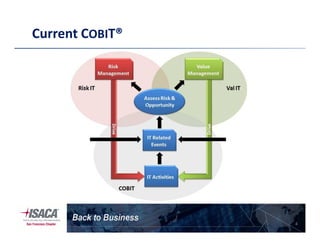
Current COBIT®
4
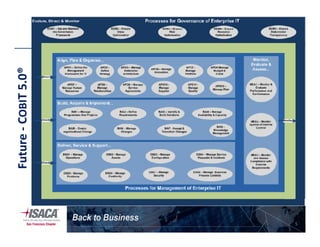
COBIT5.0®Future-C
5
Why implement COBIT?
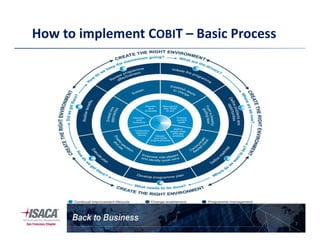
How to implement COBIT – Basic Process
7
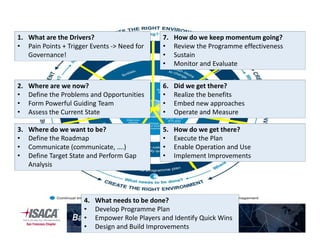
1. What are the Drivers?
• Pain Points + Trigger Events -> Need for
Governance!
2. Where are we now?
• Define the Problems and Opportunities
• Form Powerful Guiding Team
• Assess the Current State
6. Did we get there?
• Realize the benefits
• Embed new approaches
• Operate and Measure
7. How do we keep momentum going?
• Review the Programme effectiveness
• Sustain
• Monitor and Evaluate
8
4. What needs to be done?
• Develop Programme Plan
• Empower Role Players and Identify Quick Wins
• Design and Build Improvements
5. How do we get there?
• Execute the Plan
• Enable Operation and Use
• Implement Improvements
3. Where do we want to be?
• Define the Roadmap
• Communicate (communicate, ….)
• Define Target State and Perform Gap
Analysis
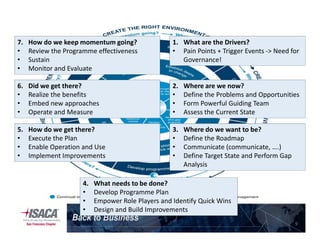
1. What are the Drivers?
• Pain Points + Trigger Events -> Need for
Governance!
2. Where are we now?
• Define the Problems and Opportunities
• Form Powerful Guiding Team
• Assess the Current State
6. Did we get there?
• Realize the benefits
• Embed new approaches
• Operate and Measure
7. How do we keep momentum going?
• Review the Programme effectiveness
• Sustain
• Monitor and Evaluate
9
3. Where do we want to be?
• Define the Roadmap
• Communicate (communicate, ….)
• Define Target State and Perform Gap
Analysis
4. What needs to be done?
• Develop Programme Plan
• Empower Role Players and Identify Quick Wins
• Design and Build Improvements
5. How do we get there?
• Execute the Plan
• Enable Operation and Use
• Implement Improvements
Lessons Learned
Success Factors
RisksRisks
10
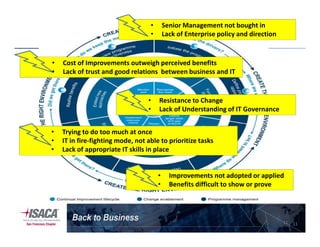
• Senior Management not bought in
• Lack of Enterprise policy and direction
• Cost of Improvements outweigh perceived benefits
• Lack of trust and good relations between business and IT
• Resistance to Change
• Lack of Understanding of IT Governance
1111
• Trying to do too much at once
• IT in fire-fighting mode, not able to prioritize tasks
• Lack of appropriate IT skills in place
• Improvements not adopted or applied
• Benefits difficult to show or prove
Lessons Learned: Deal with the People
• Must assure that people in the organization
adopt, use and sustain the practices
• People, employing the practices, generate the
benefits to the organization
• Must understand, communicate, influence• Must understand, communicate, influence
and persuade people with the case for change
• Failure to establish a measurable target
12
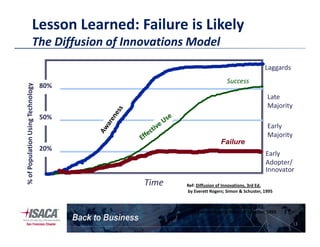
Lesson Learned: Failure is Likely
The Diffusion of Innovations Model
Laggards
Late
Majority
Early
Success
%ofPopulationUsingTechnology
50%
80%
13
Ref: Diffusion of Innovations, 3rd Ed.
by Everett Rogers; Simon & Schuster, 1995
Early
Majority
Innovator
Early
Adopter/
%ofPopulationUsingTechnology
Time
20%
Failure
Ref: Diffusion of Innovations, 3rd Ed.
by Everett Rogers; Simon & Schuster, 1995
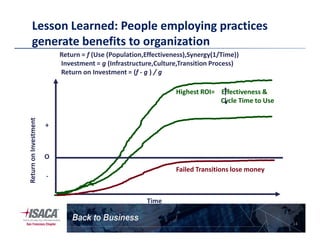
Lesson Learned: People employing practices
generate benefits to organization
Highest ROI= Effectiveness &
Cycle Time to Use
Return = f (Use (Population,Effectiveness),Synergy(1/Time))
Investment = g (Infrastructure,Culture,Transition Process)
Return on Investment = (f - g ) / g
ReturnonInvestment
+
14
ReturnonInvestment
Time
+
-
O
Failed Transitions lose money
Lesson Learned: Improvements not sustained
SMART Implementation Goal:
• At least 80% of the target users in the
organization effectively & efficiently use the
improvement.
• There is evidence of sustained use and• There is evidence of sustained use and
improving effectiveness and efficiency.
• The organization has measurable results.
• People new to the organization, are told
what to do and learn how to do it.
15
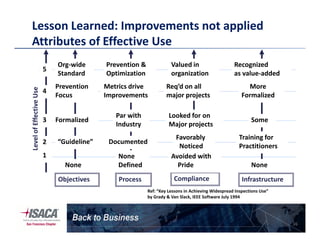
Lesson Learned: Improvements not applied
Attributes of Effective Use
3
4
5
LevelofEffectiveUse
Formalized
Prevention
Focus
Org-wide
Standard
Looked for on
Major projects
Req’d on all
major projects
Valued in
organization
Par with
Industry
Prevention &
Optimization
Some
More
Formalized
Recognized
as value-added
Metrics drive
Improvements
16
Ref: “Key Lessons in Achieving Widespread Inspections Use”
by Grady & Van Slack, IEEE Software July 1994
Objectives ComplianceProcess Infrastructure
1
2
3
LevelofEffectiveUse
None
Formalized
“Guideline”
Major projects
Avoided with
Pride
Favorably
Noticed
None
Defined
Industry
None
Training for
Practitioners
Some
Documented
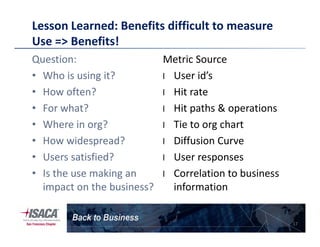
Lesson Learned: Benefits difficult to measure
Use => Benefits!
Question:
• Who is using it?
• How often?
• For what?
• Where in org?
Metric Source
l User id’s
l Hit rate
l Hit paths & operations
l Tie to org chart
17
• Where in org?
• How widespread?
• Users satisfied?
• Is the use making an
impact on the business?
l Tie to org chart
l Diffusion Curve
l User responses
l Correlation to business
information
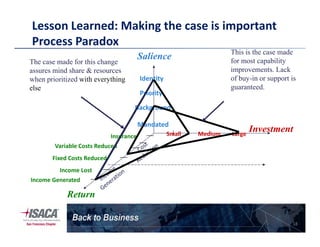
Lesson Learned: Making the case is important
Process Paradox
Salience
Investment
Mandated
Background
Priority
Identity
The case made for this change
assures mind share & resources
when prioritized with everything
else
This is the case made
for most capability
improvements. Lack
of buy-in or support is
guaranteed.
18
Return
Investment
Mandated
Income Generated
Income Lost
Fixed Costs Reduced
Variable Costs Reduced
Insurance Small Medium Large
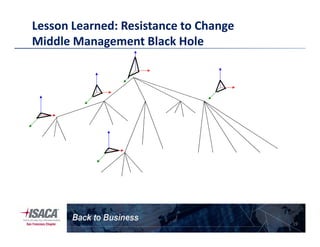
Lesson Learned: Resistance to Change
Middle Management Black Hole
19
Implementation follow-through in organization:
Development->Test->Production (Service Delivery)
• Each must be resourced and managed.
• Who has what accountability and responsibility for
sustaining or service delivery activities in the COBIT
implementation?
• How do you assure the implementation is sustained• How do you assure the implementation is sustained
through re-orgs?
• What is the SLA/OLA’s for delivering the IT
Governance service?
• How are sustaining / service delivery functions
resourced or financed?
20
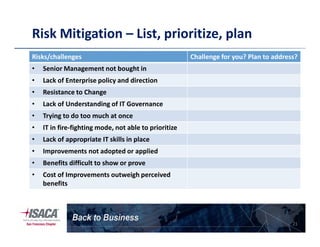
Risk Mitigation – List, prioritize, plan
Risks/challenges Challenge for you? Plan to address?
• Senior Management not bought in
• Lack of Enterprise policy and direction
• Resistance to Change
• Lack of Understanding of IT Governance
• Trying to do too much at once
• IT in fire-fighting mode, not able to prioritize• IT in fire-fighting mode, not able to prioritize
• Lack of appropriate IT skills in place
• Improvements not adopted or applied
• Benefits difficult to show or prove
• Cost of Improvements outweigh perceived
benefits
21
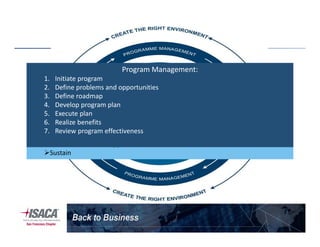
Change Enablement:
Based on Cotter Model
Establish a sense of urgency
Form a powerful guiding coalition
Create and communicate a clear vision, expressed simply
Empower others to act on the vision, identifying and implementing quick-wins
Program Management:
1. Initiate program
2. Define problems and opportunities
3. Define roadmap
4. Develop program plan
5. Execute plan
6. Realize benefits
Empower others to act on the vision, identifying and implementing quick-wins
Enable use and implement improvements/produce more change
Institutionalize new approaches
Sustain
6. Realize benefits
7. Review program effectiveness
Adapting these to your organization
Please take 10 minutes to discuss amongst yourselves:
• Your role?
• What implementation phase to start at?
• What’s your target (big Why)?
• What risks need to be managed?
• What methods to use?
• What resourcing approach?
23
Discussion Report outDiscussion Report out
24
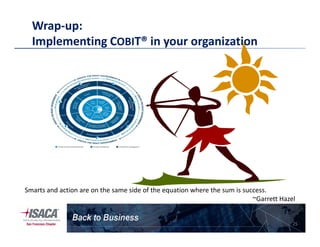
Wrap-up:
Implementing COBIT® in your organization
25
Smarts and action are on the same side of the equation where the sum is success.
~Garrett Hazel
Speaker Contact Information
Debra Mallette, CGEIT, CISA, CSSBB
4460 Hacienda Dr, Building F -1039
Pleasanton, CA 94588-2761
Office Phone: 925 924 5123
26
Office Phone: 925 924 5123
Cell: 510-295-3217
debra.mallette@kp.org

Implement cobit in your organization

  • 1.
    Session S12 Implementing COBIT®in your OrganizationOrganization by Debra Mallette, CISA, CGEIT, CSSBB
  • 2.
    Implementing COBIT® inyour organization • Implementing COBIT Program: – Organizational Change – IT Governance Program – Iterative approach to implementation • Learning Objectives: – definitions and context – basic process – lessons learned– lessons learned – success factors – risk mitigation – how to adapt these for your organization. • Pre-requisites: – "COBIT Foundation Certificate" – familiarity with ValIT and RiskIT 2
  • 3.
    Why are youhere (in this session)? • Assignment? • Champion? • Career Advancement? • Curiosity?• Curiosity? • All of the above? • Other? 3
  • 4.
  • 5.
  • 6.
  • 7.
    How to implementCOBIT – Basic Process 7
  • 8.
    1. What arethe Drivers? • Pain Points + Trigger Events -> Need for Governance! 2. Where are we now? • Define the Problems and Opportunities • Form Powerful Guiding Team • Assess the Current State 6. Did we get there? • Realize the benefits • Embed new approaches • Operate and Measure 7. How do we keep momentum going? • Review the Programme effectiveness • Sustain • Monitor and Evaluate 8 4. What needs to be done? • Develop Programme Plan • Empower Role Players and Identify Quick Wins • Design and Build Improvements 5. How do we get there? • Execute the Plan • Enable Operation and Use • Implement Improvements 3. Where do we want to be? • Define the Roadmap • Communicate (communicate, ….) • Define Target State and Perform Gap Analysis
  • 9.
    1. What arethe Drivers? • Pain Points + Trigger Events -> Need for Governance! 2. Where are we now? • Define the Problems and Opportunities • Form Powerful Guiding Team • Assess the Current State 6. Did we get there? • Realize the benefits • Embed new approaches • Operate and Measure 7. How do we keep momentum going? • Review the Programme effectiveness • Sustain • Monitor and Evaluate 9 3. Where do we want to be? • Define the Roadmap • Communicate (communicate, ….) • Define Target State and Perform Gap Analysis 4. What needs to be done? • Develop Programme Plan • Empower Role Players and Identify Quick Wins • Design and Build Improvements 5. How do we get there? • Execute the Plan • Enable Operation and Use • Implement Improvements
  • 10.
  • 11.
    • Senior Managementnot bought in • Lack of Enterprise policy and direction • Cost of Improvements outweigh perceived benefits • Lack of trust and good relations between business and IT • Resistance to Change • Lack of Understanding of IT Governance 1111 • Trying to do too much at once • IT in fire-fighting mode, not able to prioritize tasks • Lack of appropriate IT skills in place • Improvements not adopted or applied • Benefits difficult to show or prove
  • 12.
    Lessons Learned: Dealwith the People • Must assure that people in the organization adopt, use and sustain the practices • People, employing the practices, generate the benefits to the organization • Must understand, communicate, influence• Must understand, communicate, influence and persuade people with the case for change • Failure to establish a measurable target 12
  • 13.
    Lesson Learned: Failureis Likely The Diffusion of Innovations Model Laggards Late Majority Early Success %ofPopulationUsingTechnology 50% 80% 13 Ref: Diffusion of Innovations, 3rd Ed. by Everett Rogers; Simon & Schuster, 1995 Early Majority Innovator Early Adopter/ %ofPopulationUsingTechnology Time 20% Failure Ref: Diffusion of Innovations, 3rd Ed. by Everett Rogers; Simon & Schuster, 1995
  • 14.
    Lesson Learned: Peopleemploying practices generate benefits to organization Highest ROI= Effectiveness & Cycle Time to Use Return = f (Use (Population,Effectiveness),Synergy(1/Time)) Investment = g (Infrastructure,Culture,Transition Process) Return on Investment = (f - g ) / g ReturnonInvestment + 14 ReturnonInvestment Time + - O Failed Transitions lose money
  • 15.
    Lesson Learned: Improvementsnot sustained SMART Implementation Goal: • At least 80% of the target users in the organization effectively & efficiently use the improvement. • There is evidence of sustained use and• There is evidence of sustained use and improving effectiveness and efficiency. • The organization has measurable results. • People new to the organization, are told what to do and learn how to do it. 15
  • 16.
    Lesson Learned: Improvementsnot applied Attributes of Effective Use 3 4 5 LevelofEffectiveUse Formalized Prevention Focus Org-wide Standard Looked for on Major projects Req’d on all major projects Valued in organization Par with Industry Prevention & Optimization Some More Formalized Recognized as value-added Metrics drive Improvements 16 Ref: “Key Lessons in Achieving Widespread Inspections Use” by Grady & Van Slack, IEEE Software July 1994 Objectives ComplianceProcess Infrastructure 1 2 3 LevelofEffectiveUse None Formalized “Guideline” Major projects Avoided with Pride Favorably Noticed None Defined Industry None Training for Practitioners Some Documented
  • 17.
    Lesson Learned: Benefitsdifficult to measure Use => Benefits! Question: • Who is using it? • How often? • For what? • Where in org? Metric Source l User id’s l Hit rate l Hit paths & operations l Tie to org chart 17 • Where in org? • How widespread? • Users satisfied? • Is the use making an impact on the business? l Tie to org chart l Diffusion Curve l User responses l Correlation to business information
  • 18.
    Lesson Learned: Makingthe case is important Process Paradox Salience Investment Mandated Background Priority Identity The case made for this change assures mind share & resources when prioritized with everything else This is the case made for most capability improvements. Lack of buy-in or support is guaranteed. 18 Return Investment Mandated Income Generated Income Lost Fixed Costs Reduced Variable Costs Reduced Insurance Small Medium Large
  • 19.
    Lesson Learned: Resistanceto Change Middle Management Black Hole 19
  • 20.
    Implementation follow-through inorganization: Development->Test->Production (Service Delivery) • Each must be resourced and managed. • Who has what accountability and responsibility for sustaining or service delivery activities in the COBIT implementation? • How do you assure the implementation is sustained• How do you assure the implementation is sustained through re-orgs? • What is the SLA/OLA’s for delivering the IT Governance service? • How are sustaining / service delivery functions resourced or financed? 20
  • 21.
    Risk Mitigation –List, prioritize, plan Risks/challenges Challenge for you? Plan to address? • Senior Management not bought in • Lack of Enterprise policy and direction • Resistance to Change • Lack of Understanding of IT Governance • Trying to do too much at once • IT in fire-fighting mode, not able to prioritize• IT in fire-fighting mode, not able to prioritize • Lack of appropriate IT skills in place • Improvements not adopted or applied • Benefits difficult to show or prove • Cost of Improvements outweigh perceived benefits 21
  • 22.
    Change Enablement: Based onCotter Model Establish a sense of urgency Form a powerful guiding coalition Create and communicate a clear vision, expressed simply Empower others to act on the vision, identifying and implementing quick-wins Program Management: 1. Initiate program 2. Define problems and opportunities 3. Define roadmap 4. Develop program plan 5. Execute plan 6. Realize benefits Empower others to act on the vision, identifying and implementing quick-wins Enable use and implement improvements/produce more change Institutionalize new approaches Sustain 6. Realize benefits 7. Review program effectiveness
  • 23.
    Adapting these toyour organization Please take 10 minutes to discuss amongst yourselves: • Your role? • What implementation phase to start at? • What’s your target (big Why)? • What risks need to be managed? • What methods to use? • What resourcing approach? 23
  • 24.
  • 25.
    Wrap-up: Implementing COBIT® inyour organization 25 Smarts and action are on the same side of the equation where the sum is success. ~Garrett Hazel
  • 26.
    Speaker Contact Information DebraMallette, CGEIT, CISA, CSSBB 4460 Hacienda Dr, Building F -1039 Pleasanton, CA 94588-2761 Office Phone: 925 924 5123 26 Office Phone: 925 924 5123 Cell: 510-295-3217 debra.mallette@kp.org