Training Reference Material
IT Service Management
according to ISO/IEC 20000
2


Welcome & Administration


     •   Structure of the training
     •   ISO/IEC 20000 certification and course outline
     •   Examination format
     •   Agenda
3


Structure of the training

             • Welcome & Administration
             • Introduction to IT Service Management
             • Content of ISO/IEC 20000, section 1-5 - basics


                                                                     Content of ISO/IEC 20000-1
                                                                       and ISO/IEC 20000-2
                 Scope
                 Terms and definitions
                 Requirements for a management system
                 Planning and implementing service management
                 Planning and implementing new or changed services
             • Content of ISO/IEC 20000, section 6-10 – IT
                Service Management Processes:
                 Resolution Process
                 Control Process
                 Release Process
                 Service Delivery Process
                 Relationship Process
             • Classification and Preview
                 ISO/IEC 20000 certification
                 Related practices and standards
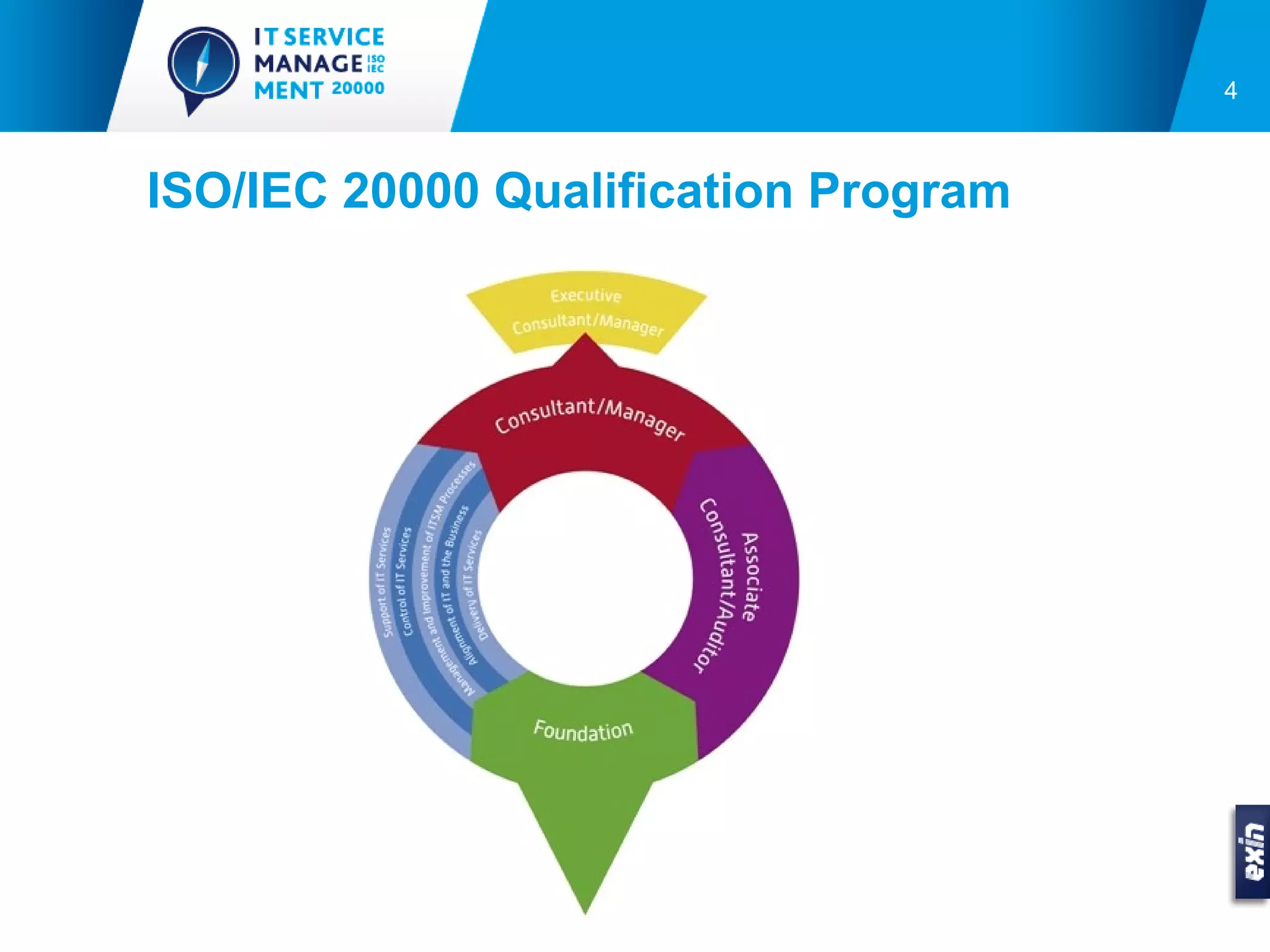
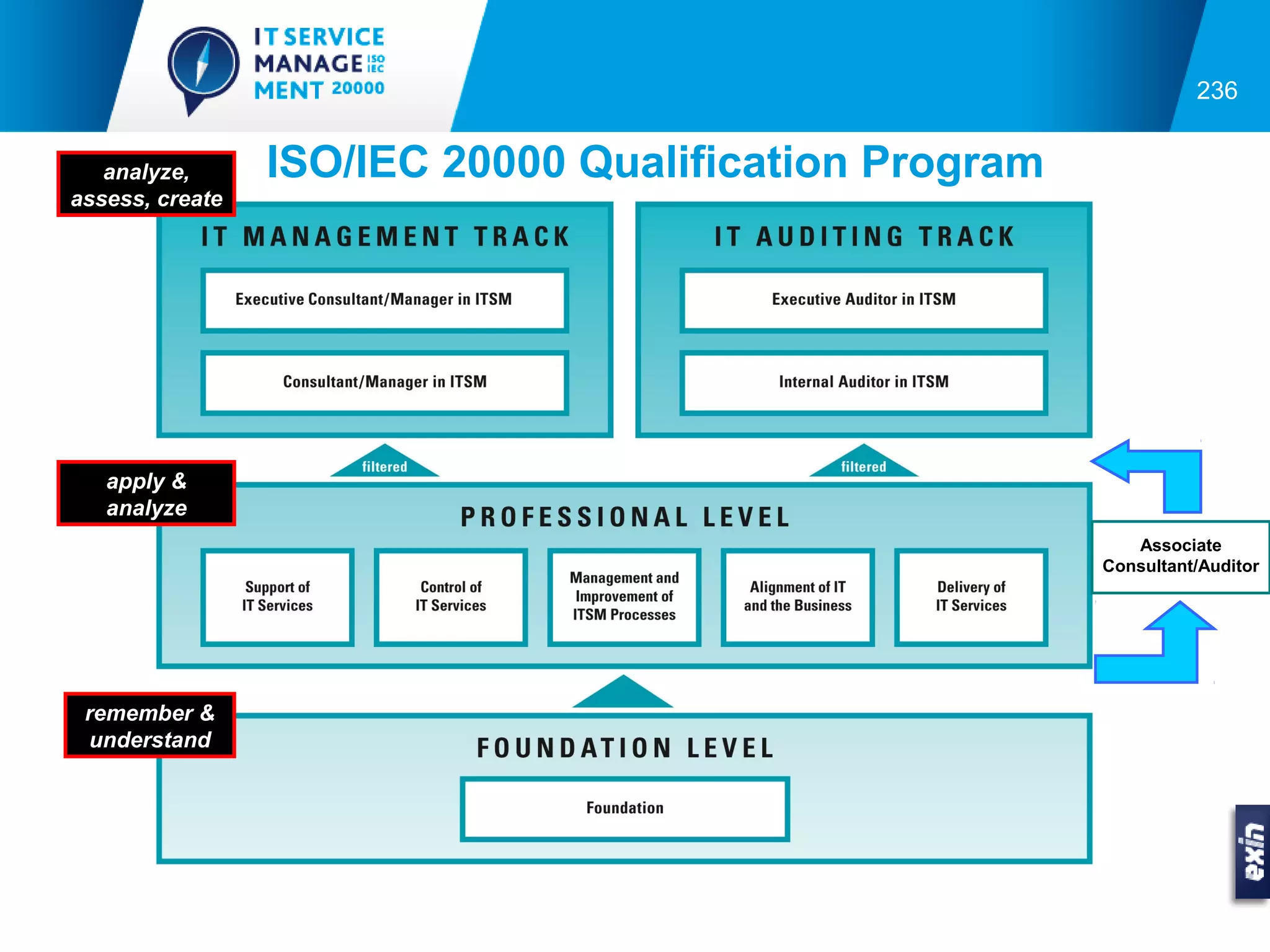
                 ISO/IEC 20000 Qualification Program
4


ISO/IEC 20000 Qualification Program
5


         Examination Format
Already available in English, Dutch, French,
 Portuguese, Japanese, Chinese, German, Italian,
 Latin-American Spanish and European Spanish.
This is a closed book exam. No materials are permitted
 in the examination room.
Duration: 1 hour
Number of questions: 40
Multiple-choice with
   four options: A, B, C or D and
   a single answer
Score minimum of 65 percent (26 of 40) to pass the
 exam.
6


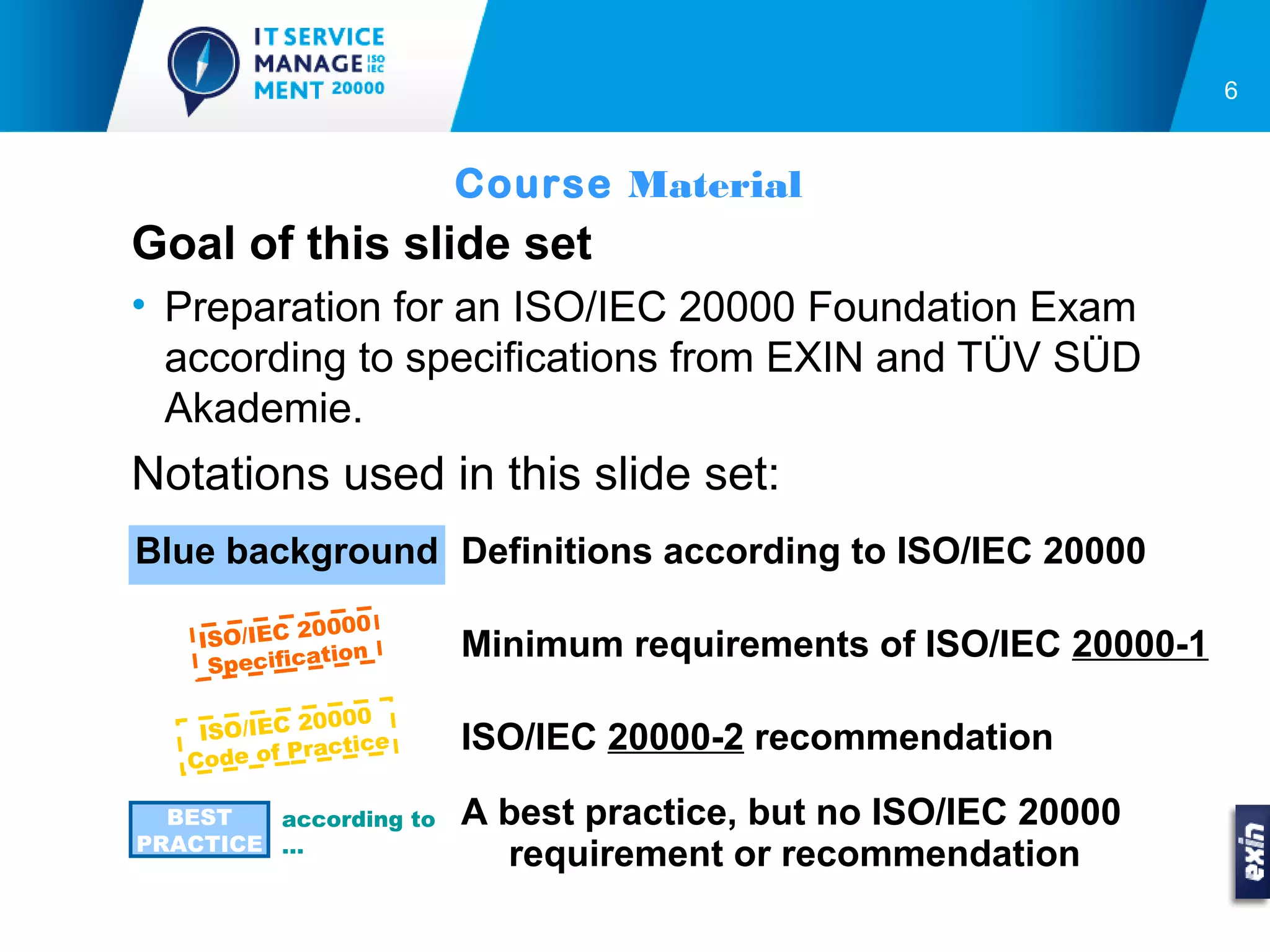
                        Course Material
Goal of this slide set
• Preparation for an ISO/IEC 20000 Foundation Exam
  according to specifications from EXIN and TÜV SÜD
  Akademie.
Notations used in this slide set:
Blue background Definitions according to ISO/IEC 20000
             0000
    ISO/IEC 2           Minimum requirements of ISO/IEC 20000-1
               tion
     Specifica

              0000
    ISO/IEC 2           ISO/IEC 20000-2 recommendation
               actice
   C ode of Pr

  BEST   according to   A best practice, but no ISO/IEC 20000
PRACTICE …
                          requirement or recommendation
7


  Introduction to IT Service
        Management

              • Motivation of process-oriented IT Service Management
              • Background, History
              • Basic principles


Check all IT Service Management Trainings conducted by Simplilearn.com
8


      Learning target of this section
• IT Services and their elements (1.2.1, 1.2.2)
• IT Service Management: Concept, Benefit, Risks
  (1.3.1, 1.3.2)
• Process orientation: Concept, Benefit (1.4.1)
• Process control and measurement (1.4.2)
• Roles of IT Service Management (1.4.3)
• Quality, Quality of Service (1.1.1, 1.1.2, 1.2.3)
• Principles of quality management and setup of a
  quality management system (1.1.3)
• ISO/IEC 20000: Purpose, Benefit, History, Owner
  (2.3.1, 2.3.2)
• Groups of processes within ISO/IEC 20000 (2.3.4)
9


       Motivation of Process Orientation
•   Availability is the most essential
    service parameter of enterprise              Application
    services.                                     Failures
•   Availability is determined by
    frequency and duration of service                       Technology
    failure.
•   About 80% of failures are a
                                                  Operator
    consequence of people and process              Errors
    issues.
•   Duration of failures heavily depends
    on non-technical factors.
                                           Causes of service failure
                                                         [Gartner 1999]


            Need for Management of IT Processes!
10


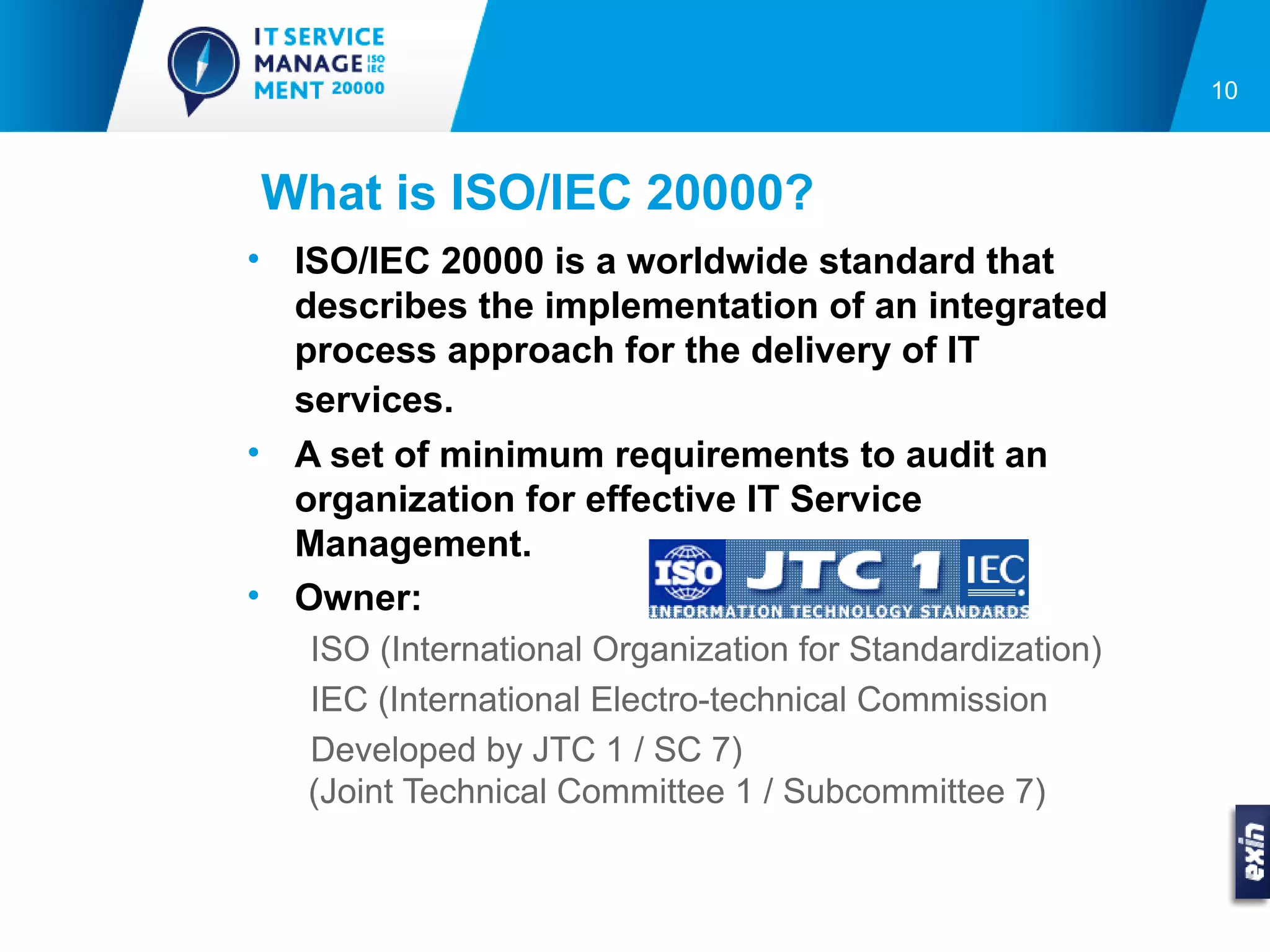
What is ISO/IEC 20000?
• ISO/IEC 20000 is a worldwide standard that
  describes the implementation of an integrated
  process approach for the delivery of IT
  services.
• A set of minimum requirements to audit an
  organization for effective IT Service
  Management.
• Owner:
   ISO (International Organization for Standardization)
   IEC (International Electro-technical Commission
   Developed by JTC 1 / SC 7)
   (Joint Technical Committee 1 / Subcommittee 7)
11


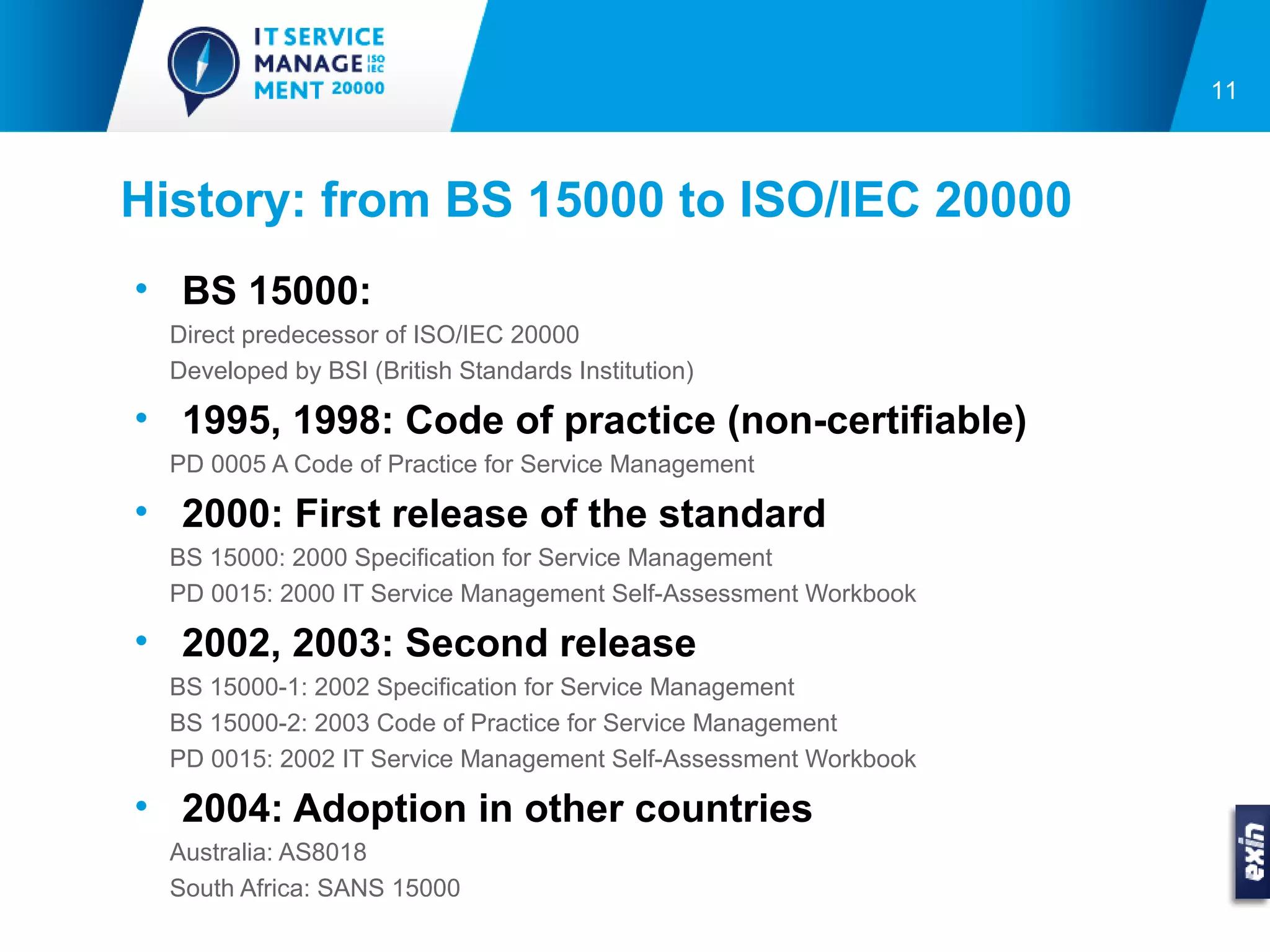
History: from BS 15000 to ISO/IEC 20000
• BS 15000:
  Direct predecessor of ISO/IEC 20000
  Developed by BSI (British Standards Institution)

• 1995, 1998: Code of practice (non-certifiable)
  PD 0005 A Code of Practice for Service Management

• 2000: First release of the standard
  BS 15000: 2000 Specification for Service Management
  PD 0015: 2000 IT Service Management Self-Assessment Workbook

• 2002, 2003: Second release
  BS 15000-1: 2002 Specification for Service Management
  BS 15000-2: 2003 Code of Practice for Service Management
  PD 0015: 2002 IT Service Management Self-Assessment Workbook

• 2004: Adoption in other countries
  Australia: AS8018
  South Africa: SANS 15000
12


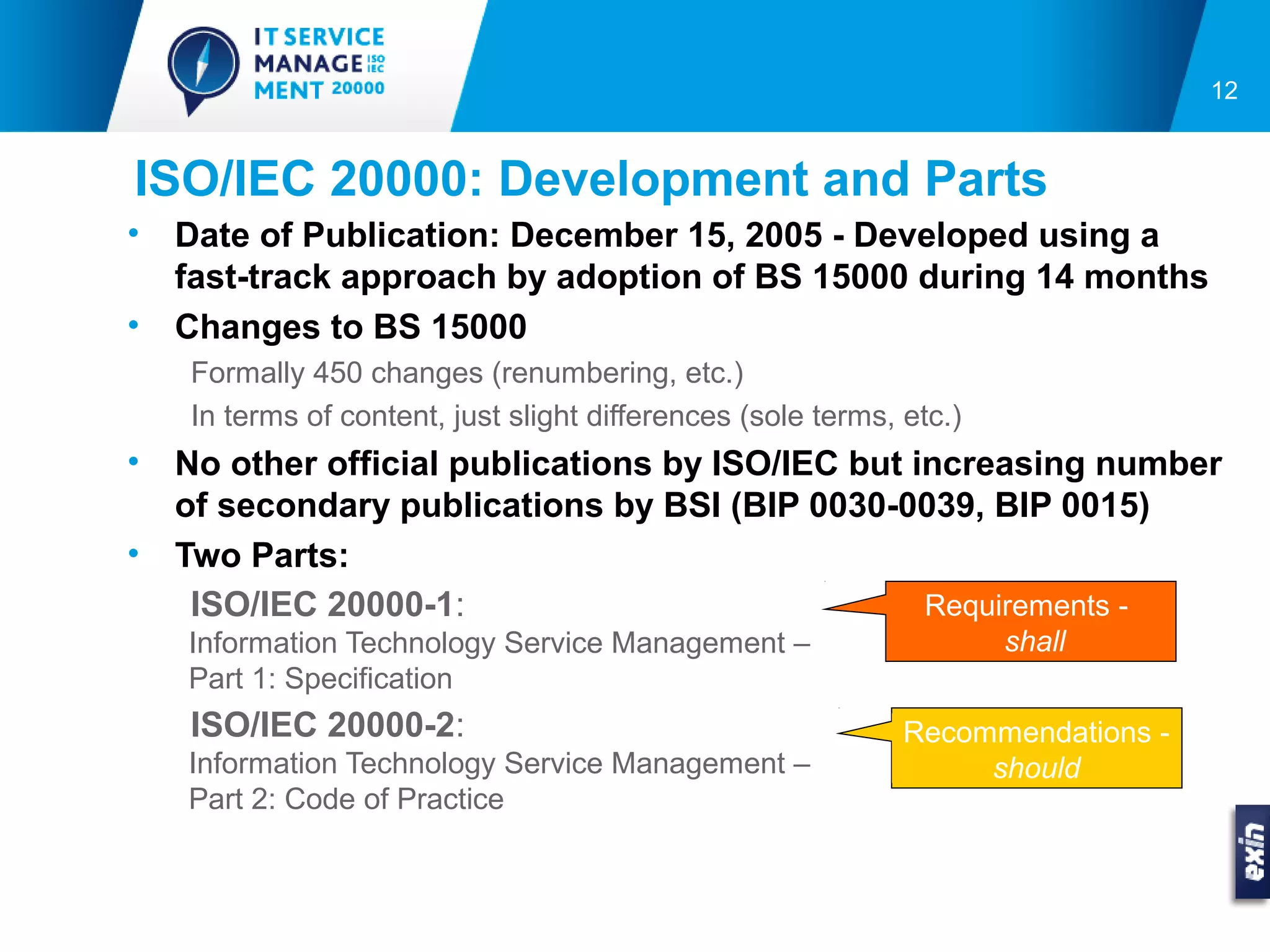
ISO/IEC 20000: Development and Parts
•   Date of Publication: December 15, 2005 - Developed using a
    fast-track approach by adoption of BS 15000 during 14 months
•   Changes to BS 15000
    Formally 450 changes (renumbering, etc.)
    In terms of content, just slight differences (sole terms, etc.)
•   No other official publications by ISO/IEC but increasing number
    of secondary publications by BSI (BIP 0030-0039, BIP 0015)
•   Two Parts:
     ISO/IEC 20000-1:                              Requirements -
    Information Technology Service Management –                       shall
    Part 1: Specification
    ISO/IEC 20000-2:                                          Recommendations -
    Information Technology Service Management –                    should
    Part 2: Code of Practice
13


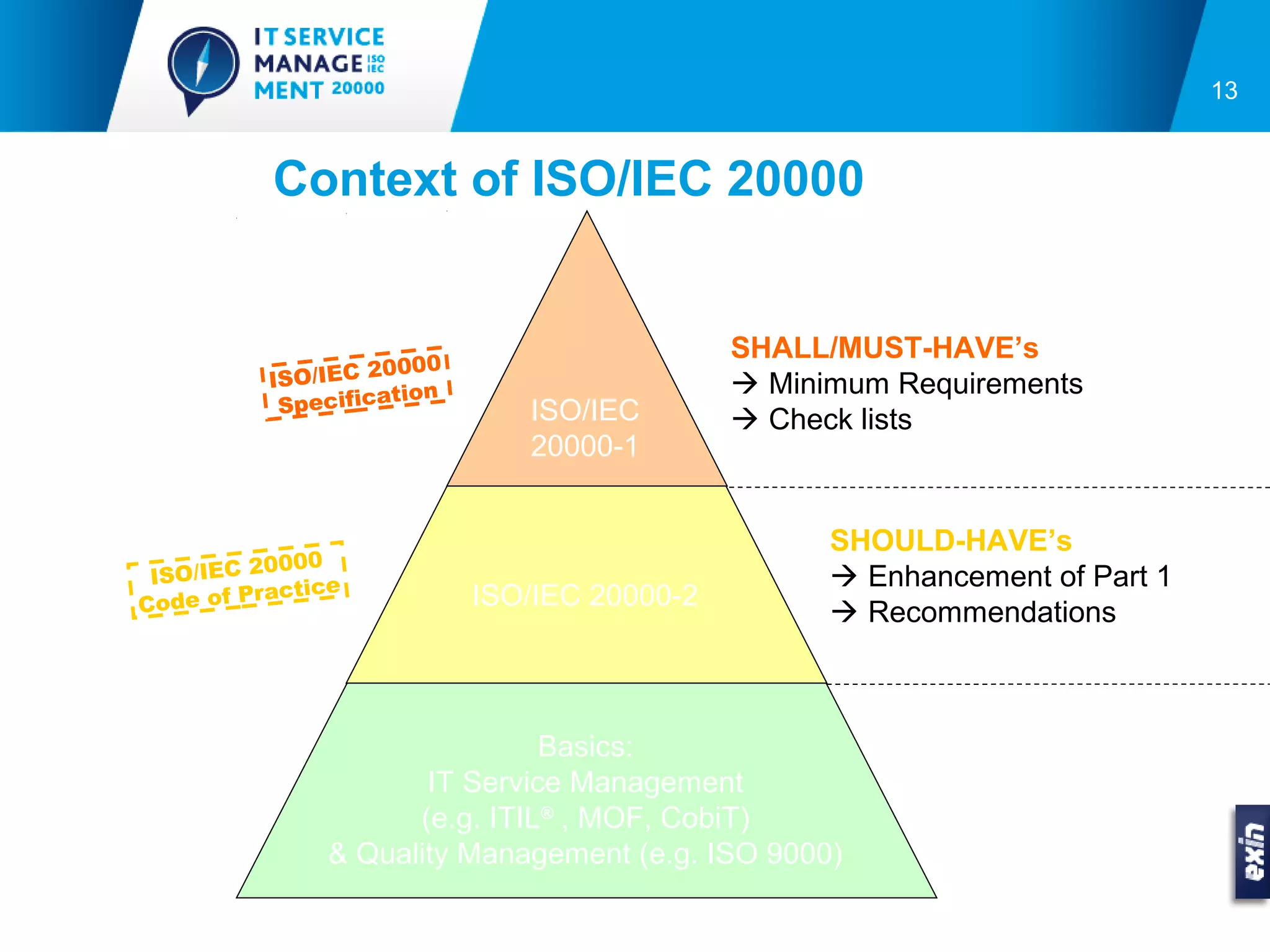
           Context of ISO/IEC 20000


                                             SHALL/MUST-HAVE’s
                      00
          ISO/IEC 200                         Minimum Requirements
                    tion
           Specifica          ISO/IEC         Check lists
                              20000-1


                                                   SHOULD-HAVE’s
           0000
 ISO/IEC 2                                          Enhancement of Part 1
            ctice
Co de of Pra               ISO/IEC 20000-2
                                                    Recommendations


                               Basics:
                      IT Service Management
                     (e.g. ITIL® , MOF, CobiT)
               & Quality Management (e.g. ISO 9000)
14


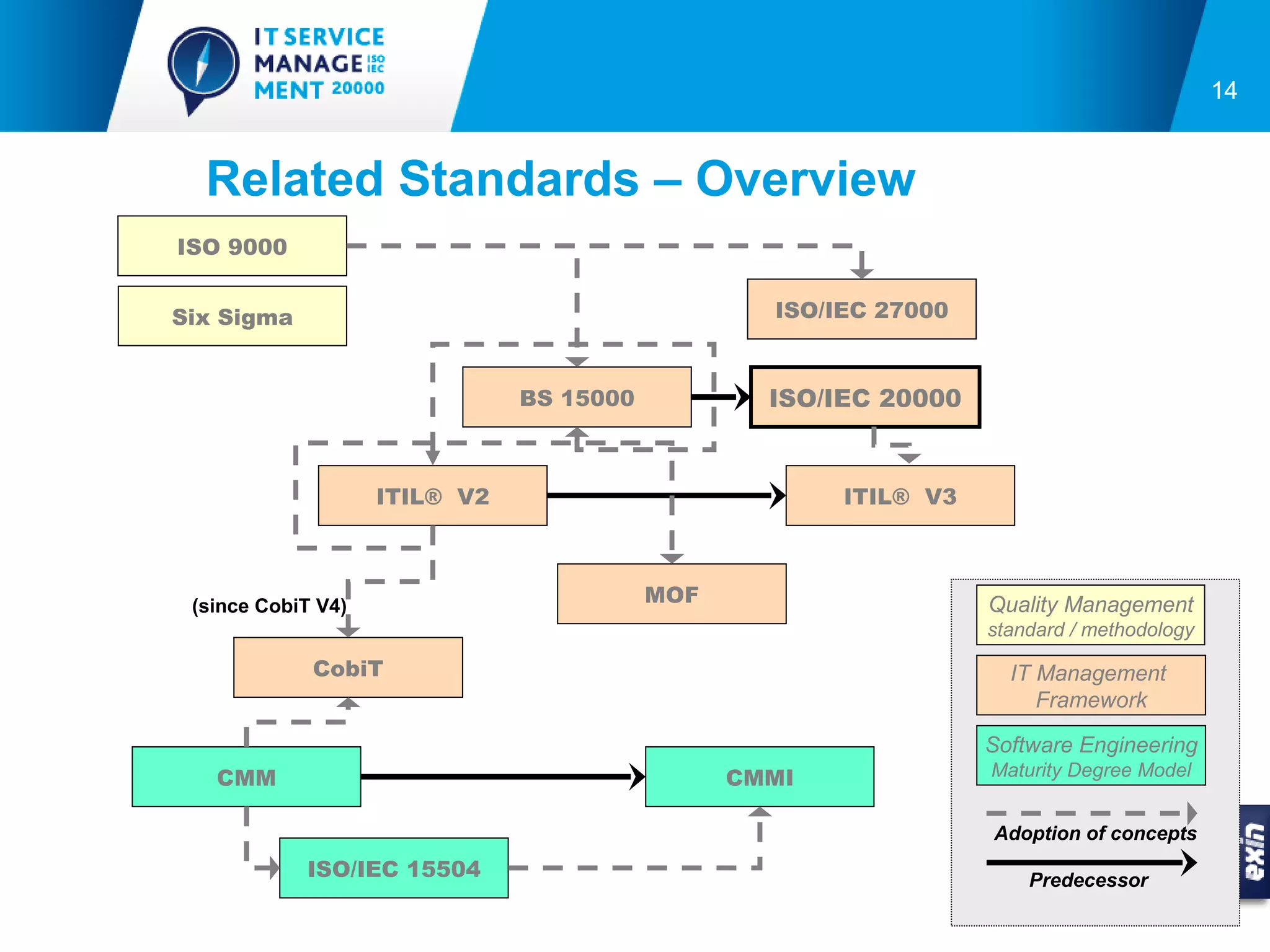
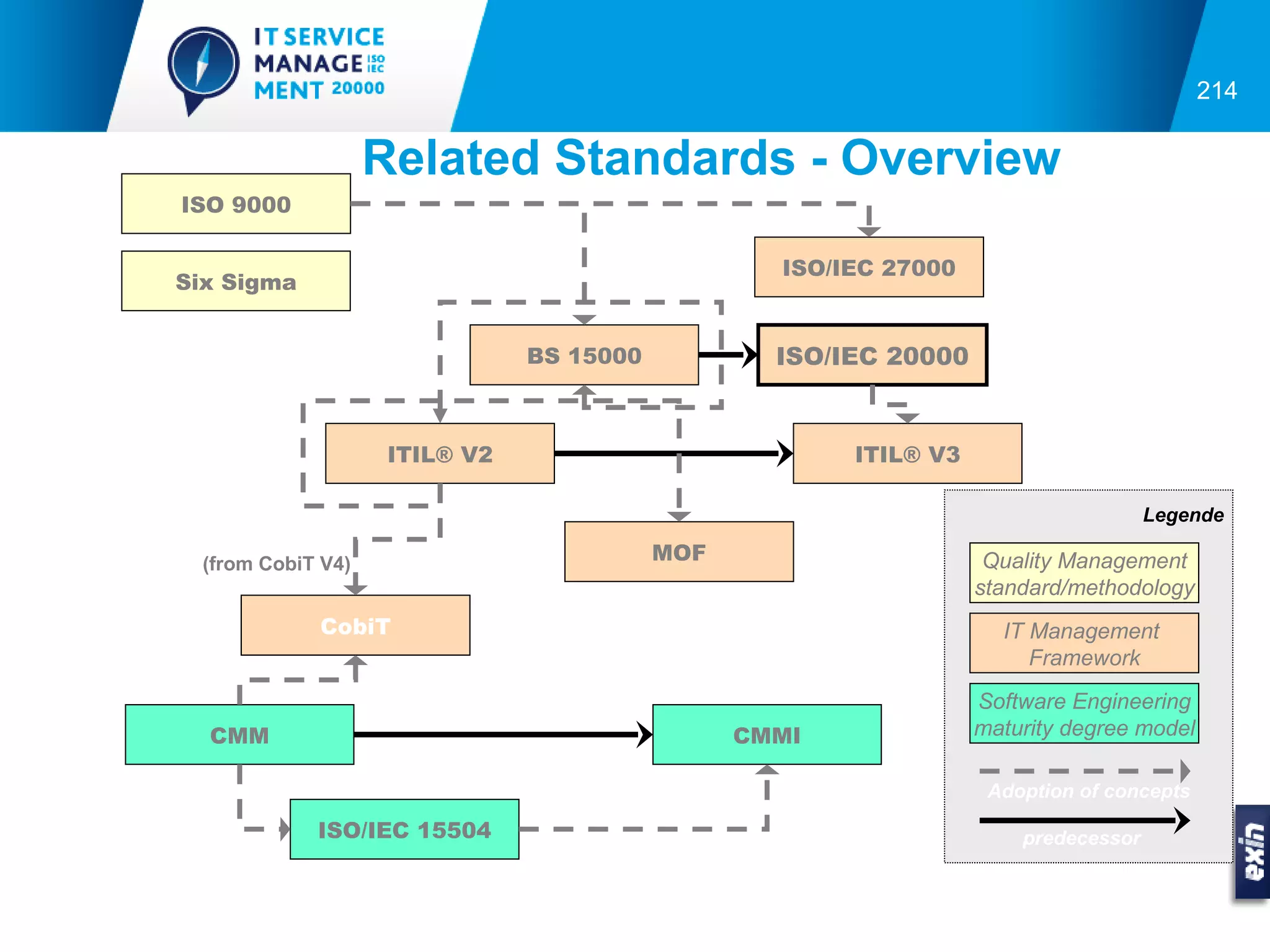
  Related Standards – Overview
ISO 9000


Six Sigma                                         ISO/IEC 27000


                               BS 15000           ISO/IEC 20000


                    ITIL® V2                           ITIL® V3


                                                                                    Legend

 (since CobiT V4)                         MOF                     Quality Management
                                                                  standard / methodology

             CobiT                                                  IT Management
                                                                       Framework

                                                                  Software Engineering
   CMM                                          CMMI              Maturity Degree Model


                                                                  Adoption of concepts
            ISO/IEC 15504                                             Predecessor
15


Basic Principles and Concepts
• Process
    Processes in general
    Business Processes
    IT Processes
•   Service
•   Process Management
•   Process Assessment
•   Quality and Quality Management
16


      What is a Process?
• Hammer, Champy (Reengineering the
  Corporation):
  “A business process is a bundle of activities,
  which requires one or several inputs and which
  creates value for the customer.”
• Office of Government Commerce (ITIL® Version 3):
  “A structured set of Activities designed to
  accomplish a specific Objective. (…)“
• DIN/ISO (ISO 9000):
  “A business process is a collection of interrelated
  resources and activities, that transform inputs
  into outputs. Resources could be personnel,
  buildings, machinery, technology and
  methodology.“
17


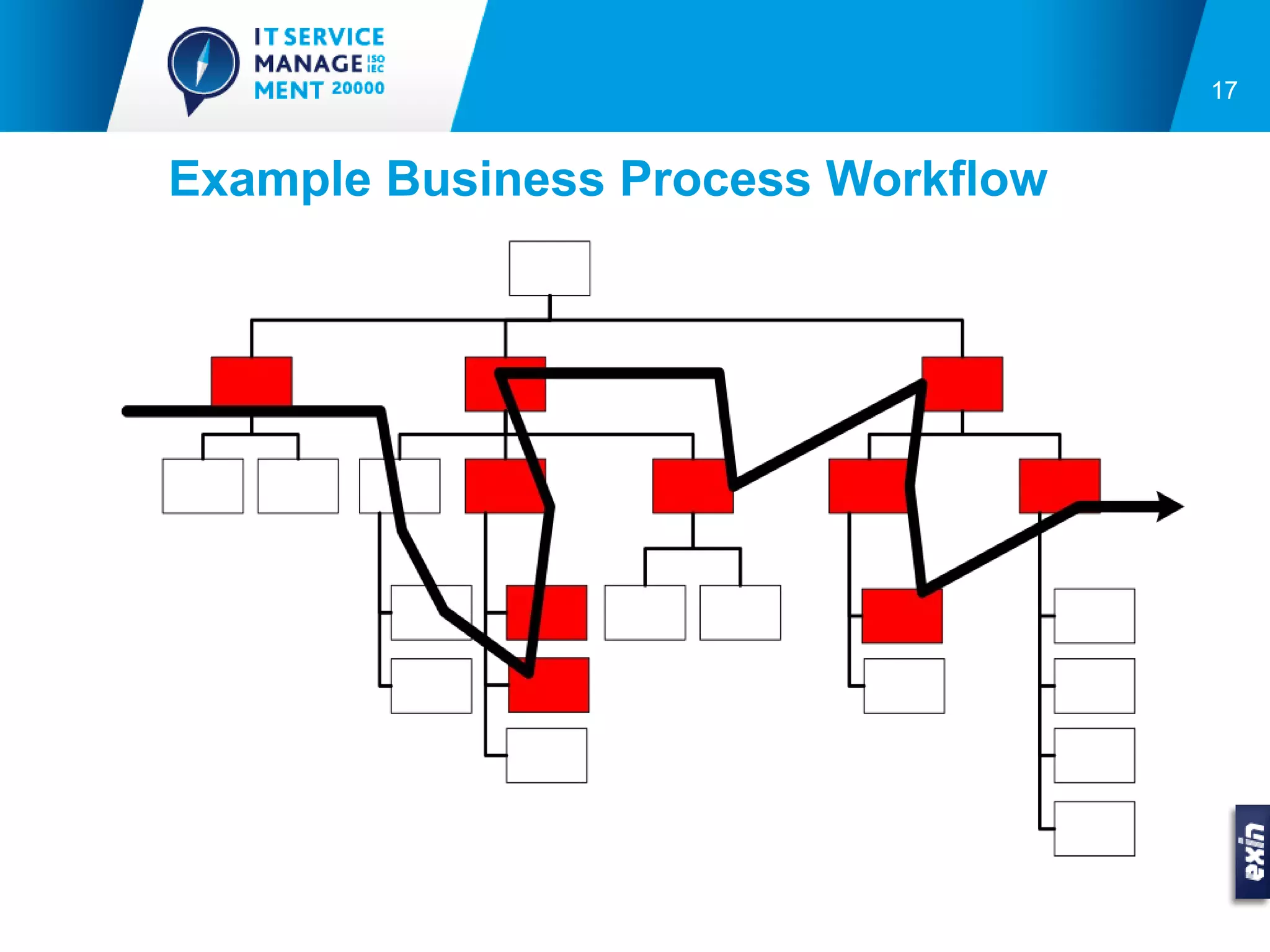
Example Business Process Workflow
18


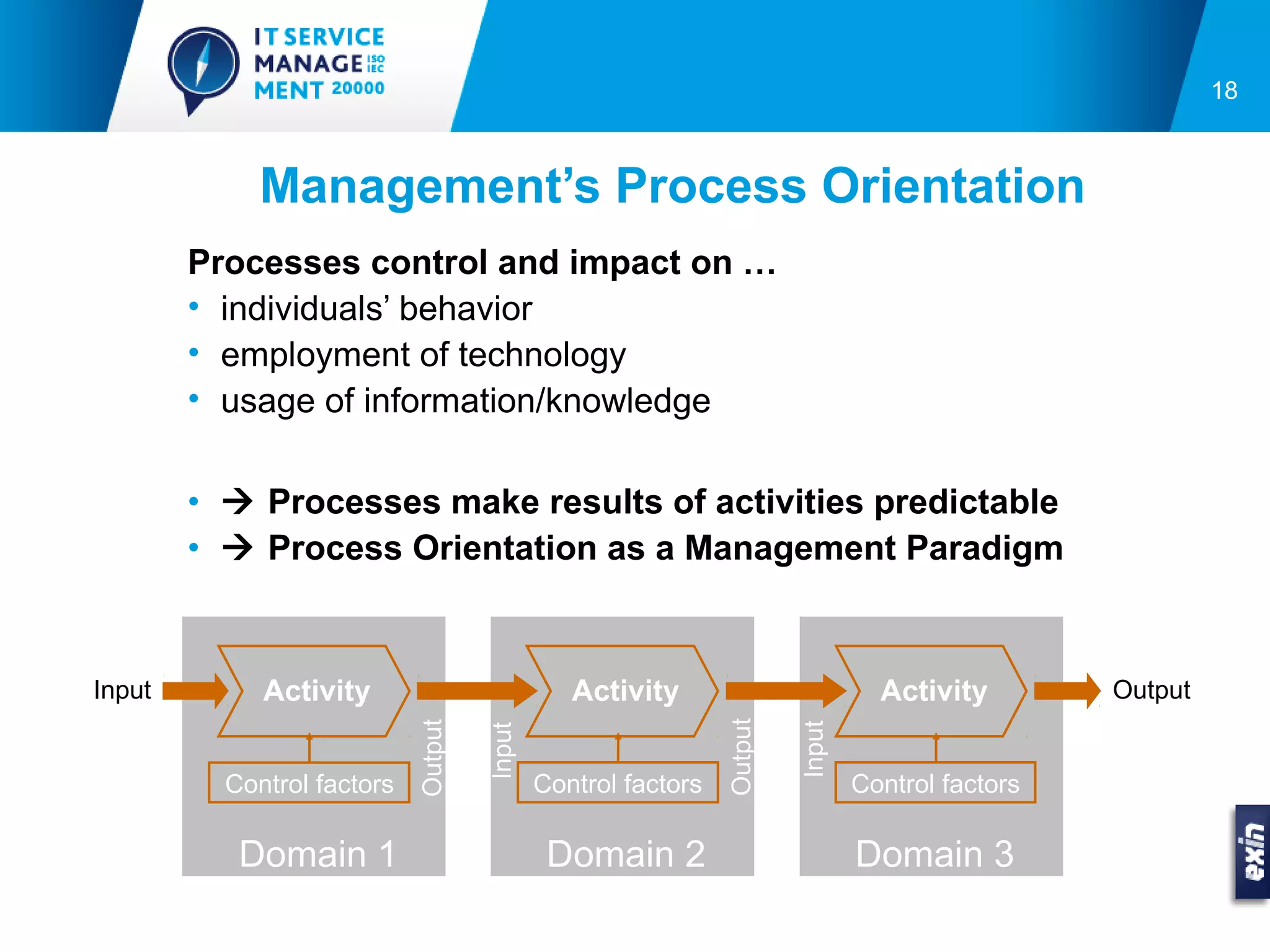
             Management’s Process Orientation
        Processes control and impact on …
        • individuals’ behavior
        • employment of technology
        • usage of information/knowledge

        •  Processes make results of activities predictable
        •  Process Orientation as a Management Paradigm


Input        Activity                           Activity                          Activity        Output
                                                               Output
                            Output


                                                                        Input
                                     Input


          Control factors                    Control factors                    Control factors

           Domain 1                           Domain 2                          Domain 3
19


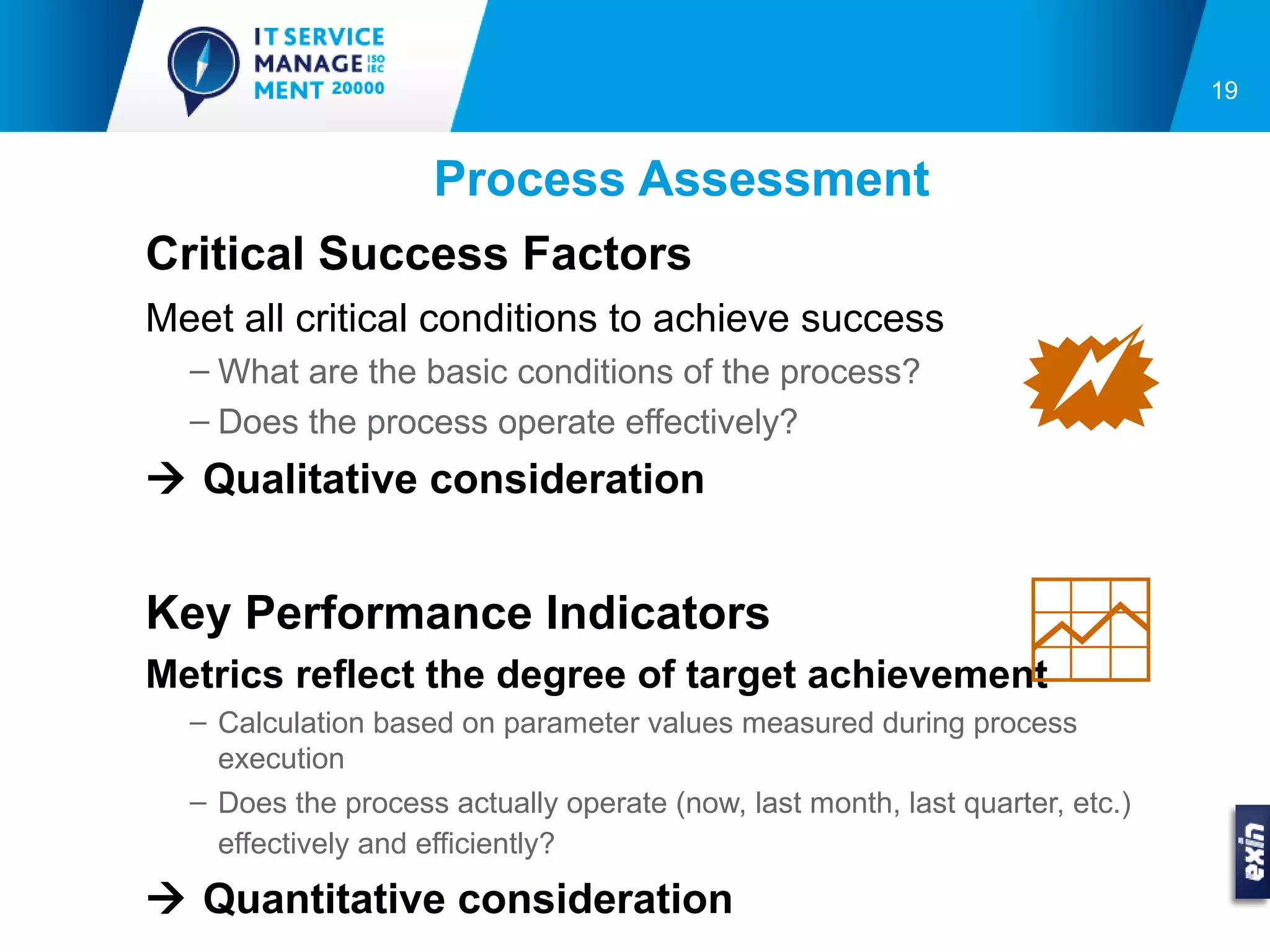
             Process Assessment
Critical Success Factors
Meet all critical conditions to achieve success
  – What are the basic conditions of the process?
  – Does the process operate effectively?
 Qualitative consideration
                                                                  
Key Performance Indicators
Metrics reflect the degree of target achievement                
  – Calculation based on parameter values measured during process
    execution
  – Does the process actually operate (now, last month, last quarter, etc.)
    effectively and efficiently?

 Quantitative consideration
20


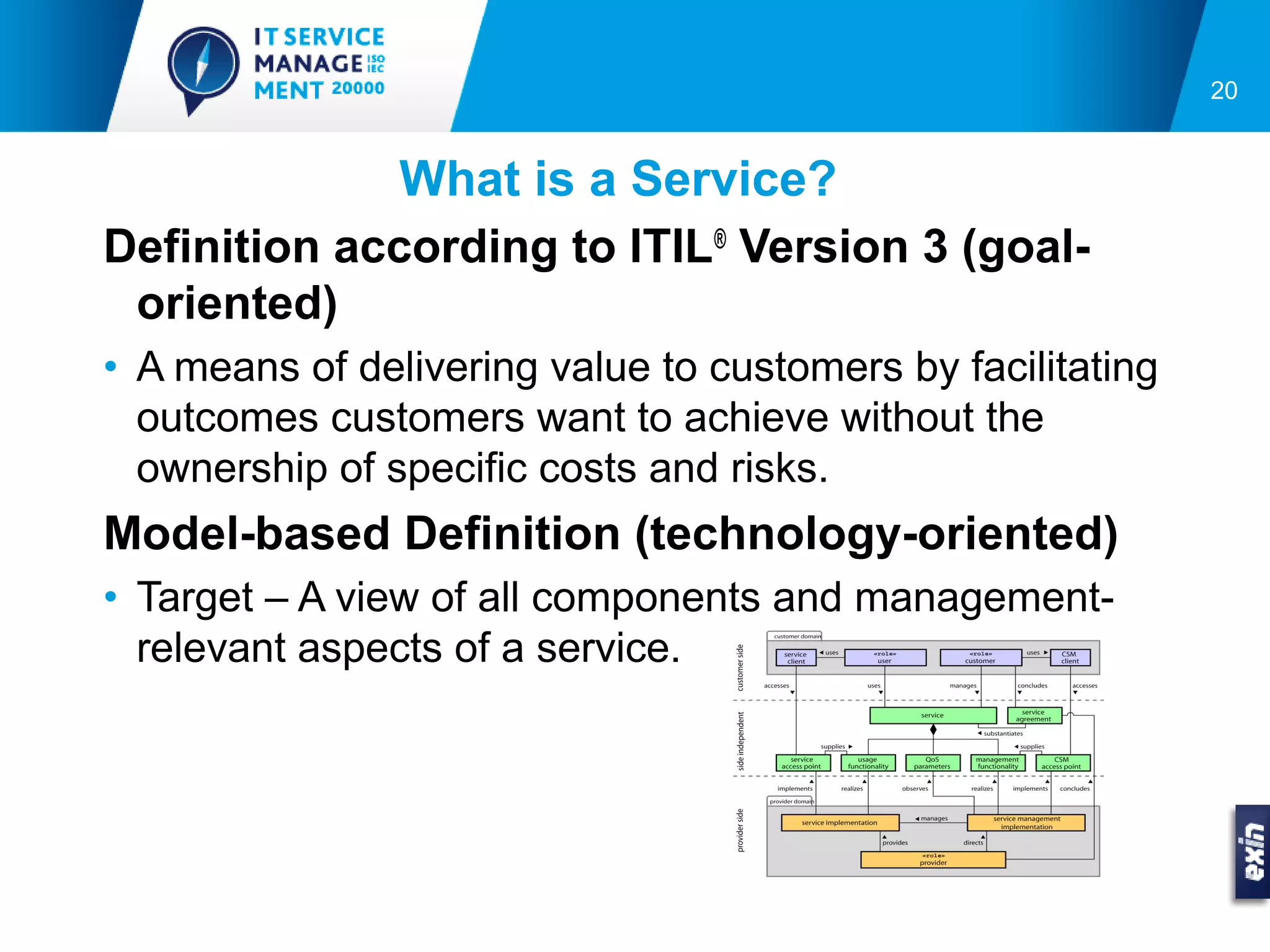
              What is a Service?
Definition according to ITIL® Version 3 (goal-
 oriented)
• A means of delivering value to customers by facilitating
  outcomes customers want to achieve without the
  ownership of specific costs and risks.
Model-based Definition (technology-oriented)
• Target – A view of all components and management-
  relevant aspects of a service.
21


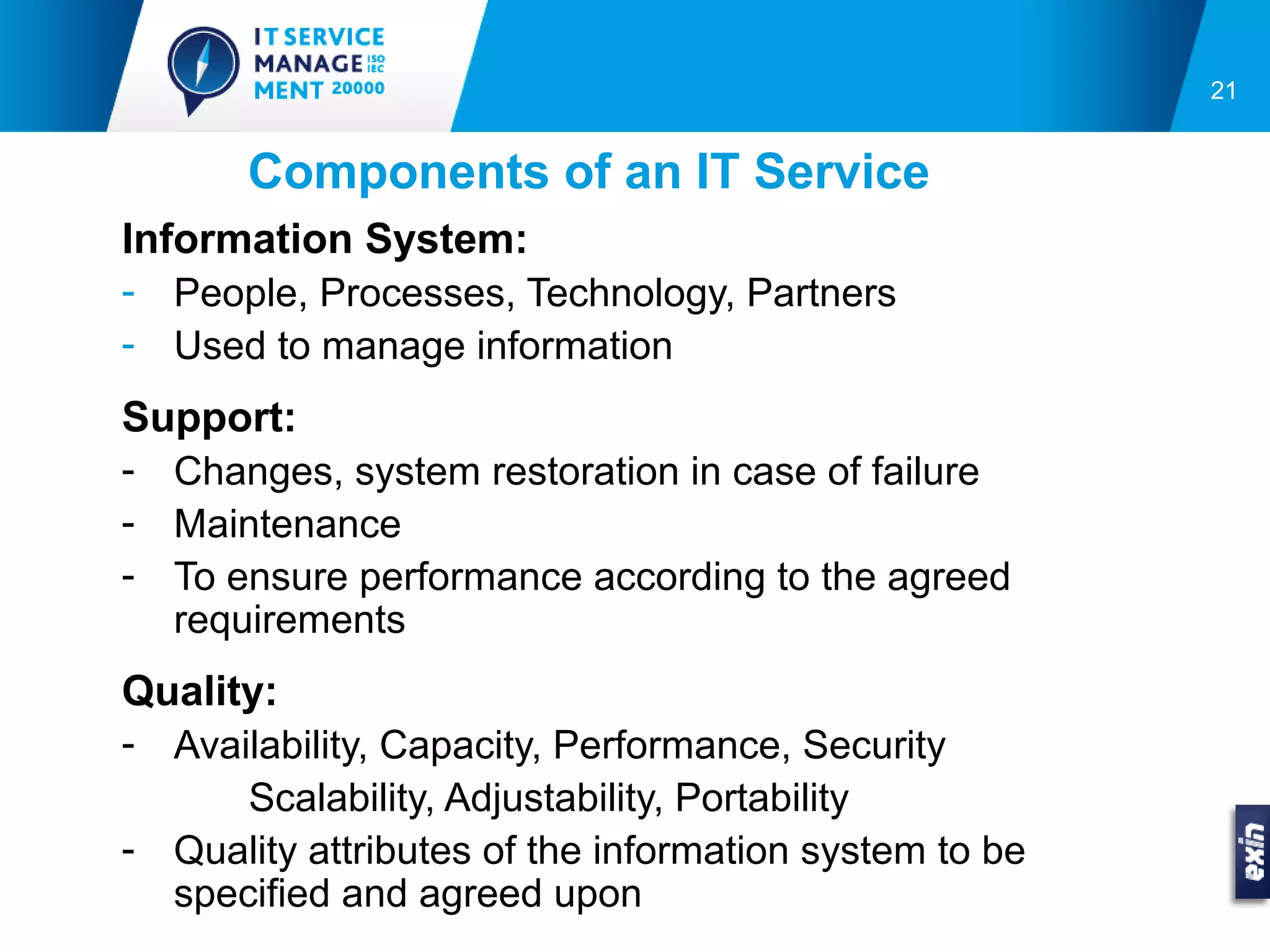
       Components of an IT Service
Information System:
- People, Processes, Technology, Partners
- Used to manage information
Support:
- Changes, system restoration in case of failure
- Maintenance
- To ensure performance according to the agreed
  requirements
Quality:
- Availability, Capacity, Performance, Security
      Scalability, Adjustability, Portability
- Quality attributes of the information system to be
  specified and agreed upon
22


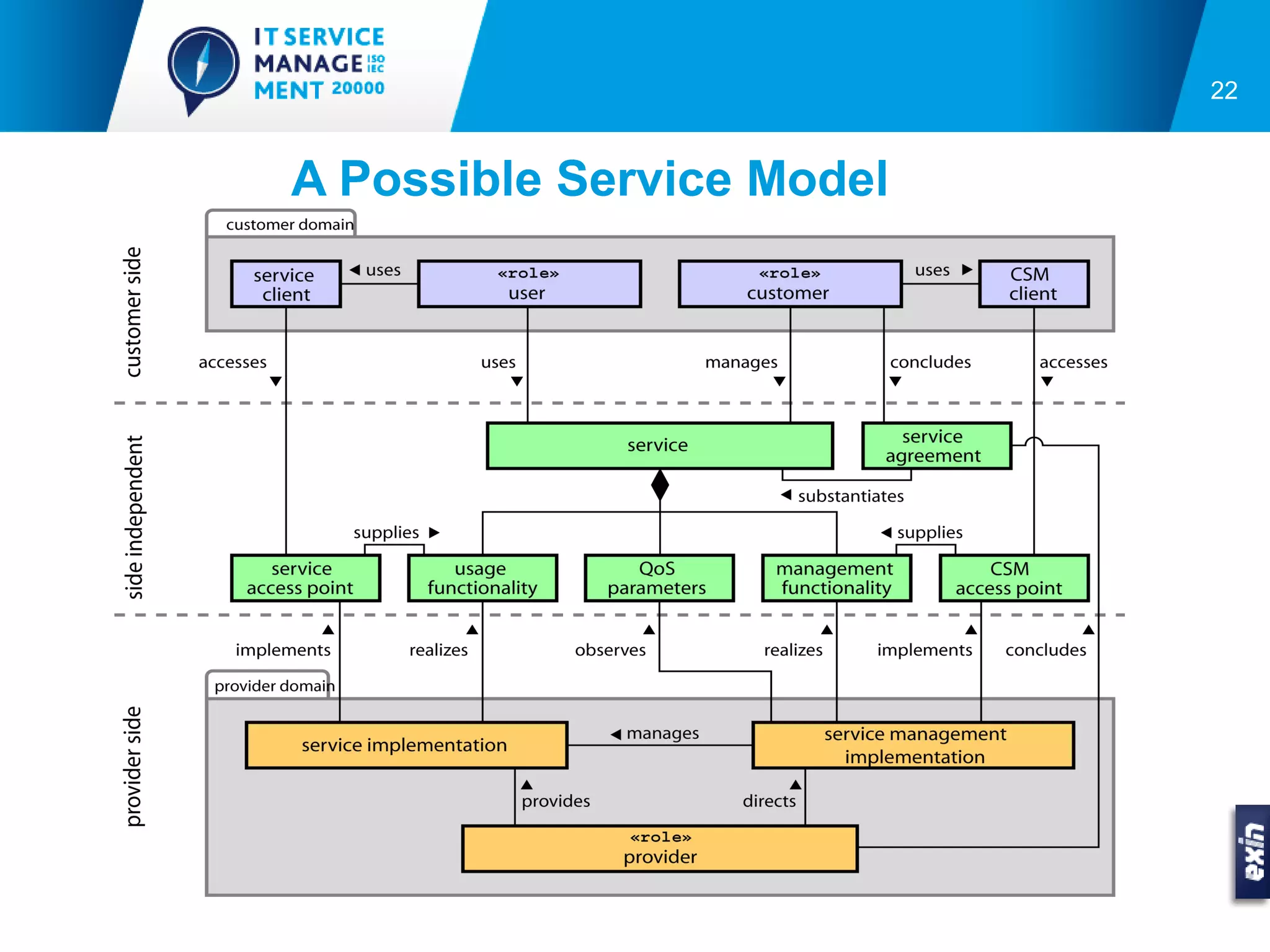
A Possible Service Model
23


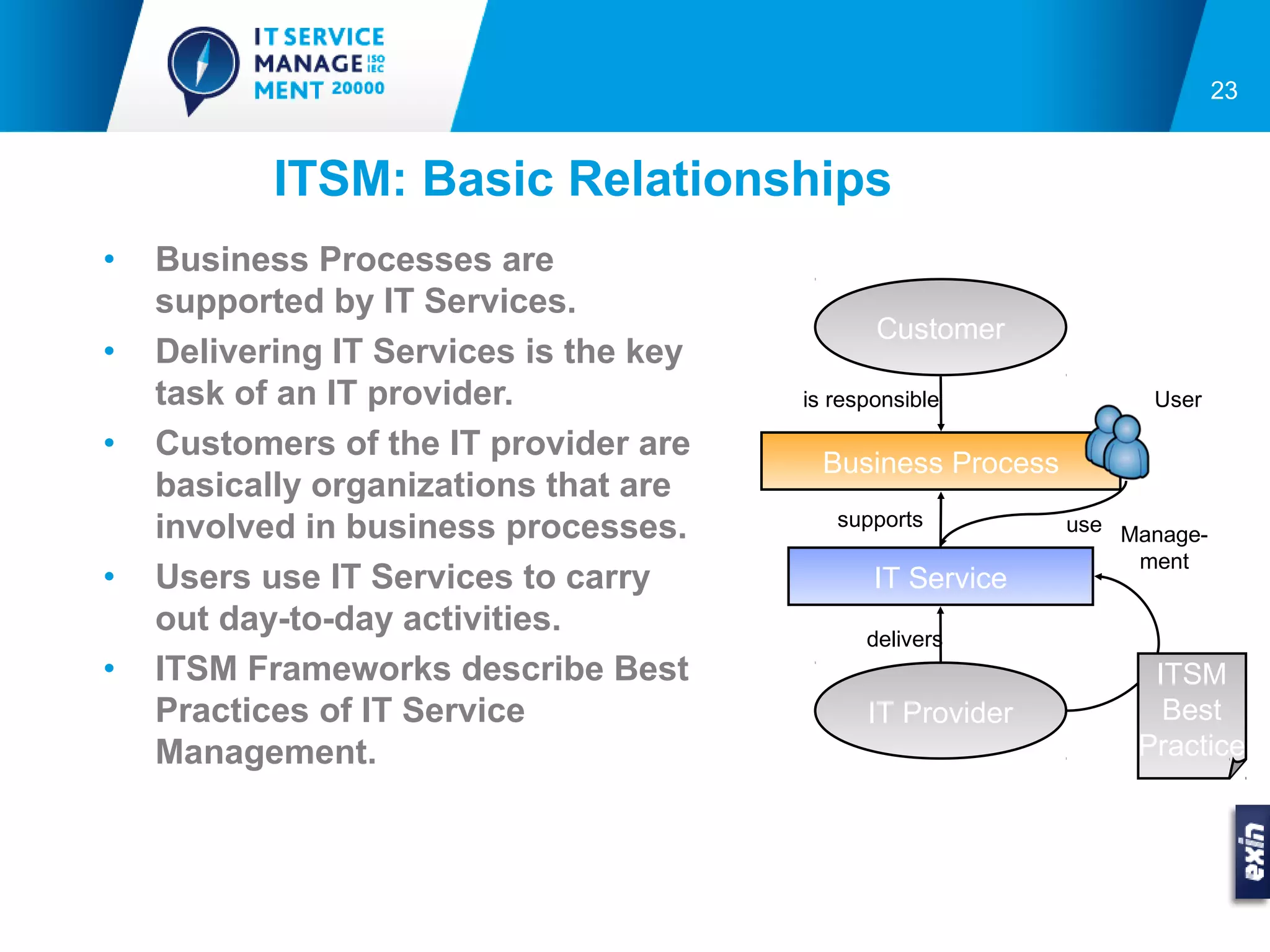
           ITSM: Basic Relationships
•   Business Processes are
    supported by IT Services.
                                               Customer
•   Delivering IT Services is the key
    task of an IT provider.             is responsible             User

•   Customers of the IT provider are
                                          Business Process
    basically organizations that are
    involved in business processes.        supports          use Manage-

•
                                                                  ment
    Users use IT Services to carry             IT Service
    out day-to-day activities.                delivers
•   ITSM Frameworks describe Best                                  ITSM
    Practices of IT Service                   IT Provider           Best
    Management.                                                   Practice
24


Process-oriented ITSM: Objectives and Benefit
 • Objectives: Management of IT Services for
   Fulfillment of Business Requirements
 • Benefit:
    – Effectiveness and efficiency of workflows will be
      increased.
    – IT Management will be placed on a stable foundation by
    focusing on business objectives and customer
    orientation.
    – Improved external communication, competitive
      advantage.
    – Improved communication, Knowledge Management
    – Output is more predictable and comprehensible.
    – Less failures and resultant faults.
    – Better management of risks (reduced insurance rates,
      compliance requirements)
25


    Process-oriented ITSM: Risks
• Bureaucratic procedures, more paperwork.
• Lower effectiveness and efficiency, if…
  – The staff is not aware of processes and measures
   and personnel do not accept the system.
  – Senior Management only pays lip-service to the
   system.
  – Important work is done outside of the system and
   process is not complied with.
26


        Roles in Process Management
Sets of responsibilities, activities and authorities
  granted to a person or team

• Per process:
   -   Process owner is responsible for process results.
   -   Process manager is responsible for realization of the process,
       day-to-day control and management.
   -   Process operatives (professionals) are responsible for defined
       activities.
Results assessed based upon agreed performance
  indicators.
One person or team may have multiple roles.
27


                  Role of Tools
Automated support aids in the performance of tasks/activities
Purpose:
• Increased efficiency = cost reduction
• Provide evidence of the process activities performed


Examples:
-   Monitoring tools
-   Software distribution tools
-   Service Management / workflow tools
-   Remote infrastructure management tools


             “A fool with a tool is still a fool!”
28


                      Service Quality
“Quality of Service is a measure that indicates the overall
  effect of service performance that determines the degree
  of satisfaction of a user of the service. The measure is
  derived from the ability of the resources to provide
  different levels of services. The measure can be both
  quantitative and qualitative.”

• Quality of service is a critical part of customer and end user
  satisfaction
• Measure of the ability of a service to provide the intended
  value to a customer
• Specific to the individual customer; quality metrics should be
  defined from the customer’s perspective
• Customer perception of service quality may vary over time
29


                      Quality Policy
The Quality Policy recognizes that there is always the
  potential to increase effectiveness and efficiency
  (continual improvement).

The Quality Policy determines the general quality goals of an
  organization.

• The Quality Policy however does not cover:
   Legal Requirements
   Customer specific requirements in quality (cp. SLA’s)
   Requirements of ISO/IEC 20000
30


Relationship between IT Services and Quality
• A service is provided through the interaction of the
  provider with customers and users; quality of the service
  depends upon this interaction.
• Quality is a measure of the extent to which the service
  fulfills the requirements and expectations of the
  customer.
• Customer perception of quality is largely based on
  expectations:
                Common language/terminology required to ensure
                  effective dialogue.
                Expectations need to be clearly defined.
                Supplier should continually assess how service is being
                  experienced and what the customer expects in the
                  future.


       Providing constant quality is crucial to perception.
31


  Principles of Quality Management

ISO/IEC 20000 is predicated on basic principles of
  Quality Management as defined in ISO 9000
  e.g.

Principles of Quality Management (QM):
   Customer focus
   Leadership
   Involvement of people
   Process approach
   System approach to management
   Continual improvement
   Factual approach to decision making
   Mutually beneficial supplier relationships
32


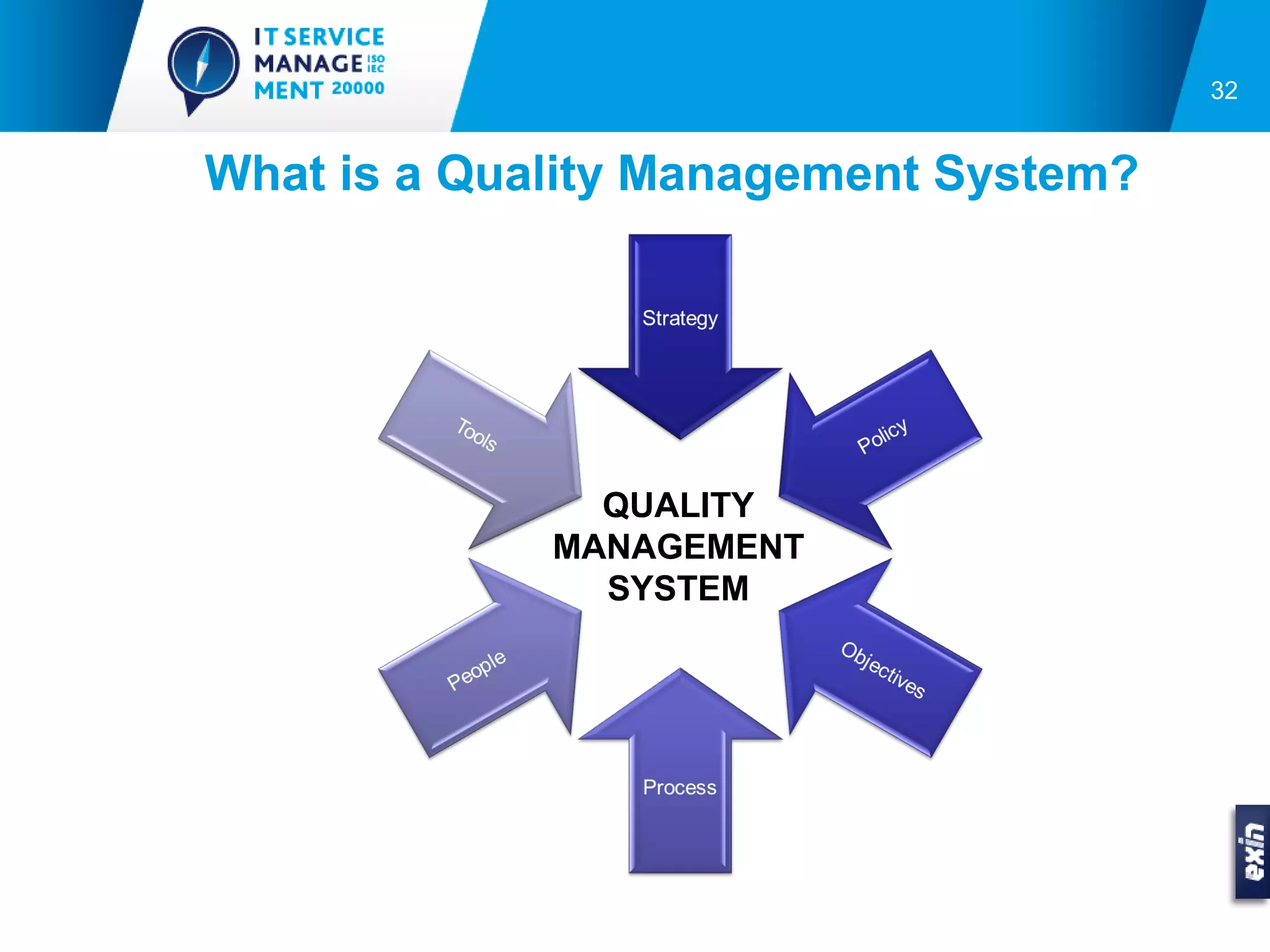
What is a Quality Management System?


               QUALITY
             MANAGEMENT
               SYSTEM
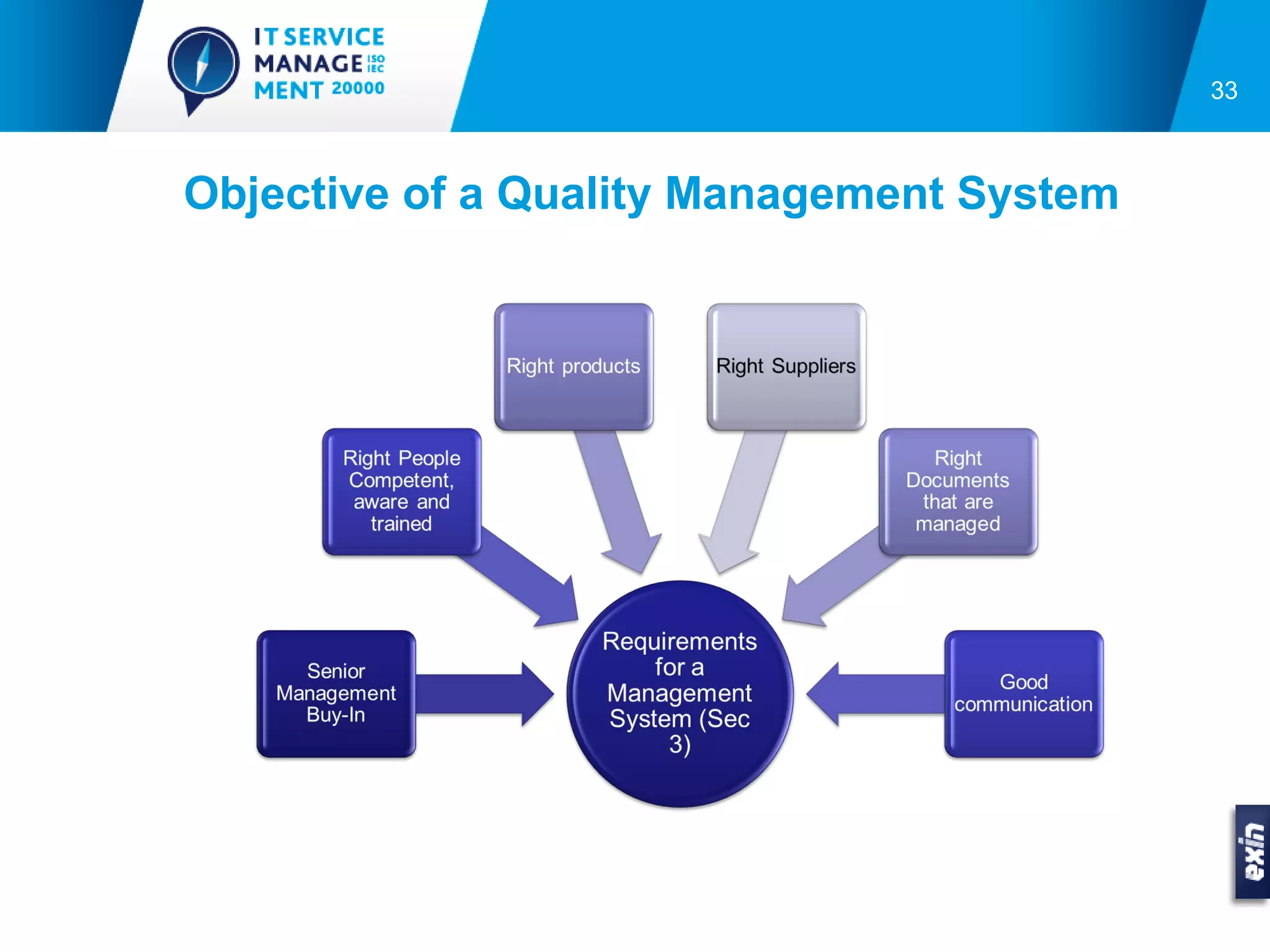
33


Objective of a Quality Management System
34


Steps to Establish a Quality Management System

    • Identify customer’s requirements and expectations.

    • Define and assign required resources to achieve the
      committed quality goals.


    • Launch procedures to measure effectiveness and
      efficiency.
35


Summary
   ISO/IEC 20000
   • Worldwide Standard
   • Process-Oriented Approach for IT Service
     Management
   • Based on:
     Best Practices in IT Service Management (as per
      description in ITIL® e.g.)
     Principles of Quality Management (as per description
      in ISO 9000 e.g.)
   • Consists of two parts:
     ISO/IEC 20000-1: Specification
     ISO/IEC 20000-2: Code of Practice
     Structure of both parts is identical.
36


              Basic Structure ISO/IEC 20000
[1] Scope
[2] Terms and Definitions
[3] Management System

[4] Planning & Implementing Service Management
[5] Planning & Implementing new or changed Services
                          [6] Service Delivery Processes
                              Service Level Management
Capacity Management                Service Reporting   Information Security Management

Service Continuity &           [9] Control Processes            Budgeting & Accounting
Availability Management                                                  for IT services
                               Configuration Management
[10] Release                     Change Management                 [7] Relationship
Process                                                                  Processes
                            [8] Resolution Processes
                                                                Business Relationship
                                Incident Management                      Management
Release Management                                              Supplier Management
                                Problem Management
37


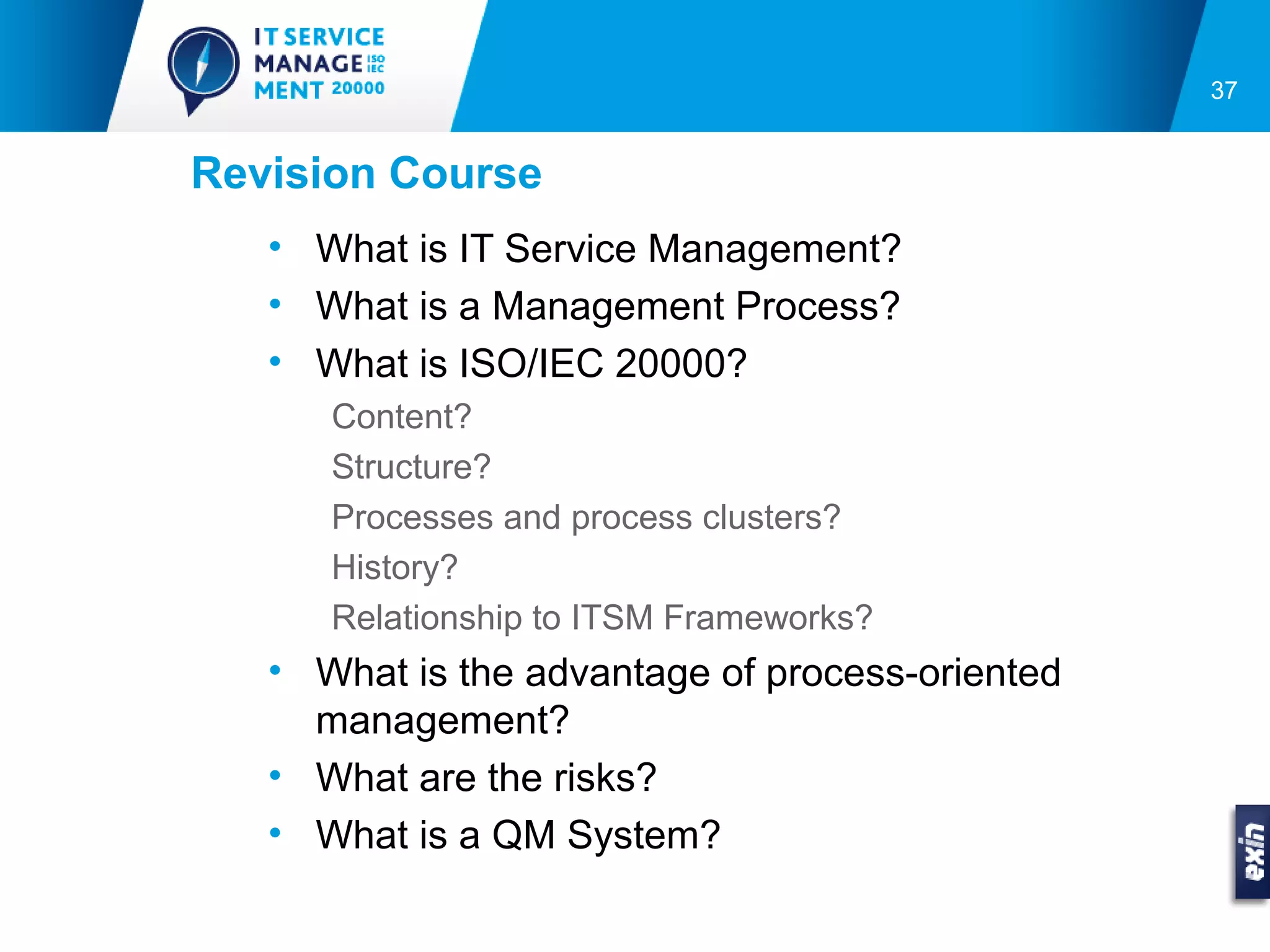
Revision Course
   • What is IT Service Management?
   • What is a Management Process?
   • What is ISO/IEC 20000?
      Content?
      Structure?
      Processes and process clusters?
      History?
      Relationship to ITSM Frameworks?
   • What is the advantage of process-oriented
     management?
   • What are the risks?
   • What is a QM System?
38


        Content of ISO/IEC 20000 Part 1:
                     Basics
                       (section 1 - 5)


[1] Scope
[2] Terms and Definitions
                                    Management responsibility
[3] Management System               Documentation requirements
                                    Competencies, awareness & training
[4] Planning & Implementing SM      Plan, Do, Check, Act

[5] Planning & Implementing new or changed Services
39


     Section 1: Scope

Objective
Description of ISO/IEC 20000 Standards and its content


[1] Scope
[2] Terms and Definitions
                                 Management responsibility
[3] Management System            Documentation requirements
                                 Competencies, awareness & training
[4] Planning & Implementing SM   Plan, Do, Check, Act

[5] Planning & Implementing new or changed Services
40


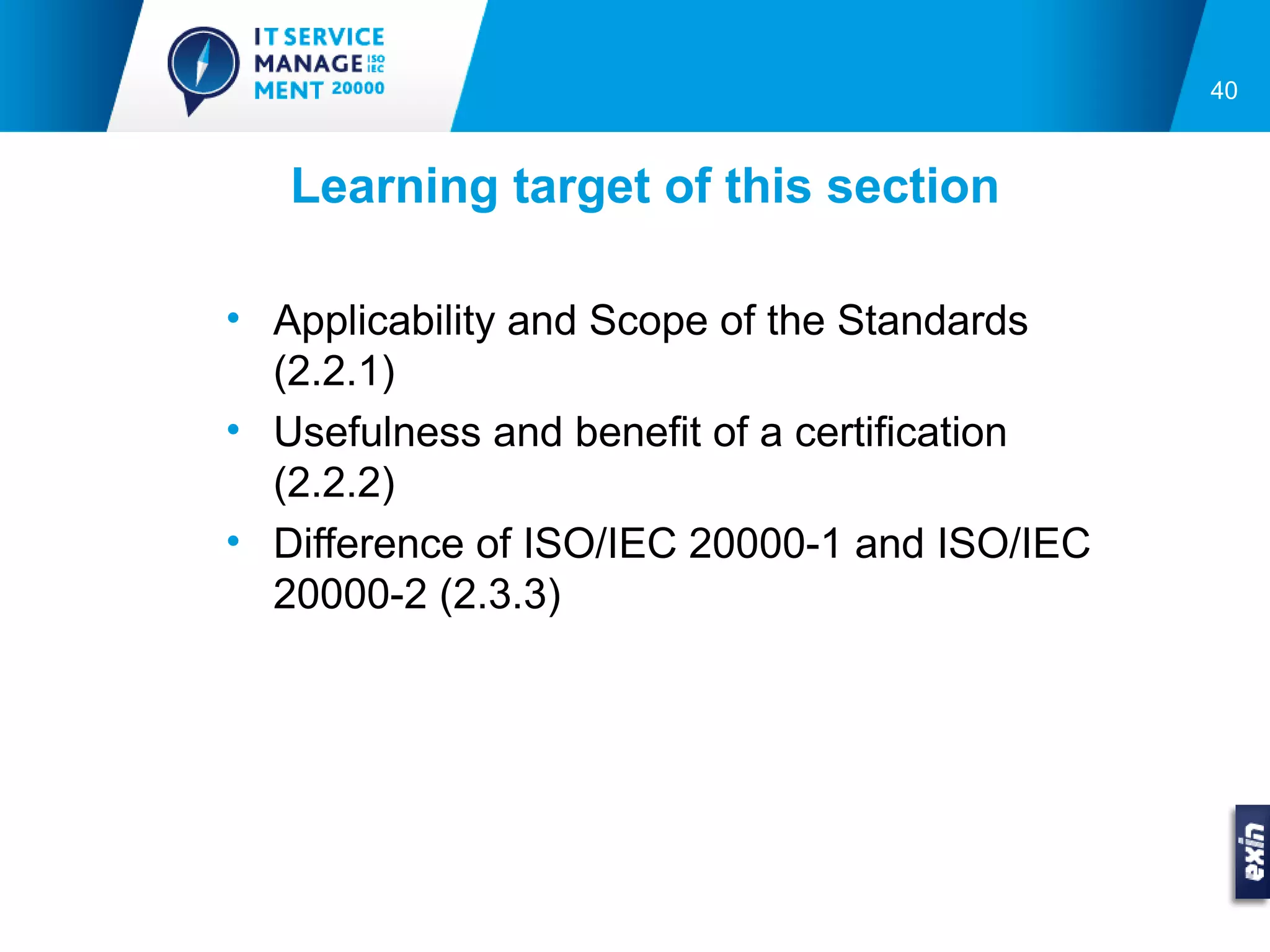
   Learning target of this section

• Applicability and Scope of the Standards
  (2.2.1)
• Usefulness and benefit of a certification
  (2.2.2)
• Difference of ISO/IEC 20000-1 and ISO/IEC
  20000-2 (2.3.3)
41


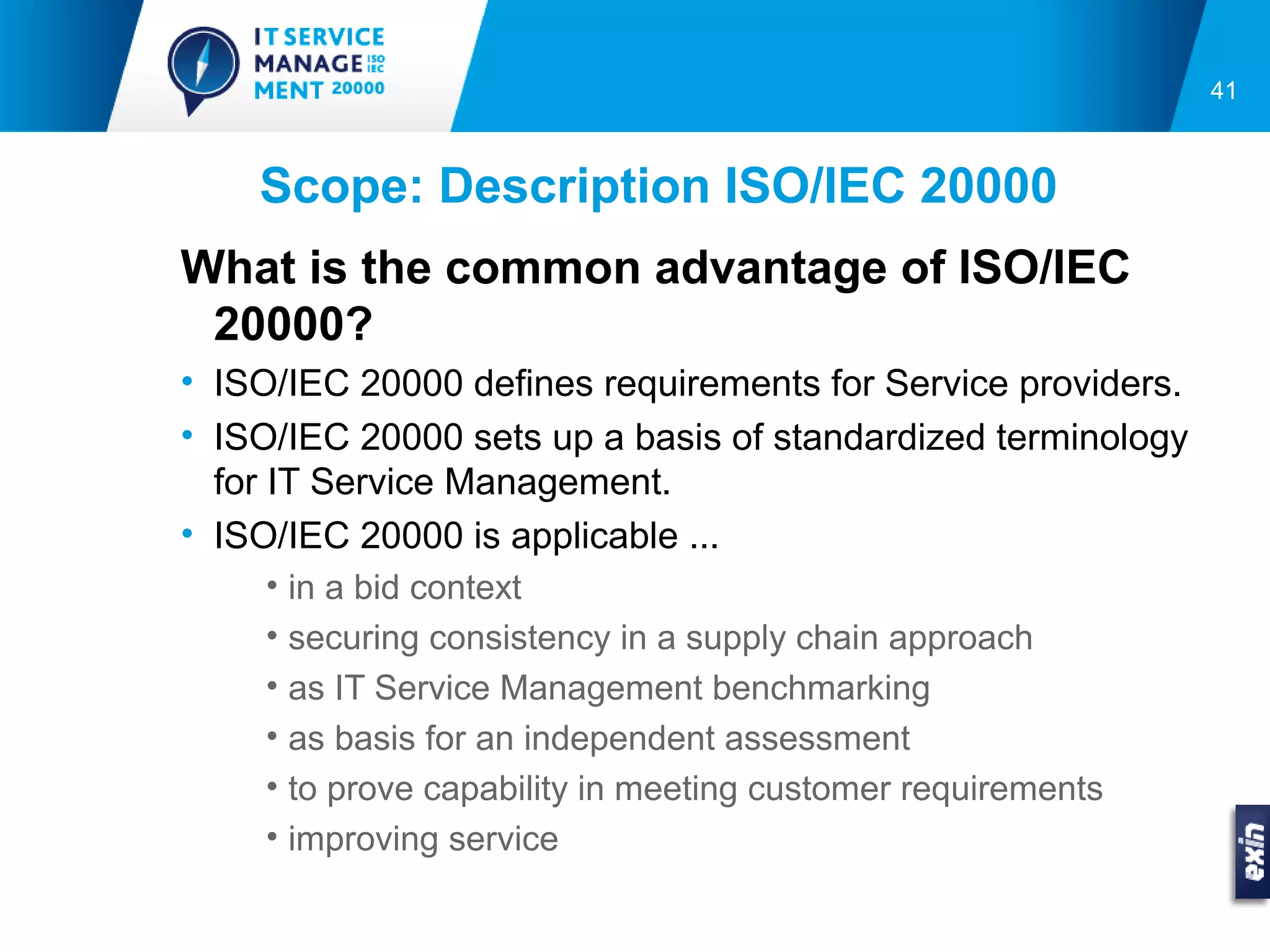
    Scope: Description ISO/IEC 20000
What is the common advantage of ISO/IEC
 20000?
• ISO/IEC 20000 defines requirements for Service providers.
• ISO/IEC 20000 sets up a basis of standardized terminology
  for IT Service Management.
• ISO/IEC 20000 is applicable ...
    • in a bid context
    • securing consistency in a supply chain approach
    • as IT Service Management benchmarking
    • as basis for an independent assessment
    • to prove capability in meeting customer requirements
    • improving service
42


Scope: Description ISO/IEC 20000
What is the purpose of the respective parts of
 ISO/IEC?
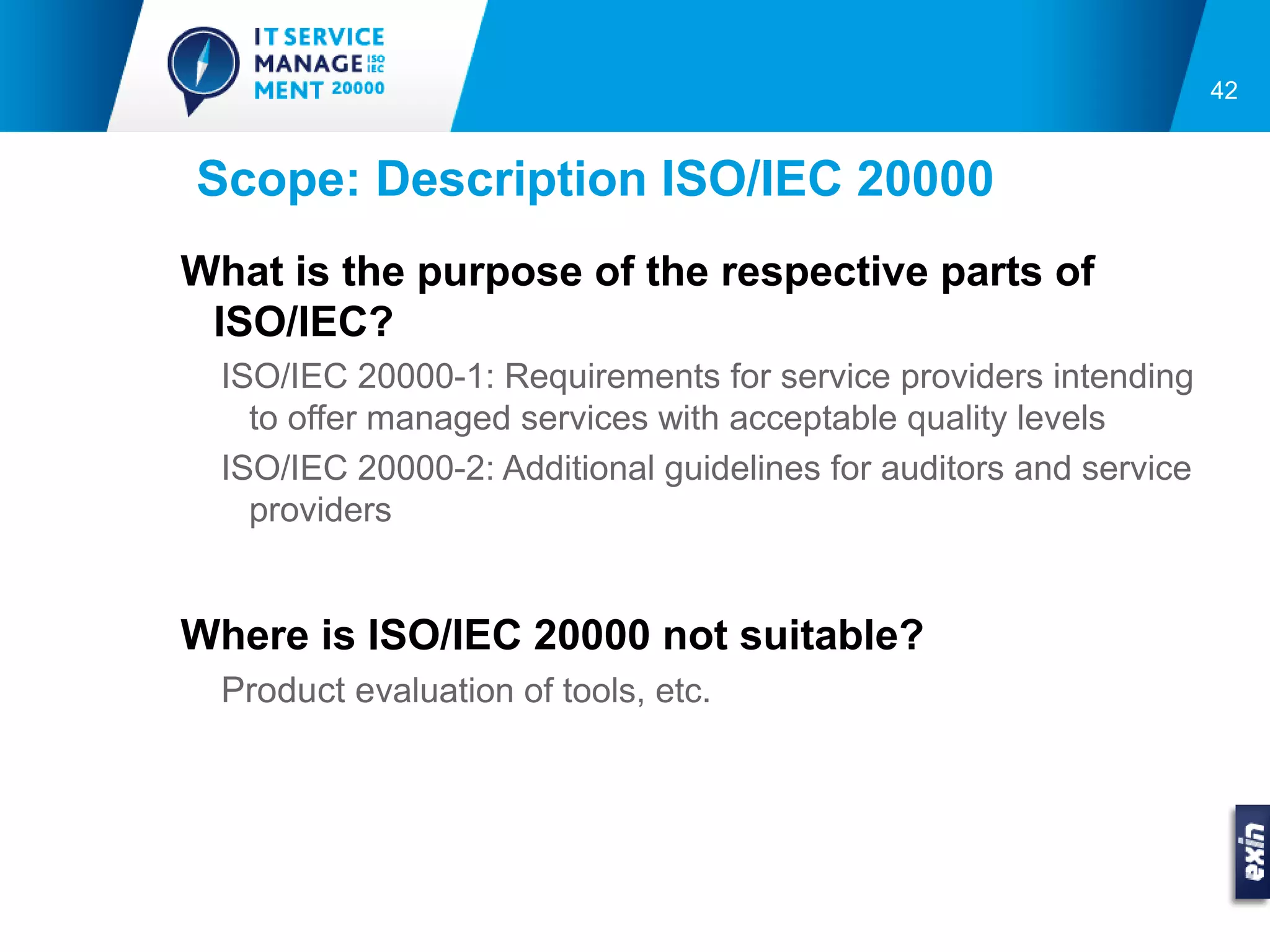
  ISO/IEC 20000-1: Requirements for service providers intending
    to offer managed services with acceptable quality levels
  ISO/IEC 20000-2: Additional guidelines for auditors and service
    providers


Where is ISO/IEC 20000 not suitable?
  Product evaluation of tools, etc.
43


      Section 2: Terms and Definitions
Objective
  Basic Definitions and Standardized Terminology

[1] Scope
[2] Terms and Definitions
                                 Management responsibility
[3] Management System            Documentation requirements
                                 Competencies, awareness & training
[4] Planning & Implementing SM   Plan, Do, Check, Act

[5] Planning & Implementing new or changed Services
44


Learning target of this section

• Terms and Definitions according to
  ISO/IEC 20000 (2.3.6)
45


      C
             00
          200 n
  O/IE icatio
                      Terms and Definitions: Overview
IS     if
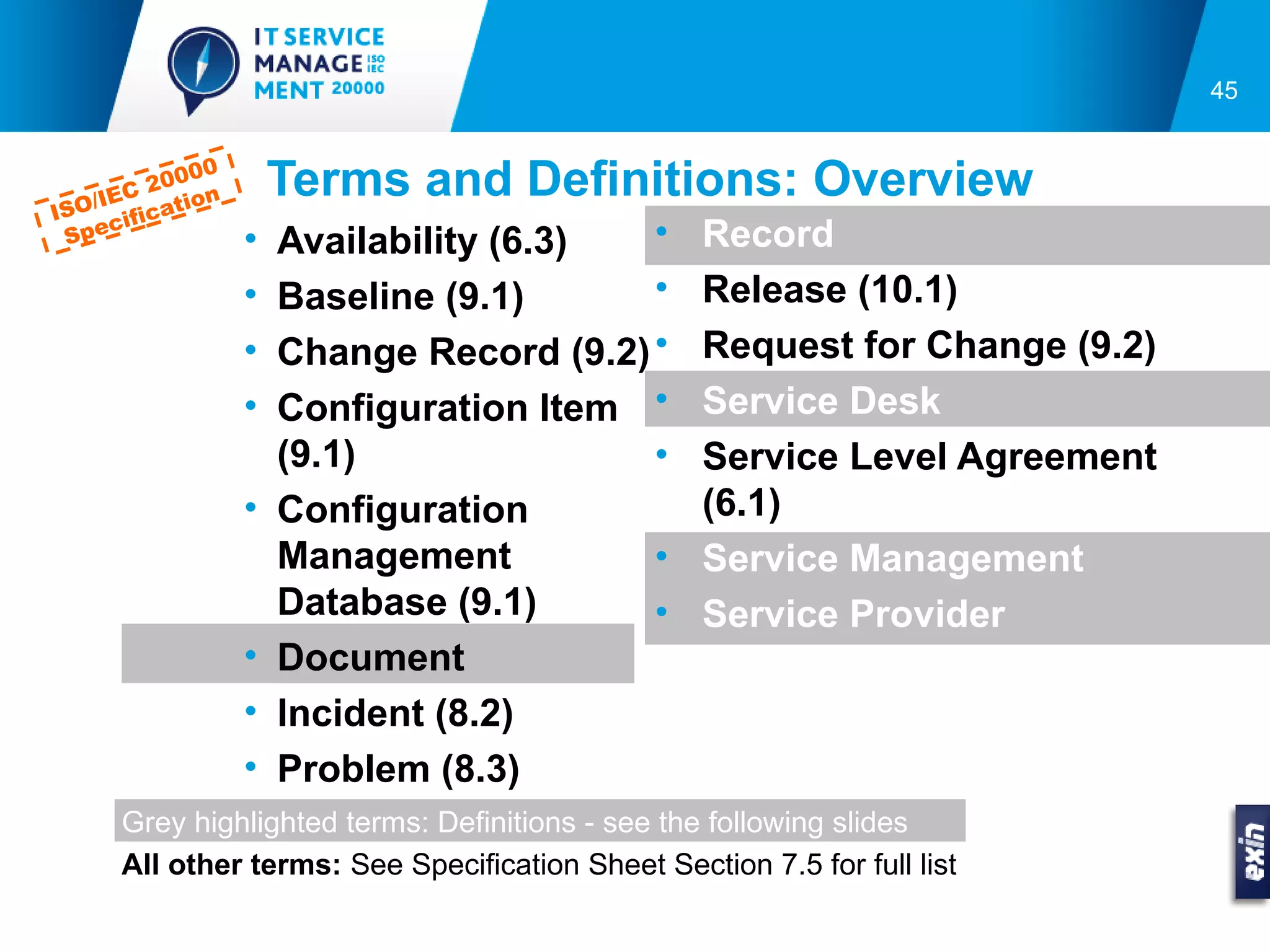
   pec            •                       •        Record
 S                    Availability (6.3)
                  •   Baseline (9.1)      •        Release (10.1)
                  •   Change Record (9.2) •        Request for Change (9.2)
                  •   Configuration Item •         Service Desk
                      (9.1)               •        Service Level Agreement
                  •   Configuration                (6.1)
                      Management          •        Service Management
                      Database (9.1)      •        Service Provider
                  •   Document
                  •   Incident (8.2)
                  •   Problem (8.3)
      Grey highlighted terms: Definitions - see the following slides
      All other terms: See Specification Sheet Section 7.5 for full list
46


ISO/IEC 2
         0000
          tion
                       Documents and Records
 Specifica
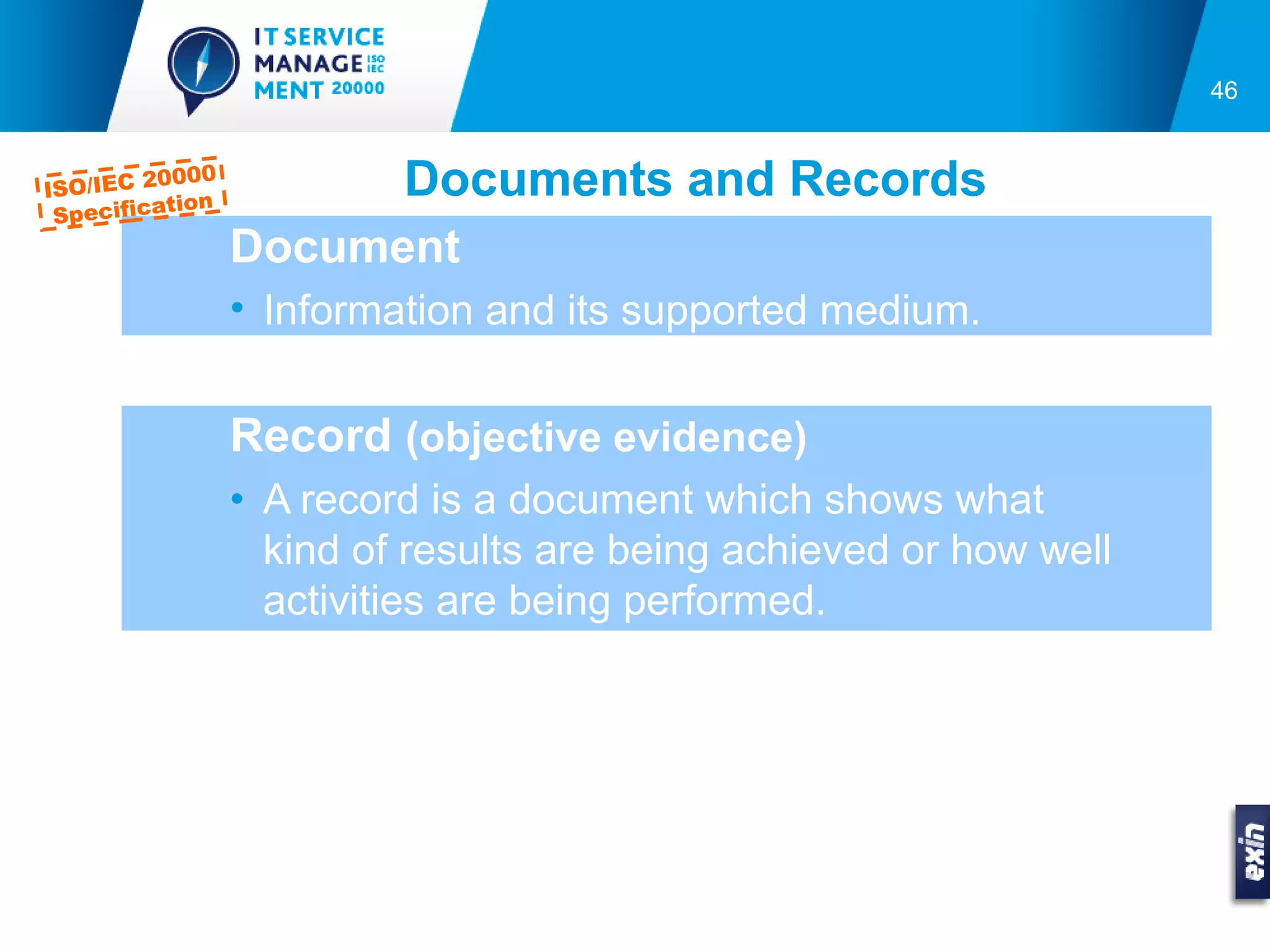
                 Document
                 • Information and its supported medium.


                 Record (objective evidence)
                 • A record is a document which shows what
                   kind of results are being achieved or how well
                   activities are being performed.
47

            000
ISO/IEC 20                                Service …
           tion
  Specifica

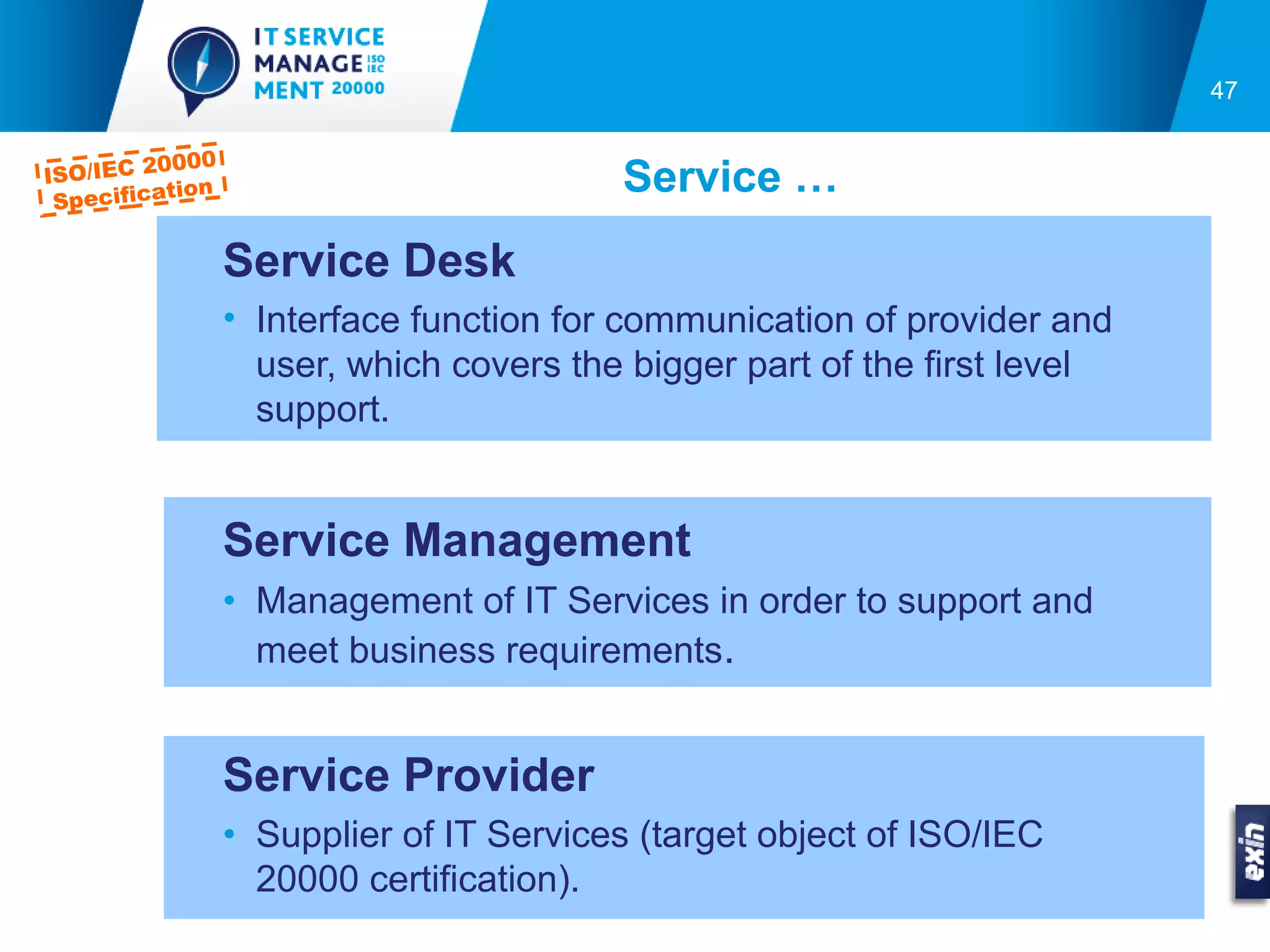
                  Service Desk
                  • Interface function for communication of provider and
                    user, which covers the bigger part of the first level
                    support.


                  Service Management
                  • Management of IT Services in order to support and
                    meet business requirements.


                  Service Provider
                  • Supplier of IT Services (target object of ISO/IEC
                    20000 certification).
48


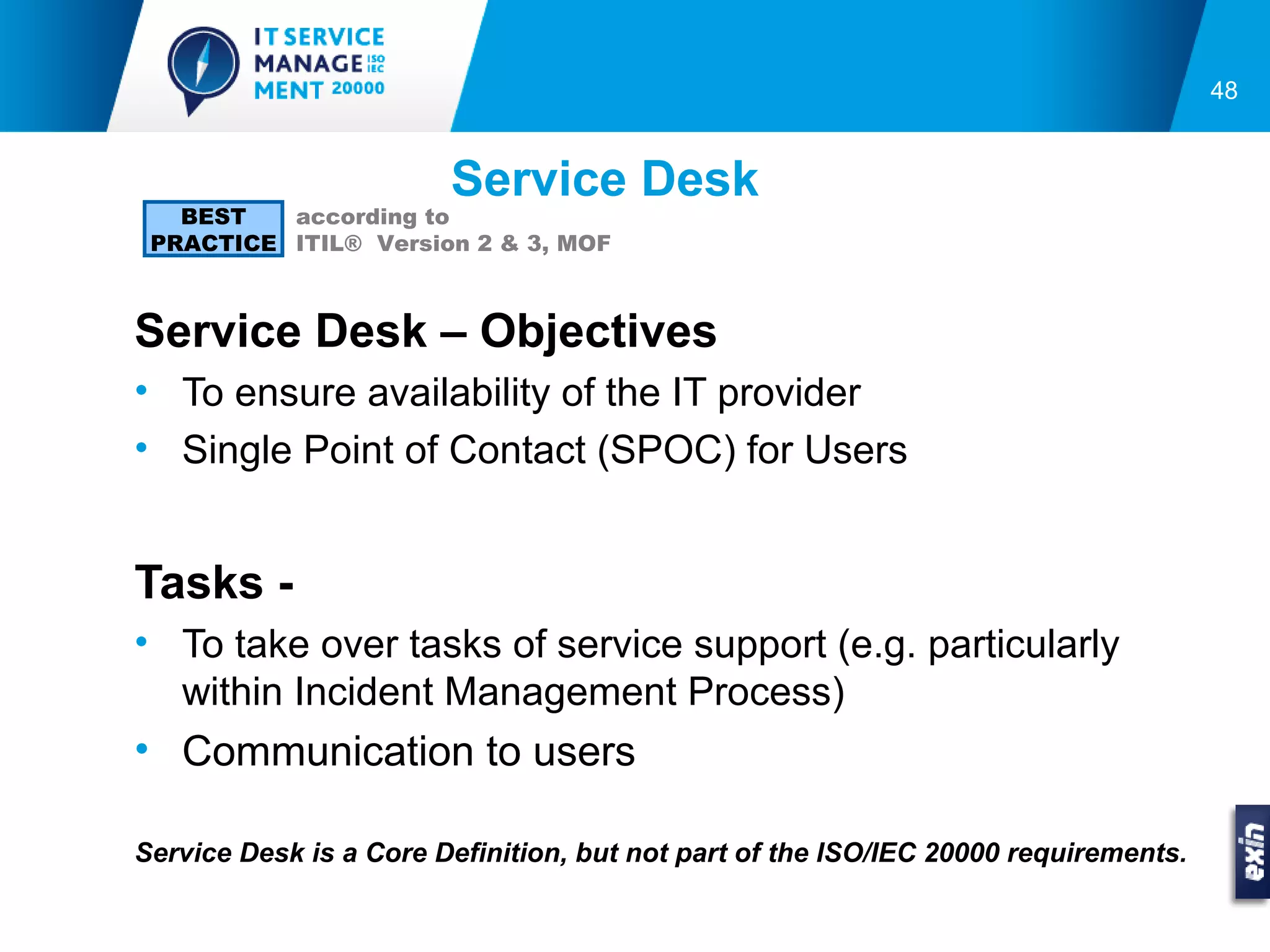
                        Service Desk
   BEST   according to
 PRACTICE ITIL® Version 2 & 3, MOF


Service Desk – Objectives
• To ensure availability of the IT provider
• Single Point of Contact (SPOC) for Users


Tasks -
• To take over tasks of service support (e.g. particularly
  within Incident Management Process)
• Communication to users

Service Desk is a Core Definition, but not part of the ISO/IEC 20000 requirements.
49


 Requirements for a Management System

Objective:
 To provide a management system enabling the effective
 management of all IT Services.


[1] Scope
[2] Terms and Definitions
                                 Management responsibility
[3] Management System            Documentation requirements
                                 Competencies, awareness & training
[4] Planning & Implementing SM   Plan, Do, Check, Act

[5] Planning & Implementing new or changed Services
50


       Learning target of this section
• Objective and purpose of a management system
  (3.1.1)
• Management responsibilities (3.1.2, 4.1.1)
• Documentation requirements (3.1.3, 4.1.2)
• Competence, Awareness and Training (3.1.4, 4.1.3)
51


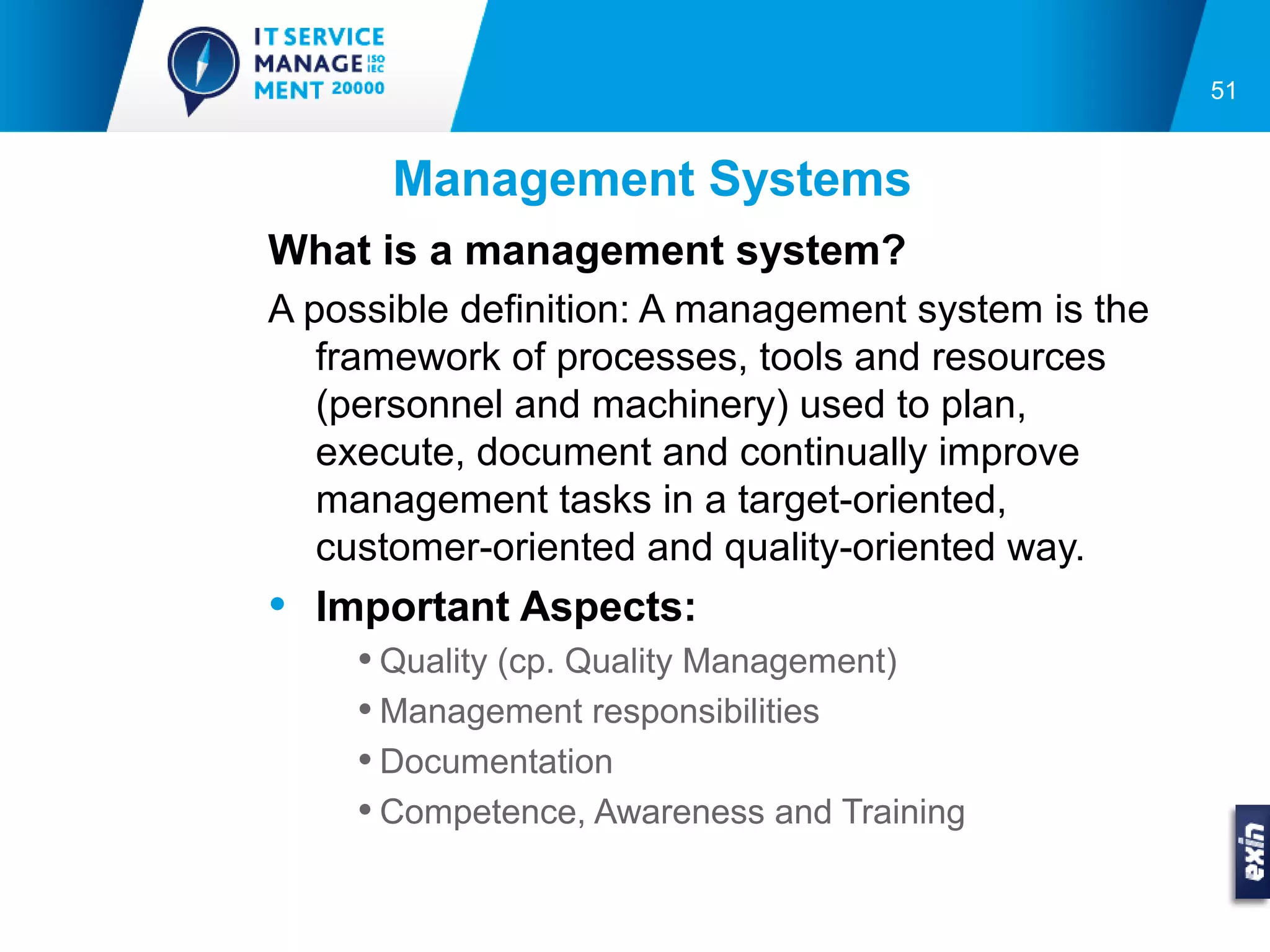
      Management Systems
What is a management system?
A possible definition: A management system is the
   framework of processes, tools and resources
   (personnel and machinery) used to plan,
   execute, document and continually improve
   management tasks in a target-oriented,
   customer-oriented and quality-oriented way.
• Important Aspects:
    • Quality (cp. Quality Management)
    • Management responsibilities
    • Documentation
    • Competence, Awareness and Training
52


         0000
ISO/IEC 2
 Specifica
          tion   Management Responsibilities

                 Management shall:
                 •   prove commitment to development, implementation and
                     improvement of service management capabilities by
                     appropriate leadership behavior and appropriate
                     measures;
                 •   establish policy, objectives and plans;
                 •   communicate the importance of meeting the objectives and
                     the need for continual improvement;
                 •   ensure that customer requirements are determined and are
                     met;
                 •   appoint a member of management responsible for the co-
                     ordination and management of all services.
53


         Management Responsibilities (continued)
               0
          0 00
     EC 2 tion
  O/I ifica
IS ec
  Sp
                   Management shall: (continued)
                   •   determine and provide resources (e.g. personnel) for
                       Service Management;
                   •   manage risks to the organization and services;
                   •   conduct reviews of service management at planned
                       intervals.
54


          Management Responsibilities (continued)
 ISO/IEC 2
           0000      Furthermore, Senior Management should:
            actice
C ode of Pr          •   require and support the implementation of service
                         management processes;
                     •   assign an executive position to the senior responsible
                         owner of IT Service Management ;
                     •   provide management representatives with required
                         resources for continual or project-related improvement;
                     •   allocate a decision-making group to the management
                         representatives with sufficient authority to define guidelines
                         and make decisions.
55


ISO/IEC 2
          0000
           tion
                    Documentation
 Specifica

Documentation and records shall be provided to
  support effective planning, operation and control.
• Including at least:
      • Documentation of Service Management guidelines and
        plans
      • Documentation of Service Level Agreements
      • Documentation of processes required by ISO/IEC 20000
      • Records required by ISO/IEC 20000
Procedures and responsibilities shall be established
  for the creation, review, approval, maintenance,
  disposal, and control.
56


        20
             0
           00 ce   Documentation: Best Practices
      C acti
    IE
  O/ of Pr
IS e
Co
  d        • Senior responsible owner should ensure evidence is
             available for audit, such as:
                    •   Policies and plans
                    •   Service documentation
                    •   Procedures
                    •   Processes
                    •   Process control records
           • Documents should be in a medium suitable for their purpose.
           • Documents should be protected from damage due to
             circumstances (e.g. environmental conditions, computer
             disasters).
57

         0000
ISO/IEC 2
 Specifica
          tion   Competence, Awareness & Training
      • All roles and responsibilities in combination with the
        required competencies shall be defined.
      • Competencies and training needs shall be determined
        and managed:
             • Maintain appropriate records of qualifications,
               experience, skills and trainings                  ISO
                                                               Co    /
             • Arrange for training and further education         de IEC 2
                                                                    of     0
                                                                       Pra 000
                                                                          cti
             • Control effectiveness of qualification and training           ce

      • Management shall ensure that staff are aware of the
        relevance and importance of their activities and how
        they contribute to the achievement of service
        management objectives.
58


Section 4: Planning and Implementing SM
                                                        PLAN
                                                         PLAN
Objective                                        [4.1] Plan Service
                                                  [4.1] Plan Service
                                                    Management
                                                     Management

• Planning and
  Implementing IT                 ACT
                                   ACT
                            [4.4] Continual
                             [4.4] Continual
                                                                                    DO
                                                                                     DO
                                                                         [4.2] Implement Service
                                                                          [4.2] Implement Service
                             Improvement                                       Management
  Service Management          Improvement                                       Management


  using Deming’s                                        CHECK
                                                        CHECK
  Quality Circle.                              [4.3] Monitor, Measure
                                                [4.3] Monitor, Measure
                                                      and Review
                                                       and Review


[1] Scope
[2] Terms and Definitions
                                        Management responsibility
[3] Management System                   Documentation requirements
                                        Competencies, awareness & training
[4] Planning & Implementing SM          Plan, Do, Check, Act

[5] Planning & Implementing new or changed Services
59


      Learning target of this section
• Objective and purpose of the section Planning and
  Implementing IT Service Management (3.1.5)
• Plan-Do-Check-Act methodology for Service
  Management Processes (1.5.1, 3.1.6, 3.1.8)
• Principles of a Service Management Plan (3.1.7)
• Internal and external audits (4.1.5, 4.1.6)
• Conduct internal and external audits (4.1.6)
60


             Continual Improvement
1. Necessary in order to improve the performance of the
   organization and increase customer satisfaction.
2. Needs to be a permanent objective of the organiation.
3. Continual activity which keeps the wheel of the PDCA
   cycle turning.
4. Ensures improvement activities at all levels are aligned
   to the organization’s strategy.
5. Increases flexibility to act quickly on opportunities.
6. Applying the principle leads to a company culture and
   organization-wide approach to continual improvement.
7. Leads to more business in the mid-term by actively
   improving the relationship with customers.
61


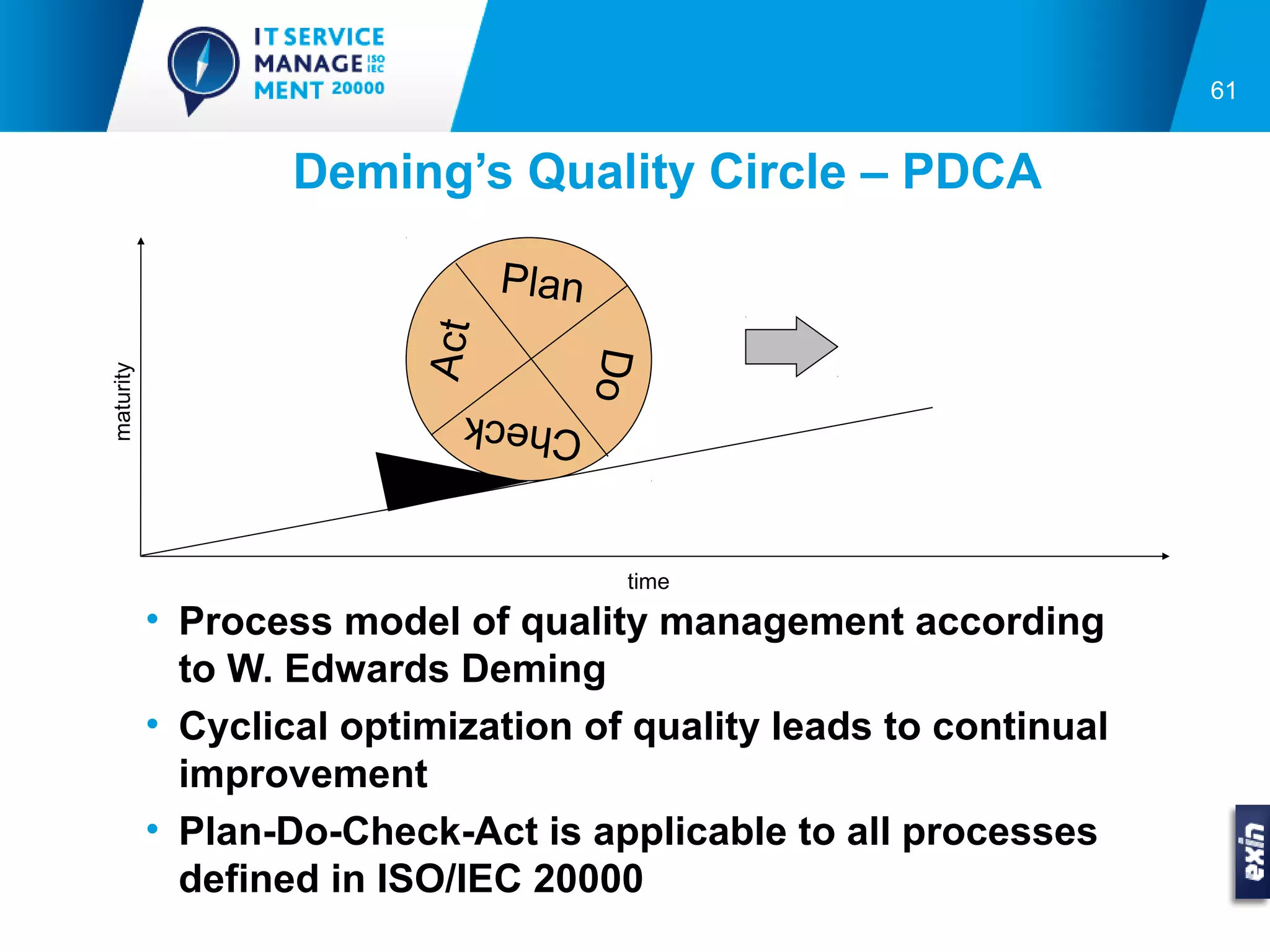
                   Deming’s Quality Circle – PDCA

                                Plan


                          Act


                                       Do
maturity


                            Check


                                        time
           • Process model of quality management according
             to W. Edwards Deming
           • Cyclical optimization of quality leads to continual
             improvement
           • Plan-Do-Check-Act is applicable to all processes
             defined in ISO/IEC 20000
62


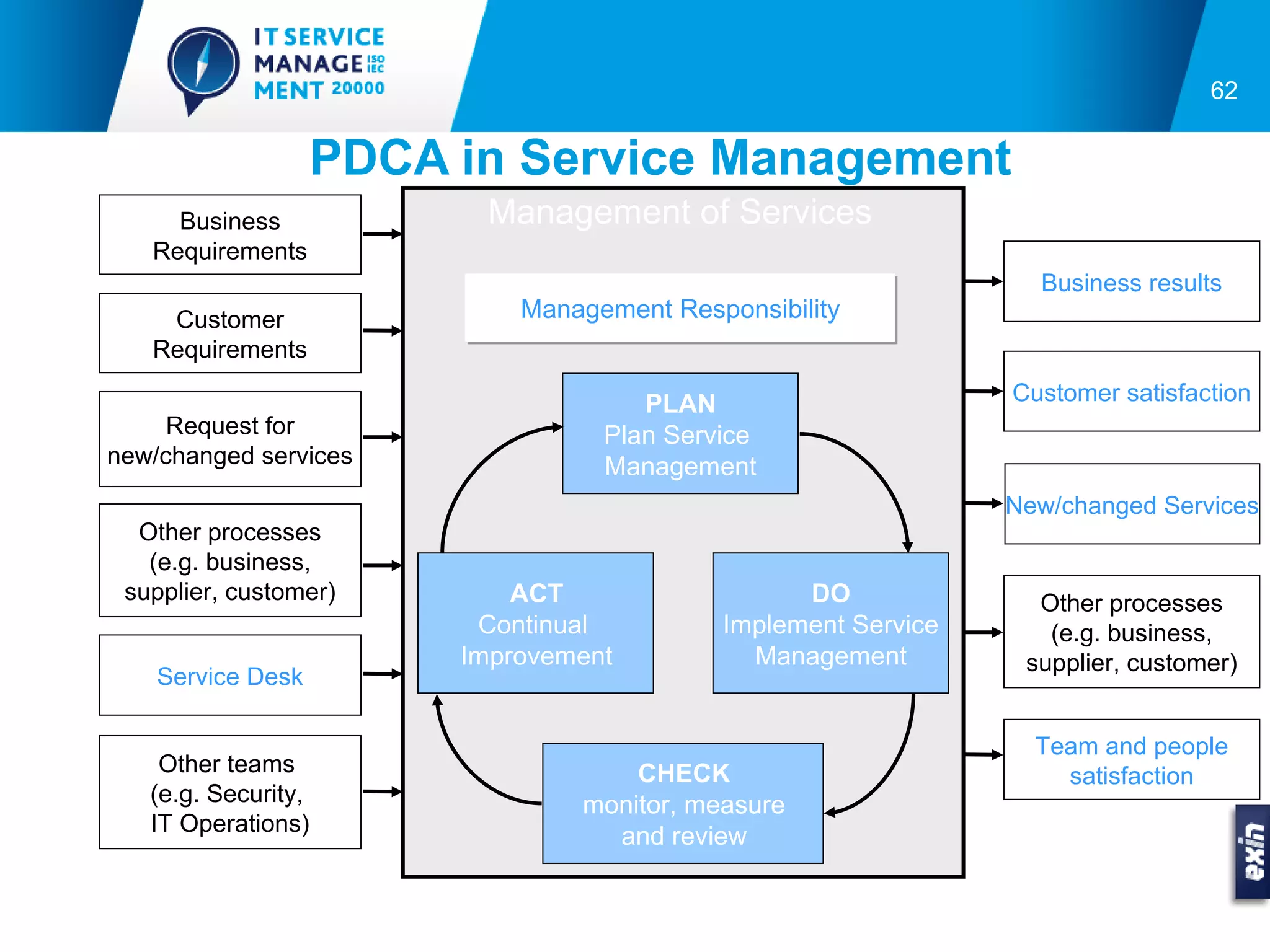
                   PDCA in Service Management
     Business            Management of Services
   Requirements
                                                                 Business results
    Customer                Management Responsibility
   Requirements

                                     PLAN                      Customer satisfaction
     Request for                  Plan Service
new/changed services              Management
                                                               New/changed Services
  Other processes
   (e.g. business,
 supplier, customer)        ACT                  DO              Other processes
                         Continual         Implement Service      (e.g. business,
                        Improvement          Management         supplier, customer)
    Service Desk

                                                                 Team and people
    Other teams                     CHECK                          satisfaction
   (e.g. Security,              monitor, measure
   IT Operations)
                                  and review
63


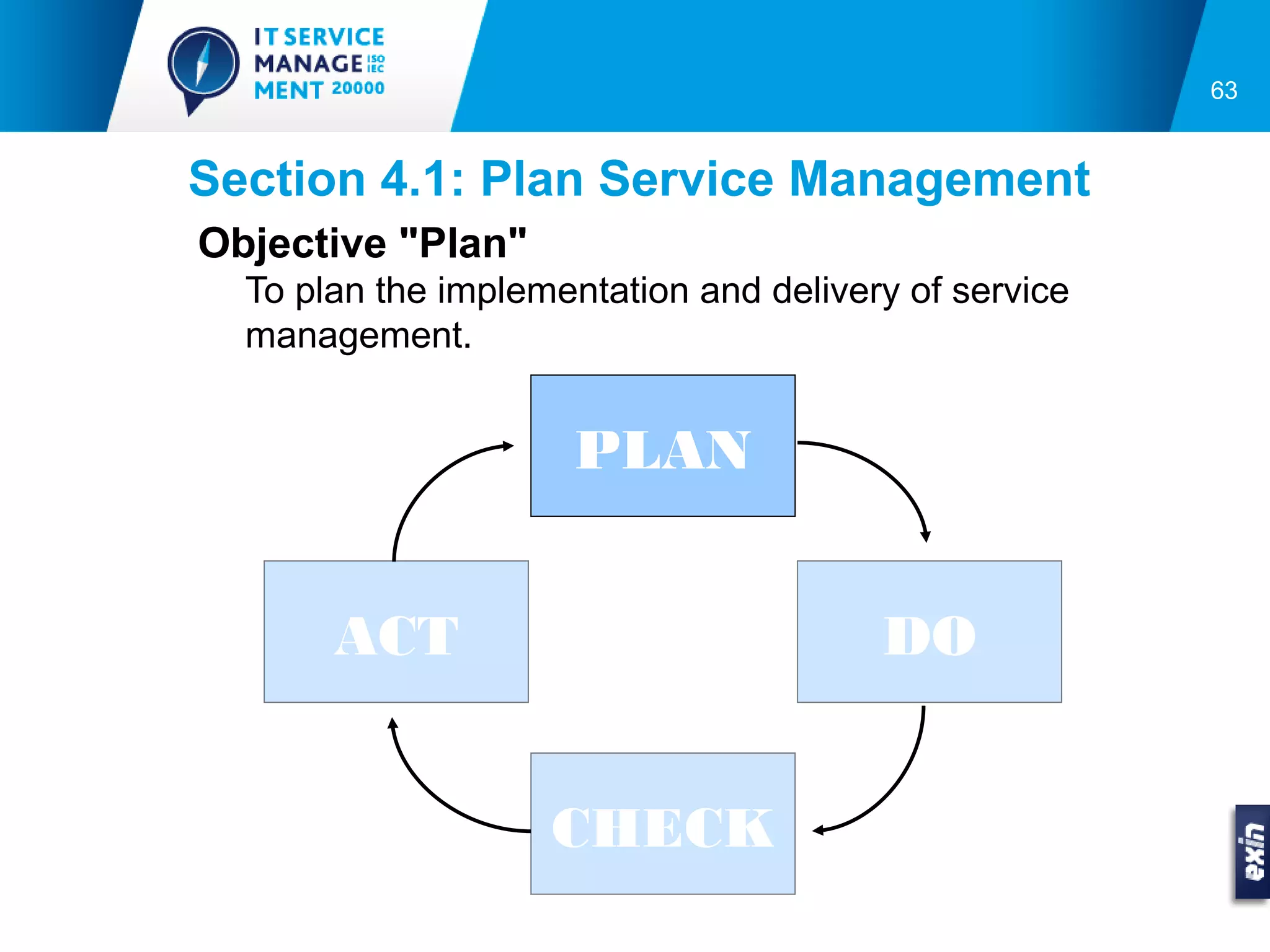
Section 4.1: Plan Service Management
Objective "Plan"
  To plan the implementation and delivery of service
  management.


                     PLAN


       ACT                              DO


                    CHECK
64


             000
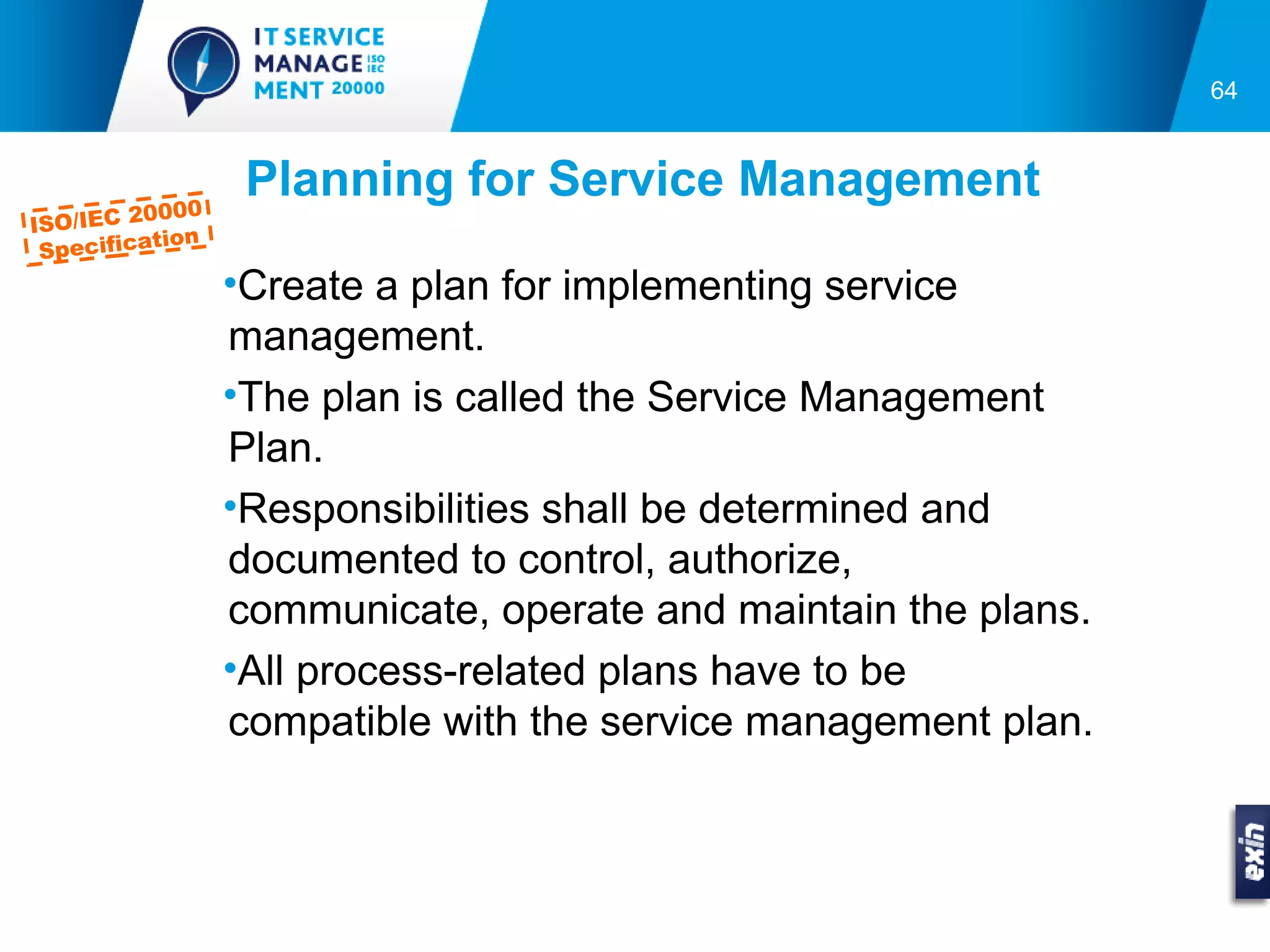
                    Planning for Service Management
ISO/IEC 20
            tion
  Specifica
                   •Create a plan for implementing service
                   management.
                   •The plan is called the Service Management
                   Plan.
                   •Responsibilities shall be determined and
                   documented to control, authorize,
                   communicate, operate and maintain the plans.
                   •All process-related plans have to be
                   compatible with the service management plan.
65


         0000
ISO/IEC 2
 Specifica
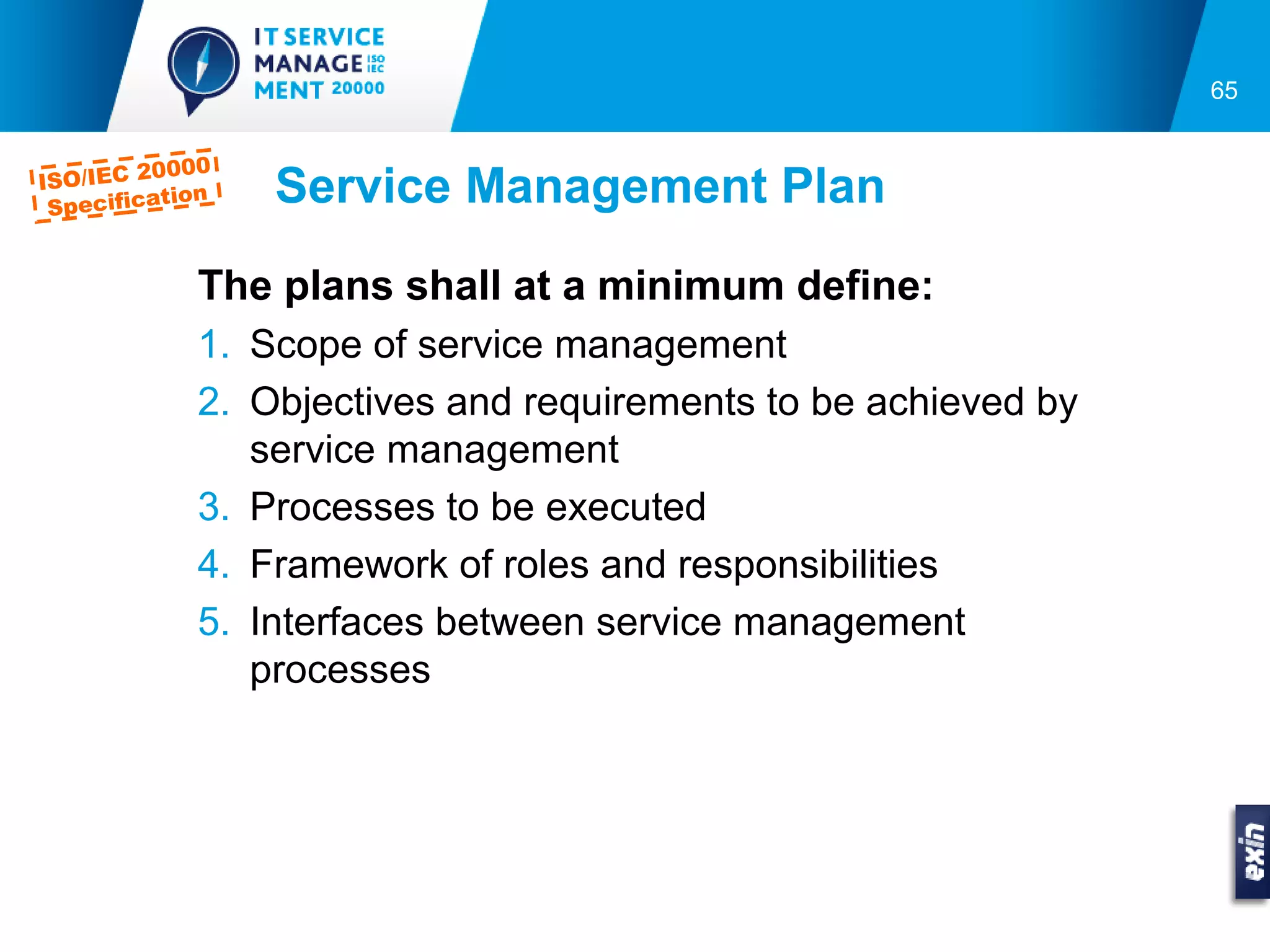
          tion   Service Management Plan
            The plans shall at a minimum define:
            1. Scope of service management
            2. Objectives and requirements to be achieved by
               service management
            3. Processes to be executed
            4. Framework of roles and responsibilities
            5. Interfaces between service management
               processes
66


         0000
ISO/IEC 2
 Specifica
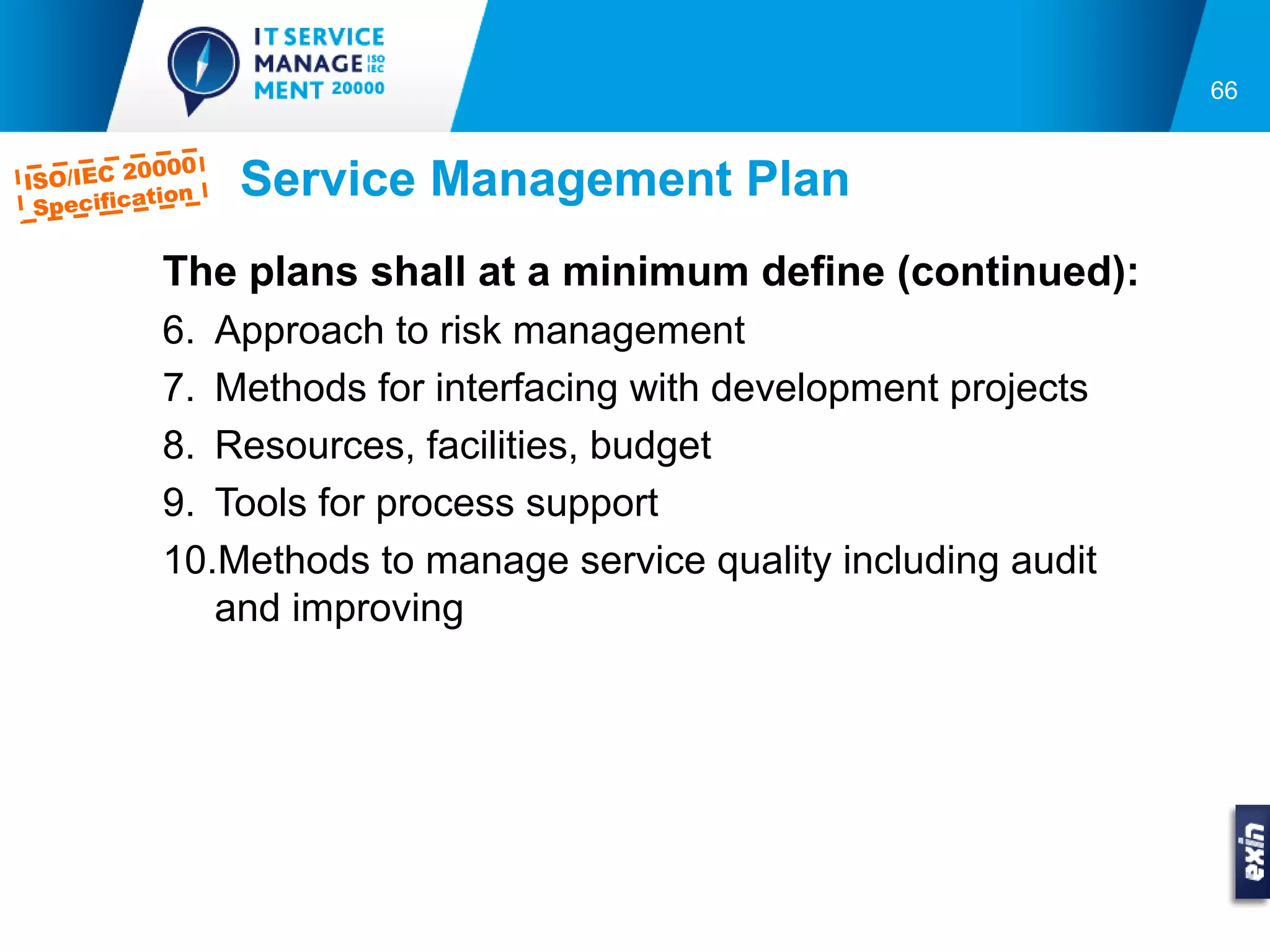
          tion   Service Management Plan
           The plans shall at a minimum define (continued):
           6. Approach to risk management
           7. Methods for interfacing with development projects
           8. Resources, facilities, budget
           9. Tools for process support
           10.Methods to manage service quality including audit
              and improving
67


           0000
C
 ISO/IEC 2
  ode of Pr
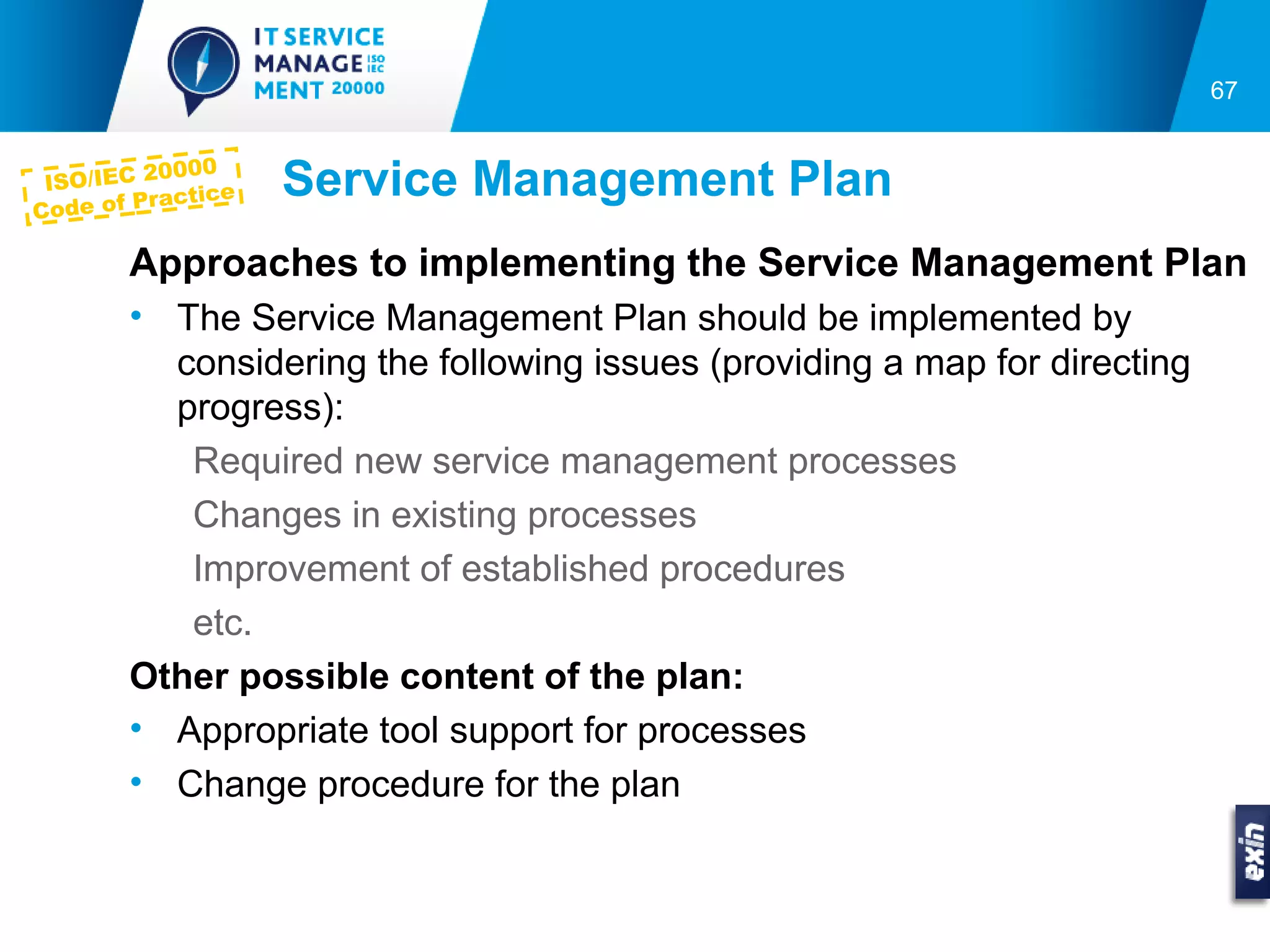
            actice   Service Management Plan
        Approaches to implementing the Service Management Plan
        • The Service Management Plan should be implemented by
          considering the following issues (providing a map for directing
          progress):
           Required new service management processes
           Changes in existing processes
           Improvement of established procedures
           etc.
        Other possible content of the plan:
        • Appropriate tool support for processes
        • Change procedure for the plan
68

               0000
     ISO/IEC 2
    Co de of Pra
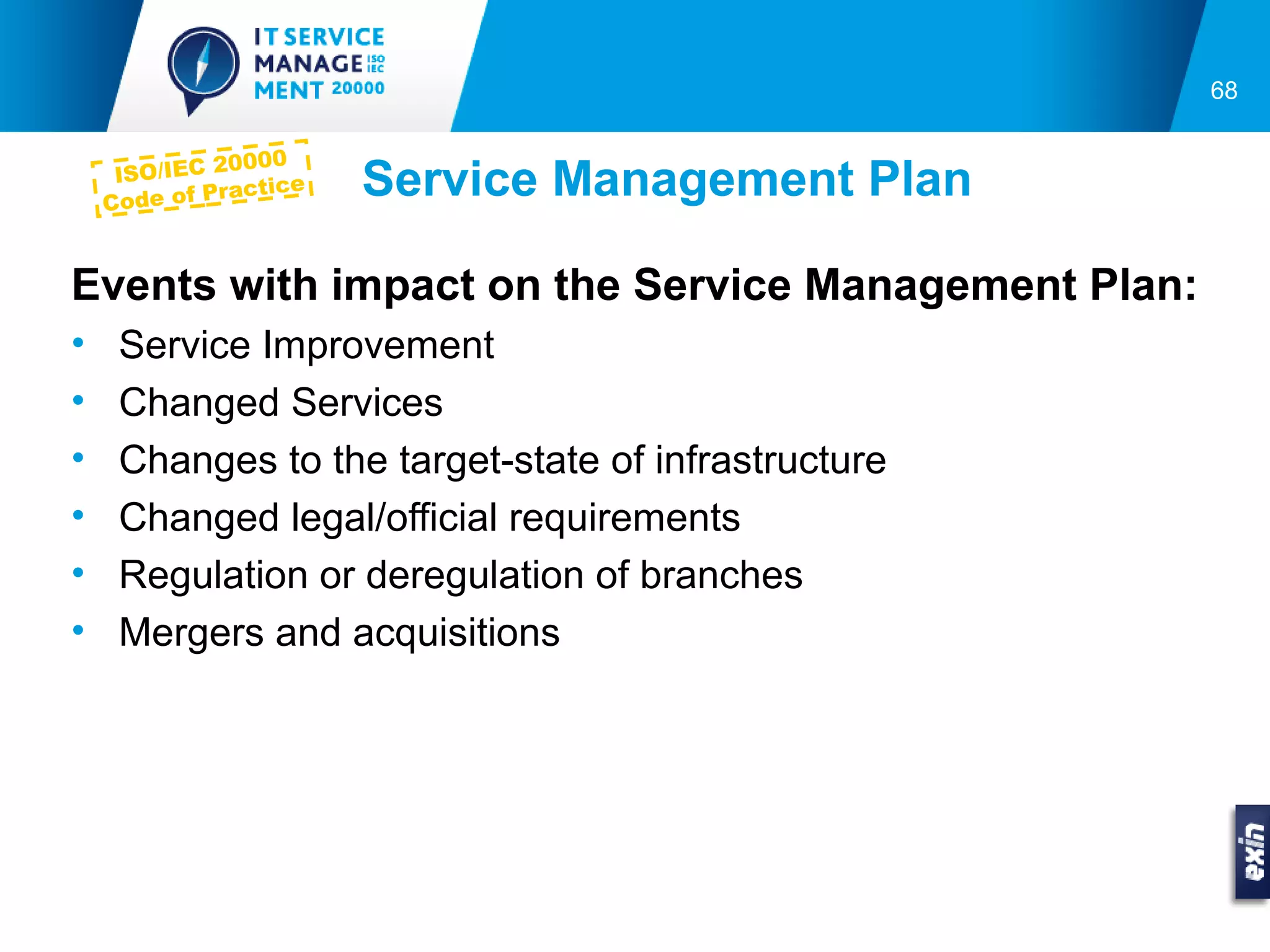
                ctice   Service Management Plan

Events with impact on the Service Management Plan:
•    Service Improvement
•    Changed Services
•    Changes to the target-state of infrastructure
•    Changed legal/official requirements
•    Regulation or deregulation of branches
•    Mergers and acquisitions
69


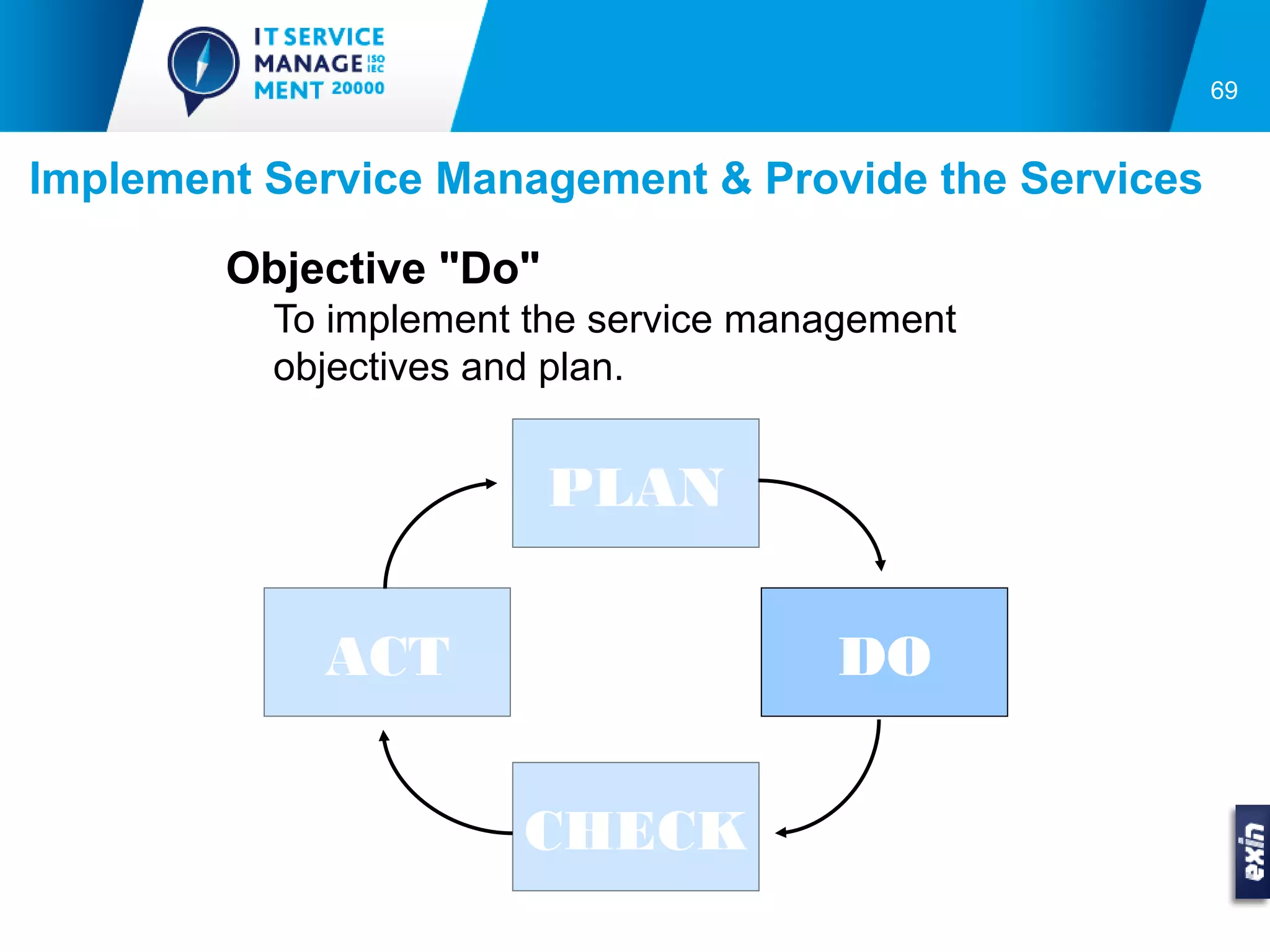
Implement Service Management & Provide the Services

        Objective "Do"
          To implement the service management
          objectives and plan.


                         PLAN

            ACT                       DO


                      CHECK
70

         0000
ISO/IEC 2
 Specifica
          tion   Implementing Service Management

            Implementing Service Management
            • Allocation of budgets
            • Allocation of roles and responsibilities
            • Documenting and maintaining policies, plans,
              procedures and definitions for each process
            • Identify and manage risks to the service
            • Managing teams (staff)
            • Managing facilities and budgets
            • Managing teams for service desk and operations
            • Reporting on progress of Service Management Plan
            • Co-ordination of service management processes
71


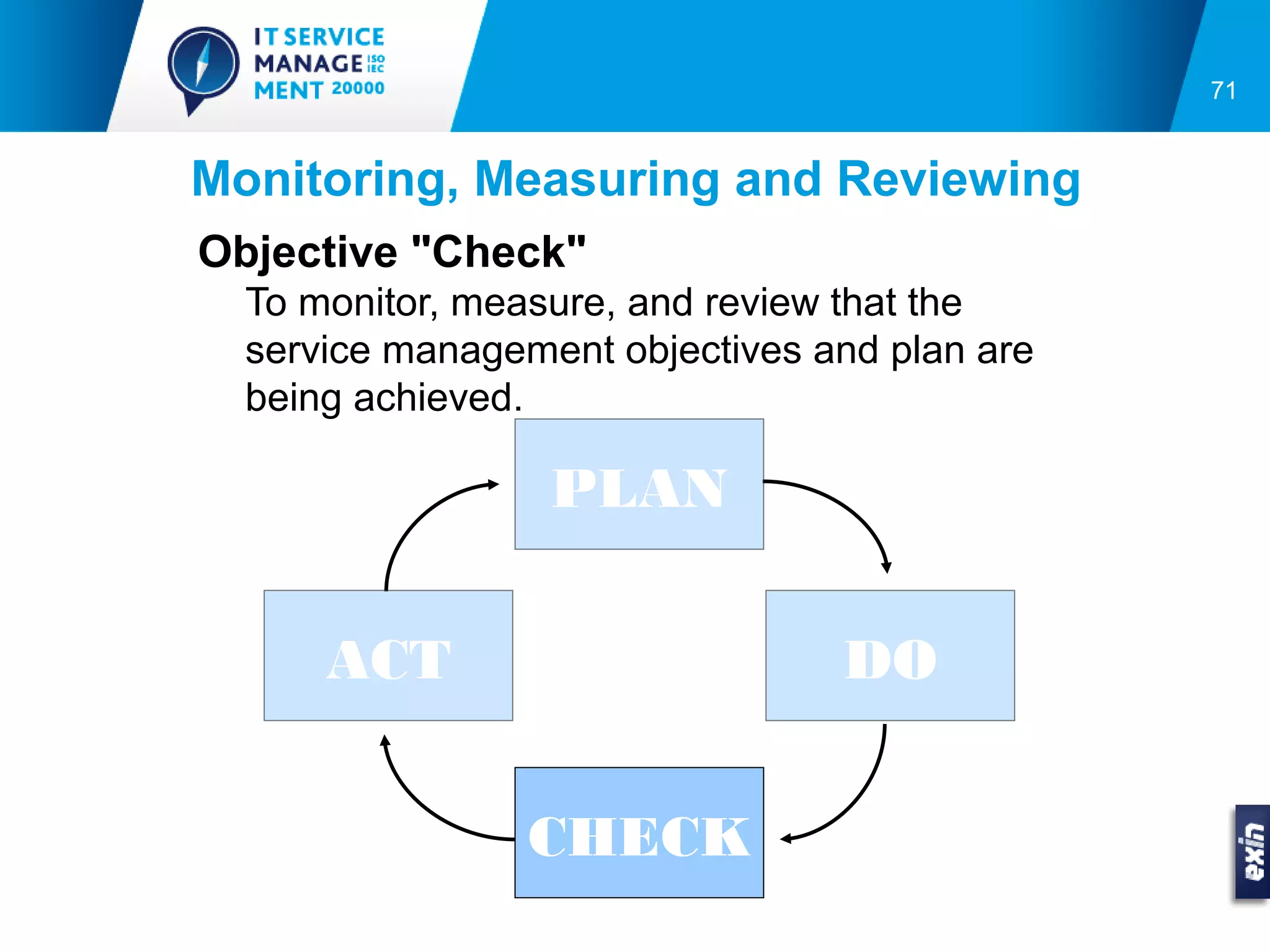
Monitoring, Measuring and Reviewing
Objective "Check"
  To monitor, measure, and review that the
  service management objectives and plan are
  being achieved.

                  PLAN


      ACT                        DO


                 CHECK
72

         0000
ISO/IEC 2
 Specifica
          tion    Achievement of Objectives
            •    Appropriate methods shall be applied for monitoring and
                 measuring processes to disclose achievement of targets.
            •    Management shall conduct reviews at planned intervals to
                 determine whether:
                    • Service management requirements conform with the
                      Service Management Plan and requirements of
                      ISO/IEC 20000
                    • Service management requirements are effectively
                      implemented and maintained
            •    An audit program shall be planned.
            •    Objectives of reviews, assessments and audits shall be
                 documented together with the results and detected
                 resolutions.
            •    In case of failure to fulfill obligations and other
                 problematical concerns, all relevant parties shall be
                 informed.
73


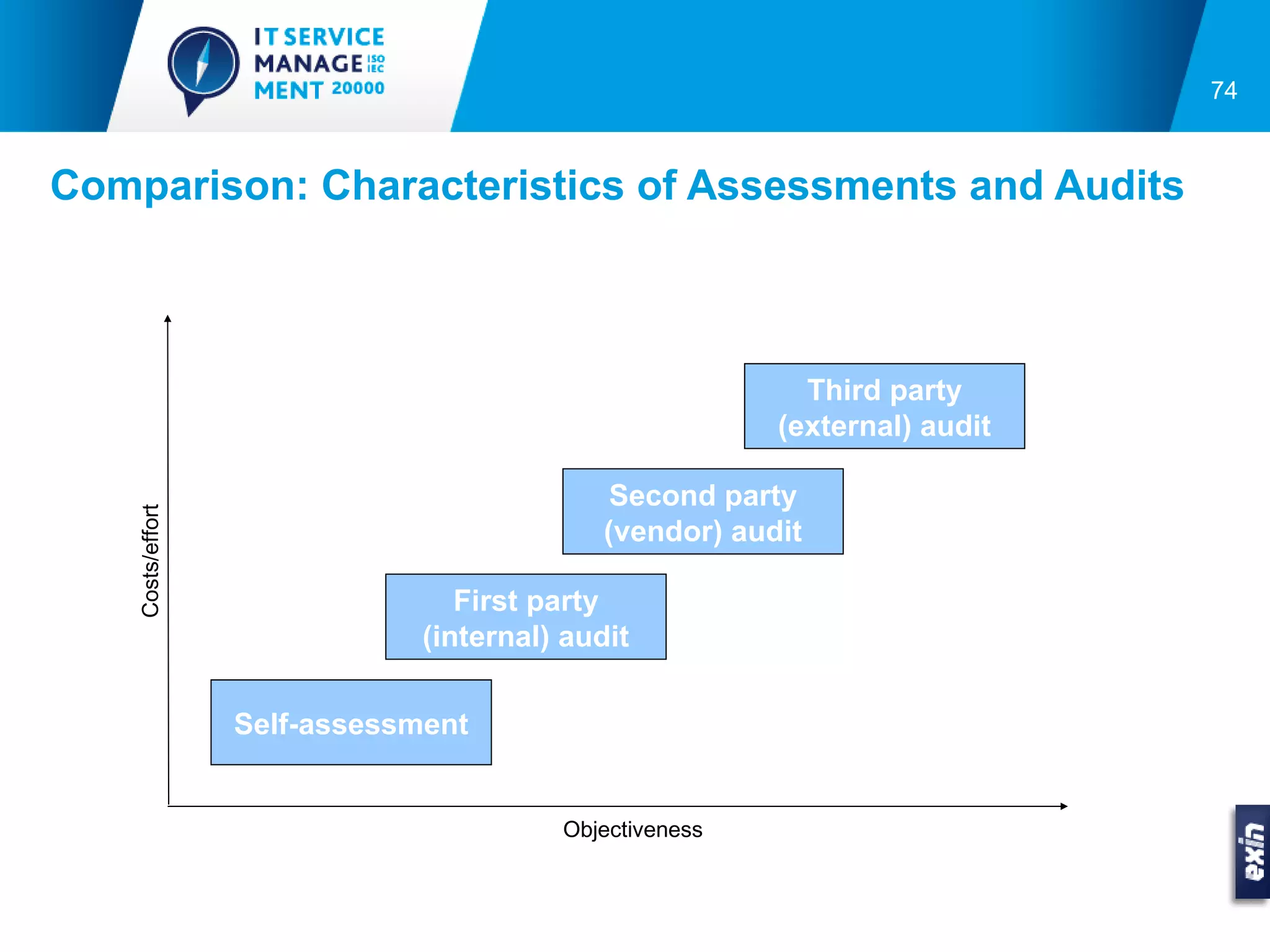
Characteristics of Assessments and Audits
 • Self-assessment
   e.g. a department assesses its own procedures
   Poor comparability, often not objective
 • First party (internal) audit
   Auditing is performed by a department within the
     organization
   Auditor belongs to same organization, but is not
     involved in audited department
 • Second party (vendor) audit
 • Third party (external) audit
   Auditing is performed by an independent external
     organization
   In the context of standard audits mostly a registered
     certified body (RCB).
74


Comparison: Characteristics of Assessments and Audits


                                                          Third party
                                                        (external) audit

                                             Second party
   Costs/effort


                                            (vendor) audit

                                 First party
                              (internal) audit

                  Self-assessment


                                        Objectiveness
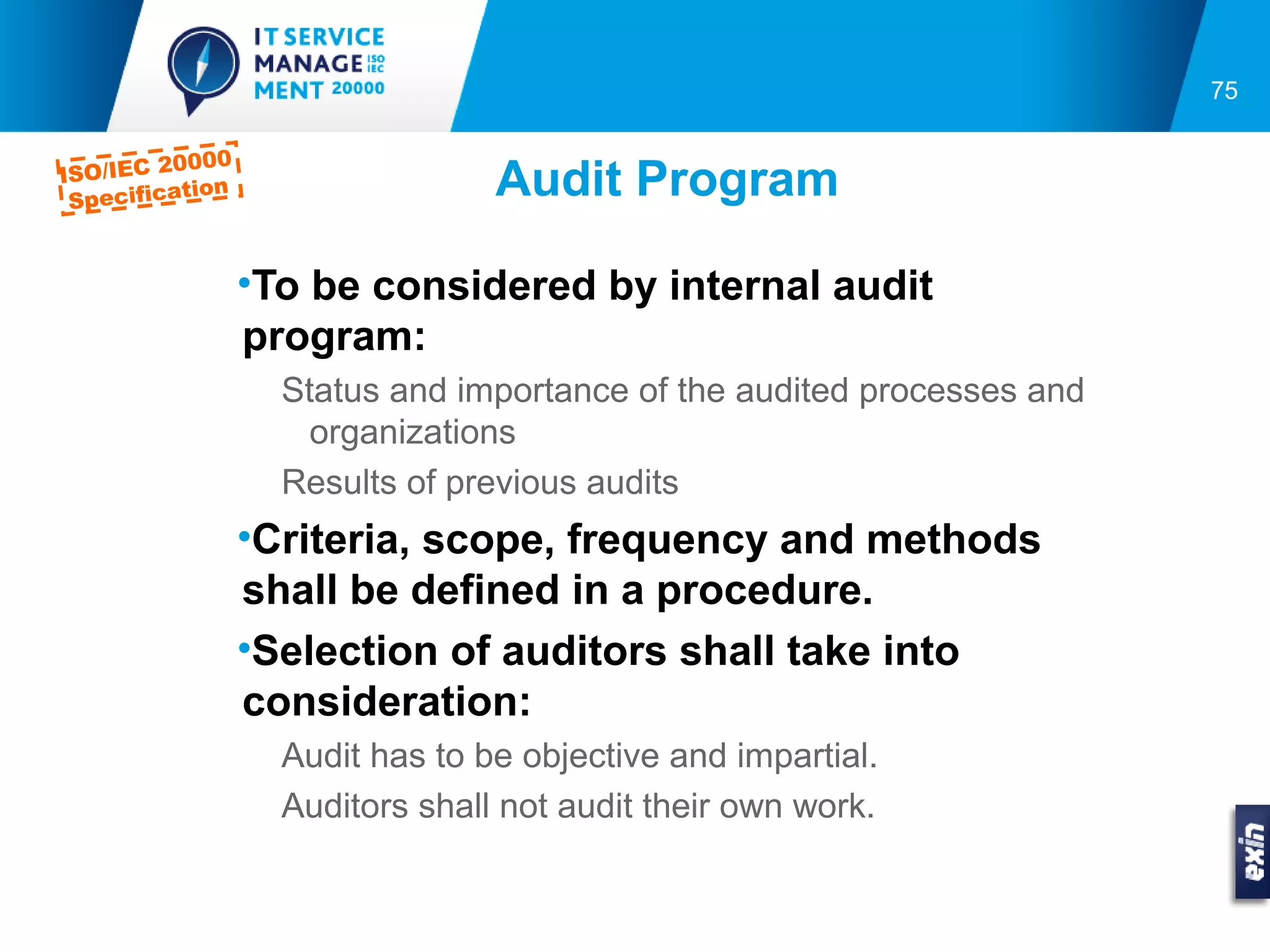
75

         0000
ISO/IEC 2
 Specifica
          tion                   Audit Program

                 •To be considered by internal audit
                 program:
                   Status and importance of the audited processes and
                     organizations
                   Results of previous audits
                 •Criteria, scope, frequency and methods
                 shall be defined in a procedure.
                 •Selection of auditors shall take into
                 consideration:
                   Audit has to be objective and impartial.
                   Auditors shall not audit their own work.
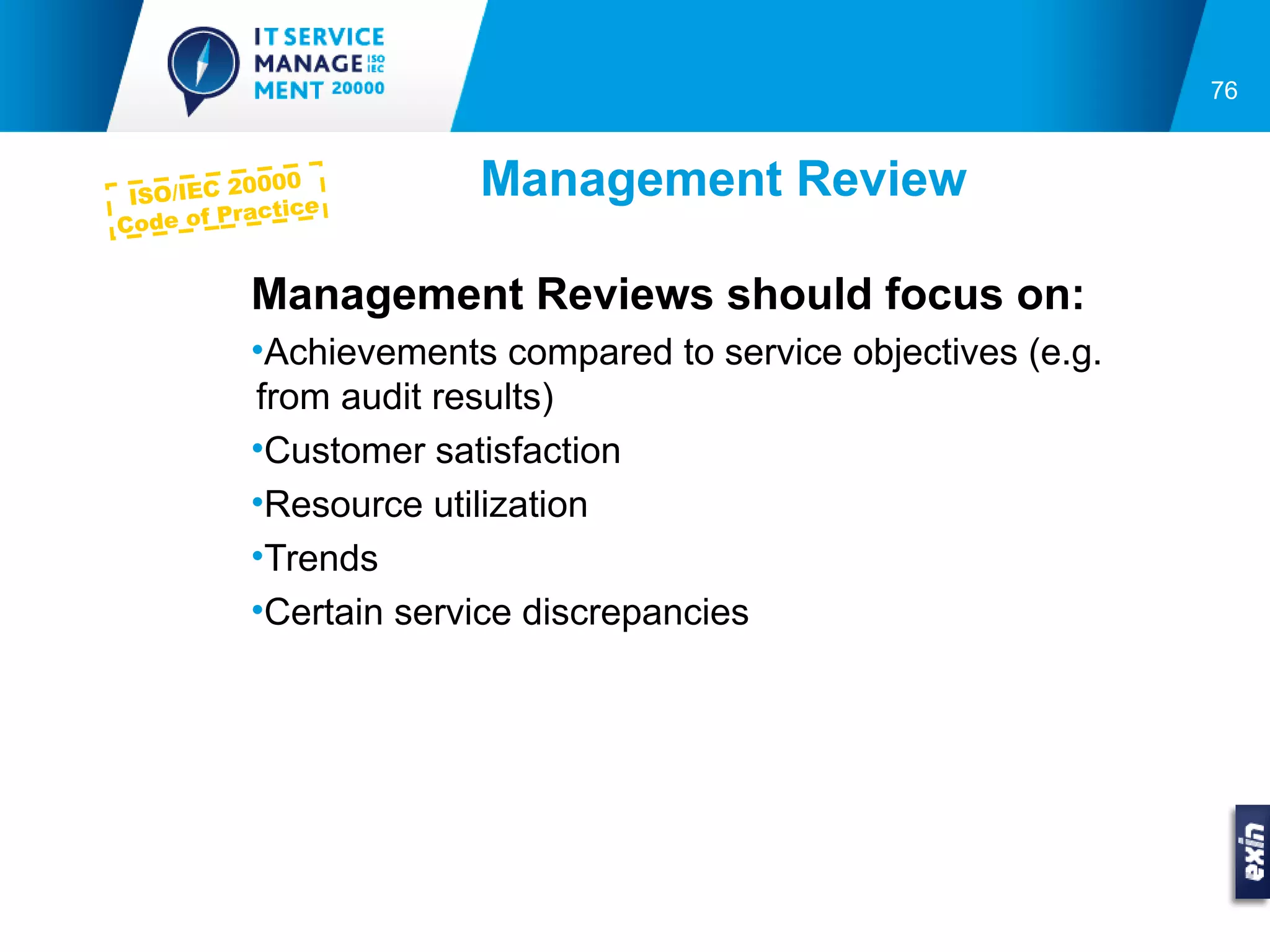
76


 ISO/IEC 2
           0000
            actice
                        Management Review
C ode of Pr


           Management Reviews should focus on:
           •Achievements compared to service objectives (e.g.
           from audit results)
           •Customer satisfaction
           •Resource utilization
           •Trends
           •Certain service discrepancies
77


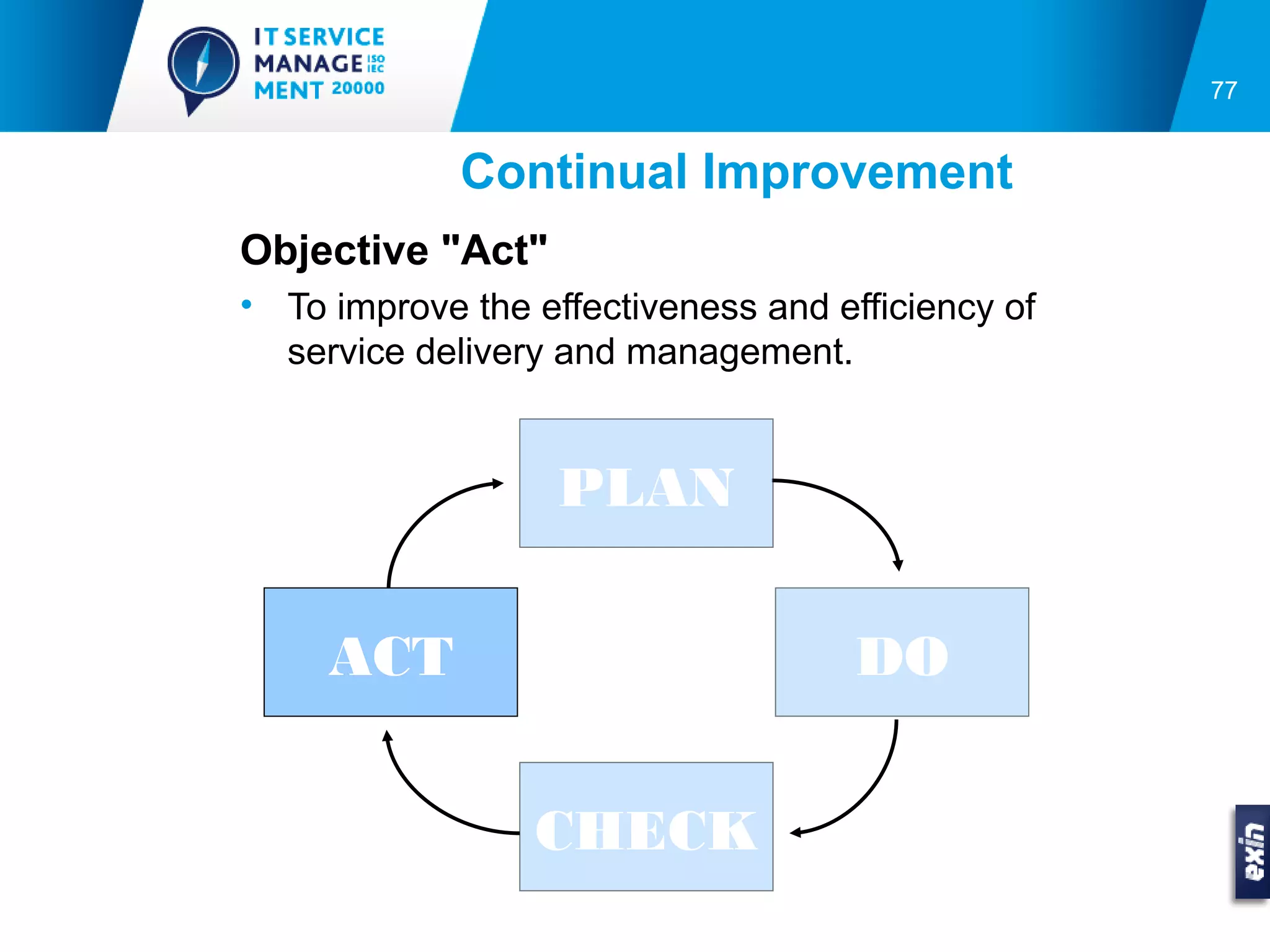
             Continual Improvement
Objective "Act"
• To improve the effectiveness and efficiency of
  service delivery and management.


                   PLAN

     ACT                             DO


                 CHECK
78


ISO/IEC 2
         0000
          tion
                             Policy
 Specifica


         •A published policy for service improvement is
         required.
         •Any non-compliance with ISO/IEC 20000 or with
         service management plan shall be remedied.
         •Roles and responsibilities for service
         improvement shall be defined clearly.
79


         0000
ISO/IEC 2
 Specifica
          tion        Management of Improvement

                 •All suggested service improvements shall be
                 evaluated, documented, prioritized and
                 authorized. Monitoring these activities shall be
                 planned.
                 •A specific process is required for continually
                 identifying, measuring, reporting and managing
                 improvement. This encompasses:
                   Improvements concerning individual processes that
                     can be implemented by process owner’s means
                   Organization-wide or cross-process improvements
80

           000
ISO/IEC 20 n
  pecific
         a ti o          Activities to be carried out
 S


                  • Information shall be recorded and analyzed as
                   a baseline and a benchmark against the
                   provider’s capability in managing services and
                   service management processes.
                  • Identify, plan, and implement improvements.
                  • Consultation with all involved parties.
                  • Set a goal for improvements regarding quality,
                   costs, resources.
81

         0000
ISO/IEC 2
 Specifica
          tion          Activities to be carried out

                 •  Consider relevant requests for improvement
                   of all services and management processes.
                 • Measure, report and communicate service
                   improvements.
                 • Revise service management policies,
                   processes, procedures and plans where
                   necessary.
                 • Ensure that all approved actions are
                   delivered and that they achieve their
                   intended objectives.
82


Section 5: Planning and Implementing Services

Objective:
 To ensure that new services and changes to services will be
 deliverable at the agreed cost and service quality.


 [1] Scope
 [2] Terms and Definitions
                                  Management responsibility
 [3] Management System            Documentation requirements
                                  Competencies, awareness & training
 [4] Planning & Implementing SM   Plan, Do, Check, Act

 [5] Planning & Implementing new or changed Services
83


       Learning target of this section
• Parties involved in planning new or changed services
  (3.2.1)
• Objective and purpose of planning and implementing
  new or changed services (3.2.2)
• Quality requirements for new or changed services (3.2.3)
• Content of an implementation plan for new or changed
  services (3.2.4)
• Planning and implementation policy for new or changed
  services (4.1.4)
• Reviews for planning new or changed services (4.2.1)
• Records for service changes (4.2.2)
84


            000
ISO/IEC 20
  Specifica
           tion      Minimum Requirements
       • The costs, commercial and organizational impact of any
         proposed new or changed services shall be considered by
         operations and management of these services.
       • New or changed services, including closure of service,
         shall be planned and authorized/approved through change
         management.
       • Planning of new/changed services shall consider aspects
         of funding and allocation of resources.
       • New/changed services require acceptance by service
         provider before deployment to live environment.
       • Post implementation review (including target-performance
         comparison) through change management process.
85


Implementation Plans for New/Changed Services
          0000
ISO/IEC 2
           tion
 Specifica

             Implementation plans for new/changed
               services comprises at least:
             • Roles and responsibilities for implementing,
               operating and managing (as well at the customer and
               at vendor)
             • Required changes to existing services and systems
             • Communication to the stakeholders
             • New and changed contracts and agreements
             • Manpower requirements
             • Skills and training requirements
86


Implementation Plans for new/changed Services
         0000
ISO/IEC 2
            ion
 Specificat

        Implementation plans for new/changed services
          consists of at least (continued):
        • Processes, measures, methods, and tools to be used in
          connection with the new/changed service
        • Budgets and timelines
        • Service Acceptance Criteria
        • The expected outcomes from operating the new service
          expressed in measurable terms
87


ISO/IEC 2
         0000
                   PINCS: Involved Parties
          tion
 Specifica


 • Roles and responsibilities related to the service need
   to be defined, including activities to be performed by:
           Customers
           Suppliers
           Service Provider


 Implementation via Change Management

 Skills and training requirements for:
           Users
           Technical support of the service
88


    Reviews at planning new or changed services
                      During planning new/changed services, the
             0 00 e     following should be reviewed:
          20 ctic
  O
       C a
    /IE f Pr          • Budget – Adjustment of budgeting required?
IS e o
   d                     Increased financial requirements through new
Co
                          services?
                         Reduction of costs through changes or replacement
                          of expensive services?
                      • Staff – Is existing staff able to provide/support
                        new/changed services?
                         Increased headcount (e.g. at support)?
                         Possible personnel consolidation through
                          new/changed services?
                      • Service Levels – Impact on existing service
                        levels?
89


   Reviews for planning new or changed services
            During planning new/changed services the
          0
        00 e
              following should be reviewed (continued):
        20 ic
      C ract    • SLA’s and other commitments
    IE
  O/ of P
IS e
  d
Co                 Changing existing or concluding new SLA’s required?
                   Other commitments?
                • Processes, procedures and documentation
                   Changing existing processes and procedures required (e.g.
                   at support)?
                   Changed services require new documentation or update of
                   existing documents?
                • Scope of Service Management
                   New or not yet implemented service management
                   processes required?
                   Service Management Plans update required?
90


              Change Records of Changed Services
                   All changes to existing services should be
                      documented in relevant change records.
             0
           00 ce
         20 ct i   • Staff training - conducted update training for
       C
  O /IE Pra
IS e of
Co
   d                  support staff
                   • Move or transfer
                   • Conducted user training
                   • Any change-related communication
                   • Changes to supporting technologies (e.g.
                      system components, software)
                   • Closure of services
91


                          Content of ISO/IEC 20000
                                   Part 2:
            IT Service Management Processes
                                    (section 6 - 10)

                          [6] Service Delivery Processes
                               Service Level Management
Capacity Management                 Service Reporting      Information Security Management

Service Continuity &                                               Budgeting & Accounting
Availability Management
                              [9] Control Processes                         for IT services
                                Configuration Management
[10] Release                      Change Management                [7] Relationship
Process                                                                 Processes
                            [8] Resolution Processes                 Business Relationship
                                 Incident Management                          Management
Release Management
                                 Problem Management                  Supplier Management
92


             Section 8: Resolution Processes
About the process group
        Incident and Problem Management are closely related
processes but differ in their objectives. These processes are covered
in the Professional module Support of IT Services within the ISO/IEC
20000 Qualification Program.
                   [6] Service Delivery Processes
                             Service Level Management
Capacity Management               Service Reporting   Information Security Management

Service Continuity &                                           Budgeting & Accounting
Availability Management
                            [9] Control Processes                       for IT services
                             Configuration Management
[10] Release                   Change Management                [7] Relationship
Process                                                              Processes
                          [8] Resolution Processes               Business Relationship
                               Incident Management                        Management
Release Management
                               Problem Management                Supplier Management
93


Learning target of this section
• Objectives and requirements within
  Incident Management (3.5.1)
• Best Practices within Incident
  Management (4.5.1)
• Objectives and requirements within
  Problem Management (3.5.2)
• Best Practices within Problem
  Management (4.5.2)
94


             00
IS
       C 2 00 ce
   O/IE Practi      Code of Practice
      of
Code
    Classification Incident vs. Problem Management
    • Incident Management: Quickest possible service
      recovery
    • Problem Management: Root cause identification and
      resolution

    Similarities and connections between Incident and
      Problem Management
    • Prioritization of Incidents and Problems
    • Problem Management develops and maintains work-
      arounds provided to Incident Management.
95


      ISO/IEC 20000
     Code of Practice   Code of Practice
Aspects to consider scheduling Incidents and
  Problems
• Priority: Control factor resulting from
    Impact
    Urgency
•   Staff skills
•   Competing requests for resource allocation
•   Costs of implementing the resolution
•   Approximated time to implement the resolution
96


                          Incident Management

Objective:
Resolve incidents as quickly as possible and minimize the
adverse impact on business operations.
                          [6] Service Delivery Processes
                               Service Level Management
Capacity Management                 Service Reporting   Information Security Management

Service Continuity &                                             Budgeting & Accounting
Availability Management
                              [9] Control Processes                       for IT services
                                Configuration Management
[10] Release                      Change Management               [7] Relationship
Process                                                                Processes
                            [8] Resolution Processes               Business Relationship
                                 Incident Management                        Management
Release Management
                                  Problem Management               Supplier Management
97


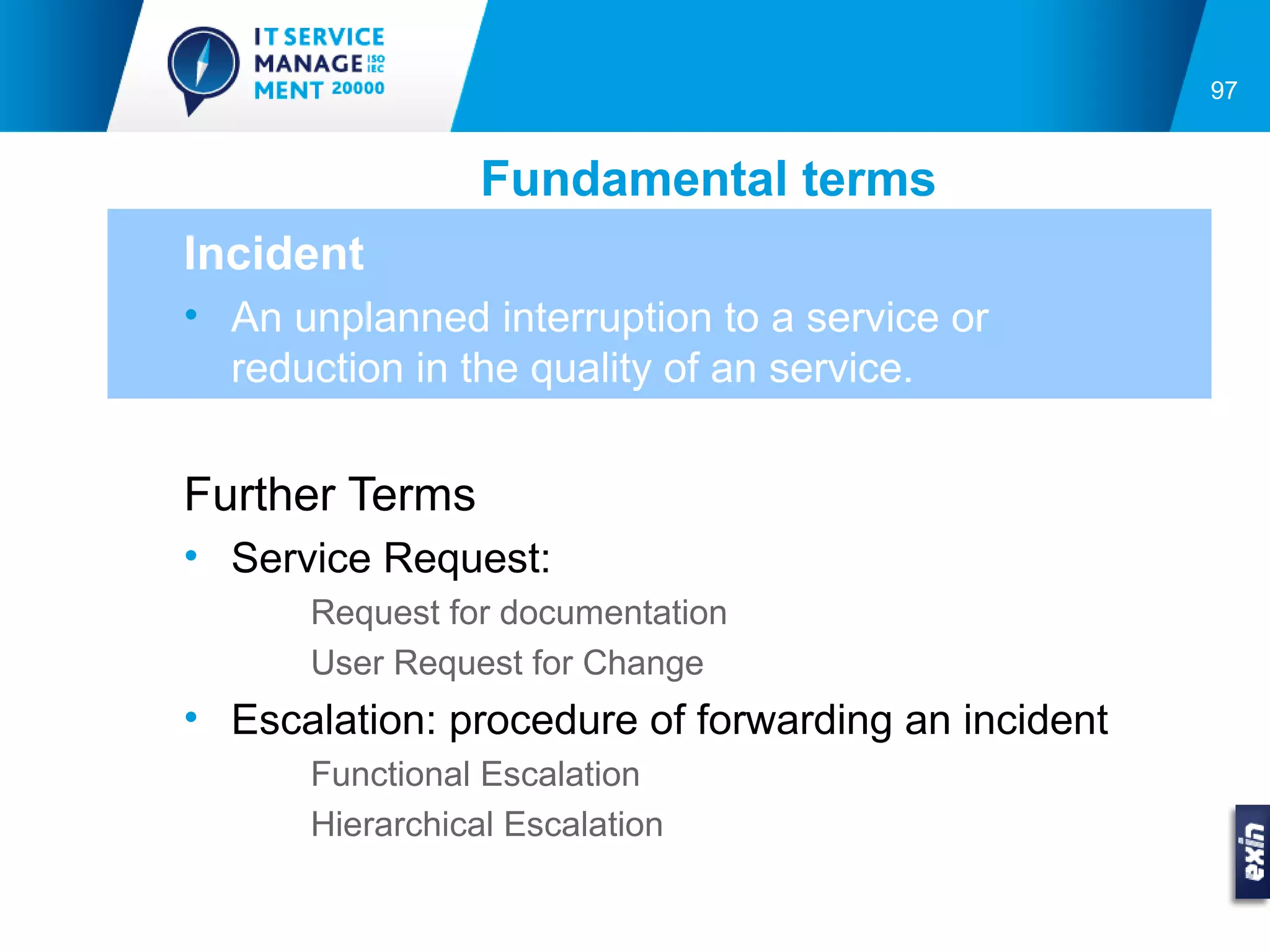
                 Fundamental terms
Incident
• An unplanned interruption to a service or
  reduction in the quality of an service.


Further Terms
• Service Request:
      Request for documentation
      User Request for Change
• Escalation: procedure of forwarding an incident
      Functional Escalation
      Hierarchical Escalation
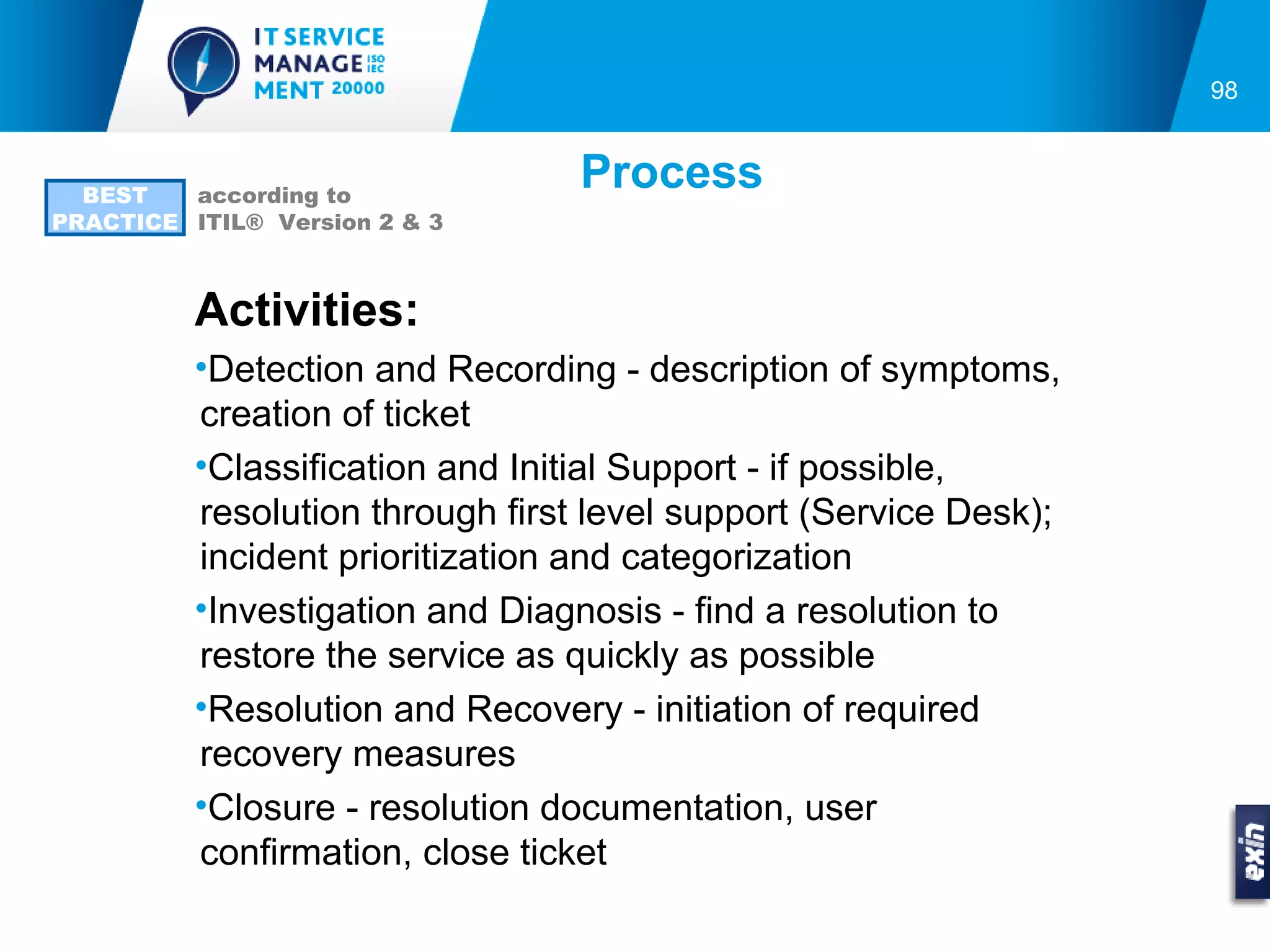
98


  BEST   according to
                                  Process
PRACTICE ITIL® Version 2 & 3


          Activities:
          •Detection and Recording - description of symptoms,
          creation of ticket
          •Classification and Initial Support - if possible,
          resolution through first level support (Service Desk);
          incident prioritization and categorization
          •Investigation and Diagnosis - find a resolution to
          restore the service as quickly as possible
          •Resolution and Recovery - initiation of required
          recovery measures
          •Closure - resolution documentation, user
          confirmation, close ticket
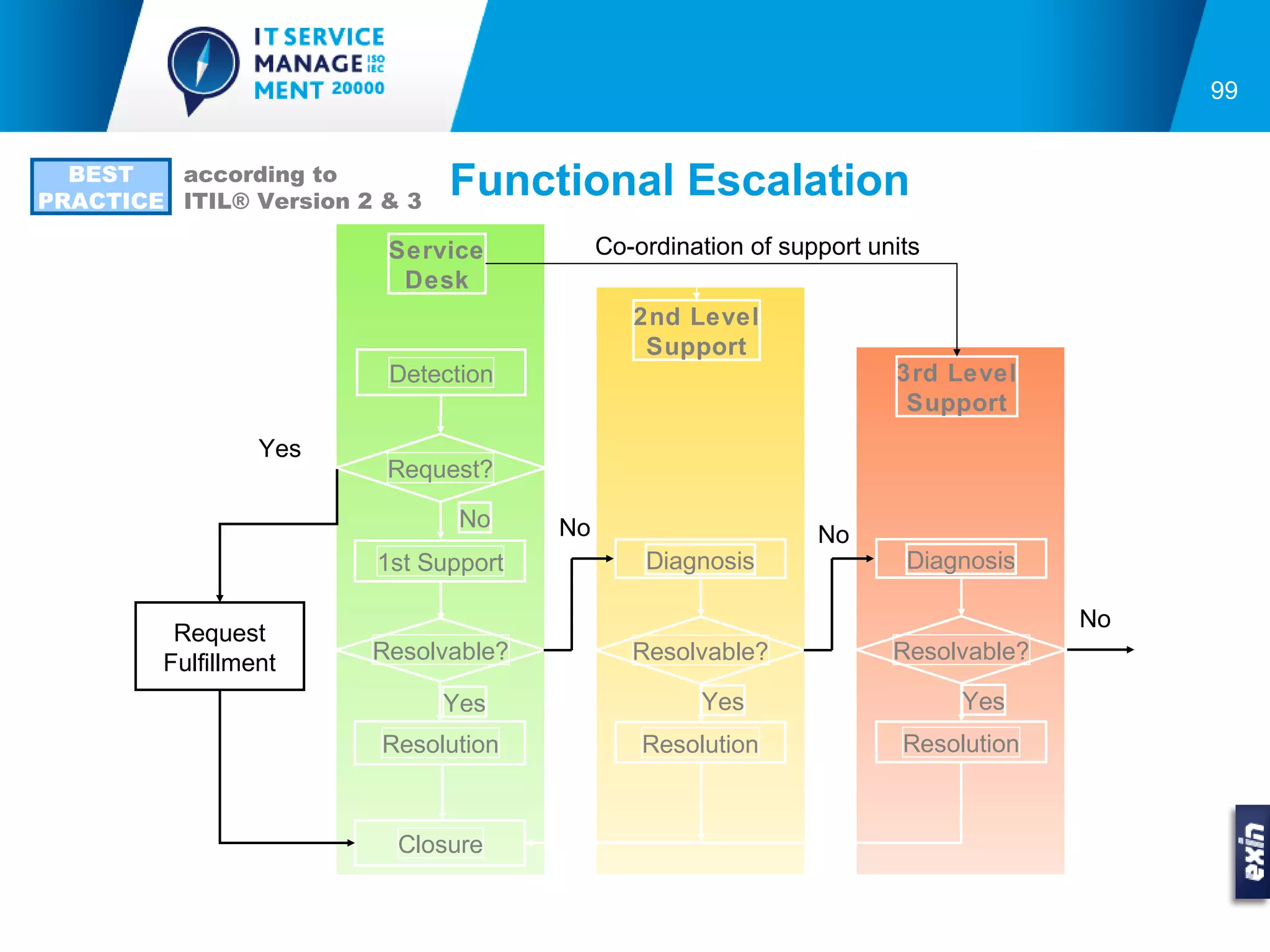
99


  BEST   according to
PRACTICE ITIL® Version 2 & 3
                               Functional Escalation
                         Service           Co-ordination of support units
                          Desk
                                              2nd Level
                                               Support
                         Detection                                    3rd Level
                                                                       Support
                  Yes
                         Request?

                                No    No                       No
                        1st Support            Diagnosis               Diagnosis

                                                                                    No
          Request
         Fulfillment    Resolvable?           Resolvable?             Resolvable?

                               Yes                  Yes                     Yes
                         Resolution            Resolution              Resolution


                          Closure
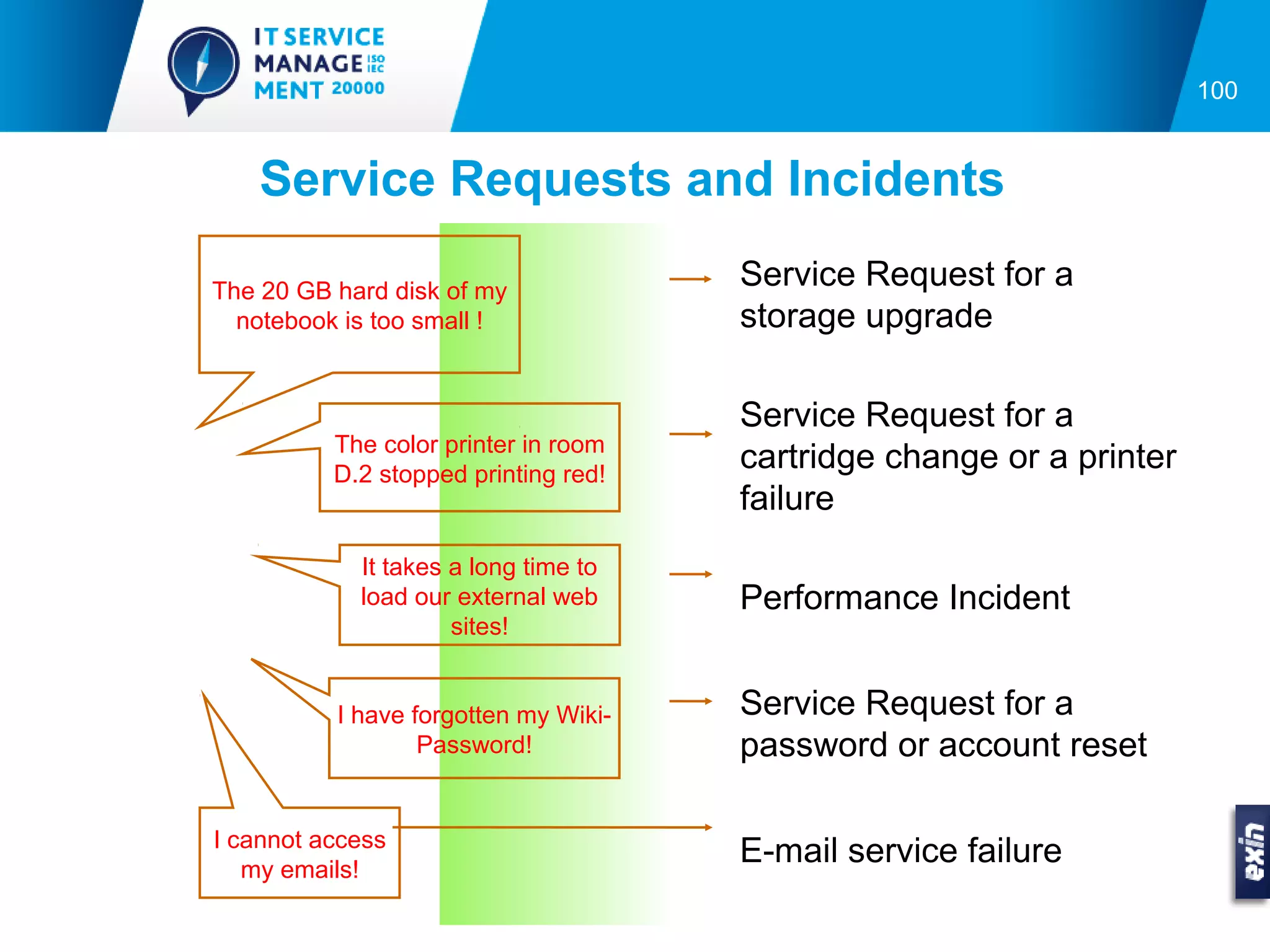
100


    Service Requests and Incidents

The 20 GB hard disk of my
                                      Service Request for a
  notebook is too small !             storage upgrade

                                      Service Request for a
          The color printer in room
          D.2 stopped printing red!
                                      cartridge change or a printer
                                      failure
            It takes a long time to
            load our external web     Performance Incident
                     sites!


          I have forgotten my Wiki-   Service Request for a
                  Password!           password or account reset

I cannot access
   my emails!
                                      E-mail service failure
101


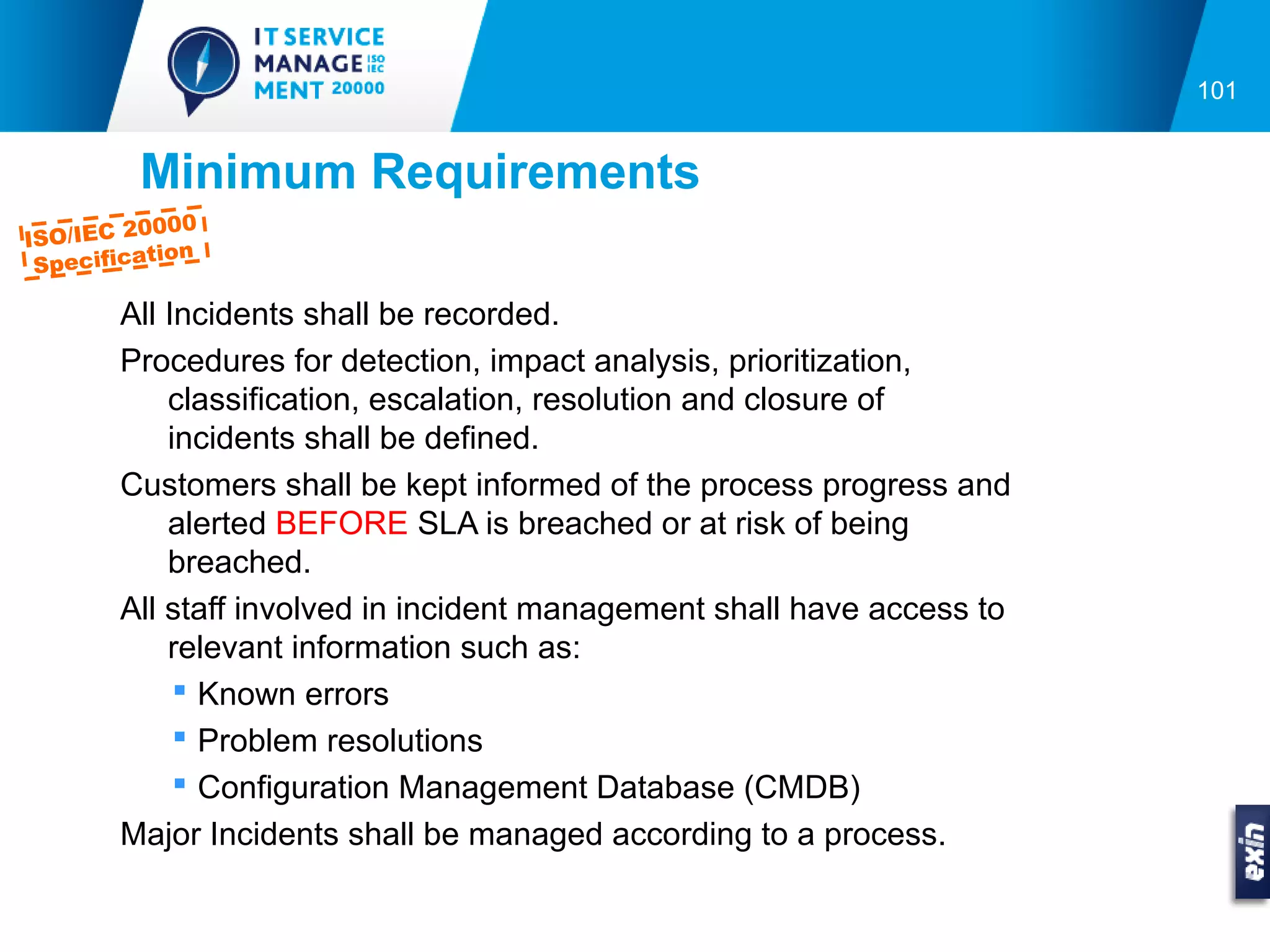
         Minimum Requirements
          0000
ISO/IEC 2
           tion
 Specifica

        All Incidents shall be recorded.
        Procedures for detection, impact analysis, prioritization,
            classification, escalation, resolution and closure of
            incidents shall be defined.
        Customers shall be kept informed of the process progress and
            alerted BEFORE SLA is breached or at risk of being
            breached.
        All staff involved in incident management shall have access to
            relevant information such as:
              Known errors
              Problem resolutions
              Configuration Management Database (CMDB)
        Major Incidents shall be managed according to a process.
102


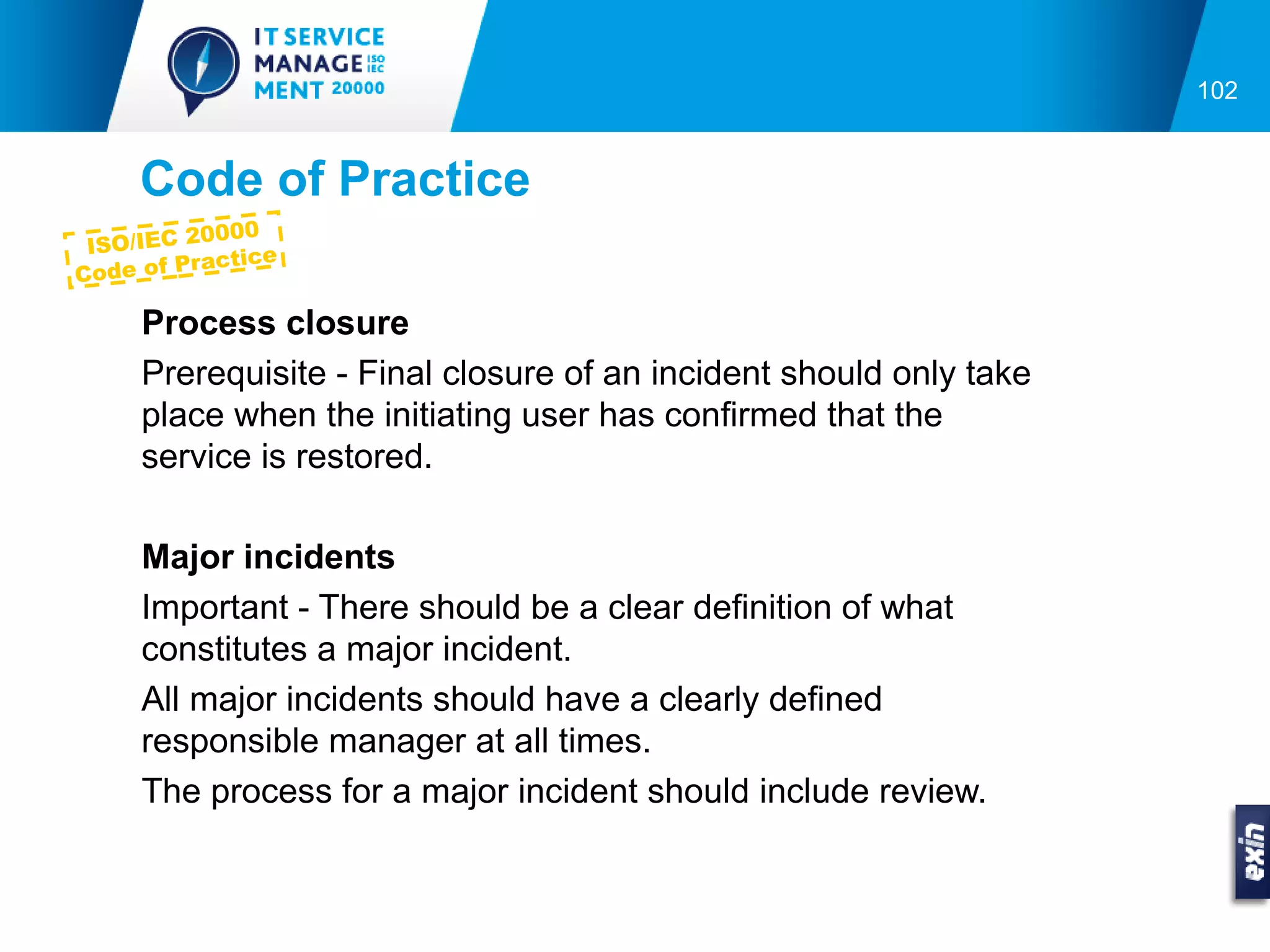
     Code of Practice
              00
 ISO/IEC 200
            actice
C ode of Pr

     Process closure
     Prerequisite - Final closure of an incident should only take
     place when the initiating user has confirmed that the
     service is restored.

     Major incidents
     Important - There should be a clear definition of what
     constitutes a major incident.
     All major incidents should have a clearly defined
     responsible manager at all times.
     The process for a major incident should include review.
103


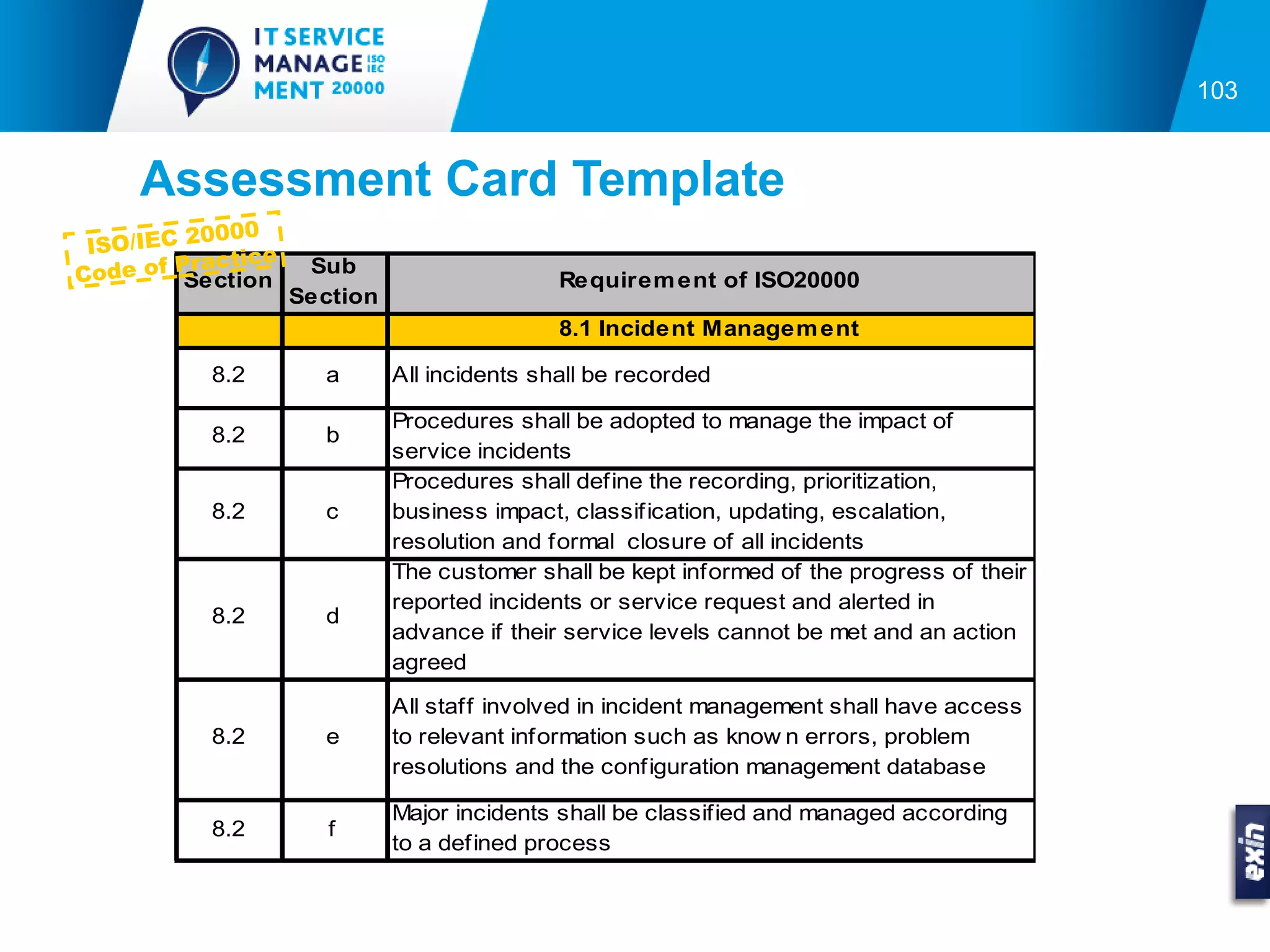
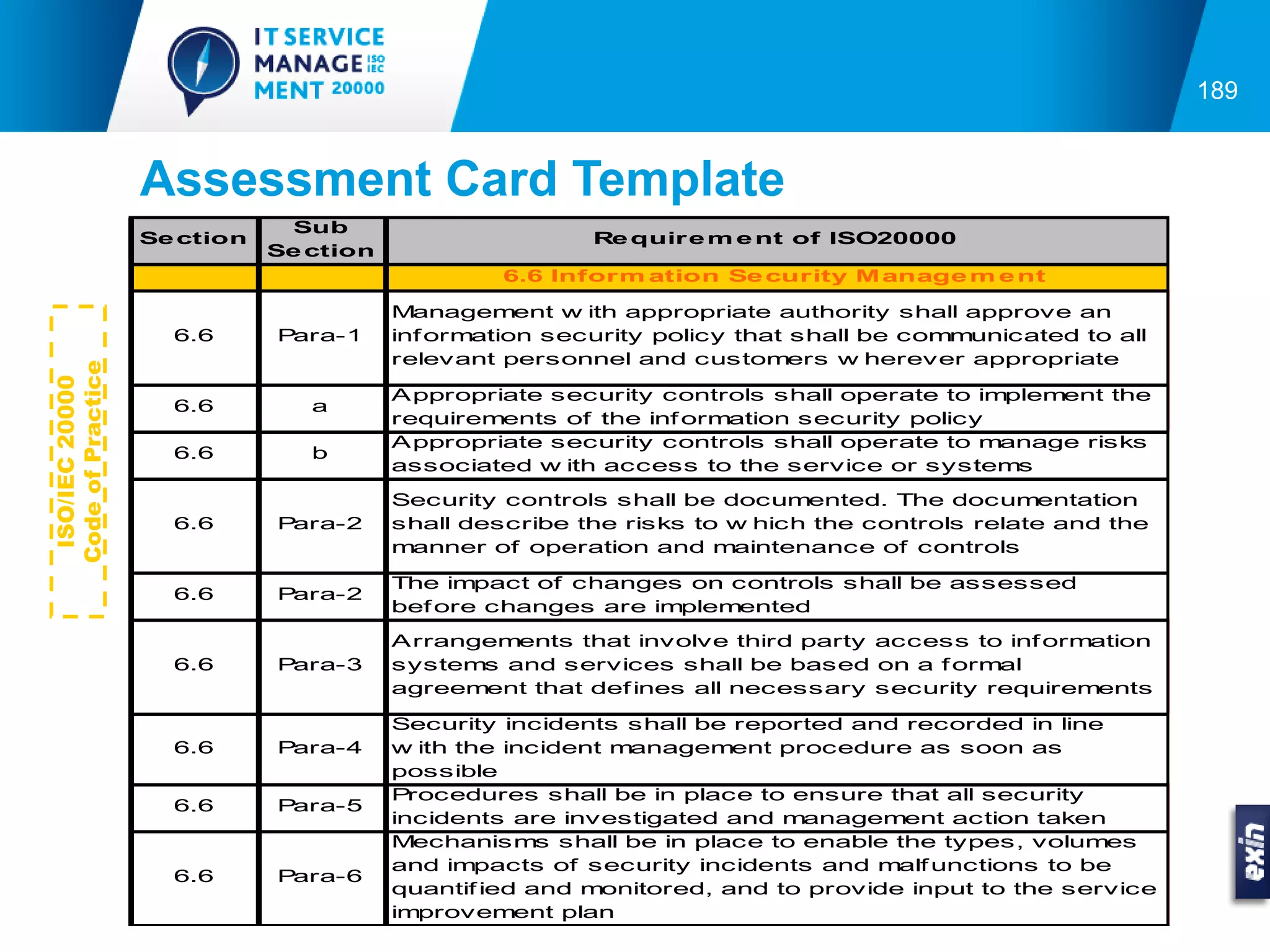
     Assessment Card Template
              00
 ISO/IEC 200
            actice
C ode of Pr
          Section
                      Sub
                                               Requirem ent of ISO20000
                     Section
                                               8.1 Incident Managem ent

            8.2        a       All incidents shall be recorded

                               Procedures shall be adopted to manage the impact of
            8.2        b
                               service incidents
                               Procedures shall define the recording, prioritization,
            8.2        c       business impact, classification, updating, escalation,
                               resolution and formal closure of all incidents
                               The customer shall be kept informed of the progress of their
                               reported incidents or service request and alerted in
            8.2        d
                               advance if their service levels cannot be met and an action
                               agreed

                               All staff involved in incident management shall have access
            8.2        e       to relevant information such as know n errors, problem
                               resolutions and the configuration management database

                               Major incidents shall be classified and managed according
            8.2         f
                               to a defined process
104


Problem Management
 Objective:
 To avoid disruption by proactive and reactive analysis of the cause of
 potential incidents.


                          [6] Service Delivery Processes
                               Service Level Management
Capacity Management                 Service Reporting   Information Security Management

Service Continuity &                                             Budgeting & Accounting
Availability Management
                              [9] Control Processes                       for IT services
                                Configuration Management
[10] Release                      Change Management               [7] Relationship
Process                                                                Processes
                            [8] Resolution Processes               Business Relationship
                                  Incident Management                       Management
Release Management
                                 Problem Management                Supplier Management
105


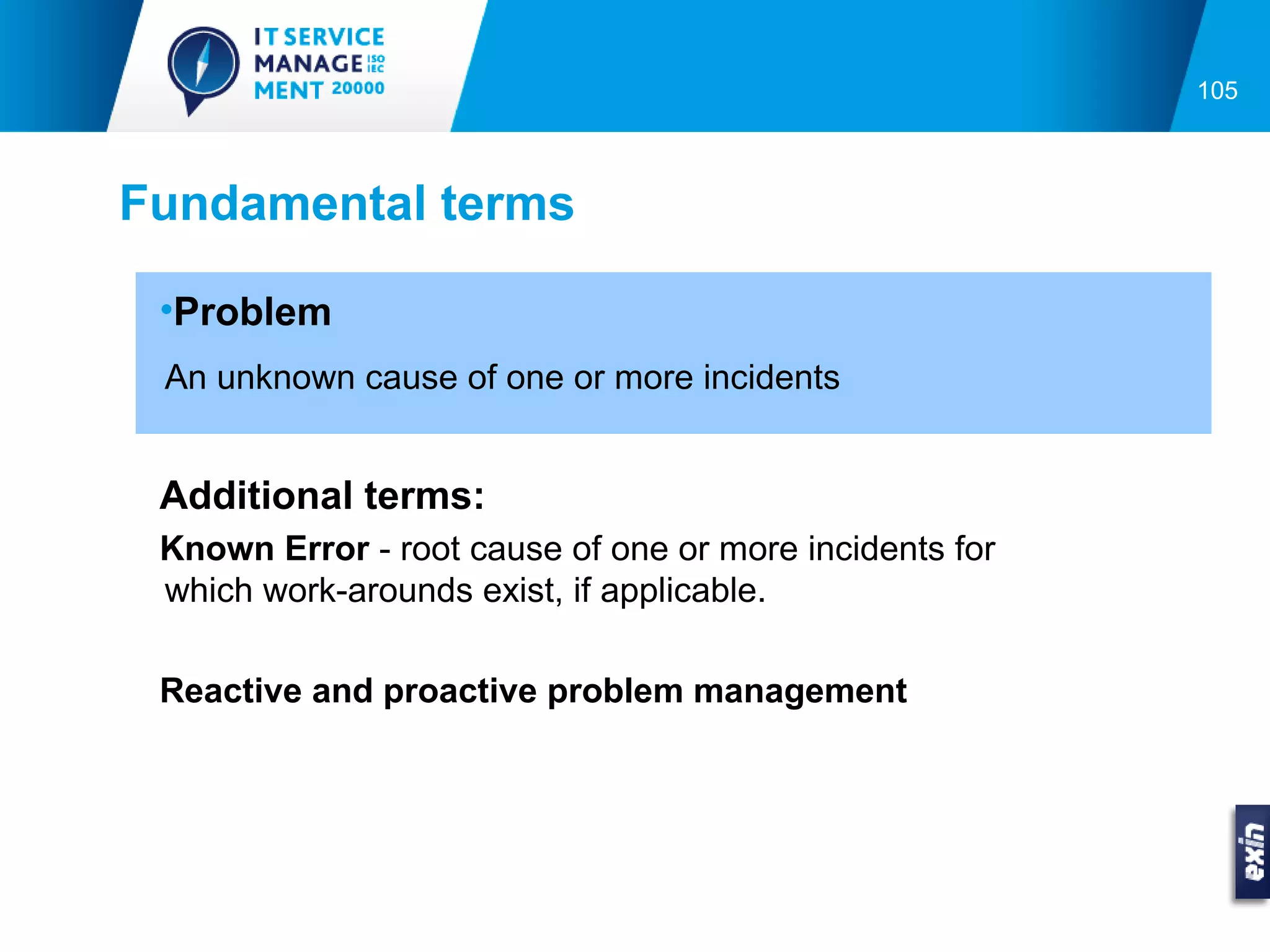
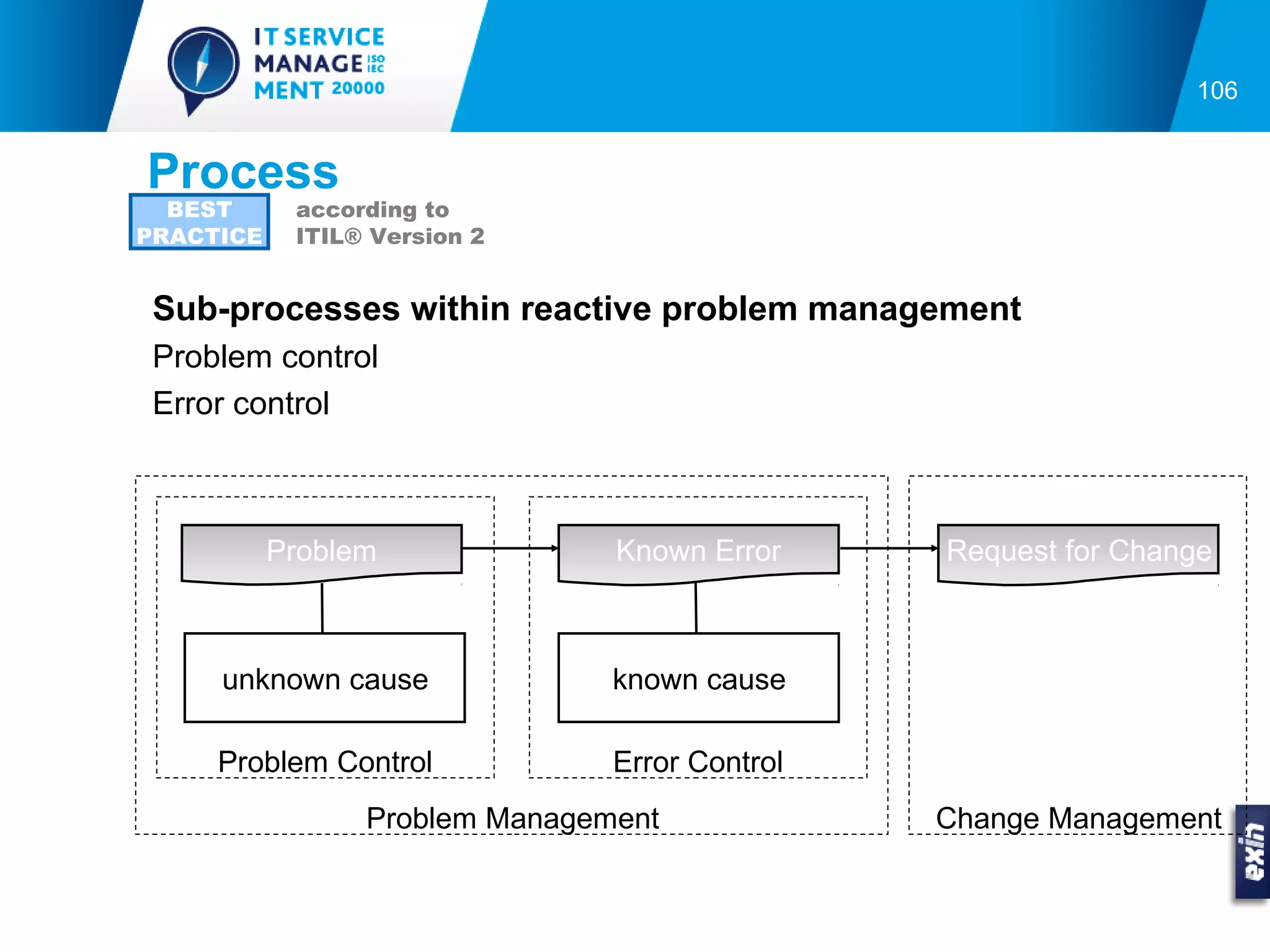
Fundamental terms

 •Problem
 An unknown cause of one or more incidents


 Additional terms:
 Known Error - root cause of one or more incidents for
 which work-arounds exist, if applicable.

 Reactive and proactive problem management
106


Process
  BEST      according to
PRACTICE    ITIL® Version 2


 Sub-processes within reactive problem management
 Problem control
 Error control


           Problem              Known Error     Request for Change


     unknown cause              known cause

     Problem Control            Error Control
                 Problem Management             Change Management
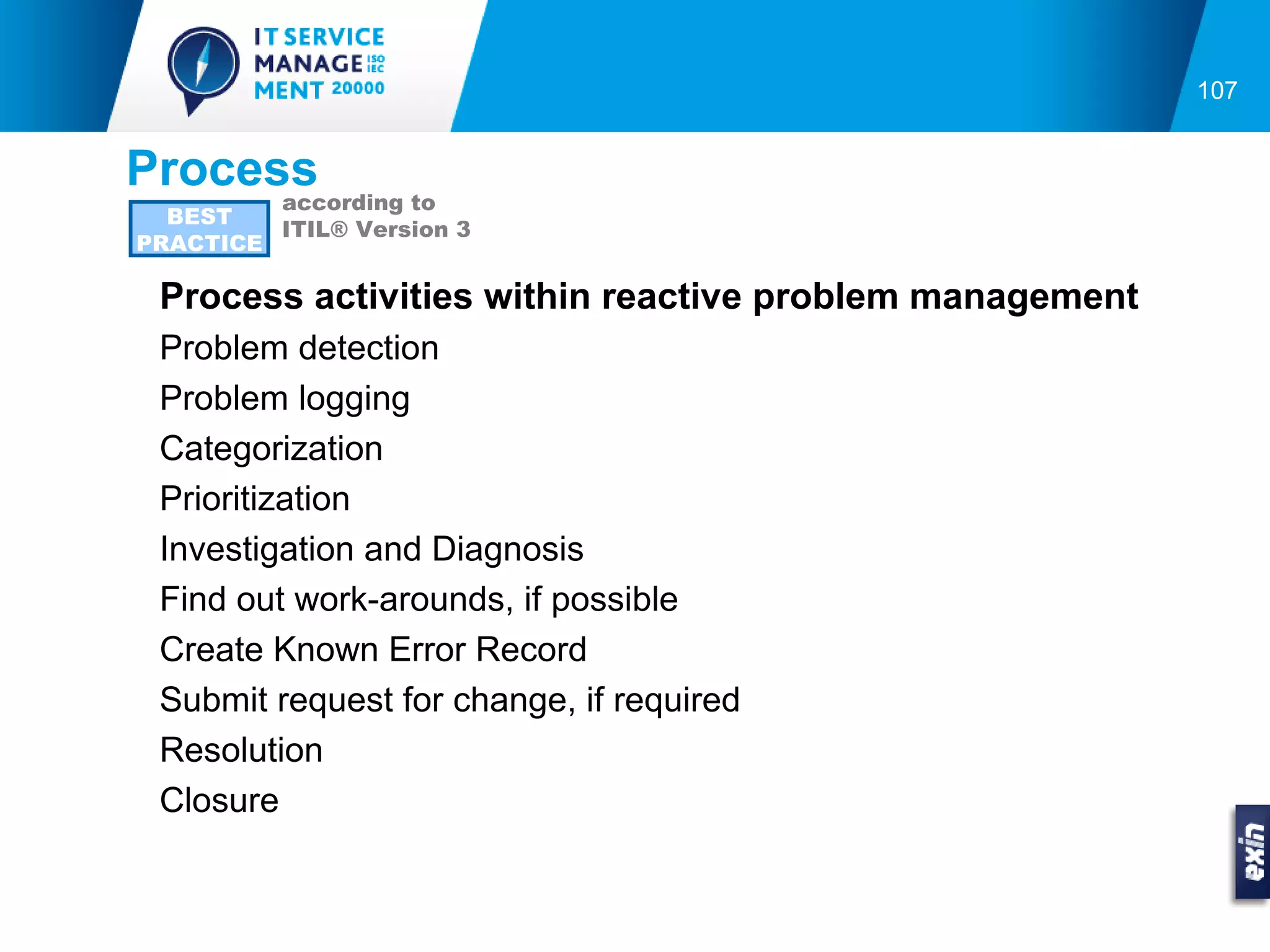
107


Process
         according to
  BEST
         ITIL® Version 3
PRACTICE

 Process activities within reactive problem management
 Problem detection
 Problem logging
 Categorization
 Prioritization
 Investigation and Diagnosis
 Find out work-arounds, if possible
 Create Known Error Record
 Submit request for change, if required
 Resolution
 Closure
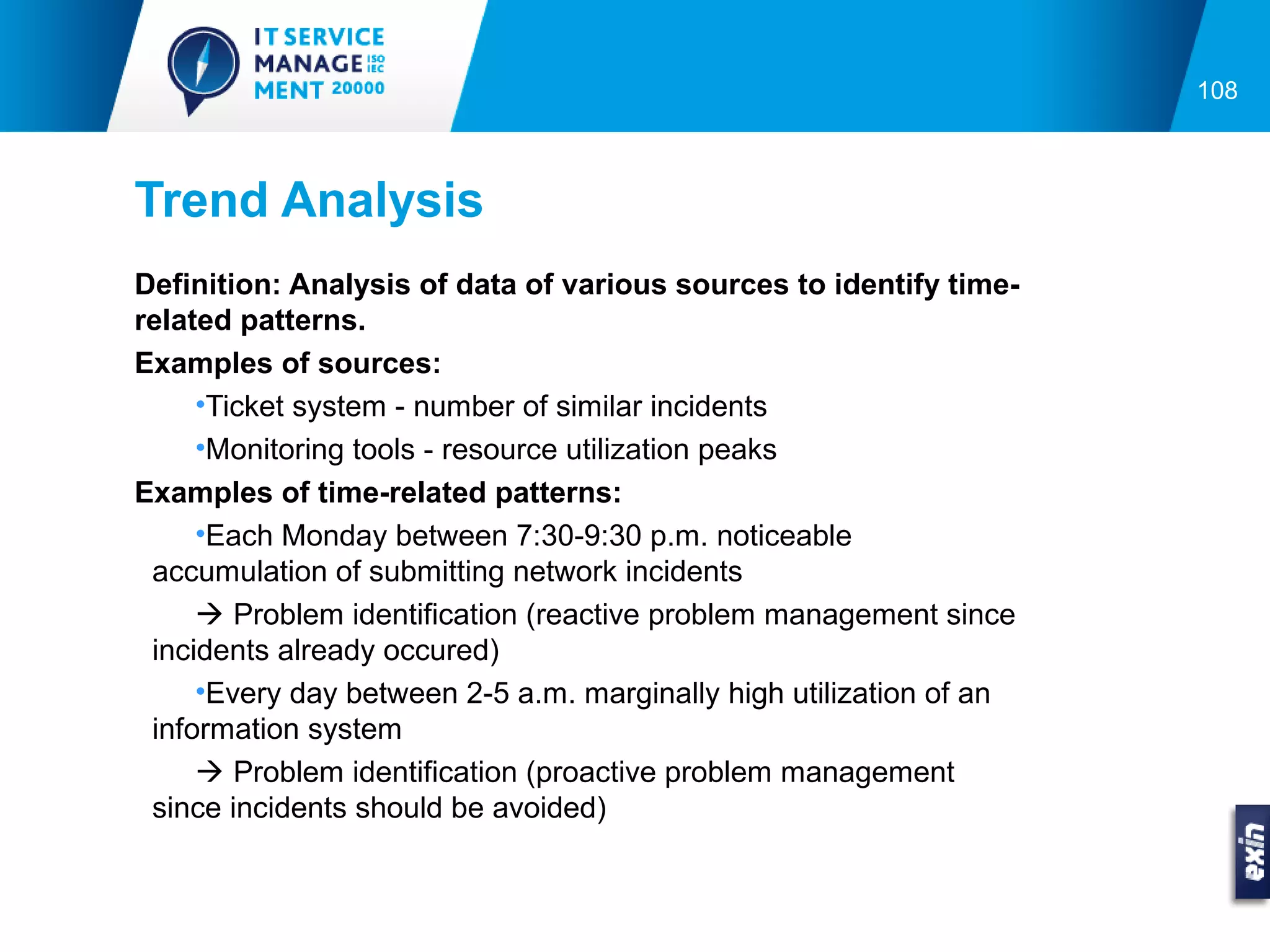
108


Trend Analysis
Definition: Analysis of data of various sources to identify time-
related patterns.
Examples of sources:
     •Ticket system - number of similar incidents
     •Monitoring tools - resource utilization peaks
Examples of time-related patterns:
     •Each Monday between 7:30-9:30 p.m. noticeable
 accumulation of submitting network incidents
      Problem identification (reactive problem management since
 incidents already occured)
     •Every day between 2-5 a.m. marginally high utilization of an
 information system
      Problem identification (proactive problem management
 since incidents should be avoided)
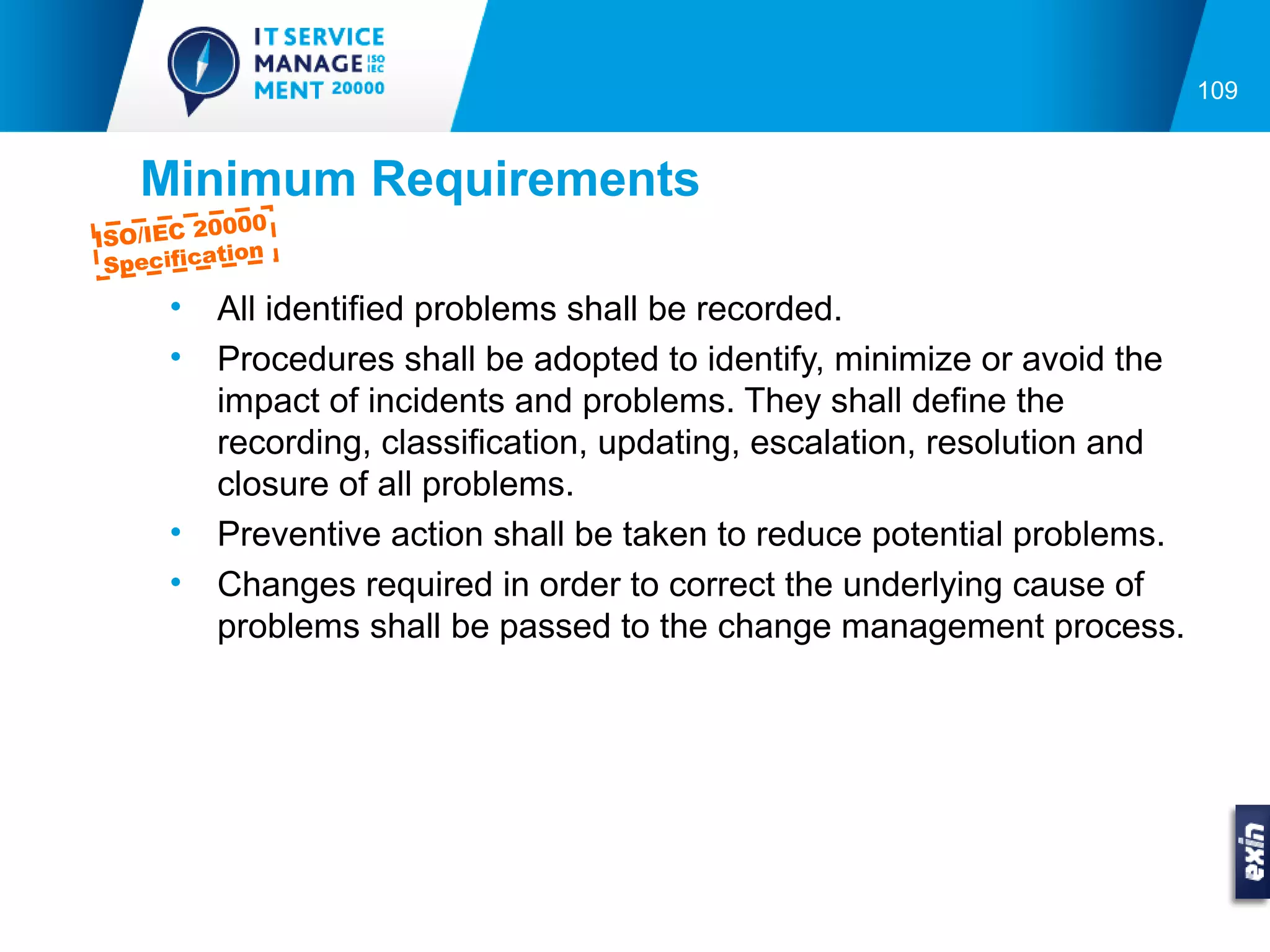
109


   Minimum Requirements
         0000
ISO/IEC 2
          tion
 Specifica

      •   All identified problems shall be recorded.
      •   Procedures shall be adopted to identify, minimize or avoid the
          impact of incidents and problems. They shall define the
          recording, classification, updating, escalation, resolution and
          closure of all problems.
      •   Preventive action shall be taken to reduce potential problems.
      •   Changes required in order to correct the underlying cause of
          problems shall be passed to the change management process.
110


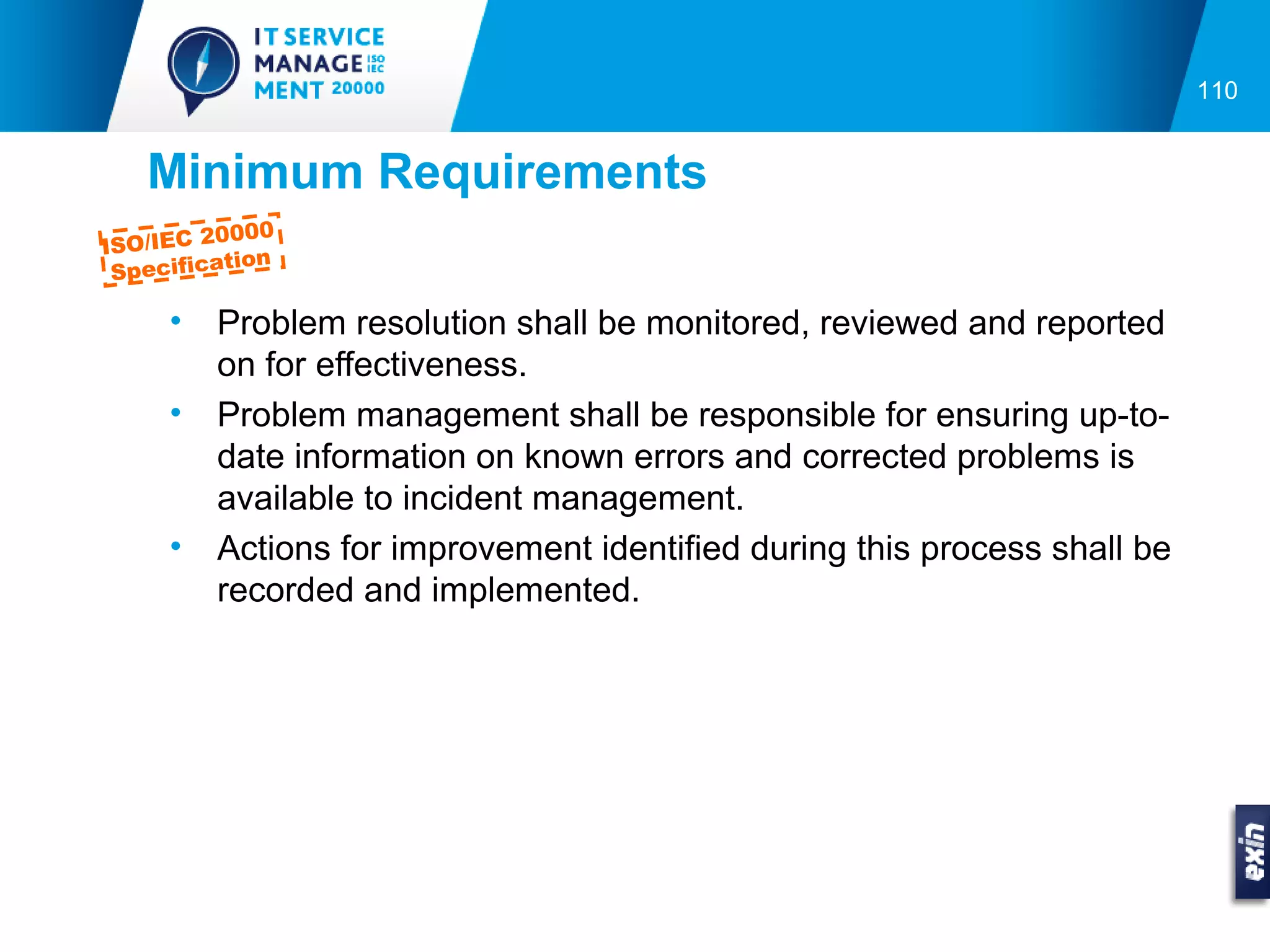
   Minimum Requirements
         0000
ISO/IEC 2
          tion
 Specifica

     •   Problem resolution shall be monitored, reviewed and reported
         on for effectiveness.
     •   Problem management shall be responsible for ensuring up-to-
         date information on known errors and corrected problems is
         available to incident management.
     •   Actions for improvement identified during this process shall be
         recorded and implemented.
111


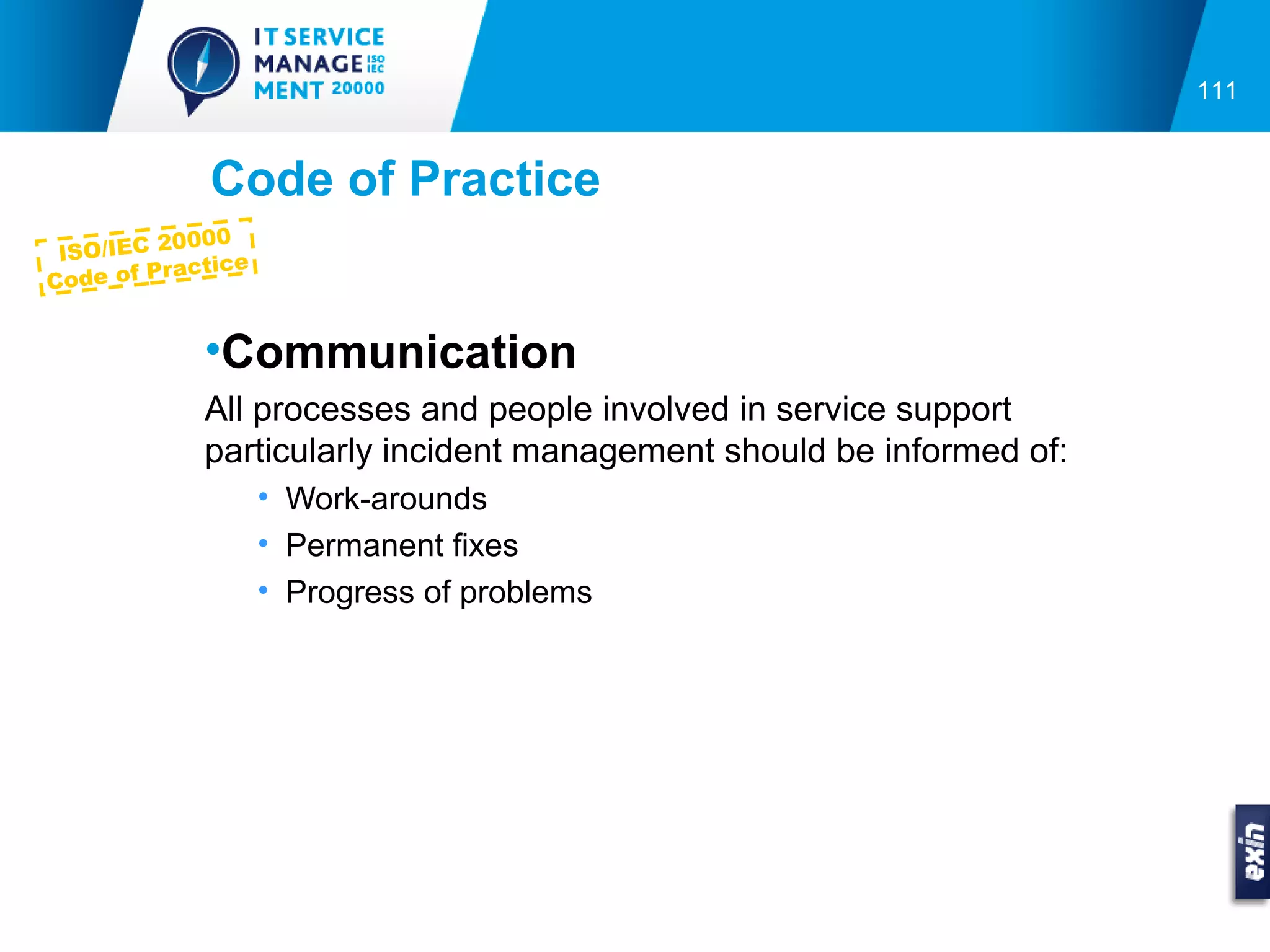
             Code of Practice
           0000
 ISO/IEC 2
            ctice
Co de of Pra


             •Communication
             All processes and people involved in service support
             particularly incident management should be informed of:
                    • Work-arounds
                    • Permanent fixes
                    • Progress of problems
112


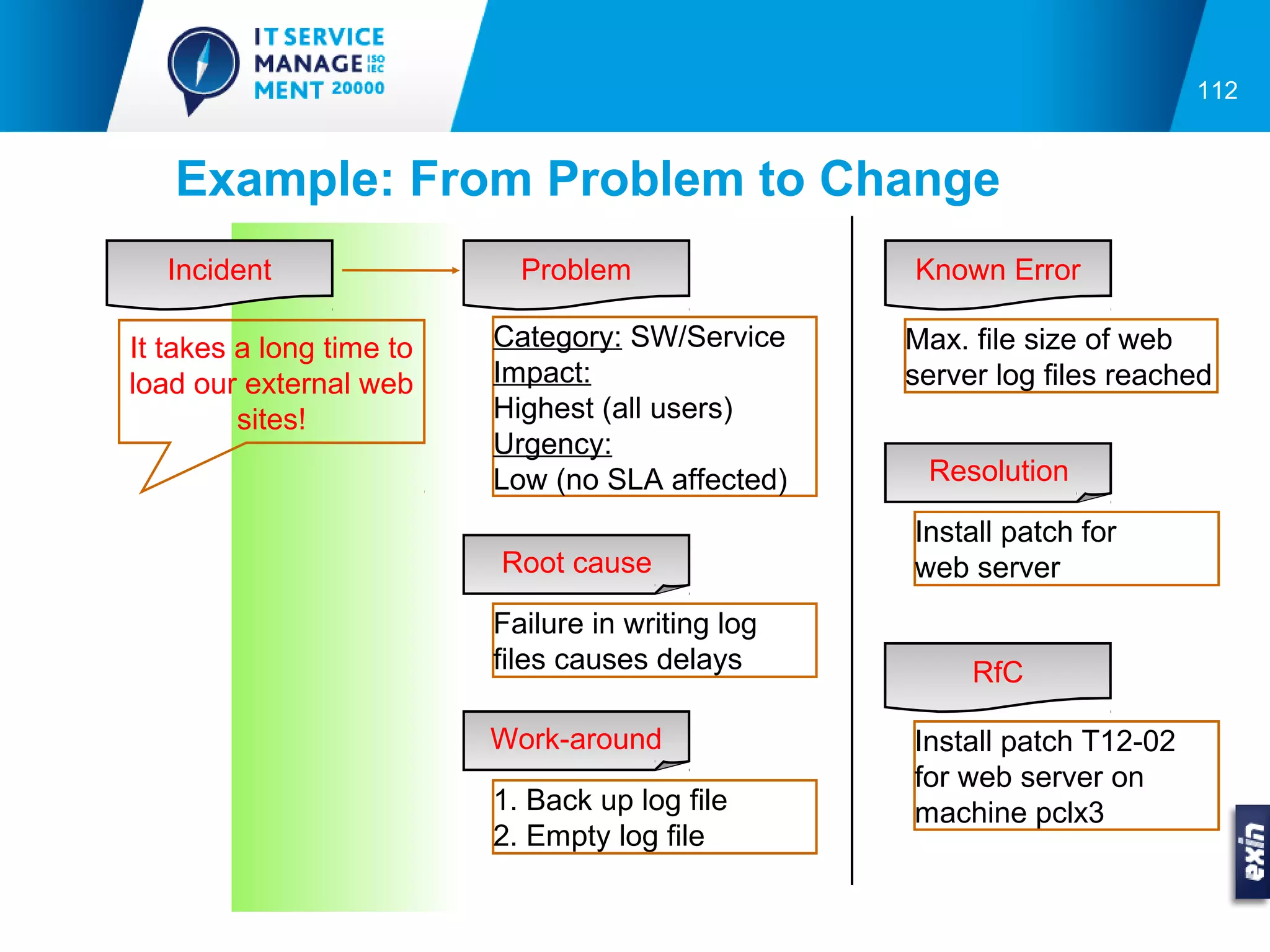
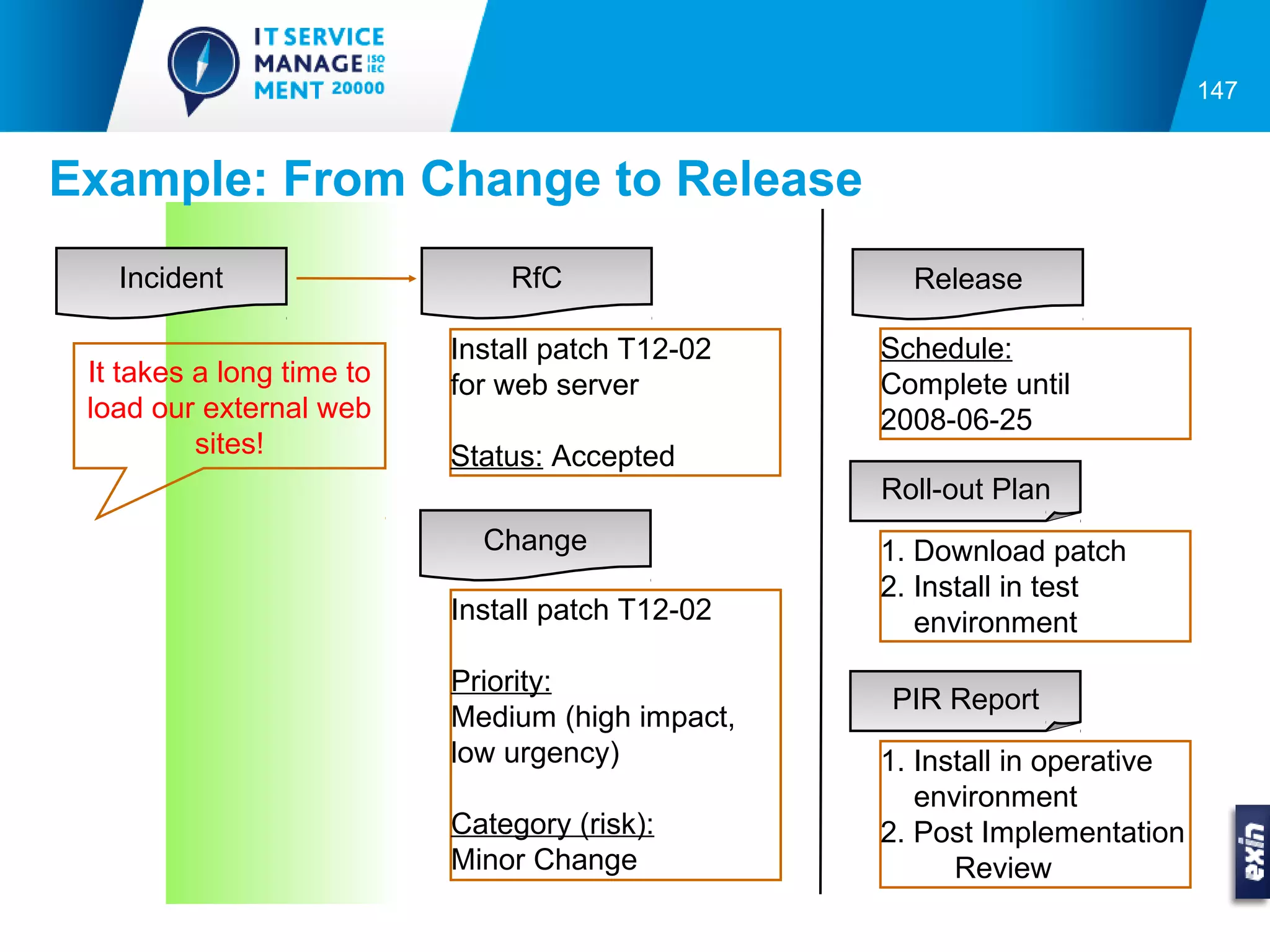
   Example: From Problem to Change
   Incident                 Problem                Known Error

It takes a long time to   Category: SW/Service     Max. file size of web
load our external web     Impact:                  server log files reached
         sites!           Highest (all users)
                          Urgency:
                          Low (no SLA affected)     Resolution

                                                   Install patch for
                          Root cause               web server
                          Failure in writing log
                          files causes delays           RfC

                          Work-around              Install patch T12-02
                                                   for web server on
                          1. Back up log file      machine pclx3
                          2. Empty log file
113


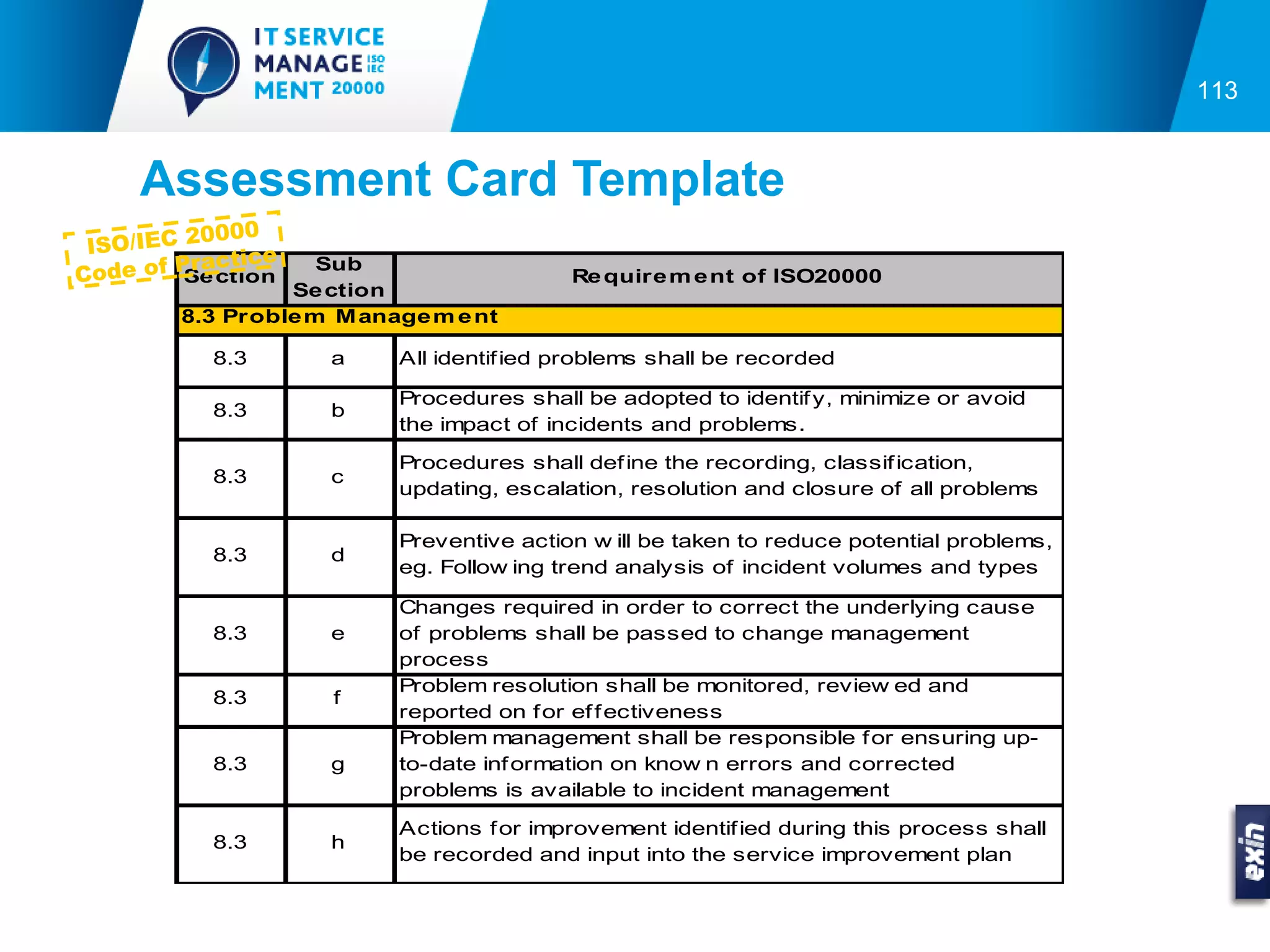
     Assessment Card Template
             00
 ISO/IEC 200
           actice
C ode of Pr ction
          Se
                    Sub
                                          Re quire m e nt of ISO20000
                 Se ction
        8.3 Proble m M anage m e nt

           8.3      a     All identif ied problems shall be recorded

                          Procedures shall be adopted to identif y, minimize or avoid
           8.3      b
                          the impact of incidents and problems.

                          Procedures shall def ine the recording, classif ication,
           8.3      c
                          updating, escalation, resolution and closure of all problems

                          Preventive action w ill be taken to reduce potential problems,
           8.3      d
                          eg. Follow ing trend analysis of incident volumes and types

                          Changes required in order to correct the underlying cause
           8.3      e     of problems shall be passed to change management
                          process
                          Problem resolution shall be monitored, review ed and
           8.3      f
                          reported on f or ef f ectiveness
                          Problem management shall be responsible f or ensuring up-
           8.3      g     to-date inf ormation on know n errors and corrected
                          problems is available to incident management

                          Actions f or improvement identif ied during this process shall
           8.3      h
                          be recorded and input into the service improvement plan
114


Revision Course
•   Trend analysis is important during what activity of problem
    management process?
•   What is the difference between a problem and an error?
•   What are the sub-processes of problem management?
•   How is problem management linked to change
    management?
•   What is the next step within problem management after a
    change was implemented to resolve an error?
•   What kind of information does problem management
    provide for the incident management process?
115


Section 9: Control Processes

 About the process group
 Objective:
  To manage configuration information and changes effectively.

                          [6] Service Delivery Processes
                               Service Level Management
Capacity Management                 Service Reporting   Information Security Management

Service Continuity &                                             Budgeting & Accounting
Availability Management
                              [9] Control Processes                       for IT services
                                Configuration Management
[10] Release                      Change Management               [7] Relationship
Process                                                                Processes
                            [8] Resolution Processes               Business Relationship
                                 Incident Management                        Management
Release Management
                                 Problem Management                Supplier Management
116


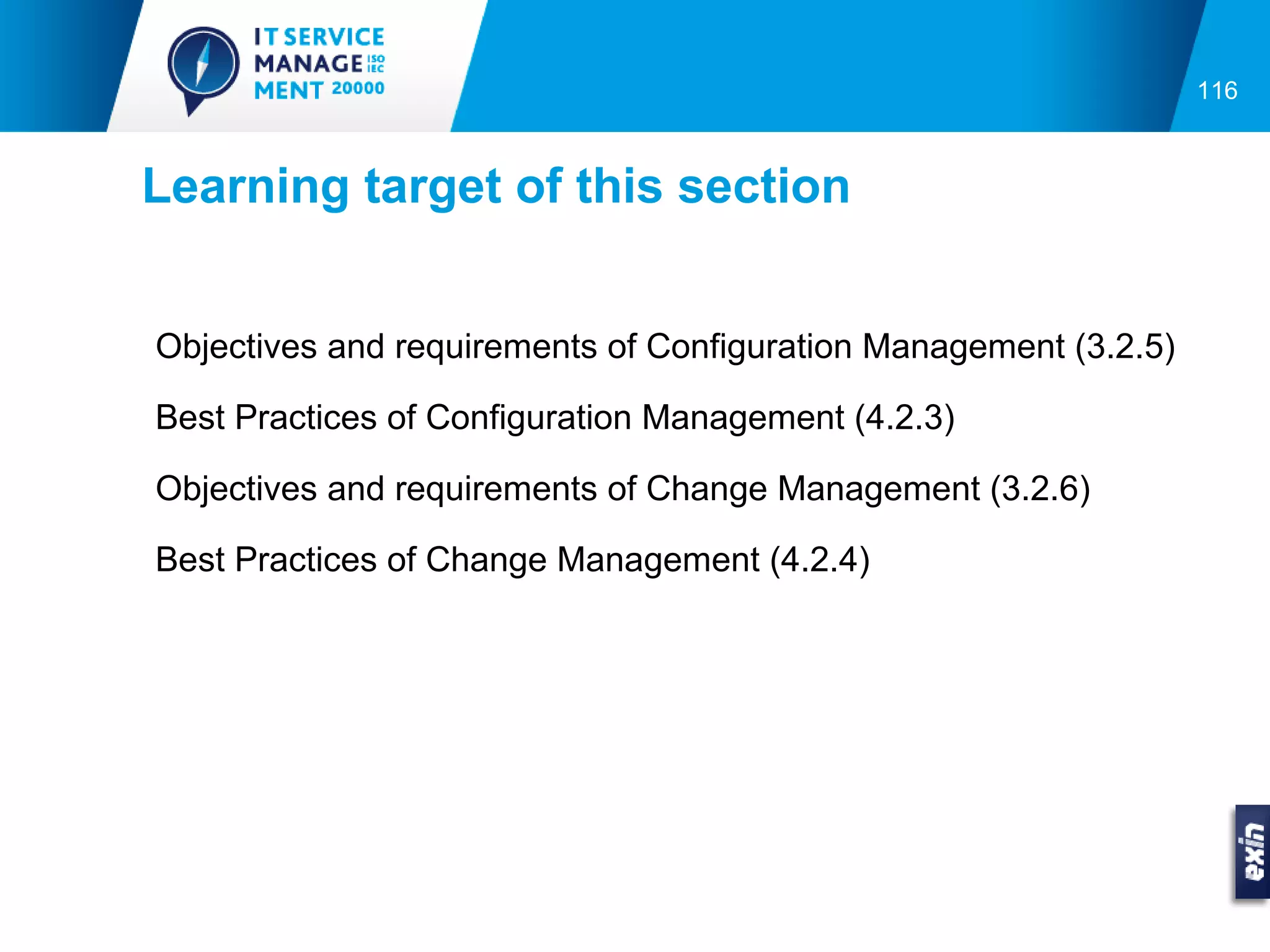
Learning target of this section


Objectives and requirements of Configuration Management (3.2.5)

Best Practices of Configuration Management (4.2.3)

Objectives and requirements of Change Management (3.2.6)

Best Practices of Change Management (4.2.4)
117


Configuration Management

Objective:
To define and control the components of the service and infrastructure
and maintain accurate configuration information.

                          [6] Service Delivery Processes
                               Service Level Management
Capacity Management                 Service Reporting   Information Security Management

Service Continuity &                                             Budgeting & Accounting
Availability Management
                              [9] Control Processes                       for IT services
                               Configuration Management
[10] Release                      Change Management               [7] Relationship
Process                                                                Processes
                            [8] Resolution Processes               Business Relationship
                                 Incident Management                        Management
Release Management
                                 Problem Management                Supplier Management
118


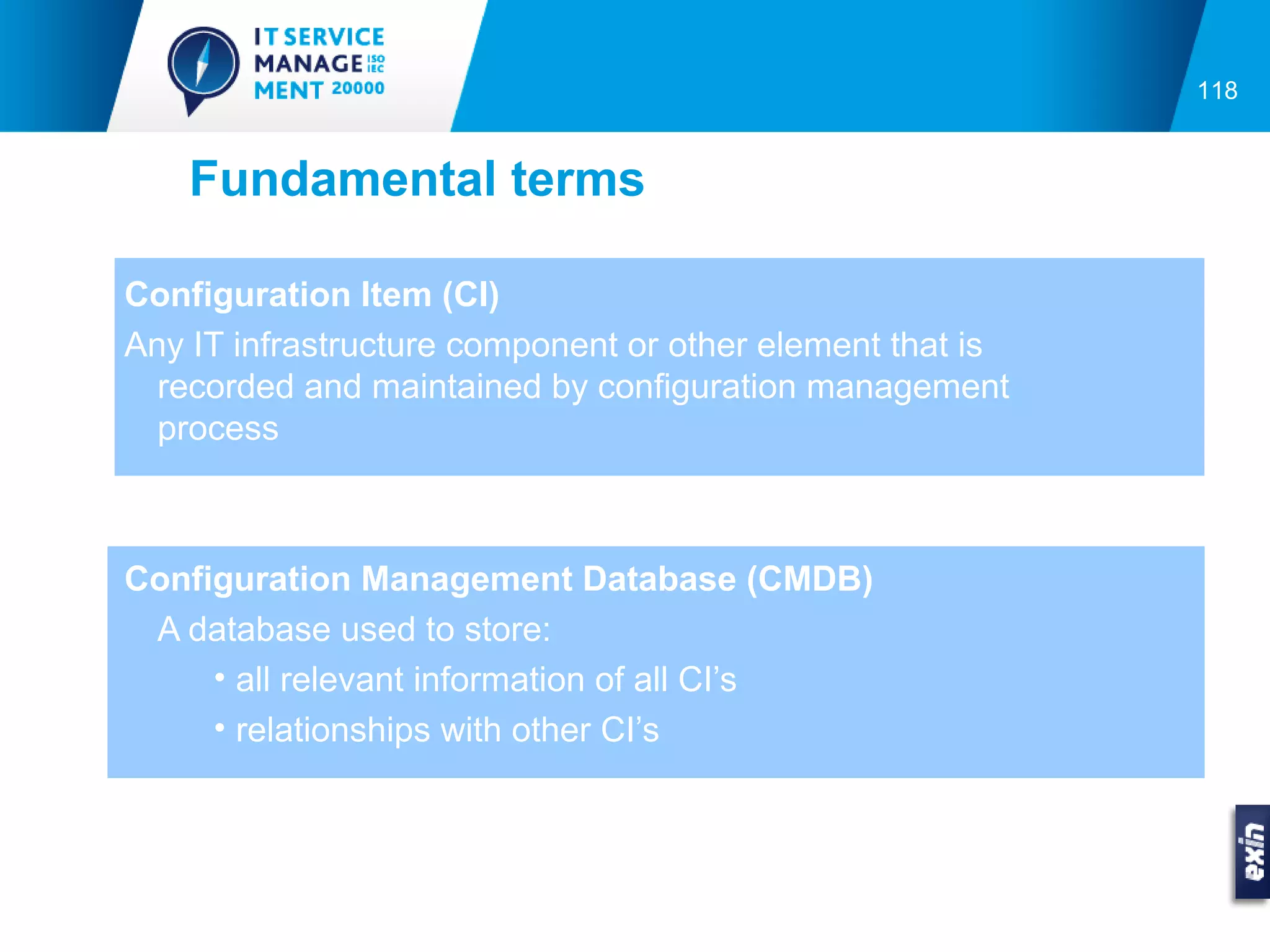
    Fundamental terms

Configuration Item (CI)
Any IT infrastructure component or other element that is
  recorded and maintained by configuration management
  process


Configuration Management Database (CMDB)
 A database used to store:
     • all relevant information of all CI’s
     • relationships with other CI’s
119


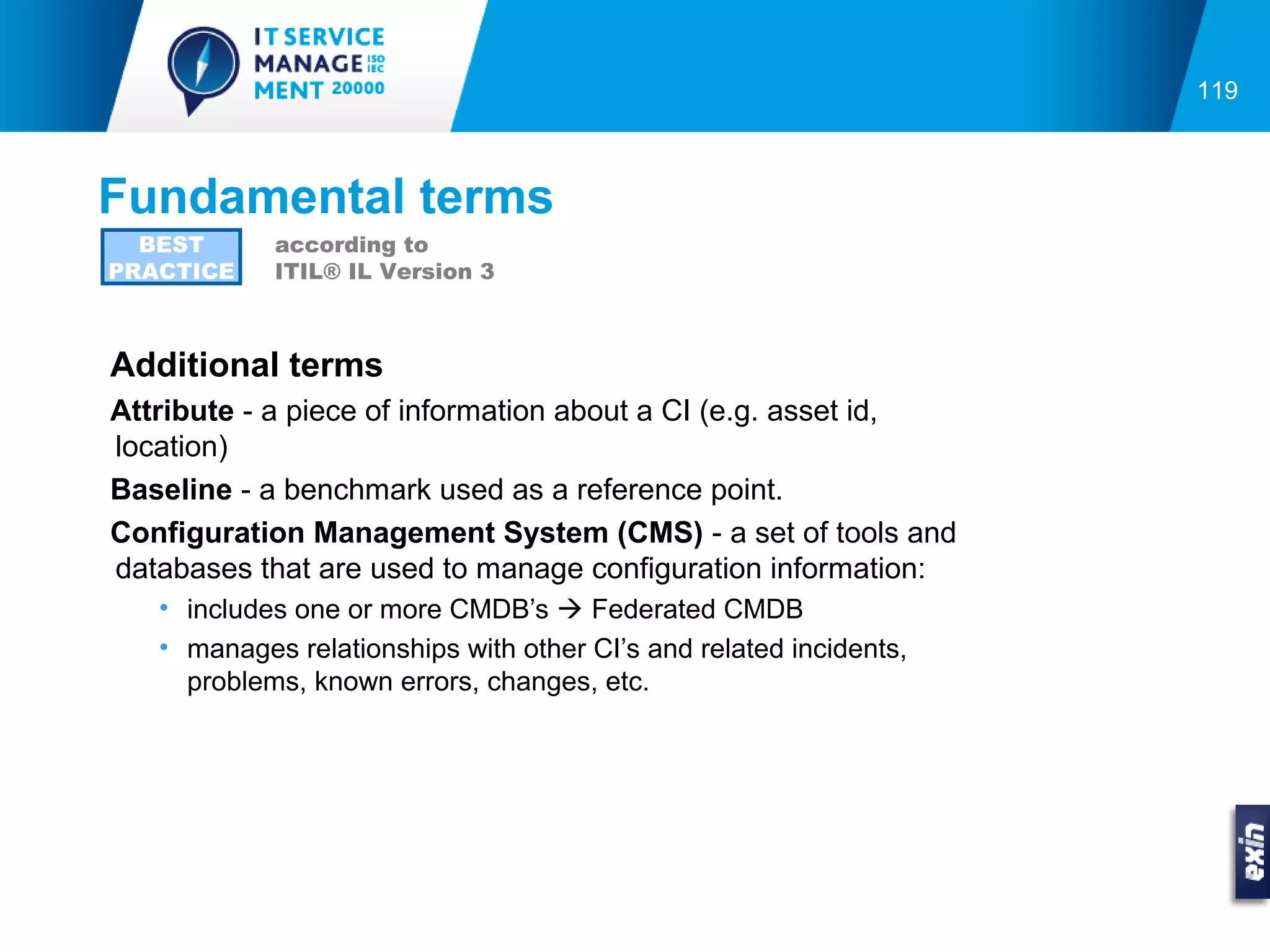
Fundamental terms
  BEST      according to
PRACTICE    ITIL® IL Version 3


Additional terms
Attribute - a piece of information about a CI (e.g. asset id,
location)
Baseline - a benchmark used as a reference point.
Configuration Management System (CMS) - a set of tools and
databases that are used to manage configuration information:
   • includes one or more CMDB’s  Federated CMDB
   • manages relationships with other CI’s and related incidents,
     problems, known errors, changes, etc.
120


Process
  BEST     according to
PRACTICE   ITIL® Version 2 & 3


Activities
Planning of:
    • CMDB targets (e.g. Which processes have to be supported?
      How?)
    • Scope of CMDB
Identification - define types of CI’s, name conventions,
 versioning
Recording and Control:
    • record new CI’s
    • update existing CI’s
Status Accounting - record/update lifecycle status of each CI
Verification - mapping CMDB and actual situation
121


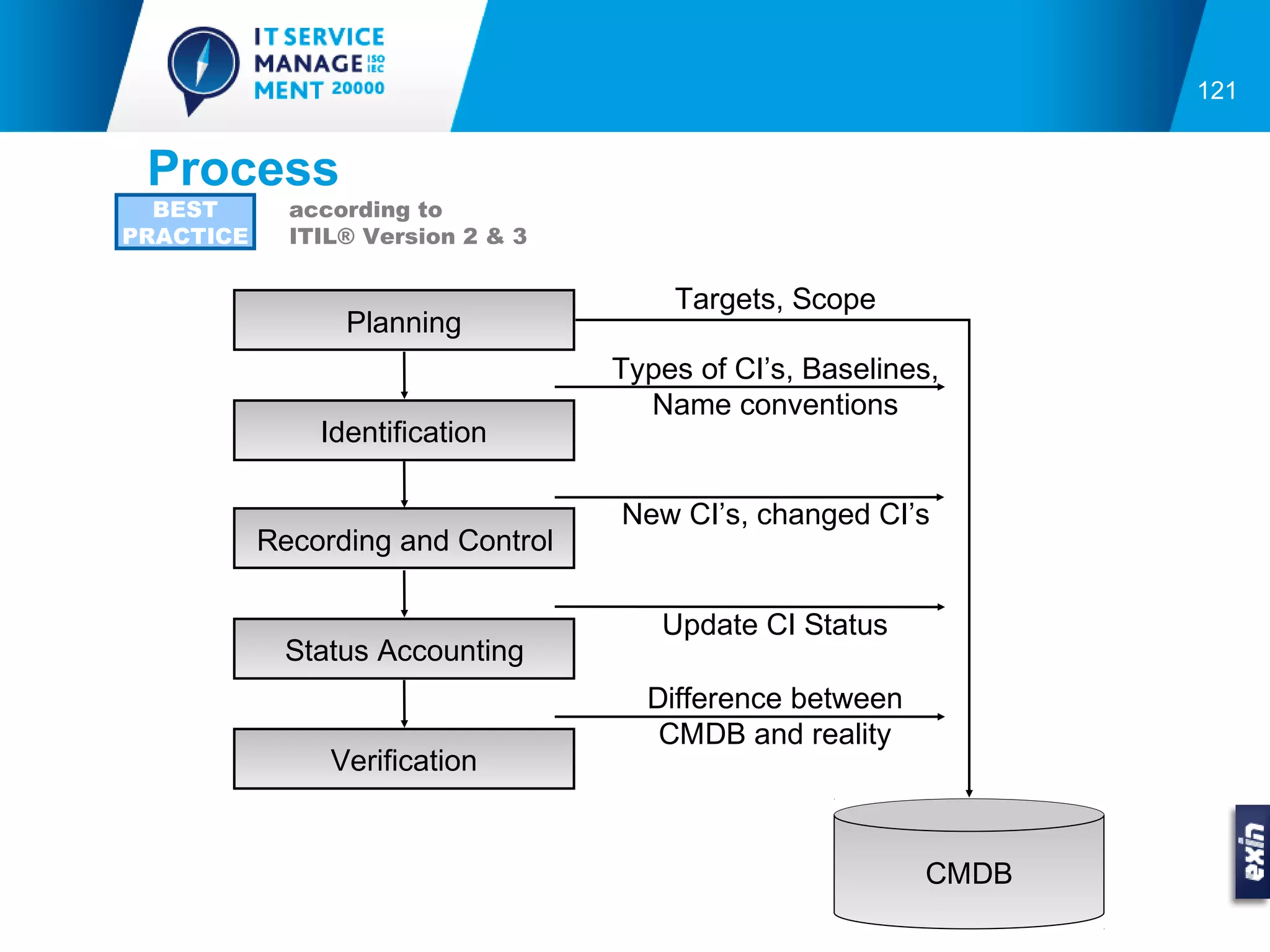
 Process
  BEST       according to
PRACTICE     ITIL® Version 2 & 3

                                       Targets, Scope
                 Planning
                                   Types of CI’s, Baselines,
                                     Name conventions
               Identification

                                   New CI’s, changed CI’s
           Recording and Control

                                      Update CI Status
             Status Accounting
                                     Difference between
                                      CMDB and reality
                Verification


                                                          CMDB
122


      Minimum Requirements
         0000
ISO/IEC 2
          tion
 Specifica

      •There shall be an integrated approach to change and
      configuration management planning  Scope of CMDB
      = Scope of change management!
      •Configuration management shall have an interface to
      financial asset accounting processes.
      •There shall be a configuration management policy on
      what is defined as a configuration item and its constituent
      components.
      •The information to be recorded for each item shall be
      defined and shall include the relationships and
      documentation necessary for effective service
      management.
123


       Minimum Requirements
         0000
ISO/IEC 2
          tion
 Specifica


         Configuration management shall provide the mechanisms
         for identifying, recording, controlling and tracking
         versions of CI’s. It shall be ensured that the process
         meets the business needs, risk of failure and service
         criticality.
         Configuration management shall provide information to
         the change management process:
                 • Supporting Change Management in risk and impact analysis
                   of planned changes
                 • Tracking of hardware/software changes
124


       Minimum Requirements
          0000
ISO/IEC 2
           tion
 Specifica

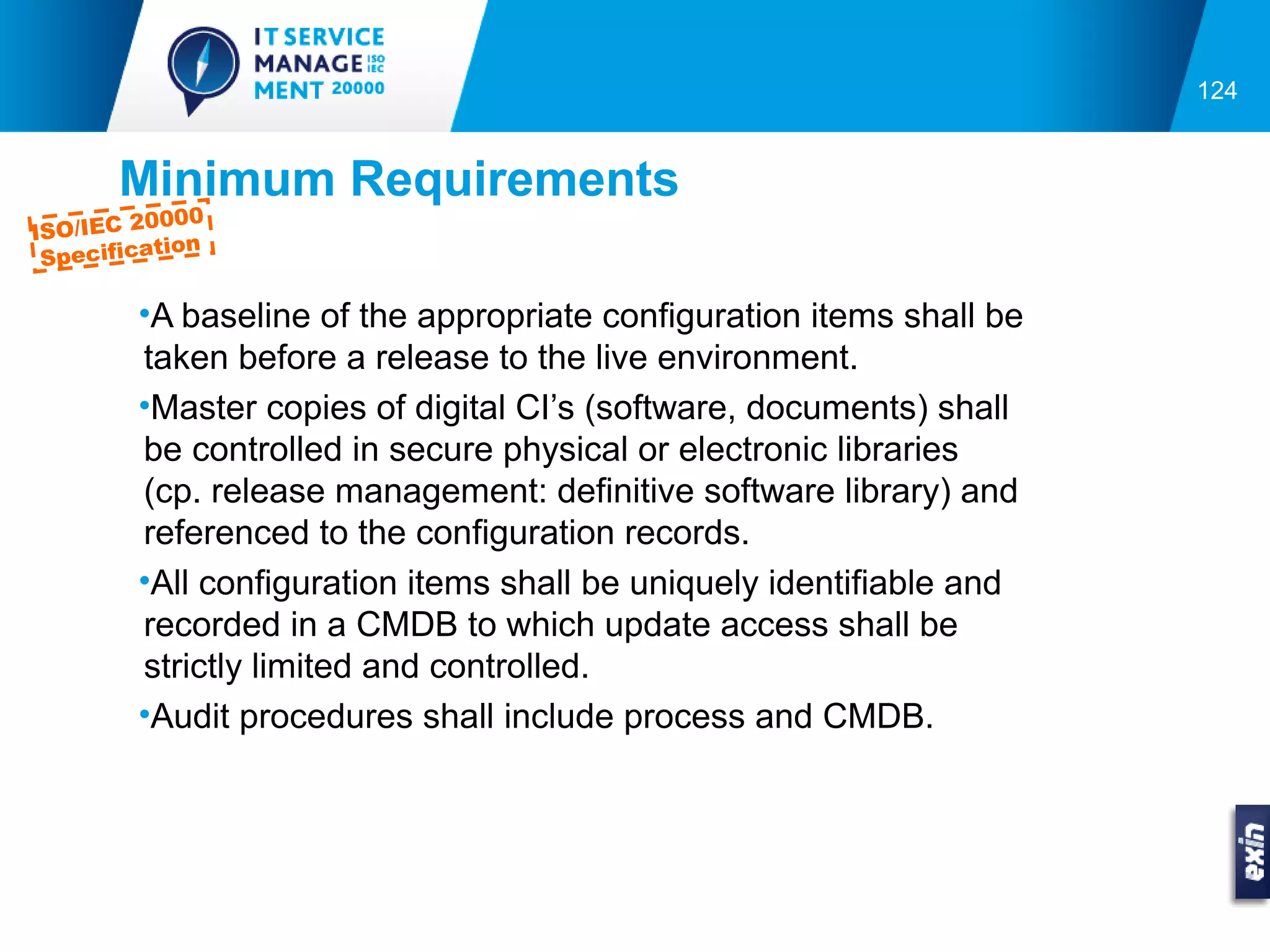
         •A baseline of the appropriate configuration items shall be
         taken before a release to the live environment.
         •Master copies of digital CI’s (software, documents) shall
         be controlled in secure physical or electronic libraries
         (cp. release management: definitive software library) and
         referenced to the configuration records.
         •All configuration items shall be uniquely identifiable and
         recorded in a CMDB to which update access shall be
         strictly limited and controlled.
         •Audit procedures shall include process and CMDB.
125


  Configuration Management: Best
  Practices
            00
 ISO/IEC 200 e
         ractic
Code of P

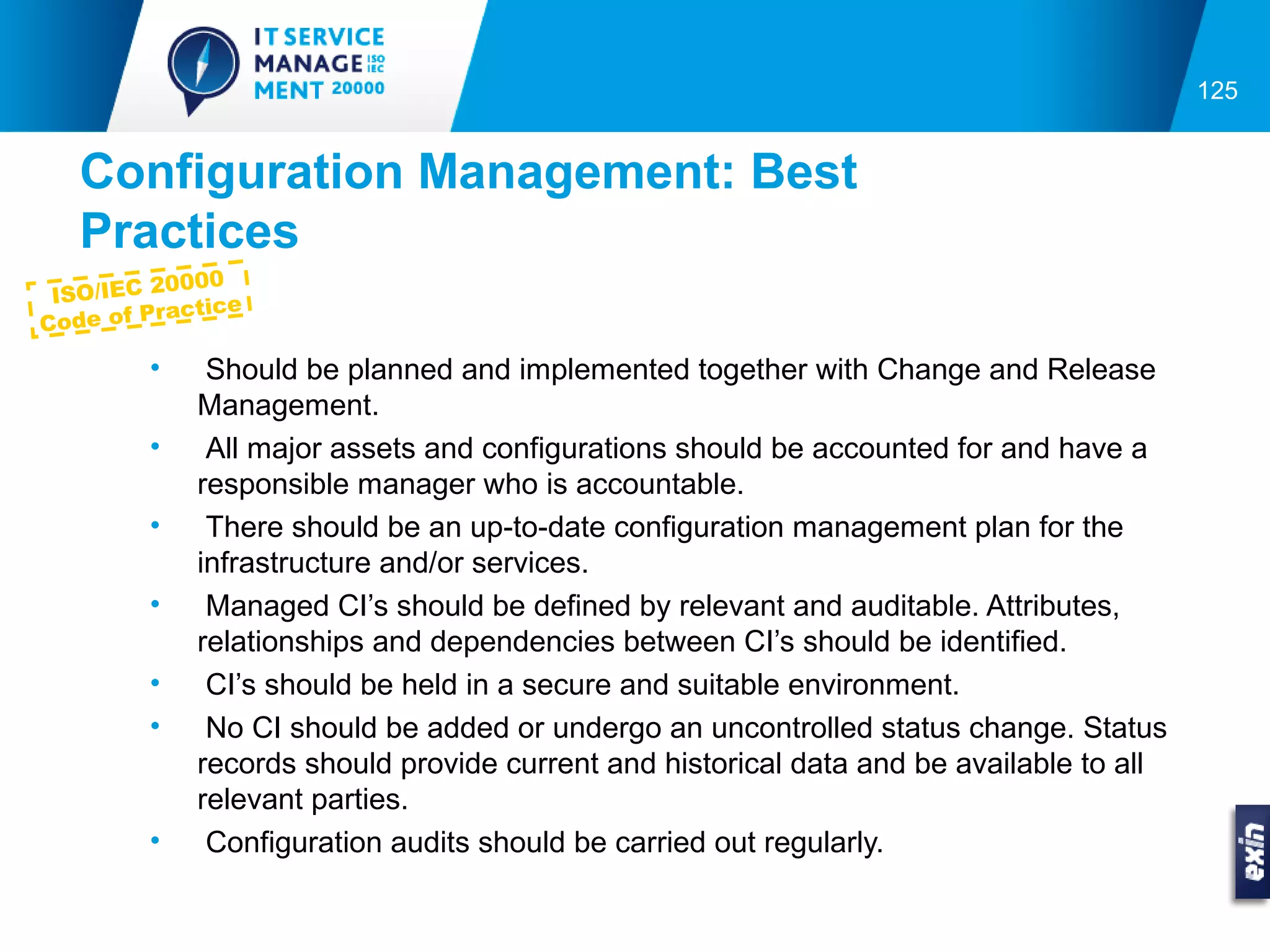
        •    Should be planned and implemented together with Change and Release
            Management.
        •    All major assets and configurations should be accounted for and have a
            responsible manager who is accountable.
        •    There should be an up-to-date configuration management plan for the
            infrastructure and/or services.
        •    Managed CI’s should be defined by relevant and auditable. Attributes,
            relationships and dependencies between CI’s should be identified.
        •    CI’s should be held in a secure and suitable environment.
        •    No CI should be added or undergo an uncontrolled status change. Status
            records should provide current and historical data and be available to all
            relevant parties.
        •    Configuration audits should be carried out regularly.
126


     Assessment Card Template
              00
   O/IEC 200
 IS 9.1 Se r vice
            actice
                     As s e t and Configur ation M anage m e nt
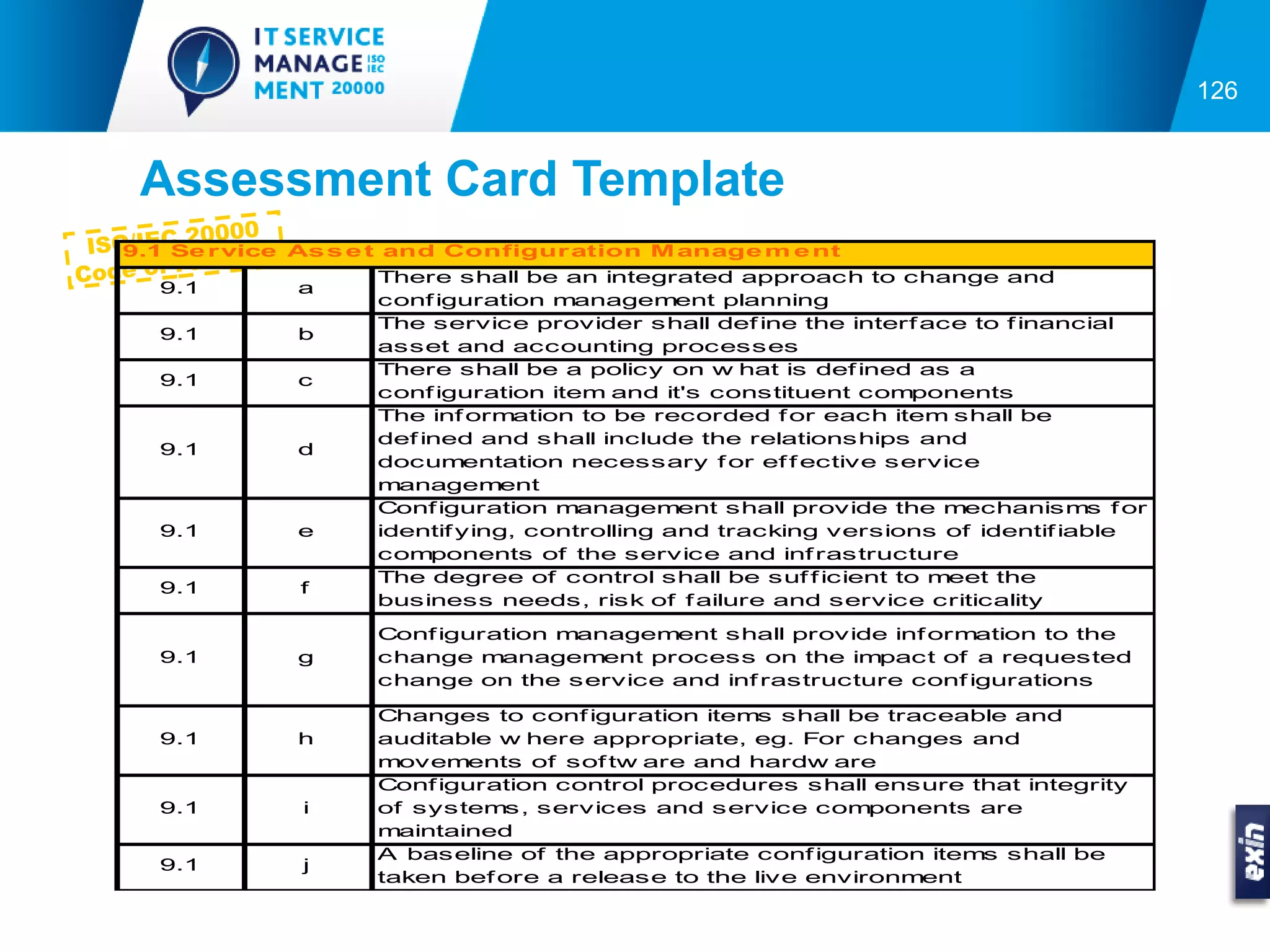
C ode of Pr                There shall be an integrated approach to change and
       9.1           a
                           conf iguration management planning
                           The service provider shall def ine the interf ace to f inancial
       9.1           b
                           asset and accounting processes
                           There shall be a policy on w hat is def ined as a
       9.1           c
                           conf iguration item and it's constituent components
                           The inf ormation to be recorded f or each item shall be
                           def ined and shall include the relationships and
       9.1           d
                           documentation necessary f or ef f ective service
                           management
                           Conf iguration management shall provide the mechanisms f or
       9.1           e     identif ying, controlling and tracking versions of identif iable
                           components of the service and inf rastructure
                           The degree of control shall be suf f icient to meet the
       9.1            f
                           business needs, risk of f ailure and service criticality

                           Conf iguration management shall provide inf ormation to the
       9.1           g     change management process on the impact of a requested
                           change on the service and inf rastructure conf igurations

                           Changes to conf iguration items shall be traceable and
       9.1           h     auditable w here appropriate, eg. For changes and
                           movements of sof tw are and hardw are
                           Conf iguration control procedures shall ensure that integrity
       9.1            i    of systems, services and service components are
                           maintained
                           A baseline of the appropriate conf iguration items shall be
       9.1            j
                           taken bef ore a release to the live environment
127


Excursus: Service Knowledge Mgmt. according to ITIL®
  BEST     according to
PRACTICE   ITIL® Version 3


 Why Service Knowledge Management?
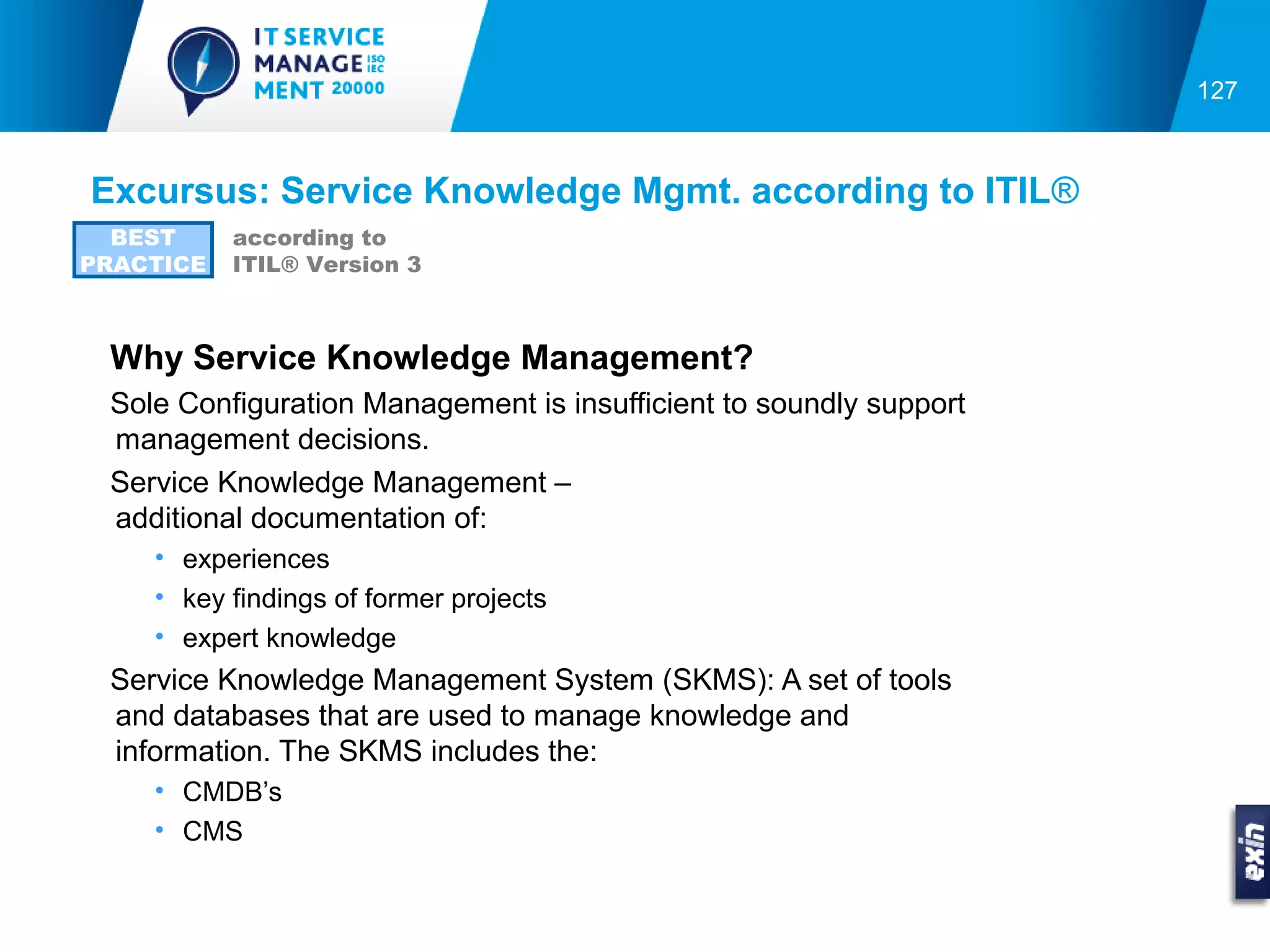
 Sole Configuration Management is insufficient to soundly support
 management decisions.
 Service Knowledge Management –
 additional documentation of:
    • experiences
    • key findings of former projects
    • expert knowledge
 Service Knowledge Management System (SKMS): A set of tools
 and databases that are used to manage knowledge and
 information. The SKMS includes the:
    • CMDB’s
    • CMS
128


Change Management

Objective:
To ensure all changes are assessed, approved, implemented and
reviewed in a controlled manner.

                           [6] Service Delivery Processes
                                Service Level Management
 Capacity Management                 Service Reporting   Information Security Management

 Service Continuity &                                             Budgeting & Accounting
 Availability Management
                               [9] Control Processes                       for IT services
                                 Configuration Management
 [10] Release                     Change Management                [7] Relationship
 Process                                                                Processes
                             [8] Resolution Processes               Business Relationship
                                  Incident Management                        Management
 Release Management
                                  Problem Management                Supplier Management
129


Fundamental terms


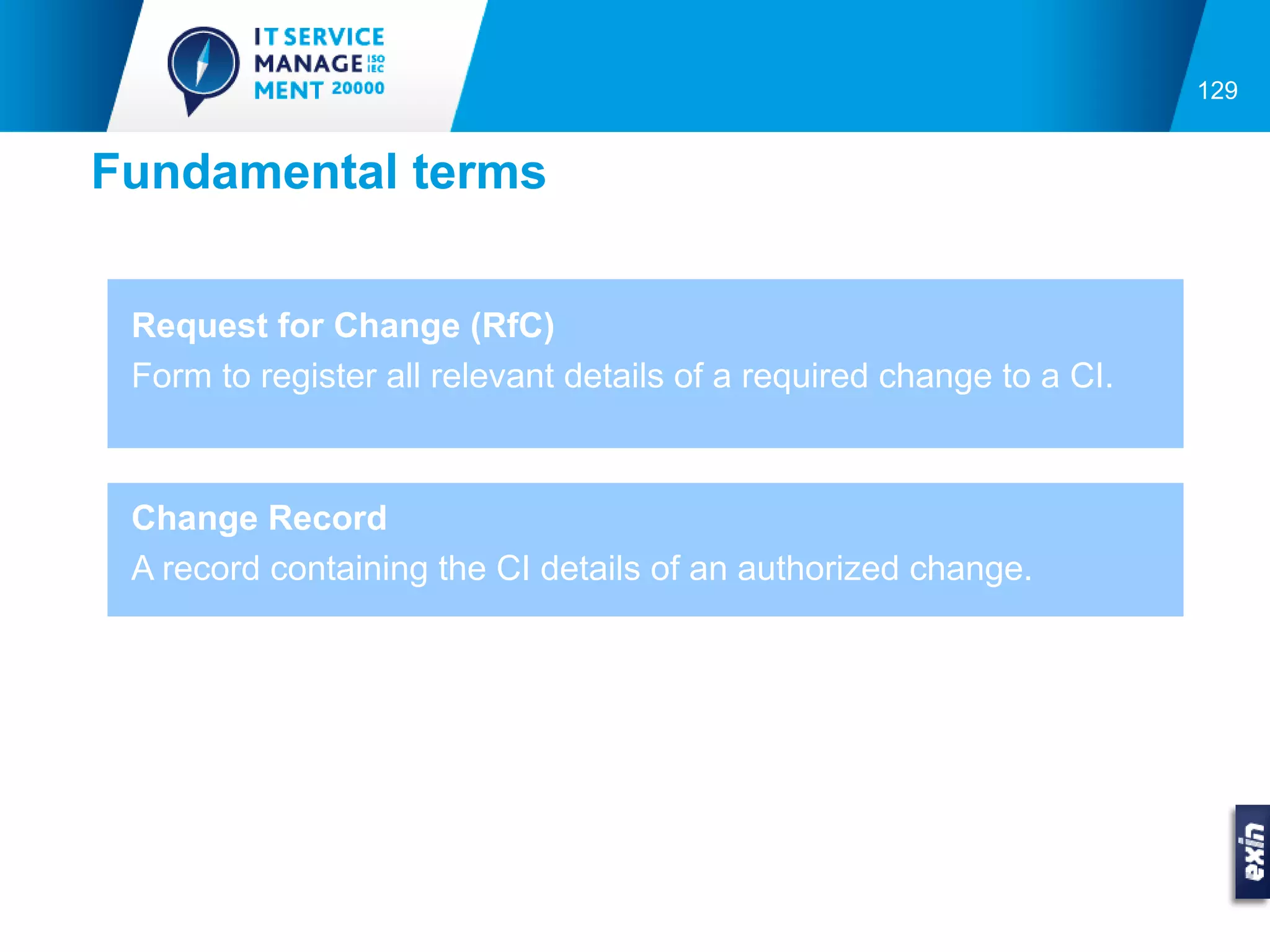
 Request for Change (RfC)
 Form to register all relevant details of a required change to a CI.


 Change Record
 A record containing the CI details of an authorized change.
130


Fundamental terms
  BEST     according to
PRACTICE   ITIL® Version 2 & 3, MOF


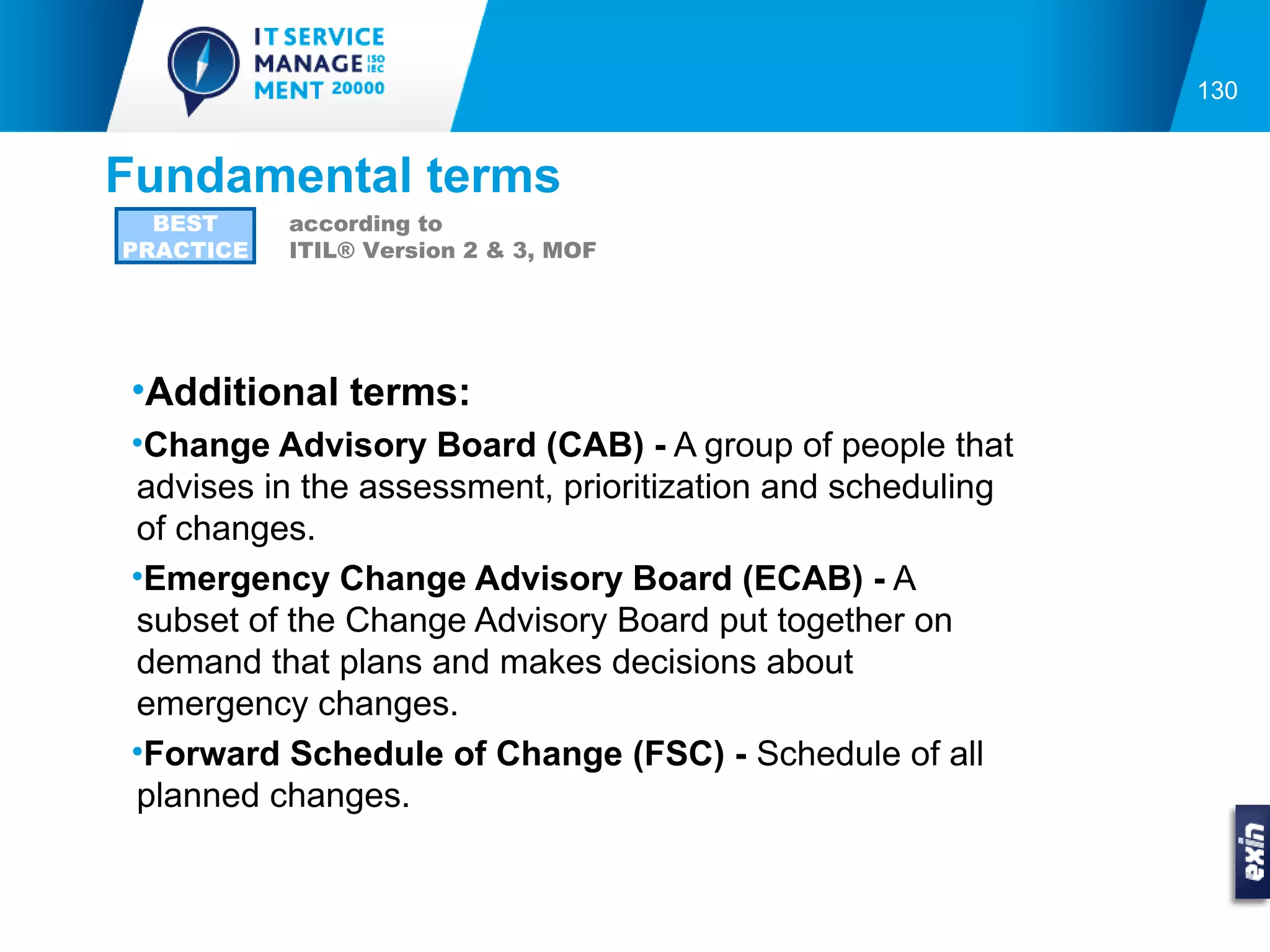
•Additional terms:
•Change Advisory Board (CAB) - A group of people that
advises in the assessment, prioritization and scheduling
of changes.
•Emergency Change Advisory Board (ECAB) - A
subset of the Change Advisory Board put together on
demand that plans and makes decisions about
emergency changes.
•Forward Schedule of Change (FSC) - Schedule of all
planned changes.
131


Process
  BEST     according to
PRACTICE   ITIL® Version 2 & 3, MOF


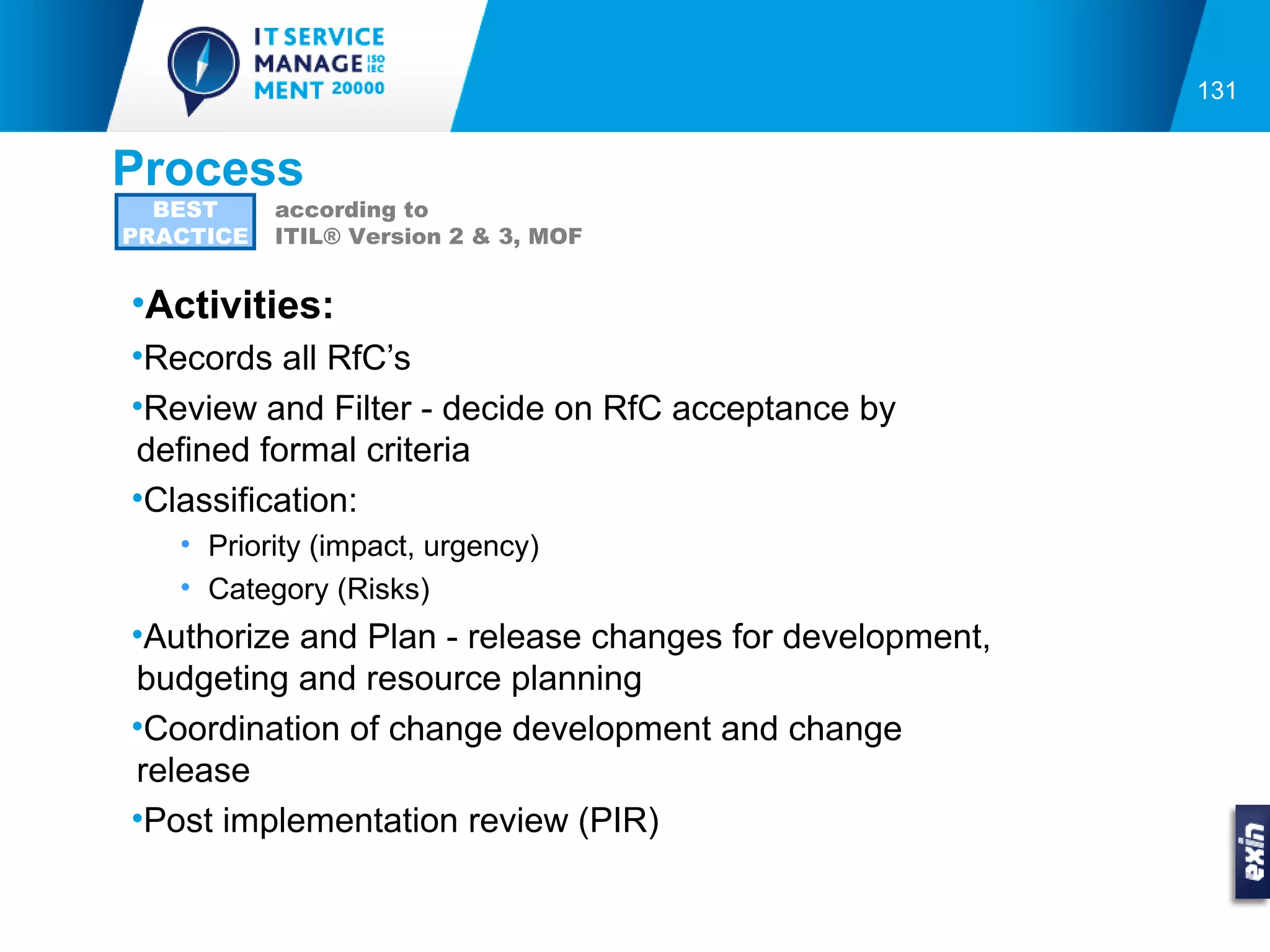
•Activities:
•Records all RfC’s
•Review and Filter - decide on RfC acceptance by
defined formal criteria
•Classification:
   • Priority (impact, urgency)
   • Category (Risks)
•Authorize and Plan - release changes for development,
budgeting and resource planning
•Coordination of change development and change
release
•Post implementation review (PIR)
132


Process
  BEST   according to
PRACTICE ITIL® Version 2 & 3, MOF


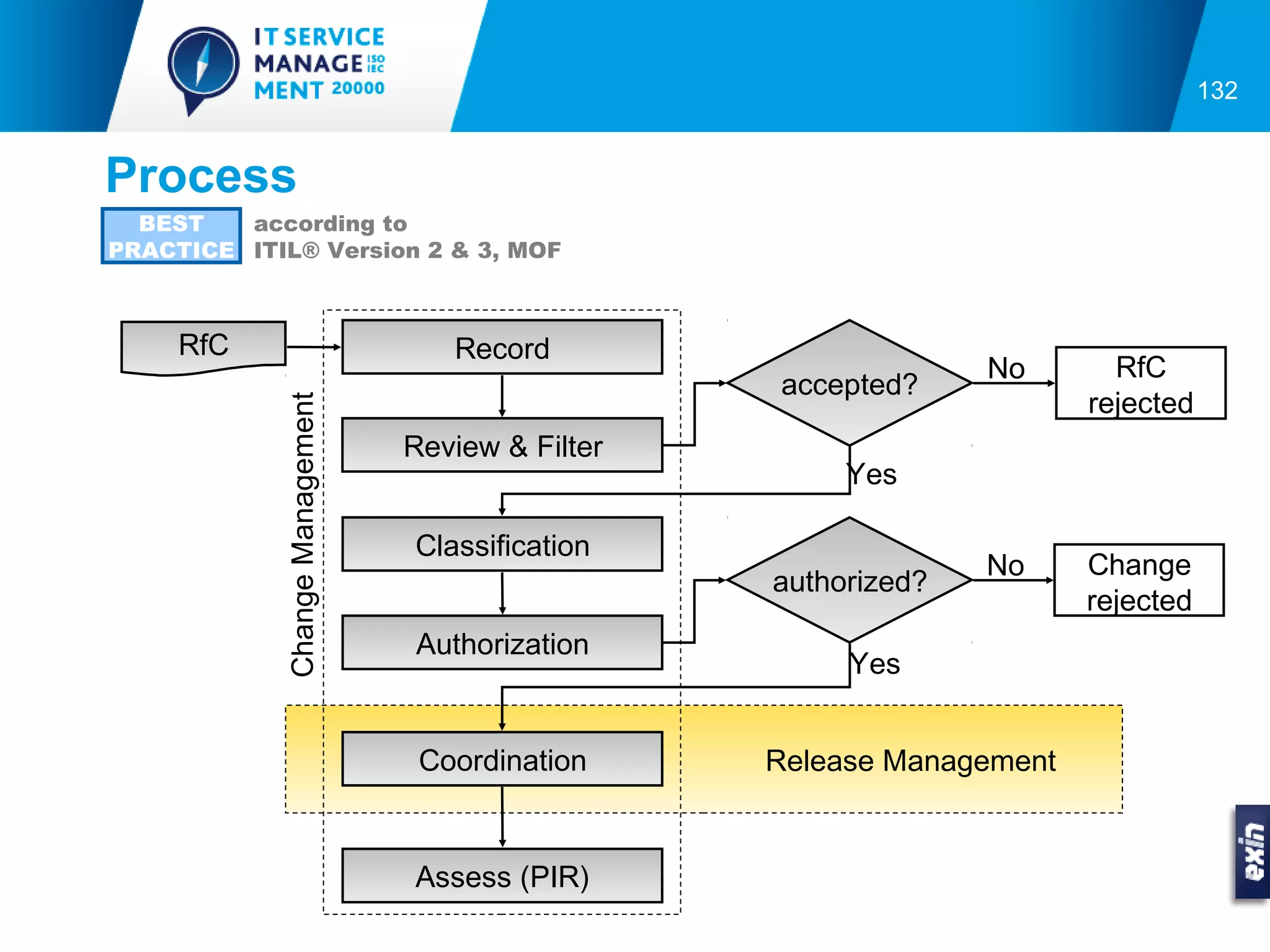
     RfC                            Record
                                                                 No       RfC
                                                   accepted?
                                                                        rejected
             Change Management


                                 Review & Filter
                                                        Yes

                                 Classification
                                                                 No     Change
                                                   authorized?
                                                                        rejected
                                 Authorization
                                                        Yes


                                  Coordination     Release Management


                                 Assess (PIR)
133


   Minimum Requirements
          0000
ISO/IEC 2
           tion
 Specifica


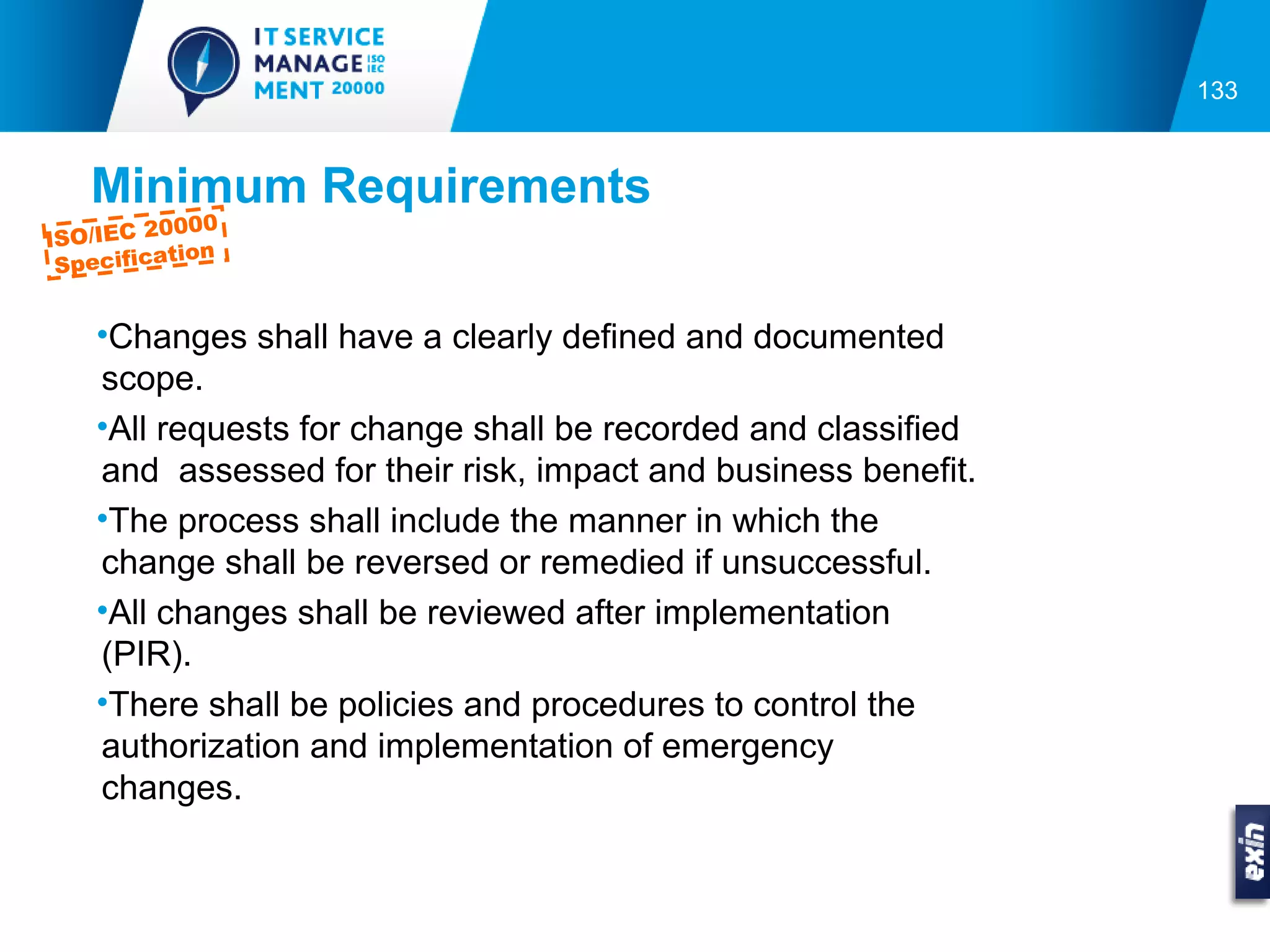
    •Changes shall have a clearly defined and documented
    scope.
    •All requests for change shall be recorded and classified
    and assessed for their risk, impact and business benefit.
    •The process shall include the manner in which the
    change shall be reversed or remedied if unsuccessful.
    •All changes shall be reviewed after implementation
    (PIR).
    •There shall be policies and procedures to control the
    authorization and implementation of emergency
    changes.
134


   Minimum Requirements
          0000
ISO/IEC 2
           tion
 Specifica


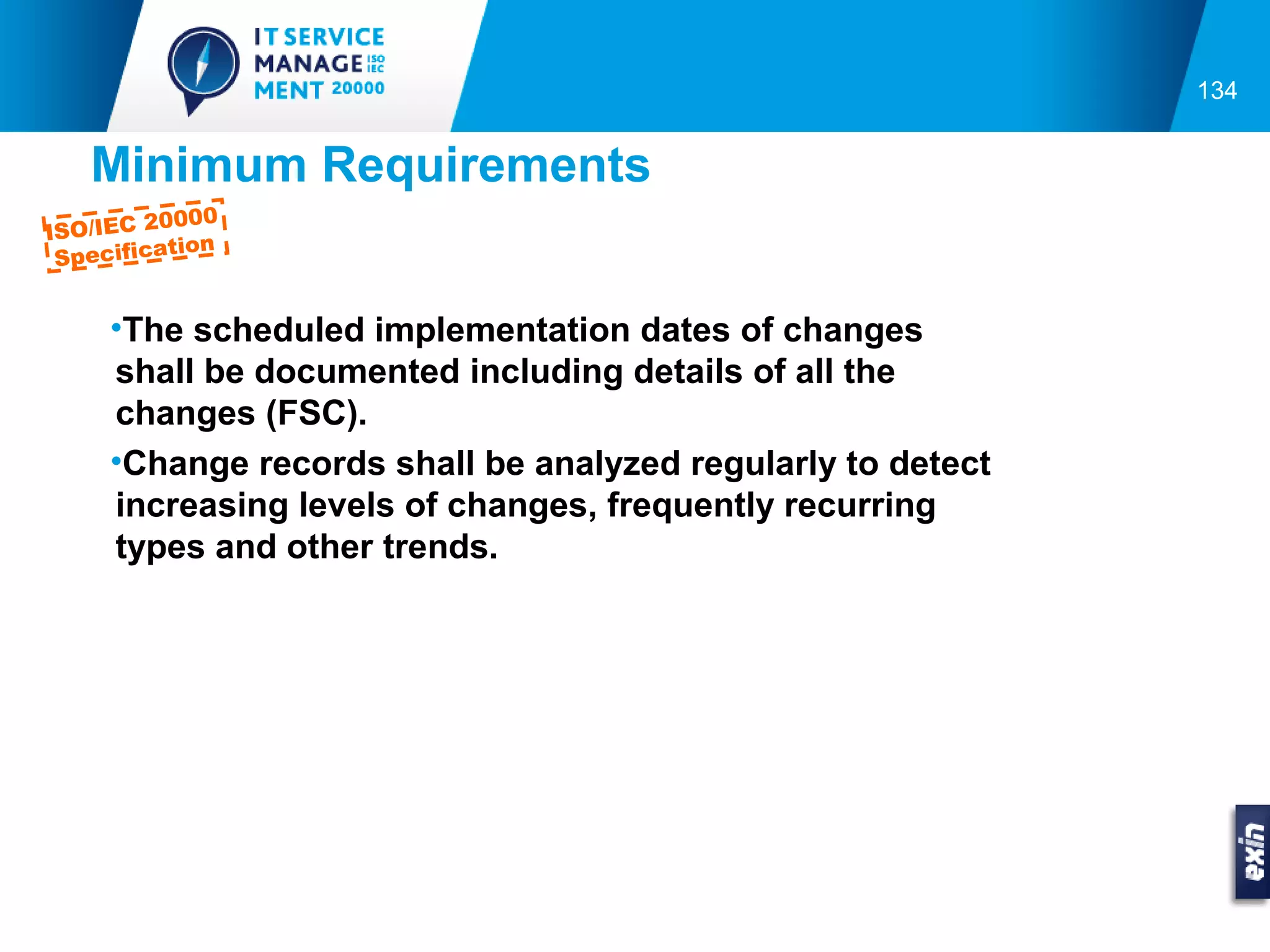
     •The scheduled implementation dates of changes
     shall be documented including details of all the
     changes (FSC).
     •Change records shall be analyzed regularly to detect
     increasing levels of changes, frequently recurring
     types and other trends.
135


    Code of Practice
           0000
 ISO/IEC 2
            ctice
Co de of Pra

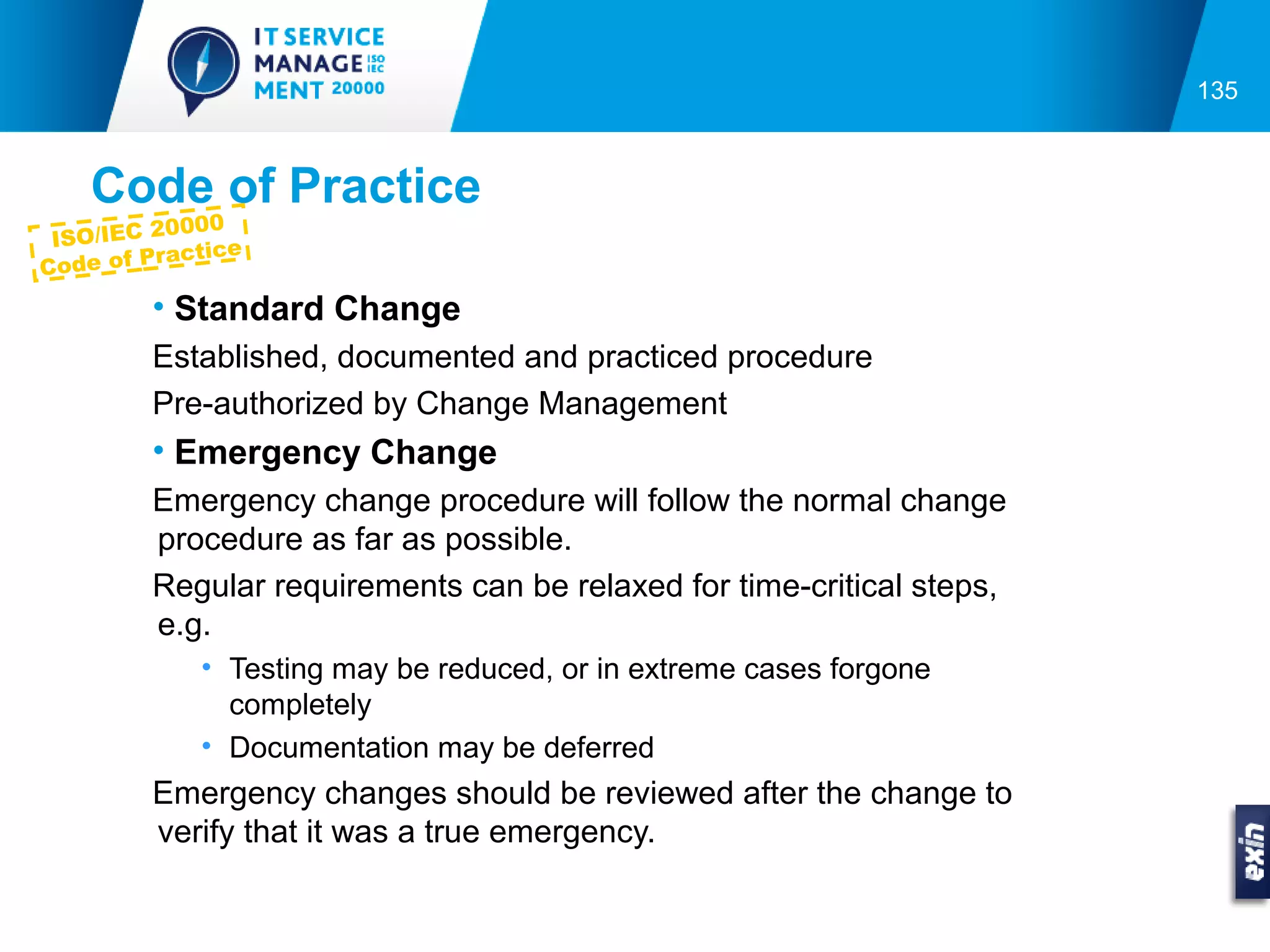
         • Standard Change
         Established, documented and practiced procedure
         Pre-authorized by Change Management
         • Emergency Change
         Emergency change procedure will follow the normal change
         procedure as far as possible.
         Regular requirements can be relaxed for time-critical steps,
         e.g.
             • Testing may be reduced, or in extreme cases forgone
               completely
             • Documentation may be deferred
         Emergency changes should be reviewed after the change to
         verify that it was a true emergency.
136


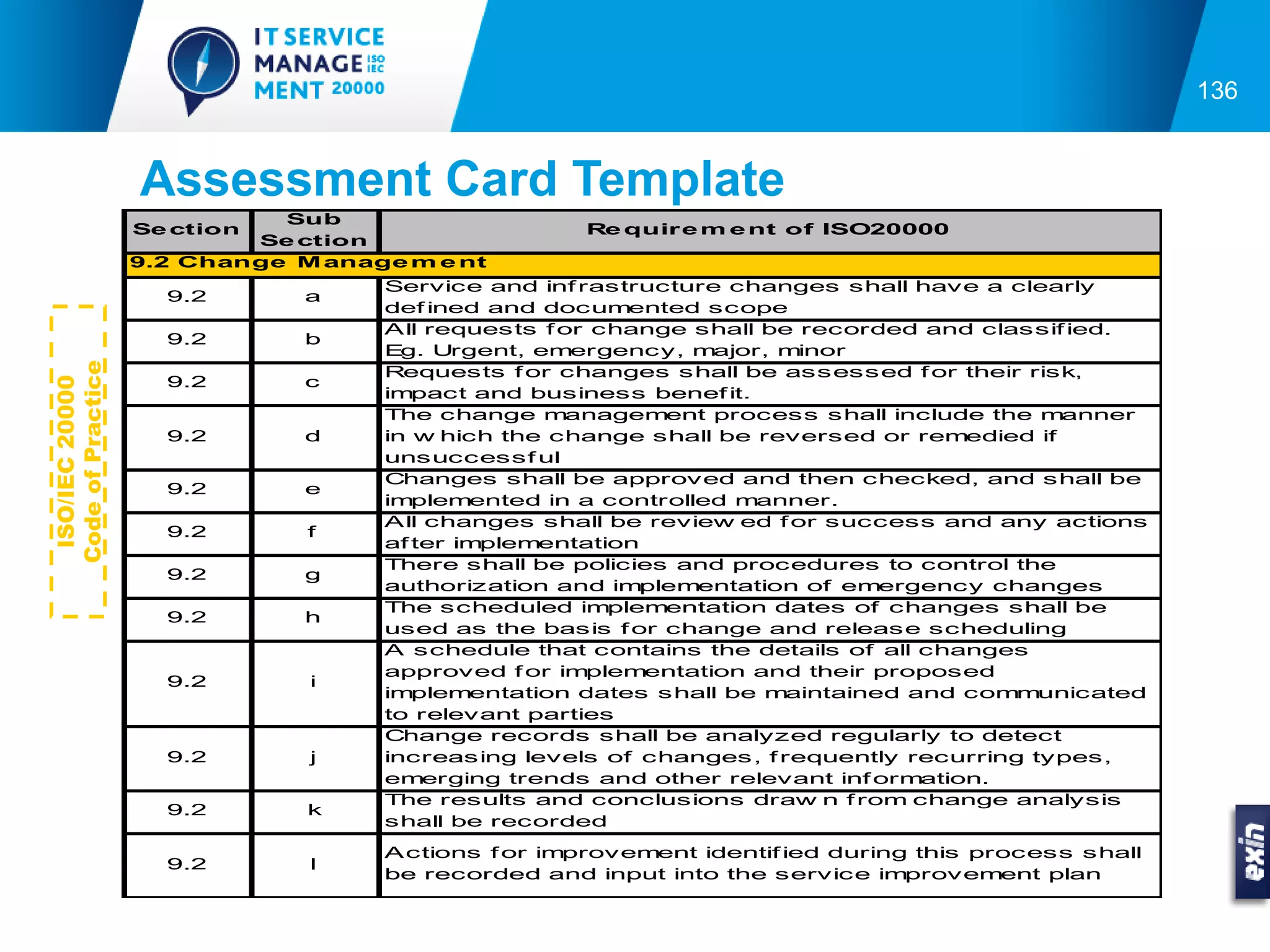
                   Assessment Card Template
                             Sub
                   Se ction                          Re quir e m e nt of ISO20000
                           Se ction
                   9.2 Change M anage m e nt
                                    Service and inf rastructure changes shall have a clearly
                     9.2       a
                                    def ined and docum     ented scope
                                    A ll requests f or change shall be recorded and classif ied.
                     9.2       b
                                    E g. Urgent, emergency, m     ajor, minor
Code of Practice


                                    Requests f or changes shall be assessed f or their risk,
                     9.2       c
 ISO/IEC 20000


                                    im pact and business benef it.
                                    The change m     anagem   ent process shall include the m   anner
                     9.2       d    in w hich the change shall be reversed or rem      edied if
                                    unsuccessf ul
                                    Changes shall be approved and then checked, and shall be
                     9.2       e
                                    im plem  ented in a controlled manner.
                                    A ll changes shall be review ed f or success and any actions
                     9.2       f
                                    af ter im plem entation
                                    There shall be policies and procedures to control the
                     9.2       g
                                    authorization and im    plementation of em  ergency changes
                                    The scheduled im     plem entation dates of changes shall be
                     9.2       h
                                    used as the basis f or change and release scheduling
                                    A schedule that contains the details of all changes
                                    approved f or im  plem  entation and their proposed
                     9.2       i
                                    im plem  entation dates shall be m  aintained and com unicated
                                                                                           m
                                    to relevant parties
                                    Change records shall be analyzed regularly to detect
                     9.2       j    increasing levels of changes, f requently recurring types,
                                    em   erging trends and other relevant inf orm  ation.
                                    The results and conclusions draw n f rom change analysis
                     9.2       k
                                    shall be recorded
                                    A ctions f or improvement identif ied during this process shall
                     9.2       l
                                    be recorded and input into the service im   provement plan
137


Section 10: Release Process/Release Management


Objective:
 To distribute one or more changes in a release to the live
 environment including planning and documentation.

                          [6] Service Delivery Processes
                               Service Level Management
Capacity Management                 Service Reporting   Information Security Management

Service Continuity &                                             Budgeting & Accounting
Availability Management
                              [9] Control Processes                       for IT services
                                Configuration Management
[10] Release                      Change Management               [7] Relationship
Process                                                                Processes
                            [8] Resolution Processes               Business Relationship
                                 Incident Management                        Management
Release Management
                                 Problem Management                Supplier Management
138


Learning target of this section

Objectives and requirements within release management
(3.2.7)

Best Practices within release management (4.2.5)
139


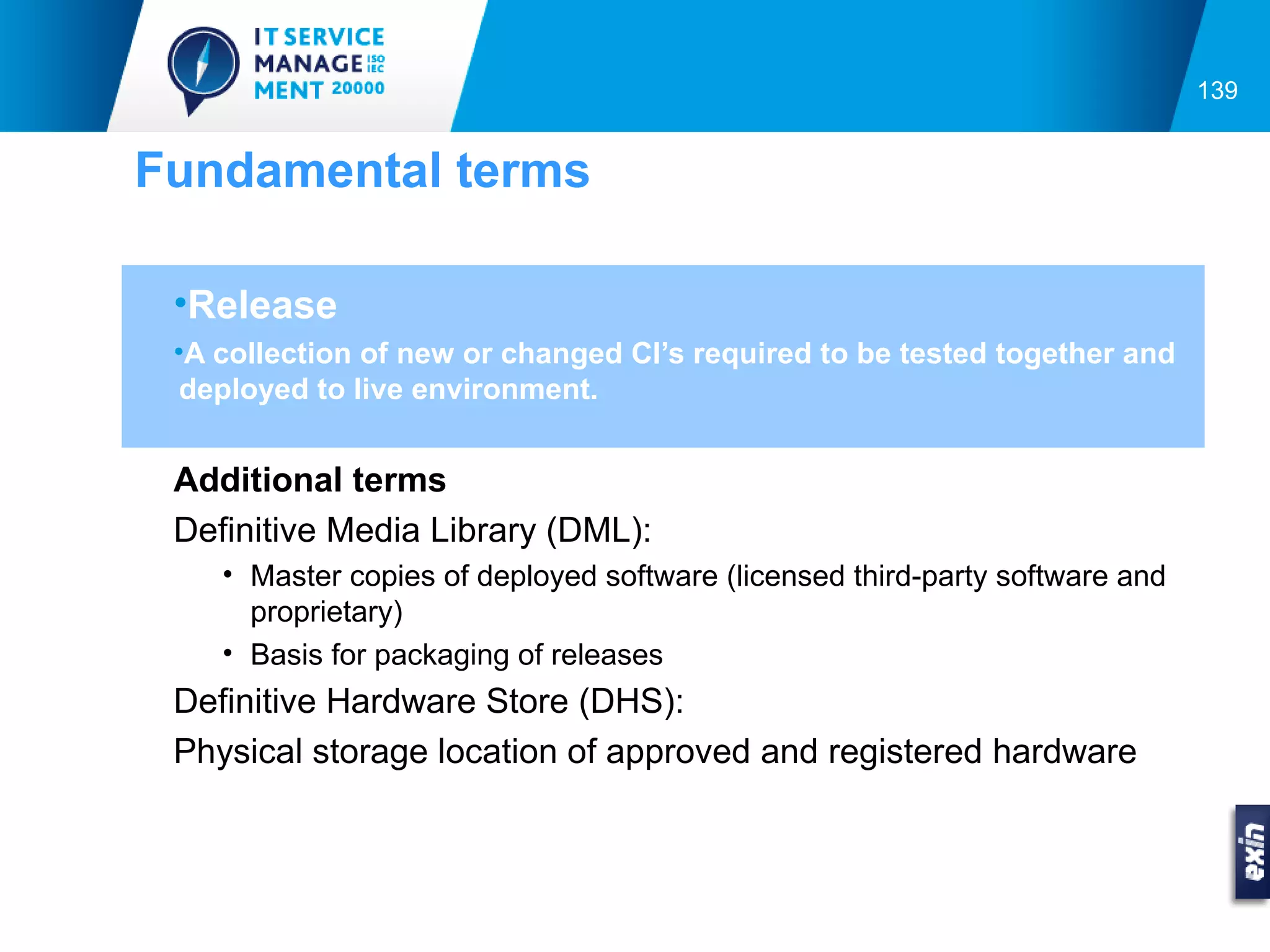
Fundamental terms

 •Release
 •A collection of new or changed CI’s required to be tested together and
  deployed to live environment.


 Additional terms
 Definitive Media Library (DML):
    • Master copies of deployed software (licensed third-party software and
      proprietary)
    • Basis for packaging of releases
 Definitive Hardware Store (DHS):
 Physical storage location of approved and registered hardware
140


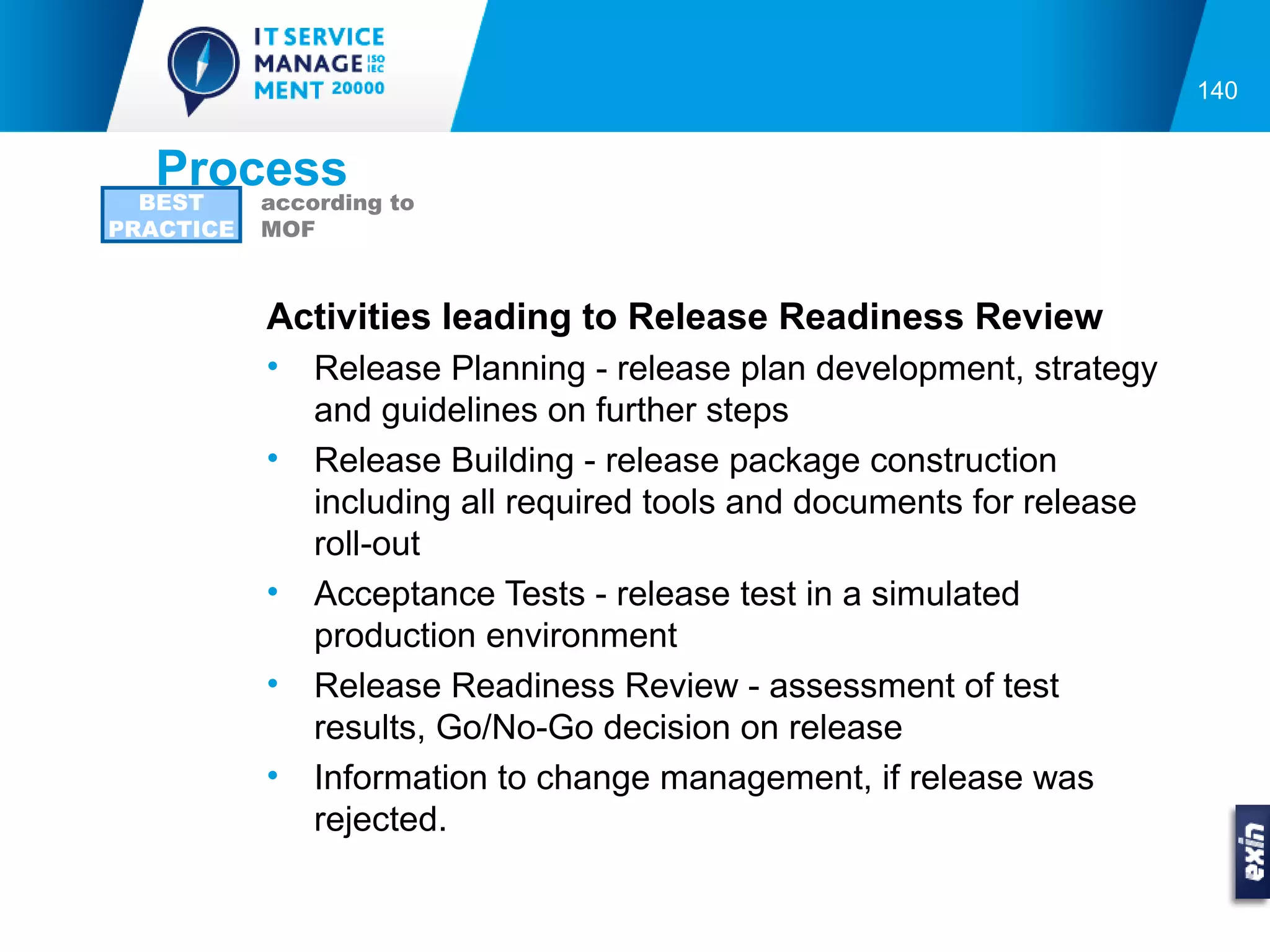
  Process
  BEST     according to
PRACTICE   MOF


           Activities leading to Release Readiness Review
           •   Release Planning - release plan development, strategy
               and guidelines on further steps
           •   Release Building - release package construction
               including all required tools and documents for release
               roll-out
           •   Acceptance Tests - release test in a simulated
               production environment
           •   Release Readiness Review - assessment of test
               results, Go/No-Go decision on release
           •   Information to change management, if release was
               rejected.
141


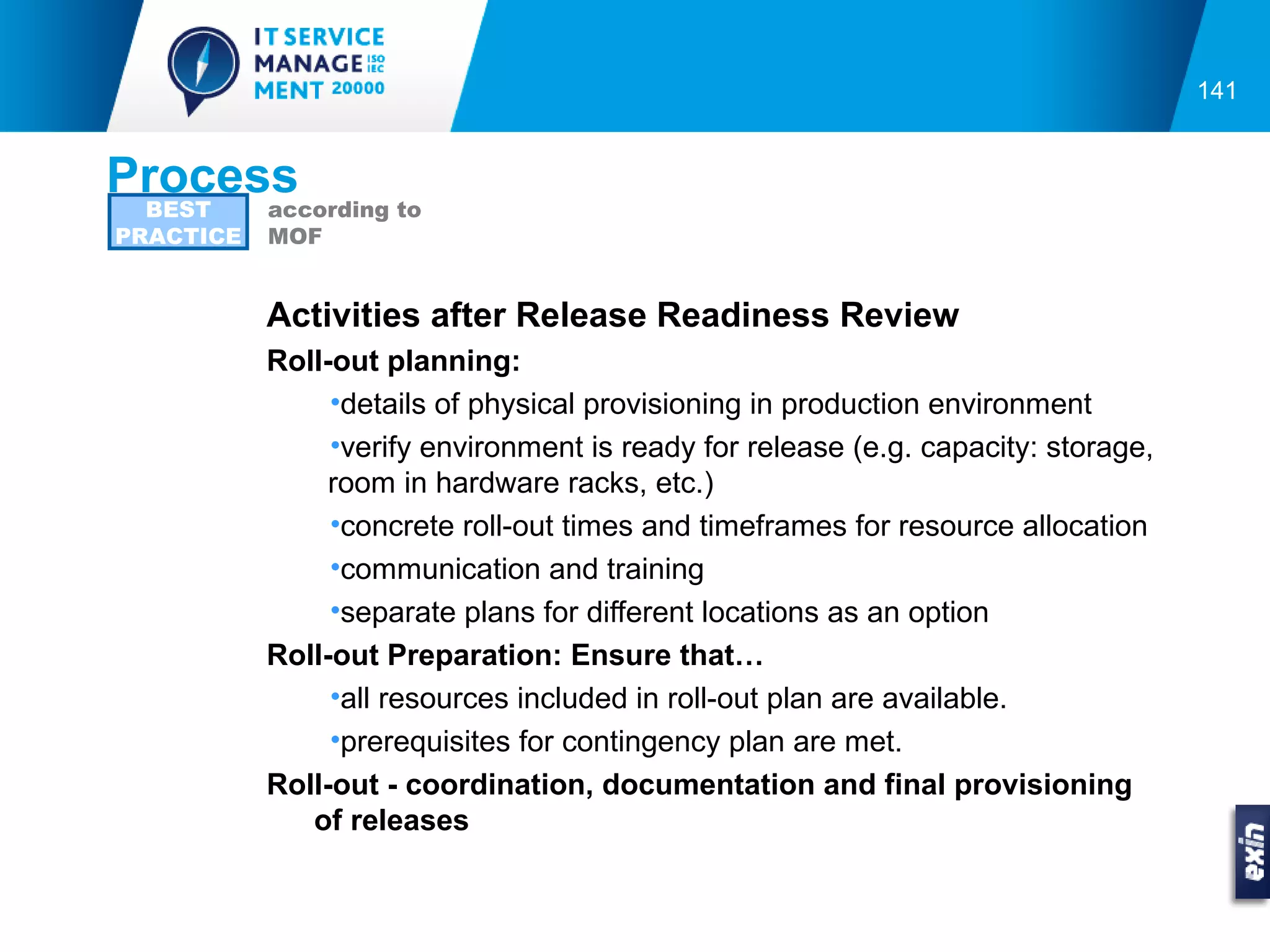
Process
  BEST     according to
PRACTICE   MOF


           Activities after Release Readiness Review
           Roll-out planning:
                •details of physical provisioning in production environment
                •verify environment is ready for release (e.g. capacity: storage,
                room in hardware racks, etc.)
                •concrete roll-out times and timeframes for resource allocation
                •communication and training
                •separate plans for different locations as an option
           Roll-out Preparation: Ensure that…
                •all resources included in roll-out plan are available.
                •prerequisites for contingency plan are met.
           Roll-out - coordination, documentation and final provisioning
              of releases
142


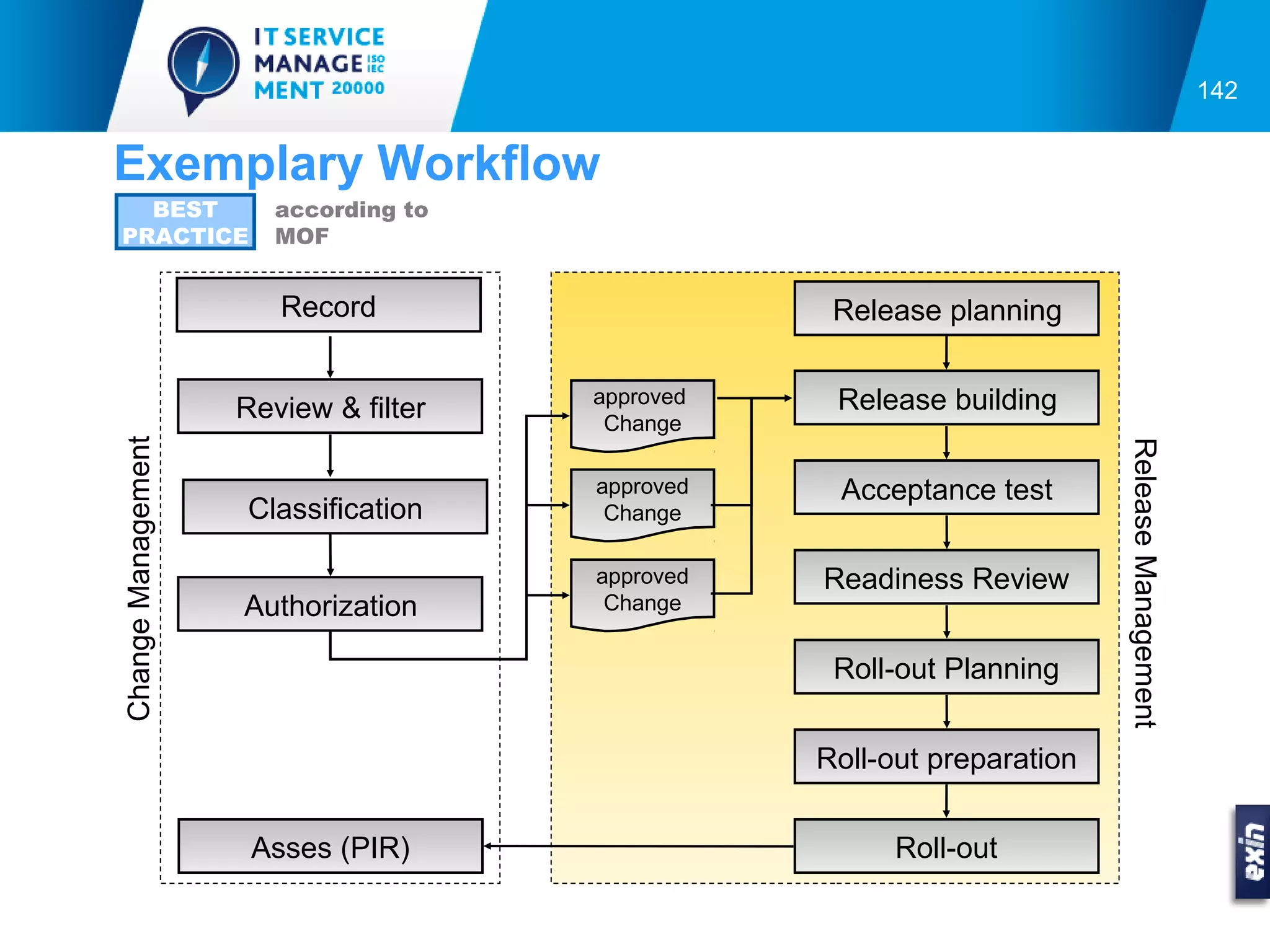
Exemplary Workflow
  BEST                 according to
PRACTICE               MOF


                       Record                     Release planning


                    Review & filter   approved    Release building
                                       Change
Change Management


                                                                        Release Management
                                      approved    Acceptance test
                    Classification     Change

                                      approved   Readiness Review
                    Authorization      Change


                                                  Roll-out Planning


                                                 Roll-out preparation


                     Asses (PIR)                       Roll-out
143


   Minimum Requirements
          0000
ISO/IEC 2
           tion
 Specifica

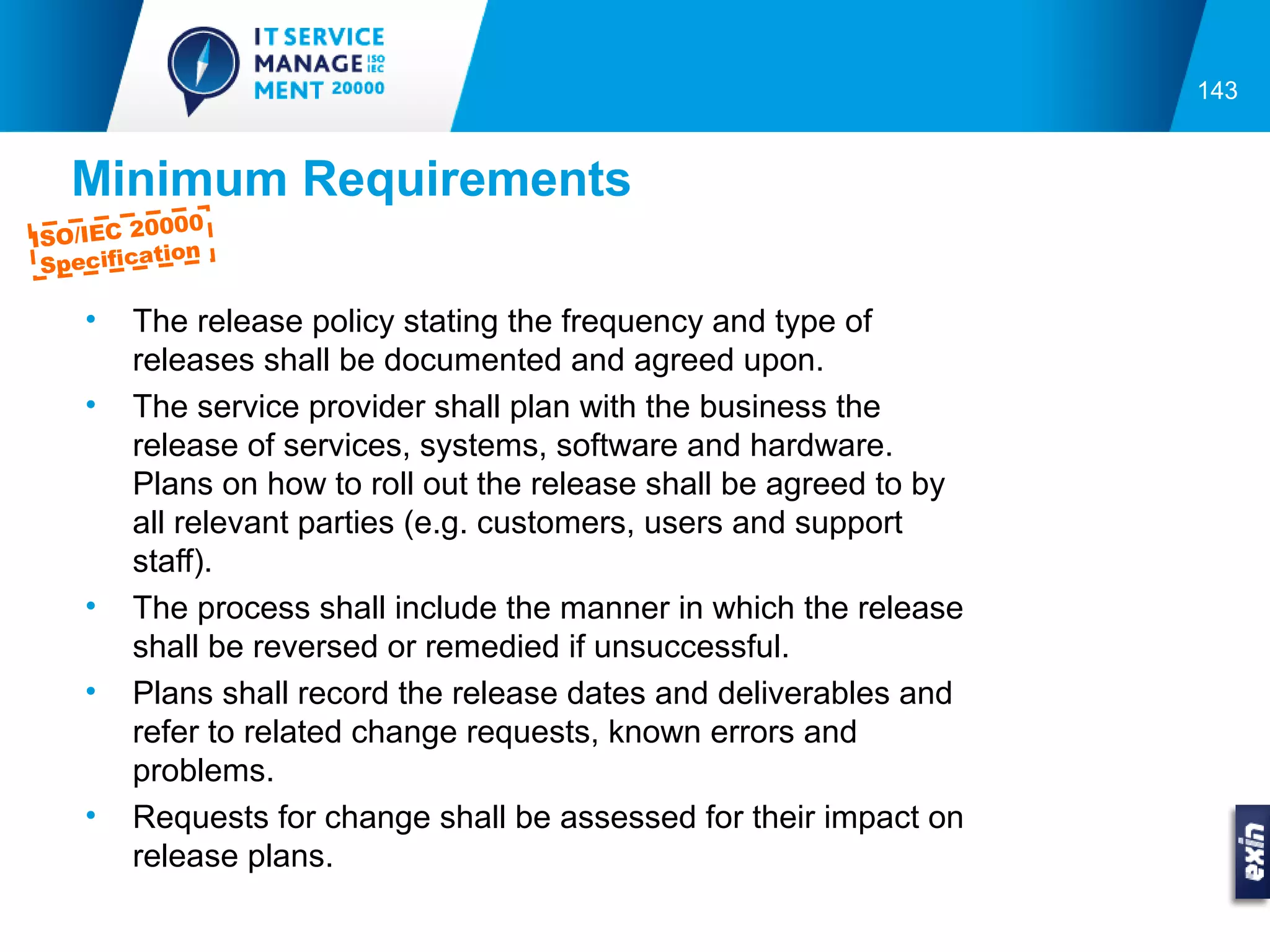
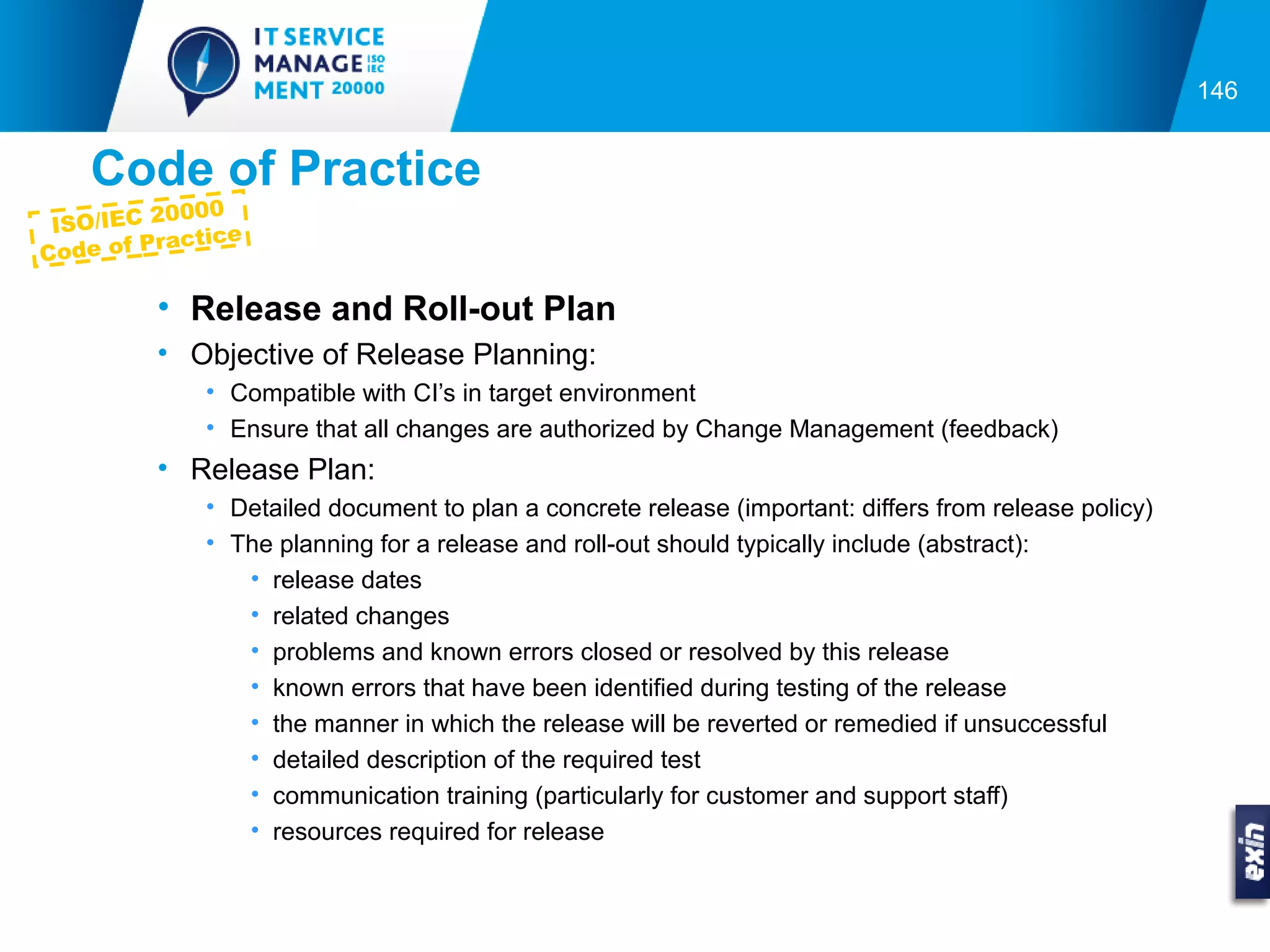
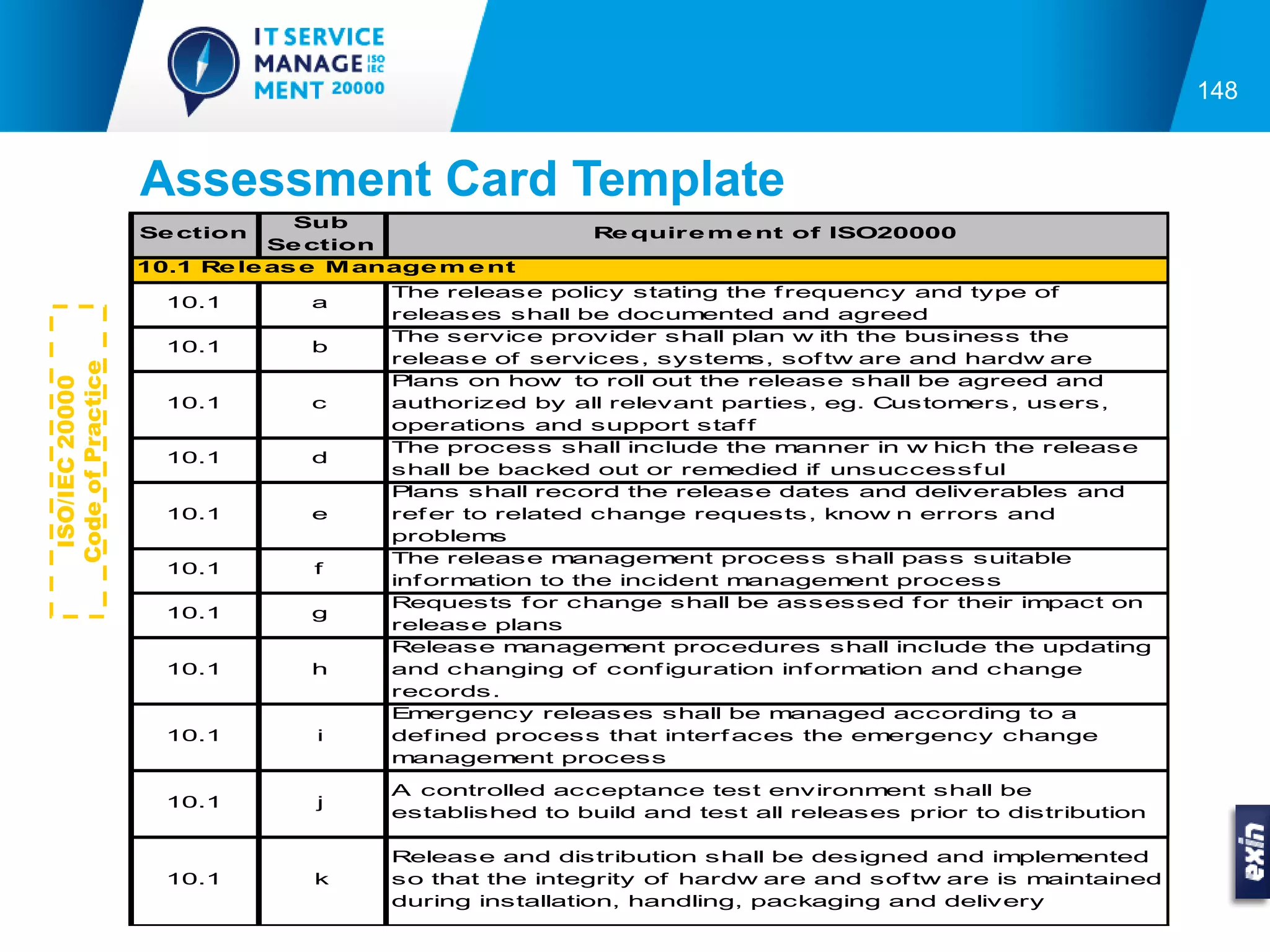
    •   The release policy stating the frequency and type of
        releases shall be documented and agreed upon.
    •   The service provider shall plan with the business the
        release of services, systems, software and hardware.
        Plans on how to roll out the release shall be agreed to by
        all relevant parties (e.g. customers, users and support
        staff).
    •   The process shall include the manner in which the release
        shall be reversed or remedied if unsuccessful.
    •   Plans shall record the release dates and deliverables and
        refer to related change requests, known errors and
        problems.
    •   Requests for change shall be assessed for their impact on
        release plans.
144


        Minimum Requirements
          0000
ISO/IEC 2
           tion
 Specifica

    •   Release management process requires update and
        change procedures for configurations items.
    •   To test releases before distribution requires a
        controlled test environment.
    •   Release and distribution shall be designed and
        implemented so that the integrity of hardware and
        software is maintained at all times.
    •   Success and failure of releases shall be measured.
        Measurements shall include incidents related to a
        release in the period following a release. Analysis shall
        provide input to a plan for improving the service.
145


     Code of Practice
           0000
 ISO/IEC 2
             ctice
Co de of Pra


   Release Policy
   A document to define general requirements for release management.

   A Release Policy should include:
      • frequency and type of release (release types)
      • roles and responsibilities for process
      • authority for the release into acceptance test
      • unique identification and description of all releases
      • approach to grouping changes into a release
      • approach to automating the plan, build and release distribution processes
      • verification and acceptance of a release (e.g. error-free or covered by
        known error database)
146


   Code of Practice
           000
 ISO/IEC 20 ce
         racti
Code of P

        • Release and Roll-out Plan
        • Objective of Release Planning:
           • Compatible with CI’s in target environment
           • Ensure that all changes are authorized by Change Management (feedback)
        • Release Plan:
           • Detailed document to plan a concrete release (important: differs from release policy)
           • The planning for a release and roll-out should typically include (abstract):
              • release dates
              • related changes
              • problems and known errors closed or resolved by this release
              • known errors that have been identified during testing of the release
              • the manner in which the release will be reverted or remedied if unsuccessful
              • detailed description of the required test
              • communication training (particularly for customer and support staff)
              • resources required for release
147


Example: From Change to Release
   Incident                    RfC                  Release

                           Install patch T12-02   Schedule:
 It takes a long time to   for web server         Complete until
 load our external web                            2008-06-25
          sites!           Status: Accepted
                                                  Roll-out Plan
                             Change               1. Download patch
                                                  2. Install in test
                           Install patch T12-02      environment
                           Priority:
                                                  PIR Report
                           Medium (high impact,
                           low urgency)           1. Install in operative
                                                     environment
                           Category (risk):       2. Post Implementation
                           Minor Change                 Review
148


                   Assessment Card Template
                                Sub
                   Se ction                             Re quir e m e nt of ISO20000
                              Se ction
                   10.1 Re le as e M anage m e nt
                                       The release policy stating the f requency and type of
                     10.1       a
                                       releases shall be documented and agreed
                                       The service provider shall plan w ith the business the
                     10.1       b
                                       release of services, systems, sof tw are and hardw are
Code of Practice


                                       P lans on how to roll out the release shall be agreed and
 ISO/IEC 20000


                     10.1       c      authorized by all relevant parties, eg. Customers, users,
                                       operations and support staf f
                                       The process shall include the manner in w hich the release
                     10.1       d
                                       shall be backed out or remedied if unsuccessf ul
                                       P lans shall record the release dates and deliverables and
                     10.1       e      ref er to related change requests, know n errors and
                                       problems
                                       The release management process shall pass suitable
                     10.1        f
                                       inf ormation to the incident management process
                                       Requests f or change shall be assessed f or their impact on
                     10.1       g
                                       release plans
                                       Release management procedures shall include the updating
                     10.1       h      and changing of conf iguration inf ormation and change
                                       records.
                                       E mergency releases shall be managed according to a
                     10.1        i     def ined process that interf aces the emergency change
                                       management process

                                       A controlled acceptance test environment shall be
                     10.1        j
                                       established to build and test all releases prior to distribution

                                       Release and distribution shall be designed and implemented
                     10.1        k     so that the integrity of hardw are and sof tw are is maintained
                                       during installation, handling, packaging and delivery
149


Section 6: Service Delivery Processes

About the process group
Service delivery processes handle long-term service planning and
management of service delivery requirements.

                          [6] Service Delivery Processes
                               Service Level Management
Capacity Management                 Service Reporting   Information Security Management

Service Continuity &                                             Budgeting & Accounting
Availability Management
                              [9] Control Processes                       for IT services
                                Configuration Management
[10] Release                      Change Management               [7] Relationship
Process                                                                Processes
                            [8] Resolution Processes               Business Relationship
                                 Incident Management                        Management
Release Management
                                 Problem Management                Supplier Management
150


Learning target of this section

  •   Objectives, requirements and best practices within
      Service Level Management (3.3.1, 4.3.1)
  •   Objectives, requirements and best practices within
      Service Reporting (4.3.2)
  •   Objectives, requirements and best practices within
      Budgeting and Accounting for IT Services (3.3.3, 4.3.3)
  •   Objectives, requirements and best practices within
      Service Continuity and Availability Management (3.4.1,
      4.4.1)
  •   Objectives, requirements and best practices within
      Capacity Management (3.4.2, 4.4.2)
  •   Objectives, requirements and best practices within
      Information Security Management (3.4.3, 4.4.3)
151


Service Level Management
Objective:
To define, agree, record and manage levels of service.


                          [6] Service Delivery Processes
                               Service Level Management
Capacity Management                 Service Reporting   Information Security Management

Service Continuity &                                             Budgeting & Accounting
Availability Management
                              [9] Control Processes                       for IT services
                                Configuration Management
[10] Release                      Change Management               [7] Relationship
Process                                                                Processes
                            [8] Resolution Processes               Business Relationship
                                 Incident Management                        Management
Release Management
                                 Problem Management                Supplier Management
152


Fundamental terms

 •Service Level Agreement (SLA)
  An agreement between an IT service provider and a
  customer which describes the IT service and service
  level targets.


 •Additional terms
 •Service Level - Acceptable quality level of a
  service
 •Service Catalogue - A structured document
  with information about all provided services (may
  contain reference to SLA)
153


Supporting Service Agreements
                                      Business


                         Service Level Agreements


           Service A             Service B          Service C

                                                                  Service
                                                                  Provider
                               IT Systems
Service Agreements / OLAs
                                  Contracts           Contracts


Internal Organizations                 Suppliers         Lead Suppliers


                                                    Subcontracted Suppliers
154


Service Level Agreements
Possible SLA content (abstract):
•   Service description
•   Validity period
•   Authorization details
•   Service hours
•   Service targets
•   Escalation and notification process
•   Guidelines to define impact and priority
•   Workload limits
•   etc.
155


    Minimum Requirements
         0000
ISO/IEC 2
          tion
 Specifica
    •   The full range of services to be provided together with the
        corresponding service level targets and workload
        characteristics shall be agreed to by the parties and
        recorded.
    •   Each service provided shall be defined, agreed upon and
        documented in one or more service level agreements
        (SLA’s).
    •   SLA’s, together with supporting service agreements,
        supplier contracts and corresponding procedures, shall be
        agreed to by all relevant parties and recorded.
    •   The SLA’s shall be under the control of the change
        management process.
    •   The SLA’s shall be maintained by regular reviews.
    •   Service levels shall be monitored and reported as
        compared to targets.
156


          Service Level Management: Best Practices
           0000
 ISO/IEC 2
            actice
C ode of Pr
      •     A service catalogue defining all services should be up-to-date
           and easily accessible for both customers and support staff.
      •     SLA’s should be defined from a customer perspective.
      •     SLM process should be flexible to accommodate major business
           changes and changing customer requirements.
      •     Service provider should be given adequate information in order
           to understand their customer’s business drivers and
           requirements.
      •     SLM process should encourage both the service provider and
           the customer to be proactive and take joint responsibility for the
           service.
      •     Customer satisfaction is key but should be recognized as a
           subjective measurement.
      •     Supported services should be documented and agreed upon
           with each supplier, including internal groups.
157


                   Assessment Card Template
                                          6.1 Service Level Managem ent


                              The f ull range of services to be provided together w ith the
                    6.1   a   corresponding service level targets and w orkload
Code of Practice
 ISO/IEC 20000


                              characteristics shall be agreed by the parties and recorded.

                              Each service provided shall be def ined, agreed and
                    6.1   b
                              documented in one or more service level agreements
                              SLA's, together w ith supporting service agreements, third
                    6.1   c   party contracts and corresponding procedures, shall be
                              agreed by all relevant parties and recorded

                    6.1   d   The SLA's shall be under Change Control

                              The SLA's shall be maintained by regular review s by the
                    6.1   e   parties to ensure that they are up to date and remain
                              ef f ective over time
                              Service levels shall be monitored and reported against
                              targets, show ing both current and trend inf ormation. The
                    6.1   f   reasons f or non-conf ormance shall be reported and
                              review ed and shall provide input to service improvement
                              plan
158


Service Reporting

Objective:
To produce agreed, timely, reliable and accurate reports for
informed decision making and effective communication.

                           [6] Service Delivery Processes
                                Service Level Management
 Capacity Management                Service Reporting    Information Security Management

 Service Continuity &                                             Budgeting & Accounting
 Availability Management
                               [9] Control Processes                       for IT services
                                 Configuration Management
[10] Release                       Change Management               [7] Relationship
Process                                                                 Processes
                             [8] Resolution Processes               Business Relationship
                                  Incident Management                        Management
 Release Management
                                  Problem Management                Supplier Management
159


     Minimum Requirements
          0000
ISO/IEC 2
           tion
 Specifica
     •   There shall be a clear description of each service report
         including its identity, purpose, audience and details of the
         data source.
     •   Service reports shall be produced to meet identified needs
         and customer requirements. Service reporting shall include:
           performance against service level targets
           non-compliance and issues (e.g. against the SLA, security
          breech)
           workload characteristics (e.g. volume, resource utilization)
           performance reporting following major events (e.g. major
          incidents and changes)
           trend information
           satisfaction analysis
     •   Management decisions and corrective actions shall take into
         consideration the findings in the service reports and shall be
         communicated to relevant parties.
160


                   Assessment Card Template
                               Sub
                   Se ction                              Re quire m e nt of ISO20000
                              Se ction
                                                              6.2 Se rvice Re porting
                                         There shall be a clear description of each service report
                     6.2      Para-1     including its identity, purpose, audience and details of the
Code of Practice
 ISO/IEC 20000


                                         data source
                                         Service reports shall be produced to meet identif ied needs
                              Para-2
                                         and customer requirements.
                                         Service reporting shall include: perf ormance against service
                     6.2         a
                                         level targets
                                         Service reporting shall include: non-compliance and issues,
                     6.2         b
                                         eg. Against the SLA, security breach
                                         Service reporting shall include: w orkload characteristics,
                     6.2         c
                                         eg. Volume, resource utilization
                                         Service reporting shall include: perf ormance reporting
                     6.2         d
                                         f ollow ing major events eg. Major incidents and changes

                     6.2         e       Service reporting shall include: trend inf ormation

                     6.2         f       Service reporting shall include: satisf action analysis

                                         Management decisions and corrective actions shall take into
                     6.2      Para-3     considerations the f indings in service reports and shall be
                                         communicated to relevant parties
161


Event Management
  BEST      according to
PRACTICE    ITIL® Version 3


•   Service reports are based on events and event statistics
    respectively.
•   Event - a change of state that has significance for the
    management of a Configuration Item or IT Service.
•   Classification of events:
     Informational Event – purely informative, for reporting purpose
      no action required
     Warning – A service or device is approaching a threshold 
     notify the appropriate persons, process or tool
     Exception – currently operating abnormally, SLA breach 
     Reaction required
•   Exceptions can cause incidents and/or requests for change.
162


Service Continuity & Availability Management

Objective:
 To ensure that agreed service continuity and availability
 commitments to customers can be met in all circumstances.

                          [6] Service Delivery Processes
                               Service Level Management
Capacity Management                 Service Reporting   Information Security Management

Service Continuity &                                             Budgeting & Accounting
Availability Management
                              [9] Control Processes                       for IT services
                                Configuration Management
[10] Release                      Change Management               [7] Relationship
Process                                                                Processes
                            [8] Resolution Processes               Business Relationship
                                 Incident Management                        Management
Release Management
                                 Problem Management                Supplier Management
163


Fundamental terms

 Availability
 Ability of a component or service to perform its agreed
   function when required.


 Additional terms
 Availability Plan - a document to define aspects of
   service availability in day-to-day operations
 Service Continuity - the capability to continue
   service operations in exception cases
 Service Continuity Plan - a document to manage
   risks of exceptional events in order to continue or
   recover IT services
164


Average Availability
165


Process
  BEST      according to
PRACTICE    ITIL® Version 2 & 3


Activities within Availability Management
Define availability requirements:
   •SLA requirements?
   •What is the maximum duration with or without constricted
 service that is acceptable for customers?
   •What is the maximum frequency of service failure that is
 acceptable for customers?
Plan availability:
   •Average Availability
   •Serviceability
   •Maintainability
Measure availability
166


Process
  BEST       according to
PRACTICE     ITIL® Version 2 & 3


Activities within Continuity Management
•   Define continuity requirements:
       •SLA requirements?
       •Business critical systems/services?
       •Maximum duration with or without constricted service that is acceptable for
     customers?
•   Plan service continuity:
      •Preventive measures
       • Technical - provide standby systems, emergency power supply, etc.
       • Organizational - reciprocal arrangements
      •Recovery options
       • Do nothing
       • Manual work-around
       • Cold Standby, Warm Standby, Hot Standby
      •Documentation of recovery procedures and operational instructions
      •Regular test and review of all plans
167


Process
  BEST     according to
PRACTICE   ITIL® Version 2 & 3


 Common Activities
 Component Failure Impact Analysis (CFIA)
     •Analyze IT infrastructure dependencies
     •Identification of Single Point of Failures (SPOF’s)
 Business Impact Analysis (BIA)
     •Analyze dependencies between services and business
     processes
     •Quantification of business impact of service failure
 Risk Analysis                Assets             Vulnerabilities   Threats
     •Assets
     •Vulnerabilities
                                                     Risk
     •Threats

                                               Countermeasure
168


   Minimum Requirements
         0000
ISO/IEC 2
          tion
 Specifica

    •   Availability and service continuity requirements shall
        be identified on the basis of business priority, SLA’s
        and risk assessments.
    •   Availability and service continuity plans shall be
        developed and reviewed at least annually.
    •   The availability and service continuity plans shall be
        re-tested at every major change to the business
        environment.
    •   The change management process shall assess the
        impact of any change on the availability and service
        continuity plan.
169


  Minimum Requirements
         0000
ISO/IEC 2
          tion
 Specifica

    •   Availability shall be measured and recorded.
        Unplanned non-availability shall be investigated and
        appropriate actions taken.
    •   Service continuity plans, contact lists and the CMDB
        shall be available when normal office access is
        prevented.
    •   The service continuity plan shall include the return to
        normal working.
    •   The service continuity plan shall be tested in
        accordance with business needs.
    •   All continuity tests shall be recorded and test failures
        shall be formulated into action plans.
170


                   Assessment Card Template
                               Sub
                   Se ction                               Re quir e m e nt of ISO20000
                              Se ction
                                           6.3 Availability and Se r vice Continuity M anage m e nt
                                         A vailability and service continuity requirements shall be
                                         identif ied on the basis of business plans, SLA 's and risk
                     6.3         a       assessments. Requirements shall include access rights and
Code of Practice


                                         response times as w ell as end to end availability of system
 ISO/IEC 20000


                                         components
                                         A vailability and service continuity plans shall be developed
                                         and review ed at least annually to ensure that requirements
                     6.3         b
                                         are met as agreed in all circumstances f rom normal through
                                         to a major loss of service.
                                         These plans shall be maintained to ensure that they ref lect
                     6.3         c
                                         agreed changes required by the business
                                         The change management process shall assess the impact
                     6.3         d
                                         of any change on the availability and service continuity plan

                     6.3         e       A vailability shall be measured and recorded

                                         unplanned no-availability shall be investigated and
                     6.3         f
                                         appropriate actions taken.
                                         Where possible, potential issues should be predicted and
                     6.3         g
                                         preventive action taken
                                         Service continuity plan, contact lists and the conf iguration
                     6.3         h       management database shall be available w hen normal
                                         of f ice access is prevented.
                                         The service continuity plan shall be tested in accordance
                     6.3         i
                                         w ith business needs
                                         A ll continuity tests shall be recorded and test f ailures shall
                     6.3         j
                                         be f ormulated into action plans
171


    Service Continuity and Availability Management:
    Best Practices
           000
 ISO/IEC 20 ce
         racti
Code of P
      •    Service Continuity and Availability processes should work
          together to ensure agreed service levels are maintained.
      •    Processes should include elements of the delivery under the
          control of the customer, suppliers or other service providers.
      •    Availability should be monitored and recorded, and resulting
          corrective actions should be recorded and carried out.
      •    An overall service continuity strategy should be defined and
          regularly reviewed. Any changes should be formally agreed upon.
      •    Service continuity plans and related documents should be linked
          to change management and contract management processes.
      •    Testing should occur with sufficient frequency to ensure plans
          remain effective.
      •    Testing should be a joint involvement between customer and
          service provider.
172


Budgeting & Accounting for IT services

Objective:
To budget and account for the cost of service provision.


                          [6] Service Delivery Processes
                               Service Level Management
Capacity Management                 Service Reporting   Information Security Management

Service Continuity &                                           Budgeting & Accounting
Availability Management
                              [9] Control Processes                     for IT services
                                Configuration Management
[10] Release                      Change Management               [7] Relationship
Process                                                                Processes
                            [8] Resolution Processes               Business Relationship
                                 Incident Management                        Management
Release Management
                                 Problem Management                Supplier Management
173


Basic Activities

•   Budgeting - predicting demand behavior to forecast
    costs of service and to manage expenditures
•   Accounting - identify actual costs
•   Charging - requiring payment for IT services from
    customers


•   Charging is not part of ISO/IEC 20000 requirements .
174


Cost types and cost classifications

• Cost types
• Depends on purpose of costs
• Examples:
   Hardware
   Labor
   Capital
   Operation
   etc.
• Cost classifications
• Direct and indirect costs
• Fixed and variable costs
175


      Minimum Requirements
             000
ISO/IEC 20
            tion
  Specifica

      •   There shall be clear policies and processes for:
                  budgeting, and accounting for all components including IT
                   assets, shared resources, overheads, externally supplied
                   service, people, insurance and licenses;
                  apportioning indirect costs and allocating direct costs to
                   services;
                  effective financial control and authorization.
      •   Costs shall be budgeted in sufficient detail to enable
          effective financial control and decision making.
      •   Costs shall be monitored and reported as compared to
          the budget.
      •   Review the financial forecasts and manage costs
          accordingly.
      •   Changes to services shall include cost estimates and be
          approved through the change management process.
176


    Budgeting and Accounting for IT Services:
    Best Practices
           0000
 ISO/IEC 2
            actice
C ode of Pr
         •    All accounting practices used should be aligned to the wider
             accountancy practices of the whole organization.
         •    Policy should define the objectives to be met as well as the detail
             to which budgeting and accounting are performed.
         •    Level of investment in financial processes should be based on
             the need of customers, service provider and suppliers for
             financial details.
         •    Budgeting should take into account planned changes to services
             and the management of shortfalls/variances.
         •    Accounting should be used to track costs to an agreed level of
             detail over an agreed period of time, and make cost of low levels
             of service or loss of service visible.
         •    Where charging is in use (OPTIONAL!), the mechanism for
             charging should be understood by all parties.
177


Charging
  BEST     according to
PRACTICE   ITIL® Version 2 & 3


Possible charging motivation:
  • Demand management
  • Cost reduction, identify inefficient areas of delivery
  • Stronger alignment of services and business
    requirements
Charging model (examples):
  •   costs
  •   cost-plus
  •   market price
  •   fixed price
178


                   Assessment Card Template
                              Sub
                   Section                            Requirem ent of ISO20000
                             Section
                                            6.4 Budgeting and Accounting for IT Services
                                       There shall be clear policies and procedures for budgeting,
Code of Practice


                                       and accounting for all components including IT assets,
 ISO/IEC 20000


                     6.4       a
                                       shared resources, overheads, third party supplied service,
                                       people, insurance and licenses
                                       There shall be clear policies and procedures for
                     6.4       b       apportioning and allocating all indirect costs to relevant
                                       services
                                       There shall be clear policies and procedures for effective
                     6.4       c
                                       financial control and authorization
                                       Costs shall be budgeted in sufficient detail to enable
                     6.4     Para-1
                                       effective financial control and decision making
                                       The service provider shall monitor and report costs against
                     6.4     Para-2    the budget, review the financial forecasts and manage
                                       costs accordingly
                                       Changes to services shall be costed and approved through
                     6.4     Para-3
                                       the change management process
179


Capacity Management

Objective:
   To ensure that the service provider has, at all times, sufficient capacity
   to meet the current and future agreed demands of the customer’s
   business needs.

                           [6] Service Delivery Processes
                                Service Level Management
 Capacity Management                 Service Reporting   Information Security Management

 Service Continuity &                                             Budgeting & Accounting
 Availability Management
                               [9] Control Processes                       for IT services
                                 Configuration Management
 [10] Release                      Change Management               [7] Relationship
 Process                                                                Processes
                             [8] Resolution Processes               Business Relationship
                                  Incident Management                        Management
 Release Management
                                  Problem Management                Supplier Management
180


Fundamental terms
  Capacity Plan:
    • Current infrastructure performance
    • Future needs
    • Documentation of cost-calculated options to achieve requirements
      and recommendations
    • Shall be produced at least annually
  Capacity Predictions:
    • Modeling, Application Sizing
    • Trend analysis
    • Customer and business-related forecast
  Demand Management - Influence user behavior for an
   optimal capacity usage
181


     Minimum Requirements
          0000
ISO/IEC 2
           tion
 Specifica

      •   Capacity management shall produce and maintain a
          capacity plan.
      •   Capacity management shall address the business
          needs and include:
           current and predicted capacity and performance
           requirements;
           identified timelines, thresholds and costs for service
           upgrades;
           evaluation of effects of anticipated service upgrades, requests
            for change, new technologies and techniques on capacity;
           predicted impact of external changes, e.g. legislative;
           data and processes to enable predictive analysis.
      •   Methods, procedures and techniques shall be identified to
          monitor service capacity, tune service performance and
          provide adequate capacity.
182


       Capacity Management: Best Practices
           0000
 ISO/IEC 2
            ctice
Co de of Pra

                Requirements should be understood in terms of what the
                business will need to enable it to deliver to customers.
                Utilization data should be captured and analyzed so that
                results of variations in workload or environment become
                predictable.
                Process should support development of new and
                changed services by providing sizing and modelling of
                services.
                Capacity plan should support SLA’s and should be
                produced at a suitable frequency (at least annually).
                Current and projected capabilities of the technical
                infrastructure should be well understood.
183


                   Assessment Card Template
                            Sub
                   Section                           Requirem ent of ISO20000
                           Section
                                                     6.5 Capacity Managem ent
                                     Capacity management shall produce and maintain a capacity
                     6.5   Para-1
Code of Practice


                                     plan, w hich shall address the business needs
 ISO/IEC 20000


                                     Capacity plan shall include current and predicted capacity
                     6.5     a
                                     and performance requirements
                                     Capacity plan shall include identified time-scales, thresholds
                     6.5     b
                                     and costs for service upgrades
                                     Capacity plan shall include evaluation of effects of
                     6.5     c       anticipated service upgrades, requests for change, new
                                     technologies and techniques on capacity
                                     Capacity plan shall include predicted impact of external
                     6.5     d
                                     changes, eg. Legislative.
                                     Capacity plan shall include data and processes to enable
                     6.5     e
                                     predictive analysis
                                     Methods, procedures and techniques shall be identified to
                     6.5   Para-2    monitor service capacity, tune service performance and
                                     provide adequate capacity
184


Information Security Management

  Objective:
  To manage information security effectively within all service
  activities.

                            [6] Service Delivery Processes
                                 Service Level Management
  Capacity Management                 Service Reporting       Information Security
                                                                      Management
  Service Continuity &                                       Budgeting & Accounting
  Availability Management
                                [9] Control Processes                 for IT services
                                  Configuration Management
 [10] Release                       Change Management        [7] Relationship
 Process                                                          Processes
                              [8] Resolution Processes        Business Relationship
                                   Incident Management                 Management
  Release Management
                                   Problem Management         Supplier Management
185


Fundamental terms
Information security:
    • Information security is the result of a system of policies and
      procedures.
    • Designed to protect information and any equipment used in
      connection with its storage, transmission and processing.
ISO/IEC 27000:
    • Bundle of information security ISO/IEC standards
    • ISO/IEC 27001: Information Security Management Systems
      – Requirements
    • ISO/IEC 27002:
       • former ISO/IEC 17799
       • Code of Practice for Information Security Management
186


    Minimum Requirements
            000
ISO/IEC 20
           tion
  Specifica


        Management with appropriate authority shall approve an
        information security policy that shall be communicated to
        all relevant personnel and customers where appropriate.

    Appropriate security controls shall operate to:
        •implement the requirements of the information security policy;
        •manage risks associated with access to the service or
         systems.
    Security controls shall be documented:
        •The documentation shall describe the risks to which the
         controls relate
        •and the manner of operation and maintenance of the controls.
187


      Information Security Management:
      Best Practices
         00
       C 200 ice
IS O/IE Pract
      of   •   Serviceprovidera should maintain an inventory of the information
Co de
             assets, classified according to criticality.

         •   Asset owners accountable for asset protection.

         •    Controls should be in place, such as:
                  - a defined and enforced security policy
                  - ISM roles and responsibilities
                  - information security training for staff with security roles, e.g.
             knowledge of ISO/IEC 17799
                  - expert help on risk assessment and control implementation
                  - information security incidents handled within Incident
             Management

              Records should be analyzed periodically for control, measuring
             effectiveness, trend identification, and improvement activities.
188


     Information Security Management:
     Best Practices in Risk Assessment
           000
 ISO/IEC 20 ce
         racti
Code of P
        •   Regular security risk assessments should be performed.

        •   Risks assessed based on:
                - their nature
                - likelihood
                - potential business impact
                - past experience

        •    Risk assessment should pay attention to disclosure of sensitive
            information to unauthorized parties, fraudulent information, availability
            of information, security policy objectives, specific customer security
            requirements and statutory requirements.
189


                   Assessment Card Template
                               Sub
                   Se ction                              Re quir e m e nt of ISO20000
                              Se ction
                                                  6.6 Inform ation Se curity M anage m e nt

                                         Management w ith appropriate authority shall approve an
                     6.6      Para-1     inf ormation security policy that shall be communicated to all
                                         relevant personnel and customers w herever appropriate
Code of Practice
 ISO/IEC 20000


                                         A ppropriate security controls shall operate to implement the
                     6.6         a
                                         requirements of the inf ormation security policy
                                         A ppropriate security controls shall operate to manage risks
                     6.6         b
                                         associated w ith access to the service or systems

                                         Security controls shall be documented. The documentation
                     6.6      Para-2     shall describe the risks to w hich the controls relate and the
                                         manner of operation and maintenance of controls

                                         The impact of changes on controls shall be assessed
                     6.6      Para-2
                                         bef ore changes are implemented
                                         A rrangements that involve third party access to inf ormation
                     6.6      Para-3     systems and services shall be based on a f ormal
                                         agreement that def ines all necessary security requirements

                                         Security incidents shall be reported and recorded in line
                     6.6      Para-4     w ith the incident management procedure as soon as
                                         possible
                                         P rocedures shall be in place to ensure that all security
                     6.6      Para-5
                                         incidents are investigated and management action taken
                                         Mechanisms shall be in place to enable the types, volumes
                                         and impacts of security incidents and malf unctions to be
                     6.6      Para-6
                                         quantif ied and monitored, and to provide input to the service
                                         improvement plan
190


Section 7: Relationship Processes

 About the process group
 Relationship processes describe the two related aspects of Supplier Management and
 Business Relationship Management.


                            [6] Service Delivery Processes
                                 Service Level Management
  Capacity Management                 Service Reporting   Information Security Management

  Service Continuity &                                             Budgeting & Accounting
  Availability Management
                                [9] Control Processes                       for IT services
                                  Configuration Management
  [10] Release                      Change Management               [7] Relationship
  Process                                                                Processes
                              [8] Resolution Processes               Business Relationship
                                   Incident Management                        Management
  Release Management
                                   Problem Management                Supplier Management
191


Learning target of this section

• Objectives and requirements within Business
  Relationship Management (3.3.4)
• Best Practices within Business Relationship
  Management (4.3.4)
• Objectives and requirements within Supplier
  Management (3.3.5)
• Best Practices within Supplier Management
  (4.3.5)
192


   Tasks and Scope
           0000
 ISO/IEC 2
            ctice
Co de of Pra
      •    The relationship processes should ensure that all parties:
             • understand and meet business needs;
             • understand capabilities and constraints;
             • understand responsibilities and obligations.
      •    Supplier Management interfaces with suppliers. Business
           Relationship Management interfaces with customers.

                         Supplier                   Business
                       Management                  Relationship
                                                   Management


                                      Service
          Supplier                                                Business
                                     Provider
193


Business Relationship Management
  Objective:
  To establish and maintain a good relationship between the service
  provider and the customer based on understanding the customer and
  their business drivers.

                           [6] Service Delivery Processes
                                Service Level Management
 Capacity Management                 Service Reporting   Information Security Management

 Service Continuity &                                             Budgeting & Accounting
 Availability Management
                               [9] Control Processes                       for IT services
                                 Configuration Management
 [10] Release                      Change Management               [7] Relationship
 Process                                                                Processes
                             [8] Resolution Processes             Business Relationship
                                  Incident Management                      Management
 Release Management
                                  Problem Management               Supplier Management
194


     Minimum Requirements
         0000
ISO/IEC 2
          tion
 Specifica

     •   The service provider shall identify and document the
         stakeholders and customers of the services.
     •   A service review shall be conducted:
            with the participation of provider and customer; other
             stakeholders may also be invited to the meetings;
            to discuss any changes to the service scope, SLA, contract
             (if present) or the business needs
            at least annually;
            and results shall be documented.

     •   Changes to the contracts, if present, and SLA’s shall
         follow from these meetings as appropriate and shall be
         subject to the change management process.
195


      Minimum Requirements
          0000
ISO/IEC 2
           tion
 Specifica

      •   The service provider shall remain aware of business needs
          and major changes in order to prepare to respond to these
          needs.
      •   There shall be a complaints process:
            The definition of a formal service complaint shall be agreed
              up on with the customer.
            All formal service complaints shall be recorded and
              managed.
            Where a complaint is not resolved, escalation shall be
              available to the customer.
      •   There shall be a named individual who is responsible for
          managing customer satisfaction.
      •   A process shall exist for obtaining customer satisfaction
          information (shall be input for Service Improvement Plan).
196


                   Assessment Card Template
                               Sub
                   Se ction                              Re quire m e nt of ISO20000
                              Se ction
                                                7.1 Bus ine s s Re lations hip M anage m e nt
                                         The service provider shall identif y and document the
                     7.2         a
                                         stakeholders and customers of the service
                                         The service provider and customer shall attend a service
Code of Practice


                                         review to discuss any changes to the service scope, SLA ,
 ISO/IEC 20000


                                         contract (if present) or the business needs at least annually
                     7.2         b
                                         and shall hold interim meetings at agreed intervals to
                                         discuss perf ormance, achievements, issues and action
                                         plans

                     7.2         c       The customer review meetings shall be documented

                                         Other stake holders in the service may also be invited to the
                     7.2         d
                                         meetings
                                         Changes to the contract(s), if present, and SLA (s) shall
                     7.2         e
                                         f ollow f rom these meetings as appropriate.
                                         These changes shall be subject to the change management
                     7.2         f
                                         process
                                         The service provider shall remain aw are of business needs
                     7.2         g       and major changes in order to prepare to respond to these
                                         needs

                     7.2         h       There shall be a complaint procedure

                                         The def inition of a f ormal service complaint shall be agreed
                     7.2         i
                                         w ith the customer
                                         All f ormal service complaints shall be recorded by the
                     7.2         j       service provider, investigated, acted upon, reported and
                                         f ormally closed.
197


                      Supplier Management
Objective:
  To manage suppliers to ensure the provision of seamless,
  quality services.
                          [6] Service Delivery Processes
                               Service Level Management
Capacity Management                 Service Reporting   Information Security Management

Service Continuity &                                             Budgeting & Accounting
Availability Management
                              [9] Control Processes                       for IT services
                                Configuration Management
[10] Release                      Change Management               [7] Relationship
Process                                                                Processes
                            [8] Resolution Processes               Business Relationship
                                 Incident Management                       Management
Release Management
                                 Problem Management               Supplier Management
198


                    Fundamental Terms
          • Supplier
          • Lead Supplier - A supplier who obtains parts of
            delivered services from a third-party
          • Subcontracted Supplier - Supplier of a lead
            supplier

                    Supplier 1


                    Supplier 2    Service Provider       Business

Subcontracted         Lead         (internal or third-
  Supplier 4        Supplier 3           party)
199

         0000
ISO/IEC 2
 Specifica
          tion              Minimum Requirements
                 •   There shall be documented supplier management
                     processes and a contract manager responsible for
                     each supplier.
                 •   The scope, level of service and communication
                     processes of the delivered services shall be
                     documented in SLA’s.
                 •   SLA’s with suppliers shall be aligned with the SLA’s for
                     the customers.
                 •   The interfaces between processes used by each party
                     shall be documented and agreed upon.
                 •   All roles and relationships between lead and
                     subcontracted suppliers shall be clearly documented.
                     Lead suppliers shall be able to demonstrate processes
                     to ensure that subcontracted suppliers meet
                     contractual requirements.
200


          0000
ISO/IEC 2
 Specifica
           tion          Minimum Requirements
        •   A process shall be in place for a major review of the
            contract:
            at least annually
            to ensure that business needs are still being met
            to ensure that contractual obligations are still being met
        •   Changes to the contracts, if present, and SLA’s shall
            follow from these reviews as appropriate and shall be
            subject to the change management process.
        •   Processes shall exist:
            to deal with contractual disputes
            to deal with the expected end of service, early end of the service
            to deal with transfer of service to another party
        •   Performance shall be monitored and reviewed:
            Compared to service level targets
            Actions for improvement shall be input for a service improvement
              plan.
201


                   Assessment Card Template
                               Sub
                   Se ction                              Re quir e m e nt of ISO20000
                              Se ction
                                                          7.2 Supplie r M anage m e nt
                                         The service provider shall have documented supplier
                     7.3         a       management processes and shall name a contract manager
                                         responsible f or each supplier
Code of Practice


                                         The requirements, scope, level of service and
 ISO/IEC 20000


                                         communication processes to be provided by the supplier(s)
                     7.3         b
                                         shall be documented in SLAs or other documents and
                                         agreed by all parties
                                         SLA's w ith the supplier shall be aligned w ith the SLAs w ith
                     7.3         c
                                         business
                                         The interf aces betw een processes used by each party
                     7.3         d
                                         shall be documented and agreed
                                         All roles and relationships betw een lead and subcontracted
                     7.3         e
                                         suppliers shall be clearly documented.
                                         Lead suppliers shall be able to demonstrate processes to
                     7.3         f       ensure that subcontracted suppliers meet contractual
                                         requirements
                                         A process shall be in place f or a major review of the
                                         contract or f ormal agreement at least annually to ensure
                     7.3         g
                                         that business needs and contractual obligations are still
                                         being met.
                                         Changes to the contract(s), if present, and SLA(s) shall
                     7.3         h       f ollow f rom these review s as appropriate or at other times
                                         as required
                                         A f ormal process shall exist to deal w ith contractual
                     7.3         i
                                         disputes
202


Classification and
   Perspective

  Certification
 • Related practices and standards
 • ISO/IEC 20000 Qualification Program
203


Learning target of this section
• Certification outline (2.2.3)
204


        Prepare Certification
• Choose a Registered Certification Body (RCB)
• Define Scope of certification together with RCB
• Conduct initial assessment:
  Internal or third-party
  Methodology e.g.
     • Self-Assessment Workbook PD0015
     • Pre-audit of RCB / Certifier
     • Apply maturity model, degree model
• All requirements considered?
• Arrange a time and date for audit.
205


                    Scoping
• The Scope defines the effective range of
  the management system.
• Scoping Statement includes:
  Services
  Geographical and local restrictions
  Organizational and functional restrictions
  Infrastructural restrictions
206


Scoping – Pictorial Depiction
207


Roles and Responsibilities in Certification
• Internal or external consultants can aid organizations
  in preparing for certification.

• Internal audits, to idenitfy any non-conformances, can
  be carried out by internal auditors.

• Certification audit has to be carried out by a
  Registered Certification Body (RCB).

• Most countries have local RCB’s, which are
  registered with the National Accreditation Body.
208


                         Certification
•   Prerequisite: Ownership and control of all processes
    defined within ISO/IEC 20000
•   Certification audit:
     – The audit typically consists of:
        • Verification of documents
        • on-site inspection
        • reporting
     – Evidence of reviewed and approved procedures (process
     descriptions):
        • Knowledge and control of process input
        • Knowledge, usage and interpretation of process output
        • Metric definition and evaluation
        • Accountability for process functionality according to ISO/IEC
          20000 standard
        • Define, measure and review process improvements
     – Required effort:
        • Depends on number of people and locations
        • Related to ISO (effort scale)
209


 After the Certification

• The certification is valid for three years:
   – Surveillance audits are performed every year
   normally.
   – Full recertification required every three years.
• Certified Organizations:
www.isoiec20000certification.com
210


    Benefits of Certification and Compliance
•   Visible short term benefits:
        •   improved efficiency and effectiveness
        •   cost savings
        •   improved customer satisfaction
        •   improved service quality


•   Medium to long term benefits:
        • to create new business and/or attract new customers, as certification
          is required for some tendors
        • to enter global markets, as the standard is international
        • to have better and more traceable documentation, e.g. for
          legislative purposes
        • to give your company a competitive edge based upon quality drive
211


ISO 20000 Implementation Roadmap
212


Classification and
   Perspective

 • Certification
  Related practices and standards
 • ISO/IEC 20000 Qualification Program
213


Learning target of this section
• Field of application, objective, audience
  and owner of CMMI, CobiT, ISO 9000, ISO
  15504, ISO/IEC 27001, ITIL® , MOF and Six
  Sigma (2.1.1)
• Principles of maturity degree models
  (1.5.2)
214


                    Related Standards - Overview
ISO 9000

                                                   ISO/IEC 27000
Six Sigma


                                BS 15000           ISO/IEC 20000


                     ITIL® V2                           ITIL® V3

                                                                                     Legende

  (from CobiT V4)                          MOF                      Quality Management
                                                                   standard/methodology
             CobiT                                                   IT Management
                                                                        Framework
                                                                   Software Engineering
  CMM                                            CMMI              maturity degree model

                                                                    Adoption of concepts

             ISO/IEC 15504                                             predecessor
215


                   ISO 9000
• Owner: ISO
• Field of application / audience: industry and service
  providers / management, customers
• Objective: International quality management standard,
  certified companies
• Publication media / source: Standard (printout,
  PDF) / via ISO
• Miscellaneous:
  ISO 9000 comprises a series of documents.
  Best known: ISO 9001 - Quality management systems
    - Requirements
  ISO 9000 process approach
216


                  ISO/IEC 27000
• Owner: ISO/IEC
• Field of application / audience: All types of
  organizations / management, customers
• Objective: International information security standard,
  certified companies
• Publication media / source: Standard (printout,
  PDF) / via ISO
• Miscellaneous:
  ISO 27000 comprises a series of documents.
  Best known: ISO 27001 – Information Technology --
    Security techniques -- Information security
    management systems -- Requirements
  ISO 27000 process approach, PDCA implemented
217


                 Six Sigma (6σ)
• Owner: none
• Field of application / audience: Historically it has
  been primarily for industry, but is increasingly used by
  service providers / management
• Objective: Increase in productivity (e.g. reducing
  spread for standard factory models) through use of
  different quality management methodologies
• Publication media / source: Many books (no official
  general document) / book trade
• Miscellaneous:
  The use of statistical tools to achieve structured
     improvement is characteristic of Six Sigma.
  „6σ“ relates to a statistical quality target (defect free
     yield of 99,99966%).
218


     IT Infrastructure Library (ITIL®)
• Owner: Office of Government Commerce (OGC)
• Field of application / audience: IT Service
  Provider / Management
• Objective: Best Practice Guidance for IT Service
  Management
• Publication media / source: Books and CD’s
  published by TSO (The Stationary Office) / book
  trade
• Miscellaneous:
   ITIL® Version 2 is the most popular ITSM framework
   Since Summer 2007, fully revised version 3 (ITIL®
     V3) available
219


                ITIL® Version 2
Content of ITIL® V2
  Service Support Book: Operational processes
  Service Delivery Book: Tactical processes
  Security Management Book
  Some additional books

                             Planning to implement Service Management
                                                                                   T
                    B                                                              e


                                                                  Management
                                                                  Infrastructure
                    u                                 Service                      c
                    s   Perspective                   Support                      h
                         Business

                    i                                                              n
                    n                                                              o
                    e                 Service                                      l
                    s                                                              o
                    s                 Delivery                                     g
                                                          Security                 y
                             Application Management      Management
                                            Suppliers
220


ITIL® Version 3

  • Service lifecycle-oriented approach
221


Mapping ISO 20000 Standard to the Service Lifecycle
        Service Strategy:
           Requirements for a Management System
           Budgeting and Accounting


        Service Design:
           Planning and Implementing New or Changed Services
           Other disciplines (e.g. Availability Management, Capacity
              Management, Service Level Management)


        Service Transition:
           Change, Configuration and Release Management


        Service Operation:
           Incident and Problem Management


        Continual Service Improvement:
           Planning & Implementing Service Management
222


Mapping Deming Cycle to the Service Lifecycle

            Plan:
               Service Strategy
               Service Design


            Do:
               Service Transiton
               Service Operation


            Check and Act:
               Continual Service Improvement
223

                           What is (not) ITIL® ?
What is covered by ITIL®:                 What is not covered by
• Definition of IT processes:                     ITIL®:
   Objectives                         Certifiable standard


                                                                            Cp. ISO/IEC
                                                                              20000
   Activities
   In-/Outputs                        • Resilient set of minimum requirements
   Interfaces within

• Recommendations for
                                      • Software, tools
  process implementation:
   requirements (e.g. staff skills)
                                      • Formal models and templates for:
   supporting concepts
                                         • processes
   required functions
                                         • relations
   risks
                                         • information artifacts
• Evaluation hints:
   Critical success factors
   Key performance indicators
224


Process Document Contents

           1) Introduction
           2) Objective
           3) Scope
           4) Target Audience
           5) Process Roles
           6) Inputs
           7) Process Flow
           8) Process Details
           9) Outputs
           10) Process Metrics
           11) Process Interfaces
           12) Appendix
           13) Glossary
225


Microsoft Operations Framework (MOF)
  • Owner: Microsoft
  • Field of application / audience: IT Service
    Provider / Management
  • Objective: Operational Guidance for users of
    Microsoft products
  • Publication media / source: printable files
    (Word, PDF) / free from web
    (www.microsoft.com/mof)
  • Miscellaneous: Based on ITIL® V2, but providing
    prescriptive guidance extended to ITIL® ’s
    descriptive guidance
226


                     MOF 4.0: Framework
• Composition:
   Process model
   Team model
   Risk management
   disciplines
• Process model
  divided in four
  quadrants
• Process model
  extended and
  substantiated
  from ITIL® V2
227


Capability Maturity Model Integration (CMMI)
    • Owner: Software Engineering Institute (SEI) of
      Carnegie Mellon University
    • Field of application / audience: Software and
      system developing organizations / management,
      customers
    • Objective: Measurement of Organizational Maturity
    • Source: Printable files (Word, PDF) / free from web
      (www.sei.cmu.edu/cmmi)
    • Miscellaneous: No ITSM standard, but maturity
      levels is a frequently used concept
228


      CMM / CMMI Maturity Levels

Optimizing

             Process improvement is established
 Managed

             Monitoring of quantitative quality goals
 Defined

             Standard processes implemented and documented
Repeatable

             Basic process existing
  Initial
229


                 Capability Assessments
• Compares the performance of a process against a
  performance standard, such as:
   –   agreements in a SLA
   –   a maturity standard
   –   a benchmark (comparison to average in the industry)
   –   an ISO standard


• Assessments will help in identifying ‘where are we now?’
  and the gap with ‘where we want to be’

• Crucial to define clearly what is being assessed

• Identifies conformances, non-conformances and
  observations
230


 Types of Capability Assessments
• Evaluation of individual processes within the
  management system

• Systematic review of the entire management system by
  top management

• Comprehensive review via self-assessment, e.g. BIP 0015
  Self-Assessment Guide Book as support aid

• Official first, second or third party audits

• Benchmark projects e.g. itSMF benchmark based on
  comprehensive process questionnaire
231


                 ISO/IEC 15504
• Owner: ISO/IEC
• Field of application / audience: Software and
  system developing organizations / management,
  customers
• Objective: International standard of organizational
  maturity assessment
• Publication media / source: Standard (printout,
  PDF) / via ISO
• Miscellaneous: The standard results from the
  European project SPICE (Software Process
  Improvement and Capability Determination)
232


                     CobiT
• CobiT – Control Objectives for Information and
  Related Technology
• Owner: ISACA/ITGI (Information Systems Audit
  and Control Association / IT Governance Institute)
• Field of application / audience: IT service
  provider / management, customers, IT auditors
• Objective: IT Governance – „Control of IT“
• Source: Core documents free from ISACA website
  (www.isaca.org/cobit.htm, registration required)
233


CobiT: Framework
• 34 processes,
  structured in four
  lifecycle domains
• For each process:
 High-Level Control
  Objective
 Detailed Control Objectives
 Management Guidelines
 Maturity Model
234


    Company Specific Standards
• Tailor-made to a specific organization
• Often based upon existing frameworks and models, e.g.
  MOF (based on ITIL, designed to support Microsoft
  products)
• Company specific standards need to conform to ISO/IEC
  20000 Part 1 requirements, in order to gain certification
• Various standards and frameworks used by one
  organization need to be aligned to each other
• Examples:
   Security policies
   Standards concerning IT architecture
   In-company finance standard
235


Classification and
   Perspective

 • Certification
 • Related practices and standards
  ISO/IEC 20000 Qualification Program
236


   analyze,      ISO/IEC 20000 Qualification Program
assess, create


   apply &
   analyze
                                                          Associate
                                                       Consultant/Auditor


 remember &
 understand
237


                  Professional Level Modules
                                    Management
                                        and         Alignment of
    Support of      Control of                                         Delivery of
                                    Improvement      IT and the
    IT Services    IT Services                                         IT Services
                                      of ITSM         Business
                                     Processes


•     Incident    •Planning &       •Requirements   •Business         •Service
                   Implementing      for a           Relationship      Continuity &
      Manage       New or Changed    Management      Management        Availability
      ment         Services          System          section 7.2       Management
                   section 5         section 3      •Service Level     section 6.3
      section     •Configuration    •Planning and    Management       •Capacity
      8.2          Management        Implementing    section 6.1       Management
                   section 9.1       Service        •Service           section 6.5
•     Problem     •Change            Management      Reporting        •Information
                   Management        section 4       section 6.2       Security
      Manage       section 9.2                                         Management
                                                    •Supplier
      ment        •Release                           Management        section 6.6
      section      Management                        section 7.3
                   section 10                       •Budgeting and
      8.3                                            Accounting for
                                                     IT Services
                                                     section 6.4
Case Study                                                            238


Introduction

7BLUES was set up in 1981 to provide aid to customers whose PCs have broken down in the form of Annual
Maintenance Contracts (AMC) based services. This service has been achieved by a mix of 7BLUES’s own
technicians and outsourced partners. Over the last 1 year they have begun to grow their business on three
fronts by:

1.Expanding their customer base, by moving into new areas of operation and by achieving a reputation of
providing a quality service

2.Expanding their service portfolio into other Desktop related services that will appeal to their existing
customers.

3.   Introducing a web-site offering membership applications and other cloud based Services.

The services are supplied by a structure based upon a strong Head office, in Bangalore, India, and satellite
offices throughout their area of operation. Until recently the local offices, whilst bound to the practices lay
down by Head Office, took calls from customers needing assistance in their area and arranged to get help to
them. This has been changing over the last 6 months as a new centralized Service Desk has been setup and a
new Remote Management Centre has been implemented in the Head Office. Accordingly, the future of the
local offices is under review. The number of such offices will certainly be reduced and a revised role for
those that remain is not yet certain.
239


At present there are 180 people working in the HQ, 60 of them work in the IT department.
There are 24 regional offices, each with between 4 and 12 staff. Field staffs of
approximately 920 are supported by about 60 staffs who are responsible for training,
supervision and maintenance. Contracts exist with 5 outsourced service providers for the
provisioning of spares.


The organization is successful in an increasingly competitive field. They realize that
versatility is the order of the day and they are looking at offering cloud based services as a
future set of service offerings. They also plan to expand into new geographical areas, into
new services by means of co-operations with other organizations where possible. The
organization has set itself a target of 15% annual growth, to be achieved with a maximum
increase in costs of 5% per year in real terms. A part of the growth is related to cost
effective service provisioning by incorporating latest technologies and looking at
automation of routine activities.
240


                                               Exercise
IT services
The infrastructure consists of a mainframe in the Head office, together with an extensive LAN
supporting a PC on almost every desk. Each regional office has PCs, most have a LAN and all have
links via a WAN into the head office.
Key IT services are:
Desktop/PC Support Services (PCSS)
This is the ‘legacy’ of the 7BLUES IT unit. The Core Asset Tracker runs on the mainframe and keeps a
track of all existing customer data including the systems supported including their configuration details
and is mostly accessed via PCs through the LAN and/or WAN.
The system should be running 24 hours x 7 days including all public holidays.
Direct Stock and Sales (DSS)
This system supports the (relatively) new direct sales to customers. It resides on a network server within
HQ, although use is made of the customer data held on the mainframe, as discounts are available to
those taking AMC with 7BLUES. Since sales are made directly from shops at the regional sites, access
to the central stock and pricing is made over the WAN.
Personnel and Administration Control (PAC)
Basically Personnel and Finance, much of the input is directly from paperwork and the service is used
mostly within the PAC section at Head Office. Pay slips etc produced in Head Office are posted to
remotely based staff. This system was developed by Finance Systems – an independent software
company based in Delhi, India - who maintain the system under an external contract.
241


Insurance Services System (ISS)
Holds local data on policies and customers and provides links via modems to underwriting companies for
quotes. Insurance is dealt with by telesales from Head Office and by direct ‘over the counter’ transactions
at some of the local offices.

Office Systems
7BLUES have recently adopted Open Office© as their preferred office system, although there are still
pockets of staff other software purchased locally. Traditionally, staffs have been able to acquire software
for specific requirements on local and low level sign off. Accordingly there is a diversity of schedulers,
graphics, and even project management software around the organization.
Web-site
The web-site is increasingly important as the percentage of business done by this method is continuing to
increase. There is a 7 x 24 x 365 requirement for the availability of this web-site.
The 7BLUES hardware is maintained by a third party Maintenance Company, IIHS. They have staff
based across all over India.
242


IT Service Management

As an organization whose core business is built around responding to customer contacts and delivering a
committed level of service, the ethos of help desk and service level agreements are well understood by
managers and most of the staff.

Service Level agreements are in place across the organization. In view of the critical nature of the IT
services to 7BLUES central functions, a team dealing with Availability and IT Contingency has recently
been established. The IT Service Continuity elements are considered as part of the organization’s overall
Business Continuity Management.

A Centralized Service Desk has recently been formulated and the customers have been made aware of the
1800-7BLUES-INDIA toll free number. The new Service Support Manager has been slowly increasing the
formalization of referring calls to second line and specialist support groups through pre-defined escalation
procedures. Formal Change Management procedures exist and an up to date CMS is in place.

It is well realized that 7BLUES are becoming ever more dependent upon the PCSS system for their
operational effectiveness - if that fails they can not function. This has perhaps diverted attention from the
rest of the IS provision and made those working on enhancing and maintaining the PCSS system into an
‘elite’ who sometimes feel ‘above the rules’.
There is a commitment to training and most of the IT Service Management staff has received some ITIL
based training.
243


Some Constraints

• There appears to be a breakdown of communication between the IT department of 7BLUES and the
business units. Due to a lack of understanding about systems and processes within the IT organization
the day-to-day operation of the business is being affected. The business feels that there is a lack of
internal cohesion within IT and this is causing the channels of communication to be confused and
disorganized.

• The introduction of Incident and Problem Management have highlighted issues around the poor
control of changes made to the IT infrastructure. In the previous 4 months 43% of changes released
have resulted in Incidents being raised. Currently, each Regional Offices has its own ad hoc process
for change coordinated through the Project Delivery Managers.

• Each Regional Office have their own CMDB and process. However, there is no standard product or
process to manage configurations throughout the organization. All audits are carried out internally by
each Regional Office. The CIO has communicated a desire to keep moving towards a best practice
approach with process-oriented systems. However, some teams are continuing to resist and work in
isolation.
244


                                             Exercise

Considering the case study ISO 20000 Implementation Approach:


Make two groups of participants.

Group No 1:

Presentation of 30 Mins include details of

1)Planning phase
2)Gap Analysis

Group No: 2

Presentation of 30 mins include details of

1)Enablement
2)Internal Audit
245


                                            Contact Information
EXIN International
Godebaldkwartier 365, 3511 DT Utrecht
P.O. box 19147, 3501 DC Utrecht
The Netherlands
tel: +31 30 234 48 25
fax: +31 30 234 31 11
e-mail: info@exin-exams.com
web: www.exin-exams.com
This documentation was developed in collaboration                                    Leibniz-Rechenzentrum der
with Leibniz-Rechenzentrum.                                                          Bayerischen Akademie der
Responsible authors:                                                                 Wissenschaften
Dr. Michael Brenner, Thomas Schaaf                                                   Boltzmannstraße 1
                                                                                     D-85748 Garching
                                                                                     www.lrz.de

Copyright © 2008 EXIN/TUV SuD Akademie
All rights reserved. No part of this publication may be published, reproduced, copied or stored in a data processing system or
circulated in any form by print, photo print, microfilm or any other means without written permission by EXIN/TUV SuD Akademie.


ITIL® is a Registered Trade Mark, and a Registered Community Trade Mark of the Office of Government Commerce,
and is Registered in the U.S. Patent and Trademark Office.
IT Infrastructure Library® is a Registered Trade Mark of the Office of Government Commerce.

ITSM Foundation Course Material

  • 1.
    Training Reference Material ITService Management according to ISO/IEC 20000
  • 2.
    2 Welcome & Administration • Structure of the training • ISO/IEC 20000 certification and course outline • Examination format • Agenda
  • 3.
    3 Structure of thetraining • Welcome & Administration • Introduction to IT Service Management • Content of ISO/IEC 20000, section 1-5 - basics Content of ISO/IEC 20000-1 and ISO/IEC 20000-2 Scope Terms and definitions Requirements for a management system Planning and implementing service management Planning and implementing new or changed services • Content of ISO/IEC 20000, section 6-10 – IT Service Management Processes: Resolution Process Control Process Release Process Service Delivery Process Relationship Process • Classification and Preview ISO/IEC 20000 certification Related practices and standards ISO/IEC 20000 Qualification Program
  • 4.
  • 5.
    5 Examination Format Already available in English, Dutch, French, Portuguese, Japanese, Chinese, German, Italian, Latin-American Spanish and European Spanish. This is a closed book exam. No materials are permitted in the examination room. Duration: 1 hour Number of questions: 40 Multiple-choice with four options: A, B, C or D and a single answer Score minimum of 65 percent (26 of 40) to pass the exam.
  • 6.
    6 Course Material Goal of this slide set • Preparation for an ISO/IEC 20000 Foundation Exam according to specifications from EXIN and TÜV SÜD Akademie. Notations used in this slide set: Blue background Definitions according to ISO/IEC 20000 0000 ISO/IEC 2 Minimum requirements of ISO/IEC 20000-1 tion Specifica 0000 ISO/IEC 2 ISO/IEC 20000-2 recommendation actice C ode of Pr BEST according to A best practice, but no ISO/IEC 20000 PRACTICE … requirement or recommendation
  • 7.
    7 Introductionto IT Service Management • Motivation of process-oriented IT Service Management • Background, History • Basic principles Check all IT Service Management Trainings conducted by Simplilearn.com
  • 8.
    8 Learning target of this section • IT Services and their elements (1.2.1, 1.2.2) • IT Service Management: Concept, Benefit, Risks (1.3.1, 1.3.2) • Process orientation: Concept, Benefit (1.4.1) • Process control and measurement (1.4.2) • Roles of IT Service Management (1.4.3) • Quality, Quality of Service (1.1.1, 1.1.2, 1.2.3) • Principles of quality management and setup of a quality management system (1.1.3) • ISO/IEC 20000: Purpose, Benefit, History, Owner (2.3.1, 2.3.2) • Groups of processes within ISO/IEC 20000 (2.3.4)
  • 9.
    9 Motivation of Process Orientation • Availability is the most essential service parameter of enterprise Application services. Failures • Availability is determined by frequency and duration of service Technology failure. • About 80% of failures are a Operator consequence of people and process Errors issues. • Duration of failures heavily depends on non-technical factors. Causes of service failure [Gartner 1999]  Need for Management of IT Processes!
  • 10.
    10 What is ISO/IEC20000? • ISO/IEC 20000 is a worldwide standard that describes the implementation of an integrated process approach for the delivery of IT services. • A set of minimum requirements to audit an organization for effective IT Service Management. • Owner: ISO (International Organization for Standardization) IEC (International Electro-technical Commission Developed by JTC 1 / SC 7) (Joint Technical Committee 1 / Subcommittee 7)
  • 11.
    11 History: from BS15000 to ISO/IEC 20000 • BS 15000: Direct predecessor of ISO/IEC 20000 Developed by BSI (British Standards Institution) • 1995, 1998: Code of practice (non-certifiable) PD 0005 A Code of Practice for Service Management • 2000: First release of the standard BS 15000: 2000 Specification for Service Management PD 0015: 2000 IT Service Management Self-Assessment Workbook • 2002, 2003: Second release BS 15000-1: 2002 Specification for Service Management BS 15000-2: 2003 Code of Practice for Service Management PD 0015: 2002 IT Service Management Self-Assessment Workbook • 2004: Adoption in other countries Australia: AS8018 South Africa: SANS 15000
  • 12.
    12 ISO/IEC 20000: Developmentand Parts • Date of Publication: December 15, 2005 - Developed using a fast-track approach by adoption of BS 15000 during 14 months • Changes to BS 15000 Formally 450 changes (renumbering, etc.) In terms of content, just slight differences (sole terms, etc.) • No other official publications by ISO/IEC but increasing number of secondary publications by BSI (BIP 0030-0039, BIP 0015) • Two Parts: ISO/IEC 20000-1: Requirements - Information Technology Service Management – shall Part 1: Specification ISO/IEC 20000-2: Recommendations - Information Technology Service Management – should Part 2: Code of Practice
  • 13.
    13 Context of ISO/IEC 20000 SHALL/MUST-HAVE’s 00 ISO/IEC 200  Minimum Requirements tion Specifica ISO/IEC  Check lists 20000-1 SHOULD-HAVE’s 0000 ISO/IEC 2  Enhancement of Part 1 ctice Co de of Pra ISO/IEC 20000-2  Recommendations Basics: IT Service Management (e.g. ITIL® , MOF, CobiT) & Quality Management (e.g. ISO 9000)
  • 14.
    14 RelatedStandards – Overview ISO 9000 Six Sigma ISO/IEC 27000 BS 15000 ISO/IEC 20000 ITIL® V2 ITIL® V3 Legend (since CobiT V4) MOF Quality Management standard / methodology CobiT IT Management Framework Software Engineering CMM CMMI Maturity Degree Model Adoption of concepts ISO/IEC 15504 Predecessor
  • 15.
    15 Basic Principles andConcepts • Process Processes in general Business Processes IT Processes • Service • Process Management • Process Assessment • Quality and Quality Management
  • 16.
    16 What is a Process? • Hammer, Champy (Reengineering the Corporation): “A business process is a bundle of activities, which requires one or several inputs and which creates value for the customer.” • Office of Government Commerce (ITIL® Version 3): “A structured set of Activities designed to accomplish a specific Objective. (…)“ • DIN/ISO (ISO 9000): “A business process is a collection of interrelated resources and activities, that transform inputs into outputs. Resources could be personnel, buildings, machinery, technology and methodology.“
  • 17.
  • 18.
    18 Management’s Process Orientation Processes control and impact on … • individuals’ behavior • employment of technology • usage of information/knowledge •  Processes make results of activities predictable •  Process Orientation as a Management Paradigm Input Activity Activity Activity Output Output Output Input Input Control factors Control factors Control factors Domain 1 Domain 2 Domain 3
  • 19.
    19 Process Assessment Critical Success Factors Meet all critical conditions to achieve success – What are the basic conditions of the process? – Does the process operate effectively?  Qualitative consideration  Key Performance Indicators Metrics reflect the degree of target achievement  – Calculation based on parameter values measured during process execution – Does the process actually operate (now, last month, last quarter, etc.) effectively and efficiently?  Quantitative consideration
  • 20.
    20 What is a Service? Definition according to ITIL® Version 3 (goal- oriented) • A means of delivering value to customers by facilitating outcomes customers want to achieve without the ownership of specific costs and risks. Model-based Definition (technology-oriented) • Target – A view of all components and management- relevant aspects of a service.
  • 21.
    21 Components of an IT Service Information System: - People, Processes, Technology, Partners - Used to manage information Support: - Changes, system restoration in case of failure - Maintenance - To ensure performance according to the agreed requirements Quality: - Availability, Capacity, Performance, Security Scalability, Adjustability, Portability - Quality attributes of the information system to be specified and agreed upon
  • 22.
  • 23.
    23 ITSM: Basic Relationships • Business Processes are supported by IT Services. Customer • Delivering IT Services is the key task of an IT provider. is responsible User • Customers of the IT provider are Business Process basically organizations that are involved in business processes. supports use Manage- • ment Users use IT Services to carry IT Service out day-to-day activities. delivers • ITSM Frameworks describe Best ITSM Practices of IT Service IT Provider Best Management. Practice
  • 24.
    24 Process-oriented ITSM: Objectivesand Benefit • Objectives: Management of IT Services for Fulfillment of Business Requirements • Benefit: – Effectiveness and efficiency of workflows will be increased. – IT Management will be placed on a stable foundation by focusing on business objectives and customer orientation. – Improved external communication, competitive advantage. – Improved communication, Knowledge Management – Output is more predictable and comprehensible. – Less failures and resultant faults. – Better management of risks (reduced insurance rates, compliance requirements)
  • 25.
    25 Process-oriented ITSM: Risks • Bureaucratic procedures, more paperwork. • Lower effectiveness and efficiency, if… – The staff is not aware of processes and measures and personnel do not accept the system. – Senior Management only pays lip-service to the system. – Important work is done outside of the system and process is not complied with.
  • 26.
    26 Roles in Process Management Sets of responsibilities, activities and authorities granted to a person or team • Per process: - Process owner is responsible for process results. - Process manager is responsible for realization of the process, day-to-day control and management. - Process operatives (professionals) are responsible for defined activities. Results assessed based upon agreed performance indicators. One person or team may have multiple roles.
  • 27.
    27 Role of Tools Automated support aids in the performance of tasks/activities Purpose: • Increased efficiency = cost reduction • Provide evidence of the process activities performed Examples: - Monitoring tools - Software distribution tools - Service Management / workflow tools - Remote infrastructure management tools “A fool with a tool is still a fool!”
  • 28.
    28 Service Quality “Quality of Service is a measure that indicates the overall effect of service performance that determines the degree of satisfaction of a user of the service. The measure is derived from the ability of the resources to provide different levels of services. The measure can be both quantitative and qualitative.” • Quality of service is a critical part of customer and end user satisfaction • Measure of the ability of a service to provide the intended value to a customer • Specific to the individual customer; quality metrics should be defined from the customer’s perspective • Customer perception of service quality may vary over time
  • 29.
    29 Quality Policy The Quality Policy recognizes that there is always the potential to increase effectiveness and efficiency (continual improvement). The Quality Policy determines the general quality goals of an organization. • The Quality Policy however does not cover: Legal Requirements Customer specific requirements in quality (cp. SLA’s) Requirements of ISO/IEC 20000
  • 30.
    30 Relationship between ITServices and Quality • A service is provided through the interaction of the provider with customers and users; quality of the service depends upon this interaction. • Quality is a measure of the extent to which the service fulfills the requirements and expectations of the customer. • Customer perception of quality is largely based on expectations: Common language/terminology required to ensure effective dialogue. Expectations need to be clearly defined. Supplier should continually assess how service is being experienced and what the customer expects in the future. Providing constant quality is crucial to perception.
  • 31.
    31 Principlesof Quality Management ISO/IEC 20000 is predicated on basic principles of Quality Management as defined in ISO 9000 e.g. Principles of Quality Management (QM): Customer focus Leadership Involvement of people Process approach System approach to management Continual improvement Factual approach to decision making Mutually beneficial supplier relationships
  • 32.
    32 What is aQuality Management System? QUALITY MANAGEMENT SYSTEM
  • 33.
    33 Objective of aQuality Management System
  • 34.
    34 Steps to Establisha Quality Management System • Identify customer’s requirements and expectations. • Define and assign required resources to achieve the committed quality goals. • Launch procedures to measure effectiveness and efficiency.
  • 35.
    35 Summary ISO/IEC 20000 • Worldwide Standard • Process-Oriented Approach for IT Service Management • Based on: Best Practices in IT Service Management (as per description in ITIL® e.g.) Principles of Quality Management (as per description in ISO 9000 e.g.) • Consists of two parts: ISO/IEC 20000-1: Specification ISO/IEC 20000-2: Code of Practice Structure of both parts is identical.
  • 36.
    36 Basic Structure ISO/IEC 20000 [1] Scope [2] Terms and Definitions [3] Management System [4] Planning & Implementing Service Management [5] Planning & Implementing new or changed Services [6] Service Delivery Processes Service Level Management Capacity Management Service Reporting Information Security Management Service Continuity & [9] Control Processes Budgeting & Accounting Availability Management for IT services Configuration Management [10] Release Change Management [7] Relationship Process Processes [8] Resolution Processes Business Relationship Incident Management Management Release Management Supplier Management Problem Management
  • 37.
    37 Revision Course • What is IT Service Management? • What is a Management Process? • What is ISO/IEC 20000? Content? Structure? Processes and process clusters? History? Relationship to ITSM Frameworks? • What is the advantage of process-oriented management? • What are the risks? • What is a QM System?
  • 38.
    38 Content of ISO/IEC 20000 Part 1: Basics (section 1 - 5) [1] Scope [2] Terms and Definitions Management responsibility [3] Management System Documentation requirements Competencies, awareness & training [4] Planning & Implementing SM Plan, Do, Check, Act [5] Planning & Implementing new or changed Services
  • 39.
    39 Section 1: Scope Objective Description of ISO/IEC 20000 Standards and its content [1] Scope [2] Terms and Definitions Management responsibility [3] Management System Documentation requirements Competencies, awareness & training [4] Planning & Implementing SM Plan, Do, Check, Act [5] Planning & Implementing new or changed Services
  • 40.
    40 Learning target of this section • Applicability and Scope of the Standards (2.2.1) • Usefulness and benefit of a certification (2.2.2) • Difference of ISO/IEC 20000-1 and ISO/IEC 20000-2 (2.3.3)
  • 41.
    41 Scope: Description ISO/IEC 20000 What is the common advantage of ISO/IEC 20000? • ISO/IEC 20000 defines requirements for Service providers. • ISO/IEC 20000 sets up a basis of standardized terminology for IT Service Management. • ISO/IEC 20000 is applicable ... • in a bid context • securing consistency in a supply chain approach • as IT Service Management benchmarking • as basis for an independent assessment • to prove capability in meeting customer requirements • improving service
  • 42.
    42 Scope: Description ISO/IEC20000 What is the purpose of the respective parts of ISO/IEC? ISO/IEC 20000-1: Requirements for service providers intending to offer managed services with acceptable quality levels ISO/IEC 20000-2: Additional guidelines for auditors and service providers Where is ISO/IEC 20000 not suitable? Product evaluation of tools, etc.
  • 43.
    43 Section 2: Terms and Definitions Objective Basic Definitions and Standardized Terminology [1] Scope [2] Terms and Definitions Management responsibility [3] Management System Documentation requirements Competencies, awareness & training [4] Planning & Implementing SM Plan, Do, Check, Act [5] Planning & Implementing new or changed Services
  • 44.
    44 Learning target ofthis section • Terms and Definitions according to ISO/IEC 20000 (2.3.6)
  • 45.
    45 C 00 200 n O/IE icatio Terms and Definitions: Overview IS if pec • • Record S Availability (6.3) • Baseline (9.1) • Release (10.1) • Change Record (9.2) • Request for Change (9.2) • Configuration Item • Service Desk (9.1) • Service Level Agreement • Configuration (6.1) Management • Service Management Database (9.1) • Service Provider • Document • Incident (8.2) • Problem (8.3) Grey highlighted terms: Definitions - see the following slides All other terms: See Specification Sheet Section 7.5 for full list
  • 46.
    46 ISO/IEC 2 0000 tion Documents and Records Specifica Document • Information and its supported medium. Record (objective evidence) • A record is a document which shows what kind of results are being achieved or how well activities are being performed.
  • 47.
    47 000 ISO/IEC 20 Service … tion Specifica Service Desk • Interface function for communication of provider and user, which covers the bigger part of the first level support. Service Management • Management of IT Services in order to support and meet business requirements. Service Provider • Supplier of IT Services (target object of ISO/IEC 20000 certification).
  • 48.
    48 Service Desk BEST according to PRACTICE ITIL® Version 2 & 3, MOF Service Desk – Objectives • To ensure availability of the IT provider • Single Point of Contact (SPOC) for Users Tasks - • To take over tasks of service support (e.g. particularly within Incident Management Process) • Communication to users Service Desk is a Core Definition, but not part of the ISO/IEC 20000 requirements.
  • 49.
    49 Requirements fora Management System Objective: To provide a management system enabling the effective management of all IT Services. [1] Scope [2] Terms and Definitions Management responsibility [3] Management System Documentation requirements Competencies, awareness & training [4] Planning & Implementing SM Plan, Do, Check, Act [5] Planning & Implementing new or changed Services
  • 50.
    50 Learning target of this section • Objective and purpose of a management system (3.1.1) • Management responsibilities (3.1.2, 4.1.1) • Documentation requirements (3.1.3, 4.1.2) • Competence, Awareness and Training (3.1.4, 4.1.3)
  • 51.
    51 Management Systems What is a management system? A possible definition: A management system is the framework of processes, tools and resources (personnel and machinery) used to plan, execute, document and continually improve management tasks in a target-oriented, customer-oriented and quality-oriented way. • Important Aspects: • Quality (cp. Quality Management) • Management responsibilities • Documentation • Competence, Awareness and Training
  • 52.
    52 0000 ISO/IEC 2 Specifica tion Management Responsibilities Management shall: • prove commitment to development, implementation and improvement of service management capabilities by appropriate leadership behavior and appropriate measures; • establish policy, objectives and plans; • communicate the importance of meeting the objectives and the need for continual improvement; • ensure that customer requirements are determined and are met; • appoint a member of management responsible for the co- ordination and management of all services.
  • 53.
    53 Management Responsibilities (continued) 0 0 00 EC 2 tion O/I ifica IS ec Sp Management shall: (continued) • determine and provide resources (e.g. personnel) for Service Management; • manage risks to the organization and services; • conduct reviews of service management at planned intervals.
  • 54.
    54 Management Responsibilities (continued) ISO/IEC 2 0000 Furthermore, Senior Management should: actice C ode of Pr • require and support the implementation of service management processes; • assign an executive position to the senior responsible owner of IT Service Management ; • provide management representatives with required resources for continual or project-related improvement; • allocate a decision-making group to the management representatives with sufficient authority to define guidelines and make decisions.
  • 55.
    55 ISO/IEC 2 0000 tion Documentation Specifica Documentation and records shall be provided to support effective planning, operation and control. • Including at least: • Documentation of Service Management guidelines and plans • Documentation of Service Level Agreements • Documentation of processes required by ISO/IEC 20000 • Records required by ISO/IEC 20000 Procedures and responsibilities shall be established for the creation, review, approval, maintenance, disposal, and control.
  • 56.
    56 20 0 00 ce Documentation: Best Practices C acti IE O/ of Pr IS e Co d • Senior responsible owner should ensure evidence is available for audit, such as: • Policies and plans • Service documentation • Procedures • Processes • Process control records • Documents should be in a medium suitable for their purpose. • Documents should be protected from damage due to circumstances (e.g. environmental conditions, computer disasters).
  • 57.
    57 0000 ISO/IEC 2 Specifica tion Competence, Awareness & Training • All roles and responsibilities in combination with the required competencies shall be defined. • Competencies and training needs shall be determined and managed: • Maintain appropriate records of qualifications, experience, skills and trainings ISO Co / • Arrange for training and further education de IEC 2 of 0 Pra 000 cti • Control effectiveness of qualification and training ce • Management shall ensure that staff are aware of the relevance and importance of their activities and how they contribute to the achievement of service management objectives.
  • 58.
    58 Section 4: Planningand Implementing SM PLAN PLAN Objective [4.1] Plan Service [4.1] Plan Service Management Management • Planning and Implementing IT ACT ACT [4.4] Continual [4.4] Continual DO DO [4.2] Implement Service [4.2] Implement Service Improvement Management Service Management Improvement Management using Deming’s CHECK CHECK Quality Circle. [4.3] Monitor, Measure [4.3] Monitor, Measure and Review and Review [1] Scope [2] Terms and Definitions Management responsibility [3] Management System Documentation requirements Competencies, awareness & training [4] Planning & Implementing SM Plan, Do, Check, Act [5] Planning & Implementing new or changed Services
  • 59.
    59 Learning target of this section • Objective and purpose of the section Planning and Implementing IT Service Management (3.1.5) • Plan-Do-Check-Act methodology for Service Management Processes (1.5.1, 3.1.6, 3.1.8) • Principles of a Service Management Plan (3.1.7) • Internal and external audits (4.1.5, 4.1.6) • Conduct internal and external audits (4.1.6)
  • 60.
    60 Continual Improvement 1. Necessary in order to improve the performance of the organization and increase customer satisfaction. 2. Needs to be a permanent objective of the organiation. 3. Continual activity which keeps the wheel of the PDCA cycle turning. 4. Ensures improvement activities at all levels are aligned to the organization’s strategy. 5. Increases flexibility to act quickly on opportunities. 6. Applying the principle leads to a company culture and organization-wide approach to continual improvement. 7. Leads to more business in the mid-term by actively improving the relationship with customers.
  • 61.
    61 Deming’s Quality Circle – PDCA Plan Act Do maturity Check time • Process model of quality management according to W. Edwards Deming • Cyclical optimization of quality leads to continual improvement • Plan-Do-Check-Act is applicable to all processes defined in ISO/IEC 20000
  • 62.
    62 PDCA in Service Management Business Management of Services Requirements Business results Customer Management Responsibility Requirements PLAN Customer satisfaction Request for Plan Service new/changed services Management New/changed Services Other processes (e.g. business, supplier, customer) ACT DO Other processes Continual Implement Service (e.g. business, Improvement Management supplier, customer) Service Desk Team and people Other teams CHECK satisfaction (e.g. Security, monitor, measure IT Operations) and review
  • 63.
    63 Section 4.1: PlanService Management Objective "Plan" To plan the implementation and delivery of service management. PLAN ACT DO CHECK
  • 64.
    64 000 Planning for Service Management ISO/IEC 20 tion Specifica •Create a plan for implementing service management. •The plan is called the Service Management Plan. •Responsibilities shall be determined and documented to control, authorize, communicate, operate and maintain the plans. •All process-related plans have to be compatible with the service management plan.
  • 65.
    65 0000 ISO/IEC 2 Specifica tion Service Management Plan The plans shall at a minimum define: 1. Scope of service management 2. Objectives and requirements to be achieved by service management 3. Processes to be executed 4. Framework of roles and responsibilities 5. Interfaces between service management processes
  • 66.
    66 0000 ISO/IEC 2 Specifica tion Service Management Plan The plans shall at a minimum define (continued): 6. Approach to risk management 7. Methods for interfacing with development projects 8. Resources, facilities, budget 9. Tools for process support 10.Methods to manage service quality including audit and improving
  • 67.
    67 0000 C ISO/IEC 2 ode of Pr actice Service Management Plan Approaches to implementing the Service Management Plan • The Service Management Plan should be implemented by considering the following issues (providing a map for directing progress): Required new service management processes Changes in existing processes Improvement of established procedures etc. Other possible content of the plan: • Appropriate tool support for processes • Change procedure for the plan
  • 68.
    68 0000 ISO/IEC 2 Co de of Pra ctice Service Management Plan Events with impact on the Service Management Plan: • Service Improvement • Changed Services • Changes to the target-state of infrastructure • Changed legal/official requirements • Regulation or deregulation of branches • Mergers and acquisitions
  • 69.
    69 Implement Service Management& Provide the Services Objective "Do" To implement the service management objectives and plan. PLAN ACT DO CHECK
  • 70.
    70 0000 ISO/IEC 2 Specifica tion Implementing Service Management Implementing Service Management • Allocation of budgets • Allocation of roles and responsibilities • Documenting and maintaining policies, plans, procedures and definitions for each process • Identify and manage risks to the service • Managing teams (staff) • Managing facilities and budgets • Managing teams for service desk and operations • Reporting on progress of Service Management Plan • Co-ordination of service management processes
  • 71.
    71 Monitoring, Measuring andReviewing Objective "Check" To monitor, measure, and review that the service management objectives and plan are being achieved. PLAN ACT DO CHECK
  • 72.
    72 0000 ISO/IEC 2 Specifica tion Achievement of Objectives • Appropriate methods shall be applied for monitoring and measuring processes to disclose achievement of targets. • Management shall conduct reviews at planned intervals to determine whether: • Service management requirements conform with the Service Management Plan and requirements of ISO/IEC 20000 • Service management requirements are effectively implemented and maintained • An audit program shall be planned. • Objectives of reviews, assessments and audits shall be documented together with the results and detected resolutions. • In case of failure to fulfill obligations and other problematical concerns, all relevant parties shall be informed.
  • 73.
    73 Characteristics of Assessmentsand Audits • Self-assessment e.g. a department assesses its own procedures Poor comparability, often not objective • First party (internal) audit Auditing is performed by a department within the organization Auditor belongs to same organization, but is not involved in audited department • Second party (vendor) audit • Third party (external) audit Auditing is performed by an independent external organization In the context of standard audits mostly a registered certified body (RCB).
  • 74.
    74 Comparison: Characteristics ofAssessments and Audits Third party (external) audit Second party Costs/effort (vendor) audit First party (internal) audit Self-assessment Objectiveness
  • 75.
    75 0000 ISO/IEC 2 Specifica tion Audit Program •To be considered by internal audit program: Status and importance of the audited processes and organizations Results of previous audits •Criteria, scope, frequency and methods shall be defined in a procedure. •Selection of auditors shall take into consideration: Audit has to be objective and impartial. Auditors shall not audit their own work.
  • 76.
    76 ISO/IEC 2 0000 actice Management Review C ode of Pr Management Reviews should focus on: •Achievements compared to service objectives (e.g. from audit results) •Customer satisfaction •Resource utilization •Trends •Certain service discrepancies
  • 77.
    77 Continual Improvement Objective "Act" • To improve the effectiveness and efficiency of service delivery and management. PLAN ACT DO CHECK
  • 78.
    78 ISO/IEC 2 0000 tion Policy Specifica •A published policy for service improvement is required. •Any non-compliance with ISO/IEC 20000 or with service management plan shall be remedied. •Roles and responsibilities for service improvement shall be defined clearly.
  • 79.
    79 0000 ISO/IEC 2 Specifica tion Management of Improvement •All suggested service improvements shall be evaluated, documented, prioritized and authorized. Monitoring these activities shall be planned. •A specific process is required for continually identifying, measuring, reporting and managing improvement. This encompasses: Improvements concerning individual processes that can be implemented by process owner’s means Organization-wide or cross-process improvements
  • 80.
    80 000 ISO/IEC 20 n pecific a ti o Activities to be carried out S • Information shall be recorded and analyzed as a baseline and a benchmark against the provider’s capability in managing services and service management processes. • Identify, plan, and implement improvements. • Consultation with all involved parties. • Set a goal for improvements regarding quality, costs, resources.
  • 81.
    81 0000 ISO/IEC 2 Specifica tion Activities to be carried out • Consider relevant requests for improvement of all services and management processes. • Measure, report and communicate service improvements. • Revise service management policies, processes, procedures and plans where necessary. • Ensure that all approved actions are delivered and that they achieve their intended objectives.
  • 82.
    82 Section 5: Planningand Implementing Services Objective: To ensure that new services and changes to services will be deliverable at the agreed cost and service quality. [1] Scope [2] Terms and Definitions Management responsibility [3] Management System Documentation requirements Competencies, awareness & training [4] Planning & Implementing SM Plan, Do, Check, Act [5] Planning & Implementing new or changed Services
  • 83.
    83 Learning target of this section • Parties involved in planning new or changed services (3.2.1) • Objective and purpose of planning and implementing new or changed services (3.2.2) • Quality requirements for new or changed services (3.2.3) • Content of an implementation plan for new or changed services (3.2.4) • Planning and implementation policy for new or changed services (4.1.4) • Reviews for planning new or changed services (4.2.1) • Records for service changes (4.2.2)
  • 84.
    84 000 ISO/IEC 20 Specifica tion Minimum Requirements • The costs, commercial and organizational impact of any proposed new or changed services shall be considered by operations and management of these services. • New or changed services, including closure of service, shall be planned and authorized/approved through change management. • Planning of new/changed services shall consider aspects of funding and allocation of resources. • New/changed services require acceptance by service provider before deployment to live environment. • Post implementation review (including target-performance comparison) through change management process.
  • 85.
    85 Implementation Plans forNew/Changed Services 0000 ISO/IEC 2 tion Specifica Implementation plans for new/changed services comprises at least: • Roles and responsibilities for implementing, operating and managing (as well at the customer and at vendor) • Required changes to existing services and systems • Communication to the stakeholders • New and changed contracts and agreements • Manpower requirements • Skills and training requirements
  • 86.
    86 Implementation Plans fornew/changed Services 0000 ISO/IEC 2 ion Specificat Implementation plans for new/changed services consists of at least (continued): • Processes, measures, methods, and tools to be used in connection with the new/changed service • Budgets and timelines • Service Acceptance Criteria • The expected outcomes from operating the new service expressed in measurable terms
  • 87.
    87 ISO/IEC 2 0000 PINCS: Involved Parties tion Specifica • Roles and responsibilities related to the service need to be defined, including activities to be performed by: Customers Suppliers Service Provider Implementation via Change Management Skills and training requirements for: Users Technical support of the service
  • 88.
    88 Reviews at planning new or changed services During planning new/changed services, the 0 00 e following should be reviewed: 20 ctic O C a /IE f Pr • Budget – Adjustment of budgeting required? IS e o d Increased financial requirements through new Co services? Reduction of costs through changes or replacement of expensive services? • Staff – Is existing staff able to provide/support new/changed services? Increased headcount (e.g. at support)? Possible personnel consolidation through new/changed services? • Service Levels – Impact on existing service levels?
  • 89.
    89 Reviews for planning new or changed services During planning new/changed services the 0 00 e following should be reviewed (continued): 20 ic C ract • SLA’s and other commitments IE O/ of P IS e d Co Changing existing or concluding new SLA’s required? Other commitments? • Processes, procedures and documentation Changing existing processes and procedures required (e.g. at support)? Changed services require new documentation or update of existing documents? • Scope of Service Management New or not yet implemented service management processes required? Service Management Plans update required?
  • 90.
    90 Change Records of Changed Services All changes to existing services should be documented in relevant change records. 0 00 ce 20 ct i • Staff training - conducted update training for C O /IE Pra IS e of Co d support staff • Move or transfer • Conducted user training • Any change-related communication • Changes to supporting technologies (e.g. system components, software) • Closure of services
  • 91.
    91 Content of ISO/IEC 20000 Part 2: IT Service Management Processes (section 6 - 10) [6] Service Delivery Processes Service Level Management Capacity Management Service Reporting Information Security Management Service Continuity & Budgeting & Accounting Availability Management [9] Control Processes for IT services Configuration Management [10] Release Change Management [7] Relationship Process Processes [8] Resolution Processes Business Relationship Incident Management Management Release Management Problem Management Supplier Management
  • 92.
    92 Section 8: Resolution Processes About the process group Incident and Problem Management are closely related processes but differ in their objectives. These processes are covered in the Professional module Support of IT Services within the ISO/IEC 20000 Qualification Program. [6] Service Delivery Processes Service Level Management Capacity Management Service Reporting Information Security Management Service Continuity & Budgeting & Accounting Availability Management [9] Control Processes for IT services Configuration Management [10] Release Change Management [7] Relationship Process Processes [8] Resolution Processes Business Relationship Incident Management Management Release Management Problem Management Supplier Management
  • 93.
    93 Learning target ofthis section • Objectives and requirements within Incident Management (3.5.1) • Best Practices within Incident Management (4.5.1) • Objectives and requirements within Problem Management (3.5.2) • Best Practices within Problem Management (4.5.2)
  • 94.
    94 00 IS C 2 00 ce O/IE Practi Code of Practice of Code Classification Incident vs. Problem Management • Incident Management: Quickest possible service recovery • Problem Management: Root cause identification and resolution Similarities and connections between Incident and Problem Management • Prioritization of Incidents and Problems • Problem Management develops and maintains work- arounds provided to Incident Management.
  • 95.
    95 ISO/IEC 20000 Code of Practice Code of Practice Aspects to consider scheduling Incidents and Problems • Priority: Control factor resulting from Impact Urgency • Staff skills • Competing requests for resource allocation • Costs of implementing the resolution • Approximated time to implement the resolution
  • 96.
    96 Incident Management Objective: Resolve incidents as quickly as possible and minimize the adverse impact on business operations. [6] Service Delivery Processes Service Level Management Capacity Management Service Reporting Information Security Management Service Continuity & Budgeting & Accounting Availability Management [9] Control Processes for IT services Configuration Management [10] Release Change Management [7] Relationship Process Processes [8] Resolution Processes Business Relationship Incident Management Management Release Management Problem Management Supplier Management
  • 97.
    97 Fundamental terms Incident • An unplanned interruption to a service or reduction in the quality of an service. Further Terms • Service Request: Request for documentation User Request for Change • Escalation: procedure of forwarding an incident Functional Escalation Hierarchical Escalation
  • 98.
    98 BEST according to Process PRACTICE ITIL® Version 2 & 3 Activities: •Detection and Recording - description of symptoms, creation of ticket •Classification and Initial Support - if possible, resolution through first level support (Service Desk); incident prioritization and categorization •Investigation and Diagnosis - find a resolution to restore the service as quickly as possible •Resolution and Recovery - initiation of required recovery measures •Closure - resolution documentation, user confirmation, close ticket
  • 99.
    99 BEST according to PRACTICE ITIL® Version 2 & 3 Functional Escalation Service Co-ordination of support units Desk 2nd Level Support Detection 3rd Level Support Yes Request? No No No 1st Support Diagnosis Diagnosis No Request Fulfillment Resolvable? Resolvable? Resolvable? Yes Yes Yes Resolution Resolution Resolution Closure
  • 100.
    100 Service Requests and Incidents The 20 GB hard disk of my Service Request for a notebook is too small ! storage upgrade Service Request for a The color printer in room D.2 stopped printing red! cartridge change or a printer failure It takes a long time to load our external web Performance Incident sites! I have forgotten my Wiki- Service Request for a Password! password or account reset I cannot access my emails! E-mail service failure
  • 101.
    101 Minimum Requirements 0000 ISO/IEC 2 tion Specifica All Incidents shall be recorded. Procedures for detection, impact analysis, prioritization, classification, escalation, resolution and closure of incidents shall be defined. Customers shall be kept informed of the process progress and alerted BEFORE SLA is breached or at risk of being breached. All staff involved in incident management shall have access to relevant information such as:  Known errors  Problem resolutions  Configuration Management Database (CMDB) Major Incidents shall be managed according to a process.
  • 102.
    102 Code of Practice 00 ISO/IEC 200 actice C ode of Pr Process closure Prerequisite - Final closure of an incident should only take place when the initiating user has confirmed that the service is restored. Major incidents Important - There should be a clear definition of what constitutes a major incident. All major incidents should have a clearly defined responsible manager at all times. The process for a major incident should include review.
  • 103.
    103 Assessment Card Template 00 ISO/IEC 200 actice C ode of Pr Section Sub Requirem ent of ISO20000 Section 8.1 Incident Managem ent 8.2 a All incidents shall be recorded Procedures shall be adopted to manage the impact of 8.2 b service incidents Procedures shall define the recording, prioritization, 8.2 c business impact, classification, updating, escalation, resolution and formal closure of all incidents The customer shall be kept informed of the progress of their reported incidents or service request and alerted in 8.2 d advance if their service levels cannot be met and an action agreed All staff involved in incident management shall have access 8.2 e to relevant information such as know n errors, problem resolutions and the configuration management database Major incidents shall be classified and managed according 8.2 f to a defined process
  • 104.
    104 Problem Management Objective: To avoid disruption by proactive and reactive analysis of the cause of potential incidents. [6] Service Delivery Processes Service Level Management Capacity Management Service Reporting Information Security Management Service Continuity & Budgeting & Accounting Availability Management [9] Control Processes for IT services Configuration Management [10] Release Change Management [7] Relationship Process Processes [8] Resolution Processes Business Relationship Incident Management Management Release Management Problem Management Supplier Management
  • 105.
    105 Fundamental terms •Problem An unknown cause of one or more incidents Additional terms: Known Error - root cause of one or more incidents for which work-arounds exist, if applicable. Reactive and proactive problem management
  • 106.
    106 Process BEST according to PRACTICE ITIL® Version 2 Sub-processes within reactive problem management Problem control Error control Problem Known Error Request for Change unknown cause known cause Problem Control Error Control Problem Management Change Management
  • 107.
    107 Process according to BEST ITIL® Version 3 PRACTICE Process activities within reactive problem management Problem detection Problem logging Categorization Prioritization Investigation and Diagnosis Find out work-arounds, if possible Create Known Error Record Submit request for change, if required Resolution Closure
  • 108.
    108 Trend Analysis Definition: Analysisof data of various sources to identify time- related patterns. Examples of sources: •Ticket system - number of similar incidents •Monitoring tools - resource utilization peaks Examples of time-related patterns: •Each Monday between 7:30-9:30 p.m. noticeable accumulation of submitting network incidents  Problem identification (reactive problem management since incidents already occured) •Every day between 2-5 a.m. marginally high utilization of an information system  Problem identification (proactive problem management since incidents should be avoided)
  • 109.
    109 Minimum Requirements 0000 ISO/IEC 2 tion Specifica • All identified problems shall be recorded. • Procedures shall be adopted to identify, minimize or avoid the impact of incidents and problems. They shall define the recording, classification, updating, escalation, resolution and closure of all problems. • Preventive action shall be taken to reduce potential problems. • Changes required in order to correct the underlying cause of problems shall be passed to the change management process.
  • 110.
    110 Minimum Requirements 0000 ISO/IEC 2 tion Specifica • Problem resolution shall be monitored, reviewed and reported on for effectiveness. • Problem management shall be responsible for ensuring up-to- date information on known errors and corrected problems is available to incident management. • Actions for improvement identified during this process shall be recorded and implemented.
  • 111.
    111 Code of Practice 0000 ISO/IEC 2 ctice Co de of Pra •Communication All processes and people involved in service support particularly incident management should be informed of: • Work-arounds • Permanent fixes • Progress of problems
  • 112.
    112 Example: From Problem to Change Incident Problem Known Error It takes a long time to Category: SW/Service Max. file size of web load our external web Impact: server log files reached sites! Highest (all users) Urgency: Low (no SLA affected) Resolution Install patch for Root cause web server Failure in writing log files causes delays RfC Work-around Install patch T12-02 for web server on 1. Back up log file machine pclx3 2. Empty log file
  • 113.
    113 Assessment Card Template 00 ISO/IEC 200 actice C ode of Pr ction Se Sub Re quire m e nt of ISO20000 Se ction 8.3 Proble m M anage m e nt 8.3 a All identif ied problems shall be recorded Procedures shall be adopted to identif y, minimize or avoid 8.3 b the impact of incidents and problems. Procedures shall def ine the recording, classif ication, 8.3 c updating, escalation, resolution and closure of all problems Preventive action w ill be taken to reduce potential problems, 8.3 d eg. Follow ing trend analysis of incident volumes and types Changes required in order to correct the underlying cause 8.3 e of problems shall be passed to change management process Problem resolution shall be monitored, review ed and 8.3 f reported on f or ef f ectiveness Problem management shall be responsible f or ensuring up- 8.3 g to-date inf ormation on know n errors and corrected problems is available to incident management Actions f or improvement identif ied during this process shall 8.3 h be recorded and input into the service improvement plan
  • 114.
    114 Revision Course • Trend analysis is important during what activity of problem management process? • What is the difference between a problem and an error? • What are the sub-processes of problem management? • How is problem management linked to change management? • What is the next step within problem management after a change was implemented to resolve an error? • What kind of information does problem management provide for the incident management process?
  • 115.
    115 Section 9: ControlProcesses About the process group Objective: To manage configuration information and changes effectively. [6] Service Delivery Processes Service Level Management Capacity Management Service Reporting Information Security Management Service Continuity & Budgeting & Accounting Availability Management [9] Control Processes for IT services Configuration Management [10] Release Change Management [7] Relationship Process Processes [8] Resolution Processes Business Relationship Incident Management Management Release Management Problem Management Supplier Management
  • 116.
    116 Learning target ofthis section Objectives and requirements of Configuration Management (3.2.5) Best Practices of Configuration Management (4.2.3) Objectives and requirements of Change Management (3.2.6) Best Practices of Change Management (4.2.4)
  • 117.
    117 Configuration Management Objective: To defineand control the components of the service and infrastructure and maintain accurate configuration information. [6] Service Delivery Processes Service Level Management Capacity Management Service Reporting Information Security Management Service Continuity & Budgeting & Accounting Availability Management [9] Control Processes for IT services Configuration Management [10] Release Change Management [7] Relationship Process Processes [8] Resolution Processes Business Relationship Incident Management Management Release Management Problem Management Supplier Management
  • 118.
    118 Fundamental terms Configuration Item (CI) Any IT infrastructure component or other element that is recorded and maintained by configuration management process Configuration Management Database (CMDB) A database used to store: • all relevant information of all CI’s • relationships with other CI’s
  • 119.
    119 Fundamental terms BEST according to PRACTICE ITIL® IL Version 3 Additional terms Attribute - a piece of information about a CI (e.g. asset id, location) Baseline - a benchmark used as a reference point. Configuration Management System (CMS) - a set of tools and databases that are used to manage configuration information: • includes one or more CMDB’s  Federated CMDB • manages relationships with other CI’s and related incidents, problems, known errors, changes, etc.
  • 120.
    120 Process BEST according to PRACTICE ITIL® Version 2 & 3 Activities Planning of: • CMDB targets (e.g. Which processes have to be supported? How?) • Scope of CMDB Identification - define types of CI’s, name conventions, versioning Recording and Control: • record new CI’s • update existing CI’s Status Accounting - record/update lifecycle status of each CI Verification - mapping CMDB and actual situation
  • 121.
    121 Process BEST according to PRACTICE ITIL® Version 2 & 3 Targets, Scope Planning Types of CI’s, Baselines, Name conventions Identification New CI’s, changed CI’s Recording and Control Update CI Status Status Accounting Difference between CMDB and reality Verification CMDB
  • 122.
    122 Minimum Requirements 0000 ISO/IEC 2 tion Specifica •There shall be an integrated approach to change and configuration management planning  Scope of CMDB = Scope of change management! •Configuration management shall have an interface to financial asset accounting processes. •There shall be a configuration management policy on what is defined as a configuration item and its constituent components. •The information to be recorded for each item shall be defined and shall include the relationships and documentation necessary for effective service management.
  • 123.
    123 Minimum Requirements 0000 ISO/IEC 2 tion Specifica Configuration management shall provide the mechanisms for identifying, recording, controlling and tracking versions of CI’s. It shall be ensured that the process meets the business needs, risk of failure and service criticality. Configuration management shall provide information to the change management process: • Supporting Change Management in risk and impact analysis of planned changes • Tracking of hardware/software changes
  • 124.
    124 Minimum Requirements 0000 ISO/IEC 2 tion Specifica •A baseline of the appropriate configuration items shall be taken before a release to the live environment. •Master copies of digital CI’s (software, documents) shall be controlled in secure physical or electronic libraries (cp. release management: definitive software library) and referenced to the configuration records. •All configuration items shall be uniquely identifiable and recorded in a CMDB to which update access shall be strictly limited and controlled. •Audit procedures shall include process and CMDB.
  • 125.
    125 ConfigurationManagement: Best Practices 00 ISO/IEC 200 e ractic Code of P • Should be planned and implemented together with Change and Release Management. • All major assets and configurations should be accounted for and have a responsible manager who is accountable. • There should be an up-to-date configuration management plan for the infrastructure and/or services. • Managed CI’s should be defined by relevant and auditable. Attributes, relationships and dependencies between CI’s should be identified. • CI’s should be held in a secure and suitable environment. • No CI should be added or undergo an uncontrolled status change. Status records should provide current and historical data and be available to all relevant parties. • Configuration audits should be carried out regularly.
  • 126.
    126 Assessment Card Template 00 O/IEC 200 IS 9.1 Se r vice actice As s e t and Configur ation M anage m e nt C ode of Pr There shall be an integrated approach to change and 9.1 a conf iguration management planning The service provider shall def ine the interf ace to f inancial 9.1 b asset and accounting processes There shall be a policy on w hat is def ined as a 9.1 c conf iguration item and it's constituent components The inf ormation to be recorded f or each item shall be def ined and shall include the relationships and 9.1 d documentation necessary f or ef f ective service management Conf iguration management shall provide the mechanisms f or 9.1 e identif ying, controlling and tracking versions of identif iable components of the service and inf rastructure The degree of control shall be suf f icient to meet the 9.1 f business needs, risk of f ailure and service criticality Conf iguration management shall provide inf ormation to the 9.1 g change management process on the impact of a requested change on the service and inf rastructure conf igurations Changes to conf iguration items shall be traceable and 9.1 h auditable w here appropriate, eg. For changes and movements of sof tw are and hardw are Conf iguration control procedures shall ensure that integrity 9.1 i of systems, services and service components are maintained A baseline of the appropriate conf iguration items shall be 9.1 j taken bef ore a release to the live environment
  • 127.
    127 Excursus: Service KnowledgeMgmt. according to ITIL® BEST according to PRACTICE ITIL® Version 3 Why Service Knowledge Management? Sole Configuration Management is insufficient to soundly support management decisions. Service Knowledge Management – additional documentation of: • experiences • key findings of former projects • expert knowledge Service Knowledge Management System (SKMS): A set of tools and databases that are used to manage knowledge and information. The SKMS includes the: • CMDB’s • CMS
  • 128.
    128 Change Management Objective: To ensureall changes are assessed, approved, implemented and reviewed in a controlled manner. [6] Service Delivery Processes Service Level Management Capacity Management Service Reporting Information Security Management Service Continuity & Budgeting & Accounting Availability Management [9] Control Processes for IT services Configuration Management [10] Release Change Management [7] Relationship Process Processes [8] Resolution Processes Business Relationship Incident Management Management Release Management Problem Management Supplier Management
  • 129.
    129 Fundamental terms Requestfor Change (RfC) Form to register all relevant details of a required change to a CI. Change Record A record containing the CI details of an authorized change.
  • 130.
    130 Fundamental terms BEST according to PRACTICE ITIL® Version 2 & 3, MOF •Additional terms: •Change Advisory Board (CAB) - A group of people that advises in the assessment, prioritization and scheduling of changes. •Emergency Change Advisory Board (ECAB) - A subset of the Change Advisory Board put together on demand that plans and makes decisions about emergency changes. •Forward Schedule of Change (FSC) - Schedule of all planned changes.
  • 131.
    131 Process BEST according to PRACTICE ITIL® Version 2 & 3, MOF •Activities: •Records all RfC’s •Review and Filter - decide on RfC acceptance by defined formal criteria •Classification: • Priority (impact, urgency) • Category (Risks) •Authorize and Plan - release changes for development, budgeting and resource planning •Coordination of change development and change release •Post implementation review (PIR)
  • 132.
    132 Process BEST according to PRACTICE ITIL® Version 2 & 3, MOF RfC Record No RfC accepted? rejected Change Management Review & Filter Yes Classification No Change authorized? rejected Authorization Yes Coordination Release Management Assess (PIR)
  • 133.
    133 Minimum Requirements 0000 ISO/IEC 2 tion Specifica •Changes shall have a clearly defined and documented scope. •All requests for change shall be recorded and classified and assessed for their risk, impact and business benefit. •The process shall include the manner in which the change shall be reversed or remedied if unsuccessful. •All changes shall be reviewed after implementation (PIR). •There shall be policies and procedures to control the authorization and implementation of emergency changes.
  • 134.
    134 Minimum Requirements 0000 ISO/IEC 2 tion Specifica •The scheduled implementation dates of changes shall be documented including details of all the changes (FSC). •Change records shall be analyzed regularly to detect increasing levels of changes, frequently recurring types and other trends.
  • 135.
    135 Code of Practice 0000 ISO/IEC 2 ctice Co de of Pra • Standard Change Established, documented and practiced procedure Pre-authorized by Change Management • Emergency Change Emergency change procedure will follow the normal change procedure as far as possible. Regular requirements can be relaxed for time-critical steps, e.g. • Testing may be reduced, or in extreme cases forgone completely • Documentation may be deferred Emergency changes should be reviewed after the change to verify that it was a true emergency.
  • 136.
    136 Assessment Card Template Sub Se ction Re quir e m e nt of ISO20000 Se ction 9.2 Change M anage m e nt Service and inf rastructure changes shall have a clearly 9.2 a def ined and docum ented scope A ll requests f or change shall be recorded and classif ied. 9.2 b E g. Urgent, emergency, m ajor, minor Code of Practice Requests f or changes shall be assessed f or their risk, 9.2 c ISO/IEC 20000 im pact and business benef it. The change m anagem ent process shall include the m anner 9.2 d in w hich the change shall be reversed or rem edied if unsuccessf ul Changes shall be approved and then checked, and shall be 9.2 e im plem ented in a controlled manner. A ll changes shall be review ed f or success and any actions 9.2 f af ter im plem entation There shall be policies and procedures to control the 9.2 g authorization and im plementation of em ergency changes The scheduled im plem entation dates of changes shall be 9.2 h used as the basis f or change and release scheduling A schedule that contains the details of all changes approved f or im plem entation and their proposed 9.2 i im plem entation dates shall be m aintained and com unicated m to relevant parties Change records shall be analyzed regularly to detect 9.2 j increasing levels of changes, f requently recurring types, em erging trends and other relevant inf orm ation. The results and conclusions draw n f rom change analysis 9.2 k shall be recorded A ctions f or improvement identif ied during this process shall 9.2 l be recorded and input into the service im provement plan
  • 137.
    137 Section 10: ReleaseProcess/Release Management Objective: To distribute one or more changes in a release to the live environment including planning and documentation. [6] Service Delivery Processes Service Level Management Capacity Management Service Reporting Information Security Management Service Continuity & Budgeting & Accounting Availability Management [9] Control Processes for IT services Configuration Management [10] Release Change Management [7] Relationship Process Processes [8] Resolution Processes Business Relationship Incident Management Management Release Management Problem Management Supplier Management
  • 138.
    138 Learning target ofthis section Objectives and requirements within release management (3.2.7) Best Practices within release management (4.2.5)
  • 139.
    139 Fundamental terms •Release •A collection of new or changed CI’s required to be tested together and deployed to live environment. Additional terms Definitive Media Library (DML): • Master copies of deployed software (licensed third-party software and proprietary) • Basis for packaging of releases Definitive Hardware Store (DHS): Physical storage location of approved and registered hardware
  • 140.
    140 Process BEST according to PRACTICE MOF Activities leading to Release Readiness Review • Release Planning - release plan development, strategy and guidelines on further steps • Release Building - release package construction including all required tools and documents for release roll-out • Acceptance Tests - release test in a simulated production environment • Release Readiness Review - assessment of test results, Go/No-Go decision on release • Information to change management, if release was rejected.
  • 141.
    141 Process BEST according to PRACTICE MOF Activities after Release Readiness Review Roll-out planning: •details of physical provisioning in production environment •verify environment is ready for release (e.g. capacity: storage, room in hardware racks, etc.) •concrete roll-out times and timeframes for resource allocation •communication and training •separate plans for different locations as an option Roll-out Preparation: Ensure that… •all resources included in roll-out plan are available. •prerequisites for contingency plan are met. Roll-out - coordination, documentation and final provisioning of releases
  • 142.
    142 Exemplary Workflow BEST according to PRACTICE MOF Record Release planning Review & filter approved Release building Change Change Management Release Management approved Acceptance test Classification Change approved Readiness Review Authorization Change Roll-out Planning Roll-out preparation Asses (PIR) Roll-out
  • 143.
    143 Minimum Requirements 0000 ISO/IEC 2 tion Specifica • The release policy stating the frequency and type of releases shall be documented and agreed upon. • The service provider shall plan with the business the release of services, systems, software and hardware. Plans on how to roll out the release shall be agreed to by all relevant parties (e.g. customers, users and support staff). • The process shall include the manner in which the release shall be reversed or remedied if unsuccessful. • Plans shall record the release dates and deliverables and refer to related change requests, known errors and problems. • Requests for change shall be assessed for their impact on release plans.
  • 144.
    144 Minimum Requirements 0000 ISO/IEC 2 tion Specifica • Release management process requires update and change procedures for configurations items. • To test releases before distribution requires a controlled test environment. • Release and distribution shall be designed and implemented so that the integrity of hardware and software is maintained at all times. • Success and failure of releases shall be measured. Measurements shall include incidents related to a release in the period following a release. Analysis shall provide input to a plan for improving the service.
  • 145.
    145 Code of Practice 0000 ISO/IEC 2 ctice Co de of Pra Release Policy A document to define general requirements for release management. A Release Policy should include: • frequency and type of release (release types) • roles and responsibilities for process • authority for the release into acceptance test • unique identification and description of all releases • approach to grouping changes into a release • approach to automating the plan, build and release distribution processes • verification and acceptance of a release (e.g. error-free or covered by known error database)
  • 146.
    146 Code of Practice 000 ISO/IEC 20 ce racti Code of P • Release and Roll-out Plan • Objective of Release Planning: • Compatible with CI’s in target environment • Ensure that all changes are authorized by Change Management (feedback) • Release Plan: • Detailed document to plan a concrete release (important: differs from release policy) • The planning for a release and roll-out should typically include (abstract): • release dates • related changes • problems and known errors closed or resolved by this release • known errors that have been identified during testing of the release • the manner in which the release will be reverted or remedied if unsuccessful • detailed description of the required test • communication training (particularly for customer and support staff) • resources required for release
  • 147.
    147 Example: From Changeto Release Incident RfC Release Install patch T12-02 Schedule: It takes a long time to for web server Complete until load our external web 2008-06-25 sites! Status: Accepted Roll-out Plan Change 1. Download patch 2. Install in test Install patch T12-02 environment Priority: PIR Report Medium (high impact, low urgency) 1. Install in operative environment Category (risk): 2. Post Implementation Minor Change Review
  • 148.
    148 Assessment Card Template Sub Se ction Re quir e m e nt of ISO20000 Se ction 10.1 Re le as e M anage m e nt The release policy stating the f requency and type of 10.1 a releases shall be documented and agreed The service provider shall plan w ith the business the 10.1 b release of services, systems, sof tw are and hardw are Code of Practice P lans on how to roll out the release shall be agreed and ISO/IEC 20000 10.1 c authorized by all relevant parties, eg. Customers, users, operations and support staf f The process shall include the manner in w hich the release 10.1 d shall be backed out or remedied if unsuccessf ul P lans shall record the release dates and deliverables and 10.1 e ref er to related change requests, know n errors and problems The release management process shall pass suitable 10.1 f inf ormation to the incident management process Requests f or change shall be assessed f or their impact on 10.1 g release plans Release management procedures shall include the updating 10.1 h and changing of conf iguration inf ormation and change records. E mergency releases shall be managed according to a 10.1 i def ined process that interf aces the emergency change management process A controlled acceptance test environment shall be 10.1 j established to build and test all releases prior to distribution Release and distribution shall be designed and implemented 10.1 k so that the integrity of hardw are and sof tw are is maintained during installation, handling, packaging and delivery
  • 149.
    149 Section 6: ServiceDelivery Processes About the process group Service delivery processes handle long-term service planning and management of service delivery requirements. [6] Service Delivery Processes Service Level Management Capacity Management Service Reporting Information Security Management Service Continuity & Budgeting & Accounting Availability Management [9] Control Processes for IT services Configuration Management [10] Release Change Management [7] Relationship Process Processes [8] Resolution Processes Business Relationship Incident Management Management Release Management Problem Management Supplier Management
  • 150.
    150 Learning target ofthis section • Objectives, requirements and best practices within Service Level Management (3.3.1, 4.3.1) • Objectives, requirements and best practices within Service Reporting (4.3.2) • Objectives, requirements and best practices within Budgeting and Accounting for IT Services (3.3.3, 4.3.3) • Objectives, requirements and best practices within Service Continuity and Availability Management (3.4.1, 4.4.1) • Objectives, requirements and best practices within Capacity Management (3.4.2, 4.4.2) • Objectives, requirements and best practices within Information Security Management (3.4.3, 4.4.3)
  • 151.
    151 Service Level Management Objective: Todefine, agree, record and manage levels of service. [6] Service Delivery Processes Service Level Management Capacity Management Service Reporting Information Security Management Service Continuity & Budgeting & Accounting Availability Management [9] Control Processes for IT services Configuration Management [10] Release Change Management [7] Relationship Process Processes [8] Resolution Processes Business Relationship Incident Management Management Release Management Problem Management Supplier Management
  • 152.
    152 Fundamental terms •ServiceLevel Agreement (SLA) An agreement between an IT service provider and a customer which describes the IT service and service level targets. •Additional terms •Service Level - Acceptable quality level of a service •Service Catalogue - A structured document with information about all provided services (may contain reference to SLA)
  • 153.
    153 Supporting Service Agreements Business Service Level Agreements Service A Service B Service C Service Provider IT Systems Service Agreements / OLAs Contracts Contracts Internal Organizations Suppliers Lead Suppliers Subcontracted Suppliers
  • 154.
    154 Service Level Agreements PossibleSLA content (abstract): • Service description • Validity period • Authorization details • Service hours • Service targets • Escalation and notification process • Guidelines to define impact and priority • Workload limits • etc.
  • 155.
    155 Minimum Requirements 0000 ISO/IEC 2 tion Specifica • The full range of services to be provided together with the corresponding service level targets and workload characteristics shall be agreed to by the parties and recorded. • Each service provided shall be defined, agreed upon and documented in one or more service level agreements (SLA’s). • SLA’s, together with supporting service agreements, supplier contracts and corresponding procedures, shall be agreed to by all relevant parties and recorded. • The SLA’s shall be under the control of the change management process. • The SLA’s shall be maintained by regular reviews. • Service levels shall be monitored and reported as compared to targets.
  • 156.
    156 Service Level Management: Best Practices 0000 ISO/IEC 2 actice C ode of Pr • A service catalogue defining all services should be up-to-date and easily accessible for both customers and support staff. • SLA’s should be defined from a customer perspective. • SLM process should be flexible to accommodate major business changes and changing customer requirements. • Service provider should be given adequate information in order to understand their customer’s business drivers and requirements. • SLM process should encourage both the service provider and the customer to be proactive and take joint responsibility for the service. • Customer satisfaction is key but should be recognized as a subjective measurement. • Supported services should be documented and agreed upon with each supplier, including internal groups.
  • 157.
    157 Assessment Card Template 6.1 Service Level Managem ent The f ull range of services to be provided together w ith the 6.1 a corresponding service level targets and w orkload Code of Practice ISO/IEC 20000 characteristics shall be agreed by the parties and recorded. Each service provided shall be def ined, agreed and 6.1 b documented in one or more service level agreements SLA's, together w ith supporting service agreements, third 6.1 c party contracts and corresponding procedures, shall be agreed by all relevant parties and recorded 6.1 d The SLA's shall be under Change Control The SLA's shall be maintained by regular review s by the 6.1 e parties to ensure that they are up to date and remain ef f ective over time Service levels shall be monitored and reported against targets, show ing both current and trend inf ormation. The 6.1 f reasons f or non-conf ormance shall be reported and review ed and shall provide input to service improvement plan
  • 158.
    158 Service Reporting Objective: To produceagreed, timely, reliable and accurate reports for informed decision making and effective communication. [6] Service Delivery Processes Service Level Management Capacity Management Service Reporting Information Security Management Service Continuity & Budgeting & Accounting Availability Management [9] Control Processes for IT services Configuration Management [10] Release Change Management [7] Relationship Process Processes [8] Resolution Processes Business Relationship Incident Management Management Release Management Problem Management Supplier Management
  • 159.
    159 Minimum Requirements 0000 ISO/IEC 2 tion Specifica • There shall be a clear description of each service report including its identity, purpose, audience and details of the data source. • Service reports shall be produced to meet identified needs and customer requirements. Service reporting shall include: performance against service level targets non-compliance and issues (e.g. against the SLA, security breech) workload characteristics (e.g. volume, resource utilization) performance reporting following major events (e.g. major incidents and changes) trend information satisfaction analysis • Management decisions and corrective actions shall take into consideration the findings in the service reports and shall be communicated to relevant parties.
  • 160.
    160 Assessment Card Template Sub Se ction Re quire m e nt of ISO20000 Se ction 6.2 Se rvice Re porting There shall be a clear description of each service report 6.2 Para-1 including its identity, purpose, audience and details of the Code of Practice ISO/IEC 20000 data source Service reports shall be produced to meet identif ied needs Para-2 and customer requirements. Service reporting shall include: perf ormance against service 6.2 a level targets Service reporting shall include: non-compliance and issues, 6.2 b eg. Against the SLA, security breach Service reporting shall include: w orkload characteristics, 6.2 c eg. Volume, resource utilization Service reporting shall include: perf ormance reporting 6.2 d f ollow ing major events eg. Major incidents and changes 6.2 e Service reporting shall include: trend inf ormation 6.2 f Service reporting shall include: satisf action analysis Management decisions and corrective actions shall take into 6.2 Para-3 considerations the f indings in service reports and shall be communicated to relevant parties
  • 161.
    161 Event Management BEST according to PRACTICE ITIL® Version 3 • Service reports are based on events and event statistics respectively. • Event - a change of state that has significance for the management of a Configuration Item or IT Service. • Classification of events: Informational Event – purely informative, for reporting purpose  no action required Warning – A service or device is approaching a threshold  notify the appropriate persons, process or tool Exception – currently operating abnormally, SLA breach  Reaction required • Exceptions can cause incidents and/or requests for change.
  • 162.
    162 Service Continuity &Availability Management Objective: To ensure that agreed service continuity and availability commitments to customers can be met in all circumstances. [6] Service Delivery Processes Service Level Management Capacity Management Service Reporting Information Security Management Service Continuity & Budgeting & Accounting Availability Management [9] Control Processes for IT services Configuration Management [10] Release Change Management [7] Relationship Process Processes [8] Resolution Processes Business Relationship Incident Management Management Release Management Problem Management Supplier Management
  • 163.
    163 Fundamental terms Availability Ability of a component or service to perform its agreed function when required. Additional terms Availability Plan - a document to define aspects of service availability in day-to-day operations Service Continuity - the capability to continue service operations in exception cases Service Continuity Plan - a document to manage risks of exceptional events in order to continue or recover IT services
  • 164.
  • 165.
    165 Process BEST according to PRACTICE ITIL® Version 2 & 3 Activities within Availability Management Define availability requirements: •SLA requirements? •What is the maximum duration with or without constricted service that is acceptable for customers? •What is the maximum frequency of service failure that is acceptable for customers? Plan availability: •Average Availability •Serviceability •Maintainability Measure availability
  • 166.
    166 Process BEST according to PRACTICE ITIL® Version 2 & 3 Activities within Continuity Management • Define continuity requirements: •SLA requirements? •Business critical systems/services? •Maximum duration with or without constricted service that is acceptable for customers? • Plan service continuity: •Preventive measures • Technical - provide standby systems, emergency power supply, etc. • Organizational - reciprocal arrangements •Recovery options • Do nothing • Manual work-around • Cold Standby, Warm Standby, Hot Standby •Documentation of recovery procedures and operational instructions •Regular test and review of all plans
  • 167.
    167 Process BEST according to PRACTICE ITIL® Version 2 & 3 Common Activities Component Failure Impact Analysis (CFIA) •Analyze IT infrastructure dependencies •Identification of Single Point of Failures (SPOF’s) Business Impact Analysis (BIA) •Analyze dependencies between services and business processes •Quantification of business impact of service failure Risk Analysis Assets Vulnerabilities Threats •Assets •Vulnerabilities Risk •Threats Countermeasure
  • 168.
    168 Minimum Requirements 0000 ISO/IEC 2 tion Specifica • Availability and service continuity requirements shall be identified on the basis of business priority, SLA’s and risk assessments. • Availability and service continuity plans shall be developed and reviewed at least annually. • The availability and service continuity plans shall be re-tested at every major change to the business environment. • The change management process shall assess the impact of any change on the availability and service continuity plan.
  • 169.
    169 MinimumRequirements 0000 ISO/IEC 2 tion Specifica • Availability shall be measured and recorded. Unplanned non-availability shall be investigated and appropriate actions taken. • Service continuity plans, contact lists and the CMDB shall be available when normal office access is prevented. • The service continuity plan shall include the return to normal working. • The service continuity plan shall be tested in accordance with business needs. • All continuity tests shall be recorded and test failures shall be formulated into action plans.
  • 170.
    170 Assessment Card Template Sub Se ction Re quir e m e nt of ISO20000 Se ction 6.3 Availability and Se r vice Continuity M anage m e nt A vailability and service continuity requirements shall be identif ied on the basis of business plans, SLA 's and risk 6.3 a assessments. Requirements shall include access rights and Code of Practice response times as w ell as end to end availability of system ISO/IEC 20000 components A vailability and service continuity plans shall be developed and review ed at least annually to ensure that requirements 6.3 b are met as agreed in all circumstances f rom normal through to a major loss of service. These plans shall be maintained to ensure that they ref lect 6.3 c agreed changes required by the business The change management process shall assess the impact 6.3 d of any change on the availability and service continuity plan 6.3 e A vailability shall be measured and recorded unplanned no-availability shall be investigated and 6.3 f appropriate actions taken. Where possible, potential issues should be predicted and 6.3 g preventive action taken Service continuity plan, contact lists and the conf iguration 6.3 h management database shall be available w hen normal of f ice access is prevented. The service continuity plan shall be tested in accordance 6.3 i w ith business needs A ll continuity tests shall be recorded and test f ailures shall 6.3 j be f ormulated into action plans
  • 171.
    171 Service Continuity and Availability Management: Best Practices 000 ISO/IEC 20 ce racti Code of P • Service Continuity and Availability processes should work together to ensure agreed service levels are maintained. • Processes should include elements of the delivery under the control of the customer, suppliers or other service providers. • Availability should be monitored and recorded, and resulting corrective actions should be recorded and carried out. • An overall service continuity strategy should be defined and regularly reviewed. Any changes should be formally agreed upon. • Service continuity plans and related documents should be linked to change management and contract management processes. • Testing should occur with sufficient frequency to ensure plans remain effective. • Testing should be a joint involvement between customer and service provider.
  • 172.
    172 Budgeting & Accountingfor IT services Objective: To budget and account for the cost of service provision. [6] Service Delivery Processes Service Level Management Capacity Management Service Reporting Information Security Management Service Continuity & Budgeting & Accounting Availability Management [9] Control Processes for IT services Configuration Management [10] Release Change Management [7] Relationship Process Processes [8] Resolution Processes Business Relationship Incident Management Management Release Management Problem Management Supplier Management
  • 173.
    173 Basic Activities • Budgeting - predicting demand behavior to forecast costs of service and to manage expenditures • Accounting - identify actual costs • Charging - requiring payment for IT services from customers • Charging is not part of ISO/IEC 20000 requirements .
  • 174.
    174 Cost types andcost classifications • Cost types • Depends on purpose of costs • Examples: Hardware Labor Capital Operation etc. • Cost classifications • Direct and indirect costs • Fixed and variable costs
  • 175.
    175 Minimum Requirements 000 ISO/IEC 20 tion Specifica • There shall be clear policies and processes for:  budgeting, and accounting for all components including IT assets, shared resources, overheads, externally supplied service, people, insurance and licenses;  apportioning indirect costs and allocating direct costs to services;  effective financial control and authorization. • Costs shall be budgeted in sufficient detail to enable effective financial control and decision making. • Costs shall be monitored and reported as compared to the budget. • Review the financial forecasts and manage costs accordingly. • Changes to services shall include cost estimates and be approved through the change management process.
  • 176.
    176 Budgeting and Accounting for IT Services: Best Practices 0000 ISO/IEC 2 actice C ode of Pr • All accounting practices used should be aligned to the wider accountancy practices of the whole organization. • Policy should define the objectives to be met as well as the detail to which budgeting and accounting are performed. • Level of investment in financial processes should be based on the need of customers, service provider and suppliers for financial details. • Budgeting should take into account planned changes to services and the management of shortfalls/variances. • Accounting should be used to track costs to an agreed level of detail over an agreed period of time, and make cost of low levels of service or loss of service visible. • Where charging is in use (OPTIONAL!), the mechanism for charging should be understood by all parties.
  • 177.
    177 Charging BEST according to PRACTICE ITIL® Version 2 & 3 Possible charging motivation: • Demand management • Cost reduction, identify inefficient areas of delivery • Stronger alignment of services and business requirements Charging model (examples): • costs • cost-plus • market price • fixed price
  • 178.
    178 Assessment Card Template Sub Section Requirem ent of ISO20000 Section 6.4 Budgeting and Accounting for IT Services There shall be clear policies and procedures for budgeting, Code of Practice and accounting for all components including IT assets, ISO/IEC 20000 6.4 a shared resources, overheads, third party supplied service, people, insurance and licenses There shall be clear policies and procedures for 6.4 b apportioning and allocating all indirect costs to relevant services There shall be clear policies and procedures for effective 6.4 c financial control and authorization Costs shall be budgeted in sufficient detail to enable 6.4 Para-1 effective financial control and decision making The service provider shall monitor and report costs against 6.4 Para-2 the budget, review the financial forecasts and manage costs accordingly Changes to services shall be costed and approved through 6.4 Para-3 the change management process
  • 179.
    179 Capacity Management Objective: To ensure that the service provider has, at all times, sufficient capacity to meet the current and future agreed demands of the customer’s business needs. [6] Service Delivery Processes Service Level Management Capacity Management Service Reporting Information Security Management Service Continuity & Budgeting & Accounting Availability Management [9] Control Processes for IT services Configuration Management [10] Release Change Management [7] Relationship Process Processes [8] Resolution Processes Business Relationship Incident Management Management Release Management Problem Management Supplier Management
  • 180.
    180 Fundamental terms Capacity Plan: • Current infrastructure performance • Future needs • Documentation of cost-calculated options to achieve requirements and recommendations • Shall be produced at least annually Capacity Predictions: • Modeling, Application Sizing • Trend analysis • Customer and business-related forecast Demand Management - Influence user behavior for an optimal capacity usage
  • 181.
    181 Minimum Requirements 0000 ISO/IEC 2 tion Specifica • Capacity management shall produce and maintain a capacity plan. • Capacity management shall address the business needs and include: current and predicted capacity and performance requirements; identified timelines, thresholds and costs for service upgrades; evaluation of effects of anticipated service upgrades, requests for change, new technologies and techniques on capacity; predicted impact of external changes, e.g. legislative; data and processes to enable predictive analysis. • Methods, procedures and techniques shall be identified to monitor service capacity, tune service performance and provide adequate capacity.
  • 182.
    182 Capacity Management: Best Practices 0000 ISO/IEC 2 ctice Co de of Pra  Requirements should be understood in terms of what the business will need to enable it to deliver to customers.  Utilization data should be captured and analyzed so that results of variations in workload or environment become predictable.  Process should support development of new and changed services by providing sizing and modelling of services.  Capacity plan should support SLA’s and should be produced at a suitable frequency (at least annually).  Current and projected capabilities of the technical infrastructure should be well understood.
  • 183.
    183 Assessment Card Template Sub Section Requirem ent of ISO20000 Section 6.5 Capacity Managem ent Capacity management shall produce and maintain a capacity 6.5 Para-1 Code of Practice plan, w hich shall address the business needs ISO/IEC 20000 Capacity plan shall include current and predicted capacity 6.5 a and performance requirements Capacity plan shall include identified time-scales, thresholds 6.5 b and costs for service upgrades Capacity plan shall include evaluation of effects of 6.5 c anticipated service upgrades, requests for change, new technologies and techniques on capacity Capacity plan shall include predicted impact of external 6.5 d changes, eg. Legislative. Capacity plan shall include data and processes to enable 6.5 e predictive analysis Methods, procedures and techniques shall be identified to 6.5 Para-2 monitor service capacity, tune service performance and provide adequate capacity
  • 184.
    184 Information Security Management Objective: To manage information security effectively within all service activities. [6] Service Delivery Processes Service Level Management Capacity Management Service Reporting Information Security Management Service Continuity & Budgeting & Accounting Availability Management [9] Control Processes for IT services Configuration Management [10] Release Change Management [7] Relationship Process Processes [8] Resolution Processes Business Relationship Incident Management Management Release Management Problem Management Supplier Management
  • 185.
    185 Fundamental terms Information security: • Information security is the result of a system of policies and procedures. • Designed to protect information and any equipment used in connection with its storage, transmission and processing. ISO/IEC 27000: • Bundle of information security ISO/IEC standards • ISO/IEC 27001: Information Security Management Systems – Requirements • ISO/IEC 27002: • former ISO/IEC 17799 • Code of Practice for Information Security Management
  • 186.
    186 Minimum Requirements 000 ISO/IEC 20 tion Specifica Management with appropriate authority shall approve an information security policy that shall be communicated to all relevant personnel and customers where appropriate. Appropriate security controls shall operate to: •implement the requirements of the information security policy; •manage risks associated with access to the service or systems. Security controls shall be documented: •The documentation shall describe the risks to which the controls relate •and the manner of operation and maintenance of the controls.
  • 187.
    187 Information Security Management: Best Practices 00 C 200 ice IS O/IE Pract of • Serviceprovidera should maintain an inventory of the information Co de assets, classified according to criticality. • Asset owners accountable for asset protection. • Controls should be in place, such as: - a defined and enforced security policy - ISM roles and responsibilities - information security training for staff with security roles, e.g. knowledge of ISO/IEC 17799 - expert help on risk assessment and control implementation - information security incidents handled within Incident Management Records should be analyzed periodically for control, measuring effectiveness, trend identification, and improvement activities.
  • 188.
    188 Information Security Management: Best Practices in Risk Assessment 000 ISO/IEC 20 ce racti Code of P • Regular security risk assessments should be performed. • Risks assessed based on: - their nature - likelihood - potential business impact - past experience • Risk assessment should pay attention to disclosure of sensitive information to unauthorized parties, fraudulent information, availability of information, security policy objectives, specific customer security requirements and statutory requirements.
  • 189.
    189 Assessment Card Template Sub Se ction Re quir e m e nt of ISO20000 Se ction 6.6 Inform ation Se curity M anage m e nt Management w ith appropriate authority shall approve an 6.6 Para-1 inf ormation security policy that shall be communicated to all relevant personnel and customers w herever appropriate Code of Practice ISO/IEC 20000 A ppropriate security controls shall operate to implement the 6.6 a requirements of the inf ormation security policy A ppropriate security controls shall operate to manage risks 6.6 b associated w ith access to the service or systems Security controls shall be documented. The documentation 6.6 Para-2 shall describe the risks to w hich the controls relate and the manner of operation and maintenance of controls The impact of changes on controls shall be assessed 6.6 Para-2 bef ore changes are implemented A rrangements that involve third party access to inf ormation 6.6 Para-3 systems and services shall be based on a f ormal agreement that def ines all necessary security requirements Security incidents shall be reported and recorded in line 6.6 Para-4 w ith the incident management procedure as soon as possible P rocedures shall be in place to ensure that all security 6.6 Para-5 incidents are investigated and management action taken Mechanisms shall be in place to enable the types, volumes and impacts of security incidents and malf unctions to be 6.6 Para-6 quantif ied and monitored, and to provide input to the service improvement plan
  • 190.
    190 Section 7: RelationshipProcesses About the process group Relationship processes describe the two related aspects of Supplier Management and Business Relationship Management. [6] Service Delivery Processes Service Level Management Capacity Management Service Reporting Information Security Management Service Continuity & Budgeting & Accounting Availability Management [9] Control Processes for IT services Configuration Management [10] Release Change Management [7] Relationship Process Processes [8] Resolution Processes Business Relationship Incident Management Management Release Management Problem Management Supplier Management
  • 191.
    191 Learning target ofthis section • Objectives and requirements within Business Relationship Management (3.3.4) • Best Practices within Business Relationship Management (4.3.4) • Objectives and requirements within Supplier Management (3.3.5) • Best Practices within Supplier Management (4.3.5)
  • 192.
    192 Tasks and Scope 0000 ISO/IEC 2 ctice Co de of Pra • The relationship processes should ensure that all parties: • understand and meet business needs; • understand capabilities and constraints; • understand responsibilities and obligations. • Supplier Management interfaces with suppliers. Business Relationship Management interfaces with customers. Supplier Business Management Relationship Management Service Supplier Business Provider
  • 193.
    193 Business Relationship Management Objective: To establish and maintain a good relationship between the service provider and the customer based on understanding the customer and their business drivers. [6] Service Delivery Processes Service Level Management Capacity Management Service Reporting Information Security Management Service Continuity & Budgeting & Accounting Availability Management [9] Control Processes for IT services Configuration Management [10] Release Change Management [7] Relationship Process Processes [8] Resolution Processes Business Relationship Incident Management Management Release Management Problem Management Supplier Management
  • 194.
    194 Minimum Requirements 0000 ISO/IEC 2 tion Specifica • The service provider shall identify and document the stakeholders and customers of the services. • A service review shall be conducted:  with the participation of provider and customer; other stakeholders may also be invited to the meetings;  to discuss any changes to the service scope, SLA, contract (if present) or the business needs  at least annually;  and results shall be documented. • Changes to the contracts, if present, and SLA’s shall follow from these meetings as appropriate and shall be subject to the change management process.
  • 195.
    195 Minimum Requirements 0000 ISO/IEC 2 tion Specifica • The service provider shall remain aware of business needs and major changes in order to prepare to respond to these needs. • There shall be a complaints process:  The definition of a formal service complaint shall be agreed up on with the customer.  All formal service complaints shall be recorded and managed.  Where a complaint is not resolved, escalation shall be available to the customer. • There shall be a named individual who is responsible for managing customer satisfaction. • A process shall exist for obtaining customer satisfaction information (shall be input for Service Improvement Plan).
  • 196.
    196 Assessment Card Template Sub Se ction Re quire m e nt of ISO20000 Se ction 7.1 Bus ine s s Re lations hip M anage m e nt The service provider shall identif y and document the 7.2 a stakeholders and customers of the service The service provider and customer shall attend a service Code of Practice review to discuss any changes to the service scope, SLA , ISO/IEC 20000 contract (if present) or the business needs at least annually 7.2 b and shall hold interim meetings at agreed intervals to discuss perf ormance, achievements, issues and action plans 7.2 c The customer review meetings shall be documented Other stake holders in the service may also be invited to the 7.2 d meetings Changes to the contract(s), if present, and SLA (s) shall 7.2 e f ollow f rom these meetings as appropriate. These changes shall be subject to the change management 7.2 f process The service provider shall remain aw are of business needs 7.2 g and major changes in order to prepare to respond to these needs 7.2 h There shall be a complaint procedure The def inition of a f ormal service complaint shall be agreed 7.2 i w ith the customer All f ormal service complaints shall be recorded by the 7.2 j service provider, investigated, acted upon, reported and f ormally closed.
  • 197.
    197 Supplier Management Objective: To manage suppliers to ensure the provision of seamless, quality services. [6] Service Delivery Processes Service Level Management Capacity Management Service Reporting Information Security Management Service Continuity & Budgeting & Accounting Availability Management [9] Control Processes for IT services Configuration Management [10] Release Change Management [7] Relationship Process Processes [8] Resolution Processes Business Relationship Incident Management Management Release Management Problem Management Supplier Management
  • 198.
    198 Fundamental Terms • Supplier • Lead Supplier - A supplier who obtains parts of delivered services from a third-party • Subcontracted Supplier - Supplier of a lead supplier Supplier 1 Supplier 2 Service Provider Business Subcontracted Lead (internal or third- Supplier 4 Supplier 3 party)
  • 199.
    199 0000 ISO/IEC 2 Specifica tion Minimum Requirements • There shall be documented supplier management processes and a contract manager responsible for each supplier. • The scope, level of service and communication processes of the delivered services shall be documented in SLA’s. • SLA’s with suppliers shall be aligned with the SLA’s for the customers. • The interfaces between processes used by each party shall be documented and agreed upon. • All roles and relationships between lead and subcontracted suppliers shall be clearly documented. Lead suppliers shall be able to demonstrate processes to ensure that subcontracted suppliers meet contractual requirements.
  • 200.
    200 0000 ISO/IEC 2 Specifica tion Minimum Requirements • A process shall be in place for a major review of the contract: at least annually to ensure that business needs are still being met to ensure that contractual obligations are still being met • Changes to the contracts, if present, and SLA’s shall follow from these reviews as appropriate and shall be subject to the change management process. • Processes shall exist: to deal with contractual disputes to deal with the expected end of service, early end of the service to deal with transfer of service to another party • Performance shall be monitored and reviewed: Compared to service level targets Actions for improvement shall be input for a service improvement plan.
  • 201.
    201 Assessment Card Template Sub Se ction Re quir e m e nt of ISO20000 Se ction 7.2 Supplie r M anage m e nt The service provider shall have documented supplier 7.3 a management processes and shall name a contract manager responsible f or each supplier Code of Practice The requirements, scope, level of service and ISO/IEC 20000 communication processes to be provided by the supplier(s) 7.3 b shall be documented in SLAs or other documents and agreed by all parties SLA's w ith the supplier shall be aligned w ith the SLAs w ith 7.3 c business The interf aces betw een processes used by each party 7.3 d shall be documented and agreed All roles and relationships betw een lead and subcontracted 7.3 e suppliers shall be clearly documented. Lead suppliers shall be able to demonstrate processes to 7.3 f ensure that subcontracted suppliers meet contractual requirements A process shall be in place f or a major review of the contract or f ormal agreement at least annually to ensure 7.3 g that business needs and contractual obligations are still being met. Changes to the contract(s), if present, and SLA(s) shall 7.3 h f ollow f rom these review s as appropriate or at other times as required A f ormal process shall exist to deal w ith contractual 7.3 i disputes
  • 202.
    202 Classification and Perspective  Certification • Related practices and standards • ISO/IEC 20000 Qualification Program
  • 203.
    203 Learning target ofthis section • Certification outline (2.2.3)
  • 204.
    204 Prepare Certification • Choose a Registered Certification Body (RCB) • Define Scope of certification together with RCB • Conduct initial assessment: Internal or third-party Methodology e.g. • Self-Assessment Workbook PD0015 • Pre-audit of RCB / Certifier • Apply maturity model, degree model • All requirements considered? • Arrange a time and date for audit.
  • 205.
    205 Scoping • The Scope defines the effective range of the management system. • Scoping Statement includes: Services Geographical and local restrictions Organizational and functional restrictions Infrastructural restrictions
  • 206.
  • 207.
    207 Roles and Responsibilitiesin Certification • Internal or external consultants can aid organizations in preparing for certification. • Internal audits, to idenitfy any non-conformances, can be carried out by internal auditors. • Certification audit has to be carried out by a Registered Certification Body (RCB). • Most countries have local RCB’s, which are registered with the National Accreditation Body.
  • 208.
    208 Certification • Prerequisite: Ownership and control of all processes defined within ISO/IEC 20000 • Certification audit: – The audit typically consists of: • Verification of documents • on-site inspection • reporting – Evidence of reviewed and approved procedures (process descriptions): • Knowledge and control of process input • Knowledge, usage and interpretation of process output • Metric definition and evaluation • Accountability for process functionality according to ISO/IEC 20000 standard • Define, measure and review process improvements – Required effort: • Depends on number of people and locations • Related to ISO (effort scale)
  • 209.
    209 After theCertification • The certification is valid for three years: – Surveillance audits are performed every year normally. – Full recertification required every three years. • Certified Organizations: www.isoiec20000certification.com
  • 210.
    210 Benefits of Certification and Compliance • Visible short term benefits: • improved efficiency and effectiveness • cost savings • improved customer satisfaction • improved service quality • Medium to long term benefits: • to create new business and/or attract new customers, as certification is required for some tendors • to enter global markets, as the standard is international • to have better and more traceable documentation, e.g. for legislative purposes • to give your company a competitive edge based upon quality drive
  • 211.
  • 212.
    212 Classification and Perspective • Certification  Related practices and standards • ISO/IEC 20000 Qualification Program
  • 213.
    213 Learning target ofthis section • Field of application, objective, audience and owner of CMMI, CobiT, ISO 9000, ISO 15504, ISO/IEC 27001, ITIL® , MOF and Six Sigma (2.1.1) • Principles of maturity degree models (1.5.2)
  • 214.
    214 Related Standards - Overview ISO 9000 ISO/IEC 27000 Six Sigma BS 15000 ISO/IEC 20000 ITIL® V2 ITIL® V3 Legende (from CobiT V4) MOF Quality Management standard/methodology CobiT IT Management Framework Software Engineering CMM CMMI maturity degree model Adoption of concepts ISO/IEC 15504 predecessor
  • 215.
    215 ISO 9000 • Owner: ISO • Field of application / audience: industry and service providers / management, customers • Objective: International quality management standard, certified companies • Publication media / source: Standard (printout, PDF) / via ISO • Miscellaneous: ISO 9000 comprises a series of documents. Best known: ISO 9001 - Quality management systems - Requirements ISO 9000 process approach
  • 216.
    216 ISO/IEC 27000 • Owner: ISO/IEC • Field of application / audience: All types of organizations / management, customers • Objective: International information security standard, certified companies • Publication media / source: Standard (printout, PDF) / via ISO • Miscellaneous: ISO 27000 comprises a series of documents. Best known: ISO 27001 – Information Technology -- Security techniques -- Information security management systems -- Requirements ISO 27000 process approach, PDCA implemented
  • 217.
    217 Six Sigma (6σ) • Owner: none • Field of application / audience: Historically it has been primarily for industry, but is increasingly used by service providers / management • Objective: Increase in productivity (e.g. reducing spread for standard factory models) through use of different quality management methodologies • Publication media / source: Many books (no official general document) / book trade • Miscellaneous: The use of statistical tools to achieve structured improvement is characteristic of Six Sigma. „6σ“ relates to a statistical quality target (defect free yield of 99,99966%).
  • 218.
    218 IT Infrastructure Library (ITIL®) • Owner: Office of Government Commerce (OGC) • Field of application / audience: IT Service Provider / Management • Objective: Best Practice Guidance for IT Service Management • Publication media / source: Books and CD’s published by TSO (The Stationary Office) / book trade • Miscellaneous: ITIL® Version 2 is the most popular ITSM framework Since Summer 2007, fully revised version 3 (ITIL® V3) available
  • 219.
    219 ITIL® Version 2 Content of ITIL® V2 Service Support Book: Operational processes Service Delivery Book: Tactical processes Security Management Book Some additional books Planning to implement Service Management T B e Management Infrastructure u Service c s Perspective Support h Business i n n o e Service l s o s Delivery g Security y Application Management Management Suppliers
  • 220.
    220 ITIL® Version 3 • Service lifecycle-oriented approach
  • 221.
    221 Mapping ISO 20000Standard to the Service Lifecycle Service Strategy: Requirements for a Management System Budgeting and Accounting Service Design: Planning and Implementing New or Changed Services Other disciplines (e.g. Availability Management, Capacity Management, Service Level Management) Service Transition: Change, Configuration and Release Management Service Operation: Incident and Problem Management Continual Service Improvement: Planning & Implementing Service Management
  • 222.
    222 Mapping Deming Cycleto the Service Lifecycle Plan: Service Strategy Service Design Do: Service Transiton Service Operation Check and Act: Continual Service Improvement
  • 223.
    223 What is (not) ITIL® ? What is covered by ITIL®: What is not covered by • Definition of IT processes: ITIL®: Objectives Certifiable standard Cp. ISO/IEC 20000 Activities In-/Outputs • Resilient set of minimum requirements Interfaces within • Recommendations for • Software, tools process implementation: requirements (e.g. staff skills) • Formal models and templates for: supporting concepts • processes required functions • relations risks • information artifacts • Evaluation hints: Critical success factors Key performance indicators
  • 224.
    224 Process Document Contents 1) Introduction 2) Objective 3) Scope 4) Target Audience 5) Process Roles 6) Inputs 7) Process Flow 8) Process Details 9) Outputs 10) Process Metrics 11) Process Interfaces 12) Appendix 13) Glossary
  • 225.
    225 Microsoft Operations Framework(MOF) • Owner: Microsoft • Field of application / audience: IT Service Provider / Management • Objective: Operational Guidance for users of Microsoft products • Publication media / source: printable files (Word, PDF) / free from web (www.microsoft.com/mof) • Miscellaneous: Based on ITIL® V2, but providing prescriptive guidance extended to ITIL® ’s descriptive guidance
  • 226.
    226 MOF 4.0: Framework • Composition: Process model Team model Risk management disciplines • Process model divided in four quadrants • Process model extended and substantiated from ITIL® V2
  • 227.
    227 Capability Maturity ModelIntegration (CMMI) • Owner: Software Engineering Institute (SEI) of Carnegie Mellon University • Field of application / audience: Software and system developing organizations / management, customers • Objective: Measurement of Organizational Maturity • Source: Printable files (Word, PDF) / free from web (www.sei.cmu.edu/cmmi) • Miscellaneous: No ITSM standard, but maturity levels is a frequently used concept
  • 228.
    228 CMM / CMMI Maturity Levels Optimizing Process improvement is established Managed Monitoring of quantitative quality goals Defined Standard processes implemented and documented Repeatable Basic process existing Initial
  • 229.
    229 Capability Assessments • Compares the performance of a process against a performance standard, such as: – agreements in a SLA – a maturity standard – a benchmark (comparison to average in the industry) – an ISO standard • Assessments will help in identifying ‘where are we now?’ and the gap with ‘where we want to be’ • Crucial to define clearly what is being assessed • Identifies conformances, non-conformances and observations
  • 230.
    230 Types ofCapability Assessments • Evaluation of individual processes within the management system • Systematic review of the entire management system by top management • Comprehensive review via self-assessment, e.g. BIP 0015 Self-Assessment Guide Book as support aid • Official first, second or third party audits • Benchmark projects e.g. itSMF benchmark based on comprehensive process questionnaire
  • 231.
    231 ISO/IEC 15504 • Owner: ISO/IEC • Field of application / audience: Software and system developing organizations / management, customers • Objective: International standard of organizational maturity assessment • Publication media / source: Standard (printout, PDF) / via ISO • Miscellaneous: The standard results from the European project SPICE (Software Process Improvement and Capability Determination)
  • 232.
    232 CobiT • CobiT – Control Objectives for Information and Related Technology • Owner: ISACA/ITGI (Information Systems Audit and Control Association / IT Governance Institute) • Field of application / audience: IT service provider / management, customers, IT auditors • Objective: IT Governance – „Control of IT“ • Source: Core documents free from ISACA website (www.isaca.org/cobit.htm, registration required)
  • 233.
    233 CobiT: Framework • 34processes, structured in four lifecycle domains • For each process: High-Level Control Objective Detailed Control Objectives Management Guidelines Maturity Model
  • 234.
    234 Company Specific Standards • Tailor-made to a specific organization • Often based upon existing frameworks and models, e.g. MOF (based on ITIL, designed to support Microsoft products) • Company specific standards need to conform to ISO/IEC 20000 Part 1 requirements, in order to gain certification • Various standards and frameworks used by one organization need to be aligned to each other • Examples: Security policies Standards concerning IT architecture In-company finance standard
  • 235.
    235 Classification and Perspective • Certification • Related practices and standards  ISO/IEC 20000 Qualification Program
  • 236.
    236 analyze, ISO/IEC 20000 Qualification Program assess, create apply & analyze Associate Consultant/Auditor remember & understand
  • 237.
    237 Professional Level Modules Management and Alignment of Support of Control of Delivery of Improvement IT and the IT Services IT Services IT Services of ITSM Business Processes • Incident •Planning & •Requirements •Business •Service Implementing for a Relationship Continuity & Manage New or Changed Management Management Availability ment Services System section 7.2 Management section 5 section 3 •Service Level section 6.3 section •Configuration •Planning and Management •Capacity 8.2 Management Implementing section 6.1 Management section 9.1 Service •Service section 6.5 • Problem •Change Management Reporting •Information Management section 4 section 6.2 Security Manage section 9.2 Management •Supplier ment •Release Management section 6.6 section Management section 7.3 section 10 •Budgeting and 8.3 Accounting for IT Services section 6.4
  • 238.
    Case Study 238 Introduction 7BLUES was set up in 1981 to provide aid to customers whose PCs have broken down in the form of Annual Maintenance Contracts (AMC) based services. This service has been achieved by a mix of 7BLUES’s own technicians and outsourced partners. Over the last 1 year they have begun to grow their business on three fronts by: 1.Expanding their customer base, by moving into new areas of operation and by achieving a reputation of providing a quality service 2.Expanding their service portfolio into other Desktop related services that will appeal to their existing customers. 3. Introducing a web-site offering membership applications and other cloud based Services. The services are supplied by a structure based upon a strong Head office, in Bangalore, India, and satellite offices throughout their area of operation. Until recently the local offices, whilst bound to the practices lay down by Head Office, took calls from customers needing assistance in their area and arranged to get help to them. This has been changing over the last 6 months as a new centralized Service Desk has been setup and a new Remote Management Centre has been implemented in the Head Office. Accordingly, the future of the local offices is under review. The number of such offices will certainly be reduced and a revised role for those that remain is not yet certain.
  • 239.
    239 At present thereare 180 people working in the HQ, 60 of them work in the IT department. There are 24 regional offices, each with between 4 and 12 staff. Field staffs of approximately 920 are supported by about 60 staffs who are responsible for training, supervision and maintenance. Contracts exist with 5 outsourced service providers for the provisioning of spares. The organization is successful in an increasingly competitive field. They realize that versatility is the order of the day and they are looking at offering cloud based services as a future set of service offerings. They also plan to expand into new geographical areas, into new services by means of co-operations with other organizations where possible. The organization has set itself a target of 15% annual growth, to be achieved with a maximum increase in costs of 5% per year in real terms. A part of the growth is related to cost effective service provisioning by incorporating latest technologies and looking at automation of routine activities.
  • 240.
    240 Exercise IT services The infrastructure consists of a mainframe in the Head office, together with an extensive LAN supporting a PC on almost every desk. Each regional office has PCs, most have a LAN and all have links via a WAN into the head office. Key IT services are: Desktop/PC Support Services (PCSS) This is the ‘legacy’ of the 7BLUES IT unit. The Core Asset Tracker runs on the mainframe and keeps a track of all existing customer data including the systems supported including their configuration details and is mostly accessed via PCs through the LAN and/or WAN. The system should be running 24 hours x 7 days including all public holidays. Direct Stock and Sales (DSS) This system supports the (relatively) new direct sales to customers. It resides on a network server within HQ, although use is made of the customer data held on the mainframe, as discounts are available to those taking AMC with 7BLUES. Since sales are made directly from shops at the regional sites, access to the central stock and pricing is made over the WAN. Personnel and Administration Control (PAC) Basically Personnel and Finance, much of the input is directly from paperwork and the service is used mostly within the PAC section at Head Office. Pay slips etc produced in Head Office are posted to remotely based staff. This system was developed by Finance Systems – an independent software company based in Delhi, India - who maintain the system under an external contract.
  • 241.
    241 Insurance Services System(ISS) Holds local data on policies and customers and provides links via modems to underwriting companies for quotes. Insurance is dealt with by telesales from Head Office and by direct ‘over the counter’ transactions at some of the local offices. Office Systems 7BLUES have recently adopted Open Office© as their preferred office system, although there are still pockets of staff other software purchased locally. Traditionally, staffs have been able to acquire software for specific requirements on local and low level sign off. Accordingly there is a diversity of schedulers, graphics, and even project management software around the organization. Web-site The web-site is increasingly important as the percentage of business done by this method is continuing to increase. There is a 7 x 24 x 365 requirement for the availability of this web-site. The 7BLUES hardware is maintained by a third party Maintenance Company, IIHS. They have staff based across all over India.
  • 242.
    242 IT Service Management Asan organization whose core business is built around responding to customer contacts and delivering a committed level of service, the ethos of help desk and service level agreements are well understood by managers and most of the staff. Service Level agreements are in place across the organization. In view of the critical nature of the IT services to 7BLUES central functions, a team dealing with Availability and IT Contingency has recently been established. The IT Service Continuity elements are considered as part of the organization’s overall Business Continuity Management. A Centralized Service Desk has recently been formulated and the customers have been made aware of the 1800-7BLUES-INDIA toll free number. The new Service Support Manager has been slowly increasing the formalization of referring calls to second line and specialist support groups through pre-defined escalation procedures. Formal Change Management procedures exist and an up to date CMS is in place. It is well realized that 7BLUES are becoming ever more dependent upon the PCSS system for their operational effectiveness - if that fails they can not function. This has perhaps diverted attention from the rest of the IS provision and made those working on enhancing and maintaining the PCSS system into an ‘elite’ who sometimes feel ‘above the rules’. There is a commitment to training and most of the IT Service Management staff has received some ITIL based training.
  • 243.
    243 Some Constraints • Thereappears to be a breakdown of communication between the IT department of 7BLUES and the business units. Due to a lack of understanding about systems and processes within the IT organization the day-to-day operation of the business is being affected. The business feels that there is a lack of internal cohesion within IT and this is causing the channels of communication to be confused and disorganized. • The introduction of Incident and Problem Management have highlighted issues around the poor control of changes made to the IT infrastructure. In the previous 4 months 43% of changes released have resulted in Incidents being raised. Currently, each Regional Offices has its own ad hoc process for change coordinated through the Project Delivery Managers. • Each Regional Office have their own CMDB and process. However, there is no standard product or process to manage configurations throughout the organization. All audits are carried out internally by each Regional Office. The CIO has communicated a desire to keep moving towards a best practice approach with process-oriented systems. However, some teams are continuing to resist and work in isolation.
  • 244.
    244 Exercise Considering the case study ISO 20000 Implementation Approach: Make two groups of participants. Group No 1: Presentation of 30 Mins include details of 1)Planning phase 2)Gap Analysis Group No: 2 Presentation of 30 mins include details of 1)Enablement 2)Internal Audit
  • 245.
    245 Contact Information EXIN International Godebaldkwartier 365, 3511 DT Utrecht P.O. box 19147, 3501 DC Utrecht The Netherlands tel: +31 30 234 48 25 fax: +31 30 234 31 11 e-mail: info@exin-exams.com web: www.exin-exams.com This documentation was developed in collaboration Leibniz-Rechenzentrum der with Leibniz-Rechenzentrum. Bayerischen Akademie der Responsible authors: Wissenschaften Dr. Michael Brenner, Thomas Schaaf Boltzmannstraße 1 D-85748 Garching www.lrz.de Copyright © 2008 EXIN/TUV SuD Akademie All rights reserved. No part of this publication may be published, reproduced, copied or stored in a data processing system or circulated in any form by print, photo print, microfilm or any other means without written permission by EXIN/TUV SuD Akademie. ITIL® is a Registered Trade Mark, and a Registered Community Trade Mark of the Office of Government Commerce, and is Registered in the U.S. Patent and Trademark Office. IT Infrastructure Library® is a Registered Trade Mark of the Office of Government Commerce.

Editor's Notes

  • #13 Mock-Question 33
  • #19 Arrow 2: Mock-Question 15
  • #25 Advantage Point 1: Mock-Question 10 Target: Mock-Question 22
  • #30 Quality Policy: Mock-Question 1
  • #32 Point 1: Mock-Question 29
  • #35 Mock-Question 19
  • #42 Point 3: Mock-Question 16
  • #53 Point 1: Mock-Question 11
  • #55 Point 4: Mock-Question 13
  • #56 Point 1: Mock-Question 17
  • #58 Point 2: Mock-Question 20
  • #62 Point 2: Mock-Question 8
  • #68 Content of the plan, Point 1: Mock-Question 40
  • #69 Point 1: Mock-Question 26 Point 3: Mock-Question 36
  • #73 Point 2: Mock-Question 23
  • #76 Point 1: Mock-Question 31
  • #77 Point 5: Mock-Question 32
  • #79 Point 2: Mock-Question 12
  • #85 Point 1: Mock-Question 6 Point 5: Mock-Question 24
  • #86 Point 5: Mock-Question 21
  • #96 Mock-Question 5
  • #102 .
  • #111 Point 2: Mock-Question 27
  • #115 Detection Cause known/unknown Reactive and proactive Problem Management Problem Management can forward a RfC to Change Management to get a solution be implemented Post Implementation Review (PIR) Information to known errors, Workarounds, successful solution, Problems with their status
  • #135 bullet 2: Mock-question 38
  • #136 Emergency Change Bullet 1: Mock-question 14
  • #145 Bullet 1: Mock-Question 2
  • #147 Release-Plan, Points 3 and 4: Mock-Question 37
  • #154 (internal) service agreement = operational level agreement = internal under-pinning agreement
  • #156 Point 2: Mock-Question 7
  • #163 Mock-Question 39
  • #164 Availability: Mock-Question 25
  • #180 Mock-Question 18
  • #193 Point 1: Mock-Question 4
  • #200 Point 3: Mock-Question 35
  • #201 Point 2: Mock-Question 28
  • #206 Mock-Question 9
  • #207 Mock-Question 9
  • #209 Mock-Question 30
  • #218 Mock-Question 34
  • #233 Point 3: Mock-Question 3