Dave in the Box
DRIVING SUCCESS AT THE CLIENT
DAVID A MESSINEO
© 2015 David A Messineo
ideasthatwork@outlook.com
1
Things I’m looking for
 Treating the project as an organization change effort not just an IT project
 Creating a balance between strategic efforts and initial wins
 Do we know that initial wins
 Establishing compelling reasons for changes
 Targeting the key 20%
 Getting Management Support
 Ensuring risk management
 Technology
 Culture
 Organization
 People and Skills
 Financial
 Transition
 Governance and Reporting
 Recognizing the importance of metrics
 ITSM Implementation Metrics
 Service Metrics
 Process Metrics
 Operational Metrics
© 2015 David A Messineo
ideasthatwork@outlook.com
2
Vision
 Can we articulate
 What the vision is for the next 1-3 years?
 What IT and business problems that we are addressing?
 What IT and business problems might result?
 Who are the key stakeholders?
 What is the scope and impact of the project?
 Whether the client understands the issues related to
implementation?
 What do the think the issues are?
 What are they proposing to address them?
© 2015 David A Messineo
ideasthatwork@outlook.com
3
Assessment
 Have we collected information on
 Process (CA)
 ITIL and the 5 Practices
 Service Lifecycle Model
 Technology (CA)
 Legacy tool set and integration points
 Tiered structure for implementation
 Organization (PW)
 Roles and Responsibilities
 “Political” establishment
 Governance (PW)
 Success factors, metrics, quality
 Specific Questions
 How well are they performing today?
 What major actions needs to be taken?
 What impacts will there be on control practices?
 What happens if we do nothing?
© 2015 David A Messineo
ideasthatwork@outlook.com
4
Planning
 Do we understand
 How the project will need to be organized into individual
efforts?
 What roles (and skills) will be required?
 Who will be assigned to lead the individual efforts?
 The total costs required?
 Key activities and tasks including specific work products
 Not just what is in the SOW but what is actually required to
complete the project
 How status information will be collected and reported on?
 How communications will be managed between
stakeholders and team?
© 2015 David A Messineo
ideasthatwork@outlook.com
5
Working
 Can we articulate the following
 Which process play a role in addressing the overall challenges and which will be covered
now?
 What the guiding principles are for each process?
 What key success factors (CSF, KPI) should be in place for each process?
 Do we have key use cases that cross processes and track success factors for those as well?
 What the major inputs/outputs are for each process?
 Do we know which systems, people, roles, applications, etc… are responsible for ensuring the proper
information flow
 What technology will be supporting each process and how?
 Do we have a list of data types, sources, and connections between them mapped to specific technologies
 What organizational structure (and resulting roles and expertise) will need to be in place
to support all the required processes?
 How will the various processes be rolled out?
 Assuming we are using a spiral based approach to helping the client reach a level of on-going maturity
improve… what are the various steps?
 The impact that specific processes will have on all audiences?
 Do we have all audiences identified?
 Are there any standard documents or artifacts that need to be created or leveraged?
 For example – Pink Atlas
 Can we specifically identify “quick wins” (see next page)
© 2015 David A Messineo
ideasthatwork@outlook.com
6
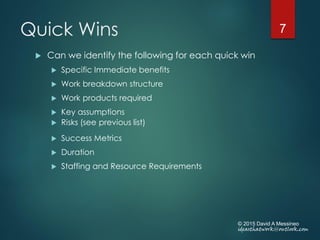
Quick Wins
 Can we identify the following for each quick win
 Specific Immediate benefits
 Work breakdown structure
 Work products required
 Key assumptions
 Risks (see previous list)
 Success Metrics
 Duration
 Staffing and Resource Requirements
© 2015 David A Messineo
ideasthatwork@outlook.com
7
Sourcing Work
 Will we be in a position to
 Identify and execute all activities required to
transition the current state to future state?
 Identify all skills (and training) required on new
processes, tools, and/or management
techniques
 Identify, implement and report on key metrics
 Identify critical roles and specific job
descriptions
 Recommend any organizational changes
 Ensure that a formal Governance process will
be in place for reviews and signoff
© 2015 David A Messineo
ideasthatwork@outlook.com
8
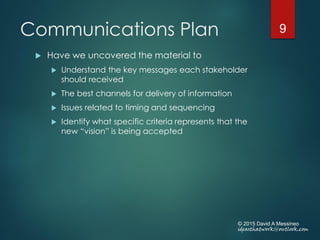
Communications Plan
 Have we uncovered the material to
 Understand the key messages each stakeholder
should received
 The best channels for delivery of information
 Issues related to timing and sequencing
 Identify what specific criteria represents that the
new “vision” is being accepted
© 2015 David A Messineo
ideasthatwork@outlook.com
9
Impact Encyclopedia
 Do we understand the specifics of the
following
 Customers
 What added value will occur
 How customer satisfaction will
increase
 Organization
 Identify what the business
needs from IT
 How decisions will be prioritized
 Employees
 How people will need to be
rewarded
 Specific job roles and skills
 Mental models will focus on the
customer mindset
 Process
 How metrics are monitored and
reported on?
 How people’s behaviors will be
impacted by changes?
 How we are eliminating the
stovepipe mentality
 Technology
 How tool sets are integrated?
 What architectural changes will be
required to take advantage of
new technologies?
 How absorption of new
technologies will be easier?
 Governance
 How to establish specific service
targets for levels of service quality?
 Culture
 How to focus on understanding and
prioritizing based on customers?
© 2015 David A Messineo
ideasthatwork@outlook.com
10
Benefits Encyclopedia
 Can we verify / articulate the benefits to the following:
 Customers
 Value
 Better Service
 More influence in IT
 Senior Management
 Meeting goals
 Improving service
 Support regulations
 Tracking costs/benefits
 Middle Management
 Meeting targets and objectives
 Staff motivation and alignment
 Meeting budgets
 Reducing non-value work
© 2015 David A Messineo
ideasthatwork@outlook.com
11
Project Management
 Do we know
 If there is there a single person responsible and
accountable for project success?
 Are there people assigned for individual results?
 If the schedule will include time for prototyping, adequate
tests, rework, and user training?
 If there is any data misalignment?
 Internal schedule date farther out than the best case
estimate?
 Project commitment data farther out than internal schedule
date?
 Project commitment date farther out than the best case
estimate?
 What are the highest risks for this project?
 What contingency plans are in place for each risk?
 What is being done to mitigate the risk?
 Where “slack time” can included in the project?
© 2015 David A Messineo
ideasthatwork@outlook.com
12
Project Failures
 Is the client showing and of the following patterns that
lead to project failure:
 Starting the wrong projects
 Do we know how projects are introduced and what the
selection process is
 Not including prerequisite steps
 Going for home runs instead of base hits
 Project duration greater than the job tenure of the
sponsoring executive
 Gathering requirements instead of negotiating them
 How much actual dialog is going on and is it open-minded?
 Not enough contingency planning
 Is there any sign or discussion around contingency planning?
© 2015 David A Messineo
ideasthatwork@outlook.com
13
Benefit Types
 How do our recommendation support the
following
 Increased Customer Satisfaction
 Reduced or Avoided Costs
 Reduced Risks
 Increased Revenue
 Improved IT Service Quality
 Improved Support Capability
 Better relationship with stakeholders
© 2015 David A Messineo
ideasthatwork@outlook.com
14
Assessment Work Products
 Can we provide the following:
 Identified gaps between current practices and best
practices, as well as future practices?
 Identified gaps in roles and responsibilities?
 Identified skill and competency gaps?
 Identified tool and data gaps?
 Identified deficiencies with Governance process?
 Identified list of key stakeholders to support “project
campaign”?
 Identified current metrics and measurement types?
 Identified expected benefits and recommendations?
 Identified estimated costs (included effort)?
 Identified organizational barriers?
 Identified quick wins?
 Specific focus on aligning the four dimensions of projects
(quality, cost, schedule, scope)?
© 2015 David A Messineo
ideasthatwork@outlook.com
15
Architecture
 How will improve the following?
 Availability
 Reliability
 Maintainability
 Serviceability
 Responsiveness
 Usability
 Security
 Ultimately how do we support “IT agility”?
© 2015 David A Messineo
ideasthatwork@outlook.com
16
Collection Library
 Have we collected the
following (or do we
know they don’t have
it)
 Organizational Charts
 Process Documentation
 Capacity Reports
 Performance Report
 Service Level Targets
 IT Plans
 Reporting Metrics
 Chargeback Reports
 IT Budgets
 Problem and Incident
Reports
 IT Continuity Plans
 IT Service Reports
 IT Governance Policies
 Change Management
Database
 Service Improvement Plans
© 2015 David A Messineo
ideasthatwork@outlook.com
17
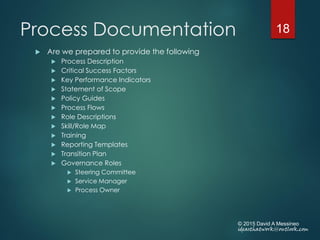
Process Documentation
 Are we prepared to provide the following
 Process Description
 Critical Success Factors
 Key Performance Indicators
 Statement of Scope
 Policy Guides
 Process Flows
 Role Descriptions
 Skill/Role Map
 Training
 Reporting Templates
 Transition Plan
 Governance Roles
 Steering Committee
 Service Manager
 Process Owner
© 2015 David A Messineo
ideasthatwork@outlook.com
18

DaveInTheBox v3

  • 1.
    Dave in theBox DRIVING SUCCESS AT THE CLIENT DAVID A MESSINEO © 2015 David A Messineo ideasthatwork@outlook.com 1
  • 2.
    Things I’m lookingfor  Treating the project as an organization change effort not just an IT project  Creating a balance between strategic efforts and initial wins  Do we know that initial wins  Establishing compelling reasons for changes  Targeting the key 20%  Getting Management Support  Ensuring risk management  Technology  Culture  Organization  People and Skills  Financial  Transition  Governance and Reporting  Recognizing the importance of metrics  ITSM Implementation Metrics  Service Metrics  Process Metrics  Operational Metrics © 2015 David A Messineo ideasthatwork@outlook.com 2
  • 3.
    Vision  Can wearticulate  What the vision is for the next 1-3 years?  What IT and business problems that we are addressing?  What IT and business problems might result?  Who are the key stakeholders?  What is the scope and impact of the project?  Whether the client understands the issues related to implementation?  What do the think the issues are?  What are they proposing to address them? © 2015 David A Messineo ideasthatwork@outlook.com 3
  • 4.
    Assessment  Have wecollected information on  Process (CA)  ITIL and the 5 Practices  Service Lifecycle Model  Technology (CA)  Legacy tool set and integration points  Tiered structure for implementation  Organization (PW)  Roles and Responsibilities  “Political” establishment  Governance (PW)  Success factors, metrics, quality  Specific Questions  How well are they performing today?  What major actions needs to be taken?  What impacts will there be on control practices?  What happens if we do nothing? © 2015 David A Messineo ideasthatwork@outlook.com 4
  • 5.
    Planning  Do weunderstand  How the project will need to be organized into individual efforts?  What roles (and skills) will be required?  Who will be assigned to lead the individual efforts?  The total costs required?  Key activities and tasks including specific work products  Not just what is in the SOW but what is actually required to complete the project  How status information will be collected and reported on?  How communications will be managed between stakeholders and team? © 2015 David A Messineo ideasthatwork@outlook.com 5
  • 6.
    Working  Can wearticulate the following  Which process play a role in addressing the overall challenges and which will be covered now?  What the guiding principles are for each process?  What key success factors (CSF, KPI) should be in place for each process?  Do we have key use cases that cross processes and track success factors for those as well?  What the major inputs/outputs are for each process?  Do we know which systems, people, roles, applications, etc… are responsible for ensuring the proper information flow  What technology will be supporting each process and how?  Do we have a list of data types, sources, and connections between them mapped to specific technologies  What organizational structure (and resulting roles and expertise) will need to be in place to support all the required processes?  How will the various processes be rolled out?  Assuming we are using a spiral based approach to helping the client reach a level of on-going maturity improve… what are the various steps?  The impact that specific processes will have on all audiences?  Do we have all audiences identified?  Are there any standard documents or artifacts that need to be created or leveraged?  For example – Pink Atlas  Can we specifically identify “quick wins” (see next page) © 2015 David A Messineo ideasthatwork@outlook.com 6
  • 7.
    Quick Wins  Canwe identify the following for each quick win  Specific Immediate benefits  Work breakdown structure  Work products required  Key assumptions  Risks (see previous list)  Success Metrics  Duration  Staffing and Resource Requirements © 2015 David A Messineo ideasthatwork@outlook.com 7
  • 8.
    Sourcing Work  Willwe be in a position to  Identify and execute all activities required to transition the current state to future state?  Identify all skills (and training) required on new processes, tools, and/or management techniques  Identify, implement and report on key metrics  Identify critical roles and specific job descriptions  Recommend any organizational changes  Ensure that a formal Governance process will be in place for reviews and signoff © 2015 David A Messineo ideasthatwork@outlook.com 8
  • 9.
    Communications Plan  Havewe uncovered the material to  Understand the key messages each stakeholder should received  The best channels for delivery of information  Issues related to timing and sequencing  Identify what specific criteria represents that the new “vision” is being accepted © 2015 David A Messineo ideasthatwork@outlook.com 9
  • 10.
    Impact Encyclopedia  Dowe understand the specifics of the following  Customers  What added value will occur  How customer satisfaction will increase  Organization  Identify what the business needs from IT  How decisions will be prioritized  Employees  How people will need to be rewarded  Specific job roles and skills  Mental models will focus on the customer mindset  Process  How metrics are monitored and reported on?  How people’s behaviors will be impacted by changes?  How we are eliminating the stovepipe mentality  Technology  How tool sets are integrated?  What architectural changes will be required to take advantage of new technologies?  How absorption of new technologies will be easier?  Governance  How to establish specific service targets for levels of service quality?  Culture  How to focus on understanding and prioritizing based on customers? © 2015 David A Messineo ideasthatwork@outlook.com 10
  • 11.
    Benefits Encyclopedia  Canwe verify / articulate the benefits to the following:  Customers  Value  Better Service  More influence in IT  Senior Management  Meeting goals  Improving service  Support regulations  Tracking costs/benefits  Middle Management  Meeting targets and objectives  Staff motivation and alignment  Meeting budgets  Reducing non-value work © 2015 David A Messineo ideasthatwork@outlook.com 11
  • 12.
    Project Management  Dowe know  If there is there a single person responsible and accountable for project success?  Are there people assigned for individual results?  If the schedule will include time for prototyping, adequate tests, rework, and user training?  If there is any data misalignment?  Internal schedule date farther out than the best case estimate?  Project commitment data farther out than internal schedule date?  Project commitment date farther out than the best case estimate?  What are the highest risks for this project?  What contingency plans are in place for each risk?  What is being done to mitigate the risk?  Where “slack time” can included in the project? © 2015 David A Messineo ideasthatwork@outlook.com 12
  • 13.
    Project Failures  Isthe client showing and of the following patterns that lead to project failure:  Starting the wrong projects  Do we know how projects are introduced and what the selection process is  Not including prerequisite steps  Going for home runs instead of base hits  Project duration greater than the job tenure of the sponsoring executive  Gathering requirements instead of negotiating them  How much actual dialog is going on and is it open-minded?  Not enough contingency planning  Is there any sign or discussion around contingency planning? © 2015 David A Messineo ideasthatwork@outlook.com 13
  • 14.
    Benefit Types  Howdo our recommendation support the following  Increased Customer Satisfaction  Reduced or Avoided Costs  Reduced Risks  Increased Revenue  Improved IT Service Quality  Improved Support Capability  Better relationship with stakeholders © 2015 David A Messineo ideasthatwork@outlook.com 14
  • 15.
    Assessment Work Products Can we provide the following:  Identified gaps between current practices and best practices, as well as future practices?  Identified gaps in roles and responsibilities?  Identified skill and competency gaps?  Identified tool and data gaps?  Identified deficiencies with Governance process?  Identified list of key stakeholders to support “project campaign”?  Identified current metrics and measurement types?  Identified expected benefits and recommendations?  Identified estimated costs (included effort)?  Identified organizational barriers?  Identified quick wins?  Specific focus on aligning the four dimensions of projects (quality, cost, schedule, scope)? © 2015 David A Messineo ideasthatwork@outlook.com 15
  • 16.
    Architecture  How willimprove the following?  Availability  Reliability  Maintainability  Serviceability  Responsiveness  Usability  Security  Ultimately how do we support “IT agility”? © 2015 David A Messineo ideasthatwork@outlook.com 16
  • 17.
    Collection Library  Havewe collected the following (or do we know they don’t have it)  Organizational Charts  Process Documentation  Capacity Reports  Performance Report  Service Level Targets  IT Plans  Reporting Metrics  Chargeback Reports  IT Budgets  Problem and Incident Reports  IT Continuity Plans  IT Service Reports  IT Governance Policies  Change Management Database  Service Improvement Plans © 2015 David A Messineo ideasthatwork@outlook.com 17
  • 18.
    Process Documentation  Arewe prepared to provide the following  Process Description  Critical Success Factors  Key Performance Indicators  Statement of Scope  Policy Guides  Process Flows  Role Descriptions  Skill/Role Map  Training  Reporting Templates  Transition Plan  Governance Roles  Steering Committee  Service Manager  Process Owner © 2015 David A Messineo ideasthatwork@outlook.com 18