An Implementation Model for Effective IT Governance Scott Lang & Rajeshwer Subramanian
Agenda Background Vision, Goals & Scope Technical Plan Management Plan Cost Plan Project Updates
Background
The Company KIG Insurance company Large IT shop (> 500 staff) IT Challenges “ 29% of IT Project succeeded while the remainder were either challenged or failed” The Standish Group International 2004 Third Quarter CHAOS Report
Problem Numerous silos Varied technologies Multiple decision points Separate Business Committees ____________________________ Lack of Business – IT alignment
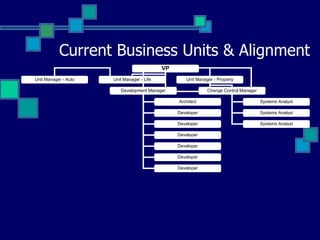
Current Business Units & Alignment VP Unit Manager - Property Development Manager Unit Manager - Auto Unit Manager - Life Change Control Manager Architect Systems Analyst Developer Developer Systems Analyst Developer Developer Developer Developer Systems Analyst
Final Catalyst For This Project “ 57% of respondents in a CEO/CIO-level executives survey said that IT is very important to the delivery of corporate strategy” IT Governance Global Status Report 2006, IT Governance Institute Effective IT Governance is the single most important predictor of the value an organization generates from IT Weill, Peter & Ross, Jeane, IT Governance
Vision, Goals & Scope
Vision Statement To successfully execute IT projects that add value to the business by implementing IT Governance
Goals Make a business case for IT Governance  (Why?) Identify areas that need to be addressed  (Where?) Provide an Implementation Plan  (What?) Explain how the plan will be implemented  (How?) Provide timelines  (When?) Identify resource needs, roles & responsibilities  (Who?)
Scope Create a single Point alignment of project consideration Create an IT governance office Establish decision rights within business units Create best practices and processes Procure a single software package to be used for all project development and tracking Hire appropriate staff
Technical Plan
Technical Plan Definitions Governance Categories Change Model Utilized High Level Changes Proposed
Definitions Definition of IT Governance: Specifying the decision rights and accountability framework to encourage desirable behavior in the use of IT Courtesy:  Weill, Peter, & Ross, Jeanne W., “IT Governance – How Top Performers Manage IT  Decision Rights for Superior Results”, Harvard Business School Press
Definitions… Definition of successful IT Project: A successful IT project is one that creates the  expected business value Needs to provide business value Business value expected should be defined Relevant metrics should be measured
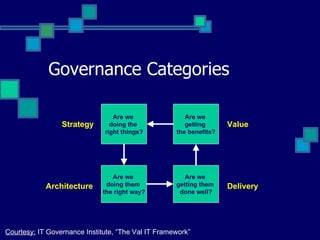
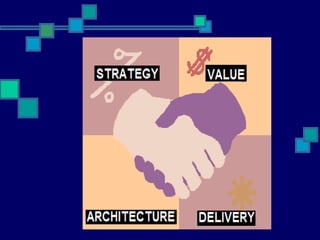
Governance Categories Are we  doing the  right things? Are we  doing them  the right way? Are we  getting  the benefits? Are we  getting them  done well? Strategy Architecture Value Delivery Courtesy:  IT Governance Institute, “The Val IT Framework”
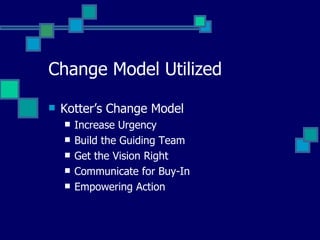
Change Model Utilized Kotter’s Change Model Increase Urgency Build the Guiding Team Get the Vision Right Communicate for Buy-In Empowering Action
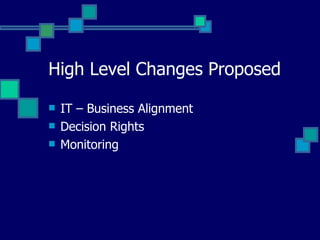
High Level Changes Proposed IT – Business Alignment Decision Rights Monitoring
Management Plan
Management Plan Table of Organization Corporate, IT Governance Office, Committees Stakeholder Communications Implementation Plan Risk Management Plan Critical Success Factors
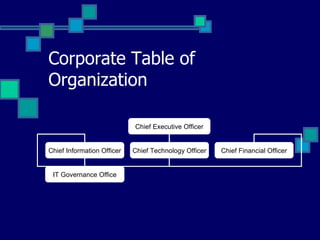
Corporate Table of Organization Chief Executive Officer  Chief Information Officer Chief Technology Officer Chief Financial Officer IT Governance Office
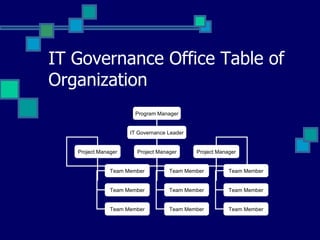
IT Governance Office Table of Organization Program Manager IT Governance Leader Project Manager Project Manager Project Manager Team Member Team Member Team Member Team Member Team Member Team Member Team Member Team Member Team Member
Stakeholder Communications The PM will provide the status reports Reports will be submitted by E-mail with milestones for face to face communications Department heads, CEO and CIO will be copied on all status reports Bi-weekly status reports to include: Milestones met Milestones missed Projected issues Projected solutions for projected issues Projected accomplishments by the next report
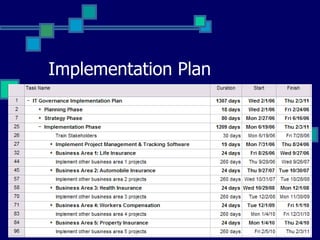
Implementation Plan
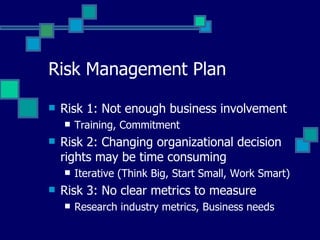
Risk Management Plan Risk 1: Not enough business involvement Training, Commitment  Risk 2: Changing organizational decision rights may be time consuming Iterative (Think Big, Start Small, Work Smart) Risk 3: No clear metrics to measure Research industry metrics, Business needs
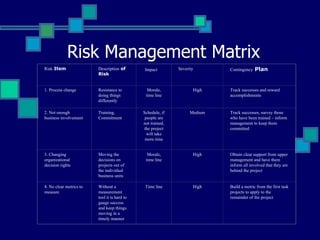
Risk Management Matrix Risk  Item Description  of Risk Impact Severity Contingency  Plan 1. Process change Resistance to doing things differently Morale, time line High Track successes and reward accomplishments 2. Not enough business involvement Training, Commitment Schedule, if people are not trained, the project will take more time Medium Track successes, survey those who have been trained – inform management to keep them committed 3. Changing organizational decision rights Moving the decisions on projects out of the individual business units Morale, time line High Obtain clear support from upper management and have them inform all involved that they are behind the project 4. No clear metrics to measure Without a measurement tool it is hard to gauge success and keep things moving in a timely manner Time line High Build a metric from the first task projects to apply to the remainder of the project
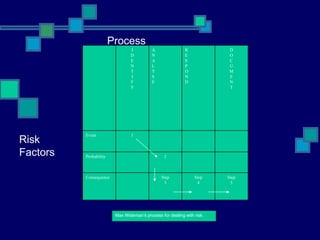
Step Step Process Risk Factors Max Wideman’s process for dealing with risk Step 5 Step 4 Step 3 Consequence 2 Probability 1 Event D O C U M E N T R E S P O N D A N A L Y S E I D E N T I F Y
Critical Success Factors Commitment from top management All changes recommended implemented and institutionalized within the first 2 years Balancing control & creativity Uncertainly in making project decisions decreased improving staff morale Increase Value  Good mechanism to monitor and track value of projects put in place within the first 2 years
Cost Plan
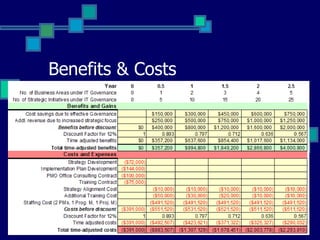
Benefits & Costs
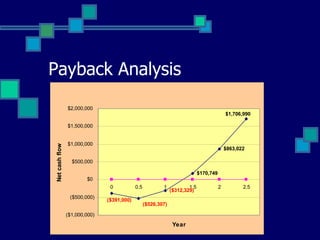
Payback Analysis
Project Updates
Some Milestones Met Creation of the IT Governance Office   Hiring of a Program Manager   Hiring of an IT Governance Leader   Hiring needed PM’s   Creation of a project steering committee   Implementation of pilot projects
Unexpected Event Lead Project Manager of a Pilot Project Left Impact: Project delayed Resolution: Promote from within
Scope Change Original Scope – 5 year plan 1 year implementation per business unit Change requested from CIO 3 year complete roll out to encompass all business units
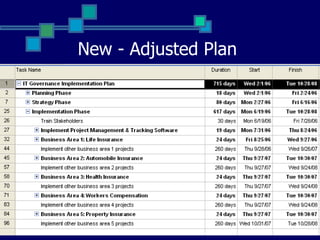
New - Adjusted Plan
 

EFFECTIVE IT GOVERNANCE presentation

  • 1.
    An Implementation Modelfor Effective IT Governance Scott Lang & Rajeshwer Subramanian
  • 2.
    Agenda Background Vision,Goals & Scope Technical Plan Management Plan Cost Plan Project Updates
  • 3.
  • 4.
    The Company KIGInsurance company Large IT shop (> 500 staff) IT Challenges “ 29% of IT Project succeeded while the remainder were either challenged or failed” The Standish Group International 2004 Third Quarter CHAOS Report
  • 5.
    Problem Numerous silosVaried technologies Multiple decision points Separate Business Committees ____________________________ Lack of Business – IT alignment
  • 6.
    Current Business Units& Alignment VP Unit Manager - Property Development Manager Unit Manager - Auto Unit Manager - Life Change Control Manager Architect Systems Analyst Developer Developer Systems Analyst Developer Developer Developer Developer Systems Analyst
  • 7.
    Final Catalyst ForThis Project “ 57% of respondents in a CEO/CIO-level executives survey said that IT is very important to the delivery of corporate strategy” IT Governance Global Status Report 2006, IT Governance Institute Effective IT Governance is the single most important predictor of the value an organization generates from IT Weill, Peter & Ross, Jeane, IT Governance
  • 8.
  • 9.
    Vision Statement Tosuccessfully execute IT projects that add value to the business by implementing IT Governance
  • 10.
    Goals Make abusiness case for IT Governance (Why?) Identify areas that need to be addressed (Where?) Provide an Implementation Plan (What?) Explain how the plan will be implemented (How?) Provide timelines (When?) Identify resource needs, roles & responsibilities (Who?)
  • 11.
    Scope Create asingle Point alignment of project consideration Create an IT governance office Establish decision rights within business units Create best practices and processes Procure a single software package to be used for all project development and tracking Hire appropriate staff
  • 12.
  • 13.
    Technical Plan DefinitionsGovernance Categories Change Model Utilized High Level Changes Proposed
  • 14.
    Definitions Definition ofIT Governance: Specifying the decision rights and accountability framework to encourage desirable behavior in the use of IT Courtesy: Weill, Peter, & Ross, Jeanne W., “IT Governance – How Top Performers Manage IT Decision Rights for Superior Results”, Harvard Business School Press
  • 15.
    Definitions… Definition ofsuccessful IT Project: A successful IT project is one that creates the expected business value Needs to provide business value Business value expected should be defined Relevant metrics should be measured
  • 16.
    Governance Categories Arewe doing the right things? Are we doing them the right way? Are we getting the benefits? Are we getting them done well? Strategy Architecture Value Delivery Courtesy: IT Governance Institute, “The Val IT Framework”
  • 17.
    Change Model UtilizedKotter’s Change Model Increase Urgency Build the Guiding Team Get the Vision Right Communicate for Buy-In Empowering Action
  • 18.
    High Level ChangesProposed IT – Business Alignment Decision Rights Monitoring
  • 19.
  • 20.
    Management Plan Tableof Organization Corporate, IT Governance Office, Committees Stakeholder Communications Implementation Plan Risk Management Plan Critical Success Factors
  • 21.
    Corporate Table ofOrganization Chief Executive Officer Chief Information Officer Chief Technology Officer Chief Financial Officer IT Governance Office
  • 22.
    IT Governance OfficeTable of Organization Program Manager IT Governance Leader Project Manager Project Manager Project Manager Team Member Team Member Team Member Team Member Team Member Team Member Team Member Team Member Team Member
  • 23.
    Stakeholder Communications ThePM will provide the status reports Reports will be submitted by E-mail with milestones for face to face communications Department heads, CEO and CIO will be copied on all status reports Bi-weekly status reports to include: Milestones met Milestones missed Projected issues Projected solutions for projected issues Projected accomplishments by the next report
  • 24.
  • 25.
    Risk Management PlanRisk 1: Not enough business involvement Training, Commitment Risk 2: Changing organizational decision rights may be time consuming Iterative (Think Big, Start Small, Work Smart) Risk 3: No clear metrics to measure Research industry metrics, Business needs
  • 26.
    Risk Management MatrixRisk Item Description of Risk Impact Severity Contingency Plan 1. Process change Resistance to doing things differently Morale, time line High Track successes and reward accomplishments 2. Not enough business involvement Training, Commitment Schedule, if people are not trained, the project will take more time Medium Track successes, survey those who have been trained – inform management to keep them committed 3. Changing organizational decision rights Moving the decisions on projects out of the individual business units Morale, time line High Obtain clear support from upper management and have them inform all involved that they are behind the project 4. No clear metrics to measure Without a measurement tool it is hard to gauge success and keep things moving in a timely manner Time line High Build a metric from the first task projects to apply to the remainder of the project
  • 27.
    Step Step ProcessRisk Factors Max Wideman’s process for dealing with risk Step 5 Step 4 Step 3 Consequence 2 Probability 1 Event D O C U M E N T R E S P O N D A N A L Y S E I D E N T I F Y
  • 28.
    Critical Success FactorsCommitment from top management All changes recommended implemented and institutionalized within the first 2 years Balancing control & creativity Uncertainly in making project decisions decreased improving staff morale Increase Value Good mechanism to monitor and track value of projects put in place within the first 2 years
  • 29.
  • 30.
  • 31.
  • 32.
  • 33.
    Some Milestones MetCreation of the IT Governance Office Hiring of a Program Manager Hiring of an IT Governance Leader Hiring needed PM’s Creation of a project steering committee Implementation of pilot projects
  • 34.
    Unexpected Event LeadProject Manager of a Pilot Project Left Impact: Project delayed Resolution: Promote from within
  • 35.
    Scope Change OriginalScope – 5 year plan 1 year implementation per business unit Change requested from CIO 3 year complete roll out to encompass all business units
  • 36.
  • 37.

Editor's Notes

  • #12 Single Point alignment of project consideration Creation of the IT governance office Establishment of decision rights within business units Create best practices and processes Procure a single software package to be used for all project development and tracking Hiring of appropriate staff Creation of a PMO
  • #28 Wideman, Max R. – Risk Management Guide to Managing Project Risks + Opportunities
  • #35 Lead PM takes leave of absence Promote from within 3 week delay Hire outside project worker / PM’s promoted within
  • #36 Event: Management requests that all business units across the enterprise be involved from the beginning instead rolling out one business unit at a time. Once a pilot project has been completed and reviewed after completion, process corrections and additions will be made. From here, multiple business units will roll out projects under the new process. As old projects close out under the current process, all new projects will be undertaken with the new process until all business units have adopted the new processes. The lead PM on the pilot project has had to take an unexpected leave of absence and will be out for 6 months. A PM from within will be promoted and a new hire will take his place. This promotion will save some time because the PM is familiar with the project; there will be less time spent getting him up to speed, however, a schedule delay of at least 2 weeks will occur. Additional work: Time lines and schedules will need to be reworked and additional resources will need to be hired sooner than anticipated. This will cause costs to rise in the beginning before being absorbed by projected savings. All new cost estimations will need to be created and budgets adjusted accordingly.