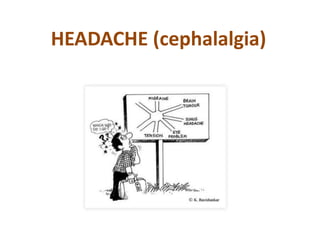
HEADACHE (cephalalgia)
Headache
• Headache is defined as diffuse pain in various
parts of the head, with the pain not confined
to the area of distribution of a nerve.
• 30 years female
• Episodic throbbing headache
• One half of the face
• Associated with nausea vomiting parasthesia
of right upper and lower limb
• No aura
• Similar headaches in her mother
• 40 years old male
• Limited to right side head
• Daily headache
• 2 attack/day for 3 weeks
• Awakens the patient from sleep
• Associated with lacrimation, nasal stuffiness
• 65 years old female
• Right sided headache and blindness * 2 years
• Thick cord like structure on the lateral side of
the head
• ESR 80mm/hr in the first hour
• 45 yrs hypertensive male
• Sudden onset severe headache
• Associated with vomiting and neck stiffness
• No focal neurological deficit
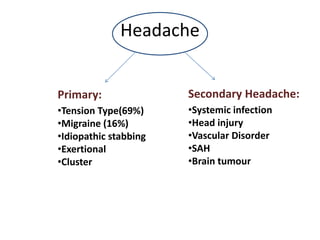
Headache
Primary:
•Tension Type(69%)
•Migraine (16%)
•Idiopathic stabbing
•Exertional
•Cluster
Secondary Headache:
•Systemic infection
•Head injury
•Vascular Disorder
•SAH
•Brain tumour
Migraine
• Fronto-temporal
• Uni or bilateral
• Young female
• Throbbing (pulsatile)
• Upon awakening
• Bright light, noise, tension, alcohol,
• Nausea, vomiting, +- aura
Cluster Headache
• Orbito-temporal
• Adolescent male(90%)
• Intense, non throbbing
• Behind the eyes
• 1-2 hrs after falling asleep
• Alcohol(rare)
• Lacrimation, stuffed nostril, rhinorrhoea,
conunctival congestion, ptosis
Tension Headache
• Generalized
• More in women
• Feeling of tight band around head
• Start in the daytime and progressive
throughout the day maximum in the evening.
• fatigue, nervous strain
• Depression, anxiety
• Brain tumours / raised ICP: headaches that disturb sleep/ early
morning headaches
• Early morning headache on waking up and again at the end of day is
due to Maxillary sinusitis (diurnal variation)
• Office headache: due to Frontal sinusitis [patient wakes up mostly
without pain due to overnight drainage, develops pain after a few
hours that lasts throughout the day]
• Vacuum headache: the headache on waking up that may occur in
Frontal sinusitis due to over night drainage.
1.Age, Sex, Occupation:
Migraine headache – more frequent in teenagers & young adults,
higher occurrence in female.
Cluster headache – almost exclusively in males.
Cranial arteritis – more frequently in late middle age & in elderly.
2. Duration
Tension headache -often has long duration.
Headache due to expanding of intracranial disease – usually short
duration.
Headache due to meningeal cause – acute in onset.
Migraine headache – recur over a long period of time, with
symptoms free interval between attacks
3. Location
As a general rule localized headache is of greater significance than
diffuse headache.
Tension headache – typically generalized, band like or bi-occipital.
Migraine with aura – often unilateral & frequently more
prominent interiorly.
Migraine without aura – frequently bilateral.
Cluster headache – invariably limited to the same side of the
head in any given attacks & usually periorbital
4. Prodromal symptoms
Migraine headache – often precede by neurological
symptoms as scintillating scotoma, transient hemianopias,
hemimotor or hemisensory disturbance & dysphasia.
5. Associated symptoms
Tension headache – often associated with other psycho-
physiologic disturbances.
Cluster headache – typically associated with ipsilateral
lacrimation, Conjunctival injection, Rhinorrhoea, & Facial
Flushing.
6. Quality of pain
Tension headache – Pressing, Squeezing, Tight or Heavy.
Migraine headache – Throbbing or Pounding.
Headache due to intracranial lesion – Relatively Mild.
Acute SAH- Pain tends to be explosive & intense.
8. Frequency, duration & diurnal variation
Tension headache – often persist & may worsen as the day progress.
Migraine headache – the frequency is variable & unpredictable.
Although usual variation is from 4 - 72 hrs, they may persist for days.
Cluster headache – occur repetitively over a period of weeks or
months. Often there are 1 or 2 attacks daily. The headache typically
nocturnal & of brief duration (30 min to a few hours).
9. Family History
Migraine headache – strong family history.
Cluster headache – are not familial.
10. Intracranial Mass Lesion –
Associated symptoms are more prominent than headache. Some intra-
cerebral lesion may exhibit seizure or vomiting.
11. Cranial arteritis
Systemic symptoms as fever, anorexia & rheumatic symptoms.
12.Tension headache & Vascular Headache
Induced or aggravated by emotional factors.
Intraventricular & posterior fossa tumour – may be accentuated by
change in the head position, coughing & Valsalva maneuver
1. General physical examination:
Flushed face, lacrimation, and unilateral rhinorrhoea – cluster
headache.
Systemic sign (fever, weight loss, anaemia) – infectious disease,
specific infection of CNS, metastatic disease of brain &/or
meninges.
2. Neurological examination:
No neurological abnormality – tension headache.
Evidence of cerebral ischaemia – small percentage of
migraine (permanent residual damage).
Horner’s syndrome – sometimes during migraine headache
(rarely permanent).
Localizing sign – expanding ICSOL.
Papilloedema -- ICP due to ICSOL.
Bruits over the eyes/cranium – vascular malformation.
Sign of meningeal irritation – lesion affecting the meninges.
Thank you

Headache

  • 1.
  • 2.
    Headache • Headache isdefined as diffuse pain in various parts of the head, with the pain not confined to the area of distribution of a nerve.
  • 3.
    • 30 yearsfemale • Episodic throbbing headache • One half of the face • Associated with nausea vomiting parasthesia of right upper and lower limb • No aura • Similar headaches in her mother
  • 4.
    • 40 yearsold male • Limited to right side head • Daily headache • 2 attack/day for 3 weeks • Awakens the patient from sleep • Associated with lacrimation, nasal stuffiness
  • 5.
    • 65 yearsold female • Right sided headache and blindness * 2 years • Thick cord like structure on the lateral side of the head • ESR 80mm/hr in the first hour
  • 6.
    • 45 yrshypertensive male • Sudden onset severe headache • Associated with vomiting and neck stiffness • No focal neurological deficit
  • 7.
    Headache Primary: •Tension Type(69%) •Migraine (16%) •Idiopathicstabbing •Exertional •Cluster Secondary Headache: •Systemic infection •Head injury •Vascular Disorder •SAH •Brain tumour
  • 9.
    Migraine • Fronto-temporal • Unior bilateral • Young female • Throbbing (pulsatile) • Upon awakening • Bright light, noise, tension, alcohol, • Nausea, vomiting, +- aura
  • 12.
    Cluster Headache • Orbito-temporal •Adolescent male(90%) • Intense, non throbbing • Behind the eyes • 1-2 hrs after falling asleep • Alcohol(rare) • Lacrimation, stuffed nostril, rhinorrhoea, conunctival congestion, ptosis
  • 15.
    Tension Headache • Generalized •More in women • Feeling of tight band around head • Start in the daytime and progressive throughout the day maximum in the evening. • fatigue, nervous strain • Depression, anxiety
  • 17.
    • Brain tumours/ raised ICP: headaches that disturb sleep/ early morning headaches • Early morning headache on waking up and again at the end of day is due to Maxillary sinusitis (diurnal variation) • Office headache: due to Frontal sinusitis [patient wakes up mostly without pain due to overnight drainage, develops pain after a few hours that lasts throughout the day] • Vacuum headache: the headache on waking up that may occur in Frontal sinusitis due to over night drainage.
  • 19.
    1.Age, Sex, Occupation: Migraineheadache – more frequent in teenagers & young adults, higher occurrence in female. Cluster headache – almost exclusively in males. Cranial arteritis – more frequently in late middle age & in elderly. 2. Duration Tension headache -often has long duration. Headache due to expanding of intracranial disease – usually short duration. Headache due to meningeal cause – acute in onset. Migraine headache – recur over a long period of time, with symptoms free interval between attacks 3. Location As a general rule localized headache is of greater significance than diffuse headache. Tension headache – typically generalized, band like or bi-occipital. Migraine with aura – often unilateral & frequently more prominent interiorly. Migraine without aura – frequently bilateral. Cluster headache – invariably limited to the same side of the head in any given attacks & usually periorbital
  • 20.
    4. Prodromal symptoms Migraineheadache – often precede by neurological symptoms as scintillating scotoma, transient hemianopias, hemimotor or hemisensory disturbance & dysphasia. 5. Associated symptoms Tension headache – often associated with other psycho- physiologic disturbances. Cluster headache – typically associated with ipsilateral lacrimation, Conjunctival injection, Rhinorrhoea, & Facial Flushing. 6. Quality of pain Tension headache – Pressing, Squeezing, Tight or Heavy. Migraine headache – Throbbing or Pounding. Headache due to intracranial lesion – Relatively Mild. Acute SAH- Pain tends to be explosive & intense.
  • 21.
    8. Frequency, duration& diurnal variation Tension headache – often persist & may worsen as the day progress. Migraine headache – the frequency is variable & unpredictable. Although usual variation is from 4 - 72 hrs, they may persist for days. Cluster headache – occur repetitively over a period of weeks or months. Often there are 1 or 2 attacks daily. The headache typically nocturnal & of brief duration (30 min to a few hours). 9. Family History Migraine headache – strong family history. Cluster headache – are not familial. 10. Intracranial Mass Lesion – Associated symptoms are more prominent than headache. Some intra- cerebral lesion may exhibit seizure or vomiting. 11. Cranial arteritis Systemic symptoms as fever, anorexia & rheumatic symptoms. 12.Tension headache & Vascular Headache Induced or aggravated by emotional factors. Intraventricular & posterior fossa tumour – may be accentuated by change in the head position, coughing & Valsalva maneuver
  • 22.
    1. General physicalexamination: Flushed face, lacrimation, and unilateral rhinorrhoea – cluster headache. Systemic sign (fever, weight loss, anaemia) – infectious disease, specific infection of CNS, metastatic disease of brain &/or meninges. 2. Neurological examination: No neurological abnormality – tension headache. Evidence of cerebral ischaemia – small percentage of migraine (permanent residual damage). Horner’s syndrome – sometimes during migraine headache (rarely permanent). Localizing sign – expanding ICSOL. Papilloedema -- ICP due to ICSOL. Bruits over the eyes/cranium – vascular malformation. Sign of meningeal irritation – lesion affecting the meninges.
  • 23.