ImmunochemistryImmunochemistry
Mr.Tapeshwar Yadav
P.G,2nd
year, Biochemistry
The Immune ResponseThe Immune Response
ImmunityImmunity: “Free from burden”. Ability of: “Free from burden”. Ability of
an organism to recognize and defend itselfan organism to recognize and defend itself
againstagainst specificspecific pathogens or antigens.pathogens or antigens.
Immune ResponseImmune Response: Third line of defense.: Third line of defense.
Involves production of antibodies andInvolves production of antibodies and
generation of specialized lymphocytesgeneration of specialized lymphocytes
against specific antigens.against specific antigens.
AntigenAntigen: Molecules from a pathogen or: Molecules from a pathogen or
foreign organism that provoke a specificforeign organism that provoke a specific
immune response.immune response.
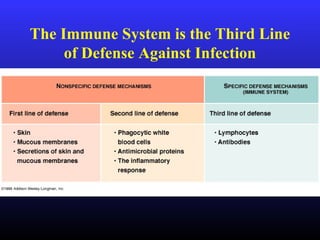
The Immune System is the Third Line
of Defense Against Infection
Innate or Genetic ImmunityInnate or Genetic Immunity: Immunity an: Immunity an
organism is born with.organism is born with.
Genetically determined.Genetically determined.
May be due to lack of receptors or otherMay be due to lack of receptors or other
molecules required for infection.molecules required for infection.
Innate human immunity to canine distemper.Innate human immunity to canine distemper.
Immunity of mice to poliovirus.Immunity of mice to poliovirus.
Acquired ImmunityAcquired Immunity:Immunity that an:Immunity that an
organismorganism developsdevelops during lifetime.during lifetime.
Not genetically determined.Not genetically determined.
May be acquired naturally or artificially.May be acquired naturally or artificially.
Development of immunity to measles in response toDevelopment of immunity to measles in response to
infection or vaccination.infection or vaccination.
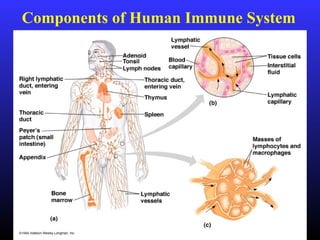
Components of Human Immune System
Types of Acquired ImmunityTypes of Acquired Immunity
I. Naturally Acquired ImmunityI. Naturally Acquired Immunity: Obtained in: Obtained in
the course of daily life.the course of daily life.
A. Naturally Acquired Active ImmunityA. Naturally Acquired Active Immunity::
AntigensAntigens or pathogens enter body naturally.or pathogens enter body naturally.
Body generates an immune response to antigens.Body generates an immune response to antigens.
Immunity may be lifelong (chickenpox or mumps)Immunity may be lifelong (chickenpox or mumps)
or temporary (influenza or intestinal infections).or temporary (influenza or intestinal infections).
B. Naturally Acquired Passive ImmunityB. Naturally Acquired Passive Immunity::
AntibodiesAntibodies pass from mother to fetus via placentapass from mother to fetus via placenta
or breast feeding (or breast feeding (colostrumcolostrum).).
No immune response to antigens.No immune response to antigens.
Immunity is usuallyImmunity is usually short-livedshort-lived (weeks to months).(weeks to months).
Protection until child’s immune system develops.Protection until child’s immune system develops.
Types of Acquired Immunity (Continued)Types of Acquired Immunity (Continued)
II. Artificially Acquired ImmunityII. Artificially Acquired Immunity: Obtained by: Obtained by
receiving a vaccine or immune serum.receiving a vaccine or immune serum.
1. Artificially Acquired Active Immunity1. Artificially Acquired Active Immunity::
AntigensAntigens are introduced in vaccines (are introduced in vaccines (immunizationimmunization).).
Body generates an immune response to antigens.Body generates an immune response to antigens.
Immunity can be lifelong (oral polio vaccine) or temporaryImmunity can be lifelong (oral polio vaccine) or temporary
(tetanus toxoid).(tetanus toxoid).
2. Artificially Acquired Passive Immunity2. Artificially Acquired Passive Immunity::
PreformedPreformed antibodiesantibodies ((antiserumantiserum) are introduced into body) are introduced into body
by injection.by injection.
Snake antivenom injection from horses or rabbits.Snake antivenom injection from horses or rabbits.
Immunity is short lived (half life three weeks).Immunity is short lived (half life three weeks).
Host immune system does not respond to antigens.Host immune system does not respond to antigens.
SerumSerum: Fluid that remains after blood has clotted: Fluid that remains after blood has clotted
and cells have been removed.and cells have been removed.
AntiserumAntiserum: Serum containing antibodies to a: Serum containing antibodies to a
specific antigen(s). Obtained from injecting anspecific antigen(s). Obtained from injecting an
animal (horse, rabbit, goat) with antigen (snakeanimal (horse, rabbit, goat) with antigen (snake
venom, botulism or diphtheria toxin).venom, botulism or diphtheria toxin).
SerologySerology: The study of reactions between: The study of reactions between
antibodies and antigens.antibodies and antigens.
Gamma GlobulinsGamma Globulins: Fraction of serum that: Fraction of serum that
contains most of the antibodies.contains most of the antibodies.
Serum SicknessSerum Sickness: Disease caused by multiple: Disease caused by multiple
injections of antiserum. Immune response toinjections of antiserum. Immune response to
foreign proteins. May cause fever, kidneyforeign proteins. May cause fever, kidney
problems, and joint pain. Rare today.problems, and joint pain. Rare today.
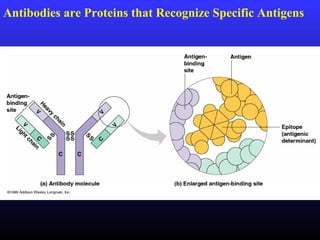
Antibodies are Proteins that Recognize Specific Antigens
AntigensAntigens
Most areMost are proteinsproteins or largeor large polysaccharidespolysaccharides fromfrom
a foreign organism.a foreign organism.
MicrobesMicrobes: Capsules, cell walls, toxins, viral capsids,: Capsules, cell walls, toxins, viral capsids,
flagella, etc.flagella, etc.
NonmicrobesNonmicrobes: Pollen, egg white , red blood cell: Pollen, egg white , red blood cell
surface molecules, serum proteins, and surfacesurface molecules, serum proteins, and surface
molecules from transplanted tissue.molecules from transplanted tissue.
Lipids and nucleic acids are only antigenic whenLipids and nucleic acids are only antigenic when
combinedcombined with proteins or polysaccharides.with proteins or polysaccharides.
Molecular weight of 10,000 or higher.Molecular weight of 10,000 or higher.
HaptenHapten: Small foreign molecule that is not antigenic. Must be: Small foreign molecule that is not antigenic. Must be
coupled to acoupled to a carriercarrier molecule to be antigenic. Once antibodiesmolecule to be antigenic. Once antibodies
are formed they will recognize hapten.are formed they will recognize hapten.
AntigensAntigens
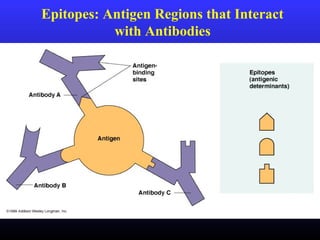
EpitopeEpitope::
Small part of an antigen that interactsSmall part of an antigen that interacts
with an antibody.with an antibody.
Any given antigen may have severalAny given antigen may have several
epitopes.epitopes.
Each epitope is recognized by a differentEach epitope is recognized by a different
antibody.antibody.
Epitopes: Antigen Regions that Interact
with Antibodies
AntibodiesAntibodies
ProteinsProteins that recognize and bind to a particularthat recognize and bind to a particular
antigen with very highantigen with very high specificityspecificity..
Made in response to exposure to the antigen.Made in response to exposure to the antigen.
One virus or microbe may have severalOne virus or microbe may have several antigenicantigenic
determinant sitesdeterminant sites, to which different antibodies, to which different antibodies
may bind.may bind.
Each antibody has at least two identical sitesEach antibody has at least two identical sites
that bind antigen:that bind antigen: Antigen binding sitesAntigen binding sites..
Valence of an antibodyValence of an antibody: Number of antigen: Number of antigen
binding sites. Most arebinding sites. Most are bivalentbivalent..
Belong to a group of serum proteins calledBelong to a group of serum proteins called
immunoglobulins (Igs).immunoglobulins (Igs).
Antibody StructureAntibody Structure
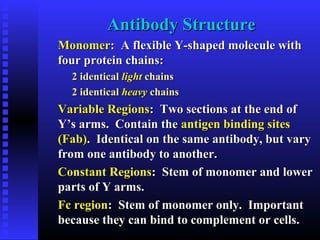
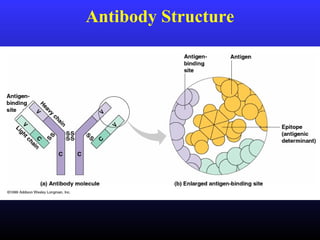
MonomerMonomer: A flexible Y-shaped molecule with: A flexible Y-shaped molecule with
four protein chains:four protein chains:
2 identical2 identical lightlight chainschains
2 identical2 identical heavyheavy chainschains
Variable RegionsVariable Regions: Two sections at the end of: Two sections at the end of
Y’s arms. Contain theY’s arms. Contain the antigen binding sitesantigen binding sites
(Fab)(Fab). Identical on the same antibody, but vary. Identical on the same antibody, but vary
from one antibody to another.from one antibody to another.
Constant RegionsConstant Regions: Stem of monomer and lower: Stem of monomer and lower
parts of Y arms.parts of Y arms.
Fc regionFc region: Stem of monomer only. Important: Stem of monomer only. Important
because they can bind to complement or cells.because they can bind to complement or cells.
Antibody Structure
Immunoglobulin ClassesImmunoglobulin Classes
I. IgGI. IgG
Structure:Structure: MonomerMonomer
Percentage serum antibodies:Percentage serum antibodies: 80%80%
Location:Location: Blood, lymph, intestineBlood, lymph, intestine
Half-life in serum:Half-life in serum: 23 days23 days
Complement Fixation:Complement Fixation: YesYes
Placental Transfer:Placental Transfer: YesYes
Known Functions:Known Functions: Enhances phagocytosis,Enhances phagocytosis,
neutralizes toxins and viruses, protects fetus andneutralizes toxins and viruses, protects fetus and
newborn.newborn.
Immunoglobulin ClassesImmunoglobulin Classes
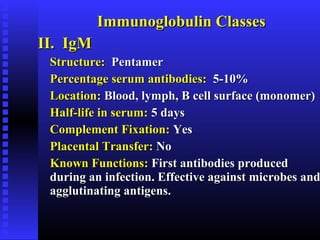
II. IgMII. IgM
Structure:Structure: PentamerPentamer
Percentage serum antibodies:Percentage serum antibodies: 5-10%5-10%
Location:Location: Blood, lymph, B cell surface (monomer)Blood, lymph, B cell surface (monomer)
Half-life in serum:Half-life in serum: 5 days5 days
Complement Fixation:Complement Fixation: YesYes
Placental Transfer:Placental Transfer: NoNo
Known Functions:Known Functions: First antibodies producedFirst antibodies produced
during an infection. Effective against microbes andduring an infection. Effective against microbes and
agglutinating antigens.agglutinating antigens.
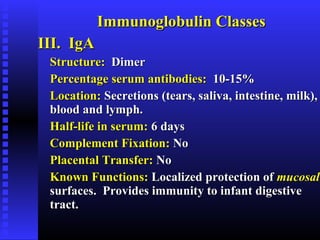
Immunoglobulin ClassesImmunoglobulin Classes
III. IgAIII. IgA
Structure:Structure: DimerDimer
Percentage serum antibodies:Percentage serum antibodies: 10-15%10-15%
Location:Location: Secretions (tears, saliva, intestine, milk),Secretions (tears, saliva, intestine, milk),
blood and lymph.blood and lymph.
Half-life in serum:Half-life in serum: 6 days6 days
Complement Fixation:Complement Fixation: NoNo
Placental Transfer:Placental Transfer: NoNo
Known Functions:Known Functions: Localized protection ofLocalized protection of mucosalmucosal
surfaces. Provides immunity to infant digestivesurfaces. Provides immunity to infant digestive
tract.tract.
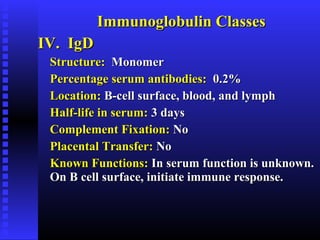
Immunoglobulin ClassesImmunoglobulin Classes
IV. IgDIV. IgD
Structure:Structure: MonomerMonomer
Percentage serum antibodies:Percentage serum antibodies: 0.2%0.2%
Location:Location: B-cell surface, blood, and lymphB-cell surface, blood, and lymph
Half-life in serum:Half-life in serum: 3 days3 days
Complement Fixation:Complement Fixation: NoNo
Placental Transfer:Placental Transfer: NoNo
Known Functions:Known Functions: In serum function is unknown.In serum function is unknown.
On B cell surface, initiate immune response.On B cell surface, initiate immune response.
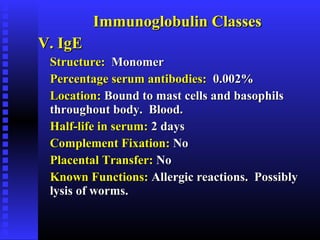
Immunoglobulin ClassesImmunoglobulin Classes
V. IgEV. IgE
Structure:Structure: MonomerMonomer
Percentage serum antibodies:Percentage serum antibodies: 0.002%0.002%
Location:Location: Bound to mast cells and basophilsBound to mast cells and basophils
throughout body. Blood.throughout body. Blood.
Half-life in serum:Half-life in serum: 2 days2 days
Complement Fixation:Complement Fixation: NoNo
Placental Transfer:Placental Transfer: NoNo
Known Functions:Known Functions: Allergic reactions. PossiblyAllergic reactions. Possibly
lysis of worms.lysis of worms.
How Do B Cells Produce Antibodies?How Do B Cells Produce Antibodies?
B cells develop fromB cells develop from stem cellsstem cells in the bonein the bone
marrow of adults (liver of fetuses).marrow of adults (liver of fetuses).
After maturation B cells migrate to lymphoidAfter maturation B cells migrate to lymphoid
organs (lymph node or spleen).organs (lymph node or spleen).
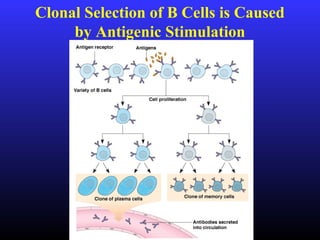
Clonal SelectionClonal Selection: When a B cell encounters an: When a B cell encounters an
antigen it recognizes, it is stimulated and dividesantigen it recognizes, it is stimulated and divides
into many clones calledinto many clones called plasma cellsplasma cells, which, which
actively secrete antibodies.actively secrete antibodies.
Each B cell produces antibodies that willEach B cell produces antibodies that will
recognize only one antigenic determinant.recognize only one antigenic determinant.
Clonal Selection of B Cells is Caused
by Antigenic Stimulation
Consequences of Antigen-Antibody BindingConsequences of Antigen-Antibody Binding
Antigen-Antibody ComplexAntigen-Antibody Complex: Formed when an: Formed when an
antibody binds to an antigen it recognizes.antibody binds to an antigen it recognizes.
AffinityAffinity: A measure of binding strength.: A measure of binding strength.
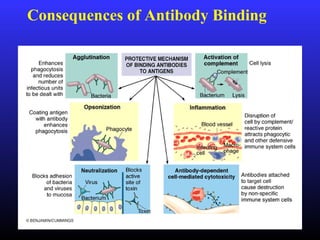
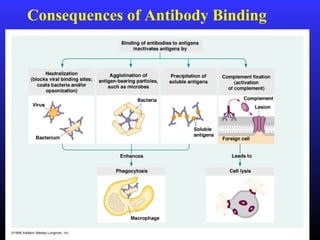
1. Agglutination:1. Agglutination: Antibodies cause antigensAntibodies cause antigens
(microbes) to clump together.(microbes) to clump together.
IgM (decavalent) is more effective that IgG (bivalent).IgM (decavalent) is more effective that IgG (bivalent).
HemagglutinationHemagglutination: Agglutination of red blood cells.: Agglutination of red blood cells.
Used to determine ABO blood types and to detectUsed to determine ABO blood types and to detect
influenza and measles viruses.influenza and measles viruses.
2. Opsonization:2. Opsonization: Antigen (microbe) is covered withAntigen (microbe) is covered with
antibodies that enhances its ingestion and lysis byantibodies that enhances its ingestion and lysis by
phagocytic cells.phagocytic cells.
Consequences of Antibody Binding
Humoral Immunity (Continued)Humoral Immunity (Continued)
3. Neutralization:3. Neutralization: IgG inactivates viruses byIgG inactivates viruses by
binding to their surface and neutralize toxins bybinding to their surface and neutralize toxins by
blocking their active sites.blocking their active sites.
4. Antibody-dependent cell-mediated cytotoxicity:4. Antibody-dependent cell-mediated cytotoxicity:
Used to destroy large organisms (e.g.: worms).Used to destroy large organisms (e.g.: worms).
Target organism is coated with antibodies andTarget organism is coated with antibodies and
bombarded with chemicals from nonspecificbombarded with chemicals from nonspecific
immune cells.immune cells.
5. Complement Activation:5. Complement Activation: Both IgG and IgMBoth IgG and IgM
trigger the complement system which results intrigger the complement system which results in
cell lysis and inflammation.cell lysis and inflammation.
Consequences of Antibody Binding
Immunological MemoryImmunological Memory
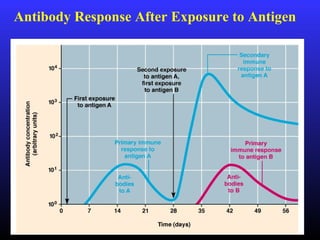
Antibody Titer:Antibody Titer: The amount of antibody in theThe amount of antibody in the
serum.serum.
Pattern of Antibody Levels During InfectionPattern of Antibody Levels During Infection
Primary Response:Primary Response:
AfterAfter initialinitial exposure to antigen, no antibodies areexposure to antigen, no antibodies are
found in serum for several days.found in serum for several days.
A gradual increase in titer, first of IgM and thenA gradual increase in titer, first of IgM and then
of IgG is observed.of IgG is observed.
Most B cells become plasma cells, but some B cellsMost B cells become plasma cells, but some B cells
become long livingbecome long living memory cellsmemory cells..
Gradual decline of antibodies follows.Gradual decline of antibodies follows.
Immunological Memory (Continued)Immunological Memory (Continued)
Secondary Response:Secondary Response:
Subsequent exposure to the same antigen displaysSubsequent exposure to the same antigen displays
a faster and more intense antibody response.a faster and more intense antibody response.
Increased antibody response is due to theIncreased antibody response is due to the
existence of memory cells, which rapidly produceexistence of memory cells, which rapidly produce
plasma cells upon antigen stimulation.plasma cells upon antigen stimulation.
Antibody Response After Exposure to Antigen
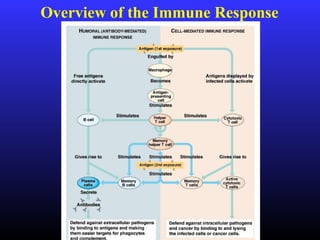
Overview of the Immune Response
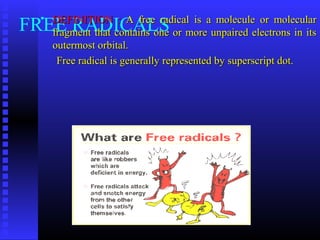
FREE RADICALS DEFINITION :DEFINITION : A free radical is a molecule or molecularA free radical is a molecule or molecular
fragment that contains one or more unpaired electrons in itsfragment that contains one or more unpaired electrons in its
outermost orbital.outermost orbital.
Free radical is generally represented by superscript dot.Free radical is generally represented by superscript dot.
HOW DO THEY GENERATE?
 Oxygen atom has two parallel spin electrons in itsOxygen atom has two parallel spin electrons in its
outermost orbital.outermost orbital.
 For a bond to occur the other molecule should alsoFor a bond to occur the other molecule should also
have two opposite spin electrons in its outer orbital ,have two opposite spin electrons in its outer orbital ,
so here Oxygen accepts only one electron which isso here Oxygen accepts only one electron which is
opposite in its spin and hence the other electron isopposite in its spin and hence the other electron is
unpaired thus forming free radical and it wanders inunpaired thus forming free radical and it wanders in
search of its compatibility.search of its compatibility.
 Free radicals that are formed by the oxidationFree radicals that are formed by the oxidation
reactions are termed as Reactive Oxygen Species.reactions are termed as Reactive Oxygen Species.
CHARACTERISTICS OF FREE
RADICAL
Characteristics of Free radical :Characteristics of Free radical :
 It is highly reactiveIt is highly reactive
 Short life spanShort life span
 Causes Damage to various Tissues byCauses Damage to various Tissues by
generation of new reactive oxygengeneration of new reactive oxygen
species by chain reaction.species by chain reaction.
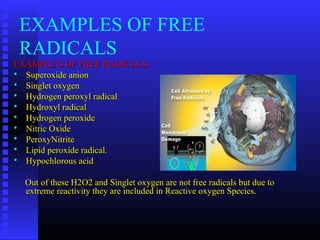
EXAMPLES OF FREE
RADICALS
EXAMPLE S OF FREE RADICALS :EXAMPLE S OF FREE RADICALS :
 Superoxide anionSuperoxide anion
 Singlet oxygenSinglet oxygen
 Hydrogen peroxyl radicalHydrogen peroxyl radical
 Hydroxyl radicalHydroxyl radical
 Hydrogen peroxideHydrogen peroxide
 Nitric OxideNitric Oxide
 PeroxyNitritePeroxyNitrite
 Lipid peroxide radical.Lipid peroxide radical.
 Hypochlorous acidHypochlorous acid
Out of these H2O2 and Singlet oxygen are not free radicals but due toOut of these H2O2 and Singlet oxygen are not free radicals but due to
extreme reactivity they are included in Reactive oxygen Species.extreme reactivity they are included in Reactive oxygen Species.
ANTIOXIDANTS
DEFINITION :DEFINITION : An antioxidantAn antioxidant
is a molecule capable ofis a molecule capable of
inhibiting the oxidation of otherinhibiting the oxidation of other
molecules.molecules.
Oxidation reactions can formOxidation reactions can form
free radicals and these startfree radicals and these start
chain reactions that damagechain reactions that damage
cells .cells .
Antioxidants terminate theseAntioxidants terminate these
chain reactions by removingchain reactions by removing
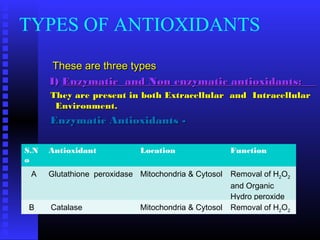
TYPES OF ANTIOXIDANTS
These are three typesThese are three types
I)I) Enzymatic and Non enzymatic antioxidants:Enzymatic and Non enzymatic antioxidants:
They are present in both Extracellular and IntracellularThey are present in both Extracellular and Intracellular
Environment.Environment.
Enzymatic Antioxidants -Enzymatic Antioxidants -
S.N
o
Antioxidant Location Function
A Glutathione peroxidase Mitochondria & Cytosol Removal of H2O2
and Organic
Hydro peroxide
B Catalase Mitochondria & Cytosol Removal of H2O2
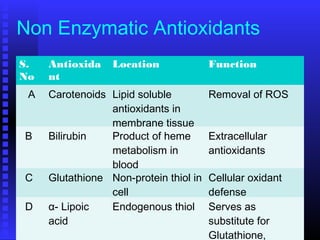
Non Enzymatic Antioxidants
S.
No
Antioxida
nt
Location Function
A Carotenoids Lipid soluble
antioxidants in
membrane tissue
Removal of ROS
B Bilirubin Product of heme
metabolism in
blood
Extracellular
antioxidants
C Glutathione Non-protein thiol in
cell
Cellular oxidant
defense
D α- Lipoic
acid
Endogenous thiol Serves as
substitute for
Glutathione,
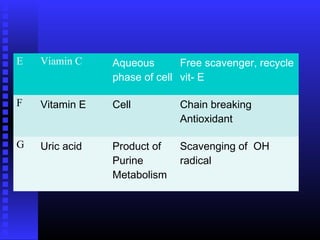
E Viamin C Aqueous
phase of cell
Free scavenger, recycle
vit- E
F Vitamin E Cell Chain breaking
Antioxidant
G Uric acid Product of
Purine
Metabolism
Scavenging of OH
radical
Functions of Antioxidants :
Antioxidants such as vit- C & vit- E boostAntioxidants such as vit- C & vit- E boost
our immune system.our immune system.
Certain phytochemicals have beneficialCertain phytochemicals have beneficial
effect on heart diseases.effect on heart diseases.
Antioxidants lower the level of LDL-Antioxidants lower the level of LDL-
cholesterol, thus preventing plaquecholesterol, thus preventing plaque
deposition in the blood vessels.deposition in the blood vessels.
It is beneficial in cancer prevention.It is beneficial in cancer prevention.
Antioxidants neutralize substances thatAntioxidants neutralize substances that
can damage the genetic material bycan damage the genetic material by
oxidationoxidation..
Collagen:-Collagen:-
 Major Structural protein found in connectiveMajor Structural protein found in connective
tissue.tissue.
 It is abt 25-30% of the total weight of proteinIt is abt 25-30% of the total weight of protein
in the body.in the body.
 It serves to hold together the cells in yheIt serves to hold together the cells in yhe
tissues.tissues.
 It is the major fibrous element of tissues likeIt is the major fibrous element of tissues like
bone, teeth, tendons, cartilage & bloodbone, teeth, tendons, cartilage & blood
vessels.vessels.
Functions of Collagen:-Functions of Collagen:-
I.I. To give support to organs.To give support to organs.
II.II. To provide alignment of cells, so that cellTo provide alignment of cells, so that cell
anchoring is possible.This in turn, helps inanchoring is possible.This in turn, helps in
proliferation & differentation of cells.proliferation & differentation of cells.
III.III.In blood vessels, if collagen is exposed,In blood vessels, if collagen is exposed,
platelets adhere & thrombus formation isplatelets adhere & thrombus formation is
initiated.initiated.
Elastin:-Elastin:-
 Protein found in connective tissue & majorProtein found in connective tissue & major
component of elastic fibers.component of elastic fibers.
 Elastic fibers can stretch & then resume theirElastic fibers can stretch & then resume their
original length.original length.
 They have high tensile strength.They have high tensile strength.
 They are found in the ligements as well as inThey are found in the ligements as well as in
the walls of the blood vessels, especially largethe walls of the blood vessels, especially large
blood vessels like aortablood vessels like aorta..
 It is rich in glycine & proline residuesIt is rich in glycine & proline residues
just like collagen.just like collagen.
 It is highly insoluble & extremely stable.It is highly insoluble & extremely stable.
 It exhibits a variety of random coilIt exhibits a variety of random coil
conformations that permit the protein toconformations that permit the protein to
stretch & recoil during physiologicalstretch & recoil during physiological
processes.processes.
Keratin:-Keratin:-
 Proteins present in hair, skin, nails, horns etc.Proteins present in hair, skin, nails, horns etc.
 Fibers present are called alpha keratins &Fibers present are called alpha keratins &
matrix as keratohyalin.matrix as keratohyalin.
 They mainly have the alpha helical structure.They mainly have the alpha helical structure.
 Keratohyalin matrix has cysteine richKeratohyalin matrix has cysteine rich
polypeptide chains which are held together bypolypeptide chains which are held together by
disulfide bonds.disulfide bonds.
Myosins:-Myosins:-
 These are actually a family of proteins withThese are actually a family of proteins with
about 15 members.about 15 members.
 Myosin i.e predominantly present in muscleMyosin i.e predominantly present in muscle
is myosin-II.is myosin-II.
 It constitute about 45% of muuscle protein &It constitute about 45% of muuscle protein &
found in thick filaments.found in thick filaments.
 Composed of 6 polypeptide chains i.eComposed of 6 polypeptide chains i.e
hexamer.hexamer.
 Contains one pair of H-chain & two pair ofContains one pair of H-chain & two pair of
L-chains.L-chains.
Enzyme Linked Immuno-SorbentEnzyme Linked Immuno-Sorbent
Assay(ELISA):-Assay(ELISA):-
 It is based on the immunochemical principles of Ag-It is based on the immunochemical principles of Ag-
Ab reaction.Ab reaction.
 ELISA techniques are widely used not only forELISA techniques are widely used not only for
hormone measurements but also for detecting anyhormone measurements but also for detecting any
other growth factors, tumor markers, bacterial orother growth factors, tumor markers, bacterial or
viral antigens, antibodies against microbes & anyviral antigens, antibodies against microbes & any
other antigens or antibodies in biological fluids.other antigens or antibodies in biological fluids.
 This test is commonly employed to detect Ags orThis test is commonly employed to detect Ags or
Abs present in very small quantities in tissues orAbs present in very small quantities in tissues or
blood.blood.
Applications:-Applications:-
 ELISA is widely used for the determination of smallELISA is widely used for the determination of small
quantities of proteins(hormones, Ags,Abs) & otherquantities of proteins(hormones, Ags,Abs) & other
biological substances.biological substances.
 Most commonly used pregnancy test for theMost commonly used pregnancy test for the
detection of human chorionic gonadotropin (hCG) indetection of human chorionic gonadotropin (hCG) in
urine is based on ELISA.urine is based on ELISA.
 By this test, Pregnancy can be detected within fewBy this test, Pregnancy can be detected within few
days after conception.days after conception.
 ELISA is also been used used for the diagnosis ofELISA is also been used used for the diagnosis of
AIDS.AIDS.
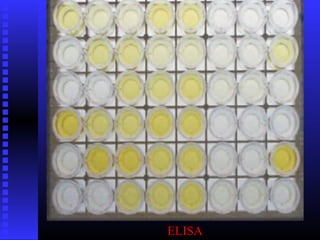
ELISA
Immunochemistry for nursing.

Immunochemistry for nursing.

  • 1.
  • 2.
    The Immune ResponseTheImmune Response ImmunityImmunity: “Free from burden”. Ability of: “Free from burden”. Ability of an organism to recognize and defend itselfan organism to recognize and defend itself againstagainst specificspecific pathogens or antigens.pathogens or antigens. Immune ResponseImmune Response: Third line of defense.: Third line of defense. Involves production of antibodies andInvolves production of antibodies and generation of specialized lymphocytesgeneration of specialized lymphocytes against specific antigens.against specific antigens. AntigenAntigen: Molecules from a pathogen or: Molecules from a pathogen or foreign organism that provoke a specificforeign organism that provoke a specific immune response.immune response.
  • 3.
    The Immune Systemis the Third Line of Defense Against Infection
  • 4.
    Innate or GeneticImmunityInnate or Genetic Immunity: Immunity an: Immunity an organism is born with.organism is born with. Genetically determined.Genetically determined. May be due to lack of receptors or otherMay be due to lack of receptors or other molecules required for infection.molecules required for infection. Innate human immunity to canine distemper.Innate human immunity to canine distemper. Immunity of mice to poliovirus.Immunity of mice to poliovirus. Acquired ImmunityAcquired Immunity:Immunity that an:Immunity that an organismorganism developsdevelops during lifetime.during lifetime. Not genetically determined.Not genetically determined. May be acquired naturally or artificially.May be acquired naturally or artificially. Development of immunity to measles in response toDevelopment of immunity to measles in response to infection or vaccination.infection or vaccination.
  • 5.
    Components of HumanImmune System
  • 6.
    Types of AcquiredImmunityTypes of Acquired Immunity I. Naturally Acquired ImmunityI. Naturally Acquired Immunity: Obtained in: Obtained in the course of daily life.the course of daily life. A. Naturally Acquired Active ImmunityA. Naturally Acquired Active Immunity:: AntigensAntigens or pathogens enter body naturally.or pathogens enter body naturally. Body generates an immune response to antigens.Body generates an immune response to antigens. Immunity may be lifelong (chickenpox or mumps)Immunity may be lifelong (chickenpox or mumps) or temporary (influenza or intestinal infections).or temporary (influenza or intestinal infections). B. Naturally Acquired Passive ImmunityB. Naturally Acquired Passive Immunity:: AntibodiesAntibodies pass from mother to fetus via placentapass from mother to fetus via placenta or breast feeding (or breast feeding (colostrumcolostrum).). No immune response to antigens.No immune response to antigens. Immunity is usuallyImmunity is usually short-livedshort-lived (weeks to months).(weeks to months). Protection until child’s immune system develops.Protection until child’s immune system develops.
  • 7.
    Types of AcquiredImmunity (Continued)Types of Acquired Immunity (Continued) II. Artificially Acquired ImmunityII. Artificially Acquired Immunity: Obtained by: Obtained by receiving a vaccine or immune serum.receiving a vaccine or immune serum. 1. Artificially Acquired Active Immunity1. Artificially Acquired Active Immunity:: AntigensAntigens are introduced in vaccines (are introduced in vaccines (immunizationimmunization).). Body generates an immune response to antigens.Body generates an immune response to antigens. Immunity can be lifelong (oral polio vaccine) or temporaryImmunity can be lifelong (oral polio vaccine) or temporary (tetanus toxoid).(tetanus toxoid). 2. Artificially Acquired Passive Immunity2. Artificially Acquired Passive Immunity:: PreformedPreformed antibodiesantibodies ((antiserumantiserum) are introduced into body) are introduced into body by injection.by injection. Snake antivenom injection from horses or rabbits.Snake antivenom injection from horses or rabbits. Immunity is short lived (half life three weeks).Immunity is short lived (half life three weeks). Host immune system does not respond to antigens.Host immune system does not respond to antigens.
  • 8.
    SerumSerum: Fluid thatremains after blood has clotted: Fluid that remains after blood has clotted and cells have been removed.and cells have been removed. AntiserumAntiserum: Serum containing antibodies to a: Serum containing antibodies to a specific antigen(s). Obtained from injecting anspecific antigen(s). Obtained from injecting an animal (horse, rabbit, goat) with antigen (snakeanimal (horse, rabbit, goat) with antigen (snake venom, botulism or diphtheria toxin).venom, botulism or diphtheria toxin). SerologySerology: The study of reactions between: The study of reactions between antibodies and antigens.antibodies and antigens. Gamma GlobulinsGamma Globulins: Fraction of serum that: Fraction of serum that contains most of the antibodies.contains most of the antibodies. Serum SicknessSerum Sickness: Disease caused by multiple: Disease caused by multiple injections of antiserum. Immune response toinjections of antiserum. Immune response to foreign proteins. May cause fever, kidneyforeign proteins. May cause fever, kidney problems, and joint pain. Rare today.problems, and joint pain. Rare today.
  • 9.
    Antibodies are Proteinsthat Recognize Specific Antigens
  • 10.
    AntigensAntigens Most areMost areproteinsproteins or largeor large polysaccharidespolysaccharides fromfrom a foreign organism.a foreign organism. MicrobesMicrobes: Capsules, cell walls, toxins, viral capsids,: Capsules, cell walls, toxins, viral capsids, flagella, etc.flagella, etc. NonmicrobesNonmicrobes: Pollen, egg white , red blood cell: Pollen, egg white , red blood cell surface molecules, serum proteins, and surfacesurface molecules, serum proteins, and surface molecules from transplanted tissue.molecules from transplanted tissue. Lipids and nucleic acids are only antigenic whenLipids and nucleic acids are only antigenic when combinedcombined with proteins or polysaccharides.with proteins or polysaccharides. Molecular weight of 10,000 or higher.Molecular weight of 10,000 or higher. HaptenHapten: Small foreign molecule that is not antigenic. Must be: Small foreign molecule that is not antigenic. Must be coupled to acoupled to a carriercarrier molecule to be antigenic. Once antibodiesmolecule to be antigenic. Once antibodies are formed they will recognize hapten.are formed they will recognize hapten.
  • 11.
    AntigensAntigens EpitopeEpitope:: Small part ofan antigen that interactsSmall part of an antigen that interacts with an antibody.with an antibody. Any given antigen may have severalAny given antigen may have several epitopes.epitopes. Each epitope is recognized by a differentEach epitope is recognized by a different antibody.antibody.
  • 12.
    Epitopes: Antigen Regionsthat Interact with Antibodies
  • 13.
    AntibodiesAntibodies ProteinsProteins that recognizeand bind to a particularthat recognize and bind to a particular antigen with very highantigen with very high specificityspecificity.. Made in response to exposure to the antigen.Made in response to exposure to the antigen. One virus or microbe may have severalOne virus or microbe may have several antigenicantigenic determinant sitesdeterminant sites, to which different antibodies, to which different antibodies may bind.may bind. Each antibody has at least two identical sitesEach antibody has at least two identical sites that bind antigen:that bind antigen: Antigen binding sitesAntigen binding sites.. Valence of an antibodyValence of an antibody: Number of antigen: Number of antigen binding sites. Most arebinding sites. Most are bivalentbivalent.. Belong to a group of serum proteins calledBelong to a group of serum proteins called immunoglobulins (Igs).immunoglobulins (Igs).
  • 14.
    Antibody StructureAntibody Structure MonomerMonomer:A flexible Y-shaped molecule with: A flexible Y-shaped molecule with four protein chains:four protein chains: 2 identical2 identical lightlight chainschains 2 identical2 identical heavyheavy chainschains Variable RegionsVariable Regions: Two sections at the end of: Two sections at the end of Y’s arms. Contain theY’s arms. Contain the antigen binding sitesantigen binding sites (Fab)(Fab). Identical on the same antibody, but vary. Identical on the same antibody, but vary from one antibody to another.from one antibody to another. Constant RegionsConstant Regions: Stem of monomer and lower: Stem of monomer and lower parts of Y arms.parts of Y arms. Fc regionFc region: Stem of monomer only. Important: Stem of monomer only. Important because they can bind to complement or cells.because they can bind to complement or cells.
  • 15.
  • 16.
    Immunoglobulin ClassesImmunoglobulin Classes I.IgGI. IgG Structure:Structure: MonomerMonomer Percentage serum antibodies:Percentage serum antibodies: 80%80% Location:Location: Blood, lymph, intestineBlood, lymph, intestine Half-life in serum:Half-life in serum: 23 days23 days Complement Fixation:Complement Fixation: YesYes Placental Transfer:Placental Transfer: YesYes Known Functions:Known Functions: Enhances phagocytosis,Enhances phagocytosis, neutralizes toxins and viruses, protects fetus andneutralizes toxins and viruses, protects fetus and newborn.newborn.
  • 17.
    Immunoglobulin ClassesImmunoglobulin Classes II.IgMII. IgM Structure:Structure: PentamerPentamer Percentage serum antibodies:Percentage serum antibodies: 5-10%5-10% Location:Location: Blood, lymph, B cell surface (monomer)Blood, lymph, B cell surface (monomer) Half-life in serum:Half-life in serum: 5 days5 days Complement Fixation:Complement Fixation: YesYes Placental Transfer:Placental Transfer: NoNo Known Functions:Known Functions: First antibodies producedFirst antibodies produced during an infection. Effective against microbes andduring an infection. Effective against microbes and agglutinating antigens.agglutinating antigens.
  • 18.
    Immunoglobulin ClassesImmunoglobulin Classes III.IgAIII. IgA Structure:Structure: DimerDimer Percentage serum antibodies:Percentage serum antibodies: 10-15%10-15% Location:Location: Secretions (tears, saliva, intestine, milk),Secretions (tears, saliva, intestine, milk), blood and lymph.blood and lymph. Half-life in serum:Half-life in serum: 6 days6 days Complement Fixation:Complement Fixation: NoNo Placental Transfer:Placental Transfer: NoNo Known Functions:Known Functions: Localized protection ofLocalized protection of mucosalmucosal surfaces. Provides immunity to infant digestivesurfaces. Provides immunity to infant digestive tract.tract.
  • 19.
    Immunoglobulin ClassesImmunoglobulin Classes IV.IgDIV. IgD Structure:Structure: MonomerMonomer Percentage serum antibodies:Percentage serum antibodies: 0.2%0.2% Location:Location: B-cell surface, blood, and lymphB-cell surface, blood, and lymph Half-life in serum:Half-life in serum: 3 days3 days Complement Fixation:Complement Fixation: NoNo Placental Transfer:Placental Transfer: NoNo Known Functions:Known Functions: In serum function is unknown.In serum function is unknown. On B cell surface, initiate immune response.On B cell surface, initiate immune response.
  • 20.
    Immunoglobulin ClassesImmunoglobulin Classes V.IgEV. IgE Structure:Structure: MonomerMonomer Percentage serum antibodies:Percentage serum antibodies: 0.002%0.002% Location:Location: Bound to mast cells and basophilsBound to mast cells and basophils throughout body. Blood.throughout body. Blood. Half-life in serum:Half-life in serum: 2 days2 days Complement Fixation:Complement Fixation: NoNo Placental Transfer:Placental Transfer: NoNo Known Functions:Known Functions: Allergic reactions. PossiblyAllergic reactions. Possibly lysis of worms.lysis of worms.
  • 21.
    How Do BCells Produce Antibodies?How Do B Cells Produce Antibodies? B cells develop fromB cells develop from stem cellsstem cells in the bonein the bone marrow of adults (liver of fetuses).marrow of adults (liver of fetuses). After maturation B cells migrate to lymphoidAfter maturation B cells migrate to lymphoid organs (lymph node or spleen).organs (lymph node or spleen). Clonal SelectionClonal Selection: When a B cell encounters an: When a B cell encounters an antigen it recognizes, it is stimulated and dividesantigen it recognizes, it is stimulated and divides into many clones calledinto many clones called plasma cellsplasma cells, which, which actively secrete antibodies.actively secrete antibodies. Each B cell produces antibodies that willEach B cell produces antibodies that will recognize only one antigenic determinant.recognize only one antigenic determinant.
  • 22.
    Clonal Selection ofB Cells is Caused by Antigenic Stimulation
  • 23.
    Consequences of Antigen-AntibodyBindingConsequences of Antigen-Antibody Binding Antigen-Antibody ComplexAntigen-Antibody Complex: Formed when an: Formed when an antibody binds to an antigen it recognizes.antibody binds to an antigen it recognizes. AffinityAffinity: A measure of binding strength.: A measure of binding strength. 1. Agglutination:1. Agglutination: Antibodies cause antigensAntibodies cause antigens (microbes) to clump together.(microbes) to clump together. IgM (decavalent) is more effective that IgG (bivalent).IgM (decavalent) is more effective that IgG (bivalent). HemagglutinationHemagglutination: Agglutination of red blood cells.: Agglutination of red blood cells. Used to determine ABO blood types and to detectUsed to determine ABO blood types and to detect influenza and measles viruses.influenza and measles viruses. 2. Opsonization:2. Opsonization: Antigen (microbe) is covered withAntigen (microbe) is covered with antibodies that enhances its ingestion and lysis byantibodies that enhances its ingestion and lysis by phagocytic cells.phagocytic cells.
  • 24.
  • 25.
    Humoral Immunity (Continued)HumoralImmunity (Continued) 3. Neutralization:3. Neutralization: IgG inactivates viruses byIgG inactivates viruses by binding to their surface and neutralize toxins bybinding to their surface and neutralize toxins by blocking their active sites.blocking their active sites. 4. Antibody-dependent cell-mediated cytotoxicity:4. Antibody-dependent cell-mediated cytotoxicity: Used to destroy large organisms (e.g.: worms).Used to destroy large organisms (e.g.: worms). Target organism is coated with antibodies andTarget organism is coated with antibodies and bombarded with chemicals from nonspecificbombarded with chemicals from nonspecific immune cells.immune cells. 5. Complement Activation:5. Complement Activation: Both IgG and IgMBoth IgG and IgM trigger the complement system which results intrigger the complement system which results in cell lysis and inflammation.cell lysis and inflammation.
  • 26.
  • 27.
    Immunological MemoryImmunological Memory AntibodyTiter:Antibody Titer: The amount of antibody in theThe amount of antibody in the serum.serum. Pattern of Antibody Levels During InfectionPattern of Antibody Levels During Infection Primary Response:Primary Response: AfterAfter initialinitial exposure to antigen, no antibodies areexposure to antigen, no antibodies are found in serum for several days.found in serum for several days. A gradual increase in titer, first of IgM and thenA gradual increase in titer, first of IgM and then of IgG is observed.of IgG is observed. Most B cells become plasma cells, but some B cellsMost B cells become plasma cells, but some B cells become long livingbecome long living memory cellsmemory cells.. Gradual decline of antibodies follows.Gradual decline of antibodies follows.
  • 28.
    Immunological Memory (Continued)ImmunologicalMemory (Continued) Secondary Response:Secondary Response: Subsequent exposure to the same antigen displaysSubsequent exposure to the same antigen displays a faster and more intense antibody response.a faster and more intense antibody response. Increased antibody response is due to theIncreased antibody response is due to the existence of memory cells, which rapidly produceexistence of memory cells, which rapidly produce plasma cells upon antigen stimulation.plasma cells upon antigen stimulation.
  • 29.
    Antibody Response AfterExposure to Antigen
  • 30.
    Overview of theImmune Response
  • 31.
    FREE RADICALS DEFINITION:DEFINITION : A free radical is a molecule or molecularA free radical is a molecule or molecular fragment that contains one or more unpaired electrons in itsfragment that contains one or more unpaired electrons in its outermost orbital.outermost orbital. Free radical is generally represented by superscript dot.Free radical is generally represented by superscript dot.
  • 32.
    HOW DO THEYGENERATE?  Oxygen atom has two parallel spin electrons in itsOxygen atom has two parallel spin electrons in its outermost orbital.outermost orbital.  For a bond to occur the other molecule should alsoFor a bond to occur the other molecule should also have two opposite spin electrons in its outer orbital ,have two opposite spin electrons in its outer orbital , so here Oxygen accepts only one electron which isso here Oxygen accepts only one electron which is opposite in its spin and hence the other electron isopposite in its spin and hence the other electron is unpaired thus forming free radical and it wanders inunpaired thus forming free radical and it wanders in search of its compatibility.search of its compatibility.  Free radicals that are formed by the oxidationFree radicals that are formed by the oxidation reactions are termed as Reactive Oxygen Species.reactions are termed as Reactive Oxygen Species.
  • 33.
    CHARACTERISTICS OF FREE RADICAL Characteristicsof Free radical :Characteristics of Free radical :  It is highly reactiveIt is highly reactive  Short life spanShort life span  Causes Damage to various Tissues byCauses Damage to various Tissues by generation of new reactive oxygengeneration of new reactive oxygen species by chain reaction.species by chain reaction.
  • 34.
    EXAMPLES OF FREE RADICALS EXAMPLES OF FREE RADICALS :EXAMPLE S OF FREE RADICALS :  Superoxide anionSuperoxide anion  Singlet oxygenSinglet oxygen  Hydrogen peroxyl radicalHydrogen peroxyl radical  Hydroxyl radicalHydroxyl radical  Hydrogen peroxideHydrogen peroxide  Nitric OxideNitric Oxide  PeroxyNitritePeroxyNitrite  Lipid peroxide radical.Lipid peroxide radical.  Hypochlorous acidHypochlorous acid Out of these H2O2 and Singlet oxygen are not free radicals but due toOut of these H2O2 and Singlet oxygen are not free radicals but due to extreme reactivity they are included in Reactive oxygen Species.extreme reactivity they are included in Reactive oxygen Species.
  • 35.
    ANTIOXIDANTS DEFINITION :DEFINITION :An antioxidantAn antioxidant is a molecule capable ofis a molecule capable of inhibiting the oxidation of otherinhibiting the oxidation of other molecules.molecules. Oxidation reactions can formOxidation reactions can form free radicals and these startfree radicals and these start chain reactions that damagechain reactions that damage cells .cells . Antioxidants terminate theseAntioxidants terminate these chain reactions by removingchain reactions by removing
  • 36.
    TYPES OF ANTIOXIDANTS Theseare three typesThese are three types I)I) Enzymatic and Non enzymatic antioxidants:Enzymatic and Non enzymatic antioxidants: They are present in both Extracellular and IntracellularThey are present in both Extracellular and Intracellular Environment.Environment. Enzymatic Antioxidants -Enzymatic Antioxidants - S.N o Antioxidant Location Function A Glutathione peroxidase Mitochondria & Cytosol Removal of H2O2 and Organic Hydro peroxide B Catalase Mitochondria & Cytosol Removal of H2O2
  • 37.
    Non Enzymatic Antioxidants S. No Antioxida nt LocationFunction A Carotenoids Lipid soluble antioxidants in membrane tissue Removal of ROS B Bilirubin Product of heme metabolism in blood Extracellular antioxidants C Glutathione Non-protein thiol in cell Cellular oxidant defense D α- Lipoic acid Endogenous thiol Serves as substitute for Glutathione,
  • 38.
    E Viamin CAqueous phase of cell Free scavenger, recycle vit- E F Vitamin E Cell Chain breaking Antioxidant G Uric acid Product of Purine Metabolism Scavenging of OH radical
  • 39.
    Functions of Antioxidants: Antioxidants such as vit- C & vit- E boostAntioxidants such as vit- C & vit- E boost our immune system.our immune system. Certain phytochemicals have beneficialCertain phytochemicals have beneficial effect on heart diseases.effect on heart diseases. Antioxidants lower the level of LDL-Antioxidants lower the level of LDL- cholesterol, thus preventing plaquecholesterol, thus preventing plaque deposition in the blood vessels.deposition in the blood vessels. It is beneficial in cancer prevention.It is beneficial in cancer prevention. Antioxidants neutralize substances thatAntioxidants neutralize substances that can damage the genetic material bycan damage the genetic material by oxidationoxidation..
  • 40.
    Collagen:-Collagen:-  Major Structuralprotein found in connectiveMajor Structural protein found in connective tissue.tissue.  It is abt 25-30% of the total weight of proteinIt is abt 25-30% of the total weight of protein in the body.in the body.  It serves to hold together the cells in yheIt serves to hold together the cells in yhe tissues.tissues.  It is the major fibrous element of tissues likeIt is the major fibrous element of tissues like bone, teeth, tendons, cartilage & bloodbone, teeth, tendons, cartilage & blood vessels.vessels.
  • 41.
    Functions of Collagen:-Functionsof Collagen:- I.I. To give support to organs.To give support to organs. II.II. To provide alignment of cells, so that cellTo provide alignment of cells, so that cell anchoring is possible.This in turn, helps inanchoring is possible.This in turn, helps in proliferation & differentation of cells.proliferation & differentation of cells. III.III.In blood vessels, if collagen is exposed,In blood vessels, if collagen is exposed, platelets adhere & thrombus formation isplatelets adhere & thrombus formation is initiated.initiated.
  • 42.
    Elastin:-Elastin:-  Protein foundin connective tissue & majorProtein found in connective tissue & major component of elastic fibers.component of elastic fibers.  Elastic fibers can stretch & then resume theirElastic fibers can stretch & then resume their original length.original length.  They have high tensile strength.They have high tensile strength.  They are found in the ligements as well as inThey are found in the ligements as well as in the walls of the blood vessels, especially largethe walls of the blood vessels, especially large blood vessels like aortablood vessels like aorta..
  • 43.
     It isrich in glycine & proline residuesIt is rich in glycine & proline residues just like collagen.just like collagen.  It is highly insoluble & extremely stable.It is highly insoluble & extremely stable.  It exhibits a variety of random coilIt exhibits a variety of random coil conformations that permit the protein toconformations that permit the protein to stretch & recoil during physiologicalstretch & recoil during physiological processes.processes.
  • 44.
    Keratin:-Keratin:-  Proteins presentin hair, skin, nails, horns etc.Proteins present in hair, skin, nails, horns etc.  Fibers present are called alpha keratins &Fibers present are called alpha keratins & matrix as keratohyalin.matrix as keratohyalin.  They mainly have the alpha helical structure.They mainly have the alpha helical structure.  Keratohyalin matrix has cysteine richKeratohyalin matrix has cysteine rich polypeptide chains which are held together bypolypeptide chains which are held together by disulfide bonds.disulfide bonds.
  • 45.
    Myosins:-Myosins:-  These areactually a family of proteins withThese are actually a family of proteins with about 15 members.about 15 members.  Myosin i.e predominantly present in muscleMyosin i.e predominantly present in muscle is myosin-II.is myosin-II.  It constitute about 45% of muuscle protein &It constitute about 45% of muuscle protein & found in thick filaments.found in thick filaments.  Composed of 6 polypeptide chains i.eComposed of 6 polypeptide chains i.e hexamer.hexamer.  Contains one pair of H-chain & two pair ofContains one pair of H-chain & two pair of L-chains.L-chains.
  • 46.
    Enzyme Linked Immuno-SorbentEnzymeLinked Immuno-Sorbent Assay(ELISA):-Assay(ELISA):-  It is based on the immunochemical principles of Ag-It is based on the immunochemical principles of Ag- Ab reaction.Ab reaction.  ELISA techniques are widely used not only forELISA techniques are widely used not only for hormone measurements but also for detecting anyhormone measurements but also for detecting any other growth factors, tumor markers, bacterial orother growth factors, tumor markers, bacterial or viral antigens, antibodies against microbes & anyviral antigens, antibodies against microbes & any other antigens or antibodies in biological fluids.other antigens or antibodies in biological fluids.  This test is commonly employed to detect Ags orThis test is commonly employed to detect Ags or Abs present in very small quantities in tissues orAbs present in very small quantities in tissues or blood.blood.
  • 47.
    Applications:-Applications:-  ELISA iswidely used for the determination of smallELISA is widely used for the determination of small quantities of proteins(hormones, Ags,Abs) & otherquantities of proteins(hormones, Ags,Abs) & other biological substances.biological substances.  Most commonly used pregnancy test for theMost commonly used pregnancy test for the detection of human chorionic gonadotropin (hCG) indetection of human chorionic gonadotropin (hCG) in urine is based on ELISA.urine is based on ELISA.  By this test, Pregnancy can be detected within fewBy this test, Pregnancy can be detected within few days after conception.days after conception.  ELISA is also been used used for the diagnosis ofELISA is also been used used for the diagnosis of AIDS.AIDS.
  • 48.