PREVENTION OF IMMUNIZATION SCHEDULE
SESSION OUTLINE
• History
• What is immunization
• Why immunization
• How vaccine works
• Types of Vaccines
• Universal Immunization Programme
• National Immunization schedule
• Cold chain and vaccines
• Achievements
BEGINNING OF VACCINATION
IMMUNIZATION
•Immunization is a process of protecting an
individual from a disease through
introduction of live attenuated, killed or
organisms or antibodies in the individual
system.
•Immunization is the process of
protecting an individual by active or
passive method.
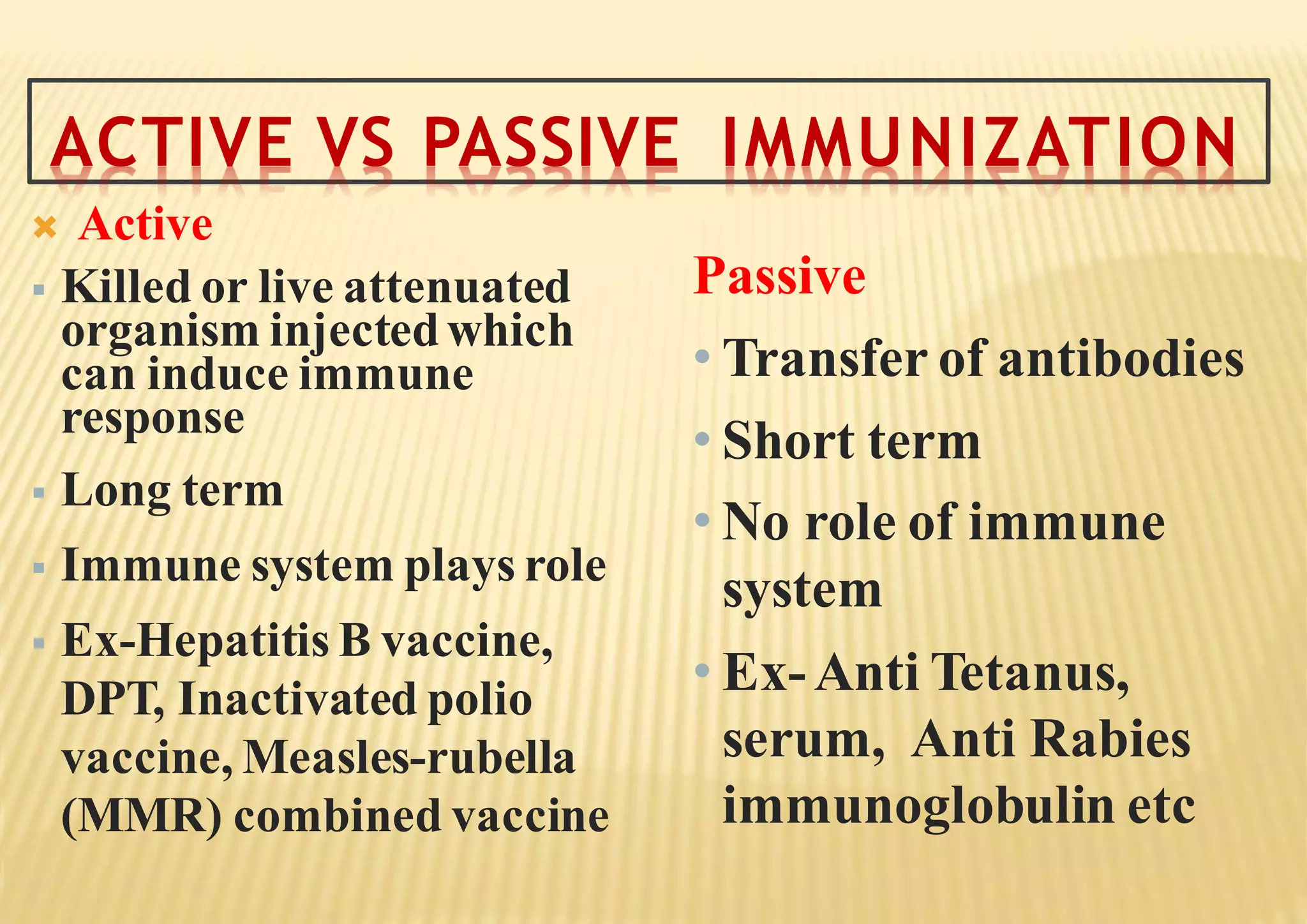
ACTIVE VS PASSIVE IMMUNIZATION
 Active
 Killed or live attenuated
organism injectedwhich
can induce immune
response
 Long term
 Immune system plays role
 Ex-Hepatitis B vaccine,
DPT, Inactivated polio
vaccine, Measles-rubella
(MMR) combined vaccine
Passive
• Transfer of antibodies
• Short term
• No role of immune
system
• Ex-Anti Tetanus,
serum, Anti Rabies
immunoglobulin etc
IMPORTANCE OF IMMUNIZATION
•Prevention of deadly and debilitating
diseases.
•Keeps child from suffering through a
preventable illness.
•Less doctor visits
•No hospitalization
COMMUNICABLE DISEASES A N D
VACCINES AVAILABLE
• TB – BCG
• Measle, Mumps, Rubella - MMR
• Chicken Pox - Varicella
• Diptheria, Tetanus, Pertussis (aka Whooping Cough) -
DPT
• Hepatitis (Aand B) – HepA, HepB
• Polio – OPV
, IPV
• Rotavirus – RVV
• Pneumoccus – PCV
• Haemophilus influenzae B- Hib
TYPES OF VACCINES
•Live, attenuated vaccines
•Inactivated vaccines
•Subunit vaccines
•Toxoids
LIVE VACCINES
• Live, attenuated vaccines contain a version of
the living microbe that has been weakened in
the lab so it can’t cause disease.
• Because a live, attenuated vaccine is the closest
thing to a natural infection, these vaccines are
good “teachers” of the immune system.
• Example: Vaccines against polio (OPV),
measles, mumps, rubella and chickenpox
INACTIVATED VACCINES
• Scientists produce inactivated vaccines by killing
the disease-causing microbe with chemicals, heat,
or radiation. Such vaccines are more stable and
safer than live vaccines.
• Because dead microbes can’t mutate back to their
disease-causing state.
• Example:Vaccines against influenza, inactivated
polio vaccine, hepatitisAetc.
TOXOIDS
• For bacteria that secrete toxins, or harmful
chemicals, a toxoid might be the answer.
• These vaccines are used when a bacterial toxin is
the main cause of illness.
• Scientists have found that they can inactivate
toxins by treating them with formalin. Such
“detoxified” toxins, called toxoids, are safe for use
in vaccines.
• Example: Diphtheria,Tetanus toxoid
SUBUNIT VACCINE
•Instead of the entire microbe, subunit
vaccines include only the antigens that
best stimulate the immune system.
•Because subunit vaccines contain only
the essential antigens and not all the
other molecules that make up the
microbe.
•Example: Plague immunization.
COMBINATIONS
THE AIM IS TO
– SIMPLIFY
ADMINISTRATION.
- reduce costs
-minimise the no. of contacts with the health
system.
Eg. DPT, DT, MMR, DPT& Hep.B, DPT, Hep
B &
Hib, HepA & B etc.
EXPANDED IMMUNIZATION PROGRAMME
• In 1974, Expanded program of Immunization (EPI) organized by
WHO
• It was called Expanded because:
• Adding more disease controlling antigens of vaccination
schedules.
• Extending coverage to all corners of a country.
• On 19 November 1985, GOI renamed EPI program, modifying the
schedule as ‘Universal Immunization Program’
• ‘Universal’ immunization is, therefore, best interpreted as
implying the ideal that no child should be denied immunization
against tuberculosis, diphtheria, whooping cough, tetanus, polio
and measles.
MILESTONE OF THE EPI
OBJECTIVES OF THE EPI
1. To reduce the morbidity and mortality of the major six
childhood disease.
2. To achieve 100% coverage for eligible children by an
ongoing integrated program .
3. To deliver an integrated immunization services through
health centers, as primary health care services package .
4. To develop a surveillance system which collect adequate
information on the disease preventable by immunization .
1. To minimize the efforts and cost of treatment .
1. To promote a new healthy generation.
STRATEGIES OF THE EPI
1. Integrated vaccination sessions with PHC services.
2. Appropriate measures to expand the vaccination coverage
of the eligible population .
3. Ensuring regular supply of potent vaccine .
4. Strengthening the cold chain.
5. Training of health personnel .
6. Promotion of community participation.
7. Ensuring logistic support(supplies and equipments).
8. Undertaking operational research to find out deficiencies &
difficulties in the programme and suggest methods of
improvement.
TARGETS OF THE EPI
1. Under – 5 years children .
2. Women in child bearing age
3. Schedule of immunization
4. Types of vaccine .
5. Dose & route of each vaccine .
6. Precautions of vaccination
IF A DOSE IS MISSED……..
•Give the dose at the next opportunity
irrespective of the time gap
•Do not start the schedule all over
again
TETANUS TOXOID
• Intramuscular– upper arm – 0.5 ml
• Pregnancy – 2 doses - 1st dose as early as possible and
second dose after 4 weeks of first dose and before 36
weeks of pregnancy
• TT booster for both boys and girls at 10 years and 16
years
• The booster dose should be given a year after the initial
doses.
• It should be stored between 4 and 10 deg C.
BCG
▣ Initial dose birth or as early as possible till one year of age
▣ 0.1 ml (0.05ml until one month of age)
▣ Intra-dermal
▣ Left upper arm
▣ Freeze dried is more stable. Diluent is Normal saline.
HEPATITIS B
• Birth dose – within 24 hours of birth
• 0.5 ml
• Intramuscular
• Antero-lateral aspect of mid-thigh
• Rest three doses at 6 weeks, 10 weeks and 14 weeks
• It should be stored at 2 to 8 deg C.
• 1 ml in adults, 05ml in children <10 yrs, given IM. Mostly
used 0,1,6 m schedule.
ORAL POLIO VACCINE
▣ Zero dose – at birth
▣ 2 drops
▣ Oral
▣ First, second and third doses at 6,10 and 14 weeks with Pentavalent-1,
2 and 3
▣ OPV booster with DPT booster at 16-24 months
PENTAVALENT VACCINE
• Simultaneous immunization against diphtheria, Pertuisis &
Tetanus, Hep B, Hib.
• Stored at 4-8 degree C.
• Given 0.5 ml IM at anterolat. aspect of thigh.
• Primary 3 doses with a booster in 16 -24 months. DT 5-6
yrs.
• C/I –progressive neurological diseases.
ROTAVIRAL VACCINE
• 3 doses given in 6th, 10th and 14th weeks.
• Can be given till one year of age
• G9P human strain.
• Dose - 5 drops/0.5 ml orally
• for prevention of diarrhoea among infants due to
rotavirus.
IPV
•2 fractional doses given in 6th and
14th weeks.
•Dose – 0.1 ml
•Given intradermally in Right upper
arm
JAPANESE ENCEPHALITIS
•0.5 ml, 2 doses
•9 months and16-24 months
•Subcutaneous
•Left upper arm
MR VACCINE
• Bivalent Live atteunated against measles and rubella.
• Given 0.5 ml SC at 9-12 and 16-24 months.
• Stored 2-8 deg C
• Strain- Measles-Edmonstorn-zagreb, Rubella- Wilstar
RA27/3
• Reactions- Fever, Resp. symp.s, Lymphadenitis or
parotitis
DPT
•Primary doses were in pentavalent vaccine.
•One booster at 16-24 m with OPV booster
(antero-lateral side of mid-thigh) and
second booster at 5-6 years (upper arm)
•0.5 ml
•Intra-muscular
VITAMIN A
• 1st dose – 1 ml (1 IU) - along-with Measles first dose - Oral
• Subsequent 8 doses (2 ml or 2 lakh IU) every six months till 5
years of age starting with DPT first booster at 16-24 months
• Use only plastic spoon provided with Vitamin A solution
• REFERENCE :-
-SAXENA R.P . TEXTBOOK OF COMMUNITY HEALTH NURSING . 2ND
EDITION. LOTUS PUBLICATION. NEW DELHI. 2018. PAGE NO. 508-5011
-PARK,S K. TEXT BOOK OF PREVENTIVE AND SOCIAL MEDICINE. 23 RD
EDITION M/S BANARASIDAS BHANOT PUBLISHERS. PREM NAGAR
NAGPUR ROAD JABALPUR (INDIA).2015
-HTTPS://APPS.WHO.INT/IRIS/HANDLE/10665/61767
-UNICEF. “EXPANDING IMMUNIZATION COVERAGE”
VACCINES AND
COLD CHAIN
Cold
W H Y HAVE THE C O L D CHAIN?
IFVACCINES ARE EXPOSED TO EXCESSIVE
Heat
Light
they may lose their potency or effectiveness.
HEAT DAMAGE
• Heat damage is cumulative effect
• Reconstituted vaccine is most sensitive to heat and
light.
• Measles and BCG vaccines should not be used 4 hrs after
reconstitution and JE 2 hrs after reconstitution
• Temperature of diluents & vaccine must be same during
reconstitution
HEAT SENSITIVITY
• BCG (after reconstitution)
• OPV
• Measles (before and after
reconstitution)
• DPT
• BCG (before reconstitution)
• DT
• TT
• HepB
LEAST SENSITIVE
MOST SENSITIVE
SENSITIVITY FROM FREEZING
• Hep B
• DPT
• DT
• TT
LEAST SENSITIVE
MOST SENSITIVE
COLD CHAIN
• System of storage & transport of vaccines at low temp. from
the manufacturer to the actual vaccination site.
Manufacturer
Airport
State/Region
District store
Health centre
Outreach
Subcentre
COLD CHAIN
• Walk-in-cold rooms-at regional levels.
• Deep freezers-for making ice packs and storage of OPV.
• Ice-lined refrigerators-at PHC level.
REMEMBER
• All vaccines tend to lose potency on exposure
to heat above +80 C
• Some vaccines (Hep B,TT,DPT) lose potency
when exposed to freezing temperatures
• Some vaccines are sensitive to light (BCG,
Measles).
• The damage is irreversible
• Physical appearance ofthe vaccine may
remain unchanged but potency might be
lost.
MONITORING OF COLD
CHAIN
The physical appearance of the vaccine may
remain unchanged even after it is damaged
The loss of potency due to either exposure to
heat or cold is permanent and can not be
regained.
Heat Damage- All vaccines are damaged
by temperatures more than +8°C.
Checking for heat damage: The Vaccine Vial
Monitor contains a heat-sensitive material,
placed on a vaccine vial to register cumulative
heat exposure over time.
COLD CHAIN
EQUIPMENTS
WALK-IN-FREEZERS
(WIF)
 Installed in all of the states and larger divisional head
quarters.
 They maintain a temperature around -20°C.
 bulk storage of OPV, and also to prepare frozen ice packs
at state stores.
Available in
sizes of 16.5 Cum. and
32 Cum.
ICE LINED REFRIGERATOR
Available in different sizes:
108 liters or 26000 to 30000 doses
45 liters or 11000 to 13000 doses
100 liters or 24000 to 28000 doses
50 liters or 12000 to 14000 doses
 Top opening because they can hold the cold air inside better than a
refrigerator with a front opening.
 There is a lining of water containers (Ice packs or tubes) fitted all
around the walls and held in place by frame.
 Keep vaccine safe with as little as 8 hours continuous electricity supp
in a 24-hour period.
DEEP
FREEZER
Available in different sizes:
264 liters or 380 icepacks
72 liters or 130 icepacks
80 liters or 140 ice packs.
 Cabinet temperature is maintained between -15°C to -
25°C.
 Used for storing of OPV (district level and above only) and
also for freezing ice packs.
 All districts have been provided 2-5 large deep freezers
 Most PHCs have been provided with one small deep freezer.
WALK-IN-COOLERS
 Established at regional levels, which store vaccines for about
4-5 districts
 Maintains temperature of +2°C to +8°C.
 Used for storage of large quantities of vaccines, like DPT, DT,
TT, Measles, BCG, Hepatitis B.
 WIC/WIF store vaccines of three months requirement and 25%
buffer
stock for the districts they cater.
Available in
sizes of 16.5 Cum. and
32 Cum.
VA C C I N E C A R R I E R S
• Used for carrying vaccines
(16-20 vials) and diluents
from PHC to the outreach
session sites.
• With 4 conditioned icepacks
maintain inside temperature of
2-80C for 12 hours.
• Close the lid of the carrier
tightly.
• Never use any day carriers
with 2 icepacks or thermos
flask for carrying vaccines.
COLD
BOX
 Big insulated boxes
 Mainly used to collect and transport large quantities of vaccines
 In emergency they can be used to store vaccines as well as frozen
ice packs.
 Store vaccines for transfer up to five days, if necessary for
outreach
sessions or when there is power cut.
Available in different sizes:
5& 8 liters for 1500 & 2400
doses
20-22 liters for 6000 -6600 doses
PREPARATION OF VACCINE
CARRIERS
Take out the required number of ice packs from the
deep freezer and wipe them dry.
Keep them out side for conditioning.
Place four conditioned ice packs in the carrier
wait till temperature to fall to <8 ° C in the carrier
Wrap vaccine vials and ampoules in thick paper
before putting in polythene bag so as to prevent
them from touching the ice packs.
CONT
….
Place some packing material between `T’ series
vaccine and the ice packs.
Place foam pad at the top of ice packs
Ensure that some ice is present in the ice
packs while conducting immunization
sessions.
Secure the lid tightly.
VACCINE VIAL
MONITOR
USABLE A N D UNUSABLE STAGES OF VVM
ACHIEVEMENTS:
• The biggest achievement of the immunization
program is the eradication of small pox.
• One more significant milestone is that
India is free of Poliomyelitis caused by
Wild Polio Virus (WPV) .
• Vaccination has contributed significantly to the
decline in the cases and deaths due to the Vaccine
Preventable Diseases (VPDs).
PREVENTIVE IMMINUIZATION.pptx

PREVENTIVE IMMINUIZATION.pptx

  • 1.
  • 4.
    SESSION OUTLINE • History •What is immunization • Why immunization • How vaccine works • Types of Vaccines • Universal Immunization Programme • National Immunization schedule • Cold chain and vaccines • Achievements
  • 6.
  • 8.
    IMMUNIZATION •Immunization is aprocess of protecting an individual from a disease through introduction of live attenuated, killed or organisms or antibodies in the individual system. •Immunization is the process of protecting an individual by active or passive method.
  • 9.
    ACTIVE VS PASSIVEIMMUNIZATION  Active  Killed or live attenuated organism injectedwhich can induce immune response  Long term  Immune system plays role  Ex-Hepatitis B vaccine, DPT, Inactivated polio vaccine, Measles-rubella (MMR) combined vaccine Passive • Transfer of antibodies • Short term • No role of immune system • Ex-Anti Tetanus, serum, Anti Rabies immunoglobulin etc
  • 10.
    IMPORTANCE OF IMMUNIZATION •Preventionof deadly and debilitating diseases. •Keeps child from suffering through a preventable illness. •Less doctor visits •No hospitalization
  • 13.
    COMMUNICABLE DISEASES AN D VACCINES AVAILABLE • TB – BCG • Measle, Mumps, Rubella - MMR • Chicken Pox - Varicella • Diptheria, Tetanus, Pertussis (aka Whooping Cough) - DPT • Hepatitis (Aand B) – HepA, HepB • Polio – OPV , IPV • Rotavirus – RVV • Pneumoccus – PCV • Haemophilus influenzae B- Hib
  • 14.
    TYPES OF VACCINES •Live,attenuated vaccines •Inactivated vaccines •Subunit vaccines •Toxoids
  • 15.
    LIVE VACCINES • Live,attenuated vaccines contain a version of the living microbe that has been weakened in the lab so it can’t cause disease. • Because a live, attenuated vaccine is the closest thing to a natural infection, these vaccines are good “teachers” of the immune system. • Example: Vaccines against polio (OPV), measles, mumps, rubella and chickenpox
  • 16.
    INACTIVATED VACCINES • Scientistsproduce inactivated vaccines by killing the disease-causing microbe with chemicals, heat, or radiation. Such vaccines are more stable and safer than live vaccines. • Because dead microbes can’t mutate back to their disease-causing state. • Example:Vaccines against influenza, inactivated polio vaccine, hepatitisAetc.
  • 17.
    TOXOIDS • For bacteriathat secrete toxins, or harmful chemicals, a toxoid might be the answer. • These vaccines are used when a bacterial toxin is the main cause of illness. • Scientists have found that they can inactivate toxins by treating them with formalin. Such “detoxified” toxins, called toxoids, are safe for use in vaccines. • Example: Diphtheria,Tetanus toxoid
  • 18.
    SUBUNIT VACCINE •Instead ofthe entire microbe, subunit vaccines include only the antigens that best stimulate the immune system. •Because subunit vaccines contain only the essential antigens and not all the other molecules that make up the microbe. •Example: Plague immunization.
  • 19.
    COMBINATIONS THE AIM ISTO – SIMPLIFY ADMINISTRATION. - reduce costs -minimise the no. of contacts with the health system. Eg. DPT, DT, MMR, DPT& Hep.B, DPT, Hep B & Hib, HepA & B etc.
  • 20.
    EXPANDED IMMUNIZATION PROGRAMME •In 1974, Expanded program of Immunization (EPI) organized by WHO • It was called Expanded because: • Adding more disease controlling antigens of vaccination schedules. • Extending coverage to all corners of a country. • On 19 November 1985, GOI renamed EPI program, modifying the schedule as ‘Universal Immunization Program’ • ‘Universal’ immunization is, therefore, best interpreted as implying the ideal that no child should be denied immunization against tuberculosis, diphtheria, whooping cough, tetanus, polio and measles.
  • 21.
  • 22.
    OBJECTIVES OF THEEPI 1. To reduce the morbidity and mortality of the major six childhood disease. 2. To achieve 100% coverage for eligible children by an ongoing integrated program . 3. To deliver an integrated immunization services through health centers, as primary health care services package . 4. To develop a surveillance system which collect adequate information on the disease preventable by immunization . 1. To minimize the efforts and cost of treatment . 1. To promote a new healthy generation.
  • 23.
    STRATEGIES OF THEEPI 1. Integrated vaccination sessions with PHC services. 2. Appropriate measures to expand the vaccination coverage of the eligible population . 3. Ensuring regular supply of potent vaccine . 4. Strengthening the cold chain. 5. Training of health personnel . 6. Promotion of community participation. 7. Ensuring logistic support(supplies and equipments). 8. Undertaking operational research to find out deficiencies & difficulties in the programme and suggest methods of improvement.
  • 24.
    TARGETS OF THEEPI 1. Under – 5 years children . 2. Women in child bearing age 3. Schedule of immunization 4. Types of vaccine . 5. Dose & route of each vaccine . 6. Precautions of vaccination
  • 26.
    IF A DOSEIS MISSED…….. •Give the dose at the next opportunity irrespective of the time gap •Do not start the schedule all over again
  • 27.
    TETANUS TOXOID • Intramuscular–upper arm – 0.5 ml • Pregnancy – 2 doses - 1st dose as early as possible and second dose after 4 weeks of first dose and before 36 weeks of pregnancy • TT booster for both boys and girls at 10 years and 16 years • The booster dose should be given a year after the initial doses. • It should be stored between 4 and 10 deg C.
  • 28.
    BCG ▣ Initial dosebirth or as early as possible till one year of age ▣ 0.1 ml (0.05ml until one month of age) ▣ Intra-dermal ▣ Left upper arm ▣ Freeze dried is more stable. Diluent is Normal saline.
  • 29.
    HEPATITIS B • Birthdose – within 24 hours of birth • 0.5 ml • Intramuscular • Antero-lateral aspect of mid-thigh • Rest three doses at 6 weeks, 10 weeks and 14 weeks • It should be stored at 2 to 8 deg C. • 1 ml in adults, 05ml in children <10 yrs, given IM. Mostly used 0,1,6 m schedule.
  • 30.
    ORAL POLIO VACCINE ▣Zero dose – at birth ▣ 2 drops ▣ Oral ▣ First, second and third doses at 6,10 and 14 weeks with Pentavalent-1, 2 and 3 ▣ OPV booster with DPT booster at 16-24 months
  • 31.
    PENTAVALENT VACCINE • Simultaneousimmunization against diphtheria, Pertuisis & Tetanus, Hep B, Hib. • Stored at 4-8 degree C. • Given 0.5 ml IM at anterolat. aspect of thigh. • Primary 3 doses with a booster in 16 -24 months. DT 5-6 yrs. • C/I –progressive neurological diseases.
  • 32.
    ROTAVIRAL VACCINE • 3doses given in 6th, 10th and 14th weeks. • Can be given till one year of age • G9P human strain. • Dose - 5 drops/0.5 ml orally • for prevention of diarrhoea among infants due to rotavirus.
  • 33.
    IPV •2 fractional dosesgiven in 6th and 14th weeks. •Dose – 0.1 ml •Given intradermally in Right upper arm
  • 34.
    JAPANESE ENCEPHALITIS •0.5 ml,2 doses •9 months and16-24 months •Subcutaneous •Left upper arm
  • 35.
    MR VACCINE • BivalentLive atteunated against measles and rubella. • Given 0.5 ml SC at 9-12 and 16-24 months. • Stored 2-8 deg C • Strain- Measles-Edmonstorn-zagreb, Rubella- Wilstar RA27/3 • Reactions- Fever, Resp. symp.s, Lymphadenitis or parotitis
  • 36.
    DPT •Primary doses werein pentavalent vaccine. •One booster at 16-24 m with OPV booster (antero-lateral side of mid-thigh) and second booster at 5-6 years (upper arm) •0.5 ml •Intra-muscular
  • 37.
    VITAMIN A • 1stdose – 1 ml (1 IU) - along-with Measles first dose - Oral • Subsequent 8 doses (2 ml or 2 lakh IU) every six months till 5 years of age starting with DPT first booster at 16-24 months • Use only plastic spoon provided with Vitamin A solution
  • 38.
    • REFERENCE :- -SAXENAR.P . TEXTBOOK OF COMMUNITY HEALTH NURSING . 2ND EDITION. LOTUS PUBLICATION. NEW DELHI. 2018. PAGE NO. 508-5011 -PARK,S K. TEXT BOOK OF PREVENTIVE AND SOCIAL MEDICINE. 23 RD EDITION M/S BANARASIDAS BHANOT PUBLISHERS. PREM NAGAR NAGPUR ROAD JABALPUR (INDIA).2015 -HTTPS://APPS.WHO.INT/IRIS/HANDLE/10665/61767 -UNICEF. “EXPANDING IMMUNIZATION COVERAGE”
  • 39.
  • 40.
    Cold W H YHAVE THE C O L D CHAIN? IFVACCINES ARE EXPOSED TO EXCESSIVE Heat Light they may lose their potency or effectiveness.
  • 41.
    HEAT DAMAGE • Heatdamage is cumulative effect • Reconstituted vaccine is most sensitive to heat and light. • Measles and BCG vaccines should not be used 4 hrs after reconstitution and JE 2 hrs after reconstitution • Temperature of diluents & vaccine must be same during reconstitution
  • 42.
    HEAT SENSITIVITY • BCG(after reconstitution) • OPV • Measles (before and after reconstitution) • DPT • BCG (before reconstitution) • DT • TT • HepB LEAST SENSITIVE MOST SENSITIVE
  • 43.
    SENSITIVITY FROM FREEZING •Hep B • DPT • DT • TT LEAST SENSITIVE MOST SENSITIVE
  • 44.
    COLD CHAIN • Systemof storage & transport of vaccines at low temp. from the manufacturer to the actual vaccination site. Manufacturer Airport State/Region District store Health centre Outreach Subcentre
  • 45.
    COLD CHAIN • Walk-in-coldrooms-at regional levels. • Deep freezers-for making ice packs and storage of OPV. • Ice-lined refrigerators-at PHC level.
  • 46.
    REMEMBER • All vaccinestend to lose potency on exposure to heat above +80 C • Some vaccines (Hep B,TT,DPT) lose potency when exposed to freezing temperatures • Some vaccines are sensitive to light (BCG, Measles). • The damage is irreversible • Physical appearance ofthe vaccine may remain unchanged but potency might be lost.
  • 47.
    MONITORING OF COLD CHAIN Thephysical appearance of the vaccine may remain unchanged even after it is damaged The loss of potency due to either exposure to heat or cold is permanent and can not be regained. Heat Damage- All vaccines are damaged by temperatures more than +8°C. Checking for heat damage: The Vaccine Vial Monitor contains a heat-sensitive material, placed on a vaccine vial to register cumulative heat exposure over time.
  • 48.
  • 49.
    WALK-IN-FREEZERS (WIF)  Installed inall of the states and larger divisional head quarters.  They maintain a temperature around -20°C.  bulk storage of OPV, and also to prepare frozen ice packs at state stores. Available in sizes of 16.5 Cum. and 32 Cum.
  • 50.
    ICE LINED REFRIGERATOR Availablein different sizes: 108 liters or 26000 to 30000 doses 45 liters or 11000 to 13000 doses 100 liters or 24000 to 28000 doses 50 liters or 12000 to 14000 doses  Top opening because they can hold the cold air inside better than a refrigerator with a front opening.  There is a lining of water containers (Ice packs or tubes) fitted all around the walls and held in place by frame.  Keep vaccine safe with as little as 8 hours continuous electricity supp in a 24-hour period.
  • 51.
    DEEP FREEZER Available in differentsizes: 264 liters or 380 icepacks 72 liters or 130 icepacks 80 liters or 140 ice packs.  Cabinet temperature is maintained between -15°C to - 25°C.  Used for storing of OPV (district level and above only) and also for freezing ice packs.  All districts have been provided 2-5 large deep freezers  Most PHCs have been provided with one small deep freezer.
  • 52.
    WALK-IN-COOLERS  Established atregional levels, which store vaccines for about 4-5 districts  Maintains temperature of +2°C to +8°C.  Used for storage of large quantities of vaccines, like DPT, DT, TT, Measles, BCG, Hepatitis B.  WIC/WIF store vaccines of three months requirement and 25% buffer stock for the districts they cater. Available in sizes of 16.5 Cum. and 32 Cum.
  • 53.
    VA C CI N E C A R R I E R S • Used for carrying vaccines (16-20 vials) and diluents from PHC to the outreach session sites. • With 4 conditioned icepacks maintain inside temperature of 2-80C for 12 hours. • Close the lid of the carrier tightly. • Never use any day carriers with 2 icepacks or thermos flask for carrying vaccines.
  • 54.
    COLD BOX  Big insulatedboxes  Mainly used to collect and transport large quantities of vaccines  In emergency they can be used to store vaccines as well as frozen ice packs.  Store vaccines for transfer up to five days, if necessary for outreach sessions or when there is power cut. Available in different sizes: 5& 8 liters for 1500 & 2400 doses 20-22 liters for 6000 -6600 doses
  • 55.
    PREPARATION OF VACCINE CARRIERS Takeout the required number of ice packs from the deep freezer and wipe them dry. Keep them out side for conditioning. Place four conditioned ice packs in the carrier wait till temperature to fall to <8 ° C in the carrier Wrap vaccine vials and ampoules in thick paper before putting in polythene bag so as to prevent them from touching the ice packs.
  • 56.
    CONT …. Place some packingmaterial between `T’ series vaccine and the ice packs. Place foam pad at the top of ice packs Ensure that some ice is present in the ice packs while conducting immunization sessions. Secure the lid tightly.
  • 57.
  • 58.
    USABLE A ND UNUSABLE STAGES OF VVM
  • 60.
    ACHIEVEMENTS: • The biggestachievement of the immunization program is the eradication of small pox. • One more significant milestone is that India is free of Poliomyelitis caused by Wild Polio Virus (WPV) . • Vaccination has contributed significantly to the decline in the cases and deaths due to the Vaccine Preventable Diseases (VPDs).