The eGranary:
 Storing the Seeds of
 Knowledge

         Heather Lee, MPH
UAB Sparkman Center for Global Health
          February 6, 2012
OBJECTIVES
 What is the Widernet Project?
 What is the eGranary Digital Library Project?

 What are some of the accomplishments of the
  eGranary Project?
 Role and vision of the Sparkman Center

 How were the portals developed, including the
  Zambia Knowledge Centre?
 Finally, the eGranary will be revealed!
WHAT IS THE
WIDERNET
PROJECT?
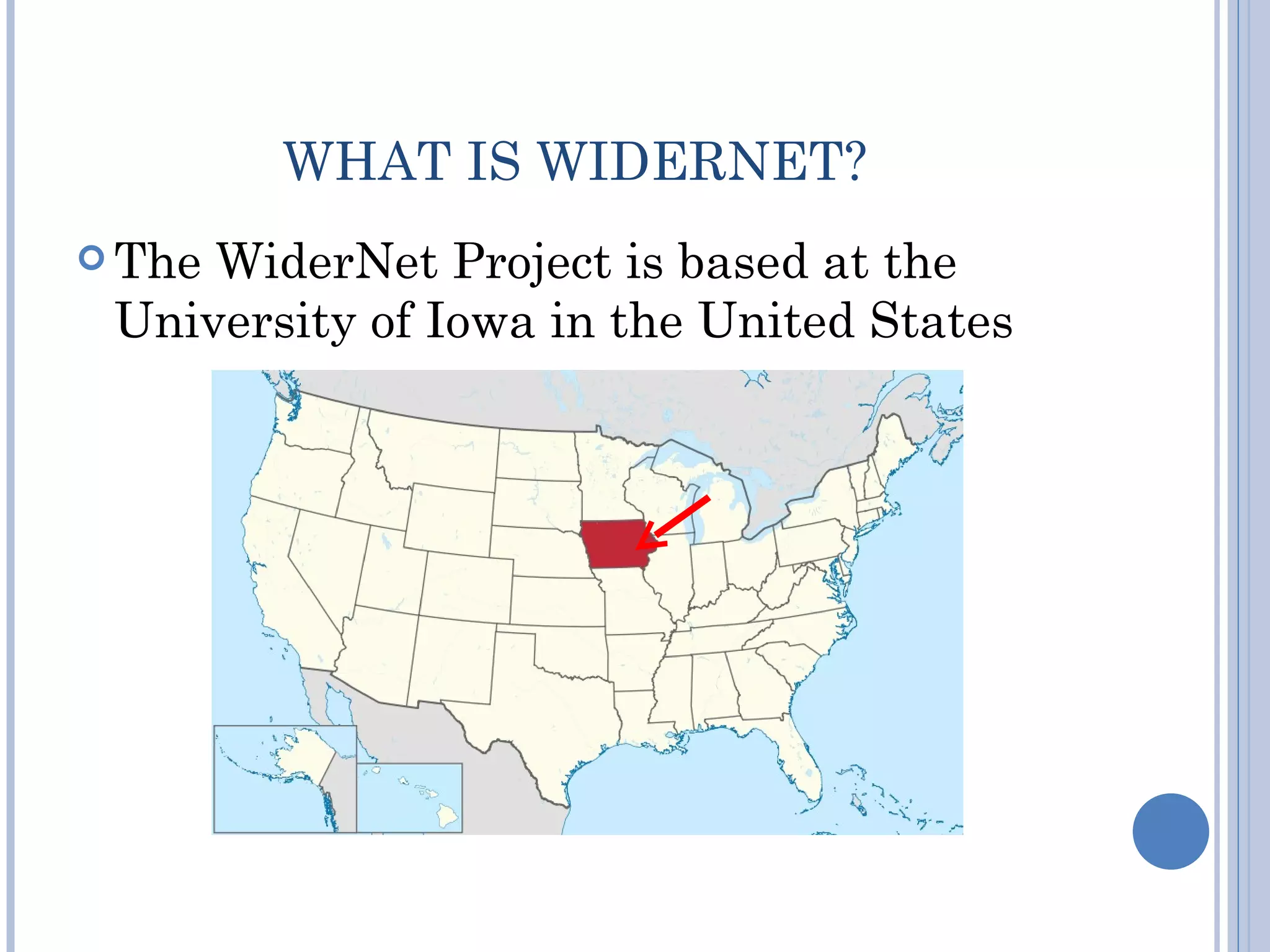
WHAT IS WIDERNET?
 TheWiderNet Project is based at the
 University of Iowa in the United States
WHAT IS THE MISSION OF
            WIDERNET?
 To improve digital communication to all
  communities and individuals around the
  world in need of educational resources,
  knowledge, and training
 Widernet serves many people who lack
  internet connectivity and information
  resources, but their work focuses
  especially on the needs in developing
  countries
WHAT DOES WIDERNET OFFER?
A  holistic approach: computers, needed
  appliances and educational material
 Also offer resources and training

 Training is important because enables
  people to be self-sufficient with using
  Information and Communication
  Technology (ICT)
WHY IS THERE A NEED FOR THEIR
           SERVICES?
 Only one out of seven people have
  adequate access to the Internet
 In many developing countries, universities
  may have a direct connection to the
  Internet, but not enough bandwidth to
  adequately serve their users
 Only a fraction of professors and students
  have access to email and basic computer
  programs
 What is your internet experience like at
  your job?
WHY DOES WIDERNET ADDRESS
       THESE PROBLEMS?
 Belief that ICT can empower people,
  giving them better access to information,
  knowledge and communication and in that
  way improve their overall quality of life
 Strive to make educational resources and
  training opportunities available to
  everyone to bridge the digital divide
WIDERNET HISTORY
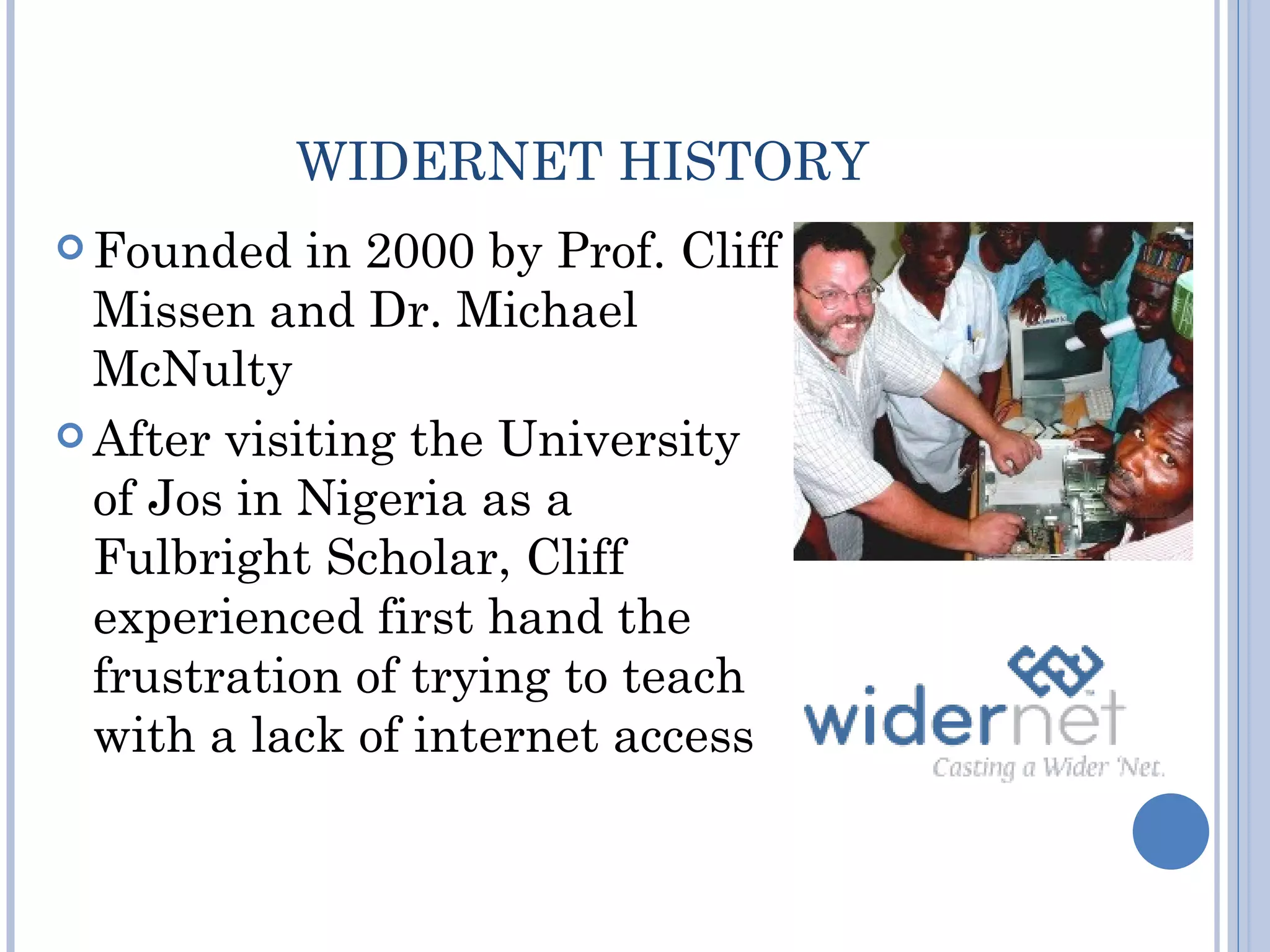
 Founded   in 2000 by Prof. Cliff
  Missen and Dr. Michael
  McNulty
 After visiting the University
  of Jos in Nigeria as a
  Fulbright Scholar, Cliff
  experienced first hand the
  frustration of trying to teach
  with a lack of internet access
WIDERNET ACCOMPLISHMENTS
 Has  donated more than 1,200 computers
  for use at universities in Africa
 Has provided training opportunities to
  thousands of university staff and
  administrators in programs customized to
  suit their institutions' specific needs
 Installed the eGranary Digital Library
  at more than 350 partner institutions
  around the world
WHAT IS THE
eGRANARY DIGITAL
LIBRARY?
THE eGRANARY DIGITAL LIBRARY
              PROJECT
 While at the University of Jos, Cliff created the
  first version of an off-line digital library after
  requesting that a UI graduate student send him
  some Web sites on a CD-ROM
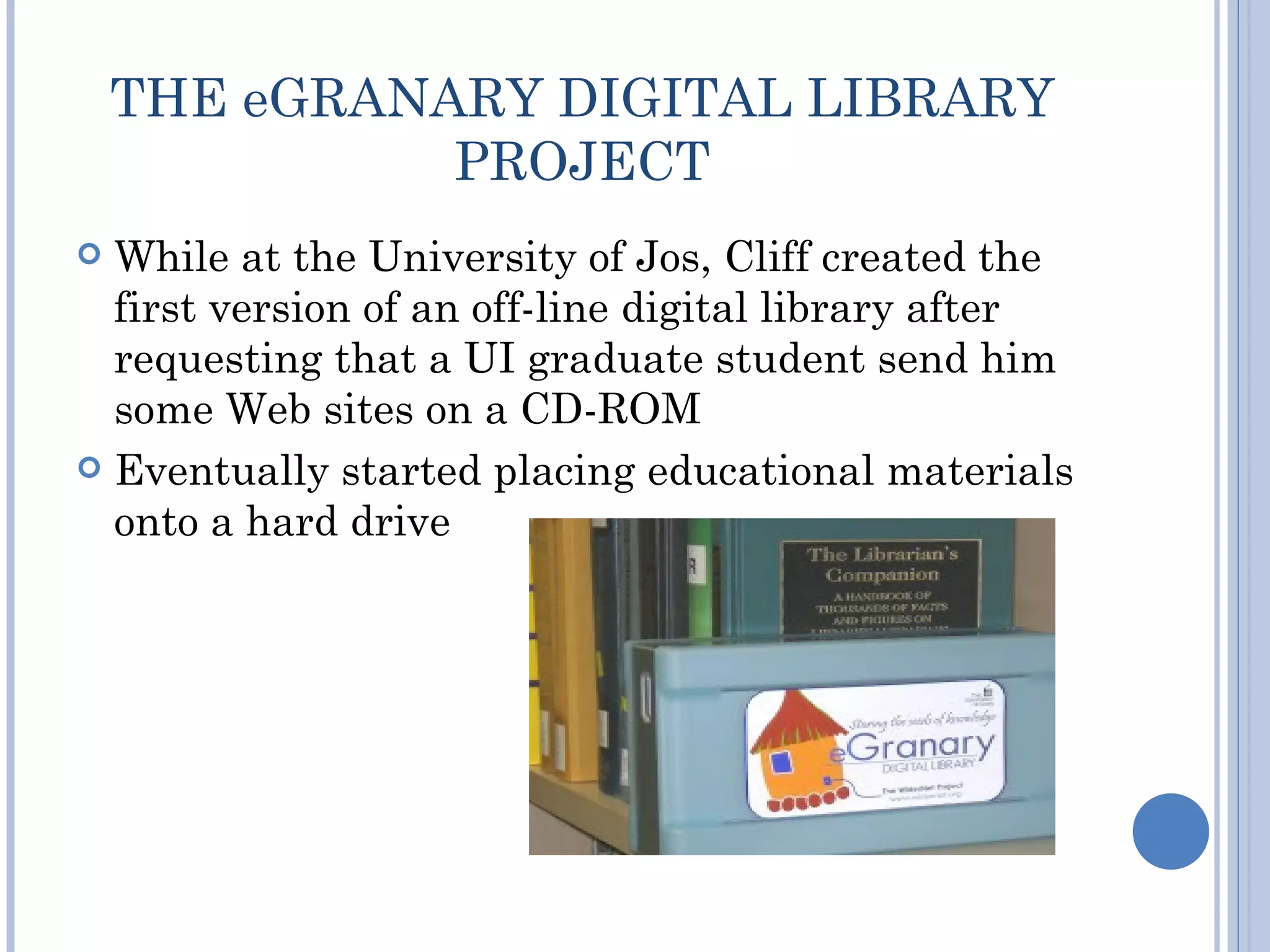
 Eventually started placing educational materials
  onto a hard drive
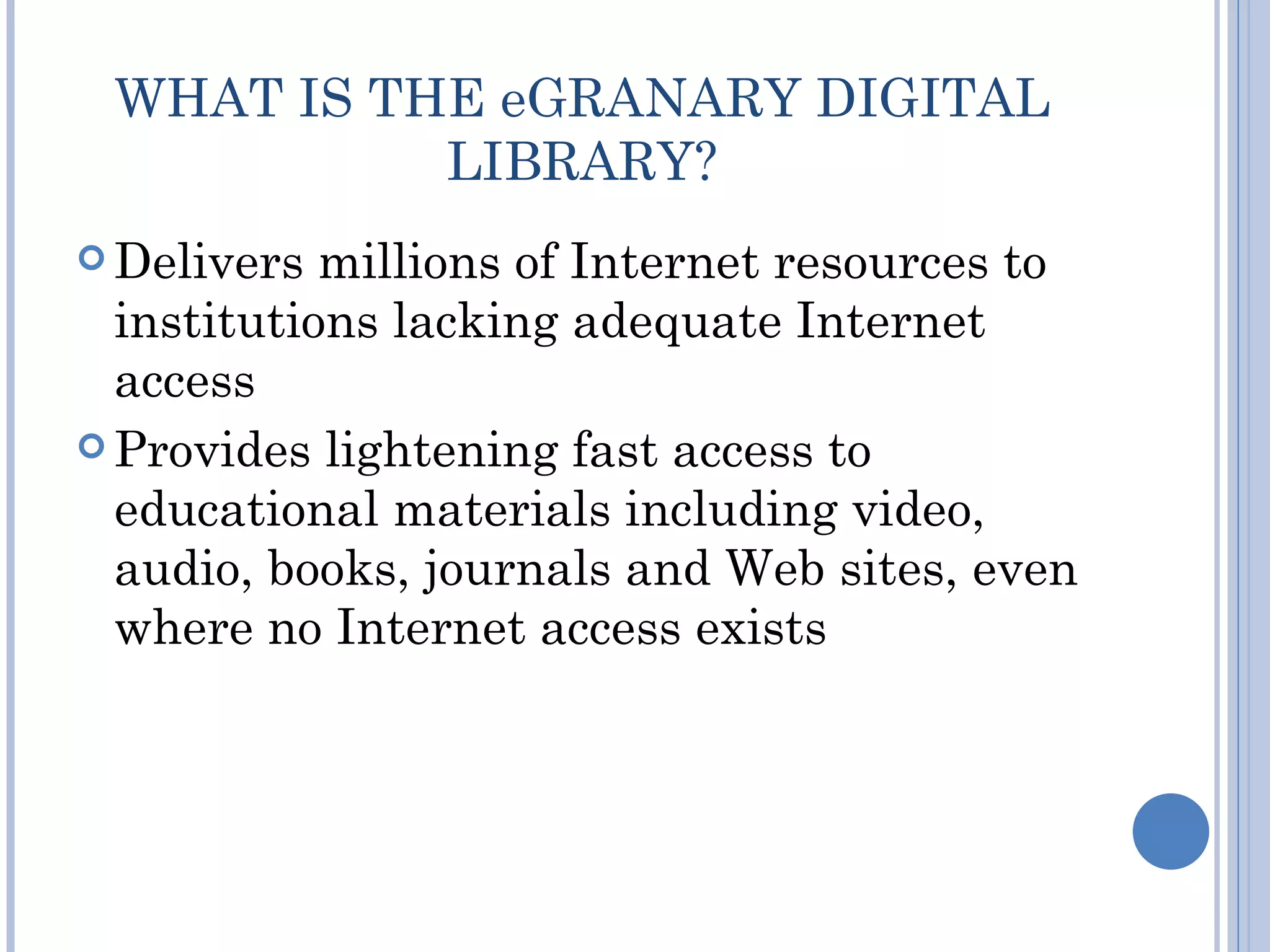
STORING THE SEEDS OF
    KNOWLEDGE
WHAT IS THE eGRANARY DIGITAL
           LIBRARY?
 Delivers  millions of Internet resources to
  institutions lacking adequate Internet
  access
 Provides lightening fast access to
  educational materials including video,
  audio, books, journals and Web sites, even
  where no Internet access exists
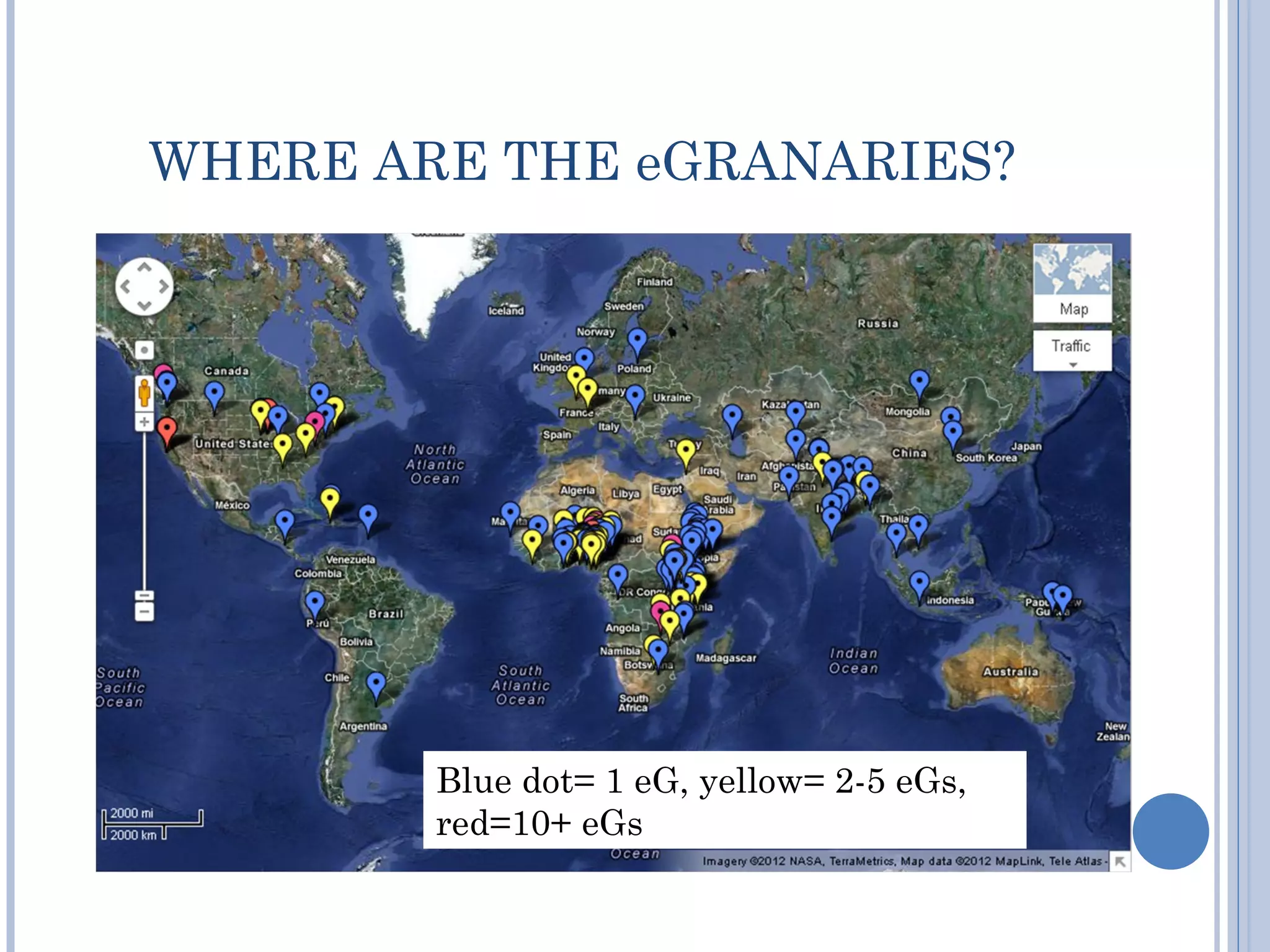
WHERE ARE THE eGRANARIES?


        Blue dot= 1 eG, yellow= 2-5 eGs,
        red=10+ eGs
WHAT KIND OF PLACES HAVE
         eGRANARIES?
 Primary  and secondary schools
 Colleges and universities

 Medical schools

 Engineering schools

 Hospitals and medical clinics

 U.S. embassies

 Churches

 Prisons

 Businesses
HOW IS CONTENT IDENTIFIED AND
          OBTAINED?
 The  eG project looks for Web sites with
  pertinent digitized academic information
  (often guided by requests of its
  subscribers) to add to its ‘wish list.’
 Requests the authors’ or publishers’
  permission to copy their materials
  through email communication. If
  permission is given, materials are copied
 Creative commons
 More to come later on the technical details
  of this!
WHAT’S INSIDE THE eGRANARY?
 Library  that is fully indexed and
  searchable using built-in search engine
 Websites, journals, videos, textbooks,
  audio files, articles, instructional manuals
  and much more
 The tools to allow you to add local content
WHAT TYPES OF INFORMATION
CAN BE FOUND IN THE eGRANARY?
   The information stored inside the eGranary
    covers dozens of topics, including:
       Math and science
       Engineering
       Medical, nursing and public health resources
       ICT resources
       Atlases, almanacs and other reference materials
       Education and teaching materials
       History, sociology, psychology, economics, religion
        and other social sciences
       Agriculture and horticulture
       Literature, art and music
EXAMPLES OF MAJOR
CONTRIBUTORS TO THE eGRANARY
       DIGITAL LIBRARY
 Wikipedia

 Columbia University
 Hesperian Foundation

 World Health Organization

 Khan Academy

 OER Africa
WHAT HAVE eGRANARY USERS HAD
      TO SAY THUS FAR?
   “The eGranary Digital Library concept is the solution
    for creation and distributing online content
    challenges currently facing most African countries.”
--Mr. Jacob Mtui, Research and Development, University of Dar Es
  Salaam, Tanzania
   “The eGranary Digital Library has helped our
    students and lecturers in accessing academic
    materials which were not easily accessible due to
    limited bandwidth. The concept is very good for those
    with limited or no bandwidth and should be
    supported. It has become part and parcel of our e-
    learning platform.”
    --Nyaga Gacheru, Network Administrator, Jomo Kenyatta University of
    Agriculture and Technology, Kenya
MORE COMMENTS FROM eGRANARY
        SUBSCRIBERS
   “It was a fantastic success; both the students and
    faculty were amazed and delighted by even a
    small taste of the eGranary content.”
    --John Frediani, eGranary Donor, Jos, Nigeria


   “The idea is simply GREAT! We are trying to
    promote it in Bangladesh, especially educational
    institutions providing higher studies in remote
    areas.”
    --Mr. Mizanur Munna, Positive Bangladesh Initiatives
COMMENTS FROM eGRANARY
         SUBSCRIBERS IN ZAMBIA
   “The eGranary can help or can easy the job of a
    librarian by giving direct subjects and topics to
    the information seeker. It gives access of
    information to the users. The eGranary does not
    consume much time as compared to the internet.”
    --Workshop Participant, University of Zambia
   “I think the eGranary digital library should be
    introduced to all the libraries, even in public
    libraries for the users to access information as
    quickly as possible.”
    --Workshop Participant, University of Zambia
ROLE AND VISION
OF THE SPARKMAN
CENTER
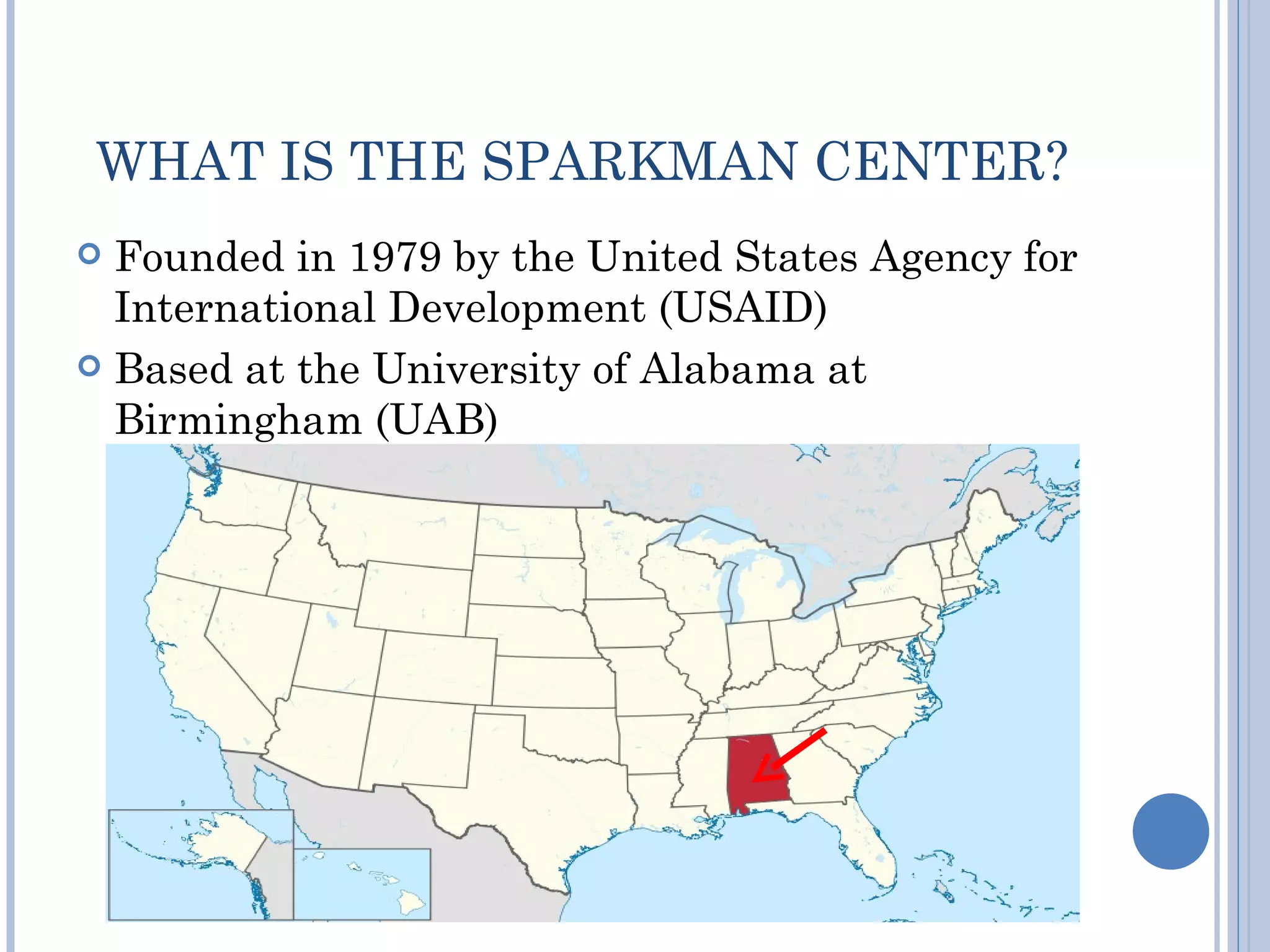
WHAT IS THE SPARKMAN CENTER?
 Founded in 1979 by the United States Agency for
  International Development (USAID)
 Based at the University of Alabama at
  Birmingham (UAB)
WHAT IS THE OVERALL VISION AND
  MISSION OF THE SPARKMAN
           CENTER?
 Alleviation of health problems in less
  developed countries by building capacity
 We work collaboratively with academic
  institutions, international agencies and
  health ministries within host countries
 We also work to enhance the capacity of
  the UAB community to engage, prepare
  and support current and future
  professionals
WHAT KINDS OF THINGS DOES THE
    SPARKMAN CENTER DO?
 Distance education
 Support international internships and
  other educational activities for UAB
  students
 Work with partner institutions in other
  countries to enhance medical, nursing and
  public health education
WHAT IS THE SPARKMAN CENTER’S
ROLE IN THE eGRANARY PROJECT?
 Sparkman   Center Director, Craig Wilson,
  heard about the eGranary at a conference
  in Lusaka in 2007
 Previously had been carrying over heavy
  textbooks each visit
 Was particularly interested in adding
  health related materials
 And that’s where I came along…
EVOLUTION OF THE PROJECT
 Significantly   expanded health science
  resources
 Have seen eGranary increase from 750GB
  capacity to 4TB
 Formed a partnership with VVOB

 Will be hiring an in country eGranary
  support person
SPARKMAN SUPPORTED
      INSTALLATIONS IN ZAMBIA
 The University of Zambia School of Medicine
 Chainama Hills College of Health Sciences
 Lusaka School of Nursing
 Copperbelt University School of Medicine
 Chikankata Mission Hospital
 Lewanika General Hospital
 Lusaka Apex Medical University (LAMU)
 Cavendish School of Medicine
 Zambian Forum for Health Research
  (ZAMFOHR)
 Supported the purchase of 4 eGranaries for the
  Colleges of Education in Zambia
WHAT IS THE SPARKMAN CENTER’S
  VISION FOR THE eGRANARY?
 To see the eGranary used widely in
  Zambia, particularly in remote areas with
  no or very limited internet access
 For every training institution in Zambia
  have an eGranary
 To continue to work with our partners to
  enhance the eGranary Digital Library
PORTAL
DEVELOPMENT
WHAT IS A PORTAL?
 Custom   portals highlight resources in
  certain topic areas
 Portals are built by consulting with
  teachers, librarians and government
  ministries to create portals that best
  match their information needs
 Portals enable teachers and students to
  quickly access information identified by
  experts in the subject
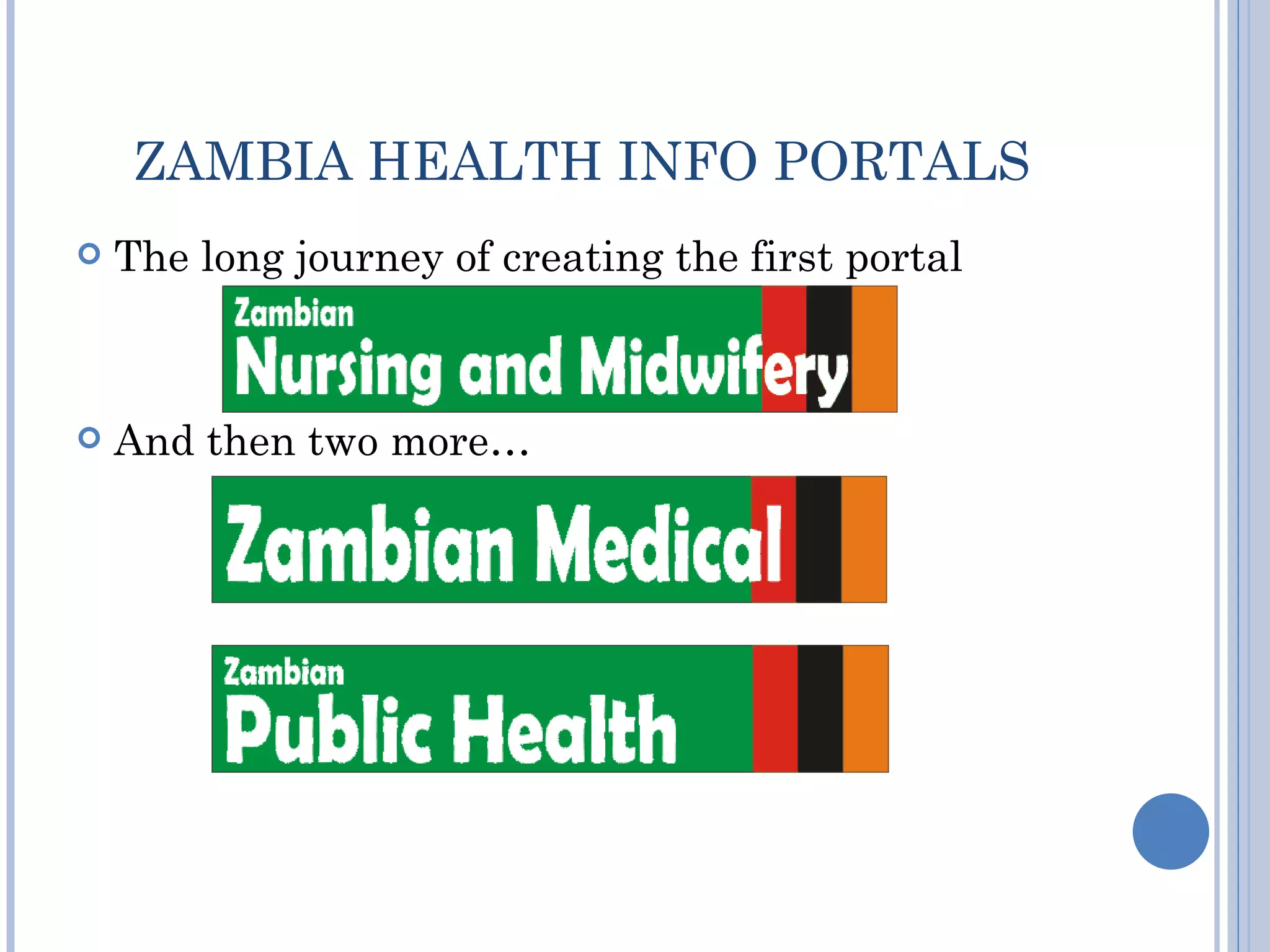
ZAMBIA HEALTH INFO PORTALS
   The long journey of creating the first portal


   And then two more…
THE GLOBAL DISABILITIES RIGHTS
        PORTAL (GDRL)
 The  purpose of the GDRL is to help users
  find resources they can put into action to
  improve the lives of people with
  disabilities around the world
 United States International Council on
  Disability (USICD) developed the portal
  with funding support from the US Agency
  for International Development (USAID)
HOW THE GDRL WAS DEVELOPED
 During   its first year in 2010, the GDRL
  Project focused on identifying partners as
  well as gathering and cataloging resources
  for the library
 Librarians at USICD and Widernet
  particularly emphasized practical toolkits
  and training manuals as well as reports
  on the status of disability rights and “best
  practice” examples around the world
GDRL DISSEMINATION
 Inmid 2011, four organizations received a
 “pilot” version of the GDRL to test the
 library and made recommendations for
 improvements
      ZAMISE was one of the sites chosen to pilot
       the GDRL
 This year, the project will continue to
  expand the library to include local content
  from end users
 A total of 60 locations will receive a free
  eGranary via the project
THE ZAMBIA KNOWLEDGE CENTRE
           PORTAL
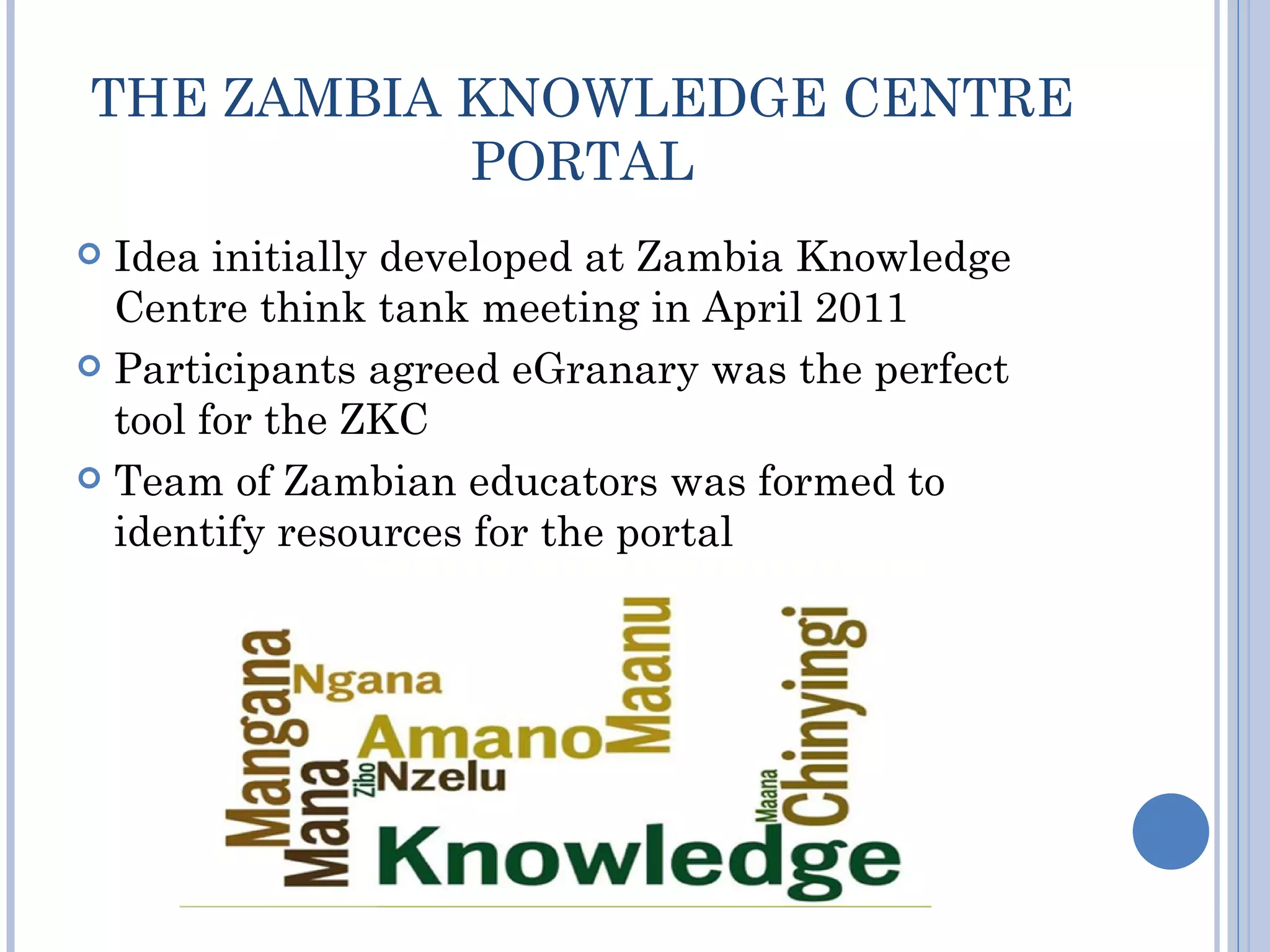
 Idea initially developed at Zambia Knowledge
  Centre think tank meeting in April 2011
 Participants agreed eGranary was the perfect
  tool for the ZKC
 Team of Zambian educators was formed to
  identify resources for the portal
A SNEAK PREVIEW OF THE
       CONTENT ON THE ZKC
 Khan   Academy
 Flexbooks

 Free High School Textbook Project (FHST)

 TESSA

 Instructional guides for Microsoft Office
  applications
 We will look at these tomorrow in more
  detail!
Questions or
 comments?
AND NOW THE
MOMENT YOU
HAVE ALL
BEEN WAITING
FOR…

Storing seeds of_knowledge_feb6

  • 1.
    The eGranary: Storingthe Seeds of Knowledge Heather Lee, MPH UAB Sparkman Center for Global Health February 6, 2012
  • 2.
    OBJECTIVES  What isthe Widernet Project?  What is the eGranary Digital Library Project?  What are some of the accomplishments of the eGranary Project?  Role and vision of the Sparkman Center  How were the portals developed, including the Zambia Knowledge Centre?  Finally, the eGranary will be revealed!
  • 3.
  • 4.
    WHAT IS WIDERNET? TheWiderNet Project is based at the University of Iowa in the United States
  • 5.
    WHAT IS THEMISSION OF WIDERNET?  To improve digital communication to all communities and individuals around the world in need of educational resources, knowledge, and training  Widernet serves many people who lack internet connectivity and information resources, but their work focuses especially on the needs in developing countries
  • 6.
    WHAT DOES WIDERNETOFFER? A holistic approach: computers, needed appliances and educational material  Also offer resources and training  Training is important because enables people to be self-sufficient with using Information and Communication Technology (ICT)
  • 7.
    WHY IS THEREA NEED FOR THEIR SERVICES?  Only one out of seven people have adequate access to the Internet  In many developing countries, universities may have a direct connection to the Internet, but not enough bandwidth to adequately serve their users  Only a fraction of professors and students have access to email and basic computer programs  What is your internet experience like at your job?
  • 8.
    WHY DOES WIDERNETADDRESS THESE PROBLEMS?  Belief that ICT can empower people, giving them better access to information, knowledge and communication and in that way improve their overall quality of life  Strive to make educational resources and training opportunities available to everyone to bridge the digital divide
  • 9.
    WIDERNET HISTORY  Founded in 2000 by Prof. Cliff Missen and Dr. Michael McNulty  After visiting the University of Jos in Nigeria as a Fulbright Scholar, Cliff experienced first hand the frustration of trying to teach with a lack of internet access
  • 10.
    WIDERNET ACCOMPLISHMENTS  Has donated more than 1,200 computers for use at universities in Africa  Has provided training opportunities to thousands of university staff and administrators in programs customized to suit their institutions' specific needs  Installed the eGranary Digital Library at more than 350 partner institutions around the world
  • 11.
    WHAT IS THE eGRANARYDIGITAL LIBRARY?
  • 12.
    THE eGRANARY DIGITALLIBRARY PROJECT  While at the University of Jos, Cliff created the first version of an off-line digital library after requesting that a UI graduate student send him some Web sites on a CD-ROM  Eventually started placing educational materials onto a hard drive
  • 13.
    STORING THE SEEDSOF KNOWLEDGE
  • 14.
    WHAT IS THEeGRANARY DIGITAL LIBRARY?  Delivers millions of Internet resources to institutions lacking adequate Internet access  Provides lightening fast access to educational materials including video, audio, books, journals and Web sites, even where no Internet access exists
  • 15.
    WHERE ARE THEeGRANARIES? Blue dot= 1 eG, yellow= 2-5 eGs, red=10+ eGs
  • 16.
    WHAT KIND OFPLACES HAVE eGRANARIES?  Primary and secondary schools  Colleges and universities  Medical schools  Engineering schools  Hospitals and medical clinics  U.S. embassies  Churches  Prisons  Businesses
  • 17.
    HOW IS CONTENTIDENTIFIED AND OBTAINED?  The eG project looks for Web sites with pertinent digitized academic information (often guided by requests of its subscribers) to add to its ‘wish list.’  Requests the authors’ or publishers’ permission to copy their materials through email communication. If permission is given, materials are copied  Creative commons  More to come later on the technical details of this!
  • 18.
    WHAT’S INSIDE THEeGRANARY?  Library that is fully indexed and searchable using built-in search engine  Websites, journals, videos, textbooks, audio files, articles, instructional manuals and much more  The tools to allow you to add local content
  • 19.
    WHAT TYPES OFINFORMATION CAN BE FOUND IN THE eGRANARY?  The information stored inside the eGranary covers dozens of topics, including:  Math and science  Engineering  Medical, nursing and public health resources  ICT resources  Atlases, almanacs and other reference materials  Education and teaching materials  History, sociology, psychology, economics, religion and other social sciences  Agriculture and horticulture  Literature, art and music
  • 20.
    EXAMPLES OF MAJOR CONTRIBUTORSTO THE eGRANARY DIGITAL LIBRARY  Wikipedia  Columbia University  Hesperian Foundation  World Health Organization  Khan Academy  OER Africa
  • 21.
    WHAT HAVE eGRANARYUSERS HAD TO SAY THUS FAR?  “The eGranary Digital Library concept is the solution for creation and distributing online content challenges currently facing most African countries.” --Mr. Jacob Mtui, Research and Development, University of Dar Es Salaam, Tanzania  “The eGranary Digital Library has helped our students and lecturers in accessing academic materials which were not easily accessible due to limited bandwidth. The concept is very good for those with limited or no bandwidth and should be supported. It has become part and parcel of our e- learning platform.” --Nyaga Gacheru, Network Administrator, Jomo Kenyatta University of Agriculture and Technology, Kenya
  • 22.
    MORE COMMENTS FROMeGRANARY SUBSCRIBERS  “It was a fantastic success; both the students and faculty were amazed and delighted by even a small taste of the eGranary content.” --John Frediani, eGranary Donor, Jos, Nigeria  “The idea is simply GREAT! We are trying to promote it in Bangladesh, especially educational institutions providing higher studies in remote areas.” --Mr. Mizanur Munna, Positive Bangladesh Initiatives
  • 23.
    COMMENTS FROM eGRANARY SUBSCRIBERS IN ZAMBIA  “The eGranary can help or can easy the job of a librarian by giving direct subjects and topics to the information seeker. It gives access of information to the users. The eGranary does not consume much time as compared to the internet.” --Workshop Participant, University of Zambia  “I think the eGranary digital library should be introduced to all the libraries, even in public libraries for the users to access information as quickly as possible.” --Workshop Participant, University of Zambia
  • 24.
    ROLE AND VISION OFTHE SPARKMAN CENTER
  • 25.
    WHAT IS THESPARKMAN CENTER?  Founded in 1979 by the United States Agency for International Development (USAID)  Based at the University of Alabama at Birmingham (UAB)
  • 26.
    WHAT IS THEOVERALL VISION AND MISSION OF THE SPARKMAN CENTER?  Alleviation of health problems in less developed countries by building capacity  We work collaboratively with academic institutions, international agencies and health ministries within host countries  We also work to enhance the capacity of the UAB community to engage, prepare and support current and future professionals
  • 27.
    WHAT KINDS OFTHINGS DOES THE SPARKMAN CENTER DO?  Distance education  Support international internships and other educational activities for UAB students  Work with partner institutions in other countries to enhance medical, nursing and public health education
  • 28.
    WHAT IS THESPARKMAN CENTER’S ROLE IN THE eGRANARY PROJECT?  Sparkman Center Director, Craig Wilson, heard about the eGranary at a conference in Lusaka in 2007  Previously had been carrying over heavy textbooks each visit  Was particularly interested in adding health related materials  And that’s where I came along…
  • 29.
    EVOLUTION OF THEPROJECT  Significantly expanded health science resources  Have seen eGranary increase from 750GB capacity to 4TB  Formed a partnership with VVOB  Will be hiring an in country eGranary support person
  • 30.
    SPARKMAN SUPPORTED INSTALLATIONS IN ZAMBIA  The University of Zambia School of Medicine  Chainama Hills College of Health Sciences  Lusaka School of Nursing  Copperbelt University School of Medicine  Chikankata Mission Hospital  Lewanika General Hospital  Lusaka Apex Medical University (LAMU)  Cavendish School of Medicine  Zambian Forum for Health Research (ZAMFOHR)  Supported the purchase of 4 eGranaries for the Colleges of Education in Zambia
  • 31.
    WHAT IS THESPARKMAN CENTER’S VISION FOR THE eGRANARY?  To see the eGranary used widely in Zambia, particularly in remote areas with no or very limited internet access  For every training institution in Zambia have an eGranary  To continue to work with our partners to enhance the eGranary Digital Library
  • 32.
  • 33.
    WHAT IS APORTAL?  Custom portals highlight resources in certain topic areas  Portals are built by consulting with teachers, librarians and government ministries to create portals that best match their information needs  Portals enable teachers and students to quickly access information identified by experts in the subject
  • 34.
    ZAMBIA HEALTH INFOPORTALS  The long journey of creating the first portal  And then two more…
  • 35.
    THE GLOBAL DISABILITIESRIGHTS PORTAL (GDRL)  The purpose of the GDRL is to help users find resources they can put into action to improve the lives of people with disabilities around the world  United States International Council on Disability (USICD) developed the portal with funding support from the US Agency for International Development (USAID)
  • 36.
    HOW THE GDRLWAS DEVELOPED  During its first year in 2010, the GDRL Project focused on identifying partners as well as gathering and cataloging resources for the library  Librarians at USICD and Widernet particularly emphasized practical toolkits and training manuals as well as reports on the status of disability rights and “best practice” examples around the world
  • 37.
    GDRL DISSEMINATION  Inmid2011, four organizations received a “pilot” version of the GDRL to test the library and made recommendations for improvements  ZAMISE was one of the sites chosen to pilot the GDRL  This year, the project will continue to expand the library to include local content from end users  A total of 60 locations will receive a free eGranary via the project
  • 38.
    THE ZAMBIA KNOWLEDGECENTRE PORTAL  Idea initially developed at Zambia Knowledge Centre think tank meeting in April 2011  Participants agreed eGranary was the perfect tool for the ZKC  Team of Zambian educators was formed to identify resources for the portal
  • 39.
    A SNEAK PREVIEWOF THE CONTENT ON THE ZKC  Khan Academy  Flexbooks  Free High School Textbook Project (FHST)  TESSA  Instructional guides for Microsoft Office applications  We will look at these tomorrow in more detail!
  • 40.
  • 41.
    AND NOW THE MOMENTYOU HAVE ALL BEEN WAITING FOR…