Teach & Learn from


...
          Zambia Knowledge Centre
          Think Tank Meeting
          8th April 2011
Zambia Knowledge Centre

Topic:         Highlights of the think tank meeting                         Authors: Lukonga Lindunda
                                                                                     Bart Cornille
Date:          8th April 2011                                               Issue:    1


    1. Objectives of the think tank meeting

                 To establish a think tank group on the Zambia Knowledge Centre
                 To explain the concept of the Zambia Knowledge Centre
                 To determine the medium for the Zambia Knowledge Centre
                 To lay the foundations of a plan to set up the Zambia Knowledge Centre and present it
                   to MoE


    2. Programme


                                                Friday 8 April 2011

     8:30           Introduction                                                                 Bart Rombaut
                                                                                                 Lemmy Kangwa
     8:45           Research: ICT integration in Zambia
                                                                                                 Lyson Chikunduzi
     9:45           Activity: Top 10 ICT tools in Zambia                                         Bart Cornille

     10:15          Break

                    Think tank: What is a knowledge centre? What are the tools for a knowledge
     10:30                                                                                       Bart Cornille
                    centre? What are the structures to set up a knowledge centre in Zambia?

     12:45          Lunch

                                                                                                 Lukonga Lindunda
     14:00          Think tank: How to set up a Zambian knowledge centre?
                                                                                                 Bart Cornille

     15:15          Break

     15:30          Activity: Knowledge in local Zambian languages                               Lukonga Lindunda

     16:30          Closure


    3. Introduction

         Bart Rombaut, the new VVOB PM, formally opened the meeting. Since the think tank meeting
         was a first of its kind, the members were also asked to introduce themselves: Lecturers and
         vice principals from Kitwe, Kasama and Malcolm Moffat, resource centre coordinators from
         Kabwe and Serenge, PEO Lusaka/Kabwe and members of the Zambia Library Service. (See
         detailed attendance list in appendix)


Teach and Learn from...                                                                                     2/7
4. Research: ICT integration in Zambia

         The researcher was introduced by means of a video recording of him teaching with a clip of
         the Khan academy (http://www.khanacademy.org/) at NISTCOL, a proof of how ICT
         integration in education can work in Zambia. Then the researcher, Lemmy Kangwa, presented
         his research findings on ICT integration in the teaching process. (See presentation in
         appendix)
         The background of the study was given and some history of ICT development in Zambia.
         Computer to staff/student ratio were discussed at length. After the problem statement, the
         purpose and objectives of the study were shared. An overview was given on the role of ICT in
         the teaching process and the factors that influence it. Conclusions and recommendations were
         discussed including,

                  The absence of an approved policy on ICT in education by MOE and lack of clear
                   curriculum does not motivate many lecturers to integrate ICTs in their teaching. MOE
                   should put in place a policy on ICT in education with a clear curriculum for CEs.
                  Lectures need to be trained on effective use of ICT in education; introduction of a
                   course on ICT in education with emphasis on subject integration for teacher
                   educators.
                  Lecturers in CEs embracing ICTs in their teaching, should not just end at using
                   PowerPoint presentations, but should explore other effective and interactive ways of
                   integrating ICT in their teaching process.
                  The mobile phone, which is owned by majority of the students, should be frequently
                   used effectively as an ICT tool for educational purposes. For instance, an audio
                   lesson can be recorded and uploaded on a mobile phone and be exported in MP3
                   format which student can listen to instead of just always listening to music.
                  There should be networking between colleges that can promote exchange of
                   information to enhance the teaching/learning process.
                  MOE HQ, provincial, district offices and CEs should have websites with updated
                   information.

         As a conclusion it was said that the think tank could play an advocacy role towards the MoE.
         The think tank hopes it can play an active role in realizing the recommendations made in the
         research of Lemmy Kangwa.


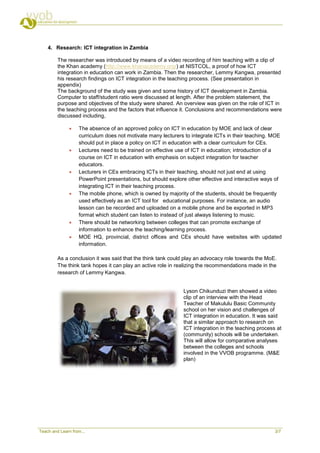
                                                              Lyson Chikunduzi then showed a video
                                                              clip of an interview with the Head
                                                              Teacher of Makululu Basic Community
                                                              school on her vision and challenges of
                                                              ICT integration in education. It was said
                                                              that a similar approach to research on
                                                              ICT integration in the teaching process at
                                                              (community) schools will be undertaken.
                                                              This will allow for comparative analyses
                                                              between the colleges and schools
                                                              involved in the VVOB programme. (M&E
                                                              plan)


Teach and Learn from...                                                                              3/7
5. Activity: Top 5 ICT tools in Zambia

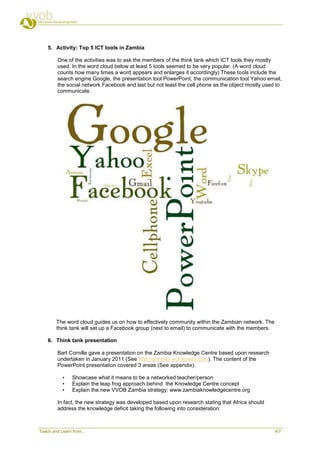
         One of the activities was to ask the members of the think tank which ICT tools they mostly
         used. In the word cloud below at least 5 tools seemed to be very popular. (A word cloud
         counts how many times a word appears and enlarges it accordingly) These tools include the
         search engine Google, the presentation tool PowerPoint, the communication tool Yahoo email,
         the social network Facebook and last but not least the cell phone as the object mostly used to
         communicate.


        The word cloud guides us on how to effectively community within the Zambian network. The
        think tank will set up a Facebook group (next to email) to communicate with the members.

    6. Think tank presentation

         Bart Cornille gave a presentation on the Zambia Knowledge Centre based upon research
         undertaken in January 2011 (See http://grmbler.wordpress.com). The content of the
         PowerPoint presentation covered 3 areas (See appendix):

           •    Showcase what it means to be a networked teacher/person
           •    Explain the leap frog approach behind the Knowledge Centre concept
           •    Explain the new VVOB Zambia strategy: www.zambiaknowledgecentre.org

         In fact, the new strategy was developed based upon research stating that Africa should
         address the knowledge deficit taking the following into consideration:


Teach and Learn from...                                                                             4/7
• To acquire knowledge developed
                                                       elsewhere rather than “reinvent the wheel”
                                                                    • The creation of knowledge locally
                                                       including tapping into indigenous knowledge
                                                       resources
                                                                    • Build the capacity of the
                                                       population to absorb and apply knowledge
                                                       through education
                                                                    • Create a capacity to
                                                       communicate knowledge throughout the country
                                                       with the new technologies


        The new strategy hopes to address the above through the development of an educational
        portal called the Zambia Knowledge Centre. It that will be made accessible (Online-Offline)
        from the Knowledge Centre at Zambia Library Service in Lusaka, to all Colleges of Education
        and Teacher Resource Centres part of this experiment. The coming 3 years VVOB will design
        and implement a capacity building programme to do just that. It is hoped for that a Community
        of Practise on the Knowledge Centre will be established within Zambia.

    7. Think tank presentation

         After a typical Zambian lunch the think tank
         continued with a presentation on linking the
         traditional African structures and education to
         the structures and educational trends in the
         digital age. (See presentation in Appendix)
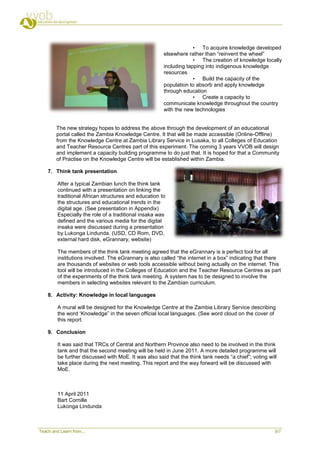
         Especially the role of a traditional insaka was
         defined and the various media for the digital
         insaka were discussed during a presentation
         by Lukonga Lindunda. (USD, CD Rom, DVD,
         external hard disk, eGrannary, website)

         The members of the think tank meeting agreed that the eGrannary is a perfect tool for all
         institutions involved. The eGrannary is also called “the internet in a box” indicating that there
         are thousands of websites or web tools accessible without being actually on the internet. This
         tool will be introduced in the Colleges of Education and the Teacher Resource Centres as part
         of the experiments of the think tank meeting. A system has to be designed to involve the
         members in selecting websites relevant to the Zambian curriculum.

    8. Activity: Knowledge in local languages

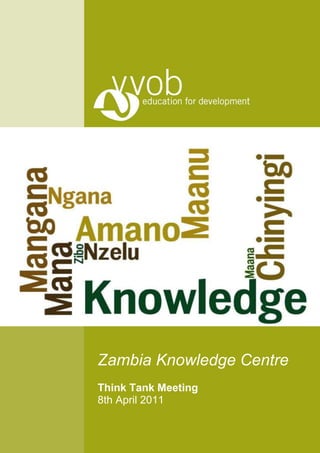
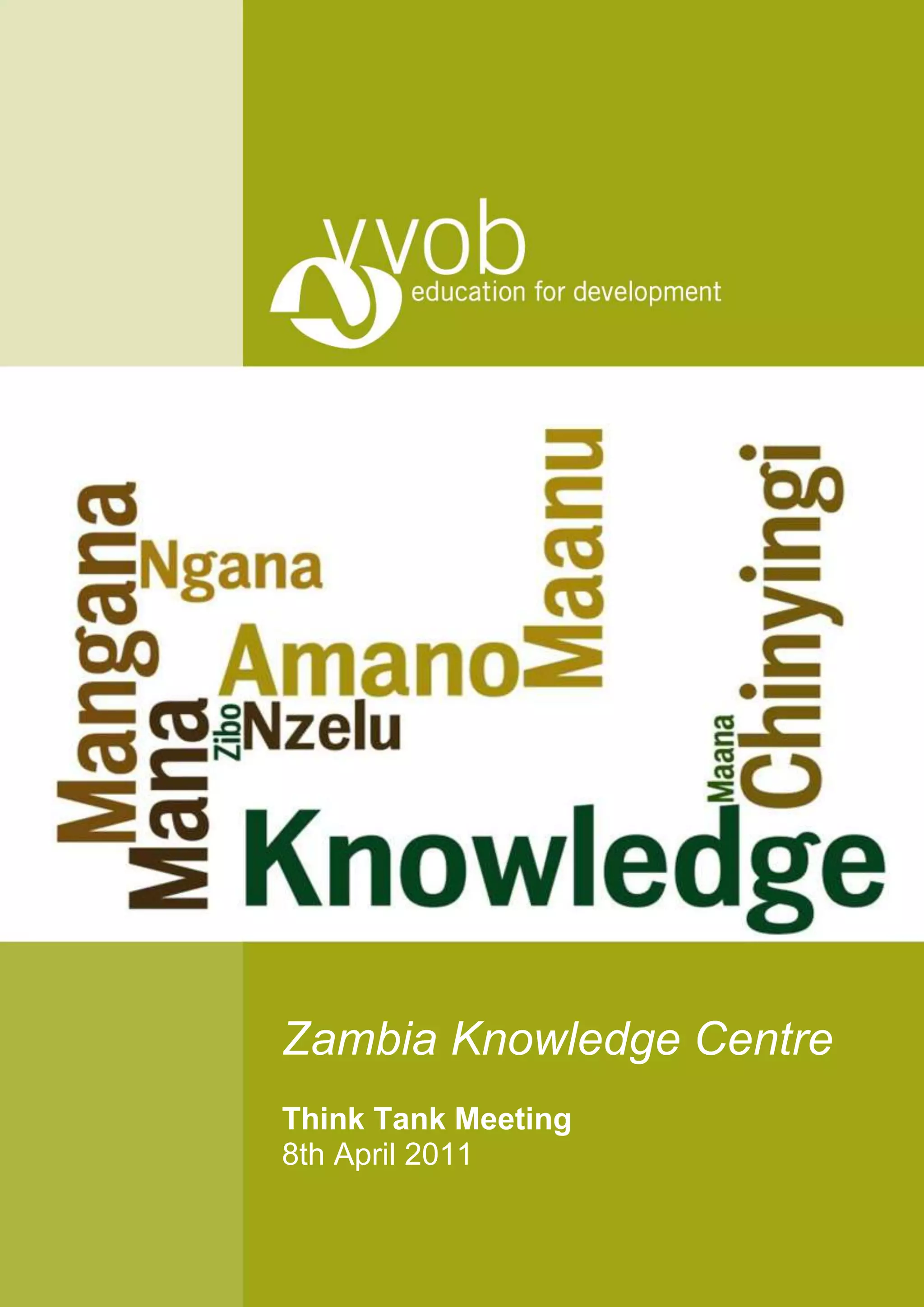
         A mural will be designed for the Knowledge Centre at the Zambia Library Service describing
         the word „Knowledge” in the seven official local languages. (See word cloud on the cover of
         this report.

    9. Conclusion

         It was said that TRCs of Central and Northern Province also need to be involved in the think
         tank and that the second meeting will be held in June 2011. A more detailed programme will
         be further discussed with MoE. It was also said that the think tank needs “a chief”; voting will
         take place during the next meeting. This report and the way forward will be discussed with
         MoE.


         11 April 2011
         Bart Cornille
         Lukonga Lindunda


Teach and Learn from...                                                                                 5/7
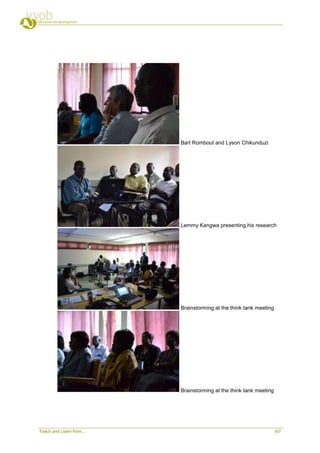
Bart Rombout and Lyson Chikunduzi


                          Lemmy Kangwa presenting his research


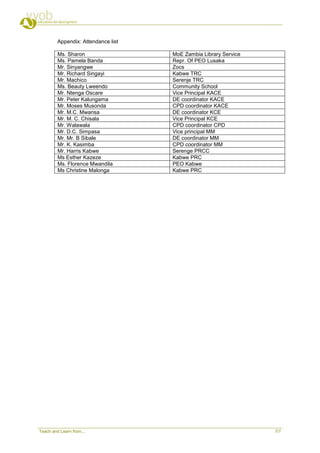
                          Brainstorming at the think tank meeting


                          Brainstorming at the think tank meeting


Teach and Learn from...                                             6/7
Appendix: Attendance list

         Ms. Sharon                  MoE Zambia Library Service
         Ms. Pamela Banda            Repr. Of PEO Lusaka
         Mr. Sinyangwe               Zocs
         Mr. Richard Singayi         Kabwe TRC
         Mr. Machico                 Serenje TRC
         Ms. Beauty Lweendo          Community School
         Mr. Ntenga Oscare           Vice Principal KACE
         Mr. Peter Kalungama         DE coordinator KACE
         Mr. Moses Musonda           CPD coordinator KACE
         Mr. M.C. Mwansa             DE coordinator KCE
         Mr. M. C. Chisala           Vice Principal KCE
         Mr. Walawala                CPD coordinator CPD
         Mr. D.C. Simpasa            Vice principal MM
         Mr. Mr. B Sibale            DE coordinator MM
         Mr. K. Kasimba              CPD coordinator MM
         Mr. Harris Kabwe            Serenge PRCC
         Ms Esther Kazeze            Kabwe PRC
         Ms. Florence Mwandila       PEO Kabwe
         Ms Christine Malonga        Kabwe PRC


Teach and Learn from...                                           7/7

Knowledge centre report 1

  • 1.
    Teach & Learnfrom ... Zambia Knowledge Centre Think Tank Meeting 8th April 2011
  • 2.
    Zambia Knowledge Centre Topic: Highlights of the think tank meeting Authors: Lukonga Lindunda Bart Cornille Date: 8th April 2011 Issue: 1 1. Objectives of the think tank meeting  To establish a think tank group on the Zambia Knowledge Centre  To explain the concept of the Zambia Knowledge Centre  To determine the medium for the Zambia Knowledge Centre  To lay the foundations of a plan to set up the Zambia Knowledge Centre and present it to MoE 2. Programme Friday 8 April 2011 8:30 Introduction Bart Rombaut Lemmy Kangwa 8:45 Research: ICT integration in Zambia Lyson Chikunduzi 9:45 Activity: Top 10 ICT tools in Zambia Bart Cornille 10:15 Break Think tank: What is a knowledge centre? What are the tools for a knowledge 10:30 Bart Cornille centre? What are the structures to set up a knowledge centre in Zambia? 12:45 Lunch Lukonga Lindunda 14:00 Think tank: How to set up a Zambian knowledge centre? Bart Cornille 15:15 Break 15:30 Activity: Knowledge in local Zambian languages Lukonga Lindunda 16:30 Closure 3. Introduction Bart Rombaut, the new VVOB PM, formally opened the meeting. Since the think tank meeting was a first of its kind, the members were also asked to introduce themselves: Lecturers and vice principals from Kitwe, Kasama and Malcolm Moffat, resource centre coordinators from Kabwe and Serenge, PEO Lusaka/Kabwe and members of the Zambia Library Service. (See detailed attendance list in appendix) Teach and Learn from... 2/7
  • 3.
    4. Research: ICTintegration in Zambia The researcher was introduced by means of a video recording of him teaching with a clip of the Khan academy (http://www.khanacademy.org/) at NISTCOL, a proof of how ICT integration in education can work in Zambia. Then the researcher, Lemmy Kangwa, presented his research findings on ICT integration in the teaching process. (See presentation in appendix) The background of the study was given and some history of ICT development in Zambia. Computer to staff/student ratio were discussed at length. After the problem statement, the purpose and objectives of the study were shared. An overview was given on the role of ICT in the teaching process and the factors that influence it. Conclusions and recommendations were discussed including,  The absence of an approved policy on ICT in education by MOE and lack of clear curriculum does not motivate many lecturers to integrate ICTs in their teaching. MOE should put in place a policy on ICT in education with a clear curriculum for CEs.  Lectures need to be trained on effective use of ICT in education; introduction of a course on ICT in education with emphasis on subject integration for teacher educators.  Lecturers in CEs embracing ICTs in their teaching, should not just end at using PowerPoint presentations, but should explore other effective and interactive ways of integrating ICT in their teaching process.  The mobile phone, which is owned by majority of the students, should be frequently used effectively as an ICT tool for educational purposes. For instance, an audio lesson can be recorded and uploaded on a mobile phone and be exported in MP3 format which student can listen to instead of just always listening to music.  There should be networking between colleges that can promote exchange of information to enhance the teaching/learning process.  MOE HQ, provincial, district offices and CEs should have websites with updated information. As a conclusion it was said that the think tank could play an advocacy role towards the MoE. The think tank hopes it can play an active role in realizing the recommendations made in the research of Lemmy Kangwa. Lyson Chikunduzi then showed a video clip of an interview with the Head Teacher of Makululu Basic Community school on her vision and challenges of ICT integration in education. It was said that a similar approach to research on ICT integration in the teaching process at (community) schools will be undertaken. This will allow for comparative analyses between the colleges and schools involved in the VVOB programme. (M&E plan) Teach and Learn from... 3/7
  • 4.
    5. Activity: Top5 ICT tools in Zambia One of the activities was to ask the members of the think tank which ICT tools they mostly used. In the word cloud below at least 5 tools seemed to be very popular. (A word cloud counts how many times a word appears and enlarges it accordingly) These tools include the search engine Google, the presentation tool PowerPoint, the communication tool Yahoo email, the social network Facebook and last but not least the cell phone as the object mostly used to communicate. The word cloud guides us on how to effectively community within the Zambian network. The think tank will set up a Facebook group (next to email) to communicate with the members. 6. Think tank presentation Bart Cornille gave a presentation on the Zambia Knowledge Centre based upon research undertaken in January 2011 (See http://grmbler.wordpress.com). The content of the PowerPoint presentation covered 3 areas (See appendix): • Showcase what it means to be a networked teacher/person • Explain the leap frog approach behind the Knowledge Centre concept • Explain the new VVOB Zambia strategy: www.zambiaknowledgecentre.org In fact, the new strategy was developed based upon research stating that Africa should address the knowledge deficit taking the following into consideration: Teach and Learn from... 4/7
  • 5.
    • To acquireknowledge developed elsewhere rather than “reinvent the wheel” • The creation of knowledge locally including tapping into indigenous knowledge resources • Build the capacity of the population to absorb and apply knowledge through education • Create a capacity to communicate knowledge throughout the country with the new technologies The new strategy hopes to address the above through the development of an educational portal called the Zambia Knowledge Centre. It that will be made accessible (Online-Offline) from the Knowledge Centre at Zambia Library Service in Lusaka, to all Colleges of Education and Teacher Resource Centres part of this experiment. The coming 3 years VVOB will design and implement a capacity building programme to do just that. It is hoped for that a Community of Practise on the Knowledge Centre will be established within Zambia. 7. Think tank presentation After a typical Zambian lunch the think tank continued with a presentation on linking the traditional African structures and education to the structures and educational trends in the digital age. (See presentation in Appendix) Especially the role of a traditional insaka was defined and the various media for the digital insaka were discussed during a presentation by Lukonga Lindunda. (USD, CD Rom, DVD, external hard disk, eGrannary, website) The members of the think tank meeting agreed that the eGrannary is a perfect tool for all institutions involved. The eGrannary is also called “the internet in a box” indicating that there are thousands of websites or web tools accessible without being actually on the internet. This tool will be introduced in the Colleges of Education and the Teacher Resource Centres as part of the experiments of the think tank meeting. A system has to be designed to involve the members in selecting websites relevant to the Zambian curriculum. 8. Activity: Knowledge in local languages A mural will be designed for the Knowledge Centre at the Zambia Library Service describing the word „Knowledge” in the seven official local languages. (See word cloud on the cover of this report. 9. Conclusion It was said that TRCs of Central and Northern Province also need to be involved in the think tank and that the second meeting will be held in June 2011. A more detailed programme will be further discussed with MoE. It was also said that the think tank needs “a chief”; voting will take place during the next meeting. This report and the way forward will be discussed with MoE. 11 April 2011 Bart Cornille Lukonga Lindunda Teach and Learn from... 5/7
  • 6.
    Bart Rombout andLyson Chikunduzi Lemmy Kangwa presenting his research Brainstorming at the think tank meeting Brainstorming at the think tank meeting Teach and Learn from... 6/7
  • 7.
    Appendix: Attendance list Ms. Sharon MoE Zambia Library Service Ms. Pamela Banda Repr. Of PEO Lusaka Mr. Sinyangwe Zocs Mr. Richard Singayi Kabwe TRC Mr. Machico Serenje TRC Ms. Beauty Lweendo Community School Mr. Ntenga Oscare Vice Principal KACE Mr. Peter Kalungama DE coordinator KACE Mr. Moses Musonda CPD coordinator KACE Mr. M.C. Mwansa DE coordinator KCE Mr. M. C. Chisala Vice Principal KCE Mr. Walawala CPD coordinator CPD Mr. D.C. Simpasa Vice principal MM Mr. Mr. B Sibale DE coordinator MM Mr. K. Kasimba CPD coordinator MM Mr. Harris Kabwe Serenge PRCC Ms Esther Kazeze Kabwe PRC Ms. Florence Mwandila PEO Kabwe Ms Christine Malonga Kabwe PRC Teach and Learn from... 7/7