Welcome  How to develop open learning materials By Bart Cornille
HOW TO DEVELOP OPEN LEARNING MATERIALS Aims of the Workshop To describe the concept of  open learning  and the implications on course design To explain how to plan  self-instructional  guides  To provide practice in how we can  humanize  our printed materials
Objectives of the Workshop Define the concept of open learning Describe who our future users/readers will be Demonstrate the writing of objectives Decide on the content and on how to sequence it Explain the media that will be used Demonstrate methods of assessment Give examples of open learning materials
Defining open learning Open learning is a state of mind; Open learning is a way of enabling adults to take responsibility for their own learning…
Roger Lewis Open learning is when decisions about learning are taken by the learner. These decisions may be over a number of different aspects of the learning process, including: Whether or not to learn What to learn (selection of content/skills) How to learn (methods, media, routes) Where to learn (the place of learning) When to learn (start and finish, pace) Who to turn to for help (tutors? Trainers? Friends? Colleagues?) How to get learning assessed (and the nature of feedback provided) What to do next (other courses? Career direction?) (1989a:90-91)
There are at least  seven major questions  we need to ask in planning a self-instructional course: Who will be the learners? What are the aims and objectives? What will be the subject-content? How will the content be sequenced? What teaching methods and media will be used? How will learners be assessed? How will the course be evaluated with a view to improvement?
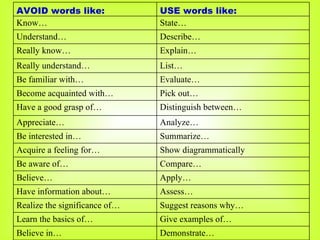
Writing Objectives  Writing objectives is meant to help you plan your teaching. In writing objectives we are trying to indicate what successful learners should be able to do (or say) to demonstrate that they have learned. So it is better to avoid introducing objectives with words like those on the left below. Instead, begin an objective with a verb like those on the right below:
Demonstrate… Believe in… Give examples of… Learn the basics of… Suggest reasons why… Realize the significance of… Assess… Have information about… Apply… Believe… Compare… Be aware of… Show diagrammatically Acquire a feeling for… Summarize… Be interested in… Analyze… Appreciate… Distinguish between… Have a good grasp of… Pick out… Become acquainted with… Evaluate… Be familiar with… List… Really understand… Explain… Really know… Describe… Understand… State… Know… USE words like: AVOID words like:
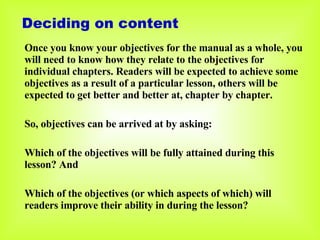
Once you know your objectives for the manual as a whole, you will need to know how they relate to the objectives for individual chapters. Readers will be expected to achieve some objectives as a result of a particular lesson, others will be expected to get better and better at, chapter by chapter. So, objectives can be arrived at by asking: Which of the objectives will be fully attained during this lesson? And Which of the objectives (or which aspects of which) will readers improve their ability in during the lesson? Deciding on content
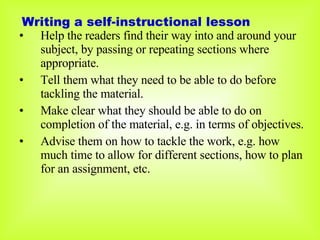
Help the readers find their way into and around your subject, by passing or repeating sections where appropriate. Tell them what they need to be able to do before tackling the material. Make clear what they should be able to do on completion of the material, e.g. in terms of objectives. Advise them on how to tackle the work, e.g. how much time to allow for different sections, how to plan for an assignment, etc. Writing a self-instructional lesson
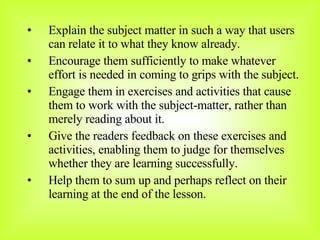
Explain the subject matter in such a way that users can relate it to what they know already. Encourage them sufficiently to make whatever effort is needed in coming to grips with the subject. Engage them in exercises and activities that cause them to work with the subject-matter, rather than merely reading about it. Give the readers feedback on these exercises and activities, enabling them to judge for themselves whether they are learning successfully. Help them to sum up and perhaps reflect on their learning at the end of the lesson.
In the list below, I have grouped these access devices according to whether you would insert them before, during, or after the main body of your lesson: Explanatory title An obvious point, but one that’s often neglected – give your lesson a title that tells the reader what it’s about. Contents list Present the learner with a list of the main topics in your lesson, arranged in order of occurrence.  Concept map A concept map or flow diagram can show up the inter-connections between topics. List of objectives Readers can find it helpful to be told what they might expect to be able to do as a result of reading the lesson. Pre-test Tell your learners what skills or knowledge you expect them to have before they can benefit from your lesson. Before
Introduction/overview An introduction can be very helpful, even if it takes only a paragraph or two. It can fulfill any combination of the following: Providing an overview of what is to come. Whetting the readers’ appetites and convincing them that the lesson is worth spending time on. Dispelling any false expectations as to what the lesson might be about. Forging links between what readers know already and what you are expecting them to learn. Pointing out links with other lessons (or courses). Giving guidance on how to learn from the lesson. During
Links with other topics Links with other topics may have been pointed out in your introduction, but they may be worth mentioning later as well. Headings Headings should help learners to: Find the parts of the text they wish to read. Recognize where one topic ends and the next begins Appreciate which topics are grouped together as aspects of some larger topic. Estimate which topics the author considers more important and which less.
Numbering systems Some writers number the sections and paragraphs within their lessons. Hence they can be cumbersome, and difficult to keep logical.  Instructions Keep your learners informed as to what they are supposed to be doing. If you want them to think up examples of their own or relate a point to their working lives, say so. If you want your readers to memorize something or write it down in their notebooks, tell them so.
Verbal signposts Try to keep your readers informed as to what  you are doing. As you write, you should be able  to help your readers with “verbal signposts” like these: “ On the other hand…” “ In much the same way…” “ Another example…” “ But that’s not the only way…” “ Now we come to an aspect that may surprise  you…” 6. “Let us turn aside for a moment to examine…” 7.  Now we come to the really tough part of the  argument…”
8. What this all adds up to is…” 9. But this no longer holds true when we look at…” Visual Signposts You will further help your reader if you can use visual as well as verbal signposting. Where possible, let the structure of your teaching be apparent at a glance.
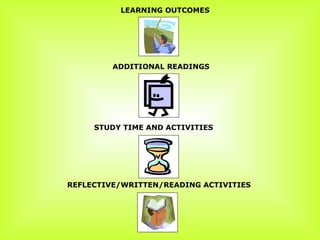
LEARNING OUTCOMES ADDITIONAL READINGS STUDY TIME AND ACTIVITIES REFLECTIVE/WRITTEN/READING ACTIVITIES
Glossary At the end of some lessons you may need a glossary. This should contain working definitions of all the new concepts that have been introduced. These will normally be definitions that refresh your readers’ minds about what they have learned. Post-test This would consist of one or more exercises that learners should be able to carry out successfully after having worked through the lesson.  Index The index should consist of the key words that readers are likely to look up.  After
Imagine how you might operate as a tutor or a coach, working with just one learner. You might simply check that the learner understood what you had been getting at. You might ask the learner to suggest examples for his or her own experience. You might get the learner to apply the ideas being discussed to a new situation or example. You might invite the learner to carry out a practical task involving the new ideas. And so on.
Some writers of self-instruction distinguish between what they call:  SAQ (Self-assessment questions) Which may appear, perhaps several together, testing major objectives, at the end of perhaps an hour or so’s reading; and ITQs (In-text questions) This may be used at frequent intervals in the text between SAQs, generating the running dialogue between author and reader.

IMIH.OpenLearning

  • 1.
    Welcome Howto develop open learning materials By Bart Cornille
  • 2.
    HOW TO DEVELOPOPEN LEARNING MATERIALS Aims of the Workshop To describe the concept of open learning and the implications on course design To explain how to plan self-instructional guides To provide practice in how we can humanize our printed materials
  • 3.
    Objectives of theWorkshop Define the concept of open learning Describe who our future users/readers will be Demonstrate the writing of objectives Decide on the content and on how to sequence it Explain the media that will be used Demonstrate methods of assessment Give examples of open learning materials
  • 4.
    Defining open learningOpen learning is a state of mind; Open learning is a way of enabling adults to take responsibility for their own learning…
  • 5.
    Roger Lewis Openlearning is when decisions about learning are taken by the learner. These decisions may be over a number of different aspects of the learning process, including: Whether or not to learn What to learn (selection of content/skills) How to learn (methods, media, routes) Where to learn (the place of learning) When to learn (start and finish, pace) Who to turn to for help (tutors? Trainers? Friends? Colleagues?) How to get learning assessed (and the nature of feedback provided) What to do next (other courses? Career direction?) (1989a:90-91)
  • 6.
    There are atleast seven major questions we need to ask in planning a self-instructional course: Who will be the learners? What are the aims and objectives? What will be the subject-content? How will the content be sequenced? What teaching methods and media will be used? How will learners be assessed? How will the course be evaluated with a view to improvement?
  • 7.
    Writing Objectives Writing objectives is meant to help you plan your teaching. In writing objectives we are trying to indicate what successful learners should be able to do (or say) to demonstrate that they have learned. So it is better to avoid introducing objectives with words like those on the left below. Instead, begin an objective with a verb like those on the right below:
  • 8.
    Demonstrate… Believe in…Give examples of… Learn the basics of… Suggest reasons why… Realize the significance of… Assess… Have information about… Apply… Believe… Compare… Be aware of… Show diagrammatically Acquire a feeling for… Summarize… Be interested in… Analyze… Appreciate… Distinguish between… Have a good grasp of… Pick out… Become acquainted with… Evaluate… Be familiar with… List… Really understand… Explain… Really know… Describe… Understand… State… Know… USE words like: AVOID words like:
  • 9.
    Once you knowyour objectives for the manual as a whole, you will need to know how they relate to the objectives for individual chapters. Readers will be expected to achieve some objectives as a result of a particular lesson, others will be expected to get better and better at, chapter by chapter. So, objectives can be arrived at by asking: Which of the objectives will be fully attained during this lesson? And Which of the objectives (or which aspects of which) will readers improve their ability in during the lesson? Deciding on content
  • 10.
    Help the readersfind their way into and around your subject, by passing or repeating sections where appropriate. Tell them what they need to be able to do before tackling the material. Make clear what they should be able to do on completion of the material, e.g. in terms of objectives. Advise them on how to tackle the work, e.g. how much time to allow for different sections, how to plan for an assignment, etc. Writing a self-instructional lesson
  • 11.
    Explain the subjectmatter in such a way that users can relate it to what they know already. Encourage them sufficiently to make whatever effort is needed in coming to grips with the subject. Engage them in exercises and activities that cause them to work with the subject-matter, rather than merely reading about it. Give the readers feedback on these exercises and activities, enabling them to judge for themselves whether they are learning successfully. Help them to sum up and perhaps reflect on their learning at the end of the lesson.
  • 12.
    In the listbelow, I have grouped these access devices according to whether you would insert them before, during, or after the main body of your lesson: Explanatory title An obvious point, but one that’s often neglected – give your lesson a title that tells the reader what it’s about. Contents list Present the learner with a list of the main topics in your lesson, arranged in order of occurrence. Concept map A concept map or flow diagram can show up the inter-connections between topics. List of objectives Readers can find it helpful to be told what they might expect to be able to do as a result of reading the lesson. Pre-test Tell your learners what skills or knowledge you expect them to have before they can benefit from your lesson. Before
  • 13.
    Introduction/overview An introductioncan be very helpful, even if it takes only a paragraph or two. It can fulfill any combination of the following: Providing an overview of what is to come. Whetting the readers’ appetites and convincing them that the lesson is worth spending time on. Dispelling any false expectations as to what the lesson might be about. Forging links between what readers know already and what you are expecting them to learn. Pointing out links with other lessons (or courses). Giving guidance on how to learn from the lesson. During
  • 14.
    Links with othertopics Links with other topics may have been pointed out in your introduction, but they may be worth mentioning later as well. Headings Headings should help learners to: Find the parts of the text they wish to read. Recognize where one topic ends and the next begins Appreciate which topics are grouped together as aspects of some larger topic. Estimate which topics the author considers more important and which less.
  • 15.
    Numbering systems Somewriters number the sections and paragraphs within their lessons. Hence they can be cumbersome, and difficult to keep logical. Instructions Keep your learners informed as to what they are supposed to be doing. If you want them to think up examples of their own or relate a point to their working lives, say so. If you want your readers to memorize something or write it down in their notebooks, tell them so.
  • 16.
    Verbal signposts Tryto keep your readers informed as to what you are doing. As you write, you should be able to help your readers with “verbal signposts” like these: “ On the other hand…” “ In much the same way…” “ Another example…” “ But that’s not the only way…” “ Now we come to an aspect that may surprise you…” 6. “Let us turn aside for a moment to examine…” 7. Now we come to the really tough part of the argument…”
  • 17.
    8. What thisall adds up to is…” 9. But this no longer holds true when we look at…” Visual Signposts You will further help your reader if you can use visual as well as verbal signposting. Where possible, let the structure of your teaching be apparent at a glance.
  • 18.
    LEARNING OUTCOMES ADDITIONALREADINGS STUDY TIME AND ACTIVITIES REFLECTIVE/WRITTEN/READING ACTIVITIES
  • 19.
    Glossary At theend of some lessons you may need a glossary. This should contain working definitions of all the new concepts that have been introduced. These will normally be definitions that refresh your readers’ minds about what they have learned. Post-test This would consist of one or more exercises that learners should be able to carry out successfully after having worked through the lesson. Index The index should consist of the key words that readers are likely to look up. After
  • 20.
    Imagine how youmight operate as a tutor or a coach, working with just one learner. You might simply check that the learner understood what you had been getting at. You might ask the learner to suggest examples for his or her own experience. You might get the learner to apply the ideas being discussed to a new situation or example. You might invite the learner to carry out a practical task involving the new ideas. And so on.
  • 21.
    Some writers ofself-instruction distinguish between what they call: SAQ (Self-assessment questions) Which may appear, perhaps several together, testing major objectives, at the end of perhaps an hour or so’s reading; and ITQs (In-text questions) This may be used at frequent intervals in the text between SAQs, generating the running dialogue between author and reader.