IMC 2016, Blagoevgrad, Bulgaria
Day 2, July 28, 2016
Problem 1. Let (x1, x2, . . .) be a sequence of positive real numbers satisfying
∞
n=1
xn
2n − 1
= 1. Prove
that
∞
k=1
k
n=1
xn
k2
≤ 2.
(Proposed by Gerhard J. Woeginger, The Netherlands)
Solution. By interchanging the sums,
∞
k=1
k
n=1
xn
k2
=
1≤n≤k
xn
k2
=
∞
n=1
xn
∞
k=n
1
k2
.
Then we use the upper bound
∞
k=n
1
k2
≤
∞
k=n
1
k2 − 1
4
=
∞
k=n
1
k − 1
2
−
1
k + 1
2
=
1
n − 1
2
and get
∞
k=1
k
n=1
xn
k2
=
∞
n=1
xn
∞
k=n
1
k2
<
∞
n=1
xn ·
1
n − 1
2
= 2
∞
n=1
xn
2n − 1
= 2.
Problem 2. Today, Ivan the Confessor prefers continuous functions f : [0, 1] → R satisfying
f(x)+f(y) ≥ |x−y| for all pairs x, y ∈ [0, 1]. Find the minimum of
1
0
f over all preferred functions.
(Proposed by Fedor Petrov, St. Petersburg State University)
Solution. The minimum of
1
0
f is 1
4
.
Applying the condition with 0 ≤ x ≤ 1
2
, y = x + 1
2
we get
f(x) + f(x + 1
2
) ≥ 1
2
.
By integrating,
1
0
f(x) dx =
1/2
0
f(x) + f(x + 1
2
) dx ≥
1/2
0
1
2
dx = 1
4
.
On the other hand, the function f(x) = x − 1
2
satises the conditions because
|x − y| = x − 1
2
+ 1
2
− y ≤ x − 1
2
+ 1
2
− y = f(x) + f(y),
and establishes
1
0
f(x) dx =
1/2
0
1
2
− x dx +
1
1/2
x − 1
2
dx =
1
8
+
1
8
=
1
4
.
Problem 3. Let n be a positive integer, and denote by Zn the ring of integers modulo n. Suppose
that there exists a function f : Zn → Zn satisfying the following three properties:
(i) f(x) = x,
(ii) f(f(x)) = x,
(iii) f(f(f(x + 1) + 1) + 1) = x for all x ∈ Zn.
Prove that n ≡ 2 (mod 4).
(Proposed by Ander Lamaison Vidarte, Berlin Mathematical School, Germany)
Solution. From property (ii) we can see that f is surjective, so f is a permutation of the elements in
Zn, and its order is at most 2. Therefore, the permutation f is the product of disjoint transpositions
of the form x, f(x) . Property (i) yields that this permutation has no xed point, so n is be even,
and the number of transpositions is precisely n/2.
Consider the permutation g(x) = f(x + 1). If g was odd then g ◦ g ◦ g also would be odd. But
property (iii) constraints that g ◦ g ◦ g is the identity which is even. So g cannot be odd; g must
be even. The cyclic permutation h(x) = x − 1 has order n, an even number, so h is odd. Then
f(x) = g ◦ h is odd. Since f is the product of n/2 transpositions, this shows that n/2 must be odd,
so n ≡ 2 (mod 4).
Remark. There exists a function with properties (iiii) for every n ≡ 2 (mod 4). For n = 2 take f(1) = 2,
f(2) = 1. Here we outline a possible construction for n ≥ 6.
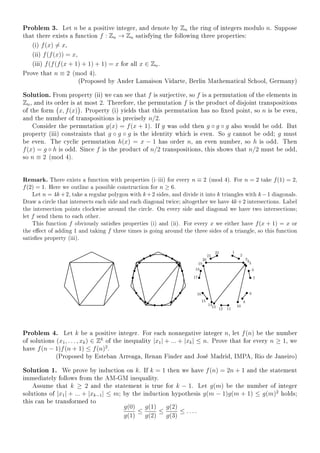
Let n = 4k+2, take a regular polygon with k+2 sides, and divide it into k triangles with k−1 diagonals.
Draw a circle that intersects each side and each diagonal twice; altogether we have 4k+2 intersections. Label
the intersection points clockwise around the circle. On every side and diagonal we have two intersections;
let f send them to each other.
This function f obviously satises properties (i) and (ii). For every x we either have f(x + 1) = x or
the eect of adding 1 and taking f three times is going around the three sides of a triangle, so this function
satises property (iii).
Problem 4. Let k be a positive integer. For each nonnegative integer n, let f(n) be the number
of solutions (x1, . . . , xk) ∈ Zk
of the inequality |x1| + ... + |xk| ≤ n. Prove that for every n ≥ 1, we
have f(n − 1)f(n + 1) ≤ f(n)2
.
(Proposed by Esteban Arreaga, Renan Finder and José Madrid, IMPA, Rio de Janeiro)
Solution 1. We prove by induction on k. If k = 1 then we have f(n) = 2n + 1 and the statement
immediately follows from the AM-GM inequality.
Assume that k ≥ 2 and the statement is true for k − 1. Let g(m) be the number of integer
solutions of |x1| + ... + |xk−1| ≤ m; by the induction hypothesis g(m − 1)g(m + 1) ≤ g(m)2
holds;
this can be transformed to
g(0)
g(1)
≤
g(1)
g(2)
≤
g(2)
g(3)
≤ . . . .
For any integer constant c, the inequality |x1|+...+|xk−1|+|c| ≤ n has g n−|c| integer solutions.
Therefore, we have the recurrence relation
f(n) =
n
c=−n
g n − |c| = g(n) + 2g(n − 1) + ... + 2g(0).
It follows that
f(n − 1)
f(n)
=
g(n − 1) + 2g(n − 2) + ... + 2g(0)
g(n) + 2g(n − 1) + ... + 2g(1) + 2g(0)
≤
≤
g(n) + g(n − 1) + (g(n − 1) + ... + 2g(0) + 2 · 0)
g(n + 1) + g(n) + (g(n) + ... + 2g(1) + 2g(0))
=
f(n)
f(n + 1)
as required.
Solution 2. We rst compute the generating function for f(n):
∞
n=0
f(n)qn
=
(x1,x2,...,xk)∈Zk
∞
c=0
q|x1|+|x2|+···+|xk|+c
=
x∈Z
q|x|
k
1
1 − q
=
(1 + q)k
(1 − q)k+1
.
For each a = 0, 1, . . . denote by ga(n) (n = 0, 1, 2, . . .) the coecients in the following expansion:
(1 + q)a
(1 − q)k+1
=
∞
n=0
ga(n)qn
.
So it is clear that ga+1(n) = ga(n)+ga(n−1) (n ≥ 1), ga(0) = 1. Call a sequence of positive numbers
g(0), g(1), g(2), . . . good if g(n−1)
g(n)
(n = 1, 2, . . .) is an increasing sequence. It is straightforward to
check that g0 is good:
g0(n) =
k + n
k
,
g0(n − 1)
g0(n)
=
n
k + n
.
If g is a good sequence then a new sequence g dened by g (0) = g(0), g (n) = g(n) + g(n − 1)
(n ≥ 1) is also good:
g (n − 1)
g (n)
=
g(n − 1) + g(n − 2)
g(n) + g(n − 1)
=
1 + g(n−2)
g(n−1)
1 + g(n)
g(n−1)
,
where dene g(−1) = 0. Thus we see that each of the sequences g1, g2, . . . , gk = f are good. So the
desired inequality holds.
Problem 5. Let A be a n × n complex matrix whose eigenvalues have absolute value at most 1.
Prove that
An
≤
n
ln 2
A n−1
.
(Here B = sup
x ≤1
Bx for every n × n matrix B and x =
n
i=1
|xi|2 for every complex vector
x ∈ Cn
.)
(Proposed by Ian Morris and Fedor Petrov, St. Petersburg State University)
Solution 1. Let r = A . We have to prove An
≤ n
ln 2
rn−1
.
As is well-known, the matrix norm satises XY ≤ X · Y for any matrices X, Y , and as a
simple consequence, Ak
≤ A k
= rk
for every positive integer k.
Let χ(t) = (t − λ1)(t − λ2) . . . (t − λn) = tn
+ c1tn−1
+ · · · + cn be the characteristic polynomial
of A. From Vieta's formulas we get
|ck| =
1≤i1...ik≤n
λi1 · · · λik
≤
1≤i1...ik≤n
λi1 · · · λik
≤
n
k
(k = 1, 2, . . . , n)
By the CayleyHamilton theorem we have χ(A) = 0, so
An
= c1An−1
+ · · · + cn ≤
n
k=1
n
k
Ak
≤
n
k=1
n
k
rk
= (1 + r)n
− rn
.
Combining this with the trivial estimate An
≤ rn
, we have
An
≤ min rn
, (1 + r)n
− rn
) .
Let r0 = 1
n√
2−1
; it is easy to check that the two bounds are equal if r = r0, moreover
r0 =
1
eln 2/n − 1

n
ln 2
.
For r ≤ r0 apply the trivial bound:
An
≤ rn
≤ r0 · rn−1

n
ln 2
rn−1
.
For r  r0 we have
An
≤ (1 + r)n
− rn
= rn−1
·
(1 + r)n
− rn
rn−1
.
Notice that the function f(r) = (1+r)n−rn
rn−1 is decreasing because the numerator has degree n − 1 and
all coecients are positive, so
(1 + r)n
− rn
rn−1

(1 + r0)n
− rn
0
rn−1
0
= r0 (1 + 1/r0)n
− 1) = r0 
n
ln 2
,
so An
 n
ln 2
rn−1
.
Solution 2. We will use the following facts which are easy to prove:
• For any square matrix A there exists a unitary matrix U such that UAU−1
is upper-triangular.
• For any matrices A, B we have A ≤ (A|B) and B ≤ (A|B) where (A|B) is the matrix
whose columns are the columns of A and the columns of B.
• For any matrices A, B we have A ≤ A
B
and B ≤ A
B
where A
B
is the matrix
whose rows are the rows of A and the rows of B.
• Adding a zero row or a zero column to a matrix does not change its norm.
We will prove a stronger inequality
An
≤ n A n−1
for any n × n matrix A whose eigenvalues have absolute value at most 1. We proceed by induction
on n. The case n = 1 is trivial. Without loss of generality we can assume that the matrix A is
upper-triangular. So we have
A =




a11 a12 · · · a1n
0 a22 · · · a2n
· · · · · · · · ·
0 0 · · · ann



 .
Note that the eigenvalues of A are precisely the diagonal entries. We split A as the sum of 3 matrices,
A = X + Y + Z as follows:
X =




a11 0 · · · 0
0 0 · · · 0
· · · · · · · · ·
0 0 · · · 0



 , Y =




0 a12 · · · a1n
0 0 · · · 0
· · · · · · · · ·
0 0 · · · 0



 , Z =




0 0 · · · 0
0 a22 · · · a2n
· · · · · · · · ·
0 0 · · · ann



 .
Denote by A the matrix obtained from A by removing the rst row and the rst column:
A =


a22 · · · a2n
· · · · · ·
0 · · · ann

 .
We have X ≤ 1 because |a11| ≤ 1. We also have
A = Z ≤ Y + Z ≤ A .
Now we decompose An
as follows:
An
= XAn−1
+ (Y + Z)An−1
.
We substitute A = X + Y + Z in the second term and expand the parentheses. Because of the
following identities:
Y 2
= 0, Y X = 0, ZY = 0, ZX = 0
only the terms Y Zn−1
and Zn
survive. So we have
An
= XAn−1
+ (Y + Z)Zn−1
.
By the induction hypothesis we have A n−1
≤ (n − 1) A n−2
, hence Zn−1
≤ (n − 1) Z n−2
≤
(n − 1) A n−2
. Therefore
An
≤ XAn−1
+ (Y + Z)Zn−1
≤ A n−1
+ (n − 1) Y + Z A n−2
≤ n A n−1
.

Imc2016 day2-solutions

  • 1.
    IMC 2016, Blagoevgrad,Bulgaria Day 2, July 28, 2016 Problem 1. Let (x1, x2, . . .) be a sequence of positive real numbers satisfying ∞ n=1 xn 2n − 1 = 1. Prove that ∞ k=1 k n=1 xn k2 ≤ 2. (Proposed by Gerhard J. Woeginger, The Netherlands) Solution. By interchanging the sums, ∞ k=1 k n=1 xn k2 = 1≤n≤k xn k2 = ∞ n=1 xn ∞ k=n 1 k2 . Then we use the upper bound ∞ k=n 1 k2 ≤ ∞ k=n 1 k2 − 1 4 = ∞ k=n 1 k − 1 2 − 1 k + 1 2 = 1 n − 1 2 and get ∞ k=1 k n=1 xn k2 = ∞ n=1 xn ∞ k=n 1 k2 < ∞ n=1 xn · 1 n − 1 2 = 2 ∞ n=1 xn 2n − 1 = 2. Problem 2. Today, Ivan the Confessor prefers continuous functions f : [0, 1] → R satisfying f(x)+f(y) ≥ |x−y| for all pairs x, y ∈ [0, 1]. Find the minimum of 1 0 f over all preferred functions. (Proposed by Fedor Petrov, St. Petersburg State University) Solution. The minimum of 1 0 f is 1 4 . Applying the condition with 0 ≤ x ≤ 1 2 , y = x + 1 2 we get f(x) + f(x + 1 2 ) ≥ 1 2 . By integrating, 1 0 f(x) dx = 1/2 0 f(x) + f(x + 1 2 ) dx ≥ 1/2 0 1 2 dx = 1 4 . On the other hand, the function f(x) = x − 1 2 satises the conditions because |x − y| = x − 1 2 + 1 2 − y ≤ x − 1 2 + 1 2 − y = f(x) + f(y), and establishes 1 0 f(x) dx = 1/2 0 1 2 − x dx + 1 1/2 x − 1 2 dx = 1 8 + 1 8 = 1 4 .
  • 2.
    Problem 3. Letn be a positive integer, and denote by Zn the ring of integers modulo n. Suppose that there exists a function f : Zn → Zn satisfying the following three properties: (i) f(x) = x, (ii) f(f(x)) = x, (iii) f(f(f(x + 1) + 1) + 1) = x for all x ∈ Zn. Prove that n ≡ 2 (mod 4). (Proposed by Ander Lamaison Vidarte, Berlin Mathematical School, Germany) Solution. From property (ii) we can see that f is surjective, so f is a permutation of the elements in Zn, and its order is at most 2. Therefore, the permutation f is the product of disjoint transpositions of the form x, f(x) . Property (i) yields that this permutation has no xed point, so n is be even, and the number of transpositions is precisely n/2. Consider the permutation g(x) = f(x + 1). If g was odd then g ◦ g ◦ g also would be odd. But property (iii) constraints that g ◦ g ◦ g is the identity which is even. So g cannot be odd; g must be even. The cyclic permutation h(x) = x − 1 has order n, an even number, so h is odd. Then f(x) = g ◦ h is odd. Since f is the product of n/2 transpositions, this shows that n/2 must be odd, so n ≡ 2 (mod 4). Remark. There exists a function with properties (iiii) for every n ≡ 2 (mod 4). For n = 2 take f(1) = 2, f(2) = 1. Here we outline a possible construction for n ≥ 6. Let n = 4k+2, take a regular polygon with k+2 sides, and divide it into k triangles with k−1 diagonals. Draw a circle that intersects each side and each diagonal twice; altogether we have 4k+2 intersections. Label the intersection points clockwise around the circle. On every side and diagonal we have two intersections; let f send them to each other. This function f obviously satises properties (i) and (ii). For every x we either have f(x + 1) = x or the eect of adding 1 and taking f three times is going around the three sides of a triangle, so this function satises property (iii). Problem 4. Let k be a positive integer. For each nonnegative integer n, let f(n) be the number of solutions (x1, . . . , xk) ∈ Zk of the inequality |x1| + ... + |xk| ≤ n. Prove that for every n ≥ 1, we have f(n − 1)f(n + 1) ≤ f(n)2 . (Proposed by Esteban Arreaga, Renan Finder and José Madrid, IMPA, Rio de Janeiro) Solution 1. We prove by induction on k. If k = 1 then we have f(n) = 2n + 1 and the statement immediately follows from the AM-GM inequality. Assume that k ≥ 2 and the statement is true for k − 1. Let g(m) be the number of integer solutions of |x1| + ... + |xk−1| ≤ m; by the induction hypothesis g(m − 1)g(m + 1) ≤ g(m)2 holds; this can be transformed to g(0) g(1) ≤ g(1) g(2) ≤ g(2) g(3) ≤ . . . .
  • 3.
    For any integerconstant c, the inequality |x1|+...+|xk−1|+|c| ≤ n has g n−|c| integer solutions. Therefore, we have the recurrence relation f(n) = n c=−n g n − |c| = g(n) + 2g(n − 1) + ... + 2g(0). It follows that f(n − 1) f(n) = g(n − 1) + 2g(n − 2) + ... + 2g(0) g(n) + 2g(n − 1) + ... + 2g(1) + 2g(0) ≤ ≤ g(n) + g(n − 1) + (g(n − 1) + ... + 2g(0) + 2 · 0) g(n + 1) + g(n) + (g(n) + ... + 2g(1) + 2g(0)) = f(n) f(n + 1) as required. Solution 2. We rst compute the generating function for f(n): ∞ n=0 f(n)qn = (x1,x2,...,xk)∈Zk ∞ c=0 q|x1|+|x2|+···+|xk|+c = x∈Z q|x| k 1 1 − q = (1 + q)k (1 − q)k+1 . For each a = 0, 1, . . . denote by ga(n) (n = 0, 1, 2, . . .) the coecients in the following expansion: (1 + q)a (1 − q)k+1 = ∞ n=0 ga(n)qn . So it is clear that ga+1(n) = ga(n)+ga(n−1) (n ≥ 1), ga(0) = 1. Call a sequence of positive numbers g(0), g(1), g(2), . . . good if g(n−1) g(n) (n = 1, 2, . . .) is an increasing sequence. It is straightforward to check that g0 is good: g0(n) = k + n k , g0(n − 1) g0(n) = n k + n . If g is a good sequence then a new sequence g dened by g (0) = g(0), g (n) = g(n) + g(n − 1) (n ≥ 1) is also good: g (n − 1) g (n) = g(n − 1) + g(n − 2) g(n) + g(n − 1) = 1 + g(n−2) g(n−1) 1 + g(n) g(n−1) , where dene g(−1) = 0. Thus we see that each of the sequences g1, g2, . . . , gk = f are good. So the desired inequality holds. Problem 5. Let A be a n × n complex matrix whose eigenvalues have absolute value at most 1. Prove that An ≤ n ln 2 A n−1 . (Here B = sup x ≤1 Bx for every n × n matrix B and x = n i=1 |xi|2 for every complex vector x ∈ Cn .) (Proposed by Ian Morris and Fedor Petrov, St. Petersburg State University) Solution 1. Let r = A . We have to prove An ≤ n ln 2 rn−1 . As is well-known, the matrix norm satises XY ≤ X · Y for any matrices X, Y , and as a simple consequence, Ak ≤ A k = rk for every positive integer k. Let χ(t) = (t − λ1)(t − λ2) . . . (t − λn) = tn + c1tn−1 + · · · + cn be the characteristic polynomial of A. From Vieta's formulas we get |ck| = 1≤i1...ik≤n λi1 · · · λik ≤ 1≤i1...ik≤n λi1 · · · λik ≤ n k (k = 1, 2, . . . , n)
  • 4.
    By the CayleyHamiltontheorem we have χ(A) = 0, so An = c1An−1 + · · · + cn ≤ n k=1 n k Ak ≤ n k=1 n k rk = (1 + r)n − rn . Combining this with the trivial estimate An ≤ rn , we have An ≤ min rn , (1 + r)n − rn ) . Let r0 = 1 n√ 2−1 ; it is easy to check that the two bounds are equal if r = r0, moreover r0 = 1 eln 2/n − 1 n ln 2 . For r ≤ r0 apply the trivial bound: An ≤ rn ≤ r0 · rn−1 n ln 2 rn−1 . For r r0 we have An ≤ (1 + r)n − rn = rn−1 · (1 + r)n − rn rn−1 . Notice that the function f(r) = (1+r)n−rn rn−1 is decreasing because the numerator has degree n − 1 and all coecients are positive, so (1 + r)n − rn rn−1 (1 + r0)n − rn 0 rn−1 0 = r0 (1 + 1/r0)n − 1) = r0 n ln 2 , so An n ln 2 rn−1 . Solution 2. We will use the following facts which are easy to prove: • For any square matrix A there exists a unitary matrix U such that UAU−1 is upper-triangular. • For any matrices A, B we have A ≤ (A|B) and B ≤ (A|B) where (A|B) is the matrix whose columns are the columns of A and the columns of B. • For any matrices A, B we have A ≤ A B and B ≤ A B where A B is the matrix whose rows are the rows of A and the rows of B. • Adding a zero row or a zero column to a matrix does not change its norm. We will prove a stronger inequality An ≤ n A n−1 for any n × n matrix A whose eigenvalues have absolute value at most 1. We proceed by induction on n. The case n = 1 is trivial. Without loss of generality we can assume that the matrix A is upper-triangular. So we have A =     a11 a12 · · · a1n 0 a22 · · · a2n · · · · · · · · · 0 0 · · · ann     . Note that the eigenvalues of A are precisely the diagonal entries. We split A as the sum of 3 matrices, A = X + Y + Z as follows: X =     a11 0 · · · 0 0 0 · · · 0 · · · · · · · · · 0 0 · · · 0     , Y =     0 a12 · · · a1n 0 0 · · · 0 · · · · · · · · · 0 0 · · · 0     , Z =     0 0 · · · 0 0 a22 · · · a2n · · · · · · · · · 0 0 · · · ann     .
  • 5.
    Denote by Athe matrix obtained from A by removing the rst row and the rst column: A =   a22 · · · a2n · · · · · · 0 · · · ann   . We have X ≤ 1 because |a11| ≤ 1. We also have A = Z ≤ Y + Z ≤ A . Now we decompose An as follows: An = XAn−1 + (Y + Z)An−1 . We substitute A = X + Y + Z in the second term and expand the parentheses. Because of the following identities: Y 2 = 0, Y X = 0, ZY = 0, ZX = 0 only the terms Y Zn−1 and Zn survive. So we have An = XAn−1 + (Y + Z)Zn−1 . By the induction hypothesis we have A n−1 ≤ (n − 1) A n−2 , hence Zn−1 ≤ (n − 1) Z n−2 ≤ (n − 1) A n−2 . Therefore An ≤ XAn−1 + (Y + Z)Zn−1 ≤ A n−1 + (n − 1) Y + Z A n−2 ≤ n A n−1 .