Aujero, Gadian, Pamonag
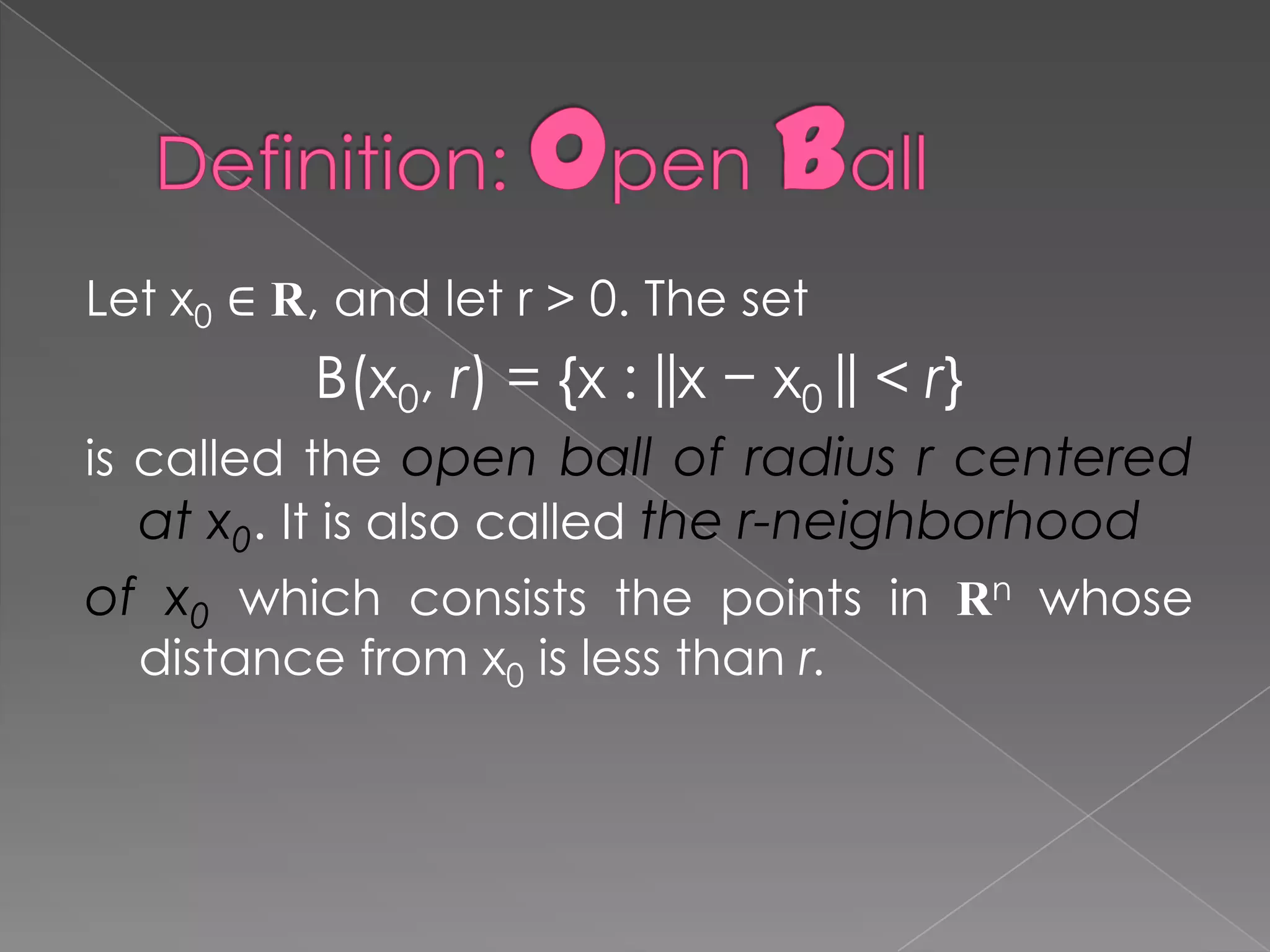
Let x0 ∈ R, and let r > 0. The set

B(x0, r) = {x : ||x − x0 || < r}
is called the open ball of radius r centered
at x0. It is also called the r-neighborhood

of x0 which consists the points in Rn whose
distance from x0 is less than r.
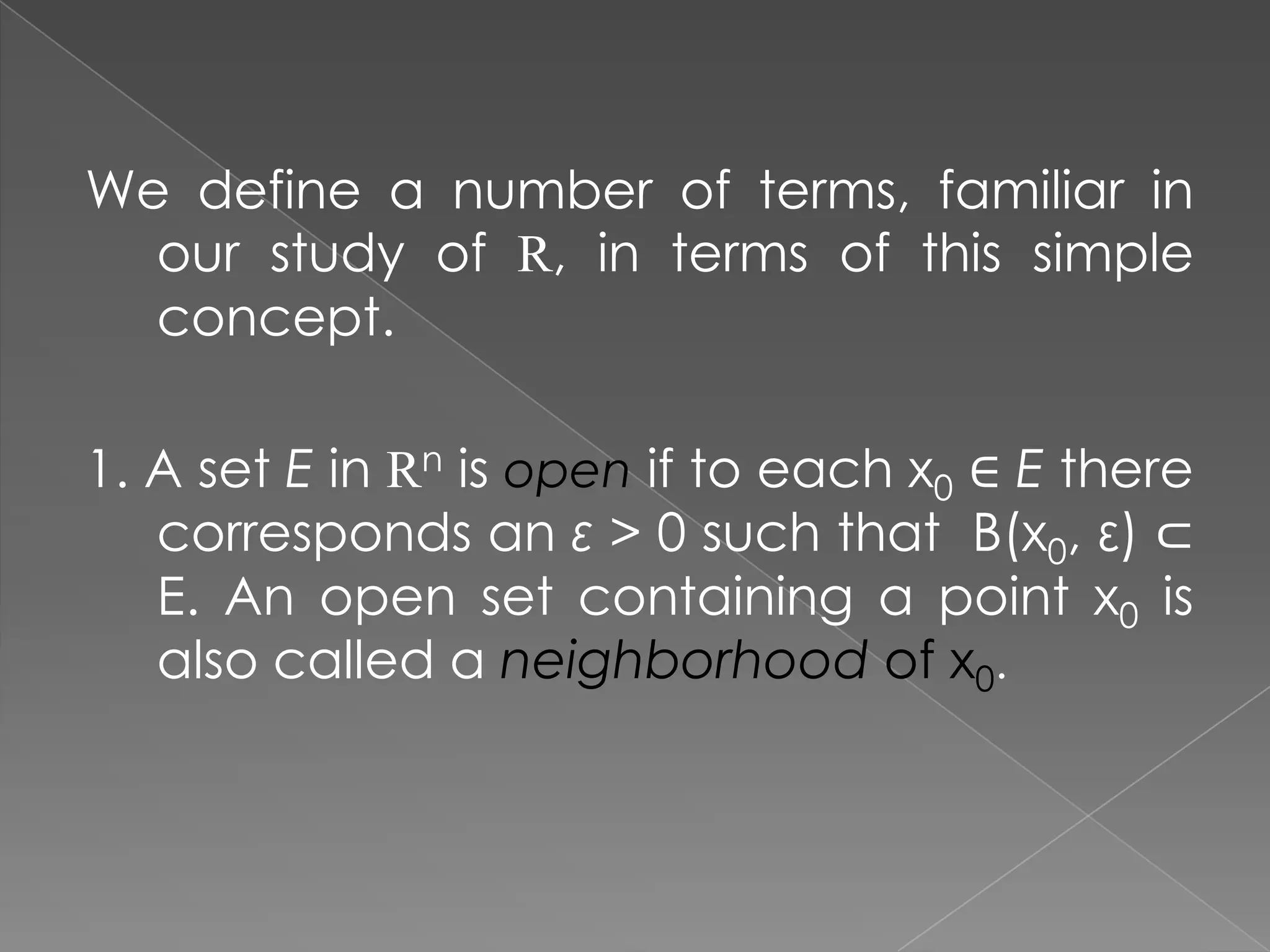
We define a number of terms, familiar in
our study of R, in terms of this simple
concept.
1. A set E in Rn is open if to each x0 ∈ E there
corresponds an ε > 0 such that B(x0, ε) ⊂
E. An open set containing a point x0 is
also called a neighborhood of x0.
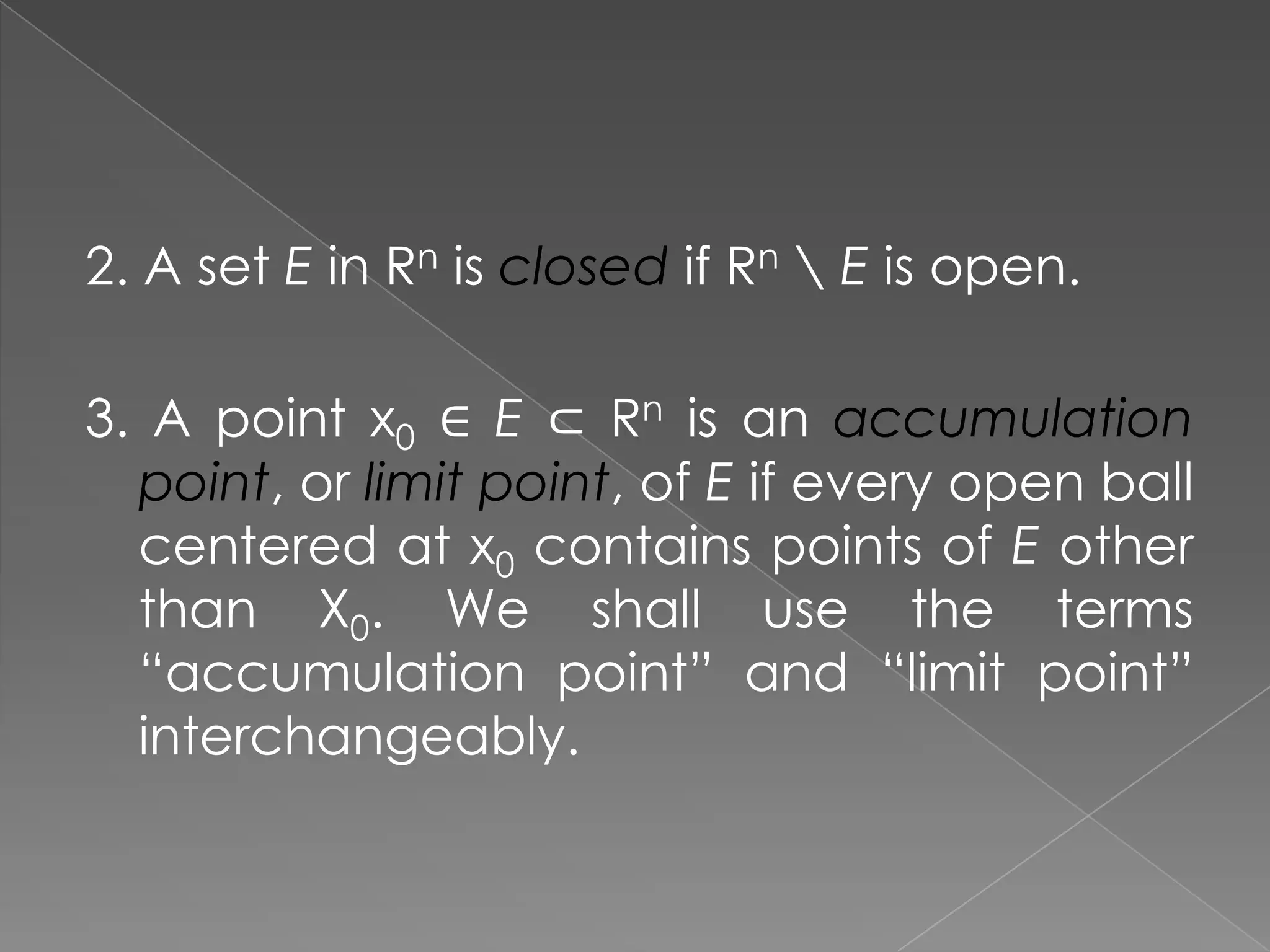
2. A set E in Rn is closed if Rn  E is open.
3. A point x0 ∈ E ⊂ Rn is an accumulation
point, or limit point, of E if every open ball
centered at x0 contains points of E other
than X0. We shall use the terms
“accumulation point” and “limit point”
interchangeably.
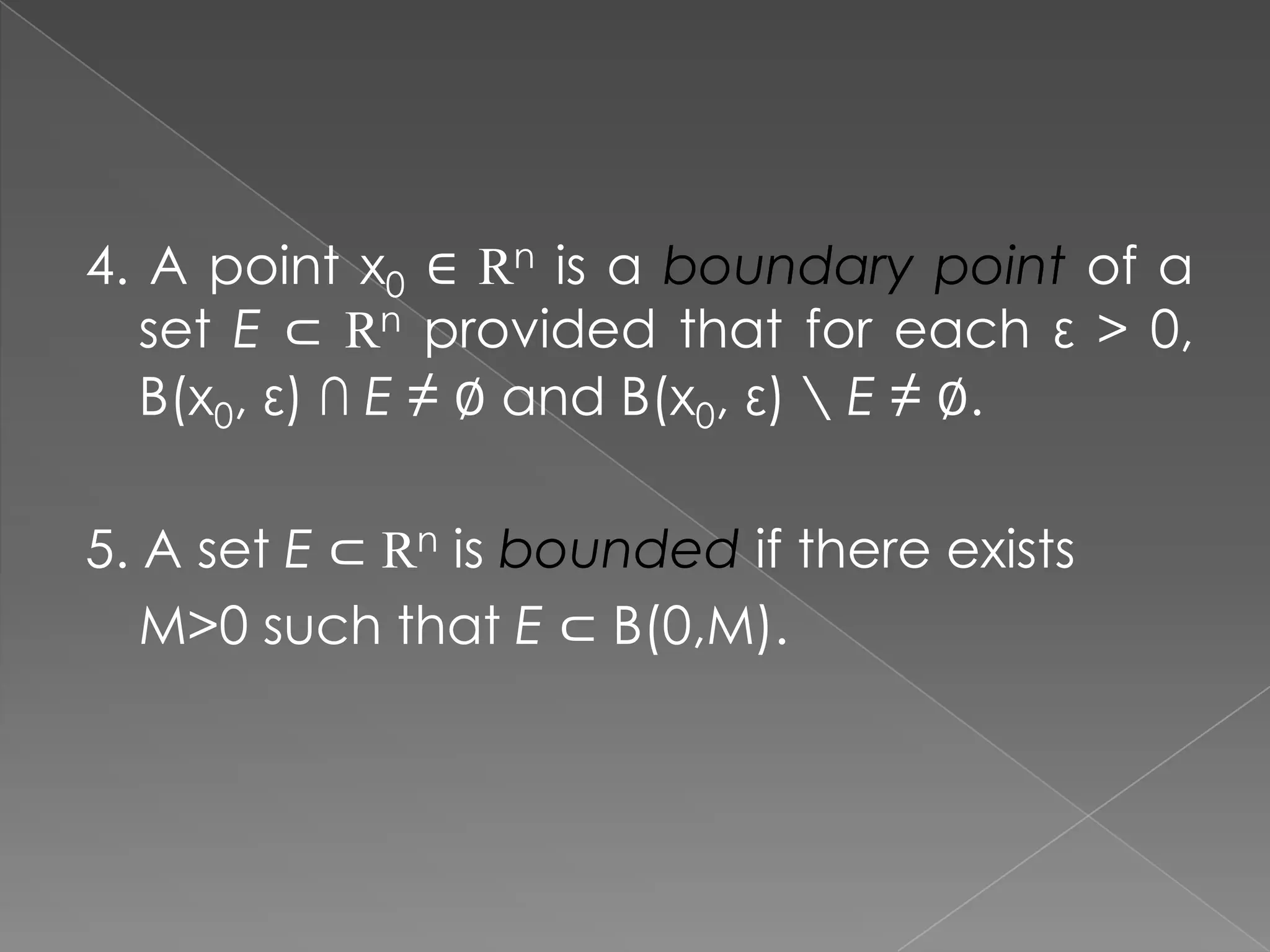
4. A point x0 ∈ Rn is a boundary point of a
set E ⊂ Rn provided that for each ε > 0,
B(x0, ε) ∩ E ≠ ∅ and B(x0, ε)  E ≠ ∅.

5. A set E ⊂ Rn is bounded if there exists
M>0 such that E ⊂ B(0,M).
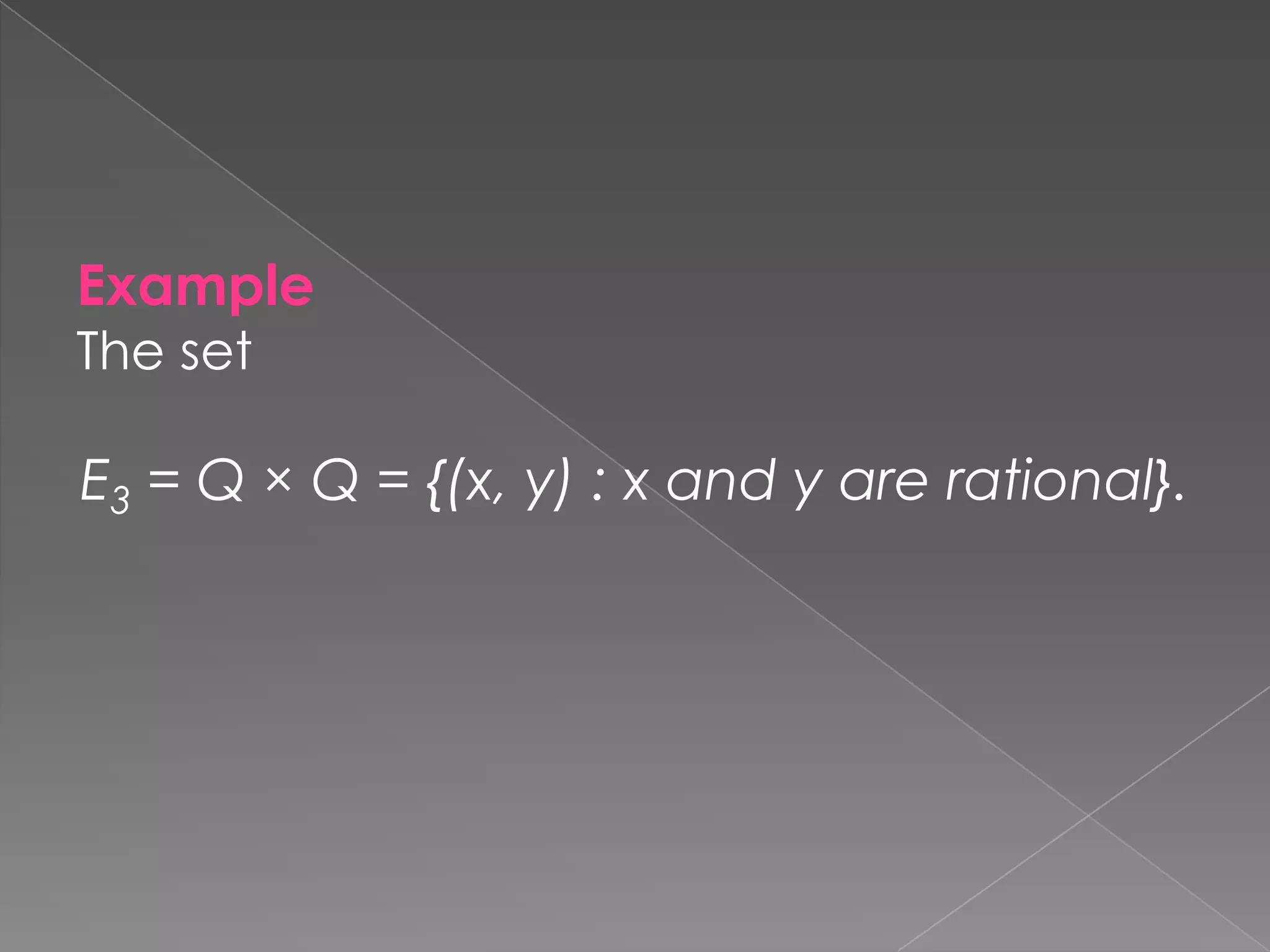
Example
The set

E3 = Q × Q = {(x, y) : x and y are rational}.
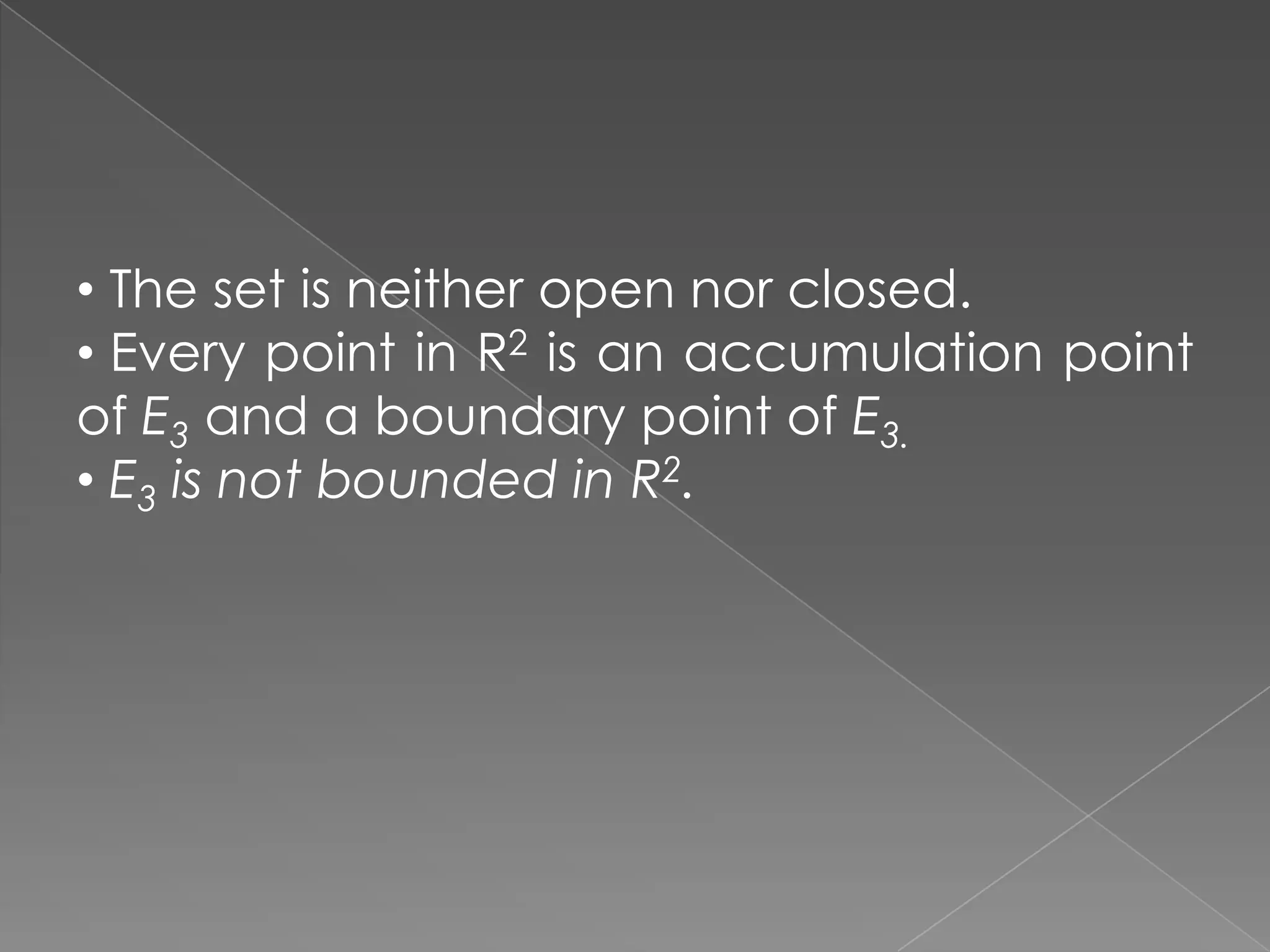
• The set is neither open nor closed.
• Every point in R2 is an accumulation point
of E3 and a boundary point of E3.
• E3 is not bounded in R2.
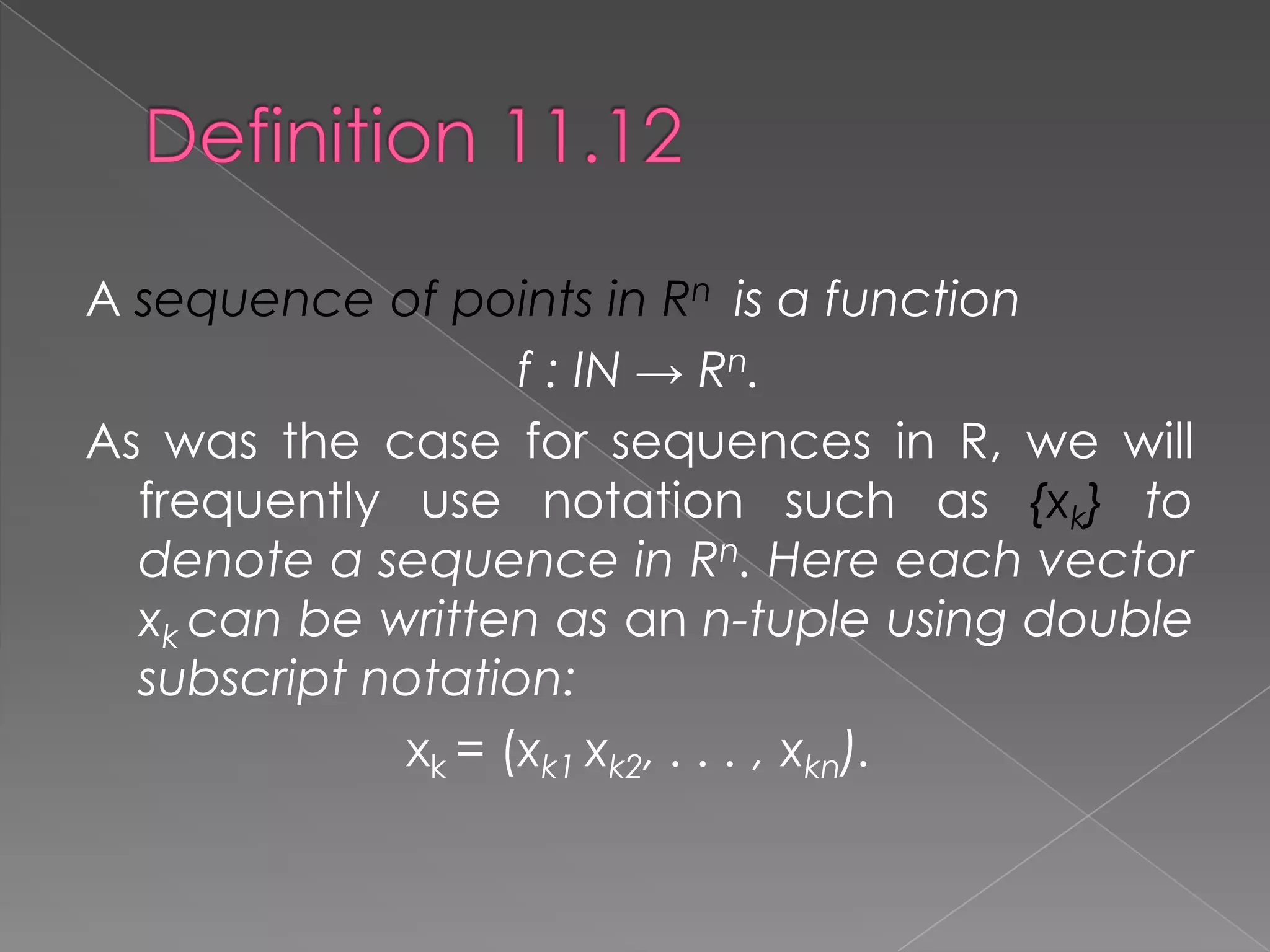
A sequence of points in Rn is a function
f : IN → Rn.
As was the case for sequences in R, we will
frequently use notation such as {xk} to
denote a sequence in Rn. Here each vector
xk can be written as an n-tuple using double
subscript notation:
xk = (xk1 xk2, . . . , xkn).
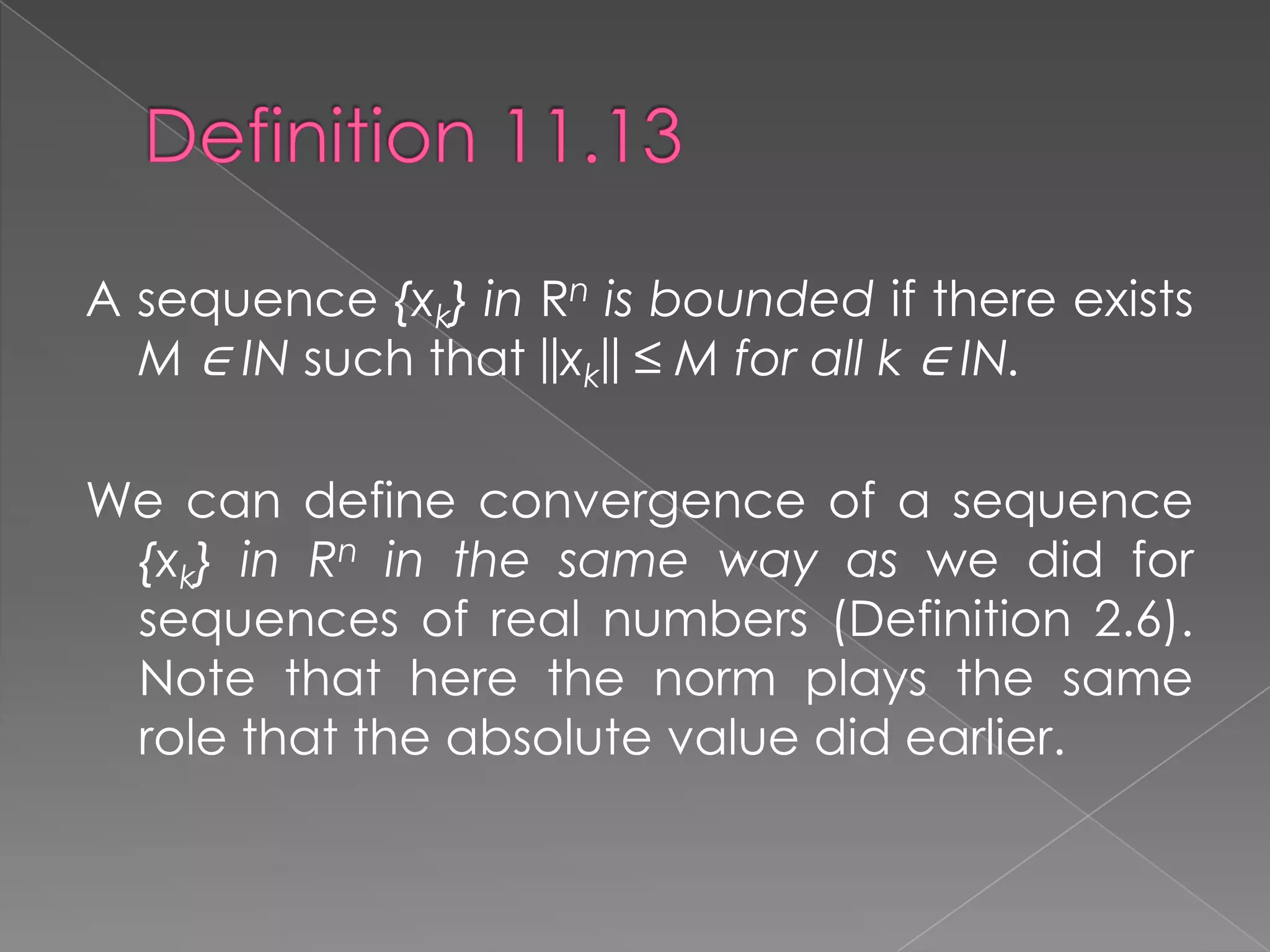
A sequence {xk} in Rn is bounded if there exists
M ∈ IN such that ||xk|| ≤ M for all k ∈ IN.
We can define convergence of a sequence
{xk} in Rn in the same way as we did for
sequences of real numbers (Definition 2.6).
Note that here the norm plays the same
role that the absolute value did earlier.
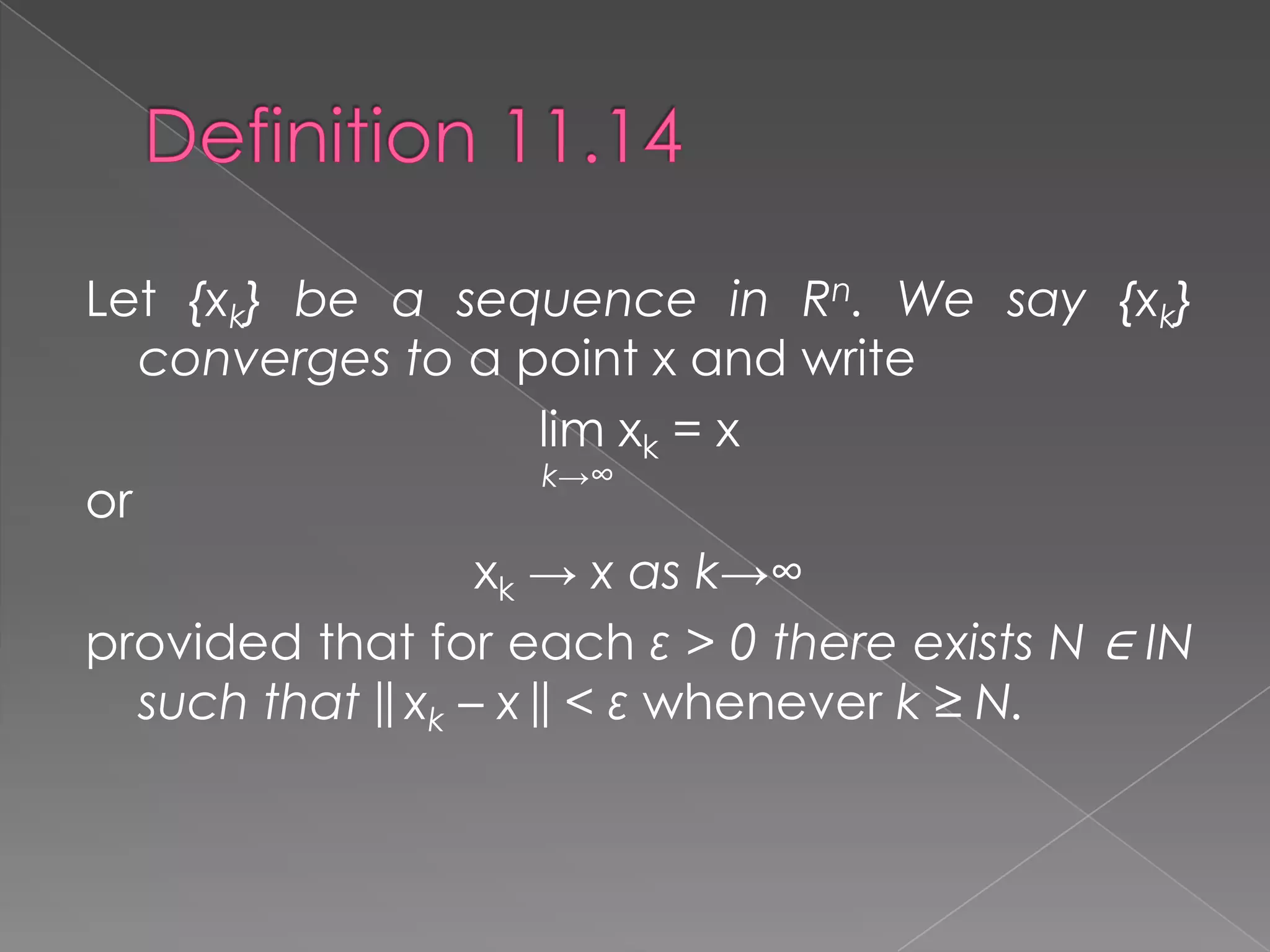
Let {xk} be a sequence in Rn. We say {xk}
converges to a point x and write
lim xk = x
k→∞
or
xk → x as k→∞
provided that for each ε > 0 there exists N ∈ IN
such that || xk – x || < ε whenever k ≥ N.
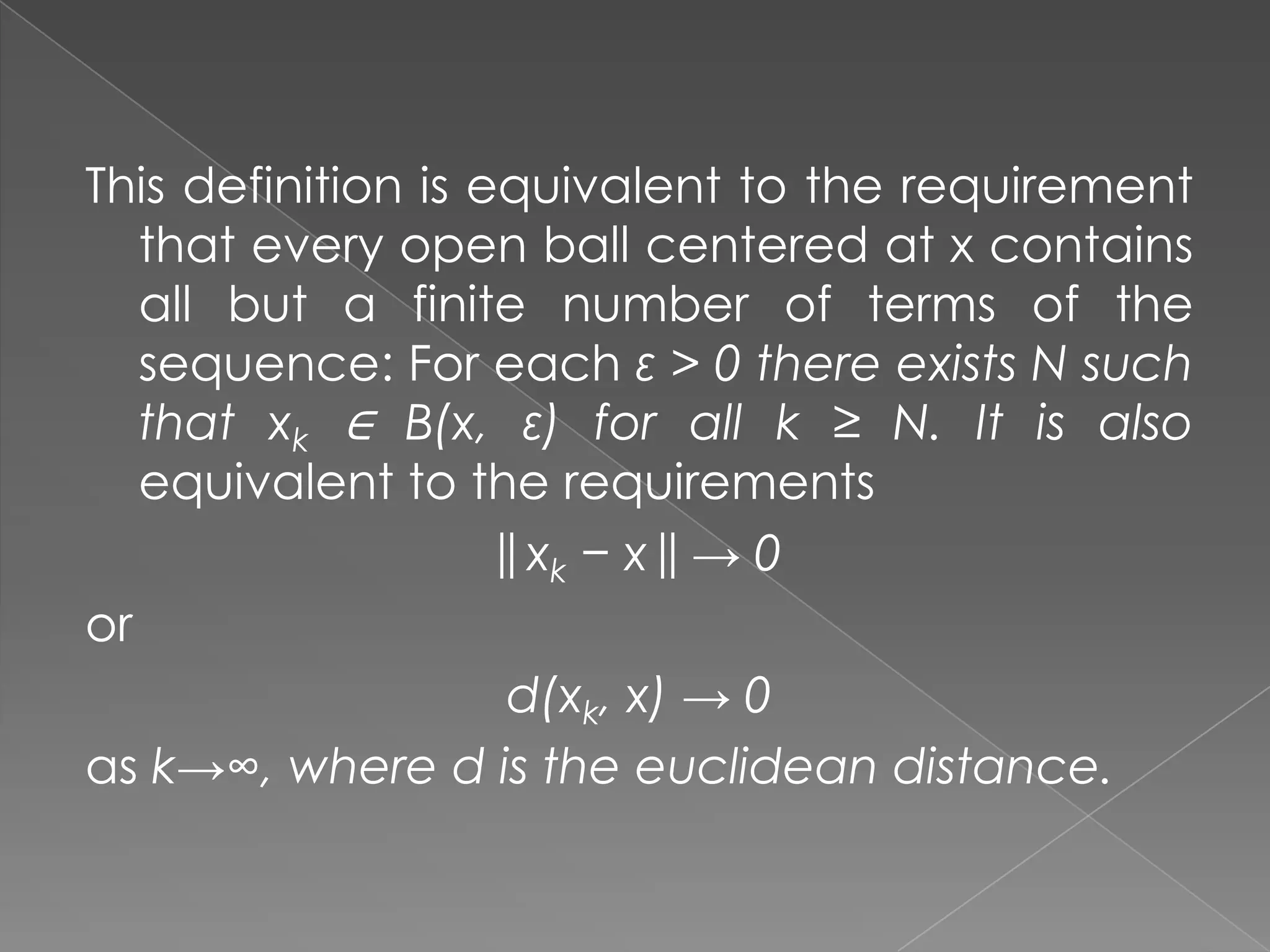
This definition is equivalent to the requirement
that every open ball centered at x contains
all but a finite number of terms of the
sequence: For each ε > 0 there exists N such
that xk ∈ B(x, ε) for all k ≥ N. It is also
equivalent to the requirements
|| xk − x || → 0
or
d(xk, x) → 0
as k→∞, where d is the euclidean distance.
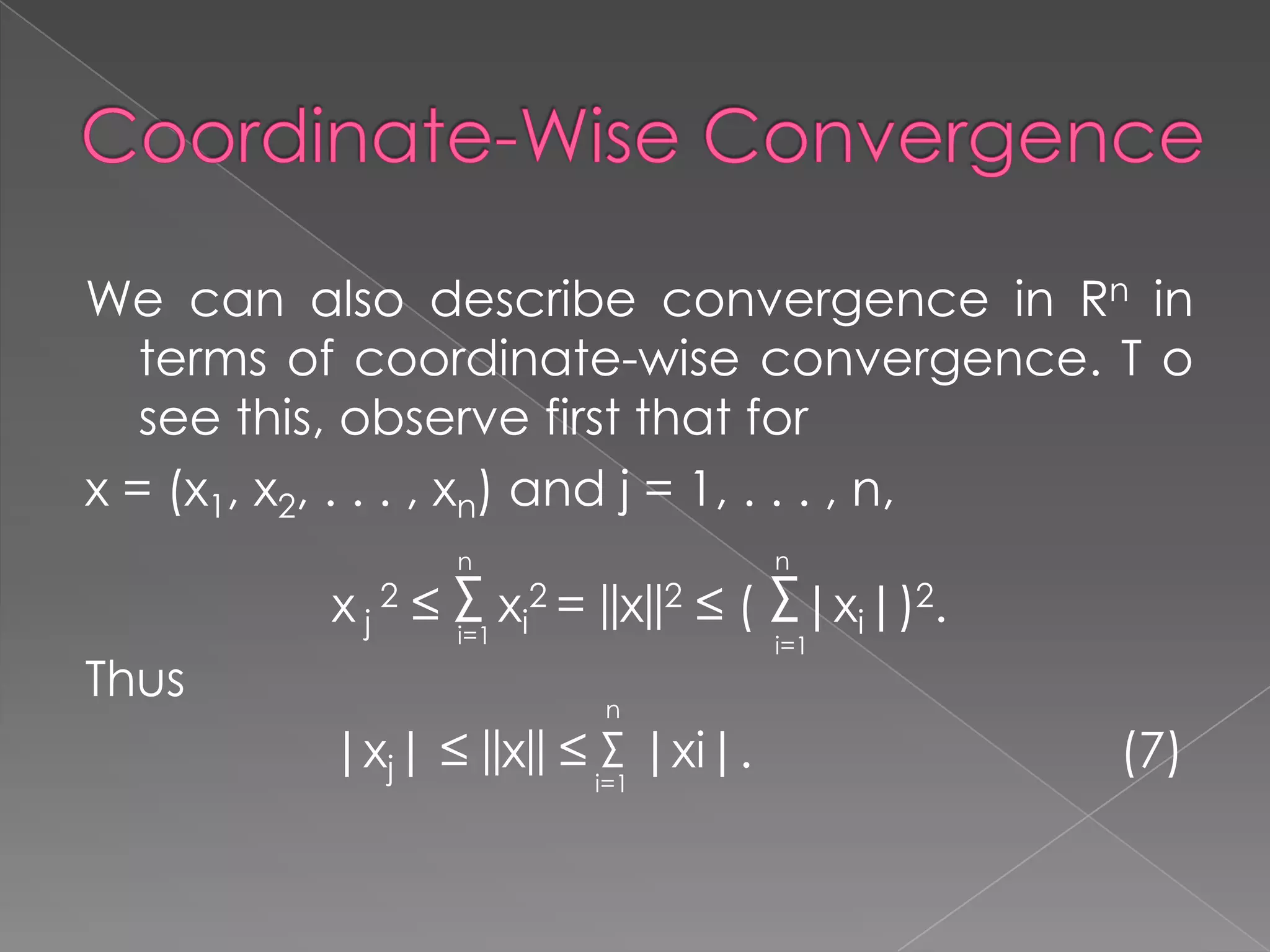
We can also describe convergence in Rn in
terms of coordinate-wise convergence. T o
see this, observe first that for
x = (x1, x2, . . . , xn) and j = 1, . . . , n,
n

n

Thus

x j 2 ≤ Σ xi2 = ||x||2 ≤ ( Σ|xi|)2.
i=1
i=1

n

|xj| ≤ ||x|| ≤ Σ |xi|.
i=1

(7)
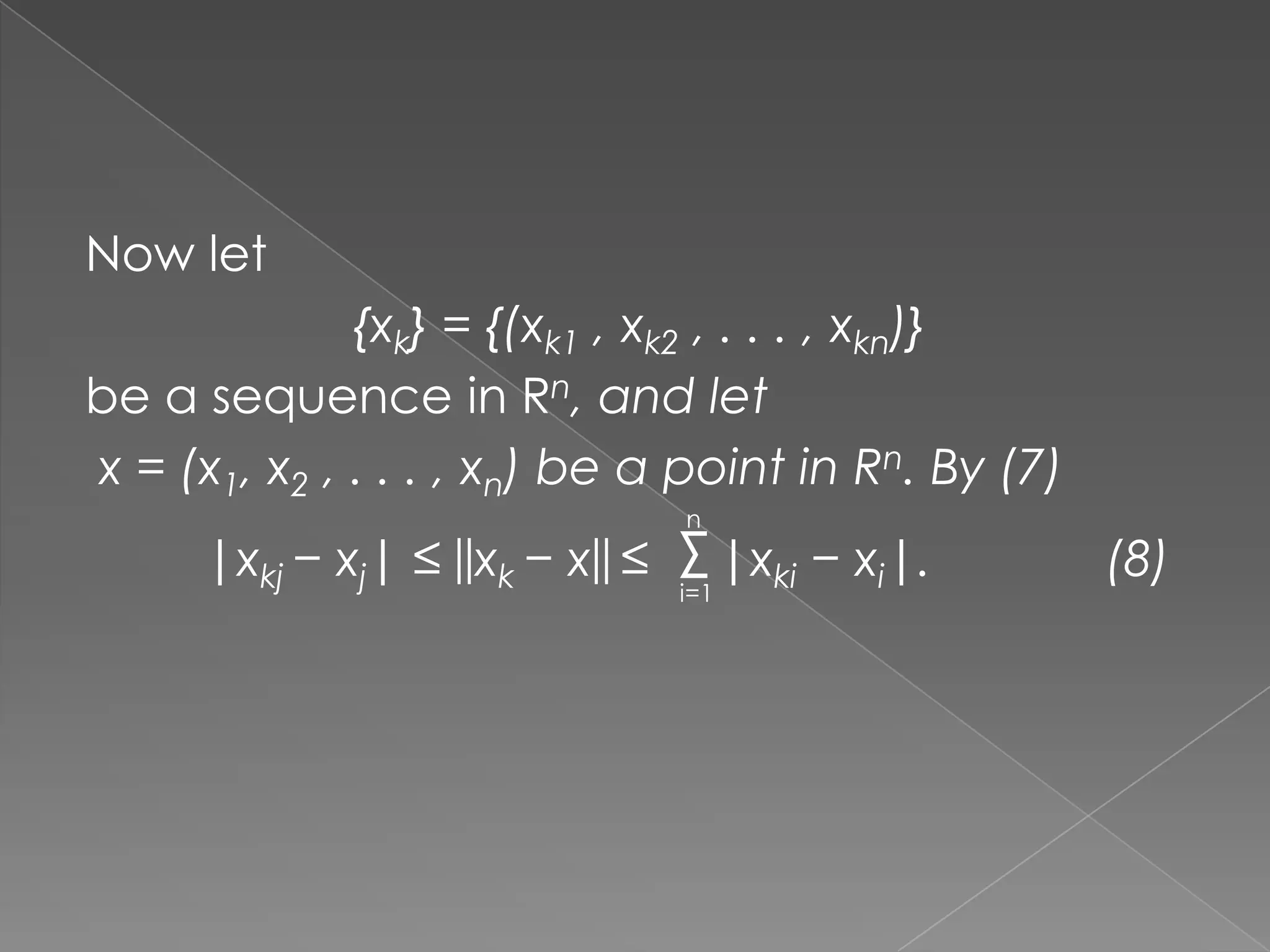
Now let

{xk} = {(xk1 , xk2 , . . . , xkn)}
be a sequence in Rn, and let
x = (x1, x2 , . . . , xn) be a point in Rn. By (7)
|xkj − xj| ≤ ||xk − x|| ≤

n

Σ |xki − xi|.
i=1

(8)
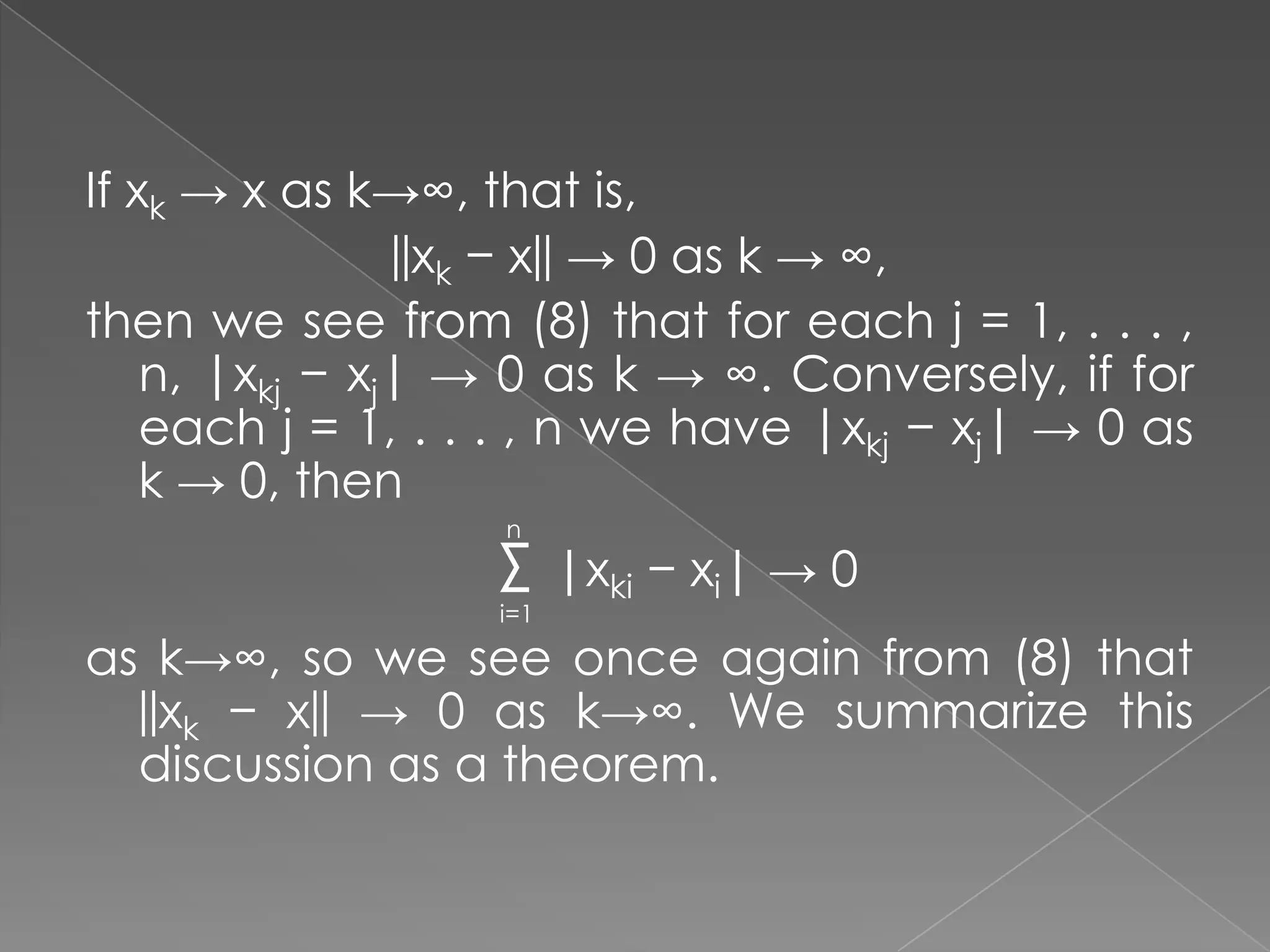
If xk → x as k→∞, that is,
||xk − x|| → 0 as k → ∞,
then we see from (8) that for each j = 1, . . . ,
n, |xkj − xj| → 0 as k → ∞. Conversely, if for
each j = 1, . . . , n we have |xkj − xj| → 0 as
k → 0, then
n

Σ |xki − xi| → 0
i=1

as k→∞, so we see once again from (8) that
||xk − x|| → 0 as k→∞. We summarize this
discussion as a theorem.
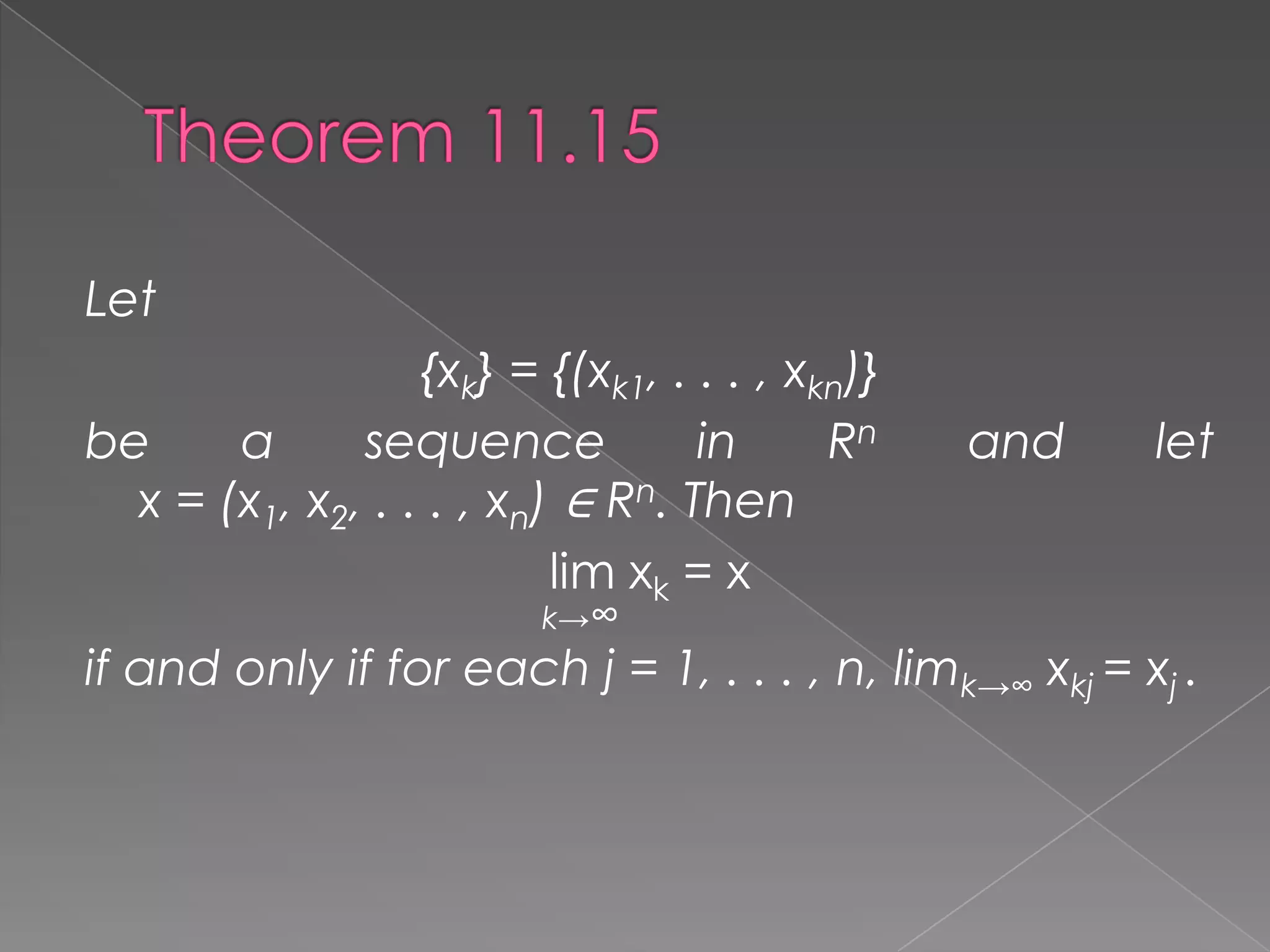
Let
{xk} = {(xk1, . . . , xkn)}
be
a
sequence
in
Rn
x = (x1, x2, . . . , xn) ∈ Rn. Then
lim xk = x
k→∞

and

let

if and only if for each j = 1, . . . , n, limk→∞ xkj = xj .
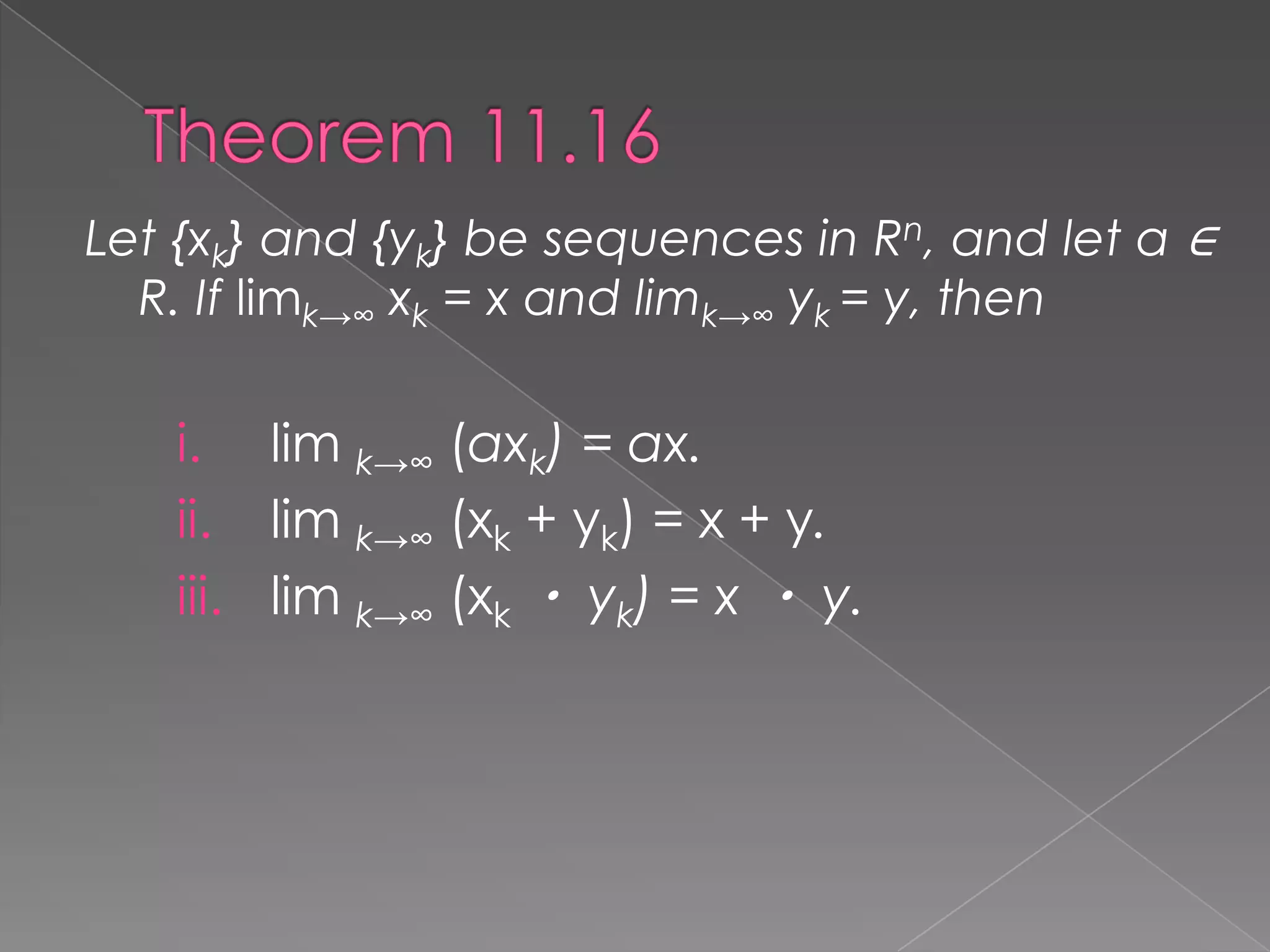
Let {xk} and {yk} be sequences in Rn, and let α ∈
R. If limk→∞ xk = x and limk→∞ yk = y, then

i. lim k→∞ (αxk) = αx.
ii. lim k→∞ (xk + yk) = x + y.
iii. lim k→∞ (xk ・ yk) = x ・ y.
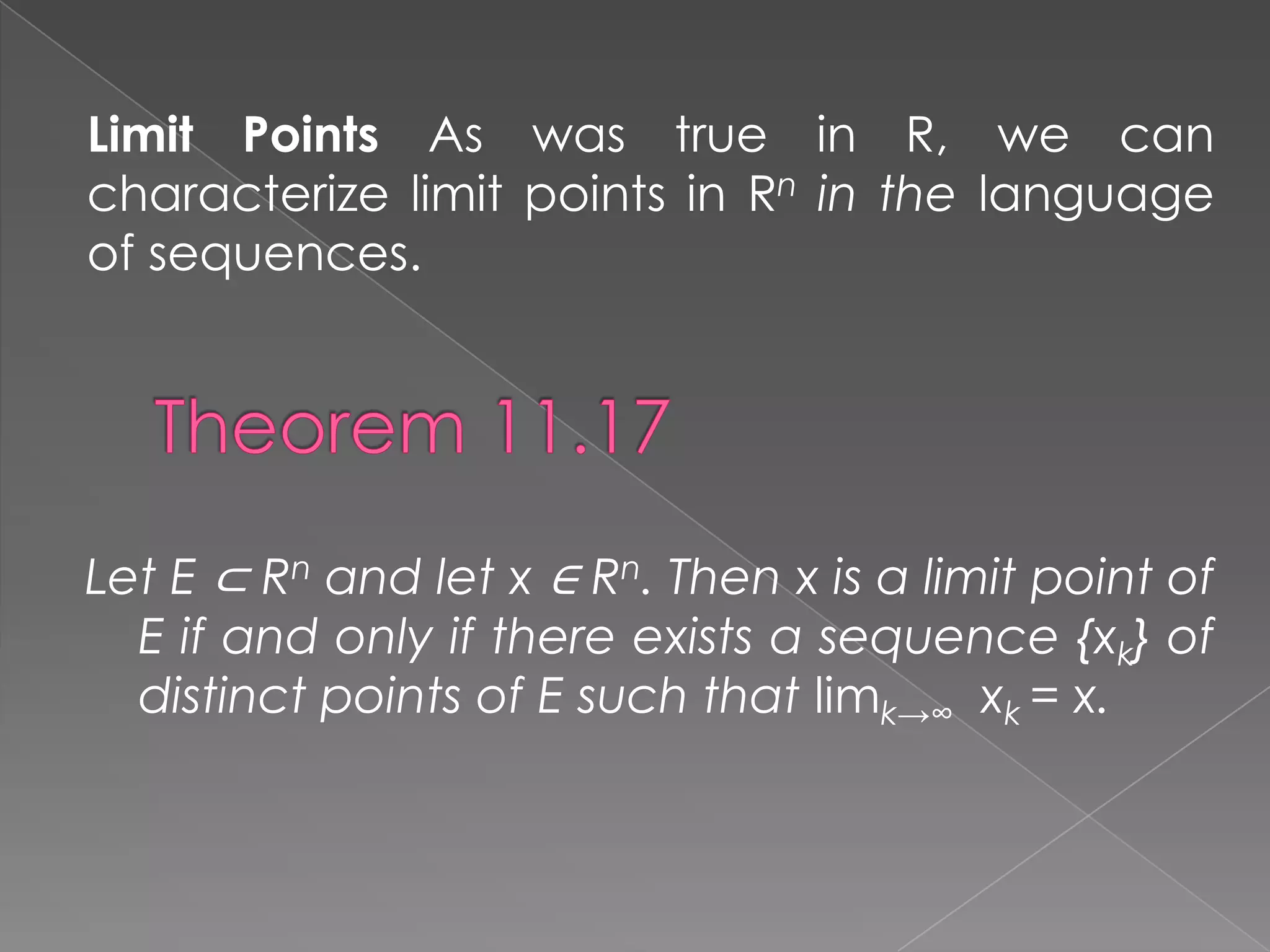
Limit Points As was true in R, we can
characterize limit points in Rn in the language
of sequences.

Let E ⊂ Rn and let x ∈ Rn. Then x is a limit point of
E if and only if there exists a sequence {xk} of
distinct points of E such that limk→∞ xk = x.
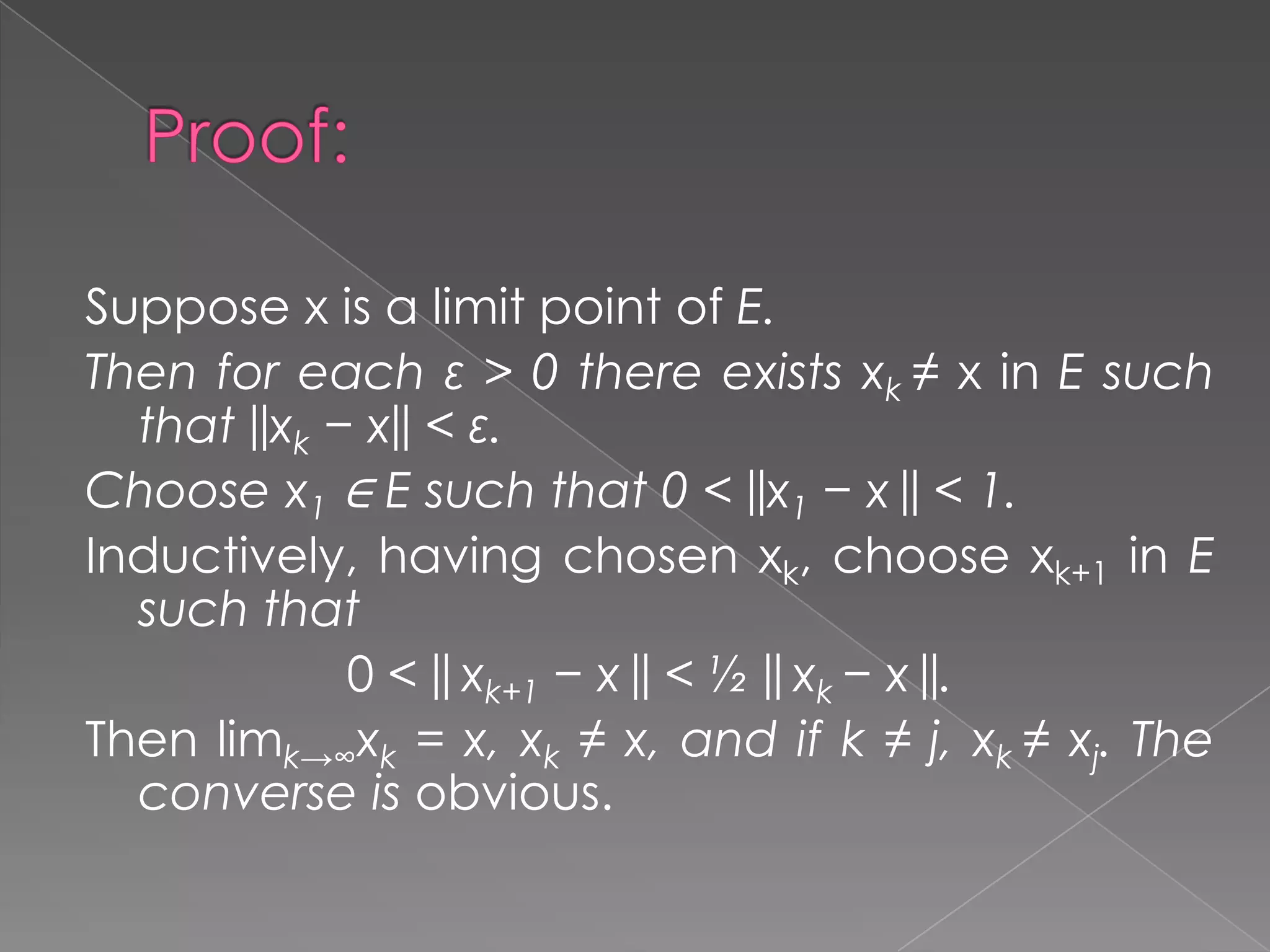
Suppose x is a limit point of E.
Then for each ε > 0 there exists xk ≠ x in E such
that ||xk − x|| < ε.
Choose x1 ∈ E such that 0 < ||x1 − x || < 1.
Inductively, having chosen xk, choose xk+1 in E
such that
0 < || xk+1 − x || < ½ || xk − x ||.
Then limk→∞xk = x, xk ≠ x, and if k ≠ j, xk ≠ xj. The
converse is obvious.
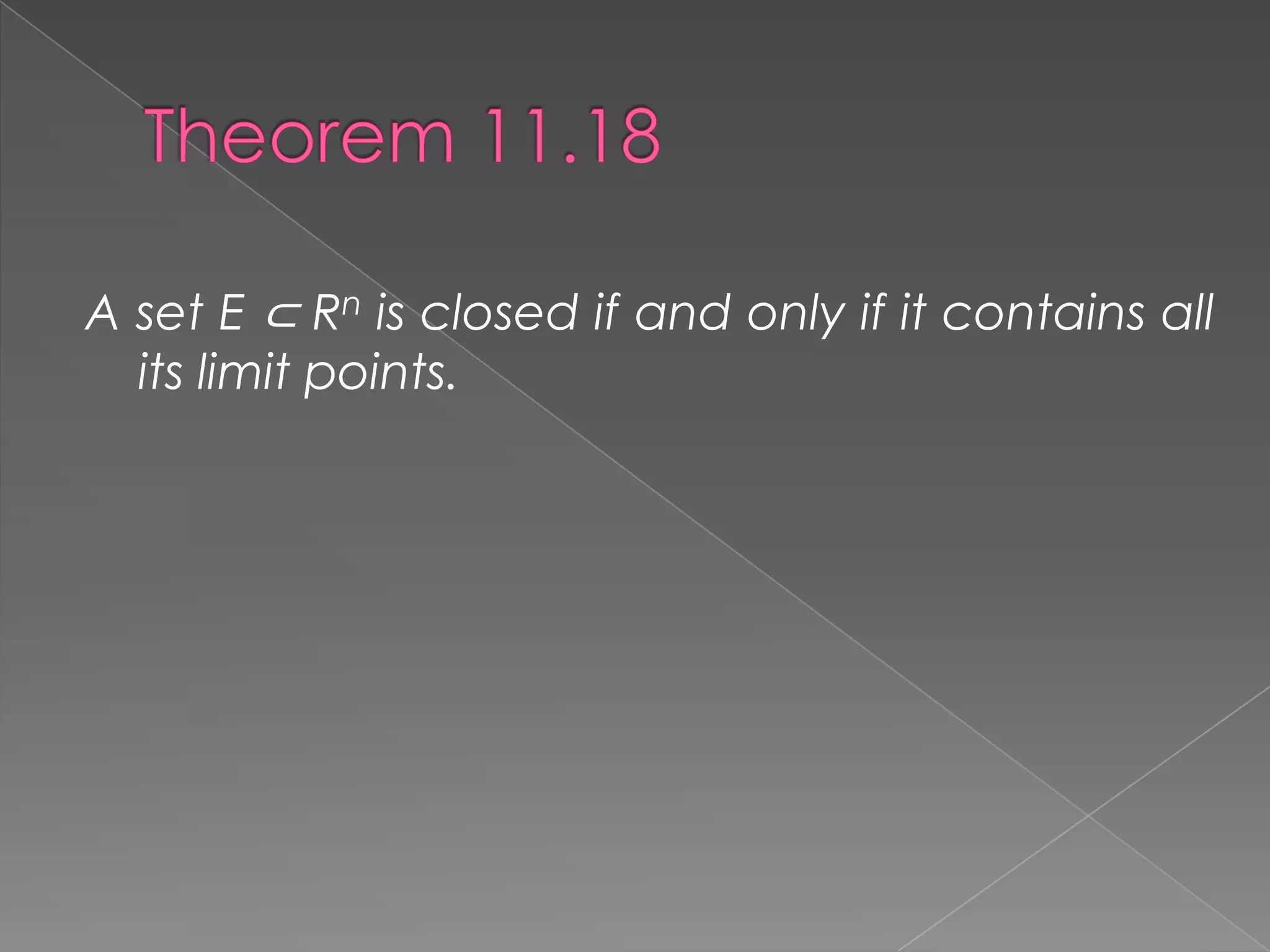
A set E ⊂ Rn is closed if and only if it contains all
its limit points.
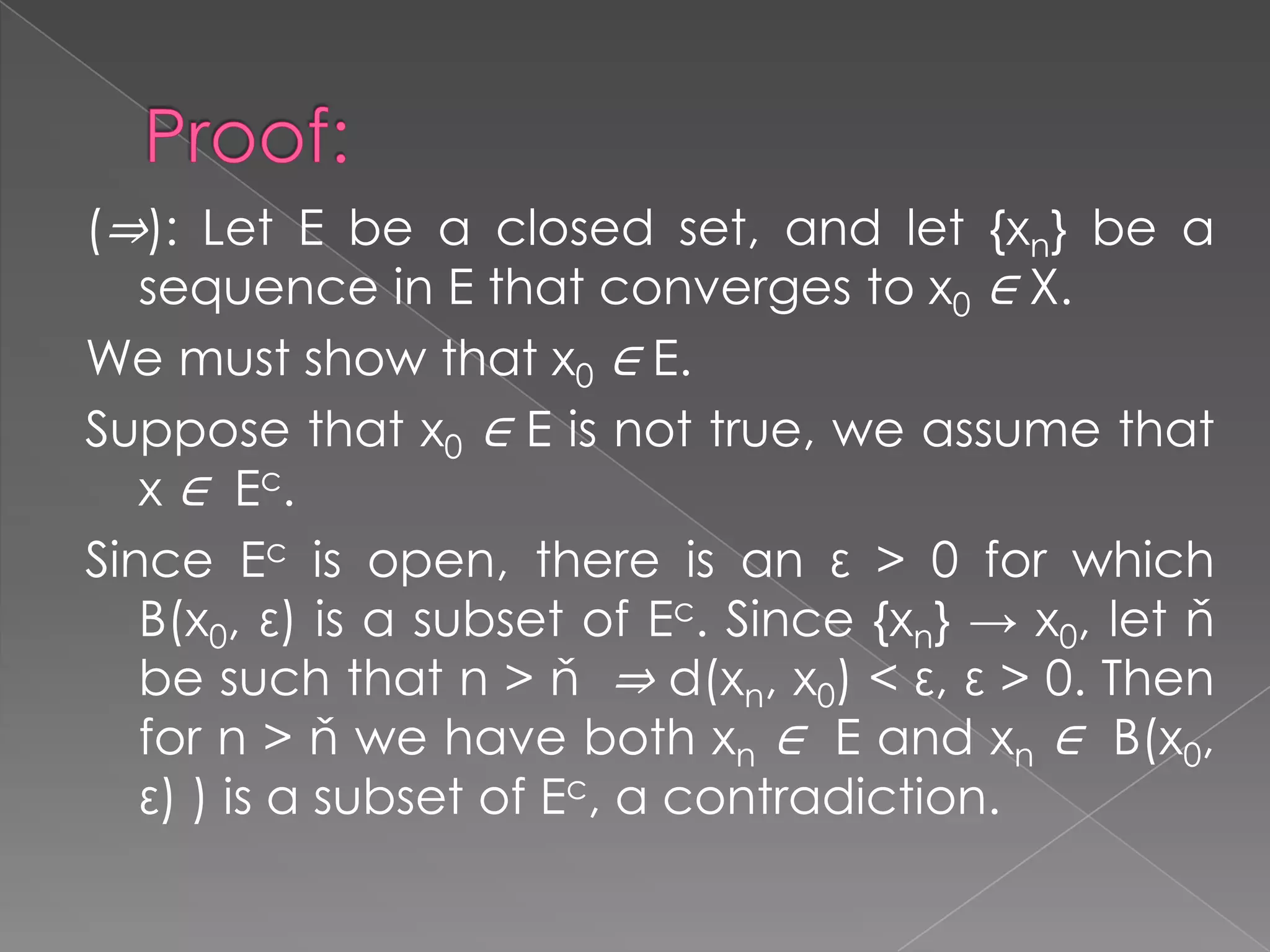
(⇒): Let E be a closed set, and let {xn} be a
sequence in E that converges to x0 ∈ X.
We must show that x0 ∈ E.
Suppose that x0 ∈ E is not true, we assume that
x ∈ E c.
Since Ec is open, there is an ε > 0 for which
B(x0, ε) is a subset of Ec. Since {xn} → x0, let ň
be such that n > ň ⇒ d(xn, x0) < ε, ε > 0. Then
for n > ň we have both xn ∈ E and xn ∈ B(x0,
ε) ) is a subset of Ec, a contradiction.
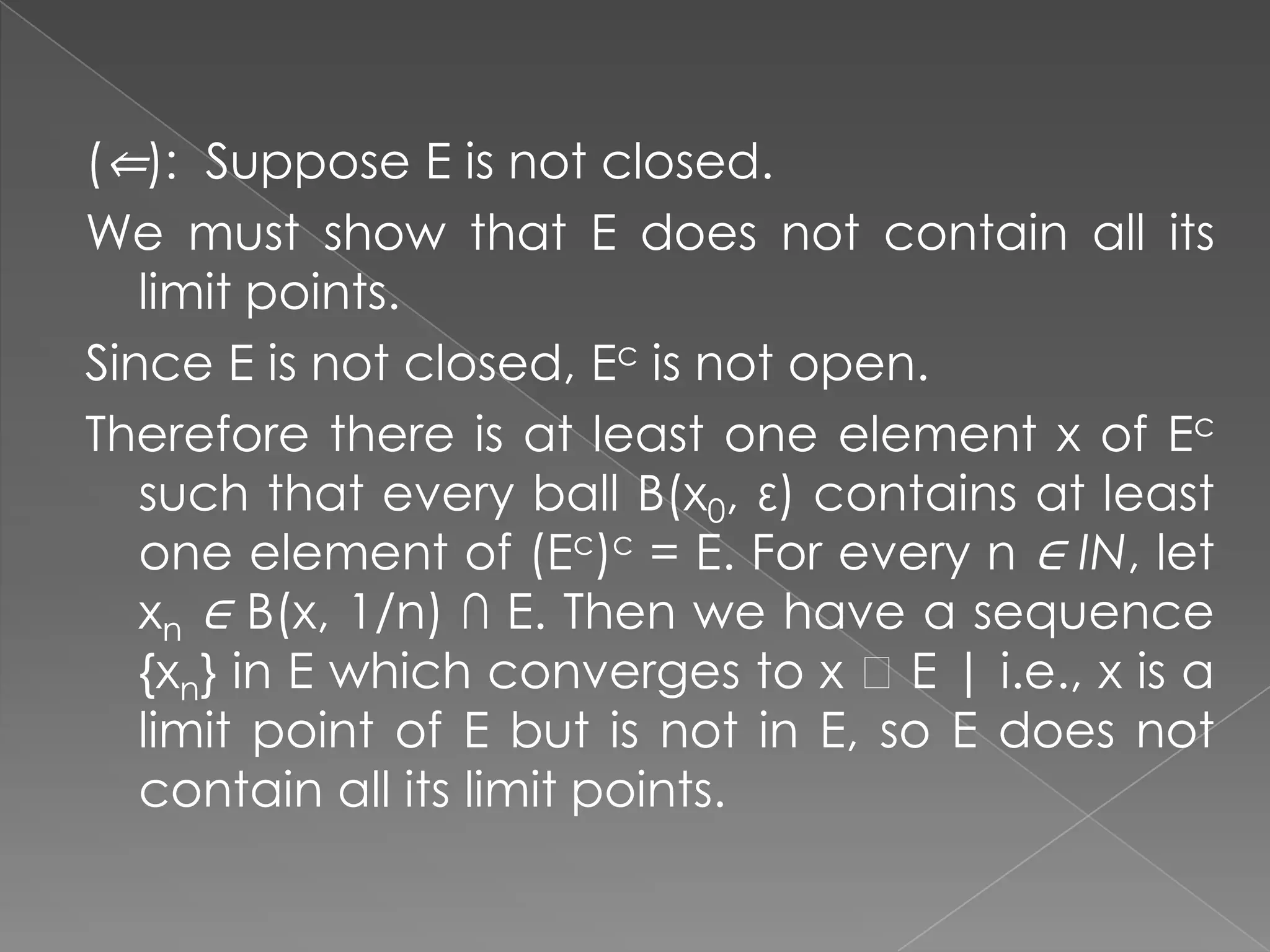
(⇐): Suppose E is not closed.
We must show that E does not contain all its
limit points.
Since E is not closed, Ec is not open.
Therefore there is at least one element x of Ec
such that every ball B(x0, ε) contains at least
one element of (Ec)c = E. For every n ∈ IN, let
xn ∈ B(x, 1/n) ∩ E. Then we have a sequence
{xn} in E which converges to x ɆE | i.e., x is a
limit point of E but is not in E, so E does not
contain all its limit points.
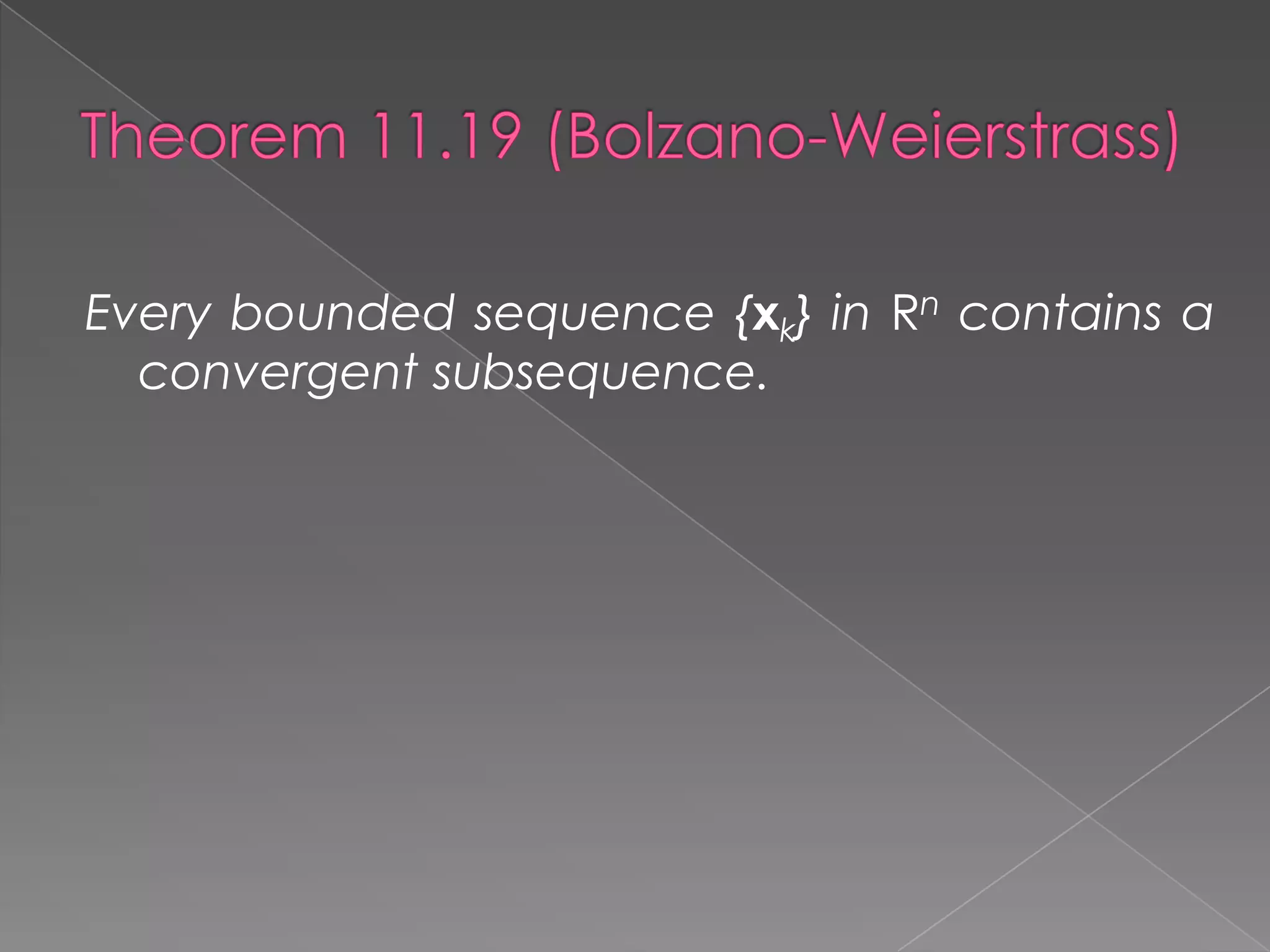
Every bounded sequence {xk} in Rn contains a
convergent subsequence.
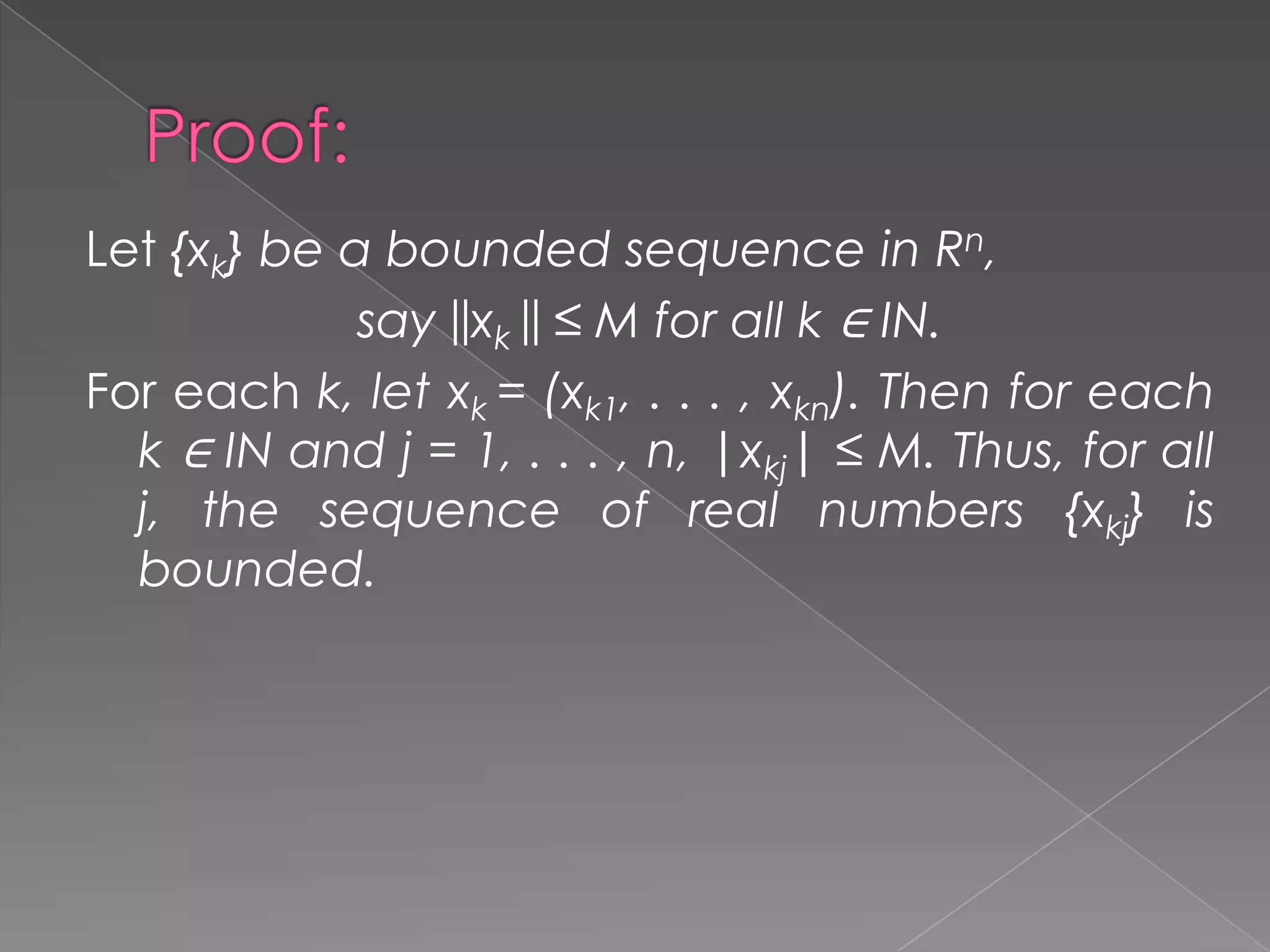
Let {xk} be a bounded sequence in Rn,
say ||xk || ≤ M for all k ∈ IN.
For each k, let xk = (xk1, . . . , xkn). Then for each
k ∈ IN and j = 1, . . . , n, |xkj| ≤ M. Thus, for all
j, the sequence of real numbers {xkj} is
bounded.
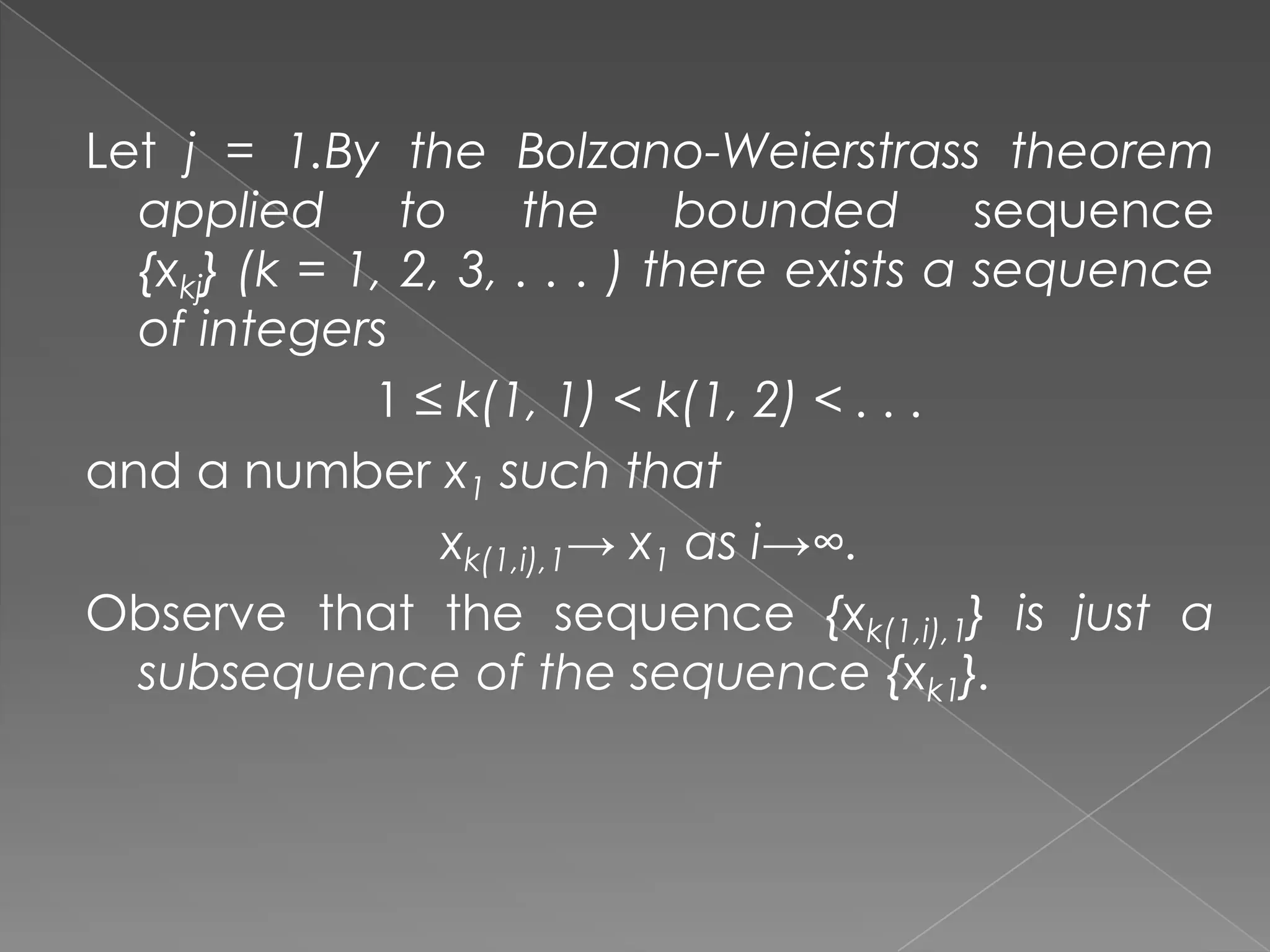
Let j = 1.By the Bolzano-Weierstrass theorem
applied to the bounded sequence
{xkj} (k = 1, 2, 3, . . . ) there exists a sequence
of integers
1 ≤ k(1, 1) < k(1, 2) < . . .
and a number x1 such that
xk(1,i),1→ x1 as i→∞.
Observe that the sequence {xk(1,i),1} is just a
subsequence of the sequence {xk1}.
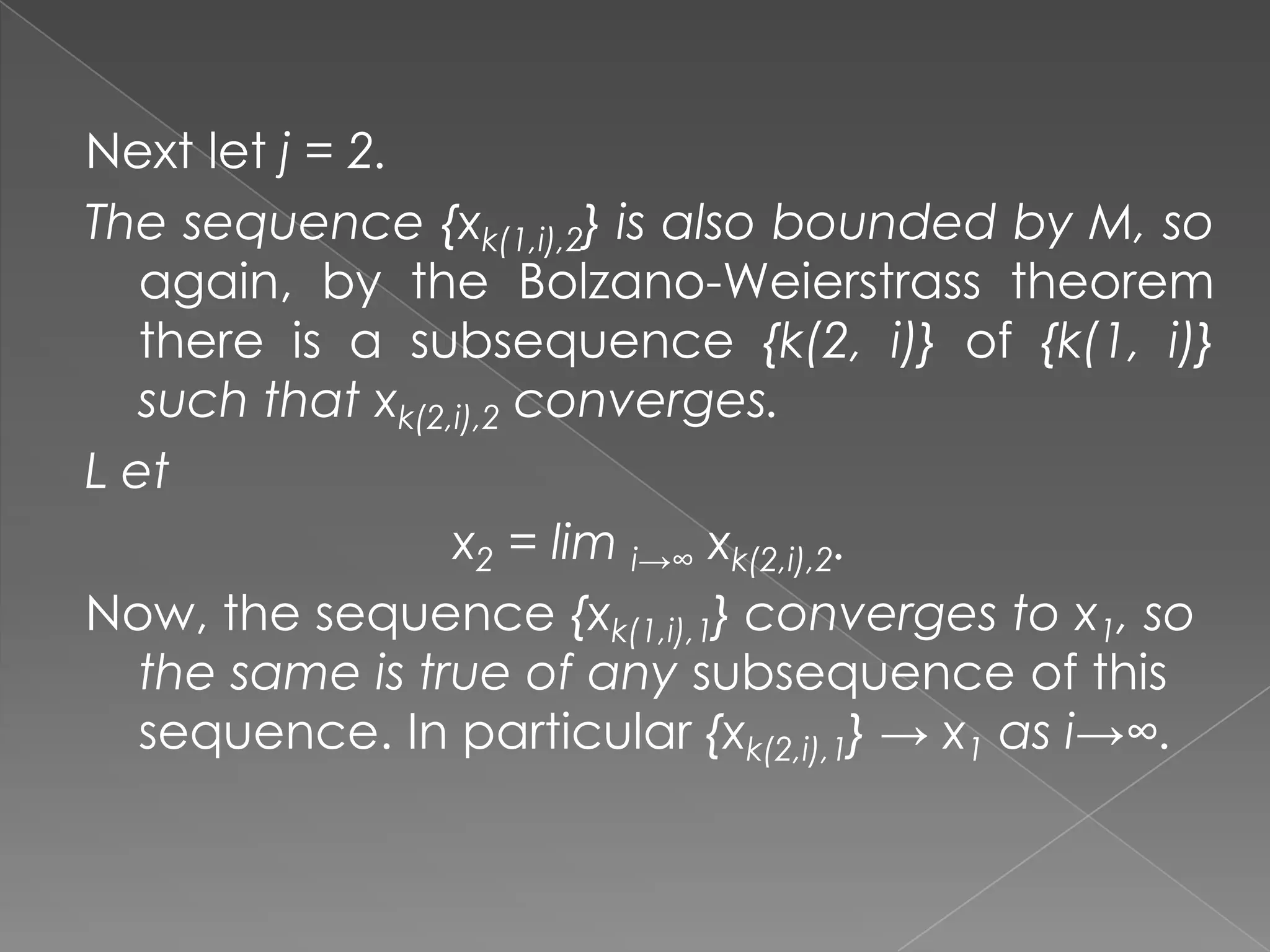
Next let j = 2.
The sequence {xk(1,i),2} is also bounded by M, so
again, by the Bolzano-Weierstrass theorem
there is a subsequence {k(2, i)} of {k(1, i)}
such that xk(2,i),2 converges.
L et
x2 = lim i→∞ xk(2,i),2.
Now, the sequence {xk(1,i),1} converges to x1, so
the same is true of any subsequence of this
sequence. In particular {xk(2,i),1} → x1 as i→∞.
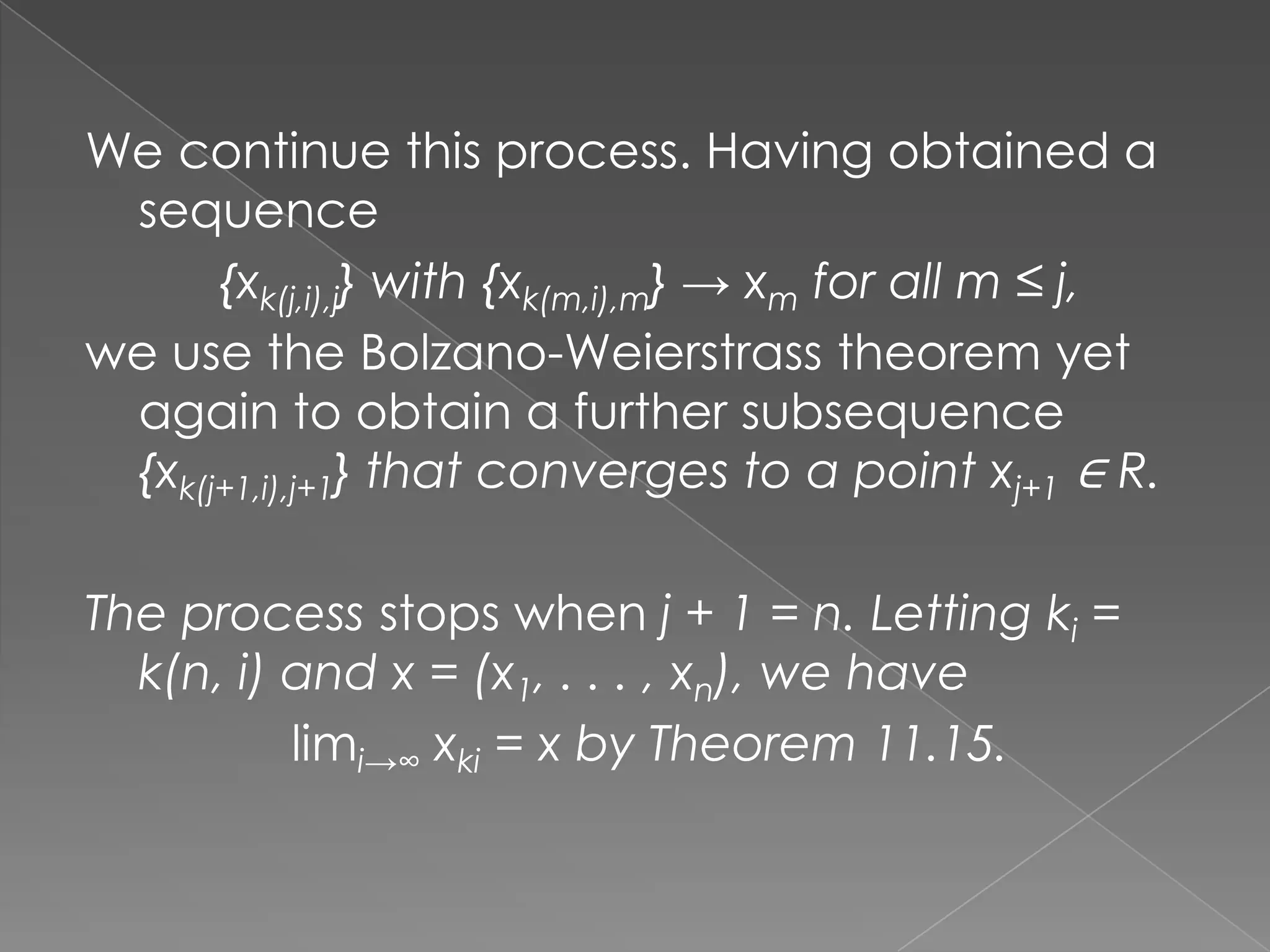
We continue this process. Having obtained a
sequence
{xk(j,i),j} with {xk(m,i),m} → xm for all m ≤ j,
we use the Bolzano-Weierstrass theorem yet
again to obtain a further subsequence
{xk(j+1,i),j+1} that converges to a point xj+1 ∈ R.
The process stops when j + 1 = n. Letting ki =
k(n, i) and x = (x1, . . . , xn), we have
limi→∞ xki = x by Theorem 11.15.
The Euclidean Spaces (elementary topology and sequences)

The Euclidean Spaces (elementary topology and sequences)

  • 1.
  • 2.
    Let x0 ∈R, and let r > 0. The set B(x0, r) = {x : ||x − x0 || < r} is called the open ball of radius r centered at x0. It is also called the r-neighborhood of x0 which consists the points in Rn whose distance from x0 is less than r.
  • 3.
    We define anumber of terms, familiar in our study of R, in terms of this simple concept. 1. A set E in Rn is open if to each x0 ∈ E there corresponds an ε > 0 such that B(x0, ε) ⊂ E. An open set containing a point x0 is also called a neighborhood of x0.
  • 4.
    2. A setE in Rn is closed if Rn E is open. 3. A point x0 ∈ E ⊂ Rn is an accumulation point, or limit point, of E if every open ball centered at x0 contains points of E other than X0. We shall use the terms “accumulation point” and “limit point” interchangeably.
  • 5.
    4. A pointx0 ∈ Rn is a boundary point of a set E ⊂ Rn provided that for each ε > 0, B(x0, ε) ∩ E ≠ ∅ and B(x0, ε) E ≠ ∅. 5. A set E ⊂ Rn is bounded if there exists M>0 such that E ⊂ B(0,M).
  • 6.
    Example The set E3 =Q × Q = {(x, y) : x and y are rational}.
  • 7.
    • The setis neither open nor closed. • Every point in R2 is an accumulation point of E3 and a boundary point of E3. • E3 is not bounded in R2.
  • 9.
    A sequence ofpoints in Rn is a function f : IN → Rn. As was the case for sequences in R, we will frequently use notation such as {xk} to denote a sequence in Rn. Here each vector xk can be written as an n-tuple using double subscript notation: xk = (xk1 xk2, . . . , xkn).
  • 10.
    A sequence {xk}in Rn is bounded if there exists M ∈ IN such that ||xk|| ≤ M for all k ∈ IN. We can define convergence of a sequence {xk} in Rn in the same way as we did for sequences of real numbers (Definition 2.6). Note that here the norm plays the same role that the absolute value did earlier.
  • 11.
    Let {xk} bea sequence in Rn. We say {xk} converges to a point x and write lim xk = x k→∞ or xk → x as k→∞ provided that for each ε > 0 there exists N ∈ IN such that || xk – x || < ε whenever k ≥ N.
  • 12.
    This definition isequivalent to the requirement that every open ball centered at x contains all but a finite number of terms of the sequence: For each ε > 0 there exists N such that xk ∈ B(x, ε) for all k ≥ N. It is also equivalent to the requirements || xk − x || → 0 or d(xk, x) → 0 as k→∞, where d is the euclidean distance.
  • 13.
    We can alsodescribe convergence in Rn in terms of coordinate-wise convergence. T o see this, observe first that for x = (x1, x2, . . . , xn) and j = 1, . . . , n, n n Thus x j 2 ≤ Σ xi2 = ||x||2 ≤ ( Σ|xi|)2. i=1 i=1 n |xj| ≤ ||x|| ≤ Σ |xi|. i=1 (7)
  • 14.
    Now let {xk} ={(xk1 , xk2 , . . . , xkn)} be a sequence in Rn, and let x = (x1, x2 , . . . , xn) be a point in Rn. By (7) |xkj − xj| ≤ ||xk − x|| ≤ n Σ |xki − xi|. i=1 (8)
  • 15.
    If xk →x as k→∞, that is, ||xk − x|| → 0 as k → ∞, then we see from (8) that for each j = 1, . . . , n, |xkj − xj| → 0 as k → ∞. Conversely, if for each j = 1, . . . , n we have |xkj − xj| → 0 as k → 0, then n Σ |xki − xi| → 0 i=1 as k→∞, so we see once again from (8) that ||xk − x|| → 0 as k→∞. We summarize this discussion as a theorem.
  • 16.
    Let {xk} = {(xk1,. . . , xkn)} be a sequence in Rn x = (x1, x2, . . . , xn) ∈ Rn. Then lim xk = x k→∞ and let if and only if for each j = 1, . . . , n, limk→∞ xkj = xj .
  • 17.
    Let {xk} and{yk} be sequences in Rn, and let α ∈ R. If limk→∞ xk = x and limk→∞ yk = y, then i. lim k→∞ (αxk) = αx. ii. lim k→∞ (xk + yk) = x + y. iii. lim k→∞ (xk ・ yk) = x ・ y.
  • 18.
    Limit Points Aswas true in R, we can characterize limit points in Rn in the language of sequences. Let E ⊂ Rn and let x ∈ Rn. Then x is a limit point of E if and only if there exists a sequence {xk} of distinct points of E such that limk→∞ xk = x.
  • 19.
    Suppose x isa limit point of E. Then for each ε > 0 there exists xk ≠ x in E such that ||xk − x|| < ε. Choose x1 ∈ E such that 0 < ||x1 − x || < 1. Inductively, having chosen xk, choose xk+1 in E such that 0 < || xk+1 − x || < ½ || xk − x ||. Then limk→∞xk = x, xk ≠ x, and if k ≠ j, xk ≠ xj. The converse is obvious.
  • 20.
    A set E⊂ Rn is closed if and only if it contains all its limit points.
  • 21.
    (⇒): Let Ebe a closed set, and let {xn} be a sequence in E that converges to x0 ∈ X. We must show that x0 ∈ E. Suppose that x0 ∈ E is not true, we assume that x ∈ E c. Since Ec is open, there is an ε > 0 for which B(x0, ε) is a subset of Ec. Since {xn} → x0, let ň be such that n > ň ⇒ d(xn, x0) < ε, ε > 0. Then for n > ň we have both xn ∈ E and xn ∈ B(x0, ε) ) is a subset of Ec, a contradiction.
  • 22.
    (⇐): Suppose Eis not closed. We must show that E does not contain all its limit points. Since E is not closed, Ec is not open. Therefore there is at least one element x of Ec such that every ball B(x0, ε) contains at least one element of (Ec)c = E. For every n ∈ IN, let xn ∈ B(x, 1/n) ∩ E. Then we have a sequence {xn} in E which converges to x ɆE | i.e., x is a limit point of E but is not in E, so E does not contain all its limit points.
  • 23.
    Every bounded sequence{xk} in Rn contains a convergent subsequence.
  • 24.
    Let {xk} bea bounded sequence in Rn, say ||xk || ≤ M for all k ∈ IN. For each k, let xk = (xk1, . . . , xkn). Then for each k ∈ IN and j = 1, . . . , n, |xkj| ≤ M. Thus, for all j, the sequence of real numbers {xkj} is bounded.
  • 25.
    Let j =1.By the Bolzano-Weierstrass theorem applied to the bounded sequence {xkj} (k = 1, 2, 3, . . . ) there exists a sequence of integers 1 ≤ k(1, 1) < k(1, 2) < . . . and a number x1 such that xk(1,i),1→ x1 as i→∞. Observe that the sequence {xk(1,i),1} is just a subsequence of the sequence {xk1}.
  • 26.
    Next let j= 2. The sequence {xk(1,i),2} is also bounded by M, so again, by the Bolzano-Weierstrass theorem there is a subsequence {k(2, i)} of {k(1, i)} such that xk(2,i),2 converges. L et x2 = lim i→∞ xk(2,i),2. Now, the sequence {xk(1,i),1} converges to x1, so the same is true of any subsequence of this sequence. In particular {xk(2,i),1} → x1 as i→∞.
  • 27.
    We continue thisprocess. Having obtained a sequence {xk(j,i),j} with {xk(m,i),m} → xm for all m ≤ j, we use the Bolzano-Weierstrass theorem yet again to obtain a further subsequence {xk(j+1,i),j+1} that converges to a point xj+1 ∈ R. The process stops when j + 1 = n. Letting ki = k(n, i) and x = (x1, . . . , xn), we have limi→∞ xki = x by Theorem 11.15.