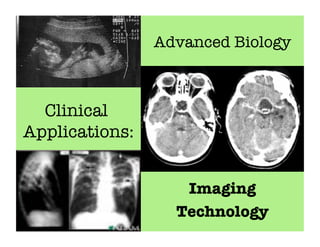
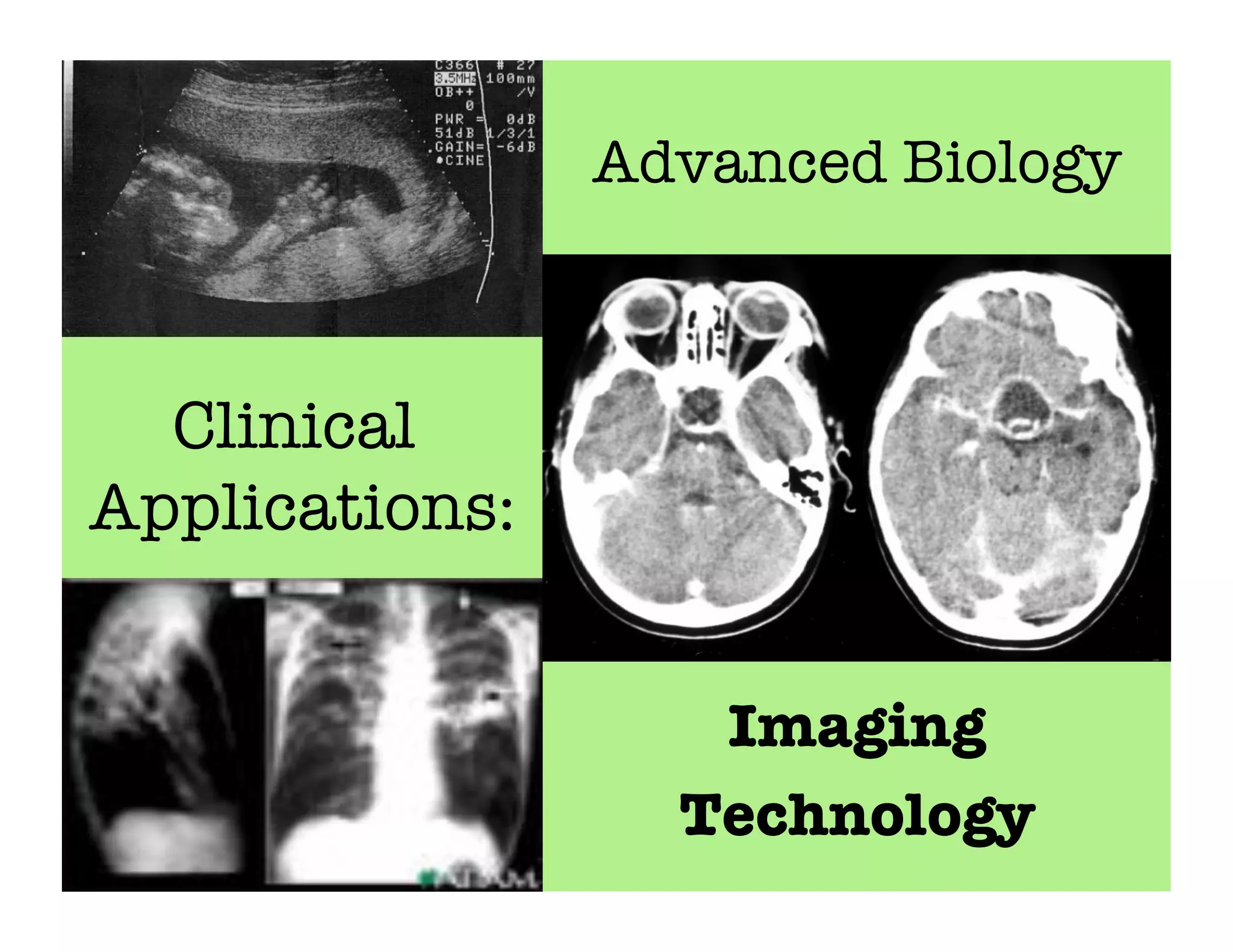
Advanced Biology


  Clinical
Applications:


                   Imaging
                  Technology
Imaging Technology

              Why?
• Imaging allows physicians to view
  internal structures and diagnose
  diseases and conditions

• Technology has steadily improved
  throughout the 20th century
Background	


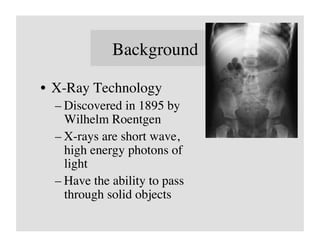
•  X-Ray Technology	

  – Discovered in 1895 by
    Wilhelm Roentgen	

  – X-rays are short wave,
    high energy photons of
    light	

  – Have the ability to pass
    through solid objects
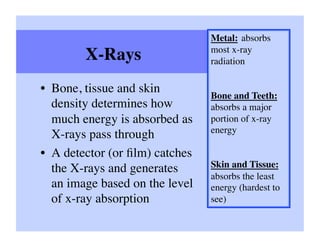
Metal: absorbs
                                 most x-ray
        X-Rays	

                radiation	


•  Bone, tissue and skin
                                 Bone and Teeth:
   density determines how        absorbs a major
   much energy is absorbed as    portion of x-ray
                                 energy	

   X-rays pass through	

•  A detector (or film) catches
   the X-rays and generates      Skin and Tissue:
                                 absorbs the least
   an image based on the level   energy (hardest to
   of x-ray absorption	

        see)
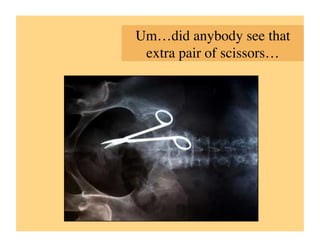
Um…did anybody see that
 extra pair of scissors…
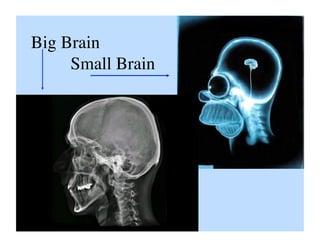
Big Brain
     Small Brain
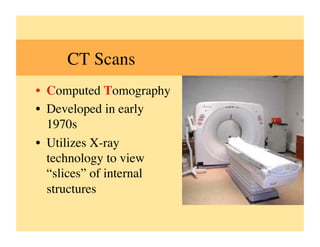
CT Scans	

•  Computed Tomography	

•  Developed in early
   1970s	

•  Utilizes X-ray
   technology to view
   “slices” of internal
   structures
How CT works…	

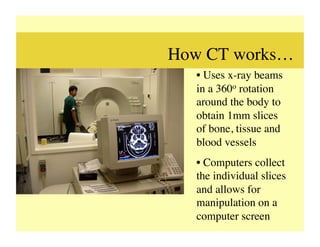
   •  Uses x-ray beams
   in a 360o rotation
   around the body to
   obtain 1mm slices
   of bone, tissue and
   blood vessels	

   •  Computers collect
   the individual slices
   and allows for
   manipulation on a
   computer screen
Special Features	

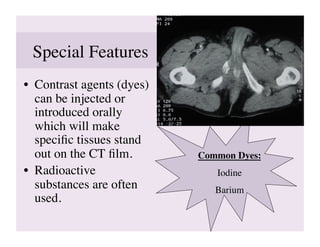
•  Contrast agents (dyes)
   can be injected or
   introduced orally
   which will make
   specific tissues stand
   out on the CT film.	

    Common Dyes:
                                       	

•  Radioactive                  Iodine
                                     	

   substances are often        Barium	

   used.
Uses of CT Scans	


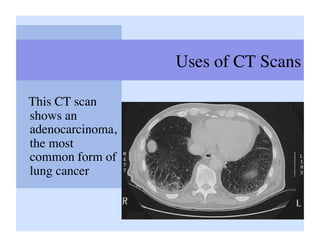
This CT scan
shows an
adenocarcinoma,
the most
common form of
lung cancer
Uses of CT Scans	


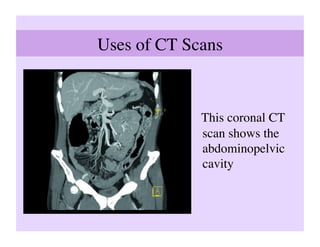
               This coronal CT
               scan shows the
               abdominopelvic
               cavity
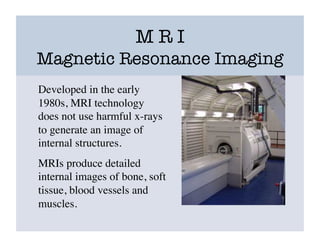
M R I
Magnetic Resonance Imaging
Developed in the early
1980s, MRI technology
does not use harmful x-rays
to generate an image of
internal structures.	
MRIs produce detailed
internal images of bone, soft
tissue, blood vessels and
muscles.
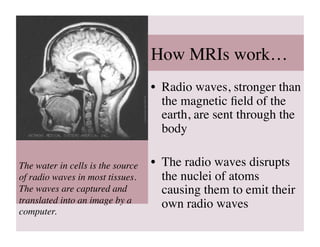
How MRIs work…	

                                   •  Radio waves, stronger than
                                      the magnetic field of the
                                      earth, are sent through the
                                      body	


The water in cells is the source   •  The radio waves disrupts
of radio waves in most tissues.       the nuclei of atoms
The waves are captured and            causing them to emit their
translated into an image by a         own radio waves	

computer.
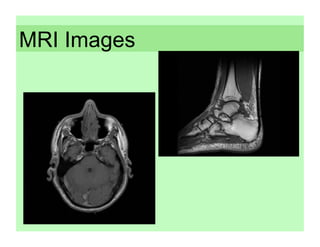
MRI Images
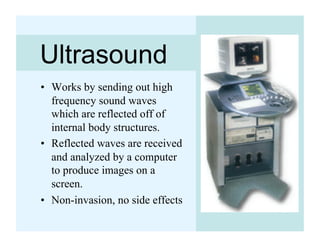
Ultrasound
•  Works by sending out high
   frequency sound waves
   which are reflected off of
   internal body structures.
•  Reflected waves are received
   and analyzed by a computer
   to produce images on a
   screen.
•  Non-invasion, no side effects
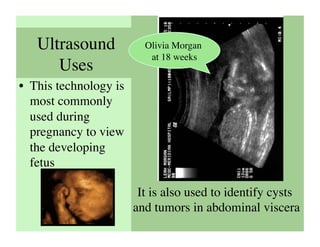
Ultrasound             Olivia Morgan
                           at 18 weeks	

      Uses	

•  This technology is
   most commonly
   used during
   pregnancy to view
   the developing
   fetus	


                         It is also used to identify cysts
                        and tumors in abdominal viscera
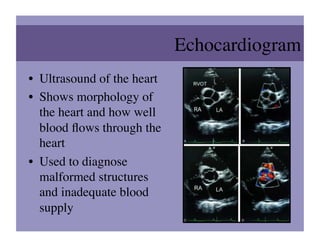
Echocardiogram 	

•  Ultrasound of the heart	

•  Shows morphology of
   the heart and how well
   blood flows through the
   heart	

•  Used to diagnose
   malformed structures
   and inadequate blood
   supply
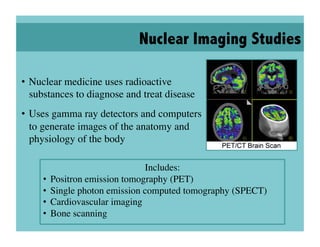
Nuclear Imaging Studies

•  Nuclear medicine uses radioactive
   substances to diagnose and treat disease	

•  Uses gamma ray detectors and computers
   to generate images of the anatomy and
   physiology of the body	


                                  Includes:
                                          	

     •  Positron emission tomography (PET)	

     •  Single photon emission computed tomography (SPECT)	

     •  Cardiovascular imaging	

     •  Bone scanning
PET Scan
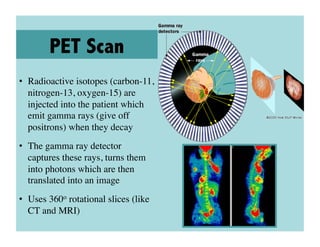
•  Radioactive isotopes (carbon-11,
   nitrogen-13, oxygen-15) are
   injected into the patient which
   emit gamma rays (give off
   positrons) when they decay	

•  The gamma ray detector
   captures these rays, turns them
   into photons which are then
   translated into an image	

•  Uses 360o rotational slices (like
   CT and MRI)
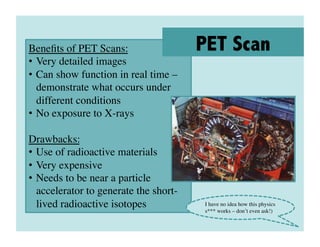
Benefits of PET Scans:	

                PET Scan
•  Very detailed images	

•  Can show function in real time –
   demonstrate what occurs under
   different conditions	

•  No exposure to X-rays	


Drawbacks:	

•  Use of radioactive materials	

•  Very expensive	

•  Needs to be near a particle
   accelerator to generate the short-
   lived radioactive isotopes	

        I have no idea how this physics
                                        s*** works – don’t even ask!)
Cardiovascular Imaging
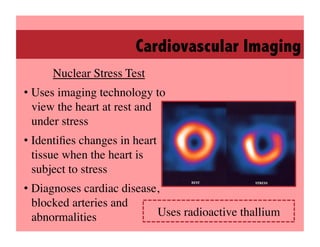
      Nuclear Stress Test
                        	

•  Uses imaging technology to
   view the heart at rest and
   under stress	

•  Identifies changes in heart
   tissue when the heart is
   subject to stress	

•  Diagnoses cardiac disease,
   blocked arteries and
   abnormalities	

         Uses radioactive thallium
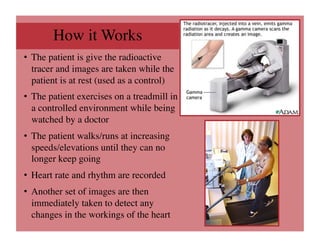
How it Works
                   	

•  The patient is give the radioactive
   tracer and images are taken while the
   patient is at rest (used as a control)	

•  The patient exercises on a treadmill in
   a controlled environment while being
   watched by a doctor	

•  The patient walks/runs at increasing
   speeds/elevations until they can no
   longer keep going	

•  Heart rate and rhythm are recorded	

•  Another set of images are then
   immediately taken to detect any
   changes in the workings of the heart
Ooooh… a

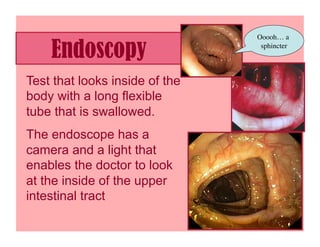
    Endoscopy                    sphincter


Test that looks inside of the
body with a long flexible
tube that is swallowed.
The endoscope has a
camera and a light that
enables the doctor to look
at the inside of the upper
intestinal tract
Endoscopy
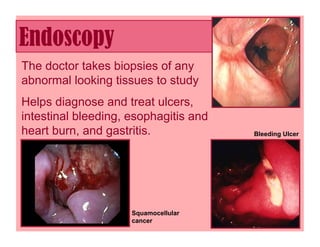
The doctor takes biopsies of any
abnormal looking tissues to study
Helps diagnose and treat ulcers,
intestinal bleeding, esophagitis and
heart burn, and gastritis.             Bleeding Ulcer


                     Squamocellular
                     cancer
Colonoscopy
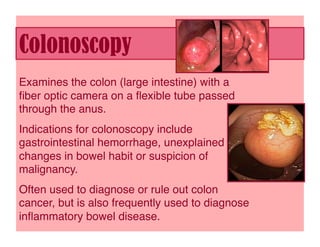
Examines the colon (large intestine) with a
fiber optic camera on a flexible tube passed
through the anus.
Indications for colonoscopy include
gastrointestinal hemorrhage, unexplained
changes in bowel habit or suspicion of
malignancy. 
Often used to diagnose or rule out colon
cancer, but is also frequently used to diagnose
inflammatory bowel disease.
Colonoscopy
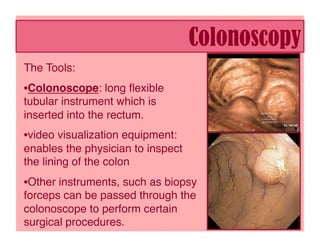
The Tools:
• Colonoscope: long flexible
tubular instrument which is
inserted into the rectum. 
• video visualization equipment:
enables the physician to inspect
the lining of the colon 
• Other instruments, such as biopsy
forceps can be passed through the
colonoscope to perform certain
surgical procedures.

Imaging powerpoint

  • 1.
    Advanced Biology Clinical Applications: Imaging Technology
  • 2.
    Imaging Technology Why? • Imaging allows physicians to view internal structures and diagnose diseases and conditions • Technology has steadily improved throughout the 20th century
  • 3.
    Background •  X-Ray Technology – Discovered in 1895 by Wilhelm Roentgen – X-rays are short wave, high energy photons of light – Have the ability to pass through solid objects
  • 4.
    Metal: absorbs most x-ray X-Rays radiation •  Bone, tissue and skin Bone and Teeth: density determines how absorbs a major much energy is absorbed as portion of x-ray energy X-rays pass through •  A detector (or film) catches the X-rays and generates Skin and Tissue: absorbs the least an image based on the level energy (hardest to of x-ray absorption see)
  • 5.
    Um…did anybody seethat extra pair of scissors…
  • 6.
    Big Brain Small Brain
  • 7.
    CT Scans •  ComputedTomography •  Developed in early 1970s •  Utilizes X-ray technology to view “slices” of internal structures
  • 8.
    How CT works… •  Uses x-ray beams in a 360o rotation around the body to obtain 1mm slices of bone, tissue and blood vessels •  Computers collect the individual slices and allows for manipulation on a computer screen
  • 9.
    Special Features •  Contrastagents (dyes) can be injected or introduced orally which will make specific tissues stand out on the CT film. Common Dyes: •  Radioactive Iodine substances are often Barium used.
  • 10.
    Uses of CTScans This CT scan shows an adenocarcinoma, the most common form of lung cancer
  • 11.
    Uses of CTScans This coronal CT scan shows the abdominopelvic cavity
  • 12.
    M R I MagneticResonance Imaging Developed in the early 1980s, MRI technology does not use harmful x-rays to generate an image of internal structures. MRIs produce detailed internal images of bone, soft tissue, blood vessels and muscles.
  • 13.
    How MRIs work… •  Radio waves, stronger than the magnetic field of the earth, are sent through the body The water in cells is the source •  The radio waves disrupts of radio waves in most tissues. the nuclei of atoms The waves are captured and causing them to emit their translated into an image by a own radio waves computer.
  • 14.
  • 15.
    Ultrasound •  Works bysending out high frequency sound waves which are reflected off of internal body structures. •  Reflected waves are received and analyzed by a computer to produce images on a screen. •  Non-invasion, no side effects
  • 16.
    Ultrasound Olivia Morgan at 18 weeks Uses •  This technology is most commonly used during pregnancy to view the developing fetus It is also used to identify cysts and tumors in abdominal viscera
  • 17.
    Echocardiogram •  Ultrasoundof the heart •  Shows morphology of the heart and how well blood flows through the heart •  Used to diagnose malformed structures and inadequate blood supply
  • 18.
    Nuclear Imaging Studies • Nuclear medicine uses radioactive substances to diagnose and treat disease •  Uses gamma ray detectors and computers to generate images of the anatomy and physiology of the body Includes: •  Positron emission tomography (PET) •  Single photon emission computed tomography (SPECT) •  Cardiovascular imaging •  Bone scanning
  • 19.
    PET Scan •  Radioactiveisotopes (carbon-11, nitrogen-13, oxygen-15) are injected into the patient which emit gamma rays (give off positrons) when they decay •  The gamma ray detector captures these rays, turns them into photons which are then translated into an image •  Uses 360o rotational slices (like CT and MRI)
  • 20.
    Benefits of PETScans: PET Scan •  Very detailed images •  Can show function in real time – demonstrate what occurs under different conditions •  No exposure to X-rays Drawbacks: •  Use of radioactive materials •  Very expensive •  Needs to be near a particle accelerator to generate the short- lived radioactive isotopes I have no idea how this physics s*** works – don’t even ask!)
  • 21.
    Cardiovascular Imaging Nuclear Stress Test •  Uses imaging technology to view the heart at rest and under stress •  Identifies changes in heart tissue when the heart is subject to stress •  Diagnoses cardiac disease, blocked arteries and abnormalities Uses radioactive thallium
  • 22.
    How it Works •  The patient is give the radioactive tracer and images are taken while the patient is at rest (used as a control) •  The patient exercises on a treadmill in a controlled environment while being watched by a doctor •  The patient walks/runs at increasing speeds/elevations until they can no longer keep going •  Heart rate and rhythm are recorded •  Another set of images are then immediately taken to detect any changes in the workings of the heart
  • 23.
    Ooooh… a Endoscopy sphincter Test that looks inside of the body with a long flexible tube that is swallowed. The endoscope has a camera and a light that enables the doctor to look at the inside of the upper intestinal tract
  • 24.
    Endoscopy The doctor takesbiopsies of any abnormal looking tissues to study Helps diagnose and treat ulcers, intestinal bleeding, esophagitis and heart burn, and gastritis. Bleeding Ulcer Squamocellular cancer
  • 25.
    Colonoscopy Examines the colon(large intestine) with a fiber optic camera on a flexible tube passed through the anus. Indications for colonoscopy include gastrointestinal hemorrhage, unexplained changes in bowel habit or suspicion of malignancy. Often used to diagnose or rule out colon cancer, but is also frequently used to diagnose inflammatory bowel disease.
  • 26.
    Colonoscopy The Tools: • Colonoscope: longflexible tubular instrument which is inserted into the rectum. • video visualization equipment: enables the physician to inspect the lining of the colon • Other instruments, such as biopsy forceps can be passed through the colonoscope to perform certain surgical procedures.