Chapter 16
Document Analysis
Document Analysis
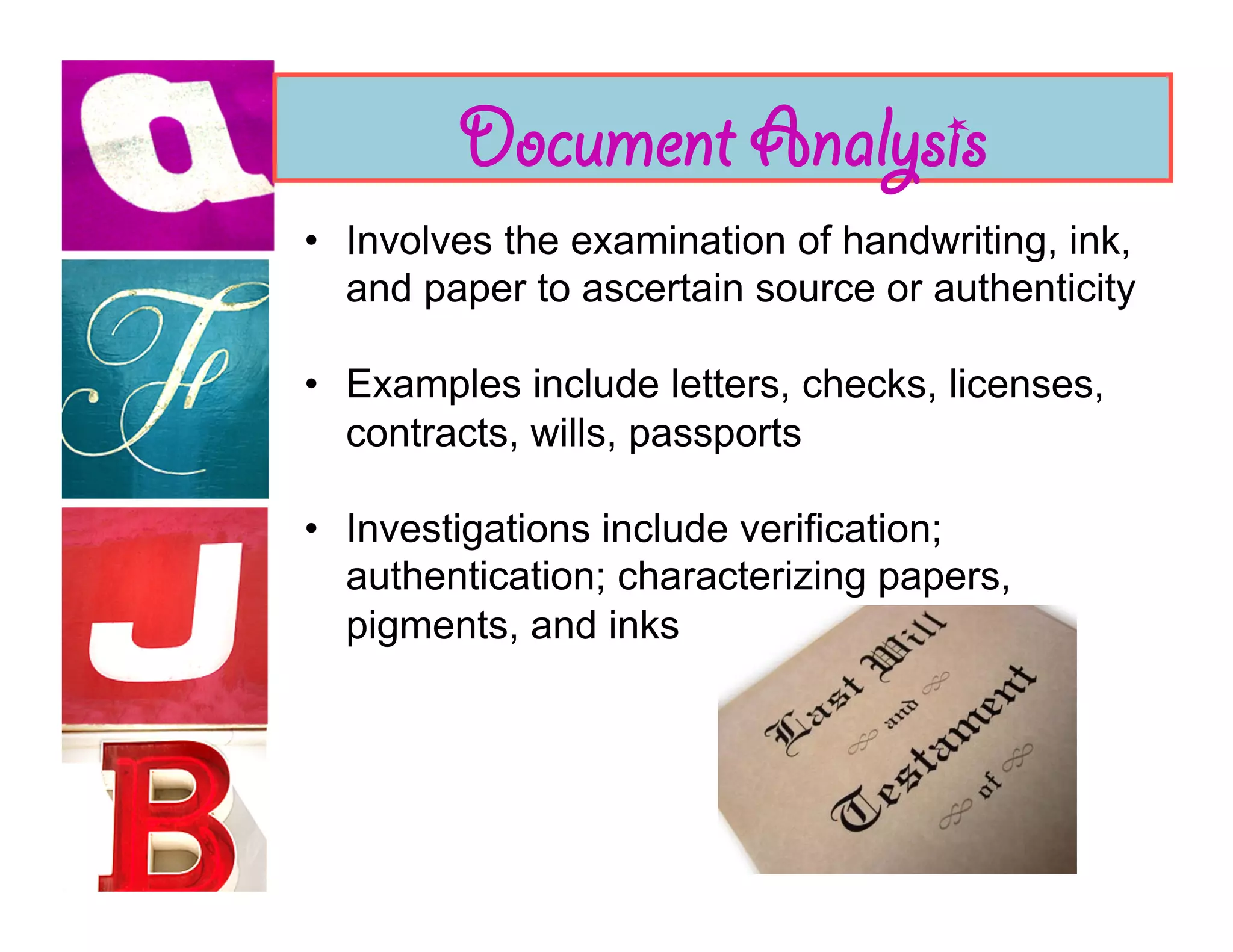
•  Involves the examination of handwriting, ink,
   and paper to ascertain source or authenticity

•  Examples include letters, checks, licenses,
   contracts, wills, passports

•  Investigations include verification;
   authentication; characterizing papers,
   pigments, and inks
Related fields
Historical dating—the verification of age and value
  of a document or object
Fraud investigation—focuses on the money trail and
  criminal intent
Paper and ink specialists—date, type, source, and/
  or catalog various types of paper, watermarks, ink,
  printing/copy/fax machines, computer cartridges
Forgery specialists—analyze altered, obliterated,
  changed, or doctored documents and photos
Typewriting analysts—determine origin, make, and
  model
Computer crime investigators—investigate
  cybercrime
Document Examination
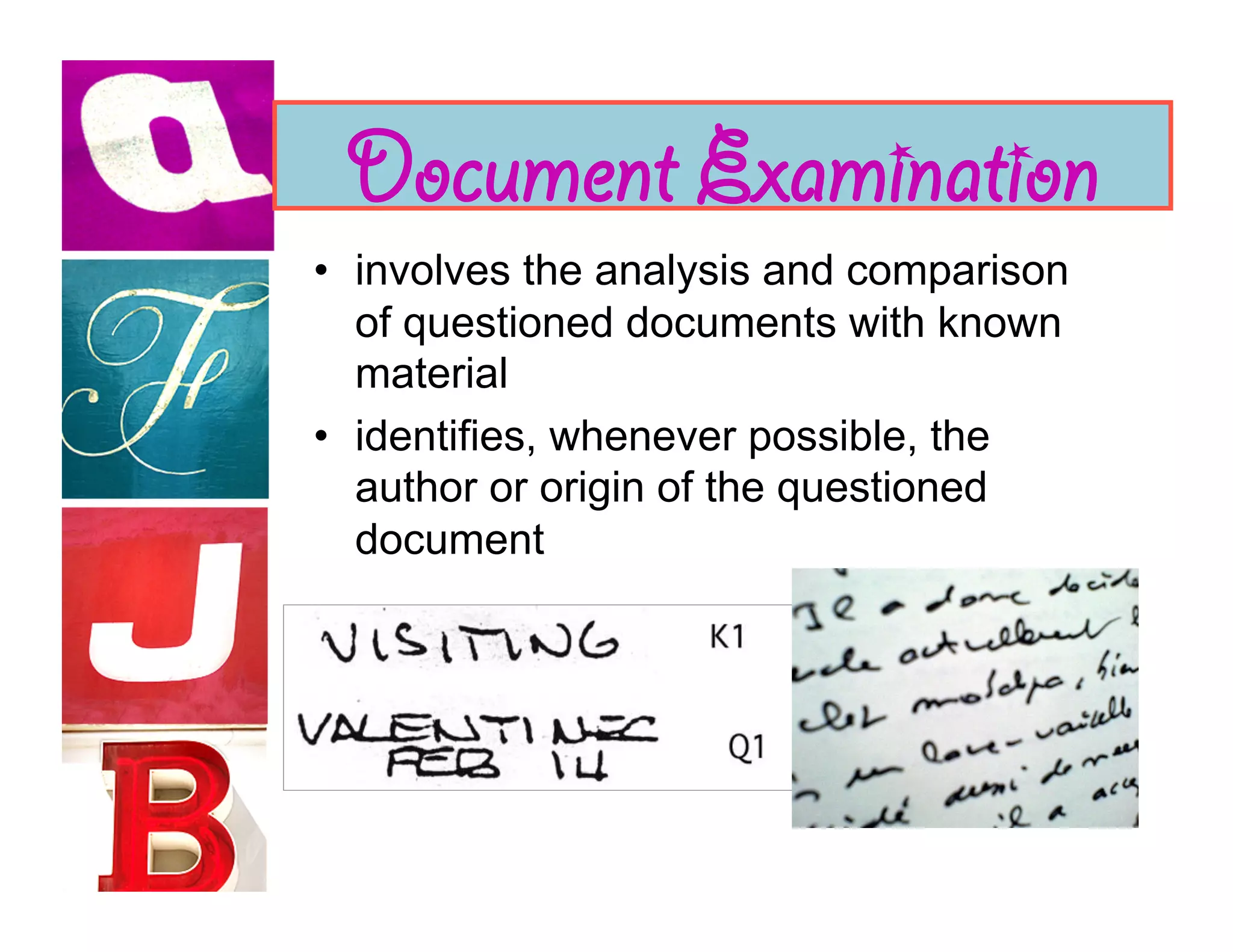
•  involves the analysis and comparison
   of questioned documents with known
   material
•  identifies, whenever possible, the
   author or origin of the questioned
   document
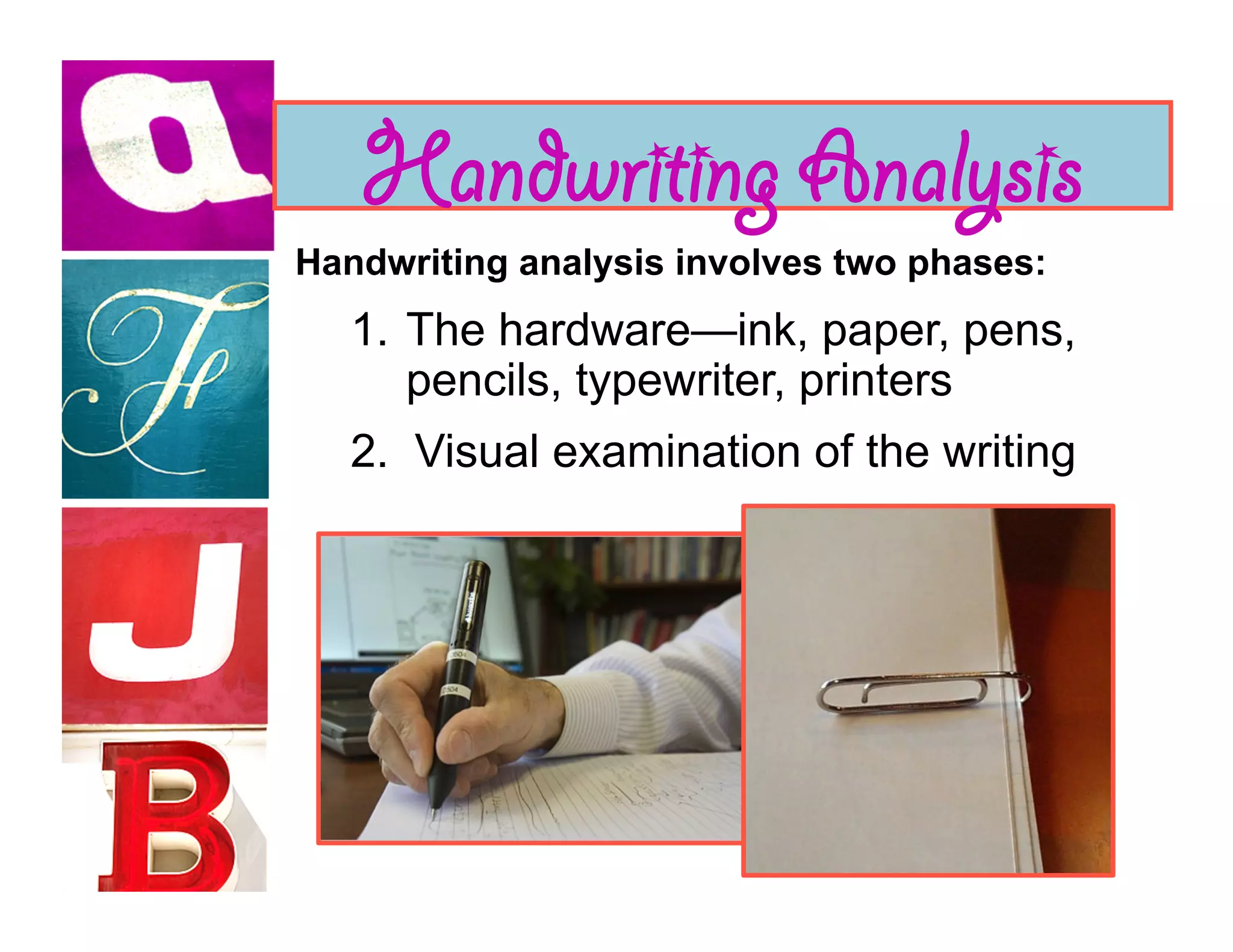
Handwriting Analysis
Handwriting analysis involves two phases:
   1.  The hardware—ink, paper, pens,
       pencils, typewriter, printers
   2. Visual examination of the writing
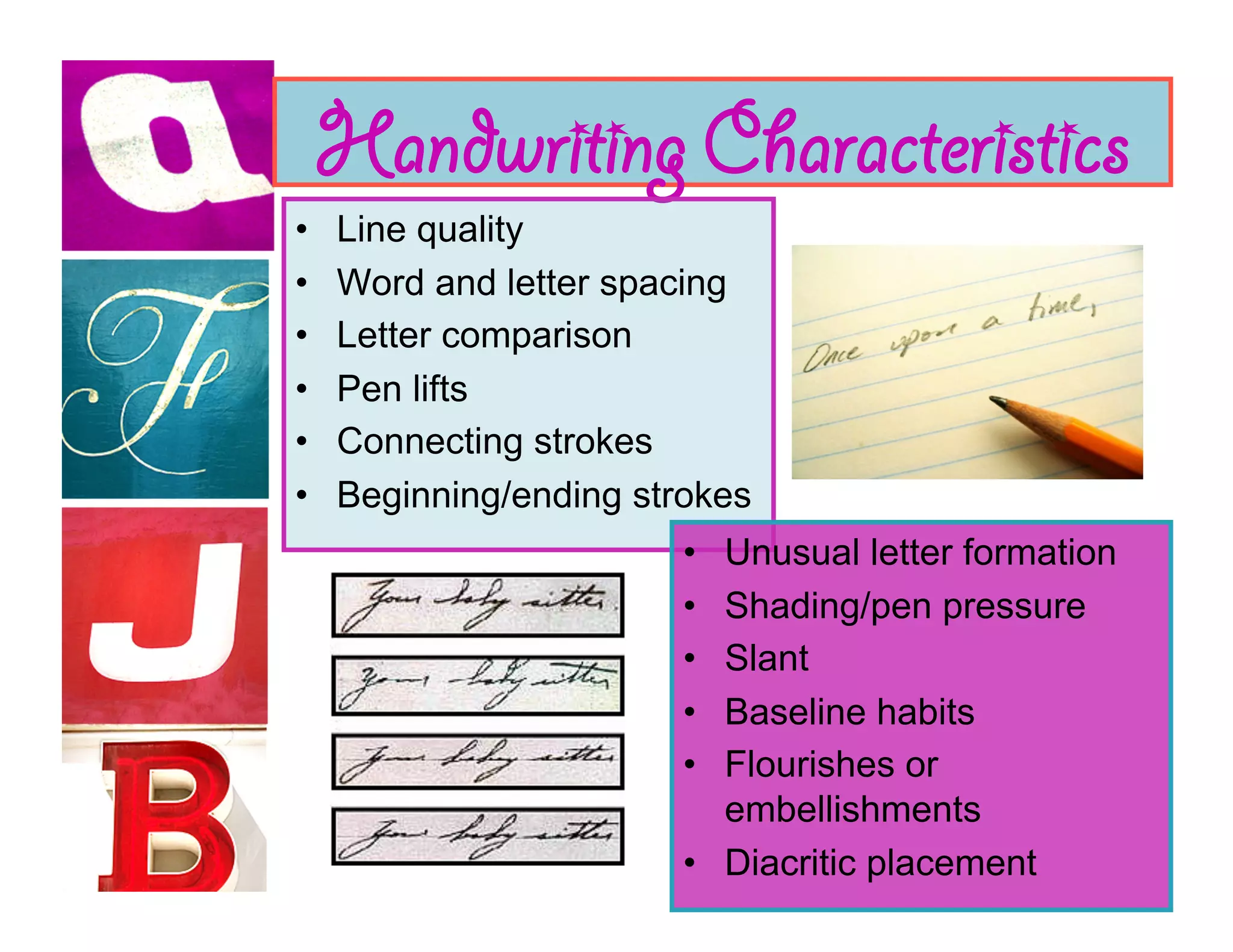
Handwriting Characteristics
•    Line quality
•    Word and letter spacing
•    Letter comparison
•    Pen lifts
•    Connecting strokes
•    Beginning/ending strokes
                         •  Unusual letter formation
                         •  Shading/pen pressure
                         •  Slant
                         •  Baseline habits
                         •  Flourishes or
                            embellishments
                         •  Diacritic placement
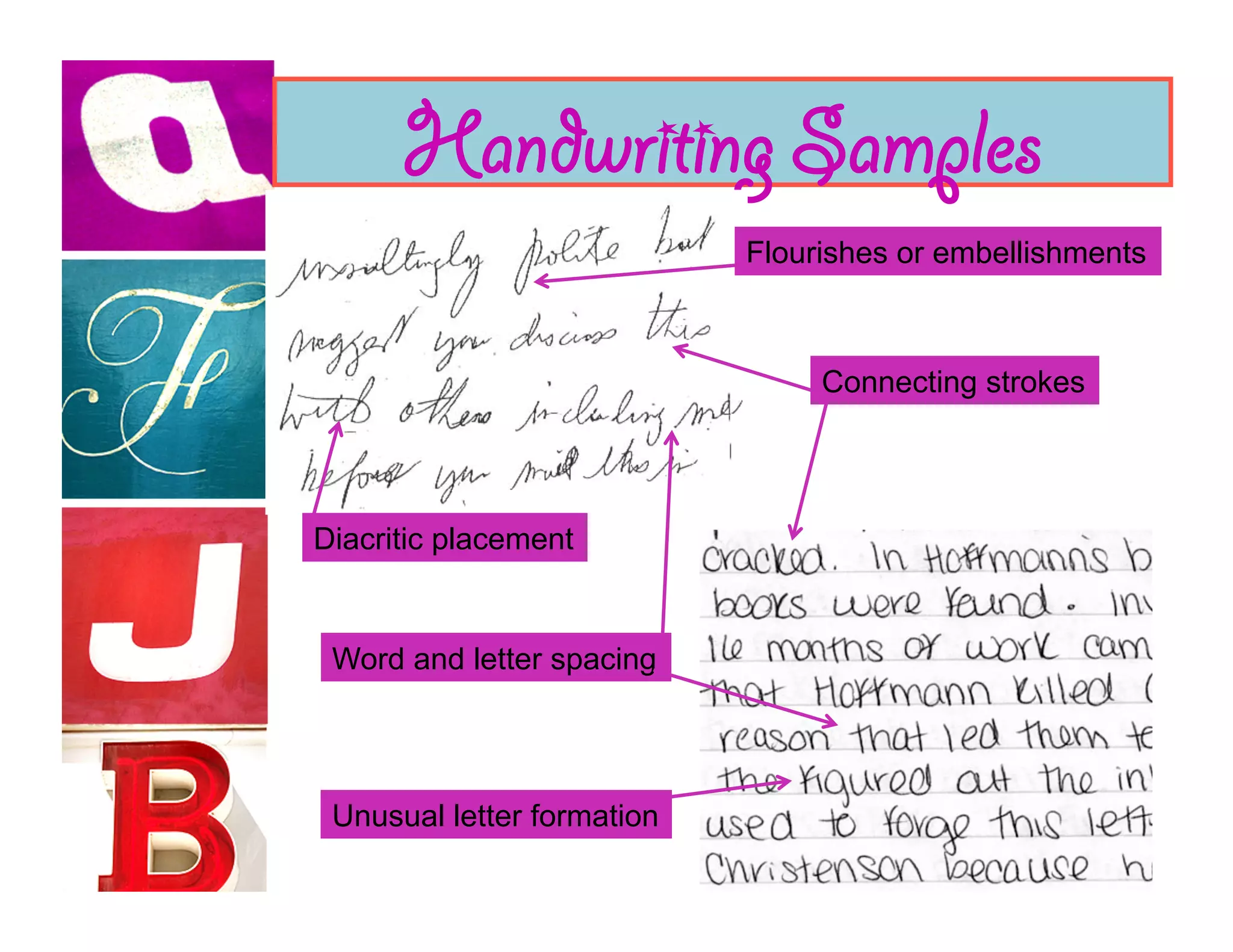
Handwriting Samples
                            Flourishes or embellishments


                                 Connecting strokes


Diacritic placement


 Word and letter spacing


 Unusual letter formation
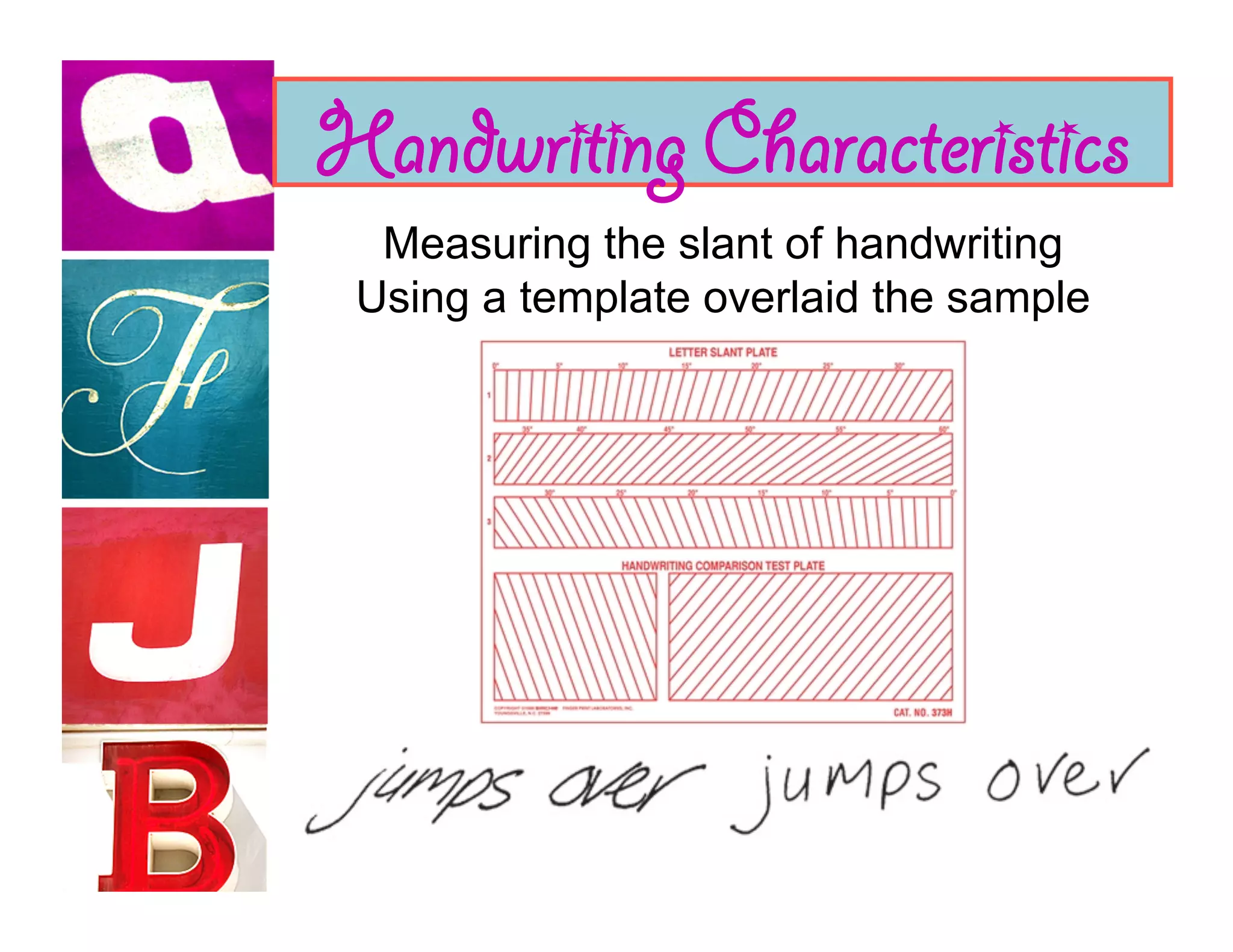
Handwriting Characteristics
  Measuring the slant of handwriting
 Using a template overlaid the sample
Handwriting Samples
When obtaining a writing sample:
•  The subject should not be shown the
   questioned document.
•  The subject is not told how to spell words or use
   punctuation.
•  The subject should use materials similar to
   those of the document.
•  The dictated text should match some parts of
   the document.
•  The subject should be asked to sign the text.
•  Always have a witness.
Types of Forgery
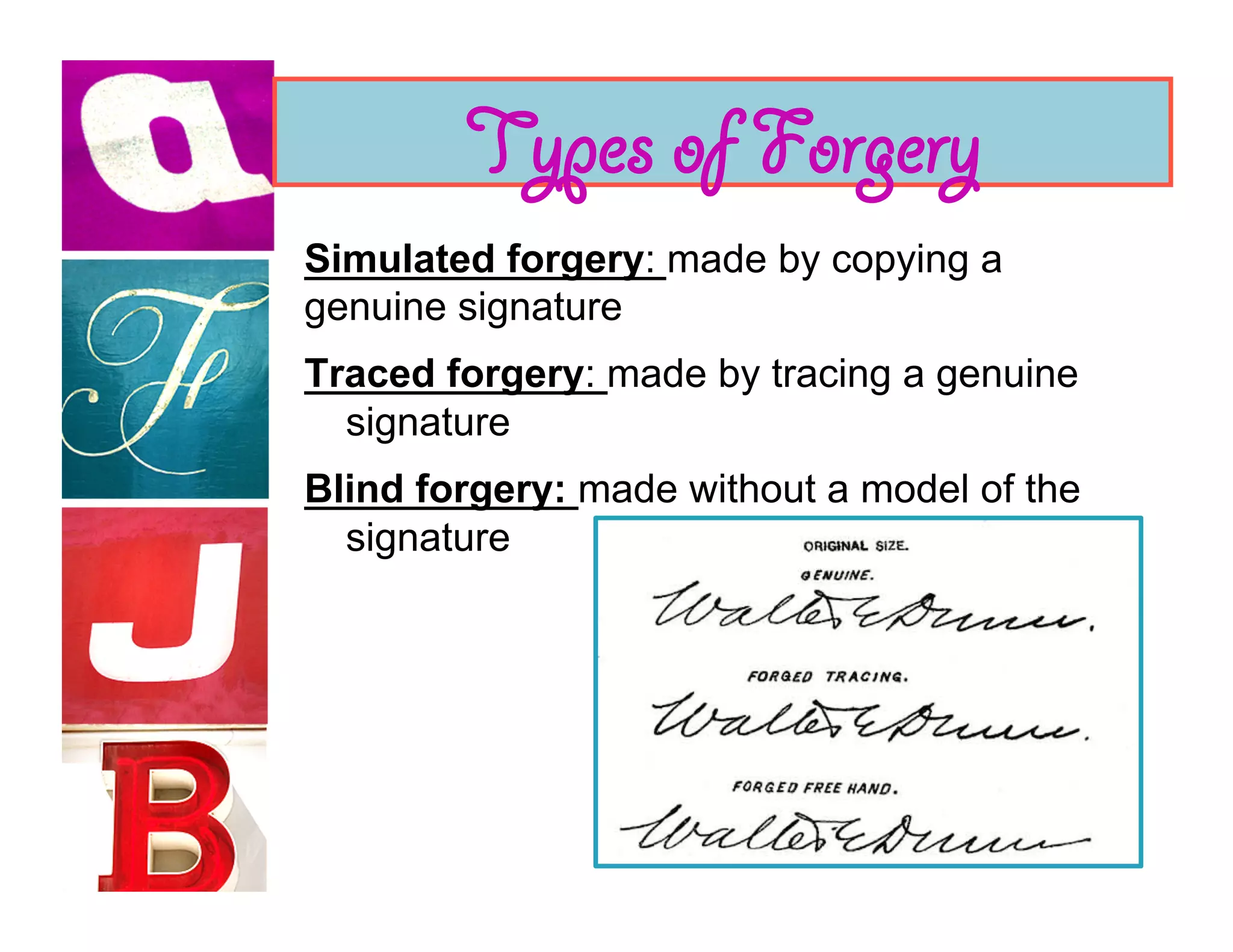
Simulated forgery: made by copying a
genuine signature
Traced forgery: made by tracing a genuine
  signature
Blind forgery: made without a model of the
  signature
Types of Forgery
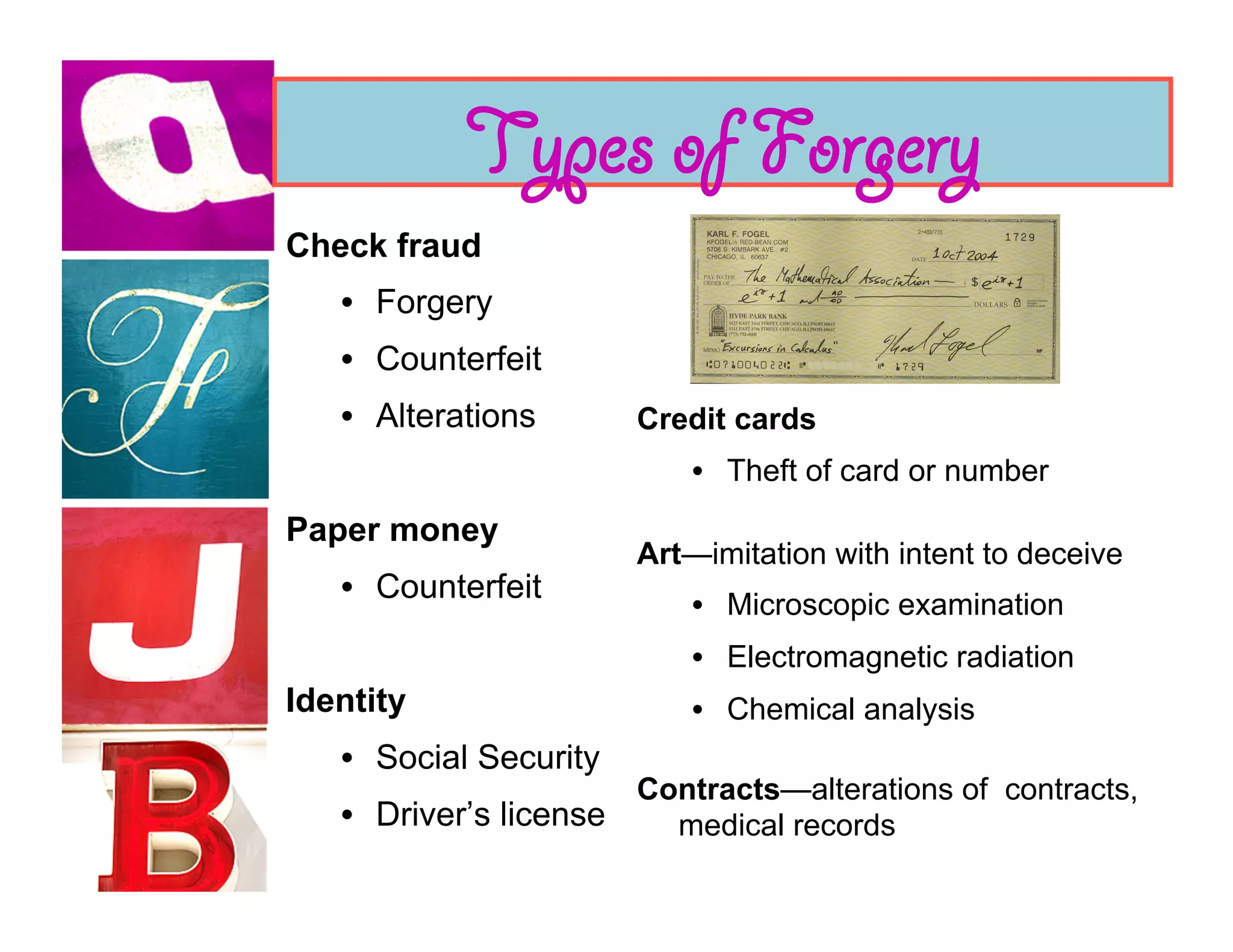
Check fraud
   •  Forgery
   •  Counterfeit
   •  Alterations        Credit cards
                             •  Theft of card or number
Paper money
                         Art—imitation with intent to deceive
   •  Counterfeit
                             •  Microscopic examination
                             •  Electromagnetic radiation
Identity                     •  Chemical analysis
   •  Social Security
                         Contracts—alterations of contracts,
   •  Driver’s license     medical records
Document Alterations
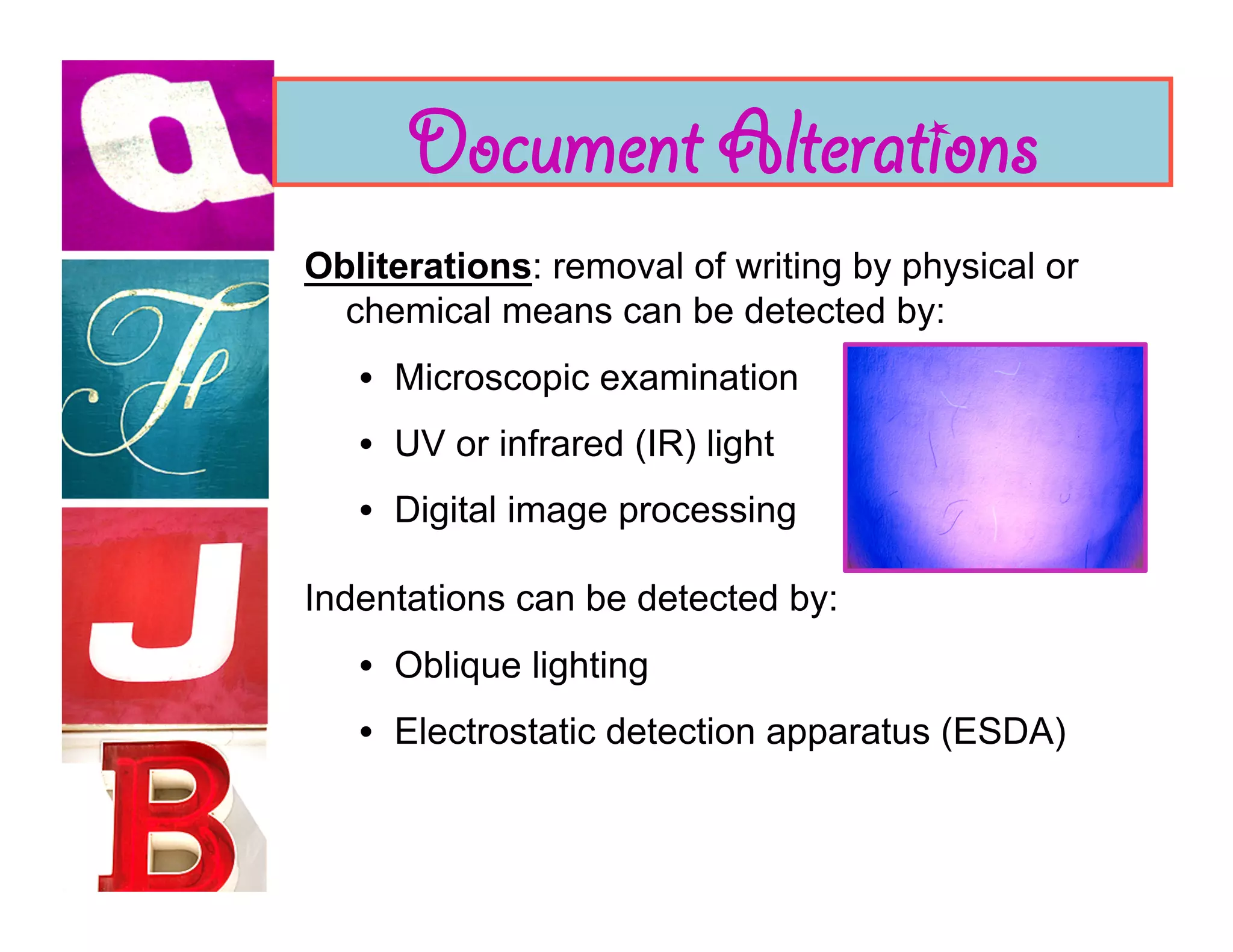
Obliterations: removal of writing by physical or
  chemical means can be detected by:
   •  Microscopic examination
   •  UV or infrared (IR) light
   •  Digital image processing

Indentations can be detected by:
   •  Oblique lighting
   •  Electrostatic detection apparatus (ESDA)
Forensic Linguists
Expert who looks at the linguistic content (the way
something is written) of a questioned document

Language used can help
to establish the writer’s
•  age
•  gender
•  ethnicity
•  level of education
•  professional training
•  ideology
Analyzing Ink
 Ink can be analyzed to help determine the source

 Chromatography is a method of physically
   separating the components of inks.

Types
1.  HPLC: high-performance
    liquid chromatography
2.  TLC: thin-layer
    chromatography
3.  Paper chromatography
Paper Chromatography
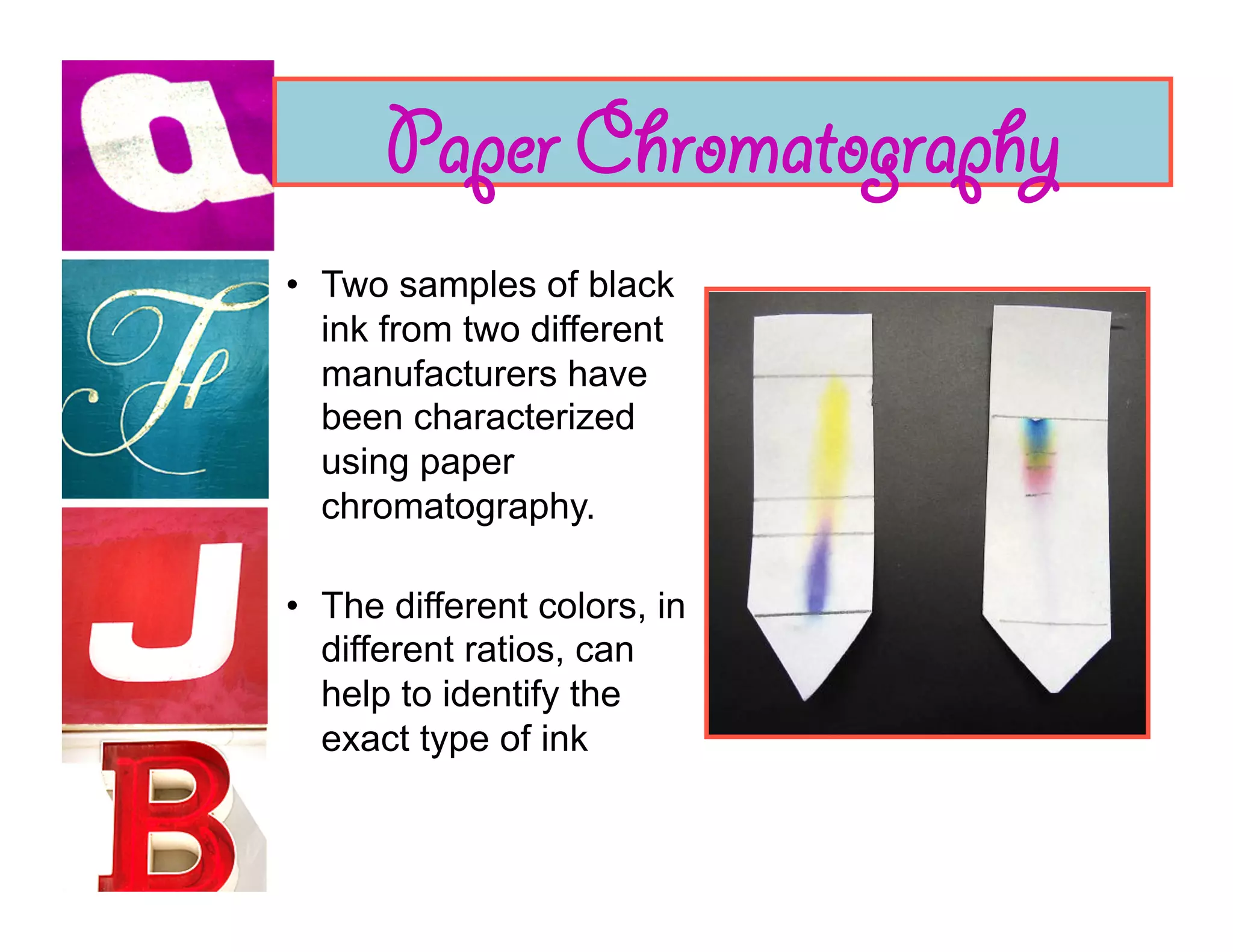
•  Two samples of black
   ink from two different
   manufacturers have
   been characterized
   using paper
   chromatography.

•  The different colors, in
   different ratios, can
   help to identify the
   exact type of ink
Retention Factor - Rf
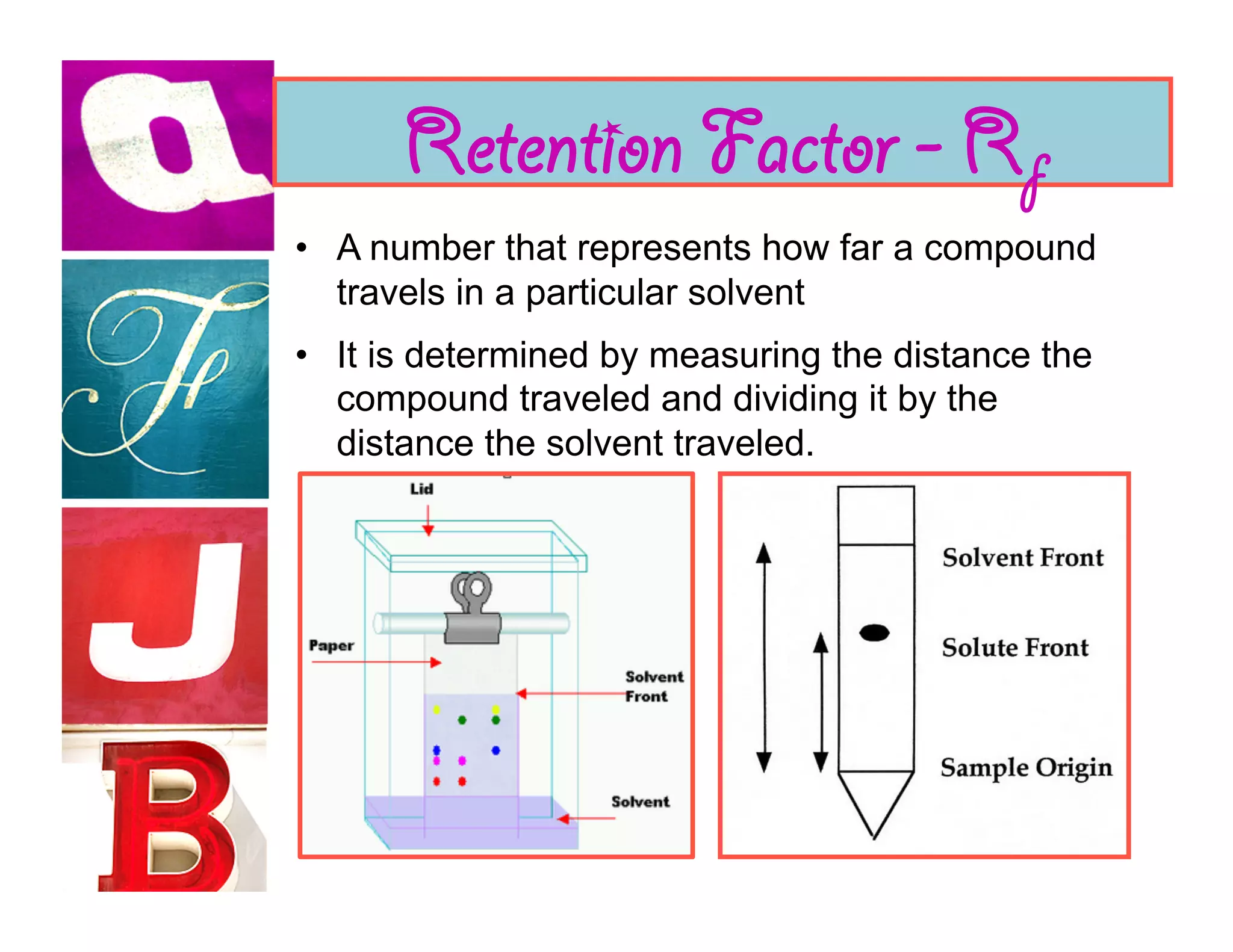
•  A number that represents how far a compound
   travels in a particular solvent
•  It is determined by measuring the distance the
   compound traveled and dividing it by the
   distance the solvent traveled.
Retention Factor - Rf
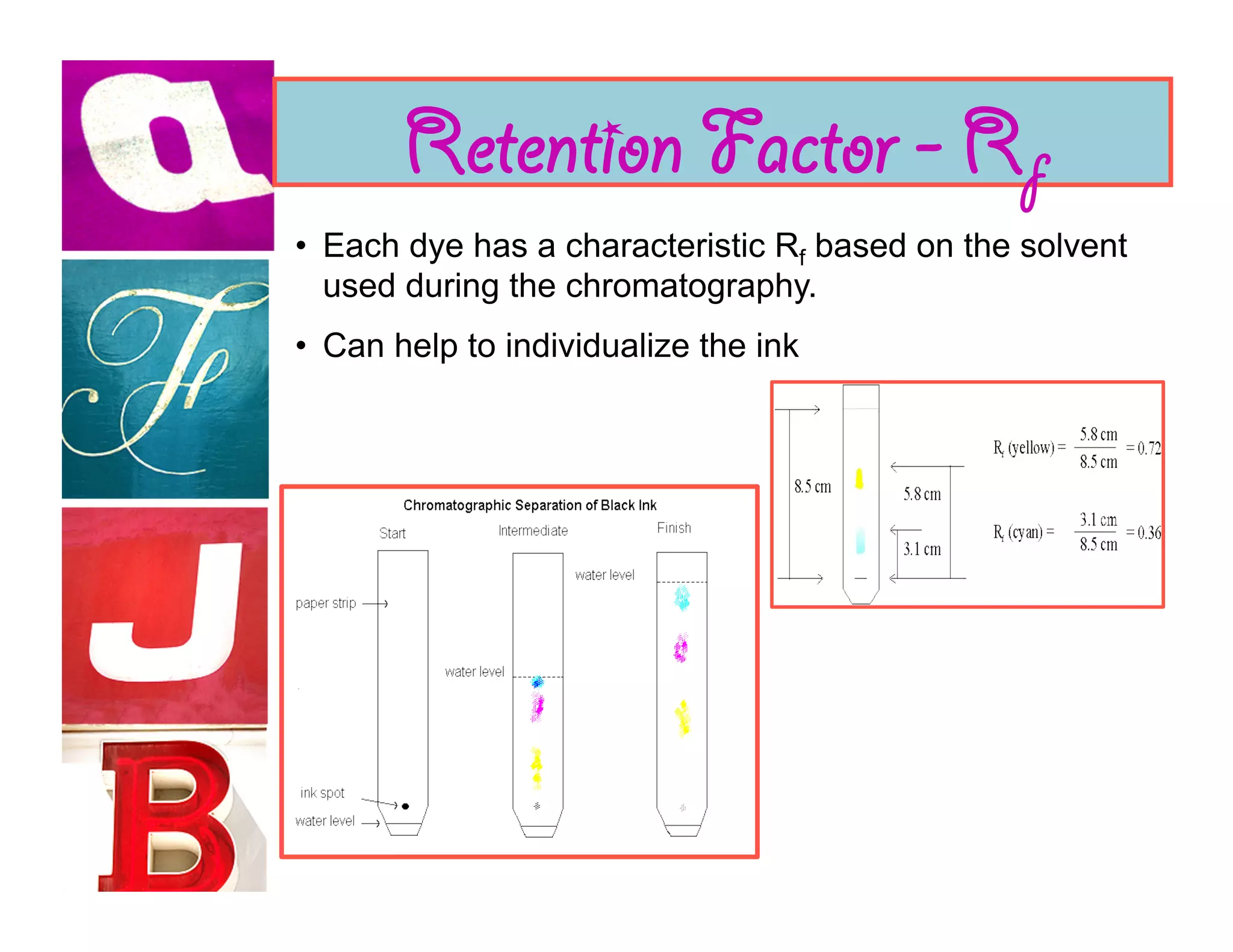
•  Each dye has a characteristic Rf based on the solvent
   used during the chromatography.
•  Can help to individualize the ink
Analyzing Paper
Analysis involves looking at the following
characteristics of paper:
   •  Raw material

   •  Weight
   •  Density

   •  Thickness

   •  Color
   •  Watermarks

   •  Age

   •  Fluorescence
Document Evidence
  Class characteristics
may include general types
of pens, pencils, or paper.


                          Individual characteristics
                          may include unique,
                         individual handwriting
                      characteristics; trash marks
                        from copiers; or printer
                            serial numbers.
Counterfeiting
•  In 1996 the government starting adding new
   security features to paper money
•  Subtle background colors have been added
   along with other features to discourage
   counterfeiting
      •  October 2003 - $20 bill
      •  September 2004 - $50 bill
      •  September 2005 - $10 bill

Fs ch 16 documents

  • 1.
  • 2.
    Document Analysis •  Involvesthe examination of handwriting, ink, and paper to ascertain source or authenticity •  Examples include letters, checks, licenses, contracts, wills, passports •  Investigations include verification; authentication; characterizing papers, pigments, and inks
  • 3.
    Related fields Historical dating—theverification of age and value of a document or object Fraud investigation—focuses on the money trail and criminal intent Paper and ink specialists—date, type, source, and/ or catalog various types of paper, watermarks, ink, printing/copy/fax machines, computer cartridges Forgery specialists—analyze altered, obliterated, changed, or doctored documents and photos Typewriting analysts—determine origin, make, and model Computer crime investigators—investigate cybercrime
  • 4.
    Document Examination •  involvesthe analysis and comparison of questioned documents with known material •  identifies, whenever possible, the author or origin of the questioned document
  • 5.
    Handwriting Analysis Handwriting analysisinvolves two phases: 1.  The hardware—ink, paper, pens, pencils, typewriter, printers 2. Visual examination of the writing
  • 6.
    Handwriting Characteristics •  Line quality •  Word and letter spacing •  Letter comparison •  Pen lifts •  Connecting strokes •  Beginning/ending strokes •  Unusual letter formation •  Shading/pen pressure •  Slant •  Baseline habits •  Flourishes or embellishments •  Diacritic placement
  • 7.
    Handwriting Samples Flourishes or embellishments Connecting strokes Diacritic placement Word and letter spacing Unusual letter formation
  • 8.
    Handwriting Characteristics Measuring the slant of handwriting Using a template overlaid the sample
  • 9.
    Handwriting Samples When obtaininga writing sample: •  The subject should not be shown the questioned document. •  The subject is not told how to spell words or use punctuation. •  The subject should use materials similar to those of the document. •  The dictated text should match some parts of the document. •  The subject should be asked to sign the text. •  Always have a witness.
  • 10.
    Types of Forgery Simulatedforgery: made by copying a genuine signature Traced forgery: made by tracing a genuine signature Blind forgery: made without a model of the signature
  • 11.
    Types of Forgery Checkfraud •  Forgery •  Counterfeit •  Alterations Credit cards •  Theft of card or number Paper money Art—imitation with intent to deceive •  Counterfeit •  Microscopic examination •  Electromagnetic radiation Identity •  Chemical analysis •  Social Security Contracts—alterations of contracts, •  Driver’s license medical records
  • 12.
    Document Alterations Obliterations: removalof writing by physical or chemical means can be detected by: •  Microscopic examination •  UV or infrared (IR) light •  Digital image processing Indentations can be detected by: •  Oblique lighting •  Electrostatic detection apparatus (ESDA)
  • 13.
    Forensic Linguists Expert wholooks at the linguistic content (the way something is written) of a questioned document Language used can help to establish the writer’s •  age •  gender •  ethnicity •  level of education •  professional training •  ideology
  • 14.
    Analyzing Ink Inkcan be analyzed to help determine the source Chromatography is a method of physically separating the components of inks. Types 1.  HPLC: high-performance liquid chromatography 2.  TLC: thin-layer chromatography 3.  Paper chromatography
  • 15.
    Paper Chromatography •  Twosamples of black ink from two different manufacturers have been characterized using paper chromatography. •  The different colors, in different ratios, can help to identify the exact type of ink
  • 16.
    Retention Factor -Rf •  A number that represents how far a compound travels in a particular solvent •  It is determined by measuring the distance the compound traveled and dividing it by the distance the solvent traveled.
  • 17.
    Retention Factor -Rf •  Each dye has a characteristic Rf based on the solvent used during the chromatography. •  Can help to individualize the ink
  • 18.
    Analyzing Paper Analysis involveslooking at the following characteristics of paper: •  Raw material •  Weight •  Density •  Thickness •  Color •  Watermarks •  Age •  Fluorescence
  • 19.
    Document Evidence Class characteristics may include general types of pens, pencils, or paper. Individual characteristics may include unique, individual handwriting characteristics; trash marks from copiers; or printer serial numbers.
  • 20.
    Counterfeiting •  In 1996the government starting adding new security features to paper money •  Subtle background colors have been added along with other features to discourage counterfeiting •  October 2003 - $20 bill •  September 2004 - $50 bill •  September 2005 - $10 bill