1
Mr. Sagar Kishor SavaleMr. Sagar Kishor Savale
[Department of Pharmaceutics][Department of Pharmaceutics]
avengersagar16@gmail.comavengersagar16@gmail.com
2015-20162015-2016
Introduction
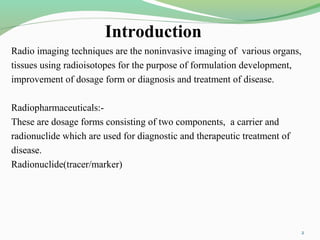
Radio imaging techniques are the noninvasive imaging of various organs,
tissues using radioisotopes for the purpose of formulation development,
improvement of dosage form or diagnosis and treatment of disease.
Radiopharmaceuticals:-
These are dosage forms consisting of two components, a carrier and
radionuclide which are used for diagnostic and therapeutic treatment of
disease.
Radionuclide(tracer/marker)
2
Ideal properties of Radionuclide
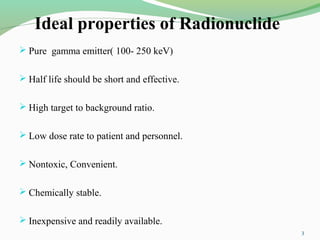
 Pure gamma emitter( 100- 250 keV)
 Half life should be short and effective.
 High target to background ratio.
 Low dose rate to patient and personnel.
 Nontoxic, Convenient.
 Chemically stable.
 Inexpensive and readily available.
3
Gamma Scintagraphy
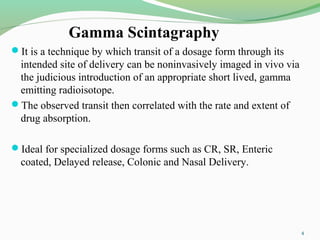
It is a technique by which transit of a dosage form through its
intended site of delivery can be noninvasively imaged in vivo via
the judicious introduction of an appropriate short lived, gamma
emitting radioisotope.
The observed transit then correlated with the rate and extent of
drug absorption.
Ideal for specialized dosage forms such as CR, SR, Enteric
coated, Delayed release, Colonic and Nasal Delivery.
4
How it is done?
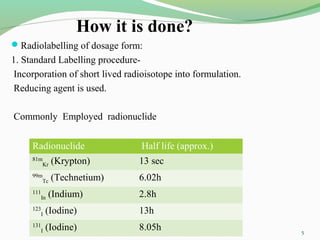
Radiolabelling of dosage form:
1. Standard Labelling procedure-
Incorporation of short lived radioisotope into formulation.
Reducing agent is used.
Commonly Employed radionuclide
Radionuclide Half life (approx.)
81m
Kr (Krypton) 13 sec
99m
Tc (Technetium) 6.02h
111
In (Indium) 2.8h
123
I (Iodine) 13h
131
I (Iodine) 8.05h 5
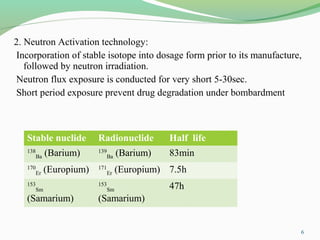
2. Neutron Activation technology:
Incorporation of stable isotope into dosage form prior to its manufacture,
followed by neutron irradiation.
Neutron flux exposure is conducted for very short 5-30sec.
Short period exposure prevent drug degradation under bombardment
Stable nuclide Radionuclide Half life
138
Ba (Barium) 139
Ba (Barium) 83min
170
Er (Europium) 171
Er (Europium) 7.5h
153
Sm
(Samarium)
153
Sm
(Samarium)
47h
6
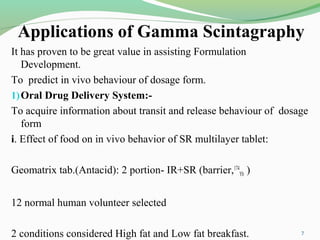
Applications of Gamma Scintagraphy
It has proven to be great value in assisting Formulation
Development.
To predict in vivo behaviour of dosage form.
1)Oral Drug Delivery System:-
To acquire information about transit and release behaviour of dosage
form
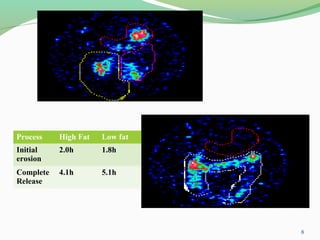
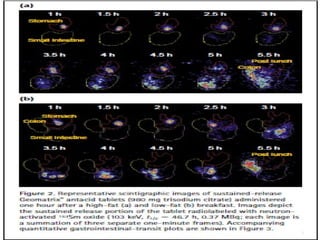
i. Effect of food on in vivo behavior of SR multilayer tablet:
Geomatrix tab.(Antacid): 2 portion- IR+SR (barrier,174
Yb )
12 normal human volunteer selected
2 conditions considered High fat and Low fat breakfast. 7
8
Process High Fat Low fat
Initial
erosion
2.0h 1.8h
Complete
Release
4.1h 5.1h
9
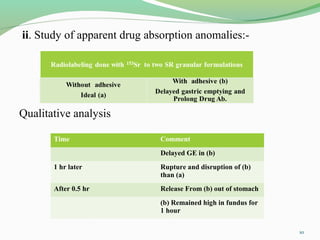
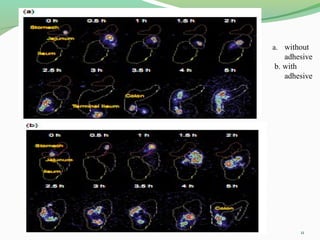
ii. Study of apparent drug absorption anomalies:-
Qualitative analysis
10
Time Comment
Delayed GE in (b)
1 hr later Rupture and disruption of (b)
than (a)
After 0.5 hr Release From (b) out of stomach
(b) Remained high in fundus for
1 hour
11
a. without
adhesive
b. with
adhesive
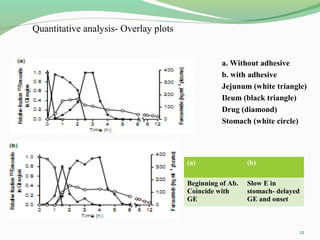
a. Without adhesive
b. with adhesive
Jejunum (white triangle)
Ileum (black triangle)
Drug (diamond)
Stomach (white circle)
12
Quantitative analysis- Overlay plots
(a) (b)
Beginning of Ab.
Coincide with
GE
Slow E in
stomach- delayed
GE and onset
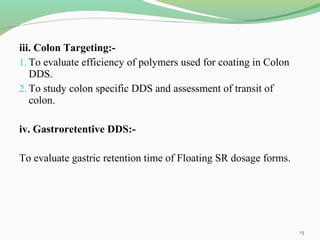
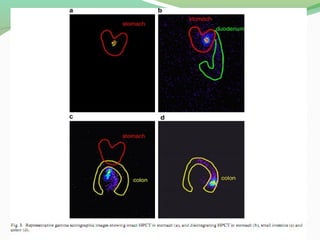
iii. Colon Targeting:-
1. To evaluate efficiency of polymers used for coating in Colon
DDS.
2. To study colon specific DDS and assessment of transit of
colon.
iv. Gastroretentive DDS:-
To evaluate gastric retention time of Floating SR dosage forms.
13
14
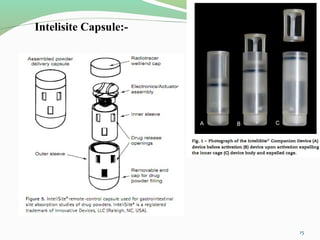
Intelisite Capsule:-
15
16
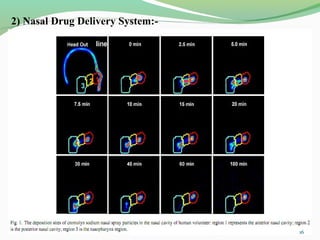
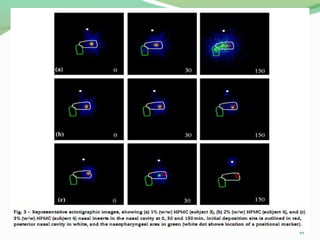
2) Nasal Drug Delivery System:-
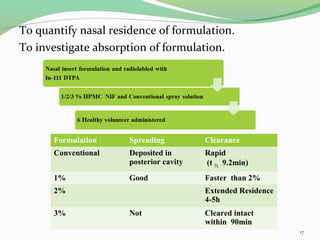
To quantify nasal residence of formulation.
To investigate absorption of formulation.
17
Formulation Spreading Clearance
Conventional Deposited in
posterior cavity
Rapid
(t ½ 9.2min)
1% Good Faster than 2%
2% Extended Residence
4-5h
3% Not Cleared intact
within 90min
18
3)Miscellaneous:-
 Rectal and Vaginal Drug Delivery System
Site specific Drug Delivery System
Evaluation of new drug during development phase.
Establishing bioequivalence of generic product.
19
Advantages:
Less time required.
Simple and convenient.
Disadvantages:
Higher cost.
Highly skilled labour.
Strict environmental control.
Unpredictable effect on formulation.
20
X ray Imaging
X-ray is the form of electromagnetic radiation which has ability to
penetrate into the body and produce images or picture for different
organs, tissues.
2D images can be produced by this technique.
X-ray produced by bombarding anode with high energy electrons
emitted from hot cathode in a tube.
X ray Energy
Soft 0.12- 12 keV
Hard 12- 120 keV
21
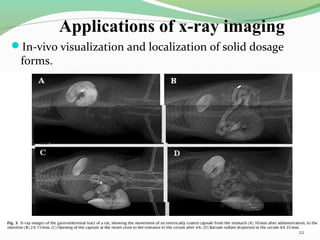
Applications of x-ray imaging
In-vivo visualization and localization of solid dosage
forms.
22
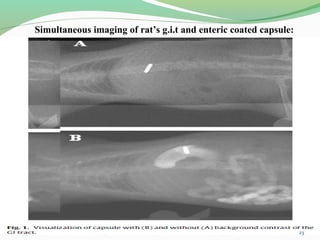
Simultaneous imaging of rat’s g.i.t and enteric coated capsule:
23
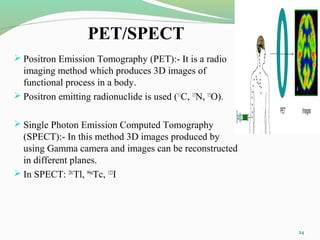
PET/SPECT
 Positron Emission Tomography (PET):- It is a radio
imaging method which produces 3D images of
functional process in a body.
 Positron emitting radionuclide is used (11
C, 13
N, 15
O).
 Single Photon Emission Computed Tomography
(SPECT):- In this method 3D images produced by
using Gamma camera and images can be reconstructed
in different planes.
 In SPECT: 201
Tl, 99m
Tc, 123
I
24
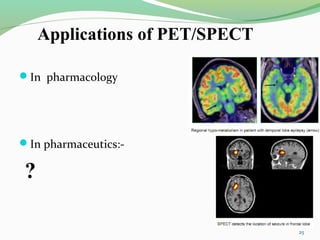
Applications of PET/SPECT
In pharmacology
In pharmaceutics:-
?
25
Magnetic Resonance Imaging
It is non invasive and nondestructive technique which can
provide cross sectional images from inside body materials
and living organisms.
MRI is generated using NMR signal (which is formed by
certain nuclei like 1
H, 13
C ) when subjected to strong
magnetic field and irradiation of radiowaves.
26
Applications of MRI
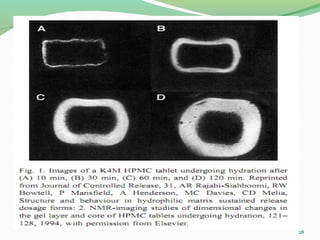
In vitro characterization:-
To study swelling behaviour of tablet.
To investigate hydration in modified release delivery systems
In study of pharmaceutical processes:-
 To measure distribution of water in Extrudates.
 Blending process.
27
28
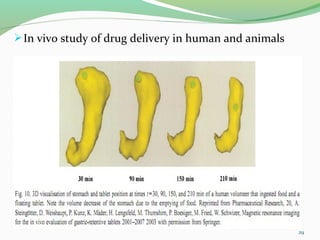
In vivo study of drug delivery in human and animals
29
Ultrasonography
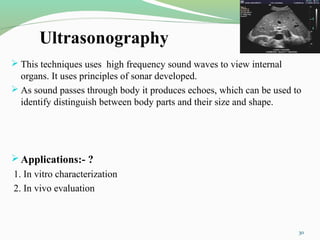
 This techniques uses high frequency sound waves to view internal
organs. It uses principles of sonar developed.
 As sound passes through body it produces echoes, which can be used to
identify distinguish between body parts and their size and shape.
Applications:- ?
1. In vitro characterization
2. In vivo evaluation
30
AC Biosusceptometry
This technique uses induction coils to record
magnetic flux variation obtained by response of
magnetic material ingested.
Magnetic tablets prepared by compression using
Ferrite.
31
Applications of ACBs
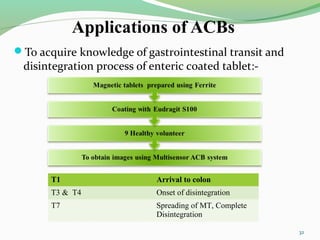
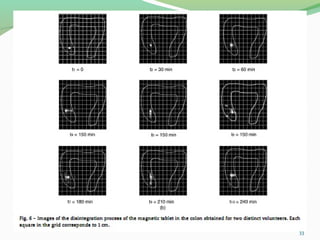
To acquire knowledge of gastrointestinal transit and
disintegration process of enteric coated tablet:-
32
T1 Arrival to colon
T3 & T4 Onset of disintegration
T7 Spreading of MT, Complete
Disintegration
33
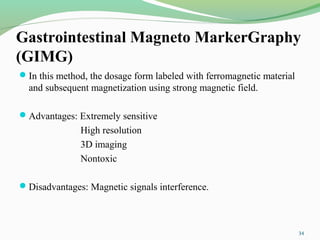
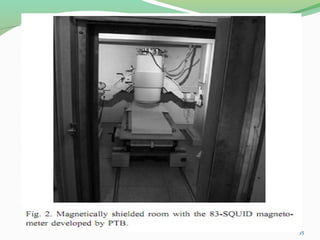
Gastrointestinal Magneto MarkerGraphy
(GIMG)
In this method, the dosage form labeled with ferromagnetic material
and subsequent magnetization using strong magnetic field.
Advantages: Extremely sensitive
High resolution
3D imaging
Nontoxic
Disadvantages: Magnetic signals interference.
34
35
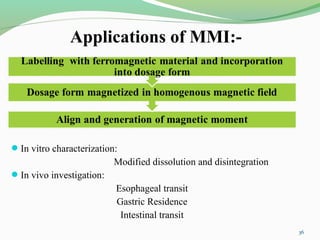
Applications of MMI:-
In vitro characterization:
Modified dissolution and disintegration
In vivo investigation:
Esophageal transit
Gastric Residence
Intestinal transit
36
References:
European Journal of Pharmaceutics
European Journal of Pharmaceutics and Biopharmaceutics
Journal of Controlled Release
Advanced Drug Delivery Reviews
International Journal of Pharmaceutics
37
38

Radio Imaging Techniques

  • 1.
    1 Mr. Sagar KishorSavaleMr. Sagar Kishor Savale [Department of Pharmaceutics][Department of Pharmaceutics] avengersagar16@gmail.comavengersagar16@gmail.com 2015-20162015-2016
  • 2.
    Introduction Radio imaging techniquesare the noninvasive imaging of various organs, tissues using radioisotopes for the purpose of formulation development, improvement of dosage form or diagnosis and treatment of disease. Radiopharmaceuticals:- These are dosage forms consisting of two components, a carrier and radionuclide which are used for diagnostic and therapeutic treatment of disease. Radionuclide(tracer/marker) 2
  • 3.
    Ideal properties ofRadionuclide  Pure gamma emitter( 100- 250 keV)  Half life should be short and effective.  High target to background ratio.  Low dose rate to patient and personnel.  Nontoxic, Convenient.  Chemically stable.  Inexpensive and readily available. 3
  • 4.
    Gamma Scintagraphy It isa technique by which transit of a dosage form through its intended site of delivery can be noninvasively imaged in vivo via the judicious introduction of an appropriate short lived, gamma emitting radioisotope. The observed transit then correlated with the rate and extent of drug absorption. Ideal for specialized dosage forms such as CR, SR, Enteric coated, Delayed release, Colonic and Nasal Delivery. 4
  • 5.
    How it isdone? Radiolabelling of dosage form: 1. Standard Labelling procedure- Incorporation of short lived radioisotope into formulation. Reducing agent is used. Commonly Employed radionuclide Radionuclide Half life (approx.) 81m Kr (Krypton) 13 sec 99m Tc (Technetium) 6.02h 111 In (Indium) 2.8h 123 I (Iodine) 13h 131 I (Iodine) 8.05h 5
  • 6.
    2. Neutron Activationtechnology: Incorporation of stable isotope into dosage form prior to its manufacture, followed by neutron irradiation. Neutron flux exposure is conducted for very short 5-30sec. Short period exposure prevent drug degradation under bombardment Stable nuclide Radionuclide Half life 138 Ba (Barium) 139 Ba (Barium) 83min 170 Er (Europium) 171 Er (Europium) 7.5h 153 Sm (Samarium) 153 Sm (Samarium) 47h 6
  • 7.
    Applications of GammaScintagraphy It has proven to be great value in assisting Formulation Development. To predict in vivo behaviour of dosage form. 1)Oral Drug Delivery System:- To acquire information about transit and release behaviour of dosage form i. Effect of food on in vivo behavior of SR multilayer tablet: Geomatrix tab.(Antacid): 2 portion- IR+SR (barrier,174 Yb ) 12 normal human volunteer selected 2 conditions considered High fat and Low fat breakfast. 7
  • 8.
    8 Process High FatLow fat Initial erosion 2.0h 1.8h Complete Release 4.1h 5.1h
  • 9.
  • 10.
    ii. Study ofapparent drug absorption anomalies:- Qualitative analysis 10 Time Comment Delayed GE in (b) 1 hr later Rupture and disruption of (b) than (a) After 0.5 hr Release From (b) out of stomach (b) Remained high in fundus for 1 hour
  • 11.
  • 12.
    a. Without adhesive b.with adhesive Jejunum (white triangle) Ileum (black triangle) Drug (diamond) Stomach (white circle) 12 Quantitative analysis- Overlay plots (a) (b) Beginning of Ab. Coincide with GE Slow E in stomach- delayed GE and onset
  • 13.
    iii. Colon Targeting:- 1.To evaluate efficiency of polymers used for coating in Colon DDS. 2. To study colon specific DDS and assessment of transit of colon. iv. Gastroretentive DDS:- To evaluate gastric retention time of Floating SR dosage forms. 13
  • 14.
  • 15.
  • 16.
    16 2) Nasal DrugDelivery System:-
  • 17.
    To quantify nasalresidence of formulation. To investigate absorption of formulation. 17 Formulation Spreading Clearance Conventional Deposited in posterior cavity Rapid (t ½ 9.2min) 1% Good Faster than 2% 2% Extended Residence 4-5h 3% Not Cleared intact within 90min
  • 18.
  • 19.
    3)Miscellaneous:-  Rectal andVaginal Drug Delivery System Site specific Drug Delivery System Evaluation of new drug during development phase. Establishing bioequivalence of generic product. 19
  • 20.
    Advantages: Less time required. Simpleand convenient. Disadvantages: Higher cost. Highly skilled labour. Strict environmental control. Unpredictable effect on formulation. 20
  • 21.
    X ray Imaging X-rayis the form of electromagnetic radiation which has ability to penetrate into the body and produce images or picture for different organs, tissues. 2D images can be produced by this technique. X-ray produced by bombarding anode with high energy electrons emitted from hot cathode in a tube. X ray Energy Soft 0.12- 12 keV Hard 12- 120 keV 21
  • 22.
    Applications of x-rayimaging In-vivo visualization and localization of solid dosage forms. 22
  • 23.
    Simultaneous imaging ofrat’s g.i.t and enteric coated capsule: 23
  • 24.
    PET/SPECT  Positron EmissionTomography (PET):- It is a radio imaging method which produces 3D images of functional process in a body.  Positron emitting radionuclide is used (11 C, 13 N, 15 O).  Single Photon Emission Computed Tomography (SPECT):- In this method 3D images produced by using Gamma camera and images can be reconstructed in different planes.  In SPECT: 201 Tl, 99m Tc, 123 I 24
  • 25.
    Applications of PET/SPECT Inpharmacology In pharmaceutics:- ? 25
  • 26.
    Magnetic Resonance Imaging Itis non invasive and nondestructive technique which can provide cross sectional images from inside body materials and living organisms. MRI is generated using NMR signal (which is formed by certain nuclei like 1 H, 13 C ) when subjected to strong magnetic field and irradiation of radiowaves. 26
  • 27.
    Applications of MRI Invitro characterization:- To study swelling behaviour of tablet. To investigate hydration in modified release delivery systems In study of pharmaceutical processes:-  To measure distribution of water in Extrudates.  Blending process. 27
  • 28.
  • 29.
    In vivo studyof drug delivery in human and animals 29
  • 30.
    Ultrasonography  This techniquesuses high frequency sound waves to view internal organs. It uses principles of sonar developed.  As sound passes through body it produces echoes, which can be used to identify distinguish between body parts and their size and shape. Applications:- ? 1. In vitro characterization 2. In vivo evaluation 30
  • 31.
    AC Biosusceptometry This techniqueuses induction coils to record magnetic flux variation obtained by response of magnetic material ingested. Magnetic tablets prepared by compression using Ferrite. 31
  • 32.
    Applications of ACBs Toacquire knowledge of gastrointestinal transit and disintegration process of enteric coated tablet:- 32 T1 Arrival to colon T3 & T4 Onset of disintegration T7 Spreading of MT, Complete Disintegration
  • 33.
  • 34.
    Gastrointestinal Magneto MarkerGraphy (GIMG) Inthis method, the dosage form labeled with ferromagnetic material and subsequent magnetization using strong magnetic field. Advantages: Extremely sensitive High resolution 3D imaging Nontoxic Disadvantages: Magnetic signals interference. 34
  • 35.
  • 36.
    Applications of MMI:- Invitro characterization: Modified dissolution and disintegration In vivo investigation: Esophageal transit Gastric Residence Intestinal transit 36
  • 37.
    References: European Journal ofPharmaceutics European Journal of Pharmaceutics and Biopharmaceutics Journal of Controlled Release Advanced Drug Delivery Reviews International Journal of Pharmaceutics 37
  • 38.