Laboratory Biology
                                   Genetics Review
Answer the following questions on a separate sheet of paper to review for the test on the
Genetics Unit.

   1. Who was Gregor Mendel? Describe the type of research and experiments he did.

   2. What were the four major conclusions Mendel reached?

   3. Briefly define the following vocabulary words: gene, allele, homozygous, heterozygous,
      genotype, phenotype, dominant and recessive.

   4. Solve the following Punnett squares:
         a. In humans, the ability to roll your tongue is a dominant trait. If two heterozygous
             tongue rolling parents have children, what percent of their children will not be
             able to roll their tongue?
         b. In trolls, big noses are dominant to small noses and large ears are dominant to
             small ears. If a homozygous big nosed, heterozygous large eared troll had
             children with a small nosed, heterozygous large eared troll, what possible
             genotypes and phenotypes would their children have?

   5. Define the following types of Non-Mendelian Genetics: incomplete dominance,
      codominance, multiple alleles, pleiotropy, epistasis, and polygenic inheritance.

   6. Solve the following Punnett squares:
         a. In roses, red flowers are incompletely dominant over white flowers. If a red rose
             bush is mated with a white rose bush, what genotypes and phenotypes are
             possible?
         b. In a rare breed of muskrat, 4 genes control the color their fur. Genes A and B are
             codominant with each other, gene B is incompletely dominant over gene C and
             gene d is recessive to all other genes. What genotypes and phenotypes are
             possible?
         c. If an O negative woman marries and has children with an AB positive
             (heterozygous for the Rh factor) man, what are the genotypes and phenotypes of
             their offspring?
         d. In fairies, purple wings are dominant to pink wings. Another gene, for the
             presence of wings (dominant trait) works in an epistatic relationship with the wing
             color gene. If a heterozygous purple, heterozygous winged fairy mates with a
             pink heterozygous winged fairy, what genotypes and phenotypes will their
             offspring have?
         e. In giraffes, the length of the neck is controlled by polygenic inheritance. Long
             necks are dominant to short necks. Rank the following genotypes from the
             longest neck to the shortest neck:
             AABbCCDd          aabbCCDD         AaBbccdd aaBbccdd AABBCCDd
7. What are sex-linked traits? On what chromosome do sex-linked exist?

8. What sex-linked genotypes exist for females? For males? Why are they not the same?
   What is the name for the male sex-linked genotype?

9. Solve the following Punnett squares:
      a. Colorblindness is a sex-linked recessive trait. If a carrier mother has children
          with a normal-visioned father, what percentage of their girls will be colorblind?
          What percentage of their boys?
      b. Demonstrate how it is possible for a girl to be colorblind.

10. What is a karyotype? What is it used for?

11. What is a pedigree? What is it used for?

12. Complete the following pedigree problems:
      a. A man who had purple ears came to the attention of a human geneticist. The
          human geneticist did a pedigree analysis and made the following observations.
          Draw this family’s pedigree:
                  In this family, purple ears proved to be an inherited trait due to a single
                  genetic locus. The man's mother and one sister also had purple ears, but
                  his father, his brother, and two other sisters had normal ears. The man and
                  his normal-eared wife had seven children, including four boys and three
                  girls. Two girls and two boys had purple ears.

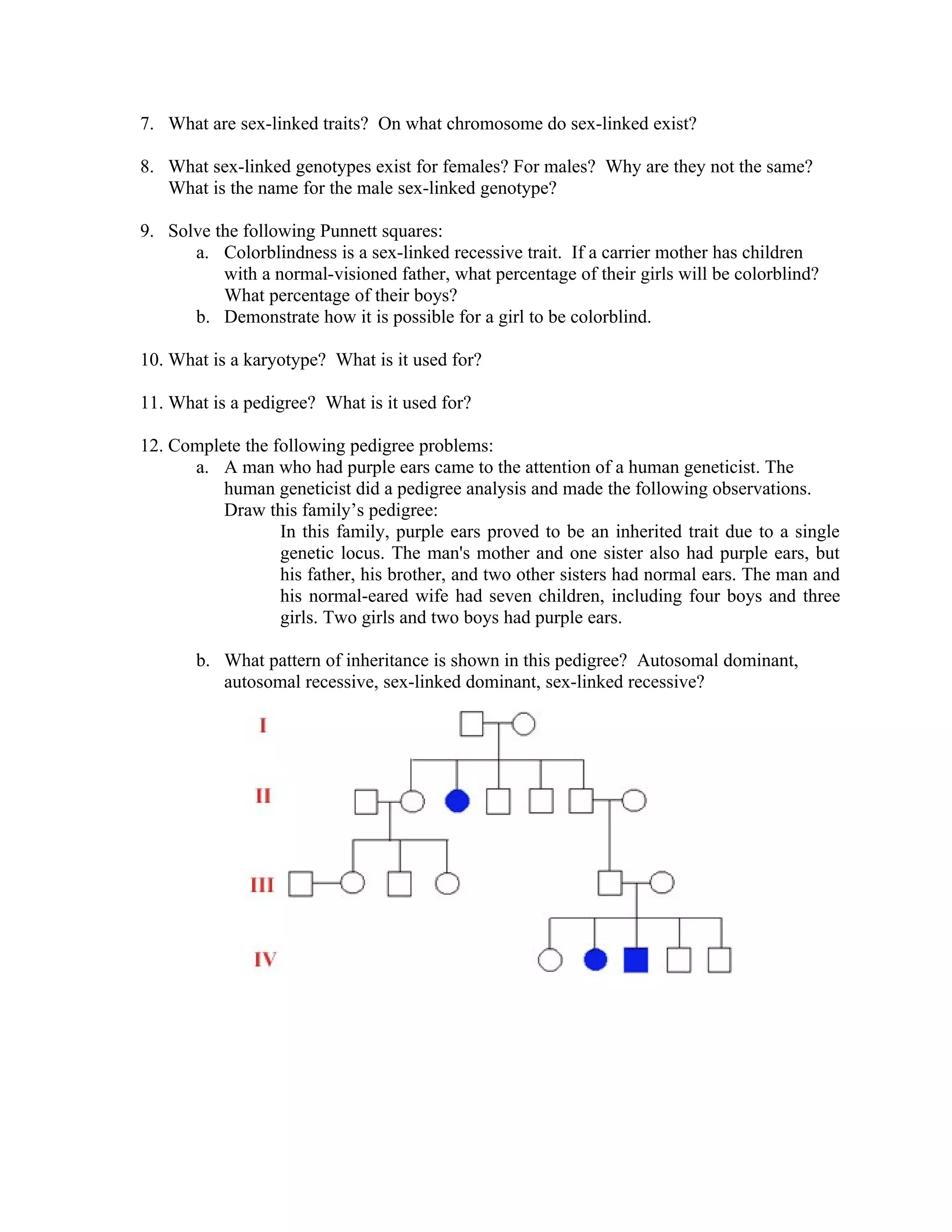
       b. What pattern of inheritance is shown in this pedigree? Autosomal dominant,
          autosomal recessive, sex-linked dominant, sex-linked recessive?

Genetics review sheet

  • 1.
    Laboratory Biology Genetics Review Answer the following questions on a separate sheet of paper to review for the test on the Genetics Unit. 1. Who was Gregor Mendel? Describe the type of research and experiments he did. 2. What were the four major conclusions Mendel reached? 3. Briefly define the following vocabulary words: gene, allele, homozygous, heterozygous, genotype, phenotype, dominant and recessive. 4. Solve the following Punnett squares: a. In humans, the ability to roll your tongue is a dominant trait. If two heterozygous tongue rolling parents have children, what percent of their children will not be able to roll their tongue? b. In trolls, big noses are dominant to small noses and large ears are dominant to small ears. If a homozygous big nosed, heterozygous large eared troll had children with a small nosed, heterozygous large eared troll, what possible genotypes and phenotypes would their children have? 5. Define the following types of Non-Mendelian Genetics: incomplete dominance, codominance, multiple alleles, pleiotropy, epistasis, and polygenic inheritance. 6. Solve the following Punnett squares: a. In roses, red flowers are incompletely dominant over white flowers. If a red rose bush is mated with a white rose bush, what genotypes and phenotypes are possible? b. In a rare breed of muskrat, 4 genes control the color their fur. Genes A and B are codominant with each other, gene B is incompletely dominant over gene C and gene d is recessive to all other genes. What genotypes and phenotypes are possible? c. If an O negative woman marries and has children with an AB positive (heterozygous for the Rh factor) man, what are the genotypes and phenotypes of their offspring? d. In fairies, purple wings are dominant to pink wings. Another gene, for the presence of wings (dominant trait) works in an epistatic relationship with the wing color gene. If a heterozygous purple, heterozygous winged fairy mates with a pink heterozygous winged fairy, what genotypes and phenotypes will their offspring have? e. In giraffes, the length of the neck is controlled by polygenic inheritance. Long necks are dominant to short necks. Rank the following genotypes from the longest neck to the shortest neck: AABbCCDd aabbCCDD AaBbccdd aaBbccdd AABBCCDd
  • 2.
    7. What aresex-linked traits? On what chromosome do sex-linked exist? 8. What sex-linked genotypes exist for females? For males? Why are they not the same? What is the name for the male sex-linked genotype? 9. Solve the following Punnett squares: a. Colorblindness is a sex-linked recessive trait. If a carrier mother has children with a normal-visioned father, what percentage of their girls will be colorblind? What percentage of their boys? b. Demonstrate how it is possible for a girl to be colorblind. 10. What is a karyotype? What is it used for? 11. What is a pedigree? What is it used for? 12. Complete the following pedigree problems: a. A man who had purple ears came to the attention of a human geneticist. The human geneticist did a pedigree analysis and made the following observations. Draw this family’s pedigree: In this family, purple ears proved to be an inherited trait due to a single genetic locus. The man's mother and one sister also had purple ears, but his father, his brother, and two other sisters had normal ears. The man and his normal-eared wife had seven children, including four boys and three girls. Two girls and two boys had purple ears. b. What pattern of inheritance is shown in this pedigree? Autosomal dominant, autosomal recessive, sex-linked dominant, sex-linked recessive?