Lecture-3-Introduction to medical image computing-part1.pdf
1.
1
CAP 5516
Medical ImageComputing
(Spring 2022)
Dr. Chen Chen
Center for Research in Computer Vision (CRCV)
University of Central Florida
Office: HEC 221
Address: 4328 Scorpius St., Orlando, FL 32816-2365
Email: chen.chen@crcv.ucf.edu
Web: https://www.crcv.ucf.edu/chenchen/
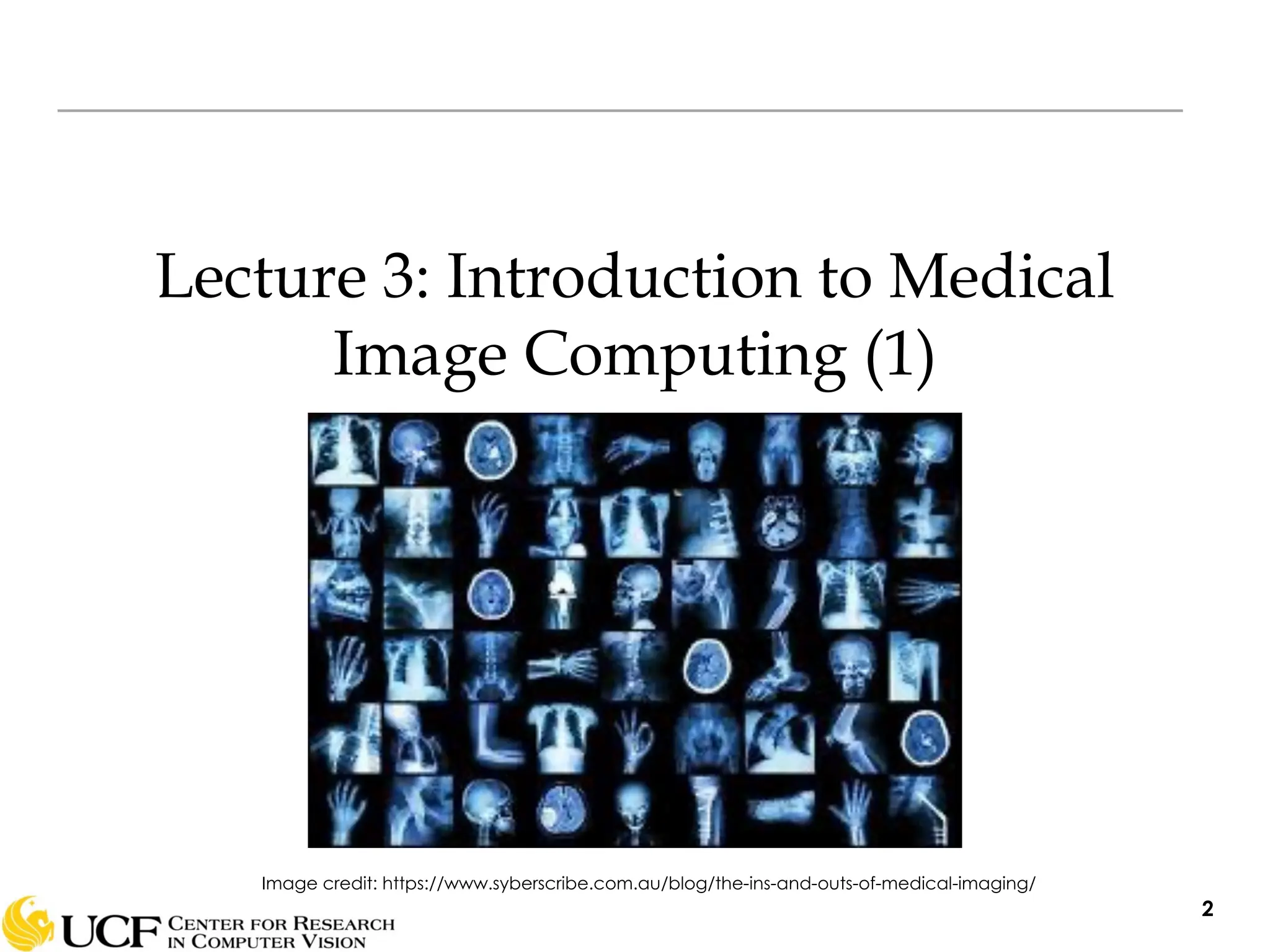
Medical Imaging
• Whatis medical imaging?
– Medical imaging is used to produce images of organs and
tissues within the body for use in diagnosis and treatment.
– Different types of medical imaging are used for seeing different
things within the body.
3
4.
Medical Imaging
• Whyis medical imaging important?
– Medical imaging allows doctors to find diseases in their early
stages, which leads to better outcomes for patients
– Assist in decisions regarding treatment and future care of the
issue
4
Radiology is a branch of medicine that uses imaging technology to
diagnose and treat disease.
5.
Medical Imaging
• Whatmedical imaging modalities do you know?
– CT (Computer Tomography)
– MRI (Magnetic Resonance Imaging)
– Ultrasound
– X-ray
– Nuclear medicine imaging (including positron-emission
tomography (PET))
…
5
Medical Imaging SystemRequirements
• Diagnostic contrast
• Sensitivity
• Specificity
• Function
• High spatial-resolution
• High temporal-resolution
• Safe
• Fast
• Inexpensive
• Easy to use
7
• Can’t satisfy all
• Often several used to make
diagnosis
Credit: Michael (Miki) Lustig, UC Berkeley
X-Ray Imaging /Radiography
• The first published medical image
was a radiograph of the hand of
the German physicist Wilhelm
Conrad Roentgen’s wife in 1895.
Nobel Prize in Physics 1901.
14
routine diagnostic radiography (2D images):
chest x-rays, fluoroscopy, mammography, motion
tomography, angiography, …
How Radiologists SearchAbnormal Patterns in
Chest X-Rays?
19
Radiologists often report the following
• Size, dimension, volume
• Pattern description,
• Location,
• Interaction with Nearby structures,
• Intensity distribution
• Shape
• …
Difficulties
• Noise
• vessels can be seen as small nodules
• radiologists may miss the pattern
• patterns may not be diagnostic
• CT often required for better diagnosis
• size estimation is done manually in 2D
• Shadowing
20.
How Radiologists SearchAbnormal Patterns in
Chest X-Rays?
20
Radiologists often report the following
• Size, dimension, volume
• Pattern description,
• Location,
• Interaction with Nearby structures,
• Intensity distribution
• Shape
• …
Difficulties
• Noise
• vessels can be seen as small nodules
• radiologists may miss the pattern
• patterns may not be diagnostic
• CT often required for better diagnosis
• size estimation is done manually in 2D
• Shadowing
Computer algorithms can solve/simplify these problems for improved healthcare
21.
Another Example forX-ray Imaging
21
Benign Malignant
(noncancerous) (cancerous)
The radiologist will look for areas of white, high-density tissue and note
its size, shape, and edges. A lump or tumor will show up as a focused
white area on a mammogram.
22.
Other X-ray usecases?
22
X-ray for security scanning
Miao, Caijing, et al. “Sixray: A large-scale security inspection x-ray benchmark for prohibited item
discovery in overlapping images.” CVPR 2019
23.
Ultrasound (US) Imaging
•US is defined as any sound wave above 20KHz
23
1794-Lazzaro Spallanzani - Physiologist
First to study US physics by deducing bats
used to US to navigate by echolocation.
1826-Jean Daniel Colladon - Physicist
Uses church bell (early transducer) under
water to calculate speed of sound through
water prove sound traveled faster through
water than air.
1880-Pierre&Jacques Curie
discover the Piezo-Electric
Effect (ability of certain
materials to generate an
electric charge in response
to applied mechanical
stress.
• Sound frequency a human ear can detect? (20Hz to 20KHz)
24.
24
1942-Karl Dussik -Neurologist
First physician to use US for medical diagnosis
1948-George Ludwig - MD
First described the use of US to diagnose gallstones
1958-Ian Donald
Pioneers in OB-GYN
US Imaging Technology
25.
Principle of USImaging
Source: https://www.nibib.nih.gov/science-education/science-
topics/ultrasound
• Ultrasound waves are produced by a
transducer, which can both emit
ultrasound waves, as well as detect the
ultrasound echoes reflected back.
• The transducer sends out a beam of
sound waves into the body.
• The sound waves are reflected back to
the transducer by boundaries between
tissues in the path of the beam (e.g. the
boundary between fluid and soft tissue
or tissue and bone).
• When these echoes hit the transducer,
they generate electrical signals that are
sent to the ultrasound scanner.
• Using the speed of sound and the time
of each echo’s return, the scanner
calculates the distance from the
transducer to the tissue boundary.
• These distances are then used to
generate two-dimensional images of
tissues and organs.
An ultrasound transducer
26.
Features of USImaging
• Resolution:
– low resolution and low SNR in deep region
• Ability of imaging soft tissue
• imaging in real time
26
27.
Clinical Use ofUS Imaging
27
A fetal ultrasound (sonogram) is an imaging technique that uses sound
waves to produce images of a fetus in the uterus.
28.
Clinical Use ofUS Imaging
28
Bone, fat, and physical length
Measurements –unborn babies
(Image Credit: S. Rueda,
Oxford Univ.)
29.
Clinical Use ofUS Imaging
29
Renal Artery Ultrasound
• Renal artery ultrasound is a
test to check for problems in
the renal arteries, the blood
vessels that supply
your kidneys.
• This provides detailed
pictures of these blood
vessels to help determine
the extent and cause of
restricted blood flow caused
by renal artery narrowing.
Source: https://health.ucdavis.edu/vascular/lab/exams/renal.html
30.
Clinical Use ofUS Imaging
30
Researchers at the University of
Michigan are investigating the clot-
dissolving capabilities of a high
intensity ultrasound technique,
called histotripsy, for the non-
invasive treatment of deep-vein
thrombosis (DVT). This technique
uses short, high-intensity pulses of
ultrasound to cause clot breakdown.
Source: https://www.nibib.nih.gov/science-education/science-topics/ultrasound
31.
Benefits of USImaging
31
• Most ultrasound scanning is noninvasive (no needles or
injections).
• Ultrasound is widely available, easy to use, and less
expensive than most other imaging methods.
• Ultrasound imaging is extremely safe and does not use
radiation.
• Ultrasound scanning gives a clear picture of soft tissues
that do not show up well on x-ray images.
• Ultrasound is the preferred imaging modality for the
diagnosis and monitoring of pregnant women and their
unborn babies.
• Ultrasound provides real-time imaging. This makes it a
good tool for guiding minimally invasive procedures such
as needle biopsies and fluid aspiration.
32.
Risks of USImaging
32
• Diagnostic ultrasound is generally regarded as safe and
does not produce ionizing radiation like that produced by
x-rays.
• Ultrasound energy has the potential to produce biological
effects on the body.
• Ultrasound waves can heat the tissues slightly.
33.
Computed Tomography (CT)
33
•Computed tomography (CT scan or CAT
scan) is a noninvasive diagnostic imaging
procedure that uses a combination of X-rays
and computer technology to produce
horizontal, or axial, images (often called
slices) of the body.
• A narrow beam of x-rays is aimed at a
patient and quickly rotated around the body,
producing signals that are processed by the
machine’s computer to generate cross-
sectional images—or “slices”—of the body.
• These slices are called tomographic images
and contain more detailed information than
conventional x-rays.
Source: https://www.fda.gov/radiation-
emitting-products/medical-x-ray-
imaging/computed-tomography-ct
Source: https://www.nibib.nih.gov/science-
education/science-topics/computed-
tomography-ct
34.
CT Contrast Agent
34
•As with all x-rays, dense structures within the body—such
as bone—are easily imaged, whereas soft tissues vary in
their ability to stop x-rays and, thus, may be faint or difficult
to see.
• Intravenous (IV) contrast agents have been developed that
are highly visible in an x-ray or CT scan and are safe to use
in patients.
• Contrast agents contain substances that are better at
stopping x-rays and, thus, are more visible on an x-ray
image. For example, to examine the circulatory system, a
contrast agent based on iodine is injected into the
bloodstream to help illuminate blood vessels. This type of
test is used to look for possible obstructions in blood
vessels, including those in the heart.
CT Imaging Example:Tumor
41
CT liver tumor segmentation
The red regions denote the liver and the green regions denote tumors
Image from the Liver
Tumor Segmentation
(LiTS) 2017 challenge
References and SlideCredits
• P. Suetens, Fundamentals of Medical Imaging,
Cambridge Univ. Press.
• ITK.org
• siemens.com
• slicer.org
• MRI lecture (basic):
https://www.youtube.com/watch?v=jWRIKNeCXjI
• Some slides are adapted from Dr. Ulas Bagci’s course
materials
44


![Diagnostic Imaging By Justin And Sarah [Autosaved]](https://cdn.slidesharecdn.com/ss_thumbnails/diagnosticimagingbyjustinandsarahautosaved-091127103120-phpapp02-thumbnail.jpg?width=640&height=640&fit=bounds)


![1. Introduction to Radiology and Imaging - Orthotrauma [Autosaved].ppt](https://cdn.slidesharecdn.com/ss_thumbnails/1-250303162235-bd3f872c-thumbnail.jpg?width=640&height=640&fit=bounds)


