IJSRD - International Journal for Scientific Research & Development| Vol. 1, Issue 5, 2013 | ISSN (online): 2321-0613
All rights reserved by www.ijsrd.com 1086
Abstract--Construction of a compact FP-tree ensures that
subsequent mining can be performed with a rather compact
data structure. This does not automatically guarantee that it
will be highly efficient since one may still encounter the
combinatorial problem of candidate generation if one simply
uses this FP-tree to generate and check all the candidate
patterns. we study how to explore the compact information
stored in an FP-tree, develop the principles of frequent-
pattern growth by examination of our running example,
explore how to perform further optimization when there exit
a single prefix path in an FP-tree, and propose a frequent-
pattern growth algorithm, FP-growth, for mining the
complete set of frequent patterns using FP-tree.
I. INTRODUCTION
There are two methods for database projection:
1 Parallel projection
2 Partition projection.
Fig. 1: method of database projection
A. Parallel projection
Parallel projection is implemented as follows: Scan the
database to be projected once, where the database could be
either a transaction database or a α-projected database. For
each transaction T in the database, for each frequent item ai
in T, project T to the ai - projected database based on the
transaction projection rule, specified in the definition of
projected database. Since a transaction is projected in parallel
to all the projected databases in one scan, it is called parallel
projection. The set of projected databases shown in of
Example 2 demonstrates the result of parallel projection. This
process is illustrated in figure 1.Parallel projection facilitates
parallel processing because all the projected databases are
available for mining at the end of the scan, and these
projected databases can be mined in parallel. Since each
transaction in the database is projected to multiple projected
databases, if a database contains many long transactions with
multiple frequent items, the total size of the projected
databases could be multiple times of the original one. Let
each transaction contains on average l frequent items. A
transaction is then projected to l - 1 projected database. The
total size of the projected data from this transaction is 1 + 2 +
·· ·+ (l- 1) = l (l-1) 2. This implies that the total size of the
single item-projected databases is about l-1 2 times of that of
the original database.
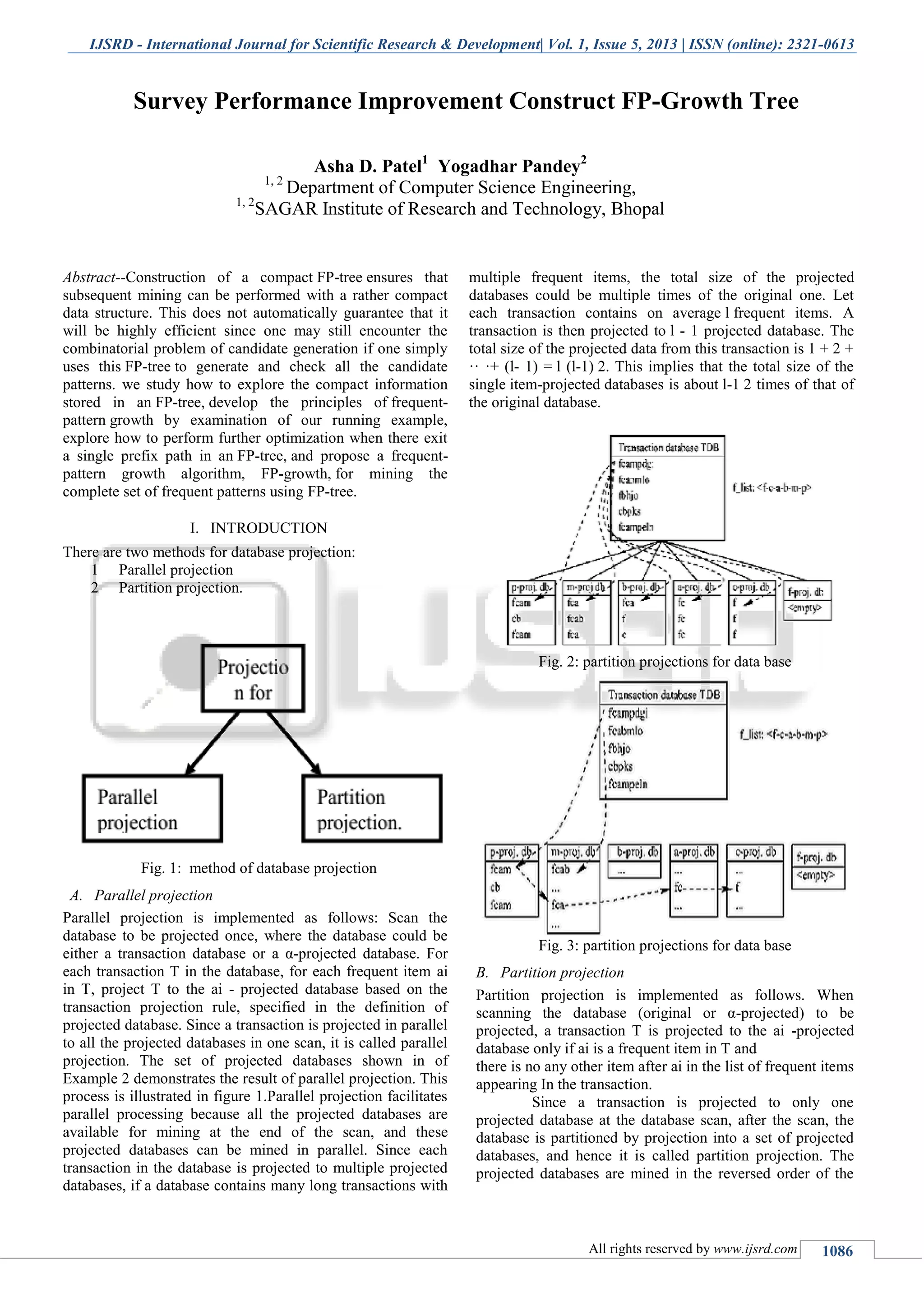
Fig. 2: partition projections for data base
Fig. 3: partition projections for data base
B. Partition projection
Partition projection is implemented as follows. When
scanning the database (original or α-projected) to be
projected, a transaction T is projected to the ai -projected
database only if ai is a frequent item in T and
there is no any other item after ai in the list of frequent items
appearing In the transaction.
Since a transaction is projected to only one
projected database at the database scan, after the scan, the
database is partitioned by projection into a set of projected
databases, and hence it is called partition projection. The
projected databases are mined in the reversed order of the
Survey Performance Improvement Construct FP-Growth Tree
Asha D. Patel1
Yogadhar Pandey2
1, 2
Department of Computer Science Engineering,
1, 2
SAGAR Institute of Research and Technology, Bhopal
S.P.B.Patel Engineering College, Mehsana, Gujarat
Survey Performance Improvement Construct FP-Growth Tree
(IJSRD/Vol. 1/Issue 5/2013/0012)
All rights reserved by www.ijsrd.com 1087
list of frequent items. That is, the projected database of the
least frequent item is mined first, and so on. Each time when
a projected database is being processed, to ensure the
remaining projected databases obtain the complete
information, each transaction in it is projected to the aj -
projected database, where aj is the item in the transaction
such that there is no any other item after aj in the list of
frequent items appearing in the transaction. The partition
projection process for the database in Conclusion:
distributed parallel computation technique or multi-CPU to
solve this problem. But these methods apparently increase
the costs for exchanging and combining control information,
and the algorithm complexity is also greatly increased,
cannot solve this problem efficiently. Even if adopting
multi-CPU technique, raising the requirement of hardware,
the performance Improvement is still limited.
REFERENCES
[1] Savasere, A., Omiecinski, E., and Navathe, S. An
Efficient Algorithm for Mining Association Rules in
Large Databases. Proceedings of the VLDB
Conference. 1995.
[2] Agrawal, R. and Srikant, R. Fast algorithms for
mining association rules. VLDB, 487-499. 1994.
[3] Han, J., Pei, J., and Yin, Y. Mining Frequent Patterns
without Candidate Generation. SIGMOD,1-12. 2000.
[4] Brin, S., Motwani, R., Ullman Jeffrey D., and Tsur
Shalom. Dynamic itemset counting and implication
rules for market basket data. SIGMOD. 1997.
[5] Brin, S., Motwani, R., and Silverstein, C. Beyond
market baskets: Generalizing association rules to
correlations. SIGMOD 26[2], 265-276.1997.
[6] Antonie, M.-L. and Zaïane, O. R., Text Document
Categorization by Term Association , IEEE
ICDM'2002, pp 19-26, Maebashi City, Japan,
December 9 - 12, 2002
[7] Han, J., Pei, J., Mortazavi-Asl, B., Chen, Q., Dayal,
U., and Hsu, M.-C. FreeSpan: Frequentpattern-
projected sequential pattern mining. ACM SIGKDD,
2000.
[8] Beil, F., Ester, M., Xu, X., Frequent Term- Based
Text Clustering, ACM SIGKDD, 2002
[9] Orlando, S., Palmerini, P., and Perego, R. Enhancing
the Apriori Algorithm for Frequent Set Counting.
Proceedings of 3rd International Conference on Data
Warehousing and Knowledge Discovery. 2001.
[10 ]Piatetsky-Shapiro, G., Fayyad, U., and Smith, P.,
"From Data Mining to Knowledge Discovery: An
Overview," in Fayyad, U., Piatetsky-Shapiro, G.,
Smith, P., and Uthurusamy, R. (eds.) Advances in
Knowledge Discovery and Data Mining AAAI/MIT
Press, 1996, pp. 1-35.
[11] Huang, H., Wu, X., and Relue, R. Association
Analysis with One Scan of Databases. Proceedings of
the 2002 IEEE International Conference on Data
Mining. 2002.
[12] Wang, K., Tang, L., Han, J., and Liu, J. Top down
FPGrowth for Association Rule Mining.Proc.Pacific-
Asia Conference, PAKDD 2002,334-340. 2002.
[13] Zaki, M. J. and Hsiao, C.-J. CHARM: An
EfficientAlgorithm for Closed Itemset Mining. SIAM
International Conference on Data Mining. 2002.
[14] Pei, J., Han, J., Nishio, S., Tang, S., and Yang, D. H-
Mine: Hyper-Structure Mining of Frequent Patterns
in Large Databases. Proc.2001 Int.Conf.on

Survey Performance Improvement Construct FP-Growth Tree

  • 1.
    IJSRD - InternationalJournal for Scientific Research & Development| Vol. 1, Issue 5, 2013 | ISSN (online): 2321-0613 All rights reserved by www.ijsrd.com 1086 Abstract--Construction of a compact FP-tree ensures that subsequent mining can be performed with a rather compact data structure. This does not automatically guarantee that it will be highly efficient since one may still encounter the combinatorial problem of candidate generation if one simply uses this FP-tree to generate and check all the candidate patterns. we study how to explore the compact information stored in an FP-tree, develop the principles of frequent- pattern growth by examination of our running example, explore how to perform further optimization when there exit a single prefix path in an FP-tree, and propose a frequent- pattern growth algorithm, FP-growth, for mining the complete set of frequent patterns using FP-tree. I. INTRODUCTION There are two methods for database projection: 1 Parallel projection 2 Partition projection. Fig. 1: method of database projection A. Parallel projection Parallel projection is implemented as follows: Scan the database to be projected once, where the database could be either a transaction database or a α-projected database. For each transaction T in the database, for each frequent item ai in T, project T to the ai - projected database based on the transaction projection rule, specified in the definition of projected database. Since a transaction is projected in parallel to all the projected databases in one scan, it is called parallel projection. The set of projected databases shown in of Example 2 demonstrates the result of parallel projection. This process is illustrated in figure 1.Parallel projection facilitates parallel processing because all the projected databases are available for mining at the end of the scan, and these projected databases can be mined in parallel. Since each transaction in the database is projected to multiple projected databases, if a database contains many long transactions with multiple frequent items, the total size of the projected databases could be multiple times of the original one. Let each transaction contains on average l frequent items. A transaction is then projected to l - 1 projected database. The total size of the projected data from this transaction is 1 + 2 + ·· ·+ (l- 1) = l (l-1) 2. This implies that the total size of the single item-projected databases is about l-1 2 times of that of the original database. Fig. 2: partition projections for data base Fig. 3: partition projections for data base B. Partition projection Partition projection is implemented as follows. When scanning the database (original or α-projected) to be projected, a transaction T is projected to the ai -projected database only if ai is a frequent item in T and there is no any other item after ai in the list of frequent items appearing In the transaction. Since a transaction is projected to only one projected database at the database scan, after the scan, the database is partitioned by projection into a set of projected databases, and hence it is called partition projection. The projected databases are mined in the reversed order of the Survey Performance Improvement Construct FP-Growth Tree Asha D. Patel1 Yogadhar Pandey2 1, 2 Department of Computer Science Engineering, 1, 2 SAGAR Institute of Research and Technology, Bhopal S.P.B.Patel Engineering College, Mehsana, Gujarat
  • 2.
    Survey Performance ImprovementConstruct FP-Growth Tree (IJSRD/Vol. 1/Issue 5/2013/0012) All rights reserved by www.ijsrd.com 1087 list of frequent items. That is, the projected database of the least frequent item is mined first, and so on. Each time when a projected database is being processed, to ensure the remaining projected databases obtain the complete information, each transaction in it is projected to the aj - projected database, where aj is the item in the transaction such that there is no any other item after aj in the list of frequent items appearing in the transaction. The partition projection process for the database in Conclusion: distributed parallel computation technique or multi-CPU to solve this problem. But these methods apparently increase the costs for exchanging and combining control information, and the algorithm complexity is also greatly increased, cannot solve this problem efficiently. Even if adopting multi-CPU technique, raising the requirement of hardware, the performance Improvement is still limited. REFERENCES [1] Savasere, A., Omiecinski, E., and Navathe, S. An Efficient Algorithm for Mining Association Rules in Large Databases. Proceedings of the VLDB Conference. 1995. [2] Agrawal, R. and Srikant, R. Fast algorithms for mining association rules. VLDB, 487-499. 1994. [3] Han, J., Pei, J., and Yin, Y. Mining Frequent Patterns without Candidate Generation. SIGMOD,1-12. 2000. [4] Brin, S., Motwani, R., Ullman Jeffrey D., and Tsur Shalom. Dynamic itemset counting and implication rules for market basket data. SIGMOD. 1997. [5] Brin, S., Motwani, R., and Silverstein, C. Beyond market baskets: Generalizing association rules to correlations. SIGMOD 26[2], 265-276.1997. [6] Antonie, M.-L. and Zaïane, O. R., Text Document Categorization by Term Association , IEEE ICDM'2002, pp 19-26, Maebashi City, Japan, December 9 - 12, 2002 [7] Han, J., Pei, J., Mortazavi-Asl, B., Chen, Q., Dayal, U., and Hsu, M.-C. FreeSpan: Frequentpattern- projected sequential pattern mining. ACM SIGKDD, 2000. [8] Beil, F., Ester, M., Xu, X., Frequent Term- Based Text Clustering, ACM SIGKDD, 2002 [9] Orlando, S., Palmerini, P., and Perego, R. Enhancing the Apriori Algorithm for Frequent Set Counting. Proceedings of 3rd International Conference on Data Warehousing and Knowledge Discovery. 2001. [10 ]Piatetsky-Shapiro, G., Fayyad, U., and Smith, P., "From Data Mining to Knowledge Discovery: An Overview," in Fayyad, U., Piatetsky-Shapiro, G., Smith, P., and Uthurusamy, R. (eds.) Advances in Knowledge Discovery and Data Mining AAAI/MIT Press, 1996, pp. 1-35. [11] Huang, H., Wu, X., and Relue, R. Association Analysis with One Scan of Databases. Proceedings of the 2002 IEEE International Conference on Data Mining. 2002. [12] Wang, K., Tang, L., Han, J., and Liu, J. Top down FPGrowth for Association Rule Mining.Proc.Pacific- Asia Conference, PAKDD 2002,334-340. 2002. [13] Zaki, M. J. and Hsiao, C.-J. CHARM: An EfficientAlgorithm for Closed Itemset Mining. SIAM International Conference on Data Mining. 2002. [14] Pei, J., Han, J., Nishio, S., Tang, S., and Yang, D. H- Mine: Hyper-Structure Mining of Frequent Patterns in Large Databases. Proc.2001 Int.Conf.on