CVS II-
ISCHAEMIC HEART
DISEASE (IHD)
Dr.Tabinda Aijaz
Department of Pathology
SJMC
Contents
 Epidemiology , Risk factors and spectrum of
IHD
 Pathogenesis
 Clinical Presentations
 Morphology
 Lab Diagnosis of IHD
 Complications
Ischaemic Heart Disease
 Definition: IHD is a group of heart diseases in
which there is an inadequate supply of blood
and oxygen to a portion of the myocardium.
 Imbalance between myocardial supply and
cardiac demand for oxygenated blood.
Blood supply of the Heart
 IHD represents a group of pathophysiologically
related syndromes resulting from Myocardial
ischemia.
 Coronary arterial occlusion is the main cause of
myocardial ischemia.
Risk of IHD depends on:
 (a) extent and severity of pre-existing (fixed)
atherosclerotic occlusion
 (b) sudden/dynamic morphological changes
in the atheromatous plaque.
a. Extent & Severity of occlusion
 Number of coronaries affected/involved: Atherosclerosis
may affect one, two or all three coronaries.
 Degree/extent of stenosis (obstruction) by atheromatous
plaques:
 Fixed obstruction less than 70%: Asymptomatic.
 Fixed obstruction of 75% or more: It results in critical
stenosis precipitates ischemia by exercise
produces symptom as chest pain—stable angina.
 Fixed obstruction of 90% and above: It leads to
inadequate coronary blood flow even at rest-unstable
angina.
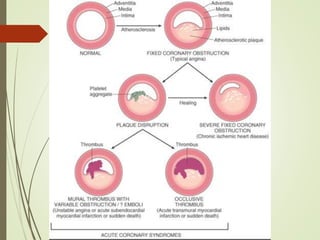
b. Acute plaque changes
Abrupt and unpredictable conversion of a stable
atherosclerotic plaque into an unstable lesion
through :
 Rupture or fissuring
 Erosion/ulceration
 Hemorrhage
 Thrombosis
Other (Nonatheromatous) Causes of
Coronary Artery Occlusion
 Coronary emboli from thrombi in left side of the
heart
 Coronary vasospasm
 Diminished availability of blood or oxygen:
– Lowered systemic blood pressure (e.g. shock)
– Hypoxemia.
Consequences Of Myocardial Ischemia
 Angina pectoris: less severe ischemia
 Myocardial infarction: most important form of IHD.
Duration & severity of ischemia causes muscle
death
 Chronic IHD with heart failure
 Sudden cardiac death
Pathogenesis of IHD
 Diminished coronary perfusion
 Fixed atherosclerotic narrowing
 >75%with exercise, >90% at rest
 Disrupted atherosclerotic plaques
 Intraluminal thrombosis
 Vasospasm
Single/two/all three vessels occluded.
IHD can present as one or more of the
following clinical syndromes.
 Myocardial infarction
ischemia causes the death of heart muscle.
 Angina pectoris
ischemia is of insufficient severity to cause
infarction, but may be a harbinger of MI.
 Chronic IHD with heart failure
 Sudden cardiac death
Angina Pectoris
 Definition: Angina pectoris clinically present as
paroxysmal and recurrent attacks of substernal or
precordial chest discomfort due to transient
myocardial ischemia, which falls short of inducing
necrosis of myocardial cell.
 Transient: 15sec-15min
3 overlapping patterns:
1) Stable angina (most common & typical
form)
2) Prinzmetal variant angina – caused by
coronary artery spasm
3) Unstable/crescendo angina
Stable Angina
Due to imbalance in coronary
perfusion.
Develops when myocardial oxygen
demand increases with increased
physical activity or emotional
excitement.
 Deep, poorly localized, squeezing or burning
sensation.
 Chest pain in the substernal region.
 Relieved by rest or administration of
sublingual vasodilators.
Prinzmetal variant angina
Caused by coronary artery spasm.
Uncommon atypical form.
Anginal attacks unrelated to physical
activity, heart rate or blood pressure.
Occurs at rest & responds to
vasodilators.
Unstable Angina pectoris
Increasingly frequent, prolonged chest
pain.
Precipitated by lower levels of physical
activity or even occurring at rest.
Mostly due to disruption of plaque.
Unstable or Crescendo Angina
 Caused by the disruption/rupture of an
atherosclerotic plaque complicated by
thrombosis/embolization/vasospasm/
vasoconstriction.
 It is of prolonged duration and occurs with
minimal physical activity or even at rest.
 May progress to myocardial infarction and is
also referred to as pre infarction angina.
Myocardial infarction
 Myocardial infarction(MI), also commonly
referred to as “heart attack,” is the death of
cardiac muscle due to prolonged severe
ischemia.
 Definition: Myocardial infarction is a
coagulative type of necrosis of cardiac muscle
and is due to prolonged severe ischemia.
Incidence and Risk Factors
 MI occurs at any age; frequency rises progressively with
increasing age (peak - 40 to 65 yrs).
 It can develop at younger age in patients with major risk
factors of atherosclerosis (hyperlipidemia, hypertension,
diabetes and cigarette smoking).
 Incidence of MI also strongly correlates with genetic and
behavioural predispositions to atherosclerosis.
 Blacks and whites are equally affected.
 Males have significantly higher risk than females mainly
during the reproductive period.
Etiology
 Coronary Atherosclerosis (90% of cases)
 MI is due to atherosclerotic narrowing of one or
more coronary arteries.
 Nonatheromatous Causes (10% of cases)
 Vasospasm
 Emboli
 Ischemia due to other causes: Vasculitis,
Amyloidosis, Vascular dissection, Hematologic
disorders like sickle cell disease.
Pathogenesis of MI
 Coronary Arterial Occlusion.
 Initial event is a sudden change in an
atheromatous plaque: intraplaque haemorrhage,
erosion or ulceration, or rupture or fissuring.
 When exposed to subendothelial collagen &
necrotic plaque contents, platelets adhere,
become activated, aggregate to form
microthrombi.
 Vasospasm is stimulated by mediators
released from platelets.
 Tissue factor activates the coagulation
pathway, adding to the bulk of the
thrombus.
 Frequently within minutes, the thrombus
evolves to completely occlude the lumen of
the vessel.
Sequence of events in a typical case of MI
1. Acute plaque change
2. Formation of microthrombi
3. Vasospasm: Activated platelets, endothelial
cell and inflammatory cells release mediators
that cause vasospasm
4. Activation of the coagulation pathway
5. Complete occlusion of vessel
6. Myocardial necrosis (Ischemic coagulative
necrosis)
Consequence of Myocardial
Ischemia
 These include functional, biochemical and
morphological changes.
 Morphological changes can be divided into
reversible and irreversible damage/injury.
A. Reversible Injury
 Biochemical Changes
 Early biochemical change is the cessation of
aerobic glycolysis within seconds inadequate
production of high-energy phosphates (e.g.,
creatine phosphate and ATP) & accumulation of
potentially noxious metabolites (e.g., lactic acid).
Functional changes
Ischaemic muscle ceases to contract within a
few min.
Necrosis inhibited if flow is restored within 20-
40mins.
Loss of contractility can precipitate
acute heart failure.
Morphological changes
 They are seen at ultrastructural level such
as mitochondrial swelling, glycogen
depletion and myofibrillar relaxation.
 They also develop within a few minutes.
B. Irreversible Injury
 Develops only after prolonged, severe
myocardial ischemia of more than 20 to 40
minutes.
 Functional disturbances: Arrhythmias.
Biochemical Changes
 Leads to leakage of cytoplasmic proteins into
the blood.
 Early phases of myocardial cell necrosis causes
breakdown of the sarcolemmal membrane.
 leakage of intracellular proteins (such as
myoglobin, LDH, CK & troponins I and T) into
the blood.
 levels of these leaked myocardial proteins in the
blood is used for the diagnosis of MI.
Morphological changes
 Coagulative necrosis of cardiac muscle fibers
usually complete within 6 hours of the onset
of myocardial ischemia.
 Zones damaged: First necrosis in the
subendocardial zone later transmural
infarct.
 A. Depending on the thickness of myocardium
involved:
 1. Transmural:
• a. Ischemic necrosis of the entire thickness of
the ventricular wall.
• b. Most myocardial infarcts are transmural.
• c. Usually associated with chronic coronary
atherosclerosis, acute plaque change, and
superimposed thrombosis.
Patterns of infarction
2. Subendocardial
(nontransmural)
 a. Ischemic necrosis of inner one-third to
one-half of the ventricular wall.
 b. Occurs due to plaque disruption
followed by a coronary thrombus, which
undergoes lysis or prolonged, severe
reduction in systemic blood pressure. For
e.g., shock superimposed on chronic,
coronary stenosis.
3. Microscopic infarcts
 Develop with occlusion of small vessel (e.g.
vasculitis, embolization) and may not show
any changes in ECG.
 B. Depending on the age of the infarct:
Recent (fresh) or old (healed).
C. Depending on the anatomic
region involved:
 Anterior
 Posterior
 lateral
 septal &
 their combination like posterolateral.
Myocardial perfusion pattern is from
epicardium to endocardium.
Ischemia is most pronounced in the
subendocardium.
Extended ischemia leads to
progressive involvement of the
transmural thickness.
Infarct localisation
 1. LAD occlusion (40–50%): a. Anterior wall
of left ventricle near the apex b. Anterior
portion of ventricular septum c. Apex
circumferentially.
 2. RCA occlusion (30–40%): a. Region of
the inferior/posterior wall of left ventricle b.
Posterior portion of interventricular septum
(inferior infarct) c. Inferior/posterior right
ventricular free wall (in some).
 3. LCA occlusion (15–20%): lateral wall of
left ventricle except at the apex.
Distribution of MI-location & nature of occlusion
Gross
 <12 hrs.- not apparent
 Immerse in triphenyltetrazolium chloride (TTC)
 Brick red color to intact areas
 Dehydrogenases (muscle)
 Unstained pale zone
 12-24hrs.- red-blue hue
 10days to 2weeks – soft yellow tan areas
 Fibrotic areas
Time Gross Features Light Microscope Electron Microscope
Reversible Injury
0–½ hr None None
Relaxation of myofibrils;
glycogen loss; mitochondrial
swelling
Irreversible Injury
½–4 hr None
Usually none; variable
waviness of fibers at border
Sarcolemmal disruption;
mitochondrial amorphous
densities
4–12 hr Occasionally dark mottling
Beginning coagulation
necrosis; edema;
hemorrhage
12–24 hr Dark mottling
Ongoing coagulation
necrosis; pyknosis of nuclei;
myocyte hypereosinophilia;
marginal contraction band
necrosis; beginning
neutrophilic infiltrate
1–3 days
Mottling with yellow-tan
infarct center
Coagulation necrosis, with
loss of nuclei and striations;
interstitial infiltrate of
neutrophils
3–7 days
Hyperemic border; central
yellow-tan softening
Beginning disintegration of
dead myofibers, with dying
neutrophils; early
phagocytosis of dead cells
by macrophages at infarct
border
Time Gross Features Light Microscope
7–10 days
Maximally yellow-tan and soft,
with depressed red-tan margins
Well-developed phagocytosis of
dead cells; early formation of
fibrovascular granulation tissue at
margins
10–14 days
Red-gray depressed infarct
borders
Well-established granulation
tissue with new blood vessels and
collagen deposition
2–8 wk
Gray-white scar, progressive from
border toward core of infarct
Increased collagen deposition,
with decreased cellularity
>2 mo Scarring complete Dense collagenous scar
Infarct of 1-3 weeks
4 -12 hrs
2 – 3 d
5 – 10d 6 weeks
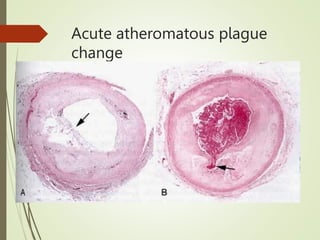
Acute atheromatous plague
change
Reperfusion & its Effects on MI
 The ischemic myocardium can be rescued by
restoring the myocardial blood fl ow as quickly
as possible by reperfusion.
 Methods of reperfusion: It may be achieved by
dissolving the thrombus using thrombolytic
drugs or angioplasty/stent placement, or
coronary artery bypass graft (CABG) surgery).
 Benefits and outcome of reperfusion: It depends
on rapidity of restoration. Reperfusion within 20
minutes of the onset of ischemia may completely
prevent necrosis.
Morphology
 Gross: Reperfused infarcted area appears
hemorrhagic.
 Microscopy: Accelerates acute inflammatory
responses: Neutrophils accumulate more
rapidly but also disappear more rapidly.
 Contraction band necrosis: It is one of the
characteristic feature.
 appear as thick, irregular, transverse, intensely
eosinophilic intracellular bands in necrotic
myocardial cells.
 Contraction band
necrosis in the
myocardium (a
result of no
flow/reflow,
ischemia/reperfusio
n injury) is visible
as dark pink bands
spanning the
myofibers
Diagnosis of MI
 Typical symptoms+ biochemical investigations+ ECG
pattern
 Pain, dyspnea, profuse sweating, rapid weak pulse
 10-15% silent MI
 Early perfusion by cardiac intevention is beneficial
Cardiac enzymes
These changes are due to leakage of
proteins from the necrotic myocardial cells
into the blood circulation.
1. Cardiac Troponins: Most sensitive and
specific biomarkers of myocardial damage
are cardiac specific proteins, cTnT and cTnI
(Troponins T and I).
2. Cardiac creatine phosphokinase (CK): It is
a nonspecifi c enzyme marker and it is
present in brain, myocardium, and skeletal
muscle.
CKMB isoform (expressed in cardiac muscle)
is sensitive but not specific.
 Time to elevation of CKMB, cTnT and cTnI is 3
to 12 hrs.
 CK-MB and cTnI peak at 24 hours.
 CK-MB returns to normal in 48-72 hrs, cTnI in
5-10 days, and cTnT in 5 to 14 days.
 3. Lactate dehydrogenase (LDH): It not specific
marker. It starts rising after 24 to 48 hours. It
remains for many days and returns to normal
in 7 to 14 days.
 4. Myoglobin: It is an oxygen-carrying
respiratory protein found only in skeletal and
cardiac muscle.
 It is an earliest marker of MI, the level rises
within 1 to 3 hours, peaks in about 8 to 12 hours
and return to normal in about 24 to 36 hours.
Sensitive and specific markers: cTnT & cTnI
Electrocardiogram (ECG)
changes
 The most frequently used
electrocardiographic criterion for identifying
acute myocardial infarction is ST segment
elevation in two or more anatomically
contiguous leads.
ECG
Complications of MI – size, site,
thickness
 Contractile dysfunction- pump failure
 Arrhythmias
 Myocardial rupture- left ventricular wall, septal,
papillary
 Pericarditis (Dressler syndrome)
 Right ventricle infarction
 Infarct extension & expansion
 Mural thrombus
 Ventricular aneurysm- late
 Papillary muscle dysfunction
 Progressive Heart Failure – Chronic IHD
Chronic ischemic heart disease
 Ischemic myocardial damage/ inadequate
compensatory response- progressive heart
failure.
 Exhaustion of compensatory hypetrophic
myocytes.
 Postinfarction functional decompensation of
hypertrophied noninfarcted myocardium.
Sudden cardiac death
Definition: Unexpected death from cardiac
causes either without symptoms or within 1-
24 hrs of symptom.
Causes include:
IHD (most common cause)
Congenital anomalies of coronaries
AV stenosis
MV prolapse
Myocarditis
Dilated/hypertrophic Cardiomyopathy
Pulmonary HTN
Fatal arrhythmia
Thank You !!!

IHD - TA L2.pptx

  • 1.
    CVS II- ISCHAEMIC HEART DISEASE(IHD) Dr.Tabinda Aijaz Department of Pathology SJMC
  • 2.
    Contents  Epidemiology ,Risk factors and spectrum of IHD  Pathogenesis  Clinical Presentations  Morphology  Lab Diagnosis of IHD  Complications
  • 3.
    Ischaemic Heart Disease Definition: IHD is a group of heart diseases in which there is an inadequate supply of blood and oxygen to a portion of the myocardium.  Imbalance between myocardial supply and cardiac demand for oxygenated blood.
  • 4.
    Blood supply ofthe Heart
  • 5.
     IHD representsa group of pathophysiologically related syndromes resulting from Myocardial ischemia.  Coronary arterial occlusion is the main cause of myocardial ischemia.
  • 6.
    Risk of IHDdepends on:  (a) extent and severity of pre-existing (fixed) atherosclerotic occlusion  (b) sudden/dynamic morphological changes in the atheromatous plaque.
  • 7.
    a. Extent &Severity of occlusion  Number of coronaries affected/involved: Atherosclerosis may affect one, two or all three coronaries.  Degree/extent of stenosis (obstruction) by atheromatous plaques:  Fixed obstruction less than 70%: Asymptomatic.  Fixed obstruction of 75% or more: It results in critical stenosis precipitates ischemia by exercise produces symptom as chest pain—stable angina.  Fixed obstruction of 90% and above: It leads to inadequate coronary blood flow even at rest-unstable angina.
  • 8.
    b. Acute plaquechanges Abrupt and unpredictable conversion of a stable atherosclerotic plaque into an unstable lesion through :  Rupture or fissuring  Erosion/ulceration  Hemorrhage  Thrombosis
  • 12.
    Other (Nonatheromatous) Causesof Coronary Artery Occlusion  Coronary emboli from thrombi in left side of the heart  Coronary vasospasm  Diminished availability of blood or oxygen: – Lowered systemic blood pressure (e.g. shock) – Hypoxemia.
  • 13.
    Consequences Of MyocardialIschemia  Angina pectoris: less severe ischemia  Myocardial infarction: most important form of IHD. Duration & severity of ischemia causes muscle death  Chronic IHD with heart failure  Sudden cardiac death
  • 16.
    Pathogenesis of IHD Diminished coronary perfusion  Fixed atherosclerotic narrowing  >75%with exercise, >90% at rest  Disrupted atherosclerotic plaques  Intraluminal thrombosis  Vasospasm Single/two/all three vessels occluded.
  • 17.
    IHD can presentas one or more of the following clinical syndromes.  Myocardial infarction ischemia causes the death of heart muscle.  Angina pectoris ischemia is of insufficient severity to cause infarction, but may be a harbinger of MI.  Chronic IHD with heart failure  Sudden cardiac death
  • 18.
    Angina Pectoris  Definition:Angina pectoris clinically present as paroxysmal and recurrent attacks of substernal or precordial chest discomfort due to transient myocardial ischemia, which falls short of inducing necrosis of myocardial cell.  Transient: 15sec-15min
  • 19.
    3 overlapping patterns: 1)Stable angina (most common & typical form) 2) Prinzmetal variant angina – caused by coronary artery spasm 3) Unstable/crescendo angina
  • 20.
    Stable Angina Due toimbalance in coronary perfusion. Develops when myocardial oxygen demand increases with increased physical activity or emotional excitement.
  • 21.
     Deep, poorlylocalized, squeezing or burning sensation.  Chest pain in the substernal region.  Relieved by rest or administration of sublingual vasodilators.
  • 22.
    Prinzmetal variant angina Causedby coronary artery spasm. Uncommon atypical form. Anginal attacks unrelated to physical activity, heart rate or blood pressure. Occurs at rest & responds to vasodilators.
  • 23.
    Unstable Angina pectoris Increasinglyfrequent, prolonged chest pain. Precipitated by lower levels of physical activity or even occurring at rest. Mostly due to disruption of plaque.
  • 24.
    Unstable or CrescendoAngina  Caused by the disruption/rupture of an atherosclerotic plaque complicated by thrombosis/embolization/vasospasm/ vasoconstriction.  It is of prolonged duration and occurs with minimal physical activity or even at rest.  May progress to myocardial infarction and is also referred to as pre infarction angina.
  • 25.
    Myocardial infarction  Myocardialinfarction(MI), also commonly referred to as “heart attack,” is the death of cardiac muscle due to prolonged severe ischemia.  Definition: Myocardial infarction is a coagulative type of necrosis of cardiac muscle and is due to prolonged severe ischemia.
  • 26.
    Incidence and RiskFactors  MI occurs at any age; frequency rises progressively with increasing age (peak - 40 to 65 yrs).  It can develop at younger age in patients with major risk factors of atherosclerosis (hyperlipidemia, hypertension, diabetes and cigarette smoking).  Incidence of MI also strongly correlates with genetic and behavioural predispositions to atherosclerosis.  Blacks and whites are equally affected.  Males have significantly higher risk than females mainly during the reproductive period.
  • 27.
    Etiology  Coronary Atherosclerosis(90% of cases)  MI is due to atherosclerotic narrowing of one or more coronary arteries.  Nonatheromatous Causes (10% of cases)  Vasospasm  Emboli  Ischemia due to other causes: Vasculitis, Amyloidosis, Vascular dissection, Hematologic disorders like sickle cell disease.
  • 28.
    Pathogenesis of MI Coronary Arterial Occlusion.  Initial event is a sudden change in an atheromatous plaque: intraplaque haemorrhage, erosion or ulceration, or rupture or fissuring.  When exposed to subendothelial collagen & necrotic plaque contents, platelets adhere, become activated, aggregate to form microthrombi.
  • 29.
     Vasospasm isstimulated by mediators released from platelets.  Tissue factor activates the coagulation pathway, adding to the bulk of the thrombus.  Frequently within minutes, the thrombus evolves to completely occlude the lumen of the vessel.
  • 31.
    Sequence of eventsin a typical case of MI 1. Acute plaque change 2. Formation of microthrombi 3. Vasospasm: Activated platelets, endothelial cell and inflammatory cells release mediators that cause vasospasm 4. Activation of the coagulation pathway 5. Complete occlusion of vessel 6. Myocardial necrosis (Ischemic coagulative necrosis)
  • 32.
    Consequence of Myocardial Ischemia These include functional, biochemical and morphological changes.  Morphological changes can be divided into reversible and irreversible damage/injury.
  • 33.
    A. Reversible Injury Biochemical Changes  Early biochemical change is the cessation of aerobic glycolysis within seconds inadequate production of high-energy phosphates (e.g., creatine phosphate and ATP) & accumulation of potentially noxious metabolites (e.g., lactic acid).
  • 34.
    Functional changes Ischaemic muscleceases to contract within a few min. Necrosis inhibited if flow is restored within 20- 40mins. Loss of contractility can precipitate acute heart failure.
  • 35.
    Morphological changes  Theyare seen at ultrastructural level such as mitochondrial swelling, glycogen depletion and myofibrillar relaxation.  They also develop within a few minutes.
  • 36.
    B. Irreversible Injury Develops only after prolonged, severe myocardial ischemia of more than 20 to 40 minutes.  Functional disturbances: Arrhythmias.
  • 37.
    Biochemical Changes  Leadsto leakage of cytoplasmic proteins into the blood.  Early phases of myocardial cell necrosis causes breakdown of the sarcolemmal membrane.  leakage of intracellular proteins (such as myoglobin, LDH, CK & troponins I and T) into the blood.  levels of these leaked myocardial proteins in the blood is used for the diagnosis of MI.
  • 38.
    Morphological changes  Coagulativenecrosis of cardiac muscle fibers usually complete within 6 hours of the onset of myocardial ischemia.  Zones damaged: First necrosis in the subendocardial zone later transmural infarct.
  • 39.
     A. Dependingon the thickness of myocardium involved:  1. Transmural: • a. Ischemic necrosis of the entire thickness of the ventricular wall. • b. Most myocardial infarcts are transmural. • c. Usually associated with chronic coronary atherosclerosis, acute plaque change, and superimposed thrombosis. Patterns of infarction
  • 40.
    2. Subendocardial (nontransmural)  a.Ischemic necrosis of inner one-third to one-half of the ventricular wall.  b. Occurs due to plaque disruption followed by a coronary thrombus, which undergoes lysis or prolonged, severe reduction in systemic blood pressure. For e.g., shock superimposed on chronic, coronary stenosis.
  • 41.
    3. Microscopic infarcts Develop with occlusion of small vessel (e.g. vasculitis, embolization) and may not show any changes in ECG.
  • 42.
     B. Dependingon the age of the infarct: Recent (fresh) or old (healed).
  • 43.
    C. Depending onthe anatomic region involved:  Anterior  Posterior  lateral  septal &  their combination like posterolateral.
  • 44.
    Myocardial perfusion patternis from epicardium to endocardium. Ischemia is most pronounced in the subendocardium. Extended ischemia leads to progressive involvement of the transmural thickness.
  • 46.
    Infarct localisation  1.LAD occlusion (40–50%): a. Anterior wall of left ventricle near the apex b. Anterior portion of ventricular septum c. Apex circumferentially.  2. RCA occlusion (30–40%): a. Region of the inferior/posterior wall of left ventricle b. Posterior portion of interventricular septum (inferior infarct) c. Inferior/posterior right ventricular free wall (in some).  3. LCA occlusion (15–20%): lateral wall of left ventricle except at the apex.
  • 47.
    Distribution of MI-location& nature of occlusion
  • 48.
    Gross  <12 hrs.-not apparent  Immerse in triphenyltetrazolium chloride (TTC)  Brick red color to intact areas  Dehydrogenases (muscle)  Unstained pale zone  12-24hrs.- red-blue hue  10days to 2weeks – soft yellow tan areas  Fibrotic areas
  • 50.
    Time Gross FeaturesLight Microscope Electron Microscope Reversible Injury 0–½ hr None None Relaxation of myofibrils; glycogen loss; mitochondrial swelling Irreversible Injury ½–4 hr None Usually none; variable waviness of fibers at border Sarcolemmal disruption; mitochondrial amorphous densities 4–12 hr Occasionally dark mottling Beginning coagulation necrosis; edema; hemorrhage 12–24 hr Dark mottling Ongoing coagulation necrosis; pyknosis of nuclei; myocyte hypereosinophilia; marginal contraction band necrosis; beginning neutrophilic infiltrate 1–3 days Mottling with yellow-tan infarct center Coagulation necrosis, with loss of nuclei and striations; interstitial infiltrate of neutrophils 3–7 days Hyperemic border; central yellow-tan softening Beginning disintegration of dead myofibers, with dying neutrophils; early phagocytosis of dead cells by macrophages at infarct border
  • 51.
    Time Gross FeaturesLight Microscope 7–10 days Maximally yellow-tan and soft, with depressed red-tan margins Well-developed phagocytosis of dead cells; early formation of fibrovascular granulation tissue at margins 10–14 days Red-gray depressed infarct borders Well-established granulation tissue with new blood vessels and collagen deposition 2–8 wk Gray-white scar, progressive from border toward core of infarct Increased collagen deposition, with decreased cellularity >2 mo Scarring complete Dense collagenous scar
  • 53.
  • 54.
    4 -12 hrs 2– 3 d 5 – 10d 6 weeks
  • 55.
  • 56.
    Reperfusion & itsEffects on MI  The ischemic myocardium can be rescued by restoring the myocardial blood fl ow as quickly as possible by reperfusion.  Methods of reperfusion: It may be achieved by dissolving the thrombus using thrombolytic drugs or angioplasty/stent placement, or coronary artery bypass graft (CABG) surgery).  Benefits and outcome of reperfusion: It depends on rapidity of restoration. Reperfusion within 20 minutes of the onset of ischemia may completely prevent necrosis.
  • 57.
    Morphology  Gross: Reperfusedinfarcted area appears hemorrhagic.  Microscopy: Accelerates acute inflammatory responses: Neutrophils accumulate more rapidly but also disappear more rapidly.  Contraction band necrosis: It is one of the characteristic feature.  appear as thick, irregular, transverse, intensely eosinophilic intracellular bands in necrotic myocardial cells.
  • 58.
     Contraction band necrosisin the myocardium (a result of no flow/reflow, ischemia/reperfusio n injury) is visible as dark pink bands spanning the myofibers
  • 59.
    Diagnosis of MI Typical symptoms+ biochemical investigations+ ECG pattern  Pain, dyspnea, profuse sweating, rapid weak pulse  10-15% silent MI  Early perfusion by cardiac intevention is beneficial
  • 60.
    Cardiac enzymes These changesare due to leakage of proteins from the necrotic myocardial cells into the blood circulation. 1. Cardiac Troponins: Most sensitive and specific biomarkers of myocardial damage are cardiac specific proteins, cTnT and cTnI (Troponins T and I). 2. Cardiac creatine phosphokinase (CK): It is a nonspecifi c enzyme marker and it is present in brain, myocardium, and skeletal muscle. CKMB isoform (expressed in cardiac muscle) is sensitive but not specific.
  • 61.
     Time toelevation of CKMB, cTnT and cTnI is 3 to 12 hrs.  CK-MB and cTnI peak at 24 hours.  CK-MB returns to normal in 48-72 hrs, cTnI in 5-10 days, and cTnT in 5 to 14 days.
  • 62.
     3. Lactatedehydrogenase (LDH): It not specific marker. It starts rising after 24 to 48 hours. It remains for many days and returns to normal in 7 to 14 days.  4. Myoglobin: It is an oxygen-carrying respiratory protein found only in skeletal and cardiac muscle.  It is an earliest marker of MI, the level rises within 1 to 3 hours, peaks in about 8 to 12 hours and return to normal in about 24 to 36 hours.
  • 63.
    Sensitive and specificmarkers: cTnT & cTnI
  • 64.
    Electrocardiogram (ECG) changes  Themost frequently used electrocardiographic criterion for identifying acute myocardial infarction is ST segment elevation in two or more anatomically contiguous leads.
  • 65.
  • 67.
    Complications of MI– size, site, thickness  Contractile dysfunction- pump failure  Arrhythmias  Myocardial rupture- left ventricular wall, septal, papillary  Pericarditis (Dressler syndrome)  Right ventricle infarction  Infarct extension & expansion  Mural thrombus  Ventricular aneurysm- late  Papillary muscle dysfunction  Progressive Heart Failure – Chronic IHD
  • 70.
    Chronic ischemic heartdisease  Ischemic myocardial damage/ inadequate compensatory response- progressive heart failure.  Exhaustion of compensatory hypetrophic myocytes.  Postinfarction functional decompensation of hypertrophied noninfarcted myocardium.
  • 71.
    Sudden cardiac death Definition:Unexpected death from cardiac causes either without symptoms or within 1- 24 hrs of symptom. Causes include: IHD (most common cause) Congenital anomalies of coronaries AV stenosis MV prolapse Myocarditis Dilated/hypertrophic Cardiomyopathy Pulmonary HTN Fatal arrhythmia
  • 72.

Editor's Notes

  • #17 Although only a single major coronary epicardial vessel may be affected, two or all three—the LAD (left anterior descending artery), LCX (left circumflex artery), and RCA (right coronary artery) —are often involved by obstructive atherosclerosis.
  • #72 HTN - hypertension