Using Innovation Games® to really
        understand what’s the most important
                     thing to do.


#SUGUK #INNOVGAMES
#SUGUK #INNOVGAMES
Agenda
 • SharePoint Project Pain
 • Serious Games
 • Getting started with serious games


#SUGUK #INNOVGAMES
Agenda
 • SharePoint Project Pain


#SUGUK #INNOVGAMES
SharePoint Project Pain
 •   IT driven change
 •   Limited business involvement
 •   No shared vision
 •   What legacy


#SUGUK #INNOVGAMES
Some questions
 • What is collaboration?
     – How do you do it?
     – Why do you do it?
     – Who do you do it with?


#SUGUK #INNOVGAMES
Traditional vs. Collaborative
 • Traditional techniques often can
     – Be highly constrained and overly precise
     – Assume people have the answers
 • Collaborative techniques
     – Allow you to explore alternatives
     – Answers can be discovered during the process

#SUGUK #INNOVGAMES
Paradox
 SharePoint is a Collaboration Platform…
 …yet we often fail to collaborate on how to use
 SharePoint!


#SUGUK #INNOVGAMES
Agenda

 • Serious Games


#SUGUK #INNOVGAMES
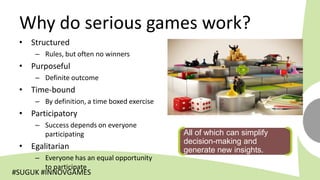
Why do serious games work?
 • Structured
     – Rules, but often no winners
 • Purposeful
     – Definite outcome
 • Time-bound
     – By definition, a time boxed exercise
 • Participatory
     – Success depends on everyone
       participating                          All of which can simplify
                                              decision-making and
 • Egalitarian                                generate new insights.
     – Everyone has an equal opportunity
       to participate
#SUGUK #INNOVGAMES
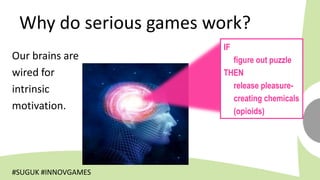
Why do serious games work?
                       IF
Our brains are           figure out puzzle
wired for              THEN
intrinsic                release pleasure-
                         creating chemicals
motivation.              (opioids)


#SUGUK #INNOVGAMES
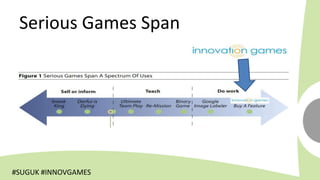
Serious Games Span


#SUGUK #INNOVGAMES
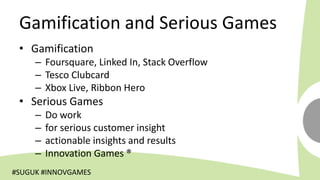
Gamification and Serious Games
 • Gamification
     – Foursquare, Linked In, Stack Overflow
     – Tesco Clubcard
     – Xbox Live, Ribbon Hero
 • Serious Games
     –   Do work
     –   for serious customer insight
     –   actionable insights and results
     –   Innovation Games ®
#SUGUK #INNOVGAMES
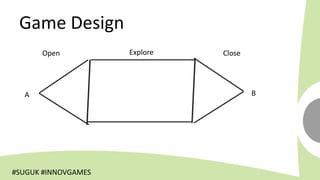
Game Design
      Open           Explore   Close


  A                                    B


#SUGUK #INNOVGAMES
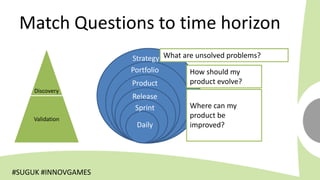
Match Questions to time horizon
                     Strategy What are unsolved problems?
                     Portfolio       How should my
                     Product         product evolve?
     Discovery
                     Release
                      Sprint         Where can my
     Validation
                                     product be
                      Daily          improved?


#SUGUK #INNOVGAMES
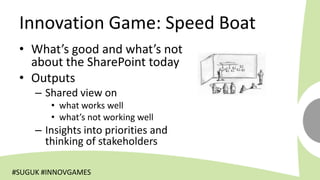
Innovation Game: Speed Boat
 • What’s good and what’s not
   about the SharePoint today
 • Outputs
     – Shared view on
        • what works well
        • what’s not working well
     – Insights into priorities and
       thinking of stakeholders

#SUGUK #INNOVGAMES
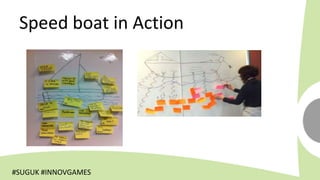
Speed boat in Action


#SUGUK #INNOVGAMES
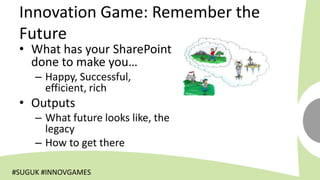
Innovation Game: Remember the
 Future
 • What has your SharePoint
   done to make you…
     – Happy, Successful,
       efficient, rich
 • Outputs
     – What future looks like, the
       legacy
     – How to get there

#SUGUK #INNOVGAMES
Innovation Game: Buy a Feature
 • Prioritize Features
 • Outputs
     – Most important features
     – Shared commitment
     – Reason for buying


#SUGUK #INNOVGAMES
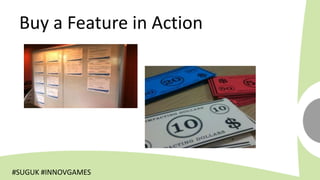
Buy a Feature in Action


#SUGUK #INNOVGAMES
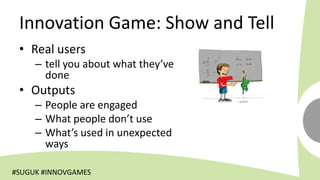
Innovation Game: Show and Tell
 • Real users
     – tell you about what they’ve
       done
 • Outputs
     – People are engaged
     – What people don’t use
     – What’s used in unexpected
       ways

#SUGUK #INNOVGAMES
Innovation Game: Spider Web
 • Visualise the full picture
 • Outputs
     – Explore relationships and
       dependencies
     – Discover hidden
       stakeholders and systems

#SUGUK #INNOVGAMES
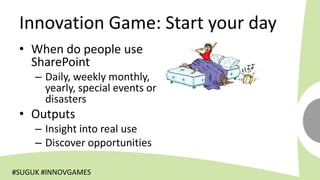
Innovation Game: Start your day
 • When do people use
   SharePoint
     – Daily, weekly monthly,
       yearly, special events or
       disasters
 • Outputs
     – Insight into real use
     – Discover opportunities

#SUGUK #INNOVGAMES
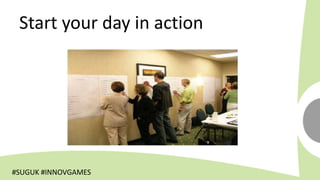
Start your day in action


#SUGUK #INNOVGAMES
Agenda


 • Getting started with serious games


#SUGUK #INNOVGAMES
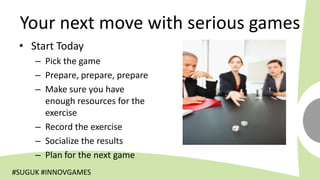
Your next move with serious games
 • Start Today
     – Pick the game
     – Prepare, prepare, prepare
     – Make sure you have
       enough resources for the
       exercise
     – Record the exercise
     – Socialize the results
     – Plan for the next game
#SUGUK #INNOVGAMES
Innovation Games Process
 •   Planning
 •   Playing
 •   Post-Processing
 •   Action


#SUGUK #INNOVGAMES
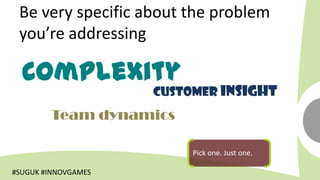
Be very specific about the problem
 you’re addressing

  Complexity
                     Customer insight
        Team dynamics

                          Pick one. Just one.

#SUGUK #INNOVGAMES
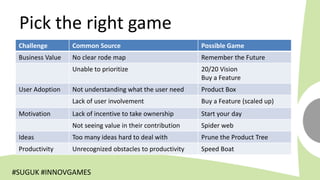
Pick the right game
 Challenge        Common Source                            Possible Game
 Business Value   No clear rode map                        Remember the Future
                  Unable to prioritize                     20/20 Vision
                                                           Buy a Feature
 User Adoption    Not understanding what the user need     Product Box
                  Lack of user involvement                 Buy a Feature (scaled up)
 Motivation       Lack of incentive to take ownership      Start your day
                  Not seeing value in their contribution   Spider web
 Ideas            Too many ideas hard to deal with         Prune the Product Tree
 Productivity     Unrecognized obstacles to productivity   Speed Boat


#SUGUK #INNOVGAMES
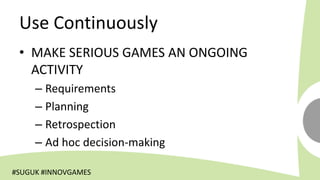
Use Continuously
 • MAKE SERIOUS GAMES AN ONGOING
   ACTIVITY
     – Requirements
     – Planning
     – Retrospection
     – Ad hoc decision-making

#SUGUK #INNOVGAMES
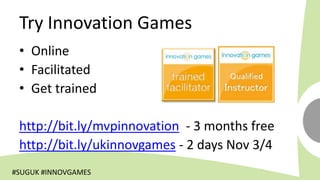
Try Innovation Games
 • Online
 • Facilitated
 • Get trained

 http://bit.ly/mvpinnovation - 3 months free
 http://bit.ly/ukinnovgames - 2 days Nov 3/4
#SUGUK #INNOVGAMES
Any questions or additional comments?


#SUGUK #INNOVGAMES

Innovation Games - Knowing whats important

  • 1.
    Using Innovation Games®to really understand what’s the most important thing to do. #SUGUK #INNOVGAMES
  • 2.
  • 3.
    Agenda • SharePointProject Pain • Serious Games • Getting started with serious games #SUGUK #INNOVGAMES
  • 4.
    Agenda • SharePointProject Pain #SUGUK #INNOVGAMES
  • 5.
    SharePoint Project Pain • IT driven change • Limited business involvement • No shared vision • What legacy #SUGUK #INNOVGAMES
  • 6.
    Some questions •What is collaboration? – How do you do it? – Why do you do it? – Who do you do it with? #SUGUK #INNOVGAMES
  • 7.
    Traditional vs. Collaborative • Traditional techniques often can – Be highly constrained and overly precise – Assume people have the answers • Collaborative techniques – Allow you to explore alternatives – Answers can be discovered during the process #SUGUK #INNOVGAMES
  • 8.
    Paradox SharePoint isa Collaboration Platform… …yet we often fail to collaborate on how to use SharePoint! #SUGUK #INNOVGAMES
  • 9.
    Agenda • SeriousGames #SUGUK #INNOVGAMES
  • 10.
    Why do seriousgames work? • Structured – Rules, but often no winners • Purposeful – Definite outcome • Time-bound – By definition, a time boxed exercise • Participatory – Success depends on everyone participating All of which can simplify decision-making and • Egalitarian generate new insights. – Everyone has an equal opportunity to participate #SUGUK #INNOVGAMES
  • 11.
    Why do seriousgames work? IF Our brains are figure out puzzle wired for THEN intrinsic release pleasure- creating chemicals motivation. (opioids) #SUGUK #INNOVGAMES
  • 12.
  • 13.
    Gamification and SeriousGames • Gamification – Foursquare, Linked In, Stack Overflow – Tesco Clubcard – Xbox Live, Ribbon Hero • Serious Games – Do work – for serious customer insight – actionable insights and results – Innovation Games ® #SUGUK #INNOVGAMES
  • 14.
    Game Design Open Explore Close A B #SUGUK #INNOVGAMES
  • 15.
    Match Questions totime horizon Strategy What are unsolved problems? Portfolio How should my Product product evolve? Discovery Release Sprint Where can my Validation product be Daily improved? #SUGUK #INNOVGAMES
  • 16.
    Innovation Game: SpeedBoat • What’s good and what’s not about the SharePoint today • Outputs – Shared view on • what works well • what’s not working well – Insights into priorities and thinking of stakeholders #SUGUK #INNOVGAMES
  • 17.
    Speed boat inAction #SUGUK #INNOVGAMES
  • 18.
    Innovation Game: Rememberthe Future • What has your SharePoint done to make you… – Happy, Successful, efficient, rich • Outputs – What future looks like, the legacy – How to get there #SUGUK #INNOVGAMES
  • 19.
    Innovation Game: Buya Feature • Prioritize Features • Outputs – Most important features – Shared commitment – Reason for buying #SUGUK #INNOVGAMES
  • 20.
    Buy a Featurein Action #SUGUK #INNOVGAMES
  • 21.
    Innovation Game: Showand Tell • Real users – tell you about what they’ve done • Outputs – People are engaged – What people don’t use – What’s used in unexpected ways #SUGUK #INNOVGAMES
  • 22.
    Innovation Game: SpiderWeb • Visualise the full picture • Outputs – Explore relationships and dependencies – Discover hidden stakeholders and systems #SUGUK #INNOVGAMES
  • 23.
    Innovation Game: Startyour day • When do people use SharePoint – Daily, weekly monthly, yearly, special events or disasters • Outputs – Insight into real use – Discover opportunities #SUGUK #INNOVGAMES
  • 24.
    Start your dayin action #SUGUK #INNOVGAMES
  • 25.
    Agenda • Gettingstarted with serious games #SUGUK #INNOVGAMES
  • 26.
    Your next movewith serious games • Start Today – Pick the game – Prepare, prepare, prepare – Make sure you have enough resources for the exercise – Record the exercise – Socialize the results – Plan for the next game #SUGUK #INNOVGAMES
  • 27.
    Innovation Games Process • Planning • Playing • Post-Processing • Action #SUGUK #INNOVGAMES
  • 28.
    Be very specificabout the problem you’re addressing Complexity Customer insight Team dynamics Pick one. Just one. #SUGUK #INNOVGAMES
  • 29.
    Pick the rightgame Challenge Common Source Possible Game Business Value No clear rode map Remember the Future Unable to prioritize 20/20 Vision Buy a Feature User Adoption Not understanding what the user need Product Box Lack of user involvement Buy a Feature (scaled up) Motivation Lack of incentive to take ownership Start your day Not seeing value in their contribution Spider web Ideas Too many ideas hard to deal with Prune the Product Tree Productivity Unrecognized obstacles to productivity Speed Boat #SUGUK #INNOVGAMES
  • 30.
    Use Continuously •MAKE SERIOUS GAMES AN ONGOING ACTIVITY – Requirements – Planning – Retrospection – Ad hoc decision-making #SUGUK #INNOVGAMES
  • 31.
    Try Innovation Games • Online • Facilitated • Get trained http://bit.ly/mvpinnovation - 3 months free http://bit.ly/ukinnovgames - 2 days Nov 3/4 #SUGUK #INNOVGAMES
  • 32.
    Any questions oradditional comments? #SUGUK #INNOVGAMES

Editor's Notes

  • #6 Story:Large organisation, had deployed SharePoint 2003 and made significant use of the platform. The deployment was not a planned roll out, more an accident that people in the intranet team saw a lot of value in. Platform has been used extensively, some people doing much more than others but little governance or control – definitely not any strategic vision.Roll forward a few years to 2010, SharePoint 2010 is pimped as the best thing since sliced bread.Project still sits with in IT > Goal we just need to get a platform that is stable and supported, appears IT were failing to meet the needs of the business with the 2003 deployment that was never planned or… funny that.How to solve itBring in Microsoft (or partner or consultant)Lots of workshops with stakeholdersReality – workshops arranged around key feature areas of the platform, records centre, search, my sitesLimited business involvement – mostly attended by current SharePoint advocates, support or IT peopleBig document written out from each meeting set in stone << still no ‘Vision for SharePoint’ << not alignment to business goalsNot engaging the usersWill it be a success?What’s the measure? A stable platform? What’s the legacy? Repeat again in 7 years time?
  • #7 How?real time Information based – collaborate on a wiki or documentOn businessWhy?Do workBetter decisionsMore effiecentWho?TeamCustomersBusinessYourself?
  • #8 Different approachAnalysts v FacilitativeMore waterfall v more agile
  • #9 Wicked Problems – for more on this see the work of Paul Culmsee – Seven Sigma
  • #11 Original source for slide: http://www.linkedin.com/redirect?url=http%3A%2F%2Fwww%2Eslideshare%2Enet%2FTomGrantForr%2Fcorporate-serious-games-are-changing-the-rules-of-product-development&urlhash=5kke&_t=tracking_discThanks to Tom Grant
  • #12 Source: Getty Images (http://www.gettyimages.com/detail/sb10063846ai-001/Digital-Vision)Original source for slide: http://www.linkedin.com/redirect?url=http%3A%2F%2Fwww%2Eslideshare%2Enet%2FTomGrantForr%2Fcorporate-serious-games-are-changing-the-rules-of-product-development&urlhash=5kke&_t=tracking_discThanks to Tom Grant
  • #13 Sneak King – Burger King game for the XboxDarfur is Dyning – Flash game about the crisis in Darfur, western sudanUltimate Team Play – Created for Hilton Garden Inn – players interact with guests and perform common dutiesRe-Mission – game to help children with cancer learn about their treatmentsBinary Game – Cisco, all about adding up numbers Google Image Labeler – game to get users to label images, played against other people – google got good taggingBuy a Feature – An Innovation game
  • #14 Gamification is the use of game design techniques[1] and mechanics to solve problems and engage audiences. Typically gamification applies to non-game applications (also known as "funware"),[2] particularly consumer-oriented web and mobile sites, in order to encourage people to adopt the applications. It also strives to encourage users to engage in desired behaviors in connection with the applications.[3]Gamification works by making technology more engaging,[4] and by encouraging desired behaviors, taking advantage of humans' psychological predisposition to engage in gaming.[5] The technique can encourage people to perform chores that they ordinarily consider boring, such as completing surveys, shopping, or reading web sites.[4]Innovation Games are powerful qualitative research and problem solving techniques focused on the use of collaborative play with customers, colleagues, partners and the community at large. Used both in-person and online, the techniques include both open-ended and more focused methods for achieving actionable insights and results.The 13 games invented by Luke Hohmann, 12 of which are outlined in his book, have been used extensively by companies around the world in their Voice of the Customer, Market Research and Customer Insight initiatives.
  • #19 1. Scope of this could be used for other policy decisions….Can we have SharePoint Designer -> OK, lets use RTF to see what our world would look like if we did this…..Legacy Story – could relate to the idea of remember the future – i.e. what are we really looking for.Sydney Opera House – Was it a success? The Opera House was formally completed in 1973, having cost $102 million. The original cost estimate in 1957 was $7 million. The original completion date set by the government was 1963. Thus, the project was completed ten years late and over-budget by more than fourteen times. Ultzon, the designer of the opera house never lived to set foot in it, having left Australia in disgust, swearing never to come back.In traditional Time/Cost/Scope -> Quality lens it’s a complete epic failure!Looking back now on the project (in 1957 we could have used Remember the Future) to see what the future looked like and what it really was we were building?People remember legacy, not scopeQuote Paul Culmsee: http://www.cleverworkarounds.com/2011/05/22/whatever-you-do-do-not-ignore-legacy/
  • #20 Goal: Prioritize FeaturesWhich feature will entice customers to purchase your product? Which feature will cause customers to upgrade? Which feature will make customers so happy that they’ll ignore or tolerate the features that they wish you would fix or remove?Product planners endlessly debate these and other kinds of questions. Choosing the right set of features to add to a release often marks the difference between short-term failure or long-term success. Unfortunately, too many product planners make this choice without involving the people most affected by it—their customers. The Buy a Feature game improves the quality of this decision by asking your customers to help you make it.The GameCreate a list of potential features and provide each with a price. Just like for a real product, the price can be based on development costs, customer value, or something else. Although the price can be the actual cost you intend to charge for the feature, this is usually not required. Customers buy features that they want in the next release of your product using play money you give them. Make certain that some features are priced high enough that no one customer can buy them. Encourage customers to pool their money to buy especially important and/or expensive features. This will help motivate negotiations between customers as to which features are most important.This game works best with four to seven customers in a group, so that you can create more opportunities for customers to pool their money through negotiating. Unlike the Product Box game, the Buy a Feature game is based on the list of features that are likely to be in your development road map.Why It WorksProduct planners often fall into the trap of thinking that customers have clearly defined product priorities. Some do. Most don’t. When presented with a set of options, many customers will simply say “I want them all” and put the responsibility for prioritizing their requests on your shoulders. Alternatively, product managers often gather feature priorities by working with customers one-on- one and, in the process, and perhaps without even realizing it, again take responsibility for prioritizing features. By engaging customers as a group and giving them a limited amount of resources, you give them the opportunity to prioritize their desires as a group. But that’s not where the magic lies. The magic lies in structuring the conversations so that your customers are negotiating with each other for specific features. It is this negotiation that enhances your understanding of what your customers really want.http://innovationgames.com/buy-a-feature/
  • #22 Goal: Identify the Most Important Artifacts Created by Your ProductMuch like a child excitedly sharing their most prized possession at school during show-and-tell, customers are often equally excited of the results that they can produce with your product, and they’ll tell you all about it – if you let them. In the process, you’ll gain new insights into what really matters.The GameAsk your customers to being examples of artifacts created or modified by your product or service. Ask them to tell you why these artifacts are important, and when and how they’re used. For example, if your product is a software system to manage invoices, ask them to show you the invoices, reports, or spreadsheets that they’ve created through the use of your product.Pay careful attention to anything that surprises you – artifacts you expected them to create or modify that they have ignored, artifacts that aren’t used, or artifacts used in unexpected ways. What do these tell you?Why It WorksCountless studies have demonstrated something that great managers have known for a long time: most people want to do a good job. It doesn’t really matter if the person is a barber, a construction worker, a parent changing a diaper, an accountant, or a software developer. Each of them wants to demonstrate their special skill. Show and Tell works by giving your customers a chance to dip into the deeply felt human emotion to show you when and how they are using your product to do their very best. At the same time they are telling you how they are doing the best they can, they will also be telling you how you can help them do it better.
  • #25 Image from Enthiosysslide deck at http://www.slideshare.net/Enthiosys/collaborating-with-customers-using-innovation-game
  • #27 Source: Getty Images (http://www.gettyimages.com/detail/104821308/OJO-Images)Original source for slide: http://www.linkedin.com/redirect?url=http%3A%2F%2Fwww%2Eslideshare%2Enet%2FTomGrantForr%2Fcorporate-serious-games-are-changing-the-rules-of-product-development&urlhash=5kke&_t=tracking_discThanks to Tom Grant
  • #28 It doesn’t matter if you’re using the games to help you manage your sales pipeline or your project portfolio: the essential Innovation Games® process always follows these key activities.Planning The first step is planning your use of the games. You’ll determine what your goals are, and the right tools/techniques to achieve them. Different games will require various levels of planning, materials, recruitment and analysis. Planning will also include all of the necessary logistics for managing your event.Playing Arguably the most enjoyable part of the process, playing the game means more than just creating a fun experience. It means making sure that the serious aspects of game come through in a way that enables you to get the insights you need to solve the problems and achieve the goals you outlined during planning.Post-Processing Once you’ve completed your games you’ll need to post-process the results. For in-person games, this means taking photos of user-generated artwork, transcribing observer notes, and developing a report that captures your insights. For online games, you’ll need to review the user-generated game content, chat logs, and your own experiences across the several games you’ll be playing to develop your report.Taking Action Making decisions and taking action are the most important results of Innovation Games®. If you’ve read this far, return the planning step: the games work best when you’ve prepared your team to take action once the results of the games are known.