
DIGITAL
IMAGEPROCESSING
IEEE Papers on Image Processing
Required IEEE based Papers on Image Processing.
Get Free IEEE Papers
CALL US : +91 9041262727
E2MATRIX Research Lab
Thesis and Project Guidance
E2MATRIX RESEARCH LAB, MOB : +91 9041262727
What is MATLAB
MATLAB is a high-performance language for technical computing. It integrates
computation, visualization, and programming in an easy-to-use environment where
problems and solutions are expressed in familiar mathematical notation. Typical
uses include:
Math and computation
Algorithm development
Modelling, simulation, and prototyping
Data analysis, exploration, and visualization
Scientific and engineering graphics
Application development, including Graphical User Interface building
E2MATRIX RESEARCH LAB, MOB : +91 9041262727
MATLAB is an interactive system whose basic data element is an array that does
not require dimensioning. This allows you to solve many technical computing
problems, especially those with matrix and vector formulations, in a fraction of
the time it would take to write a program in a scalar no interactive language such
as C or Fortran.
The name MATLAB stands for matrix laboratory. MATLAB was originally written to
provide easy access to matrix software developed by the LINPACK and EISPACK
projects, which together represent the state-of-the-art in software for matrix
computation.
MATLAB has evolved over a period of years with input from many users. In
university environments, it is the standard instructional tool for introductory and
advanced courses in mathematics, engineering, and science. In industry, MATLAB
is the tool of choice for high-productivity research, development, and analysis.
E2MATRIX RESEARCH LAB, MOB : +91 9041262727
MATLAB features a family of application-specific solutions called toolboxes. Very
important to most users of MATLAB, toolboxes allow you
to learn and apply specialized technology. Toolboxes are comprehensive
collections of MATLAB functions (M-files) that extend the MATLAB environment to
solve particular classes of problems. Areas in which toolboxes are available
include signal processing, control systems, neural networks, fuzzy logic, wavelets,
simulation, and many others.
E2MATRIX RESEARCH LAB, MOB : +91 9041262727
The MATLAB System
The MATLAB system consists of five main parts:
The MATLAB language.
This is a high-level matrix/array language with control flow statements, functions,
data structures, input/output, and object-oriented programming features. It
allows both "programming in the small" to rapidly create quick and dirty throw-
away programs, and "programming in the large" to create complete large and
complex application programs.
The MATLAB working environment.
This is the set of tools and facilities that you work with as the MATLAB user or
programmer. It includes facilities for managing the variables in your workspace
and importing and exporting data. It also includes tools for developing, managing,
debugging, and profiling M-files, MATLAB's applications.
E2MATRIX RESEARCH LAB, MOB : +91 9041262727
Handle Graphics.
This is the MATLAB graphics system. It includes high-level commands for two-
dimensional and three-dimensional data visualization, image processing,
animation, and presentation graphics. It also includes low-level commands that
allow you to fully customize the appearance of graphics as well as to build
complete Graphical User Interfaces on your MATLAB applications.
The MATLAB mathematical function library.
This is a vast collection of computational algorithms ranging from elementary
functions like sum, sine, cosine, and complex arithmetic, to more sophisticated
functions like matrix inverse, matrix eigenvalues, Bessel functions, and fast Fourier
transforms.
The MATLAB Application Program Interface (API).
This is a library that allows you to write C and Fortran programs that interact with
MATLAB. It include facilities for calling routines from MATLAB (dynamic linking),
calling MATLAB as a computational engine, and for reading and writing MAT-files.
E2MATRIX RESEARCH LAB, MOB : +91 9041262727
Digital Image Processing
Digital image processing deals with manipulation of digital images through a digital computer. It
is a subfield of signals and systems but focus particularly on images. DIP focuses on developing a
computer system that is able to perform processing on an image. The input of that system is a
digital image and the system process that image using efficient algorithms, and gives an image
as an output. The most common example is Adobe Photoshop. It is one of the widely used
application for processing digital images.
E2MATRIX RESEARCH LAB, MOB : +91 9041262727
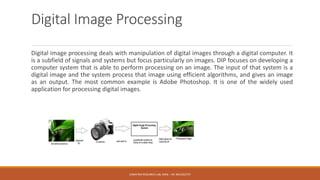
In the above figure, an image has been captured by a camera and has been sent to
a digital system to remove all the other details, and just focus on the water drop
by zooming it in such a way that the quality of the image remains the same.
Audience
This tutorial gives you the knowledge of widely used methods and procedures for
interpreting digital images for image enhancement and restoration and
performing operations on images such as (blurring , zooming , sharpening , edge
detection , e.t.c). It also focuses on the understanding of how the human vision
works. How do human eye visualize so many things , and how do brain interpret
those images? The tutorial also covers some of the important concepts of signals
and systems such as (Sampling , Quantization , Convolution , Frequency domain
analysis e.t.c).
E2MATRIX RESEARCH LAB, MOB : +91 9041262727
Prerequisites
Signals and systems
Since DIP is a subfield of signals and systems , so it would be good if you already
have some knowledge about signals and systems , but it is not necessary. But you
must have some basic concepts of digital electronics.
Calculus and probability
Basic understanding of calculus , probability and differential equations is also
required for better understanding.
Basic programming skills
Other than this, it requires some of the basic programming skills on any of the
popular languages such as C++ , Java , or MATLAB.
E2MATRIX RESEARCH LAB, MOB : +91 9041262727
E2MATRIX Research Lab
Opp. Phagwara Bus Stand
Parmar Complex, Backside Axis Bank
Phagwara, Punjab (India).
web : www.e2matrix.com
email : support@e2matrix.com
Mobile : +91 9041262727
E2MATRIX RESEARCH LAB, MOB : +91 9041262727

IEEE Papers on Image Processing

  • 1.
  • 2.
    IEEE Papers onImage Processing Required IEEE based Papers on Image Processing. Get Free IEEE Papers CALL US : +91 9041262727 E2MATRIX Research Lab Thesis and Project Guidance E2MATRIX RESEARCH LAB, MOB : +91 9041262727
  • 3.
    What is MATLAB MATLABis a high-performance language for technical computing. It integrates computation, visualization, and programming in an easy-to-use environment where problems and solutions are expressed in familiar mathematical notation. Typical uses include: Math and computation Algorithm development Modelling, simulation, and prototyping Data analysis, exploration, and visualization Scientific and engineering graphics Application development, including Graphical User Interface building E2MATRIX RESEARCH LAB, MOB : +91 9041262727
  • 4.
    MATLAB is aninteractive system whose basic data element is an array that does not require dimensioning. This allows you to solve many technical computing problems, especially those with matrix and vector formulations, in a fraction of the time it would take to write a program in a scalar no interactive language such as C or Fortran. The name MATLAB stands for matrix laboratory. MATLAB was originally written to provide easy access to matrix software developed by the LINPACK and EISPACK projects, which together represent the state-of-the-art in software for matrix computation. MATLAB has evolved over a period of years with input from many users. In university environments, it is the standard instructional tool for introductory and advanced courses in mathematics, engineering, and science. In industry, MATLAB is the tool of choice for high-productivity research, development, and analysis. E2MATRIX RESEARCH LAB, MOB : +91 9041262727
  • 5.
    MATLAB features afamily of application-specific solutions called toolboxes. Very important to most users of MATLAB, toolboxes allow you to learn and apply specialized technology. Toolboxes are comprehensive collections of MATLAB functions (M-files) that extend the MATLAB environment to solve particular classes of problems. Areas in which toolboxes are available include signal processing, control systems, neural networks, fuzzy logic, wavelets, simulation, and many others. E2MATRIX RESEARCH LAB, MOB : +91 9041262727
  • 6.
    The MATLAB System TheMATLAB system consists of five main parts: The MATLAB language. This is a high-level matrix/array language with control flow statements, functions, data structures, input/output, and object-oriented programming features. It allows both "programming in the small" to rapidly create quick and dirty throw- away programs, and "programming in the large" to create complete large and complex application programs. The MATLAB working environment. This is the set of tools and facilities that you work with as the MATLAB user or programmer. It includes facilities for managing the variables in your workspace and importing and exporting data. It also includes tools for developing, managing, debugging, and profiling M-files, MATLAB's applications. E2MATRIX RESEARCH LAB, MOB : +91 9041262727
  • 7.
    Handle Graphics. This isthe MATLAB graphics system. It includes high-level commands for two- dimensional and three-dimensional data visualization, image processing, animation, and presentation graphics. It also includes low-level commands that allow you to fully customize the appearance of graphics as well as to build complete Graphical User Interfaces on your MATLAB applications. The MATLAB mathematical function library. This is a vast collection of computational algorithms ranging from elementary functions like sum, sine, cosine, and complex arithmetic, to more sophisticated functions like matrix inverse, matrix eigenvalues, Bessel functions, and fast Fourier transforms. The MATLAB Application Program Interface (API). This is a library that allows you to write C and Fortran programs that interact with MATLAB. It include facilities for calling routines from MATLAB (dynamic linking), calling MATLAB as a computational engine, and for reading and writing MAT-files. E2MATRIX RESEARCH LAB, MOB : +91 9041262727
  • 8.
    Digital Image Processing Digitalimage processing deals with manipulation of digital images through a digital computer. It is a subfield of signals and systems but focus particularly on images. DIP focuses on developing a computer system that is able to perform processing on an image. The input of that system is a digital image and the system process that image using efficient algorithms, and gives an image as an output. The most common example is Adobe Photoshop. It is one of the widely used application for processing digital images. E2MATRIX RESEARCH LAB, MOB : +91 9041262727
  • 9.
    In the abovefigure, an image has been captured by a camera and has been sent to a digital system to remove all the other details, and just focus on the water drop by zooming it in such a way that the quality of the image remains the same. Audience This tutorial gives you the knowledge of widely used methods and procedures for interpreting digital images for image enhancement and restoration and performing operations on images such as (blurring , zooming , sharpening , edge detection , e.t.c). It also focuses on the understanding of how the human vision works. How do human eye visualize so many things , and how do brain interpret those images? The tutorial also covers some of the important concepts of signals and systems such as (Sampling , Quantization , Convolution , Frequency domain analysis e.t.c). E2MATRIX RESEARCH LAB, MOB : +91 9041262727
  • 10.
    Prerequisites Signals and systems SinceDIP is a subfield of signals and systems , so it would be good if you already have some knowledge about signals and systems , but it is not necessary. But you must have some basic concepts of digital electronics. Calculus and probability Basic understanding of calculus , probability and differential equations is also required for better understanding. Basic programming skills Other than this, it requires some of the basic programming skills on any of the popular languages such as C++ , Java , or MATLAB. E2MATRIX RESEARCH LAB, MOB : +91 9041262727
  • 11.
    E2MATRIX Research Lab Opp.Phagwara Bus Stand Parmar Complex, Backside Axis Bank Phagwara, Punjab (India). web : www.e2matrix.com email : support@e2matrix.com Mobile : +91 9041262727 E2MATRIX RESEARCH LAB, MOB : +91 9041262727