Machine Learning
-Sandeep Singh
Introduction
Machine Learning is a subset of Artificial Intelligence that,
according to Arthur Samuel in 1959, gives "computers the
ability to learn without being explicitly programmed.”
It evolved from the study of pattern recognition and
computational learning theory in artificial intelligence
“Machine learning refers to a system capable of the
autonomous acquisition and integration of knowledge.”
What is Machine Learning?
Tom Mitchell (1998) Well-posed Learning Problem:
 A computer program is said to learn from experience
E with respect to some task T and some performance
measure P, if its performance on T, as measured by P,
improves with experience E.
Learning = Improving with experience at some task
 Improve over task T,
 With respect to performance measure, P
 Based on experience, E.
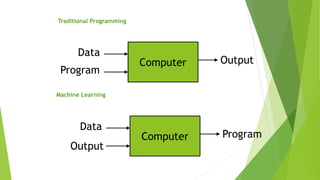
Traditional Programming
Machine Learning
Computer
Data
Program
Output
Computer
Data
Output
Program
Why Machine Learning?
 No human experts
 industrial/manufacturing control
 mass spectrometer analysis, drug design, astronomic discovery
 Black-box human expertise
 face/handwriting/speech recognition
 driving a car, flying a plane
 Rapidly changing phenomena
 credit scoring, financial modeling
 diagnosis, fraud detection
 Need for customization/personalization
 personalized news reader
 movie/book recommendation
6
What We Talk About When We Talk
About“Learning”
 Learning general models from a data of particular examples
 Data is cheap and abundant (data warehouses, data marts);
knowledge is expensive and scarce.
 Example in retail: Customer transactions to consumer behavior:
People who bought “Da Vinci Code” also bought “The Five People
You Meet in Heaven” (www.amazon.com)
 Build a model that is a good and useful approximation to the data.
ML in a Nutshell
 Tens of thousands of machine learning algorithms
 Hundreds new every year
 Every machine learning algorithm has three components:
 Representation
 Evaluation
 Optimization
Representation
 Decision trees
 Sets of rules / Logic programs
 Instances
 Graphical models (Bayes/Markov nets)
 Neural networks
 Support vector machines
 Model ensembles
 Etc.
Evaluation
 Accuracy
 Precision and recall
 Squared error
 Likelihood
 Posterior probability
 Cost / Utility
 Margin
 Entropy
 K-L divergence
 Etc.
Optimization
 Combinatorial optimization
 E.g.: Greedy search
 Convex optimization
 E.g.: Gradient descent
 Constrained optimization
 E.g.: Linear programming
Types of Learning
 Supervised (inductive) learning
 Training data includes desired outputs
 Unsupervised learning
 Training data does not include desired outputs
 Semi-supervised learning
 Training data includes a few desired outputs
 Reinforcement learning
 Rewards from sequence of actions
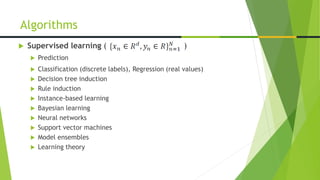
 Supervised learning ( )
 Prediction
 Classification (discrete labels), Regression (real values)
 Decision tree induction
 Rule induction
 Instance-based learning
 Bayesian learning
 Neural networks
 Support vector machines
 Model ensembles
 Learning theory
Algorithms
 Supervised Learning: Uses
Example: decision trees tools that create rules
 Prediction of future cases: Use the rule to predict the output for future inputs
 Knowledge extraction: The rule is easy to understand
 Compression: The rule is simpler than the data it explains
 Outlier Detection: Exceptions that are not covered by the rule, e.g., fraud
Algorithms
 Unsupervised learning ( )
 Clustering
 Probability distribution estimation
 Finding association (in features)
 Dimension reduction
 Semi-supervised learning
 Reinforcement learning
 Decision making (robot, chess machine)
 Recommender Systems
Algorithms
 Web Search
 Finance
 E-commerce
 Robotics
 Space Exploration
 Information Extraction
 Social Networks
 Face detection and recognition
 Object detection and recognition
 Image segmentation
 Multimedia event detection
 Economical and commercial usage
 Speech recognition
 Healthcare
 Weather forecast
Applications
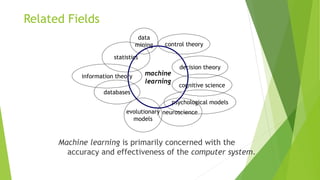
Related Fields
Machine learning is primarily concerned with the
accuracy and effectiveness of the computer system.
psychological models
data
mining
cognitive science
decision theory
information theory
databases
machine
learning
neuroscience
statistics
evolutionary
models
control theory
We have a simple overview of some techniques
and algorithms in machine learning. Furthermore,
there are more and more techniques apply machine
learning as a solution. In the future, machine learning
will play an important role in our daily life.
Conclusion
 www.google.com
 www.wikipedia.org
Resources
Any Questions…??
Q & A ?

Machine learning

  • 1.
  • 2.
    Introduction Machine Learning isa subset of Artificial Intelligence that, according to Arthur Samuel in 1959, gives "computers the ability to learn without being explicitly programmed.” It evolved from the study of pattern recognition and computational learning theory in artificial intelligence “Machine learning refers to a system capable of the autonomous acquisition and integration of knowledge.”
  • 3.
    What is MachineLearning? Tom Mitchell (1998) Well-posed Learning Problem:  A computer program is said to learn from experience E with respect to some task T and some performance measure P, if its performance on T, as measured by P, improves with experience E. Learning = Improving with experience at some task  Improve over task T,  With respect to performance measure, P  Based on experience, E.
  • 4.
  • 5.
    Why Machine Learning? No human experts  industrial/manufacturing control  mass spectrometer analysis, drug design, astronomic discovery  Black-box human expertise  face/handwriting/speech recognition  driving a car, flying a plane  Rapidly changing phenomena  credit scoring, financial modeling  diagnosis, fraud detection  Need for customization/personalization  personalized news reader  movie/book recommendation
  • 6.
    6 What We TalkAbout When We Talk About“Learning”  Learning general models from a data of particular examples  Data is cheap and abundant (data warehouses, data marts); knowledge is expensive and scarce.  Example in retail: Customer transactions to consumer behavior: People who bought “Da Vinci Code” also bought “The Five People You Meet in Heaven” (www.amazon.com)  Build a model that is a good and useful approximation to the data.
  • 7.
    ML in aNutshell  Tens of thousands of machine learning algorithms  Hundreds new every year  Every machine learning algorithm has three components:  Representation  Evaluation  Optimization
  • 8.
    Representation  Decision trees Sets of rules / Logic programs  Instances  Graphical models (Bayes/Markov nets)  Neural networks  Support vector machines  Model ensembles  Etc.
  • 9.
    Evaluation  Accuracy  Precisionand recall  Squared error  Likelihood  Posterior probability  Cost / Utility  Margin  Entropy  K-L divergence  Etc.
  • 10.
    Optimization  Combinatorial optimization E.g.: Greedy search  Convex optimization  E.g.: Gradient descent  Constrained optimization  E.g.: Linear programming
  • 11.
    Types of Learning Supervised (inductive) learning  Training data includes desired outputs  Unsupervised learning  Training data does not include desired outputs  Semi-supervised learning  Training data includes a few desired outputs  Reinforcement learning  Rewards from sequence of actions
  • 12.
     Supervised learning( )  Prediction  Classification (discrete labels), Regression (real values)  Decision tree induction  Rule induction  Instance-based learning  Bayesian learning  Neural networks  Support vector machines  Model ensembles  Learning theory Algorithms
  • 13.
     Supervised Learning:Uses Example: decision trees tools that create rules  Prediction of future cases: Use the rule to predict the output for future inputs  Knowledge extraction: The rule is easy to understand  Compression: The rule is simpler than the data it explains  Outlier Detection: Exceptions that are not covered by the rule, e.g., fraud Algorithms
  • 14.
     Unsupervised learning( )  Clustering  Probability distribution estimation  Finding association (in features)  Dimension reduction  Semi-supervised learning  Reinforcement learning  Decision making (robot, chess machine)  Recommender Systems Algorithms
  • 15.
     Web Search Finance  E-commerce  Robotics  Space Exploration  Information Extraction  Social Networks  Face detection and recognition  Object detection and recognition  Image segmentation  Multimedia event detection  Economical and commercial usage  Speech recognition  Healthcare  Weather forecast Applications
  • 16.
    Related Fields Machine learningis primarily concerned with the accuracy and effectiveness of the computer system. psychological models data mining cognitive science decision theory information theory databases machine learning neuroscience statistics evolutionary models control theory
  • 17.
    We have asimple overview of some techniques and algorithms in machine learning. Furthermore, there are more and more techniques apply machine learning as a solution. In the future, machine learning will play an important role in our daily life. Conclusion
  • 18.
  • 19.