Alex Krizhevsky
University of Toronto
kriz@cs.utoronto.ca
ImageNet Classification with Deep Convolutional
Neural Networks
Ilya Sutskever
University of Toronto
ilya@cs.utoronto.ca
Geoffrey E. Hinton
University of Toronto
hinton@cs.utoronto.ca
Presenter : Aydin Ayanzadeh
Email: Ayanzadeh17@itu.edu.tr
Computer vision-Dr.-Ing. Hazım Kemal EKENEL, Spring 2018
Outline
● Introduction
● Dataset
● Architecture of the Network
● Reducing over-fitting
● Learning
● Result
● Discussion
2
ImageNet
● About 15M Labeled High resolution Images
● Roughly 22K Categories
● Collected from the web and labeled by Amazon Mechanical Turk
3
Computer vision-Dr.-Ing. Hazım Kemal EKENEL, Spring 2018
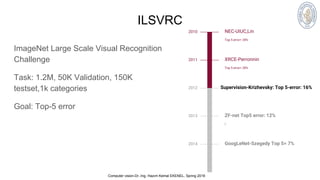
ILSVRC
ImageNet Large Scale Visual Recognition
Challenge
Task: 1.2M, 50K Validation, 150K
testset,1k categories
Goal: Top-5 error
NEC-UIUC,Lin
Top 5 error= 28%
2010
XRCE-Perronnin
Top 5 error= 28%
2011
Supervision-Krizhevsky: Top 5-error: 16%2012
ZF-net Top5 error: 12%
L
2013
GoogLeNet-Szegedy Top 5= 7%2014
Computer vision-Dr.-Ing. Hazım Kemal EKENEL, Spring 2018
5
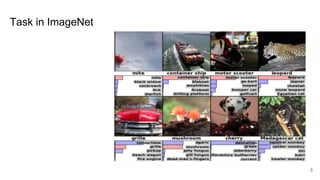
Task in ImageNet
AlexNet General Feature
● 650K neuron
● 60M Parameters
● 630M connections
● 7 hidden weight layers
● Rectified Linear Units(Relu)
● Dropout trick,
● Randomly extracted patches with the size of (224*224)
6Computer vision-Dr.-Ing. Hazım Kemal EKENEL, Spring 2018
Rectified Linear Units (ReLUs)
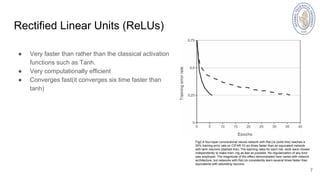
● Very faster than rather than the classical activation
functions such as Tanh.
● Very computationally efficient
● Converges fast(it converges six time faster than
tanh)
7
Fig2.A four-layer convolutional neural network with ReLUs (solid line) reaches a
25% training error rate on CIFAR-10 six times faster than an equivalent network
with tanh neurons (dashed line). The learning rates for each net- work were chosen
independently to make train- ing as fast as possible. No regularization of any kind
was employed. The magnitude of the effect demonstrated here varies with network
architecture, but networks with ReLUs consistently learn several times faster than
equivalents with saturating neurons.
Architecture
8Computer vision-Dr.-Ing. Hazım Kemal EKENEL, Spring 2018
Architecture
9Computer vision-Dr.-Ing. Hazım Kemal EKENEL, Spring 2018
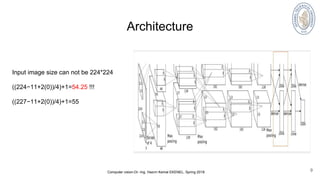
Input image size can not be 224*224
((224−11+2(0))/4)+1=54.25 !!!
((227−11+2(0))/4)+1=55
10
Architecture
Computer vision-Dr.-Ing. Hazım Kemal EKENEL, Spring 2018
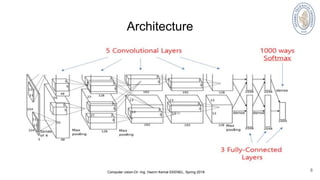
Full (simplified) AlexNet architecture:
[227x227x3] INPUT
[55x55x96]CONV1 : 96 11x11 filters at stride 4, pad 0
[27x27x96] MAX POOL1: 3x3 filters at stride 2
[27x27x96] NORM1: Normalization layer
[27x27x256] CONV2: 256 5x5 filters at stride 1, pad 2
[13x13x256] MAX POOL2: 3x3 filters at stride 2
[13x13x256] NORM2: Normalization layer
[13x13x384] CONV3 : 384 3x3 filters at stride 1, pad 1
[13x13x384] CONV4 : 384 3x3 filters at stride 1, pad 1
[13x13x256] CONV5 : 256 3x3 filters at stride 1, pad 1
[6x6x256] MAX POOL3 : 3x3 filters at stride 2
[4096] FC6: 4096 neurons
[4096] FC7:4096 neurons with F=1
[1000] FC8:1000 neurons (class scores)
Local Response Normalization
● reduces top-1 and top-5 error rates
by 1.4% and 1.2%
● k = 2, n = 5, α = 10e-4, and β = 0.75.
● It applies before ReLU nonlinearity in
certain layers
11
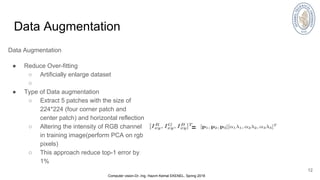
Data Augmentation
Data Augmentation
● Reduce Over-fitting
○ Artificially enlarge dataset
○
● Type of Data augmentation
○ Extract 5 patches with the size of
224*224 (four corner patch and
center patch) and horizontal reflection
○ Altering the intensity of RGB channel
in training image(perform PCA on rgb
pixels)
○ This approach reduce top-1 error by
1%
12
Computer vision-Dr.-Ing. Hazım Kemal EKENEL, Spring 2018
=
Dropout
131-Srivastava, Nitish, et al. "Dropout: A simple way to prevent neural networks from overfitting." The Journal of Machine Learning Research 15.1 (2014): 1929-1958.
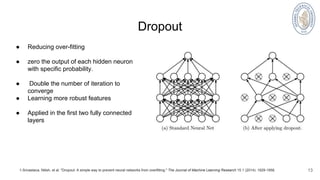
● Reducing over-fitting
● zero the output of each hidden neuron
with specific probability.
● Double the number of iteration to
converge
● Learning more robust features
● Applied in the first two fully connected
layers
Stochastic Gradient Descent
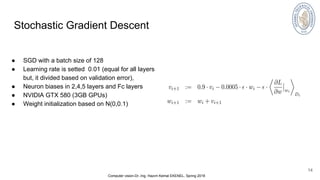
● SGD with a batch size of 128
● Learning rate is setted 0.01 (equal for all layers
but, it divided based on validation error),
● Neuron biases in 2,4,5 layers and Fc layers
● NVIDIA GTX 580 (3GB GPUs)
● Weight initialization based on N(0,0.1)
14
Computer vision-Dr.-Ing. Hazım Kemal EKENEL, Spring 2018
Results
15
Model Top-1(Val) Top-5(Val) Top-5(test)
SIFT+FVs 18.2% 26.2%
1 CNN 40.7% 18.2%
5 CNN 38.1% 16.4% 16.4%
1 CNN* 39.0% 16.6%
7 CNNs* 36.7% 15.4% 15.3%
Table 2:
Comparison of error rates on ILSVRC-2012 validation and test sets. In italics are best
results achieved by others. Models with an asterisk were “pre-trained” to classify the
entire ImageNet 2011 Fall release. See Section 6 for details.
Computer vision-Dr.-Ing. Hazım Kemal EKENEL, Spring 2018
● Averaging the predictions of two CNNs that
were pre-trained on the entire release with
5CNNs has 15.3%.
Conclusion
AlexNet
● Rectified Linear Units(Relu)
● Dropout trick
● Data augmentation
● Trained the model using batch stochastic gradient descent
● Top5-error rate=15.4%
16
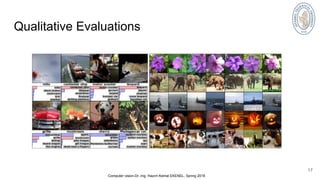
Qualitative Evaluations
17
Computer vision-Dr.-Ing. Hazım Kemal EKENEL, Spring 2018
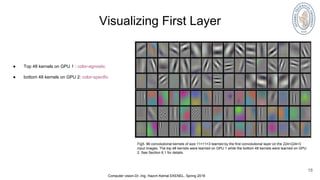
Visualizing First Layer
18
Computer vision-Dr.-Ing. Hazım Kemal EKENEL, Spring 2018
Fig5. 96 convolutional kernels of size 11×11×3 learned by the first convolutional layer on the 224×224×3
input images. The top 48 kernels were learned on GPU 1 while the bottom 48 kernels were learned on GPU
2. See Section 6.1 for details.
● Top 48 kernels on GPU 1 : color-agnostic
● bottom 48 kernels on GPU 2: color-specific.
References
[1] R.M. Bell and Y. Koren. Lessons from the netflix prize challenge. ACM SIGKDD Explorations Newsletter,9(2):75–79, 2007.
[2] A. Berg, J. Deng, and L. Fei-Fei. Large scale visual recognition challenge 2010. www.image net.org/challenges. 2010.
[3] L. Breiman. Random forests. Machine learning, 45(1):5–32, 2001.
[4] D. Cire ̧san, U. Meier, and J. Schmidhuber. Multi-column deep neural networks for image classification. Arxiv preprint arXiv:1202.2745, 2012.
[5] D.C. Cire ̧san, U. Meier, J. Masci, L.M. Gambardella, and J. Schmidhuber. High-performance neural networks for visual object classification. Arxiv preprint arXiv:1102.0183, 2011.
[6] J. Deng, W. Dong, R. Socher, L.-J. Li, K. Li, and L. Fei-Fei. ImageNet: A Large-Scale Hierarchical Image Database. In CVPR09, 2009.
[7] J. Deng, A. Berg, S. Satheesh, H. Su, A. Khosla, and L. Fei-Fei. ILSVRC-2012, 2012. URL http://www.image-net.org/challenges/LSVRC/2012/.
[8] L. Fei-Fei, R. Fergus, and P. Perona. Learning generative visual models from few training examples: An incremental bayesian approach tested on 101 object categories.Computer
Vision and Image Understand-ing, 106(1):59–70, 2007.
[9] G. Griffin, A. Holub, and P. Perona. Caltech-256 object category dataset. Technical Report 7694, California Institute of Technology, 2007.
URLhttp://authors.library.caltech.edu/7694
[10] G.E. Hinton, N. Srivastava, A. Krizhevsky, I. Sutskever, and R.R. Salakhutdinov. Improving neural networks by preventing co-adaptation of feature detectors. arXiv preprint
arXiv:1207.0580, 2012.
19
[11] K. Jarrett, K. Kavukcuoglu, M. A. Ranzato, and Y. LeCun. What is the best multi-stage architecture for object recognition In International Conference on Computer Vision, pages
2146–2153. IEEE, 2009.
[12] A. Krizhevsky. Learning multiple layers of features from tiny images. Master’s thesis, Department of Computer Science, University of Toronto, 2009.
[13] A. Krizhevsky. Convolutional deep belief networks on cifar-10. Unpublished manuscript, 2010.
[14] A. Krizhevsky and G.E. Hinton. Using very deep autoencoders for content-based image retrieval. In ESANN , 2011.
[15] Y. Le Cun, B. Boser, J.S. Denker, D. Henderson, R.E. Howard, W. Hubbard, L.D. Jackel, et al. Hand-written digit recognition with a back-propagation network. In Advances in neural
information processing systems, 1990.
[16] Y. LeCun, F.J. Huang, and L. Bottou. Learning methods for generic object recognition with invariance to pose and lighting. In Computer Vision and Pattern Recognition, 2004. CVPR
2004. Proceedings of the 2004 IEEE Computer Society Conference on volume 2, pages II–97. IEEE, 2004.
[17] Y. LeCun, K. Kavukcuoglu, and C. Farabet. Convolutional networks and applications in vision. In Circuits and Systems (ISCAS), Proceedings of 2010 IEEE International Symposium on,
pages 253–256.IEEE, 2010.
[18] H. Lee, R. Grosse, R. Ranganath, and A.Y. Ng. Convolutional deep belief networks for scalable unsuper-
vised learning of hierarchical representations. In Proceedings of the 26th Annual International Conference on Machine Learning, pages 609–616. ACM, 2009.
[19] T. Mensink, J. Verbeek, F. Perronnin, and G. Csurka. Metric Learning for Large Scale Image Classification: Generalizing to New Classes at Near-Zero Cost. In ECCV - European
Conference on Computer Vision, Florence, Italy, October 2012.
20
References
21
22

AlexNet(ImageNet Classification with Deep Convolutional Neural Networks)

  • 1.
    Alex Krizhevsky University ofToronto kriz@cs.utoronto.ca ImageNet Classification with Deep Convolutional Neural Networks Ilya Sutskever University of Toronto ilya@cs.utoronto.ca Geoffrey E. Hinton University of Toronto hinton@cs.utoronto.ca Presenter : Aydin Ayanzadeh Email: Ayanzadeh17@itu.edu.tr Computer vision-Dr.-Ing. Hazım Kemal EKENEL, Spring 2018
  • 2.
    Outline ● Introduction ● Dataset ●Architecture of the Network ● Reducing over-fitting ● Learning ● Result ● Discussion 2
  • 3.
    ImageNet ● About 15MLabeled High resolution Images ● Roughly 22K Categories ● Collected from the web and labeled by Amazon Mechanical Turk 3 Computer vision-Dr.-Ing. Hazım Kemal EKENEL, Spring 2018
  • 4.
    ILSVRC ImageNet Large ScaleVisual Recognition Challenge Task: 1.2M, 50K Validation, 150K testset,1k categories Goal: Top-5 error NEC-UIUC,Lin Top 5 error= 28% 2010 XRCE-Perronnin Top 5 error= 28% 2011 Supervision-Krizhevsky: Top 5-error: 16%2012 ZF-net Top5 error: 12% L 2013 GoogLeNet-Szegedy Top 5= 7%2014 Computer vision-Dr.-Ing. Hazım Kemal EKENEL, Spring 2018
  • 5.
  • 6.
    AlexNet General Feature ●650K neuron ● 60M Parameters ● 630M connections ● 7 hidden weight layers ● Rectified Linear Units(Relu) ● Dropout trick, ● Randomly extracted patches with the size of (224*224) 6Computer vision-Dr.-Ing. Hazım Kemal EKENEL, Spring 2018
  • 7.
    Rectified Linear Units(ReLUs) ● Very faster than rather than the classical activation functions such as Tanh. ● Very computationally efficient ● Converges fast(it converges six time faster than tanh) 7 Fig2.A four-layer convolutional neural network with ReLUs (solid line) reaches a 25% training error rate on CIFAR-10 six times faster than an equivalent network with tanh neurons (dashed line). The learning rates for each net- work were chosen independently to make train- ing as fast as possible. No regularization of any kind was employed. The magnitude of the effect demonstrated here varies with network architecture, but networks with ReLUs consistently learn several times faster than equivalents with saturating neurons.
  • 8.
  • 9.
    Architecture 9Computer vision-Dr.-Ing. HazımKemal EKENEL, Spring 2018 Input image size can not be 224*224 ((224−11+2(0))/4)+1=54.25 !!! ((227−11+2(0))/4)+1=55
  • 10.
    10 Architecture Computer vision-Dr.-Ing. HazımKemal EKENEL, Spring 2018 Full (simplified) AlexNet architecture: [227x227x3] INPUT [55x55x96]CONV1 : 96 11x11 filters at stride 4, pad 0 [27x27x96] MAX POOL1: 3x3 filters at stride 2 [27x27x96] NORM1: Normalization layer [27x27x256] CONV2: 256 5x5 filters at stride 1, pad 2 [13x13x256] MAX POOL2: 3x3 filters at stride 2 [13x13x256] NORM2: Normalization layer [13x13x384] CONV3 : 384 3x3 filters at stride 1, pad 1 [13x13x384] CONV4 : 384 3x3 filters at stride 1, pad 1 [13x13x256] CONV5 : 256 3x3 filters at stride 1, pad 1 [6x6x256] MAX POOL3 : 3x3 filters at stride 2 [4096] FC6: 4096 neurons [4096] FC7:4096 neurons with F=1 [1000] FC8:1000 neurons (class scores)
  • 11.
    Local Response Normalization ●reduces top-1 and top-5 error rates by 1.4% and 1.2% ● k = 2, n = 5, α = 10e-4, and β = 0.75. ● It applies before ReLU nonlinearity in certain layers 11
  • 12.
    Data Augmentation Data Augmentation ●Reduce Over-fitting ○ Artificially enlarge dataset ○ ● Type of Data augmentation ○ Extract 5 patches with the size of 224*224 (four corner patch and center patch) and horizontal reflection ○ Altering the intensity of RGB channel in training image(perform PCA on rgb pixels) ○ This approach reduce top-1 error by 1% 12 Computer vision-Dr.-Ing. Hazım Kemal EKENEL, Spring 2018 =
  • 13.
    Dropout 131-Srivastava, Nitish, etal. "Dropout: A simple way to prevent neural networks from overfitting." The Journal of Machine Learning Research 15.1 (2014): 1929-1958. ● Reducing over-fitting ● zero the output of each hidden neuron with specific probability. ● Double the number of iteration to converge ● Learning more robust features ● Applied in the first two fully connected layers
  • 14.
    Stochastic Gradient Descent ●SGD with a batch size of 128 ● Learning rate is setted 0.01 (equal for all layers but, it divided based on validation error), ● Neuron biases in 2,4,5 layers and Fc layers ● NVIDIA GTX 580 (3GB GPUs) ● Weight initialization based on N(0,0.1) 14 Computer vision-Dr.-Ing. Hazım Kemal EKENEL, Spring 2018
  • 15.
    Results 15 Model Top-1(Val) Top-5(Val)Top-5(test) SIFT+FVs 18.2% 26.2% 1 CNN 40.7% 18.2% 5 CNN 38.1% 16.4% 16.4% 1 CNN* 39.0% 16.6% 7 CNNs* 36.7% 15.4% 15.3% Table 2: Comparison of error rates on ILSVRC-2012 validation and test sets. In italics are best results achieved by others. Models with an asterisk were “pre-trained” to classify the entire ImageNet 2011 Fall release. See Section 6 for details. Computer vision-Dr.-Ing. Hazım Kemal EKENEL, Spring 2018 ● Averaging the predictions of two CNNs that were pre-trained on the entire release with 5CNNs has 15.3%.
  • 16.
    Conclusion AlexNet ● Rectified LinearUnits(Relu) ● Dropout trick ● Data augmentation ● Trained the model using batch stochastic gradient descent ● Top5-error rate=15.4% 16
  • 17.
  • 18.
    Visualizing First Layer 18 Computervision-Dr.-Ing. Hazım Kemal EKENEL, Spring 2018 Fig5. 96 convolutional kernels of size 11×11×3 learned by the first convolutional layer on the 224×224×3 input images. The top 48 kernels were learned on GPU 1 while the bottom 48 kernels were learned on GPU 2. See Section 6.1 for details. ● Top 48 kernels on GPU 1 : color-agnostic ● bottom 48 kernels on GPU 2: color-specific.
  • 19.
    References [1] R.M. Belland Y. Koren. Lessons from the netflix prize challenge. ACM SIGKDD Explorations Newsletter,9(2):75–79, 2007. [2] A. Berg, J. Deng, and L. Fei-Fei. Large scale visual recognition challenge 2010. www.image net.org/challenges. 2010. [3] L. Breiman. Random forests. Machine learning, 45(1):5–32, 2001. [4] D. Cire ̧san, U. Meier, and J. Schmidhuber. Multi-column deep neural networks for image classification. Arxiv preprint arXiv:1202.2745, 2012. [5] D.C. Cire ̧san, U. Meier, J. Masci, L.M. Gambardella, and J. Schmidhuber. High-performance neural networks for visual object classification. Arxiv preprint arXiv:1102.0183, 2011. [6] J. Deng, W. Dong, R. Socher, L.-J. Li, K. Li, and L. Fei-Fei. ImageNet: A Large-Scale Hierarchical Image Database. In CVPR09, 2009. [7] J. Deng, A. Berg, S. Satheesh, H. Su, A. Khosla, and L. Fei-Fei. ILSVRC-2012, 2012. URL http://www.image-net.org/challenges/LSVRC/2012/. [8] L. Fei-Fei, R. Fergus, and P. Perona. Learning generative visual models from few training examples: An incremental bayesian approach tested on 101 object categories.Computer Vision and Image Understand-ing, 106(1):59–70, 2007. [9] G. Griffin, A. Holub, and P. Perona. Caltech-256 object category dataset. Technical Report 7694, California Institute of Technology, 2007. URLhttp://authors.library.caltech.edu/7694 [10] G.E. Hinton, N. Srivastava, A. Krizhevsky, I. Sutskever, and R.R. Salakhutdinov. Improving neural networks by preventing co-adaptation of feature detectors. arXiv preprint arXiv:1207.0580, 2012. 19
  • 20.
    [11] K. Jarrett,K. Kavukcuoglu, M. A. Ranzato, and Y. LeCun. What is the best multi-stage architecture for object recognition In International Conference on Computer Vision, pages 2146–2153. IEEE, 2009. [12] A. Krizhevsky. Learning multiple layers of features from tiny images. Master’s thesis, Department of Computer Science, University of Toronto, 2009. [13] A. Krizhevsky. Convolutional deep belief networks on cifar-10. Unpublished manuscript, 2010. [14] A. Krizhevsky and G.E. Hinton. Using very deep autoencoders for content-based image retrieval. In ESANN , 2011. [15] Y. Le Cun, B. Boser, J.S. Denker, D. Henderson, R.E. Howard, W. Hubbard, L.D. Jackel, et al. Hand-written digit recognition with a back-propagation network. In Advances in neural information processing systems, 1990. [16] Y. LeCun, F.J. Huang, and L. Bottou. Learning methods for generic object recognition with invariance to pose and lighting. In Computer Vision and Pattern Recognition, 2004. CVPR 2004. Proceedings of the 2004 IEEE Computer Society Conference on volume 2, pages II–97. IEEE, 2004. [17] Y. LeCun, K. Kavukcuoglu, and C. Farabet. Convolutional networks and applications in vision. In Circuits and Systems (ISCAS), Proceedings of 2010 IEEE International Symposium on, pages 253–256.IEEE, 2010. [18] H. Lee, R. Grosse, R. Ranganath, and A.Y. Ng. Convolutional deep belief networks for scalable unsuper- vised learning of hierarchical representations. In Proceedings of the 26th Annual International Conference on Machine Learning, pages 609–616. ACM, 2009. [19] T. Mensink, J. Verbeek, F. Perronnin, and G. Csurka. Metric Learning for Large Scale Image Classification: Generalizing to New Classes at Near-Zero Cost. In ECCV - European Conference on Computer Vision, Florence, Italy, October 2012. 20 References
  • 21.
  • 22.