Webinar on “Real-time applications
of Data Science”
Objectives
2
Objectives
• Understand Big Data Challenges
• What exactly is Data Science and what do Data
Scientists do
• Data Science contrasted with other disciplines
• Case Study & Use Cases
Outline
3
• Big Data & Challenges
• What is Data Science
• Data Science & Academia
• Data Science & Others
• Case Studies
• Essential points
• Conclusion
Data All Around
4
• Lots of data is being collected
and warehoused
– Scientific Experiments
– Internet of Things
– Web data, e-commerce
– Financial transactions, bank/credit transactions
– Online trading and purchasing
– Social Network
– ……many more!
Big Data
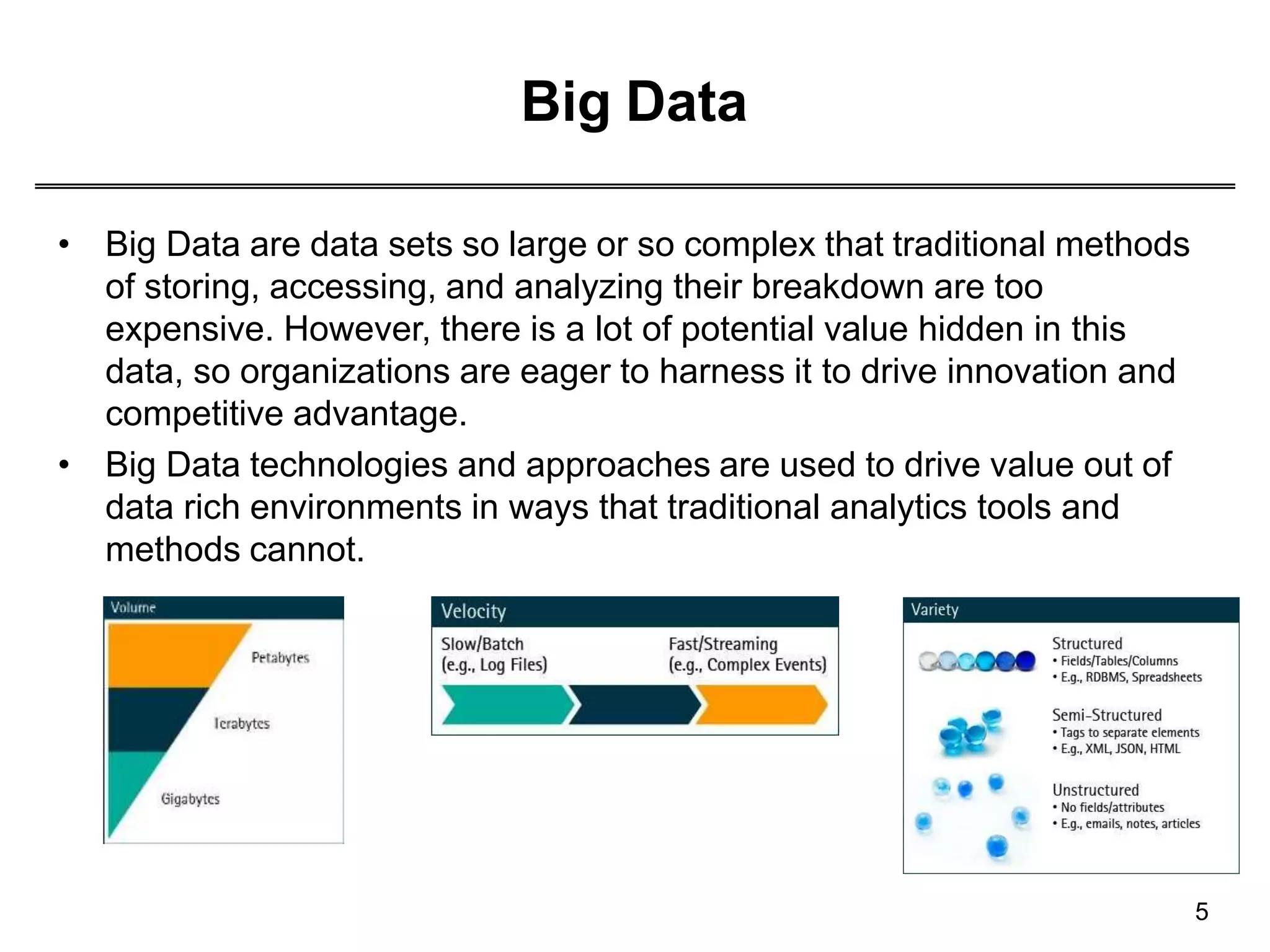
• Big Data are data sets so large or so complex that traditional methods
of storing, accessing, and analyzing their breakdown are too
expensive. However, there is a lot of potential value hidden in this
data, so organizations are eager to harness it to drive innovation and
competitive advantage.
• Big Data technologies and approaches are used to drive value out of
data rich environments in ways that traditional analytics tools and
methods cannot.
5
What To Do With These Data?
6
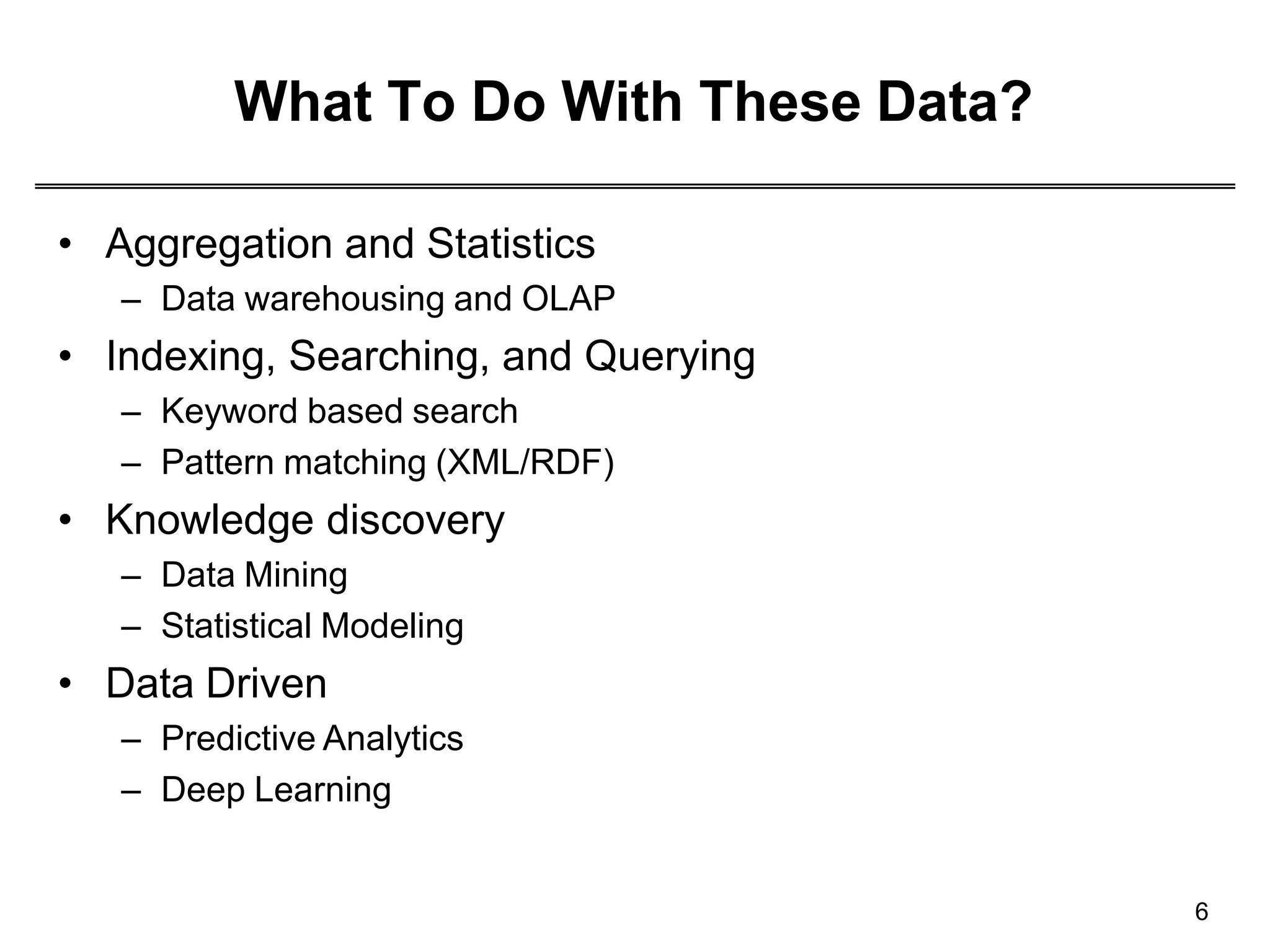
• Aggregation and Statistics
– Data warehousing and OLAP
• Indexing, Searching, and Querying
– Keyword based search
– Pattern matching (XML/RDF)
• Knowledge discovery
– Data Mining
– Statistical Modeling
• Data Driven
– Predictive Analytics
– Deep Learning
Big Data & Data Science
7
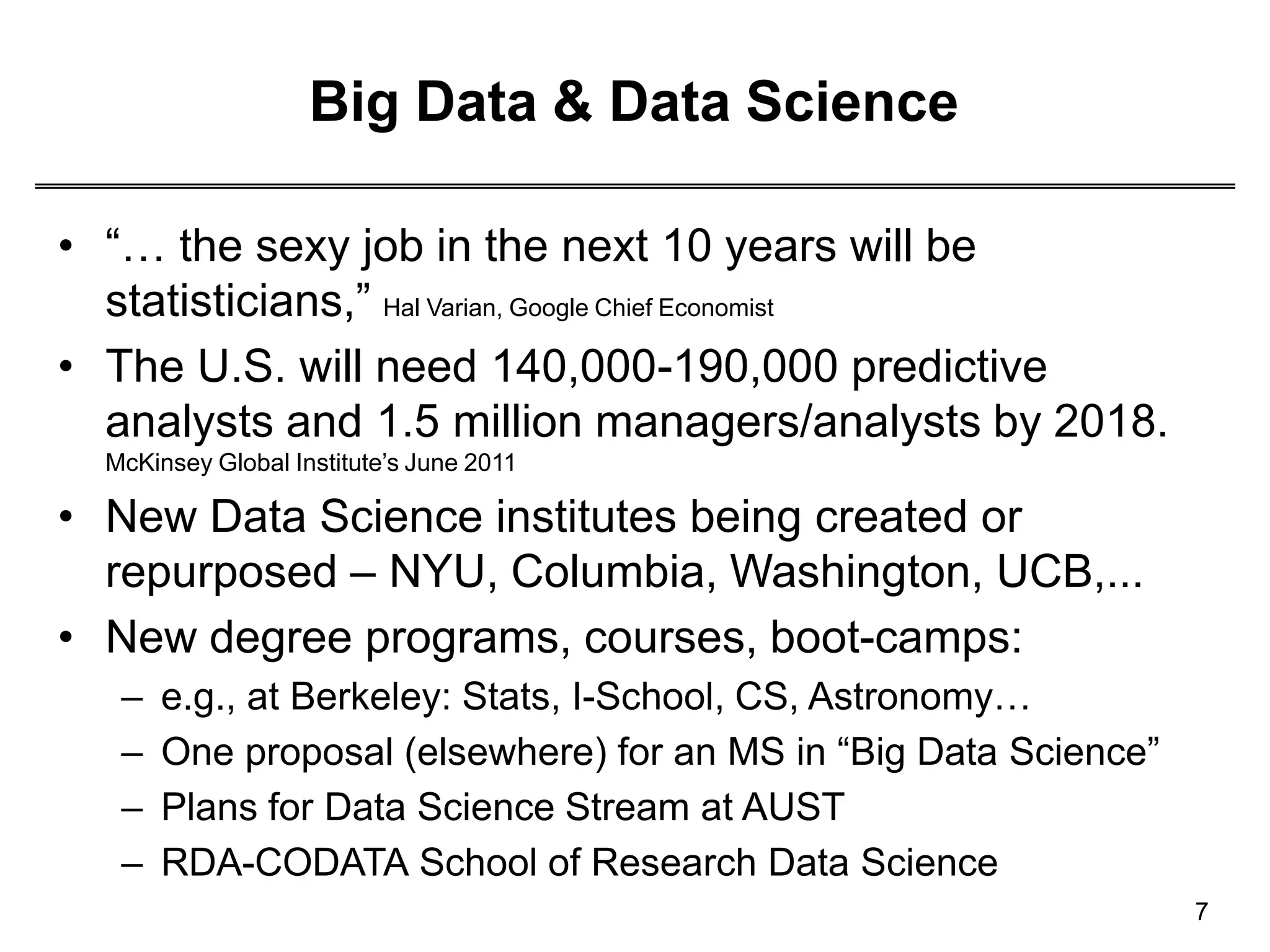
• “… the sexy job in the next 10 years will be
statisticians,” Hal Varian, Google Chief Economist
• The U.S. will need 140,000-190,000 predictive
analysts and 1.5 million managers/analysts by 2018.
McKinsey Global Institute’s June 2011
• New Data Science institutes being created or
repurposed – NYU, Columbia, Washington, UCB,...
• New degree programs, courses, boot-camps:
– e.g., at Berkeley: Stats, I-School, CS, Astronomy…
– One proposal (elsewhere) for an MS in “Big Data Science”
– Plans for Data Science Stream at AUST
– RDA-CODATA School of Research Data Science
What is Data Science?
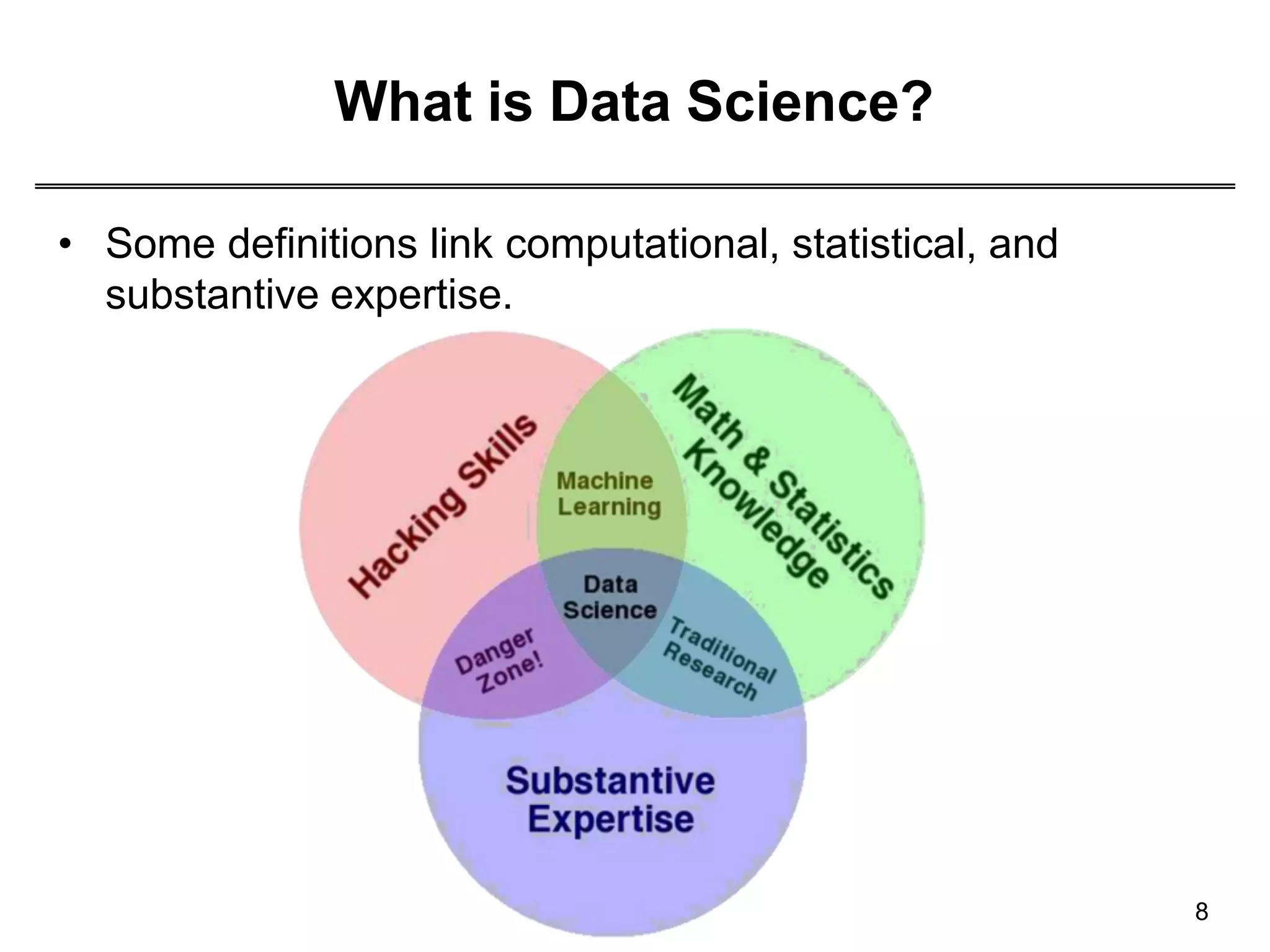
• Some definitions link computational, statistical, and
substantive expertise.
8
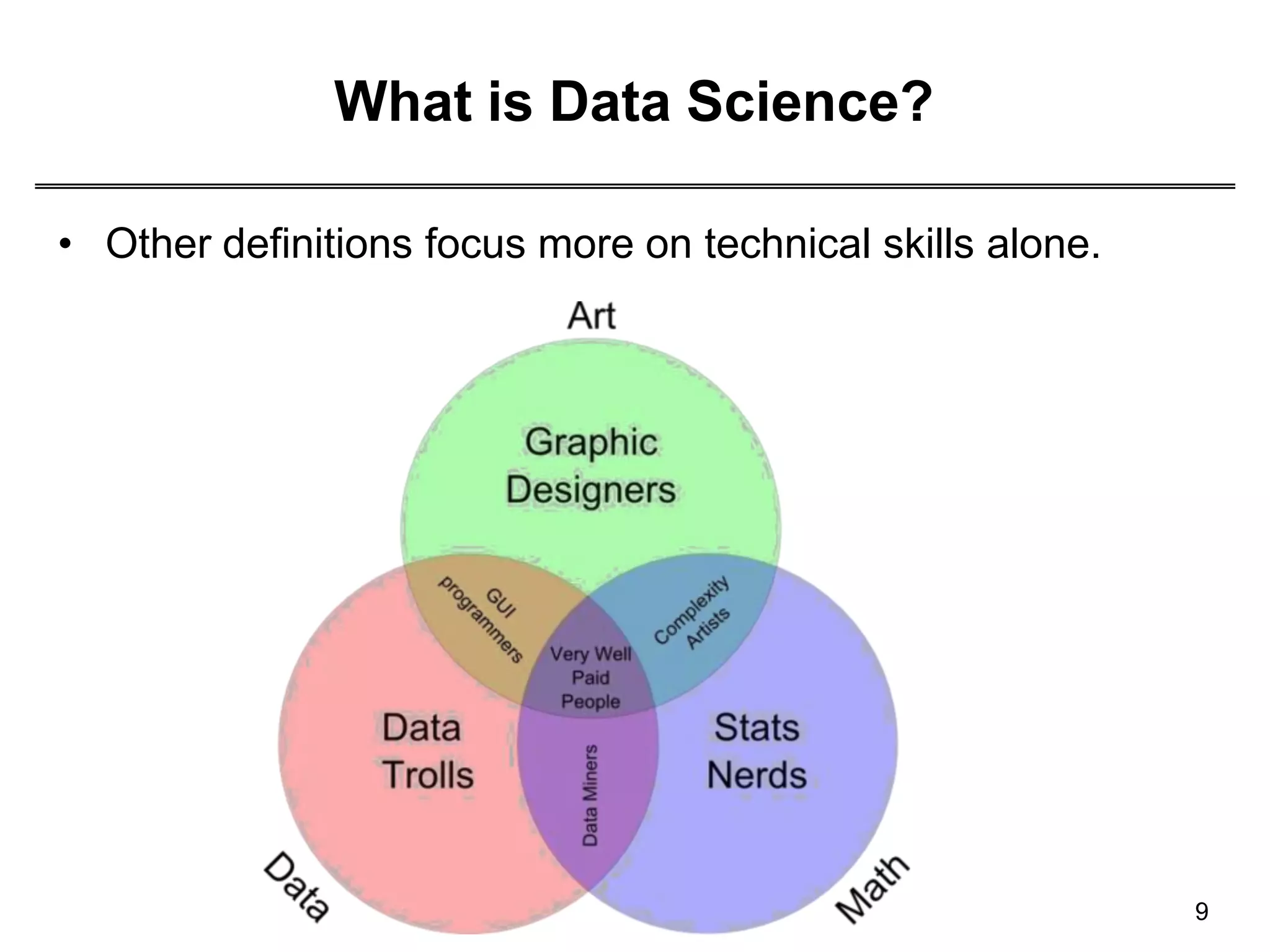
What is Data Science?
• Other definitions focus more on technical skills alone.
9
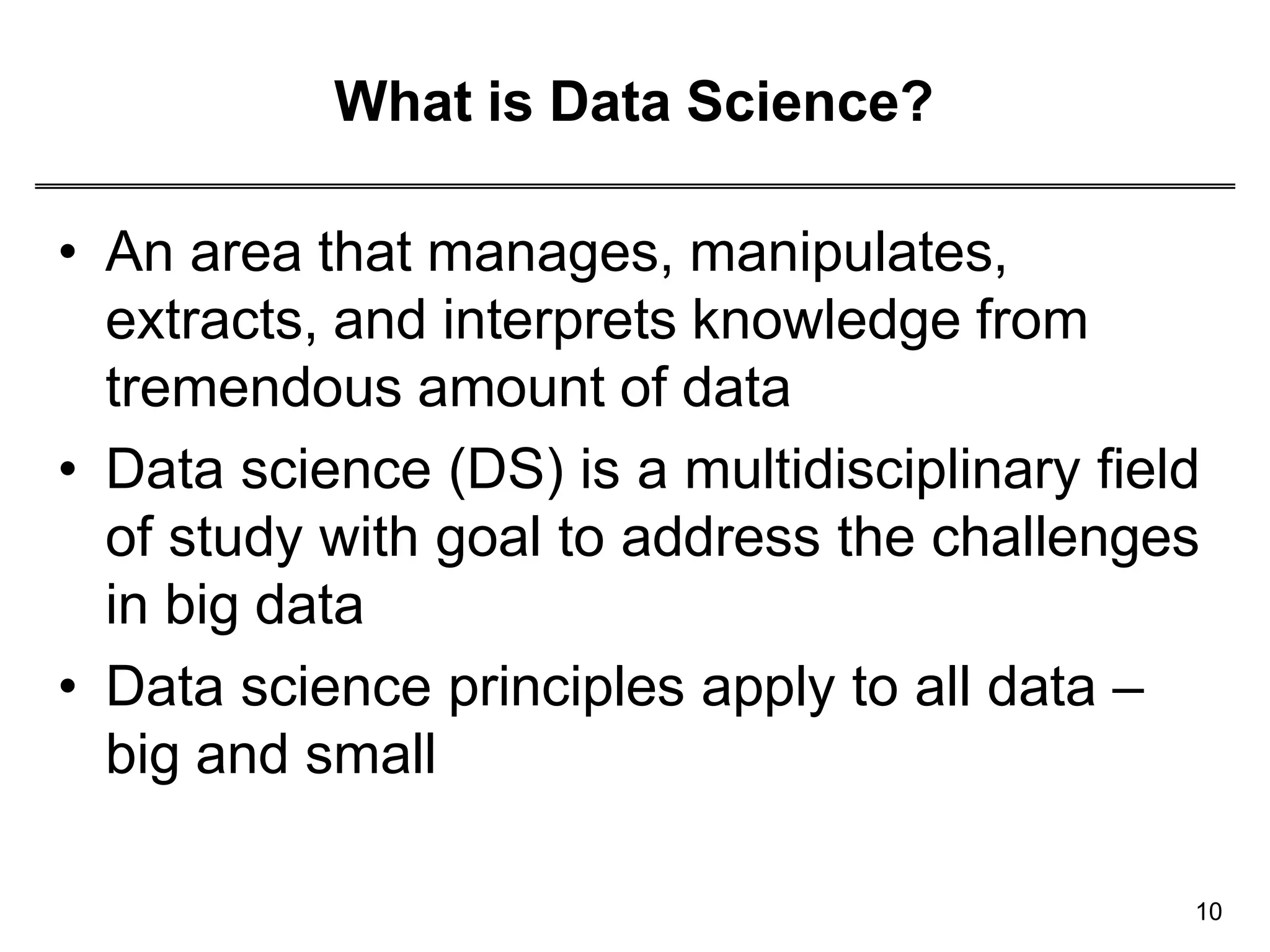
What is Data Science?
10
• An area that manages, manipulates,
extracts, and interprets knowledge from
tremendous amount of data
• Data science (DS) is a multidisciplinary field
of study with goal to address the challenges
in big data
• Data science principles apply to all data –
big and small
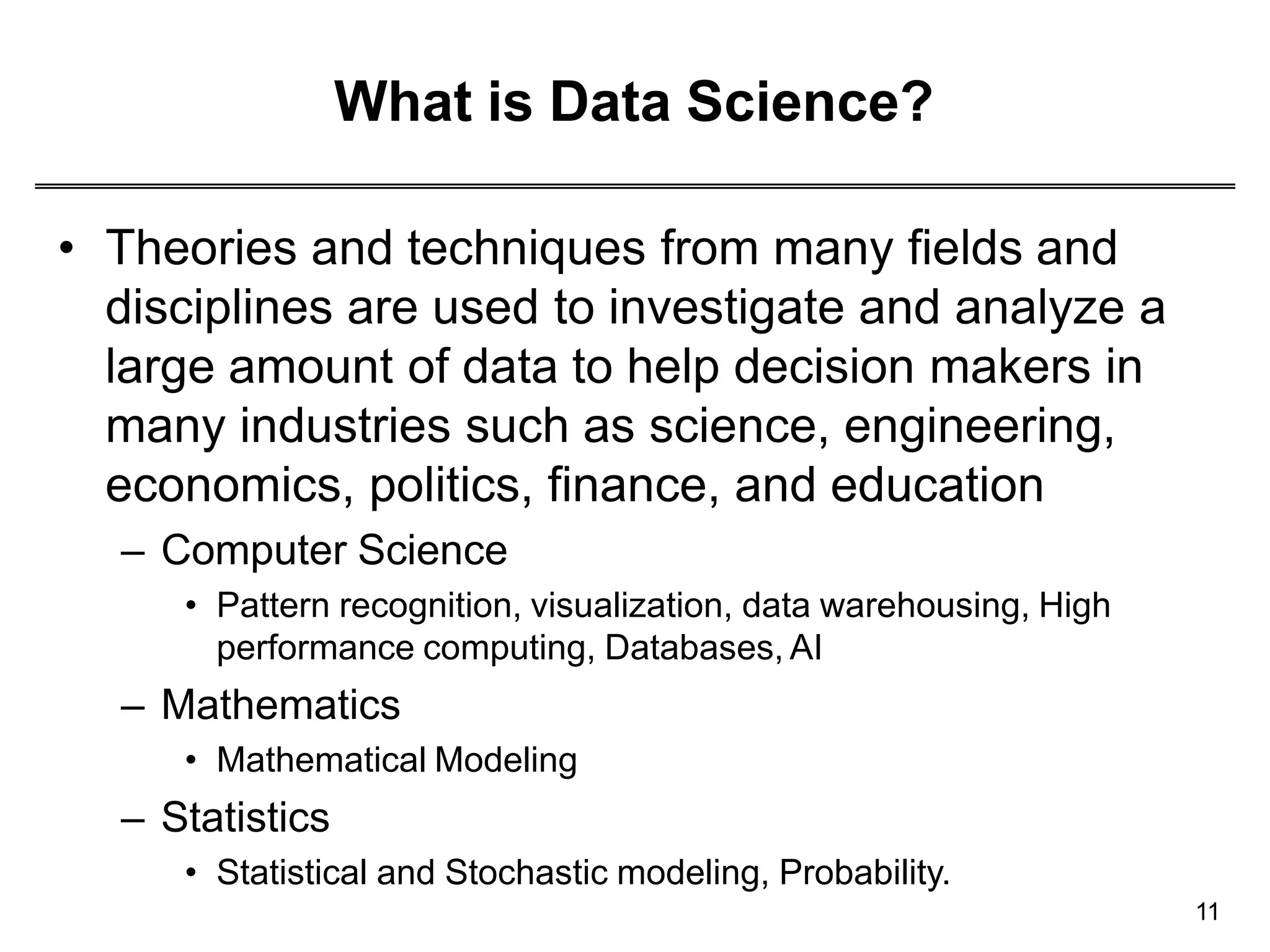
What is Data Science?
11
• Theories and techniques from many fields and
disciplines are used to investigate and analyze a
large amount of data to help decision makers in
many industries such as science, engineering,
economics, politics, finance, and education
– Computer Science
• Pattern recognition, visualization, data warehousing, High
performance computing, Databases, AI
– Mathematics
• Mathematical Modeling
– Statistics
• Statistical and Stochastic modeling, Probability.
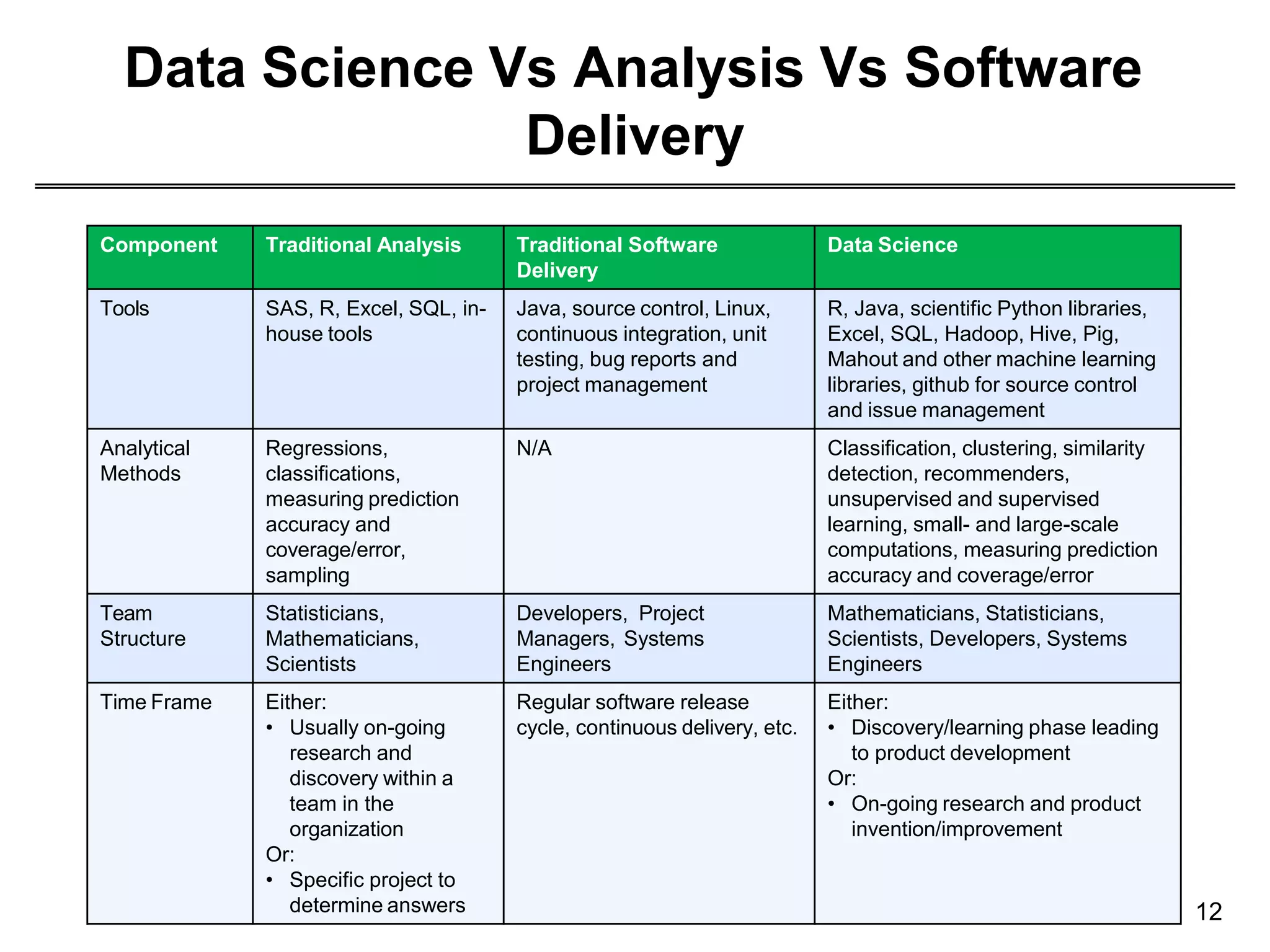
Data Science Vs Analysis Vs Software
Delivery
12
Component Traditional Analysis Traditional Software
Delivery
Data Science
Tools SAS, R, Excel, SQL, in-
house tools
Java, source control, Linux,
continuous integration, unit
testing, bug reports and
project management
R, Java, scientific Python libraries,
Excel, SQL, Hadoop, Hive, Pig,
Mahout and other machine learning
libraries, github for source control
and issue management
Analytical
Methods
Regressions,
classifications,
measuring prediction
accuracy and
coverage/error,
sampling
N/A Classification, clustering, similarity
detection, recommenders,
unsupervised and supervised
learning, small- and large-scale
computations, measuring prediction
accuracy and coverage/error
Team
Structure
Statisticians,
Mathematicians,
Scientists
Developers, Project
Managers, Systems
Engineers
Mathematicians, Statisticians,
Scientists, Developers, Systems
Engineers
Time Frame Either:
• Usually on-going
research and
discovery within a
team in the
organization
Or:
• Specific project to
determine answers
Regular software release
cycle, continuous delivery, etc.
Either:
• Discovery/learning phase leading
to product development
Or:
• On-going research and product
invention/improvement
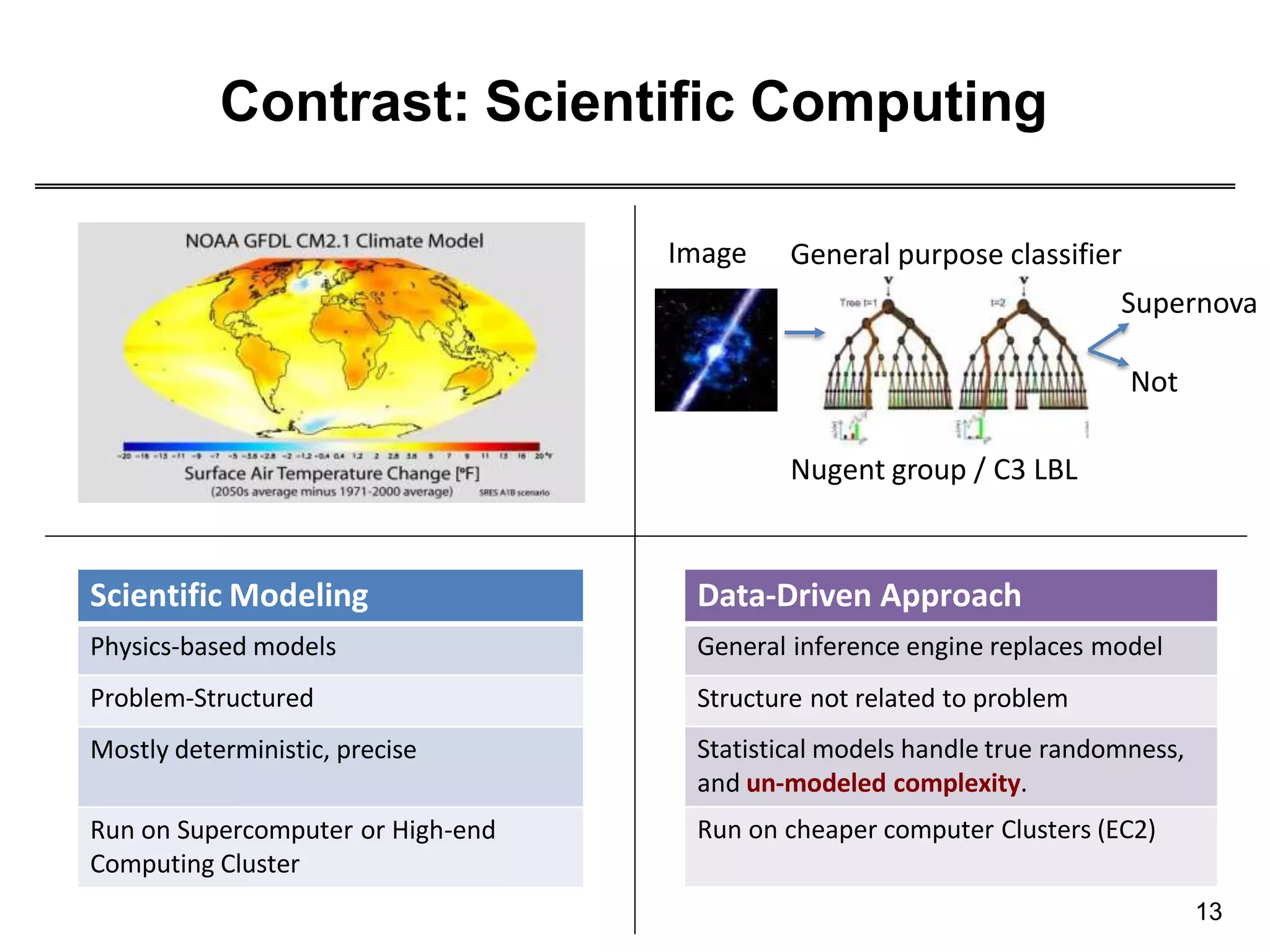
Contrast: Scientific Computing
Scientific Modeling
Physics-based models
Problem-Structured
Mostly deterministic, precise
Run on Supercomputer or High-end
Computing Cluster
Image General purpose classifier
Supernova
Data-Driven Approach
General inference engine replaces model
Structure not related to problem
Statistical models handle true randomness,
and un-modeled complexity.
Run on cheaper computer Clusters (EC2)
Not
Nugent group / C3 LBL
13
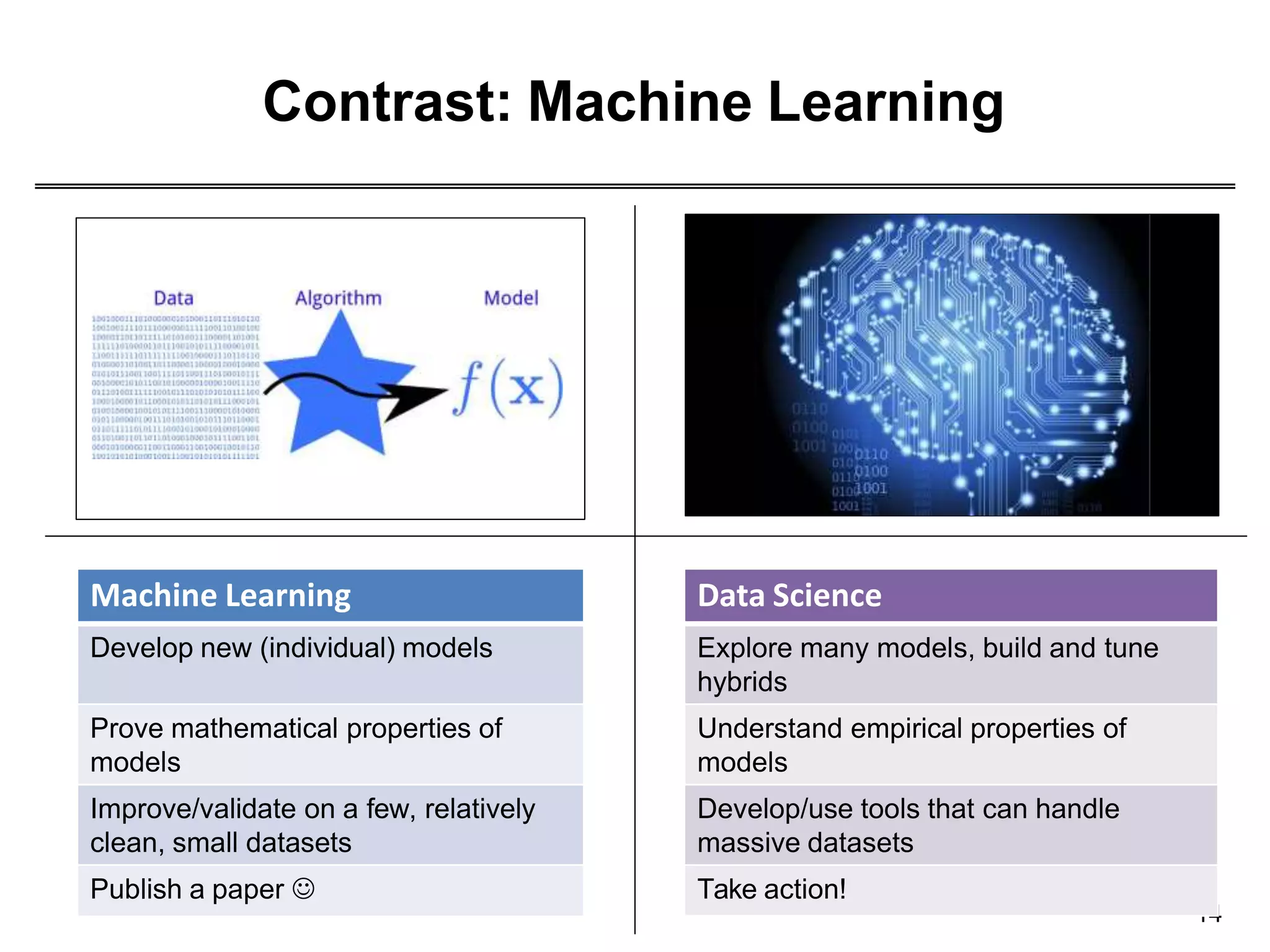
Contrast: Machine Learning
14
Machine Learning
Develop new (individual) models
Prove mathematical properties of
models
Improve/validate on a few, relatively
clean, small datasets
Publish a paper 
Data Science
Explore many models, build and tune
hybrids
Understand empirical properties of
models
Develop/use tools that can handle
massive datasets
Take action!
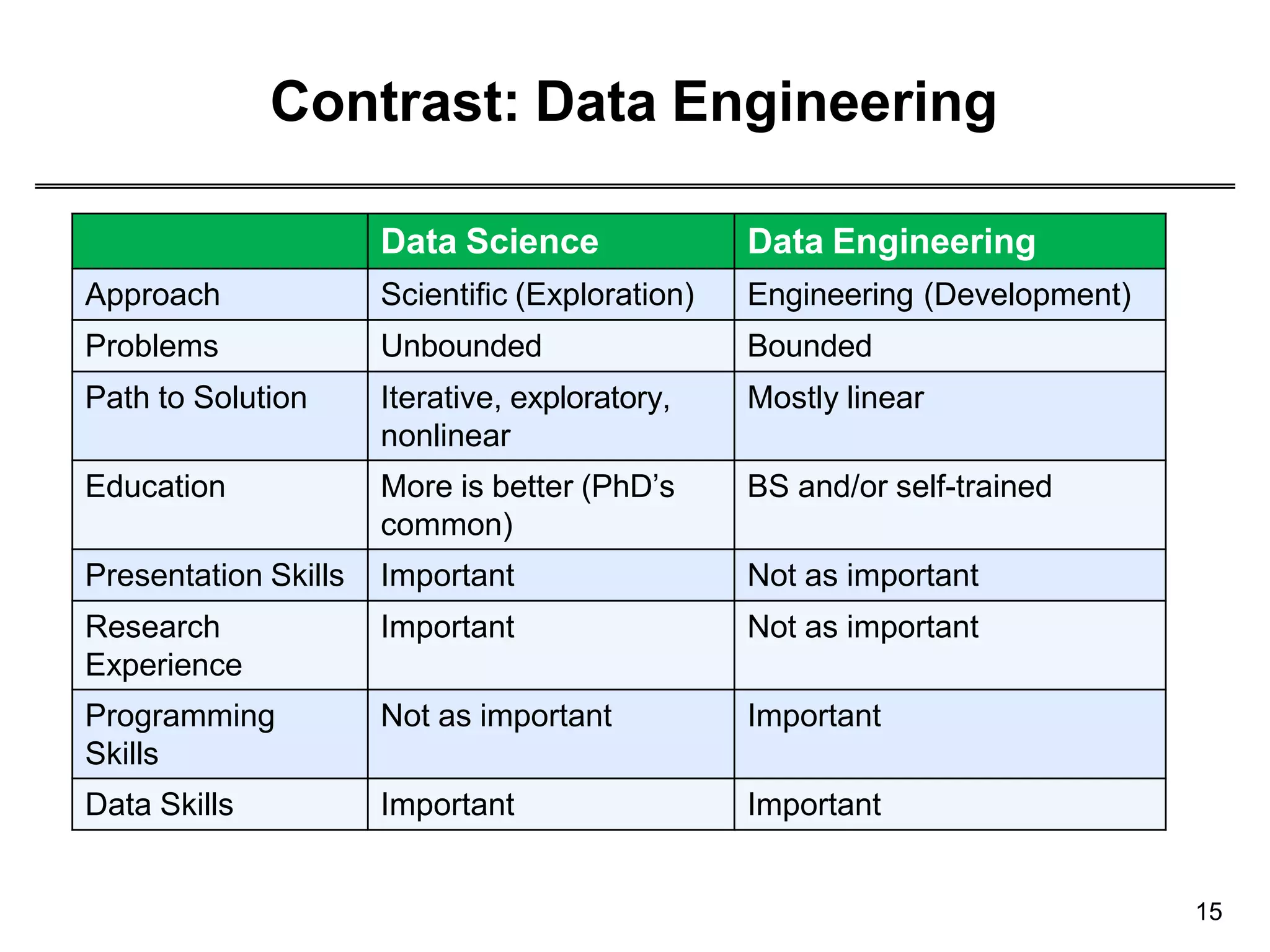
Contrast: Data Engineering
15
Data Science Data Engineering
Approach Scientific (Exploration) Engineering (Development)
Problems Unbounded Bounded
Path to Solution Iterative, exploratory,
nonlinear
Mostly linear
Education More is better (PhD’s
common)
BS and/or self-trained
Presentation Skills Important Not as important
Research
Experience
Important Not as important
Programming
Skills
Not as important Important
Data Skills Important Important
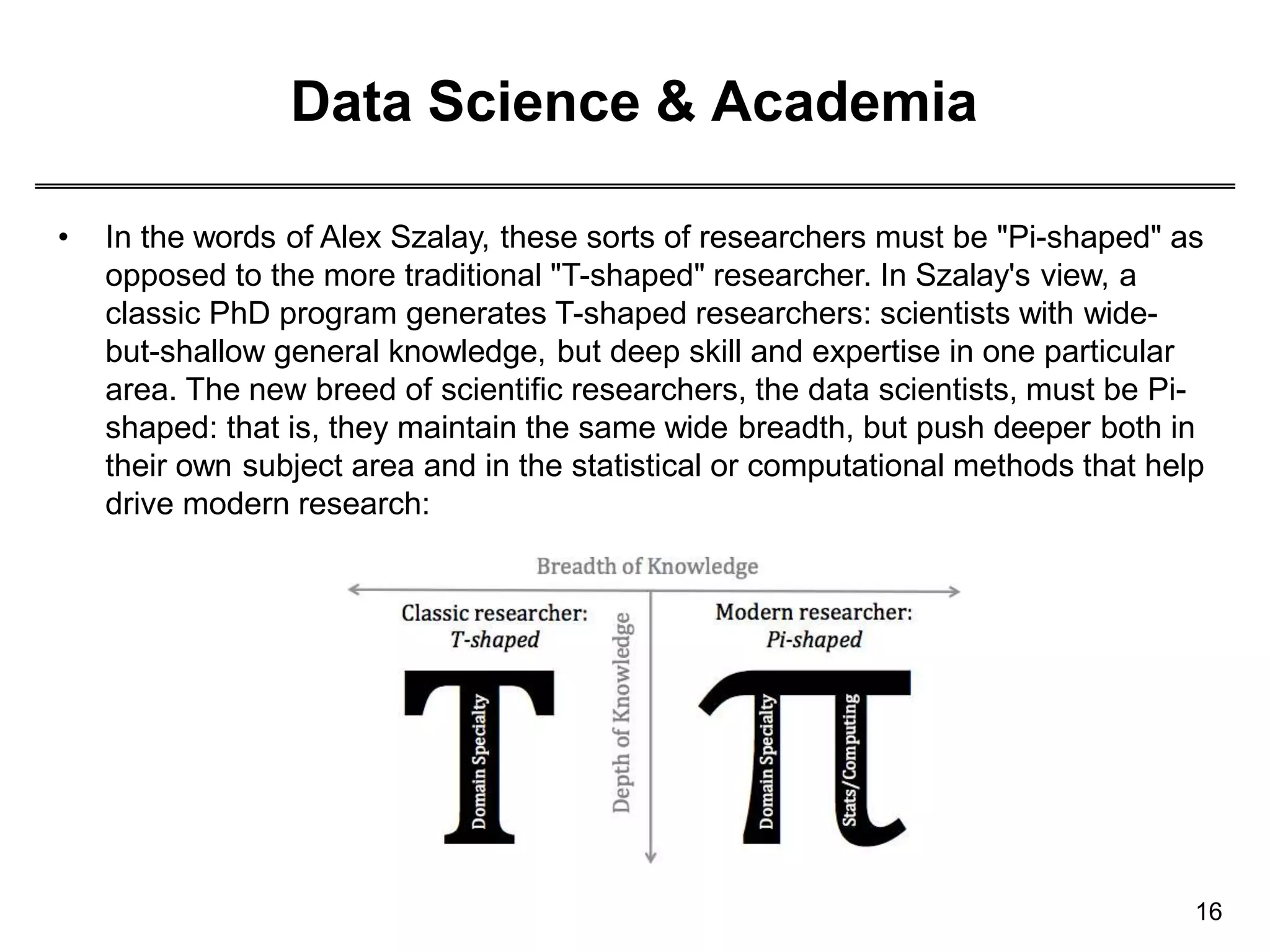
Data Science & Academia
• In the words of Alex Szalay, these sorts of researchers must be "Pi-shaped" as
opposed to the more traditional "T-shaped" researcher. In Szalay's view, a
classic PhD program generates T-shaped researchers: scientists with wide-
but-shallow general knowledge, but deep skill and expertise in one particular
area. The new breed of scientific researchers, the data scientists, must be Pi-
shaped: that is, they maintain the same wide breadth, but push deeper both in
their own subject area and in the statistical or computational methods that help
drive modern research:
16
Data Science & Academia
17
• In a post by Jake Vanderplas in 2014 related to SciFoo discussion on:
Academia and Data Science, the following questions below were
discussed.
• I encourage you to develop your own thoughts on them and come up
with your assessment
– Where does Data Science fit within the current structure of the
university & research institutions?
– What is it that academic data scientists want from their career?
How can academia offer that?
– What drivers might shift academia toward recognizing & rewarding
data scientists in domain fields?
– Recognizing that graduates will go on to work in both academia
and industry, how do we best prepare them for success in both
worlds?
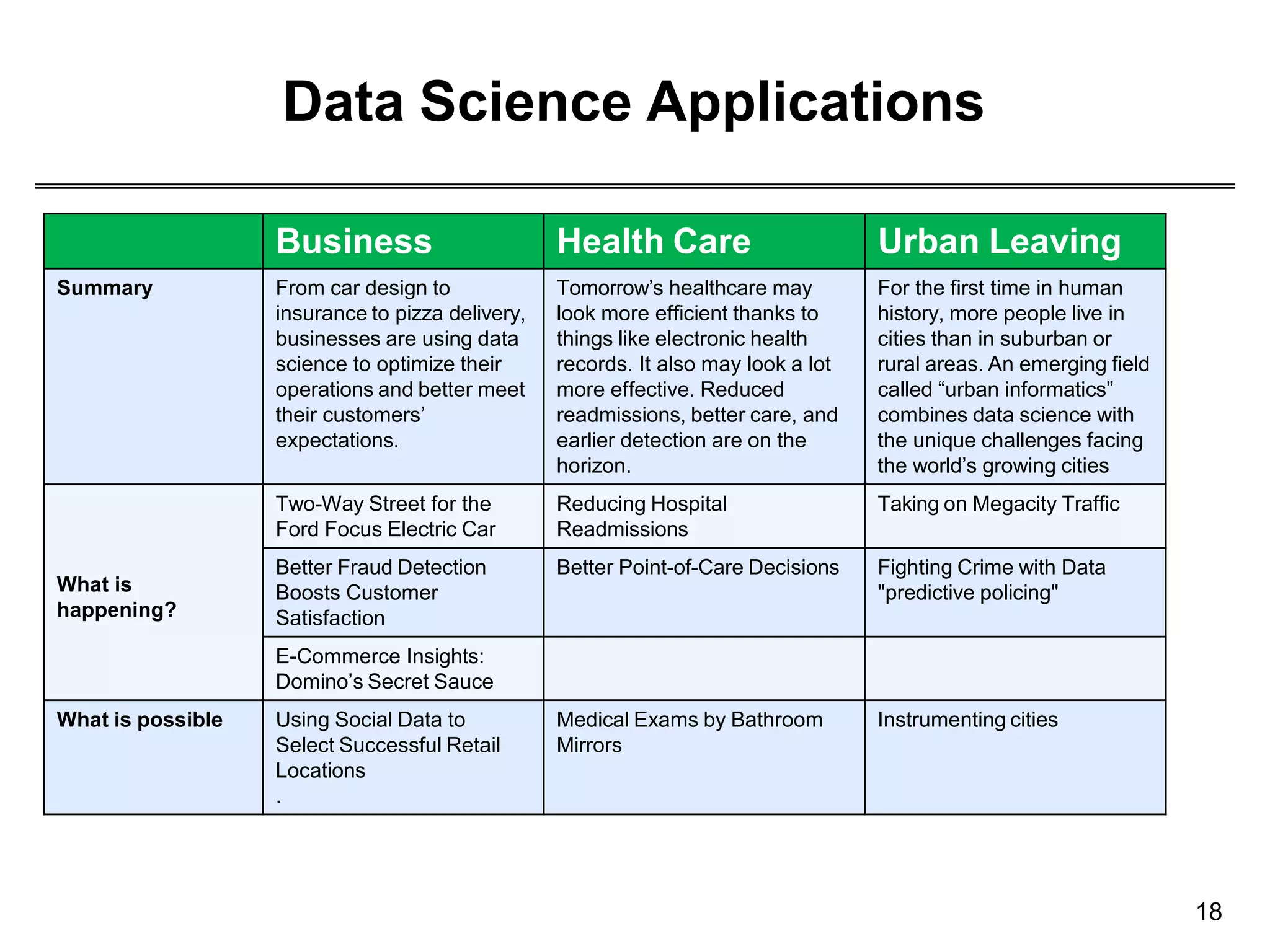
Data Science Applications
18
Business Health Care Urban Leaving
Summary From car design to
insurance to pizza delivery,
businesses are using data
science to optimize their
operations and better meet
their customers’
expectations.
Tomorrow’s healthcare may
look more efficient thanks to
things like electronic health
records. It also may look a lot
more effective. Reduced
readmissions, better care, and
earlier detection are on the
horizon.
For the first time in human
history, more people live in
cities than in suburban or
rural areas. An emerging field
called “urban informatics”
combines data science with
the unique challenges facing
the world’s growing cities
What is
happening?
Two-Way Street for the
Ford Focus Electric Car
Reducing Hospital
Readmissions
Taking on Megacity Traffic
Better Fraud Detection
Boosts Customer
Satisfaction
Better Point-of-Care Decisions Fighting Crime with Data
"predictive policing"
E-Commerce Insights:
Domino’s Secret Sauce
What is possible Using Social Data to
Select Successful Retail
Locations
.
Medical Exams by Bathroom
Mirrors
Instrumenting cities
Contrast: Computational Sciences
• Is there a contrast between Data Science and
Computational Science?
19
Data Science: Case Study
Cancer Research
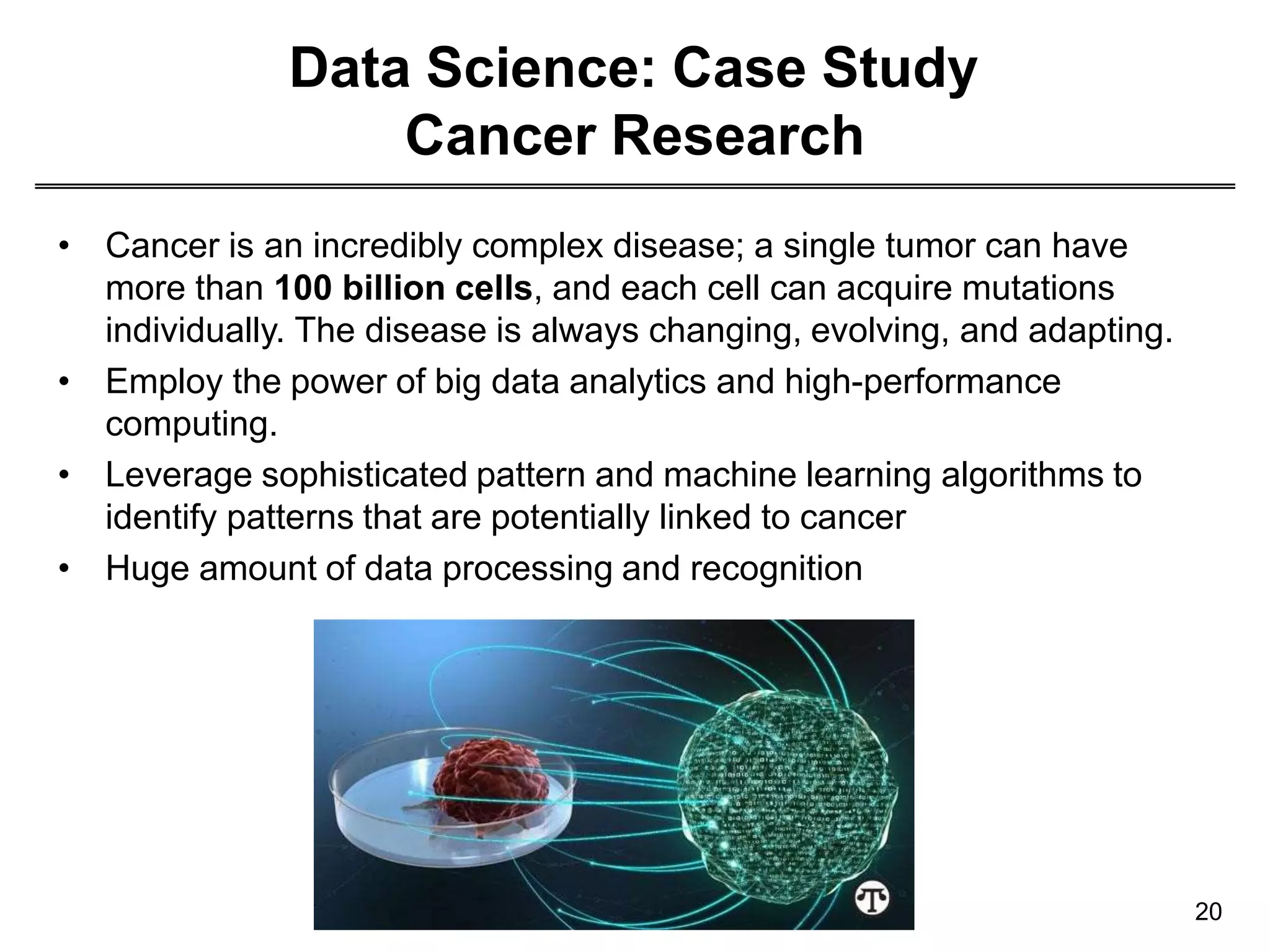
• Cancer is an incredibly complex disease; a single tumor can have
more than 100 billion cells, and each cell can acquire mutations
individually. The disease is always changing, evolving, and adapting.
• Employ the power of big data analytics and high-performance
computing.
• Leverage sophisticated pattern and machine learning algorithms to
identify patterns that are potentially linked to cancer
• Huge amount of data processing and recognition
20
Data Science: Case Study
Health Care
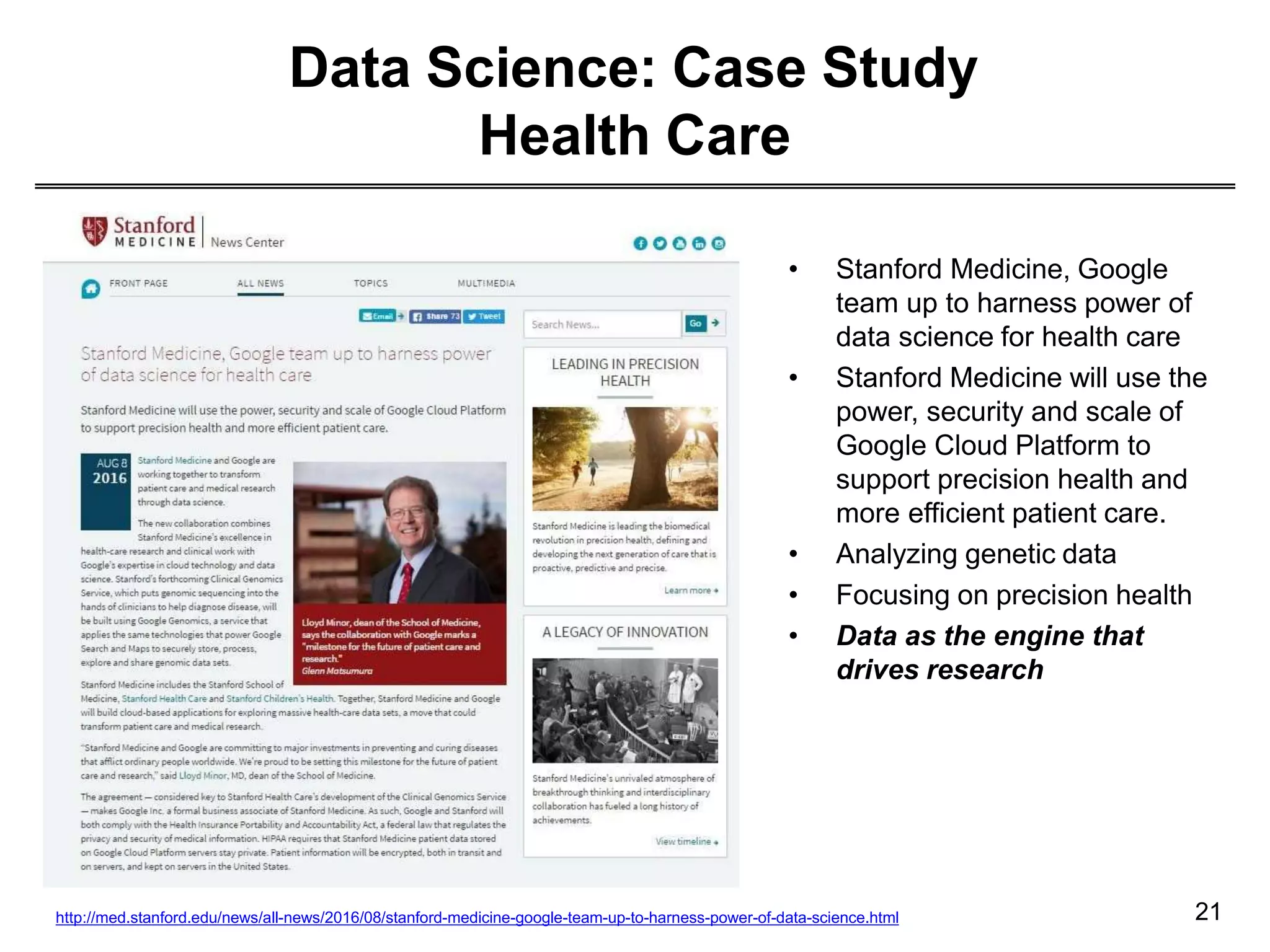
• Stanford Medicine, Google
team up to harness power of
data science for health care
• Stanford Medicine will use the
power, security and scale of
Google Cloud Platform to
support precision health and
more efficient patient care.
• Analyzing genetic data
• Focusing on precision health
• Data as the engine that
drives research
21
http://med.stanford.edu/news/all-news/2016/08/stanford-medicine-google-team-up-to-harness-power-of-data-science.html
Data Science: Case Study
Elections
• The Obama campaigns in 2008 and 2012 are credited for their
successful use of social media and data mining.
• Micro-targeting in 2012
– http://www.theatlantic.com/politics/archive/2012/04/the-
creepiness-factor-how-obama-and-romney-are-getting-to-know-
you/255499/
– http://www.mediabizbloggers.com/group-m/How-Data-and-Micro-
Targeting-Won-the-2012-Election-for-Obama---Antony-Young-
Mindshare-North-America.html
• Micro-profiles built from multiple sources accessed by aps, real-
time updating data based on door-to-door visits, focused media
buys, e-mails and Facebook messages highly targeted.
• 1 million people installed the Obama Facebook app that gave
access to info on “friends”.
22
Data Science: Case Study
Internet of Things (IoT)
23
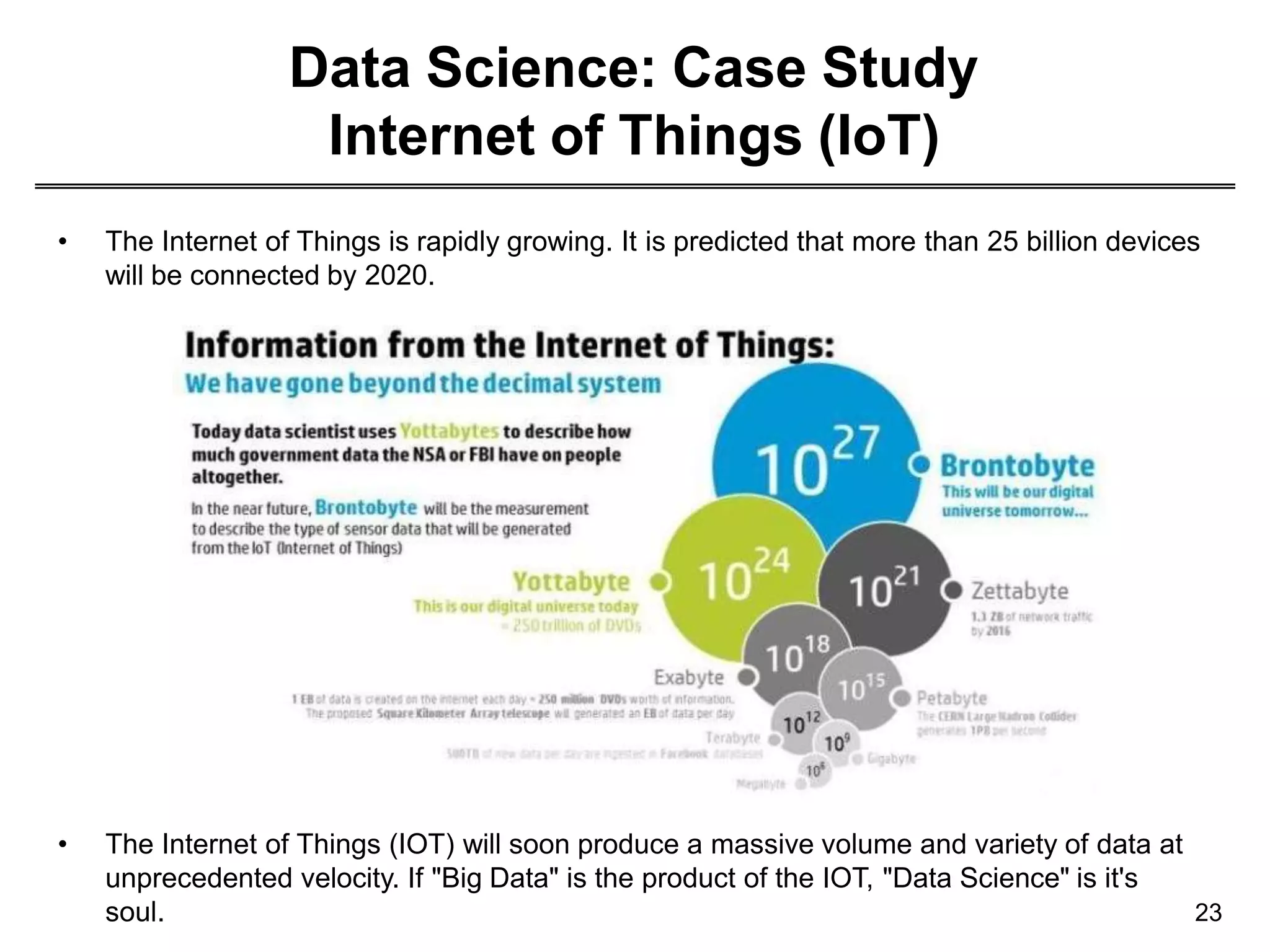
• The Internet of Things is rapidly growing. It is predicted that more than 25 billion devices
will be connected by 2020.
• The Internet of Things (IOT) will soon produce a massive volume and variety of data at
unprecedented velocity. If "Big Data" is the product of the IOT, "Data Science" is it's
soul.
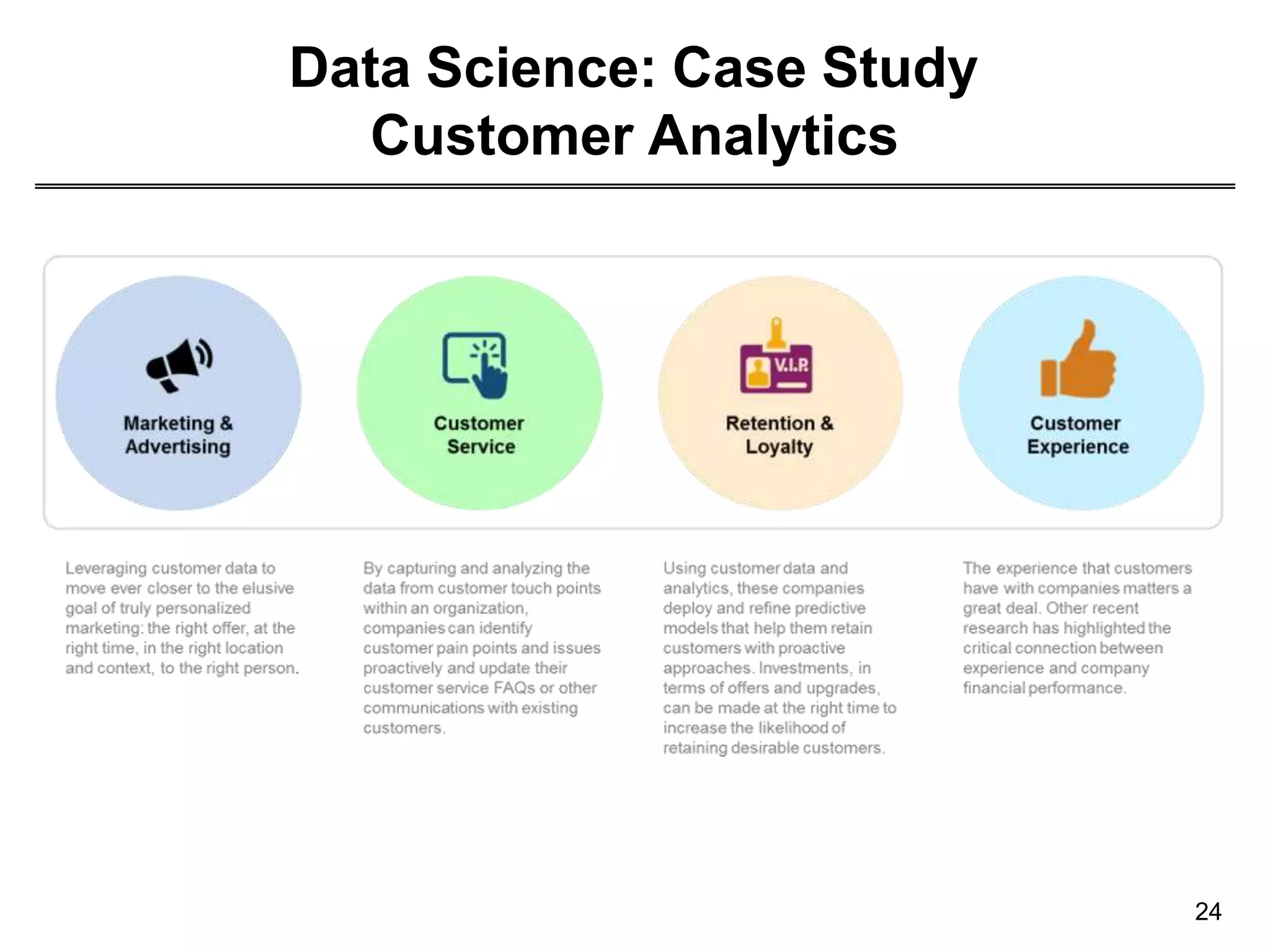
Data Science: Case Study
Customer Analytics
24
Essential Points
25
• Big Data has given rise to Data Science
• Data science is rooted in solid foundations of
mathematics and statistics, computer science, and
domain knowledge
• Sexy profession – Data Scientists 
• Not every thing with data or science is Data Science!
• The use cases for Data Science are compelling
Conclusion
26
In this section you have learned
• What Big Data Challenges are
• What exactly is Data Science and what do Data
Scientists do
• Data Science contrasted with other disciplines
• Case Study & Use Cases
Questions?
27
Thank
You!
28
http://www.ign.com/articles/2015/12/16/star-wars-the-force-awakens-review

Real-time applications of Data Science.pptx

  • 1.
    Webinar on “Real-timeapplications of Data Science”
  • 2.
    Objectives 2 Objectives • Understand BigData Challenges • What exactly is Data Science and what do Data Scientists do • Data Science contrasted with other disciplines • Case Study & Use Cases
  • 3.
    Outline 3 • Big Data& Challenges • What is Data Science • Data Science & Academia • Data Science & Others • Case Studies • Essential points • Conclusion
  • 4.
    Data All Around 4 •Lots of data is being collected and warehoused – Scientific Experiments – Internet of Things – Web data, e-commerce – Financial transactions, bank/credit transactions – Online trading and purchasing – Social Network – ……many more!
  • 5.
    Big Data • BigData are data sets so large or so complex that traditional methods of storing, accessing, and analyzing their breakdown are too expensive. However, there is a lot of potential value hidden in this data, so organizations are eager to harness it to drive innovation and competitive advantage. • Big Data technologies and approaches are used to drive value out of data rich environments in ways that traditional analytics tools and methods cannot. 5
  • 6.
    What To DoWith These Data? 6 • Aggregation and Statistics – Data warehousing and OLAP • Indexing, Searching, and Querying – Keyword based search – Pattern matching (XML/RDF) • Knowledge discovery – Data Mining – Statistical Modeling • Data Driven – Predictive Analytics – Deep Learning
  • 7.
    Big Data &Data Science 7 • “… the sexy job in the next 10 years will be statisticians,” Hal Varian, Google Chief Economist • The U.S. will need 140,000-190,000 predictive analysts and 1.5 million managers/analysts by 2018. McKinsey Global Institute’s June 2011 • New Data Science institutes being created or repurposed – NYU, Columbia, Washington, UCB,... • New degree programs, courses, boot-camps: – e.g., at Berkeley: Stats, I-School, CS, Astronomy… – One proposal (elsewhere) for an MS in “Big Data Science” – Plans for Data Science Stream at AUST – RDA-CODATA School of Research Data Science
  • 8.
    What is DataScience? • Some definitions link computational, statistical, and substantive expertise. 8
  • 9.
    What is DataScience? • Other definitions focus more on technical skills alone. 9
  • 10.
    What is DataScience? 10 • An area that manages, manipulates, extracts, and interprets knowledge from tremendous amount of data • Data science (DS) is a multidisciplinary field of study with goal to address the challenges in big data • Data science principles apply to all data – big and small
  • 11.
    What is DataScience? 11 • Theories and techniques from many fields and disciplines are used to investigate and analyze a large amount of data to help decision makers in many industries such as science, engineering, economics, politics, finance, and education – Computer Science • Pattern recognition, visualization, data warehousing, High performance computing, Databases, AI – Mathematics • Mathematical Modeling – Statistics • Statistical and Stochastic modeling, Probability.
  • 12.
    Data Science VsAnalysis Vs Software Delivery 12 Component Traditional Analysis Traditional Software Delivery Data Science Tools SAS, R, Excel, SQL, in- house tools Java, source control, Linux, continuous integration, unit testing, bug reports and project management R, Java, scientific Python libraries, Excel, SQL, Hadoop, Hive, Pig, Mahout and other machine learning libraries, github for source control and issue management Analytical Methods Regressions, classifications, measuring prediction accuracy and coverage/error, sampling N/A Classification, clustering, similarity detection, recommenders, unsupervised and supervised learning, small- and large-scale computations, measuring prediction accuracy and coverage/error Team Structure Statisticians, Mathematicians, Scientists Developers, Project Managers, Systems Engineers Mathematicians, Statisticians, Scientists, Developers, Systems Engineers Time Frame Either: • Usually on-going research and discovery within a team in the organization Or: • Specific project to determine answers Regular software release cycle, continuous delivery, etc. Either: • Discovery/learning phase leading to product development Or: • On-going research and product invention/improvement
  • 13.
    Contrast: Scientific Computing ScientificModeling Physics-based models Problem-Structured Mostly deterministic, precise Run on Supercomputer or High-end Computing Cluster Image General purpose classifier Supernova Data-Driven Approach General inference engine replaces model Structure not related to problem Statistical models handle true randomness, and un-modeled complexity. Run on cheaper computer Clusters (EC2) Not Nugent group / C3 LBL 13
  • 14.
    Contrast: Machine Learning 14 MachineLearning Develop new (individual) models Prove mathematical properties of models Improve/validate on a few, relatively clean, small datasets Publish a paper  Data Science Explore many models, build and tune hybrids Understand empirical properties of models Develop/use tools that can handle massive datasets Take action!
  • 15.
    Contrast: Data Engineering 15 DataScience Data Engineering Approach Scientific (Exploration) Engineering (Development) Problems Unbounded Bounded Path to Solution Iterative, exploratory, nonlinear Mostly linear Education More is better (PhD’s common) BS and/or self-trained Presentation Skills Important Not as important Research Experience Important Not as important Programming Skills Not as important Important Data Skills Important Important
  • 16.
    Data Science &Academia • In the words of Alex Szalay, these sorts of researchers must be "Pi-shaped" as opposed to the more traditional "T-shaped" researcher. In Szalay's view, a classic PhD program generates T-shaped researchers: scientists with wide- but-shallow general knowledge, but deep skill and expertise in one particular area. The new breed of scientific researchers, the data scientists, must be Pi- shaped: that is, they maintain the same wide breadth, but push deeper both in their own subject area and in the statistical or computational methods that help drive modern research: 16
  • 17.
    Data Science &Academia 17 • In a post by Jake Vanderplas in 2014 related to SciFoo discussion on: Academia and Data Science, the following questions below were discussed. • I encourage you to develop your own thoughts on them and come up with your assessment – Where does Data Science fit within the current structure of the university & research institutions? – What is it that academic data scientists want from their career? How can academia offer that? – What drivers might shift academia toward recognizing & rewarding data scientists in domain fields? – Recognizing that graduates will go on to work in both academia and industry, how do we best prepare them for success in both worlds?
  • 18.
    Data Science Applications 18 BusinessHealth Care Urban Leaving Summary From car design to insurance to pizza delivery, businesses are using data science to optimize their operations and better meet their customers’ expectations. Tomorrow’s healthcare may look more efficient thanks to things like electronic health records. It also may look a lot more effective. Reduced readmissions, better care, and earlier detection are on the horizon. For the first time in human history, more people live in cities than in suburban or rural areas. An emerging field called “urban informatics” combines data science with the unique challenges facing the world’s growing cities What is happening? Two-Way Street for the Ford Focus Electric Car Reducing Hospital Readmissions Taking on Megacity Traffic Better Fraud Detection Boosts Customer Satisfaction Better Point-of-Care Decisions Fighting Crime with Data "predictive policing" E-Commerce Insights: Domino’s Secret Sauce What is possible Using Social Data to Select Successful Retail Locations . Medical Exams by Bathroom Mirrors Instrumenting cities
  • 19.
    Contrast: Computational Sciences •Is there a contrast between Data Science and Computational Science? 19
  • 20.
    Data Science: CaseStudy Cancer Research • Cancer is an incredibly complex disease; a single tumor can have more than 100 billion cells, and each cell can acquire mutations individually. The disease is always changing, evolving, and adapting. • Employ the power of big data analytics and high-performance computing. • Leverage sophisticated pattern and machine learning algorithms to identify patterns that are potentially linked to cancer • Huge amount of data processing and recognition 20
  • 21.
    Data Science: CaseStudy Health Care • Stanford Medicine, Google team up to harness power of data science for health care • Stanford Medicine will use the power, security and scale of Google Cloud Platform to support precision health and more efficient patient care. • Analyzing genetic data • Focusing on precision health • Data as the engine that drives research 21 http://med.stanford.edu/news/all-news/2016/08/stanford-medicine-google-team-up-to-harness-power-of-data-science.html
  • 22.
    Data Science: CaseStudy Elections • The Obama campaigns in 2008 and 2012 are credited for their successful use of social media and data mining. • Micro-targeting in 2012 – http://www.theatlantic.com/politics/archive/2012/04/the- creepiness-factor-how-obama-and-romney-are-getting-to-know- you/255499/ – http://www.mediabizbloggers.com/group-m/How-Data-and-Micro- Targeting-Won-the-2012-Election-for-Obama---Antony-Young- Mindshare-North-America.html • Micro-profiles built from multiple sources accessed by aps, real- time updating data based on door-to-door visits, focused media buys, e-mails and Facebook messages highly targeted. • 1 million people installed the Obama Facebook app that gave access to info on “friends”. 22
  • 23.
    Data Science: CaseStudy Internet of Things (IoT) 23 • The Internet of Things is rapidly growing. It is predicted that more than 25 billion devices will be connected by 2020. • The Internet of Things (IOT) will soon produce a massive volume and variety of data at unprecedented velocity. If "Big Data" is the product of the IOT, "Data Science" is it's soul.
  • 24.
    Data Science: CaseStudy Customer Analytics 24
  • 25.
    Essential Points 25 • BigData has given rise to Data Science • Data science is rooted in solid foundations of mathematics and statistics, computer science, and domain knowledge • Sexy profession – Data Scientists  • Not every thing with data or science is Data Science! • The use cases for Data Science are compelling
  • 26.
    Conclusion 26 In this sectionyou have learned • What Big Data Challenges are • What exactly is Data Science and what do Data Scientists do • Data Science contrasted with other disciplines • Case Study & Use Cases
  • 27.
  • 28.