* TRANSPARENT COMPUTING
A CLOUD SERVICE USING SPATIO-TEMPORAL
EXTENSION ON VON NEUMANN ARCHITECTURE
Presented By :ASWIN G K
Department Of Computer Science
Lourdes Matha College Of Science and Technology
Trivandrum
Under The Guidance Of
Saranya B S
(Assistant Prof. Department of Information Technology)
1
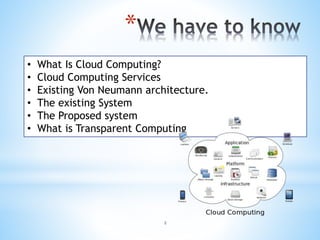
• What Is Cloud Computing?
• Cloud Computing Services
• Existing Von Neumann architecture.
• The existing System
• The Proposed system
• What is Transparent Computing
*
2
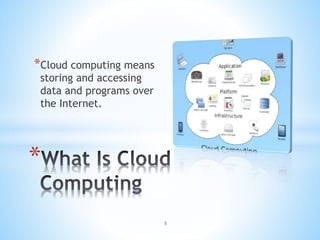
*Cloud computing means
storing and accessing
data and programs over
the Internet.
*
3
*
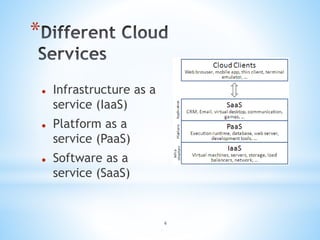
 Infrastructure as a
service (IaaS)
 Platform as a
service (PaaS)
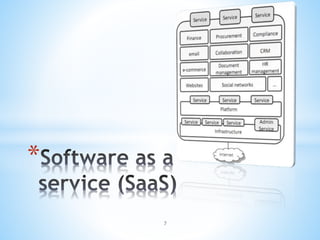
 Software as a
service (SaaS)
4
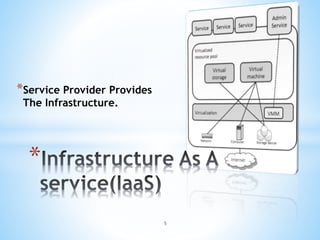
*Service Provider Provides
The Infrastructure.
*
5
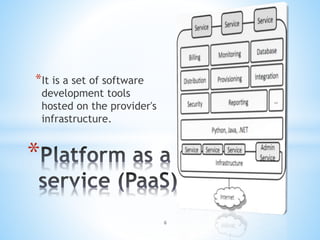
*It is a set of software
development tools
hosted on the provider's
infrastructure.
*
6
*
7
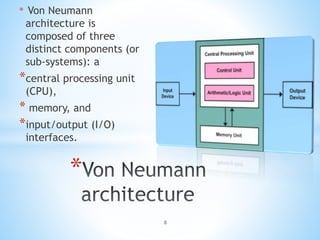
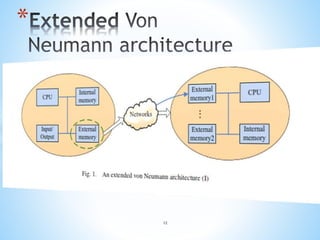
* Von Neumann
architecture is
composed of three
distinct components (or
sub-systems): a
*central processing unit
(CPU),
* memory, and
*input/output (I/O)
interfaces.
*
8
*
• The existing stored program concept the instructions
and data are treated and stored in the same way in the
storage devices.
• This traditional way of storage with local devices is hard
to provide personalized or active services to users.
• The small, limited size embedded devices cannot hold
all the needed programs.
• Programs on the local storage need maintenance,
fighting against malware, and other management jobs.
9
*
*Meta OS, to support Oses streaming through a distributed
4VP+ (4Layer 2 Protocols) platform.
*Meeting user demands for any computing services in a
trouble-free way in the right place at right time.
* The essential idea is to spatio-temporally extend the
traditional stored program concept.
*Programs are stored on the central computers
(servers) The programs are streamed computers (embedded
devices or clients).
10
*
*A fundamental paradigm shift from traditional
solutions
*Some changes from traditional system:
1. System Architecture
2. Computing Model
3. Separate computing and storage: store
program in server, execute program in client
4. Management
5. Centralization
11
*
12
*
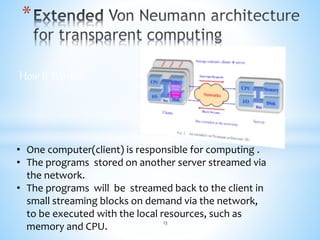
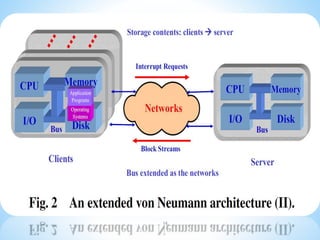
• One computer(client) is responsible for computing .
• The programs stored on another server streamed via
the network.
• The programs will be streamed back to the client in
small streaming blocks on demand via the network,
to be executed with the local resources, such as
memory and CPU.
How It Works..
13
14
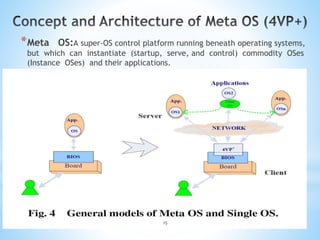
*Meta OS:A super-OS control platform running beneath operating systems,
but which can instantiate (startup, serve, and control) commodity OSes
(Instance OSes) and their applications.
15
*
16
Program Streaming Through 4VP+
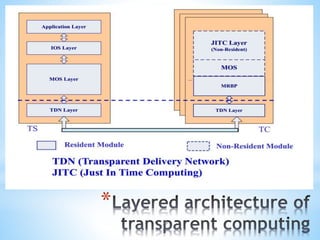
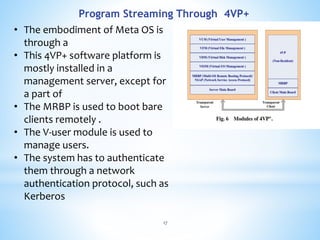
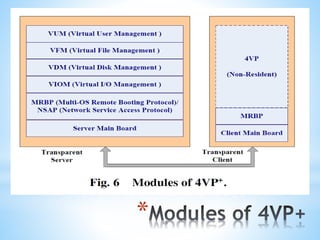
• The embodiment of Meta OS is
through a
• This 4VP+ software platform is
mostly installed in a
management server, except for
a part of
• The MRBP is used to boot bare
clients remotely .
• The V-user module is used to
manage users.
• The system has to authenticate
them through a network
authentication protocol, such as
Kerberos
17
* 18
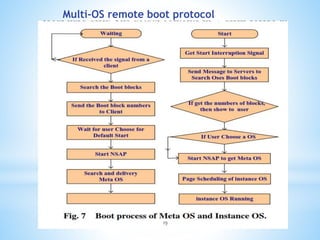
Multi-OS remote boot protocol
19
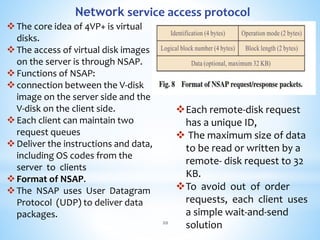
Network service access protocol
The core idea of 4VP+ is virtual
disks.
The access of virtual disk images
on the server is through NSAP.
Functions of NSAP:
connection between the V-disk
image on the server side and the
V-disk on the client side.
Each client can maintain two
request queues
Deliver the instructions and data,
including OS codes from the
server to clients
Format of NSAP.
The NSAP uses User Datagram
Protocol (UDP) to deliver data
packages.
Each remote-disk request
has a unique ID,
 The maximum size of data
to be read or written by a
remote- disk request to 32
KB.
To avoid out of order
requests, each client uses
a simple wait-and-send
solution20
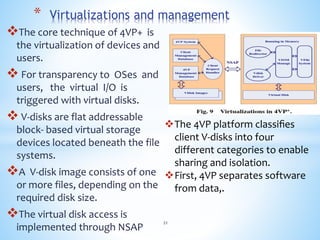
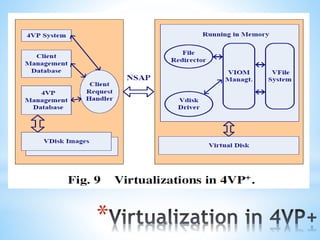
The core technique of 4VP+ is
the virtualization of devices and
users.
 For transparency to OSes and
users, the virtual I/O is
triggered with virtual disks.
 V-disks are flat addressable
block- based virtual storage
devices located beneath the file
systems.
A V-disk image consists of one
or more files, depending on the
required disk size.
The virtual disk access is
implemented through NSAP
* Virtualizations and management
The 4VP platform classifies
client V-disks into four
different categories to enable
sharing and isolation.
First, 4VP separates software
from data,.
21
* 22
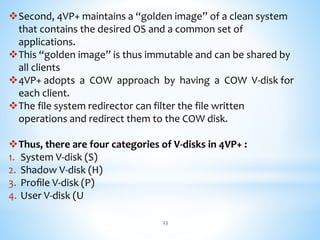
Second, 4VP+ maintains a “golden image” of a clean system
that contains the desired OS and a common set of
applications.
This “golden image” is thus immutable and can be shared by
all clients
4VP+ adopts a COW approach by having a COW V-disk for
each client.
The file system redirector can filter the file written
operations and redirect them to the COW disk.
Thus, there are four categories of V-disks in 4VP+ :
1. System V-disk (S)
2. Shadow V-disk (H)
3. Profile V-disk (P)
4. User V-disk (U
23
*24
*
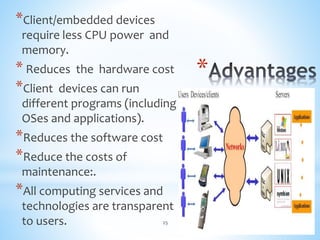
*Client/embedded devices
require less CPU power and
memory.
* Reduces the hardware cost
*Client devices can run
different programs (including
OSes and applications).
*Reduces the software cost
*Reduce the costs of
maintenance:.
*All computing services and
technologies are transparent
to users. 25
*
*This paper introduces transparent computing, which
spatio-temporally extends the von Neumann
architecture.
*stream programs, including operating systems and their
applications.
*Select and demand their desired services.
*Moreover, the system based on 4VP+ can achieve a
lower cost than before.
26
1. Zhang, Yaoxue, Zhou, Yuezhi.”Transparent computing:
Spatio-temporal extension on von Neumann
architecture for cloud services.” Tsinghua Science and
Technology (Volume: 18, Issue: 1) Page(s):10 - 21. Feb.
2013
2. T. Richardson, Q. Stafford-Fraser, K. R. Wood, and A.
Hopper, Virtual network computing, IEEE Internet
Computing, vol. 2, no. 1, pp. 33-38, 1998.
3. Google Docs, https://docs.google.com/, 2012.
*
27
*
28
Aswin G K
S7 COMPUTER SCIENCE AND ENGINEERING
Lourdes Matha College Of Science And Technology
Trivandrum
Under The Guidance Of:
Saranya B S
(Assistant Prof. Department of Information Technology)
*
29

TRANSPARENT COMPUTING A CLOUD SERVICE USING SPATIO-TEMPORAL EXTENSION ON VON NEUMANN ARCHITECTURE

  • 1.
    * TRANSPARENT COMPUTING ACLOUD SERVICE USING SPATIO-TEMPORAL EXTENSION ON VON NEUMANN ARCHITECTURE Presented By :ASWIN G K Department Of Computer Science Lourdes Matha College Of Science and Technology Trivandrum Under The Guidance Of Saranya B S (Assistant Prof. Department of Information Technology) 1
  • 2.
    • What IsCloud Computing? • Cloud Computing Services • Existing Von Neumann architecture. • The existing System • The Proposed system • What is Transparent Computing * 2
  • 3.
    *Cloud computing means storingand accessing data and programs over the Internet. * 3
  • 4.
    *  Infrastructure asa service (IaaS)  Platform as a service (PaaS)  Software as a service (SaaS) 4
  • 5.
    *Service Provider Provides TheInfrastructure. * 5
  • 6.
    *It is aset of software development tools hosted on the provider's infrastructure. * 6
  • 7.
  • 8.
    * Von Neumann architectureis composed of three distinct components (or sub-systems): a *central processing unit (CPU), * memory, and *input/output (I/O) interfaces. * 8
  • 9.
    * • The existingstored program concept the instructions and data are treated and stored in the same way in the storage devices. • This traditional way of storage with local devices is hard to provide personalized or active services to users. • The small, limited size embedded devices cannot hold all the needed programs. • Programs on the local storage need maintenance, fighting against malware, and other management jobs. 9
  • 10.
    * *Meta OS, tosupport Oses streaming through a distributed 4VP+ (4Layer 2 Protocols) platform. *Meeting user demands for any computing services in a trouble-free way in the right place at right time. * The essential idea is to spatio-temporally extend the traditional stored program concept. *Programs are stored on the central computers (servers) The programs are streamed computers (embedded devices or clients). 10
  • 11.
    * *A fundamental paradigmshift from traditional solutions *Some changes from traditional system: 1. System Architecture 2. Computing Model 3. Separate computing and storage: store program in server, execute program in client 4. Management 5. Centralization 11
  • 12.
  • 13.
    * • One computer(client)is responsible for computing . • The programs stored on another server streamed via the network. • The programs will be streamed back to the client in small streaming blocks on demand via the network, to be executed with the local resources, such as memory and CPU. How It Works.. 13
  • 14.
  • 15.
    *Meta OS:A super-OScontrol platform running beneath operating systems, but which can instantiate (startup, serve, and control) commodity OSes (Instance OSes) and their applications. 15
  • 16.
  • 17.
    Program Streaming Through4VP+ • The embodiment of Meta OS is through a • This 4VP+ software platform is mostly installed in a management server, except for a part of • The MRBP is used to boot bare clients remotely . • The V-user module is used to manage users. • The system has to authenticate them through a network authentication protocol, such as Kerberos 17
  • 18.
  • 19.
  • 20.
    Network service accessprotocol The core idea of 4VP+ is virtual disks. The access of virtual disk images on the server is through NSAP. Functions of NSAP: connection between the V-disk image on the server side and the V-disk on the client side. Each client can maintain two request queues Deliver the instructions and data, including OS codes from the server to clients Format of NSAP. The NSAP uses User Datagram Protocol (UDP) to deliver data packages. Each remote-disk request has a unique ID,  The maximum size of data to be read or written by a remote- disk request to 32 KB. To avoid out of order requests, each client uses a simple wait-and-send solution20
  • 21.
    The core techniqueof 4VP+ is the virtualization of devices and users.  For transparency to OSes and users, the virtual I/O is triggered with virtual disks.  V-disks are flat addressable block- based virtual storage devices located beneath the file systems. A V-disk image consists of one or more files, depending on the required disk size. The virtual disk access is implemented through NSAP * Virtualizations and management The 4VP platform classifies client V-disks into four different categories to enable sharing and isolation. First, 4VP separates software from data,. 21
  • 22.
  • 23.
    Second, 4VP+ maintainsa “golden image” of a clean system that contains the desired OS and a common set of applications. This “golden image” is thus immutable and can be shared by all clients 4VP+ adopts a COW approach by having a COW V-disk for each client. The file system redirector can filter the file written operations and redirect them to the COW disk. Thus, there are four categories of V-disks in 4VP+ : 1. System V-disk (S) 2. Shadow V-disk (H) 3. Profile V-disk (P) 4. User V-disk (U 23
  • 24.
  • 25.
    * *Client/embedded devices require lessCPU power and memory. * Reduces the hardware cost *Client devices can run different programs (including OSes and applications). *Reduces the software cost *Reduce the costs of maintenance:. *All computing services and technologies are transparent to users. 25
  • 26.
    * *This paper introducestransparent computing, which spatio-temporally extends the von Neumann architecture. *stream programs, including operating systems and their applications. *Select and demand their desired services. *Moreover, the system based on 4VP+ can achieve a lower cost than before. 26
  • 27.
    1. Zhang, Yaoxue,Zhou, Yuezhi.”Transparent computing: Spatio-temporal extension on von Neumann architecture for cloud services.” Tsinghua Science and Technology (Volume: 18, Issue: 1) Page(s):10 - 21. Feb. 2013 2. T. Richardson, Q. Stafford-Fraser, K. R. Wood, and A. Hopper, Virtual network computing, IEEE Internet Computing, vol. 2, no. 1, pp. 33-38, 1998. 3. Google Docs, https://docs.google.com/, 2012. * 27
  • 28.
  • 29.
    Aswin G K S7COMPUTER SCIENCE AND ENGINEERING Lourdes Matha College Of Science And Technology Trivandrum Under The Guidance Of: Saranya B S (Assistant Prof. Department of Information Technology) * 29