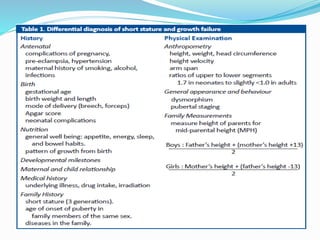
Growth disorders
By
Khaled Hamed Shalaby
Ass. lecturer of Internal Medicine
Faculty of Medicine
Tanta University
By Khaled Hamed Shalaby
SHORT STATURE
TALL STATURE
1-Approach to short
stature
Objectives
 Introduction.
 Evaluation .
 Management.
 GH deficiency.
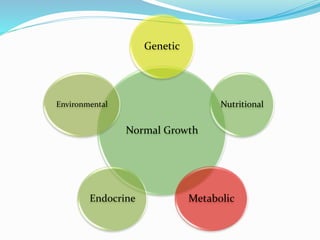
Normal Growth
Genetic
Nutritional
Metabolic
Endocrine
Environmental
Short stature /Growth failure
 height below 3rd percentile (-2SD for age
and gender)
• height significantly below genetic potentials
(-2SD below mid-parental target)
• abnormally slow growth velocity
• downwardly crossing percentile channels on
growth chart (> 18 months age)
NORMAL GROWTH VELOCITY
- prenatal growth : 1.2 -1.5 cm / week
- infancy : 23 - 28 cm / year
- childhood : 5 - 6.5 cm / year
- puberty : 8.3 cm / year (girls), 9.5 cm / year (boys)
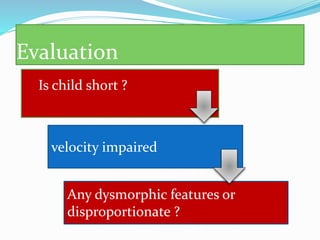
Evaluation
Is Is child short ?
child short ?
velocity impaired
Any dysmorphic features or
disproportionate ?
Is child short ?
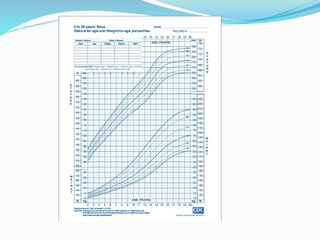
 Plotted on an appropriate growth chart.
 Length is measured lying down and
should be used for infants and children up
to 24 months of age .
 Height is measured standing and should
be used for children 2 years and above.
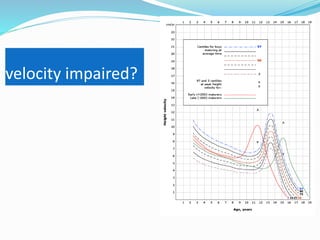
velocity impaired?
 Accurate height measurements performed at 6-month
intervals and plotted to the year and month of age on
the growth curve
 If the growth velocity is subnormal (below the 25th
percentile for age) without alternative physiological
explanations, the child should be thoroughly
investigated
velocity impaired?
causes
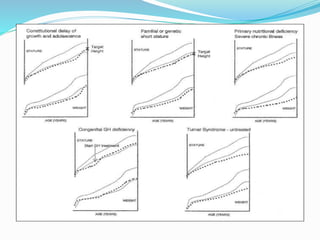
Familial short stature
Constitutional growth delay
Small for gestational age
Genetic syndromes
Down syndrome, Turner syndrome
Prader-Willi syndrome
Skeletal dysplasia
Achondroplasia, hypochondroplasia
Nonorganic aetiologies psychosocial deprivation
Causes cont.
Systemic diseases
Infectious
HIV, tuberculosis
Cardiac disease
Renal disease
Renal tubular acidosis
Chronic renal insufficiency
Gastrointestinal
Malabsorption ,celiac disease
cystic fibrosis
Inflammatory bowel disease
Chronic lung disease, bronchial asthma
Malignancy
Central nervous system disease
Causes cont.
Endocrinopathies
Hypothyroidism
Hypopituitarism
Isolated GH deficiency
Insensitivity (Laron syndrome)
Glucocorticoid excess
Cushing syndrome, exogenous steroids
precocious puberty
pseudohypoparathyroidism )Albright hereditary osteodystrophy (AHO)(
Pseudopseudohypoparathyroidism
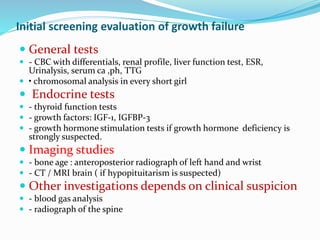
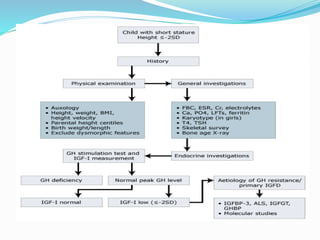
Initial screening evaluation of growth failure
 General tests
 - CBC with differentials, renal profile, liver function test, ESR,
Urinalysis, serum ca ,ph, TTG
 • chromosomal analysis in every short girl
 Endocrine tests
 - thyroid function tests
 - growth factors: IGF-1, IGFBP-3
 - growth hormone stimulation tests if growth hormone deficiency is
strongly suspected.
 Imaging studies
 - bone age : anteroposterior radiograph of left hand and wrist
 - CT / MRI brain ( if hypopituitarism is suspected)
 Other investigations depends on clinical suspicion
 - blood gas analysis
 - radiograph of the spine
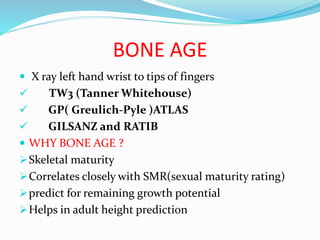
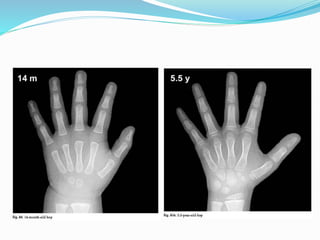
BONE AGE
 X ray left hand wrist to tips of fingers
 TW3 (Tanner Whitehouse)
 GP( Greulich-Pyle )ATLAS
 GILSANZ and RATIB
 WHY BONE AGE ?
Skeletal maturity
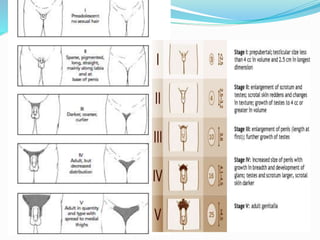
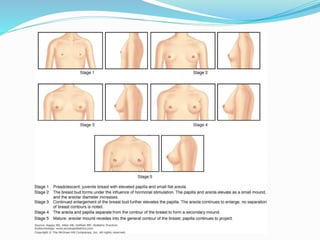
Correlates closely with SMR(sexual maturity rating)
predict for remaining growth potential
Helps in adult height prediction
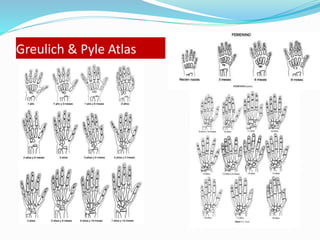
Greulich & Pyle Atlas
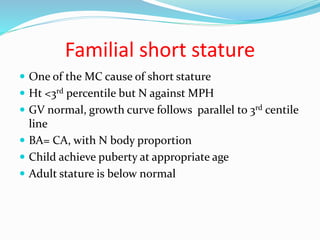
Familial short stature
 One of the MC cause of short stature
 Ht <3rd percentile but N against MPH
 GV normal, growth curve follows parallel to 3rd centile
line
 BA= CA, with N body proportion
 Child achieve puberty at appropriate age
 Adult stature is below normal
Constitutional delay of growth and
puberty (CDGP)
 More frequently encountered in boys
 Born with normal weight and length
 Grow normally in the 1st year, decelerates during 2nd -
3rd year to reach just below 3rd percentile
 Continue to grow parallel to 3rd percentile with normal
GV throughout the childhood
 Puberty delayed with growth spurt delayed and
attenuated
 BA< CA
 H/O delayed puberty in either parent often
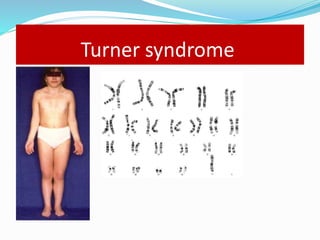
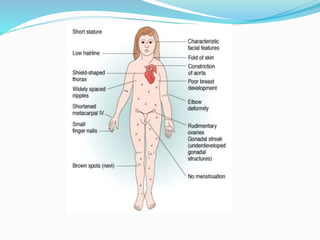
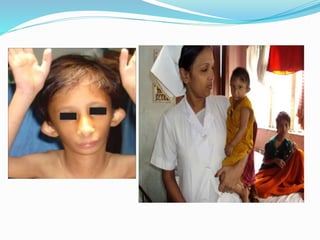
Turner syndrome
seckel syndrome
 Inheritance is autosomal recessive
 Caused by defects of genes on chromosome 3 and 18
 Mental retardation (more than half of the patients have an IQ below
50)
 Microcephaly
 Sometimes pancytopenia
 Cryptorchidism
 Low birth weight
 Dislocations of pelvis and elbow
 Unusually large eyes
 Low ears
 Small chin
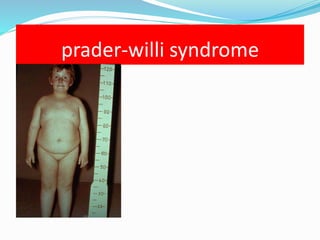
prader-willi syndrome
Presentation
 genetic disorder in which seven genes (or some subset thereof)
on chromosome 15 (q 11–13) are deleted or unexpressed
 Cryptorchidism
 Speech delay
 Poor physical coordination
 Hyperphagia (over-eating
 Excessive weight gain
 Sleep disorders
 Delayed puberty
 Short stature
 Obesity
 Extreme flexibility
 Infertility (males and females)
 Hypogonadism
 Sparse pubic hair
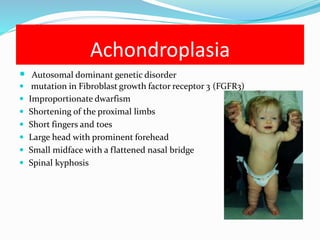
Achondroplasia
 Autosomal dominant genetic disorder
 mutation in Fibroblast growth factor receptor 3 (FGFR3)
 Improportionate dwarfism
 Shortening of the proximal limbs
 Short fingers and toes
 Large head with prominent forehead
 Small midface with a flattened nasal bridge
 Spinal kyphosis
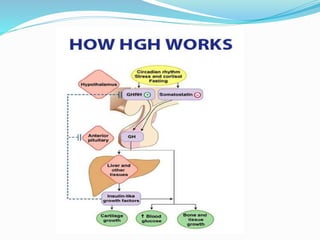
Growth Hormone
Deficiency
GHD
Growth hormone deficiency
epidemiology
 The incidence :about 1:4000 to 1:10000
 3 to 30 percent of children with growth hormone
deficiency (GHD) have an affected parent, sibling, or
child.
Aetiology
idiopathic
congenital acquired
congenital
 The first pattern is related to perinatal asphyxia e.g a
history of perinatal distress, breech delivery, cesarean
section, and low Apgar scores.

 The second pattern of GHD presenting in infancy is
associated with early prenatal embryologic
malformations, including central nervous system
(CNS) malformations (eg, septo-optic dysplasia),
midface abnormalities (eg, coloboma of the eye,
midface hypoplasia, cleft palate and lip, median cleft
face, and single central incisors),and in males,
micropenis.
 Mutations: Prop-1 . POU1F1 . Pit-1

acquired
 most commonly Idiopathic
 Head trauma
 Tumor
 Inflammatory (Histiocytosis X, autoimmune)
 CNS radiation
 Surgical damage to the pituitary and hypothalamus
CLINICAL PRESENTATION
 The single most important clinical manifestation of
GHD is growth failure.
 Congenital :
 Breech presentation and perinatal asphyxia.
 Hypoglycemia and prolonged jaundice.
 The penis may be small.
 Higher male : female ratio 3 : 1.
CLINICAL PRESENTATION
Acquired :
 severe growth failure.
 increase weight
Investigation
 Insulin-like growth factor-1 (IGF-I)
 Insulin-like growth factor binding protein-3 (IGFBP-3)
 provocative growth hormone (GH) testing
 MRI
GH stimulation test
 insulin, arginine, clonidine , glucagon.
 GH peak after stimulation < 10 ng/ml
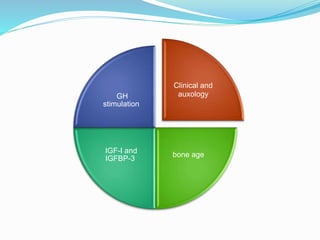
Clinical and
auxology
bone age
IGF-I and
IGFBP-3
GH
stimulation
Management
 treat underlying cause.
 psychological support for non-treatable causes.
Indications For GH Treatment
 Paediatric GH deficiency.
• Turner syndrome.
• Small for gestational age.
• Chronic renal insufficiency.
• Idiopathic short stature.
• Prader–Willi syndrome .
• AIDS cachexia
GH treatment
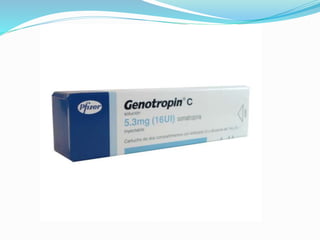
 GH dose: 0.025 - 0.05 mg/kg/day(0.5 - 1.0
units/kg/wk) at night SC.
 GH treatment should start with low doses and be
titrated according to clinical response, side effects,
and growth factor levels
 patients should be monitored at 3-month intervals
When to stop
 Continue treatment till child reaches near final height.
 Height velocity of < 2cm / year over at least 9 months .
 Bone age >13 years in girls and >14 years in boys
Complications
• increased intracranial pressure.
• SCFE.
• Impaired GTT.
• joint pain, muscle pain.
• carpal tunnel syndrome.
• Pancreatitis.
• Scoliosis.
• Increased risk of recurrence of neoplasim
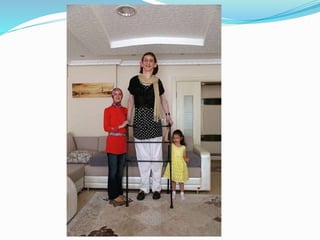
Tall Stature
Height greater than two standard deviations above
the mean for a population same sex, age, and race.‘
 Height > 2 SD
Etiology
 Genetic
– Familial tall stature
– Familial rapid maturation( constitutional tall stature)
 • Hormonal
– GH excess
– Hyperthyroid
– Androgen/estrogen excess
 • Syndromes
– Weaver, Sotos, Marfan, Kleinefelter
 • Metabolic disorders
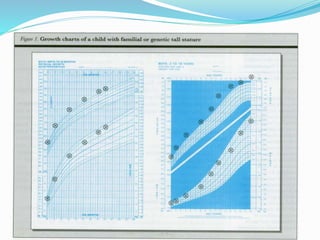
Familial or genetic tall stature
 most common cause of tall stature.
 These children are usually tall from early childhood
and have tall parents.
 Genetically tall children have a high normal growth
rate, normal results from physical examination, and a
bone age that is compatible with chronologic age.
 Comparing the growth of the patient and the parents
on a growth chart reveals that the tall stature is
appropriate for that family.
Constitutional tall stature.
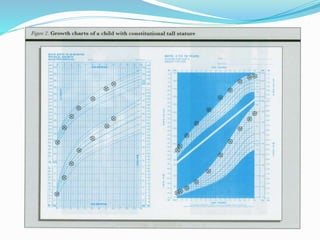
 Is the second most common cause of tall stature.
 They have a normal length at birth. The growth velocity
accelerates in early childhood, and the tall stature is usually
evident by the age of 3 to 4 years Growth velocity slows
down after the child reaches 4 or 5 years; thereafter the
growth curve is parallel to and above the normal curve.
 slightly or moderately advanced bone age.
 Puberty usually develops in the early range of normal, and
final adult height is in the upper range of normal.
 There is usually a family history of a similar growth pattern
Precocious puberty.
 Acceleration of linear growth invariably occurs
simultaneously with signs of premature sexual
development or inappropriate virilization.
 Osseous maturation(BA) that is greater than expected
for the chronologic age.
 The ultimate height is less than it would have been
otherwise due to early epiphyseal closure.
Pituitary growth hormone excess.
 Growth hormone-producing or null cell adenoma of
the pituitary gland Before the epiphyses close.
 Bone age is often advanced.
Marfan's syndrome.
 Autosomal dominant trait.
 Arachnodactyly, tall stature, superior lens subluxation
or dislocation, and aortic or mitral regurgitation.“
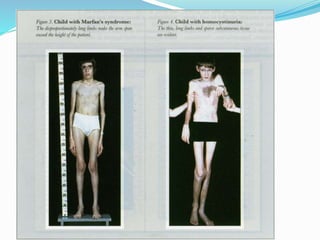
 The arm span is greater than height, and the
 Upper to lower body segment ratio is diminished
 joint hyperextension,
 Inguinal or femoral hernia, pectus excavatum, scoliosis,
megalocornea, and myopia." Retinal detachment
 Aortic aneurysm and rupture
Homocystinuna.
 Autosomal recessive disorder caused by a deficiency of
cystathionine P-synthase with resultant excretion of
large amounts of homocystine in urine
 Phenotypic appearance similar to those with Marfan's
syndrome
 Mental retardation, malar flush,
 Inferior lens subluxation or dislocation,
 Increased incidence of seizures,
 Arterial and venous thrombosis, osteoporosis,
vertebral collapse
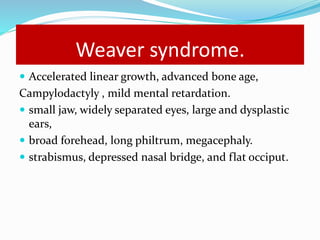
Weaver syndrome.
 Accelerated linear growth, advanced bone age,
Campylodactyly , mild mental retardation.
 small jaw, widely separated eyes, large and dysplastic
ears,
 broad forehead, long philtrum, megacephaly.
 strabismus, depressed nasal bridge, and flat occiput.
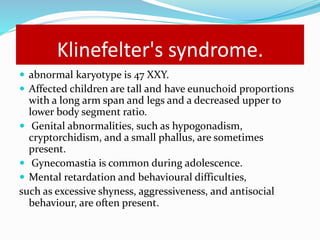
Klinefelter's syndrome.
 abnormal karyotype is 47 XXY.
 Affected children are tall and have eunuchoid proportions
with a long arm span and legs and a decreased upper to
lower body segment ratio.
 Genital abnormalities, such as hypogonadism,
cryptorchidism, and a small phallus, are sometimes
present.
 Gynecomastia is common during adolescence.
 Mental retardation and behavioural difficulties,
such as excessive shyness, aggressiveness, and antisocial
behaviour, are often present.
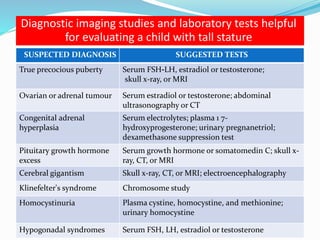
Diagnostic imaging studies and laboratory tests helpful
for evaluating a child with tall stature
SUGGESTED TESTS
SUSPECTED DIAGNOSIS
Serum FSH-LH, estradiol or testosterone;
skull x-ray, or MRI
True precocious puberty
Serum estradiol or testosterone; abdominal
ultrasonography or CT
Ovarian or adrenal tumour
Serum electrolytes; plasma 1 7-
hydroxyprogesterone; urinary pregnanetriol;
dexamethasone suppression test
Congenital adrenal
hyperplasia
Serum growth hormone or somatomedin C; skull x-
ray, CT, or MRI
Pituitary growth hormone
excess
Skull x-ray, CT, or MRI; electroencephalography
Cerebral gigantism
Chromosome study
Klinefelter's syndrome
Plasma cystine, homocystine, and methionine;
urinary homocystine
Homocystinuria
Serum FSH, LH, estradiol or testosterone
Hypogonadal syndromes
growthdisorders-141014114149-conversion-gate02.pdf

growthdisorders-141014114149-conversion-gate02.pdf

  • 1.
    Growth disorders By Khaled HamedShalaby Ass. lecturer of Internal Medicine Faculty of Medicine Tanta University
  • 3.
  • 4.
  • 5.
  • 6.
    Objectives  Introduction.  Evaluation.  Management.  GH deficiency.
  • 7.
  • 8.
    Short stature /Growthfailure  height below 3rd percentile (-2SD for age and gender) • height significantly below genetic potentials (-2SD below mid-parental target) • abnormally slow growth velocity • downwardly crossing percentile channels on growth chart (> 18 months age)
  • 10.
    NORMAL GROWTH VELOCITY -prenatal growth : 1.2 -1.5 cm / week - infancy : 23 - 28 cm / year - childhood : 5 - 6.5 cm / year - puberty : 8.3 cm / year (girls), 9.5 cm / year (boys)
  • 11.
    Evaluation Is Is childshort ? child short ? velocity impaired Any dysmorphic features or disproportionate ?
  • 12.
    Is child short?  Plotted on an appropriate growth chart.  Length is measured lying down and should be used for infants and children up to 24 months of age .  Height is measured standing and should be used for children 2 years and above.
  • 15.
    velocity impaired?  Accurateheight measurements performed at 6-month intervals and plotted to the year and month of age on the growth curve  If the growth velocity is subnormal (below the 25th percentile for age) without alternative physiological explanations, the child should be thoroughly investigated
  • 16.
  • 17.
    causes Familial short stature Constitutionalgrowth delay Small for gestational age Genetic syndromes Down syndrome, Turner syndrome Prader-Willi syndrome Skeletal dysplasia Achondroplasia, hypochondroplasia Nonorganic aetiologies psychosocial deprivation
  • 18.
    Causes cont. Systemic diseases Infectious HIV,tuberculosis Cardiac disease Renal disease Renal tubular acidosis Chronic renal insufficiency Gastrointestinal Malabsorption ,celiac disease cystic fibrosis Inflammatory bowel disease Chronic lung disease, bronchial asthma Malignancy Central nervous system disease
  • 19.
    Causes cont. Endocrinopathies Hypothyroidism Hypopituitarism Isolated GHdeficiency Insensitivity (Laron syndrome) Glucocorticoid excess Cushing syndrome, exogenous steroids precocious puberty pseudohypoparathyroidism )Albright hereditary osteodystrophy (AHO)( Pseudopseudohypoparathyroidism
  • 22.
    Initial screening evaluationof growth failure  General tests  - CBC with differentials, renal profile, liver function test, ESR, Urinalysis, serum ca ,ph, TTG  • chromosomal analysis in every short girl  Endocrine tests  - thyroid function tests  - growth factors: IGF-1, IGFBP-3  - growth hormone stimulation tests if growth hormone deficiency is strongly suspected.  Imaging studies  - bone age : anteroposterior radiograph of left hand and wrist  - CT / MRI brain ( if hypopituitarism is suspected)  Other investigations depends on clinical suspicion  - blood gas analysis  - radiograph of the spine
  • 23.
    BONE AGE  Xray left hand wrist to tips of fingers  TW3 (Tanner Whitehouse)  GP( Greulich-Pyle )ATLAS  GILSANZ and RATIB  WHY BONE AGE ? Skeletal maturity Correlates closely with SMR(sexual maturity rating) predict for remaining growth potential Helps in adult height prediction
  • 24.
  • 28.
    Familial short stature One of the MC cause of short stature  Ht <3rd percentile but N against MPH  GV normal, growth curve follows parallel to 3rd centile line  BA= CA, with N body proportion  Child achieve puberty at appropriate age  Adult stature is below normal
  • 29.
    Constitutional delay ofgrowth and puberty (CDGP)  More frequently encountered in boys  Born with normal weight and length  Grow normally in the 1st year, decelerates during 2nd - 3rd year to reach just below 3rd percentile  Continue to grow parallel to 3rd percentile with normal GV throughout the childhood  Puberty delayed with growth spurt delayed and attenuated  BA< CA  H/O delayed puberty in either parent often
  • 30.
  • 32.
    seckel syndrome  Inheritanceis autosomal recessive  Caused by defects of genes on chromosome 3 and 18  Mental retardation (more than half of the patients have an IQ below 50)  Microcephaly  Sometimes pancytopenia  Cryptorchidism  Low birth weight  Dislocations of pelvis and elbow  Unusually large eyes  Low ears  Small chin
  • 34.
  • 35.
    Presentation  genetic disorderin which seven genes (or some subset thereof) on chromosome 15 (q 11–13) are deleted or unexpressed  Cryptorchidism  Speech delay  Poor physical coordination  Hyperphagia (over-eating  Excessive weight gain  Sleep disorders  Delayed puberty  Short stature  Obesity  Extreme flexibility  Infertility (males and females)  Hypogonadism  Sparse pubic hair
  • 36.
    Achondroplasia  Autosomal dominantgenetic disorder  mutation in Fibroblast growth factor receptor 3 (FGFR3)  Improportionate dwarfism  Shortening of the proximal limbs  Short fingers and toes  Large head with prominent forehead  Small midface with a flattened nasal bridge  Spinal kyphosis
  • 37.
  • 38.
    Growth hormone deficiency epidemiology The incidence :about 1:4000 to 1:10000  3 to 30 percent of children with growth hormone deficiency (GHD) have an affected parent, sibling, or child.
  • 39.
  • 40.
    congenital  The firstpattern is related to perinatal asphyxia e.g a history of perinatal distress, breech delivery, cesarean section, and low Apgar scores.  The second pattern of GHD presenting in infancy is associated with early prenatal embryologic malformations, including central nervous system (CNS) malformations (eg, septo-optic dysplasia), midface abnormalities (eg, coloboma of the eye, midface hypoplasia, cleft palate and lip, median cleft face, and single central incisors),and in males, micropenis.  Mutations: Prop-1 . POU1F1 . Pit-1
  • 41.
    acquired  most commonlyIdiopathic  Head trauma  Tumor  Inflammatory (Histiocytosis X, autoimmune)  CNS radiation  Surgical damage to the pituitary and hypothalamus
  • 42.
    CLINICAL PRESENTATION  Thesingle most important clinical manifestation of GHD is growth failure.  Congenital :  Breech presentation and perinatal asphyxia.  Hypoglycemia and prolonged jaundice.  The penis may be small.  Higher male : female ratio 3 : 1.
  • 43.
    CLINICAL PRESENTATION Acquired : severe growth failure.  increase weight
  • 44.
    Investigation  Insulin-like growthfactor-1 (IGF-I)  Insulin-like growth factor binding protein-3 (IGFBP-3)  provocative growth hormone (GH) testing  MRI
  • 45.
    GH stimulation test insulin, arginine, clonidine , glucagon.  GH peak after stimulation < 10 ng/ml
  • 46.
    Clinical and auxology bone age IGF-Iand IGFBP-3 GH stimulation
  • 47.
    Management  treat underlyingcause.  psychological support for non-treatable causes.
  • 48.
    Indications For GHTreatment  Paediatric GH deficiency. • Turner syndrome. • Small for gestational age. • Chronic renal insufficiency. • Idiopathic short stature. • Prader–Willi syndrome . • AIDS cachexia
  • 49.
    GH treatment  GHdose: 0.025 - 0.05 mg/kg/day(0.5 - 1.0 units/kg/wk) at night SC.  GH treatment should start with low doses and be titrated according to clinical response, side effects, and growth factor levels  patients should be monitored at 3-month intervals
  • 50.
    When to stop Continue treatment till child reaches near final height.  Height velocity of < 2cm / year over at least 9 months .  Bone age >13 years in girls and >14 years in boys
  • 51.
    Complications • increased intracranialpressure. • SCFE. • Impaired GTT. • joint pain, muscle pain. • carpal tunnel syndrome. • Pancreatitis. • Scoliosis. • Increased risk of recurrence of neoplasim
  • 57.
    Tall Stature Height greaterthan two standard deviations above the mean for a population same sex, age, and race.‘  Height > 2 SD
  • 58.
    Etiology  Genetic – Familialtall stature – Familial rapid maturation( constitutional tall stature)  • Hormonal – GH excess – Hyperthyroid – Androgen/estrogen excess  • Syndromes – Weaver, Sotos, Marfan, Kleinefelter  • Metabolic disorders
  • 59.
    Familial or genetictall stature  most common cause of tall stature.  These children are usually tall from early childhood and have tall parents.  Genetically tall children have a high normal growth rate, normal results from physical examination, and a bone age that is compatible with chronologic age.  Comparing the growth of the patient and the parents on a growth chart reveals that the tall stature is appropriate for that family.
  • 61.
    Constitutional tall stature. Is the second most common cause of tall stature.  They have a normal length at birth. The growth velocity accelerates in early childhood, and the tall stature is usually evident by the age of 3 to 4 years Growth velocity slows down after the child reaches 4 or 5 years; thereafter the growth curve is parallel to and above the normal curve.  slightly or moderately advanced bone age.  Puberty usually develops in the early range of normal, and final adult height is in the upper range of normal.  There is usually a family history of a similar growth pattern
  • 63.
    Precocious puberty.  Accelerationof linear growth invariably occurs simultaneously with signs of premature sexual development or inappropriate virilization.  Osseous maturation(BA) that is greater than expected for the chronologic age.  The ultimate height is less than it would have been otherwise due to early epiphyseal closure.
  • 64.
    Pituitary growth hormoneexcess.  Growth hormone-producing or null cell adenoma of the pituitary gland Before the epiphyses close.  Bone age is often advanced.
  • 65.
    Marfan's syndrome.  Autosomaldominant trait.  Arachnodactyly, tall stature, superior lens subluxation or dislocation, and aortic or mitral regurgitation.“  The arm span is greater than height, and the  Upper to lower body segment ratio is diminished  joint hyperextension,  Inguinal or femoral hernia, pectus excavatum, scoliosis, megalocornea, and myopia." Retinal detachment  Aortic aneurysm and rupture
  • 66.
    Homocystinuna.  Autosomal recessivedisorder caused by a deficiency of cystathionine P-synthase with resultant excretion of large amounts of homocystine in urine  Phenotypic appearance similar to those with Marfan's syndrome  Mental retardation, malar flush,  Inferior lens subluxation or dislocation,  Increased incidence of seizures,  Arterial and venous thrombosis, osteoporosis, vertebral collapse
  • 68.
    Weaver syndrome.  Acceleratedlinear growth, advanced bone age, Campylodactyly , mild mental retardation.  small jaw, widely separated eyes, large and dysplastic ears,  broad forehead, long philtrum, megacephaly.  strabismus, depressed nasal bridge, and flat occiput.
  • 70.
    Klinefelter's syndrome.  abnormalkaryotype is 47 XXY.  Affected children are tall and have eunuchoid proportions with a long arm span and legs and a decreased upper to lower body segment ratio.  Genital abnormalities, such as hypogonadism, cryptorchidism, and a small phallus, are sometimes present.  Gynecomastia is common during adolescence.  Mental retardation and behavioural difficulties, such as excessive shyness, aggressiveness, and antisocial behaviour, are often present.
  • 71.
    Diagnostic imaging studiesand laboratory tests helpful for evaluating a child with tall stature SUGGESTED TESTS SUSPECTED DIAGNOSIS Serum FSH-LH, estradiol or testosterone; skull x-ray, or MRI True precocious puberty Serum estradiol or testosterone; abdominal ultrasonography or CT Ovarian or adrenal tumour Serum electrolytes; plasma 1 7- hydroxyprogesterone; urinary pregnanetriol; dexamethasone suppression test Congenital adrenal hyperplasia Serum growth hormone or somatomedin C; skull x- ray, CT, or MRI Pituitary growth hormone excess Skull x-ray, CT, or MRI; electroencephalography Cerebral gigantism Chromosome study Klinefelter's syndrome Plasma cystine, homocystine, and methionine; urinary homocystine Homocystinuria Serum FSH, LH, estradiol or testosterone Hypogonadal syndromes