Akshai George Paul
MID PARENTAL HEIGHT
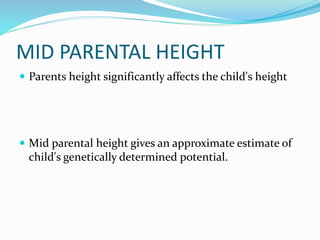
 Parents height significantly affects the child's height
 Mid parental height gives an approximate estimate of
child's genetically determined potential.
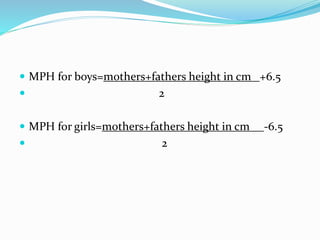
 MPH for boys=mothers+fathers height in cm +6.5
 2
 MPH for girls=mothers+fathers height in cm -6.5
 2
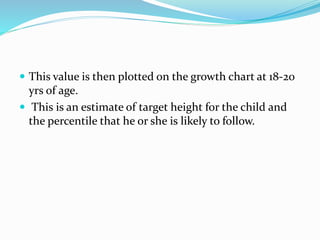
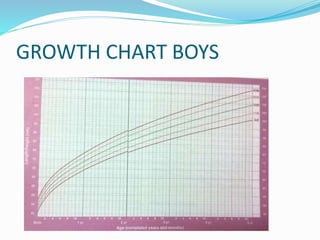
 This value is then plotted on the growth chart at 18-20
yrs of age.
 This is an estimate of target height for the child and
the percentile that he or she is likely to follow.
GROWTH CHART BOYS
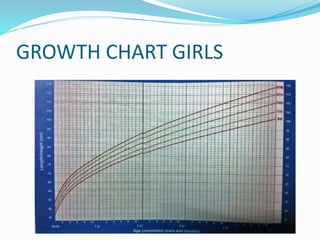
GROWTH CHART GIRLS
INVESTIGATIONS
Laboratory evaluation of short stature involves
step wise application of diagnostic tests to determine
the etiology
STEP 1
☺The first step in investigation is to rule out
common causes.
☺This involves exclusion of
malnutrition,chronic systemic illness
and recurrent infection
☺It is by using complete blood counts,erythrocyte
sedimentation rate,chest x ray,serum electrolyte and
liver and renal function tests.
☺Tissue transglutaminase antibody (coeliac disease)
and venous blood (renal tubular acidosis) should be
performed if the screening tests are normal.
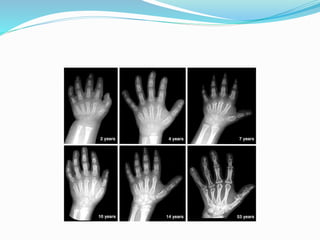
☺Estimation of skeltal maturation forms an important
aspect of evaluaton of short stature.
☺This is done by comparing the X ray of left wrist with
age specific norm.
STEP 2
The next step in evaluation involves evaluation for
hypothyroidsm (free T4 and TSH) and Turners
syndrome (karyotype) in all girls.
STEP 3
☺ Evaluation for GH-IGF axis is performed only after
other common causes of growth retardation have been
excluded.
☺This is important as systemic illness and
hypothyroidsm influence the GH-insulin like growth
factor axis.
☺Random or fasting blood GH level measurements
donot confirm the diagnosis of GHD as hormone
secretion is pulsatile.
☺The diagnosis of GHD thus requires pharmacological
stimulation tests
 GHD is suspected when peak level of GH is <10 ng/ml
following stimulation.
 The common provocative agents used are
insulin,glucagon and clonidine.
 Levels of IGF-1 and IGF binding protein 3 are helpful
to diagnose GHD and Laron syndrome.
😊 GHD may be associated with other pituitary hormone
deficiencies and appropriate investigations should be
carried out to detect deficiencies of these hormones if
GHD present.
😊 CT or MRI scan of hypothalamic and pituitary regions
are essential to rule out developmental or neurological
diseases
MANAGEMENT
GENERAL MEASURES
😊 Patient should be advised in diet rich in protein and
calorie content.
😊The should be encouraged to increse their physical
activity.iron and vitamin deficiencies should be
corrected.
😊Zinc supplimentation(10 mg/day for 3 to 6 months)
may help in improving growth in patient with
idiopathic short stature.
SPECIFIC THERAPY
Initiation of specific treatment is effective in
restoring growth in hypothyroidism(thyroxine),celiac
disease(gluten free diet)and renal tubular
acidosis(bicarbonate suppliment).
 A short course of testosterone may be given to boys
with constitutional delay of puberty and growth.
 Treatment of genetic syndrome and skeletal dysplasia
is extremely difficult. Some of them do not respond to
GH therapy.
 Bone lengthening(illizaro technique)has been used
with variable success in some forms of skeletal
dysplasia
GROWTH HORMONE
🙂GH is highly effective in patients with GHD. This can
result in a increase in hight by 20 to 30cms.
🙂The treatment given as daily night time injection (25 -
50 micro gram /kg/day) till epiphyseal closure.
🙂 The treatment is expensive and hence should be
started only if it can be given regularly for atleast 2
years.
The role of GH is expanding with increase in use in
turner’s syndrome,chronic renal failure,small for
gestational age infants who failed to catch up,russel
silverman syndrome,prader willi syndrome and
idiopathic short stature
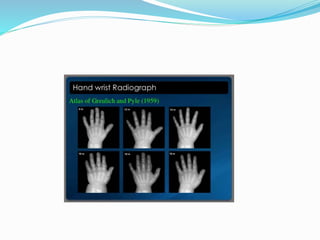
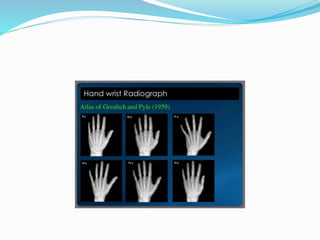
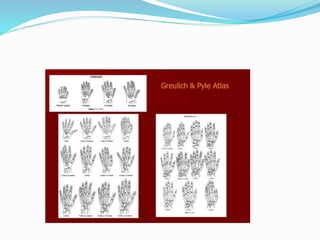
GREULICH AND PYLE CHART
 These are one of the most widely accepted method of
skeltal age determination
Underlying the construction of the Greulich and
Pyle atlas are the assumptionsthat,in healthy
children,skeletal maturation is uniform,that all
bones have an identical skeletal age, and that the
appearance and subsequent development of body
centers follow a fixed pattern.
However,considerable
evidence suggests that a wide
range of normal variation
exists in the pattern of
ossification of the different
bones of the hand and the
wrist and that this variation is
genetically determined.
Short stature agp
Short stature agp
Short stature agp
Short stature agp
Short stature agp

Short stature agp

  • 1.
  • 2.
    MID PARENTAL HEIGHT Parents height significantly affects the child's height  Mid parental height gives an approximate estimate of child's genetically determined potential.
  • 3.
     MPH forboys=mothers+fathers height in cm +6.5  2  MPH for girls=mothers+fathers height in cm -6.5  2
  • 4.
     This valueis then plotted on the growth chart at 18-20 yrs of age.  This is an estimate of target height for the child and the percentile that he or she is likely to follow.
  • 5.
  • 6.
  • 7.
    INVESTIGATIONS Laboratory evaluation ofshort stature involves step wise application of diagnostic tests to determine the etiology
  • 8.
    STEP 1 ☺The firststep in investigation is to rule out common causes. ☺This involves exclusion of malnutrition,chronic systemic illness and recurrent infection
  • 9.
    ☺It is byusing complete blood counts,erythrocyte sedimentation rate,chest x ray,serum electrolyte and liver and renal function tests. ☺Tissue transglutaminase antibody (coeliac disease) and venous blood (renal tubular acidosis) should be performed if the screening tests are normal.
  • 10.
    ☺Estimation of skeltalmaturation forms an important aspect of evaluaton of short stature. ☺This is done by comparing the X ray of left wrist with age specific norm.
  • 11.
    STEP 2 The nextstep in evaluation involves evaluation for hypothyroidsm (free T4 and TSH) and Turners syndrome (karyotype) in all girls.
  • 12.
    STEP 3 ☺ Evaluationfor GH-IGF axis is performed only after other common causes of growth retardation have been excluded. ☺This is important as systemic illness and hypothyroidsm influence the GH-insulin like growth factor axis.
  • 13.
    ☺Random or fastingblood GH level measurements donot confirm the diagnosis of GHD as hormone secretion is pulsatile. ☺The diagnosis of GHD thus requires pharmacological stimulation tests
  • 14.
     GHD issuspected when peak level of GH is <10 ng/ml following stimulation.  The common provocative agents used are insulin,glucagon and clonidine.  Levels of IGF-1 and IGF binding protein 3 are helpful to diagnose GHD and Laron syndrome.
  • 15.
    😊 GHD maybe associated with other pituitary hormone deficiencies and appropriate investigations should be carried out to detect deficiencies of these hormones if GHD present. 😊 CT or MRI scan of hypothalamic and pituitary regions are essential to rule out developmental or neurological diseases
  • 16.
    MANAGEMENT GENERAL MEASURES 😊 Patientshould be advised in diet rich in protein and calorie content. 😊The should be encouraged to increse their physical activity.iron and vitamin deficiencies should be corrected. 😊Zinc supplimentation(10 mg/day for 3 to 6 months) may help in improving growth in patient with idiopathic short stature.
  • 17.
    SPECIFIC THERAPY Initiation ofspecific treatment is effective in restoring growth in hypothyroidism(thyroxine),celiac disease(gluten free diet)and renal tubular acidosis(bicarbonate suppliment).
  • 18.
     A shortcourse of testosterone may be given to boys with constitutional delay of puberty and growth.  Treatment of genetic syndrome and skeletal dysplasia is extremely difficult. Some of them do not respond to GH therapy.  Bone lengthening(illizaro technique)has been used with variable success in some forms of skeletal dysplasia
  • 19.
    GROWTH HORMONE 🙂GH ishighly effective in patients with GHD. This can result in a increase in hight by 20 to 30cms. 🙂The treatment given as daily night time injection (25 - 50 micro gram /kg/day) till epiphyseal closure. 🙂 The treatment is expensive and hence should be started only if it can be given regularly for atleast 2 years.
  • 20.
    The role ofGH is expanding with increase in use in turner’s syndrome,chronic renal failure,small for gestational age infants who failed to catch up,russel silverman syndrome,prader willi syndrome and idiopathic short stature
  • 21.
    GREULICH AND PYLECHART  These are one of the most widely accepted method of skeltal age determination Underlying the construction of the Greulich and Pyle atlas are the assumptionsthat,in healthy children,skeletal maturation is uniform,that all bones have an identical skeletal age, and that the appearance and subsequent development of body centers follow a fixed pattern.
  • 22.
    However,considerable evidence suggests thata wide range of normal variation exists in the pattern of ossification of the different bones of the hand and the wrist and that this variation is genetically determined.