Journal club
Yassin M. Al-saleh
Dr.Sumahya Al-hajjaj
‫بسم ا الرحمن الرحيم‬

‫)انما يخشى‬
‫ا من عباده‬
‫العلماء(‬
INTRODUCTION
• Hypoxic-ischemic encephalopathy (HIE)
occurs in 3 to 5 cases per 100 deliveries.
• remains an important cause of neonatal
death and long-term neurologic disability.
INTRODUCTION
• Interventions, including induced
hypothermia, may limit secondary cerebral
damage.
• To offer effective hypothermia, clinicians
need to establish the infant’s prognosis
within 6 hours after birth.
INTRODUCTION
• Electroencephalographic (EEG)
abnormalities can be used to aid outcome
prediction for infants with HIE.
Objectives
• Our aim was to collect detailed, early,
continuous, video-EEG data for a well
defined group of infants with HIE.
• We wished to determine which of the early
EEG features would best predict neurologic
outcomes at 24 months of age.
METHODOLOGY
• Study Design:
• The prospective study was conducted in a
large maternity service with 6000 deliveries
per year.
• Between May 2003 and May 2005
METHODOLOGY
• term infants (37weeks of gestation) with
HIE were recruited if they fulfilled 2 of the
following criteria:
• initial capillary or arterial pH of 7.1.
• Apgar score at 5 minutes of 5.
• initial capillary or arterial lactate level of 7
mmol/L.
• abnormal neurologic features/clinical
seizures.
METHODOLOGY
• After recruitment, EEG electrodes were
applied to the scalp.
• Recordings were commenced as soon as
possible after birth, generally within 6
hours.
METHODOLOGY
• Developmental follow-up assessments were
performed at 6, 12, and 24 months using the
Revised Griffiths Scales of Mental
Development.
• Abnormal outcome was defined as death,
cerebral palsy, or a Griffiths quotient (GQ)
of 87.
METHODOLOGY
EEG Analyses:
• The evolution of EEG findings was examined
including:
• background.Amplitude.
• presence of discontinuity,
• length of EEG activity burst . Interburst interval.
• return of sleep-wake cycling (SWC).
• presence or absence of seizures.
• EEG segments that were 1 hour in length and free
of visual artifacts were chosen at 6, 12, 24, and 48
hours of age for each infant
METHODOLOGY
• All patient identifiers were removed.
• The segments were stored as separate files
and then were visually analyzed separately
by a neurophysiologist .
METHODOLOGY
• Clinicians were blinded to all EEG data,
and antiepileptic medications were
administered if seizures were suspected
clinically.
METHODOLOGY
Statistical Analyses
• Means and SDs were calculated for
demographic factors.
• The predictive ability of EEG grades was
by using:
• positive predictive value (PPV).
• Negative predictive value (NPV).
• Statistical significance was taken as P .05.
RESULTS
Study Group
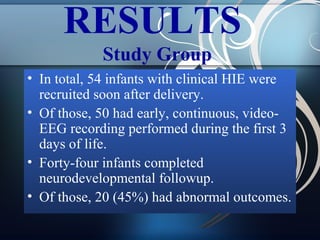
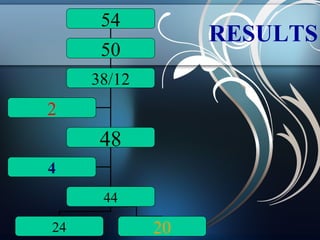
• In total, 54 infants with clinical HIE were
recruited soon after delivery.
• Of those, 50 had early, continuous, videoEEG recording performed during the first 3
days of life.
• Forty-four infants completed
neurodevelopmental followup.
• Of those, 20 (45%) had abnormal outcomes.
54

RESULTS

50
38/12

2

48
4
44
24

20
RESULTS
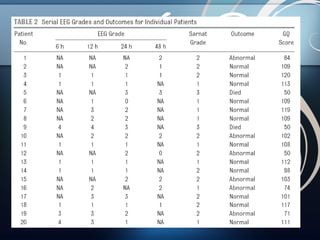
EEG Grades
• At 24hours, the number of infants assigned to each
grade was as follows: normal,6; mild, 11;
moderate, 9; severe, 9; isoelectric,3.
EEG Grades and Prediction of
Outcomes
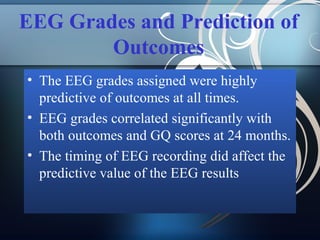
• The EEG grades assigned were highly
predictive of outcomes at all times.
• EEG grades correlated significantly with
both outcomes and GQ scores at 24 months.
• The timing of EEG recording did affect the
predictive value of the EEG results
RESULTS
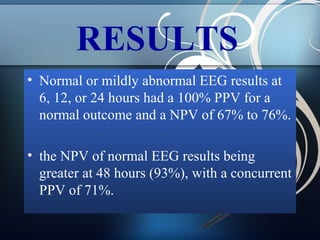
• Normal or mildly abnormal EEG results at
6, 12, or 24 hours had a 100% PPV for a
normal outcome and a NPV of 67% to 76%.
• the NPV of normal EEG results being
greater at 48 hours (93%), with a concurrent
PPV of 71%.
RESULTS
Evolution of EEG Results
• EEG abnormalities improved with time,
with the worst EEG grade seen on the
earliest recording in all cases.
• Normal or mildly abnormal EEG results at
6 hours remained normal/mild and were
associated with normal outcomes in 100%
of cases.
RESULTS
Individual EEG Features
• EEG features that were associated with
abnormal outcomes were background
amplitude of 30V, interburst interval of 30
seconds, electrographic seizures, and
absence of sleep-wake cycling at 48 hours.
RESULTS
• Clinical Sarnat grades at 24 hours were
correlated significantly with outcomes (R
0.703; P .001).
• No correlation was found between
socioeconomic group and
neurodevelopment.
Critical
apprasial
PICO

• Population: term infants (37 weeks of
gestation) with HIE.
• Intervention: EEG recording.
• Control: clinical assesment.
• Out come:prediction of outcome in
HIE
Relevance
• 1. Does the study address a common
problem in your practice?
•
YES
• 2. Does the study address an
important outcome to you or to your
patient? (DOE vs. POEM).
•
YES
Relevance
3. Assuming that the study conclusion is
true would it lead to a change in your
practice?

yes
Are the Results of the Study
Valid?
• Was the assignment concealed?
Yes
• Was follow-up complete& long enough?
YES
• Sensitivity analysis (WCS)
NO
Are the Results of the Study
Valid?
Were all clinically important outcomes
considered?
yes
Are the Results of the Study
Valid?
• Is reference standard used acceptable?

• No.
• Was there an independent, blind comparison
with a reference standard?
• YES.
• Were both reference standard and test applied
to all patients?

• YES
Are the Results of the Study
Valid?
• Did the patient sample include an
appropriate spectrum of patients to
whom the diagnostic test will be applied
in clinical practice?
• yes
Are the Results of the Study
Valid?
• Did the results of the test being evaluated
influence the decision to perform the
reference standard?
• NO
Are the Results of the Study
Valid?
• Were the methods for performing the
test described in sufficient detail to
permit replication?
• YES
What Were the Results?
• Are likelihood ratios for the test results
presented or data necessary for their
calculation provided?
• YES
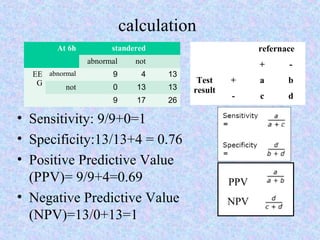
calculation
At 6h

standered

refernace

abnormal
9

4

13

0

13

13

9

EE abnormal
G
not

not

17

26

+

• Sensitivity: 9/9+0=1
• Specificity:13/13+4 = 0.76
• Positive Predictive Value
(PPV)= 9/9+4=0.69
• Negative Predictive Value
(NPV)=13/0+13=1

Test
result

-

+

a

b

-

c

d

PPV
NPV
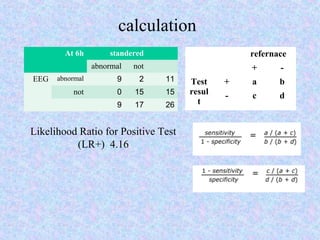
calculation
At 6h

standered

refernace

abnormal
abnormal

9

2

11

not

0

15

15

9

EEG

not

17

26

+

Likelihood Ratio for Positive Test
(LR+) 4.16

Test
resul
t

-

+

a

b

-

c

d
Will the results Help Me in Caring
for My Patients?
• Will the reproducibility of the test result
and its interpretation be satisfactory in
my setting?
• NO.
Will the results Help Me in Caring
for My Patients?
• Are the results applicable to my
patient?
• Similar distribution of disease severity?
(spectrum)
• YES.
Will the results Help Me in Caring
for My Patients?
• Will the results change my
management?
• Test and treatment thresholds? (is it
between)
• YES.
• High or low LR's?
Will the results Help Me in Caring
for My Patients?
• Will patients be better off as a result
of the test?
• Is target disorder dangerous if left
undiagnosed?
• YES.
• Is test risk acceptable?
• YES
Will the results Help Me in Caring
for My Patients?
• Does effective treatment exist?
• YES.
• Information from test will lead to change of
Management beneficial to patient?
• YES.
Glossary
• Cohort study: Follow-up of exposed and
non-exposed defined groups, with a
comparison of disease rates during the time
covered. ( Harm, Prognosis)
Glossary
• Blind(ed) study (Syn: masked study): A study in which
observer(s) and/or subjects are kept ignorant of the group
to which the subjects are assigned, as in an experimental
study, or of the population from which the subjects come,
as in a nonexperimental or observational study. Where
both observer and subjects are kept ignorant, the study is
termed a double-blind study. If the statistical analysis is
also done in ignorance of the group to which subjects

belong, the study is sometimes described as triple blind.
The purpose of "blinding" is to eliminate sources of bias.
(Diagnosis, Harm, Therapy)
Glossary
• Exclusion Criteria: Conditions which
preclude entrance of candidates into an
investigation even if they meet the inclusion
criteria.
• Reproducibility (Repeatability,
Reliability): the results of a test or measure
are identical or closely similar each time it
is conducted.
Glossary
• Gold Standard: Accepted reference
standard or diagnostic test for a
particular illness.
• Sensitivity: The probability of the test
finding disease among those who have
the disease or the proportion of people
with disease who have a positive test
result.
• Sensitivity = true positives / (true
positives + false negatives)
Glossary
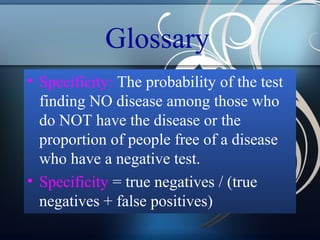
• Specificity: The probability of the test
finding NO disease among those who
do NOT have the disease or the
proportion of people free of a disease
who have a negative test.
• Specificity = true negatives / (true
negatives + false positives)
Glossary
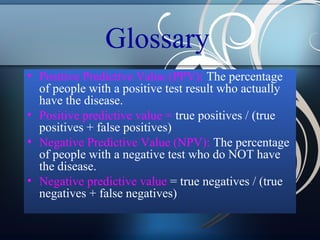
• Positive Predictive Value (PPV): The percentage
of people with a positive test result who actually
have the disease.
• Positive predictive value = true positives / (true
positives + false positives)
• Negative Predictive Value (NPV): The percentage
of people with a negative test who do NOT have
the disease.
• Negative predictive value = true negatives / (true
negatives + false negatives)
Glossary
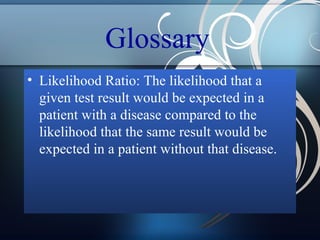
• Likelihood Ratio: The likelihood that a
given test result would be expected in a
patient with a disease compared to the
likelihood that the same result would be
expected in a patient without that disease.
Glossary
• Likelihood Ratio Positive (LR+): The odds that a
positive test result would be found in a patient
with, versus without, a disease.
• Likelihood Ratio Positive (LR+) = Sensitivity / (1
- Specificity).
• The probability of a test result being positive in a
person with the disease divided by the probability
of a test result being positive in a person without
the disease.
• LR(+) = [TP / (TP + FN)] / [FP / (FP + TN)]
Glossary
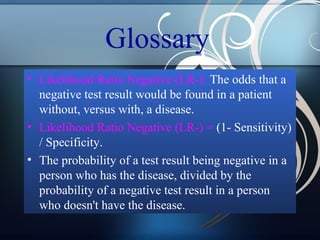
• Likelihood Ratio Negative (LR-): The odds that a
negative test result would be found in a patient
without, versus with, a disease.
• Likelihood Ratio Negative (LR-) = (1- Sensitivity)
/ Specificity.
• The probability of a test result being negative in a
person who has the disease, divided by the
probability of a negative test result in a person
who doesn't have the disease.
Glossary
• Griffiths Mental Development Scales :
• During the 1960s the Griffiths scales, which were
originally designed to measure children from birth
to two years, were extended to cover birth to eight
years and a sixth scale (Practical Reasoning) was
added to the five scales comprising the measure
for the early years. The first edition was published
in 1970 and revised in 1984. The third and most
current edition was published in 2006.
Glossary
• The six sub-scales are:
• Sub-scale A: Locomotor: Gross motor skills
including the ability to balance and to co-ordinate
and control movements.
• Sub-scale B: Personal-Social: Proficiency in the
activities of daily living, level of independence and
interaction with other children.
• Sub-scale C: Language: Receptive and expressive
language.
Glossary
• Sub-scale D: Eye and Hand Co-ordination:
Fine motor skills, manual dexterity and visual
monitoring skills.
• Sub-scale E: Performance: Visuospatial skills
including speed of working and precision.
• Sub-scale F: Practical Reasoning: ability to
solve practical problems, understanding of basic
mathematical concepts and understanding of moral
issues.
CONGRATULATION

To Dr.Sameer , his
team and our
department.
THANK
YOU FOR
YOUR
ATTENTIO

Journal club222 EEG as predictive tool for development

  • 1.
    Journal club Yassin M.Al-saleh Dr.Sumahya Al-hajjaj
  • 2.
    ‫بسم ا الرحمنالرحيم‬ ‫)انما يخشى‬ ‫ا من عباده‬ ‫العلماء(‬
  • 4.
    INTRODUCTION • Hypoxic-ischemic encephalopathy(HIE) occurs in 3 to 5 cases per 100 deliveries. • remains an important cause of neonatal death and long-term neurologic disability.
  • 5.
    INTRODUCTION • Interventions, includinginduced hypothermia, may limit secondary cerebral damage. • To offer effective hypothermia, clinicians need to establish the infant’s prognosis within 6 hours after birth.
  • 6.
    INTRODUCTION • Electroencephalographic (EEG) abnormalitiescan be used to aid outcome prediction for infants with HIE.
  • 7.
    Objectives • Our aimwas to collect detailed, early, continuous, video-EEG data for a well defined group of infants with HIE. • We wished to determine which of the early EEG features would best predict neurologic outcomes at 24 months of age.
  • 9.
    METHODOLOGY • Study Design: •The prospective study was conducted in a large maternity service with 6000 deliveries per year. • Between May 2003 and May 2005
  • 10.
    METHODOLOGY • term infants(37weeks of gestation) with HIE were recruited if they fulfilled 2 of the following criteria: • initial capillary or arterial pH of 7.1. • Apgar score at 5 minutes of 5. • initial capillary or arterial lactate level of 7 mmol/L. • abnormal neurologic features/clinical seizures.
  • 11.
    METHODOLOGY • After recruitment,EEG electrodes were applied to the scalp. • Recordings were commenced as soon as possible after birth, generally within 6 hours.
  • 12.
    METHODOLOGY • Developmental follow-upassessments were performed at 6, 12, and 24 months using the Revised Griffiths Scales of Mental Development. • Abnormal outcome was defined as death, cerebral palsy, or a Griffiths quotient (GQ) of 87.
  • 13.
    METHODOLOGY EEG Analyses: • Theevolution of EEG findings was examined including: • background.Amplitude. • presence of discontinuity, • length of EEG activity burst . Interburst interval. • return of sleep-wake cycling (SWC). • presence or absence of seizures. • EEG segments that were 1 hour in length and free of visual artifacts were chosen at 6, 12, 24, and 48 hours of age for each infant
  • 14.
    METHODOLOGY • All patientidentifiers were removed. • The segments were stored as separate files and then were visually analyzed separately by a neurophysiologist .
  • 15.
    METHODOLOGY • Clinicians wereblinded to all EEG data, and antiepileptic medications were administered if seizures were suspected clinically.
  • 16.
    METHODOLOGY Statistical Analyses • Meansand SDs were calculated for demographic factors. • The predictive ability of EEG grades was by using: • positive predictive value (PPV). • Negative predictive value (NPV). • Statistical significance was taken as P .05.
  • 18.
    RESULTS Study Group • Intotal, 54 infants with clinical HIE were recruited soon after delivery. • Of those, 50 had early, continuous, videoEEG recording performed during the first 3 days of life. • Forty-four infants completed neurodevelopmental followup. • Of those, 20 (45%) had abnormal outcomes.
  • 19.
  • 20.
    RESULTS EEG Grades • At24hours, the number of infants assigned to each grade was as follows: normal,6; mild, 11; moderate, 9; severe, 9; isoelectric,3.
  • 21.
    EEG Grades andPrediction of Outcomes • The EEG grades assigned were highly predictive of outcomes at all times. • EEG grades correlated significantly with both outcomes and GQ scores at 24 months. • The timing of EEG recording did affect the predictive value of the EEG results
  • 22.
    RESULTS • Normal ormildly abnormal EEG results at 6, 12, or 24 hours had a 100% PPV for a normal outcome and a NPV of 67% to 76%. • the NPV of normal EEG results being greater at 48 hours (93%), with a concurrent PPV of 71%.
  • 23.
    RESULTS Evolution of EEGResults • EEG abnormalities improved with time, with the worst EEG grade seen on the earliest recording in all cases. • Normal or mildly abnormal EEG results at 6 hours remained normal/mild and were associated with normal outcomes in 100% of cases.
  • 24.
    RESULTS Individual EEG Features •EEG features that were associated with abnormal outcomes were background amplitude of 30V, interburst interval of 30 seconds, electrographic seizures, and absence of sleep-wake cycling at 48 hours.
  • 25.
    RESULTS • Clinical Sarnatgrades at 24 hours were correlated significantly with outcomes (R 0.703; P .001). • No correlation was found between socioeconomic group and neurodevelopment.
  • 27.
  • 28.
    PICO • Population: terminfants (37 weeks of gestation) with HIE. • Intervention: EEG recording. • Control: clinical assesment. • Out come:prediction of outcome in HIE
  • 29.
    Relevance • 1. Doesthe study address a common problem in your practice? • YES • 2. Does the study address an important outcome to you or to your patient? (DOE vs. POEM). • YES
  • 30.
    Relevance 3. Assuming thatthe study conclusion is true would it lead to a change in your practice? yes
  • 31.
    Are the Resultsof the Study Valid? • Was the assignment concealed? Yes • Was follow-up complete& long enough? YES • Sensitivity analysis (WCS) NO
  • 32.
    Are the Resultsof the Study Valid? Were all clinically important outcomes considered? yes
  • 33.
    Are the Resultsof the Study Valid? • Is reference standard used acceptable? • No. • Was there an independent, blind comparison with a reference standard? • YES. • Were both reference standard and test applied to all patients? • YES
  • 34.
    Are the Resultsof the Study Valid? • Did the patient sample include an appropriate spectrum of patients to whom the diagnostic test will be applied in clinical practice? • yes
  • 35.
    Are the Resultsof the Study Valid? • Did the results of the test being evaluated influence the decision to perform the reference standard? • NO
  • 36.
    Are the Resultsof the Study Valid? • Were the methods for performing the test described in sufficient detail to permit replication? • YES
  • 37.
    What Were theResults? • Are likelihood ratios for the test results presented or data necessary for their calculation provided? • YES
  • 40.
    calculation At 6h standered refernace abnormal 9 4 13 0 13 13 9 EE abnormal G not not 17 26 + •Sensitivity: 9/9+0=1 • Specificity:13/13+4 = 0.76 • Positive Predictive Value (PPV)= 9/9+4=0.69 • Negative Predictive Value (NPV)=13/0+13=1 Test result - + a b - c d PPV NPV
  • 41.
  • 43.
    Will the resultsHelp Me in Caring for My Patients? • Will the reproducibility of the test result and its interpretation be satisfactory in my setting? • NO.
  • 44.
    Will the resultsHelp Me in Caring for My Patients? • Are the results applicable to my patient? • Similar distribution of disease severity? (spectrum) • YES.
  • 45.
    Will the resultsHelp Me in Caring for My Patients? • Will the results change my management? • Test and treatment thresholds? (is it between) • YES. • High or low LR's?
  • 46.
    Will the resultsHelp Me in Caring for My Patients? • Will patients be better off as a result of the test? • Is target disorder dangerous if left undiagnosed? • YES. • Is test risk acceptable? • YES
  • 47.
    Will the resultsHelp Me in Caring for My Patients? • Does effective treatment exist? • YES. • Information from test will lead to change of Management beneficial to patient? • YES.
  • 49.
    Glossary • Cohort study:Follow-up of exposed and non-exposed defined groups, with a comparison of disease rates during the time covered. ( Harm, Prognosis)
  • 50.
    Glossary • Blind(ed) study(Syn: masked study): A study in which observer(s) and/or subjects are kept ignorant of the group to which the subjects are assigned, as in an experimental study, or of the population from which the subjects come, as in a nonexperimental or observational study. Where both observer and subjects are kept ignorant, the study is termed a double-blind study. If the statistical analysis is also done in ignorance of the group to which subjects belong, the study is sometimes described as triple blind. The purpose of "blinding" is to eliminate sources of bias. (Diagnosis, Harm, Therapy)
  • 51.
    Glossary • Exclusion Criteria:Conditions which preclude entrance of candidates into an investigation even if they meet the inclusion criteria. • Reproducibility (Repeatability, Reliability): the results of a test or measure are identical or closely similar each time it is conducted.
  • 52.
    Glossary • Gold Standard:Accepted reference standard or diagnostic test for a particular illness. • Sensitivity: The probability of the test finding disease among those who have the disease or the proportion of people with disease who have a positive test result. • Sensitivity = true positives / (true positives + false negatives)
  • 53.
    Glossary • Specificity: Theprobability of the test finding NO disease among those who do NOT have the disease or the proportion of people free of a disease who have a negative test. • Specificity = true negatives / (true negatives + false positives)
  • 54.
    Glossary • Positive PredictiveValue (PPV): The percentage of people with a positive test result who actually have the disease. • Positive predictive value = true positives / (true positives + false positives) • Negative Predictive Value (NPV): The percentage of people with a negative test who do NOT have the disease. • Negative predictive value = true negatives / (true negatives + false negatives)
  • 55.
    Glossary • Likelihood Ratio:The likelihood that a given test result would be expected in a patient with a disease compared to the likelihood that the same result would be expected in a patient without that disease.
  • 56.
    Glossary • Likelihood RatioPositive (LR+): The odds that a positive test result would be found in a patient with, versus without, a disease. • Likelihood Ratio Positive (LR+) = Sensitivity / (1 - Specificity). • The probability of a test result being positive in a person with the disease divided by the probability of a test result being positive in a person without the disease. • LR(+) = [TP / (TP + FN)] / [FP / (FP + TN)]
  • 57.
    Glossary • Likelihood RatioNegative (LR-): The odds that a negative test result would be found in a patient without, versus with, a disease. • Likelihood Ratio Negative (LR-) = (1- Sensitivity) / Specificity. • The probability of a test result being negative in a person who has the disease, divided by the probability of a negative test result in a person who doesn't have the disease.
  • 58.
    Glossary • Griffiths MentalDevelopment Scales : • During the 1960s the Griffiths scales, which were originally designed to measure children from birth to two years, were extended to cover birth to eight years and a sixth scale (Practical Reasoning) was added to the five scales comprising the measure for the early years. The first edition was published in 1970 and revised in 1984. The third and most current edition was published in 2006.
  • 59.
    Glossary • The sixsub-scales are: • Sub-scale A: Locomotor: Gross motor skills including the ability to balance and to co-ordinate and control movements. • Sub-scale B: Personal-Social: Proficiency in the activities of daily living, level of independence and interaction with other children. • Sub-scale C: Language: Receptive and expressive language.
  • 60.
    Glossary • Sub-scale D:Eye and Hand Co-ordination: Fine motor skills, manual dexterity and visual monitoring skills. • Sub-scale E: Performance: Visuospatial skills including speed of working and precision. • Sub-scale F: Practical Reasoning: ability to solve practical problems, understanding of basic mathematical concepts and understanding of moral issues.
  • 61.
    CONGRATULATION To Dr.Sameer ,his team and our department.
  • 62.