APPROACH TO HYPERTENSION IN
YOUNG
‘ENDOCRINOLOGIST PERSPECTIVE’
DR. OM J LAKHANI
MD, DNB (ENDOCRINE)
CONSULTANT ENDOCRINOLOGIST
ZYDUS HOSPITAL, AHMEDABAD
Phone- +919871009021
Consultation Details
• Timings 10 am t0 1 pm and 4 pm to 7 pm
from Monday to Saturday
• Zydus Hospitals, Ahmedabad
• Phone – 079-6619 0201
• Email – dromlakhani@gmail.com
Imp Information
• Images of the patients have been removed
Introduction to the Talk
1. Mainly discuss 5 Cases of Endocrine causes
of hypertension
2. Stick to practical and clinically relevant
points
CASE #1
• 25 year old male
• Pre-employment checkup
• BP – 150 / 100 mm Hg
• Does this patient need evaluation for
secondary hypertension ?
• Q. In Which cases would you consider
secondary cause of hypertension ?
1. Resistant Hypertension
2.Hypertension in patient
<30 years or childhood
3.Malignant or accelerated
hypertension
• Q. What are the Major causes of Secondary
Hypertension ?
RENAL
• Renovascular
Hypertension
• Primary Renal disease
ENDOCRINE CAUSES
• Primary
Aldosteronism
(Conn’s syndrome)
• Cushing’s Syndrome
• Pheochromocytoma
• Other Endocrine
causes
CARDIOVASCULAR CAUSES
• Coarctation of the
aorta
• Q. What Investigations we generally order
when dealing with a secondary hypertension
?
Our List of Investigations
*Sir Ganga Ram Hospital Protocol for
Secondary Hypertension
1. Apart from Routine investigations (as
appropriate)
2. S. Creatinine
3. S. Electrolytes- Calcium, Sodium, Potassium,
Bicarbonate
4. Thyroid function test
5. 24 hr Urine Metanephrine and
Normetanephrine
6. Aldosterone – Renin Ratio
7. Ultrasound of Abdomen and Pelvis
CASE #2
• 35 year old male
• Hypertension
• Weight gain
• Change in Mood
• Stretch marks over abdomen
• Q. What is the SPOT Diagnosis ?
• Cushing’s syndrome
• Q. Based on clinical examination, in Which
cases would you consider testing for
Cushing’s syndrome ?
• Facial Flushing
• Violaceous striae in Abdomen
• Proximal Muscle weakness
• Q. How will you Diagnose Cushing’s
syndrome ?
• For Diagnosis of Cushing’s syndrome , we
need to have TWO tests for Cushing’s
syndrome positive.
SGRH Protocol for Cushing’s
diagnosis
DAY 1
1. 8 am Cortisol – to rule out Exogenous Cushing’s
syndrome
2. Collect Sample for S. Cortisol at 11 pm and ACTH
(Late night serum cortisol)
3. Then give 1 mg of Dexamethasone
DAY 2
1. Again collect S. Cortisol at 8 am the next morning
Points 2 and 3 – Overnight Dexamethasone suppression
test
• Late night Serum cortisol >7.5 mcg/dl –>
Suggestive of Cushing’s
• After ONDST – Serum cortisol >1.8 mcg/dl –
diagnostic of Cushing’s
• 8 am cortisol on day 1 if <3.6 mcg/dl –
suggestive of Exogenous Cushing’s
Alternative Approach
• Day 1 – 24 hr urine free cortisol
• Day 2 – ONDST
24 hr urine free cortisol normal range is 80-120
mcg/24
Caution !
• Make sure you DON’T start collection of 24
hr UFC , after giving Dexamethasone for
ONDST
• Q. Diagnosis of Cushing’s is Established ,
what next ?
Before & After
CASE #3
• 7 years old female child
• complaints of weight gain, puffiness of face,
rashes on face and body
• failure to gain height and hypertension since
1 year.
• Child also had few episodes of seizures (?
Hypertensive encephalopathy)
• Q. What is the definition of Hypertension in
Pediatric age group ?
• Q. When will you suspect Cushing’s
syndrome in a Child ?
• Short height + Increase of Weight
• Q. How is diagnosis of Cushing’s syndrome
Established in a child ?
• Similar to adults
• Only dose of Dexamethasone needs to be
adjusted
• Q. What is the dose of Dexamethasone used
for ONDST in children ?
– ONDST- 15 ug/kg
– LDDST - 30 ug/kg/day in 4 divided doses
– HDDST- 120 ug/kg/day in 4 divided doses
– For children > 40 kg- use same dose as adults
CASE #4
• 24 year old female
• c/o of headache and other non specific
complaints
• BP – 160/90 mm Hg
• Ix done – Aldosterone : Renin Ratio > 30:1
• Q. What is Primary Aldosteronism ?
• “PA is a group of disorders in which
aldosterone production is inappropriately
high for sodium status, relatively
autonomous of the major regulators of
secretion (angiotensin II, plasma potassium
concentration), and nonsuppressible by
sodium loading”
• Also called Conn’s syndrome
• Q. What are the causes of Primary
Aldosteronism ?
1. Aldosterone production Adenoma (APA)
2. Bilateral Idiopathic adrenal hyperplasia (IHA)
3. Familial hyperaldosternism- type I- Glucocorticoid
remedible hypertension
4. Familal hyperaldosterone type II- mutations
producting familial APA / IHA
5. FHA type III- KCNJ5 mutation
6. Unilateral adrenal hyperplasia
7. Ectopic aldosterone producing tumor
8. Aldosterone producing carcinoma
• Q. How common is Primary Aldosteronism ?
• More common than you think !
• 5-10% of Hypertensive patients may have
Primary Aldosteronism !
• Q. Why is primary aldosteronism important?
• Higher CV morbidity and mortality compared
to other hypertensive patients of same age
and sex
• Q. Which patients should be tested for
Primary Aldosteronism ?
Endo Society guidelines
1. Sustained blood pressure (BP) above 150/100 mm Hg on each of
three measurements obtained on different days,
2. Hypertension (BP 140/90 mm Hg) resistant to three
conventional antihypertensive drugs (including a diuretic),
3. Controlled BP (140/90 mm Hg) on four or more antihypertensive
drugs;
4. Hypertension and spontaneous or diuretic-induced hypokalemia
5. Hypertension and adrenal incidentaloma
6. Hypertension and sleep apnea
7. Hypertension and a family
8. History of early onset hypertension or cerebrovascular accident
at a young age (40 years);
9. All hypertensive first-degree relatives of patients with PA.
• Q. What is classical triad of PA ?
1. Hypertension
2.Hypokalemia
3.Metabolic alkalosis
•However most patients donot have all the
features of this triad
• Q. Do all patients with PA have hypokalemia
?
• This is a common mistake
• Infact Hypokalemia is only present in 10-30%
cases of Primary aldosteronism
• Q. What are the 3 steps in diagnosis of PA ?
• Case detection  Case confirmation 
Subtype classification
• Q. What is the screening test for PA ?
• Aldosterone- Renin ratio (ARR)
• Q. Which Drugs need to be stopped before
testing for ARR and for how long ?
Stop for 4 weeks
1. Spironolactone, eplerenone, amiloride, and
triamterene
2. Potassium-wasting diuretics
3. Products derived from licorice root (eg,
confectionary licorice, chewing tobacco)
Stop for 2 weeks
1. Beta Adrenergic blockers
2. Central alpa-2 agonists (eg, clonidine, alpa-
methyldopa)
3. nonsteroidal anti-inflammatory drugs
4. Angiotensin-converting enzyme inhibitors
5. angiotensin receptor blockers
6. renin inhibitors
7. dihydropyridine
8. calcium channel antagonists
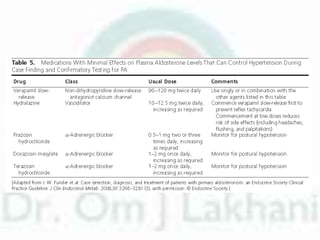
• Q. Which antihypertensives to use during the
interim period to control the BP ?
• Q. Can OC Pills be continued ?
• OC pills need to be stopped if Direct Renin
concentration is measured
• No need to stop if PRA is measured
• Q. What other precaution need to be taken ?
1. Correct the hypokalemia if present before
testing
2. Liberal salt intake for 1-2 weeks before
testing
• Q. What is the protocol for testing ?
• Q. What is the screening cutoff to consider
PA based on Aldosterone- Renin ratio ?
• Q. A patient has Aldosterone value of 3 ng/dl
and PRA of 0.1 ng/ml/hr, the ratio is 30:1 ,
does he have primary aldosteronism ?
• No
• This is the catch
• To call it a Primary aldosteronism, the PAC
should be >15 ng/dl and PRA <1 ng/ml/hr
• Q. Give the DD of secondary causes of
hypertension based on PAC / PRA values ?
• Q. What is done once diagnosis of Primary
Aldosteronism is established ?
CASE #5
• 39 year old female
• Presented with severe headache, vomiting
• BP was 180/110 mm Hg in emergency
• MRI Brain- was normal
• Emergent management of hypertension done and
then discharged with Anti Hypertensives
• BP- 110/70 mm Hg on OPD follow up
• Again after 15 days- presented to emergency with
Similar episode
• BP – 170/110 , ECG- Sinus tachycardia with HR of 110
beats per minute
• Admitted and start on Sodium Nitroprusside
under Cardiology
• Reference done to Nephrology, Neurology
and Endocrinology !
• Our Routine protocol detected high urinary
metanephrine
• MRI was suggestive of Large
Pheochromocytoma
• Q. In Which patients would you Consider
Pheochromocytoma ?
• The classic triad of headache, sweating, and tachycardia
• Hyperadrenergic spells (eg, self-limited episodes of nonexertional
palpitations, diaphoresis, headache, tremor, or pallor).
• Onset of hypertension at a young age (eg, <20 years), resistant
hypertension, or hypertension with new onset or atypical
diabetes mellitus (eg, new onset of apparent type 2 diabetes in a
slender person).
• A familial syndrome that predisposes to catecholamine-secreting
tumors (eg, multiple endocrine neoplasia type 2 [MEN2],
neurofibromatosis type 1 [NF1], or von Hippel-Lindau [VHL]).
• A family history of pheochromocytoma.
• Adrenal incidentaloma with or without hypertension.
• Pressor response during anesthesia, surgery, or angiography.
• Idiopathic dilated cardiomyopathy.
• A history of gastric stromal tumor or pulmonary chondromas
(Carney triad).
• Q. How will you Diagnose
Pheochromocytoma ?
1. Urinary Metanephrine, Normetanephrine
and Dopamine
2. Plasma Metanephrine and
Normetanephrine
• Q. What is the role of VMA ?
• VMA has low sensitivity in Detection of
Pheochromocytoma
• Though it has good specificity
• Q. Which drugs can potentially cause false
elevation of Catecholamine ? How long are
they stopped before testing ?
1. TCA- most notorious
2. SSRI
3. Amphetamine
4. Cough and cold medications
• Q. What food substances need to be avoided
and for how long ?
• Nuts
• Caffeine
• Chocolate
• Bananas
• Alcohol
• Vanilla
For 3 days prior to testing
• Q. What is the procedure for Collection of
tests for Metanephrine and
Normetanephrine ?
1. Discard the first urine of the day
2. Start collection from next urine sample
onwards
3. Collect urine with appropriate volume of
50% HCl to maintain pH between 1–2.
(Generally container provided by lab)
4. Urine sample is kept in refrigerator in
between collection
5. Shipped refrigerated and frozen
• Q. How is plasma metanephrine test done ?
• Indwelling catheter in place
• Patient has overnight fast
• Patient supine for 30 min
• Sample is taken
• Q. Describe the further steps in evaluation of
Pheochromocytoma ?
FINALLY SOME IMPORTANT
PEARLS
• Drugs and ‘Complimentary alternative
Medicine’ intake
Other important history points
• Hypertension before age of 21 years and Family
history of Cerebral hemorrhage before age 40
years  GLUCOCORTICOID REMEDIABLE
HYPERTENSION (FAMILIAL
HYPERALDOSTERONISM TYPE 1)
• Obstructive Sleep Apnea- STOP BANG
questionnaire
• OC Pill use  OC pills can cause an increase in
BP (though increase is mild)
DON’T FORGET
• Palpate all four limb pulses and blood
pressure – Why ?
• Fundus Examination
• Auscultation for abdominal bruit for Renal
artery stenosis (Only 40% sensitivity but 99%
specificity)
TAKE HOME MESSAGE
Secondary Cause of
hypertension should be
considered in Resistant
hypertension and young
hypertensives
•Proximal Muscle
weakness
•Violaceous striae
•Facial flushing
Are high discriminant signs
for Cushing’s syndrome
Short height + Increase
weight – think of
Cushing’s in Young
children
Primary Aldosteronism is
more common than you
think
Urinary VMA is now
outdated test for
diagnosis of
Pheochromocytoma
THANK YOU !
DR. OM J LAKHANI
MD, DNB (ENDOCRINE)
CONSULTANT ENDOCRINOLOGIST
ZYDUS HOSPITAL, AHMEDABAD

Endocrine causes of hypertension

  • 1.
    APPROACH TO HYPERTENSIONIN YOUNG ‘ENDOCRINOLOGIST PERSPECTIVE’ DR. OM J LAKHANI MD, DNB (ENDOCRINE) CONSULTANT ENDOCRINOLOGIST ZYDUS HOSPITAL, AHMEDABAD Phone- +919871009021
  • 2.
    Consultation Details • Timings10 am t0 1 pm and 4 pm to 7 pm from Monday to Saturday • Zydus Hospitals, Ahmedabad • Phone – 079-6619 0201 • Email – dromlakhani@gmail.com
  • 3.
    Imp Information • Imagesof the patients have been removed
  • 4.
    Introduction to theTalk 1. Mainly discuss 5 Cases of Endocrine causes of hypertension 2. Stick to practical and clinically relevant points
  • 5.
  • 6.
    • 25 yearold male • Pre-employment checkup • BP – 150 / 100 mm Hg • Does this patient need evaluation for secondary hypertension ?
  • 7.
    • Q. InWhich cases would you consider secondary cause of hypertension ?
  • 8.
    1. Resistant Hypertension 2.Hypertensionin patient <30 years or childhood 3.Malignant or accelerated hypertension
  • 9.
    • Q. Whatare the Major causes of Secondary Hypertension ?
  • 10.
  • 11.
    ENDOCRINE CAUSES • Primary Aldosteronism (Conn’ssyndrome) • Cushing’s Syndrome • Pheochromocytoma • Other Endocrine causes
  • 12.
  • 13.
    • Q. WhatInvestigations we generally order when dealing with a secondary hypertension ?
  • 14.
    Our List ofInvestigations *Sir Ganga Ram Hospital Protocol for Secondary Hypertension 1. Apart from Routine investigations (as appropriate) 2. S. Creatinine 3. S. Electrolytes- Calcium, Sodium, Potassium, Bicarbonate 4. Thyroid function test 5. 24 hr Urine Metanephrine and Normetanephrine 6. Aldosterone – Renin Ratio 7. Ultrasound of Abdomen and Pelvis
  • 15.
  • 16.
    • 35 yearold male • Hypertension • Weight gain • Change in Mood • Stretch marks over abdomen
  • 18.
    • Q. Whatis the SPOT Diagnosis ?
  • 19.
  • 20.
    • Q. Basedon clinical examination, in Which cases would you consider testing for Cushing’s syndrome ?
  • 21.
    • Facial Flushing •Violaceous striae in Abdomen • Proximal Muscle weakness
  • 24.
    • Q. Howwill you Diagnose Cushing’s syndrome ?
  • 25.
    • For Diagnosisof Cushing’s syndrome , we need to have TWO tests for Cushing’s syndrome positive.
  • 26.
    SGRH Protocol forCushing’s diagnosis DAY 1 1. 8 am Cortisol – to rule out Exogenous Cushing’s syndrome 2. Collect Sample for S. Cortisol at 11 pm and ACTH (Late night serum cortisol) 3. Then give 1 mg of Dexamethasone DAY 2 1. Again collect S. Cortisol at 8 am the next morning Points 2 and 3 – Overnight Dexamethasone suppression test
  • 27.
    • Late nightSerum cortisol >7.5 mcg/dl –> Suggestive of Cushing’s • After ONDST – Serum cortisol >1.8 mcg/dl – diagnostic of Cushing’s • 8 am cortisol on day 1 if <3.6 mcg/dl – suggestive of Exogenous Cushing’s
  • 28.
    Alternative Approach • Day1 – 24 hr urine free cortisol • Day 2 – ONDST 24 hr urine free cortisol normal range is 80-120 mcg/24
  • 29.
    Caution ! • Makesure you DON’T start collection of 24 hr UFC , after giving Dexamethasone for ONDST
  • 30.
    • Q. Diagnosisof Cushing’s is Established , what next ?
  • 32.
  • 33.
  • 34.
    • 7 yearsold female child • complaints of weight gain, puffiness of face, rashes on face and body • failure to gain height and hypertension since 1 year. • Child also had few episodes of seizures (? Hypertensive encephalopathy)
  • 36.
    • Q. Whatis the definition of Hypertension in Pediatric age group ?
  • 39.
    • Q. Whenwill you suspect Cushing’s syndrome in a Child ?
  • 40.
    • Short height+ Increase of Weight
  • 42.
    • Q. Howis diagnosis of Cushing’s syndrome Established in a child ?
  • 43.
    • Similar toadults • Only dose of Dexamethasone needs to be adjusted
  • 44.
    • Q. Whatis the dose of Dexamethasone used for ONDST in children ?
  • 45.
    – ONDST- 15ug/kg – LDDST - 30 ug/kg/day in 4 divided doses – HDDST- 120 ug/kg/day in 4 divided doses – For children > 40 kg- use same dose as adults
  • 47.
  • 48.
    • 24 yearold female • c/o of headache and other non specific complaints • BP – 160/90 mm Hg • Ix done – Aldosterone : Renin Ratio > 30:1
  • 49.
    • Q. Whatis Primary Aldosteronism ?
  • 50.
    • “PA isa group of disorders in which aldosterone production is inappropriately high for sodium status, relatively autonomous of the major regulators of secretion (angiotensin II, plasma potassium concentration), and nonsuppressible by sodium loading”
  • 51.
    • Also calledConn’s syndrome
  • 53.
    • Q. Whatare the causes of Primary Aldosteronism ?
  • 54.
    1. Aldosterone productionAdenoma (APA) 2. Bilateral Idiopathic adrenal hyperplasia (IHA) 3. Familial hyperaldosternism- type I- Glucocorticoid remedible hypertension 4. Familal hyperaldosterone type II- mutations producting familial APA / IHA 5. FHA type III- KCNJ5 mutation 6. Unilateral adrenal hyperplasia 7. Ectopic aldosterone producing tumor 8. Aldosterone producing carcinoma
  • 55.
    • Q. Howcommon is Primary Aldosteronism ?
  • 56.
    • More commonthan you think ! • 5-10% of Hypertensive patients may have Primary Aldosteronism !
  • 57.
    • Q. Whyis primary aldosteronism important?
  • 58.
    • Higher CVmorbidity and mortality compared to other hypertensive patients of same age and sex
  • 59.
    • Q. Whichpatients should be tested for Primary Aldosteronism ?
  • 60.
    Endo Society guidelines 1.Sustained blood pressure (BP) above 150/100 mm Hg on each of three measurements obtained on different days, 2. Hypertension (BP 140/90 mm Hg) resistant to three conventional antihypertensive drugs (including a diuretic), 3. Controlled BP (140/90 mm Hg) on four or more antihypertensive drugs; 4. Hypertension and spontaneous or diuretic-induced hypokalemia 5. Hypertension and adrenal incidentaloma 6. Hypertension and sleep apnea 7. Hypertension and a family 8. History of early onset hypertension or cerebrovascular accident at a young age (40 years); 9. All hypertensive first-degree relatives of patients with PA.
  • 61.
    • Q. Whatis classical triad of PA ?
  • 62.
    1. Hypertension 2.Hypokalemia 3.Metabolic alkalosis •Howevermost patients donot have all the features of this triad
  • 63.
    • Q. Doall patients with PA have hypokalemia ?
  • 64.
    • This isa common mistake • Infact Hypokalemia is only present in 10-30% cases of Primary aldosteronism
  • 65.
    • Q. Whatare the 3 steps in diagnosis of PA ?
  • 66.
    • Case detection Case confirmation  Subtype classification
  • 67.
    • Q. Whatis the screening test for PA ?
  • 68.
  • 69.
    • Q. WhichDrugs need to be stopped before testing for ARR and for how long ?
  • 70.
    Stop for 4weeks 1. Spironolactone, eplerenone, amiloride, and triamterene 2. Potassium-wasting diuretics 3. Products derived from licorice root (eg, confectionary licorice, chewing tobacco)
  • 71.
    Stop for 2weeks 1. Beta Adrenergic blockers 2. Central alpa-2 agonists (eg, clonidine, alpa- methyldopa) 3. nonsteroidal anti-inflammatory drugs 4. Angiotensin-converting enzyme inhibitors 5. angiotensin receptor blockers 6. renin inhibitors 7. dihydropyridine 8. calcium channel antagonists
  • 72.
    • Q. Whichantihypertensives to use during the interim period to control the BP ?
  • 74.
    • Q. CanOC Pills be continued ?
  • 75.
    • OC pillsneed to be stopped if Direct Renin concentration is measured • No need to stop if PRA is measured
  • 76.
    • Q. Whatother precaution need to be taken ?
  • 77.
    1. Correct thehypokalemia if present before testing 2. Liberal salt intake for 1-2 weeks before testing
  • 78.
    • Q. Whatis the protocol for testing ?
  • 80.
    • Q. Whatis the screening cutoff to consider PA based on Aldosterone- Renin ratio ?
  • 82.
    • Q. Apatient has Aldosterone value of 3 ng/dl and PRA of 0.1 ng/ml/hr, the ratio is 30:1 , does he have primary aldosteronism ?
  • 83.
    • No • Thisis the catch • To call it a Primary aldosteronism, the PAC should be >15 ng/dl and PRA <1 ng/ml/hr
  • 84.
    • Q. Givethe DD of secondary causes of hypertension based on PAC / PRA values ?
  • 86.
    • Q. Whatis done once diagnosis of Primary Aldosteronism is established ?
  • 89.
  • 90.
    • 39 yearold female • Presented with severe headache, vomiting • BP was 180/110 mm Hg in emergency • MRI Brain- was normal • Emergent management of hypertension done and then discharged with Anti Hypertensives • BP- 110/70 mm Hg on OPD follow up • Again after 15 days- presented to emergency with Similar episode • BP – 170/110 , ECG- Sinus tachycardia with HR of 110 beats per minute
  • 91.
    • Admitted andstart on Sodium Nitroprusside under Cardiology • Reference done to Nephrology, Neurology and Endocrinology ! • Our Routine protocol detected high urinary metanephrine • MRI was suggestive of Large Pheochromocytoma
  • 93.
    • Q. InWhich patients would you Consider Pheochromocytoma ?
  • 94.
    • The classictriad of headache, sweating, and tachycardia • Hyperadrenergic spells (eg, self-limited episodes of nonexertional palpitations, diaphoresis, headache, tremor, or pallor). • Onset of hypertension at a young age (eg, <20 years), resistant hypertension, or hypertension with new onset or atypical diabetes mellitus (eg, new onset of apparent type 2 diabetes in a slender person). • A familial syndrome that predisposes to catecholamine-secreting tumors (eg, multiple endocrine neoplasia type 2 [MEN2], neurofibromatosis type 1 [NF1], or von Hippel-Lindau [VHL]). • A family history of pheochromocytoma. • Adrenal incidentaloma with or without hypertension. • Pressor response during anesthesia, surgery, or angiography. • Idiopathic dilated cardiomyopathy. • A history of gastric stromal tumor or pulmonary chondromas (Carney triad).
  • 95.
    • Q. Howwill you Diagnose Pheochromocytoma ?
  • 96.
    1. Urinary Metanephrine,Normetanephrine and Dopamine 2. Plasma Metanephrine and Normetanephrine
  • 97.
    • Q. Whatis the role of VMA ?
  • 98.
    • VMA haslow sensitivity in Detection of Pheochromocytoma • Though it has good specificity
  • 99.
    • Q. Whichdrugs can potentially cause false elevation of Catecholamine ? How long are they stopped before testing ?
  • 100.
    1. TCA- mostnotorious 2. SSRI 3. Amphetamine 4. Cough and cold medications
  • 102.
    • Q. Whatfood substances need to be avoided and for how long ?
  • 103.
    • Nuts • Caffeine •Chocolate • Bananas • Alcohol • Vanilla For 3 days prior to testing
  • 104.
    • Q. Whatis the procedure for Collection of tests for Metanephrine and Normetanephrine ?
  • 105.
    1. Discard thefirst urine of the day 2. Start collection from next urine sample onwards 3. Collect urine with appropriate volume of 50% HCl to maintain pH between 1–2. (Generally container provided by lab) 4. Urine sample is kept in refrigerator in between collection 5. Shipped refrigerated and frozen
  • 106.
    • Q. Howis plasma metanephrine test done ?
  • 107.
    • Indwelling catheterin place • Patient has overnight fast • Patient supine for 30 min • Sample is taken
  • 108.
    • Q. Describethe further steps in evaluation of Pheochromocytoma ?
  • 110.
  • 111.
    • Drugs and‘Complimentary alternative Medicine’ intake
  • 113.
    Other important historypoints • Hypertension before age of 21 years and Family history of Cerebral hemorrhage before age 40 years  GLUCOCORTICOID REMEDIABLE HYPERTENSION (FAMILIAL HYPERALDOSTERONISM TYPE 1) • Obstructive Sleep Apnea- STOP BANG questionnaire • OC Pill use  OC pills can cause an increase in BP (though increase is mild)
  • 114.
    DON’T FORGET • Palpateall four limb pulses and blood pressure – Why ? • Fundus Examination • Auscultation for abdominal bruit for Renal artery stenosis (Only 40% sensitivity but 99% specificity)
  • 115.
  • 116.
    Secondary Cause of hypertensionshould be considered in Resistant hypertension and young hypertensives
  • 117.
    •Proximal Muscle weakness •Violaceous striae •Facialflushing Are high discriminant signs for Cushing’s syndrome
  • 118.
    Short height +Increase weight – think of Cushing’s in Young children
  • 119.
    Primary Aldosteronism is morecommon than you think
  • 120.
    Urinary VMA isnow outdated test for diagnosis of Pheochromocytoma
  • 121.
    THANK YOU ! DR.OM J LAKHANI MD, DNB (ENDOCRINE) CONSULTANT ENDOCRINOLOGIST ZYDUS HOSPITAL, AHMEDABAD