
Growth Hormone therapy in
children with Growth Hormone
deficiency
Dr. Pranab Kumar Sahana
MBBS, M.D, D.M
Associate Professor,
Department of Endocrinology
NRS Medical College, Kolkata,W.B
Human Growth Hormone
Human GH is secreted by the somatotrophs of the
anterior pituitary gland under the control of—
• GH releasing hormone (GHRH)
• Somatostatin and
• Ghrelin
Potent stimulators of GH secretion—
• Exercise
• Stress
• High protein meals
• Prolonged fasting
Human Growth Hormone
(191 aminoacids)
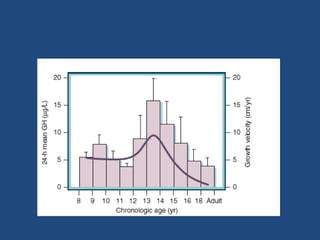
• Under normal physiological conditions, GH is
secreted in approximately 6-10 secretary burts
each day
• GH secretion is very low in between pulses.
• Nearly 50 per cent of the daily GH secretion
occurs during the early hours of the night
following the onset of deep sleep (stage3 & 4).
• The growth promoting effects of GH are
mediated through a family of insulin-like
growth factors (principally IGF-1).
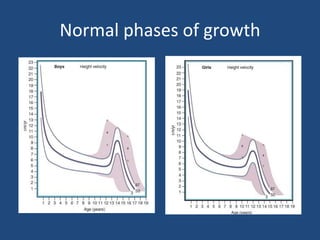
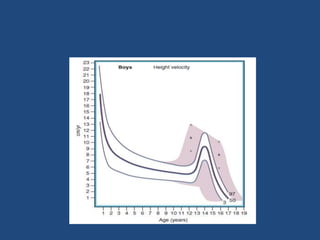
Normal phases of growth
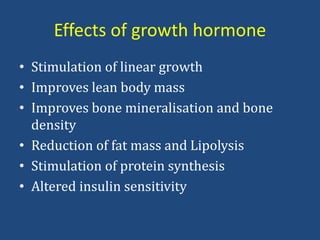
Effects of growth hormone
• Stimulation of linear growth
• Improves lean body mass
• Improves bone mineralisation and bone
density
• Reduction of fat mass and Lipolysis
• Stimulation of protein synthesis
• Altered insulin sensitivity
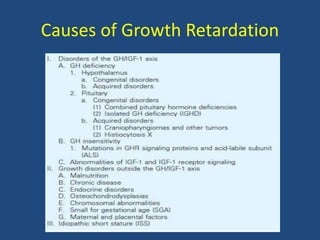
Causes of Growth Retardation
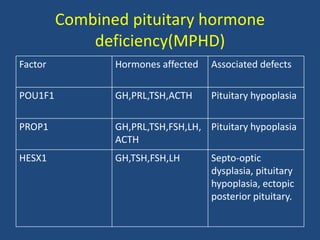
Combined pituitary hormone
deficiency(MPHD)
Factor Hormones affected Associated defects
POU1F1 GH,PRL,TSH,ACTH Pituitary hypoplasia
PROP1 GH,PRL,TSH,FSH,LH,
ACTH
Pituitary hypoplasia
HESX1 GH,TSH,FSH,LH Septo-optic
dysplasia, pituitary
hypoplasia, ectopic
posterior pituitary.
Classification based on growth velocity
Children who are short but growing with
a normal velocity
• Genetic short stature.
• Constitutional delay.
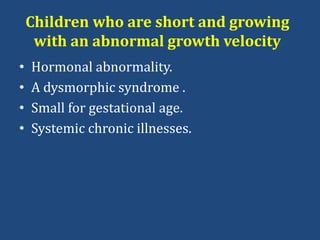
Children who are short and growing
with an abnormal growth velocity
• Hormonal abnormality.
• A dysmorphic syndrome .
• Small for gestational age.
• Systemic chronic illnesses.
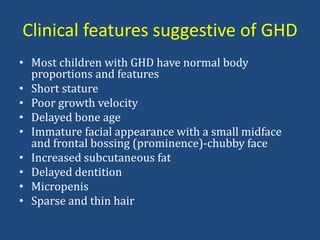
Clinical features suggestive of GHD
• Most children with GHD have normal body
proportions and features
• Short stature
• Poor growth velocity
• Delayed bone age
• Immature facial appearance with a small midface
and frontal bossing (prominence)-chubby face
• Increased subcutaneous fat
• Delayed dentition
• Micropenis
• Sparse and thin hair
Developmental defects associated with
GHD
• Septo-Optic nerve hypoplasia
• Agenesis of corpus callosum
• Holoprosencephaly - a defect of the midline
cleavage of the forebrain
• Single central incisor
• Cleft lip and palate
• Hypospadias, microphallus,cryptorchidism -
GNRH deficiency
•
Features suggestive of GHD in neonate
• Hypoglycemia, prolonged jaundice,
microphallus, traumatic delivery
What is Growth failure
• 2-4 years : Height velocity less than 5.5
cm/rear
• 4-6 years: HV less than 5 cm/year
• 6-8 years: HV less than 4 cm/year for boys
HV less than 4.5 cm/year for girls
Normal Growth velocity = 6 cm /yr (4-10 years)
Auxology
• Compare child’s growth with established
norms.
• Length stadiometer: less than 2 years.
• Vertical Stadiometer: more than 2 years.
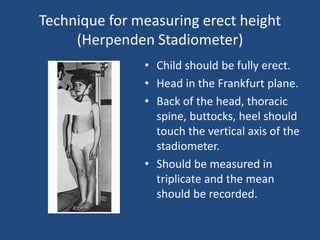
Technique for measuring erect height
(Herpenden Stadiometer)
• Child should be fully erect.
• Head in the Frankfurt plane.
• Back of the head, thoracic
spine, buttocks, heel should
touch the vertical axis of the
stadiometer.
• Should be measured in
triplicate and the mean
should be recorded.
Males
Age (y)
30
34
38
42
46
50
54
58
62
66
70
74
78
Height(in)
Height(cm)
2 4 6 8 10 12 14 16 18 20
70
80
90
100
110
120
130
140
150
160
170
180
190
200
0
+2
+1
-1
-2
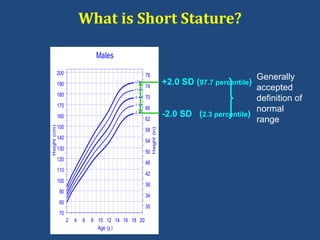
What is Short Stature?
+2.0 SD (97.7 percentile)
-2.0 SD (2.3 percentile)
Generally
accepted
definition of
normal
range
Short stature
• Incidence of short stature due to Growth
Hormone deficieny is 1:4000 to 1:10000
• Short stature: a height of less than -2 standard
deviations (SDs) compared to the average
height at the corresponding sex and age.
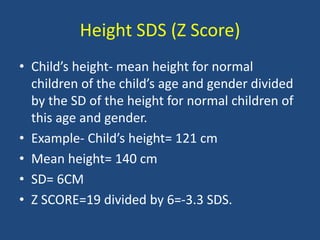
Height SDS (Z Score)
• Child’s height- mean height for normal
children of the child’s age and gender divided
by the SD of the height for normal children of
this age and gender.
• Example- Child’s height= 121 cm
• Mean height= 140 cm
• SD= 6CM
• Z SCORE=19 divided by 6=-3.3 SDS.
Body proportions
• Occipito-frontal head circumference.
• Lower body segment.
• Upper body segment.
• Arm span.
Physical Examination
• Upper segment / lower segment ratio.
• Normal ratio: ~1.4 under 4yr, ~1.2 at 10yr, ~1.1
during puberty, 0.9 in adult.
• Short limbs: achondroplasia, hypochondroplasia,
multiple epiphyseal dysplasia.
• Short trunk: mucopolysaccharidoses,
spondyloepiphyseal dysplasia.
Definition of growth pattern
• Bone age- Age for which bone maturation is
average.
• Chronological age - calendar age.
• Height age- Age for which height is average.
• Weight age- Age for which weight is average.
Skeletal maturation /Bone age
• Mirror of tempo of growth and maturation
• Degree of growth plate senescence.
• X-ray of left wrist.
• Gruelich and Pyle.
• BA is a better predictor of pubertal milestones
than chronological age.
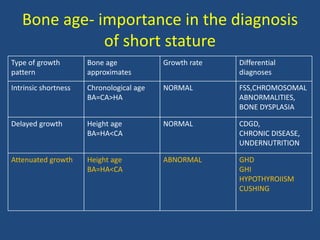
Bone age- importance in the diagnosis
of short stature
Type of growth
pattern
Bone age
approximates
Growth rate Differential
diagnoses
Intrinsic shortness Chronological age
BA=CA>HA
NORMAL FSS,CHROMOSOMAL
ABNORMALITIES,
BONE DYSPLASIA
Delayed growth Height age
BA=HA<CA
NORMAL CDGD,
CHRONIC DISEASE,
UNDERNUTRITION
Attenuated growth Height age
BA=HA<CA
ABNORMAL GHD
GHI
HYPOTHYROIISM
CUSHING
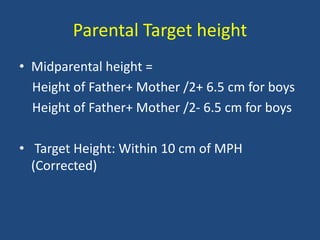
Parental Target height
• Midparental height =
Height of Father+ Mother /2+ 6.5 cm for boys
Height of Father+ Mother /2- 6.5 cm for boys
• Target Height: Within 10 cm of MPH
(Corrected)
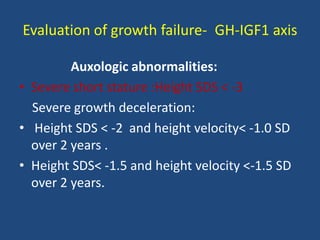
Evaluation of growth failure- GH-IGF1 axis
Auxologic abnormalities:
• Severe short stature :Height SDS < -3
Severe growth deceleration:
• Height SDS < -2 and height velocity< -1.0 SD
over 2 years .
• Height SDS< -1.5 and height velocity <-1.5 SD
over 2 years.
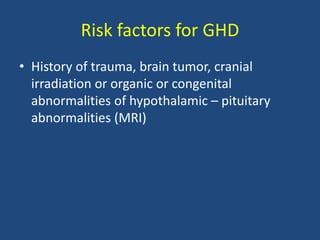
Risk factors for GHD
• History of trauma, brain tumor, cranial
irradiation or organic or congenital
abnormalities of hypothalamic – pituitary
abnormalities (MRI)
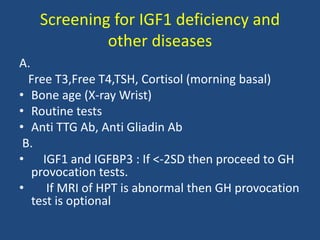
Screening for IGF1 deficiency and
other diseases
A.
Free T3,Free T4,TSH, Cortisol (morning basal)
• Bone age (X-ray Wrist)
• Routine tests
• Anti TTG Ab, Anti Gliadin Ab
B.
• IGF1 and IGFBP3 : If <-2SD then proceed to GH
provocation tests.
• If MRI of HPT is abnormal then GH provocation
test is optional
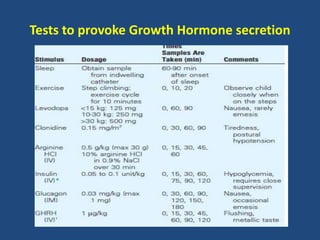
Tests to provoke Growth Hormone secretion
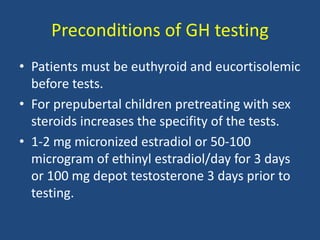
Preconditions of GH testing
• Patients must be euthyroid and eucortisolemic
before tests.
• For prepubertal children pretreating with sex
steroids increases the specifity of the tests.
• 1-2 mg micronized estradiol or 50-100
microgram of ethinyl estradiol/day for 3 days
or 100 mg depot testosterone 3 days prior to
testing.
Limitations of GH stimulation tests
• Tests are non physiological.
• Cut off level is non uniform.
• Tests are expensive.
• GH assays are variable.
When GH stimulation test is not
necessary?
• Pituitary abnormalitity- hypoplasia, ectopic
posterior pituitary, abnormal stalk
• Severe short stature (Height<-3SD) with
significantly reduced IGF1 and IGFBP3 with
normal nutrition
Inerpretaion of GH stimulation test
• If peak GH < 10ng/ml: GHD .
• If peak GH < 5ng/ml: Complete GHD
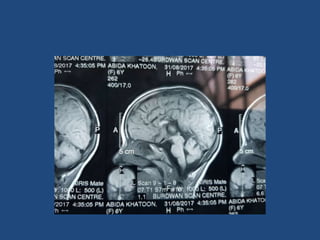
• then MRI of pituitary hypothalamic area
• Test for other pituitary hormones if not done
already.
• Molecular genetics:
GH,GHR,GHRHR,PROP1,POU1F1,HESX1,LHX3/4.
IGF1
• Advantage:
• Reflects integrated growth hormone secretion
• Stable concentrations throughout the day
• Disadvantage:
• Age and sex dependent ranges
• Nutrition dependent
• Difficult to assay- small molecule
• Costly
• Unreliable in <5 years children
IGFBP3
• Simple to measure – large molecule
• Independent on age, gender and nutrition
• Better screening test.
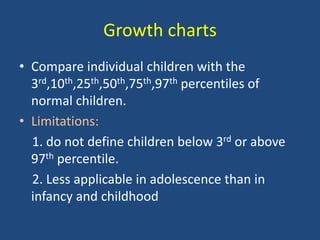
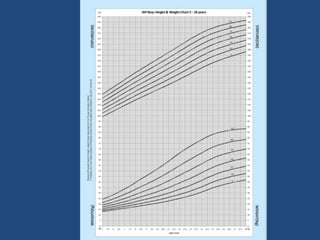
Growth charts
• Compare individual children with the
3rd,10th,25th,50th,75th,97th percentiles of
normal children.
• Limitations:
1. do not define children below 3rd or above
97th percentile.
2. Less applicable in adolescence than in
infancy and childhood
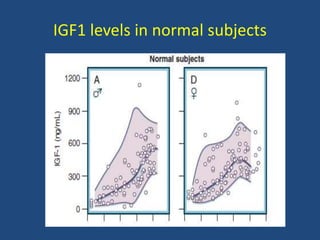
IGF1 levels in normal subjects
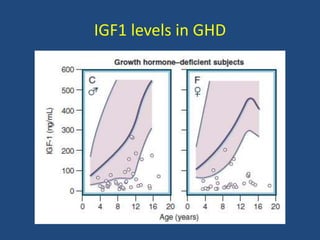
IGF1 levels in GHD
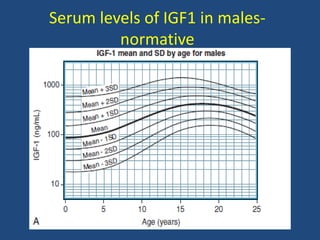
Serum levels of IGF1 in males-
normative
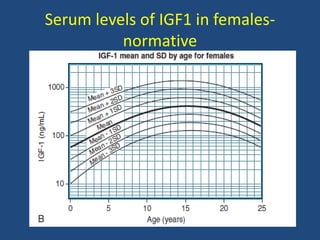
Serum levels of IGF1 in females-
normative
Dosage and method of
administration
• 0.18-0.35 mg/kg/week administered in 7 daily
doses in the evening.
• In puberty: dose can be increased
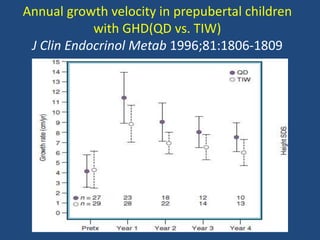
Usual Growth responses to hGH:
• 1st year: 10-12 cm.
• 2nd and 3rd year: 7-9 cm.
Annual growth velocity in prepubertal children
with GHD(QD vs. TIW)
J Clin Endocrinol Metab 1996;81:1806-1809
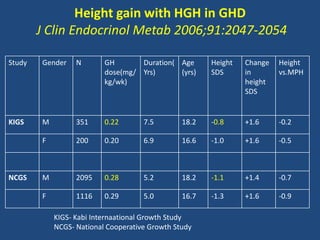
Height gain with HGH in GHD
J Clin Endocrinol Metab 2006;91:2047-2054
Study Gender N GH
dose(mg/
kg/wk)
Duration(
Yrs)
Age
(yrs)
Height
SDS
Change
in
height
SDS
Height
vs.MPH
KIGS M 351 0.22 7.5 18.2 -0.8 +1.6 -0.2
F 200 0.20 6.9 16.6 -1.0 +1.6 -0.5
NCGS M 2095 0.28 5.2 18.2 -1.1 +1.4 -0.7
F 1116 0.29 5.0 16.7 -1.3 +1.6 -0.9
KIGS- Kabi Internaational Growth Study
NCGS- National Cooperative Growth Study
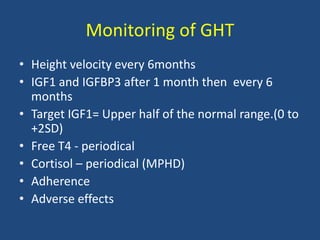
Monitoring of GHT
• Height velocity every 6months
• IGF1 and IGFBP3 after 1 month then every 6
months
• Target IGF1= Upper half of the normal range.(0 to
+2SD)
• Free T4 - periodical
• Cortisol – periodical (MPHD)
• Adherence
• Adverse effects
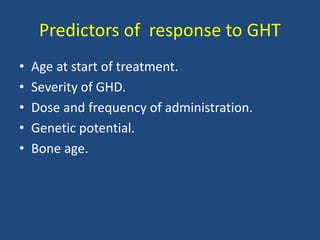
Predictors of response to GHT
• Age at start of treatment.
• Severity of GHD.
• Dose and frequency of administration.
• Genetic potential.
• Bone age.
Inadequate growth response on GHT
• Poor adherence.
• Subtherapeutic dose.
• Concurrent GHI.
• Development of neutralising antibodies.
• Development of central hypothyroidism.
• Comorbid disease.
• Incorrect diagnosis.
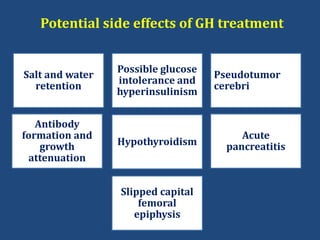
Potential side effects of GH treatment
Salt and water
retention
Possible glucose
intolerance and
hyperinsulinism
Pseudotumor
cerebri
Antibody
formation and
growth
attenuation
Hypothyroidism
Acute
pancreatitis
Slipped capital
femoral
epiphysis
Adverse effects of GHT
• Prepubertal gynaecomastia
• Growth of naevi
• Worsening of neurofibromatosis
• Hypertrophy of tonsils and adenoids ,sleep apnea
• Cancer: no increased risk in IGHD,ISS
• For patients with primary cancer diagnosis that
led to GHT – increased risk of secondary cancer.
Duration of GHT in children with GHD
• GHT is continued till GV < 2.5 cm/year.
• 2/3rd of IGHD will be growth hormone
sufficient at adult age.
• Genetic or organic causes of GHD is usually
permanent.
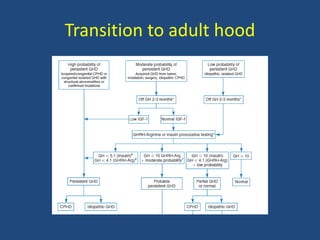
Transition to adult hood
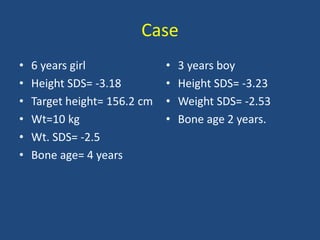
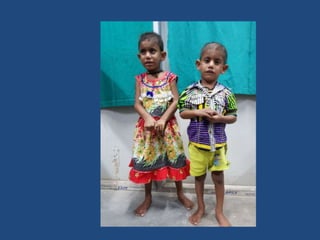
Case
• 6 years girl
• Height SDS= -3.18
• Target height= 156.2 cm
• Wt=10 kg
• Wt. SDS= -2.5
• Bone age= 4 years
• 3 years boy
• Height SDS= -3.23
• Weight SDS= -2.53
• Bone age 2 years.
Summary
• GHD is an important cause of short stature.
• Accurate diagnosis is essential.
• Auxology,IGF1,IGFBP3 and stimulated GH are
cornerstones of diagnosis.
• Recombinant human growth hormone is
efficacious and safe.
• Regular monitoring is essential to have
optimum results.

Presentation1

  • 1.
    Growth Hormone therapyin children with Growth Hormone deficiency Dr. Pranab Kumar Sahana MBBS, M.D, D.M Associate Professor, Department of Endocrinology NRS Medical College, Kolkata,W.B
  • 2.
    Human Growth Hormone HumanGH is secreted by the somatotrophs of the anterior pituitary gland under the control of— • GH releasing hormone (GHRH) • Somatostatin and • Ghrelin Potent stimulators of GH secretion— • Exercise • Stress • High protein meals • Prolonged fasting
  • 3.
    Human Growth Hormone (191aminoacids) • Under normal physiological conditions, GH is secreted in approximately 6-10 secretary burts each day • GH secretion is very low in between pulses. • Nearly 50 per cent of the daily GH secretion occurs during the early hours of the night following the onset of deep sleep (stage3 & 4). • The growth promoting effects of GH are mediated through a family of insulin-like growth factors (principally IGF-1).
  • 5.
  • 6.
    Effects of growthhormone • Stimulation of linear growth • Improves lean body mass • Improves bone mineralisation and bone density • Reduction of fat mass and Lipolysis • Stimulation of protein synthesis • Altered insulin sensitivity
  • 8.
    Causes of GrowthRetardation
  • 9.
    Combined pituitary hormone deficiency(MPHD) FactorHormones affected Associated defects POU1F1 GH,PRL,TSH,ACTH Pituitary hypoplasia PROP1 GH,PRL,TSH,FSH,LH, ACTH Pituitary hypoplasia HESX1 GH,TSH,FSH,LH Septo-optic dysplasia, pituitary hypoplasia, ectopic posterior pituitary.
  • 10.
    Classification based ongrowth velocity Children who are short but growing with a normal velocity • Genetic short stature. • Constitutional delay.
  • 11.
    Children who areshort and growing with an abnormal growth velocity • Hormonal abnormality. • A dysmorphic syndrome . • Small for gestational age. • Systemic chronic illnesses.
  • 12.
    Clinical features suggestiveof GHD • Most children with GHD have normal body proportions and features • Short stature • Poor growth velocity • Delayed bone age • Immature facial appearance with a small midface and frontal bossing (prominence)-chubby face • Increased subcutaneous fat • Delayed dentition • Micropenis • Sparse and thin hair
  • 13.
    Developmental defects associatedwith GHD • Septo-Optic nerve hypoplasia • Agenesis of corpus callosum • Holoprosencephaly - a defect of the midline cleavage of the forebrain • Single central incisor • Cleft lip and palate • Hypospadias, microphallus,cryptorchidism - GNRH deficiency •
  • 14.
    Features suggestive ofGHD in neonate • Hypoglycemia, prolonged jaundice, microphallus, traumatic delivery
  • 15.
    What is Growthfailure • 2-4 years : Height velocity less than 5.5 cm/rear • 4-6 years: HV less than 5 cm/year • 6-8 years: HV less than 4 cm/year for boys HV less than 4.5 cm/year for girls Normal Growth velocity = 6 cm /yr (4-10 years)
  • 16.
    Auxology • Compare child’sgrowth with established norms. • Length stadiometer: less than 2 years. • Vertical Stadiometer: more than 2 years.
  • 17.
    Technique for measuringerect height (Herpenden Stadiometer) • Child should be fully erect. • Head in the Frankfurt plane. • Back of the head, thoracic spine, buttocks, heel should touch the vertical axis of the stadiometer. • Should be measured in triplicate and the mean should be recorded.
  • 18.
    Males Age (y) 30 34 38 42 46 50 54 58 62 66 70 74 78 Height(in) Height(cm) 2 46 8 10 12 14 16 18 20 70 80 90 100 110 120 130 140 150 160 170 180 190 200 0 +2 +1 -1 -2 What is Short Stature? +2.0 SD (97.7 percentile) -2.0 SD (2.3 percentile) Generally accepted definition of normal range
  • 19.
    Short stature • Incidenceof short stature due to Growth Hormone deficieny is 1:4000 to 1:10000 • Short stature: a height of less than -2 standard deviations (SDs) compared to the average height at the corresponding sex and age.
  • 20.
    Height SDS (ZScore) • Child’s height- mean height for normal children of the child’s age and gender divided by the SD of the height for normal children of this age and gender. • Example- Child’s height= 121 cm • Mean height= 140 cm • SD= 6CM • Z SCORE=19 divided by 6=-3.3 SDS.
  • 21.
    Body proportions • Occipito-frontalhead circumference. • Lower body segment. • Upper body segment. • Arm span.
  • 22.
    Physical Examination • Uppersegment / lower segment ratio. • Normal ratio: ~1.4 under 4yr, ~1.2 at 10yr, ~1.1 during puberty, 0.9 in adult. • Short limbs: achondroplasia, hypochondroplasia, multiple epiphyseal dysplasia. • Short trunk: mucopolysaccharidoses, spondyloepiphyseal dysplasia.
  • 23.
    Definition of growthpattern • Bone age- Age for which bone maturation is average. • Chronological age - calendar age. • Height age- Age for which height is average. • Weight age- Age for which weight is average.
  • 24.
    Skeletal maturation /Boneage • Mirror of tempo of growth and maturation • Degree of growth plate senescence. • X-ray of left wrist. • Gruelich and Pyle. • BA is a better predictor of pubertal milestones than chronological age.
  • 25.
    Bone age- importancein the diagnosis of short stature Type of growth pattern Bone age approximates Growth rate Differential diagnoses Intrinsic shortness Chronological age BA=CA>HA NORMAL FSS,CHROMOSOMAL ABNORMALITIES, BONE DYSPLASIA Delayed growth Height age BA=HA<CA NORMAL CDGD, CHRONIC DISEASE, UNDERNUTRITION Attenuated growth Height age BA=HA<CA ABNORMAL GHD GHI HYPOTHYROIISM CUSHING
  • 26.
    Parental Target height •Midparental height = Height of Father+ Mother /2+ 6.5 cm for boys Height of Father+ Mother /2- 6.5 cm for boys • Target Height: Within 10 cm of MPH (Corrected)
  • 27.
    Evaluation of growthfailure- GH-IGF1 axis Auxologic abnormalities: • Severe short stature :Height SDS < -3 Severe growth deceleration: • Height SDS < -2 and height velocity< -1.0 SD over 2 years . • Height SDS< -1.5 and height velocity <-1.5 SD over 2 years.
  • 28.
    Risk factors forGHD • History of trauma, brain tumor, cranial irradiation or organic or congenital abnormalities of hypothalamic – pituitary abnormalities (MRI)
  • 29.
    Screening for IGF1deficiency and other diseases A. Free T3,Free T4,TSH, Cortisol (morning basal) • Bone age (X-ray Wrist) • Routine tests • Anti TTG Ab, Anti Gliadin Ab B. • IGF1 and IGFBP3 : If <-2SD then proceed to GH provocation tests. • If MRI of HPT is abnormal then GH provocation test is optional
  • 30.
    Tests to provokeGrowth Hormone secretion
  • 31.
    Preconditions of GHtesting • Patients must be euthyroid and eucortisolemic before tests. • For prepubertal children pretreating with sex steroids increases the specifity of the tests. • 1-2 mg micronized estradiol or 50-100 microgram of ethinyl estradiol/day for 3 days or 100 mg depot testosterone 3 days prior to testing.
  • 32.
    Limitations of GHstimulation tests • Tests are non physiological. • Cut off level is non uniform. • Tests are expensive. • GH assays are variable.
  • 33.
    When GH stimulationtest is not necessary? • Pituitary abnormalitity- hypoplasia, ectopic posterior pituitary, abnormal stalk • Severe short stature (Height<-3SD) with significantly reduced IGF1 and IGFBP3 with normal nutrition
  • 34.
    Inerpretaion of GHstimulation test • If peak GH < 10ng/ml: GHD . • If peak GH < 5ng/ml: Complete GHD • then MRI of pituitary hypothalamic area • Test for other pituitary hormones if not done already. • Molecular genetics: GH,GHR,GHRHR,PROP1,POU1F1,HESX1,LHX3/4.
  • 35.
    IGF1 • Advantage: • Reflectsintegrated growth hormone secretion • Stable concentrations throughout the day • Disadvantage: • Age and sex dependent ranges • Nutrition dependent • Difficult to assay- small molecule • Costly • Unreliable in <5 years children
  • 36.
    IGFBP3 • Simple tomeasure – large molecule • Independent on age, gender and nutrition • Better screening test.
  • 37.
    Growth charts • Compareindividual children with the 3rd,10th,25th,50th,75th,97th percentiles of normal children. • Limitations: 1. do not define children below 3rd or above 97th percentile. 2. Less applicable in adolescence than in infancy and childhood
  • 39.
    IGF1 levels innormal subjects
  • 40.
  • 41.
    Serum levels ofIGF1 in males- normative
  • 42.
    Serum levels ofIGF1 in females- normative
  • 44.
    Dosage and methodof administration • 0.18-0.35 mg/kg/week administered in 7 daily doses in the evening. • In puberty: dose can be increased Usual Growth responses to hGH: • 1st year: 10-12 cm. • 2nd and 3rd year: 7-9 cm.
  • 45.
    Annual growth velocityin prepubertal children with GHD(QD vs. TIW) J Clin Endocrinol Metab 1996;81:1806-1809
  • 46.
    Height gain withHGH in GHD J Clin Endocrinol Metab 2006;91:2047-2054 Study Gender N GH dose(mg/ kg/wk) Duration( Yrs) Age (yrs) Height SDS Change in height SDS Height vs.MPH KIGS M 351 0.22 7.5 18.2 -0.8 +1.6 -0.2 F 200 0.20 6.9 16.6 -1.0 +1.6 -0.5 NCGS M 2095 0.28 5.2 18.2 -1.1 +1.4 -0.7 F 1116 0.29 5.0 16.7 -1.3 +1.6 -0.9 KIGS- Kabi Internaational Growth Study NCGS- National Cooperative Growth Study
  • 47.
    Monitoring of GHT •Height velocity every 6months • IGF1 and IGFBP3 after 1 month then every 6 months • Target IGF1= Upper half of the normal range.(0 to +2SD) • Free T4 - periodical • Cortisol – periodical (MPHD) • Adherence • Adverse effects
  • 48.
    Predictors of responseto GHT • Age at start of treatment. • Severity of GHD. • Dose and frequency of administration. • Genetic potential. • Bone age.
  • 49.
    Inadequate growth responseon GHT • Poor adherence. • Subtherapeutic dose. • Concurrent GHI. • Development of neutralising antibodies. • Development of central hypothyroidism. • Comorbid disease. • Incorrect diagnosis.
  • 50.
    Potential side effectsof GH treatment Salt and water retention Possible glucose intolerance and hyperinsulinism Pseudotumor cerebri Antibody formation and growth attenuation Hypothyroidism Acute pancreatitis Slipped capital femoral epiphysis
  • 51.
    Adverse effects ofGHT • Prepubertal gynaecomastia • Growth of naevi • Worsening of neurofibromatosis • Hypertrophy of tonsils and adenoids ,sleep apnea • Cancer: no increased risk in IGHD,ISS • For patients with primary cancer diagnosis that led to GHT – increased risk of secondary cancer.
  • 52.
    Duration of GHTin children with GHD • GHT is continued till GV < 2.5 cm/year. • 2/3rd of IGHD will be growth hormone sufficient at adult age. • Genetic or organic causes of GHD is usually permanent.
  • 53.
  • 54.
    Case • 6 yearsgirl • Height SDS= -3.18 • Target height= 156.2 cm • Wt=10 kg • Wt. SDS= -2.5 • Bone age= 4 years • 3 years boy • Height SDS= -3.23 • Weight SDS= -2.53 • Bone age 2 years.
  • 57.
    Summary • GHD isan important cause of short stature. • Accurate diagnosis is essential. • Auxology,IGF1,IGFBP3 and stimulated GH are cornerstones of diagnosis. • Recombinant human growth hormone is efficacious and safe. • Regular monitoring is essential to have optimum results.