SHORT STATURE
Short stature is defined as a condition in which an individual's height is in the 3rd percentile for
the mean height of a given age, sex, and population group.
( Reference : NCBI Statpearls )
Short stature may occur as a result of constitutive intrinsic growth defects or because of
acquired extrinsic factors that impair growth.
*************************************************
Short stature :
# Normal variants ( Familial short stature , Constitutional growth delay )
# Pathologic
- Proportionate
- Disproportionate
Proportionate :
# Systemic diseases ( Chronic anemia , Chronic renal failure , Renal tubular acidosis, Chronic
asthma , Congenital heart disease , Malabsorption , Chronic liver disease )
# Malnutrition
# Endocrine disorders ( Growth hormone deficiency , Hypothyroidism , Cushing syndrome ,
Diabetes mellitus , Diabetes insipidus , Hypopituitarism , Hypogonadism )
# Intrauterine growth restriction
# Genetic syndromes
# Inborn errors of metabolism
# Psychosocial dwarfism
# Idiopathic
Disproportionate :
# Skeletal dysplasias
# Rickets
*************************************************
In general, delayed bone age in a child with short stature is suggestive of a hormonal or
systemic disorder, whereas normal bone age in a short child is more likely to be caused by a
genetic cartilage dysplasia or growth plate disorder.
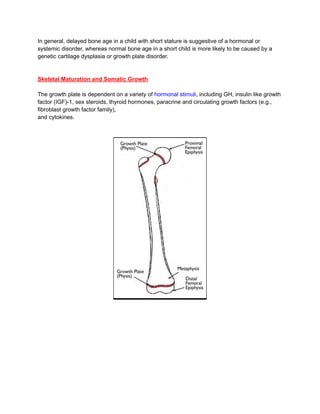
Skeletal Maturation and Somatic Growth
The growth plate is dependent on a variety of hormonal stimuli, including GH, insulin like growth
factor (IGF)-1, sex steroids, thyroid hormones, paracrine and circulating growth factors (e.g.,
fibroblast growth factor family),
and cytokines.
The growth-promoting process also requires caloric energy, amino acids, vitamins, and trace
metals and consumes ~10% of
normal energy production. Malnutrition impairs chondrocyte activity, increases GH resistance,
and leads to reduced circulating IGF-1 and IGF binding protein (IGFBP)-3 levels.
Linear bone growth rates are very high in infancy and are pituitary dependent. Mean growth
velocity is ~6 cm/year in later childhood and usually is maintained within a given range on a
standardized percentile
chart.
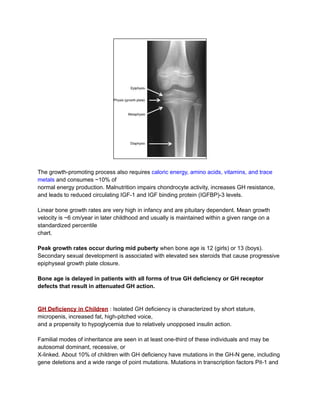
Peak growth rates occur during mid puberty when bone age is 12 (girls) or 13 (boys).
Secondary sexual development is associated with elevated sex steroids that cause progressive
epiphyseal growth plate closure.
Bone age is delayed in patients with all forms of true GH deficiency or GH receptor
defects that result in attenuated GH action.
GH Deficiency in Children : Isolated GH deficiency is characterized by short stature,
micropenis, increased fat, high-pitched voice,
and a propensity to hypoglycemia due to relatively unopposed insulin action.
Familial modes of inheritance are seen in at least one-third of these individuals and may be
autosomal dominant, recessive, or
X-linked. About 10% of children with GH deficiency have mutations in the GH-N gene, including
gene deletions and a wide range of point mutations. Mutations in transcription factors Pit-1 and
Prop-1, which control somatotrope development , result in GH deficiency in combination with
other pituitary hormone deficiencies, which may
become manifest only in adulthood.
The diagnosis of idiopathic GH deficiency should be made only after known molecular defects
have been rigorously excluded.
GHRH receptor mutations : Recessive mutations of the GHRH receptor gene in subjects with
severe proportionate dwarfism are associated with low basal GH levels that cannot be
stimulated by exogenous
GHRH, GH-releasing peptide, or insulin-induced hypoglycemia, as
well as anterior pituitary hypoplasia. The syndrome exemplifies the importance of the GHRH
receptor for determining somatotrope cell proliferation and hormonal responsiveness.
GH insensitivity : This is caused by defects of GH receptor structure or signaling. Homozygous
or heterozygous mutations of the GH receptor are associated with partial or complete GH
insensitivity and growth
failure (Laron syndrome). The diagnosis is based on normal or high GH levels, with decreased
circulating GH-binding protein (GHBP), and low IGF-1 levels. Very rarely, defective IGF-1, IGF-1
receptor, or
IGF-1 signaling defects are also encountered. STAT5B mutations result
in both immunodeficiency as well as abrogated GH signaling, leading to short stature with
normal or elevated GH levels and low IGF-1 levels. Circulating GH receptor antibodies may
rarely cause peripheral GH insensitivity.
Nutritional short stature : Caloric deprivation and malnutrition, uncontrolled diabetes, and
chronic renal failure represent secondary causes of abrogated GH receptor function. These
conditions also stimulate production of proinflammatory cytokines, which act to exacerbate the
block of GH-mediated signal transduction. Children
with these conditions typically exhibit features of acquired short stature
with normal or elevated GH and low IGF-1 levels.
Psychosocial short stature : Emotional and social deprivation lead to growth retardation
accompanied by delayed speech, discordant hyperphagia, and an attenuated response to
administered GH. A nurturing environment restores growth rates.
Presentation
Short stature is commonly encountered in clinical practice, and the decision to evaluate these
children requires clinical judgment
in association with auxologic data and family history.
Short stature should be evaluated comprehensively if a patient’s height is >3 standard
deviations below the mean for age or if the growth rate has decelerated.
Skeletal maturation is best evaluated by measuring a radiologic bone age, which is based
mainly on the degree of wrist bone growth plate fusion.
Final height can be predicted using standardized scales
(Bayley-Pinneau or Tanner-Whitehouse) or estimated by adding 6.5 cm (boys) or subtracting 6.5
cm (girls) from the midparental height.
Laboratory investigations
Because GH secretion is pulsatile, GH deficiency is best assessed by examining the response
to provocative stimuli, including exercise, insulin-induced hypoglycemia, and other
pharmacologic tests that normally increase GH to >7 μg/L in children.
Random GH measurements do not distinguish normal children from those with true GH
deficiency.
Adequate adrenal and thyroid hormone replacement should be assured before testing.
Age-matched IGF-1 levels are not sufficiently sensitive or specific to make the diagnosis but can
be useful to confirm GH deficiency.
Pituitary MRI may reveal pituitary mass lesions or structural defects.
Molecular analyses for known mutations should be undertaken when the cause of short stature
remains cryptic or when
additional clinical features suggest a genetic cause.
Treatment
Replacement therapy with recombinant GH (0.02–0.05 mg/kg per day SC) restores growth
velocity in GH-deficient children to
~10 cm/year.
If pituitary insufficiency is documented, other associated hormone deficits should be corrected,
especially adrenal steroids.
In selected situations, GH treatment may be combined with strategies to delay puberty (e.g.,
GnRH agonist) or reduce sex steroids (e.g., aromatase inhibitors) as a means to mitigate sex
steroid effect on epiphyseal closure.
GH treatment is also moderately effective for accelerating growth rates in children with Turner
syndrome and chronic renal failure.
Treating psychosocial or constitutional
(idiopathic) short stature with GH is not uniformly recommended as these children may only
experience modest additive growth,
which should be weighed against GH cost and side effect profiles.
In patients with GH insensitivity and growth retardation due to mutations of the GH receptor,
treatment with IGF-1 bypasses the dysfunctional GH receptor.
Reference : Harrison's Principles of Internal Medicine 21st edition

SHORT STATURE - Some important points.pdf

  • 1.
    SHORT STATURE Short statureis defined as a condition in which an individual's height is in the 3rd percentile for the mean height of a given age, sex, and population group. ( Reference : NCBI Statpearls ) Short stature may occur as a result of constitutive intrinsic growth defects or because of acquired extrinsic factors that impair growth. ************************************************* Short stature : # Normal variants ( Familial short stature , Constitutional growth delay ) # Pathologic - Proportionate - Disproportionate Proportionate : # Systemic diseases ( Chronic anemia , Chronic renal failure , Renal tubular acidosis, Chronic asthma , Congenital heart disease , Malabsorption , Chronic liver disease ) # Malnutrition # Endocrine disorders ( Growth hormone deficiency , Hypothyroidism , Cushing syndrome , Diabetes mellitus , Diabetes insipidus , Hypopituitarism , Hypogonadism ) # Intrauterine growth restriction # Genetic syndromes # Inborn errors of metabolism # Psychosocial dwarfism # Idiopathic Disproportionate : # Skeletal dysplasias # Rickets *************************************************
  • 2.
    In general, delayedbone age in a child with short stature is suggestive of a hormonal or systemic disorder, whereas normal bone age in a short child is more likely to be caused by a genetic cartilage dysplasia or growth plate disorder. Skeletal Maturation and Somatic Growth The growth plate is dependent on a variety of hormonal stimuli, including GH, insulin like growth factor (IGF)-1, sex steroids, thyroid hormones, paracrine and circulating growth factors (e.g., fibroblast growth factor family), and cytokines.
  • 3.
    The growth-promoting processalso requires caloric energy, amino acids, vitamins, and trace metals and consumes ~10% of normal energy production. Malnutrition impairs chondrocyte activity, increases GH resistance, and leads to reduced circulating IGF-1 and IGF binding protein (IGFBP)-3 levels. Linear bone growth rates are very high in infancy and are pituitary dependent. Mean growth velocity is ~6 cm/year in later childhood and usually is maintained within a given range on a standardized percentile chart. Peak growth rates occur during mid puberty when bone age is 12 (girls) or 13 (boys). Secondary sexual development is associated with elevated sex steroids that cause progressive epiphyseal growth plate closure. Bone age is delayed in patients with all forms of true GH deficiency or GH receptor defects that result in attenuated GH action. GH Deficiency in Children : Isolated GH deficiency is characterized by short stature, micropenis, increased fat, high-pitched voice, and a propensity to hypoglycemia due to relatively unopposed insulin action. Familial modes of inheritance are seen in at least one-third of these individuals and may be autosomal dominant, recessive, or X-linked. About 10% of children with GH deficiency have mutations in the GH-N gene, including gene deletions and a wide range of point mutations. Mutations in transcription factors Pit-1 and
  • 4.
    Prop-1, which controlsomatotrope development , result in GH deficiency in combination with other pituitary hormone deficiencies, which may become manifest only in adulthood. The diagnosis of idiopathic GH deficiency should be made only after known molecular defects have been rigorously excluded. GHRH receptor mutations : Recessive mutations of the GHRH receptor gene in subjects with severe proportionate dwarfism are associated with low basal GH levels that cannot be stimulated by exogenous GHRH, GH-releasing peptide, or insulin-induced hypoglycemia, as well as anterior pituitary hypoplasia. The syndrome exemplifies the importance of the GHRH receptor for determining somatotrope cell proliferation and hormonal responsiveness. GH insensitivity : This is caused by defects of GH receptor structure or signaling. Homozygous or heterozygous mutations of the GH receptor are associated with partial or complete GH insensitivity and growth failure (Laron syndrome). The diagnosis is based on normal or high GH levels, with decreased circulating GH-binding protein (GHBP), and low IGF-1 levels. Very rarely, defective IGF-1, IGF-1 receptor, or IGF-1 signaling defects are also encountered. STAT5B mutations result in both immunodeficiency as well as abrogated GH signaling, leading to short stature with normal or elevated GH levels and low IGF-1 levels. Circulating GH receptor antibodies may rarely cause peripheral GH insensitivity. Nutritional short stature : Caloric deprivation and malnutrition, uncontrolled diabetes, and chronic renal failure represent secondary causes of abrogated GH receptor function. These conditions also stimulate production of proinflammatory cytokines, which act to exacerbate the block of GH-mediated signal transduction. Children with these conditions typically exhibit features of acquired short stature with normal or elevated GH and low IGF-1 levels. Psychosocial short stature : Emotional and social deprivation lead to growth retardation accompanied by delayed speech, discordant hyperphagia, and an attenuated response to administered GH. A nurturing environment restores growth rates. Presentation Short stature is commonly encountered in clinical practice, and the decision to evaluate these children requires clinical judgment in association with auxologic data and family history. Short stature should be evaluated comprehensively if a patient’s height is >3 standard deviations below the mean for age or if the growth rate has decelerated.
  • 5.
    Skeletal maturation isbest evaluated by measuring a radiologic bone age, which is based mainly on the degree of wrist bone growth plate fusion. Final height can be predicted using standardized scales (Bayley-Pinneau or Tanner-Whitehouse) or estimated by adding 6.5 cm (boys) or subtracting 6.5 cm (girls) from the midparental height. Laboratory investigations Because GH secretion is pulsatile, GH deficiency is best assessed by examining the response to provocative stimuli, including exercise, insulin-induced hypoglycemia, and other pharmacologic tests that normally increase GH to >7 μg/L in children. Random GH measurements do not distinguish normal children from those with true GH deficiency. Adequate adrenal and thyroid hormone replacement should be assured before testing. Age-matched IGF-1 levels are not sufficiently sensitive or specific to make the diagnosis but can be useful to confirm GH deficiency. Pituitary MRI may reveal pituitary mass lesions or structural defects. Molecular analyses for known mutations should be undertaken when the cause of short stature remains cryptic or when additional clinical features suggest a genetic cause. Treatment Replacement therapy with recombinant GH (0.02–0.05 mg/kg per day SC) restores growth velocity in GH-deficient children to ~10 cm/year. If pituitary insufficiency is documented, other associated hormone deficits should be corrected, especially adrenal steroids. In selected situations, GH treatment may be combined with strategies to delay puberty (e.g., GnRH agonist) or reduce sex steroids (e.g., aromatase inhibitors) as a means to mitigate sex steroid effect on epiphyseal closure. GH treatment is also moderately effective for accelerating growth rates in children with Turner syndrome and chronic renal failure.
  • 6.
    Treating psychosocial orconstitutional (idiopathic) short stature with GH is not uniformly recommended as these children may only experience modest additive growth, which should be weighed against GH cost and side effect profiles. In patients with GH insensitivity and growth retardation due to mutations of the GH receptor, treatment with IGF-1 bypasses the dysfunctional GH receptor. Reference : Harrison's Principles of Internal Medicine 21st edition