HYPERTENSION
Hypertension 5th leading cause of morbidity in the Philippines (2005)Prevalence of 6.2% in the Filipino elderly
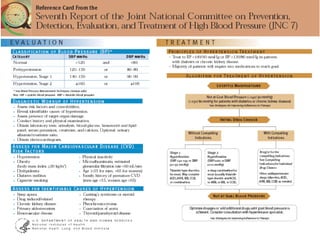
The Seventh Report of the Joint National Committee onPrevention, Detection, Evaluation, and Treatment of High Blood Pressure (JNC 7)
For persons over age 50, SBP is a more important than DBP as CVD risk factor.
Starting at 115/75 mmHg, CVD risk doubles with each increment of  20/10 mmHg throughout the BP range.
Persons who are normotensive at age 55 have a 90% lifetime risk for developing HPN.
Those with SBP 120–139 mmHg or DBP 80–89 mmHg should be considered prehypertensive who require health-promoting lifestyle modifications to prevent CVD.Key Messages
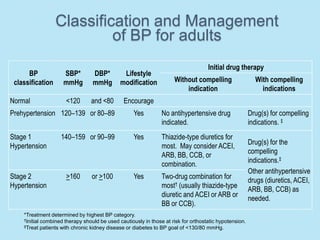
Key MessagesThiazide-type diuretics should be initial drug therapy for most, either alone or combined with other drug classes.
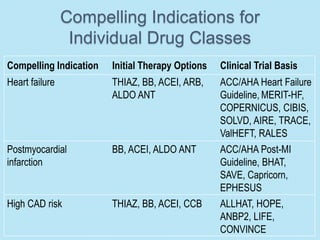
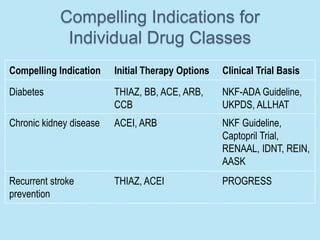
Certain high-risk conditions are compelling indications for other drug classes.
Most patients will require two or more antihypertensive drugs to achieve goal BP.
If BP is >20/10 mmHg above goal, initiate therapy with two agents, one usually should be a thiazide-type diuretic.Key MessagesThe most effective therapy prescribed by the careful clinician will control HPN only if patients are motivated.
Motivation improves when patients have positive experiences with, and trust in, the clinician.
Empathy builds trust and is a potent motivator.
The responsible physician’s judgment remains paramount.BP MEASUREMENT AND CLINICAL EVALUATION
Definition of HypertensionBP of 140/90 recorded on at least two separate occasions
CVD RiskThe BP relationship to risk of CVD is continuous, consistent, and independent of other risk factors.
Each increment of 20/10 mmHg doubles the risk of CVD across the entire BP range starting from 115/75 mmHg.
Prehypertension signals the need for increased education to reduce BP in order to prevent hypertension.Benefits of Lowering BPAverage 		Reduction	Stroke incidence 	35–40%  	Myocardial infarction 	20–25% 	Heart failure	50%
BP Measurement Techniques
Office BP MeasurementUse auscultatory method with a properly calibrated and validated instrument.
Patient should be seated quietly for 5 minutes in a chair  (not on an exam table), feet on the floor, and arm supported at heart level.
Appropriate-sized cuff should be used to ensure accuracy.
At least two measurements should be made.
Clinicians should provide to patients, verbally and in writing, specific BP numbers and BP goals. Ambulatory BP MonitoringWarranted for evaluation of “white-coat” HPN in the absence of target organ injury.
Ambulatory BP values are usually lower than clinic readings.
Awake individuals with hypertension have an average BP of >135/85 mmHg and during sleep >120/75 mmHg.
BP drops by 10 to 20% during the night; if not, signals possible increased risk for cardiovascular events.Self-Measurement of BPProvides information on:Response to antihypertensive therapyImproving adherence with therapy Evaluating white-coat HPNHome measurement of >135/85 mmHg is generally considered to be hypertensive.
Home measurement devices should be checked regularly.Patient EvaluationObjectives:  Assess lifestyle and identify other CV risk factors or concomitant disorders that affects prognosis and guides treatment. Reveal identifiable causes of high BP.Assess the presence or absence of target organ damage and CVD.
HistoryAge of onsetOther co-morbid conditionsIngestion of medications/supplementsFamily history
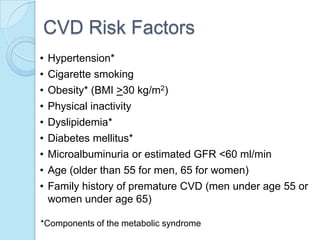
CVD Risk FactorsHypertension*
Cigarette smoking
Obesity* (BMI >30 kg/m2)
Physical inactivity
Dyslipidemia*
Diabetes mellitus*
Microalbuminuria or estimated GFR <60 ml/min
Age (older than 55 for men, 65 for women)
Family history of premature CVD (men under age 55 or women under age 65)*Components of the metabolic syndrome.
Medications that may induce/worsen hypertensionSodium-containing antacidsNSAIDs, Cyclooxygenase 2 inhibitorsSympathomimetics (decongestants, anorectics)Oral contraceptivesCorticosteroidsCyclosporine, tacrolimusErythropoietinLicorice (including some chewing tobacco)
Physical ExaminationTruncal obesity, moon face, acne, other features of Cushing’s syndromeSweaty palms, fine tremors, brisk DTRs, new onset AFDry skin, hair loss, bradycardiaAbdominal bruitsPalpable bilateral flank massTachycardia, labile BP
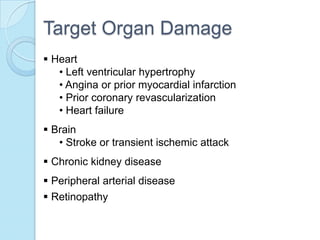
Target Organ DamageHeart
 Left ventricular hypertrophy
 Angina or prior myocardial infarction
 Prior coronary revascularization
 Heart failure
Brain
 Stroke or transient ischemic attack
Chronic kidney disease

Hypertension