SHORT STATURE Dr SANJAY KALRA, D.M. [AIIMS]
OUR VISION To  be a globally-acknowledged centre of excellence  for clinical care,  education &   training , and research  in diabetology and endocrinology.
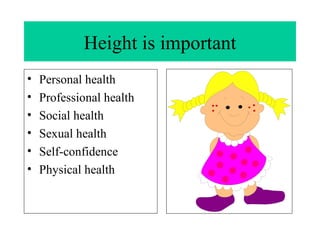
Height is important Personal health Professional health Social health Sexual health Self-confidence Physical health
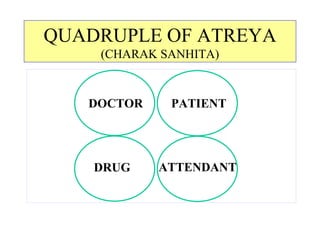
QUADRUPLE OF ATREYA  (CHARAK SANHITA) DOCTOR PATIENT DRUG ATTENDANT
Defining short stature According to growth charts ICMR Aggarwal Western Below 3 rd  %ile or 5 th  %ile  Growth velocity mid-parental height  FH + MH + 6.5 cm for boys FH + MH _ 6.5 cm for girls
Measuring stature  Stadiometer  Barefeet Four points touching the wall Frankfurt plane [line joining inferior orbital margin to ext auditory meatus] paralel to ground Serial measurements better
Anthropometry  US: LS ratio Arm span SE: EMC ratio Sitting height Supine length [if age< 2 years]
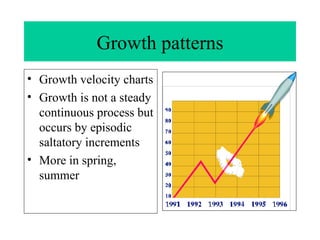
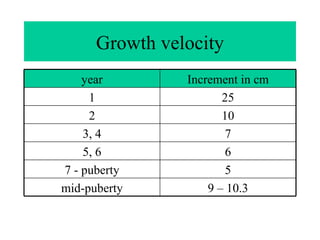
Growth patterns Growth velocity charts Growth is not a steady continuous process but occurs by episodic saltatory increments  More in spring, summer
Growth velocity 9 – 10.3 mid-puberty 5 7 - puberty 6 5, 6 7 3, 4 10 2 25 1 Increment in cm year
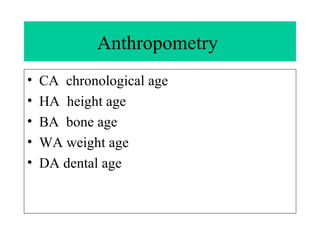
Anthropometry  CA  chronological age HA  height age BA  bone age WA weight age DA dental age
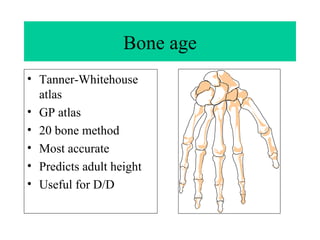
Bone age Tanner-Whitehouse atlas  GP atlas 20 bone method Most accurate Predicts adult height Useful for D/D
Differential diagnosis Constitutional growth delay CGD Delayed puberty/ Late bloomer BL normal [upto 3 years] BA = HA < CA GV normal for BA AH normal
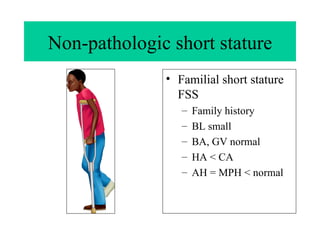
Non-pathologic short stature Familial short stature FSS Family history BL small BA, GV normal  HA < CA AH = MPH < normal
PATHOLOGICAL SHORT STATURE ENDOCRINE METABOLIC GENETIC PSYCHOSOCIAL SYSTEMIC NUTRITONAL IUGR SKELETAL IDIOPATHIC
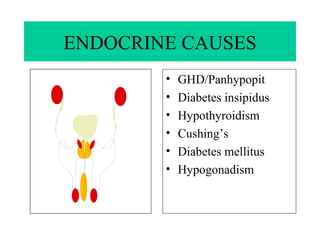
ENDOCRINE CAUSES GHD/Panhypopit Diabetes insipidus Hypothyroidism Cushing’s  Diabetes mellitus Hypogonadism
GENETIC SYNDROMES Turner’s syn Noonan’s  Russel Silver Seckel’s Down’s
SYSTEMIC ILLNESSES Chronic anaemia CRF RTA Asthma congenital heart disease Chronic infections Chronic bowel disease Steroid therapy
Differential diagnosis ENDOCRINOPATHY Bone age retarded History  Birth asphyxia/breech Headache/vomiting Polyuria/polydipsia Weight gain/obesity Delayed milestones Physical features NON-ENDOCRINOPATHY Bone age normal History  Weight loss/anorexia Chr diarrhea Chr cough/dyspnea Low birth weight Poor intake Physical features
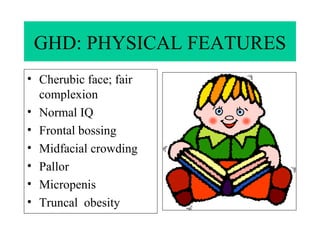
GHD: PHYSICAL FEATURES Cherubic face; fair complexion Normal IQ Frontal bossing Midfacial crowding Pallor  Micropenis  Truncal  obesity
GHD: PROVOCATIVE TESTS Needed because normal range is wide Basal GH of no help Insulin tolerance test is gold standard Exercise test Sleep test Clonidine stimulation test: 0.15 mg/m2 clonidine given orally in morning IV line must be in place Sample for GH at 0’, 30’, 60’ and 90’ GH must rise to > 10 ng/ml Value of  > 7 ng/ml indicates partial deficiency
Growth hormone therapy EVOLUTION: 1958 -  pituitary GH 1978 - Creutzfeld- Jacob  disease  1985 - approval for biosynthetic hGH
Growth hormone therapy Available only as injection Subcutaneous Administer after 8.00 pm 3 to 7 times a week 0.15 to 0.3 mg/kg/week Effect is dose-dependent
Growth hormone therapy Effect reduces with time; esp after 3 years ?Formation of antibodies ?Hypothyroidism Side effects more common in adults
Growth hormone therapy Response better if started earlier Average increment = 10 cm/year Better response in classic GHD Higher dose needed in Turner syndrome
Indications  GH Deficiency IUGR Non-GH deficient short stature FSS CGD Chronic renal failure Burns Steroid therapy Osteoporosis  HIV-associated cachexia Sports
Side effects Edema Arthralgia  Myalgia  Muscle stiffness Paresthesias  Carpal tunnel syn Hypertension Melanocytic nevi Hypothyroidism
 
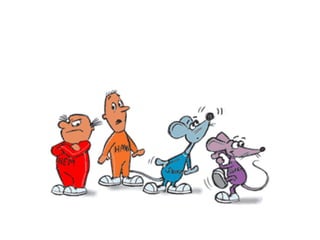
Who Moved My    Cheese ? ? WHO KEPT ME SHORT ?
 

FTT

  • 1.
    SHORT STATURE DrSANJAY KALRA, D.M. [AIIMS]
  • 2.
    OUR VISION To be a globally-acknowledged centre of excellence for clinical care, education & training , and research in diabetology and endocrinology.
  • 3.
    Height is importantPersonal health Professional health Social health Sexual health Self-confidence Physical health
  • 4.
    QUADRUPLE OF ATREYA (CHARAK SANHITA) DOCTOR PATIENT DRUG ATTENDANT
  • 5.
    Defining short statureAccording to growth charts ICMR Aggarwal Western Below 3 rd %ile or 5 th %ile Growth velocity mid-parental height FH + MH + 6.5 cm for boys FH + MH _ 6.5 cm for girls
  • 6.
    Measuring stature Stadiometer Barefeet Four points touching the wall Frankfurt plane [line joining inferior orbital margin to ext auditory meatus] paralel to ground Serial measurements better
  • 7.
    Anthropometry US:LS ratio Arm span SE: EMC ratio Sitting height Supine length [if age< 2 years]
  • 8.
    Growth patterns Growthvelocity charts Growth is not a steady continuous process but occurs by episodic saltatory increments More in spring, summer
  • 9.
    Growth velocity 9– 10.3 mid-puberty 5 7 - puberty 6 5, 6 7 3, 4 10 2 25 1 Increment in cm year
  • 10.
    Anthropometry CA chronological age HA height age BA bone age WA weight age DA dental age
  • 11.
    Bone age Tanner-Whitehouseatlas GP atlas 20 bone method Most accurate Predicts adult height Useful for D/D
  • 12.
    Differential diagnosis Constitutionalgrowth delay CGD Delayed puberty/ Late bloomer BL normal [upto 3 years] BA = HA < CA GV normal for BA AH normal
  • 13.
    Non-pathologic short statureFamilial short stature FSS Family history BL small BA, GV normal HA < CA AH = MPH < normal
  • 14.
    PATHOLOGICAL SHORT STATUREENDOCRINE METABOLIC GENETIC PSYCHOSOCIAL SYSTEMIC NUTRITONAL IUGR SKELETAL IDIOPATHIC
  • 15.
    ENDOCRINE CAUSES GHD/PanhypopitDiabetes insipidus Hypothyroidism Cushing’s Diabetes mellitus Hypogonadism
  • 16.
    GENETIC SYNDROMES Turner’ssyn Noonan’s Russel Silver Seckel’s Down’s
  • 17.
    SYSTEMIC ILLNESSES Chronicanaemia CRF RTA Asthma congenital heart disease Chronic infections Chronic bowel disease Steroid therapy
  • 18.
    Differential diagnosis ENDOCRINOPATHYBone age retarded History Birth asphyxia/breech Headache/vomiting Polyuria/polydipsia Weight gain/obesity Delayed milestones Physical features NON-ENDOCRINOPATHY Bone age normal History Weight loss/anorexia Chr diarrhea Chr cough/dyspnea Low birth weight Poor intake Physical features
  • 19.
    GHD: PHYSICAL FEATURESCherubic face; fair complexion Normal IQ Frontal bossing Midfacial crowding Pallor Micropenis Truncal obesity
  • 20.
    GHD: PROVOCATIVE TESTSNeeded because normal range is wide Basal GH of no help Insulin tolerance test is gold standard Exercise test Sleep test Clonidine stimulation test: 0.15 mg/m2 clonidine given orally in morning IV line must be in place Sample for GH at 0’, 30’, 60’ and 90’ GH must rise to > 10 ng/ml Value of > 7 ng/ml indicates partial deficiency
  • 21.
    Growth hormone therapyEVOLUTION: 1958 - pituitary GH 1978 - Creutzfeld- Jacob disease 1985 - approval for biosynthetic hGH
  • 22.
    Growth hormone therapyAvailable only as injection Subcutaneous Administer after 8.00 pm 3 to 7 times a week 0.15 to 0.3 mg/kg/week Effect is dose-dependent
  • 23.
    Growth hormone therapyEffect reduces with time; esp after 3 years ?Formation of antibodies ?Hypothyroidism Side effects more common in adults
  • 24.
    Growth hormone therapyResponse better if started earlier Average increment = 10 cm/year Better response in classic GHD Higher dose needed in Turner syndrome
  • 25.
    Indications GHDeficiency IUGR Non-GH deficient short stature FSS CGD Chronic renal failure Burns Steroid therapy Osteoporosis HIV-associated cachexia Sports
  • 26.
    Side effects EdemaArthralgia Myalgia Muscle stiffness Paresthesias Carpal tunnel syn Hypertension Melanocytic nevi Hypothyroidism
  • 27.
  • 28.
    Who Moved My  Cheese ? ? WHO KEPT ME SHORT ?
  • 29.