Plant ideotypes
and
Adaptation & distribution of crops
Dr. O.P.Lathwal
Prof. (Agronomy)
CCSHAU College of Agriculture, Kaul
• Ideotype is a biological model which is expected to perform or behave in a
predictable manner within a defined environment.
• Ideotype term is given by C.M. Donald (1968)
• According to Donald: A crop ideotype is a plant modal which is expected to
yield greater quantity or quality of grain, oil or other useful product when
developed as cultivar.
Main Points about Ideotype
• Crop ideotype refers to model plant or ideal plant type for a specific
environment.
• Donald included only morphological characters to define an ideotype of wheat
subsequently, physiological and biochemical traits were also included for
broadening the concept of crop ideotype.
• Ideal plants are expected to give higher yield than old cultivars.
• Ideotype is a moving goal which changes according to climatic situations, type
of cultivation, market requirement etc.
IDEOTYPE DEFINITION
• Donald (1968) coined the term ideotype which refers to an idealized plant type
with specific combination of characteristic, favorable to photosynthesis
• Gallais (1983) defined ideotype as an abstract genotype with an ideal ‘profile
under the conditions of agricultural practice, will give to a maximum economic
yield.
SYNONYMS OF IDEOTYPE
• Model plant type
• Ideal model plant type
• Ideal plant type
FEATURES OF PLANT IDEOTYPE
• An Ideotype will be the most efficient in utilizing its environmental
resources.
• Each unit of dry matter produced will include such a number of flowers/
florets or other sinks that is able to accept all the photosynthates either
from its own green surface or from other parts of the plant.
• The Ideotype must include such morphological and physiological
characteristics that result in a high harvest index.
• Ideotypes are popular concept for plant breeder who designate as such the
ideal combinations of traits in a particular crop to harvest maximum.
While developing the new ideotypes the emphasis should be on the
following:
1. Leaf arrangement should be such that maximum solar radiation is
intercepted
2. The assimilating area (leaf area) should be more
3. To avoid lodging the stem should be short and strong enough
4. Proper partitioning and translocation of assimilates
5. Resistances against pests
6. The crop should respond to higher doses of applied inputs
7. Efficient roots systems for uptake of nutrients
8. Synchronized tillering, flowering and maturity
9. Tolerance to adverse conditions
10.Absence of seed dormancy
11.Low floret sterility
12.Shorter growth duration for multiple cropping
13.Efficient translocation from source to sink
14.And finally high yield potentiality
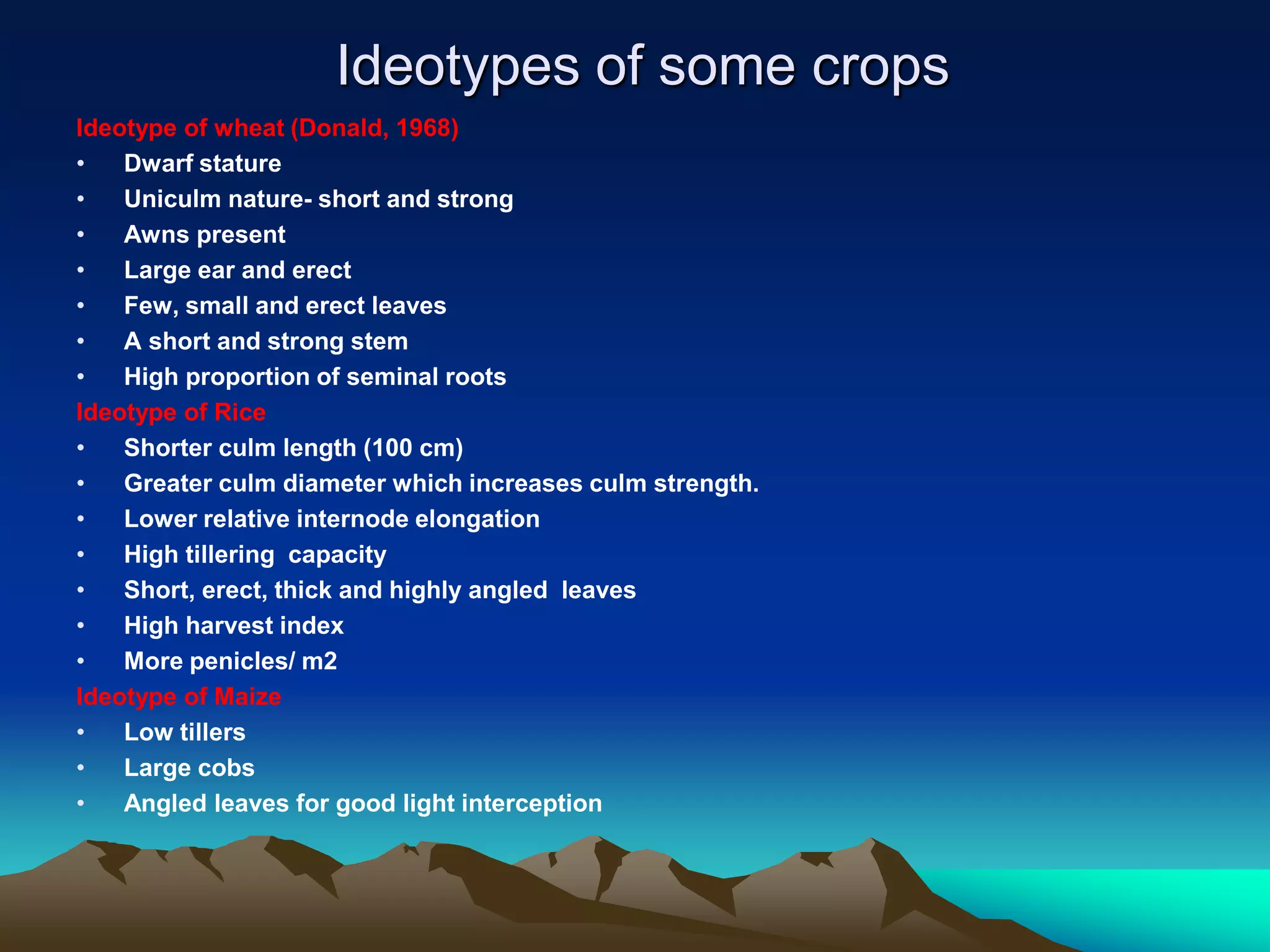
Ideotypes of some crops
Ideotype of wheat (Donald, 1968)
• Dwarf stature
• Uniculm nature- short and strong
• Awns present
• Large ear and erect
• Few, small and erect leaves
• A short and strong stem
• High proportion of seminal roots
Ideotype of Rice
• Shorter culm length (100 cm)
• Greater culm diameter which increases culm strength.
• Lower relative internode elongation
• High tillering capacity
• Short, erect, thick and highly angled leaves
• High harvest index
• More penicles/ m2
Ideotype of Maize
• Low tillers
• Large cobs
• Angled leaves for good light interception
Adaptation and distribution of crops
Adaptation:
Adaptation may be defined as any feature of an organism,
which has survival value under the existing condition of its habitat.
Such features or feature may allow the plants to make fuller use of
nutrients, water, temperature or light available or may give protection
against adverse factors such as temperature extremes, harmful
insects and diseases.
Morphological adaptation: such as growth habit, strength of stalk, radial
symmetry, or rhizomes.
Physiological adaptation: which result in resistance to parasites, greater
ability to compete for nutrients or ability to withstand desiccation.
However both morphological and physiological adaptation represents
the expression of physiological processes.
Distribution: It is the spread of various plant species from its place of
origin to different parts of the world. Distribution of different field
crops all over the world depends upon several factors such as:
climate, growing season, altitude, rainfall, wind, soil, slope, and other
factors.
Principles of Plant Distribution
Environmental factors are highly influential in
determining the natural distribution of plants. There are
eight principles of plant distribution
• Evolution
• Climatic factors like light, temperature, moisture, wind etc.
• Edaphic factors like soil, parent material, physiography
• Dispersal of flora
• Plant migrations
• Climatic variations or change
• Relative distributions of land and sea (occurrence in
geological time) and it exerts a high degree of control over
distribution of flora
• Biotic factors like obligate insect pollination, seed
dissemination by animals and grazing by livestock directly
influence the plant distribution
Theories Governing Crop Adaptation and Distribution
Theory of tolerance :
Each plant or living organisms is able to thrive well in certain climatic
conditions below which and above which the plant can’t grow i.e., it
requires optimum climatic conditions. Temperature is one of the most
common limiting factors in plant distribution. Many tropical crops such
as rubber, cocoa, banana will not with stand freezing temperature (0°C).
In these rubber probably has the narrowest tolerance range and banana
the widest range for temperature tolerance.
Theory of avoidance :
It may be accomplished through rapid completion of the life cycle, as
in ephemerals, dormancy in seeds to avoid effects of the hottest and
driest periods, dormancy in vegetative parts or roots
of all the perennials, water accumulation in succulents and extremely
deep root systems to avoid moisture deficiency.
Theory of factors replaceability :
One factor that can be replaced by another or substituted
by another factors. viz:
• Elevation can be substituted for latitude because of its
temperature effects. The climatic conditions at the latitudes of
35 – 45° N resembles to that of tropical regions at elevation
of4000 – 6000 ft.
• The angle direction of slope may be substituted for latitude.
This is also a temperature adjustment, depending on the angle
of exposure to solar radiation, wind etc.
• Parent materials may compensate for climate.
• Rainfall may be replaced by fog and to some extent by dew.
• Soil texture may be substituted for moisture.

Agro 101, 12.ppt

  • 1.
    Plant ideotypes and Adaptation &distribution of crops Dr. O.P.Lathwal Prof. (Agronomy) CCSHAU College of Agriculture, Kaul
  • 2.
    • Ideotype isa biological model which is expected to perform or behave in a predictable manner within a defined environment. • Ideotype term is given by C.M. Donald (1968) • According to Donald: A crop ideotype is a plant modal which is expected to yield greater quantity or quality of grain, oil or other useful product when developed as cultivar. Main Points about Ideotype • Crop ideotype refers to model plant or ideal plant type for a specific environment. • Donald included only morphological characters to define an ideotype of wheat subsequently, physiological and biochemical traits were also included for broadening the concept of crop ideotype. • Ideal plants are expected to give higher yield than old cultivars. • Ideotype is a moving goal which changes according to climatic situations, type of cultivation, market requirement etc. IDEOTYPE DEFINITION • Donald (1968) coined the term ideotype which refers to an idealized plant type with specific combination of characteristic, favorable to photosynthesis • Gallais (1983) defined ideotype as an abstract genotype with an ideal ‘profile under the conditions of agricultural practice, will give to a maximum economic yield.
  • 3.
    SYNONYMS OF IDEOTYPE •Model plant type • Ideal model plant type • Ideal plant type FEATURES OF PLANT IDEOTYPE • An Ideotype will be the most efficient in utilizing its environmental resources. • Each unit of dry matter produced will include such a number of flowers/ florets or other sinks that is able to accept all the photosynthates either from its own green surface or from other parts of the plant. • The Ideotype must include such morphological and physiological characteristics that result in a high harvest index. • Ideotypes are popular concept for plant breeder who designate as such the ideal combinations of traits in a particular crop to harvest maximum.
  • 4.
    While developing thenew ideotypes the emphasis should be on the following: 1. Leaf arrangement should be such that maximum solar radiation is intercepted 2. The assimilating area (leaf area) should be more 3. To avoid lodging the stem should be short and strong enough 4. Proper partitioning and translocation of assimilates 5. Resistances against pests 6. The crop should respond to higher doses of applied inputs 7. Efficient roots systems for uptake of nutrients 8. Synchronized tillering, flowering and maturity 9. Tolerance to adverse conditions 10.Absence of seed dormancy 11.Low floret sterility 12.Shorter growth duration for multiple cropping 13.Efficient translocation from source to sink 14.And finally high yield potentiality
  • 5.
    Ideotypes of somecrops Ideotype of wheat (Donald, 1968) • Dwarf stature • Uniculm nature- short and strong • Awns present • Large ear and erect • Few, small and erect leaves • A short and strong stem • High proportion of seminal roots Ideotype of Rice • Shorter culm length (100 cm) • Greater culm diameter which increases culm strength. • Lower relative internode elongation • High tillering capacity • Short, erect, thick and highly angled leaves • High harvest index • More penicles/ m2 Ideotype of Maize • Low tillers • Large cobs • Angled leaves for good light interception
  • 6.
  • 7.
    Adaptation: Adaptation may bedefined as any feature of an organism, which has survival value under the existing condition of its habitat. Such features or feature may allow the plants to make fuller use of nutrients, water, temperature or light available or may give protection against adverse factors such as temperature extremes, harmful insects and diseases. Morphological adaptation: such as growth habit, strength of stalk, radial symmetry, or rhizomes. Physiological adaptation: which result in resistance to parasites, greater ability to compete for nutrients or ability to withstand desiccation. However both morphological and physiological adaptation represents the expression of physiological processes. Distribution: It is the spread of various plant species from its place of origin to different parts of the world. Distribution of different field crops all over the world depends upon several factors such as: climate, growing season, altitude, rainfall, wind, soil, slope, and other factors.
  • 8.
    Principles of PlantDistribution Environmental factors are highly influential in determining the natural distribution of plants. There are eight principles of plant distribution • Evolution • Climatic factors like light, temperature, moisture, wind etc. • Edaphic factors like soil, parent material, physiography • Dispersal of flora • Plant migrations • Climatic variations or change • Relative distributions of land and sea (occurrence in geological time) and it exerts a high degree of control over distribution of flora • Biotic factors like obligate insect pollination, seed dissemination by animals and grazing by livestock directly influence the plant distribution
  • 9.
    Theories Governing CropAdaptation and Distribution Theory of tolerance : Each plant or living organisms is able to thrive well in certain climatic conditions below which and above which the plant can’t grow i.e., it requires optimum climatic conditions. Temperature is one of the most common limiting factors in plant distribution. Many tropical crops such as rubber, cocoa, banana will not with stand freezing temperature (0°C). In these rubber probably has the narrowest tolerance range and banana the widest range for temperature tolerance. Theory of avoidance : It may be accomplished through rapid completion of the life cycle, as in ephemerals, dormancy in seeds to avoid effects of the hottest and driest periods, dormancy in vegetative parts or roots of all the perennials, water accumulation in succulents and extremely deep root systems to avoid moisture deficiency.
  • 10.
    Theory of factorsreplaceability : One factor that can be replaced by another or substituted by another factors. viz: • Elevation can be substituted for latitude because of its temperature effects. The climatic conditions at the latitudes of 35 – 45° N resembles to that of tropical regions at elevation of4000 – 6000 ft. • The angle direction of slope may be substituted for latitude. This is also a temperature adjustment, depending on the angle of exposure to solar radiation, wind etc. • Parent materials may compensate for climate. • Rainfall may be replaced by fog and to some extent by dew. • Soil texture may be substituted for moisture.