ICH Q6A
SPECIFICATIONS
By,CHANDRAMOHAN
Introduction
Objective
Scope
General Concepts
Guidelines
Specifications: Definition and Justification
Universal tests
Specific tests
 Drug Substance
 Drug Product
- Solid orals
- Oral liquids
- Parenterals
Objective of the guideline
• Establishment of a single set of global specifications for new drug substances and
products.
• Guidance on the setting and justification of acceptance criteria and the selection of test
procedures.
Scope of the guideline
The quality of drug substances and products is determined by their:
• Design
• Development
• In-process controls
• GMP controls
• Process validation
• Specifications applied to them throughout development and manufacture.
The guideline addresses specifications, e.g. those tests, procedures and acceptance criteria
used to assure the quality at release and during shelf life.
The guideline addresses only the marketing approval of new drug products but not the
clinical research stages of drug development.
This guidelines provides acceptance criteria:
• Universal acceptance criteria established for all drug substances and products,
• Specific to individual drug substance and/or dosage forms.
The guideline covers:
• Solid dosage forms
• Liquid dosage forms
• Parenterals (small and large volume).
Scope of the Guideline…
General Concepts
• Periodic or Skip Testing
• Release vs. Shelf-life Acceptance Criteria
• In-process Tests
• Design and Development Considerations
• Limited Data Available at Filing
• Parametric Release
• Alternative Procedures
• Pharmacopoeial Tests and Acceptance Criteria
• Evolving Technologies
• Impact of Drug Substance on Drug Product Specifications
• Reference Standard
General Concepts…
• These concepts are important in the development and setting of harmonized specifications.
• They are not universally applicable, but each should be considered in particular
circumstances.
• This guideline presents a brief definition of each concept and an indication of the
circumstances under which it may be applicable.
• Generally, proposals to implement these concepts should be justified by the applicant and
approved by the appropriate regulatory authority before being put into effect.
Periodic or Skip Testing
Performance of specified tests at release on pre-selected batches and/or at predetermined
intervals.
This less than full schedule of testing should be justified and presented to the regulatory
authority prior to implementation.
Examples for solid dosage forms:
• Residual solvents
• Microbiological testing.
Periodic or Skip Testing…
• If justified, skip test parameters should be in the specs: At minimum every 10th batch, at
least one batch annually
• In all cases, the API or FPP should meet the full specifications if tested
• This concept may be implemented post approval in accordance with GMP, if sufficient
data are available. E.g test results taken from the API manufacturer's COA
Release vs. Shelf-life Acceptance Criteria
• Applicable only to drug products.
• More restrictive criteria for release than for shelf life
- Assay
- Impurity (degradation products).
• Dissolution specs at release and shelf-life should be identical
• In USA and Japan release specifications only in-house criteria, in the EU regulatory
requirements for distinct specifications for release and for shelf life.
In-process Tests
• In-process tests which are used for the purpose of adjusting process parameters within an
operating range, e.g. hardness, friability of coated tablets and individual tablet weights,
are not included in the specifications.
• Test conducted during manufacturing process where acceptance criteria is identical or
tighter than release requirements, e.g. pH of solution may be used to satisfy specification
requirements when the test is included in the specification.
• However, this approach should be validated to show that test results or product
performance characteristics do not change from the in-process stage to finished product.
Design and Development Considerations
• The experience and data accumulated during the development of a new drug substance or
product should form the basis for setting specifications.
• It may be possible to propose excluding or replacing certain tests on this basis:
- Microbiological testing for drug substances and solid dosage forms not show support for
microbial viability or growth.
- Extractables from product containers. No extractable found or levels met accepted
standard for safety.
- Particle size: may be performed as an in-process test, or as a release test, depending on
its relevance to product performance;
- Dissolution testing versus disintegration testing for immediate release solid oral drug
products.
Limited Data Available at Filing
• Limited amount of data may be available at the time of filing, which can influence
the process of setting acceptance criteria.
• As a result it may be necessary to propose revised acceptance criteria as additional
experience is gained with the manufacture of a particular drug substance or drug
product (example: acceptance limits for a specific impurity).
Parametric release
• Can be used as an operational alternative to routine release testing
• Eg. Sterility testing based on monitoring temperature, pressure and time during terminal
sterilisation phase. If parametric release is performed, the attribute which is indirectly
controlled, e.g. sterility, together with a reference to the associated test procedure should
be included in the specifications.
• It is important to note that the sterilization process should be adequately validated before
parametric release is proposed
Alternative Procedures
Alternative procedures or those which may be used if comparable or superior to the official
procedure.
Examples:
• Tablets no degradation during manufacture, spectrophotometric procedure for release
instead of chromatographic.
• Chromatographic procedure used to demonstrate compliance with acceptance criteria
during shelf life.
• Valiadation – full validation required for in-house methods
• Verification – required for compendial methods
• Equivalency – required for in-house methods, when compendial standard is claimed
Pharmacopoeial tests and acceptance criteria
• References to certain procedures are found in pharmacopoeias in each region. Whenever
appropriate pharmacopoeial methods should be utilised.
• A harmonised specification is possible only, if the procedure and acceptance criteria
defined are acceptable to regulatory authorities in all regions.
• To signify the harmonised status of these procedure, the pharmacopoeias have agreed to
include a statement in their respective texts which indicates that the procedure and the
acceptance criteria from all three pharmacopoeias are considered to be equivalent and are
therefore interchangeable.
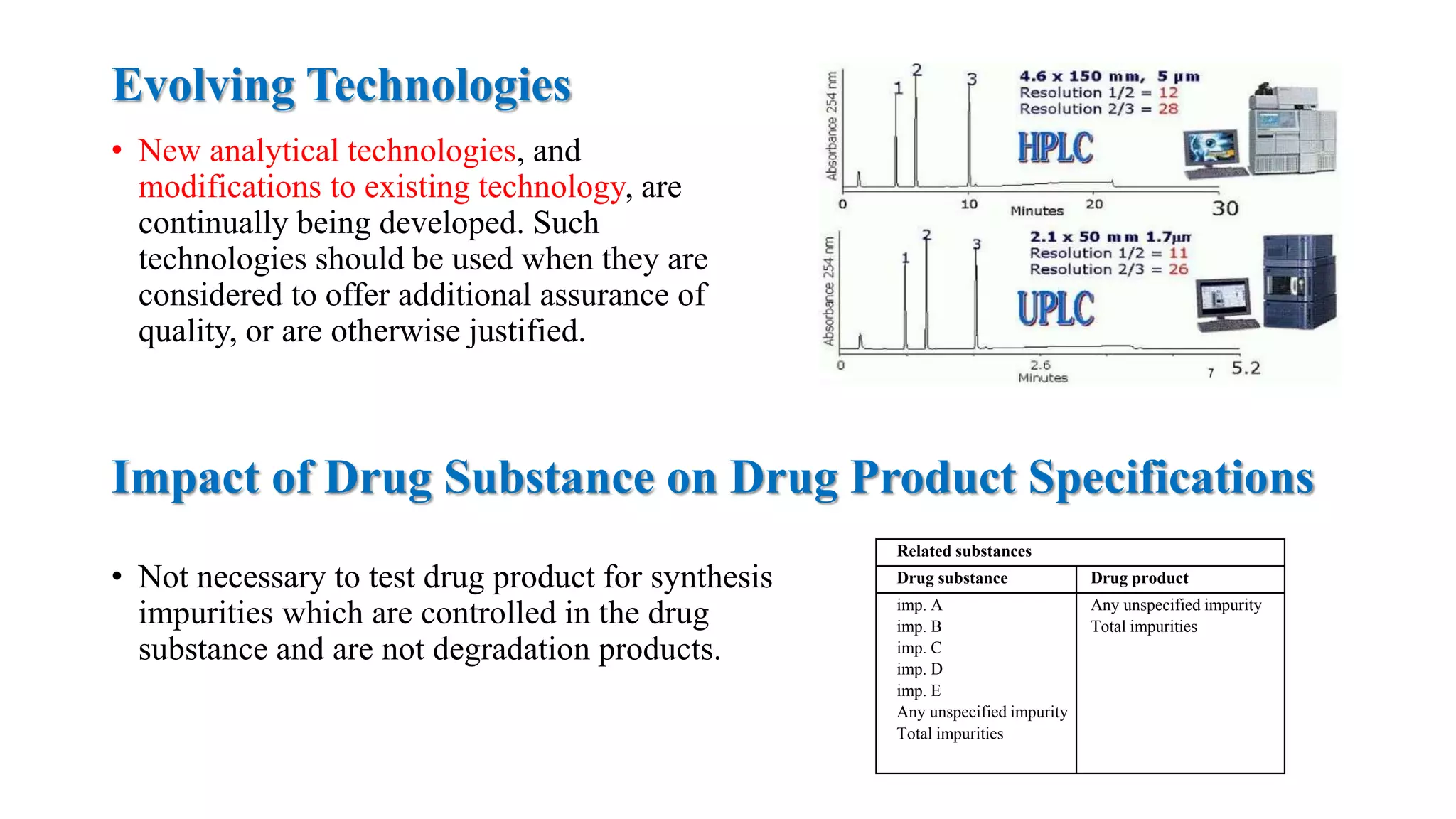
Evolving Technologies
• New analytical technologies, and
modifications to existing technology, are
continually being developed. Such
technologies should be used when they are
considered to offer additional assurance of
quality, or are otherwise justified.
Impact of Drug Substance on Drug Product Specifications
• Not necessary to test drug product for synthesis
impurities which are controlled in the drug
substance and are not degradation products.
Related substances
Drug substance Drug product
imp. A
imp. B
imp. C
imp. D
imp. E
Any unspecified impurity
Total impurities
Any unspecified impurity
Total impurities
Reference Standard
Reference standard is substance prepared for use as standard for
• Assay
• Identification
• Purity test.
Substance either
• The new drug substance
• or a known impurity.
Quality appropriate to its use.
Purity should be measured by a quantitative procedure.
GUIDELINES
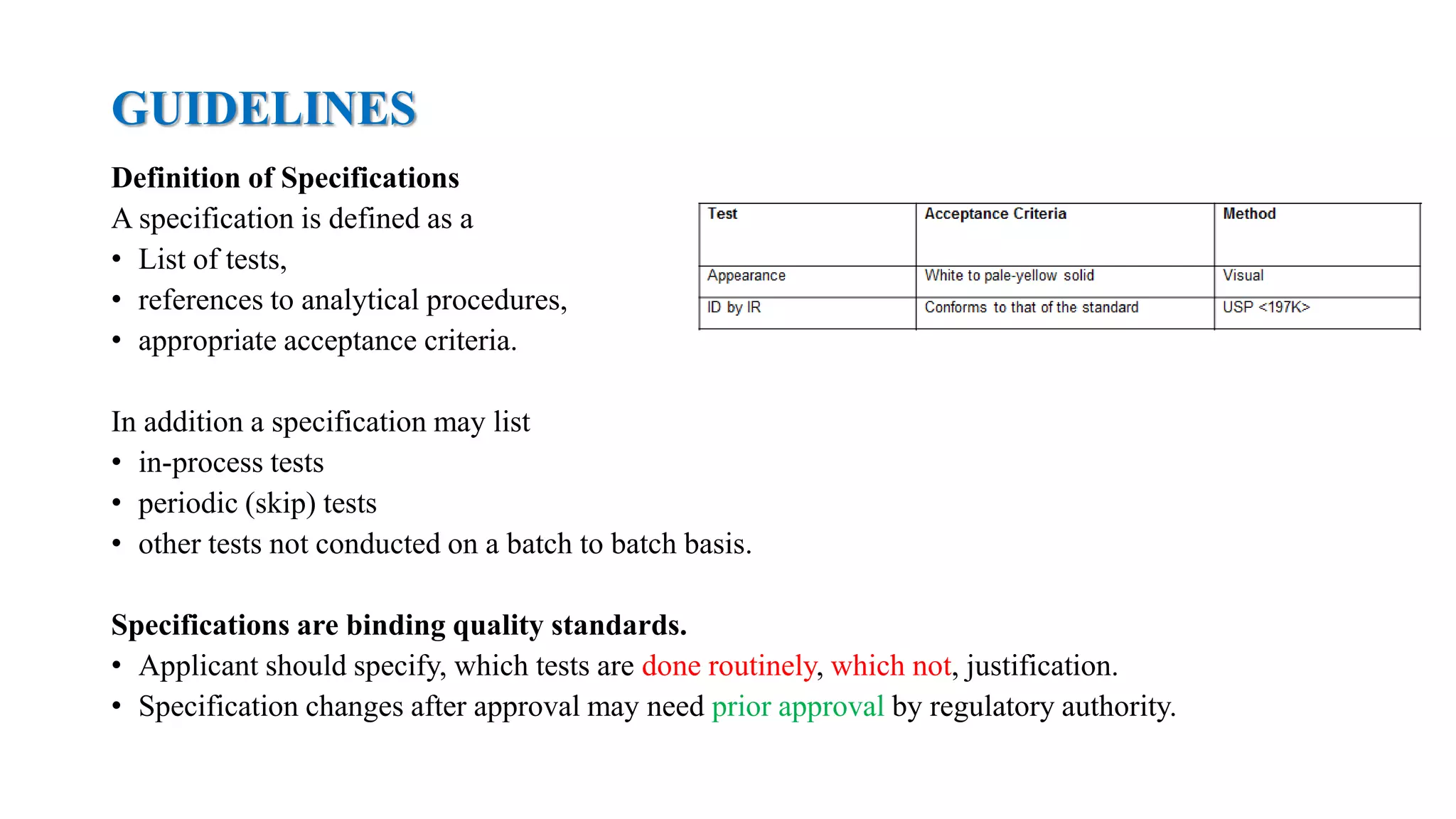
Definition of Specifications
A specification is defined as a
• List of tests,
• references to analytical procedures,
• appropriate acceptance criteria.
In addition a specification may list
• in-process tests
• periodic (skip) tests
• other tests not conducted on a batch to batch basis.
Specifications are binding quality standards.
• Applicant should specify, which tests are done routinely, which not, justification.
• Specification changes after approval may need prior approval by regulatory authority.
Justification of Specifications
Justification required for
• Each procedure,
• Each acceptance criterion included in the specification.
Justification should refer to:
• Relevant development data,
• Pharmacopoeial standards,
• Test data of batches used in toxicology and clinical studies,
• Results from accelerated and long term stability studies,
• Reasonable range of expected analytical and manufacturing variability.
Setting and justifying
specifications by
• Batches from:
- Primary stability,
- Scale-up,
- Validation.
Universal tests/criteria
For both API and FPP
• Description
• Identification
• Assay
• Impurities
Description
API: Qualitative statement: colour, state (e.g. solid, liquid)
FP: Qualitative description: colour, shape, coating, markings (score, ink, embossing)
Taste is critical (especially paediatrics): dispersible, sublingual/buccal, soluble, effervescent,
and chewable tablets, and powders & granules for dispersion/solution or to be used as
sprinkles.
If changes during storage, change should be investigated and appropriate action taken.
Identification
• Identification should be specific to the API, i.e. should be able to discriminate between
compounds of closely related structure (Q6A) - IR spectroscopy for API, not always
applicable to FPP
• A single HPLC retention time is not regarded as being specific. Two chromatographic
procedures, where the separation is based on different principles (HPLC + TLC) , or
combination of tests into a single procedure is generally acceptable, such as HPLC/UV
diode array, HPLC/MS, or GC/MS. (Q6A)
Assay
• Assay: should be stability indicating. May be non-specific, e.g. titration, but need to
achieve overall specificity, e.g. non-specific assay plus suitable related substances test.
• The assay in the release specifications of FPP is ± 5% of the label claim (i.e. 95.0-
105.0%)..
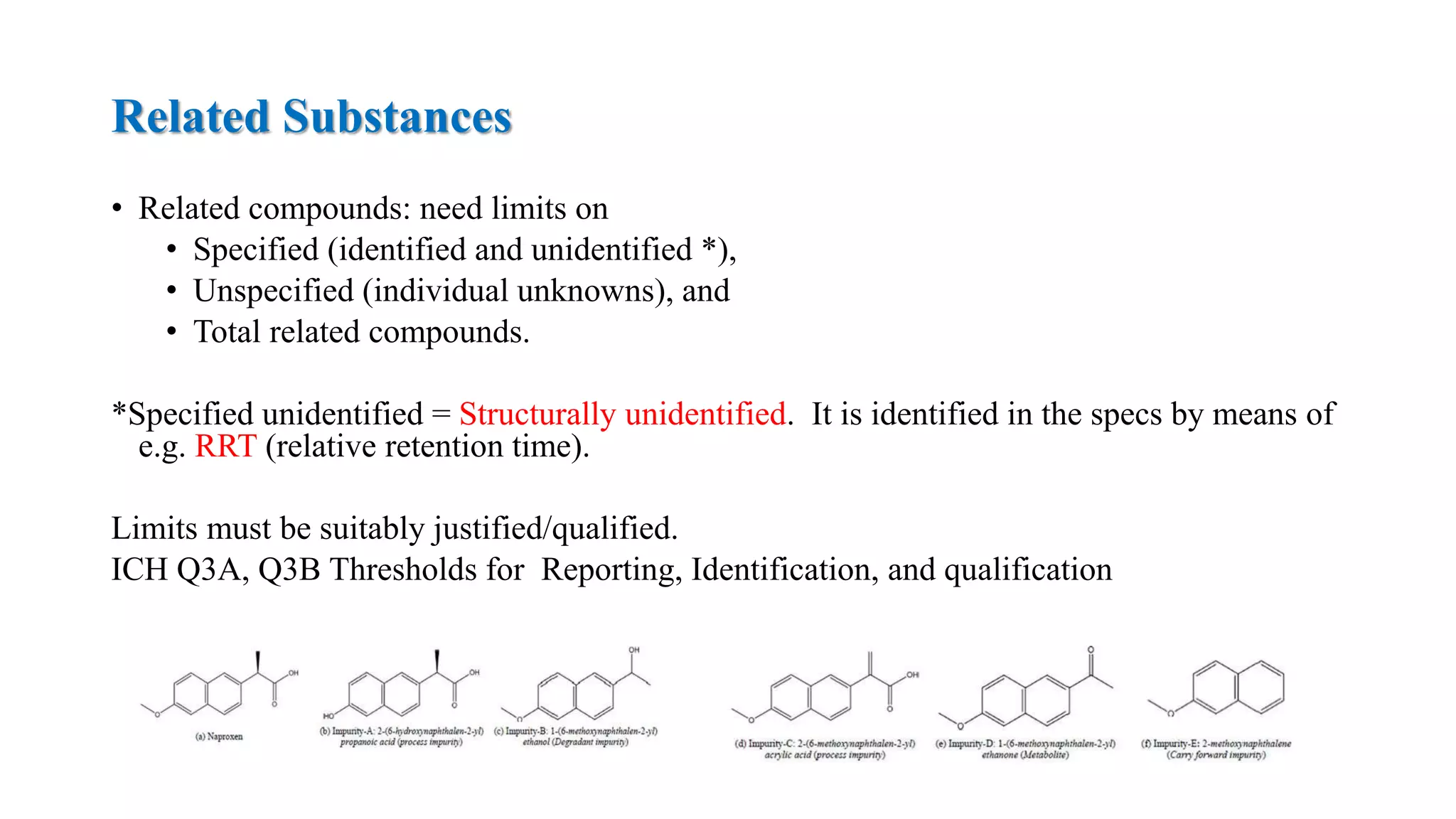
Related Substances
• Related compounds: need limits on
• Specified (identified and unidentified *),
• Unspecified (individual unknowns), and
• Total related compounds.
*Specified unidentified = Structurally unidentified. It is identified in the specs by means of
e.g. RRT (relative retention time).
Limits must be suitably justified/qualified.
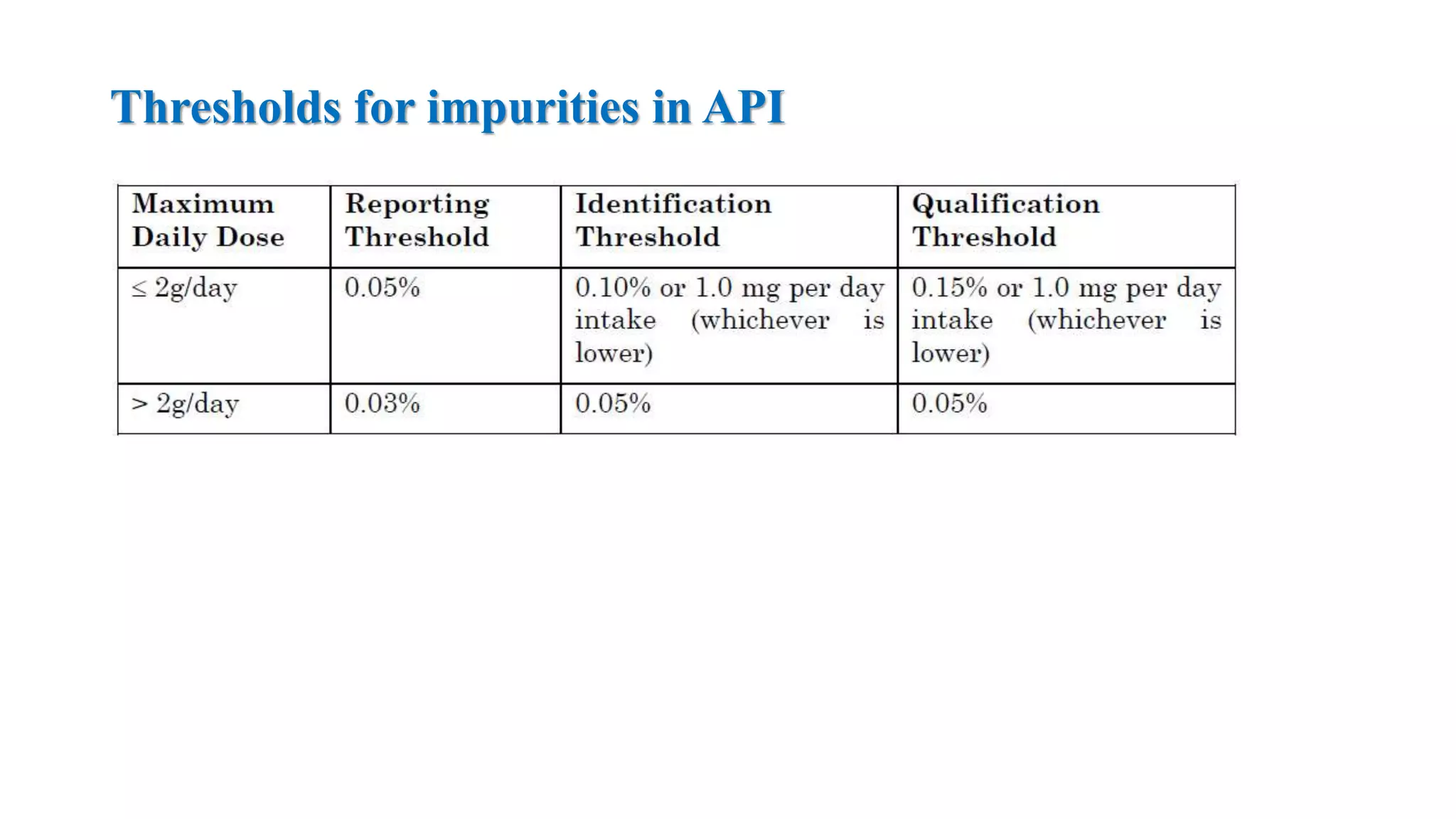
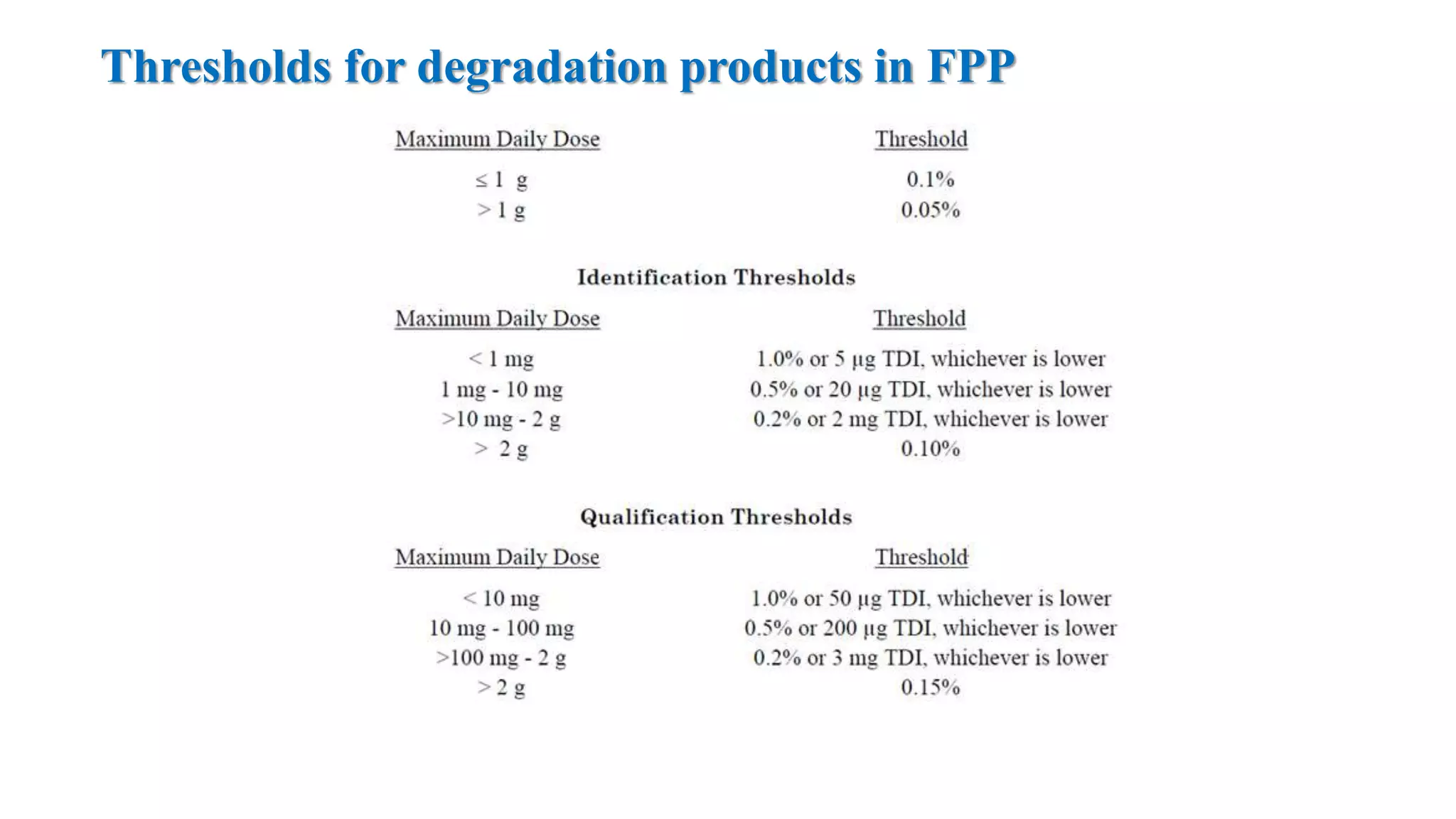
ICH Q3A, Q3B Thresholds for Reporting, Identification, and qualification
Thresholds for impurities in API
Thresholds for degradation products in FPP
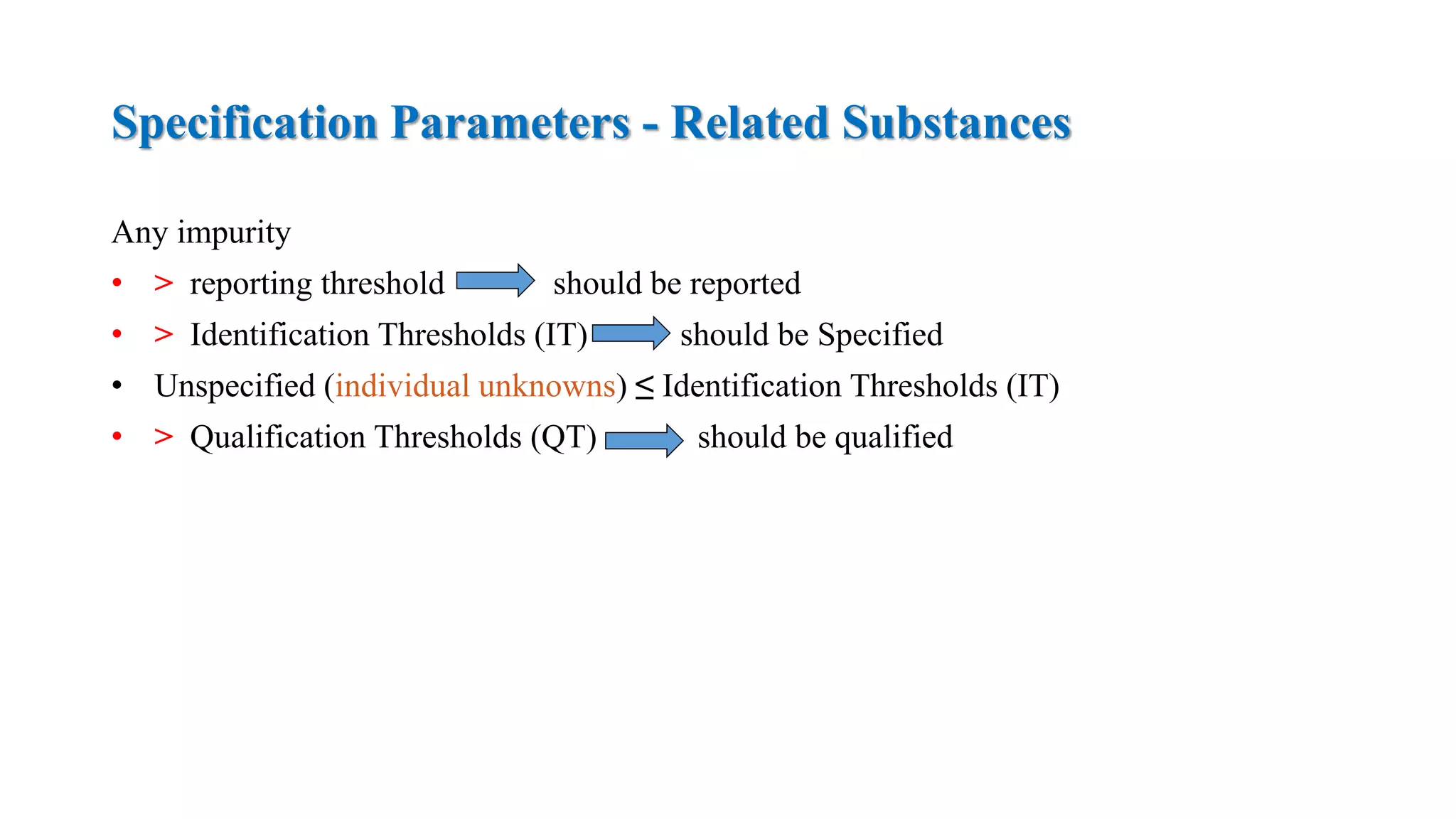
Specification Parameters - Related Substances
Any impurity
• > reporting threshold should be reported
• > Identification Thresholds (IT) should be Specified
• Unspecified (individual unknowns) ≤ Identification Thresholds (IT)
• > Qualification Thresholds (QT) should be qualified
Drug Substance: Specific tests/criteria
• Physico-chemical properties
• Particle size
• Polymorphic forms
• Tests for chiral new drug substances
• Water content
• Inorganic impurities
• Microbial limits
Physicochemical properties
These are properties such as
• pH of an aqueous solution,
• melting point/range, and
• refractive index.
• solubility
The procedures used for the measurement of these properties are usually unique and do not
need much elaboration.
Particle size
Significant effect on:
• Dissolution rate
• Bioavailability/Or stability
Required for drug substances intended for use in solid or suspension drug products,
Not required for drug substance is dissolved during manufacture and solution dosage form.
Polymorphic forms
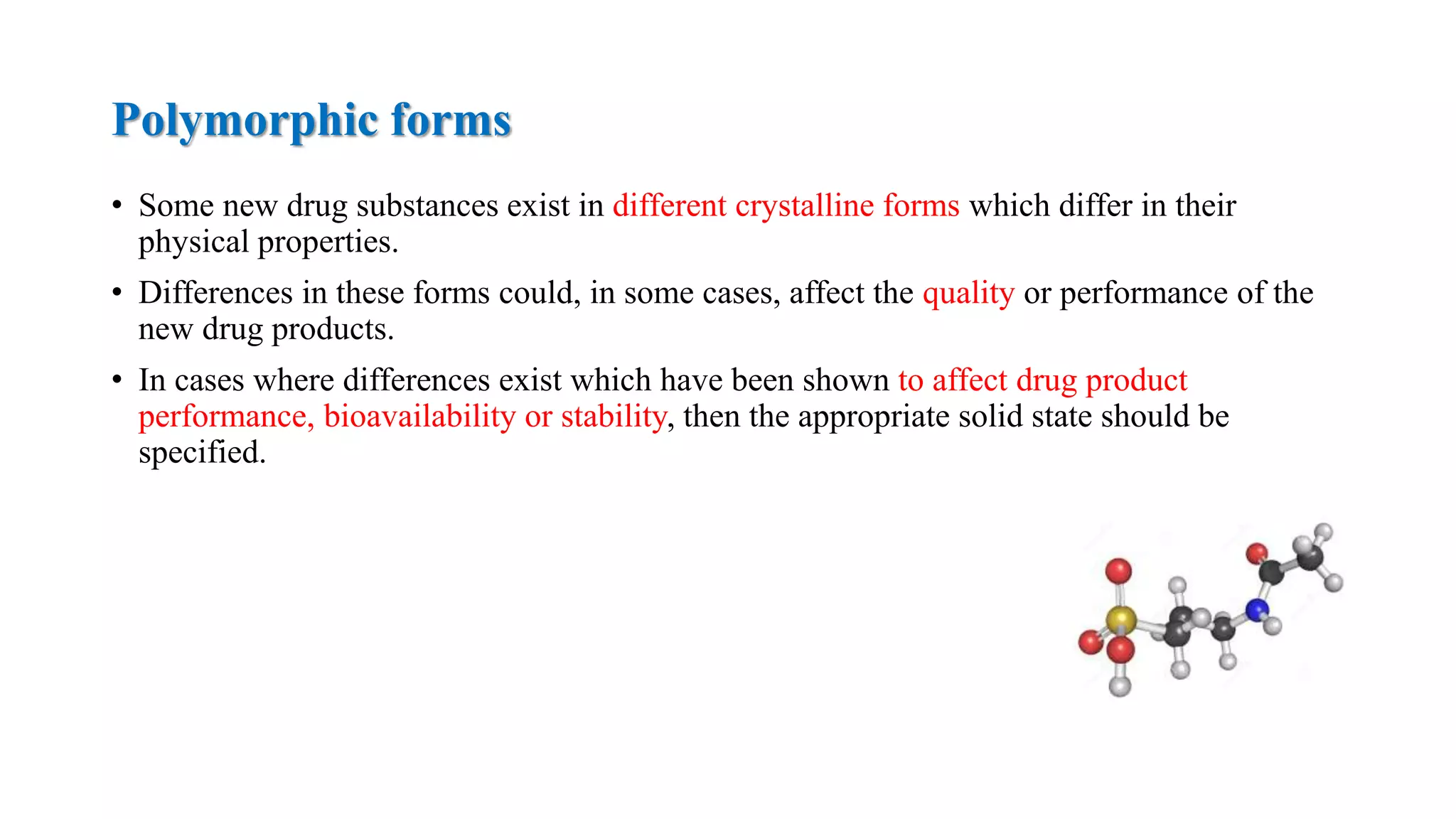
• Some new drug substances exist in different crystalline forms which differ in their
physical properties.
• Differences in these forms could, in some cases, affect the quality or performance of the
new drug products.
• In cases where differences exist which have been shown to affect drug product
performance, bioavailability or stability, then the appropriate solid state should be
specified.
Polymorphic forms
Analytical Techniques
• Melting point (including hot-stage microscopy),
• Solid state IR,
• X-ray powder diffraction,
• Thermal analysis procedures (like DSC, TGA and DTA),
• Raman spectroscopy,
• Optical microscopy, and
• Solid state NMR.
It is very difficult to measure polymorphic changes in drug products. A surrogate test, e.g.
dissolution, can generally be used to monitor product performance.
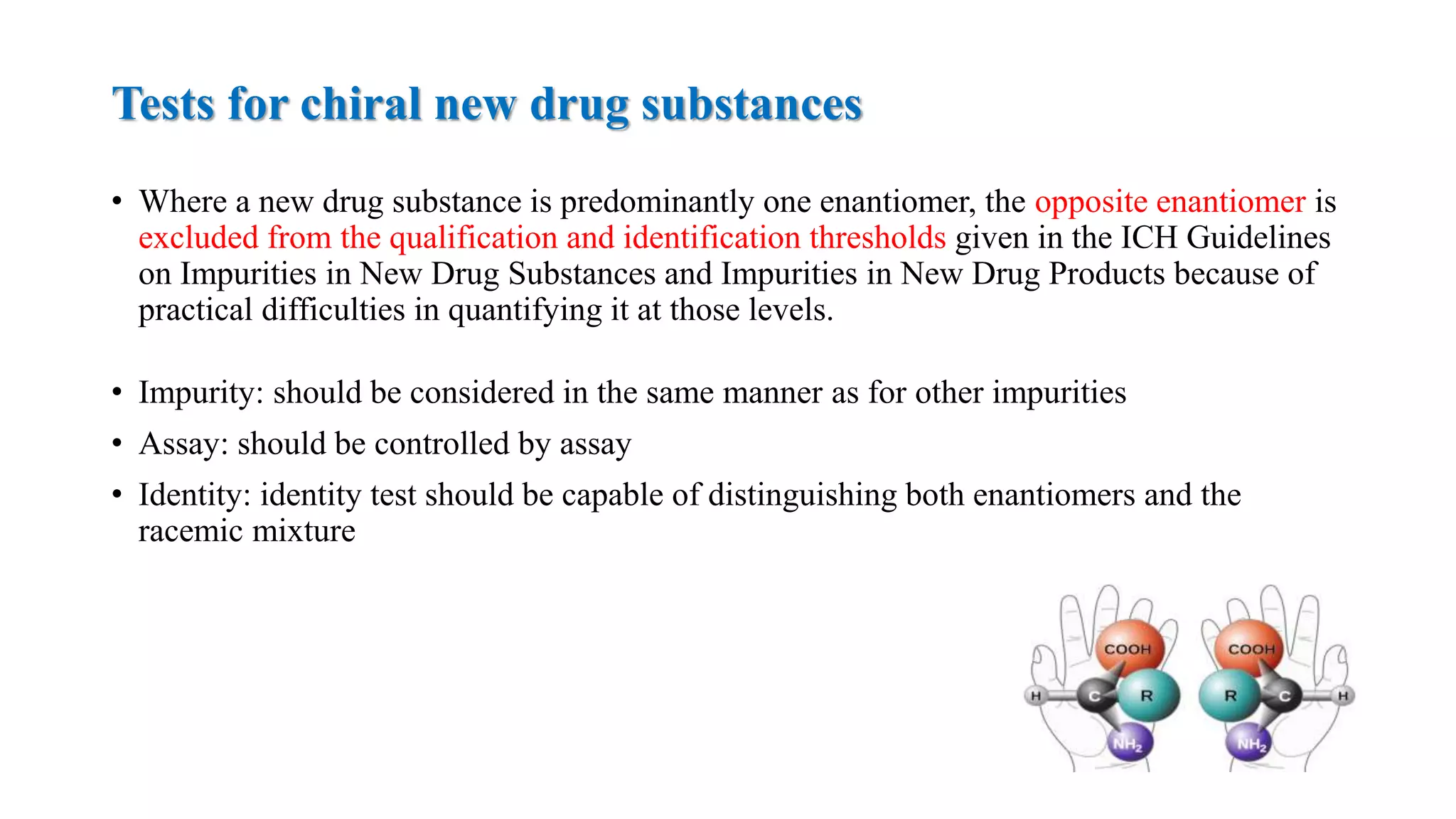
• Where a new drug substance is predominantly one enantiomer, the opposite enantiomer is
excluded from the qualification and identification thresholds given in the ICH Guidelines
on Impurities in New Drug Substances and Impurities in New Drug Products because of
practical difficulties in quantifying it at those levels.
• Impurity: should be considered in the same manner as for other impurities
• Assay: should be controlled by assay
• Identity: identity test should be capable of distinguishing both enantiomers and the
racemic mixture
Tests for chiral new drug substances
Water content
This test is important in cases where the new drug substance is known to be
• Hygroscopic or
• Degraded by moisture or
• When the drug substance is known to be a stoichiometric hydrate.
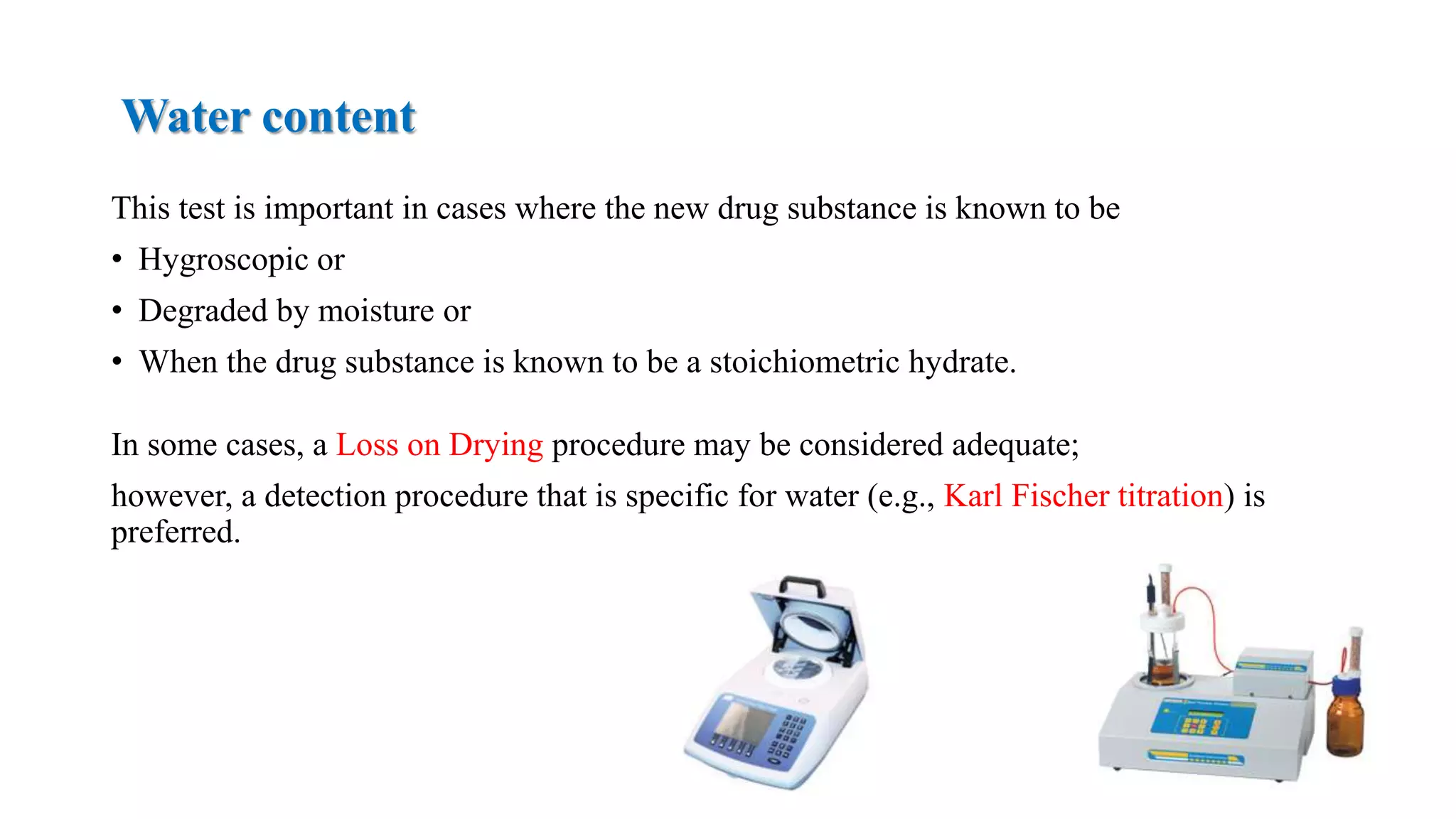
In some cases, a Loss on Drying procedure may be considered adequate;
however, a detection procedure that is specific for water (e.g., Karl Fischer titration) is
preferred.
Inorganic impurities
• The need for inclusion of tests and acceptance criteria for inorganic impurities (e.g.,
catalysts) should be studied during development and based on knowledge of the
manufacturing process.
• Procedures and acceptance criteria for sulfated ash / residue on ignition should follow
pharmacopoeial precedents; other inorganic impurities may be determined by other
appropriate procedures, e.g., atomic absorption spectroscopy.
Microbial limits
There may be a need to specify
• Total count of aerobic microorganisms,
• Total count of yeasts and molds, and
• Absence of specific objectionable bacteria (e.g., Staphylococcus aureus, Escherichia coli,
Salmonella, Pseudomonas aeruginosa).
• These should be suitably determined using pharmacopoeial procedures.
Drug Products: Specific tests/criteria
The specific dosage forms addressed include
• Solid orals,
• Liquid orals, and
• Parenterals (small and large volume).
Solid Oral Drug Products: Tablets (coated and uncoated)
and Hard capsules
• Dissolution,
• Disintegration
• Hardness/Friability
• Uniformity of dosage units
• Water content
• Microbial limits
Dissolution
• Single-point measurements are normally considered to be suitable for immediate-release
dosage forms.
• For modified-release dosage forms, appropriate test conditions and sampling procedures
should be established.
- multiple time point sampling should be performed for extended-release dosage forms
- two-stage testing (using different media in succession or in parallel, as appropriate)
may be appropriate for delayed-release dosage forms.
• For immediate-release drug products where changes in dissolution rate have been
demonstrated to significantly affect bioavailability
Dissolution
• Dissolution is considered product-specific. The method and limits should be appropriate
for the proposed product.
• Dissolution specs at release and shelf-life should be identical. It is useful to have the
parameters (medium, apparatus, speed) in specs.
• Some accepted specifications can be checked e.g. FDA site “Dissolution Methods for
Drug Products” www.accessdata.fda.gov/scripts/cder/dissolution/
• Surfactant use should be exceptional and appropriate.- not exceed 2% normally
Dissolution
• The limits should be expressed as “Q”, which also implies three stage testing as per
harmonized texts. Ideally the stages are expressed in the specs (i.e. S1 all individual
values  Q+5%)
• There should be a discussion if the time is > 45 minutes.
• For products containing water insoluble APIs, it is recommended to have a two tire
dissolution limit. For example Artemether dissolution: NLT 40% in 1 hour and NLT 60%
at the 3rd hour
Dissolution
• For considering accepting DT in place of dissolution: all the considerations should be
carefully assessed: highly soluble and very rapidly dissolving, plus significant supporting
development data – including
• justified by results of 5 batches
• when DT is more discriminating or
• has a demonstrated relationship to dissolution, robustness of the
formulation/manufacturing process have been demonstrated wrt DT, etc.
Dissolution
Additional considerations are required when there is a BCS-based biowaiver:
• BCS Class 1 (e.g. emtricitabine, stavudine, zidovudine, levofloxacin, ofloxacin): The
test and comparator products must be at least rapidly dissolving. (NLT 85% in 30
minutes)
• BCS Class 3 (e.g. abacavir sulfate, lamivudine, ethambutol, isoniazid,
pyrazinamide): The test and comparator products must be very rapidly dissolving (NLT
85% in 15 minutes).
• Dissolution limits must meet the biowaiver requirements.
Dissolution
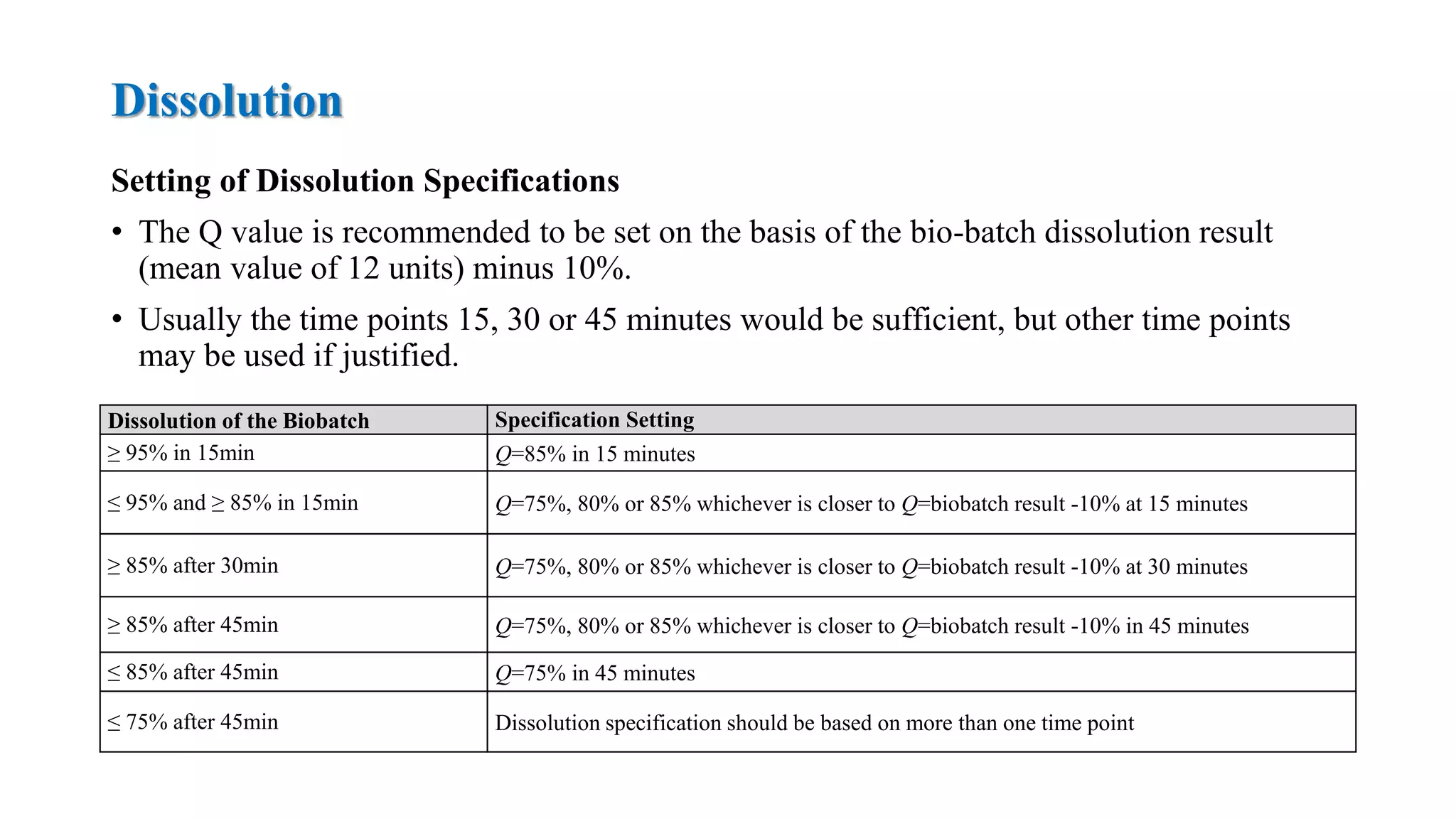
Setting of Dissolution Specifications
• The Q value is recommended to be set on the basis of the bio-batch dissolution result
(mean value of 12 units) minus 10%.
• Usually the time points 15, 30 or 45 minutes would be sufficient, but other time points
may be used if justified.
Dissolution of the Biobatch Specification Setting
≥ 95% in 15min Q=85% in 15 minutes
≤ 95% and ≥ 85% in 15min Q=75%, 80% or 85% whichever is closer to Q=biobatch result -10% at 15 minutes
≥ 85% after 30min Q=75%, 80% or 85% whichever is closer to Q=biobatch result -10% at 30 minutes
≥ 85% after 45min Q=75%, 80% or 85% whichever is closer to Q=biobatch result -10% in 45 minutes
≤ 85% after 45min Q=75% in 45 minutes
≤ 75% after 45min Dissolution specification should be based on more than one time point
Disintegration
• For rapidly dissolving (dissolution >80% in 15 minutes at pH 1.2, 4.0 and 6.8) products
containing drugs which are highly soluble throughout the physiological range
(dose/solubility volume < 250 mL from pH 1.2 to 6.8), disintegration may be substituted
for dissolution.
Un coated tablet NMT 15 min, in water with disc 37 °C ± 2°C
Coated tablet NMT 30 min, in water with disc for film coated tab, and
NMT 60 min, other than film coated tablet
Enteric coated tab Intact for 1 hr in 0.1 N HCl & disintegrate within 2 hr in mixed 6.8 phosphate
buffer.
According to USP 1 hr in simulated gastric fluid, then in simulated intestinal fluid.
Dispersible/soluble Within 3 min in water at 25°C ±1°C (IP)
15-25°C (BP)
Orodispersible Within 1 min
Effervescent tab 5 min in 250 ml water at 20 – 30 °C (IP)
5 min in 200 ml water at 15 – 25 °C (BP)
Buccal & sublingual Not applicable but dissolve within 15 – 30 min
Hardness/Friability
• It is normally appropriate to perform hardness and/or friability testing as an in-process
control. Under these circumstances, it is normally not necessary to include these attributes
in the specification.
• Chewable tablets: acceptance criteria should be included in the specification.
• Friability limit is NMT 1 %
Uniformity of dosage units
• This term includes both the mass of the dosage form and the content of the active
substance in the dosage form;
• A pharmacopoeial procedure should be used.
• In general, the specification should include one or the other but not both.
• If appropriate, these tests may be performed in-process;
• The acceptance criteria should be included in the specification.
A test and limit for weight variation may be established in lieu of content uniformity testing;
- For tablets - For capsules
IP/BP Limit USP
80 mg or less 10 % 130 mg or less
80 mg – 250 mg 7.5 % 130 mg – 324 mg
250 mg or more 5 % 324 mg or more
IP Limit
Less than 300 mg 10 %
300 mg or more 7.5 %
Water content
• A test for water content should be included when appropriate. The acceptance criteria may
be justified with data on the effects of hydration or water absorption on the drug product.
• In some cases, a Loss on Drying procedure may be considered adequate; however, a
detection procedure which is specific for water (e.g., Karl Fischer titration) is preferred.
Microbial limits
Acceptance criteria should be set for
• Total count of aerobic microorganisms,
• Total count of yeasts and molds, and
• Absence of specific objectionable bacteria (e.g., Staphylococcus aureus, Escherichia coli,
Salmonella, Pseudomonas aeruginosa).
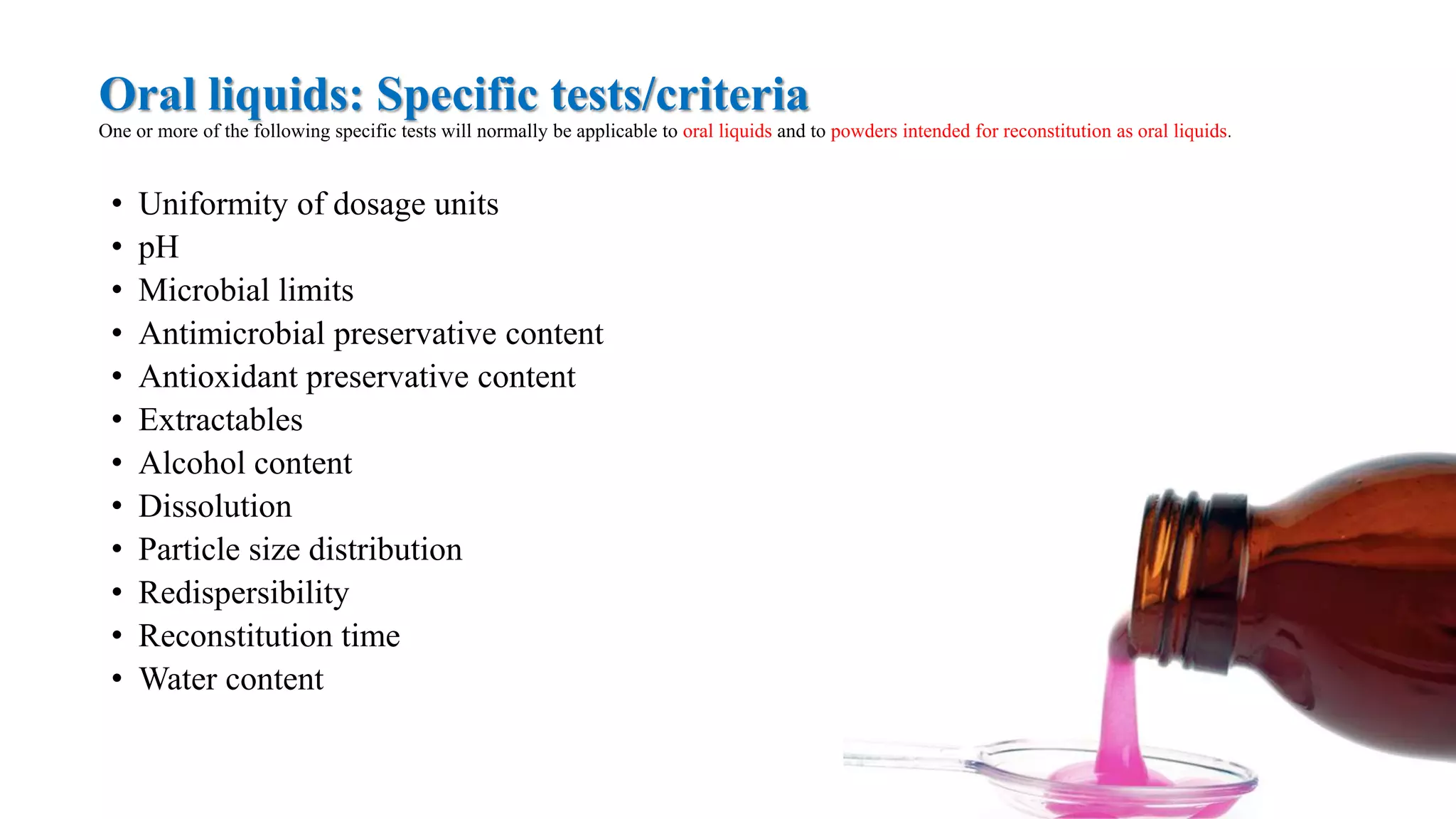
Oral liquids: Specific tests/criteria
One or more of the following specific tests will normally be applicable to oral liquids and to powders intended for reconstitution as oral liquids.
• Uniformity of dosage units
• pH
• Microbial limits
• Antimicrobial preservative content
• Antioxidant preservative content
• Extractables
• Alcohol content
• Dissolution
• Particle size distribution
• Redispersibility
• Reconstitution time
• Water content
Uniformity of dosage units
• Content uniformity
• Mass uniformity
pH
• Acceptance criteria where applicable and proposed range justified.
Microbial limits
• TAMC,
• TYMC,
• Specified micro organism
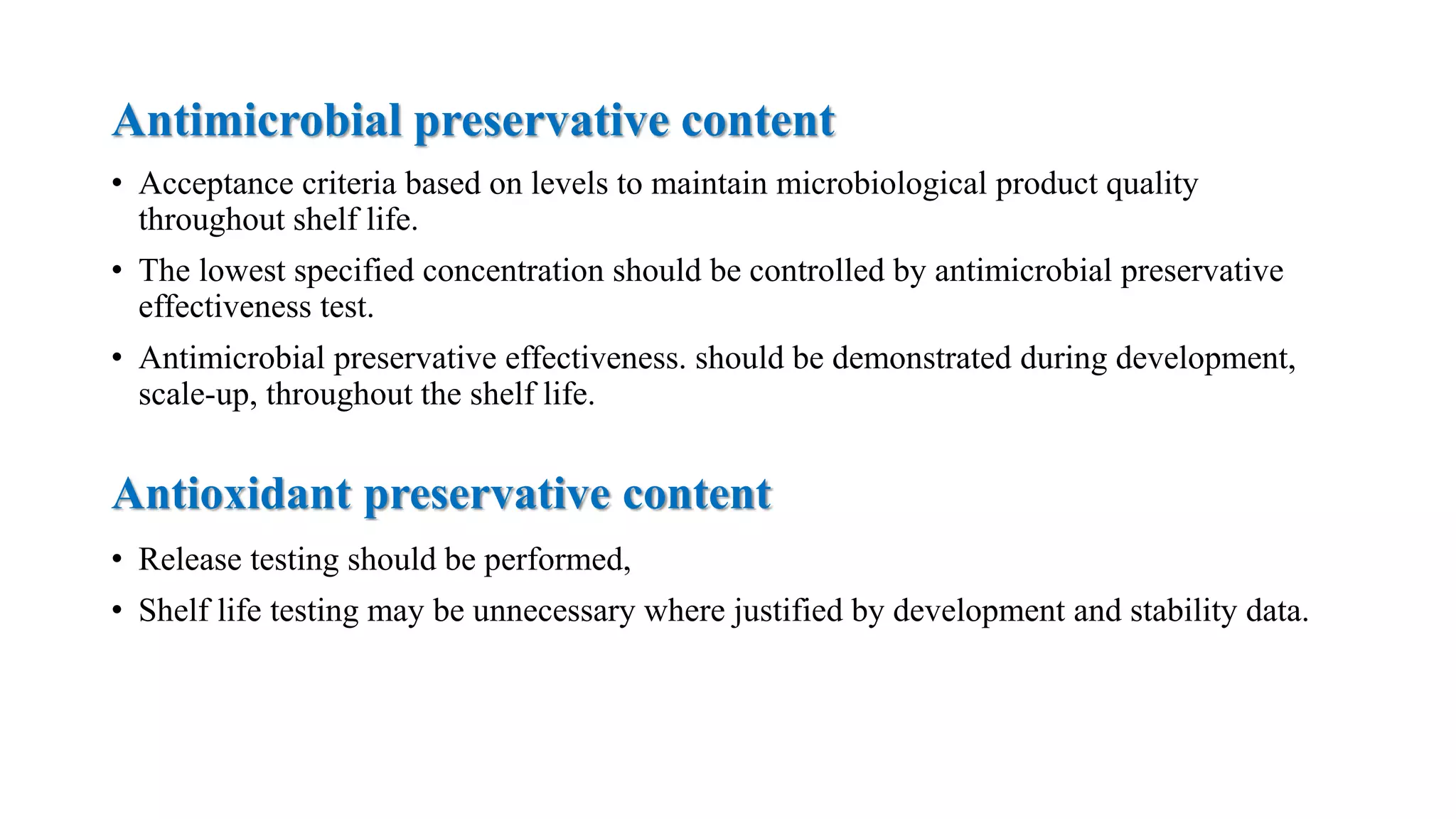
Antimicrobial preservative content
Antioxidant preservative content
• Acceptance criteria based on levels to maintain microbiological product quality
throughout shelf life.
• The lowest specified concentration should be controlled by antimicrobial preservative
effectiveness test.
• Antimicrobial preservative effectiveness. should be demonstrated during development,
scale-up, throughout the shelf life.
• Release testing should be performed,
• Shelf life testing may be unnecessary where justified by development and stability data.
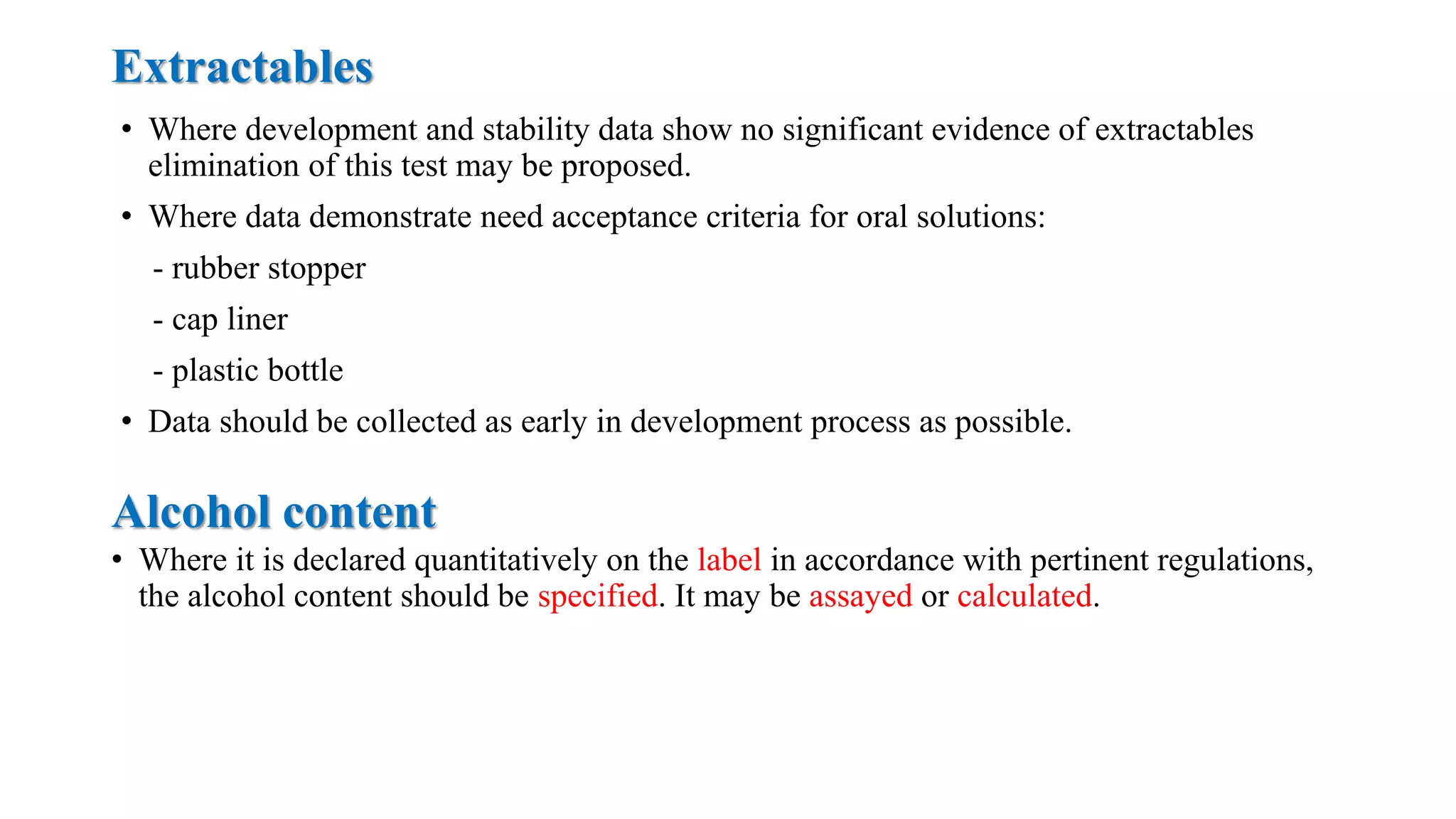
Extractables
• Where development and stability data show no significant evidence of extractables
elimination of this test may be proposed.
• Where data demonstrate need acceptance criteria for oral solutions:
- rubber stopper
- cap liner
- plastic bottle
• Data should be collected as early in development process as possible.
Alcohol content
• Where it is declared quantitatively on the label in accordance with pertinent regulations,
the alcohol content should be specified. It may be assayed or calculated.
Dissolution
• It may be appropriate for insoluble drug substance
• Single-point measurements - Immediate-release dosage forms
• Multiple-point measurements - Modified-release dosage forms
Particle size distribution
• PSD may be appropriate for oral suspensions
• Developmental data should be considered for either a dissolution procedure or a particle
size distribution procedure for these formulations
• Particle size distribution testing may also be proposed in place of dissolution testing,
justification should be provided.
• Mean, upper and/or lower particle size limits should be well defined.
Redispersibility
• For oral suspensions which settle on storage (produce
sediment), acceptance criteria for redispersibility may be
appropriate. Shaking may be an appropriate procedure.
Reological properties
• For relatively viscous solutions or suspensions, it may be appropriate to include rheological
properties (viscosity/specific gravity) in the specification.
Reconstitution time
• should be provided for dry powder
products which require reconstitution
• The choice of diluent should be justified
• R#R#R: Data generated during product development may be sufficient to justify skip lot testing,
or elimination of this attribute from the specification may be proposed.
Water content
• For oral products requiring reconstitution
• Loss on drying is generally considered sufficient
• In certain cases a more specific procedure (e.g., Karl Fischer titration) may be preferable.
Parenteral Drug Products: specific tests/criteria
• Uniformity of dosage units
• pH
• Sterility
• Endotoxins/Pyrogens
• Particulate matter
• Water content
• Antimicrobial preservative content
• Antioxidant preservative content
• Extractables
• Functionality testing of delivery systems
• Osmolarity
• Particle size distribution
• Redispersibility
• Reconstitution time
Uniformity of dosage units: as discussed in Oral liquids
pH: as discussed in Oral liquids
Sterility:
• This approach may be proposed for terminally sterilized drug products
• Data generated during development and validation
Endotoxins/Pyrogens:
• Endotoxins-using a procedure such as the limulus amoebocyte lysate test (LAL test)
• Pyrogenicity testing may be proposed as an alternative to endotoxin testing where
justified
Particulate matter:
• Limits for visible particulates (foreign matter) and / or clarity of solution, as well as for
sub-visible particulates as appropriate.
Water content:
• For non-aqueous parenterals, and for parenteral products for reconstitution
• Loss on drying is generally considered sufficient
• In certain cases a more specific procedure (e.g., Karl Fischer titration) may be preferable.
Antimicrobial preservative content: as discussed in Oral liquids
Antioxidant preservative content: as discussed in Oral liquids
Extractables:
• More important for parenteral products than for oral liquids
• where development and stability data show evidence that extractables are consistently below the
levels that are demonstrated to be acceptable and safe, elimination of this test can normally be
accepted.
Functionality testing of delivery systems:
• For pre-filled syringes, autoinjector cartridges, or the equivalent
• These may include control of syringeability, pressure, and seal integrity (leakage), and/or
parameters such as tip cap removal force, piston release force, piston travel force, and
power injector function force.
• Skip test applicable, if justified.
Osmolarity:
• When the tonicity of a product is declared in its labeling, appropriate control of its
osmolarity should be performed.
• Skip test applicable, if justified.
Particle size distribution: as discussed in Oral liquids
Redispersibility: as discussed in Oral liquids
Reconstitution time: as discussed in Oral liquids
ICH Q6A Specifications by Chandra Mohan

ICH Q6A Specifications by Chandra Mohan

  • 1.
  • 2.
    Introduction Objective Scope General Concepts Guidelines Specifications: Definitionand Justification Universal tests Specific tests  Drug Substance  Drug Product - Solid orals - Oral liquids - Parenterals
  • 3.
    Objective of theguideline • Establishment of a single set of global specifications for new drug substances and products. • Guidance on the setting and justification of acceptance criteria and the selection of test procedures.
  • 4.
    Scope of theguideline The quality of drug substances and products is determined by their: • Design • Development • In-process controls • GMP controls • Process validation • Specifications applied to them throughout development and manufacture. The guideline addresses specifications, e.g. those tests, procedures and acceptance criteria used to assure the quality at release and during shelf life. The guideline addresses only the marketing approval of new drug products but not the clinical research stages of drug development.
  • 5.
    This guidelines providesacceptance criteria: • Universal acceptance criteria established for all drug substances and products, • Specific to individual drug substance and/or dosage forms. The guideline covers: • Solid dosage forms • Liquid dosage forms • Parenterals (small and large volume). Scope of the Guideline…
  • 6.
    General Concepts • Periodicor Skip Testing • Release vs. Shelf-life Acceptance Criteria • In-process Tests • Design and Development Considerations • Limited Data Available at Filing • Parametric Release • Alternative Procedures • Pharmacopoeial Tests and Acceptance Criteria • Evolving Technologies • Impact of Drug Substance on Drug Product Specifications • Reference Standard
  • 7.
    General Concepts… • Theseconcepts are important in the development and setting of harmonized specifications. • They are not universally applicable, but each should be considered in particular circumstances. • This guideline presents a brief definition of each concept and an indication of the circumstances under which it may be applicable. • Generally, proposals to implement these concepts should be justified by the applicant and approved by the appropriate regulatory authority before being put into effect.
  • 8.
    Periodic or SkipTesting Performance of specified tests at release on pre-selected batches and/or at predetermined intervals. This less than full schedule of testing should be justified and presented to the regulatory authority prior to implementation. Examples for solid dosage forms: • Residual solvents • Microbiological testing.
  • 9.
    Periodic or SkipTesting… • If justified, skip test parameters should be in the specs: At minimum every 10th batch, at least one batch annually • In all cases, the API or FPP should meet the full specifications if tested • This concept may be implemented post approval in accordance with GMP, if sufficient data are available. E.g test results taken from the API manufacturer's COA
  • 10.
    Release vs. Shelf-lifeAcceptance Criteria • Applicable only to drug products. • More restrictive criteria for release than for shelf life - Assay - Impurity (degradation products). • Dissolution specs at release and shelf-life should be identical • In USA and Japan release specifications only in-house criteria, in the EU regulatory requirements for distinct specifications for release and for shelf life.
  • 11.
    In-process Tests • In-processtests which are used for the purpose of adjusting process parameters within an operating range, e.g. hardness, friability of coated tablets and individual tablet weights, are not included in the specifications. • Test conducted during manufacturing process where acceptance criteria is identical or tighter than release requirements, e.g. pH of solution may be used to satisfy specification requirements when the test is included in the specification. • However, this approach should be validated to show that test results or product performance characteristics do not change from the in-process stage to finished product.
  • 12.
    Design and DevelopmentConsiderations • The experience and data accumulated during the development of a new drug substance or product should form the basis for setting specifications. • It may be possible to propose excluding or replacing certain tests on this basis: - Microbiological testing for drug substances and solid dosage forms not show support for microbial viability or growth. - Extractables from product containers. No extractable found or levels met accepted standard for safety. - Particle size: may be performed as an in-process test, or as a release test, depending on its relevance to product performance; - Dissolution testing versus disintegration testing for immediate release solid oral drug products.
  • 13.
    Limited Data Availableat Filing • Limited amount of data may be available at the time of filing, which can influence the process of setting acceptance criteria. • As a result it may be necessary to propose revised acceptance criteria as additional experience is gained with the manufacture of a particular drug substance or drug product (example: acceptance limits for a specific impurity). Parametric release • Can be used as an operational alternative to routine release testing • Eg. Sterility testing based on monitoring temperature, pressure and time during terminal sterilisation phase. If parametric release is performed, the attribute which is indirectly controlled, e.g. sterility, together with a reference to the associated test procedure should be included in the specifications. • It is important to note that the sterilization process should be adequately validated before parametric release is proposed
  • 14.
    Alternative Procedures Alternative proceduresor those which may be used if comparable or superior to the official procedure. Examples: • Tablets no degradation during manufacture, spectrophotometric procedure for release instead of chromatographic. • Chromatographic procedure used to demonstrate compliance with acceptance criteria during shelf life. • Valiadation – full validation required for in-house methods • Verification – required for compendial methods • Equivalency – required for in-house methods, when compendial standard is claimed
  • 15.
    Pharmacopoeial tests andacceptance criteria • References to certain procedures are found in pharmacopoeias in each region. Whenever appropriate pharmacopoeial methods should be utilised. • A harmonised specification is possible only, if the procedure and acceptance criteria defined are acceptable to regulatory authorities in all regions. • To signify the harmonised status of these procedure, the pharmacopoeias have agreed to include a statement in their respective texts which indicates that the procedure and the acceptance criteria from all three pharmacopoeias are considered to be equivalent and are therefore interchangeable.
  • 16.
    Evolving Technologies • Newanalytical technologies, and modifications to existing technology, are continually being developed. Such technologies should be used when they are considered to offer additional assurance of quality, or are otherwise justified. Impact of Drug Substance on Drug Product Specifications • Not necessary to test drug product for synthesis impurities which are controlled in the drug substance and are not degradation products. Related substances Drug substance Drug product imp. A imp. B imp. C imp. D imp. E Any unspecified impurity Total impurities Any unspecified impurity Total impurities
  • 17.
    Reference Standard Reference standardis substance prepared for use as standard for • Assay • Identification • Purity test. Substance either • The new drug substance • or a known impurity. Quality appropriate to its use. Purity should be measured by a quantitative procedure.
  • 18.
    GUIDELINES Definition of Specifications Aspecification is defined as a • List of tests, • references to analytical procedures, • appropriate acceptance criteria. In addition a specification may list • in-process tests • periodic (skip) tests • other tests not conducted on a batch to batch basis. Specifications are binding quality standards. • Applicant should specify, which tests are done routinely, which not, justification. • Specification changes after approval may need prior approval by regulatory authority.
  • 19.
    Justification of Specifications Justificationrequired for • Each procedure, • Each acceptance criterion included in the specification. Justification should refer to: • Relevant development data, • Pharmacopoeial standards, • Test data of batches used in toxicology and clinical studies, • Results from accelerated and long term stability studies, • Reasonable range of expected analytical and manufacturing variability. Setting and justifying specifications by • Batches from: - Primary stability, - Scale-up, - Validation.
  • 20.
    Universal tests/criteria For bothAPI and FPP • Description • Identification • Assay • Impurities
  • 21.
    Description API: Qualitative statement:colour, state (e.g. solid, liquid) FP: Qualitative description: colour, shape, coating, markings (score, ink, embossing) Taste is critical (especially paediatrics): dispersible, sublingual/buccal, soluble, effervescent, and chewable tablets, and powders & granules for dispersion/solution or to be used as sprinkles. If changes during storage, change should be investigated and appropriate action taken.
  • 22.
    Identification • Identification shouldbe specific to the API, i.e. should be able to discriminate between compounds of closely related structure (Q6A) - IR spectroscopy for API, not always applicable to FPP • A single HPLC retention time is not regarded as being specific. Two chromatographic procedures, where the separation is based on different principles (HPLC + TLC) , or combination of tests into a single procedure is generally acceptable, such as HPLC/UV diode array, HPLC/MS, or GC/MS. (Q6A)
  • 23.
    Assay • Assay: shouldbe stability indicating. May be non-specific, e.g. titration, but need to achieve overall specificity, e.g. non-specific assay plus suitable related substances test. • The assay in the release specifications of FPP is ± 5% of the label claim (i.e. 95.0- 105.0%)..
  • 24.
    Related Substances • Relatedcompounds: need limits on • Specified (identified and unidentified *), • Unspecified (individual unknowns), and • Total related compounds. *Specified unidentified = Structurally unidentified. It is identified in the specs by means of e.g. RRT (relative retention time). Limits must be suitably justified/qualified. ICH Q3A, Q3B Thresholds for Reporting, Identification, and qualification
  • 25.
  • 26.
  • 27.
    Specification Parameters -Related Substances Any impurity • > reporting threshold should be reported • > Identification Thresholds (IT) should be Specified • Unspecified (individual unknowns) ≤ Identification Thresholds (IT) • > Qualification Thresholds (QT) should be qualified
  • 28.
    Drug Substance: Specifictests/criteria • Physico-chemical properties • Particle size • Polymorphic forms • Tests for chiral new drug substances • Water content • Inorganic impurities • Microbial limits
  • 29.
    Physicochemical properties These areproperties such as • pH of an aqueous solution, • melting point/range, and • refractive index. • solubility The procedures used for the measurement of these properties are usually unique and do not need much elaboration.
  • 30.
    Particle size Significant effecton: • Dissolution rate • Bioavailability/Or stability Required for drug substances intended for use in solid or suspension drug products, Not required for drug substance is dissolved during manufacture and solution dosage form.
  • 31.
    Polymorphic forms • Somenew drug substances exist in different crystalline forms which differ in their physical properties. • Differences in these forms could, in some cases, affect the quality or performance of the new drug products. • In cases where differences exist which have been shown to affect drug product performance, bioavailability or stability, then the appropriate solid state should be specified.
  • 32.
    Polymorphic forms Analytical Techniques •Melting point (including hot-stage microscopy), • Solid state IR, • X-ray powder diffraction, • Thermal analysis procedures (like DSC, TGA and DTA), • Raman spectroscopy, • Optical microscopy, and • Solid state NMR. It is very difficult to measure polymorphic changes in drug products. A surrogate test, e.g. dissolution, can generally be used to monitor product performance.
  • 33.
    • Where anew drug substance is predominantly one enantiomer, the opposite enantiomer is excluded from the qualification and identification thresholds given in the ICH Guidelines on Impurities in New Drug Substances and Impurities in New Drug Products because of practical difficulties in quantifying it at those levels. • Impurity: should be considered in the same manner as for other impurities • Assay: should be controlled by assay • Identity: identity test should be capable of distinguishing both enantiomers and the racemic mixture Tests for chiral new drug substances
  • 34.
    Water content This testis important in cases where the new drug substance is known to be • Hygroscopic or • Degraded by moisture or • When the drug substance is known to be a stoichiometric hydrate. In some cases, a Loss on Drying procedure may be considered adequate; however, a detection procedure that is specific for water (e.g., Karl Fischer titration) is preferred.
  • 35.
    Inorganic impurities • Theneed for inclusion of tests and acceptance criteria for inorganic impurities (e.g., catalysts) should be studied during development and based on knowledge of the manufacturing process. • Procedures and acceptance criteria for sulfated ash / residue on ignition should follow pharmacopoeial precedents; other inorganic impurities may be determined by other appropriate procedures, e.g., atomic absorption spectroscopy.
  • 36.
    Microbial limits There maybe a need to specify • Total count of aerobic microorganisms, • Total count of yeasts and molds, and • Absence of specific objectionable bacteria (e.g., Staphylococcus aureus, Escherichia coli, Salmonella, Pseudomonas aeruginosa). • These should be suitably determined using pharmacopoeial procedures.
  • 37.
    Drug Products: Specifictests/criteria The specific dosage forms addressed include • Solid orals, • Liquid orals, and • Parenterals (small and large volume).
  • 38.
    Solid Oral DrugProducts: Tablets (coated and uncoated) and Hard capsules • Dissolution, • Disintegration • Hardness/Friability • Uniformity of dosage units • Water content • Microbial limits
  • 39.
    Dissolution • Single-point measurementsare normally considered to be suitable for immediate-release dosage forms. • For modified-release dosage forms, appropriate test conditions and sampling procedures should be established. - multiple time point sampling should be performed for extended-release dosage forms - two-stage testing (using different media in succession or in parallel, as appropriate) may be appropriate for delayed-release dosage forms. • For immediate-release drug products where changes in dissolution rate have been demonstrated to significantly affect bioavailability
  • 40.
    Dissolution • Dissolution isconsidered product-specific. The method and limits should be appropriate for the proposed product. • Dissolution specs at release and shelf-life should be identical. It is useful to have the parameters (medium, apparatus, speed) in specs. • Some accepted specifications can be checked e.g. FDA site “Dissolution Methods for Drug Products” www.accessdata.fda.gov/scripts/cder/dissolution/ • Surfactant use should be exceptional and appropriate.- not exceed 2% normally
  • 41.
    Dissolution • The limitsshould be expressed as “Q”, which also implies three stage testing as per harmonized texts. Ideally the stages are expressed in the specs (i.e. S1 all individual values  Q+5%) • There should be a discussion if the time is > 45 minutes. • For products containing water insoluble APIs, it is recommended to have a two tire dissolution limit. For example Artemether dissolution: NLT 40% in 1 hour and NLT 60% at the 3rd hour
  • 42.
    Dissolution • For consideringaccepting DT in place of dissolution: all the considerations should be carefully assessed: highly soluble and very rapidly dissolving, plus significant supporting development data – including • justified by results of 5 batches • when DT is more discriminating or • has a demonstrated relationship to dissolution, robustness of the formulation/manufacturing process have been demonstrated wrt DT, etc.
  • 43.
    Dissolution Additional considerations arerequired when there is a BCS-based biowaiver: • BCS Class 1 (e.g. emtricitabine, stavudine, zidovudine, levofloxacin, ofloxacin): The test and comparator products must be at least rapidly dissolving. (NLT 85% in 30 minutes) • BCS Class 3 (e.g. abacavir sulfate, lamivudine, ethambutol, isoniazid, pyrazinamide): The test and comparator products must be very rapidly dissolving (NLT 85% in 15 minutes). • Dissolution limits must meet the biowaiver requirements.
  • 44.
    Dissolution Setting of DissolutionSpecifications • The Q value is recommended to be set on the basis of the bio-batch dissolution result (mean value of 12 units) minus 10%. • Usually the time points 15, 30 or 45 minutes would be sufficient, but other time points may be used if justified. Dissolution of the Biobatch Specification Setting ≥ 95% in 15min Q=85% in 15 minutes ≤ 95% and ≥ 85% in 15min Q=75%, 80% or 85% whichever is closer to Q=biobatch result -10% at 15 minutes ≥ 85% after 30min Q=75%, 80% or 85% whichever is closer to Q=biobatch result -10% at 30 minutes ≥ 85% after 45min Q=75%, 80% or 85% whichever is closer to Q=biobatch result -10% in 45 minutes ≤ 85% after 45min Q=75% in 45 minutes ≤ 75% after 45min Dissolution specification should be based on more than one time point
  • 45.
    Disintegration • For rapidlydissolving (dissolution >80% in 15 minutes at pH 1.2, 4.0 and 6.8) products containing drugs which are highly soluble throughout the physiological range (dose/solubility volume < 250 mL from pH 1.2 to 6.8), disintegration may be substituted for dissolution. Un coated tablet NMT 15 min, in water with disc 37 °C ± 2°C Coated tablet NMT 30 min, in water with disc for film coated tab, and NMT 60 min, other than film coated tablet Enteric coated tab Intact for 1 hr in 0.1 N HCl & disintegrate within 2 hr in mixed 6.8 phosphate buffer. According to USP 1 hr in simulated gastric fluid, then in simulated intestinal fluid. Dispersible/soluble Within 3 min in water at 25°C ±1°C (IP) 15-25°C (BP) Orodispersible Within 1 min Effervescent tab 5 min in 250 ml water at 20 – 30 °C (IP) 5 min in 200 ml water at 15 – 25 °C (BP) Buccal & sublingual Not applicable but dissolve within 15 – 30 min
  • 46.
    Hardness/Friability • It isnormally appropriate to perform hardness and/or friability testing as an in-process control. Under these circumstances, it is normally not necessary to include these attributes in the specification. • Chewable tablets: acceptance criteria should be included in the specification. • Friability limit is NMT 1 %
  • 47.
    Uniformity of dosageunits • This term includes both the mass of the dosage form and the content of the active substance in the dosage form; • A pharmacopoeial procedure should be used. • In general, the specification should include one or the other but not both. • If appropriate, these tests may be performed in-process; • The acceptance criteria should be included in the specification. A test and limit for weight variation may be established in lieu of content uniformity testing; - For tablets - For capsules IP/BP Limit USP 80 mg or less 10 % 130 mg or less 80 mg – 250 mg 7.5 % 130 mg – 324 mg 250 mg or more 5 % 324 mg or more IP Limit Less than 300 mg 10 % 300 mg or more 7.5 %
  • 48.
    Water content • Atest for water content should be included when appropriate. The acceptance criteria may be justified with data on the effects of hydration or water absorption on the drug product. • In some cases, a Loss on Drying procedure may be considered adequate; however, a detection procedure which is specific for water (e.g., Karl Fischer titration) is preferred. Microbial limits Acceptance criteria should be set for • Total count of aerobic microorganisms, • Total count of yeasts and molds, and • Absence of specific objectionable bacteria (e.g., Staphylococcus aureus, Escherichia coli, Salmonella, Pseudomonas aeruginosa).
  • 49.
    Oral liquids: Specifictests/criteria One or more of the following specific tests will normally be applicable to oral liquids and to powders intended for reconstitution as oral liquids. • Uniformity of dosage units • pH • Microbial limits • Antimicrobial preservative content • Antioxidant preservative content • Extractables • Alcohol content • Dissolution • Particle size distribution • Redispersibility • Reconstitution time • Water content
  • 50.
    Uniformity of dosageunits • Content uniformity • Mass uniformity pH • Acceptance criteria where applicable and proposed range justified. Microbial limits • TAMC, • TYMC, • Specified micro organism
  • 51.
    Antimicrobial preservative content Antioxidantpreservative content • Acceptance criteria based on levels to maintain microbiological product quality throughout shelf life. • The lowest specified concentration should be controlled by antimicrobial preservative effectiveness test. • Antimicrobial preservative effectiveness. should be demonstrated during development, scale-up, throughout the shelf life. • Release testing should be performed, • Shelf life testing may be unnecessary where justified by development and stability data.
  • 52.
    Extractables • Where developmentand stability data show no significant evidence of extractables elimination of this test may be proposed. • Where data demonstrate need acceptance criteria for oral solutions: - rubber stopper - cap liner - plastic bottle • Data should be collected as early in development process as possible. Alcohol content • Where it is declared quantitatively on the label in accordance with pertinent regulations, the alcohol content should be specified. It may be assayed or calculated.
  • 53.
    Dissolution • It maybe appropriate for insoluble drug substance • Single-point measurements - Immediate-release dosage forms • Multiple-point measurements - Modified-release dosage forms Particle size distribution • PSD may be appropriate for oral suspensions • Developmental data should be considered for either a dissolution procedure or a particle size distribution procedure for these formulations • Particle size distribution testing may also be proposed in place of dissolution testing, justification should be provided. • Mean, upper and/or lower particle size limits should be well defined.
  • 54.
    Redispersibility • For oralsuspensions which settle on storage (produce sediment), acceptance criteria for redispersibility may be appropriate. Shaking may be an appropriate procedure. Reological properties • For relatively viscous solutions or suspensions, it may be appropriate to include rheological properties (viscosity/specific gravity) in the specification. Reconstitution time • should be provided for dry powder products which require reconstitution • The choice of diluent should be justified • R#R#R: Data generated during product development may be sufficient to justify skip lot testing, or elimination of this attribute from the specification may be proposed.
  • 55.
    Water content • Fororal products requiring reconstitution • Loss on drying is generally considered sufficient • In certain cases a more specific procedure (e.g., Karl Fischer titration) may be preferable.
  • 56.
    Parenteral Drug Products:specific tests/criteria • Uniformity of dosage units • pH • Sterility • Endotoxins/Pyrogens • Particulate matter • Water content • Antimicrobial preservative content • Antioxidant preservative content • Extractables • Functionality testing of delivery systems • Osmolarity • Particle size distribution • Redispersibility • Reconstitution time
  • 57.
    Uniformity of dosageunits: as discussed in Oral liquids pH: as discussed in Oral liquids Sterility: • This approach may be proposed for terminally sterilized drug products • Data generated during development and validation Endotoxins/Pyrogens: • Endotoxins-using a procedure such as the limulus amoebocyte lysate test (LAL test) • Pyrogenicity testing may be proposed as an alternative to endotoxin testing where justified Particulate matter: • Limits for visible particulates (foreign matter) and / or clarity of solution, as well as for sub-visible particulates as appropriate.
  • 58.
    Water content: • Fornon-aqueous parenterals, and for parenteral products for reconstitution • Loss on drying is generally considered sufficient • In certain cases a more specific procedure (e.g., Karl Fischer titration) may be preferable. Antimicrobial preservative content: as discussed in Oral liquids Antioxidant preservative content: as discussed in Oral liquids Extractables: • More important for parenteral products than for oral liquids • where development and stability data show evidence that extractables are consistently below the levels that are demonstrated to be acceptable and safe, elimination of this test can normally be accepted.
  • 59.
    Functionality testing ofdelivery systems: • For pre-filled syringes, autoinjector cartridges, or the equivalent • These may include control of syringeability, pressure, and seal integrity (leakage), and/or parameters such as tip cap removal force, piston release force, piston travel force, and power injector function force. • Skip test applicable, if justified. Osmolarity: • When the tonicity of a product is declared in its labeling, appropriate control of its osmolarity should be performed. • Skip test applicable, if justified.
  • 60.
    Particle size distribution:as discussed in Oral liquids Redispersibility: as discussed in Oral liquids Reconstitution time: as discussed in Oral liquids